



Abstract
The four concepts that form the first tier of the title of this article—collaboration, empowerment, education, and action—are four crucial tenets of participatory action research (PAR). Over the past three decades, efforts to enhance English teaching as a foreign language have expanded significantly in Kazakhstan, as the government has advocated for English proficiency to improve the country's global competitiveness. Kazakhstan's Ministry of Education and Science regulations require teachers to teach English as the sole language of instruction. However, most English teachers in Kazakhstan, instead of adhering to the rule of teaching English monolingually, employ creative maladjustment and subversion by using their discretion to shift between languages during English lessons. This study aims to explore teachers’ practices of creative maladjustment and creative subversion and to utilize participatory action research (PAR) to empower teachers to set priorities for using translanguaging as a pedagogical strategy in teaching English as a foreign language (EFL). The findings indicated that teachers have practiced creative maladjustment and creative subversion in their teaching practices; they do not obey the Ministry's monolingual regulation and have been shifting between languages when teaching English, utilizing a translingual approach. Since teachers indicated empowerment in utilizing translanguaging as a pedagogical strategy in their classrooms, there is no going back to the obsolete practice of monolingual teaching. We recommend that the government rescind the rule of teaching English monolingually and institute professional development strategies that will introduce and develop translingual art-based procedures for teaching and learning English in Kazakhstan.
Keywords
Significance of English for Global Competitiveness in Kazakhstan
Kazakhstan is moving towards a multilingual society through the government's policy initiatives (Agbo & Pak, 2017; Zenkova & Khamitova, 2018; Zhetpisbayeva & Shelestova, 2015). Lately, a major government policy agenda in Kazakhstan's society is to acquire fluency in the Kazakh, Russian, and English languages, a policy that Kazakhstan's scholars dub “Trilingualism” (Agbo & Pak, 2017; Zenkova & Khamitova, 2018; Zhetpisbayeva & Shelestova, 2015). The government has been working to integrate educational institutions to achieve trilingualism (Zhetpisbayeva & Shelestova 2015). For higher education institutions in Kazakhstan, proficiency in the English language serves as a powerful benchmark for measuring the adequacy or inadequacy of these institutions in achieving ‘trilingualism’ and, consequently, global competitiveness (Agbo & Pak, 2017; Zenkova & Khamitova, 2018). Accordingly, over the past two decades, several universities have mandated the English language as the language of instruction in undergraduate and graduate programs. There are ongoing discussions within the government that English will soon become the language of instruction in all science subjects in secondary schools (Agbo et al., 2024; Agbo & Pak, 2017; Zenkova & Khamitova, 2018).
As a member of the Russian Empire and the former Soviet Union, Kazakhstan inherited Russian as a lingua franca in the eighteenth century (Agbo & Pak, 2017; Fierman, 2006). Traditionally, Kazakhstan has maintained a multiethnic and multicultural society (Fierman, 2006). Notwithstanding the pivotal position of Russian, both the Kazakh and Russian languages have constituted a bilingual structure for the nation (Fierman, 2006; Zenkova & Khamitova, 2018). The national identities and self-determination of post-Soviet states that followed the demise of the Soviet Union facilitated the passing of the Law of Languages in Kazakhstan to assign the Kazakh language the legitimate status as the national language of Kazakhstan and assign the Russian language the status of ‘the language of interethnic communication’ (Agbo & Pak, 2017; Law of Languages, 1989). Following independence in 1991, the Constitution of Kazakhstan legally sanctioned Kazakh and Russian as the national languages in Kazakhstan (Constitution of the Republic of Kazakhstan, 1995).
Consequently, since independence in 1991, efforts have continued to build an all-inclusive multilingualism backed by government policies (Pavlenko, 2013). In 1995, then-President of Kazakhstan Nursultan Nazarbayev established the Assembly of the People of Kazakhstan to promote uniform language development among all ethnicities in the country, enabling them to function effectively (The Assembly of the People of Kazakhstan, 1995). Correspondingly, the President called for the formation of the Triedinstvo Yazykov. This multilingual initiative involved studying Kazakh as the national language, Russian as the language for interethnic communication, and English as the language for global competitiveness (The Addres s of the President of the Republic of Kazakhstan, February 28, 2007).
Multilingualism in Kazakhstan resounds in numerous state documents, such as the “State Program on Education Development of the Republic of Kazakhstan for 2011–2020 which is a 10-year plan with three purposes:
to enlarge and reinforce the functions of the Kazakh language; to maintain the shared cultural characteristics of the Russian language; and, to assist in the expansion of the English language (Zhetpisbayeva & Shelestova, 2015).
The government acknowledges the standardization structure of the ‘Trinity of Languages’ in the State Program on Language Functioning and Development for 2011–2020, which launches the guidelines for the overall description of undergraduate education, as well as the amount of work that students should cover in Kazakh, Russian, and English (Zhetpisbayeva & Shelestova, 2015). Accordingly, the Ministry of Education and Science has, over the past two decades, been implementing comprehensive reforms to establish benchmarks and policies for educational institutions (Agbo et al., 2024; Agbo & Pak, 2017; Zhetpisbayeva & Shelestova, 2015). Subsequently, government policy proposes that by 2020, about 20 percent of the population of Kazakhstan should be proficient in English (Agbo & Pak, 2017) (at the time of writing, the authors were not sure if the population had met the projected target of the English acquisition level). In 2015 the government also issued the document, One Hundred Steps in Implementing Five Institutional Reforms to highlight the fundamental procedures of the economic growth of the country that comprise the function of the educational institutions to carry on a relentless makeover into the English language at all levels in the modernization and global competitiveness of the country (Agbo et al. 2022; Agbo & Pak, 2017; Zhetpisbayeva & Shelestova, 2015).
Despite the change in the status of the Kazakh language, Russian remains the lingua franca, representing the political, family, school, and workplace languages of Kazakhstan (Agbo et al., 2024; Agbo & Pak, 2017; Fierman, 2006). Fierman (2006) argues that the ethnic Kazakhs residing in urban areas “had grown up viewing linguistic and cultural [R]ussification as valuable assets for upward mobility. Consequently, they often looked down on the culture and the language of their rural co-ethnics” (p. 102). Correspondingly, like many post-Soviet states, the Russian language in Kazakhstan has emerged as the language of upward mobility economically and socio-culturally (Fierman, 2006; Pavlenko, 2013). As Fierman writes: At the end of the Soviet era, over 80 percent – and possibly more than 90 percent – of Kazakhstan's urban population was literate in Russian. In contrast, although Kazakh had been declared Kazakhstan's single ‘state language’, the share of literate people in Kazakh was probably not higher than 10–15 percent. (p. 101)
Thus, the Russian language remains in a unique position in higher education in Kazakhstan (Agbo et al., 2024). Notwithstanding the significance that government documents accorded to the Russian and Kazakh languages, English has become a premium language by proxy. Due to the significance accorded to the English language, the Ministry of Education and Science oversees English teaching and establishes the pedagogical requirements for teachers. In this article, we explored the primary, secondary, and tertiary English teachers to fathom how they carried out their daily teaching responsibilities. In what follows, we analyze the constructs of creative maladjustment and creative subversion to gain a better understanding of the daily experiences of English teachers at primary, secondary, and tertiary levels.
Accordingly, to become globally competitive, Kazakhstan's Ministry of Education and Science has recently been modernizing the educational system (Agbo et al., 2023; Agbo & Pak, 2017). One of the Ministry's strategies is to mandate monolingual English instruction. However, teachers have recently begun to disregard the monolingual teaching rule (Agbo et al., 2024). Teachers have been shuttling between languages in their EFL classroom, practicing what is known as creative maladjustment and creative subversion. The present study is a PAR inquiry that aims at empowering teachers to do what they perceive would enhance student achievement and help them utilize translanguaging as a pedagogical strategy. The present study proposes to address improvement and instructional enhancement goals related to teaching English as a foreign language.
Within the context of teaching English as a monolingual language, teachers often lament that students lack the necessary knowledge and skills to comprehend lessons taught entirely in English (Agbo et al., 2022; Agbo & Pak, 2017). The track record of monolingual teaching began to change following a series of translanguaging seminars and conferences, encouraging in-depth discussions about teachers’ classroom experiences in teaching EFL. The discussions revealed that English language teachers have taught English in a multilingual manner and used translanguaging discretely in their classrooms. Teachers considered it a violation of government rules to teach English in a multilingual manner, and they were afraid their superiors would punish them if they found out that teachers were not teaching English monolingually. This study employs participatory action research (PAR) to empower teachers to research, educate themselves, and act on issues that enhance their classroom practices, rather than unthinkingly following rules that do not meet their students’ needs. In what follows, we take a closer look at the theoretical framework concepts of creative maladjustment and creative subversion, the construct of translanguaging, and the methodology used in the present study. We then report the findings, discuss the results, and draw conclusions.
Theoretical Framework
We theoretically ground the present study in the concepts of creative maladjustment (Kohl, 1994) and creative subversion (Baker, 2008). In the context of this study, we have formulated a simple definition of creative maladjustment and creative subversion as concerning a reflective way of teachers adapting their teaching to meet the needs of the students instead of following the Ministry's rules that they find repressive. Over the last few decades, researchers have used the terms creative maladjustment and creative subversion to describe what makes a good teacher (Kohl, 1994; Baker, 2008). In Kohl's (1994) classical book, I Won’t Learn from You and Other Thoughts on Creative Maladjustment, Herbert Kohl (1994) uses a famous quote from Dr. Martin Luther King Jr.'s speech at Berkeley in May 1958 to support the concept of creative maladjustment: Modern psychology has a word that is probably used more than any other word. It is the word “maladjusted.” Now we all should seek to live a well-adjusted life in order to avoid neurotic and schizophrenic personalities. But there are some things within our social order to which I am proud to be maladjusted. I never intend to adjust myself to segregation and discrimination. I never intend to adjust myself to mob rule. I never intend to adjust myself to the tragic effects of the methods of physical violence and to tragic militarism. I call upon you to be maladjusted to such things (Kohl, 1994, p. 129). Creative maladjustment consists of breaking social patterns that are morally reprehensible, taking conscious control of one's place in the environment, and readjusting the world one lives in based on personal integrity and honesty – that is, it consists of learning to survive with minimal moral and personal compromise in a thoroughly compromised world and of not being afraid of planned and willed conflict, if necessary.
A famous passage in Kohl's treatise on creative maladjustment nicely captures this central insight: Creative maladjustment is reflective. It implies adapting your own particular maladjustment to the nature of the social systems that you find repressive. It also implies learning how other people are affected by those systems, how personal discontent can be appropriately turned into moral and political action, and how to speak out about the violence that thoughtless adjustment can cause or perpetuate. (p. 130) Professor Debra Myhill, from Exeter University … argued that while good subject knowledge and intellectual ability were both important, they were not “sufficient” to be a good teacher. The crucial ingredient, she argued, was a teacher's ability to reflect on his or her own performance and then to change it. She too argued for a healthy scepticism towards national policy initiatives. Indeed, she advocated that a good teacher should go in for “
The essence of teachers’ creative maladjustment and creative subversion in this article's context is to disclose how good teachers refuse to follow repressive regulations and practice creative maladjustment to do what they think would be beneficial for their students. The teachers disobey government rules about how to teach but do so creatively to keep their jobs. Indeed, on this justification, Kohl clearly stated the main goal of creative maladjustment or creative subversion by providing a personal example of maladjustment: I had to maladjust myself to the notion that the demands and structure of schooling were normal and the students were problems if they did not adjust. This meant examining the nature of the life I was expected to lead as a teacher and sorting out what was sensible and beneficial to my students from procedures meant simply to keep things under control. It meant learning to recognize practices and texts that were racist or sexist, as well as coming to understand the mechanisms of tolerating professional incompetence and for marginalizing children who are outspoken or different. This had to be done while I was figuring out how to teach well, and I have to be creative about it if I wanted to keep my job. I had to develop the skills of creative maladjustment and integrate into every aspect of my teaching the idea that school was not always worth adjusting to and that my students were often right to resist the education being forced upon them.
Translanguaging
We begin by examining the fundamentals of thought from diverse constructs of translanguaging, enabling us to explore it rather than starting with a translanguaging definition that would oversimplify such a complex and multifaceted construct. The easiest way to support this assertion is to review what scholars working on translanguaging have to say about the construct. Lewis et al. (2012), for example, contend: “[T]he essential assumption is that there can be no exact or essentialist definition as the meaning of translanguaging will become more refined and increasingly clarified, conceptually and through further research” (p. 642). Canagarajah (2011) cautions that, “We still have a long way to go in developing teaching strategies out of these broadly conceived [translanguaging] models” (p. 402). Academics differentiate translanguaging from the customary concept of monolingualism both in practical and theoretical terms (Cenoz, 2017; Garcia & Leiva, 2014; Hornberger & Link, 2012). As Cenoz (2017) asserts: Translanguaging is related to other theoretical contributions that aim at softening rigid boundaries between languages and have proposed that additional languages are best taught not as separate and autonomous entities but in interrelationship with the learner's existing language features and practices (Cenoz, 2017, p. 194).
Relatedly, Hornberger and Link (2012) argue, “The notion of translanguaging refers broadly to how bilingual students communicate and make meaning by drawing on and intermingling linguistic features from different languages” (p. 240). Accordingly, learners engaging in translanguaging are “a practice that is becoming more widely recognized across educational contexts in an increasingly globalized world” (Hornberger & Link, 2012, p. 240). Translanguaging originated in the 1980s, when Cen Williams (1994), a Welsh doctoral student, investigated classroom procedures in Welsh revival instruction, where teachers struggled to teach entirely in Welsh (Agbo et al., 2024). Williams realized that the monolingual policy was incompatible because students frequently replied in English (Rosiers et al., 2018). Williams argued that it would be beneficial for students and their learning conditions if teachers permitted them to use their full linguistic range of English and Welsh (Lewis et al., 2012; Rosiers et al., 2018). Consequently, Williams realized that instructors enhanced learning outcomes in classes where they taught in Welsh but allowed the learners to respond in English (Agbo et al., 2024). By not reinforcing monolingualism, most instructors also shuttled between Welsh and English because the instructors themselves were bilingual, helping their students learn more of Welsh and English (Hornberger & Link, 2012; Rosiers et al., 2018). Williams completed his doctoral thesis in Welsh, and his supervisor, Colin Baker (2001, 2003), coined the term “translanguaging” to represent Williams's bilingual instructional practice (Rosiers et al., 2018). Afterward, Baker (2003) and García (2009) expanded the concept by developing a definition that diverged from its earlier view as the educational practice of utilizing two languages to a portrayal of how bilinguals instinctively and pragmatically traverse between their multiple languages (García, 2009; Garcia et al., 2017; Lewis et al., 2012; Williams, 1994). For Garcia (2009), translanguaging comprises “multiple discursive practices in which bilinguals engage in order to make sense of their bilingual worlds” (p. 45). As Garcia concisely puts it, translanguaging is “rooted in the belief that bilinguals and multilinguals select features and co-construct or soft-assemble their language practices from various relational contexts in ways that fit their communicative needs” (García, 2014, p. 95). Translanguaging owes its attraction to the developed definition that García accorded, referring mainly to its dynamic appeal.
In her orthodox analysis of bilingualism in education in the twenty-first century, García (2009) summarizes the construct of translanguaging. García argues that bilingualism is “not monolingualism times two” (p. 71), “not like a bicycle with two balanced wheels,” nonetheless, it is “more like an all-terrain vehicle,” with wheels that “extend and contract, flex and stretch, making possible, over highly uneven ground, movement forward that is bumpy and irregular but also sustained and effective” (p. 45). To accurately express the longitudinal principles of translanguaging, García & Wei (2014) show its extent: “A translanguaging approach to bilingualism extends the repertoire of semiotic practices of individuals and transforms them into dynamic mobile resources that can adapt to global and local sociolinguistic situations” (García & Wei, 2014, p. 18). Accordingly, translanguaging is not a copyrighted term. However, by labeling, translanguaging emphasizes the connection between interaction and meaning-making in language use (Agbo et al., 2024). It is difficult to disagree with Hornberger and Link (2012) when they argue that it is better to contemplate the concept of translanguaging broadly: “The notion of translanguaging refers broadly to how bilingual students communicate and make meaning by drawing on and intermingling linguistic features from different languages” (Hornberger & Link, 2012, p. 240). Claiming that the value of a method does not lie solely in its orthodoxy or rigor but primarily in the kind of outcomes it delivers, Alamillo et al. (2017) write about the substance of translanguaging: “Translanguaging involves the process of hybridizing and flexibly using languages, systematically and strategically, in service of meaning-making and communication within various contexts” (p. 472). To highlight their disagreement with monolingualism, Esquinca et al. (2014) assert that “translanguaging is generally used by bilingual and multilingual speakers, even in situations where the curriculum plans the separation of languages” (p. 167). Translanguaging is thus related to splitting away from what Cummins (2007) has termed the monolingual seclusions within bilingual and multilingual education.
Participatory Action Research as a Dialogue for Empowerment
The research design for the present study drew on participatory action research (PAR), an alternative research approach in social science and educational research that empowers both researchers and participants (Agbo, 2010; Hall, 1993; Maguire, 1987). As Agbo (2010) describes participatory action research: In contrast to traditional social science research paradigms that allow little or no space for the culture and protocols of the host community, participatory research acknowledges community cultures and protocols in equal terms with the research agenda. Accordingly, for real community service to occur, researchers cannot enter communities simply as objects to be studied, controlled, and manipulated, however well-meaning. Genuine community service projects need to be negotiated and implemented with the invitation and wishes of the local inhabitants. (Agbo, 2010, p. 187) Participatory research offers a way to openly demonstrate solidarity with oppressed and disempowered people through our work as researchers. In addition to recognizing many forms of knowledge, participatory research insists on an alternative position regarding the purpose of knowledge creation. The purpose of participatory research is not merely to describe social reality but to radically change it (Maguire, 1987, p. 34).
As a research process, the research team and teacher participants explored social problems that we collaboratively proposed and resolved (Agbo et al., 2024). As an educational process, this study educated both researchers and participants by engaging us in the exploration of structural causes of selected problems through collaborative discussion and interaction (Agbo, 2003, 2010; Participatory Research Network, 1982; Maguire, 1987); and as an action process, the study enabled us the researchers and participants to take collaborative action for radical social change in both the short and the long run (Agbo, 2010; Hall & Berube, 2010; Maguire, 1987).
Accordingly, the most peculiar aspect of the present study is the direct link between research and action (Agbo, 2003; Hall, 1993; Maguire, 1987). The combination of the creation of knowledge about social reality with actual action in that reality distinguishes PAR from traditional research methods (Agbo, 2003, 2010; Hall & Berube, 2010; Maguire, 1987). Therefore, the objective of this study was to use a collective inquiry procedure to involve elementary and secondary school teachers in building group ownership of information as they moved from being mere objects of research to acting as subjects of their research process (Maguire, 1987). As Agbo (2003) writes: “The approach and contexts to participatory research suggest that it is useful in helping dominated, exploited, and minority groups to identify problems and take action in solving them” (p. 28). Thus, working towards what we believe is the fundamental need for understanding and improving teaching EFL in Kazakhstan, our research is an example of the critical education research process that “is organised to produce collaborative action which can then be submitted to reflection and evaluation, and produce further action” (Kemmis, 1991, p. 103). So, the present study was unlike more latent interpretive forms of critical theory (Agbo, 2003). The study was: Learning by doing in collaborative groups - `critical and self-critical communities’ whose aim is to improve their understanding of the world, their practices, and their organization as groups committed to the development of more rational, productive, satisfying, just, and humane forms of life. (Kemmis, 1991, p. 103).
Research Procedures
Hall (1993) asserts that participatory research literature has always been implicit about the problem of methods. Thus, the precept is that PAR is context-bound, and the procedures should emanate from both the researcher and participants. The Participatory Research Network (1982) documents various approaches to participatory research. These include group discussions, public meetings, document analysis, research teams, open-ended surveys, community seminars, factfinding tours, collective production of audiovisual materials, theatre, education camps, and many more. For this study, we drew on data collected through document analysis, Zoom workshops based on group discussions, Zoom informational meetings, collective production of audiovisual materials, education, and interviews. We collected the data through participant observation from January 2024 to February 2025.
Workshops Based on Group Discussions
According to the Participatory Research Network (1982), “Group discussions are probably the most widely used method in PAR. They occur throughout the process and are often used together with other methods” (p. 6). Agbo (2010) asserts, “In thinking of the dialogical process in participatory research, for example, a remarkable way in which dialogue is embodied in research is through group discussion workshops” (p. 190). About thirty-five elementary and secondary school teachers signed up to participate in group discussion workshops. The Participatory Research Network (1982) suggests that a small number of eight to 40 participants meet to solve problems by sharing experiences, information, and support. For this study, we targeted 40 elementary and secondary school teachers to participate in our workshops.
Before the workshops, the research team emailed participating teachers, asking them to engage in a problem-identification exercise. In a PAR enterprise, we believed that identifying and recognizing problems of teaching and learning EFL was the first step toward solving the problems. The purpose of the problem identification exercise was to identify the problems that teachers faced in teaching English and the challenges that the students faced in learning English. Participants in the workshops attempted to describe the existing conditions in teaching English and planned for a more desirable condition in the future.
Our first step in setting priorities for utilizing translanguaging as an effective pedagogical strategy was for the teachers to recognize the attributes of translanguaging. The next step should be understanding continuous research, education, and action on the issues. During each of the workshops, participants were in four groups. Each group comprised elementary and secondary school teachers and a research facilitator. The objective of the workshops was for the groups to draw on the existing knowledge about the challenges facing teaching EFL and plan for appropriate strategies for their solution. The group, which constituted a research team, worked with a teacher as secretary to discuss issues and find solutions. As the principal researcher and lead author of this article, I acted as a facilitator and participated in various group discussions. After discussing issues in groups the whole morning, participants broke up for lunch and returned in the afternoon to discuss their results in a plenary session. At these sessions, group secretaries presented their reports for comments from participants. We devoted the last workshop to creative artists, whom we invited from the Almaty Institute of Creative Arts to help build new knowledge for language teaching and learning by actively integrating translingual theories into teaching EFL.
As an alternative to introducing the concept of translanguaging from the beginning, we leveraged the creative potential of translanguaging (Hirsu et al., 2021). We employed arts-based practices to revitalize and enhance teaching and learning practices. Our aim was for the teachers to understand the relevance of art-based procedures for their practice and students’ learning experiences. We invited all the teachers to appeal to their creative, engaging, relevant, and generative abilities to place arts-based activities at the center of their translingual experiences (Hirsu et al., 2021). Overall, the arrangement worked effectively, as participants indicated that they enjoyed the exercise. Sometimes, disagreements resulted in arguments, which made it necessary for participants to take a vote on issues. If participants agreed, we documented and tape-recorded the discussion to ensure we did not overlook important remarks. After the discussions, we produced a summary report for distribution to all participants, who were free to draw the research team's attention to any issues we missed.
Interviews
In the present study, we based the interview procedures on Freire's (1970) conceptions of dialogue and problem-posing. As Freire writes:
Since dialogue is the encounter in which the united reflection and action of the dialoguers are addressed to the world which is to be transformed and humanized, this dialogue cannot be reduced to the act of one person's ‘depositing’ ideas in another, nor can it become a simple exchange of ideas to be ‘consumed’ by the discussants (Freire, 1970, p. 77).
Freire (1970) further contends that “Without dialogue, there is no communication, and without communication, there can be no true education” (p. 81). Hence, in Freire's terms, dialogue fosters critical thinking and action. The present study involved mobilizing Kazakhstan's elementary and secondary teachers to identify problems and devise solutions. The interview process must, therefore, be malleable to accommodate all the essential viewpoints of participants. As Freire describes problem-posing:
Problem-posing education, as a humanist and liberating praxis, posits as fundamental that men subjected to domination must fight for their emancipation. To that end, it enables teachers and students to become Subjects of the educational process by overcoming authoritarianism and alienating intellectualism; it also enables men to overcome their false perception of reality (p. 74).
So, in the present study, dialogue with individuals and groups meant developing conversation with the teachers and respecting their ways of knowing, working, and thinking about certainty (Freire, 1981). We first asked open-ended questions to allow participants to express their unique views about teaching English. We utilized a semi-structured interview guide that focused on fundamental questions, e.g.,
We tape-recorded all the interviews and transcribed the tapes verbatim after completing each interview. The interview procedure allowed us to explore areas of unique teachers’ concerns or importance that we might not have initially anticipated, as well as areas of concern common to all participants. Throughout the interview and transcription process, we highlighted responses that appeared especially relevant or similar to others. We also reviewed those responses that differed from others but had intensity or relevance to specific issues.
Research Phases
This section highlights the phases in which we conducted the present study. The study proceeded in five phases: 1) negotiating the research relationship; 2) identifying the most significant problems; 3) collective educational activities; 4) classification, analysis, and conclusion building; and 5) definition of action projects. Note-taking and tape recording of interviews were an integral part of all the phases of the research. Table 1 shows the research phases and activities we introduced.
Research Phases.
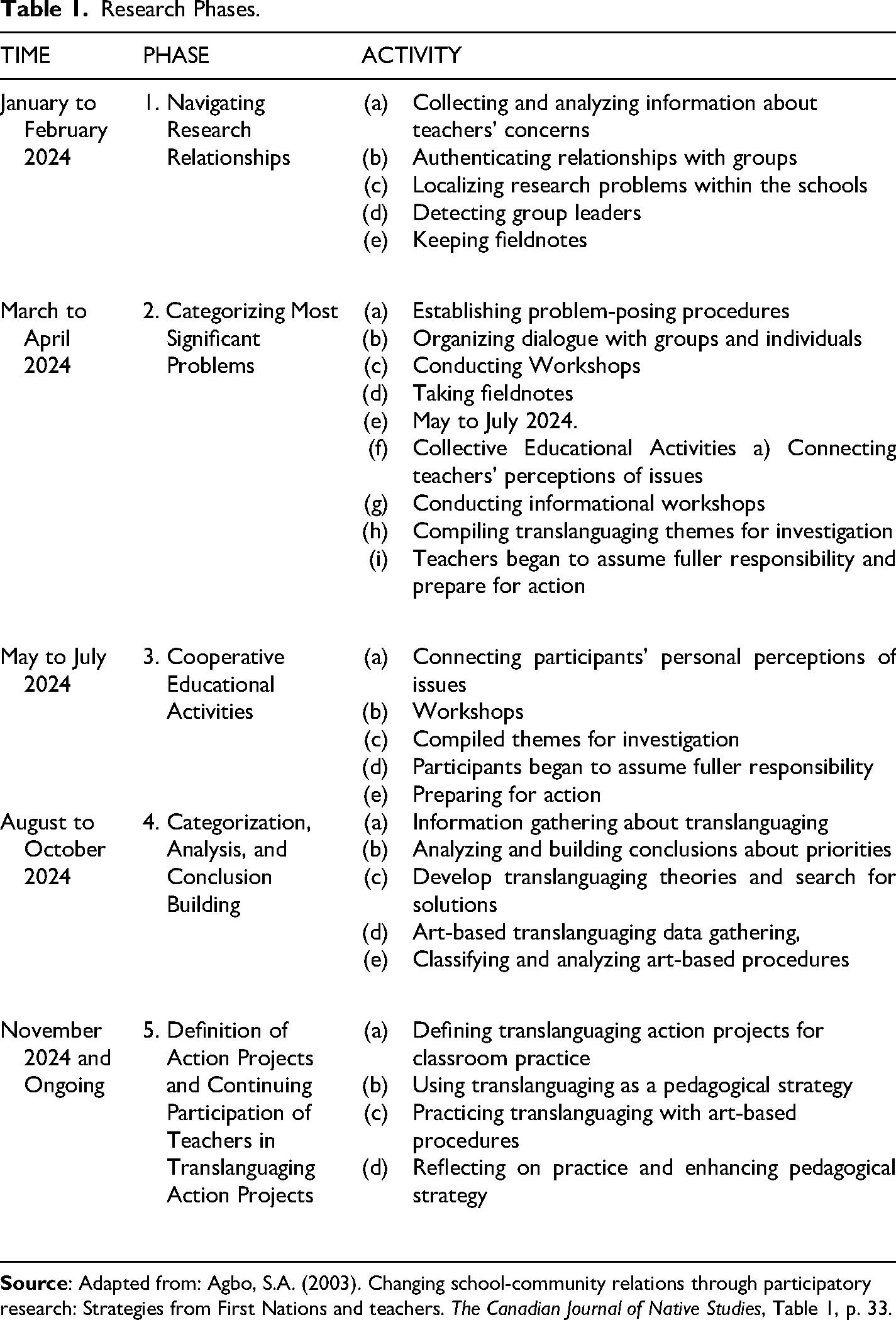
Table 1 shows the research phases of the present study, which totaled five phases. The following sections provide a more detailed description of the activities during the phases.
Phase 1: Navigating the Research Relationship (January–February 2024)
We had a series of translanguaging seminars and conferences in Almaty City in 2023, encouraging in-depth discussions about teachers’ classroom experiences in teaching EFL. The initial goal was to establish ourselves and be accepted by the teachers as researchers of the outlawed translanguaging in Kazakhstan's classrooms. Following the seminars and conferences in 2023, we began gathering and analyzing information on English teaching in Kazakhstan. It was a period when we started establishing relationships with teachers and inviting them to participate in the research process. We tried to locate the research problem within the schools. We started visiting schools and dialoging with teachers about the attributes of translanguaging.
Phase 2: Categorizing Most the Significant Problems (March–April 2024)
In March 2024, we emailed the teachers to identify their problems in teaching English. In total, we received 32 lists from teachers. Some provided causes of the problems and suggestions for their solution, while others merely listed the problems. The high standard of responses, the teachers’ efforts to identify the problems, and the number of suggestions reflected the importance they attached to effective school practices and PAR. We decided to conduct workshops to discuss the problems. We held the first two-day workshop at the beginning of April 2024. The workshops’ themes reflected teachers’ viewpoints concerning the problems they viewed as most pressing in teaching English. We analyzed the submissions in two stages to identify common problems. First, we thoroughly examined all the submissions. Second, we subjected them to a coding process. In coding the submissions, we classified all the issues by using colored stickers to reflect common themes expressed by the teachers.
Phase 3: Cooperative Educational Activities (May–July 2024)
In the third phase, we connected teachers’ perceptions of issues to Kazakhstan's broader context of English teaching. At this stage, the research team and creative artists from the Almaty Institute of Creative Arts started working on new knowledge by actively integrating trilingual concepts in EFL teaching. We conducted another three-day workshop in May 2024. At the April workshops, we assigned discussion topics to five to seven teachers and a research team member who came together to address problems by sharing experiences, information, and support. The group proposed problems, identified possible causes, discussed solutions, and prepared the grounds for evaluating actions. A research team member was the group leader responsible for presenting the group's findings at a general meeting of all members. Participants critiqued group findings to arrive at a consensus.
Phase 4: Categorization, Analysis, and Conclusion Building (August–October 2024)
During phase four, we had two other workshops, bringing the total to seven workshops. We involved the teachers through various means, such as inviting them to gather information, classify, analyze, and draw conclusions about translanguaging. Teachers and researchers met twice every month to investigate problems posed in Phase 3. In phase four, teachers began to develop their theories and understanding of translanguaging and found its practical uses in context.
Phase 5: Definition of Action Projects (November 2024 and Ongoing)
Phase five, which is ongoing, has involved the research participants in deciding what actions to take to address the issues they have cooperatively identified and analyzed. At this stage, teachers have “moved from objects to subjects and beneficiaries of the research” (Maguire, 1987, p. 51). We have become involved activists in improving the teaching of English. Although the research process has indicated direct, immediate value for the researchers and teachers, we cannot determine the research results since phase five is still ongoing. We should expect conclusive results from teachers and researchers in a follow-up study after a couple of years. Phase five is crucial to this study, as it marks the point at which teachers began employing translanguaging as a pedagogical strategy and developed innovations, including the use of art-based procedures to practice translanguaging.
Data Analysis
Lather (1992) argues that alternative research paradigms data analysis transcends the ordinary application of qualitative approaches. As Lather writes: “Rooted in the research traditions of interpretive sociology and anthropology, alternative practices of educational research go well beyond the mere use of qualitative methods. Their focus is the overriding importance of meaning-making and context in human experiencing” (p. 91). Correspondingly, Miles and Huberman (1994) contend that because participatory research aims at transforming the social environment through a method of critical inquiry by acting on the world, data analysis should focus on descriptions in the initial stages and proceed to the search for underlying concepts or ideals (see p. 9). Consequently, the data analysis in the present study primarily employed qualitative procedures with an emphasis on creating meaning within a specific context (Lather, 1992).
There were two major phases of data analysis in this study: 1) the collection phase and 2) the analysis phase. During the collection phase, we continuously referred to and contemplated the collected data and compiled systematic field notes that were useful to the study. As group discussions constituted a valuable source of data for the present study, we prepared guidelines for discussions. We took notes that included comments about individual exchanges, group dynamics, and participants’ comments on EFL teaching, as well as their overall reflections. After each day's discussions, we initially listened to each audiotape and made copious notes or transcriptions of the discussions. We then categorized each issue according to standard patterns, themes, or ideas that fit within the research objectives. After typing the discussion summaries, we returned them to the participants, who were free to bring to the research team's attention any issues that were missing from the report. We reviewed them and made necessary modifications at the beginning of each day's session. The analysis period entailed classifications, the formation and testing of ideas, making connections among ideas, and relating concepts to the literature review (Miles & Huberman, 1994). At the end of the data collection, we employed a descriptive analysis (see Miles & Huberman. 1994) that gave a feeling for the views of the participants and included the search for patterns, repeated themes, or views that correspond with categories such as problems of monolingual teaching and the fundamental and detailed suggestions to deal with the priorities of teaching English. As the analysis proceeded, we recorded theoretical memos about what the patterns possibly meant and drew from the analytic insights and interpretations that emerged during the discussions (see Miles & Huberman, 1994). We then assigned the emerging ideas and patterns to categories. For example, we assigned pieces of information relating to problems of monolingual teaching and priorities of translingual teaching. To view an opinion as a factor, the majority of participants would have had to refer to it as an issue and, therefore, deserve consideration in the analysis and presentation of the findings of the present study.
To ensure trustworthiness and credibility of the data, the design of this study utilized Lather's (1986) face validity and catalytic validity approaches. Face validity occurs by “recycling categories, emerging analysis, back through at least a subsample of respondents” (Lather, 1986, p. 78). In the present study, after typing the discussion summaries, we took them back to the participants and the research team for review and necessary revisions. Catalytic validity follows when there is “some documentation that the research process has led to insight and, ideally, activism on the part of the respondents” (Lather, 1986, p. 78). Catalytic validity is crucial to this study, as its primary purpose was to promote participants’ understanding of their capabilities and right to control decisions affecting them. The identification of priorities and action projects addresses the concern for catalytic validity, as the action projects are still ongoing.
Findings
Two main perspectives emerged from the present study: 1) the problem of monolingual teaching and creative maladjustment and creative subversion of Kazakhstan's teachers; and 2) priorities of teaching EFL. The first problem, the problem of monolingual teaching and creative maladjustment and creative subversion of Kazakhstan's teachers, has to do with the Ministry's regulation to teach English monolingually and how the teachers were contending with the directive and had to creatively maladjust and subvert the regulations (Baker, 2008; Kohl, 1994). The second aspect, priorities of teaching EFL, reports teachers’ priorities concerning using translanguaging as a pedagogical strategy. In this perspective, we report how teachers came to embrace several translingual procedures for teaching English, particularly how teachers used art-based procedures in translingual teaching to enhance student learning. In reporting this perspective, we will provide the fundamental and specific strategies that teachers suggested for dealing with the issue.
The Problem of Monolingual Teaching
Most elementary and secondary school English teachers asserted that, although they and their students were proficient in English, Kazakh, and Russian, the Ministry does not permit them to switch between languages when teaching English, as the Ministry requires them to teach English monolingually by directive. However, some teachers contended that despite the Ministry's regulation, they shuttled between languages when teaching English. Thus, they were independently practicing creative maladjustment and creative subversion. Elementary school teacher, Alicia, who spent a semester on an academic mobility exchange program in a university in England, is symbolic of teachers who shuttled among languages despite the Ministry's regulation: I was in England on an academic exchange program for one semester, and I became acquainted with translanguaging. Upon my return to Kazakhstan, I discovered that our managers require us to teach English monolingually, aiming to expose learners to the English language, as they already speak Kazakh and Russian at home and in their communities. In our school, we only use the English language in English classrooms. Since students do not fully understand English, I try to explain things in Kazakh or Russian, but I am always careful so that the administrators do not know what I do.
The bulk of the secondary teachers who disobeyed the Ministry's monolingual regulation and shuttled among languages in the classroom. I constantly switch between English, Kazakh, and Russian. I know that regulations do not allow us to move from one language to another when teaching English. Our English classrooms are supposed to be monolingual, where the teacher should speak only English in the classroom. However, I switch between English and Kazakh or Russian as needed to enhance my students’ understanding of the material. I used to do it all the times switching from English to Kazakh and then Russian. I had to be careful, watching out for administrators. However, one morning when I was teaching and switching between languages, I looked at the window and there was my head of department standing there looking at me and shaking her head. She beckoned me to the hallway and asked me to see her and the principal during recess. The principal told me that I knew the rules so there was no option but to terminate my appointment at the school. I’m lucky to find another school so I’m very careful not to make the same mistake.
Priorities of Teaching English
Our workshops’ data concerned the priorities that teachers came up with that they found necessary to teach English as a foreign language. We examined the issues that came to light and discussed details of proposed fundamental strategies for dealing with the issues, as well as specific implementation strategies suggested by the teachers. To determine the highest priority problems among the issues identified during the initial period of this study, we first listed all issues, then categorized them, and finally discussed them in groups, where members jointly prioritized them. Each of the groups then submitted a list of issues that the group members deemed to be of the highest priority. Finally, participants jointly agreed on the matters that they thought were very important and came up with categories of the highest priority issues that would constitute action projects. In the present study, a priority issue is a matter that demands urgent, immediate attention and action to improve teaching English.
Priority Issue 1–Translanguaging as a Pedagogical Strategy
Participants indicated that the most important issue for them is to be able to teach English multilingually, particularly by understanding and using translanguaging as a pedagogical strategy in their EFL classrooms. The teachers said that they needed more understanding of translanguaging and how to incorporate it into their EFL teaching. Zarina, a 36-year-old elementary school teacher, captures most of the teachers’ responses: My priority is to utilize multiple languages in my EFL classroom instead of teaching English monolingually. I would particularly like to understand the translingual concept of teaching and how to use translanguaging in my classroom effectively.
Fundamental and Specific Strategies Suggested to Address Priority 1
The first fundamental strategy to address Priority 1 involves teachers switching between at least two languages. Specifically, this involves navigating between the substance in one language and the dialogue in another. The second fundamental strategy to address priority issue 1 involves teachers managing teaching content. Specifically, this involves redistributing content that represents different languages. The third fundamental strategy focuses on conversation and comprehension, specifically requiring teachers to speak in one language and then confirm comprehension in another. The fourth fundamental strategy for Priority Issue 1 involves reading and writing. Specifically, teachers are to present or read in one language and write in another, or to talk in one language and write in another. The fifth fundamental strategy involves combining students’ language resources, and the specific implementation strategy entails merging learners’ language resources. The final fundamental strategy is translingual teaching, and the specific implementation strategy is for teachers to shuttle between languages willingly.
Priority Issue 2: Translingual Art-Based Procedures
During the present PAR project, we empowered the EFL teachers in elementary and secondary schools in Almaty to obtain a deeper understanding of translingual teaching by creating art-based procedures that they experimented with and adapted to their students’ contexts. Teachers holistically indicated that their second priority is utilizing translingual art-based procedures as a pedagogical strategy in the EFL classroom. Through our workshops, we fostered collaboration with creative artists from the Almaty Zhurgenov Kazakh National Academy of Arts, who collaborated with the teachers to develop novel practices for EFL teaching as well as to foster the effective amalgamation of translingual theories.
Figure 1 shows the art-based relics that teachers utilized in their classrooms to enhance translanguaging. The second priority issue for the participants of the present study shadows the professional development activities on the lines of Hirsu et al.'s (2021) Translingual arts-based practices for language learners. Hirsu et al. (2021) advocate arts-based creative dimensions of translanguaging by utilizing arts-based procedures to renew and enhance language teaching and learning experiences. As they write: “Arts-based activities enable learners to think and do new things with language while also reflecting critically on how they generally deploy their linguistic resources in everyday interactions. Therefore, creativity, criticality, and language awareness operate together in translingual experiences” (p. 24). Teachers in the present study indicated priority for reconstructing translingual education's principles, methods, and content. This priority undertaking is tremendous because the required formulation should be interdisciplinary throughout; not only should it use the best available knowledge from linguistics and bilingual education.
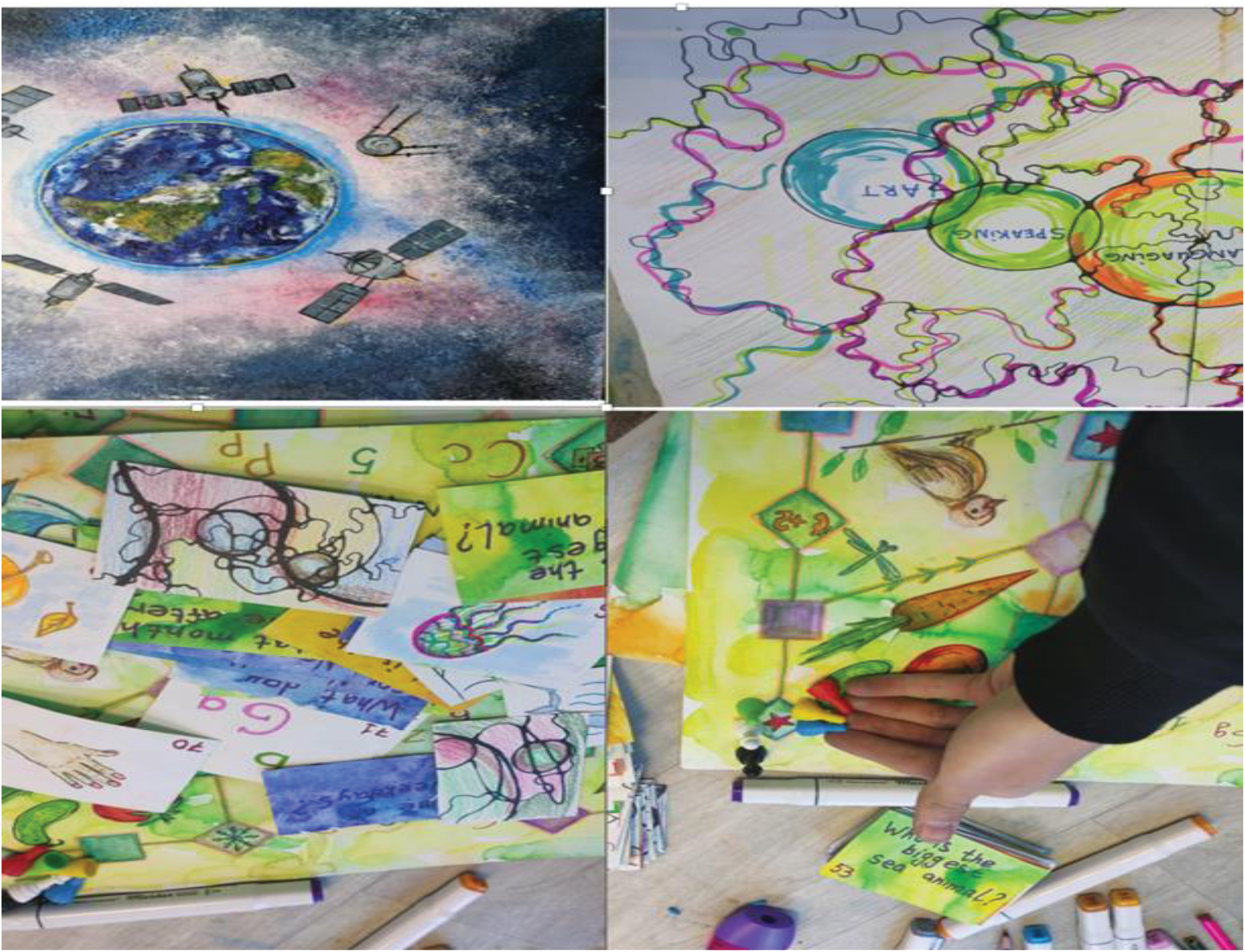
Translingual art-based relics that teachers utilized to enhance the use of translanguaging as a pedagogical strategy.
Our classroom observations showed how teachers used art-based relics to enhance language learning. Below are examples of art-based relics that teachers use in the classroom. Figure 1 shows examples of art-based procedures teachers used in translanguaging to enhance student learning. When asked how they use art-based procedures in translanguaging, the teachers explained that art-based procedures empower learners to contemplate and do different things with language while thinking judiciously about how they usually utilize their language resources in everyday dealings. Accordingly, translingual practices enhance student creativity, critical awareness, and language alertness. As Almira, a 35-year-old elementary school teacher, stated: I work with students to draw pictures. I ask my students to look at the pictures and construct a story about them, write a poem, or compose music. They then shuttle between Russian, Kazakh, and English to make sense of their stories, poems, or music.
Discussion
The findings in the present study support Kohl's (1994) assertion that “When it is impossible to remain in harmony with one's environment without giving up deeply held moral values, creative maladjustment becomes a sane alternative to giving up altogether” (p. 130). Educational researchers have emphasized the importance of teachers’ ability to make informed decisions in enhancing students’ achievement rather than unthinkingly following rules (Baker, 2008; Kohl, 1994). According to these researchers, successful teachers realize that the most significant challenge is not following unreasonable curriculum demands but the autonomy to decide what is important for their students (Agbo et al., 2025). Teacher discretion involves knowledge of curriculum limitations and emphasizes the things that matter most for student achievement rather than idolizing the curriculum (Kohl, 1994). Kohl (1994) and Baker (2008) argue that one of the soberest responsibilities confronting good teachers is analyzing and organizing the premises upon which they conduct their educational practices. They assert that it becomes necessary for teachers to re-examine themselves and their institutions, and subject even their most sacred beliefs to examination, determining by the highest standards of rational inquiry whether the beliefs they have been taking for granted may require thorough reformation. As Kohl writes: “A central teaching skill consists of detecting and analyzing dysfunctional patterns of obedience and learning and developing strategies to negate them” (p. 144). According to Kohl, this means that “teachers have to become sophisticated pattern detectives and sleuth out ways in which the practices they have been taught – or have inherited – inhibit learning” (p. 144). In other words, Baker (2008) and Kohl (1994) call on teachers to seriously challenge the beliefs that have governed the organization and practice of education on every level and should renounce inherited beliefs in education that predominantly instill in the minds of educators and students the acceptance of customary patterns. Therefore, good teachers practice creative maladjustment and creative subversion. Moreover, that was indeed what Kazakhstan's English teachers did in the present study.
Given that Kazakhstan's English teachers and their students are bilingual and multilingual is, nonetheless, one indication that an increasing majority of the English teachers in Kazakhstan are coming to realize that they cannot achieve the purposes and objectives that they set for their students as long as they remain subservient to the curriculum regulations of the Ministry of Education and Science. The teachers were insistent on awakening their students from lethargy by shuttling between English and Kazakh or Russian to become conscious of the fact that their languages, as well as English, were important and had a prominent place in the English classroom. The most noteworthy experience of teachers in navigating between languages was that they engaged their students, leaving passivity behind. In hearing their languages in the English classroom, the students undoubtedly became aware of the cultural possibilities in their society, as language is the pivot of culture (Klerides, 2009; Pickel, 2013).
The suggestion from the teachers that teaching and learning became intense and exciting when they shuttled between languages means that the students’ languages bring out the creative possibilities of language learning that infiltrate the life of the students in a way that the gulf between them and their culture narrowed (Hornberger & Link, 2012; Hurst & Mona, 2017; Klerides, 2009). Hornberger and Link (2012) assert that translanguaging “provides a fuller understanding of the communicative repertoires students bring to school and helps identify how to draw on those repertoires for successful educational experiences for all students” (p. 40). Accordingly, we cannot understand education except in its cultural context. Education replicates the culture in its setting, and in turn, education wields its influence upon the culture (Klerides, 2009; Kohl, 1994).
This study's findings, which reveal that teachers have been practicing translanguaging in hiding, open the door to long-needed professional development in contemporary approaches and methods needed in language instruction. The cultural significance of the creative maladjustment and creative subversion that teachers practiced in teaching English represents social justice, as it implicitly acknowledges the equal status of students’ languages to English in the classroom (García & Leiva, 2014). Nevertheless, given the prevailing political fear among teachers, they acted independently of government regulations. By being mindful of creative maladjustment and creative subversion of curriculum rules that they deemed senseless, the teachers showed that education is not dogmatism but an unceasing subversion against the notion that “the demands and structure of schooling were normal, and the students were problems if they did not adjust” (Kohl, 1994, p. 133). Kazakhstan's teachers wanted to teach well, albeit without the autonomy of ‘the how’ to teach. To retain their jobs, they had to cultivate the skills of creative maladjustment and creative subversion, incorporating aspects of their teaching that reflected their resistance to repressive educational regulations (Kohl, 1994).
The potential for reaction in teaching English in Kazakhstan is immense. When teachers and students were most likely to be active and eager to learn English, the high wall of the monolingual curriculum requirement isolated them. Teachers’ reaction to practicing creative maladjustment to shuttle between languages does not explicitly make them non-compliant. Instead, those were moments when teachers needed creative maladjustment and creative subversion to adapt to the unreasonable demands that they found repressive (Baker, 2008; Kohl, 1994). There is no question, then, that teachers were practicing translanguaging individually and painstakingly. However, if translanguaging were to meet its goals and objectives effectively and move forward to improve the teaching and learning of English, then teachers should not practice translanguaging in secrecy. Instead, the most effective way for teachers to enhance learning and teaching English is from above – that is, through the supervision of the Ministry of Education and Science and the government, which centrally governs education in Kazakhstan. The Ministry alone that makes regulations about the conduct of education is responsible for discovering solutions for educational institutions.
Conclusion
A common observation in the present study is that educational policymakers and their allies offer a monolingual approach to teaching English on a deeper level. Although they are often remarkably unaware of the state-of-the-art teaching approaches, policymakers believe that the best way for Kazakhstan's youth to become proficient in English is for teachers to teach English monolingually, thereby deterring students from listening to and speaking their native languages during English lessons. Therefore, for English teachers, the ultimate way is to subvert the regulations and engage in translanguaging covertly. Teachers cannot solve the problem of teaching and learning English by hiding and doing the right things behind their classroom doors until policymakers understand the importance of translingual education and declare it the appropriate approach to teaching English. In this effort, it is essential to offer teachers rigorous professional development to acquire all the relevant facts and principles available about translanguaging.
For teachers’ professional development, we can now realize in a more profound way that translingual education, if it is to function with cultural effectiveness, requires the fullest possible enlistment of all community resources (Hirsu et al., 2021; Kohl, 1994). We are still exploring many of these resources, as the earlier notion of translanguaging has challenged us. For example, thanks to Hirsu et al. (2021), we are starting to reformulate our whole conception of the translingual education process. We realize, overwhelmingly more than before, that bilingual education, far from being limited to language literacy, encompasses the whole complex human dynamics that cultures seek both to maintain and to innovate their structures, operations, and purposes (García & Otheguy, 2020). Hence, the effectiveness of translingual education depends on its capacity to fulfill this crucial role in collaboration with society's cultural artifacts (Hirsu et al., 2021). The teachers’ resilience, alertness, sense of responsibility, and, above all, their competence and eagerness to energetically engage the total life of the cultures that support the society are the measures that control their worth as translingual teachers and enculturating agencies of both stability and planned change in translingual education.
Accordingly, the nature of the professional development that we encourage for Kazakhstan's English teachers in the present context will now become clear with our recommendation to plan teachers’ professional development activities on the lines of Hirsu et al.'s (2021) Translingual arts-based practices for language learners. Hirsu et al. (2021) argue for arts-based creative dimensions of translanguaging by utilizing arts-based procedures to revamp and enhance language teaching and learning experiences. As they write: “Arts-based activities enable learners to think and do new things with language while also reflecting critically on how they generally deploy their linguistic resources in everyday interactions. Therefore, creativity, criticality, and language awareness operate together in translingual experiences” (p. 24). Teachers’ professional work in EFL classrooms should reconstruct the principles, methods, and content of translingual education. This undertaking is tremendous because the required formulation should be interdisciplinary throughout; it should not only utilize the best available knowledge from linguistics and bilingual education but also integrate insights from other relevant fields. Nevertheless, it should incorporate the most significant creations of the arts, from music, sculpture, fine arts, acting, and design to local literature and architecture, to create a seamless web of interweaving characteristics that reflect the transformation we need in translingual education. To conclude, we recommend further research into students’ lived experiences in translingual classrooms to shed light on the diverse ways that translanguaging impacts students’ lives.
Footnotes

Funding
The authors received no financial support for the research, authorship, and/or publication of this article.
Declaration of Conflicting Interests
The authors declared no potential conflicts of interest with respect to the research, authorship, and/or publication of this article.