



Abstract
In a telecollaboration (or ‘virtual exchange’) between teacher candidates (TCs) from Türkiye and the United States (U.S.), U.S. TCs experience various elements of translingual practice as potential challenge to their monolingual backgrounds. The challenges occur as TCs from the U.S. context work to fulfill, with Turkish assistance, collaborative final projects: a K-6 learning resource in the form of ‘kamishibai’, digital story, or translanguaging children’s book. Analysis in the article draws on various data sources, including the final projects, recorded video interactions between U.S. and Turkish TCs, and written reflections by U.S. TCs. The analysis aims to answer the following research questions: (1) How have the U.S. TCs’ monoglossic orientations been challenged during their translingual collaborations with TCs from Türkiye? (2) How do the U.S. TCs interpret and define translanguaging through their experience in this telecollaborative contact zone? In the absence of clear modeling or detailed theoretical exegesis of translanguaging as pedagogy and social-justice orientation, the U.S. TCs vary in their explications of translanguaging, describing the phenomenon as the existence of multiple languages in one discourse or the use, or non-use, of translation to aid understanding. In video-recorded interactions with TCs from Türkiye, the U.S. TCs engage in a ‘contact zone’ of translingualism. They participate in and negotiate their way through language mixing and translation, interculturality, diverse linguistic and literacy practices, and misunderstandings. There is little evidence, however, of U.S. TCs adopting a translanguaging stance: for instance, there are no ‘breakthrough’ or ‘aha’ moments in the U.S. cohort that helped them connect the multilingual negotiations with Turkish students with what they might one day face in their language classrooms. But walls between monoglossic ideations and real-world languaging were fractured, helping U.S. TCs to access gesture, and become parties to bilingualism, collaboration, mediation, and vernacular expression.
Keywords
I Introduction
International telecollaboration – also known as virtual intercultural exchange – offers a natural setting for distant groups of learners to experiment with multilingual interaction and to draw on, or to expand, their linguistic repertoires (Kumagai & Shimazu, 2023; Uzum et al., 2022; Walker, 2017). Telecollaboration is defined as ‘the practice of engaging distant classes of language learners in interaction with one another using internet-based communication tools to support intercultural exchange and foreign language learning’ (Helm & Guth, 2016, p. 241). Depending on teachers’ and teacher educators’ needs and preferences, telecollaboration can be conducted in a variety of learning formats. The pedagogical side of telecollaboration might unleash facilitator and practitioner creativity, through the combination of tasks and learner engagement in whatever linguistic or semiotic form. While the internet affords a variety of potential intercultural connections, telecollaboration designers need to decide about how to structure these exchanges and to integrate them within a language teaching or teacher education curriculum (O’Dowd, 2020). In general terms, the exchanges occur over several weeks to a year, as academic calendars permit, with participants having some stake in the activities in the form of grade percentages for the class. Recently, instructive pedagogical responses in telecollaboration have aimed to move from superficiality in interactions (e.g. paying attention only to ‘safe’ topics; see Helm, 2013, p. 37) to fostering more engagement by taking a more critical approach (O’Dowd, 2020).
The present study explores how teacher candidates (TCs) in two contexts – English as a foreign language (EFL) TCs in Türkiye, and early childhood through grade 6 (EC6) TCs in the United States – interpret a telecollaborative assignment to create a multilingual resource for K-6 language learners. The final project offered the TCs the choice of making a ‘kamishibai’, a digital story, or a translanguaging children’s book. ‘Kamishibai’ involves telling a story while manipulating illustrations, a Japanese custom that dates to the eighteenth century (McGowan, 2012; see also Vermeir & Kelchtermans, 2020). The kamishibai – along with the digital story and children’s book – for participants from Türkiye and the U.S. aims to instill storytelling as part of language education and to give them a sphere for interaction.
Participants were asked to create a text for the ‘contact zone’, that is, a site of culture mixing, heterogeneity, and translingualism (Pratt, 1991). TCs in the telecollaboration were encouraged in the direction of translanguaging without much explicit guidance on what that might look like. Much literature on translanguaging applies the concept as a theoretical lens and pedagogical tool in a manner that is more intentional than what was attempted in the present study, which offered translanguaging as one possibility in completing a final telecollaborative project. For the TCs participating in the present study, translanguaging was not theorized or modeled in a detailed manner. Peers on both sides of the telecollaboration were left largely on their own to decide what translanguaging is or might be (for contrast and for a range of potential translingual writing pedagogies, see Sun, 2022). In Tian and Zhang-Wu (2022), translanguaging as pedagogy and as an advocacy tool was infused consistently throughout a teacher education course on bilingual education. Participants showed development in their translanguaging stance (García et al., 2017) and grappled with the practical uses of translanguaging in the classroom; they could see the potential of translanguaging, understand it as a scaffolding tool, and imagine other ways to inject translanguaging into their own teaching practice. At the same time, scholars discussed translanguaging as an innovative and ordinary practice in multilingual contact zones (Lee & Dovchin, 2019). Drawing upon that innovative and ordinary nature of translanguaging, the present study examines what occurs with TCs when the translanguaging concept is less scaffolded. In other words, this study focuses on how TCs interpret what translanguaging is and what it looks like in the multilingual classroom and language learning materials without receiving explicit guidance on translanguaging and its implications in the classroom. The purpose was to see how TCs made sense of the concept when they are in a multilingual contact zone and receive no specific instruction on translanguaging. In this way, future curriculum and designs can establish the starting point of TCs in terms of their interpretation of translanguaging, and can build on this existing understanding.
II Background literature
1 The translanguaging stance and teacher education
Scholars have explored the pedagogical implementation of translanguaging approaches to language use and learning, and teacher education has been one of the research areas. García et al. (2017) seek to lay out how teachers might prepare themselves to fashion a social justice-oriented, translanguaging environment by paying attention to stance (philosophical orientation), design (translanguaging plan), and shifts (in-the-moment openness to translanguaging). The three ingredients are intertwined, although the authors make clear that without a translanguaging stance – defined as a belief in ‘one holistic language repertoire’ (pp. 49–50) – a teacher cannot take advantage of translanguaging’s many affordances. Scholars do not universally agree upon how such a stance might be instilled among preservice teachers, but they suggest strategies for helping to shape a translanguaging mindset and, ultimately, a translanguaging space (Li, 2018) that remains welcoming to diverse language practices and to participatory, community-connected learning. Those strategies include attention to TCs’ identities and ideologies about language (Andrei et al., 2020; Palmer & Martínez, 2016), with cautions that teachers’ ideologies might not always accord with what they do when faced with real students (Martínez et al., 2015). For example, an instructor might declare allegiance to linguistic purism (see Martínez et al., 2015), but might actively use translanguaging techniques. The reverse situation might be true, too.
Translanguaging literature emphasizes the need for teacher reflection on practices and ideologies (Goodman & Tastanbek, 2021; Kearney & Mahoney, 2020; Woodley et al., 2020), with special attention to awareness, for English-language teachers, on the language’s dominance, its colonial past, and on how such power differentials influence classroom dynamics (Espinosa et al., 2020; Lau, 2020a). Colleagues share important caveats that even with intentional focus on translanguaging and its potential benefits, teachers still have difficulty accepting students’ use of informal, social, and non-standard language features (Woodley et al., 2020). In Lau’s (2020a) study, participants in Malawi felt that they needed a ‘nod of approval’ (p. 221) from Western partners despite an openness to the use of their full communicative repertoires in a professional-development setting. Other constituent elements of educating for a translanguaging approach include a grounding in translanguaging praxis and pedagogy, with the opportunity to experiment with such strategies in a practicum or peer-education environment (Deroo et al., 2020; Hirsu, 2020; Pacheco et al., 2019). Tian and Zhang-Wu (2022) create a bilingual-education course for TCs that intentionally infuses translanguaging by allowing development of a translanguaging stance and ‘growing recognition of English as the hidden curriculum’ (p. 156).
One cautionary note highlighted by scholars is not to let overly lofty expectations for TCs obscure that shifts in stance – from seeing translanguaging as teaching strategy to regarding it as educational philosophy – do not occur automatically. For example, Robinson et al. (2020) note ‘we believe it is unrealistic for us to expect participants to implement translanguaging in transformative ways when it has not been modeled for them’ (p. 158). In Oliver et al. (2021), situated in Indigenous Australia, translanguaging is viewed as a consistent resource, representing ‘both a psycho-linguistic and sociolinguistic perspective of language use’ (p. 138). To reject Australia’s ‘monolingual mindset’ (p. 145), translanguaging in the classroom can and should draw on community resources. Again in Australia, Slaughter and Cross (2021) regard the classroom teacher as the fulcrum point for such matters of education policy by discerning a lack of pedagogical guidance for translanguaging. In their study, students’ language mapping helps teachers imagine themselves in more agentive ways, as makers of ‘language and literacy policy’ (p. 56).
Another argument for incorporating translanguaging in teacher education pedagogy is that it might help teacher educators reflect on ‘their own translanguaging capacity and practice’ (Yuan & Yang, 2020, p. 19). In a case study of one teacher educator, Kenny, in Hong Kong, Yuan and Yang’s study found that Kenny was not always aware of his own translanguaging intuition. Similarly to other research, Yuan and Yang discuss how translanguaging should not remain a fuzzy concept in the education of teacher educators but ‘needs to occur in a process of dialogic meaning negotiation and co-construction’ (p. 19).
2 Translingual practice in telecollaboration
One of the theorized alternatives to translanguaging is translingual practice (Canagarajah, 2013), which relies on performative competence and an impetus toward cooperation in contact zone situations (Pratt, 1991). Given that telecollaboration is a deliberately designed, facilitated intercultural interaction, mediated by technology, that forms part of a language-learning or other educational program (O’Dowd, 2018), it is well-suited to study how participants utilize their linguistic repertoires to make meaning and to communicate in a hybrid zone of language contact. García and Li (2014) do not explicitly object to Canagarajah’s terminology, but rather to what they see as a mischaracterization of translanguaging, which offers social and multimodal features in its essence. In this article, we use the terms ‘translingual practice’ and ‘translanguaging’ interchangeably, since participants in the U.S.–Türkiye exchange in this study represent creative and critical multilingual encounters involving ‘tension, conflict, competition, difference, and change in a number of spheres’ (Li, 2018, p. 23). Researchers view telecollaboration as potentially transformative in this manner, as telecollaborative exchanges demand linguistic performances and identity negotiations to push participants out of their comfort zones, even when a lingua franca is used (O’Dowd, 2021; Prieto-Arranz et al., 2013; Uzum et al., 2022). Relevant studies on translingual practice encompass both its use in telecollaborative settings (Kulavuz-Onal & Vásquez, 2018; O’Dowd, 2020; Walker, 2018) and in the workplace (Menard-Warwick & Leung, 2017), where the bridge-building and brokering potentials of language use are foregrounded (Yanaprasart, 2018). The present study regards all its participants as capable of deploying translingual strategies, semiotic resources such as gesture, intonation, and so on, and other symbolic means of communication. In fact, computer-assisted language learning (CALL) has been chided in recent years for a paucity of translingual approaches and for a ‘monolingual bias’. Buendgens-Kosten (2020) defines this bias as a ‘deficit in considering the full range of . . . languages used in a setting, or of (plurilingual skills)’ (p. 307) and proposes a new emphasis on multilingual CALL (MCALL).
Kumagai and Shimazu (2023) favor a translingual over monolingual approach in an international telecollaboration project to create an online magazine. They found that ‘creating a translanguaging space offered the learners important opportunities to deeply reflect on and observe not only their own language practices but also those of others’ (p. 192). Similarly, in the present study, our pedagogical purpose in introducing TCs to translingual practice through their creation of multilingual texts as final projects was to help TCs experience the utility of an expansive semiotic repertoire through their encounters and languaging as a relational meaning-making activity (see Walker, 2017). In this approach, communication resources are expanded within telecollaboration, which itself forges a virtual social environment for learners to realize agency. ‘Telecollaboration contexts are potential sites of sociality which can empower distributed learners to become social agents who co-construct meaning with each other’ (Walker, 2017, paragraph 48). Approaching the telecollaborative context as a translingual contact zone (Canagarajah, 2013) and a discursively, collaboratively created socially mediated space (Walker, 2017), we addressed the following research questions:
Research question 1: How have the U.S. TCs’ monoglossic orientations been challenged during their translingual collaborations with the TCs from Türkiye?
Research question 2: How do the U.S. TCs interpret and define translanguaging through their experience in this telecollaborative contact zone?
III Methods
1 Participants
The telecollaborative project was conducted between two teacher education programs in the U.S. and Türkiye in Spring, 2018. A total of 90 TCs participated in the project; 54 of them (10 male, 44 female) were from North Anatolian University (all names are pseudonyms) in Türkiye, and 36 of them (2 male, 34 female) were from City University in the southwestern U.S. The participants in Türkiye were preparing to become EFL teachers in K-12 public schools and were in their senior year of the four-year university program. Their counterparts in the U.S. were studying to become EC-6 teachers with ESL certification in the U.S. public schools, and were in their junior year of the four-year university program. Prior to this project, TCs in Türkiye had completed coursework in EFL teacher education such as ‘language acquisition’, ‘material design’, ‘language assessment’, but had not had any extended immersive collaborative experience with English speakers. TCs in the U.S. had completed a ‘multicultural education’ course (some TCs were able to waive it, transferring similar coursework), and a ‘second language acquisition’ course, and were in their final course in the sequence before being eligible to take the state’s ESL certification exam.
The U.S. TCs had heterogeneous racial backgrounds, and some were bilingual, speaking Spanish in addition to English, while TCs from Türkiye identified themselves as Turkish and spoke Turkish as their first language. The project was a required assignment in both contexts (‘Literacy Strategies for English Language Learners’ in the U.S. taught by Babürhan Üzüm; ‘Language and Culture’ in Türkiye taught by Sedat Akayoğlu), and was presented as an immersive learning experience aiming to facilitate interaction between peers from different socio-educational contexts, toward building intercultural communicative competence. It was especially important for the U.S. TCs since they did not have any other immersive experience with English language learners (ELL) at the time of the project and would likely work with them in their future classrooms. Field experience and working directly with ELLs is currently a formal component and now attached to this course in City University’s teacher education curriculum.
2 Instruments and procedures
Throughout eight weeks, TCs engaged in asynchronous discussions facilitated by weekly prompts on multicultural education and had synchronous planning and collaboration meetings. In their synchronous sessions, they worked on a series of interviews, a lesson plan, and a final telecollaborative project in which they were asked to create a multilingual classroom resource. They met three times synchronously on Zoom and video-recorded their meetings. The first meeting was for introduction; the second meeting was for lesson plan exchange; and the third meeting was to share their final multilingual artifacts with each other and read them together. To accomplish our research goals in the current study, we focused on the third synchronous meeting, the U.S. TCs’ final projects, and the post-reflection papers they wrote (see Figure 1).
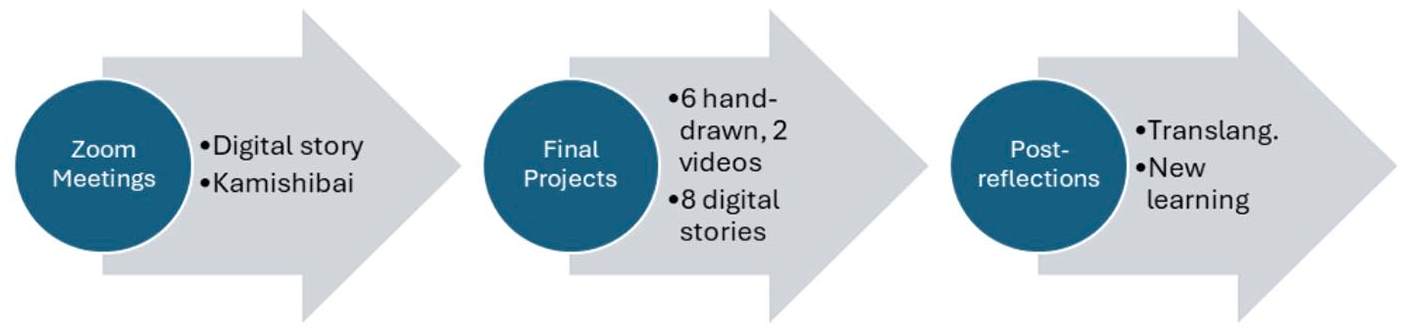
Project timeline.
Therefore, the U.S. TCs (preparing to work with ELLs in EC-6 classrooms) were asked to experience cross-cultural contact and employ translingual meaning-making resources in creating an artifact that would testify to this experience of translingual negotiations with their peers in Türkiye. They were given the opportunity to create this artifact in the form of a kamishibai (visual participatory story; see Vermeir & Kelchtermans, 2020), digital story, or translanguaging children’s book. In the latter, the TCs were tasked to write a children’s book in which at least one character would not speak English, and they would need to negotiate meaning in creative ways. It was up to the TCs to find and use translingual strategies that are available to them to make communication possible (for assignment instructions, see Appendix A).
We followed the human research procedures at the U.S. university, and we included in the analysis the data only from the TCs who provided consent to release their data for research purposes. The instructors (Babürhan and Sedat) did not know the TCs’ decision until after the final grades were submitted. Those who did not consent were still able to participate in the immersive experience, but their data were not included in the analysis. We used pseudonyms throughout the article to protect the TCs’ anonymity.
3 Data collection and analysis
This study analyses data from three specific data sources:
the culminating project artifacts (a kamishibai, digital story, or translanguaging children’s book);
video-recorded online planning and story performances from TCs from Türkiye and the U.S.; and
written post-collaboration reflections by U.S. TCs on their definitions of translanguaging and on the experience of using translingual practices in making a curriculum resource.
Table 1 provides the summary of data sources and their relevance to research questions. This summary can help further explicate how our data analysis has addressed the research questions that guided our study.
Data sources and connection to research questions.
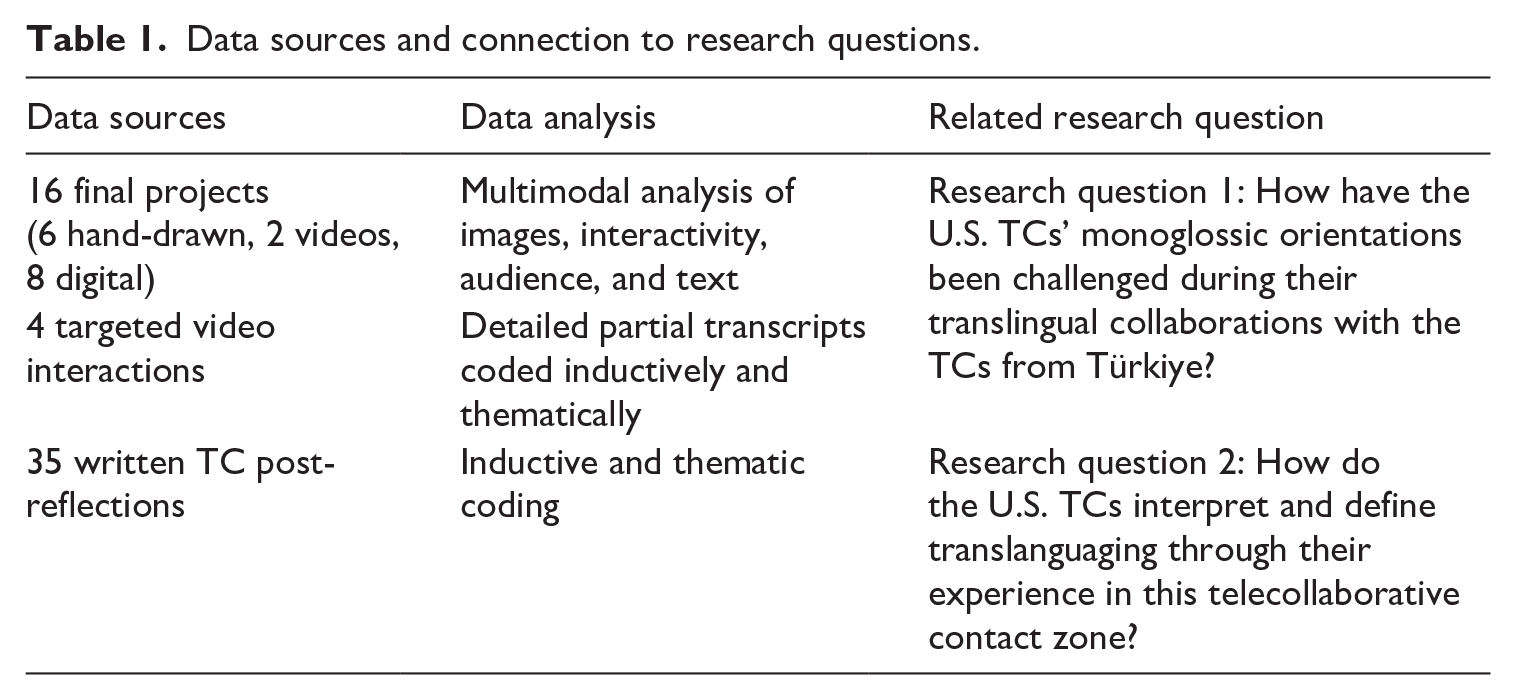
The U.S. TCs submitted the culminating artifacts as still pictures of hand-drawn kamishibai or storybooks, as narrated videos, or as electronically produced story collections (using https://www.storyjumper.com). Altogether, there were six hand-drawn projects, two videos, and eight digital stories. Since the TCs worked on the projects in pairs, the total of 16 submissions accounted for 32 of the 36 participants. These projects were analysed for use of images, level of interactivity, intended audience, and integration of language. The TCs were instructed to use at least two languages such as English and Turkish in their multilingual artifacts. The video-recorded group collaboration sessions, uniting the TCs from both contexts, were conducted via Zoom, and their recordings were uploaded to YouTube as unlisted. Ranging from 10 to 40 minutes in length, these encounters offered a rich source of conversation about language and ELL-centered pedagogy. We decided to choose four video collaborations for partial transcription by selecting pairs so that each form of final project was represented. That is, among these four U.S. TC pairs, there was one hand-drawn kamishibai, one narrated video, and two digital stories.
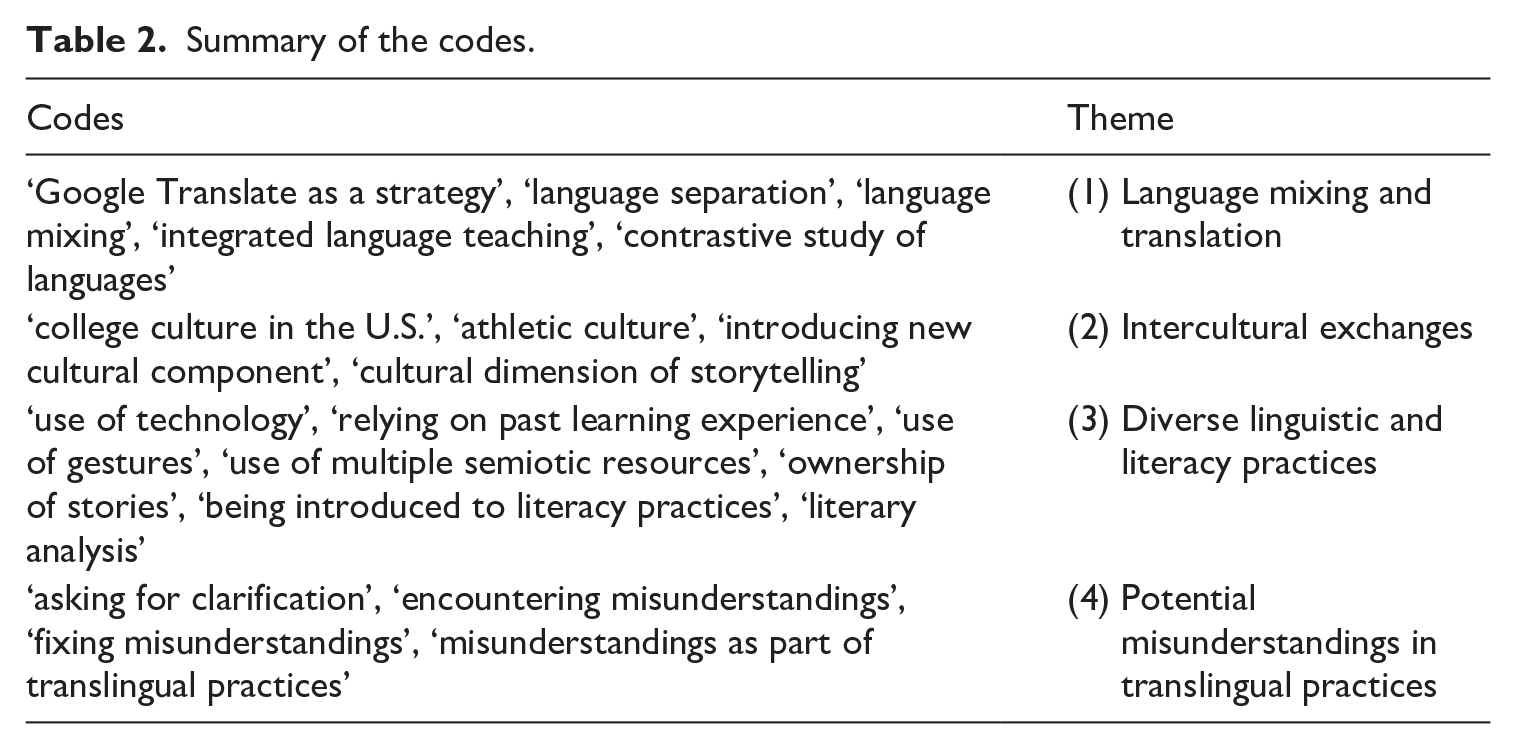
We coded transcripts with integrated attention to the TCs’ gestures inductively by using a combination of descriptive, in-vivo and process codes (Saldaña, 2021), with conversations which we then grouped by theme. For example, our descriptive codes for the image in Figure 3 below included ‘shared parallel experience as college students’; and ‘creating a community of college students’, and ‘team spirit and symbolic gestures’. Then, focusing on research question 1, we coded the transcripts to explore instances where U.S. TCs’ discourses reflected monoglossic orientation and its potential destabilization. More specifically, we were interested in understanding how monoglossic orientation informed their approaches to language and if TCs’ engagement in creating multilingual instructional materials included any experiences that challenge monoglossic understanding of language use and interaction. Examining if and how they are moving away from that understanding, we had the following codes: ‘Google translate as a strategy’, ‘use of technology’, ‘relying on past learning experience’, ‘language separation’, ‘language mixing’, ‘integrated language teaching’, ‘college culture in the U.S.’, ‘athletic culture’, ‘introducing new cultural component’, ‘use of gestures’, ‘use of multiple semiotic resources’, ‘cultural dimension of storytelling’, ‘ownership of stories’, ‘being introduced to literacy practices’, ‘contrastive study of languages’, ‘literary analysis’, ‘asking for clarification’, ‘encountering misunderstandings’, ‘fixing misunderstandings’, ‘misunderstandings as part of translingual practices’. We organized these codes into four themes that show how U.S. TCs’ participation in the translingual contact zone led them to nudge their monoglossic orientation by experiencing: (1) language mixing and translation, (2) intercultural exchanges, (3) diverse linguistic and literacy practices, and (4) potential misunderstandings in those practices. These experiences are indicative of nascent translanguaging stance. As they were moving away from that orientation, they were in the proverbial borderlands between monoglossic and translanguaging stances. In other words, U.S. TCs have been nudged away from monoglossic orientations through experiences of (1) language mixing and translation, (2) intercultural exchanges, (3) diverse linguistic and literacy practices, and (4) potential misunderstandings in those practices. For a summary of the codes under the four overarching themes, see Table 2.
Summary of the codes.
Finally, the data also included the TCs’ responses to two questions in the post-reflection papers written after the end of telecollaboration. The prompts for these post-reflection papers were:
How would you define ‘kamishibai’ and ‘translanguaging’ in your own words to someone who hasn’t heard about it before? How do you think you can use these concepts in your future classroom?
Please describe your experience briefly when writing a children’s story using kamishibai or translanguaging. What do you think you have learned from this experience?
Thirty-five of the 36 U.S. TCs completed post-reflection assignments after the telecollaboration ended; among these 35 post-reflections, 27 TCs shared their definitions of translanguaging. We imported TCs’ reflections into NVivo 12 for inductive coding and thematic grouping. Our coding of those reflections followed two stages. First, we focused on TCs’ definitions of translanguaging and coded these data to understand what characteristics TCs assigned to translanguaging in their own conceptualization. The following are some example codes from that stage: ‘multiple languages’, ‘different languages’, ‘presence or absence of translation’, and ‘contextual clues’. Second, we coded TCs’ post-reflections to examine what topics they discussed in their reflections on their experiences in the telecollaborative project, and our analysis generated such codes as ‘translation and translanguaging’, ‘cultural diversity’, ‘future classroom application’, ‘childhood connections’, and ‘creativity’. When presenting what we found in our analysis, we introduce data excerpts to exemplify the codes and substantiate our findings.
Before moving forward, we would like to clarify that the assignment instructions (see Appendix A) might have influenced the extent to which TCs engaged in translanguaging practices in constructing their multilingual books for their students. We provided TCs with three options to select from for their culminating collaborative projects and one of them was ‘Multilingual book using translanguaging’. Although we provided resources on translanguaging, we believe the TCs needed more scaffolding to be able to collaboratively create multilingual books featuring translanguaging practices. Also considering the restrictions of limited time (eight weeks for the entire telecollaboration) and time zone differences, TCs seemed to focus on the ‘multilingual’ aspect of the book they were putting together and not much on the translanguaging aspect. Within this context, our findings demonstrate more of TCs’ nudging monoglossic orientation towards translanguaging stance in their discourses than actual translanguaging practices in what they have created. The work they accomplished through their participation in the translingual contact zone is meaningful, especially when we consider previous research that found such an ideological shift takes a long time and language teachers usually demonstrate tensions in their understanding and application of translanguaging (Andrei et al., 2020; Goodman & Tastanbek, 2021).
IV Findings
In this section, we address the research questions:
Research question 1: How have the U.S. TCs’ monoglossic orientations been challenged during their translingual collaborations with the TCs from Türkiye?
Research question 2: How do the U.S. TCs interpret and define translanguaging through their experience in this telecollaborative contact zone?
We present the findings with references to the three data points by beginning with (1) the finished kamishibai, videos, or digital stories; followed by (2) treatment of the groups’ Zoom interactions, to address the first research question; and concluding with (3) participants’ written post-reflections, for research question 2.
Research question 1: How have the U.S. TCs’ monoglossic orientations been challenged during their translingual collaborations with the TCs from Türkiye?
a TCs’ final projects (kamishibai, videos, and digital stories)
The U.S. TCs’ creations, namely the 16 total hand-drawn, video, and digital story projects, for the most part feature English-speaking characters with narratives in English and, translated in adjacent text blocks, in Turkish (in 12 stories) and sometimes Spanish (eight stories). A small number of groups had bilingual TCs speaking Spanish, so they chose to add Spanish translations in their stories. Other groups had monolingual English-speaking TCs, and some of these groups also chose to add Spanish translations, given the linguistic and cultural context of the southwestern U.S. In addressing the first research question, the U.S. TCs interpreted the translanguaging assignment as a product for an English–Spanish bilingual context (one in four students in the K-12 schools of this context is a Spanish speaker) and they used this awareness in their design choices. Seven of the stories (see Table 3) included English narratives with Turkish and Spanish translations. In addition, this university-level teacher preparation course focused on teaching pre-kindergarten to sixth-grade classrooms, which is why stories were targeted to these grade levels. Themes and images were aimed at young readers; for instance, nine of the 16 stories involved animals; eight featured the theme of friendship; and seven involved children. As a sign that the U.S. TCs were cognizant of the telecollaborative setting and seeking to make transnational connections through theme and language, 10 projects related to travel or non-U.S. environments. Six projects addressed language differences. In these latter types of projects, the stories’ protagonists required translation or did not understand the other characters’ discourse and had to rely on situational cues to respond. In Table 3, the 16 stories, their storylines, themes, and language use, are presented.
Summary of the U.S. TCs’ 16 final projects.
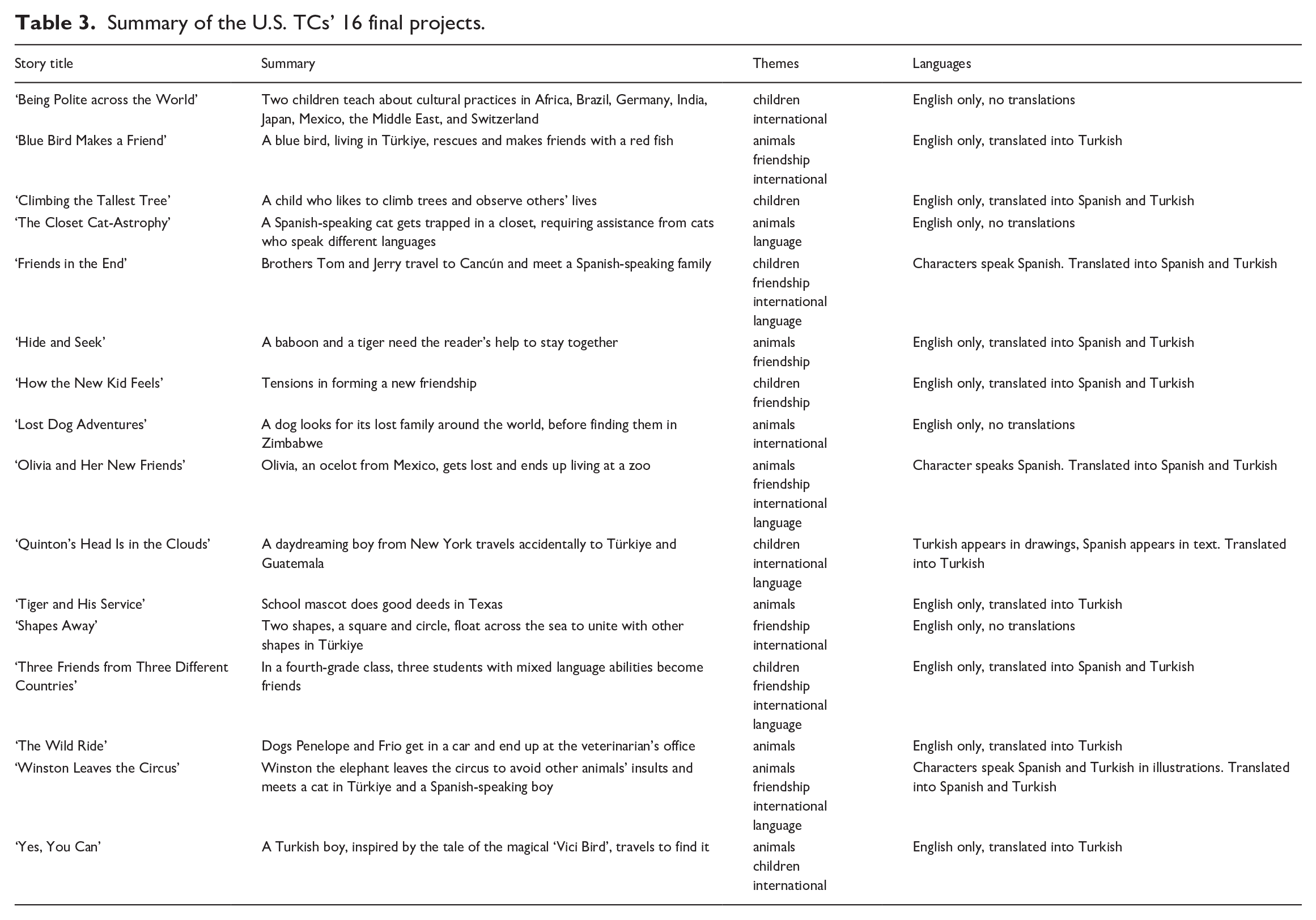
We devote additional attention here to the six projects that address language differences. In ‘The Closet Cat-Astrophy’, the protagonist, Smoky the cat, is characterized as speaking only Spanish, while another pair of cats speak an unnamed tongue. A fourth cat speaks both Spanish and English. Nevertheless, the four cats transcend linguistic differences to rescue Smoky from a locked closet; all narration is in English, and there is no translation provided. Another story, ‘Three Friends from Three Different Countries’, describes one character as Spanish–English bilingual, another as monolingual English, and a third as Turkish-speaking with some capacity in English. Again, all narration is in English. The conflict revolves around one of the characters, Mateo, making friends with the Turkish newcomer, Berk, and seemingly abandoning his long-standing companion, James. ‘Mateo told James that all he wanted to do was make Berk feel welcomed in school,’ reads the narration, ‘because he knew how it felt to be new and not know the language’. Three stories – ‘Olivia and Her New Friends’, ‘Quinton’s Head Is in the Clouds’, and ‘Winston Leaves the Circus’ – contain moments in which characters showcase their linguistic repertoires, but only in brief excerpts, and sometimes only in the accompanying illustrations (see Figure 2, in which a cat greets Winston in Turkish). In addressing our first question, these brief attempts illustrate the TCs’ interpretation and awareness of translanguaging in line with the latter of the three ingredients (stance, design, shifts) proposed by García et al. (2017). That is, they show the TCs’ shifts, i.e. in-the-moment openness to translanguaging. Finally, one story, ‘Friends in the End’, deals at length with what might be called language learning and grappling with translanguaging, that is, with the use of characters’ full linguistic repertoires as a key ingredient in the story arc. Two brothers, Tom and Jerry, meet Spanish-speaking boys on the beach in Cancún, then accept an invitation to have lunch together with them. Tom copies speech patterns in Spanish to ask for an enchilada, with the narrator concluding, ‘Despite the language difference, the boys soon realized they actually had a lot of similarities.’ This example also illustrates TCs’ momentary openness to translanguaging by allowing their English-speaking character to try out a Spanish utterance and leave with an affirmation of the experience. If we assume that the English-speaking character may act as an extension of the author in the literary space, the shifts (in-the-moment openness to translanguaging) can be a predictor of growing stance in which the TCs are acknowledging similarities between the seemingly different worlds of the characters and getting closer to imagine a holistic repertoire.
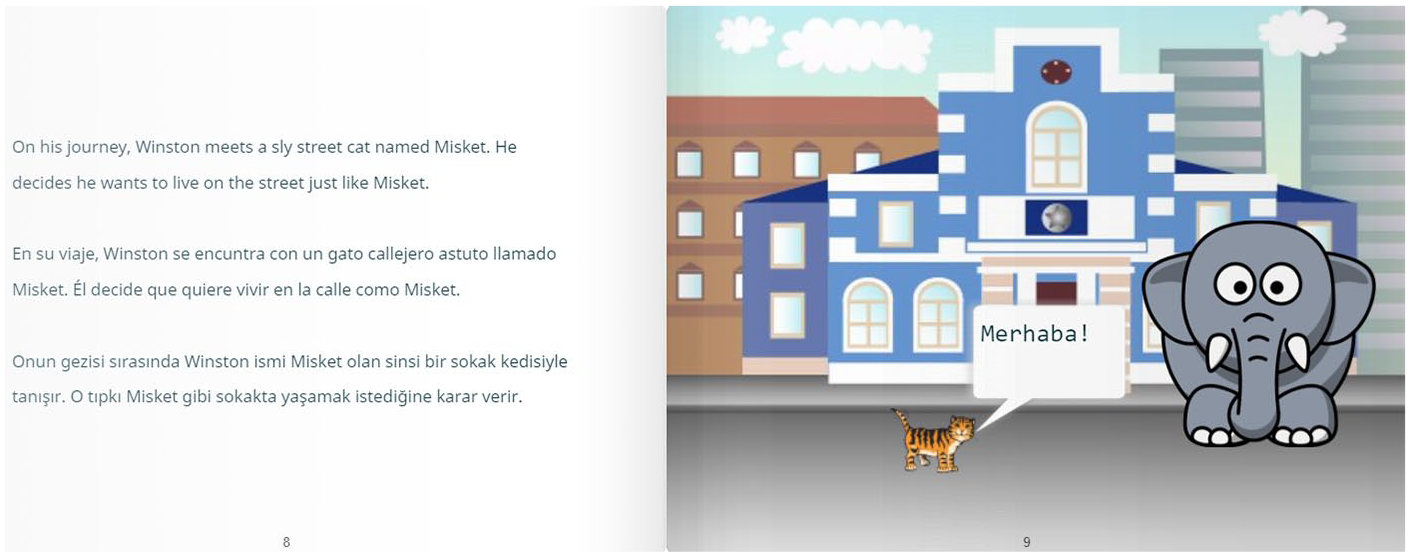
Sample pages from ‘Winston Leaves the Circus’.
b Recordings of Zoom conversations
In these video conversations, the U.S. TCs appear to sense that they are coming close to and entering a sort of borderland between staunch monolingualism and the possibility of (1) language mixing and translation, (2) interculturality, (3) diverse linguistic and literacy practices, and (4) potential misunderstandings in those practices. We offer below examples from the video transcripts of each of these ‘borderland’ phenomena. The four U.S. TC pairs (eight from a total of 36 U.S. TCs) whose video encounters were selected for closer study, approached the task of sharing kamishibai and digital stories differently. Some asked directly for live Turkish translation; others performed their stories and listened, in turn, to those of their Turkish counterparts; others wrestled with the constraints of an electronically mediated environment and abandoned the interaction prematurely.
For all four groups, the idea of collaborating on a story with Turkish TCs at North Anatolian University had changed to a compromise position. Each of the TC groups, in the end, created their own stories in kamishibai or digital formats – targeted at learners in the sixth grade or younger – and solicited the Turkish or U.S. teams for feedback. In the case of the U.S. TCs, they asked for translations into Turkish while also in some cases supplying Spanish translations. None of these four U.S. TC tandems had opted for the last of the three final-project options, which was a ‘translanguaging children’s book’ featuring at least one character who did not speak English. Addressing our first research question, the U.S. TCs expressed some of the discomfort with translanguaging as a concept or pedagogy later in their post-reflections in which they tried to define ‘translanguaging’ and to describe their experiences with it (see TCs’ post-reflections below). We present the four categories of challenge to monolingualism with extended transcripts and video stills from the Zoom conversations.
c Language mixing and translation
There were several video interactions about the possibilities of language mixing and the task of translation, for which the U.S. TCs were almost exclusively reliant on their Turkish partners. However, in Group 3 the U.S. TC pair of Ruby and Natalia had already supplied a rendering of its story, ‘How the New Kid Feels’, into Turkish, which surprised the Turkish TCs, Ayla and Özge, when the two groups met on Zoom:
[Inaudible] We have checked your translation, Turkish. It was very good [gives thumbs-up gesture].
Uh huh. Yeah, we uh . . .
You just used Google Translate, right?
Yes.
That’s Google Translate.
Yep, just Google Translate. I literally just put it in there and hit ‘Go’, and it just [makes spinning motion with her hand] . . . we had – when we did our, our thank-you messages the other day, umm, [name of professor] told us that it was actually translating correctly, when we were typing them in, and we were surprised.
It was great. I mean, I was shocked.
I know.
‘How did, how did they translate that?’ [laughs].
[Laughing] When we, umm, I, I’ve known from past experience when I tried to do Spanish, umm, that the Spanish doesn’t, umm, isn’t able to tell what’s male and what’s female, and a lot of when they’re speaking is male or female, so it made it very difficult to try it in Spanish. So, I had that translated by, umm, a friend of ours whose wife is from [name of city], Texas, which is really close to Mexico. Umm, and she went ahead and translated it for . . . she’s also a teacher as well. And she’s actually a bilingual teacher, so she teaches all of the students to speak English, so . . . yep.
Wow.
The TC groups first express surprise about the technological affordances of Google Translate. Notably, Özge refers to her response when she sees the ‘How the New Kid Feels’ story translated into intelligible Turkish, by indirectly referencing what she knows to be the monolingualism of the U.S. pair: ‘How did, how did they translate that?’, not expecting them to be able to speak Turkish. The U.S. pair then offers a reservation about blindly using machine translation with Natalia’s comment about the possible inaccuracies in translating between English and Spanish. They make a reference to the professor, and in a way cite his support and confirmation that it translated accurately. They acknowledge that there are cases when there is no substitute for a human translator. In this case, they need an authentic, personal relationship with a borderland dweller who can serve as ‘language mediator’ (Yanaprasart, 2018, p. 14).
Group 1 (Olivia and Emily) were in dialogue with Turkish counterparts, Elif and Yıldız, and participated in a video exchange about language teaching methodologies that addressed the potential to mix languages in a multilingual classroom. The Turkish TCs appeared to endorse strict language separation in the Turkish context, with Emily and Olivia going along:
Are you guys gonna like teach both English and Turkish, like do you teach both together [links fingers]. Or is it like separate?
In kindergarten or in general?
Just what y’all are gonna teach in general, I think.
Umm . . .
Integrated . . . Turkish and English.
We have two separate classes, one is Turkish and one is English, but we don’t use our native tongue in English classes.
Oh, okay.
We don’t use any Turkish in English classes [gestures with hand cutting across her throat].
Oh, wow.
’Cause our teacher said that they cannot learn [inaudible] if you talk in Turkish.
Yeah. I mean I feel that would work better than the way Spanish is [taught] here [laughs].
Yeah.
The gestures noted in the transcript are worth mentioning for how they facilitate this translingual encounter and how they solidify the Turkish pair’s objection to translanguaging pedagogy. The Turkish-speaking TCs, Elif and Yıldız, frequently resorted to Turkish between themselves (see a second Group 1 excerpt below, under ‘Misunderstandings’). One might note the contradiction in how Elif and Yıldız use their linguistic repertoires in negotiating this long-distance Zoom interaction, but based on received wisdom from some teachers, remain staunchly monoglossic in their philosophy of working with ELLs. Elif emphatically makes a slicing motion across her throat, an almost violent allusion, to signal how dangerous the idea of language mixing seems to her because of what she was taught about teaching English as a foreign language. Emily laughs, making a joke to contrast how Spanish is taught in her context, and Olivia agrees. The U.S. pair signals concord, despite having been introduced to translanguaging earlier in the course and despite the objective behind the final project, which is to negotiate multiple linguistic repertoires within a single narrative. Emily and Olivia’s agreement perhaps represents a case of the ‘make it normal’ principle (Canagarajah, 2013, p. 86), a negotiation strategy in translingual practice to smooth out group interaction and to facilitate agreement.
d Interculturality
While seemingly limited by lack of competence in Turkish, the U.S. TCs are nevertheless challenged by having to serve as intercultural interpreters, thus gaining a taste for what they might encounter in future classrooms. They are called to ‘perform’ English, via Zoom, for their Turkish interlocutors, in a manner unique to synchronous transnational telecollaboration. Thus, they embody the performative dimensions of translingual encounter suggested by Li (2018) in his conceptions of translanguaging space: The act of Translanguaging creates a social space for the language user by bringing together different dimensions of their personal history, experience, and environment; their attitude, belief, and ideology; their cognitive and physical capacity, into one coordinated and meaningful performance. (p. 23)
The U.S. TCs in Group 2, Zoey and Elena, perform through gesture (see Suárez, 2020) and other modalities (García & Li, 2014; on ‘performative competence’, see also Canagarajah, 2013, p. 88), including exaggerated intonation, laughter, and other means to help bring their Turkish listeners, Nuray and Hande into a U.S. college sports arena in the example below:
. . . I have a question: I search on the internet, uhh, ‘Eat ’em up, Tigers [pseudonym]’, your university’s logo . . .
Yes.
Yeah.
I think –
We say it, umm . . .
[Nods and laughs.] Yeah, yeah. Uhh, what’s the meaning of, what’s the meaning of ‘Eat ’em up, Tigers’? . . . I don’t know.
So, like, umm, at sporting events and, umm, stuff like that where people play sports, the crowd like . . . it’s just like something they yell, so like instead of, ‘Go, team, go’, it’s like, ‘Eat ’em up, Tigers!’ [laughs].
Like, we’re gonna win, so we’re gonna eat you up [laughs].
It’s like, umm, beat them and finish them, or something like that?
Yeah, like we’re gonna beat them, but instead of beating them, since it’s a [tiger], we’re gonna eat ’em [laughs].
Yeah, it’s like uhh, if you look up what a [tiger] is, it’s really scary looking, and our mascot looks nothing like it, but that’s what it’s supposed to be, kinda like a [makes claw gesture with right hand; see Figure 3.] . . .
It’s like, ‘Go, team, go!’ but the scary version [makes air-quote marks with her hands].
That matches him. But, yeah, that’s uhh [Elena laughs] . . . we say it a lot and it goes like, ‘Eat ’em up, Tigers!’ [makes circular motion with right hand, drawn into the shape of a claw; see below.] That’s what we do.
There are multiple semiotic layers at work in the above excerpt. First, there is the most superficial level of the synchronous video-mediated interaction itself, which seems to influence Nuray toward exaggerated laughter while asking her question, signaling awkwardness in having to pronounce a Texas-based colloquialism. The colloquialism itself, ‘Eat ’em up, Tigers’, provides another level of semiotic nuance, as the U.S. TCs had to explain both the phrase’s literal and contextual meanings via performative means. They are invited linguistically onto their own terrain, in which the use of shortened forms such as ‘gonna’, ‘kinda’, and ‘’em’ are welcomed. The U.S. TCs also accept this positioning and use ‘we’ (that’s what we do) to index students in that university and place themselves within that community. In addition, there is the layer of gesture as mentioned above, which is also influenced by video mediation, as the U.S. TCs on multiple occasions shape their hands into claws, scrape at the air, and use ‘air quotes’ to try to simulate the surroundings at a college football game or other athletic event.
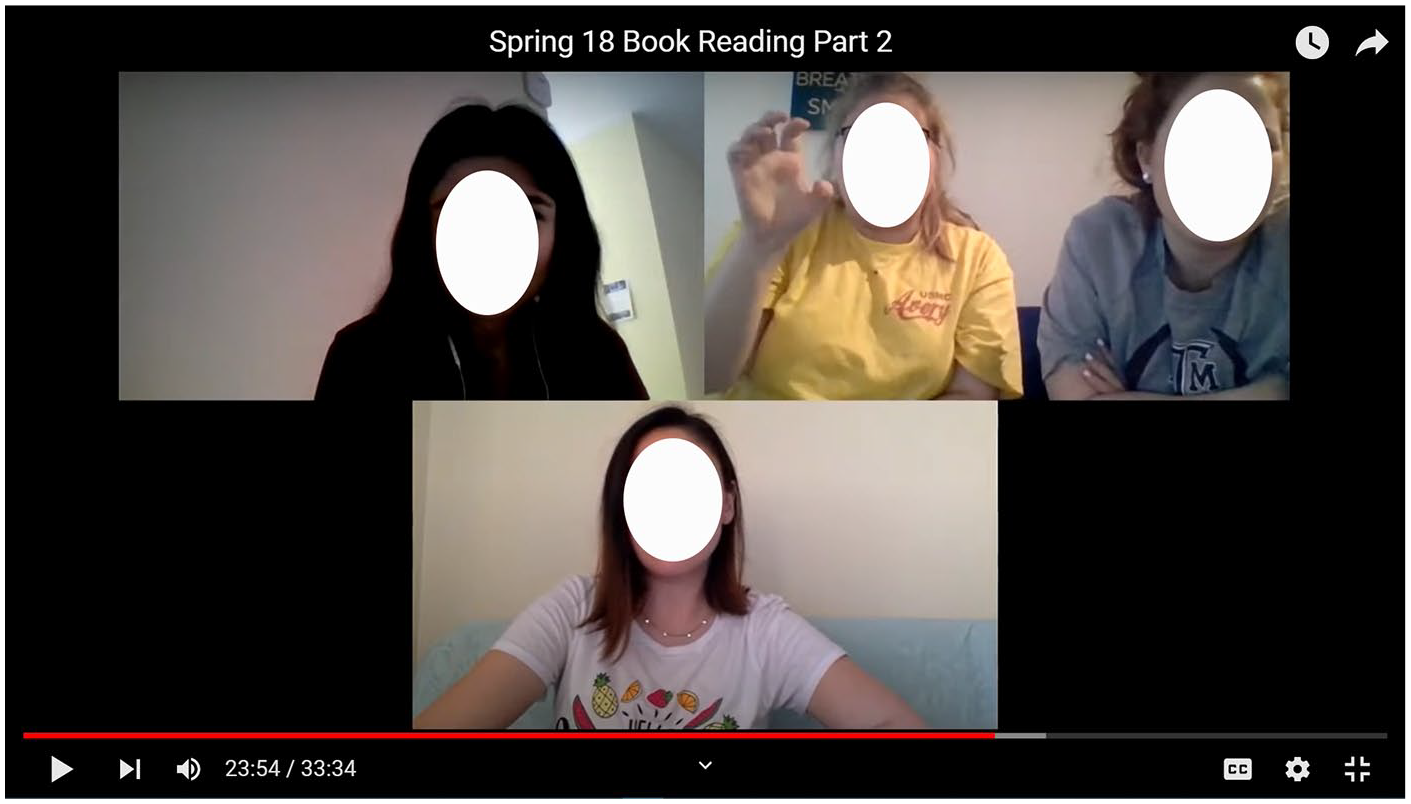
Group 2’s Zoey makes claw gesture to help explain ‘eat ’em up tigers’.
e Diverse linguistic and literacy practices
The diverse linguistic and literacy practices evidenced in the Zoom meetings also point to another challenge to monolingual ideologies. The same U.S. TC grouping of Zoey and Elena, later in the interaction, is ushered into the depth of their Turkish conversation partners’ literacy knowledge and practice during a conversation following performance of the Turkish TCs’ story, ‘Fox and Crow’ (see Figure 4). Attention to the use of the word ‘cunning’ in the story leads to a curious reversal in which the Turkish dyad volunteers to ‘share’ its story with the Texas-based pair:
Is that like a Turkish folk tale?
Uhh . . .
Or is that just like a widely known one that I don’t know?
So, you don’t know this story, okay. It’s a classical one. I don’t know if it’s from the Aesop or not [inaudible]. But, yeah, I remember that I, umm, uhh . . . I remember it from my childhood, the story about the liar people who can deceive with nice words, and you shouldn’t believe them. Everybody’s used this objective for some people’s voice. Eh, he has a kind of crowy voice in Turkish, and so the crow knew nobody [speech garbled] voice. [Speech is garbled for next 0:14, as Hande finishes explaining her memory of the story.]
It was very – I loved your use of like adjectives and uhh like you brought back the word ‘cunning’. I haven’t heard that in a really long time, and it’s like one of my . . .
[Interrupts] I like that word.
Yeah, it’s like a really like awesome word, and I love that it was in there. Like I – I really liked both of y’all’s stories. They were like so like cute, and if I was like in a classroom, I would [inaudible].
[Inaudible.]
Also, the word ‘cunning’ in Turkish use always, uses always with the fox, like uh ‘cunning as fox’, we say. But I didn’t want to use that adjective in my story because it’s, uhh, would be always repeated to you. And in every page, I have to use it if it goes with the content. ‘The cunning fox says’, ‘The cunning fox asks’ . . . I didn’t want to use it. I just wanted to give the moral at the end because they also get the idea in the middle of the story, so they could be hate from the fox. But I didn’t want that feeling. I just want to show that if you believe that someone you don’t know, you just met [speech garbled], which is very important for you, because, uhh, [the crow] was very hungry at the beginning of the story. And he just want the piece of food, piece of cheese, and he also lost it suddenly. And, he also beginning, uhh, the line says he wants to, uhh, find some place that he doesn’t want to share his food at all. So, he lost because he was also not generous to share with his friends. So, there are also two morals, actually.
Well, I really liked that story. I’m glad like, uhh, you were able to introduce it to us.
Yeah, I like it, too.
It’s all yours [spreads arms wide]. You can use [laughs].
We might.
No, I don’t. I always share with you [laughs].
The excerpt is interesting in several dimensions. First, from the beginning, the Turkish TCs are presenting in English a broadly circulated Aesopian fable (see http://read.gov/aesop/027.html) and introducing this widely known children’s tale to the two U.S. TCs, seemingly for the first time. Hande offers a miniature version of her own literacy autobiography, sharing how she remembers the story from childhood, even the protagonist animal’s ‘crowy voice’ in Turkish. In validating the Turkish TCs’ command of English, Zoey praises the choice of adjectives throughout, especially the standout vocabulary word ‘cunning’, a word pulled from a lofty English register for which Hande makes a direct one-to-one correlation with the Turkish language. The TCs’ lengthened discussion on comparing the word ‘cunning’ in the two languages and the associated meanings almost blurs the rigid boundaries between the languages where the semantics and functions overlap while the morphology may still be different. This brief discussion also serves as an indicator of the TCs’ interpretation of translanguaging and their openness to talk about language differences and discuss how they can creatively use them to amplify their intended meaning. In this case, ‘cunning’ was not a word that the U.S. TCs would come up with on their own, but appreciated that the Turkish TCs used it (interpreted as an influence of their first language). Furthermore, Hande embarks on a literary analysis that identifies the ‘moral within the moral’, which is the crow’s own selfishness in not sharing the food with fellows. Seemingly aware of the curiously reversed situation within this contact zone interaction, Hande exaggeratedly spreads her arms and declares, ‘It’s all yours’, then laughs as she transfers ‘ownership’ of this long-transmitted, Greek-provenance tale to listeners in the U.S. By doing so, Hande also indicates that the four participants in the conversation share a vocational orientation of teaching English to young learners. That is, the idea of sharing in this context means that a teacher shares future classroom material with another teacher.
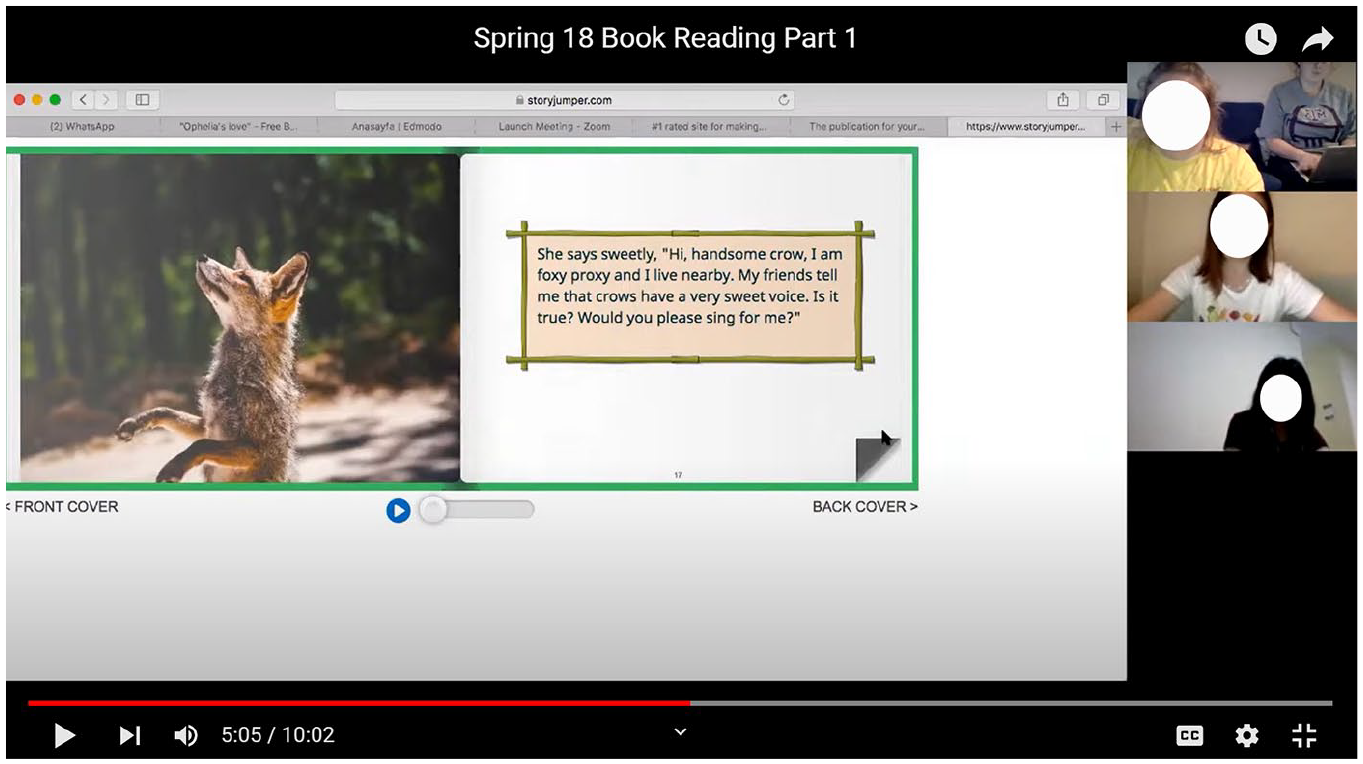
Screen shot from presentation of ‘fox and crow’.
f Misunderstandings
Finally, in their discourses, the U.S. and Turkish tandems are privy to misunderstandings and frequent negotiations that characterize such a translingual space. One extended example occurs in Group 1 as Emily takes the lead in completing her group’s assignment and tries to arrange a live Turkish translation of their story, ‘The Wild Ride’. Preparations begin at the 03:31-minute mark of the recording. Not until the 08:04-minute mark do Elif and Yıldız begin reading the story in Turkish, as the U.S. TC explains the technical requirements for recording the Turkish TCs’ words. Then, midway through the interaction, a third Turkish TC, Dicle, who had been experiencing internet-connection issues, joins, and the explanation had to begin again amidst the Turkish TCs’ code-switching between Turkish and English:
Welcome [inaudible].
[Speaks in Turkish to Dicle.]
[Replies in Turkish.]
Yes, we can hear you. [Gives thumbs-up.]
Sorry, I have some problems about the internet.
Umm, so we were just saying that, umm, uh, we were gonna read our story that y’all translated into Turkish, if y’all would read in Turkish so that I could put it in the video file, umm. I was saying that it’s just gonna be, like, the images, er, the PowerPoint slides that y’all saw when you translated to Turkish. That’s all that’s gonna be seen in the video. It won’t be anybody’s faces or anything, uhh, it’ll just be those slides, and then you’d hear your voices reading in Turkish. So, I don’t know if y’all wanna take turns on pages, or one of you read it, or whatever, however y’all wanna handle it, umm, but, I guess, if y’all would read that and then I’ll record it on my phone just to make sure, ’cause I don’t know if I’ll be able to pull it . . . I’m recording the meeting, um, to submit, but I don’t know if I’ll be able to pull audio off of it, so I’m just gonna record it on my phone, too. But . . .
[Speaks to Yıldız in Turkish.] Do we need to, umm, [inaudible] all of them, eh, English and Turkish?
Uhh, just Turkish, ’cause I’ll read it in English for the video, but if y’all would do the Turkish, ’cause I’m not about to try that [laughs]. But, umm . . .
Can you read your, umm, sentences, and I say . . .?
[Speaks in Turkish.]
Okay, just can both of us read the Turkish statements?
All right, perfect.
Emily demonstrates patience and persistence in explaining, in extended detail, the recording requirements: the need for mutual access to PowerPoint slides, the taping of the Turkish TCs’ audio via smartphone, the satisfaction of the assignment parameters, and so on. Again, these are experiences encountered when stepping from monolingual confines. Such encounters will be the reality for the U.S. TCs as they enter classrooms in Texas to work with English language learners. Perhaps Emily’s efforts are complicated by her recourse to shortened forms such as ‘gonna’, ‘wanna’, ‘’cause’, and ‘y’all’, which might indicate reluctance to switch registers, lack of awareness of her own speech patterns, or deliberate commitment to her own idiolect. In fact, Emily is able to make a joke about her self-perceived linguistic limitations, as she protests that she would not be able to do the Turkish reading herself: ‘. . .if y’all would do the Turkish, ’cause I’m not about to try that [laughs].’ After the Turkish performance, Emily extends her admiration of the Turkish TCs’ linguistic repertoire, saying, ‘Yeah, that was crazy, like, I don’t know [inaudible] most Turkish sounds [laughs].’ The statements elevate her Turkish conversation partners’ multilingual capacities (Yanaprasart, 2018) in a gently self-deprecating manner, while still clinging, again out of pride or blindness, to her own English idiolect. Such observations open a pedagogical opportunity to discuss how these TCs are aware of or might accommodate their future students’ target language capacities and comfort levels.
Research question 2: How do the U.S. TCs interpret and define translanguaging through their experience in this telecollaborative contact zone?
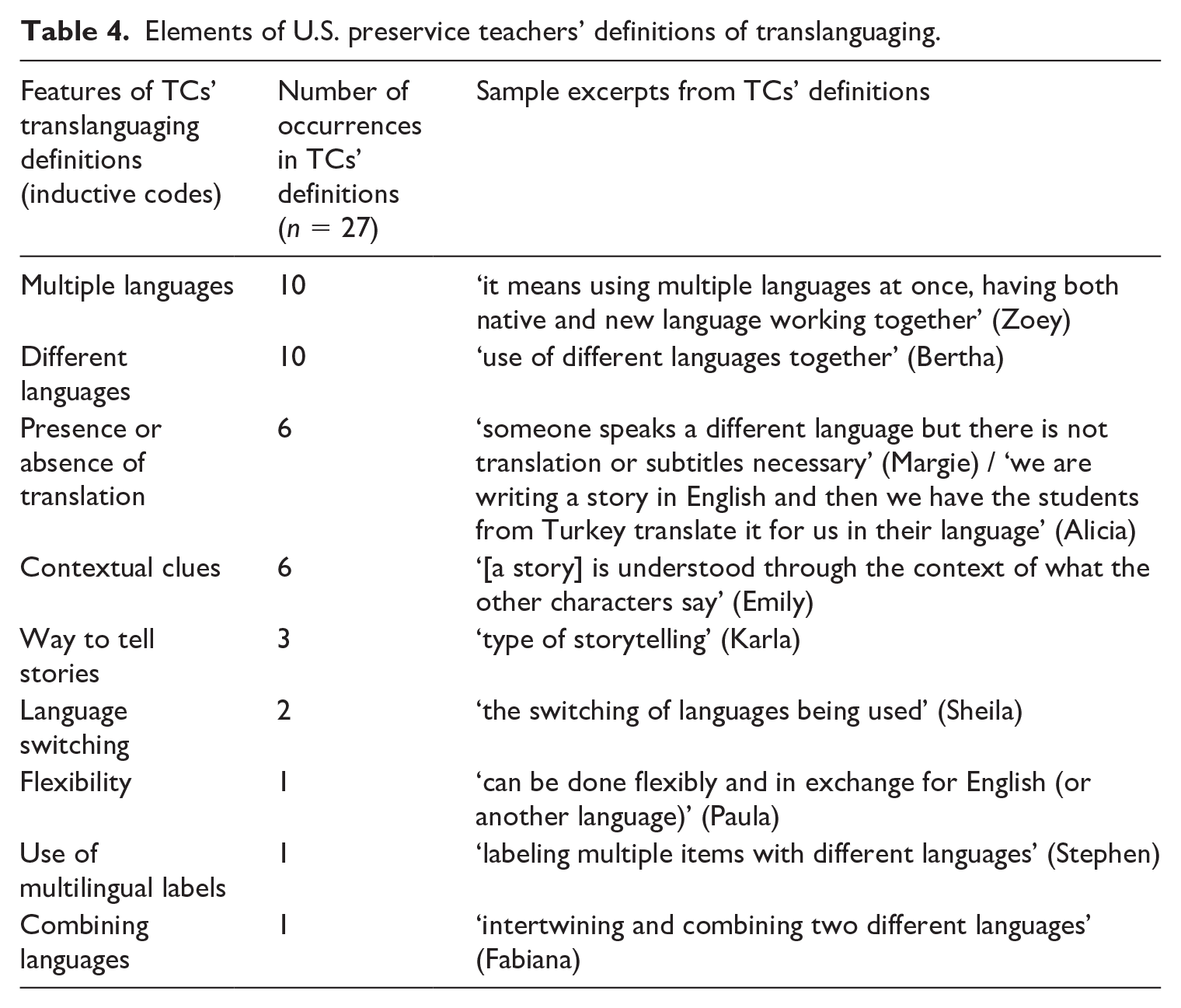
Thirty-five of the 36 U.S. TCs completed post-reflection assignments after the telecollaboration; among these 35 post-reflections, 27 TCs supplied definitions of translanguaging, summarized in Table 4. The two most frequently mentioned aspects, which we identified through inductive coding, were that translanguaging features multiple languages, or blends different languages. There were related definitions involving language switching, the use of multilingual labels for classroom objects, and combining languages. Also fairly common was reference to translation which occurred six times among the 27 definitions, and was likely influenced by the course’s final assignment, for which most U.S. TC pairs elicited Turkish translations from their international partners. Interestingly, some TCs believed that translanguaging occurs without recourse to translation. That is, understanding might result from environmental cues, as in the Peanuts animated cartoons when the child characters are able to respond to their teachers’ voices, rendered as muffled trumpet sounds. The following TC, Natalia, refers to Peanuts in her definition:
Elements of U.S. preservice teachers’ definitions of translanguaging.
Translanguaging, I would explain that it is a way of saying what the person is saying by not actually translating it. For instance, on Charlie Brown, the teacher is represented by a noise when they speak, but Charlie Brown always talks and answers to the teacher by saying things like, ‘so your saying that there is going to be a test?’ Which then tells you the teacher was informing him that he is about to have a test in the class. I think that explaining translanguaging to someone who has never heard it before would be slightly difficult without a relatable example that the person can make a connection too.
Such definitions of translanguaging seems to be influenced by the fact that translanguaging was presented to TCs in the context of creating semester-concluding kamishibai, video narrations, or digital stories. Most explicitly, three definitions characterized translanguaging as a storytelling technique.
Analysing TCs’ post-reflections on the experience of writing a multilingual children’s story by using kamishibai or translanguaging, we coded TCs’ responses (n = 35) and thematically presented them in the following categories:
Translation and translanguaging (nine responses). Many responses connected translanguaging with translation skills or the act of translation. Says one TC, ‘I learned that it can be hard to try to translate words into a different language. So now I can only imagine how elementary school students would feel trying to translate text into a different language’ (Lana).
Cultural diversity (nine responses). TCs thought multiculturalism went hand in hand with multilingualism as they created translanguaging texts, e.g. ‘[T]here are formats out there in which people can defy language barriers and cultural differences’ (Alta).
Future classroom application (seven responses). TCs envisioned borrowing the activity for use in their classrooms, e.g. ‘I feel like this would give ELLs an awesome way to get communicating with their peers’ (McKenna).
Childhood connections (four responses). TCs saw the value of the translanguaging activity for making a child-friendly text, e.g. ‘What I have learned from this experience would be how to make a children’s story using the kamishibai method’ (Priscilla).
Multiple languages (four responses). Several TCs noted how translanguaging facilitates the use of named languages in concert, e.g. ‘[I]t was rewarding to see the book come to life and see all of the languages working together’ (Doris).
Creativity (two responses). TCs viewed translanguaging as an inherently creative process, e.g. ‘Figuring out how to incorporate Spanish within English . . . was challenging but also allowed me to be creative’ (Natalie).
Translanguaging anxiety (two responses). For two TCs, the notion of translanguaging invoked nervousness, e.g. ‘I felt that the translanguaging might be above my skill level’ (Natalia).
Language acquisition (one response). TCs regarded the translanguaging task as useful for learning languages: ‘It also helps [students’] development of their weaker language’ (Melanie).
Language ideologies (one response). Having to execute a translanguaging assignment helped Mark show sensitivity to minoritized languages: ‘I had to make sure that we respected the other language without being too harsh to the character that spoke another language.’
Scaffolding for reading (one response). Lana saw the translanguaging project as a useful reading tool: ‘I learned that having a book in multiple languages can make reading easier for students.’
Importance of context (one response). Natalie writes, ‘I learned that context clues can help people make sense of the input even if they do not understand everything that is being said.’
Translanguaging expectations (one response). Grace noted of the TCs from Türkiye that ‘they use translanguaging sometimes but not as much as I thought they would.’
Writing process (one response). Olivia connected translanguaging to the creative side of storytelling and its challenges: ‘[I]t strengthened my ability to think creatively, as well as collaboratively.’
Most extensive in TCs’ post-reflections was comment on translanguaging as a translation process. Participants for the most part recognized that translation is a nuanced skill, and that some ideas are more translatable than others. For example, Paula comments that an attempt to add alliteration to their story was aborted when the pair realized that the resulting text would not necessarily be alliterative in a second language. Paula says: ‘I have learned kind of what it is like for someone to have to translate words in their mind’ and she adds ‘It can be confusing and things might not transfer well.’ In addition, many TCs identified a possible shortcoming in the assignment in that the translation work was one-sided because they lacked skills in Turkish. One TC, Emily, the coauthor of ‘The Wild Ride’, writes: The way that the project was done created a disconnect between the two sides of the story. [Olivia] and I wrote it in English, and the girls from Turkey translated it to Turkish. We didn’t collaborate on the translation or the writing, so the two countries were fairly disconnected throughout the process. The part that was really cool, however, was hearing the girls from Turkey read our story in Turkish.
The U.S. TCs think that they missed an opportunity for true collaboration by conceiving of a multilingual tale together with integrated language elements. Certainly, given the need to coordinate video meetings, practical issues were at play: They had an eight-hour time difference, and needed to negotiate the internet connectivity issues at times. The sense of distance from Turkish partners appears to have been accentuated by the separation between English and Turkish, to which the translated story products called attention.
V Discussion and conclusions
An open question at this stage is to what extent these U.S. TCs still view translanguaging as translation or the mixing of languages (conceptualized as separate codes) based on their provisional definitions of translanguaging and other post-reflections. The ideal goal that is presented in the research literature is a pedagogical stance that (1) involves integration of language practices and cultural understandings to enhance learner identity, (2) advocates for the voices of families and community, and (3) regards the classroom as a dialogical, democratic space (García et al., 2017). In addressing the first research question, i.e. how the U.S. TCs’ monoglossic orientations have been challenged during their translingual collaborations with the TCs from Türkiye, we found that the TCs approached the integration of English, Spanish, and Turkish in their final artifacts as a novelty, and demonstrated their lack of familiarity with this concept. They were surprised to hear the discursive representation of another language, especially more so in the case of Turkish. While Spanish was interpreted to be somewhat closer to English and looked comparatively more natural to co-exist with English text most likely due to their exposure in the southwestern U.S. context, Turkish was distant from such positioning, and its presence along with English discourse was an extraordinary scene.
The translinguistic differences the TCs encountered were not merely phonological or lexical, but also had pragmatic underpinnings. In their post-reflection, one TC (Annie) wrote: I learned about the differences in conversational skills in the U.S. and Turkey. As discussed in class, normal conversations in Turkey are like bowling, while normal conversations in the U.S. are more like playing tennis. We did follow a kind of turn-taking procedure when conducting our meetings. This was different to me because I am used to more of a discussion, back and forth type of conversation. I felt like I needed to talk more than I normally do because nobody else was interrupting to talk themselves. I also did not know how to really end my portion of the discussion, since I am used to having someone else cut in or respond quickly.
In this example, Annie illustrates García et al.’s (2017) ‘integration of language practices and cultural understandings to enhance learner identity’ when she carries out an English conversation with a new conversation style that is inherent to Turkish in her experience, thereby stepping outside of her comfort zone and making herself vulnerable in this new role. The distance between Turkish and English was also more prominent with TCs’ avoidance from trying to pronounce the Turkish words. On the other hand, a translanguaging stance would encourage the teacher to try out their students’ language and put themselves in the position of a learner while empowering them at the same time. This happened in some of the stories where the main character spoke the language of their peers. It is also interesting to note that the TCs were more comfortable with producing Turkish discourse through Google Translate, but shied away from reading or writing it on their own, probably out of respect for not claiming ownership or not making any mistakes in their peers’ language.
To address the second research question, the way that the U.S. TCs interpret and define translanguaging suggests that they do regard it as more-or-less congruent with code-switching. The outcome is not surprising, given that the final product of the U.S.-Türkiye telecollaboration was designed as a bilingual text, which the U.S. TCs tended to interpret as an English-language narrative with translations. The epistemological distinction between translanguaging and code-switching – that the former refers to creative and performative application of a single linguistic repertoire (García & Li, 2014, p. 22) – has yet to be expressed by the U.S. cohort. For the U.S. TCs, the epistemological restrictions of code-switching – belief in separate, named languages akin to ‘compartments in a box separated by very thin walls that should not be damaged’ (Goodman & Tastanbek, 2021, p. 43) – have not become readily apparent. But they are in good company with other teachers reported on in the research literature that discuss conflicts between teachers’ and students’ beliefs about the two concepts and the ongoing debates over how either code-switching or translanguaging should be encouraged or discouraged as language-learning practices (Andrei et al., 2020; Goodman & Tastanbek, 2021). We did not find in the research data any ‘breakthrough’ or ‘aha’ moments in the U.S. cohort that helped them connect the multilingual negotiations with Turkish students with what they might one day face in their language classrooms. Nor is there direct metalinguistic acknowledgment of their own linguistic repertoires and the limitations of monolingualism. The closest example was when a TC (Stacey) wrote in their post-reflections: ‘I found it very interesting when they said that they know many languages. It is just a normal thing to be multilingual in Turkey rather than hear most people stick with just English.’ Such conceptualization is likely linked to the macro discourses circulating in the U.S. context and in the teacher education curriculum. For example, the TCs were being trained to receive ESL certification to teach ELLs in their future classrooms. In terms of policy and curriculum, there is no explicit expectation for them to promote translingual practices or multilingualism in general as a desired asset in their future classrooms. Instead, they are expected to create multicultural and multilingual learning environments only toward the ultimate goal of teaching English to multilingual students. In other words, translingual practices rely on multilingualism being promoted and acknowledged in a context so that they can be actively enacted by the speakers. In the absence of multilingualism inherent in the macro discourses, monoglossic imagination of the educational contexts (teaching multilingual students English) will continue. As a matter of fact, the 232-page state guidelines for the ESL supplemental certification mentions the word ‘multilingual’ three times throughout the document: ‘ . . .the ESL teacher must know how to leverage multiculturalism and multilingualism in order to address the affective, linguistic, and cognitive needs of English learners while facilitating both content learning and language acquisition in accordance with TAC’ (The Texas Education Agency [TEA], 2019, p. 34).
Turning back to the first research question – how U.S. participants’ monoglossic ideologies have been challenged – we can say that the walls between ideations of linguistic purism and real-world languaging were fractured, if not torn down (Lau, 2020b). We need to acknowledge the fact that the U.S. TCs were exposed to translation as art and communicative practice and that they needed to engage in mediated translingual practice to obtain the required Turkish translations. Translation is an indispensable part of translanguaging pedagogies (see García & Li, 2014, p. 101) and can be considered alongside multimodal tools such as bilingual texts, realia, pictures, videos, mimicry, and gestures as ways to boost vocabulary and provide translanguaging support (Sánchez et al., 2018; Vaish & Subhan, 2015). For example, Vaish and Subhan (2015) describe a situation in Singapore in which second-grade students’ authentic language talents are allowed voice, partly through translation, rather than being rejected by the ideological power of monoglossia. This triumph might also be claimed for TCs in this U.S. cohort, who were moved from their mostly monolingual surroundings into a multilingual reality. Although they still only spoke English, they had to access gesture and become parties to bilingualism, collaboration, mediation, and vernacular expression to which Pratt (1991) refer as ‘literate arts of the contact zone’ (p. 37). For example, Shana was able to voice a desire to move beyond translation to a more intense language contact: ‘I wish I would have had more chance to speak with the students from Türkiye about translating the book, or having them assist me make it a book that used more translanguaging.’ What could be said to be missing in the U.S. cohort’s translanguaging introduction is appreciation for the stance’s social justice applications – in the sense that speakers’ own linguistic practices take precedence over that of nation-states (Vogel & García, 2017) or any clear definition of linguistic justice (Woodley et al., 2020).
In telecollaboration, we have a case of first-order languaging which is dialogic, social, potentially transformative, as opposed to language as a second-order abstract code (Turner & Lin, 2020). In contrast to a typical classroom environment, these U.S. TCs needed others’ language skills to finish a collection of assignments. They also resorted to a range of ‘negotiation strategies’ (Canagarajah, 2013, p. 86), including clarification, repair, and confirmation, in addition to trans-semiotic affordances such as gesture, laughter, silence, and facial expressions to complete the necessary transactions. Furthermore, the requirement to fashion a multilingual classroom resource pushed the U.S. TCs to devise stories that featured international themes and, in many cases, to include languaging moments within the narratives. Therefore, the telecollaboration included the structures for affirming translanguaging as a theoretical stance and pedagogical tool. However, it lacked an overarching pedagogical framework and theoretical conception of translanguaging that would emphasize the latter’s performative and creative affordances for making translingual negotiation a dynamic occasion for cross-cultural interplay. Even if the U.S. TCs did not speak any Turkish, the project had translanguaging aspects. That is, one objective of the activity was to help TCs imagine their future classroom ecologies as diverse linguistic spaces characterized by students’ multilingual repertoires (for an ecological perspective on translanguaging, see Allard, 2017). The U.S. TCs’ take on translanguaging in this study is similar to Andrei et al.’s (2020) class in which the TCs leave with a range of definitions and still harbor uncertainties about exactly how to translate translanguaging theory into practice, even after engaging in targeted classroom discussion and reading about translanguaging. We might assume that this U.S. cohort moves onto their teaching trajectories with many of the same uncertainties.
We would not know if participants leave with a sensibility that ‘[t]he goal of English teaching and learning in the post-multilingual era is no longer acquiring the native-like form of English and becoming another monolingual, but becoming a competent, multilingual language user’ (Tian et al., 2020, p. 10). Regarding what a competent, multilingual language user looks like, the U.S. TCs can draw on their direct experiences with the Turkish translanguaging project. However, to imagine a change in teaching approach or to apply translanguaging as a philosophy and pedagogy, it will take significant investment, as well as leading the TCs toward awareness of multilingual realities and their own ideologies through modeling and examples.
Our telecollaboration followed the recent critical, multilingual approaches advocated by leading scholars who use telecollaboration for teacher education (e.g. Kato & Kumagai, 2022; Kumagai & Shimazu, 2023; O’Dowd, 2020). It also responded to the calls for integrating learning opportunities for the TCs in teacher education to challenge the monoglossic ideologies (e.g. Deroo et al., 2020; Goodman & Tastanbek, 2021). Our findings demonstrate that telecollaboration is an inexpensive pedagogical activity that teacher educators can incorporate in their practices to lead the TCs into a translingual contact zone in which they would need to engage with ‘otherness’ (Byram, 1997) in terms of language and culture. That engagement does not guarantee the absolute shift from monoglossic perspective to translingual dispositions. As we witnessed in our TCs’ data, such engagement has the potential to begin destabilizing pervasive monoglossic ideologies which are too well-entrenched in societal discourses. When we consider that encountering with otherness will be part of the TCs’ future classroom reality within increasingly multilingual contact zones in the U.S. schools, the destabilization of their monoglossic ideologies or realizing the tension in their beliefs about language use in contact zones are particularly important. Additionally, regarding the contribution of telecollaboration with its embedded transnational teacher learning activities, it is never a ‘tidy’ intervention which promises lofty goals. It always presents the TCs with numerous novel, organic, and messy experiences with lots of challenges to navigate potential challenges and to negotiate identities as language users and future teachers of multilingual classes. Finally, telecollaboration as a transnational teacher learning practice introduces the TCs to the complexities of their peers’ socioeducational context and gives opportunities to introduce their context to peers. Such transcultural learning emerges in the moments of conversation and relies on the willingness of interactants. That willingness was evident in the examples when the Turkish TCs explained the fable to the U.S. TCs and when the U.S. TCs explained their university mascot, which speak to the ordinary and mundane nature of transcultural sharing (Lee & Dovchin, 2019).
To close, we recommend that colleagues with resources should consider designing and implementing similar transcultural exchanges that could provide TCs with translingual contact zones. Related reflection on such exchanges could easily become transformative learning that connects to the TCs’ professional identity negotiation and construction as well as emotions and agency (see Uzum et al., 2023; Yazan et al., 2023). Teacher educators can bring some example exchanges into their in-person classes to collaboratively reflect on and discuss potential problematization or subversion of monoglossic ideologies.
Footnotes
Appendix A
Acknowledgements
We are grateful to the editor of Language Teaching Research, Dr Mayo Garcia and the anonymous referees for their comments and suggestions on the earlier versions of this article. Their feedback, guidance, and support significantly contributed to improving its quality. We are also thankful to the preservice teachers from the U.S. and Turkey who took part in this telecollaboration project in Spring 2018.
Funding
The author(s) received no financial support for the research, authorship, and/or publication of this article.
