



Abstract
This paper investigates the widespread integration of technology-enhanced learning (TEL) within specialist Communication Design studio education in the UK and Australia. The impetus for this paper has grown from the challenges facing day-to-day design studio education and the recognition that the use of technology in higher education today has increased dramatically. Conventional design studio facilities are being reconfigured into blended studio-based classroom learning spaces (often generically termed as ‘studio’). This study compares the lived experiences of students interacting with technology within two differing international studio settings. The two case studies used a Participatory Action Research approach and employed sensory affect as a lens through which learning within studio education was investigated using Participatory Design practice-led methods. The study finds that the Australian participants working within a TEL classroom-based environment faced significant obstacles to engagement and that their UK counterparts, who were situated within a conventional studio environment, much less so. This paper aims to support Communication Design students as they engage with studio education via the proposed transferable methodological framework – the Methods Process Model.
Keywords
Introduction: two differing international studio education settings
This paper investigates the widespread integration of technology-enhanced learning (TEL) within specialist Communication Design studio education in the UK and Australia. The impetus for this paper has grown from the challenges facing day-to-day design studio education and the recognition that the formal/informal division of educational space is impacting upon student learning and engagement in higher education more acutely than ever before. As a consequence of the changing educational climate which is being directly shaped by global, economic, social, political and technological issues, institutions of Art and Design are now seeing a dramatic change to the way in which design education is taught. For example, conventional, physical design studio facilities are being reconfigured into virtual and blended studio-based classroom learning spaces (often generically termed as ‘studio’).
This study compares the lived experiences of students within two differing international studio settings. The two case studies used a Participatory Action Research (PAR) approach and employed sensory affect as a lens through which learning within studio education was investigated using Participatory Design (PD) practice-led methods. Sensory affect is the awareness of control or lack of control of sensory inputs through the senses, that may interfere with learning and the creative flow. In short, sensory affect is experience, and the effect of those experiences, detected through the body. Therefore, this methodological investigation challenges and explores conventional approaches to learning, teaching and research within Communication Design by employing sensory affect as the vehicle through which analogue, digital and social media tools and techniques are investigated.
The data were gathered via the systematic examination of a conventional studio environment within an art school in the UK (Case Study 1) and a studio-based technology-driven classroom environment within a college of art residing within a parent university in Australia (Case Study 2). Real-life formal and informal learning spaces provided the naturalistic settings in which the research with two groups of Communication Design students was conducted. The participants responded to their everyday learning experiences through detailed and reflective narrative accounts via a series of participatory group workshops and individual visual, sensory and sound ethnographic research methods.
The study found that the Australian participants working within a TEL classroom-based environment faced significant obstacles to engagement and that their UK counterparts, who were situated within a conventional studio environment, much less so. Overall, the findings showed that the participants could either be disrupted or supported by sensory affect in their experiences of these learning spaces. The Case Study 1 participants in the UK responded that their friendly, informal, day-to-day social interactions with peers and staff in their situated conventional studio community, were integral to their collective and individual learning and practice. The Case Study 2 participants created their own offline and online community outside of the boundaries of their TEL studio-based classroom spaces, mainly in cafes, at home and via social media. The findings evidenced the importance of multisensory research methods in drawing out relationships between place, lived experience and community, and to investigate the widespread integration of digital technologies within specialist design studio education. This paper aims to support Communication Design students as they engage with studio education via the proposed transferable methodological framework – the Methods Process Model (MPM) (or elements thereof – to be discussed later in this paper).
Challenges facing Communication Design education and studio learning
What follows is an account of the challenges facing design education and studio learning today because the traditional relationship between the educational institution and the student designer has shifted (Rudd et al., 2006: 5). Consequently, learning approaches and practices in specialist studio settings have seen some dramatic transformations. To contextualise the relevance of these developments in recent years within Art and Design in further and higher education, it is worth highlighting the changes to education in the UK and Australia over the past several decades.
In the UK, these developments started to appear in the 1960s, when the Coldstream Report outlined the formation of art diplomas following the first report of the National Advisory Council for Art Education (NACAE, 1960). Degree status was awarded to recognised art school courses in the UK and the link between the study of art and design subjects and studio training was established (Rust et al., 2007; Thistlewood, 1992). Following this, the Robbins Report (Robbins, 1963) argued that student-to-staff ratios generally should not be allowed to decline and there should be wider access to higher education. Many art schools became part of the Polytechnic system in the 1970s and the guidelines governing quality in learning began to change (Rust et al., 2007). Expansion, efficiency, economic and political accountability became the focus in education (Finlayson and Hayward, 2010). The Dearing Report (Dearing and National Committee of Inquiry into Higher Education, 1997) argued there should be a focus on students’ technological learning skills across a diversity of provision in higher education (National Committee of Inquiry into Higher Education, 1997). In the first decade of the new millennium, significant public investment in higher education saw further growth of physical and digital education in the UK (Boddington and Boys, 2011: xi).
A similar educational reform timeline exists in Australia; in 1957, the Murray Report was the first comprehensive investigation of Australian higher education (Marginson, 2002; Murray, 1957). This report revealed serious shortcomings in the standard of university education, with overcrowding, poor facilities and low student retention rates cited as characteristics. It recommended increased expenditure so that universities could remedy these issues and support widening participation (Murray, 1957). However, it was not until the Dawkins Report in 1987 that key tertiary education reforms were triggered. This report pushed for quality, diversity and parity of access to higher education while also cultivating the international competitiveness of Australian universities (Dawkins, 1987). The West Report and the Kemp Report, published in 1998 and 1999 respectively, reported a crisis of resources and made recommendations for increased levels of participation through low-cost, high-volume technology-based distance learning and the establishment of an economic market in higher education (Kemp, 1999; Marginson, 1998; West, 1998). In 2008, the Bradley Review targeted the recruitment of students from low socio-economic backgrounds, endorsed diversity and quality via funding allocation, and established the Tertiary Education Quality and Standards Agency to enhance quality and support accreditation (Bradley and Australia Department of Education, Employment and Workplace Relations, 2008). Australian universities, like their UK counterparts, recognised the forthcoming income benefits of an increased student population (Bradley et al., 2008; Wild, 2013).
It is widely recognised that universities are endeavouring to reshape education and delivery in more cost-effective ways, as business sensibilities have sought to harmonise with academia on a global scale (Wild, 2013). As wider access and participation in higher education increases, students globally are embracing flexible forms of curriculum delivery and adaptable TEL spaces, which include both virtual and blended modes of learning. As a consequence of this global expansion of tertiary education, higher student numbers appear to be transforming the culture of learning, leading to communities of practice that are qualitatively different from those of a less crowded era (Wenger, 2000). Today, these transformations are impacting on learning and teaching innovation, as ‘more teaching for less’ is expected in visually pleasing, formal and informal physical, virtual and online learning spaces designed to accommodate digital technologies and peer collaboration for large numbers of students (Boys, 2014, 2015; Harrison and Hutton, 2014; Ryan, 2016; Scott-Webber, 2012; Vignoles and Murray, 2016; Wild, 2013).
Justifying Communication Design studio education in this study
The justification for this research study is closely associated to my background and practice as a Communication Design educator, and my personal experience of, and interest in, studio environments. My interest in studio learning developed largely from my conventional art school studio education in the 1990s, while my interest in Communication Design arose from the specific context in which it functions as a distinct discipline. Communication Design employs a different set of skills, applications, practices and functions than those used in other design disciplines. Its project-based framework focuses on team working, client-driven projects, social interactions and creative collaborations. The following sections outline more fully the explicit background of Communication Design, its terminology and its unique practice.
Communication Design is a key phrase for a broad, mixed domain that was traditionally studio-based. It acts as an umbrella term for the design of visual and non-visual messaging, ideas and information, with Graphic Design, Illustration and Photography being its central disciplines. One of Communication Design’s distinctive characteristics is its focus on undertaking design projects that actively identify a problem area where it can play a central and significant role (Frascara, 2004). In this way, the discipline makes a distinctive contribution in the curriculum, from the opening brief to the resulting creative outcome. It requires learning spaces and resources particularly suited to its ever-evolving and divergent practice, and socially constructed design studio communities (Cennamo and Brandt, 2012; Crowther, 2013; Ellmers, 2014; Powers, 2017: 6; Sandbach, 2011; Vyas et al., 2013).
However, as a creative field, Communication Design now assumes a different studio identity due to technological advancements in education, and as blended learning spaces, echoes a changed industry studio model. Dedicated, physical studios are rarer in the changing face of design education, and digital technology has enabled Communication Design students to work external to a physical studio environment mainly within digitally portable spaces (such as laptops). This is partly due to cost pressures and space provision, and for reasons of convenience for the institution (Sassoon, 2009). Conversely, online studios can pose a challenge to people forming trust within a group, with periods of technological interruptions, inaccessibility and time limitations also causing frustration (Saghafi et al., 2012). In the current ever-changing educational landscape, tension exists between the need to deliver both technological and craft-orientated forms of learning by doing while maintaining creativity and innovation in Communication Design (Boling et al., 2016; Montgomery, 2012; Rigley, 2011). Therefore, to understand contemporary design and design education, one needs to also understand how differing international studio settings operate today.
Conventional studio learning and studio-based classroom learning
The character of studio training has changed considerably over time, with its heritage stemming from the workshops of 13th-century Europe (Amirsadeghi and Eisler, 2012). Originally, a team of people in a workshop environment produced work according to instructions. The master of the workshop, normally a reputable artist, would supervise, train and pass on knowledge to groups of students (generally craftsmen), teaching by example. In the mid-16th century through to the 19th century, the master/apprentice model evolved into art academy training, which included lecture theatres alongside studios. In the 20th century, artists and designers seized derelict warehouses, factories and buildings as fashionable workshop spaces, changing the interior and architectural dynamic of studio – this was particularly noticeable from the 1960s and 1970s onwards (Blazwick, 2012). Today, many designers have discarded the conventional artist’s studio model in favour of new modes of working facilitated by technological advances. For example, a studio can now exist as a virtual ‘studio of the mind’, or as a computer-based studio desk, and not only as a physical large or small room space (Amirsadeghi and Eisler, 2012: 6). These far-reaching transformations from the original studio context also reflect a changing print culture and design practice over time and influences the role that studio plays in the teaching of Communication Design today.
The studio in design education normally involves a passionate, driven investment and membership in a creative learning space where a unique set of skills and thought processes are taught. Physically, a design studio provides students with access to the studio environment, often at irregular hours, and with space to work, while work in progress remains on display in their allocated desk space. Every studio, I believe, should have its own identity, character and zones to facilitate privacy, freedom, activism, refuge and expression. The studio should act as a laboratory of ideas and as a gallery space for display (Blazwick, 2012). However, there is a growing trend in teaching design within non-traditional environments, which is now adapting the knowledge and approaches from within studio pedagogy, known as a ‘signature pedagogy’, to classroom-based learning (Boling et al., 2013; Crowther, 2013; Shulman, 2005; Sims and Shreeve, 2012). Studio learning is now often synonymous with classroom learning as the roles that these two environments assume now overlap (Boling et al., 2013; Knaub et al., 2016).
Classroom environments are timetabled, learning spaces, which are found across all educational institutions, delivering creative and non-creative learning, from early childhood to postgraduate education. A classroom is often a carpeted room in which a group of students at desks are taught, with no reference to the traditional workshop (Oxford Dictionaries, 2016). In these generalised educational environments, studio lessons can be facilitated via ‘interactive boards and display devices in the classroom’ typically seen as an attempt to plan, control and orchestrate the studio learning experience in a non-specialised learning space (Scott-Webber et al., 2014: 153). In recent years, a studio-based classroom often exists as an accessible online educational content management system using software, such as Moodle, VLE (Virtual Learning Environment), Blackboard, Adobe Connect or Google Classroom (Google, 2017; Güler, 2015; Pektas, 2012). In consideration of these changes, recent literature now points to studio learning as being dissimilar to traditional studios, with certain educators now having a ‘received understanding’ of studio, having imagined it and read about it, yet not having traditionally experienced it (Boling et al., 2016: 5).
Reconfigured studio environments may impact upon student learning and engagement within Communication Design. The diversity of studio spaces in use today could contribute to the stimulation, indifference or disruption of a students’ senses, and interfere with creative flow and practice. Students may be sensitive to the sensory affects within their learning spaces, yet the impact of these experiences may go unnoticed or simply be tolerated within the environment in which they are situated. Therefore, understanding the relationship between learning, design practice, community and the value of place within studio and studio-based classroom learning spaces is becoming increasingly important. For this study, sensory affect was used as the investigative lens, particularly in light of the changing methods of practice-led processes arising from reduced specialist facilities and more hybridised, online and blended forms of TEL. It is argued that these changes to specialist learning spaces are impacting on students’ sensory well-being, and their social, creative and educational needs in a variety of ways.
Current literature in this field
In design research, studio spaces are often investigated within a professional or technological context and in disciplines other than Communication Design, such as architecture (Shaughnessy and Brook, 2009; Vyas et al., 2013). Researchers who have studied the subject of studios and learning spaces in the context of education and who are of considerable interest to this study include Boys (2010, 2015), Boddington and Boys (2011), Scott-Webber (2012), Harrison and Hutton (2014), Scott-Webber et al. (2014), Carvalho et al. (2016) and Boling et al. (2016). These texts critically discuss the shape of learning environments within higher education today, and much of this literature considers how everyday experiences of physical and social networking and e-learning affect educational sites (Knox, 2014; Pektas, 2012).
In recent years, the majority of educational studies researching digital technologies are based on the lived experiences of academics delivering TEL (Young and Nichols, 2017) and teachers as designers of TEL in higher education (Kali et al., 2015). Many more studies explore TEL environments as effective facilitators that support students’ learning (Kori et al., 2014; Swart, 2017). Yet, several studies question the wide acceptance and effectiveness of TEL today (Bayne, 2015; Kirkwood and Price, 2014). While there has been a renewed interest in design studio inhabitation and the ‘studio-as-pedagogy’ model for learning in recent years, few texts explore the design students’ experience of TEL in relation to physical and virtual studio education. Studies that investigate TEL to support pedagogies in the art and design education community do exist (Sclater, 2016). However, it is difficult to locate educational studies that embrace TEL as a component in conjunction with studio-based classroom environments – and, specifically, Communication Design studio learning. This gap is predominantly in relation to the impact that TEL may have on the connection between students’ senses and their engagement with studio learning or, indeed, investigating educational environments through the senses (Henshaw and Mould, 2013; Marshalsey, 2015; Pink, 2008; Scott-Webber, 2012).
Given that learning spaces are evolving in parallel with the rapid development of new technological tools, processes and pedagogical practices, there is, I argue, an urgent need to investigate how Communication Design students experience TEL innovation in their studio spaces and how this impacts on their learning and creativity.
Case study as method
This research study is concerned with exploring and developing participatory methods that can be used to understand and capture what the participants say about their lived experiences of their studio and studio-based classroom environments and attempts to better understand the relationship between studio education and learning spaces. This study also explores the impact of digital technologies in relation to the pedagogical approach to a specialist discipline in two international settings. In other words, to understand the impact of TEL on studio education and to identify the ways in which studio pedagogy might be re-designed and re-conceptualised to take account of and work with the effects on engagement more explicitly. Examining and foregrounding the specific experiential characteristics of contemporary studio education can, I claim, allow students and educators to facilitate better engagement with their daily studio environment.
This study uses a qualitative case study approach to investigate participants’ on-the-ground, lived experiences of Communication Design studio learning, explored through a series of co-designed sensory focused interventions in two distinct higher education settings. Case Study 1 was situated in a higher education art school in the UK, with three participating Graphic Design students enrolled within a Communication Design curriculum (Figure 1). Case Study 2 was conducted with seven participating Graphic Design students enrolled within a Graphic Design curriculum at a higher education college of art in Australia (Figure 2). These two settings form the focus for this research and full ethical permission was obtained from the ethics committees within both case study institutions prior to the commencement of the research.
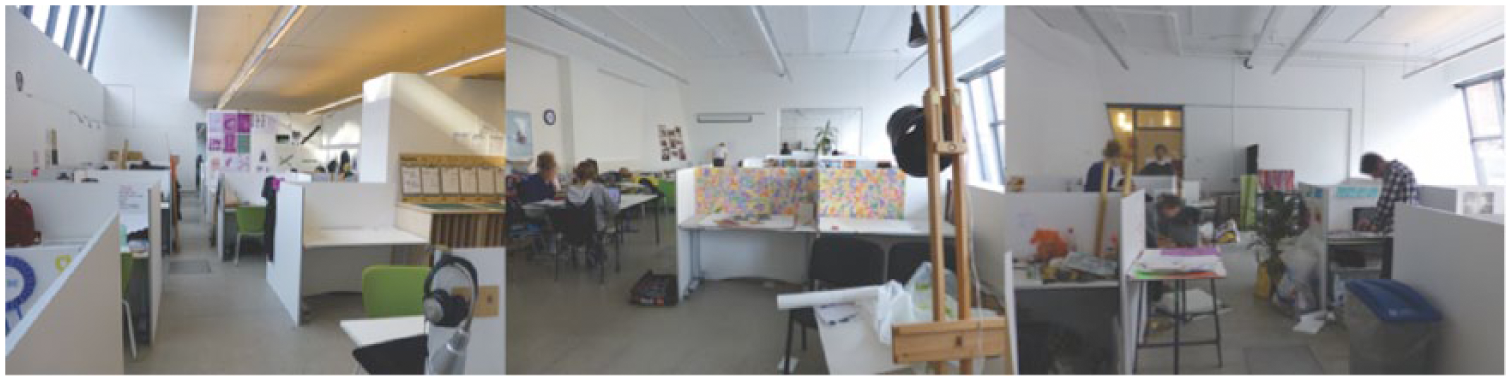
Case Study 1: an art school in the UK. © L Marshalsey, 2016.
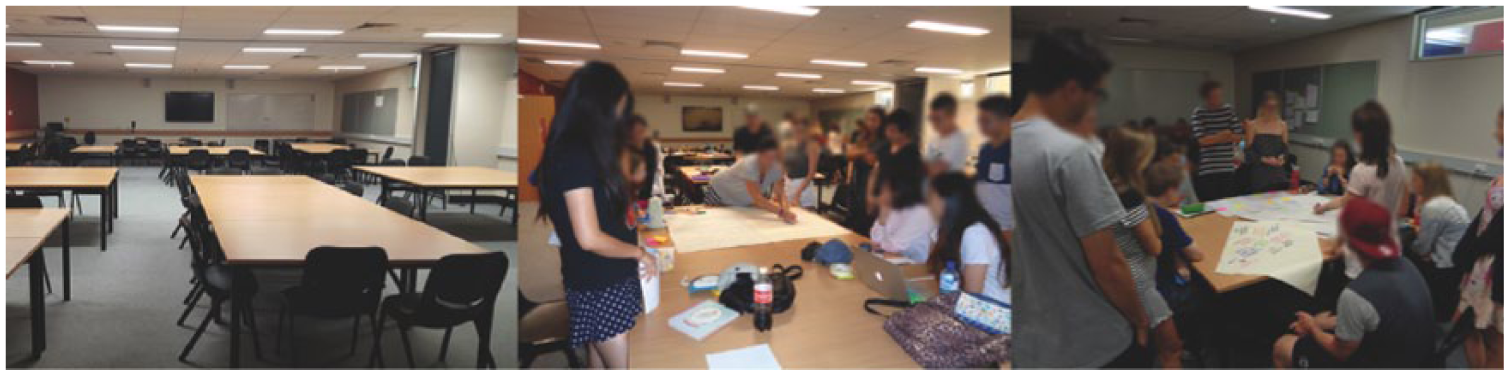
Case Study 2: a college of art in Australia. © L Marshalsey, 2016.
As studio pedagogy is perceived, practiced and embedded in a wide range of curriculum programmes, the character and delivery of studio activities can vary. The programme requirements being taught within these two different organisations dictate the use of the studio space and the specific practices of the students in each case study. Therefore, an outline of the two different Communication Design curriculum frameworks and delivery approaches is sketched in the following sections.
Case Study 1: a conventional studio within an art school in the UK
In Case Study 1, the participants were located within one large interconnected, open-plan, physical studio environment designed to accommodate three Communication Design specialist areas (Photography, Illustration and Graphic Design) and with a mix of year groups. The location-specific terminology used by this institution for this learning space is ‘studio’, and refers to active, experiential pedagogy. Within this environment, each student has one small desk assigned to them with many other students in close proximity. Desk dividers allow a small amount of privacy between each workstation. Wall space is a highly sought-after commodity and priority is given to students in years three and four. However, this curriculum encourages a more fluid use of space within studio learning. Group and individual critiques can occur at communal sofa areas, in-situ at desks, within the many workshop spaces or in corridors, with the workflow expressed in each context. Students are expected to attend this studio space full-time and, through a process of engagement and community, the students are made aware of the value of studio through curriculum activities (for example, formally and informally working together). The studio component is an assessable part of the degree course. The students are not defined by their specialisation within this Communication Design curriculum, but through their creative interpretations and articulation of the project briefs delivered to them. There are no medium-specific briefs. Instead, diverse interests are dispersed across the programme, with overlapping interests, sub-communities and activities, such as film screenings and speaker events, bringing students with common interests together. This art school facilitates and encourages the students and tutors to socialise together in one fluid, informal studio setting.
Case Study 2: a college of art in Australia
The college of art in Australia (Case Study 2) is more formal in its approach to a Communication Design curriculum. The participants attend short, fixed timetabled tutorials dictated within studio-based classroom spaces and in one lecture theatre. The location-specific terminology used by this institution for these learning spaces is also ‘studio’, and refers to active, experiential pedagogy. Students are not assigned an individual desk space, as they do not inhabit one studio. Instead, hot-desking or no-desking is common practice. Group and individual critiques occur within timetabled tutorial sessions in the classroom and the workflow is not expressed in variable physical contexts. This curriculum encourages a fixed use of formal space within studio learning. Students are expected to attend classes only for the duration of the timetabled session. However, they do engage with activities constituting studio practice, such as working together in groups on project briefs. They are not bound by a physical space, but by common interests, and individuals cluster accordingly. The studio component is not an assessable part of the course, as it does not appear in the students’ learning outcomes. The students are defined by their specialisation and they work on centralised, medium-specific set briefs in this Communication Design curriculum. This college of art facilitates the students’ and tutors’ formal socialisation through the allocated timetable sessions in the studio setting. To a lesser degree, overlapping interests, sub-communities and activities bring students with commonalities together.
Research methodologies, methods and theoretical framework
Much of the current literature about practice-based studio learning has focused on learning and teaching strategies, and recent higher educational studies use the well-established qualitative case study approach to examine arts-based communities, investigating the nature of faculty–student interactions (Cennamo and Brandt, 2012), developing collaborative support in design studio environments (Vyas et al., 2013) and utilising new technologies to deliver studio learning (Fleischmann, 2014). Collaborative action research projects have facilitated research into developing work-based curriculums to accommodate new members of academic staff in participatory research, which includes students as decision makers who help to share and develop appropriate learning spaces (Bryant et al., 2013). In recent studies, PAR has been used to investigate the issues of diversity and widening participation across creative education and its subsequent impact on students (Hayton et al., 2014). These developments have directly influenced the chosen research methodologies and methods used in this paper.
Community of practice (CoP) theory provided the theoretical foundation and the participation framework which shaped the research design and informed the methodological approach towards the domain (the shared studio), the community (the multi-memberships present within studio learning) and the practice (the activities and critiques which shape studio learning). Communication Design is the common interest that connects and holds the design studio community together, connected by the shared practical activities, critiques and discussions students undertake. It is the participants of the community who learn together, yet it is the individual who internalises and manipulates structures to alter their conceptions of learning (Lave and Wenger, 1991: 15). The students’ own practice informs their participation in the community; what they learn from the community affects what they do in return (Wenger, 2000).
In his influential work on CoP theory, educational theorist and practitioner Etienne Wenger’s (2000) notion of ‘reification’ makes concrete the shared domain of interest in learning, commitment to the learning community and a shared competence of the discipline (Lave and Wenger, 1991; Wenger, 2000). In this study, the reification and the creation and use of artefacts via the digital and analogue methods, guided the participants’ reflection as they continually worked to change their mutual explicit and tacit thinking processes. The creation of artefacts helped to draw out the tensions in each case study and provided the means to examine the forces that had created and sustained the two divergent communities amid their differing approaches to Communication Design education. The two diverse dialogues emerging from each case study – learning as belonging (in the community), learning as doing (in practice), learning as becoming (in their identities) and learning as experience (in making meaning) – became clearly evident in the findings discussed later in this paper.
The PAR and the case study approach
The PAR approach was adopted in the early stages of the research, and in each case study the research activities took place over an eight-week period, beginning in the UK, followed by Australia. The interventions provided a vehicle – a set of tools and practices – designed to enable research participants to individually and collectively respond to and reflect upon their experiences within their own learning spaces, and to consider the influence of these experiences on their creative design process. This approach encouraged the participants to develop a deepening awareness of their senses as experienced through their interaction with the mediating artefacts (the interventions), their learning spaces (the studio, incorporating both physical and virtual forms of learning) and their learning community.
The case study research design was intentionally reactive to the participants’ stories and experiences. Action research is an iterative, systematic process involving an action-reflection cycle. The action research cyclical process consists of ‘observe–reflect–act–evaluate–modify’, where practice is continually modified to determine new directions that may or may not be effective (McNiff and Whitehead, 2006: 9). This cycle facilitates a multi-modal enquiry that becomes progressively open-ended. This approach guided the flexible nature of the research design where participant voices drawn from the data were intentionally woven into the narrative. The participants from the two case study sites expressed differing interpretations of ‘studio’, learning, sensory affect and their CoP. Their lived stories arose from their active engagement within their learning environment where they intervened, diagnosed and attempted to solve problems in a specific real-world context (Clandinin, 2007; Clandinin, 2013: 145; Gray and Malins, 2004: 74). For these reasons, PAR was used in parallel with a multiple case study approach, which included narrative inquiry and ethnographic methods.
Participatory Design (PD)
In a design context, PD represents collaborative forms of engagement which may or may not involve a co-created experience. PD encourages the active involvement of the stakeholders in the design and decision-making processes. It is an approach that originated in the many political, social and civil rights movements of the 1970s (Sanders and Stappers, 2008). During this time, people demanded a greater say in decision-making, as they believed that they ‘were not being planned “for” but planned “at”’ (Nichols, 2009; Simonsen and Robertson, 2013). PD is grounded in the involvement of people in the development processes, as it builds on the participants’ experiences and challenges conventional approaches to designing (Szebeko and Tan, 2010).
In this study, I have appropriated methods from PD into the field of educational PAR to research studio learning. Therefore, as the lead researcher in this process, I have guided and facilitated the participants’ expressions of studio learning and environments using participatory creative methods (Sanders and Stappers, 2008). This study is concerned with PD as a set of tools, methods and processes that particularly relate directly to the actors in this setting. They were used to elicit what meaning participants attributed to their learning environments and to understand the nature of their participation as they engaged in the research activities. Within the studio, the participants’ contributions to the intersubjective framework of PD allowed them to show and tell their various views and experiences through visual methods, workshop activities, interviews and focus group transcripts. In Case Study 1 and 2, a degree of control was given to the students as participants, with the participants in Case Study 1 taking more control over their journey and the PD methods than the Case Study 2 participants, who generally exhibited less control and enthusiasm.
The systematic nature of the data collection techniques and procedures produced qualitative data derived from visual, narrative and sensory methods/techniques that included video, photography, field notes, transcripts, drawing, sonic mapping and sound recordings, among others. The visual data, narrative transcripts and sensory files permitted me to create a detailed case study data archive for each site and produced diverse views and perspectives from the participants and me. As a consequence, this multifaceted investigation produced different kinds of empirical data to test and extend the methodological framework. This evidence provided a combined data set greater than its individual parts, from which patterns, categories and themes were identified.
Ethnography and ethnographic methods
To understand the impact of studio or studio-based classroom life, I developed a variety of practice-led participatory methods alongside the participants. In doing so, I generated research data from a process grounded in subjective experience using a variety of emergent and established ethnographic research methods (Kolb, 1983). It was my intention to adopt methods for this investigation that would encourage participants in this study to feel with their senses. For this reason, photographic methods were initially omitted as tools in the original research design, even though I was familiar with visual ethnography from the studies of Pink (2001, 2006, 2008, 2009, 2014). Due in part to the critical reflection of the first case study, visual ethnographic methods were valuable for generating interpretative research stories. Therefore, visual ethnographic methods such as video and photography were subsequently embedded in the research design.
Visual ethnographic methods: Photovoice
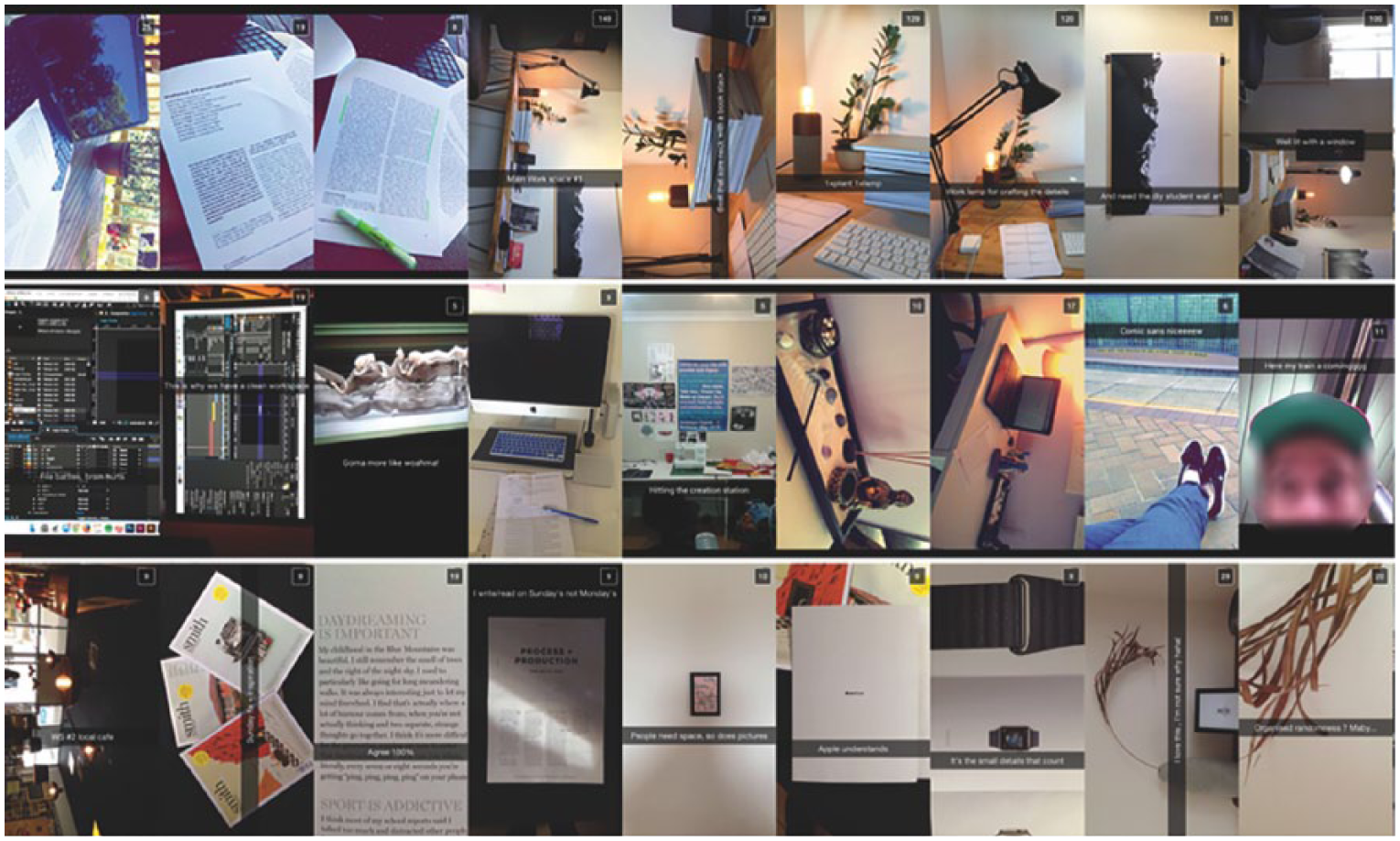
As an example, the participants were asked to participate in a student-led visual activity that was also, of itself, an ethnographic method known as Photovoice. Devised in the mid-1990s, Photovoice is ‘an arts-based qualitative research method usually housed within community-based participatory research’ (Delgado, 2015: 7). Participants are asked to represent their community or express their point of view by photographing scenes to develop both personal and collective social change. This visual method enables a powerful expression of experiences, as cameras are placed directly in the hands of the participants, particularly as photographic media and visual technologies are now prolific worldwide (Brandt, 2014; Delgado, 2015; Given, 2008: 623). In research studies, photography has become an active voice for participants’ perspectives from behind the camera – a term Brandt (2014: 621) called ‘shooting back’. In my study, this method expressed the participants’ own experiences as captured through immediate and spontaneous image-making. For example, the inclusion of digital practice was a recurring theme in Communication Design studio learning, as shown in the images in Figure 3.
A recurring theme of digital practice is shown in the images. © L Marshalsey, 2015.
Visual ethnographic methods: Snapchat®
As a method of Photovoice, the Snapchat® app is a popular social networking tool with the student researchers as they were already familiar with it as a leisurely and fun mobile phone application. Snapchat® is a photo or video messaging mobile application, in which users can add captions and drawings onto images and send them to other users. These can be screen-grabbed by other users. Using Snapchat® allowed the participants to voice their immediate and fleeting studio experiences from their own, empowered perspective (Delgado, 2015). Instant and short-lived studio experiences can be effectively recorded using Snapchat®, as this app records short-term visual images (with or without captions) of less than 10 seconds to send to other Snapchatters (accepted term for a person regularly using this mobile phone app). In the first instance, I, as the main researcher, was the sole recipient of the Snapchat® images. I subsequently screen-grabbed and saved them anonymously for future analysis and creative output. The Snapchat® images were then returned en masse to the participants to reflect upon and use for their own purposes.
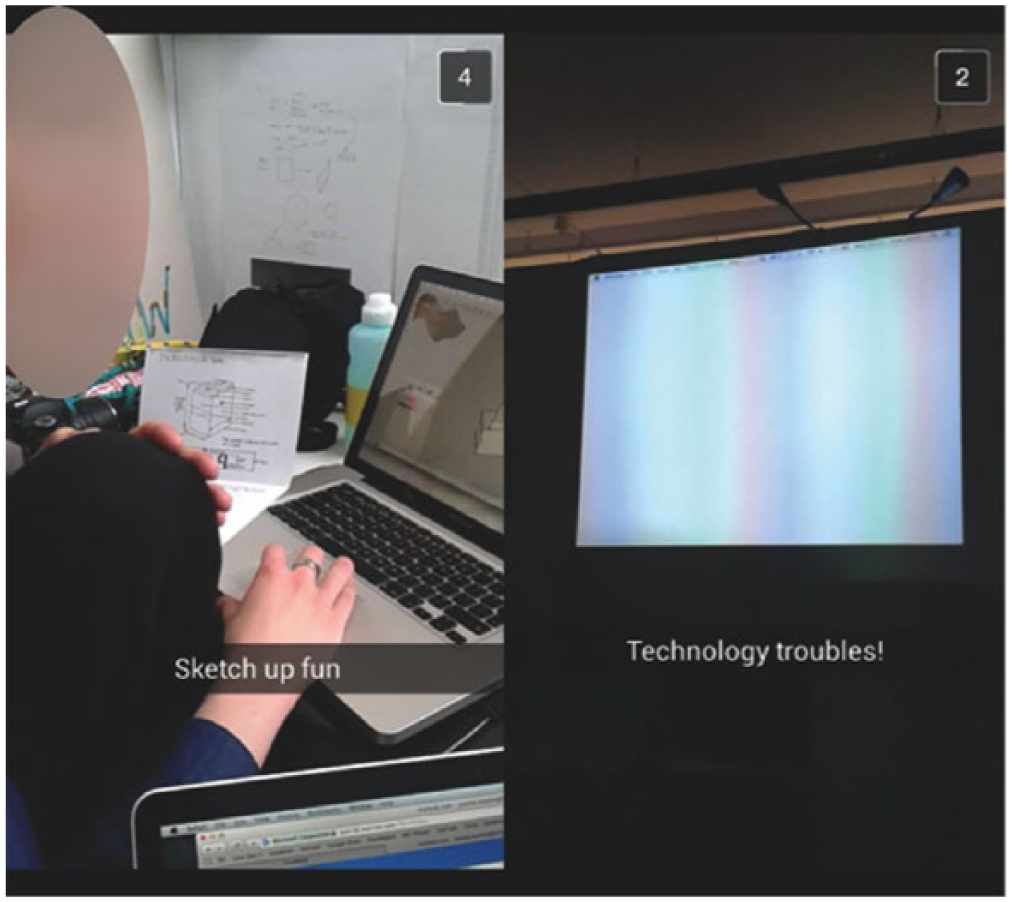
This method generated a flowing narrative of images and studio happenings as shown in Figure 4. It produced unbiased data from the participants’ own perspective, as studio life happened around them and with them. However, the main disadvantage of this method was its sporadic use at times and its reliance on regular student engagement. Yet, this method was feasible in terms of the resources and time available during the case study. It bypassed the need for expensive equipment as all the participants had access to the Snapchat® app on their mobile phones. This eliminated the need for extended periods of time to set up and instruct on the use of video equipment.
Generated images from the Snapchat® method. © L Marshalsey, 2015.
Visual ethnographic methods: GoPro®
In contrast to the very short-term nature of Snapchat®, GoPro® film cameras and mobile phone video applications were utilised by the student researchers. GoPro® is a US brand that develops, manufactures and markets high-definition (HD) videographic equipment and cameras, known as GoPros. These cameras are often used in action, such as in water and for sports video photography. They are compact and lightweight and are wearable via chest, head or wrist harnesses. The cameras capture HD images through wide-angle lenses (GoPro Inc., 2018). In Case Study 1, the film cameras were used to capture footage lasting from seconds to hours as the participants filmed their everyday studio experiences from their own storytelling perspective (Figure 5).
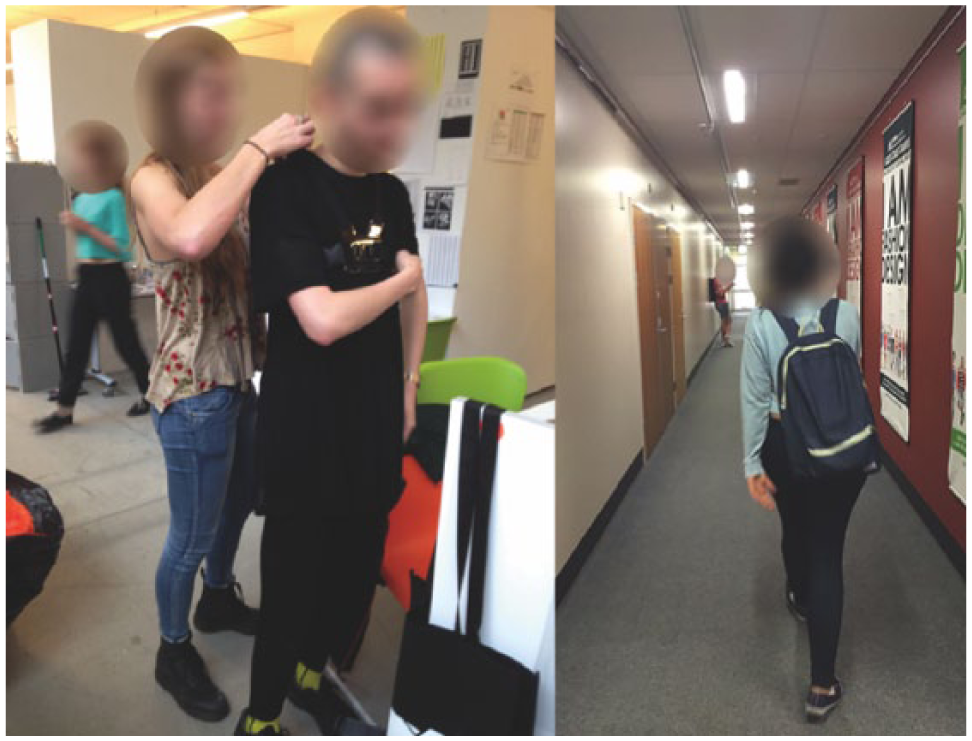
The participants used GoPro® film cameras and mobile phone video applications. © L Marshalsey, 2015.
In the critical reflection between the first and second case study, it was noted that qualitative yet experimental tools and methods, such as Snapchat® and GoPro® filming, offered effective ways for participants to generate their own interpretative research data in new ways. These methods were suitable for addressing the questions underpinning the research study and the participants were not merely involved in intellectual discussion but also wholly engaged in the activities (Keiny and Orland-Barak, 2009: 173). When the participants and I watched the visual data together, it often led to insights on both our parts about the dynamics of a specific event and illuminated ways in which we might try to improve an aspect of our practice (Wells, 2009: 51). The new understanding emerging from this mutual learning activity encourages self-awareness of multiple critical incidents (Wenger, 2000). Visual ethnographic methods allow for valuable insights from the on-the-ground student perspective, which may be fleeting and short-lived or prolonged and sustained. Consequently, Snapchat® and GoPro® filming research methods, as a form of Photovoice, were integral to the research design.
Sensory ethnographic methods: drawing and sonic mapping
Multi-modal sound and sensory ethnographic methods were also employed in this study to obtain rich data in action, going beyond solely visual interpretations of studio learning (Pink, 2001, 2009). According to Pink (2009: 7), sensory ethnography explores new potential when attending to the senses in ethnographic research. In this study, I consider the ideas of Pink (2009, 2014) and draw upon them to elicit student experiences of sensory affect in contemporary Communication Design studio learning.
Consequently, sensory-based ethnographic drawing methods (both digital and hand-driven) and sonic mapping via artefacts, have been used in this research study to critically examine the participants’ own interpretations of sensory affect. Ingold (2011) states that drawing is an enormously powerful ethnographic tool, alongside that of writing, and studio learning relies on drawing as a fundamental technique (Sassoon, 2009). Ingold (2011) defines drawing as combining observation and description in a single gestural movement and refers to this method as ‘graphic anthropology’: an anthropology that takes drawing as its medium (Ingold, 2011: 222). In Case Study 2, the participants used Apple® iPad Mini tablets with a pressure-sensitive stylus to draw their own interpretations of their daily studio-based classrooms onto photographs of these same spaces (Figure 6). Their drawings used colour, dynamic shapes and lines and words to represent the experiential impact of sensory affect in the three different learning spaces they occupied.
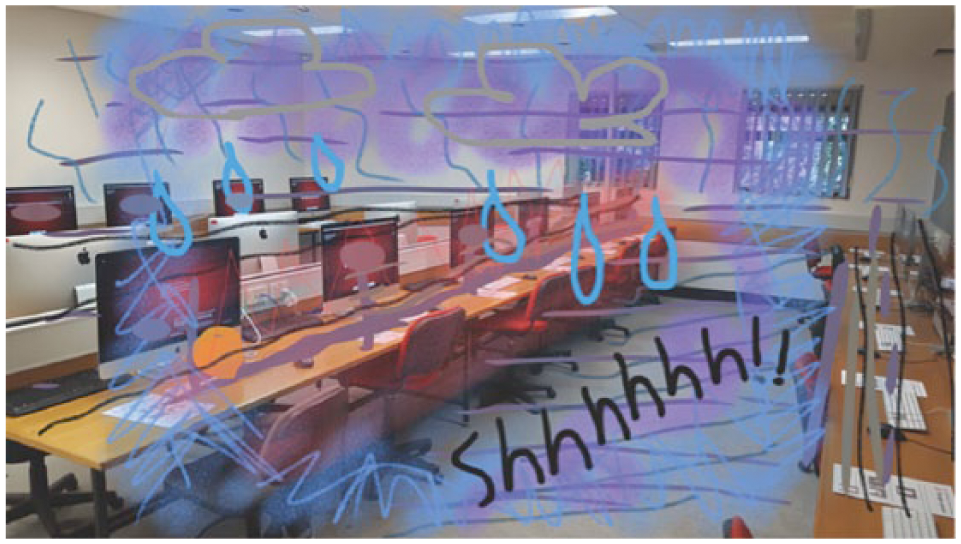
Digital sensory-based drawing methods in Case Study 2. © L Marshalsey, 2015.
In both case studies, the student researchers visualised the sounds present in their daily studio life using drawing and mark-making onto paper, as an earlier pilot study had revealed the presence of varying sound in educational environments (Figure 7). During this pilot investigation, we found that the constitution of the studio (the CoP, the learning processes and creative practices, the architecture and the social relationships) generated creative and non-creative sound. Furthermore, in Case Study 1, the initial data responses revealed an intrusion of sound from the open-plan nature of the architecture. Consequently, sound ethnography became established as a core element of the research design, and sound as a phenomenon of experience was creatively interpreted via hand-driven drawing methods, sound recordings and sonic-mapping artefacts.
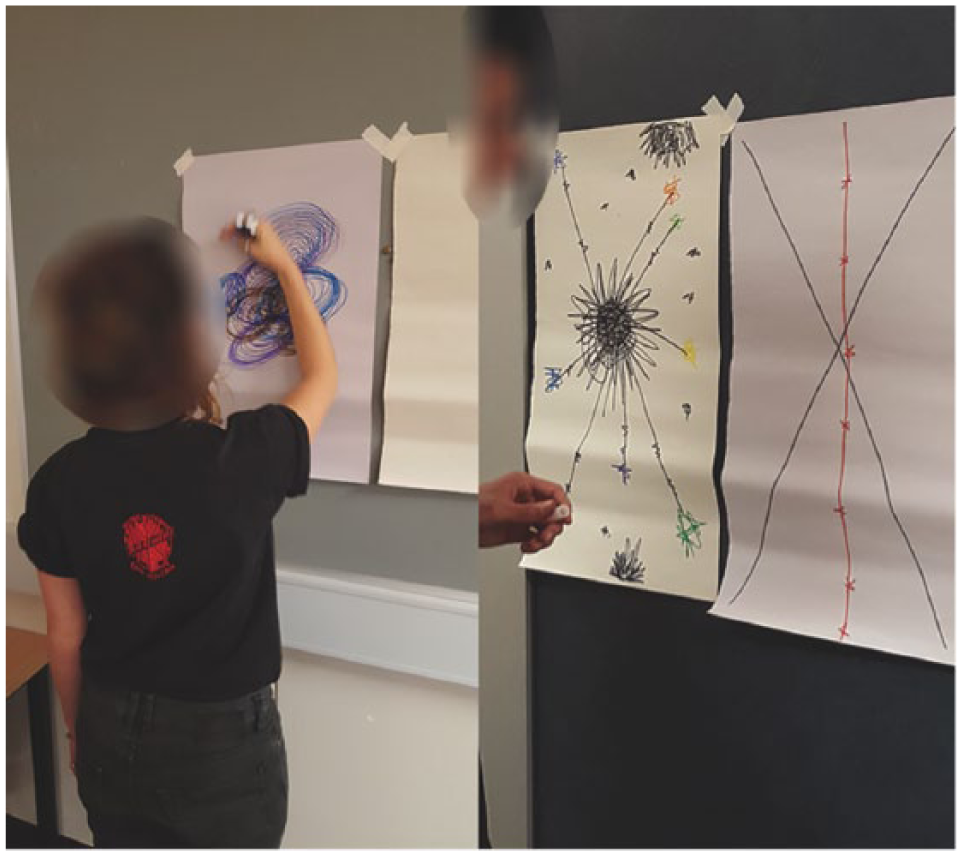
Hand-driven sensory-based drawing methods in Case Study 2. © L Marshalsey, 2015.
Analysis and interpretation
The four-stage approach to the analytical strategy adopted in this investigation has specific characteristics. These are representative of the close reading of the narrative inquiry as a means to generate initial categories to later form the key themes (Saldaña, 2016). This approach is similar in nature to the transcription process and thematic narrative analysis of Birch (2011), the narrative coding of categories in Cavendish (2011) and the analysis of narratives in Varbelow (2015).
In the pre-coding stage, I circled, highlighted and underlined notable data, as the raw data were collected, in order to prompt or trigger later reflection (Saldaña, 2016). Stage 1 comprised the formation of the preliminary categories from my subjective immersed reading, highlighting and memoing of the transcripts. Stage 2 collapsed these preliminary categories to form four broader descriptive codes: communities of practice, sensory affect, place/space and tools. Stage 3 pursued an in-depth, low-tech analysis involving the revisiting and unpacking of the four descriptive codes in greater detail, and then cross-matching them directly back to each student’s specific narratives. This step in the analytical process acted as evidence and verification of the thematic development. This stage faithfully returns to the actual phrases and descriptions in context – it is not drawn from my personal perspective, as Stage 1 was. Stage 4 organised the collated concepts arising from Stage 3 into larger units of abstraction to concretise the key themes underpinning the findings of this investigation.
Comparing the findings
Overall, the findings showed that the participants in both settings could either be disrupted or supported in their experiences of learning spaces and, overall, several key themes emerged relating to sensory affect: community; place and space; and tools. The Case Study 1 participants in the UK responded that their friendly, informal, day-to-day social interactions with peers and staff in their situated studio community, were integral to their collective and individual learning and practice. The Case Study 2 participants created their own offline and online community outside of the boundaries of their studio-based classroom learning spaces, mainly in cafes, at home and via social media. When comparing the findings from both case studies relating to practice and technology in studio and studio-based classroom environments different dialogues emerged.
In Case Study 1, the participants preferred hands-on processes, drawing and tactile tools; yet, numerous instances of digital practice were also identified in the analysis. In the first week of the research investigation, Toby admitted to working with ‘found object, drawing, sculpture… I hope to do more hand-rendered typographic works in the future – I feel the digital makes this too easy’. Toby typified the participants’ attitudes towards conventional processes when he said, ‘hands-on techniques allow you to appreciate the characteristics of traditional methods’. However, in the closing stages of the case study, Toby reflected through a self-review of his practice throughout his third year and admitted:
I did a few big paintings. Just because I was really depressed with the computer work I’d made all year. I wanted to do something completely, drastically different… I felt it was wrong to make something on the computer. I had to have more than one voice.
He continued to say, ‘It made me aware of how much my work is digital this year… I don’t know whether it’s a bad thing to get so locked into a digital world. And I wonder if the building has had an impact on that’. Jill supported this view as she said, ‘A lot of stuff I have been doing this term has been on the computer. I know that’s not what I enjoy, so I don’t know why I keep going back to it’. Jill continued, ‘I don’t do anything other than paper, pens, digital stuff in this studio’. Robyn noted, ‘I started to draw and then just went straight to digital’. She concluded the disruption to the participants’ conventional studio practice as due to the lack of a wet area: ‘There is not a sink in the graphics studio. You have to either go down to Illustration or go to the toilet’.
Taken together, these responses suggest that traditional and digital production methods provide varying levels of sensory engagement. Traditional methods are noted for being messy and tactile (for example, when using letterpress and wet ink). Digital processes are referred to as clean and dry, and require equipment on a smaller, more portable scale than traditional techniques do. The availability of a wide range of non-specialist and specialist resources in the art school, such as letterpress and digital facilities, offers the students free choice to experiment with their creative process and to develop projects. Jill explained, ‘you achieve something… to go to the woodwork shop and come out with something that I’ve made’. Robyn agreed, ‘…and also screen-printing – so much fun and something to be proud of at the end’. She explained, ‘with digital stuff, you can tinker at it, whereas… The only way to see if you have something worthwhile is to print it, look at it and do it again. I like the idea of the really hands-on aspect’. She also verified that ‘The hands-on approach helps me to better understand typefaces, etc.’. Toby reflected, ‘[I was] doing a hand-rendered workshop a couple of weeks ago and I really enjoyed the process. We used watercolours to do it. I’ve never done that before’.
Turning now to Case Study 2, the data indicated that the participants infrequently constructed meaning together in their CoP and preferred to work alone. The most striking result to emerge from the data set is the participants’ preference to work at home on a regular basis rather than in the university studios. The results indicate that there are several reasons for this preferred mode of working (at home), rather than within the university educational environments. The participants admitted to feeling self-conscious within their learning spaces. A correlation was found between the feeling of vulnerability in the community and the need for the students to conceal their creative work in progress from other students in the studio-based classrooms. Jack indicated his embarrassment at displaying his work in progress when he said, ‘you could be halfway through a process that looks really bad on screen or something’. My own students often tell me that their work is ‘fine’ whenever I ask to see their process in the studio. Yet, they have not brought their work into the studio for discussion, so I cannot visually confirm that it is indeed adequate until after the deadline. Often, the design work still needs refinement following final assessment and the students’ marks and grades could have reasonably increased if the students’ work had been visible throughout the semester as requested. Charlie remarked, ‘you do so much work. Then you hand in assignments and then they go into cyber space and you never see it again’. Not discussing the work with the students and their CoP after the assessment may indeed contribute to the problem. Charlie remarked that displaying a finished project work within the community in which it was formed does help to support a student’s valued place within their year group: ‘To have the work printed and stuff on the walls… You feel like a champion and this is how you… feel valued and it works’.
Traditionally, design students are influenced by research channelled directly from their interactions with educators. This could be via lectures, seminars, tutorials, gallery and studio visits, artefacts and materials, such as library books. Within Case Study 2, the participants appeared to predominantly use the Internet as a primary tool for research to supplement the traditional forms of their studio learning. This is based on the premise that the students watch videos and use social media as a bridge to learn between university and home, and, therefore, rely less on direct interaction with educators (Van Sickle, 2016). Within the studio-based classroom, Dan said that he ‘found more artists on Instagram® and followed them, stalked them… and then started drawing what was on my mind’. Certainly, from my everyday verbal conversations with students, I have gathered inspirational sources via social media, which is standard practice among them, with Instagram® and Snapchat® being the most popular platforms. Nevertheless, the participants may prefer non-digital research avenues, as Dan said, ‘You find your research online’ and Charlie commented, ‘It doesn’t feel as real’.
Despite the popularity of online and digital tools, Rose confessed, ‘I struggle to see it [the work] on the computer and then actually how it’s going to translate in real life… I guess the great thing about digital is, it’s endless… the possibilities are so endless’. However, she did say, ‘I don’t turn my computer on until I have a piece of paper in front of me’. Jack also agreed with this, saying, ‘I love to draw really bad, quick sketches of ideas, then bring it into the computer’. Charlie identified his practice as equivalent to the other students and said, ‘I use temporary paper. I usually throw out stuff and then digitise it’. These responses indicate that drawing and note taking on paper precede digital creation. Rose continued to say, ‘I’m really trying my hardest to get away from technology at the moment because… when I was younger, I went to a school that didn’t have technology and I was so creative’. A realisation may exist among the participants that digital tools only partially foster the sensory engagement required for optimal creativity, as Dan acknowledged, ‘I needed a break from the computer’. He continued to explain his view of the negative associations between digital practice and wellbeing: ‘People are feeling the strain of screens… And everyone’s got a screen in front of them… I appreciate print a lot’.
Conclusion: critical perspectives on the integration of TEL within specialist Communication Design studio education within the UK and Australia
The remainder of this paper examines the implications of the integration of TEL within specialist Communication Design studio education in the two international settings in the UK and Australia. The findings have framed a range of future recommendations for Communication Design studio and studio-based classroom learning and summarise why is it important that the discipline looks to challenge its educative process – in terms of thinking, creativity, practice, environment, community and education.
When reviewing the implications for design practice, it was evident that Case Study 2 had greater student numbers than Case Study 1. This meant that the available tools and resources for practice were spread amongst a larger year group in Case Study 2. In addition to this, Case Study 2 had timetabled curriculum restrictions, which meant less time to be creative in the short two-hour tutorial classes with the available resources. Case Study 1 had better access to conventional Communication Design processes, such as letterpress, and over longer periods of time.
Two divergent and contradictory actions emerged from the two case studies: Case Study 1 participants were happy to demonstrate and verbally reflect upon their work within their community as this practice was a fundamental part of studio learning to them, while the Case Study 2 participants universally sought to hide their work as they saw little value in what they produced within the studio-based classrooms until completion. The participants in Case Study 1 had confidence in their work and in their approach towards producing, experimenting, developing, openly displaying and critiquing their practice-led processes in their community. The Case Study 2 participants exhibited a distinct lack of confidence; their work appeared to be less valued within the community because their working processes were not visibly shared in the learning spaces every day. The dominance of digital practice meant that it was easy for the Case Study 2 participants to obscure their work (via personal laptops) from the view of others – peers and educators alike – during the timetabled studio critiques, unassigned studio time and informal one-on-one consultation sessions with the educator. Several students avoided using sketchbooks altogether and supported their heavily digital practice by drawing on disposable scraps of paper instead. A record of their creative process was captured digitally and then hidden in a filing structure on their hard drives. However, even though the participants perceived digitised practice as having endless possibilities, they also said that hands-on engagement with traditional materials enhanced creativity and was of more value to them than digital practice. Also, openly sharing work triggered stressful responses from the Case Study 2 participants, as they associated sharing with assessment points. Furthermore, the lack of assigned personal desks also reduced opportunities for participants in Case Study 2 to display physical copies of work in progress, in contrast to the participants in the Case Study 1 who openly displayed printed iterations of work in progress on desks and walls as part of normal everyday practice.
I was not prepared for the disparity between the two case studies and in each set of participants’ observations of and existence within their day-to-day studio community. Their individual accounts in Case Study 2 showed the participants’ preference to work at home had impacted on their community and experience of studio learning. The studio as a valued physical site for learning seemed irrelevant to them. They did not appear to have a conception of studio and judged its current state as uninspiring or ineffective. Instead, social media channels offered these participants a sense of belonging in their dispersed community. They had found other strategies to manage their learning within their own context – their community existed in small pockets of friends who socialised online or in person outside of the class or campus. This notion of a dispersed community was further evidenced by a lack of familiarity between members of the group in Case Study 2. There was a sense that the students experienced little reward from a physical educational environment as their learning spaces were impermanent and overpopulated. In contrast, the Case Study 1 participants had more positive community experiences. They were able to form a stronger peer group structure in their community despite the studio population creating elevated sound via technology, machinery, music, talking and when moving around the architecture.
These findings suggest that the participants from both case studies had a tendency to unconsciously partially disengage with their dedicated studio environment (Case Study 1) or wholly disengage with their studio-based classroom environments (Case Study 2). The participants either attempted to work with unsuitable sensory conditions or to recreate a studio environment elsewhere (for example, at home). I also found that having or lacking an institutionally assigned desk space appeared to influence participants’ sense of place and belonging in a studio environment and influenced their perceived value of their CoP. The participants in Case Study 2 had no dedicated physical studio or personal workstation and they vocalised a strength of emotion around this in the strong language they used. They felt that the university hadn’t held up their end of the bargain to provide creative learning spaces for engagement. In contrast, the allocated, high-density desk spaces within Case Study 1 fostered a closeness in the community.
However, the participants from both case studies indicated a clear preference for wanting to engage with their community even if they weren’t able to. The findings suggest that lived, embodied experiences of a bonded community are a strong motivational factor for successfully maintaining a presence in the studio and studio-based classroom environments, and also in terms of actively engaging learners in their learning. Events, such as having lunch together, reflecting work in progress to others, working nearby for spontaneous debate (participation connected via projects) and having informal, relaxed educator-led group critiques can foster this. The findings clearly evidence that constructing a multi-membership, participation framework allows time and resources for practice-led interaction, and that providing communal informal areas in the studio for rest, nourishment and critiques brings the community together.
Therefore, a key finding is the central role that the community plays in both supporting and helping to drive learning individually and collectively. From an educator perspective, it is important to explicitly support the maintenance of the community via educational interventions that help to scaffold the process of developing community among its members. The importance of community and its relationship to learning is evidenced in both of my case studies where close friendships, collaboration and teamwork were central to the creative process. Experiential learning and collaborative practice leading to socially constructed meaning was more evident in Case Study 1 in the UK as everyday group work (formal and informal), and much less so in Case Study 2 in Australia. The participants from Case Study 1 benefitted much more from their friendly, informal, day-to-day social interactions with peers and staff than the participants of Case Study 2.
Also, in the Australian institution students considered studio education to be synonymous with classroom learning. Participants expressed little hope that the university would supply dedicated design studios solely for Communications Designers in the future. Increasing the university student population results in the need to accommodate more students studying differing design and non-design disciplines in the same space. This can also cause social, sensory and visual impediments, which can affect focus.
Notably, the participants who occupied a regular, personal desk space within the conventional studio environment, such as those within Case Study 1, were more likely to implement cognitive strategies and methodologies to engage with learning as a result of the PD research activities. In contrast, the Case Study 2 participants were less likely to apply their own developed strategies in the university learning spaces and chose to work at home. Situated within a mainstream higher educational no-desking culture, I found it incredibly challenging to convey the values and experiences I assigned to studio learning to the Case Study 2 participants. I could not transfer the fuller embodied experience of a physical studio model to the Australian participants through images alone. Furthermore, my values and judgments of studio learning from an educator’s perspective changed when exposed to the new educational environments over time in Case Study 2. I realised that studio learning may function in different ways, for example in friendship groups that meet outside of class and within social media platforms.
To summarise, this research investigation has focused on exploring students’ experiences in virtual, technological and physical educational environments, and how PD methods can be employed to capture, understand and adapt Communication Design pedagogy to improve student engagement. This is with the intention of developing the participants’ own self-awareness, confidence and agency through studio learning activities. In this way, enactive cognition becomes the dynamic interaction between the person and the environment. For example, the participants from both case studies made meaning in relation to the value of the studio community. In Case Study 1 community was drawn out from the GoPro® filming method, and as participants identified the unmistakeable signs of mutual membership and joint enterprise in their shared practices and rituals within the physical studio. In Case Study 2, the participants identified their dispersed community and as they examined their strategies to create a sense of community online as an alternative to the difficult management of a much larger physical community and a heavily digital practice.
The participants in both case studies valued their membership within their CoP and their specialised design education. Yet, the Australian experience cannot be described or pitched as ‘studio’ learning, despite best intentions from the institution to replicate a conventional studio model. Unfortunately, the spaces experienced by the participants in Case Study 2 in Australia are not representative of the values of a conventional, physical studio model, which are still seen in the art school in Case Study 1 in the UK. A large degree of embedded TEL made their everyday experiences of Communication Design education much more challenging for the group of participants in Case Study 2. Even though the institution and educators are hopeful that they are delivering a studio-based model, it is decidedly different from the physical studio model delivered in Case Study 1.
The MPM as an intervention
It is useful at this point to articulate the set of ethnographic participatory methods I have identified as examples of methodological evidence-based practice arising from this investigation. This participation framework (acknowledged in my thesis as a MPM) aids the identification of a set of methodological best practice tools and techniques, which are developed from the ethnographic methods in this investigation. This research design determines the chronology of methods that may be used when investigating contemporary Communication Design education, and across studio and studio-based classroom environments. This MPM, shown in Figure 8, facilitates the participants being able to qualitatively interpret their learning spaces and to explore, take account of and work with studio spaces more explicitly in design education. In this investigation, the MPM is a model of best practice participatory methods, which is based on the findings of the research from each of the two case studies.
The
The
The
The
The social media platform
As a reflective tool, the
The reflective
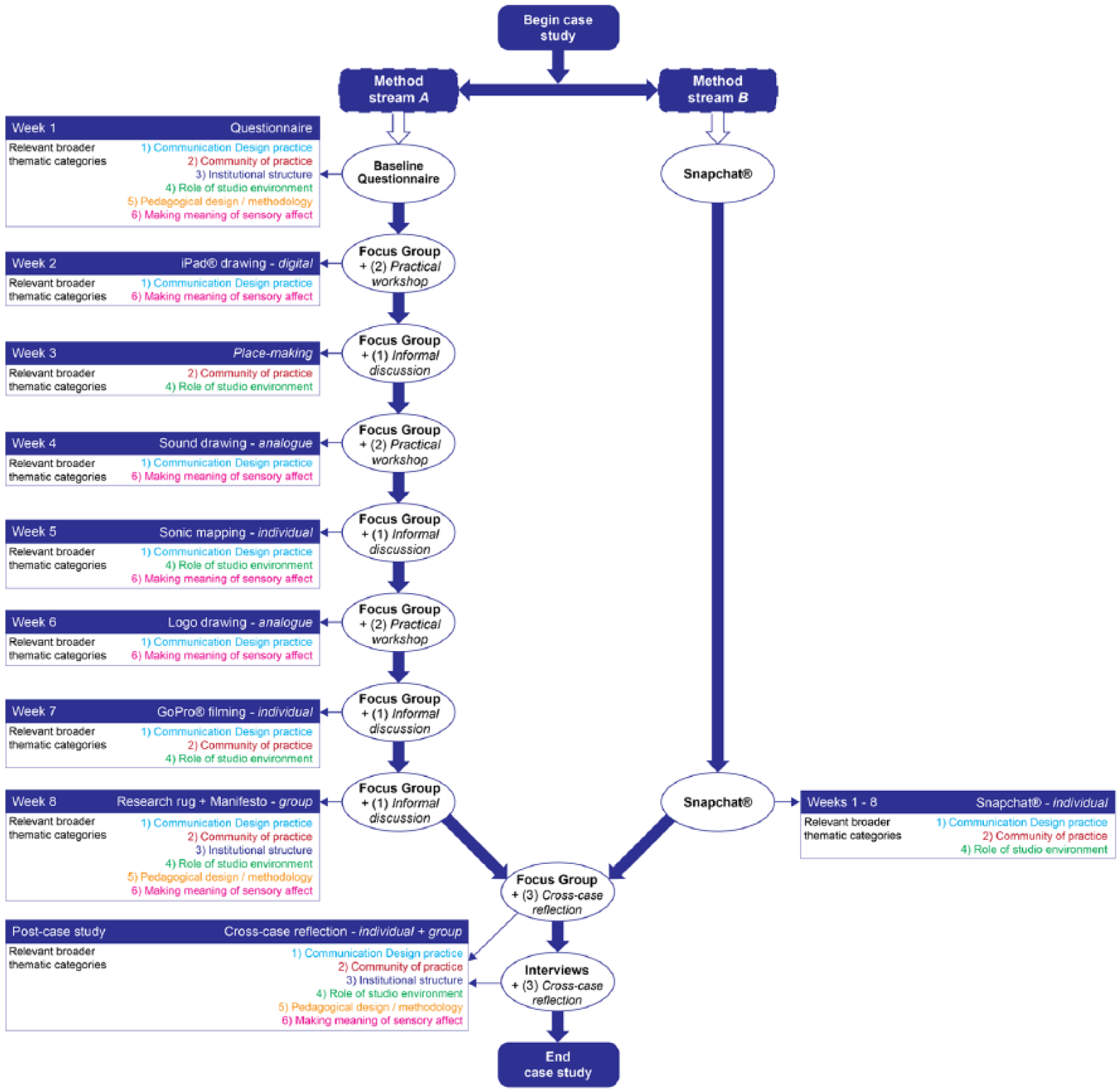
As a research design template, the Methods Process Model (MPM) provides two methodological streams – A and B. © L Marshalsey, 2017.
The overall purpose of the MPM is to provide a transferable framework of methods, from which to explore various iterations of studio learning via its implementation and to survey the results of its application as a flexible model in differing studio contexts. However, to date, the MPM has not been tested as a whole or as an adaptable model. In future studies, iterations of the model will be tested in higher education institutions delivering studio learning.
The two parallel methodological streams – A (beginning with the questionnaire) and B (Snapchat®) – may be used simultaneously or independently for best effect. This model is designed to embrace changes to the methodologies and the nature of the activities depending on the variable factors affecting the stakeholders’ available time, repertoire of spaces, curriculum model and institution. This methodological process has been carefully scaffolded to capture the participants’ cognisance as they make meaning in relation to their developing awareness of their senses in the process. The MPM draws out the value judgments the participants place on their newly acquired insights and their evaluation of the impact of their educational environments on their present practice. As a research design template, this provides a methodological framework that educators may adapt in order to explore, take account of and work with studio learning more explicitly in design education.
In conclusion, students, educators and institutions can support and develop Communication Design studio education in several ways. Firstly, educators and institutions should facilitate a Communication Design pedagogy that embraces a progressive, student-centred approach to the discipline-specific, digital and analogue, offline and online tools and methods in an experiential and experimental way. This will lead to participants developing confidence, agency and an increasingly reflective awareness in studio and studio-based classroom learning spaces. The PD tools used in several iterations of the MPM support these practice-led processes and offer opportunities for meta-cognitive learning strategies to develop through the PAR approach.
This research investigation travels a substantial distance towards a form of reconciliation and understanding of contemporary Communication Design learning spaces to support student engagement. As articulated throughout this paper, this is largely a methodological investigation, which employs sensory affect via the practice-led and research methods. The suggestion is that when employing the proposed transferable framework – the MPM (or elements thereof) – then the student’s individual and collective relationship with learning is supported in relation to practice, community, governance, the role of the studio, pedagogy and curriculum, and sensory affect. The factors that might disrupt studio learning need to be brought forward into a students’ consciousness using this framework, guided by educators, researchers and institutions. Being mindful of these issues might mean that students and educators can implement strategies to work better within the studio. Future research studies are planned, which will employ iterations of the MPM across a broader sample of institutions delivering studio education. Therefore, it is hoped that the intended transferable MPM developed within this study can be used to capture, take account of, understand and work with disruptive influences more explicitly in studio and studio-based classroom learning to improve student engagement.
Footnotes
Declaration of conflicting interests
The author(s) declared no potential conflicts of interest with respect to the research, authorship, and/or publication of this article.
Funding
The author(s) received no financial support for the research, authorship, and/or publication of this article.