



Abstract
This study examined the accessibility and utilization of mental health support services among students. The study adopted a quantitative, cross-sectional research design. A sample size of 119 students completed an online questionnaire. Results revealed a significant gap in mental health awareness. Consequently, a substantial number of students had not sought mental health support due to various barriers. The findings underscore the need for increased mental health awareness activities, accessible counseling services, and culturally sensitive support to improve the mental well-being of students. The study recommends a supportive campus environment where all students’ mental health is prioritized.
Keywords
Background
Mental health is essential for students to achieve success in their academic pursuits, as well as in their daily activities. Sound mental health enables individuals to enhance their capacity for social interaction, cognitive functioning, adaptive coping, and overall well-being. Mental health is even more important for students to be able to navigate life's challenges, in addition to those that are a direct consequence of being a student. The prioritization of student mental health within the context of higher education institutions should be a central focus in conversations about the overall welfare of students. Goodman contended that the unique developmental opportunities provided by higher education institutions render mental health a critical concern for post-secondary students. This is because institutions of higher learning provide an essential platform for equipping students with the necessary skills to promote sustained mental health and general well-being.
Several studies (Abelson et al., 2022
Research evidence suggests that the post-secondary education phase is linked to an elevated risk of developing common mental illnesses. For example, a study conducted by Ballester et al. (2020) among university students in Spain demonstrated that nearly 42% of the participants exhibited signs of at least one potential mental condition. Bantjes et al. (2023) conducted a national survey on the mental health of university students in South Africa, which revealed that common mental disorders are extremely prevalent among South African university students. Another study conducted by Mhata et al. (2023) on medical students at the University of Namibia (UNAM) found that more than one-third of the participants exhibited symptoms of exhaustion and melancholy, while just under one-third exhibited symptoms of anxiety. The study by Mhata et al. also revealed that a significant number of participants (77%) reported a cold, negative disposition that was characterized by a progressive disengagement from academic pursuits. Additionally, 68% of participants reported profound fatigue and emotional exhaustion.
Building on this understanding, mental health emerges as a critical and widely recognized concern among university students. Therefore, it is imperative that support services be established in higher education institutions to address the mental health of students (Buizza et al., 2022). Students should also have access to these types of support structures (Graham & Eloff, 2022). Notably, the UNAM has made considerable efforts to have student mental health support systems in place (UNAM, 2023). Students at UNAM can access mental health services through the Directorate of Student Affairs office. However, the extent to which the student mental health resources within the existing frameworks at UNAM are accessible and utilized is yet to be determined. This study aimed to assess the extent to which students access and utilize mental health resources at one UNAM Campus.
Statement of the Problem
Mental health is crucial for students to succeed in their everyday lives and, most importantly, their academic lives. Research has shown a prevalence of mental health challenges in student populations (Bantjes et al., 2023; Katz & Davison, 2014; Macaskill, 2013; Mhata et al., 2023). Higher education institutions need to provide comprehensive support systems that prioritize the promotion of students’ psychological well-being. Indeed, it is documented that many higher education institutions worldwide, including UNAM, have comprehensive structures in place aiming to promote students’ mental well-being and facilitate their academic focus (DiPlacito-DeRango, 2016; Giamos et al., 2017; Hughes & Spanner, 2019; Mbongo & Sheyapo, 2024; Priestley et al., 2022). However, there is a dearth of literature on students’ use of the support structures of students’ mental health in institutions of higher education in Namibia. This study investigates students’ access to and utilization of the mental health resources at one of the UNAM campuses.
Literature Review
Mental Health Support Services at Institutions of Higher Learning
Mental health support in institutions of higher learning refers to the provision of targeted help, including personal and environmental factors, which facilitate students’ participation in everyday academic activities and their integration into the academic community (Hartrey et al., 2017). Student support services in institutions of higher learning typically encompass a blend of mental health teams, counseling services, disability support teams, well-being teams, nursing teams, pastoral care services, residential or accommodation teams, crisis intervention, and financial advisory services (Hughes & Spanner, 2019). Research evidence confirms the existence of mental health support services in many universities worldwide (Prince, 2015). The provision of counseling services, in particular, is documented to be of utmost importance in institutions of higher education (Lattie et al., 2019; Prince, 2015). Psychological counseling services in universities deal with students experiencing adjustment challenges, homesickness and loneliness, social skills, self-esteem, confidence building, individuation away from home and being away from home, loss and bereavement, trauma and crisis intervention, rape, sexual assault and harassment, HIV/AIDS counseling, sexual identity and orientation, addiction issues, and family problems (Abrams, 2022; Hans-Werner, 2015; Lattie et al., 2019; Pedrelli et al., 2015; Stein, 2013; UNAM, 2023). An observation was also made that more students were seeking counseling services at levels unprecedented in the history of counseling (Prince, 2015).
UNAM has made efforts to care for students’ well-being through the Directorate of Student Affairs. The Directorate of Student Affairs is divided into two sections: Student Support Services and Residences, and Career Services and Student Experiences. While all divisions of the Directorate of Student Affairs are concerned with the well-being of the institution's students, the university's website indicates that the academic counseling and psychosocial counseling offices are especially concerned with and support students’ mental health (UNAM, 2023). The institution employs a Clinical Psychologist and Academic Counselors who regularly handle student cases involving anxiety disorders, panic attacks, depressive disorders, bipolar mood disorders, substance use and dependency, psychotic disorders, academic problems, such as motivation and concentration, and other psychosocial challenges (UNAM, 2023). The Psychosocial Counselling Services office offers professional help and counseling to students facing personal, social, and life issues that make it difficult for them to concentrate on their studies (UNAM, 2023).
Access and Barriers to the Utilization of Mental Health Services
It has been reported that students face a variety of challenges in accessing and using mental health support services in institutions of higher learning. Conley et al. (2015) noted that only a few students experiencing mental health challenges actually receive mental health assistance due to the manner of delivery of mental health and supportive services in institutions of higher education. Several researchers have identified factors that make it difficult for university students to seek mental health care. For instance, stigma and discrimination against individuals with mental health challenges are obstacles to seeking mental health care, as many people are under the impression that those who seek counseling are mentally ill (Parry et al., 2020; Vidourek et al., 2014). Some barriers identified include embarrassment, stigma, cultural beliefs, quality of service, and self-awareness (Zay Hta et al., 2021).
Materials and Methods
Research Design
The study followed a quantitative research approach, utilizing a cross-sectional survey design. The cross-sectional design is deemed appropriate for this research, which aims to determine the status of students’ use of mental health resources at one Campus of the UNAM, as cross-sectional studies are designed to describe phenomena in their existing state.
Population and Sample
The study was carried out at one UNAM campus. The campus was conveniently selected for ease of access to the lead researcher. The Campus has a population of 3771 students
Data Collection Procedures
Data were gathered using a questionnaire to inquire about the extent to which students utilized the mental health resources provided by the university. Students received information about participating in the study through several channels, such as lectures and WhatsApp groups. A WhatsApp group was opened, and interested students were invited or added to the group. Students who consented to participate in the study were given a link to the questionnaire (Google Document).
Data Analysis
The questionnaires were analyzed through the use of descriptive computer software, the Statistical Package for Social Sciences, Version 28. Descriptive summary statistics, such as frequencies and percentages, were computed to identify general characteristics among the participants.
Ethical Consideration
Ethical approval was granted from the University of Namibia's Research Ethics Committee (UREC) through the Rundu Campus Decentralised Ethics Committee (Reference: RUC0027). The purpose of the study was explained to the participants. The study ensured anonymity and autonomy, allowing participants to decide whether to participate without fear of penalty or discrimination. Participants in this study were not exposed to any physical or emotional harm. No sensitive information was solicited from the respondents.
Results
Participants
A total of 119 students participated in the study, yielding a completion rate of 32%. The participants comprised 59% females and 41% males. Their age ranged from 18 to over 25 years, with those aged 21–25 years making up 56% of the population, while 19% were aged 18–20 years and 25% were over 25 years. The majority of participants (64.5%) were Bachelor of Education (Hons) students. Student nurses comprised 26.4% of the group, while the remaining 9.1% were from the Faculty of Commerce and Management Sciences. The majority of participants (39%) were first-year students, while the final-year students comprised 34%, the second-year students made up 17%, and the third-year students made up only 10% of the population.
Mental Health Awareness and Access
Table 1 below presents the findings on students’ awareness, access, and use of mental health support services available on campus.
Awareness, Access and Use of Mental Health Support Services on Campus.
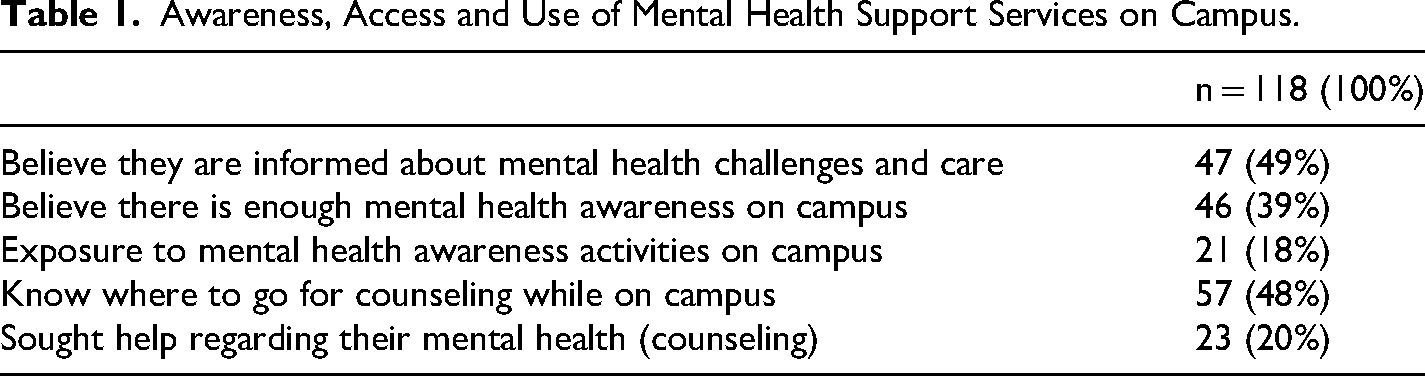
As presented in Table 1 above, the results indicate that more than half of the participants believe that they are not well-informed about mental health challenges and care. As such, many participants believe there is not enough mental health awareness on campus, with 61% of the participants indicating so. Consequently, only 18% of the participants indicated having been exposed to mental health awareness activities on campus, such as workshops, programs, or even posters. The results further indicate that more than half (52%) of the participants do not know how to access mental health resources on the campus, if needed. Consequently, 81% of the participants have never sought help regarding their mental health while at the campus.
Barriers to Mental Health Resources Access
Table 2 below presents the results on the barriers and difficulties faced by students in accessing mental health resources on campus.
Barriers and Difficulties to Accessing Mental Health Resources on Campus.
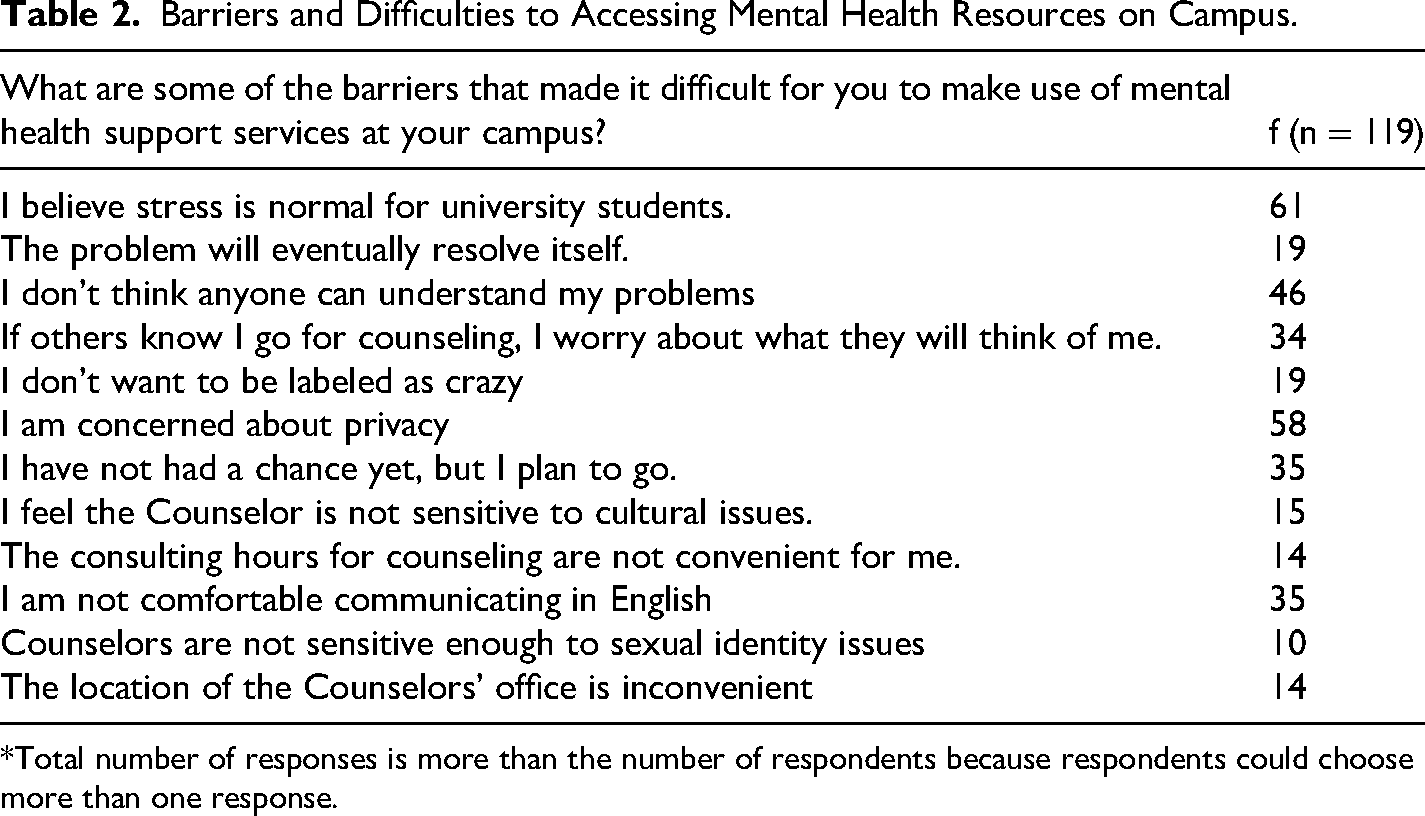
*Total number of responses is more than the number of respondents because respondents could choose more than one response.
Table 2 above indicates that a significant number of participants believed that stress is a common experience for university students and, as a result, did not seek help. After this, privacy concerns were the most frequently cited reason as a barrier to accessing mental health support services on campus. Table 2 further shows that many students do not seek help because they believe no one would understand their problems. Furthermore, some participants expressed apprehension of how they would be perceived by others if they were aware that they were seeking counseling, and others indicated that they would prefer not to engage in counseling because they did not want to be stigmatized as mentally ill. Communication in English was also rated by a number of participants as a deterrent to counseling on campus. Notably, a few students indicated that they stayed away from seeking help as they felt counselors were not sensitive to sexual identity issues.
The participants were further requested to identify any additional obstacles that hindered their ability to access and utilize mental health resources on campus, in addition to the reasons noted in Table 1 above. They mentioned the following reasons: not knowing who to approach or where the counseling office is located, not feeling secure with the student counselor, counselor availability, or being too shy to approach the counseling office.
Discussion
Awareness, Access and use of Mental Health Support Services on Campus
The results of this study suggest that students are not adequately informed about mental health challenges. This could be due to a lack of education, mental health promotion, and awareness at the institution. Education and understanding about mental health are crucial to addressing and managing mental health issues. Educational institutions must offer initiatives and resources to raise mental health awareness and minimize the stigma attached to mental health. The absence of mental health awareness activities on campus is an obstacle to the mental well-being of students. Hughes and Spanner (2019) observed that the promotion and awareness of mental health could significantly contribute to shifting the discourse away from interventions and instead focus on the comprehensive influence of universities and the need for proactive support of students and staff in maintaining positive mental well-being. Correspondingly, Brewster et al. (2022) contend that universities should go beyond merely providing reactive services or individual interventions. Rather, higher education institutions should promote a proactive and comprehensive strategy incorporating cultural and structural changes. The study highlights a need for serious mental health awareness activities in universities. This finding underscores the critical need for universities to prioritize mental health awareness and support services. To address this issue, universities can implement a range of strategies, such as organizing mental health awareness campaigns, providing accessible counseling services, encouraging peer support groups, offering stress management workshops, and collaborating with mental health professionals. By taking these initiatives, universities not only create a more supportive environment for their students but also promote their overall well-being and academic success.
The results further indicate that many students do not know how to access mental health resources on campus if needed. Consequently, most participants have never sought help regarding their mental health on campus. This finding is concerning, as students spent a substantial amount of their time at the university and would be anticipated to be cognizant of the resources that are available to them in the event that they require mental health support. This finding concurs with Conley et al. (2015), who also reported that only a few students experiencing mental health challenges actually receive mental health assistance due to the manner of delivery of mental health and supportive services in institutions of higher education. It can thus be construed that many students hardly receive the necessary mental health support at their institution of higher learning. And as it has already been established, if students’ mental struggles are not effectively addressed, they have the potential to impede students’ paths toward productive careers and future mental health and well-being (Bentley, 2018).
Barriers and Difficulties to Accessing Mental Health Resources on Campus
The results showed that the student participants did not seek assistance when they were stressed because they believed that stress is considered a normal experience for university students. Consequently, they did not utilize mental health services on campus. This trend has also been noted in the literature that there seems to be a tendency for students to normalize feeling overwhelmed and being constantly stressed as part of being a student (Winter et al., 2017). In their study, Osborn et al. (2024) reported how professionals in the mental health field explained how students believed that different needs warranted attention from health services. It is therefore predictable that a significant number of students did not seek mental health assistance, as they perceived stress as a natural part of the student experience.
Privacy concerns were another obstacle to the utilization of mental health support services, as reported by the majority of participants in this study. Confidentiality is a critical component of counseling, and individuals must be assured of their privacy to engage in open discussions regarding private and revealing information. Prior studies have also found that many students stayed away from seeking mental health help on campus due to the fear of their issues being made public (Kamunya et al., 2016). The fear of others knowing about possible mental health struggles is another deterrent to accessing mental health services on campus. Similarly, Winter et al. (2017) argued that some students are discouraged from seeking assistance with their mental health due to their fear of being stigmatized and labeled.
Other issues raised as obstacles to seeking mental health concerns on campus are language barriers between students and the counselors. While Namibia is a multilingual society with English being used as a second language, many people, including students, struggle to fully express themselves in English. Additionally, some students, especially those from minority groups, may worry about the counselor's sensitivity to their specific needs. For instance, counselor sensitivity to sexual identity issues can be a deterrent to help-seeking (Zay Hta et al. 2021). This is despite the fact that students from sexual minority groups are prone to mental health challenges compared to their heterosexual counterparts (McDonald, 2018).
Conclusion and Recommendations
The findings of this study underscore the critical need for universities to prioritize mental health awareness and support services. The identified barriers to accessing mental health resources, such as stigma, language barriers, and limited availability, highlight the importance of implementing comprehensive strategies to address these challenges. To foster a supportive campus environment, UNAM and other universities in general should invest in mental health awareness campaigns, stigma reduction initiatives, and accessible counseling services. By providing timely and effective support, institutions can help students overcome mental health obstacles, improve their academic performance, and enhance their overall well-being. Positive access to mental well-being services can significantly benefit university students. By reducing stress, enhancing emotional regulation, and improving focus, these services contribute to better mental health and academic performance. Additionally, mental health services foster stronger social connections, improve interpersonal skills, and increase a sense of belonging. Ultimately, well-being services equip students with lifelong skills, such as stress management and time management, leading to overall well-being and future success.
Footnotes
Acknowledgements
We are most grateful to the participants in the study.

Funding
The authors received no financial support for the research, authorship, and/or publication of this article.
Declaration of Conflicting Interests
The authors declared no potential conflicts of interest with respect to the research, authorship, and/or publication of this article.