




Abstract
Peer support programs offer a promising approach to addressing the high levels of stress and psychological distress reported by university students. However, few studies have considered the impact of implemented programs on the wellbeing and skill development of student facilitators. This study examines the experiences of student facilitators of a guided peer support program for reducing and preventing stress and low mood in student participants. Benefits to student facilitators, anticipated and actual, include the development of skills and experience in group facilitation, and a greater sense of community and belonging. While challenges exist in establishing initiatives, peer support and mentoring programs can offer valuable benefits by increasing wellbeing and fostering skill development for both participants and student facilitators. It is important that university-based peer support programs consider the student facilitator experience in both program development and evaluation and ensure training addresses facilitator concerns, prepares students adequately for the role, and considers the benefits for individual professional development.
Introduction
Both Australian and international research have reported significant levels of stress and psychological distress amongst those undertaking tertiary level study (Bore et al., 2016; Cvetkovski et al., 2012; Schofield et al., 2016). Reports also suggest growing demand being placed on university counselling services to support students to cope with the stressors of university life (McAllister et al., 2014; Stallman, 2010; Thorley, 2017; Williams et al., 2015). To support existing counselling and study support services, peer support and mentoring programs are increasingly being introduced into academic institutions to assist students in managing stress and transition to the new university environment (e.g., Collings et al., 2014; Dearlove et al., 2007; Horgan et al., 2013). Encompassing both one-on-one mentoring and peer facilitated group-based programs, peer support initiatives can offer a sustainable and cost-effective strategy for supporting first year students (Heirdsfield et al., 2008; Mead et al., 2001; Solomon, 2004). Evidence exists for a wide range of benefits to participants from the use of peer facilitated programs, including, improved academic outcomes, better adjustment to university, increased retention and sense of belonging (e.g., Collings et al., 2014; Dearlove et al., 2007; Glaser et al., 2006), and improved mental wellbeing (Byrom, 2018). However, what is often overlooked in evaluations of these initiatives is the experience of the student facilitator. In order to ensure best practice in the implementation of peer support programs, the impact of volunteering on those students acting as facilitators should be acknowledged and monitored closely.
The literature supports a range of physical and psychological health benfits to engaging in informal help and volunteer activities. These benefits can include improved mental and physical health and wellbeing, greater quality of life, self-esteem and sense of purpose, increased social support and reduced stress (see Casiday, et al., 2008, for review; Oarga et al., 2015). Within a university context, volunteering activities have also shown to enhance social, communication and organisational skills, and improve confidence (Bullen et al., 2010; Glaser et al., 2006; Williamson et al., 2017). Examination of the role of peer support within mental health services has demonstrated that individuals who are employed as peer support workers for mental health programs report improved self-esteem and confidence, skill development and personal growth as just some of the benefits they experience from providing support to others (Pfeiffer et al., 2011; Repper & Carter, 2011; Salzer & Shear, 2002; Solomon, 2004). While similar benefits may also exist for students engaged as program facilitators or mentors for student mental health programs further research in this area is needed.
Within higher education, increasing emphasis is placed on the employability of graduates and the need for universities to ensure students possess the skills and confidence to succeed in the workforce. These skills include good interpersonal communication skills and the ability to work as part of a team, self-confidence, initiative, integrity, and organisation and leadership skills (see Tymon, 2013, for review). While some of these skills are developed as part of students’ coursework, emphasis is increasingly placed on work integrated learning strategies and extra or co-curricular volunteer opportunities to further student development and employability (Bennett et al., 2015). Peer-based student mental health programs may therefore also offer student facilitators important opportunities to develop the desired graduate attributes needed to assist in navigating a challenging employment environment.
The present article reports on the expectations and experiences of student facilitators of a university-based peer support program called Positive Minds designed to promote positive wellbeing and reduce or prevent stress and low mood. This study aimed to extend previous evaluations of peer support programs for mental health and wellbeing, including evaluations of the Positive Minds program (e.g. Byrom, 2018), to conduct a preliminary examination of: (1) the anticipated benefits, motivations and concerns of students prior to commencing training for the facilitator role; (2) the perceived benefits experienced by facilitators; and (3) the challenges faced by facilitators. This study will inform the improvement of facilitator training and the supports offered by this initiative as well as highlight issues that should be considered in the development of similar programs.
The Positive Minds program
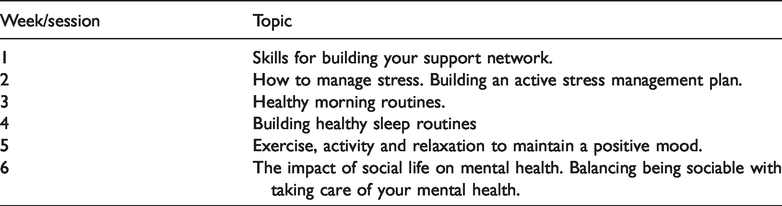
Positive Minds is a six-week guided peer support program designed to provide young adults with strategies to promote positive wellbeing and reduce or prevent the negative impact of stress and low mood. The course, developed by Student Minds (http://www.studentminds.org.uk/), is based on research demonstrating the benefits of early intervention through the development of practical skills and goal setting. The program aims to provide students the opportunity to share experiences in a safe environment to reduce social isolation. Sessions include the discussion topics presented in Table 1. A workbook is provided to participants to assist in guiding discussions and provide a template for reflection and recording of useful strategies through the program. The Positive Minds program is peer-led, facilitated by students who complete specific training for the role. Each session is facilitated by a team of 2 to 3 facilitators. Program facilitators have access to regular supervision and supports. See Byrom (2018) for further information about the program.
Positive Minds program structure.
Method
Participants and procedure
The present study comprised 16 second- and third-year university students recruited to train as volunteer facilitators of the Positive Minds program in 2017 and 2018. Facilitators were recruited using posters and announcements placed on university notice boards. Those students who expressed an interest in being facilitators of the program completed an online application form and were invited to an interview. Selection criteria sought to recruit students who were motivated to perform the role and had insight into the skills that would be required (e.g. listening and communication skills, empathy) and the barriers that would be important for a facilitator to maintain. Awareness of other services that the university provides for students (e.g. medical and counselling services) was of benefit. Successful applicants also had to be available to complete the training designed specifically for the program. Incidentally, all facilitators recruited for the program were undergraduate psychology students.
For the purposes of the research study, facilitators were invited to complete an online survey prior to completing the training (Time 1), following training prior to the start of the program (Time 2), and at the conclusion the program (Time 3). Participants completed measures of confidence in their ability to help someone, general self-efficacy and wellbeing. The primary focus of the present article is participants’ responses to open-ended questions on expected and experienced benefits and challenges associated with being a program facilitator.
Facilitator training program
The training program, approximately 12 hours delivered over three days, provided facilitators with an overview of student mental health, an introduction to motivational interviewing techniques, and strategies for managing difficult conversations that may arise. It worked through the role of the group facilitator and the importance of establishing ground rules, as well as how to maintain boundaries and confidentiality. The training also introduced the program structure and provided an opportunity for attendees to plan sessions and practice skills in group facilitation. The training program was offered in July 2017 and January 2018 and was delivered by the program supervisor – consistent with the training manual produced by Student Minds.
Measures
The online survey comprised both closed and open-ended questions to assess both facilitator confidence and wellbeing and obtain their perceptions of the experience.
Confidence
Facilitator confidence was assessed at each time point using a single item ‘How confident do you feel in supporting someone who is finding it difficult to cope with university?’ Participants responded on a 5-point scale from 1 (not at all) to 5 (extremely).
Self-efficacy
The 10-item General Self-Efficacy Scale (Schwarzer & Jerusalem, 1995) was used to assess general self-efficacy at each time point. Participants responded on a 4-point scale from 1 (not at all true) to 4 (exactly true). A total score was calculated by calculating the mean across items with higher scores reflect greater self-efficacy. Internal consistency for the scale was appropriate (Cronbach alpha = .75 to .87).
Wellbeing
Facilitator wellbeing was assessed at each time point using the 7-item Short Warwick–Edinburgh Mental Well-being Scale (Fat, et al., 2017; Tennant et al., 2007). Participants responded on a 5-point scale from 1 (none of the time) to 5 (all of the time). A total score was calculated by summing the score for each of the items and transforming the total score for each person according to the conversion table prescribed for the scale (Stewart-Brown et al., 2009), higher scores reflect greater positive wellbeing. Internal consistency for the scale was high (Cronbach alpha = .86 to .95).
Expected benefits and challenges
Participants were invited to respond to two open-ended questions prior to training (Time 1) to identify perceived benefits and challenges associated with participating in the program. Specifically, participants were asked ‘What do you think might be the benefits of participating in the peer support program?’ and ‘What concerns do you have about participating in the peer support program?’ These same questions were also asked at Time 2.
Experienced benefits and challenges
At the conclusion of the program (Time 3), participants were asked: ‘What do you think are the benefits of participating in the peer support program?’; ‘What were the main challenges or difficulties associated with participating in the peer support program?’; ‘What have you learnt through this process?’, ‘Would you recommend this type of program to other students?’ Each question provided the opportunity for open-ended responses.
Data analysis
Responses to the open-ended questions were subjected to a qualitative content analysis. Initial coding of item responses was conducted by the primary investigator. An inductive approach to the identification of codes was used whereby they were derived from the data. This procedure involved reading each participant response to identify the type of benefit or concern raised and identify key words or themes common across participants. The data were examined at a surface level, to reduce bias and speculation regarding what had informed the participants’ response, focusing instead on what the participant had specifically written. It should be noted that participant responses were largely succinct. This approach was also taken given the lack of prior research looking specifically at the experience of student facilitators and acknowledgement that it may be different to other volunteer or peer support activities. The identified codes were then labelled and provided to a co-author for independent cross-coding. No exceptional differences were identified (98% agreement). Minor discrepancies were resolved by discussion between the two raters. Coding labels were then revised for clarity for reporting purposes as used below. For summary purposes, the number of participants who provided a response that was coded within each category (e.g. helping others) was quantified. Responses to each question could be allocated more than one code.
Results
Facilitator confidence, self-efficacy and wellbeing
Table 2 reports the mean levels of confidence, self-efficacy and wellbeing prior to training (Time 1), post training (Time 2) and following the conclusion of the program (Time 3). Overall, confidence amongst the facilitators in their ability to help support someone finding it difficult to cope with university was high across time points. A small increase in confidence was noted following training (mean difference between Time 1 and Time 2 = .51). Reported self-efficacy and wellbeing were also generally high across time points; however, there was no substantive change indicated over time for these measures.
Mean confidence, self-efficacy and wellbeing, by time.

Anticipated benefits and concerns prior to training
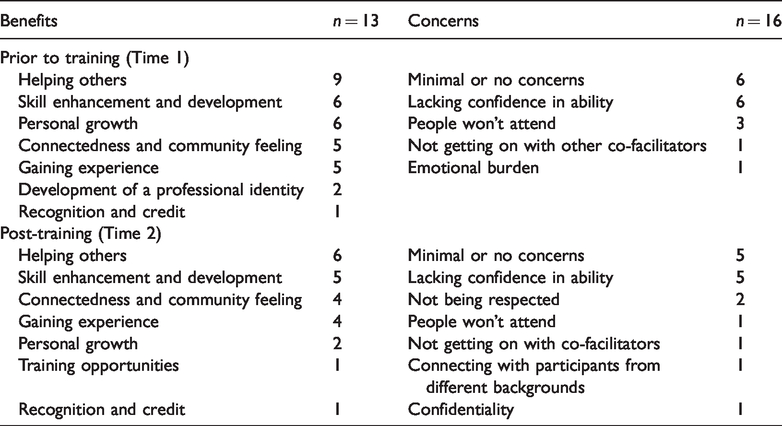
At Time 1, 13 of the 16 facilitators indicated perceived benefits associated with being a facilitator, and 8 facilitators cited concerns about participating in the program (see Table 3).
Summary of anticipated benefits and concerns reported prior to and post-training.
Benefits anticipated
The anticipated benefits of being a peer support facilitator included, helping others, skill enhancement and development, personal growth, connectedness and community feeling and gaining experience. The most commonly anticipated benefit, reported by 9/16 facilitators, reflected the anticipation of feeling positively about ‘helping others’ in need. For example, one facilitator commented ‘Benefits of a program like this include … generally feeling good knowing you’ve helped somebody’. Another facilitator reported: providing guidance to peers who need help with time management, de-stressing techniques and ability to cope with university life; helping peers come up with strategies that work best for them as each individual is unique; providing peers with useful and a range of skills that they can use as part of dealing with stress, improving mental health and university.
Improved social connectedness and feeling part of a community was cited as an anticipated benefit by 5/16 facilitators. Facilitators anticipated benefits such as the ability to ‘engage with people from different backgrounds’, ‘network with supervisors and peers’, and ‘feel part of the university community’. Finally, five facilitators also cited that the opportunity to gain experience that extended their psychology studies would be an important benefit.
Concerns
While 6 of the facilitators did not cite any concerns prior to training, 10 of the facilitators reported initial concerns associated with a lack of confidence in ability, and concern that people won’t attend. In addition, one facilitator expressed a concern regarding not getting on with other facilitators, and one facilitator reported concern associated with the potential emotional burden of being a peer support facilitator and the need to look after one’s self. Concern related to a lack of confidence in ability reflected apprehension associated with engaging in a new skill/activity. This is illustrated by one facilitator who commented:
As this is the first time I have been a group facilitator I am unsure about my ability to provide an environment where I can encourage people to share their feelings and experiences and feel safe doing so. I am unsure of how to ensure everyone gets a fair turn, and in particular how to handle people who may dominate discussion, or issues such as conflict that may arise.
Concerns relating to people not attending reflected anxiety about how to ‘encourage people to keep coming to sessions’ and that ‘people may not return especially as they get busier with university work’. Another facilitator commented ‘it can be nerve wracking to facilitate a group that is not motivated to be present or learn anything from one another’.
Anticipated benefits and concerns post-training
Following the training (Time 2), 10 of the 16 facilitators provided further feedback on the anticipated benefits and concerns of being a facilitator. Also summarised in Table 3, it can be seen that responses were similar to those highlighted prior to training. Benefits associated with ‘helping others’, obtaining new skills and experience, and feeling connected to the university community were prominent in responses. Few concerns were noted. Those that were noted, continued to reflect initial nervousness/anxiety about starting sessions.
Benefits and challenges experienced
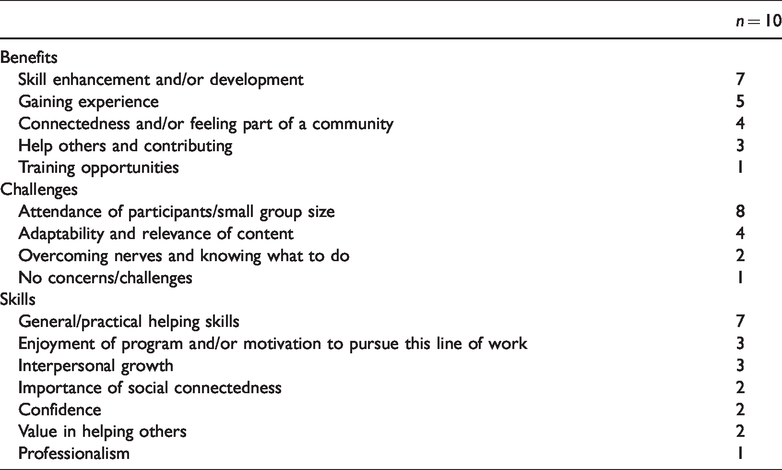
Following the conclusion of the program, 10 of the 16 facilitators provided feedback on their experience. As can be seen in Table 4, while all respondents cited benefits of being a peer support facilitator, 9 of the 10 respondents also reported challenges associated with participating in the program.
Summary of benefits and challenges experienced and skills gained (Time 3).
Benefits experienced
The most commonly cited benefit reported by facilitators was the development and enhancement of skills, similar to that anticipated at baseline. This was illustrated by one facilitator who commented ‘Being a facilitator it enables you to learn how to approach situations in a professional manner. It allows you broaden your ability to work in a team and to communicate to your team and the participants’. Another respondent reflected that the benefits of being a facilitator were ‘learning how to respond to different people, learning how to communicate to a group, developing people skills’. This was further emphasised by another facilitator who reported that:
I think it gives the opportunity to reflect on your own experience and what you have learned, which can increase confidence in your own abilities. It is also good experience in working with other people, both in a team capacity and in a facilitation role. It’s useful to practice speaking in front of people, particularly in an informal setting rather than a presentation setting. This allows you to practice thinking on the spot, going off script, and using your initiative to change course if appropriate.
Finally, four facilitators also reflected on a sense of social connectedness and feeling that one was part of the university community. Specifically, one facilitator expressed that the benefit of being a peer support facilitator was ‘contributing to the university community, meeting new people, friendships with other facilitators, support from supervision, feeling more connected to university and more supported’.
Skills obtained
When asked specifically what they had learnt through their participation as facilitators, seven respondents reflected on skills attained. A summary of responses coded are presented in Table 4. For example, one facilitator commented ‘I have learned to behave in a professional manner and to conduct myself appropriately according to the situation. As well as building on foundational skills I have learned in other areas’. Three facilitators indicated general interpersonal growth, for example: how valuable it can be to give someone the opportunity to talk about their situation. How much more enjoyable uni(versity) can be when feeling connected to the university community. Confidence in my own abilities. That I want to do more to promote mental health.
Would participants recommend the experience?
When asked if they would recommend the experience to other students all respondents said yes. One facilitator added: (it is an) amazing opportunity to gain practical experience as well as build your own support network and help students in need”; another reflected “(it) is a great way to get a sense of working with people, teamwork and communicating effectively with confidence.
Challenges experienced
A summary of the challenges experienced by facilitators during the program is presented in Table 4. Almost all respondents cited maintaining the attendance of participants as a challenge, with four facilitators highlighting that when group sizes were small discussion activities were made more difficult.
Discussion
This study examined the expectations and experiences of second- and third-year students recruited as facilitators for a university-based peer support program. Overall, the study highlighted that despite facing some challenges, facilitators found the experience rewarding.
Prior to both the commencement of training, and the implementation of the program, the prospect of helping others appeared to drive motivations for many students to volunteer as a facilitator. The opportunity to develop skills and experience in leadership, communication and group dynamics was a further benefit anticipated by many facilitators. These ‘anticipated benefits’ are similar to motives reported by students engaged in both mentor and health-related volunteer activities (Egege & Kutieleh, 2015; Williamson et al., 2017). However, it should be acknowledged that these motivations are reflective of criteria often used to select facilitators (including in the present study), namely some understanding of the skills that a facilitator would require such as listening and communication skills and empathy. Regardless, the characteristics and motivations of individuals recruited as the program facilitators are likely to be a major contributing factor to the success of any peer support program, due to the important role that rapport between facilitators and participants plays in program outcomes (Egege & Kutieleh, 2015). Therefore, acknowledging and understanding the expectations and motivations of student volunteers in the context of these types of programs is important in ensuring appropriate recruitment and training of facilitators and the overall success of the program.
Despite reporting relatively high confidence overall, prior to commencing the program many facilitators held concerns reflecting a lack of confidence in their ability. This type of apprehension is understandable, if not expected, even after training, where students have not had any prior experience of a similar situation. To our knowledge, past research has failed to examine the concerns and fears of the facilitators of peer support programs; however, knowledge of these concerns provides useful information for ensuing facilitators are appropriately prepared for their role. By examining and understanding concerns, these can be addressed through training, and the facilitators’ confidence in their abilities can be improved. Certainly, in the present study, we found that following our training program, mean confidence levels increased, which is an important benefit associated with volunteering. However, continued acknowledgement of concerns following training is also important in providing ongoing support and supervision for student facilitators.
Following the conclusion of the program, facilitators overwhelmingly reported a positive experience and confirmed that that they would recommend participating to their peers. While no substantive change was observed in the quantitative measures of wellbeing or self-efficacy and confidence showed only small increases following training, qualitative feedback indicated that the skills and experience gained can make an important contribution to the rounded professional development of the students involved. Specific benefits included the enhancement and development of professional and communication skills, and connection to the university community, in addition to improved confidence. These results are consistent with available research suggesting the benefits of helping others in a peer support role or similar volunteer activity can include skill development and improve the confidence of mentors (Bullen et al., 2010; Williamson et al., 2017). Importantly, aside from personal wellbeing, these benefits reflect skills consistent with desired graduate attributes in discussions of employability (Tymon, 2013). It is possible that the lack of substantial change in the other outcome measures may be due to the small sample size and ceiling effects resulting from the high levels of wellbeing and self-efficacy reported at baseline. While the mechanisms associated with reported skill development were not examined specifically in the present study, it is suggested that by providing the opportunity and support to take on a leadership role in this capacity students are able to build confidence in their capability.
A feeling of connection to the university community is an additional significant benefit highlighted in the present study. Engaging students in experiences that promote a sense of belonging to the institution is an important factor in students’ success and retention in higher education (O’Keeffe, 2013). While a sense of belonging can be achieved through the development of positive student/staff relationships and other support services, the development of ‘belongingness’ obtained through making a specific contribution to the university community may be particularly powerful and should be considered further in future research.
At the end of the program, facilitators reported the irregular attendance of participants as the primary challenge they faced. The commitment and attendance, or continuation of contact, of mentees with either individual mentors or larger mentor programs, is a challenge highlighted in past research (Collings et al., 2014; Heirdsfield et al., 2008; Horgan et al., 2013). Indeed, a prior evaluation of the Positive Minds program across eight UK institutions reported only that 34% of participants completed the six-week program, with 43% attending only a single session (Byrom, 2018). A voluntary or optional program such as this must be engaging and perceived as supportive to attract participants, and low attendance rates create a challenging cycle for facilitators and program coordinators working to build such an environment. Consequently, consideration needs to be given to the scheduling of group sessions to ensure optimal positioning within the teaching periods and avoidance of conflicts with academic commitments; the potential for online or alternative flexible delivery options should also be considered. Further, these challenges may be addressed by revising the length of the program, in light of further evaluation, or embedding the program within other student services (Byrom, 2018).
Limitations and future directions
While the present study highlights important considerations for program coordinators to consider in recruiting, retaining and supporting peer facilitators, the findings must be considered in the context of several limitations. First, due to the small sample and the program only having been newly implemented in the University, the reported experiences of facilitators are not generalisable to all facilitators of peer support programs, or even the experiences of all Positive Minds volunteers. It can take time for a program such as this to become established within an institution; therefore, ongoing consideration of facilitator experiences, in the context of program evaluation and benefits to be awarded for participants, is important. The small sample size should also be acknowledged in the context of interpreting the quantitative results. These results should be interpreted as descriptive only as the sample does not provide sufficient power to substantively test change over time. Second, the diversity in definitions of what constitutes a peer-support program means comparisons are difficult between the experiences of our program facilitators and those of other mentor programs. Specifically, this program is focused on developing strategies to promote positive wellbeing and reduce or prevent the impact of stress and low mood, where others are focused more on supporting academic skills. As such, the specific benefits to be awarded to mentors and facilitators may differ. However, the development of interpersonal skills, confidence and connection to the community may be important outcomes expected to extend across all peer-mentoring and support programs. Third, the present study is limited by the survey methodology used. The use of a more in-depth focus group or interview approach would have provided richer data and the ability to explore facilitator experiences further. However, the online survey approach was employed to facilitate greater anonymity in the feedback provided and enable challenges and criticisms of the program to be more freely articulated. Further, this study does not capture individual characteristics of the program facilitators that may be key factors driving successful implementation. Future research should seek to examine characteristics of student volunteers to identify those most suited to the role. Finally, it would be of interest to examine longitudinal changes in confidence, self-esteem and academic performance and engagement of program facilitators to determine the cumulative impact of volunteering in this capacity on individual wellbeing and academic success, and student retention. However, despite these limitations, the study provides valuable initial feedback that needs to be considered in the further development of this and other similar initiatives.
Conclusion
In conclusion, peer support programs can offer important positive benefits for program facilitators in addition to those often considered for program participants. While further research is required to establish commonalities across different types of programs, these may include, at a minimum, the opportunity to develop communication skills, feelings of social connectedness and purpose or civic responsibility. However, the concerns and challenges faced should also be considered.
Past research has highlighted the need for further research to examine the effectiveness of undergraduate student-support programs. Importantly, a review of undergraduate mentoring programs by Gershenfeld (2014) and others (e.g., Egege & Kutieleh, 2015) have highlighted the need to consider the extent to which mentors receive appropriate training and support for their role, and the importance of social validity in such studies; ‘gathering data on participant perceptions’ for ‘understanding the relevance of the mentoring process on those who matter most’ (Gershenfeld, 2014, p. 387). In implementing peer-based programs, consideration must be given to the impact of the program as a whole, including the experience of both participants and student volunteers. While student facilitators may benefit in terms of personal skills and experience gained as a result of the opportunity, there is potential for negative impacts on confidence and self-esteem if participant engagement is low. Training provided for student facilitators should acknowledge and address their concerns and help to further build confidence and alleviate anxieties prior to taking on the role. Monitoring of the whole program is important in ensuring best practice in such initiatives.
Footnotes
Acknowledgements
Declaration of Conflicting Interests
Funding
ORCID iD
