




Abstract
Music students in tertiary education struggle with a range of health-related problems. We investigated students’ self-referrals for counseling at a UK conservatoire to explore trends in students’ attendance at counseling sessions over time and identify their reasons for seeking and continuing to attend counseling. We conducted a secondary analysis of data collected from 645 students by two in-house counselors at the conservatoire between 2000 and 2016. We obtained analogous data on all students registered during the same period for comparison and conducted nonparametric tests of association between the groups. A total of 645 students attended a mean of eight (Mdn = 4) counseling sessions over the 16-year period: 63% were female, 79% were from the UK, and 72.5% were undergraduate students. The percentages of students attending counseling increased from 2 (1%) in 2000–2001 to 71 (13%) in 2015–2016. The presenting concerns of almost one in 10 students who sought counseling were related to self-esteem, self-confidence, ego strength, and coping ability. Their main reasons for continuing to attend counseling were also to do with self and identity, relationships, academic concerns, loss, abuse, and anxiety. Female students, postgraduate students, and those studying singing were most likely to attend counseling sessions.
Musicians form one of the occupational groups most at risk for mental health problems (Brodsky, 1996). Classical musicians suffer from a range of health-related problems, particularly related to musculoskeletal issues (Cruder et al., 2020; Rotter et al., 2019), mental ill-health (Ackermann et al., 2014; Vaag, Saksvik-Lehouillier, et al., 2016), and music performance anxiety (MPA; Burin & Osório, 2016). When compared to nonmusicians, music students reported taking less responsibility for their health and stress management, lower usage of coping strategies, poorer sleep quality, worse health overall, and higher rates of anxiety, depression, and MPA (Araújo et al., 2017; Robson & Kenny, 2017). However, there is contradictory evidence as to the extent to which musicians seek treatment for psychological issues (Vaag, Bjorngaard, & Bjekeset, 2016; Vaag et al., 2021; Wristen, 2013). The predictors of MPA include depression, being female, having experienced a breakdown while performing music (Robson & Kenny, 2017), negative cognitions such as catastrophizing (Liston et al., 2003), trait anxiety, and fear of negative evaluation (Osborne & Kenny, 2008).
Proportions of music students similar to those of professional musicians report musculoskeletal symptoms, which may begin in high school or even earlier (Ackermann et al., 2002; Lonsdale & Kuan Boon, 2016; Ranelli et al., 2008). Both psychosocial and physical risk factors are associated with performance-related musculoskeletal disorders. Psychosocial risk factors include depression (Kenny & Ackermann, 2015), performance anxiety (Leaver et al., 2011; Steinmetz et al., 2015), pressure from self (Wu, 2007), stress and social phobia (Chan & Ackermann, 2014), and personality traits such as perfectionism (Altenmüller & Jabusch, 2010).
Furthermore, the classical music work environment has been associated with a number of psychosocial pressures that include suboptimal social support, low control, high job demands, competition, and criticism (Jacukowicz, 2016) and thus poorer well-being (Willis et al., 2019). Stresses associated with conservatoires include their emphasis on “talent” and performance rather than purely academic achievement, competitive ethos, and often, authoritarian approaches to teaching (Perkins, 2013a, 2013b).
In universities and conservatoires alike, departments of student services (or their equivalent) provide students with health and well-being-related help via specific well-being, counseling, and disability services. Each conservatoire is likely to employ between one and five counselors who provide students with free, in-house, one-to-one counseling, typically in the form of a course of eight 45-minute weekly sessions, although students can be referred to external providers.
The negative changes in music students’ mental health between the beginning of their studies and the third or fourth years of study (Rosset et al., 2022) have already been documented. While there are some data on music students’ use of psychotherapy and counseling in Norway and the United States (Land, 1979; Vaag et al., 2021), we found no published data on the extent to which music students seek and attend counseling or on why they do so. Furthermore, no publications (to our knowledge) have yet reported longitudinal data collected in a higher education institution or discussed them relative to all enrolled students for a better understanding of trends over time. Additionally, given that existing findings on music students’ psychological issues come from self-report data, it may be important to explore the perspective of mental health professionals themselves, especially when collected by the same professionals across an extended period of time, without recall bias. Our findings are embedded in a critical approach to current conceptualizations of mental health and support an invitation to look at mental health from a much broader, less clinical perspective, namely, one that encompasses the curriculum, instrumental and vocal teachers, institutions, culture, and notably, the ideology of Western classical music. This is of relevance beyond the single institution presented here. We also discuss some ways in which counselors could improve their data collection for the purposes of research given the important contribution they make to knowledge of changes in music students’ mental health.
Terminology: Anxiety, Mental Health, Mental Well-Being, or Distress?
Different terms are used in different contexts. “Anxiety” has a specific meaning in the American Psychiatric Association’s Diagnostic and Statistical Manual of Mental Disorders (DSM; Baxter et al., 2014). Thus, psychologists use “anxiety” as a diagnosis, while members of academic staff at higher education institutions (HEIs) might refer to “normal levels of anxiety” in stressful everyday situations. Counselors are more likely to refer to “psychological distress.” Other terms for mental disorders, such as “mental illness,” “mental health problems,” and “difficulties”/“issues” (Equality Challenge Unit, 2014), are used interchangeably, which makes it particularly difficult to synthesize the literature (Sheldon et al., 2021). Mental disorders vary in their severity (Royal College of Psychiatrists, 2021), from mild conditions to schizophrenia and bipolar disorder, both of which are likely to require psychiatric intervention. Similarly, the World Health Organization (2018) described mental disorders as presenting in a variety of ways and wrote that “they are generally characterized by a combination of abnormal thoughts, perceptions, emotions, behaviour and relationships with others.” The fifth edition of the DSM has been criticized given that its roots lie in consensus rather than science and that a focus on diagnosing individuals can be used to avoid addressing the real problem, which is social in nature (Davies, 2016).
The Present Study
We investigated the main reasons why students at one particular UK conservatoire sought counseling and their presenting concerns by analyzing data from the records kept between 2000 and 2016 by in-house student counselors at the conservatoire.
The research questions were: (1) What were the demographic characteristics of all students registered between 2000 and 2016 and those attending counseling sessions? (2) What proportion of all students registered were students attending counseling sessions in each year between 2000 and 2016? (3) Why did students attend counseling sessions? What were their presenting concerns and main reasons for continuing to attend? (4) How severe were students’ presenting concerns? (5) What were the associations among students’ demographic characteristics? (6) How were each of students’ demographic characteristics associated with the students’ use of counseling? and (7) What were the potential relationships between the students’ demographic characteristics and the number of counseling sessions they attended?
Method
Design
We conducted a secondary analysis of data from 645 students collected by two counselors as part of their routine record-keeping between 2000 and 2016. We also obtained analogous data on all students registered during the same period for comparison. Data recorded and stored by one male and one female counselor, both accredited by the British Association for Counseling and Therapy (BACP), comprised demographic information, year of (self-)referral, number of sessions attended, and presenting and emerging concerns categorized by degree of severity. Demographic information consisted of the student’s (i.e., client’s) date of birth, sex, nationality, school of study, 1 program (undergraduate/graduate student), and year of study. We computed a new variable called “age” by subtracting the year of birth from the year in which the first counseling session took place.
Demographic Characteristics
The total number of students registered between 2000 and 2016 ranged from 140 in 2000–2001 to 567 in 2015–2016 (Table 1). There were similar proportions of males and females. The majority were undergraduate students; played string, wind, brass, and percussion instruments; and were British.
Characteristics of Students Registered in 2000–2016.
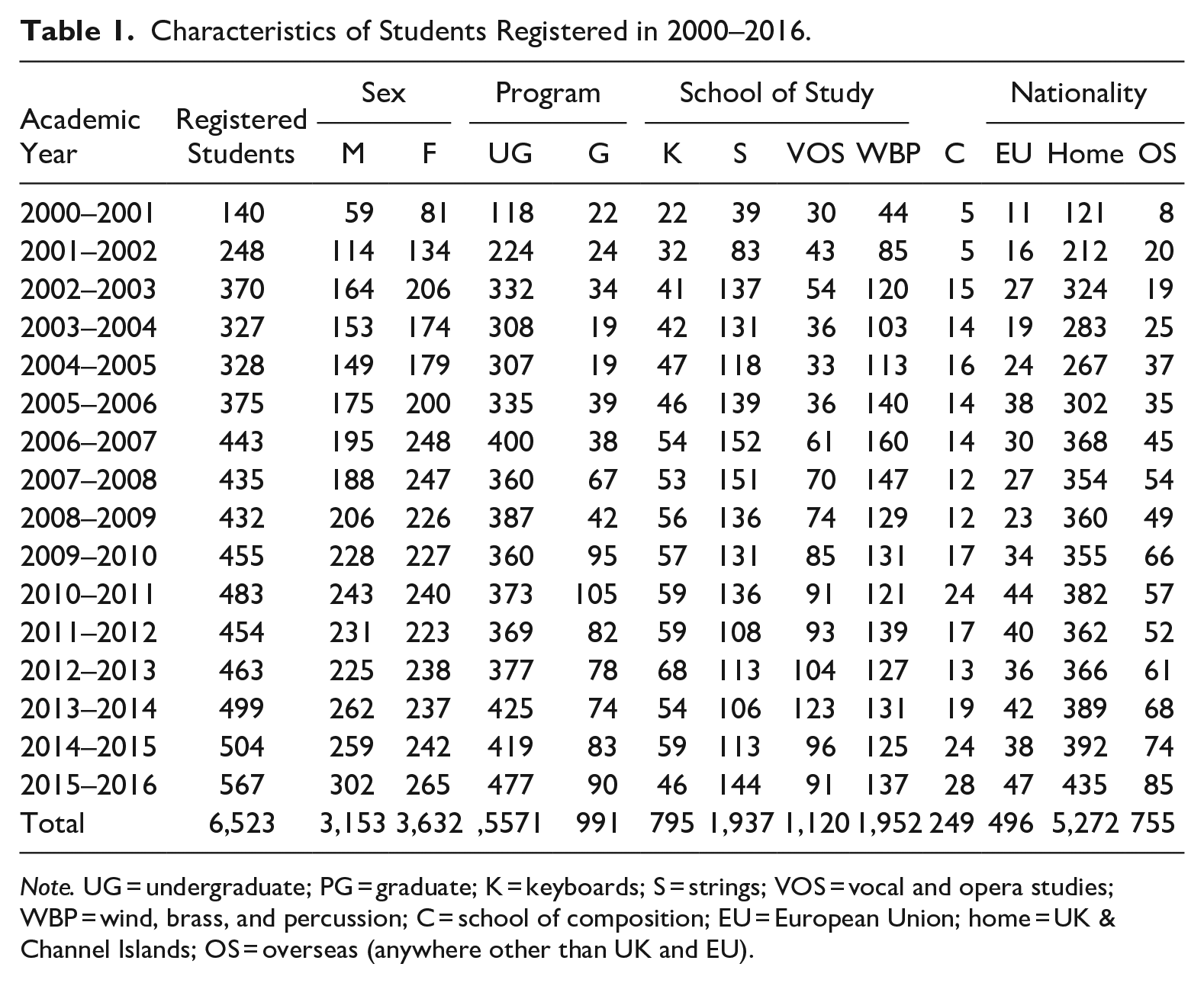
Note. UG = undergraduate; PG = graduate; K = keyboards; S = strings; VOS = vocal and opera studies; WBP = wind, brass, and percussion; C = school of composition; EU = European Union; home = UK & Channel Islands; OS = overseas (anywhere other than UK and EU).
The ages of the 645 students who attended counseling sessions between 2000 and 2016 ranged between 18 and 33 years (M = 22, SD = 2.89; MD = 21). They attended between one and 69 sessions, and one student attended a total of 130 sessions (M = 8, SD = 11.19, Mdn = 4; Mode = 1). The majority were female (n = 403, 63%), undergraduate (n = 459, 72.5%), and British (n = 498, 79%). They were divided between string players (n = 183, 29%); wind, brass, and percussion players (n = 180, 28%); singers (n = 171, 27%); keyboard players (n = 66, 10%); and composers (n = 33, 5%). It was mostly first-year students who attended counseling sessions (n = 160, 35.1%), followed by second-year (n = 129, 28.3%), third-year (n = 100, 21.9%), and fourth-year students (n = 67, 14.7%). The 645 students attended 5,005 sessions in all. The male counselor delivered sessions to 520 students (80.6% of the total) between 2000 and 2016, and a female counselor delivered them to the remaining 125 (19.4%) between 2012 and 2016.
Materials
We documented two types of concerns: (a) presenting concerns, representing the main reason that the client sought the counselor’s help, and (b) emerging concerns, representing any problem that emerged during the initial session or subsequently and was observed by the counselor and/or raised by the client. Presenting and emerging concerns were labeled according to the AUCC Categorisation of Client Concerns, the system used by counseling services in the UK and Ireland since 2000 to collect data for the AUCC Annual Survey of Counseling in Further and Higher Education. It lists over 280 concerns, organized into 15 broad categories (Table 3). The AUCC is a subjective assessment that can be used to compare university and college services and explore trends in the sector (University of Oxford, n.d.). Its psychometric properties have not been formally evaluated.
We categorized concerns in terms of their severity on a scale from 0 (experiencing normal issues of living, mood stable, functioning well) to 7 (not coping, out of control, despair and hopelessness, emotionally overwhelmed, suicidal thoughts/intent). We also obtained matching demographic data on all students registered between 2000 and 2016 from the conservatoire’s registry to make comparisons between those who sought and those who did not seek counseling.
Procedure
The Conservatoires UK Research Ethics Committee granted us ethical approval. The senior of the two counselors gave us access to the raw, handwritten records, and we entered the data into SPSS between July and September 2016.
We assessed the numbers of counseling sessions attended in each year against the data on the number of all students registered at the same time. These data included the number of all students registered for each year between 2000 and 2016 and the following characteristics: sex, nationality, school of study, program, and year of study. We removed the data from those who were labeled as alumni, interrupted, withdrawn, or transferred.
Results
Proportion of Registered Students Who Attended Counseling
We counted students as attending counseling sessions in the year of their first session only regardless of whether they attended counseling during that year only or for more than 1 year. For example, if a first-year undergraduate student attended their first session in 2005 and went on to have a further 70 sessions during the course of 2006, 2007, and 2008, they would be considered a member of the cohort of students who attended 71 counseling sessions in 2005 only.
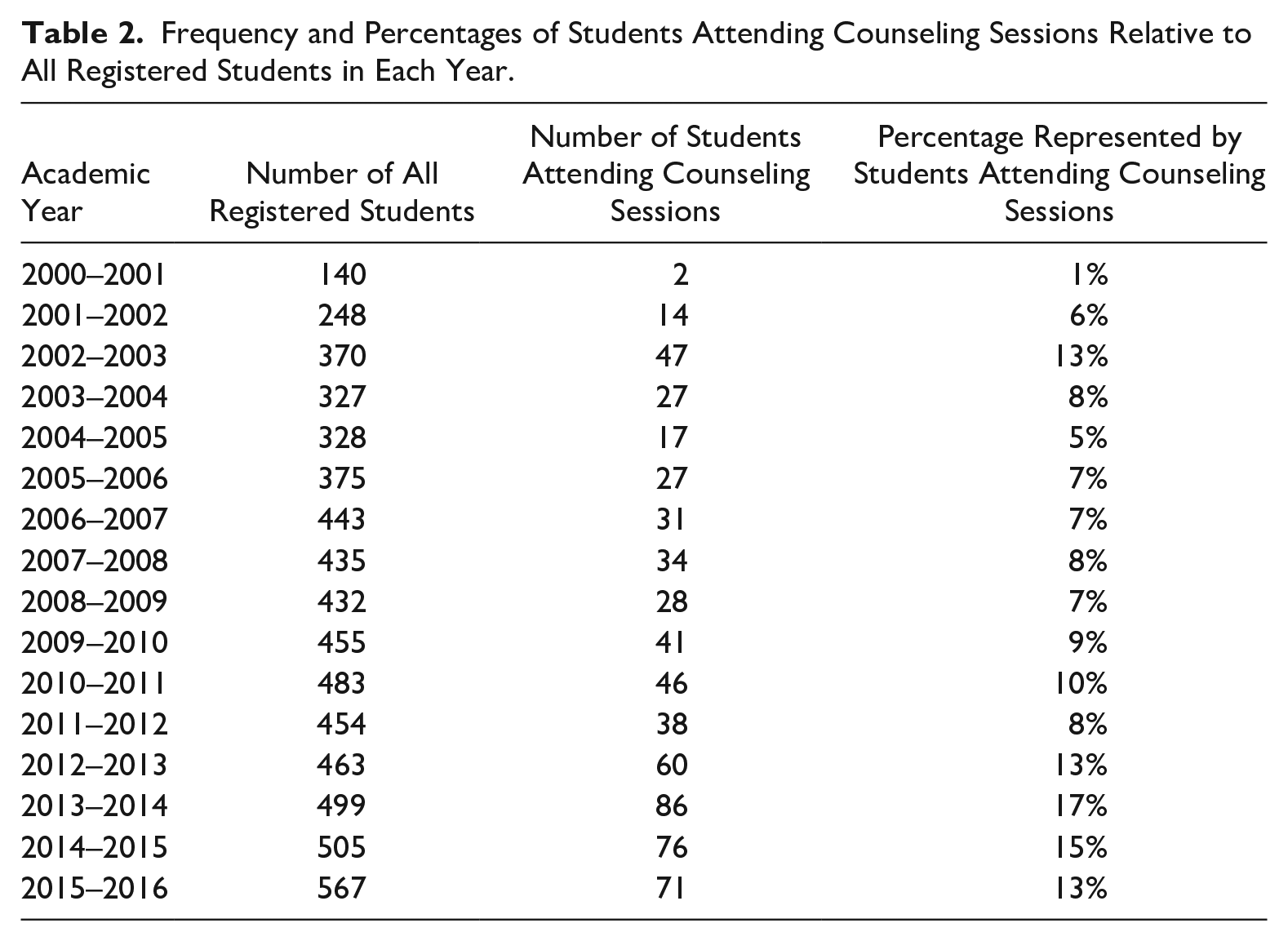
As shown in Table 2, the numbers of students attending counseling sessions increased from two in 2000–2001 to a total of 71 in 2015–2016, in the context of a similar increase in the numbers of students registered each year, from 140 to 567. The percentage of all students registered who attended counseling sessions ranged from a minimum of 1% in 2000–2001 to a maximum 17% in 2013–2014.
Frequency and Percentages of Students Attending Counseling Sessions Relative to All Registered Students in Each Year.
Why Students Attend Counseling Sessions
Presenting concerns
Of the 280 concerns listed by the AUCC, the 20 most common, in terms of frequency and the percentages of students who presented with them in their first counseling sessions, were as follows: self-esteem/self-confidence/ego strength/coping ability (n = 62, 9.6%), relationship with partner (n = 35, 5.4%), performance anxiety – not exams (n = 33, 5.1%), letting go after a relationship ends (n = 31, 4.8%), bereavement – a loss of a relationship through death (n = 26, 4.0%), relationships in the family or with a family member (n = 26, 4.0%), lack of academic motivation/concentration and procrastination (n = 23, 3.6%), anxiety – mild and/or generalized (n = 23, 3.6%), relationship with other/s (including staff; n = 22, 3.4%), severe anxiety state (n = 20, 3.1%), panic attacks (n = 20, 3.1%), struggling academically (n = 17, 2.6%), poor study skills/time management (n = 15, 2.3%), disappointment with course/course content (n = 14, 2.2%), personal growth/search for values and meaning (n = 13, 2.0%), low mood (n = 11, 1.7%), depression (n = 11, 1.7%), bulimia (n = 11, 1.7%), relationship with friend(s) and/or housemates (n = 11, 1.7%), and employment and vocational (n = 10, 1.6%).
Undergraduate and graduate students presented with similar concerns in their first sessions. The top presenting concerns for undergraduate students by number of students were self-esteem (n = 45), bereavement (n = 23), relationship with partner (n = 23), letting go after a relationship ends (n = 22), relationship with family (n = 21), performance anxiety – not exams (n = 18), and lack of academic motivation (n = 18). The top presenting concerns for graduate students were self-esteem (n = 16), performance anxiety – not exams (n = 15), letting go after relationship ends (n = 9), relationship with partner (n = 9), relationship with others (including staff ; n = 8); anxiety – mild or generalized (n = 8), employment and vocational (n = 5), and severe anxiety state (n = 5).
Main reasons for attending counseling
We reported students’ presenting concerns in the previous section. Most students continued to attend counseling after their first session, and their main reasons for so doing were not necessarily the same as their presenting concerns. Table 3 shows the 20 most common concerns, that is, their main reasons for attending counseling sessions, ordered by the frequency with which the counselors nominated them, nested within the 15 categories listed in the AUCC Categorisation of Client Concerns. Each concern was counted only once per student. The frequencies therefore represent the number of students who presented with each concern. Accordingly, the most common reasons by category and concern were self and identity (82%), mostly for self-esteem; relationships (73%), mostly for relationships in the family; academic (48%), mostly for performance anxiety unrelated to exams; loss (31%), mostly for letting go after a relationship ends and bereavement; and equally common, abuse (20%) and anxiety (20%).
Main Reasons Why Students Attended Counseling Sessions (AUCC Categorisation of Client Concerns).
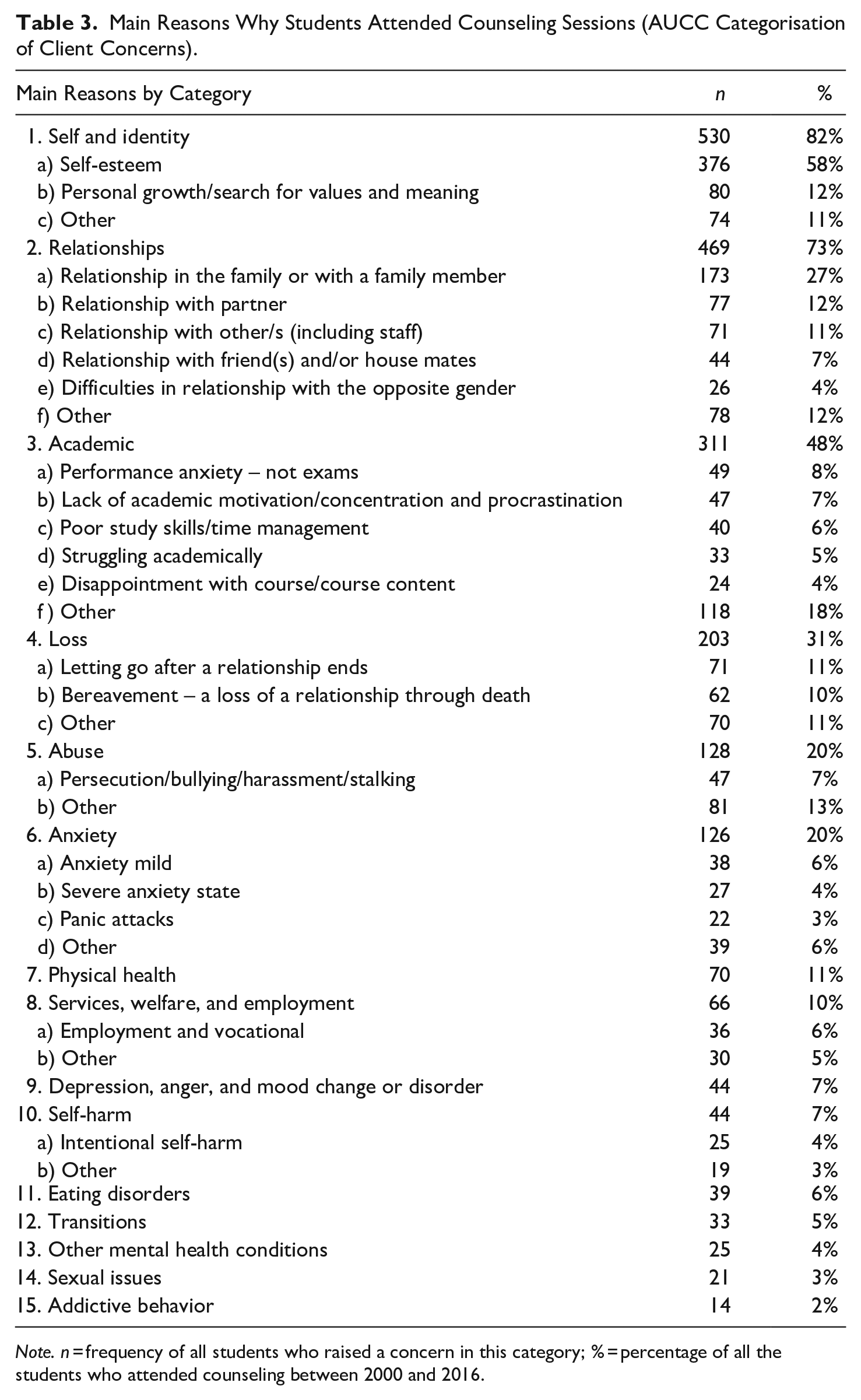
Note. n = frequency of all students who raised a concern in this category; % = percentage of all the students who attended counseling between 2000 and 2016.
Severity of presenting concerns
The counselors rated the severity of presenting concerns, regardless of their nature, on a scale from 0 to 7. Mean severity was 4 (SD = 1.06; i.e., the issue is causing considerable anxiety and distress, which in turn is affecting several areas of functioning). A total of 68.6% of students presented with concerns rated 4 (n = 220, 34.3%) and 5 (n = 220, 34.3%).
Associations Between Demographic Characteristics, Use of Counseling, and Numbers of Sessions Attended
We carried out a preliminary analysis to explore associations between demographic characteristics (i.e., students’ sex, program, nationality, school of study) using χ2 tests of association, post hoc tests of standardized residuals, Cramer’s V coefficients, 95% confidence intervals (CIs), and Bonferroni-corrected α values. To deal with missing values, we excluded cases listwise.
We found significant associations between sex and school of study, χ2(4) = 20.70, p < .001, Cramer’s V = .18; program and nationality, χ2(3) = 53.36, p < .001, Cramer’s V = .29; program and school of study, χ2(4) = 14.99, p = .005, Cramer’s V = .15; and nationality and school of study, χ2(12) = 26.50, p = .009, Cramer’s V = .11. We used Bonferroni corrections by dividing the α level by the number of analyses that were run. Next, we calculated χ2 scores based on the standardized residuals (i.e., z scores; χ2 = z2) and then calculated new p values. These values were then compared against the new α levels (Beasley & Schumacker, 1995; MacDonald & Gardner, 2000). Composers were more likely to be male, χ2(1) = 15.37, p < .005; postgraduate students were more likely to be from overseas, χ2(1) = 50.69, p < .001; undergraduate students were more likely to be from the UK, χ2(1) = 42.25, p < .00; and students in the school of keyboard were more likely to be from overseas, χ2(1) = 12.46, p < .002. We did not find any other significant associations.
Using the same strategies, we explored associations between students’ use of counseling and each demographic characteristic. We found weak associations between use of counseling and sex, χ2(1) = 36.46, p < .001, Cramer’s V = .07; program, χ2(1) = 104.81, p < .001, Cramer’s V = .13; and school of study, χ2(4) = 38.99, p < .001, Cramer’s V = .08; but not nationality. Female students were 1.67 times as likely as male students (odds ratio [OR] = 1.67; 95% CI [1.41, 1.98]), and postgraduate students were 2.63 times as likely as undergraduate students to use counseling (OR = 2.63; 95% CI [2.17, 3.18]). Post hoc analyses with Bonferroni corrections showed that vocal students were twice as likely as keyboard students, χ2(1) = 20.89, p < .005, Cramer’s V = .10; OR = 0.50, 95% CI [0.37, 0.68]; 1.75 times as likely as wind/brass/percussion students, χ2(1) = 25.113, p < .005, Cramer’s V = .09; OR = 0.57, 95% CI [0.45, 0.71]; and 1.69 times as likely as string students, χ2(1) = 22.46, p < .005, Cramer’s V = .08; OR = 0.59, 95% CI [0.47, 0.73], to use counseling.
We assessed the potential effects of each demographic characteristic on the number of sessions attended, computed as a continuous variable, using Mann-Whitney U and Kruskal-Wallis tests as appropriate. The assumption of normality was violated, so we conducted the nonparametric Levene test to check the assumption for homogeneity of variance (by median with adjusted degrees of freedom). We used CIs of 95% throughout. We calculated effect sizes using the following formula: η2 = Z2 / (N – 1), where N is the total number of participants. We interpreted the eta squared (η2) value as follows: .01 as a small effect, .09 as a medium effect, and .25 as a large effect (Allen, 2017).
Undergraduate students attended significantly fewer counseling sessions than postgraduate students (U = 33,560, Z = −3,052, p = .002, η2 = 0.01). We found an association between school of study and number of counseling sessions attended, with a medium effect size, χ2(4) = 10.57, p = .032, η2 = 0.17. Pairwise comparisons revealed that students in the school of keyboard attended more counseling sessions than those in the school of wind, brass, and percussion (U = 4,484, Z = −2.914, p = .004, η2 = 0.03). We found no other significant differences.
Discussion
What Were the Demographic Characteristics of All Students Registered Between 2000 and 2016 and Those Attending Counseling Sessions?
A total of 645 students attended a mean of eight and a median of four counseling sessions over the whole 16-year period. Sixty-three percent were female, 79% were from the UK, 72.5% were registered on the undergraduate program, and all schools of study were represented. Numbers of undergraduate students attending counseling sessions decreased from the first to the fourth year of study. It is possible that students may become accustomed to college life and become more resilient and/or more able to cope with it after their first year. However, previous research with the same population of students revealed that third-year students may experience more severe depression, distress, and lack of vitality compared to first-year students and lower positive and higher negative affect (Matei et al., 2018).
What Proportion of All Students Registered Were Students Attending Counseling Sessions Between 2000 and 2016?
There were increases each year in the numbers of students registered annually during the period. Frequencies and percentages of students attending counseling sessions fluctuated, but there was an overall increase from two (1%) in 2000–2001 to 71 (13%) in 2015–2016, with a peak of 86 (17%) in 2013–2014 (Table 2). The peak might be explained at least partially by the rise of UK’s undergraduate tuition fee cap to £9,000 per year from 2012 (Department for Business, Innovation & Skills, 2010). The UK’s neoliberal university culture characterized by competition and part-time work as a way to afford high tuition fees has been criticized for the impact it has had on music students’ stress levels (Jääskeläinen et al., 2020; Ritchey, 2019). The overall increase could be due to various other factors, including stigma-reducing campaigns and relevant policies, better promotion of counseling and other relevant services in-house, but also the increased medicalization of otherwise typical reactions to real-life situations (Broglia et al., 2021; Priestley et al., 2021).
Why Did Students Attend Counseling Sessions?
The presenting concerns of almost 1 in 10 students who sought counseling were related to self-esteem, self-confidence, ego strength, and coping ability, for undergraduate and graduate students alike. Their main reasons for continuing to attend counseling were also to do with self and identity, relationships, academic concerns, loss, abuse, and anxiety (see Table 3). These findings contribute to the literature showing that besides stress, mental health issues, and academic difficulties, relationship issues constitute the most common presenting concern in students seeking counseling (Ibrahim et al., 2013; Raunic & Xenos, 2008; Said et al., 2013).
Self-esteem was the most common reason for seeking counseling. However, the concept of self-esteem is problematic in several ways, not least because low self-esteem cannot always be distinguished from an overall negative attitude (Baumeister et al., 2003). Furthermore, it is only weakly linked with task performance, interpersonal relationships, and health-promoting behaviors. It is unclear whether interventions aimed at boosting self-esteem may improve any desirable outcomes. Also unclear is whether performance anxiety – not exams and/or anxiety – mild and/or generalized also included MPA. This lack of clarity may be unimportant, however, given that Wiedemann et al. (2022) found that general anxiety may be the main predictor for MPA.
How severe were students’ presenting concerns?
The counselors rated most students’ presenting concerns as causing considerable or severe anxiety and distress affecting several or all areas of functioning, including their coping ability. This, too, is not surprising given that students may wait until their coping ability is impaired before seeking help (Broglia et al., 2017).
How Were Students’ Demographic Characteristics Associated With Their Use of Counseling?
While associations were weak, female students, graduate students, and those studying singing were most likely to attend counseling sessions. There is evidence that females are more likely than males to disclose mental health conditions (Royal College of Psychiatrists, 2021) and that psychological distress, depression, and anxiety all increase during undergraduate years (Andrews & Wilding, 2004; Bewick et al., 2010). This may help explain why a comparatively large proportion of graduate students attended counseling sessions. Also, the relatively high levels of distress reached during the undergraduate years may not return to baseline (Andrews & Wilding, 2004; Cooke et al., 2006). Singers might draw on their emotional resources, particularly when singing operatic roles. Some evidence suggests that string players have the highest levels of performance anxiety, while singers have the lowest (Tamborrino, 2001). Singers may make more and better use of coping strategies when it comes to stress and anxiety, or perhaps because they tend to struggle with them less, for whatever reason, they are more willing to talk about them openly.
What Were the Potential Relationships Between Students’ Demographic Characteristics and the Number of Counseling Sessions They Attended?
Graduate students attended more counseling sessions than undergraduates, and students of keyboard instruments attended more sessions than those studying wind, brass, or percussion instruments. As we already mentioned, students of keyboard instruments (particularly pianists) were more likely to be from overseas. It might be the case that being from a different country or from a different cultural background makes it harder to adapt and therefore may lead to a need for counseling. Yet we found no associations between nationality and students’ use of counseling.
Limitations and Strengths
A number of limitations are associated with the secondary analysis of existing data as a research method. New research questions can arise during analysis that cannot always be answered using the data available. More importantly, we may not have access to all the information needed as to how data were collected or the types of problems that might have occurred while it was being collected. For instance, counselors were unable to explain exactly how they distinguished between very similar concerns such as shock state and posttraumatic stress disorder, stress and anxiety, and difficulties in the workplace and work-related stress. That said, the AUCC categories they used span a huge spectrum of types of mental illness experienced at different levels of severity. Rating a concern as most severe (i.e., describing the client as not coping, out of control, despair and hopelessness, emotionally overwhelmed, suicidal thoughts/intent) implies that addressing the concern went beyond the clinical expertise of a counselor. We might expect that students so described were referred on to psychiatric services, but the data do not specify whether this was so or not.
We computed dichotomous yes/no variables for each concern rather than continuous variables to capture frequencies, so total counts of main reasons for attending counseling sessions may not be as accurate as those for presenting concerns only. It was rare for the same concern to be mentioned in all of the sessions attended by a single student. The data were derived from counselors’ rather than clients’ notes and ratings: Given that counselors are motivated to see improvements in their clients, they might tend to rate concerns more severe at the outset and/or overestimate improvements over time. The data set from this single HEI for music is valuable because there are no comparable data from musicians. However, the AUCC categories do not represent a particularly robust measurement tool. Research using other types of measurement, such as standardized effectiveness outcomes and feedback from clients, may be needed to paint a bigger and more accurate picture. Other measures that could be included are estimations of academic coping, therapeutic alliance, treatment satisfaction, waiting times, short-term and long-term effects, dropout/completion rates, whether the ending was planned or unplanned, and potential adverse effects (Broglia et al., 2017).
Despite these limitations, the data were freely available because they had been collected for purposes other than those of the present study: rigorous, contemporaneous record-keeping unlikely to have been affected by memory biases given that the counselors took in-the-moment notes in the form of diaries rather than recalling events or selecting cases for their atypicality. A longitudinal approach could be taken to the exploration of trends in a large sample, saving money, time, and effort. To our knowledge, the present study is the first of its kind.
Future Research
It would be worth investigating the barriers to and facilitators and perceived benefits of help-seeking attitudes and behaviors as well as students’ attitudes to and awareness of in-house counseling and their reasons for seeking and for not seeking counseling. After all, while support may be available, conservatoire students might not be aware, not know how to access it, might want to avoid stigma, or may not consider their struggles are bad enough (Matei & Ginsborg, 2022).
In this study, we investigated only the use of an in-house counseling service. The extent to which students needed high-intensity support and had to be referred on from the in-house counseling service remains unclear. Analysis of data on referrals to external health providers and professionals, such as psychologists, psychotherapists, and/or psychiatrists accessed, via the British Association for Performing Arts Medicine and other routes and the use of counseling services outside the college could reveal further insights.
Implications for Practice
It would be helpful for counselors to also engage with students outside the context of counseling on topics, such as relationships, anxiety, and academic stress, that are particularly prevalent (Hinderaker, 2013). This might make it easier for music students who do not seek help because they feel uncomfortable about doing so (Matei & Ginsborg, 2022). After all, ways in which counselors work preventively include involvement in introduction or induction weeks for first-year students and special days dedicated to mental health; training other members of staff; helping to develop mental health policies; collaborating with colleagues such as student union officers, chaplains, and/or disability advisers; and liaising with external health professionals (BACP, 2017; Hinderaker, 2013).
The most effective approaches are likely to be holistic, based on whole-setting health promotion, as recommended by the Healthy Universities Network (World Health Organization, 1998). A strategy aiming to embed help at all levels of an institution might lighten the load on counselors and help prevent a potential increase in the severity of students’ distress. For example, it might be that a course or at least a series of sessions on issues of particular concern to students could be particularly useful (e.g., the course and its evaluation described by Matei et al., 2018; Matei & Ginsborg, 2022). Topics could include distinguishing between reliable and unreliable sources on the internet, interpersonal communication and healthy relationships, financial literacy, and educational, career, and/or vocational success. Occupational health courses at the undergraduate level and encouraging students to engage with health care resources have already been recommended for some time (Chesky et al., 2006). More information about stress management, coping strategies such as adequate planning, and physical activity has also been recommended (Araújo et al., 2017; Bonneville-Roussy et al., 2017; Kreutz et al., 2009).
There are other ways in which the existing promotion of psychological health in conservatoires could be (and indeed, at the conservatoire where the research was conducted, is already being) further enhanced: through materials such as welcome packs, leaflets, magazines, newsletters and bulletins, videos, websites, and emails as to what is available; during induction week and at events such as open days and guest lectures; and awareness-raising campaigns (Thorley, 2017).
Instrumental and vocal teachers in higher education music institutions are key allies when addressing music students’ health, considering their influence on students (Norton, 2016; Norton et al., 2015a, 2015b). While they cannot be expected to provide expert health advice, it is important for them to recognize key signs of distress and refer students to relevant services given that the lack of perceived access to health services may be a barrier to optimal health and engagement with health content among conservatoires students in the UK (Matei & Ginsborg, 2022). As such, they could be ambassadors in the promotion of health and well-being. Building a healthy relationship based on trust and empathy with students is key in both engaging students in the pedagogical process and in enabling them to talk about their worries. After all, greater levels of perceived social support have been associated with reduced performance anxiety (Schneider & Chesky, 2011).
Pecen et al. (2016) suggested that performance psychology/science and coaching may be particularly useful in conservatoire given the key role of the music institutions in the development of musicians and its applied nature focused on enabling musicians to perform under stressful conditions. However, performance psychology needs to be tailored to the cultural specificities of classical music to be more smoothly integrated.
At the same time, it is advisable to consider the ideology and potentially a set of misconceptions related to Western classical music that can be seen to restrict musicians’ freedom of expression and creative autonomy to an unjustifiable extent, thereby interfering with their well-being. Unless we question these norms, any attempt to help fix individuals or make them more resilient and adaptive to a profession that is potentially harmful is, arguably, unethical (Leech-Wilkinson, 2020). It may be time, now, to focus more on cooperation, creativity, and artistic autonomy rather than competition, thus questioning the neoliberal focus of educational approaches in the conservatoire (Jääskeläinen et al., 2020). We could achieve this by facilitating separate training sessions and group discussions for music students and instrumental/vocal teachers in higher education. Current misconceptions such as “If my teacher says it, it must be right” and “If I was good enough, I wouldn’t be getting nervous” the obsession with quantity over quality in practice and/or “suffering for art” (Matei & Phillips, 2023b; Roos et al., 2021) may limit the extent to which musicians seek help (Pecen et al., 2016). We need to question such assumptions as part of the broader training of musicians’ critical thinking (Matei & Phillips, 2023a, 2023b). We need to also question the conservatoire culture characterized by pressure, competition, socially prescribed perfectionism, and a celebration of “star” players (Detari et al., 2022; Perkins, 2012), and the political and ethical assumptions surrounding contemporary perceptions of virtuosity (Leech-Wilkinson, 2020). Specific ways in which norms in classical music could be questioned have already been documented (Leech-Wilkinson, 2020; Ritchey, 2019). The integration of improvisation in students’ interpretations of classical music scores and a generally freer approach to music performance has been found to have beneficial effects on the well-being of both musicians and their audience (Dolan et al., 2013, 2018). Less focus on criticism, conforming, and not making mistakes and focusing more on creating engaged, freer performances that lead to greater agency on the part of the performer could further lead to less guilt and emotional pressure (Dobson, 2010; Leech-Wilkinson, 2020), less anxiety and depression (Flett et al., 2002), and perhaps more vitality (Miksza et al., 2021). A greater willingness to question the status quo could also lead to more flexible career identities and the identification of more opportunities that may reduce the gap between aspirations and reality (Bennett & Bridgstock, 2015; Bridgstock, 2013; Palmer & Baker, 2021).
Other practical ways forward could include incentivizing good practice; integrating training in teachers’ contracts; communicating relevant health-related information via policy, documents, and institutional websites (Jääskeläinen & López-Íñiguez, 2022); and designing teacher training focused on musicians’ psychological health from a broad perspective (Matei & Phillips, 2023a, 2023b; Norton et al., 2015a, 2015b). Such training could help teachers reduce competition between students, encourage students to build social support networks, allow more space for creativity, provide career support, and advise the use of effective practice strategies and psychological skills (Jääskeläinen et al., 2022; Jääskeläinen & López-Íñiguez, 2022; Miksza et al., 2021). We also need adequate regulation given the lack of agreed standards and alignment between current conservatoire teaching and recent pedagogical evidence and the tendency for conservatoires to employ famous performers as teachers in preference to good pedagogues (Carey et al., 2013; Palmer & Baker, 2021).
Mental health problems are too often detached from their social, cultural, political, and ideological contexts (Detari & Egermann, 2022; Detari et al., 2022; Leech-Wilkinson, 2020). We need initiatives that address mental health from the perspective of the wider determinants of health and well-being, encompassing regulations, policies, educators, training, institutions, culture, and assumptions (Araújo et al., 2017). Perhaps we also need to explore what it may mean to view anxiety as a normal response to an imperfect system that needs to change (Leech-Wilkinson, 2020).
Footnotes
Declaration of Conflicting Interests
The author(s) declared no potential conflicts of interest with respect to the research, authorship, and/or publication of this article.
Funding
We gratefully acknowledge funding from Musical Impact, a Conservatoires UK project funded by the UK’s Arts and Humanities Research Council (grant ref. AH/K002287/1).
