



Abstract
Past research shows that teams working on a complex task need developmental space to be successful. They can create this space in their interaction by undertaking four activities: creating future, reflecting, organizing, and dialoguing. These four activities refer to two orientations: the performance orientation, limiting the space, and the sensemaking orientation, opening up the space. Teams need them both, yet it seems inconsistent and impossible to achieve together, thus a paradox. In this exploratory research, we address the way in which teams experience and handle that “developmental space paradox,” and how it affects team success. Individual team members (N = 70) from 12 teams were interviewed. Successful (n = 7) and unsuccessful (n = 5) teams were compared. The results show that successful teams experience this paradox differently than the unsuccessful teams, and that both categories choose other coping strategies to handle this paradox.
Introduction
Teams can be more creative and better at finding solutions than individuals (Chrislip, 2002; Snow, 1999), and their information-processing capabilities can exceed individual capabilities (Curşeu, Lucian Jansen, & Chappin, 2013). However, teams often struggle to outperform individuals (Curşeu et al., 2013; McGrath, 1984; Rietzschel, Nijstad, & Stroebe, 2006). Team interactions are crucial to achieving this level of performance (LePine, Hanson, Borman, & Motowidlo, 2000; LePine, Piccolo, Jackson, Mathieu, & Saul, 2008). In previous research, an interaction model, a model of developmental space (Coenders, 2008; Derksen, de Caluwé, Rupert, & Simons, 2014; Derksen, de Caluwé, & Simons, 2011), for teams was developed to exceed the individual capabilities (Figure 1). This study builds on and extends that research.
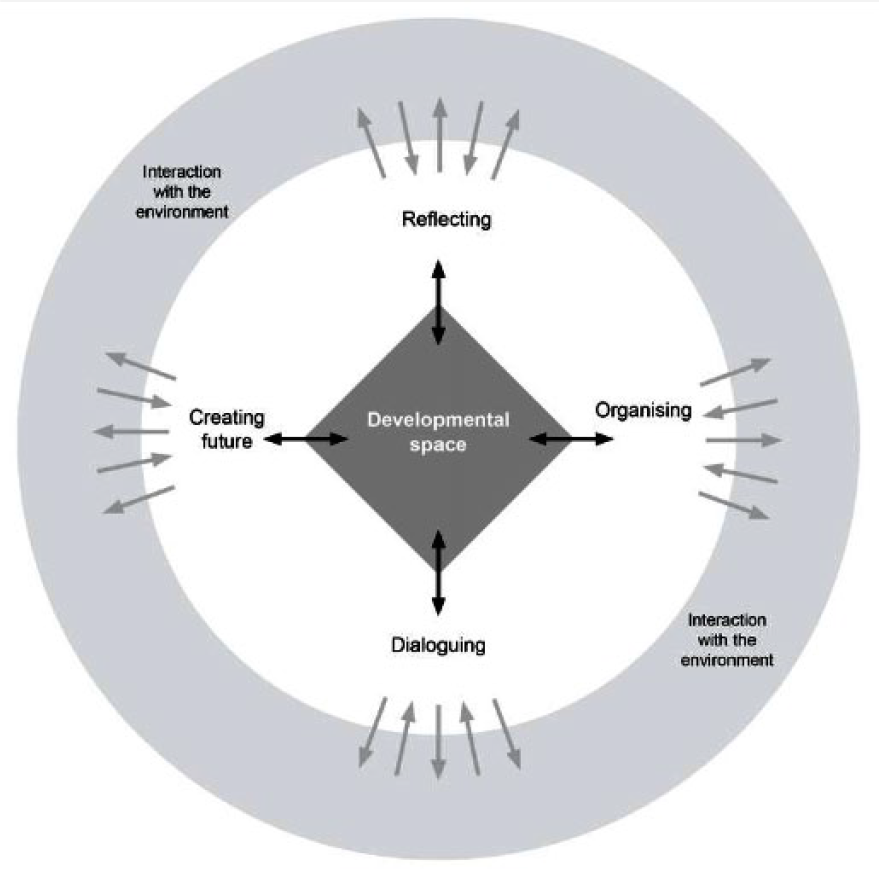
Model of development space (Derksen, de Caluwé, & Simons, 2011).
Developmental space is a social space created by team members in their interactions with each other and their environment involving four activities: creating future, reflecting, organizing, and dialoguing (Derksen et al., 2014; Derksen et al., 2011). It appears that the more developmental space teams create, the better their results (Derksen et al., 2014). While creating developmental space, teams need to focus on the performance and sensemaking orientations. However, these two orientations appear to be at odds with each other in other words, a paradox. Teams face, for example, this paradox as the need to share and explore all available information, and at the same time deliver an outcome within a limited time.
Previous research (Coenders, 2008; Derksen et al., 2014; Derksen et al., 2011) has concluded that teams must deal with a paradox while creating developmental space. However, how teams experience and handle this paradox and whether this is a critical success factor for them are not yet clear. Therefore, our research question is as follows:
This article makes several contributions to the existing literature in the field: First, we build on and extend previous research on developmental space. This concept is relatively new, but seems promising in both facilitating and explaining team interactions. As team interactions are presented as the most crucial in explaining team effectiveness (Leenders, Contractor, & DeChurch, 2015; LePine et al., 2000; LePine et al., 2008; Tjosvold, West, & Smith, 2003), it seems worthwhile to ensure that the concept of developmental space is more robust. Derksen et al. (2014) claim that the way teams experience and handle the developmental space paradox is a critical factor for success, but this has not yet been empirically tested. Second, we expand the theory on paradoxes. While there is a rapid growth of research on paradoxes, the commonalities across studies remain unclear (Lewis & Smith, 2014), with each study presenting its own solutions to handling paradoxes. We will present an overview of this literature and empirically test the findings. Finally, the literature on paradoxes focuses on the analysis of what paradoxes are, or on specific paradoxes, for example, ambidexterity, and on how organizations, leaders, and managers can “manage” paradoxes. As organizations are tending to work increasingly with teams and team life in itself is full of paradoxes (K. Smith & Berg, 1997), it seems important to determine how teams experience and handle paradoxes. This is the focus of our research.
In this study, a team is defined as a group working together on a complex task. We focus on a complex task for two reasons: First, the task is a key factor in team processes and team performance (Antoni & Hertel, 2009). Teams tend to function quite differently depending on their task (Mathieu et al., 2008). Second, tasks are becoming increasingly complex and because teams have the potential to outperform individuals in solving complex tasks (Cummings & Worley, 2009; Goleman, Boyatzis, & McKee, 2002; Gratton, 2007; Miron-Spektor & Argote, 2008; Pacanowsky, 1995), there is a growth in teams working on complex tasks. In the literature, many characteristics related to task complexity have been identified (Byström & Järvelin, 1995). In this study, a complex task involves creating new knowledge or new combinations of existing knowledge (Corso et al., 2001; Kessels, 2004), meaning that the task is at least nonrepetitive, not a priori determinable, and presents a number of alternatives in relation to its execution (Byström & Järvelin, 1995; Payne, 1976).
In relation to the theoretical background, we will first briefly explain the central concepts of “paradox,” the developmental space paradox, and handling paradoxes. This will be followed by the presentation of our research method, the reporting of our results, a discussion of the findings, and our conclusions.
Theoretical Background
A Paradox
A paradox consists of two contradictory interrelated elements that seem inconsistent and impossible to achieve together, which persist over time (Lewis, 2000; W. K. Smith & Lewis, 2011). Handling paradoxes is not an “either-or” issue but requires the adoption of a “both-and” stance (Jules & Good, 2014). A paradox is more like two sides of the same coin (Handy, 1994; Simons, 1999). In other words, a paradox has two main characteristics: (a) it consists of two contradictory interrelated elements in relation to which we experience a tension, and this tension often makes us feel uncomfortable; (b) it persists over time, meaning that the tension will always be there. We might ignore or choose only one side, but we can only achieve a sustainable result by embracing both (Beech, Burns, de Caestecker, MacIntosh, & MacLean, 2004; Cameron, 1986, 2008; Lewis, 2000; Lewis & Smith, 2014; Lüscher & Lewis, 2008; Miron-Spektor & Argote, 2008; Miron-Spektor, Gino, & Argote, 2011; Poole & Van de Ven, 1989; W. K. Smith & Lewis, 2011). However, embracing both means living with inconsistency, which seems difficult for us (Kahane, 2010; W. K. Smith & Lewis, 2011).
Nevertheless, it has been found that the tension of a paradox leads to the following benefits: it keeps teams alive (Cameron, 1986; Hoebeke, 2004); it is a trigger for change, creativity, and the discovery of new unconventional routes (Lewis, 2000; Lüscher & Lewis, 2008; Miron-Spektor et al., 2011); and it is a ubiquitous and persistent force challenging and fueling long-term success (Lewis & Smith, 2014).
The Developmental Space Paradox
Teams create developmental space by interacting with each other and their environment (Coenders, 2008; Derksen et al., 2011): “In the optimal developmental space, team members feel free to speak up. They trust each other and dare to put forward different viewpoints. They are able to openly discuss these different, sometimes conflicting, ideas” (Derksen et al., 2014, p. 279). In this process, the members also utilize each other’s strengths. Teams create this space by undertaking four activities (Table 1): creating future, reflecting, organizing, and dialoguing (Coenders, 2008; Derksen et al., 2011). Developmental space is highly dynamic, and varies depending on the situation and the moment. Previous research has shown that when teams create more developmental space, they are significantly more satisfied with their results (Derksen et al., 2014).
Developmental Space, Based on Derksen, de Caluwé, and Simons (2011), and Derksen, de Caluwé, Rupert, and Simons (2014).
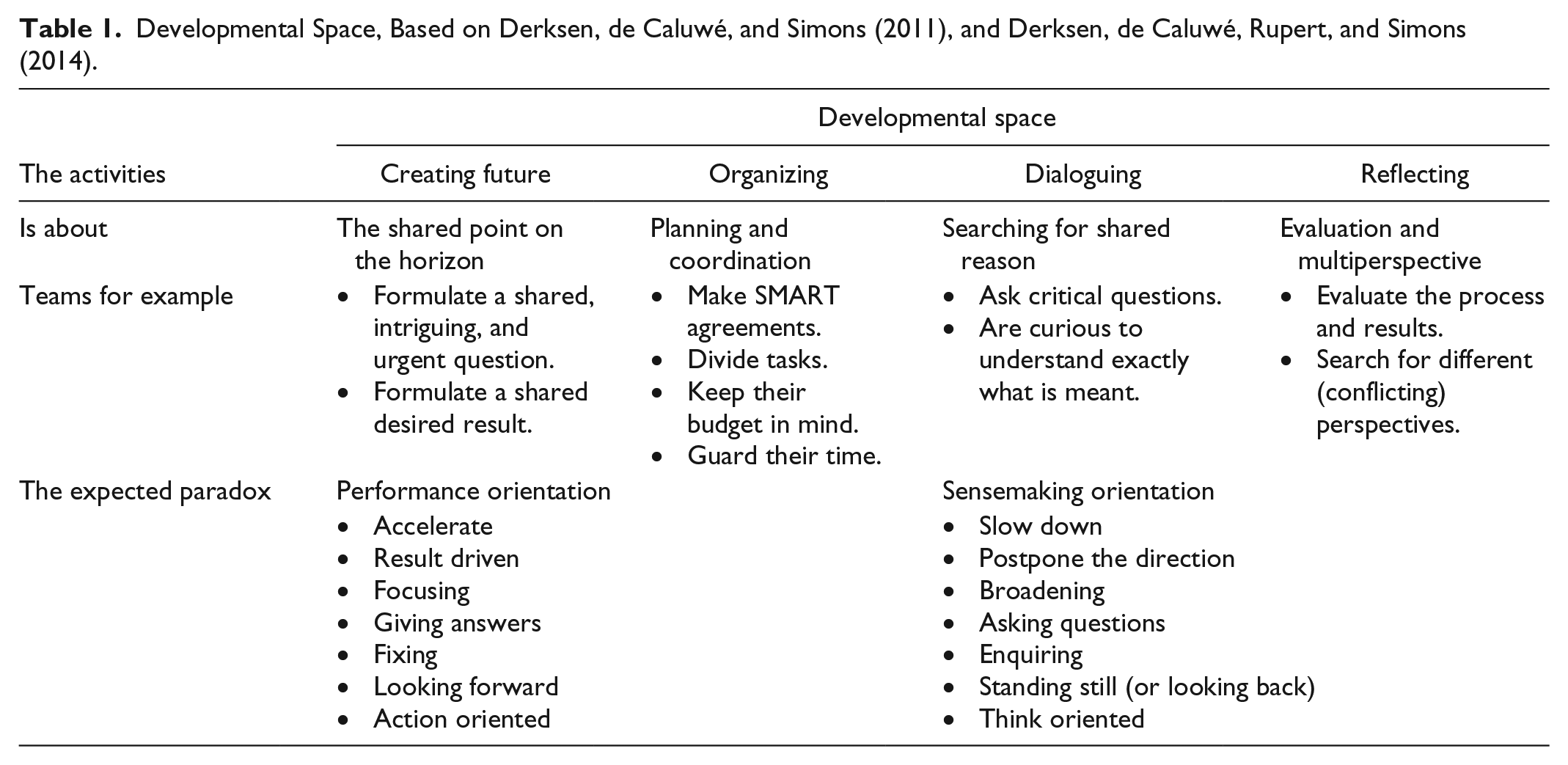
The four activities comprise two orientations: a performance and a sensemaking orientation, which seem diametrically opposed (Coenders, 2008; Derksen et al., 2014; Derksen et al., 2011). “The performance orientation, with creating future and organizing, limits the space by focusing, while the sensemaking orientation, with reflecting and dialoguing, stretches the space by opening-up” (Derksen et al., 2011, p. 262). The performance orientation concerns speeding up, narrowing down, and finding answers as quickly as possible, whereas the sensemaking orientation concerns slowing down, broadening, searching for alternatives, and asking questions. Derksen et al. (2014) find evidence to suggest that teams need both orientations to achieve the best results, and they suggested a follow-up study to determine how teams experience and handle this paradox.
Handling a Paradox
Research findings on how individuals handle paradoxes are not unanimous, and they are even less in agreement about how teams handle paradoxes. Therefore, we will first present an overview of the suggestions found in the literature about handling paradoxes (Figure 2). Handling paradoxes seems to involve a process of making choices, consciously or unconsciously, in which each choice influences the next step taken. Bringing the outcomes of the different studies together, we can discern the following steps: (a) recognizing the paradox, (b) responding to the paradox, and (c) deploying coping strategies (Figure 2).
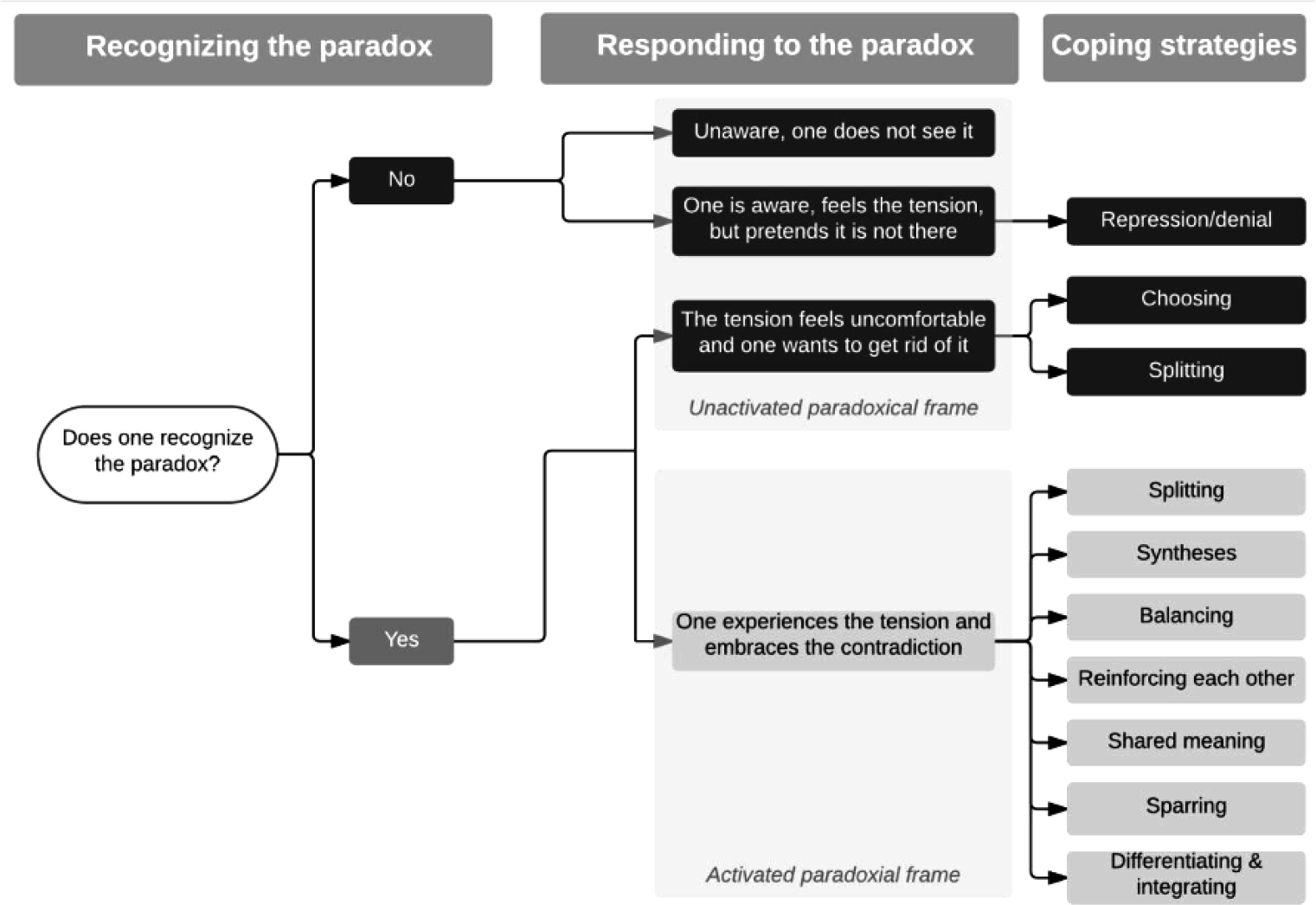
Summary of the process of handling paradoxes.
The process starts with the question of whether the paradox is recognized. A “yes” or “no” answer leads to different responses to the paradox, the second step in the process. People experience and react differently to paradoxes, which according to Miron-Spektor et al. (2011) depends on their paradoxical frame.
Some people experience paradoxes as uncomfortable and threatening: They are described by Miron-Spektor et al. (2011) as not having an activated paradoxical frame. Such people want to consciously or unconsciously avoid and evade the uncomfortable tension as quickly as possible (Jay, 2012; Lewis, 2000; K. Smith & Berg, 1997). To do so, they employ defensive coping strategies such as repression, denial, choosing one side, or splitting the two sides of the paradox (Fredberg, 2014; Lewis, 2000; Vince & Broussine, 1996). These defensive strategies are dysfunctional because avoiding a paradox means getting stuck in a vicious circle (Jay, 2012; Lewis, 2000; Pacanowsky, 1995; K. Smith & Berg, 1997). By defending oneself and attempting to get rid of the uncomfortable tension, people tend to choose the pole that supports their preference (Lewis, 2000), satisfying the need for consistency and uncertainty reduction (W. K. Smith & Tushman, 2005). Supporters of each side do not see “ . . . that both views are accurate, but incomplete” (Pacanowsky, 1995, p. 45).
Levinthal and March (1993) demonstrate the risks of choosing one side, which leads to two traps related to the paradox of “organizational ambidexterity” (O’Reilly & Tushman, 2011)—a well-known paradox that resembles the developmental space paradox. The first of these is the failure trap, where failure leads to excessive exploration and ultimately to commercial nonviability. The second of these is the success trap, where success seduces people into focusing completely on exploitation, leading them to becoming stuck with one product and one market.
Other people feel that they have to live with the tension and embrace the two poles of the paradox (Clegg, Vieira da Cunha, & Pina e Cunha, 2002; Fredberg, 2014; Lewis, 2000; Lüscher & Lewis, 2008; Miron-Spektor et al., 2011; Papachroni, Heracleous, & Paroutis, 2015; W. K. Smith & Tushman, 2005). According to Miron-Spektor et al. (2011), they have an activated paradoxical frame, and this encourages “paradoxical inquiry, in which a problem is identified, its contradictory elements and their links are revealed and explored, and alternative solutions are found and tested” (p. 230). In this case, tensions are seen as an opportunity for and invitation to creativity and unconventional lines of thought (Beech et al., 2004; Lüscher & Lewis, 2008; Miron-Spektor et al., 2011).
The coping strategies employed are more like an “exploratory cyclical journey,” as Lewis (2000) describes the process. This includes strategies such as “reinforcing each other,” “giving shared meaning,” and “sparring as a collaborative process of working through paradox” (Lüscher & Lewis, 2008). These strategies focus on exploring, examining, asking different kinds of questions, and, thus, sensemaking together. Others suggest combining or synthesizing the two sides (Jarzabowski, Lệ, & Van de Ven, 2013; Simons, 1999; W. K. Smith & Tushman, 2005), while balancing the tension seems another coping strategy (Cameron, 1986; Heracleous & Wirtz, 2014; March, 1991; Miron-Spektor et al., 2011). Here, it is not about finding a balance as such but about a constant and continuous play of balancing; in other words, it is about a dynamic equilibrium (W. K. Smith & Lewis, 2011). Another strategy entails differentiating and integrating (Clegg et al., 2002; Miron-Spektor et al., 2011; W. K. Smith & Tushman, 2005). Differentiating involves recognizing and reinforcing the differences. This encourages less rigid commitment to existing ideas and a more open belief in and generation of new ones. Integrating, in contrast, entails the team shifting to other levels of analysis to identify possible linkages and synergies. This strategy seems paradoxical in itself, and therefore may be less feasible. Finally “splitting” (Lewis, 2000; W. K. Smith & Lewis, 2011) is another possible coping strategy. This strategy can be both defensive and accommodating. Splitting may be done in different departments, such as a product department and a research and development department, or over time by paying attention to creating future (part of the performance orientation) first and evaluating (part of the sensemaking orientation) afterward. In all the accommodation strategies mentioned, the differences coexist in a state of tension, except for synthesizing and sometimes splitting. By reducing or removing the tension, the above-mentioned advantages of the tension expire. Therefore, splitting may be deadly (Hoebeke, 2004).
Now that we have an overview from the literature on how paradoxes in general can be experienced and handled, we are curious how teams experience and handle the developmental space paradox.
Method
A qualitative approach was adopted for this exploratory research. We conducted a multiple case study research using interviews as the method of data collection. This approach was chosen as it is suitable for a better understanding of complex social phenomena and offers a holistic and meaningful view of team behavior (Yin, 2014). In research in common, reliability and validity are criteria which are used to reflect the quality of research studies. These criteria originate from the quantitative research paradigm, and can also be used for qualitative research according to Patton (2002). However, Healy and Perry (2000) argue that the quality of a study in each paradigm should be judged by its own paradigm’s terms. To be more specific with the term of reliability in qualitative research, Lincoln and Guba (1985) use “dependability.” In relation to the validity criterion, Creswell and Miller (2000) argue that the validity is affected by the researcher’s perception of validity in the study and his choice of paradigm assumption, and is not a criterion which can be transferred directly from quantitative research methods to qualitative research methods. As such, there was a need for the development of concepts of validity and reliability applicable for the qualitative paradigm what qualitative researchers consider to be more appropriate terms, such as quality, rigor, and trustworthiness (see, for example, Davies & Dodd, 2002). Hence, this has led to the development of new terms for words such as validity and reliability to reflect the conceptions and paradigms as used in qualitative research. While the terms reliability and validity are essential criteria for the quality in quantitative paradigms, in qualitative paradigms the terms credibility, transferability, dependability, and confirmability are becoming more the essential criteria for quality (see, for example, Guba & Lincoln, 1994). As such, we will use these criteria in our research study. Below, we explain how we met these four criteria.
Participants
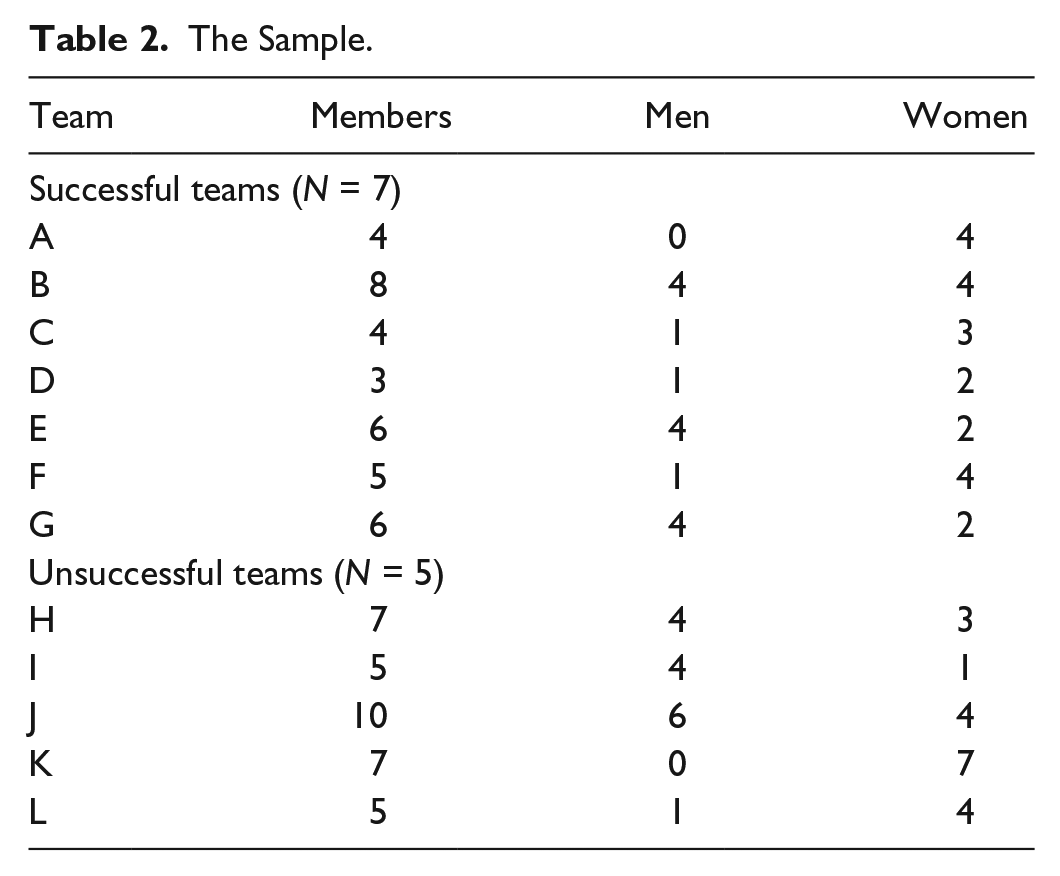
The sample consisted of N = 12 teams with a total of N = 70 team members. Of these, there were seven successful teams with 36 team members and five unsuccessful teams with 34 team members (Table 2). All team members were highly educated. Some of the teams worked in two different higher education organizations and varied from teaching teams to work groups with a specific task, for example, developing a new curriculum. The other teams worked in two different youth care organizations and varied from care teams to human resources development teams to work groups with a specific task.
The Sample.
Three teams (H, J, K) were part of the organizational structure and had worked together as a team on a daily basis for years. The other nine teams were created specifically to fulfill their complex task and had started working together between 3 and 12 months before we interviewed them. Thus, the teams were diverse but were all situated in nonprofit organizations and, as mentioned above, all team members were highly educated. In relation to the transferability of the results, we will describe the research context as precisely as possible. Those who wish to “transfer” the results may then judge the appropriateness of that transfer (Guba & Lincoln, 1994). Furthermore, in relation to dependability, the teams were not exposed to changes in context during our research, and therefore the requirements for dependability were also met (Guba & Lincoln, 1994).
Procedures
Sampling procedure
Higher management of the two youth care organizations and the two higher education organizations was asked to choose successful and unsuccessful teams for participation. The criteria we gave the higher management were as follows: (a) successful teams perform well on the task and collaborate well, whereas unsuccessful teams do not perform well on their task and do not collaborate well (West & Hirst, 2005); (b) a team consists of two to 10 people (Belbin, 2010; West & Hirst, 2005); (c) team members work together on a complex task, as described in the introduction, such as designing an entirely new curriculum for a faculty in higher education and starting a “sales” team within a youth care organization.
As we had criteria for the sample selection, we used a nonprobability purposive sampling technique (Patton, 2002).
Research approach
Every team member was interviewed individually. We chose a semistructured interview because we wanted to focus on specific subjects and had specific questions for which we wanted answers. At the same time, we wanted to explore the insights of interviewees about certain events in more depth (Yin, 2014), and how they experience and handle the developmental space paradox within their team. As we were looking for the effects of handling that paradox, we also compared “successful and unsuccessful” teams (Brinkerhoff, 2002). The teams, however, did not know that their success or lack of it had been judged by their higher management.
The interviewees were told that all information would be dealt with anonymously. The interviews were audiotaped, transcribed, and checked for accuracy by the interviewee. We summarized the results for each team separately, and had a separate meeting with each team where we gave them feedback. In this way, we were also able to check and interpret the outcomes together with each team. This enhances the credibility of our results; the participants themselves are the only ones to legitimately judge the credibility (Guba & Lincoln, 1994).
Two researchers conducted the interviews. They started by working together, interviewing each of the team members of the first two teams. They then conducted interviews separately, afterward checking and discussing these interviews together to make sure that they were working in a similar manner. Working in this manner with two researchers is known to enhance confirmability (Guba & Lincoln, 1994).
Semistructured interviews
As we wanted to determine how team members experienced and handled the developmental space paradox, in the first part of the interview, we asked open questions about the team and collaboration (e.g., What is your assignment and goal as a team? How would you describe your collaboration? What difficult moments did you experience in your collaboration? Were there moments when you did not agree with each other and why?). Interviewing has the disadvantage that we are dependent on what team members themselves report on their activities and how they handle the paradox of developmental space. However, interviewing every team member separately probably gives a fairly good idea of what the teams did and did not do.
As we were specifically interested in the developmental space paradox, in the second part of the interview, we explained the model of developmental space and the expected tension between the performance and sensemaking orientation (see Table 1). We then asked the interviewees whether they recognized these aspects in their team (e.g., Which of the four activities do you practice as a team and how do you practice them? Does the tension between the performance and sensemaking orientation play in your team, and how does your team handle this?). By informing the interviewees about the developmental space paradox, we risk that the interviewees recognize the paradox only because we mentioned it. However, we were not sure if we would gain enough information on how teams experienced and handled the developmental space paradox if we would not introduce it to them. Therefore, we decided to take this risk and take this into account while analyzing the data.
Data Analysis
A template analysis was chosen because it is appropriate for analyzing large volumes of rich qualitative data and helpful in an exploratory research (Crabtree & Miller, 1999; King, 2012). Developing a coding template is the central technique. The analysis started with a limited number of predefined codes, and the template was revised in response to the concerns arising from the data, as is common in template analysis (King, 2012; Waring & Wainwright, 2008). We thus coded both deductively and inductively, as is recommended in the literature (Braun & Clarke, 2006; Joffe, 2012; King, 2012). We used four steps in analyzing the data as described below (King, 2012) .
As a first step, we coded the data in NVivo by hand using the predefined codes. The first code was developmental space, because creating that as a team seems to be a precondition for experiencing the developmental space paradox in the first place. In relation to developmental space, we also used four subcodes—creating future, organizing, reflecting, and dialoguing. As developmental space assumes that there is a way of collaborating within a team, this also became a predefined code. The last predefined code was the developmental space paradox (see Table 3).
The Predefined Codes, Their Definitions, and Examples of Excerpts.
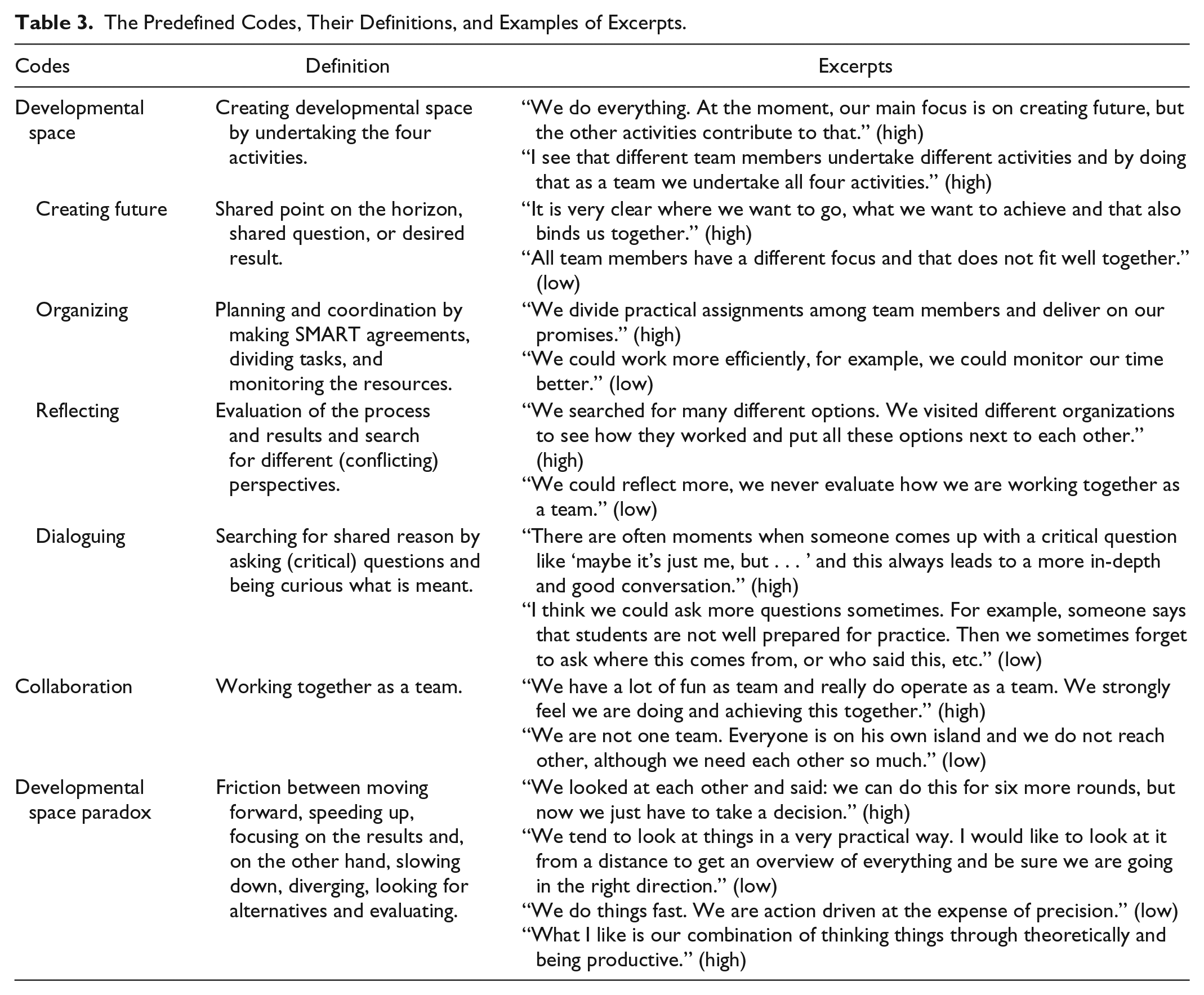
As a second step, we developed an initial template. With setting up an initial template, each code became a node in NVivo. Looking more closely at the outcomes of the codes, we concluded that to gain more insight into how the teams experienced and handled the developmental space paradox, we needed another template.
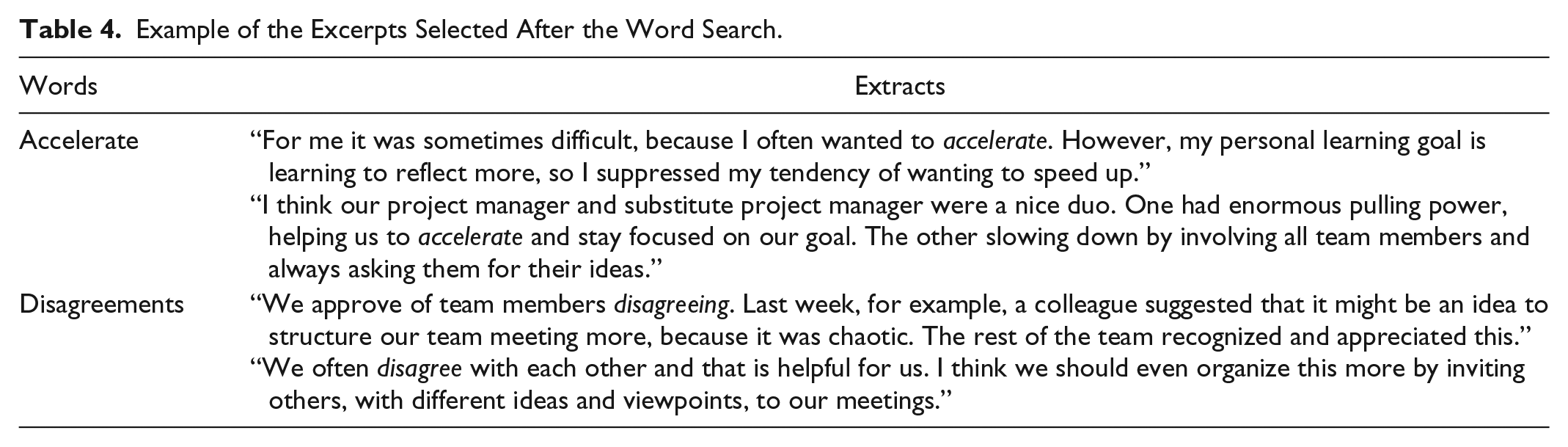
After this, a third step, the creation of the final template was conducted. Once the initial template had been created, the data analysis moved through an “iterative process” (King, 2012, p. 430) in which the initial template was applied to the complete set of interview transcripts, and further revised and refined. This iterative process, based on the research question, is common in template analysis (King, 2012). To do this, we used words and their conjugations that could be connected to the developmental space paradox (see Figure 3). These were words related to tempo and time, because the developmental space paradox is about slowing down and speeding up (see Table 4). Other words were related to tensions within the team or to its sense of direction, insofar as the developmental space paradox is also about narrowing down and opening up.
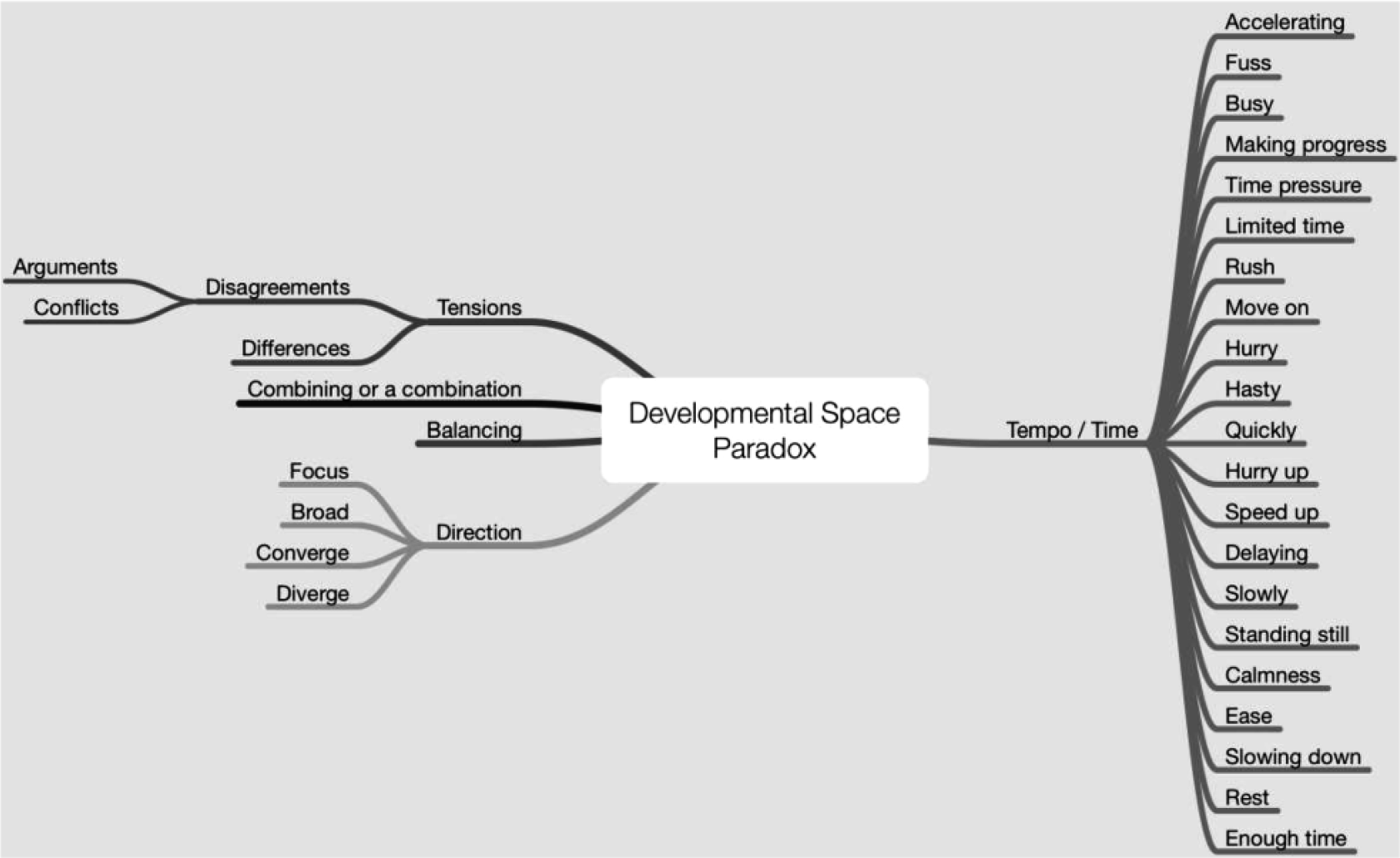
The words used searching for excerpts about the development space paradox.
Example of the Excerpts Selected After the Word Search.
Finally as a fourth step, we looked for “balance,” “balancing,” and “combining” or “combination,” because it was apparent in the data that these terms were sometimes used to point out to the developmental space paradox. Van Dick et al. (2008) emphasizes that following the development of the final template, “it is necessary to move beyond the descriptive nature of the summary towards interpretation and theorization” (p. 45). To make sense of the categories we conceptualized in the final template, we selected those connected to the developmental space paradox, resulting in 113 excerpts in total. We then searched for repeated patterns of meaning in the excerpts (Braun & Clarke, 2006; Joffe, 2012) and clustered them. This again was an iterative process, as “analysis involves a constant moving back and forward between . . . , the coded extracts of data that you are analysing, and the analysis of the data that you are producing” (Braun & Clarke, 2006, p. 15). As a final step, within the clusters, we compared the outcomes of the successful and unsuccessful teams.
This detailed description of the procedure followed to check and recheck the data is part of template analysis and also a way of enhancing confirmability (Guba & Lincoln, 1994).
Results
It is time to answer our research question: How do teams experience and handle the developmental space paradox, and what effect does that have? As the differences are primarily related to the level of success of the teams, we mention the teams to which the results relate throughout this section.
We will first present some overall results. We started each interview with the question: “What is your assignment and goal as a team?” In all successful teams, all of the team members had the same idea about their assignment and goal in contrast to the unsuccessful teams. For example, in Team K all seven team members gave a different answer.
Only three (H, J, K) of the 12 teams were “regular” teams, that is, part of the organizational structure and working together as a team on a regular and daily basis. Of the nine specially composed teams, 78% were successful, and of the three “regular” teams, 100% were unsuccessful.
Experiencing the developmental space paradox implies that teams practice all four activities related to developmental space. The successful teams confirmed that they practiced all four activities of the developmental space: 86.1% of the members of successful teams, compared with 8.8% of the members of unsuccessful teams. This corresponds with results from previous research (Derksen et al., 2014; Derksen et al., 2011). In three unsuccessful teams (J, K, L), every member reported that they did not practice all four activities. In four successful teams (A, B, D, F), every member confirmed that they practiced all four activities. In every team, members mentioned that they could have paid more attention to reflecting and dialoguing.
The Way Teams Experience the Paradox of Developmental Space
Although not every team practiced all four activities still from every team, at least one member of every team, and in total 69% of the team members, mentioned something related to the developmental space paradox (see the examples in Table 3), and thus experienced the developmental space paradox. The developmental space paradox was more often recognized in the successful teams: 83.3% of the team members, compared with 52.9% of the team members from the unsuccessful teams (Table 5). Of the total of 113 responses to the developmental space paradox, 71% were given by team members from the successful teams and 29% by team members from the unsuccessful teams. Of all the experiences of the developmental space paradox mentioned, there were three common experiences, referred to by at least one team member from each team. Below, they are described in random order.
Responses to the Developmental Space Paradox.

High time pressure and a sense of urgency
Time pressure seemed to originate outside the team, from a client, a supervisor, or a manager. For some unsuccessful teams, this pressure made it difficult to devote attention to the sensemaking orientation, and they were encouraged to focus on the performance orientation (I, J, K, L). For example, one team member said, “We really did not have the time for dialoguing and reflecting, we just needed to move on otherwise we would never have delivered the outcomes in time.” With the exception of two successful teams (B, F), an evaluation of the team process was never carried out. However, all the teams evaluated their results more or less frequently. Two teams (G, H) planned a few “motivational events” during the year to dialogue and reflect because they did not have time to do so during their regular meetings. One unsuccessful team (L) mentioned the paradoxical situation that time pressure kept them from meeting each other, but not meeting slowed them down, and thus created even more time pressure. Other team members, all from successful teams (A, B, C, D, G), mentioned the time pressure in their team as being helpful. For example, one member of Team B said, “The time pressure helped us to balance. Taking time to search for alternatives and reflect on our approach, but also marking a point somewhere and achieving results in time.”
Uncertainty about the completion of the assignment
A few unsuccessful teams (H, K, L) mentioned their difficulty in accelerating, because they were uncertain whether they had taken sufficient alternatives into account. These teams seemed to be too perfectionist, risking paralysis or becoming caught in a vicious circle, or avoiding the sensemaking orientation. For example, a team member said, “We have to deal with so many factors and stakeholders, it is so complex, that we have been moving around in circles for months now and do not dare to make a decision.” Some of the successful teams had confidence that slowing down would pay off (B, F, G). For example, they invested time at the start in getting to know each other, finding common ground and a shared understanding of their assignment and goal. According to these teams, they then felt they could accelerate. Other successful teams decided together that they had done enough exploring, and felt that they could always change that decision and explore more if needed (B, E).
Personal qualities related to the four activities of developmental space
Team members mentioned that while some members preferred to move on, plan, and focus on the result, other members preferred to slow down, ask questions, and bring in different viewpoints. One person said, for example, “I can lose myself in rethinking things and searching for different options. Luckily we also have team members who are good at focusing on the result and some are very good at planning and monitoring time.” The four activities of developmental space seem to be related to personal preferences, or qualities, of the different team members. Some of the successful teams saw these differences as an advantage (A, B, E, F, G), while for some of the unsuccessful teams it was considered a hindrance (H, I, J, L). In the latter case, it led to frustration and subgroup formation within teams. One person said, for example, “We have two islands in our team. One group quickly wants to move on and achieve results and another group wants to slows down and sees hurdles everywhere.” For some of the successful teams, these differences seemed to be productive. A quote, for example, “Our project leader is a quick thinker and very result driven. She knows her pitfall is moving too fast and appreciates it when I slow down and ask critical questions.”
How Teams Handle the Developmental Space Paradox
To answer this part of our research question, we return to our overview of the literature on handling paradoxes (Figure 2). In that overview, we suggested that handling a paradox consists of three successive steps: recognizing the paradox, responding to the paradox, and applying coping strategies. Our findings support this idea.
In relation to the first step, recognizing the paradox, 69% of the team members recognized the developmental space paradox, and 63% of them were members of successful teams. Thus, within the successful teams, the paradox of developmental space is more often recognized.
Responding to the paradox is the second step. In this step, we see differences related to the successfulness of the teams. The unsuccessful teams appear to pretend that the paradox of developmental space is not there and they want to get rid of it as soon as possible. In contrast, the successful teams appear to accept that they have to deal with both sides and embrace the two sides of the paradox.
The third step concerns the coping strategies. Almost all of the strategies mentioned appear to be used by the teams participating in our research. Some unsuccessful teams consciously or unconsciously denied the paradox. Members of these teams (I, J) mentioned that the paradox was neglected. One team member said, “We did not do anything about the tension. We just moved on as if it did not exist and each team member went their own way.” Other team members of unsuccessful teams mentioned that they completely focused on the performance orientation (I, J, K, L). Thus, their coping strategy involved choosing one side.
The successful teams appear to constantly balance the two sides by alternately paying attention to the performance and sensemaking orientations. They openly discuss whether they need to focus on their results and speed up (performance orientation), or need to slow down and diverge (sensemaking orientation). This looks much like the “exploratory cyclical journey” described by Lewis (2000). A related insight seems to be that these teams decide together what they need to do and make this decision based on their shared idea of the assignment and goal, with every team member having an almost identical idea about these, in contrast to the unsuccessful teams. In relation to balancing, the successful teams also seem to apply other coping strategies mentioned in the literature, such as sparring, giving shared meaning, and differentiating. For example, one member of a successful team said, Every time when we experienced the tension of some team members wanting to move on and others having the idea that we needed to explore more before we could move on, we discussed this in light of our team goal and decided together what we needed to do. We constantly balanced these two sides.
Another member of a successful team said, “Our team was quick to move forward and good at organizing. It helped us to pinpoint the moments and subjects we needed to slow down on and schedule time for that.”
Another coping strategy mentioned in the literature is splitting. In practice, this coping strategy seems to be functional at some times and dysfunctional at others. Two teams, one successful (G) and one unsuccessful (H), split the performance and sensemaking orientations by dedicating a few days each year to sensemaking. Only two and a half of the coping strategies we found in the literature were not used by the teams in our research: syntheses, reinforcing each other, and, in relation to differentiating and integrating, the latter was not used.
The Effect of Handling the Developmental Space Paradox in Different Ways
In the previous section, we described the apparent differences in relation to experiencing and handling the developmental space paradox between the successful and unsuccessful teams. Therefore, we now present a summary of these differences.
In all successful teams, the team members had the same idea about their assignment and goal, in contrast to the unsuccessful teams. Moreover, compared with the unsuccessful teams, the successful teams more often recognize the paradox of developmental space.
For the successful teams, time pressure and a sense of urgency seem helpful in balancing the two orientations of the developmental space. However, for the unsuccessful teams, it seems to paralyze them and lead to denial or to them choosing the performance orientation (see Table 6).
Differences in Experiencing the Developmental Space Paradox Between Successful and Unsuccessful Teams.
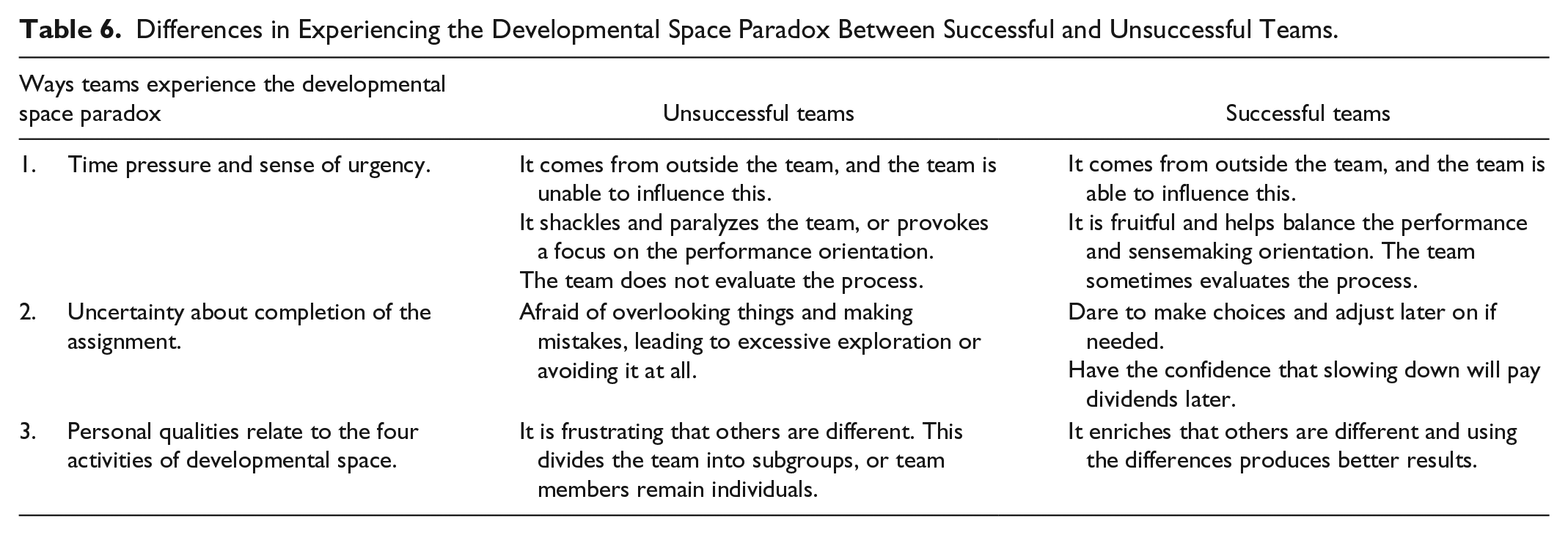
In dealing with uncertainties about completing the assignment, the unsuccessful teams appeared to be afraid of making mistakes. They reported being trapped in the endless exploration of alternatives, or did not engage in exploration at all because they did not feel they had sufficient time. In contrast, the successful teams seemed to explore alternatives and agree to make a decision at some point, trusting that they could always adjust or make changes later.
In relation to the different personal preferences for the four activities of developmental space, the unsuccessful teams experienced these differences as a hindrance: They frustrated them and sometimes led to subgroups forming or team members working as individuals. For the successful teams, the different personal preferences appear productive, leading to better results.
Discussion
If we return to our research question, “How do teams experience and handle the developmental space paradox and what effect does that have?” we can roughly outline two ways of handling that paradox: First, the unsuccessful teams seem to deny the paradox and/or choose for the performance orientation. Second, the successful teams seem to balance the two orientations by using their shared goal as a base, with some of them complementing this by planning time for sensemaking.
Below, we will first explore some of the results in greater depth, relating them to various theories and offering suggestions for future research. This will be followed by theoretical and managerial implications, and a discussion of the limitations of our study.
A Call for More Reflection and Dialoguing
It is noteworthy that in every team at least a few members mentioned that they could have paid more attention to reflection and dialoguing. Why are these two activities mentioned by so many, while the other two activities of developmental space, creating future and organizing, are rarely mentioned? Where does this dissatisfaction come from, even in the successful teams?
There are probably several reasons for this: First, this may be associated with the tendency today, at least in our Western society, of organizations and teams to be required to achieve results as quickly as possible. Second, managers might play a key role in this, as they often prioritize short-term over long-term success (Levinthal & March, 1993). They monitor and judge employees based on their achievement of quick results, and they are in turn judged on that basis. In this haste, people feel that they do not have the space to explore and inquire alternatives, to ask for feedback from customers or other relevant parties, or to evaluate how things are being done, in other words, dialoguing and reflecting. Derksen (2016) finds that most leaders practice, for the greater part, creating future and/or organizing activities. These leaders gagged team members who asked critical questions or introduced other perspectives, leading to one-sidedness and frustrated team members.
Third, teams feel uncertain about completion (Mueller, Melwani, & Goncalo, 2011). When have they reflected and dialogued enough? When have enough alternatives been taken into account, explored, or sufficiently evaluated? This leads some teams to excessive exploration, coming close to the failure trap described by Levinthal and March (1993). Other teams do not even have the courage to start. In our study, we observed both reactions in the unsuccessful teams. In contrast, the successful teams in this study felt that they had the space, and they also had the confidence that any decision was temporary, and that they could always change direction or go back and make a different choice, or merely trusted that slowing down would pay dividends later in the process.
These responses to uncertainty may depend on the team’s regulatory focus (Higgins, 1998). Teams with a promotion focus will choose to move on and dare to take risks, whereas teams with a prevention focus will choose to avoid risks (Brockner & Higgins, 2001). In future research, it might be interesting to take the regulatory focus into account.
Finally, the call for more reflection and dialoguing may correspond with the personal preferences of team members. Members who prefer reflecting and dialoguing may have more need for these activities and may, therefore, have mentioned that their team could have reflected and dialogued more. Thus, it would be interesting to take personal preferences into account in a follow-up study.
The Paradox Because of Diversity
In every team, some members mentioned that certain members mainly focused on and represented the sensemaking orientation (or one of the aspects of it), while others focused on and represented the performance orientation (or one of the aspects of it). Thus, the paradox appears to result from the diversity within teams. In some of the successful teams, this diversity helped them handle the developmental space paradox, and in some of the unsuccessful teams, it was an insurmountable obstacle that led to the formation of subgroups, which resembled a “faultline” (Lau & Murnighan, 1998; Meyer, Glenz, Antino, Rico, & Gonzalez-Roma, 2014). A faultline “depends on the compositional dynamics of the multiple demographic attributes that can potentially subdivide a group” (Lau & Murnighan, 1998, p. 325). Lau and Murnighan (2005) show that the stronger the faultline, the less effective the communication will be between subgroups. Carton and Cummings (2012) argue that integration of the research on faultlines, diversity, and intergroup processes is needed to better understand subgroups. Other factors that may influence subgroup formation are team identification (Bezrukova, Jehn, Zanutto, & Thatcher, 2009) and team climate (Chrislip, 2002; Mesmer-Magnus & DeChurch, 2009).
Perhaps another helpful notion for dealing with the issue of diversity is the idea of the “trading zone,” a metaphor of how the coordination of different ideas and actions may take place despite differences (Kellogg, Orlikowski, & Yates, 2006). The strength of this concept is that the differences are left intact.
Teams seem to need diversity to create developmental space, with some members focusing on the performance orientation and others focusing on the sensemaking orientation. However, some teams find it difficult to make these necessary differences within their team productive. How teams can realize this requires further research.
Handling Paradox and Coping With Stress
As research on handling paradoxes seems not to have a long history, it may be interesting to look at a comparable research area with a longer history. If we consider a paradox as a tension persisting over time and we study ways to handle this tension, we do recognize that this resembles the issue of coping with stress, the process involved when someone attempts to change what is stressful (Lazarus & Folkman, 1987). Looking more closely at the study by Lazarus and Folkman (1987), a few aspects strike us because of their similarity to handling paradoxes. The authors emphasize that coping with stress is a process, the understanding of which entails the need for a research design in which comparisons of coping under different conditions can be made. This resembles our study design comparing successful and unsuccessful teams. Furthermore, they state that coping with stress can be functional and dysfunctional. This depends on reality testing; for example, if a person appraises a situation as changeable when in reality it is not, the coping effort will likely produce a poor outcome (Lazarus & Folkman, 1987), and thus be dysfunctional. This also seems to be the case for handling paradoxes; for example, if one denies the paradox and chooses one side when in reality you need both sides, this will likely produce a poor outcome.
As the question of how people cope with stress has been a topic of research for a much longer time than the question of handling paradoxes, it may be of value and of interest to explore whether and in what way we can learn from research on coping with stress, applying these insights in future research on handling paradoxes.
Theoretical Implications
Previous studies on handling paradoxes claim that we can only achieve a sustainable result by embracing both sides of the paradox (Beech et al., 2004; Cameron, 1986, 2008; Lewis, 2000; Lewis & Smith, 2014; Lüscher & Lewis, 2008; Miron-Spektor & Argote, 2008; Miron-Spektor et al., 2011; Poole & Van de Ven, 1989; W. K. Smith & Lewis, 2011). Those claims are confirmed by this study. All successful teams paid attention to both sides of the paradox, the performance orientation and the sensemaking orientation, whereas the unsuccessful teams only paid attention to one side of the paradox.
Next, research findings are not unanimous on how we can embrace both sides of the paradox. Therefore, we presented an overview of the suggestions found in the literature about handling paradoxes (Figure 2). Our findings support the idea that handling paradoxes consists of taking three steps: (a) recognizing the paradox, (b) responding to the paradox, and (c) deploying coping strategies (Figure 2). This is, however, the first time that handling paradoxes is presented as a process of three sequential steps. More research is needed to confirm these findings and how these findings can be helpful in handling paradoxes.
An (un)activated paradoxical frame seems to be a prerequisite (Miron-Spektor et al., 2011) for the kind of response to paradoxes. In earlier studies, the paradoxical frame seemed a personal mind-set. In this study, it seems that a paradoxical frame can also be a team mind-set. If a paradoxical frame can be a team mindset and how this emerges within teams needs further research.
For the coping strategies, the most used strategy by the successful teams in this study was “balancing” the two sides. These teams also used strategies such as reinforcing each other, giving shared meaning, sparring, and differentiating. This corresponds with recent research of Lewis and Smith (2014) that highly performing individuals, teams, and firms apply a combination of strategies when handling paradoxes.
As this is a small study and the model for handling paradoxes (Figure 2) is a first attempt of giving an overview on the process of handling paradoxes, more research on this topic is needed. In the literature so far, handling paradoxes seems mostly studied from an individual perspective. This research tried to study the topic from a team perspective. As a multitude of variables relate to team effectiveness (Antoni & Hertel, 2009), certainly a lot of follow-up research is needed to gain more insight on the team process of handling paradoxes.
Managerial Implications
In our study, all successful teams had a clear goal, and every team member could individually describe their team goal. Having a clear team goal is often mentioned as an important precondition for team success (Larson & LaFasto, 1989; Levi, 2017; West, 2012; West & Hirst, 2005; Zander, 1994). West (2012) even states that the “ . . . clarity of team objectives is the single most important predictor of team success” (p. 107). Teams, among others, use team goals for evaluating the appropriateness of their actions and decisions (Zander, 1994). The successful teams in our study indeed used their shared team goal as their basis when deciding what they needed to do, while balancing the two sides of the developmental space paradox.
Our study also shows that asking every individual member about the team goal quickly reveals how clear the goal is to the team. This is a simple intervention manager, and teams can undertake, which is not time-consuming. In our research, the teams in which the members had different understandings of their goal were astonished when they realized this. It seems that they were completely unaware of each other’s views.
Thus, it appears crucial that every team member has a clear idea about the team goal. In our opinion, this can only be achieved if all team members actively participate in goal setting. We think this is another important precondition for team success. Finally, goal setting is not a one-off activity (Levi, 2017). In our study, it seems that within the successful teams it is more an ongoing process. Bearing in mind that all successful teams had a shared goal, but this was lacking in all the unsuccessful teams, we might ask whether having a clear and shared goal means something more. Does having a clear, shared goal have something to do with the team process? Is creating a clear, shared goal as a team a complex task? Is succeeding in doing this a sign that the team has in fact created developmental space? These questions require further research in the future. The importance of team goals seems beyond doubt, but the suggestion that goal setting requires the active participation of all team members and is an ongoing team process needs further research.
Limitations
The qualitative approach employed in this study offers insight into how teams experience the developmental space paradox, how they handle it, and the impact of their selected strategies. We also looked for themes in the data. In this respect, the literature is ambiguous about the sample size needed. This varies from 6 to 80 respondents (Guest, Bunce, & Johnson, 2006; Joffe, 2012). The total number of interviews in this study (N = 70) therefore seems to be sufficient. However, the sample of 12 teams divided into two groups, successful (n = 7) and unsuccessful (n = 5), is relatively small.
We used the success case method of Brinkerhoff (2002) to gain insight into the impact of selected strategies for handling the developmental space paradox. The criteria for successful and unsuccessful teams were based on West (2012) but were not very strict, and we relied on the judgment of higher management. In a follow-up study, we recommend using more objective criteria to define the successfulness of teams.
Furthermore, the sample consisted of three regular and nine specially composed teams. For future research, we recommend focusing on regular or specially composed teams. If they are combined, we recommend a larger and more balanced sample.
We chose a semistructured interview approach in which we started with open questions, followed by a brief explanation of the developmental space and its paradox. By explaining these two concepts, we controlled the responses of the interviewees. We recommend a follow-up study that does not explicitly explain or mention the developmental space paradox but is still focused on understanding how team members experience and handle this paradox. In addition, the use of interviews relies on the responses of the interviewees, all of whom were interviewed individually. While this broad number of views can offer a good insight into each team, the findings would be even stronger if complemented this with a follow-up study that included researcher observations.
Conclusion
This study examined how teams experience and handle the developmental space paradox and what effect that has. We interviewed individual team members (N = 70) from 12 teams: seven successful and five unsuccessful.
All teams mentioned that they could have engaged in more reflection and dialogue. It seems that time pressure leads the unsuccessful teams to focus on performance orientation, while the successful teams devoted attention to both the performance and sensemaking orientations.
The successful teams recognized and experienced the developmental space paradox more often than the unsuccessful teams. Team members appear to take on different roles: some slow down and ask critical questions, adding multiple perspectives (sensemaking orientation), while others want to move forward, plan, and focus on the result (performance orientation). For successful teams, these differences seem to be productive. For the unsuccessful teams, these differences tend to create frustration and a schism or subgroup formation within the teams.
All unsuccessful teams employ defensive coping strategies—repression, denial, and choosing one side—to handle the developmental space paradox. The successful teams seem to employ a kind of “explorative cyclical journey” (Lewis, 2000) in which “paradoxical inquiry” (Miron-Spektor et al., 2011) takes place. As for the coping strategies, the successful teams seem to constantly balance. At one moment, they will decide together to move on and focus on the result, while at another time, they will decide that they need to slow down and look for alternatives. They make these choices explicitly, consciously and as a team, based on their shared and explicitly identified team goal. Some teams that are good at organizing pinpoint the critical moments up front, and plan additional time for reflection and dialoguing at these moments. This study showed that handling the developmental space paradox seems to be a critical factor for the success of teams.
We close this study with two recommendations for teams and managers: invest time in creating a shared and clear idea about the assignment and goals, because that is your guideline during team work; and make space to decide together as a team on what to do when, focusing alternatively on the performance orientation or on the sensemaking orientation.
Footnotes
Acknowledgements
The authors wish to thank Angelique Bongers for her support with the interviews.
Declaration of Conflicting Interests
The author(s) declared no potential conflicts of interest with respect to the research, authorship, and/or publication of this article.
Funding
The author(s) received no financial support for the research, authorship, and/or publication of this article.