




Abstract
Background
Individuals with neurodevelopmental disorders (NDDs) face challenges in employment. Emerging technologies such as augmented reality (AR), virtual reality (VR), and mixed reality (MR) offer innovative, immersive training environments, enhancing skills, and media literacy while providing cost-effective, engaging solutions.
Objective
The review investigates how AR, MR, and VR technologies can support individuals with NDDs in workplace and training.
Methods
A systematic review of studies across 6 databases was conducted. Selection criteria focused on studies published after 2016, involving immersive AR/MR/VR technologies, targeting NDDs in workplace contexts. Data extraction utilized qualitative content analysis.
Results
The analysis of 10 studies showed that AR and VR improved work performance and motivation in most cases, with features like assistive prompts and simplified interfaces aiding usability. No studies involving MR were identified. Key barriers included sensory overload and difficulties interacting with AR-/VR-elements, but these were not universal. AR was noted for workplace integration, and VR was linked to fewer reported complications compared to AR. A lack of standardized research frameworks and focus on mainstream labour markets was identified.
Conclusions
AR and VR are promising tools for vocational training but require better accessibility, adaptability, and inclusion in broader labour market contexts to maximize their impact.
Keywords
Introduction
Many individuals with neurodevelopmental disorders (NDDs) aspire to engage in meaningful work, as it provides financial stability, structure, self-worth, and social support. Studies highlight that employment is associated with improved mental health, reduced depression and lower suicide rates. 1 However, despite these benefits, employment rates for this group in the regular labour market remain extremely low. 2
According to DSM-5, NDDs encompass conditions that emerge during the developmental period and lead to functional impairments, including intellectual disabilities. 3 Examples of disorders included in this diagnostic are ASD, Attention-Deficit/Hyperactivity Disorder (ADHD), Communication Disorders, Neurodevelopmental Motor Disorders, Tic Disorders, and Learning Disorders. 4
While comprehensive research covering the entire spectrum of NDDs remains limited, existing studies from various countries, like Germany, 5 U.S.A., 6 or Australia, 7 consistently highlight employment challenges faced by individuals with autism spectrum disorder (ASD). These studies reveal that individuals with ASD are substantially less likely to be employed compared to their non-disabled peers.
Assistive technologies are commonly used in rehabilitation to provide structured training and motivate users with engaging graphics. In recent years, augmented reality (AR) and virtual reality (VR) have introduced immersive environments for skills training. While VR immerses users in a fully simulated 3D space, AR overlays virtual elements onto the real world, allowing interaction with both. 8 Mixed reality (MR) is a technology that blends physical and virtual elements, creating an interactive experience where real and digital objects coexist and can interact in real-time. 9 These technologies offer cost-effective and time-efficient alternatives by eliminating the need for physical setups and enabling reusable virtual resources. 8 Furthermore, using digital technologies (like MR/AR/VR) increases media literacy, which is important for all kinds of employments.
Immersive virtual or augmented environments can range from basic computer interfaces to systems with full-body motion capture and interaction. Immersion depends on how inclusive, extensive, surrounding, vivid, and matching the environment is. 10 Immersive technologies like head-mounted displays (HMDs) block out or augment the physical world, provide high sensory engagement, and adapt to user movement for a realistic experience. Miller et al. (2016) 10 concluded from a systematic literature review on the importance of immersion level for people with ASD that highly immersive virtual environments produce overwhelmingly positive treatment responses. Therefore, this review focuses on HMD-based technologies, which also contributes to a better comparability of the studies.
A systematic review is a type of secondary research that synthesizes findings from existing studies to answer a specific research question. It uses explicit, rigorous, and transparent methods to ensure reliability and accountability, treating the review process as a structured form of research. 11 The review is undertaken to explore the following research question: How can the new technologies of augmented reality, mixed reality and virtual reality support people with neurodevelopmental disorders in the workplace? Since the transitions between AR, MR, and VR are fluid, all of these technologies are being included and a critical reflection will be made on whether the results in one technology are transferable for the others.
Method
Search strategy
For the systematic literature review, the PRISMA-Guidelines (Preferred Reporting Items for Systematic Reviews and Meta Analyses) were followed throughout the review process (see Figure 1).
12
The search took place from October to December 2024 and was performed by one reviewer. The following data bases were searched: Scopus, Web of Science, PubMed, and EBSCO Host. These were found suitable because they are large databases that provide comprehensive search results. Furthermore, all databases offer the advanced search with Boolean operators. The registers Cochrane Central Register of Controlled Trials (CENTRAL) and ClinicalTrials.gov were searched for studies that are currently still in the publication process. These were selected because, like the databases, they also allow searching with Boolean operators. Modified PRISMA flow chart.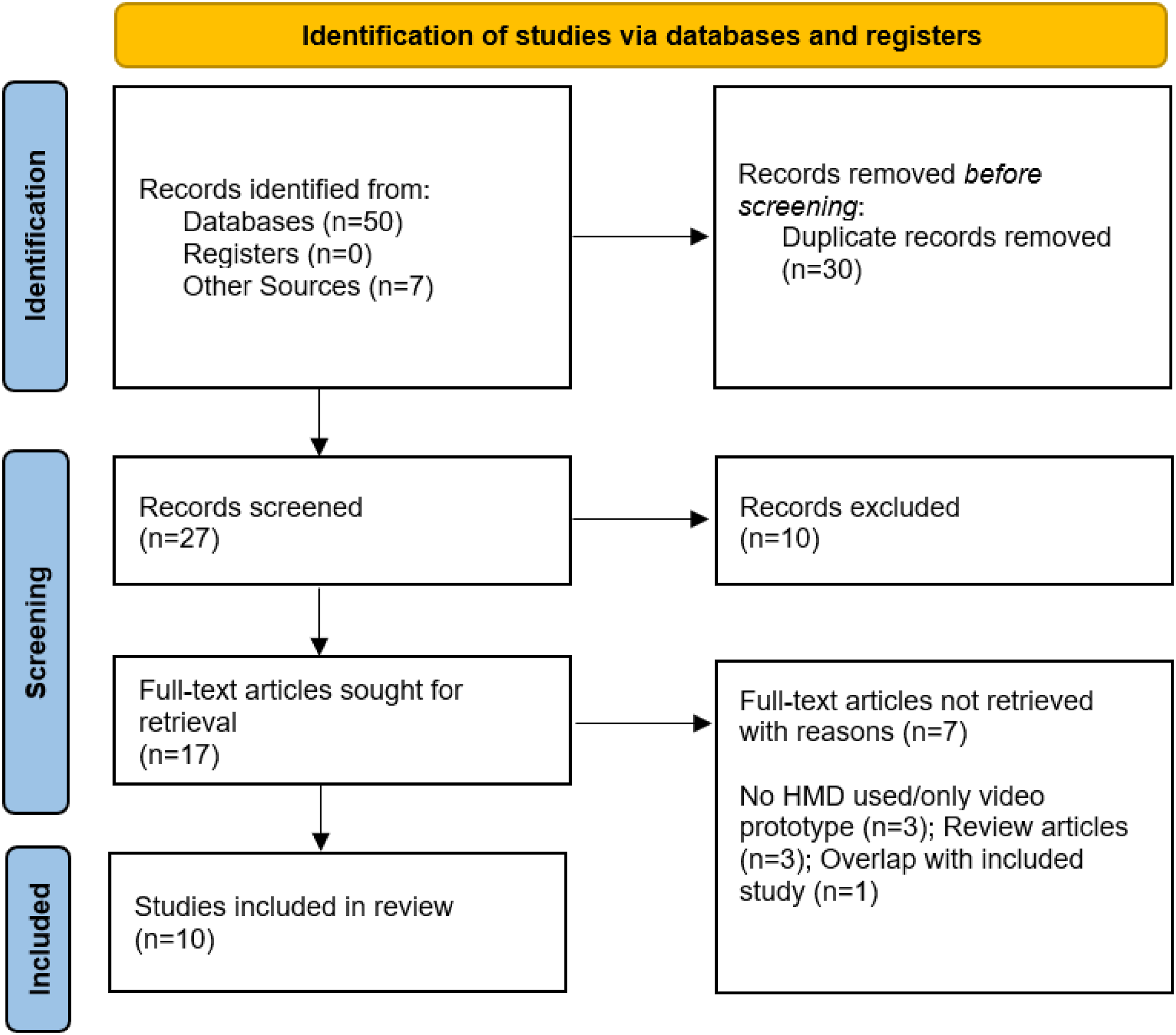
For all databases the following search was conducted: (“augmented reality” OR “mixed reality” OR “virtual reality” OR “XR” OR “extended reality”) AND (“cognitive impairments” OR “learning difficulties” OR “intellectual disabilities” OR “neurodiversity” OR “learning disabilities”) AND (workplace OR “work environment” OR employment OR “job performance” OR “vocational training”) AND (support OR assist* OR facilitat* OR improve* OR “enable” OR “adaptation”). For some databases, the search string had to be slightly adapted to meet the specific rules of the database.
Selection criteria
The research question was decisive for the selection criteria. Only English-language papers were included. Journal articles, conference papers or contributions to edited volumes were considered, but not systematic literature reviews. This is due to the fact that the reviews either examine papers that are also relevant for this review due to the topic and the selection criteria and would therefore be weighted twice, or they examined papers that do not meet the selection criteria and should therefore not be included at this point. However, systematic reviews were used to search the references for other suitable papers that met the selection criteria. Only papers that were published in 2016 or later were selected. That year, the Oculus Rift 1 and the HoloLens 1 were released, making immersive MR, AR, and VR technologies much more accessible. Before 2016, there was no HMD available with a corresponding level of technical complexity, which is why studies conducted before that year do not provide comparable results.13–15
In addition to the formal selection criteria, the following substantive criteria were important for inclusion: (a) The study addresses MR, AR or MR. Only immersive technologies in which a HMD was used for presentation were selected, as they provide an immersive experience and come with very different advantages, but also hurdles, compared to, for example, computer or smartphone-based applications. (b) The target group are people who fall into the overarching category of NDDs introduced in DSM-5.
3
(c) The technology is used in a work context, that is, at a workplace, during vocational training or in preparation for applying for a job (i.e., preparation for job interviews). The purely educational context is not taken into account. Workplace and vocational training can be located in the primary labour market or in special training facilities or workplaces for people with disabilities.
All articles had to include all three criteria to get selected.
Article selection
The title and abstract of the search hits found in the databases were checked for selection criteria. If the articles appeared suitable in terms of title and abstract, they were transferred to a directory. The articles in the directory were then read as full text so that a decision could be made if they met the selection criteria. Furthermore, the reference lists of the articles were checked for further articles. Articles from the references that appeared to be suitable were handled in the same way as search hits from databases.
To ensure consistency throughout the screening process, the reviewer periodically paused to review previous decisions, ensuring that the inclusion and exclusion criteria were applied correctly and consistently, and any inconsistencies were addressed.
Data extraction
Data was extracted from the articles using a Qualitative Content Analysis according to Mayring. 16 The categorization was carried out partly deductively and partly inductively. The main categories and some subcategories were developed in advance from the research question. During the coding of the articles, however, new subcategories and items could be added if this became necessary based on the content. The main categories were Characteristics (e.g., Authors, Year, Country of publication) Context (e.g., Aim of Study, Target Group, Work Setting), Technology Use (e.g., if AR, MR or VR were used, Features of the technology, Accessibility), Barriers and Challenges (Technological Barriers, User Barriers or Workplace Barriers), Research Design (e.g., Data Collection Method, Theoretical Framework or Outcome) and Recommendations (for work practice and for future research). The data was recorded in a category system and analyzed in Microsoft Excel. One reviewer was in charge of the data extraction and periodical check-ups were performed to ensure that categories were used consistently.
Results
Search results
The search in databases and registers yielded a total of 50 search results, of which 20 articles remained after the removal of duplicates (n = 30). The articles were screened by reading the title and abstract. In addition, the references were checked for other matching articles. This resulted in 7 further articles that were additionally screened. Of the 27 articles, 10 were excluded after screening. All removed articles except for one were removed because no HMD was used in the studies. One was removed because it was not work related.
Seventeen articles were read in full length. Of these, 7 were removed for the following reasons: No HMD was used or only a video prototype (n = 3), the articles were identified as review articles (n = 3) and one study was from the same authors as an included study and had partially overlapping content (n = 1).
In two cases, two papers dealt with the same technical application. However, since the data collection and the participants were different and the testing took place at different times all four papers were included due to their unique findings.
Description of studies
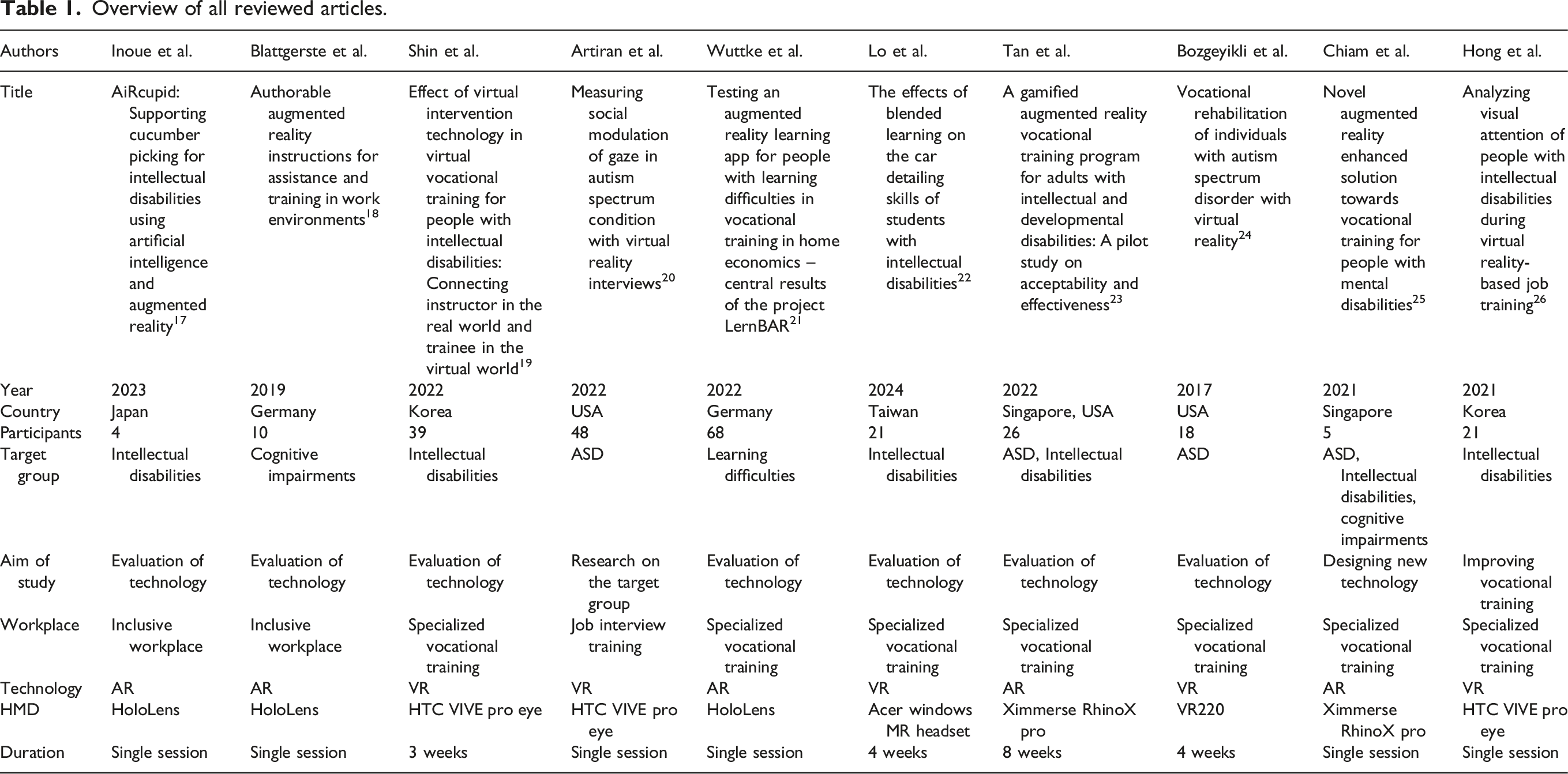
The 10 articles were published between 2017 and 2024. 6 articles were published in East Asian countries (Japan, Korea, Taiwan and Singapore), 2 are from the USA and 2 from Germany. The number of participants varied from 4 to 68 with an average of 26 participants. Not all participants were people with NDDs since also participants of control groups or trainers were examined.
The primary aims of the articles are the evaluation of developed technology (n = 7), research on the target group (n = 1), designing new technology (n = 1), and improving vocational training (n = 1).
All studies examined people with NDDs. Within this category, intellectual disabilities (n = 6), ASD (n = 4), cognitive impairment (n = 2), and learning difficulties (n = 1) were mentioned.
Seven studies focused on special training for people with disabilities. Two provided support in specifically created workplaces for people with disabilities. One study tested job interview training. No study investigated work or training scenarios for the primary labour market, although some of the interventions in training were intended to simplify the transition in the long term.
VR was used in 5 studies and AR in 5 as well. No study mentioned MR or mixed use of VR and AR. The most frequently used HMDs were the HoloLens (n = 3) and the HTC VIVE Pro Eye (n = 3). In all studies except for one the technology was used with the purpose of offering training opportunities. Another purpose that was found in 3 studies was task support. In one study, a purpose of the technology was to offer an authoring tool and in one study, the technology was used to track gaze patterns. In some of the articles reviewed, there was more than one purpose in using the technology.
Another important factor of the technology is the accessibility features that are provided. While no accessibility features were mentioned in 3 studies, a total of 10 different features were coded for the other studies. The most common feature used in the applications was assistive prompts (n = 5), that is, help functions that provide support during the work process in the event of difficulties. Furthermore, the features simplified interfaces/instructions, difficulty levels, additional help from instructor, tutorials, and sound cues were reported with 3 mentions each.
Overview of all reviewed articles.
Main findings
All articles have predominantly positive results. The most common outcomes are an increase in work performance and an increase in motivation (both n = 5). Transferrable learnings and perceived usefulness by the target group were also frequently reported (both n = 4). In 3 studies, it was stated that participants enjoyed their work more when using VR or AR technologies. In 2 studies, better results were achieved than in a control group that did not use AR/VR applications. Two studies each found an increase in soft skills and perceived usefulness of trainers/staff.
However, barriers associated with the use of AR and VR were also identified in 7 of the studies. These related primarily to barriers identified by the users, while technical barriers and barriers related to the workplace were seldom mentioned. The most common barriers were that participants felt overwhelmed by the VR/AR content and that there were difficulties in interacting with the VR/AR elements (both n = 3). Other barriers include difficulties related to disability, unfamiliarity, fatigue, blurry vision, and difficulty perceiving stimuli from the real environment (n = 2 each). These user barriers never occur for all participants, but usually only affect a few, while others have no problems and rate the offer positively.
When it comes to recommendations that can be derived from the study results, the adaptability of the technology is the top priority. In 4 studies, it was discussed that to enable as many people as possible to use the technology successfully, it must be adaptable in presentation formats and difficulty levels to the needs of the users. Including regular breaks is also recommended in 2 studies.
All studies present recommendations for further research like conducting studies with a higher number of cases (n = 3), long-term studies, comparisons to conventional instructions/learning material, including performance tests, trying out a wider variety of scenarios and research in monitoring techniques/feedback mechanisms for fatigue and mental load (n = 2 each).
Discussion
The results provide valuable insights for the use of AR/VR in vocational training for people with NDDs. While the studies reviewed highlight the potential of these technologies, they also reveal some limitations.
Positive outcomes
The reviewed studies demonstrate that AR/VR can be effective tools for vocational training. Many participants with NDDs showed improvements in work performance and motivation, suggesting that these technologies can engage in ways traditional methods might not. Also, AR/VR was found to facilitate transferable learning for other tasks and contexts. The immersive and interactive nature of AR/VR made the training more enjoyable for many participants, enhancing their overall experience and satisfaction.
Accessibility features
The accessibility features integrated into AR/VR systems can play a critical role in their success, especially when working with people with disabilities. Many different features were used in the studies so it is difficult to state which ones are effective. Features like assistive prompts, simplified interfaces, adjustable difficulty levels and tutorials were commonly cited as helpful, enabling users to overcome challenges and improve task performance. Common accessibility concepts like Universal Design (UD) or Easy-To-Read Language were not mentioned in any of the studies. Which accessibility settings are particularly important for the user group and how AR/VR can be made even more accessible are important topics for future research. However, four studies come to the conclusion that a high level of adaptability of the AR/VR application (such as adjusting the font size or difficulty level) leads to higher usability ratings.
Theoretical background
A comparison of the studies shows that there is no uniform theoretical basis for researching AR/VR applications in the work context. Different if any explanatory models were used in each study, and the scales or frameworks employed for data collection vary considerably. In order to enhance comparability and coherence across future research, it is essential to establish a foundational framework for investigating immersive technologies. The Technology Acceptance Model (TAM) remains a widely used and validated framework for understanding user acceptance and perceived ease of use of new technologies. 27 Also the Perceive, Recall, Plan, Perform (PRPP) System of Task Analysis offers a cognitive-behavioural lens for examining how individuals engage with work-related tasks. PRPP can help identify how immersive technologies support or hinder specific components of task performance. 28 By incorporating TAM and PRPP, future studies can address the technological and human-performance dimensions of immersive systems in vocational settings, contributing to a more standardized and practical research foundation.
Comparison of AR and VR
The comparison of AR and VR based on user barriers and outcomes highlights both similarities and differences. In terms of barriers, both technologies show equal challenges related to disabilities, fatigue, blurry vision, and reduced perception of the environment (see Figure 2). However, AR demonstrates higher levels of unfamiliarity, difficulties with interaction, and feelings of being overwhelmed. On the other hand, VR is more associated with dizziness or motion sickness but also stands out for having instances where no user barriers were reported (see Figure 2). A possible explanation for this is that AR often requires users to simultaneously process digital overlays and real-world environments, which can lead to cognitive overload and interaction challenges. In contrast, VR provides a fully immersive, controlled environment that can simplify interactions. Also, VR on HMDs has been more widely adopted in consumer markets so participants are more likely to have prior exposure to VR than AR. User barriers for AR- and VR-studies.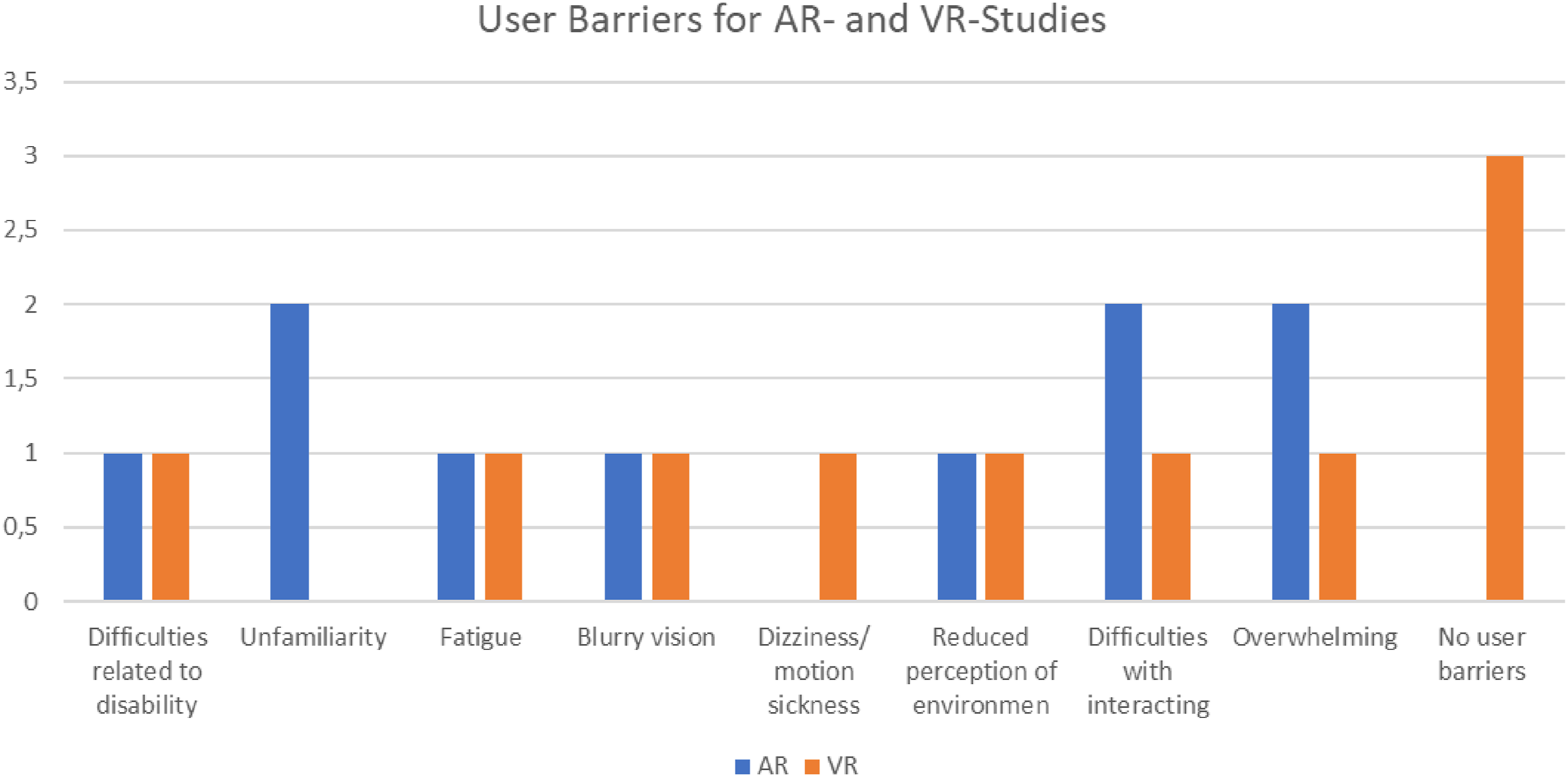
When examining outcomes, both AR and VR are equally effective in facilitating transferable learnings and being perceived as useful by both users and trainers. For the increase in work performance, VR seems to be more effective, whereas AR has a better score for the increase in motivation. However, both technologies are very similar differing in both categories only by one point (see Figure 3). Outcomes for AR- and VR-studies.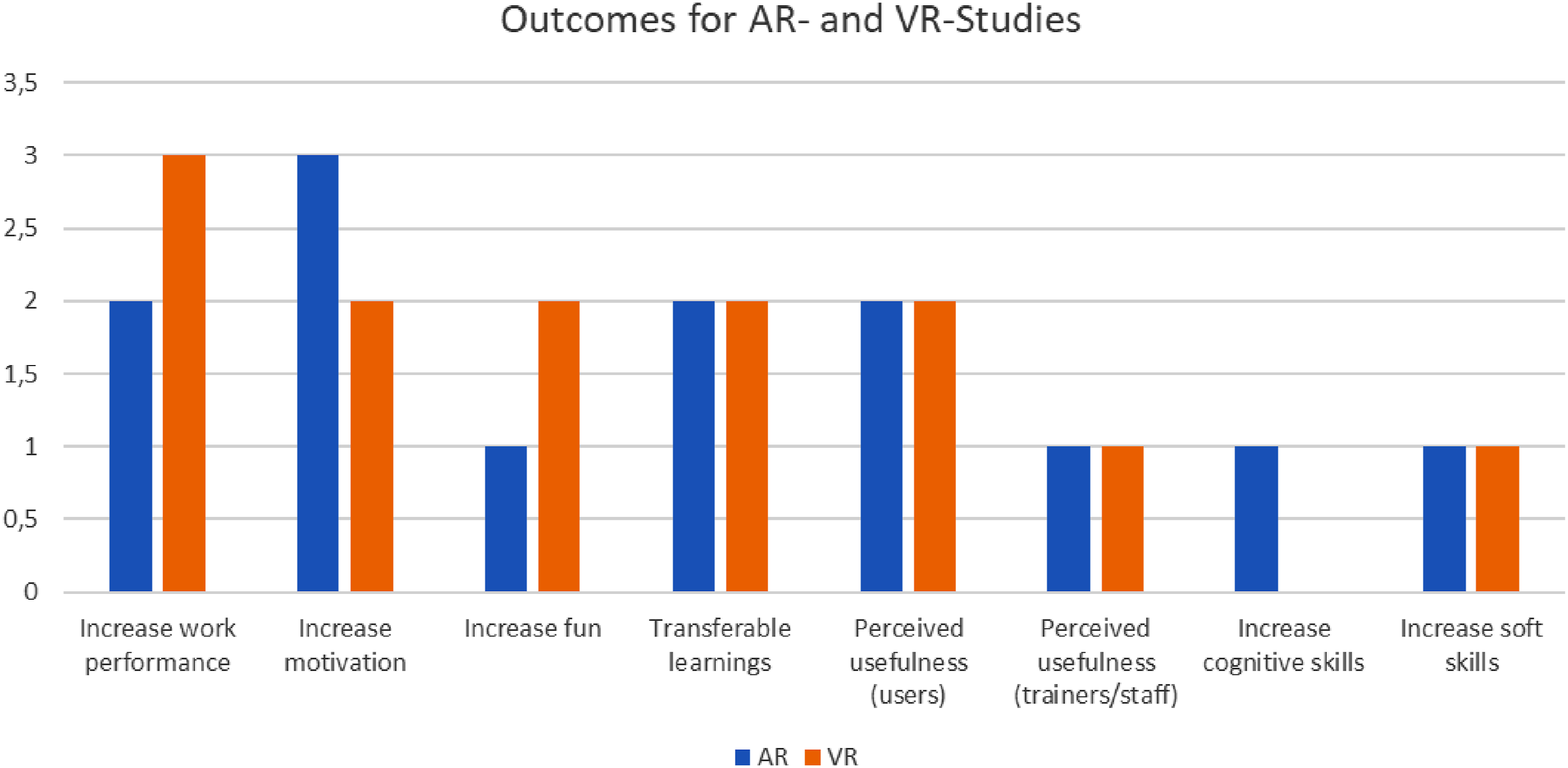
These findings show that, although there are some slight differences, AR and VR are comparable in terms of the effects they have on the user. AR and VR have different areas of application due to their different properties. In the studies, both are primarily used in special training for people with NDDs. Only AR is also used in the workplace as AR offers the possibility to use the technology not only for training but also in the real work process by anchoring it in the real world.
Challenges and limitations
Despite these positive outcomes, several challenges remain. Barriers were primarily user-centred, with participants experiencing sensory overload, fatigue, or difficulty interacting with the technology. These barriers, while not universal, highlight the need for more user-friendly designs that cater to the diverse needs of individuals with NDDs.
A significant gap in the current research is the lack of studies examining the use of AR/VR for people with NDDs that work on the general labour market or do a vocational training that leads to it. While some interventions aimed to prepare individuals for such environments, there is little evidence on how these tools function in integrated workplaces alongside neurotypical employees. This limits the understanding of their full potential in promoting workplace inclusion.
Conclusion
This review highlights the significant potential of AR/VR in vocational training for individuals with NDDs. These technologies enhance work performance, motivation, and transferable learning, with their immersive nature making training more engaging than traditional methods. However, challenges such as sensory overload, fatigue, and user unfamiliarity underscore the need for more user-friendly, adaptive designs.
Accessibility features like assistive prompts and adjustable difficulty levels are critical but inconsistently applied across studies, pointing to the need for standardized approaches, including principles like UD. Comparisons between AR and VR reveal similar outcomes, though VR has fewer reported user barriers, while AR is uniquely applicable in real-world workplaces.
Considering the cost-benefit issue when purchasing VR/AR devices in work contexts it becomes clear that while AR/VR systems can involve significant upfront costs they may offer long-term savings. In training contexts AR/VR offer reusable virtual resources and don’t need a physical set up. This is especially relevant given that 8 of the reviewed studies focus on workplaces in the service sector, where resource-intensive tasks are common.
The use of AR/VR head-mounted displays (HMDs) also raises privacy and ethical concerns. These devices may collect sensitive data such as voice input, eye movements, or spatial mapping, posing risks around data protection and informed consent. To address these issues, it is recommended that organizations implement transparent data policies, obtain informed consent, and adopt ethical guidelines that prioritize user autonomy and privacy.
A research gap exists in studying AR/VR applications in integrated workplace settings alongside neurotypical employees. Most studies focus on training environments, limiting understanding of these tools’ potential for workplace inclusion. Future efforts should prioritize accessibility, standardize evaluation methods, and explore broader applications, paving the way for a more inclusive workforce.
However, this review process had limitations. The search was limited to English-language studies, potentially excluding relevant research published in other languages. Also, the review primarily draws on literature from East Asia (60%). As a result, regional perspectives may be overrepresented, potentially limiting the generalizability of findings to other cultural or policy contexts. Future research should incorporate more diverse geographic viewpoints to ensure broader applicability. Additionally, the absence of uniform theoretical frameworks and standardized research methodologies in the reviewed studies makes comparisons challenging. Future research should address these gaps by adopting consistent research models and exploring long-term effects and comparative studies with traditional training methods. Expanding research to include workplace settings on the primary labour market and larger, more diverse participant samples would also enhance the generalizability of findings and strengthen the evidence for AR and VR’s role in vocational training for individuals with NDDs.
Footnotes

Funding
The authors received no financial support for the research, authorship, and/or publication of this article.
Declaration of conflicting interests
The authors declared no potential conflicts of interest with respect to the research, authorship, and/or publication of this article.