




Abstract
The hegemonic masculine influence on outdoor adventure education (OAE) culture has long been recognized. For example, both Jordan (1992) and Humberstone (2000) raised questions about the male-dominated history of the field and its promotion of masculinized attitudes and assumptions. Numerous other OAE leaders and academics have described the deleterious effects of gendered values, practices, (Gray, 2016; Newbery, 2003; Tilstra et al., 2022) and hidden curriculum (Warren et al., 2018) on women in the field. Such issues were largely unnoticed by men outdoor leaders (Gray et al., 2017), possibly due to men's sense of privilege and entitlement (Flood, 2019). Men's inattention is problematic as scholars assert that men's allyship is important to lasting efforts to reject gender stereotypes and promote gender equity (Bell et al., 2018; Gray et al., 2020; Haluza-Delay & Dyment, 2003).
Men have dominated the leadership and academic footprint of OAE, leaving women under-represented (Gray, 2016) and one could rightly question the need to revisit their perspectives. However, Warren (2015) noted that OAE literature had not yet explored men's notions of masculinity and there may be opportunities for men who resist masculine stereotypes to challenge the dominant masculinist OAE culture. Further, as Gray et al. (2020) stated, men would likely benefit from reflection on masculinity in an OAE context as doing so may prompt reconsideration of “the ways certain demonstrations of masculinity can oppress women” (p. 104). Although Henderson and Gibson (2013) described men's experiences of leisure and Blenkinsop et al. (2018) detailed hegemonic masculine influences on nature-loving boys’ socialization, no specific exploration of men's conceptions of masculinity in OAE has been undertaken.
Herein I respond to this gap in the research by exploring men outdoor leaders’ notions of masculinity in the OAE subculture. Through analysis, it is hoped opportunities and obstacles may be identified toward a more gender-equitable practice in OAE. This article presents a subset of data from a broader study focusing on men OAE leaders’ attitudes toward, and interactions with, women leaders and students and how these demonstrate the dominant masculinity in the subculture.
Literature Review
Connell (2005) noted that a patriarchal gender hierarchy not only subjugated the feminine, and therefore women through essentialism, but also certain men that did not enact valued hegemonic traits. All men, therefore, work to enact or embody as many of the valued hegemonic masculine characteristics as possible to position themselves optimally within the hierarchy. Connell's (2005) valued hegemonic masculine characteristics initially included displays of toughness, dominance, competition, physical strength, and emotional stoicism. However, the theory was later amended to indicate that valued hegemonic characteristics may vary with context. Paechter's (2006) notion of gendered communities of practice is also useful when considering OAE. Paechter (2006) stated that within a given subculture, patriarchal values translate to specifically gendered practices and activities. These practices are policed by men and boys to demarcate gender categories and ensure conformity, thereby solidifying their superiority. Humberstone (2000) and others (e.g., Kennedy & Russell, 2021) have applied Connell's (2005) model to OAE, highlighting gendered structures and practices that reinforce hegemonic masculine norms.
Concepts of resilience, risk, and leadership are staple aspects of the OAE curriculum (Haluza-Delay & Dyment, 2003; Martin et al., 2017). These characteristics are likely derived from the militarist origins of the field and men's historical domination of recognized leadership (Bell et al., 2018; Gray et al., 2017). Such structures have resulted in the erasure of women OAE leaders’ contributions (Gray, 2016), as well as highly gendered expectations linked to hegemonic masculine norms. Examples of hegemonic masculine values include physical strength gaining outdoor leaders status (Newbery, 2003; Ouellet & Laberge, 2021), and the gendering of outdoor skills, with men associated with valued technical skills (Hickman & Stokes, 2016) and women with deprioritized relational skills (Warren et al., 2018). In addition, Tilstra et al. (2022) demonstrated that risk is also a gendered notion in OAE programming, with men and boys perceived to be associated with physical risks, and women and girls with social risks, such as emotional vulnerability. The authors’ concluded that binary-gendered stereotypes remain prevalent within the OAE paradigm.
In addition to curricular and cultural aspects of the outdoor education field, men's enactment of hegemonic masculine traits has been reported in the outdoors, such as dominance and competitiveness (Oakley et al., 2018), invalidation of women leaders (Avery, 2015; Gray et al., 2020), or creating a “boys’ club” (Allen-Craig et al., 2020, p. 126) within the work environment. However, Oakley et al. (2018) also witnessed non-competitive alternative masculinities that resist hegemonic masculine stereotypes in nonprofessional outdoor contexts and posited that these could become more prevalent in OAE. Warren (2015) suggested that examples of such alternative masculinities “contradict the prevailing ethos …the male-dominated nature of the outdoor experience” (p. 364).
Men's enactment of hegemonic masculine norms has been problematized by recent social movements such as #MeToo (Mendes & Ringrose, 2019), in popular culture (Gillette, 2019), and in OAE literature (Kennedy & Russell, 2021; Oakley et al., 2018). Further, some recent interest in men's experiences of masculinity appears in the OAE literature. Su et al. (2021), evaluated an OAE program designed to produce a “positive masculinity” in adolescent boys, an implicit indictment of the masculine norms in the field.
Interestingly, hegemonic masculinity's influence on all genders has been questioned, with Blaine and Akhurst (2021) concluding that its current significance in OAE is overstated. In addition, recent small-scale studies have demonstrated men's growing recognition of gender biases, willingness to confront overt sexism, and transgression of gender norms in their practice (Allen-Craig et al., 2020; Davies et al., 2019). Such changes may indicate a shift in conceptions of masculinity in OAE to those more consistent with alternative masculine enactments promoted by Oakley et al. (2018) and Warren (2015). Alternatively, men may be rearticulating masculinity to maintain hegemony (Connell, 2005), as witnessed in other subcultures (Bridges & Pascoe, 2014).
Despite calls in the OAE literature (Warren, 2015) there has been, to date, little research on men's notions of masculinity in the OAE subculture. Elsewhere, I have considered men outdoor leaders’ definitions of masculinity, their influences on them, and how men's conceptions influence their values and practices in OAE (Kennedy, 2022). In this article, informed by Paechter's (2006) notion that inter-gender interactions can either reduce or strengthen perceived gendered group boundaries, I focus on men's attitudes toward and interactions with women OAE leaders and students. Findings are then compared with my previous assertion (Kennedy, 2022) of dominant hybrid masculinity in OAE culture.
Methods
Methodology
This study was guided by a relativist perspective, considering reality as subjective and constructed through an individual's perception, which is determined by their situated position within a given context (Burr, 2003). A constructivist epistemology follows, requiring that multiple perspectives be collected, each understood as negotiated within a specific social and cultural milieu (Merriam & Tisdell, 2015), in this case, the OAE subculture. Data collection within such a paradigm is qualitative, permitting each participant the freedom to articulate their own perspective (Creswell, 2012). Within this framework, a case study methodology was undertaken. The current case study applied White et al.'s (2009) notion that data collection in situ permits the researcher to capture contextual understandings more effectively. As described in the literature review, the influence of the outdoor education setting and culture are likely significant factors in outdoor leaders’ practice and views about gender. Case study designs suit situations in which the boundaries between phenomenon and context are not clear (Yin, 2017). The current research used a single case study embedded design (Yin, 2017) as opposed to a multiple case study. A single case-embedded design is preferable in a study, such as this one, with limited resources and a single researcher, due to the temporal and analytical demands of a multiple case study, per Yin (2017). Further, the intention is not to compare masculinities, as would be done in a multiple case study (Yin, 2017) but rather to determine a commonly-held or dominant conception of masculinity within the subculture. Within a single case-embedded study, multiple sub-units constitute and describe one case (Yin, 2017). In the present study, the single case was men's dominant conception of masculinity in outdoor education and the sub-units (i.e., individual men outdoor leaders) inform that case, with data collected at several locations across North America.
Participants
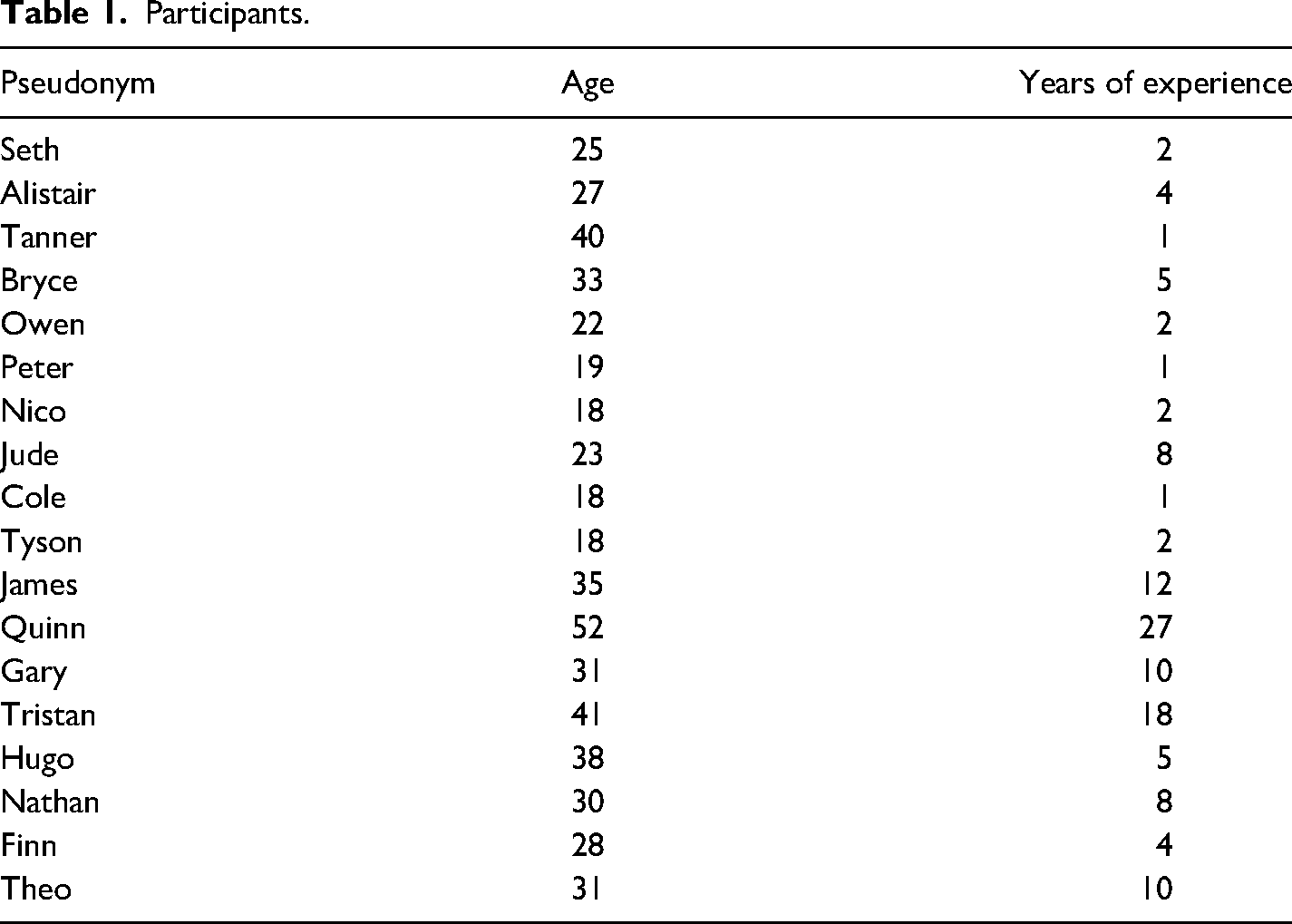
After obtaining approval from the IRB at Lakehead University and permission from three North American outdoor adventure education organizations to collect data on their base sites to ensure embeddedness within the OAE culture, the organizations distributed a call for volunteers to their staff. Volunteers contacted the researcher directly to schedule data collection based on their scheduled time on site. Participants each read a letter of information and subsequently provided written consent. The resulting 18 participants were men outdoor recreation leaders, between 18 and 52 years of age, with 0 to 20 + years of experience (see Table 1), situated at various levels of their organization's hierarchy. All participants but one were White, Anglophone, and middle- or upper-class, thereby representing the demographics of men in the field (Warren et al., 2018). Specifics of the final participants’ identities have been omitted for purposes of anonymity.
Participants.
Data Collection and Analysis
Interviews employed a semi-structured format, due to the flexibility and autonomy afforded the researcher (Creswell, 2012). Interviews were conducted individually at a location on the worksite chosen by each participant. The interview duration varied between 12 and 104 mins. One participant's interview was conducted by telephone because of logistical issues. All interviews were audio recorded to aid transcription.
Observations were recorded in the form of narrative notes to allow for unexpected actions and recording of cultural and contextual influences on behavior (Skinner et al., 2000). Observations took place over 1 workday, although session times varied in duration based on each participant's time on site. One of the three participating organizations did not permit observations. Due to this restriction to data collection, instead of providing a method of checking that participants’ actions were consistent with their interview responses, as initially intended, where applicable, observational data have been used to supplement interview responses. Site descriptions were recorded, per Yin (2017) and artefactual data (e.g., policy documents and evaluation forms) were collected on each site. These data provided a sense of the historical, cultural, and ecological contexts of the study. The three collection methods permitted triangulation to improve the trustworthiness of the data (Johnson, 1995). Moreover, to increase validity, participants were given the opportunity to member check the interview transcript and recorded observational notes to confirm accuracy. Participants were permitted to choose a pseudonym; however new pseudonyms have been assigned in this manuscript to provide greater anonymity.
An initial inductive coding strategy was undertaken, using in vivo codes to identify emerging themes between data collection sessions. Once data collection was complete, Atlas.ti was used to store and organize interview transcripts and observation notes. Later, descriptive coding was employed, summarizing topics raised by the participants. In the second cycle of analysis, pattern coding was used to group analogous codes into incipient themes (e.g., awareness of gender inequity), these were subsequently refined to discern thematic categories, as suggested by Saldaña (2016).
Findings and Discussion
The findings presented in this article are a subset of data from a broader study of masculinity in OAE culture. The data furnished below are participants’ descriptions of their attitudes toward, and interactions with, women colleagues and students that inform the dominant notion of masculinity in OAE. I recognize that focusing on men's descriptions of women in OAE reinforces a binary notion of gender. However, a significant majority of literature on hegemonic masculinity in OAE practice is written from women leaders’ perspectives, likely due to women's historic and ongoing devaluation by men in the OAE field, their desire to redress the situation (Gray, 2016), and men's inattention to gender issues (Mitten, 2018). This domain-specific literature directly influenced some interview questions, possibly resulting in responses that focused on the binary. Yet, despite questions being open-ended, only one participant discussed gender beyond the binary, stating he would speak in the binary “because it's the easiest,” perhaps indicating a lack of knowledge of gender beyond the binary associated with men's inattention to gender, associated with privilege (Flood, 2019). Also illustrative of their gender knowledge, and consistent with tendencies in some OAE contexts (Tilstra et al., 2022), participants often conflated sex and gender in their responses.
Multiple themes were identified about participants’ interactions with women colleagues and students, including their awareness of gender inequity, students’ gendered assumptions, participant blind spots, and essentialist beliefs. These are presented in the sections below with data provided first, followed by analysis.
Awareness of Gender Inequity
The participants all demonstrated awareness of gender issues. Their recognition of gender inequity was partly attributed to what many described as the “changing culture” in North America and in the outdoor education realm, more specifically. James and Shawn indicated that they felt the discourse had shifted just within the last four or five years, resulting in an important awareness of toxic masculinity. Gary attributed the recent focus on gender to social media campaigns, such as #MeToo.
The #MeToo movement was one of the most successful (to date), campaigns to raise awareness about women's experiences of sexual and gendered harassment (Fileborn & Loney-Howes, 2019). The immensity of women's response resulted in more “substantive and sustained global media coverage and public debate” (Fileborn & Loney-Howes, 2019, p. 24) than previous campaigns and a greater recognition of gendered power imbalances in the work environment.
Such burgeoning popular recognition may have a significant effect on OAE leaders’ awareness as Cook (2001) asserted that OAE subcultural norms tend to reflect those in the wider culture. Another influence may be the ever-growing catalog of scholarship about gender inequity and the need for men's allyship in OAE (e.g., Warren et al., 2018). For example, Theo noted the need to consider the power dynamics when working with a woman coleader. He said, “With a mixed-gender team of leaders you need to address gender roles and power dynamics … directly.” He stated that the awareness of gender bias as a factor on an instructor team necessitated intentional changes to practice. Such a statement about power dynamics may be indicative of a hegemonic masculine assumption that men exist in a superior position within a gendered hierarchy. Alternatively, it could reflect an awareness of the scholarship (e.g., Warren et al., 2018, which explicitly attributes power to men when advocating for men's allyship).
Working with women coleaders to combat gender biases requires planning, initiative, and a willingness to break gendered norms by teaching nonstereotypical skills, according to Theo. Shawn concurred, indicating that the division of curriculum required planning to disrupt gender conventions by Trying to get each person on the instructor team to teach a technical skill within the first three days … Making sure that that's being divvied up evenly or, even, potentially, having a female-identified [sic] instructor teaching the higher-level skill earlier on, to break down that perception with students.
The endeavors outlined above align with the efforts of some men outdoor leaders to address inequity in their professional practice (Allen-Craig et al., 2020) by intentionally taking on nonstereotypical roles within the leadership team (Davies et al., 2019). Further, they partly enact Warren et al.'s (2018) recommendation to counter gender stereotypes by having “a male [sic] instructor teach baking class whilst a female [sic] instructor teaches rock climbing anchor construction” (p. 256). Within a historically hegemonic masculine domain, such as OAE, roles and practices are “owned” by men and women, who come to identify with and reproduce the hegemonic masculine structures through practical repetition (Kronsell, 2005). Therefore, planning to disrupt these repeated, and thereby validated, skills and roles may affect some change within environments historically dominated by men (Kronsell, 2005) and associated masculinities.
Students’ Gendered Assumptions
In addition to intentional planning, six participants explicitly stated that they challenge students’ sexist language or use of gendered stereotypes, out of respect for coleaders and a general desire to further gender equity. This is promising. However, Gray (2016) noted that obvious misogyny or obstruction is rare and instead more subtle biases tend to manifest. For example, some participants noticed gender-biased student behavior and worked to address it. James described an occasion when he and his coleader detected differential treatment by students: If I said something, it would elicit either an immediate or a much quicker response on the part of a couple of students versus when…our female [sic] leader said something. And we tested it a couple times, because we kind of saw it and we were like, “Let's test this. We want to kind of see what's going on here.”
James and his coleader worked together to confront the situation, calling it to the attention of the students. The students’ attitudes may be reflective of a recognized issue in OAE culture that students have less confidence in women leaders (Cousineau & Roth, 2012), reflecting pervasive gender norms that devalue women's capacity (Manne, 2010). The joint actions of James and his coleader may indicate a growing willingness amongst men OE leaders to recognize and address sexism and “support” (p. 254) women coleaders as allies, per Warren et al. (2018).
Participant Blind Spots
Participants described additional methods by which they worked to act as allies to women coleaders. Seth claimed that he works to, “support my fellow leaders who are women to share their voice and their perspective.” To “share the voice” seemed a common phrase as Hugo made a similar statement, indicating that he makes, “more of an effort to … share the voice and empower my female [sic] coleaders or female [sic] students and make sure that their opinions are being heard and the skills that they have to offer are being taught.”
Multiple participants mentioned some variation on “sharing the voice” as one way they work to address the silencing of women colleagues. Certainly, the exclusion of women's participation by men's aggressive and dominating communication styles has been identified as problematic in North American culture (e.g., Lipman, 2018) and was recorded in at least one observation session (Alistair). However, participants’ overtures to “empower” their women coleaders are problematic and demonstrate blind spots in their awareness. Asserting that one can empower another is, in itself, a self-aggrandizing and potentially patronizing statement. In addition, participants’ descriptions of “sharing the voice” with a woman coleader indicate that the power of voice is bestowed, positioning the individual doing the “sharing” as benevolent or enlightened, potentially increasing their status and leaving their biases and motivations unexamined (Ellsworth, 1989), thereby supporting hegemonic masculine hierarchy. Questions thus arise, such as: Are conditions attached when the voice is “shared?” Further, the singular nature of “the voice” being shared implies that those who are being empowered all have similar perspectives and experiences (Cook-Sather, 2007). Participants’ efforts to empower or “support,” then, take on an air of benevolent sexism, or assuming a patriarchal protector role (Glick & Fiske, 2001), which falsely promotes a viewpoint that women have little agency. Similarly, the use of “my coleader” may simply be a colloquial turn of phrase, but may also indicate a sense of possession.
Despite their stated desire to act as allies, according to four of the participants, it is women coleaders and students who best disrupt essentialist notions about men's strength and technical skill through their capacity in the field. As Hugo stated about busting gender expectations on an all-male trip, “It's definitely harder to erase that in an all-male course because you don’t have that female [sic] rock star that's charging up the mountain when some of the other guys are just huffing and puffing.”
As found by Cousineau and Roth (2012), exposure to strong women leaders can change students’ perceptions of gender and leadership, modeling non-stereotypical gender performances. However, it is disconcerting that combatting sexism and gender bias remains largely a women's role (Gray & Mitten, 2018). Participants’ comments demonstrated a persisting need for women to outperform men to be seen as equals, consistent with Warren's (1996) notion of the backcountry “superwoman.” Placing such value on the “female [sic] rock star” also demonstrates a blinkered viewpoint about the physical and psychological toll of constantly having to perform at such a level to demonstrate one's capacity (Warren et al., 2018), as well as about the masculine subcultural norms that are reinforced by such a requirement (Newbery, 2003).
Another blind spot was evinced by participants when discussing the provision of feedback. Providing feedback to colleagues is a valued professional practice in the outdoor education field (Martin et al., 2017). However, multiple participants indicated that it can be awkward to give feedback on backcountry staff teams due to the proximity of living. Further, Finn stated that if he perceived feedback to be incorrect, he simply ignored it.
Participants seemed to take for granted that feedback from others was candid and fulsome, with nothing hidden or omitted. Tristan was the only participant to explicitly question whether feedback and debrief sessions were entirely honest, stating that he had to assume that they were. Although multiple participants noted that they needed to “share the voice” to counteract established patterns of silencing women (Lipman, 2018), they seemed unaware of more subtle gendered communication dynamics. The participants’ assumption of candor represents a gendered blind spot in the feedback process. When outnumbered by men, which is likely given the leadership demographics of the outdoor education field, women outdoor leaders may feel censored or self-censor (Avery, 2015; Gray, 2016). Self-censorship is especially likely for women when attempting to report sexist comments, behavior, gender bias, or microaggressions (Allen-Craig et al., 2020; Avery, 2015) as men often react with denial or anger to such accusations (Bell et al., 2018). Further, raising such issues can have repercussions for a woman leader's career (Davies et al., 2019; Gray et al., 2020), or incur other social costs (Ahmed, 2017) due to men's sense of entitlement and resulting resentment when women deviate from normative roles (Manne, 2010). The men outdoor leaders in this study seemed unaware of these barriers and continued with a “no news is good news” (Haluza-Delay & Dyment, 2003, p. 11) mentality.
Two participants indicated that they had received feedback from women coleaders that changed their thinking and practice. Bryce related his experience with a coleader: I’ve said something and to me, in my head, in my context, it was nothing. Like, you’d say it to your buddies … And I’ve been told, “It has been bothering me for the past two weeks.” [Makes a shocked face] “Why didn’t you say anything?!?” So, out of sensitivity to that I’ve been treading a little bit more lightly. But I don’t think I’ve ever intentionally said anything or done anything where I’m like, “You’re a female [sic], I’ve got to do this for you.”
Bryce's comment does demonstrate a willingness to accept delayed feedback and to use it to inform his practice. However, he indicates that he is aware of only the most obvious sexism and does not recognize more subtle slights (Gray et al., 2020) in his wording and practice. In addition, he states that he now treads lightly around women instructors, a demonstration of both gendered othering and Ahmed's (2017) assertion that women who speak out are perceived as overly sensitive, requiring, in this case, Bryce to watch his words. Such statements may also relate to claims (by men) that men are increasingly policed or punished, indicating men's resentment of women's outspokenness and advocacy for greater recognition (Manne, 2010).
Participants were also informed about studies stating that women OAE leaders’ felt devalued by male colleagues and asked if such issues were consistent with their observations. Participants all expressed support for that claim in the abstract, but most could not identify examples from their own experience. When asked, Alistair stated, “It's not anything that I’ve seen, but I could imagine that being the case.” Alistair's statement possibly indicates some openness to acknowledging women's experiences but may also support findings that men do not recognize more nuanced examples of sexist devaluation (Gray et al., 2020).
James reflected that he hadn’t witnessed such devaluation but stated, “I mean, it's one of those things…In every workplace, there are always going to be bad apples.” James’ comment echoes the findings of Macomber (2012) that even self-identified progressive men look to deflect blame for gendered bias or harassment onto others, thereby preserving their own status.
Hugo, although acknowledging gender issues exist in the field, suggested that women's feelings of devaluation were, instead, the result of different experience levels between colleagues, which produces a power dynamic that women misattributed to gender. Hugo's argument is in line with two other statements that explicitly deny women's claims of devaluation, opining that such issues were unjustly attributed to gender. One example is Finn's statement: I actually think that women in general are rapidly being more validated every day. And part of that is because people are learning to see the world through gender … And so, saying that “I don’t feel validated at this organization because I’m a woman” … that is a story that whoever said that is telling themselves and it's probably partially true and, like, it's actually not entirely true.
Such statements dismiss women's self-advocacy and illustrate the phenomenon of testimonial injustice, whereby a person from a marginalized group who challenges established norms is viewed as incompetent and untrustworthy (Fricker, 2007). This phenomenon, in concert with structurally ingrained gender stereotypes that position men as objective and women as subjective (Connell, 2005; Paechter, 2006), allow these participants to feel justified in claiming that the women in the studies mentioned were mistaken. The above comments demonstrate Wall's (2017) assertion that when women outdoor leaders raise issues of sexism or bias, men often claim they are fabricated and disregard them. Further, the participants’ statements ignore the well-established hegemonic masculine structures in OAE that create barriers to women speaking out about such issues (Gray, 2016; Gray et al., 2020).
The participants’ blinkered viewpoint may be due, as Flood (2019) asserts, to a disinterest in or even an unwillingness to critically examine their own assumptions. It may also demonstrate that superficial changes to masculine enactment, described in previous sections, obscure or blur boundaries, permitting participants to support entrenched gender norms and hierarchies (Bridges & Pascoe, 2018). Despite the claims of devaluation not involving the participants directly, denial of the women leaders’ perspectives likely functions to pre-emptively reject their own implications in such practices. Moreover, the attribution of gendered devaluation to “bad apples” can be a method of scapegoating subordinated groups of men, upholding a hegemonic masculine hierarchy (Kennedy, 2022).
Essentialist Beliefs
Despite claiming egalitarian attitudes to gender overall, multiple participants demonstrated problematic beliefs in essentialized traits and characteristics. Owen asserted that women outdoor leaders are different from male leaders due to, what he considered, their natural awareness of risks: “They also have the better instincts, the better brain capacity, like, ‘Hang on, we shouldn’t be fighting over that rock in the water. Let's stop because it's not safe’.” Bryce stated that he thought women coleaders brought an empathetic aspect to the instructor team that he could not stating, “It's always the females [sic] that are more empathetic, more understanding.”
Gary, condemning such statements, indicated that he often hears comments asserting women are not as strong as men in professional contexts, made by both students and instructors. He continued, “And that's not one time, but many times, so it's like a common … it's like a cultural thing, to think that women are weaker and not as competent as men.”
Associating women with inherent gendered qualities, such as nurturance (Bryce), risk-aversion (Owen), and physical frailty (other instructors, per Gary) exemplifies a tendency to fortify boundaries (Bridges & Pascoe, 2018) reifying a gendered hierarchy in which stereotypically masculine characteristics are most valued and stereotypically feminine characteristics are devalued. Hegemony is created when such characteristics are accepted as essential or natural (Connell, 2005). Such essentialism is a hallmark of sexism, the rationalization for the differential treatment of women by men. The employment of essentialist narratives is often used as a more conventionally socially acceptable method of policing stereotypical gender norms (Manne, 2010), thereby permitting men who identify themselves as progressive to perpetuate gender inequality (Bridges & Pascoe, 2018).
Continuing the essentialist narratives, 13 of 18 participants stated that there was a noticeable difference in recreational and professional outdoor experiences with a woman coleader versus those with another man. Quinn argued that inherent differences between men and women create social complexity that does not exist in all-male excursion groups: “from my experience the communication would be simpler because it's all one gender and it's easier to have more of a … common language.” Theo felt similarly, stating, “All-male trip leader teams can serve as an affinity space in some ways where males can be open to connect in ways that they wouldn’t otherwise with a mixed-gender … team.”
The views expressed by participants about working with women add support to the findings of Davies et al. (2019) that beliefs about men and women's inherent physical abilities persist in the outdoor education field as do perceptions of inter-gender communication limitations. These persistent essentialist statements are problematic in that they contribute to discrimination in the workplace (Coleman & Hong, 2008; Newbery, 2003). Further, differences in cognitive abilities, communication styles, social behavior, and personality traits between men and women have been shown to be minimal (Zell et al., 2015). Studies claiming such differences are coming under increasing methodological and analytical scrutiny (Fine, 2010). Moreover, physical strength differences between men and women have been documented, but may be explained by social factors, such as the encouragement of boys and men to gendered physical activities (Miller et al., 1993). Claims of difference in hegemonic masculine organizations, such as OAE, may serve as a method of protest against the increasing recognition of women's accomplishments (Cohn, 2000) and value ascribed to stereotypically feminine skills in the field (Ouellet & Laberge, 2021). Essentialist claims of difference are particularly deleterious in OAE as they serve to reinforce the hegemonic masculinity in the subculture (Humberstone, 2000) and support the hidden curriculum that values stereotypically masculine traits and abilities (Mitten, 2018; Newbery, 2003).
The preference to work with male coleaders may indicate belonging to an in-group that holds similar traits and values (Kahan et al., 2007). Such notions function to separate men from women emphasizing a divide that permits othering and increased discrimination (Brauer & Er-Rafiy, 2011), adhering to Manne's (2010) definition of sexism and thereby supporting hegemonic masculine hierarchy. In addition, the stated ease in relating to other men may be one factor in the men-heavy gender imbalance found in outdoor organizations’ senior leadership (Bell et al., 2018; Gray et al., 2017), due to homologous reproduction, that is, hiring those who are similar to oneself (Loeffler, 1996).
In more examples of such othering, Cole indicated that he avoids joking and physical contact with a woman leader on his 3-person staff team partly due to his worry over issues of consent and a desire to be professional. He admitted that his approach meant that the woman was treated differently than the other man coleader and often left out of social interactions, but he could not see how the situation could change. Peter was likewise observed avoiding interactions with women staff on multiple occasions, preferring to interact with men.
Cole and Peter avoided authentic interaction with the women staff team in favor of social interaction with male coleaders. This tactic results in the othering of women coleaders and maintenance of the gender hierarchy through exclusion (Howard & Goldenberg, 2020) or creating a “boys’ club” (Allen-Craig et al., 2020, p. 126). These examples indicate that men outdoor leaders may, when confronted with a challenge, simply retreat and take solace in familiar gendered in-groups. In doing so, they maintain the gender hierarchy while simultaneously claiming to support women leaders.
Conclusion
At first glance, participants’ awareness of gender equity issues demonstrated some promise. That participants were all aware of stereotypical gender roles speaks to the increased visibility of gender issues in North American society (Cover, 2019) and to the increasing focus on social justice issues in outdoor education (e.g., Breunig & Rylander, 2016; Warren et al., 2014). Men outdoor leaders worked with women coleaders to present non-stereotypical skills and confront explicitly sexist language and behavior, as recommended by Haluza-Delay and Dyment (2003). Some participants’ responses indicated potential uptake of Warren et al.'s (2018) recommended strategies for allyship, such as: increasing social justice awareness, confronting sexist language, and teaching skills outside of stereotypical gender roles.
However, contravening participants’ claims of progressivism were repeated assertions of essentialist views (e.g., men's physical strength, women's relational capacity and risk aversion, communication differences). The proclaimed differences amount to sexism (Manne, 2010) by reinforcing the gender hierarchy, especially considering the greater prestige afforded to masculine traits within the male-dominated outdoor education field (Newbery, 2003; Warren et al., 2018).
The persistence of hegemonic norms in OAE has been established by multiple scholars and was demonstrated in this study. However, recent social movements and changes to OAE practice that incorporate stereotypically feminine skills (Kennedy, 2022; Ouellet & Laberge, 2021) may indicate changes to men's conceptions of their masculinity in OAE. Elsewhere, I have argued that men's claims of changes to practice, together with denigration of men who enact hypermasculine or socially conservative masculinities, may constitute a new dominant masculinity in OAE (Kennedy, 2022). Bridges and Pascoe (2014) postulated that privileged men, such as the mostly White, middle- and upper-middle-class men that participated in this study, may enact a hybrid masculinity. In this hybrid masculine formulation, privileged men can assume a more socially progressive posture while subtly subordinating other groups of men and other genders. The results above support this claim by demonstrating that men outdoor leaders reinforce more socially acceptable sexism in the form of gender essentialism, what Bridges and Pascoe (2018) term “fortifying boundaries,” thereby supporting the hegemonic masculine hierarchy.
Though this study sought to determine the dominant form of masculinity in North American OAE culture, its sample of 18 men in outdoor leadership is small. Further, because data collection for this study involved volunteers, it is likely that the participants felt more knowledgeable or aware of gender issues than those who did not participate, demonstrating a potential selection bias. In addition, the organizations that permitted access to their sites for data collection likely all have unique cultures (Barnes, 2003). Comparing differences in stated and enacted masculinities between organizations would provide greater clarity on the effects of staff training and organizational culture on OAE masculinities.
The participants in this study, despite often bolstering gender stereotypes, indicated a desire to act as allies to women and other gender colleagues in OAE. Duncanson (2015) argued that gender-equitable masculinities will not appear fully formed, but will instead be fashioned in an iterative process. In this way, according to Duncanson (2015), hybrid masculinities, while problematic, may represent progress toward the alternative masculinities encouraged by some scholars (Oakley et al., 2018; Warren et al., 2018) and thereby the potential for greater gender equity. If men in outdoor leadership truly want to act as allies, then as Potvin (2021), writing about the pitfalls of heterosexual LGBTQ + allyship, argues, we must engage in self-reflection, challenging ourselves to critically consider our attitudes and behaviors. Potvin (2021) suggests that such reflection will result in sustained discomfort. However, such discomfort allows those with the privilege to question ingrained assumptions. Therefore, men in OAE should focus on learning our own privilege, considering how it shapes our viewpoint and reproduces hegemonic masculine values. By embracing discomfort and rejecting the impulse for defensiveness, we may produce alternative masculinities that help foster greater gender equity.
Supplemental Material
sj-xlsx-1-jee-10.1177_10538259231153041 - Supplemental material for Men's Perspectives on Gender Relations in the Outdoor Education Field: Furthering the Case for a Hybrid Masculinity
Supplemental material, sj-xlsx-1-jee-10.1177_10538259231153041 for Men's Perspectives on Gender Relations in the Outdoor Education Field: Furthering the Case for a Hybrid Masculinity by Jay Kennedy in Journal of Experiential Education
Footnotes
Declaration of Conflicting Interests
The author declared no potential conflicts of interest with respect to the research, authorship, and/or publication of this article.
Funding
The author received no financial support for the research, authorship, and/or publication of this article.

Supplemental Material
Supplemental material for this article is available online.
Author Biography
References
Supplementary Material
Please find the following supplemental material available below.
For Open Access articles published under a Creative Commons License, all supplemental material carries the same license as the article it is associated with.
For non-Open Access articles published, all supplemental material carries a non-exclusive license, and permission requests for re-use of supplemental material or any part of supplemental material shall be sent directly to the copyright owner as specified in the copyright notice associated with the article.
