




Abstract
In higher education, it has been argued that there is an ongoing paradigm shift (Barr & Tagg, 1995) from an instructional to a learning paradigm (Prince & Felder, 2006). This shift represents a departure from a transmission view of learning toward a constructivist view of learning that emphasizes learning with and from each other. It acknowledges the importance of peers in the learning process and how they co-create knowledge (Shiner, 1999). One way to operationalize a constructivist view of learning is through experiential education (Kuh, 2008). An important role in experiential education is the facilitator who encourages students to reflect on what will, or has been learned from experiences (Brown, 2004), or manages the group process to help groups achieve identified goals (Thomas, 2010). A major limitation, however, is that facilitation is resource-intensive and that there is a lack of trained facilitators with a focus on team dynamics in higher education (Roberts, 2016). As McKeen et al. (2018) pointed out, experiential and project-based learning activities are the most difficult to scale, because monitoring teams and evaluating their progress are more time demanding than traditional classroom practices.
In the literature, different strategies to overcome this limitation have been proposed ranging from paying external partners for hosting student teams, including adjunct and alumni faculty, to data mining and app solutions (McKeen et al., 2018). One particularly interesting approach, however, is to educate students as learning assistants (LAs) in the role of facilitators in experiential higher education, as it involves other students and provides them with an interesting job. In the context of project-based learning, Andernach and Saunders-Smits (2006) describe how students can work as project tutors with a focus on facilitation in first- and second-year engineering project courses. In addition, several studies have demonstrated that students in the role of facilitators, often referred to as teaching or learning assistants, can help to facilitate fellow students in higher education without increasing the demands on the teachers (Barrasso & Spilios, 2021; Bent et al., 2020; Linh et al., 2019; Sloan et al., 2013). At the same time, facilitators need to have certain skill sets (Lee, 2006; Schwarz, 2017) and facilitation education (Thomas, 2004).
Since facilitation is about involving and engaging people (Hogan, 2002), facilitation practices can change depending on the focus of the involvement (Hogan, 2003). As the literature points out, the student facilitator has different tasks depending on what is to be learned. Groccia and Miller (1996) have shown how “peer learning assistants” can be used to manage group dynamics when students work in groups in a biology course. Campbell (2014) focused on how student facilitators can design and deliver a small group session by engaging students in a clinical legal education module. Linh et al. (2019) described and conceptualized how student facilitators can be part of a teaching team that can be delegated tasks and monitor and encourage group discussions in English classes. These studies notwithstanding, there is a lack of studies in the facilitation literature that consider what help in the form of education or training student facilitators need and that examine how they approach and experience facilitation practices. In other words, there is a lack of studies that practical and empirical link student facilitator education to Thomas’ (2004) definition of education which implies a broader focus on skills, processes, knowledge, and understanding.
In this article, we explore LAs qualifications and facilitator practices in a course aimed at developing students’ interdisciplinary teamwork competency. The educational context for this study is Experts in Teamwork (EiT), an interdisciplinary umbrella framework for what in 2019 amounted to 95 courses with around 2,500 students at the Norwegian University of Science and Technology (NTNU). In 2019, EiT involved 190 student LAs who received training and practical experience in facilitation. This facilitation practice had clear boundaries and a focus on giving fellow students an opportunity to become aware of underlying team processes that potentially could affect their teamwork. To explore the LAs’ qualifications and experiences with facilitation, we pose the following two questions: What kind of education do the LAs receive in facilitation through EiT? And how did the LAs experience their facilitator education in practice? We will approach these two research questions through a descriptive analysis of the facilitation education and reflective accounts from the LAs. The empirical material is discussed in the light of research literature, theoretical perspectives on facilitator education, and the authors’ experiences. With this in mind, the purpose of the study is three-fold: (1) exemplify how student facilitators can help to operationalize experiential learning in higher education, (2) contribute empirical accounts from student facilitators, and (3) provide concrete pointers on how to structure facilitator education programs.
Theoretical Perspectives on Facilitation
The term “facilitate” means to make easier, from the Latin word facilis (Hogan, 2002). However, beyond the etymological derivation, there is no unambiguous definition of the term (Thomas, 2006). In this article, which focuses on facilitation in an education setting, facilitation can be understood as a practice that invites learning without providing answers, advice, or obvious conclusions. It corresponds to a practice based on the following assumption derived from an organizational context: Through facilitation, the team members must be encouraged to remain proactive, as only they know the true complexity of their situation and what will work for them (Schein, 2009).
Facilitation with a Focus on Team Process—A Delimitation
The facilitation practice, in this article, has a focus on the team process. In its broadest sense, a process is how something is said or done (Schein, 1988, 1999). An example of this from a team context is: “… communication patterns (who spoke to whom, who spoke how often, who interrupted, who shouted, who asked questions, who made assertions) quite independent of the actual content of what each person said” (Schein, 1978, p. 340). Challenging aspects of team processes include that parts of them are often unconscious, even though they shape the collaboration in teams (Schein, 1999).
Facilitation may be used to make students more aware of their unconscious interaction processes in a team; thus, they can understand and learn about how these aspects of teamwork influence their work with the task (Dick, 2002). By increasing awareness of observable but often unconscious processes through facilitation and inviting the team members to reflect on what is happening, the team members can themselves discover and reveal processes that are “blind areas” for them. This is an approach to facilitation that tries to involve all team members in taking responsibility for the process as well as the content (Dick, 2002). An approach to facilitation limited to giving the individuals and the team an opportunity to become aware of unconscious team processes, which can be applied in an education context, may to some extent be at odds with a practice we often find in an organizational setting where learning how to handle team dynamics is not the main goal (Thomas, 2006). It will also be at odds with a facilitation practice in an educational context where learning outcomes are linked to academic content achievements (e.g., Baker et al., 2018; Groccia & Miller, 1996; Linh et al., 2019).
The Facilitator Role and Facilitator Education
The facilitator role can be challenging for both the facilitator and the students. Many novice facilitators are afraid of losing control of the team when facilitating (Hogan, 2002). Resistance from the team may cause the novice facilitator to slip out of the facilitator role and into a more familiar educational role, such as teacher or supervisor. Students, that are being facilitated, may also find the facilitator role and the facilitation challenging. The novice facilitators must, therefore, be able to build secure, trusting environments where the students can rewrite the “scripts” that inhibit their growth and learning (Hogan, 2002).
In most cultures, according to Schein (2009), it is difficult to build helping relationships. The reason for this is that asking for help puts one in an inferior position that leads to an imbalance in the relationship. Seeking advice or new knowledge may be seen as putting the learner in an inferior position. The challenge of building a successful and supportive relationship lies in raising the status of the learner or, in this context, the team that is being facilitated. Accordingly, the facilitator should preferably choose a role other than that of the powerful expert and instead take on a more neutral, humble, and inquisitive role that creates a learning environment where it is safe to reveal information and emotions that otherwise may provoke anxiety (Lapalme & Conklin, 2015). Hogan (2002) concludes: “Facilitators need to give away the need to be the fount of all learning or expertise …” (p. 31).
At the same time, the novice facilitator and student team members may find it awkward and unfamiliar to relate to another role than that of the expert. This is partly due to Western cultural traditions and norms, according to Schein: “We are biased toward telling instead of asking because we live in a pragmatic, problem-solving culture in which knowing things and telling others what we know is valued” (Schein, 2013, p. 10). Educating LAs as facilitators, therefore, requires some awareness and reconsideration of certain cultural traditions and norms.
Bearing in mind that the facilitator role might not be a familiar one, various ways to teach and train facilitators have been discussed in the literature. One wide framework for analyzing facilitator education is provided by Thomas (2004). He proposes a typology of four approaches to facilitator education inspired by the literature in different context areas: (1) technical facilitator education; (2) intentional facilitator education; (3) person-centered facilitator education; and (4) critical facilitator education (Thomas, 2004).
In a later work, Thomas argues that these four approaches build on each other as four dimensions in a facilitator education (Thomas, 2005). In our work, we will use Thomas’ typology framework to stimulate reflection on the design of a facilitator education that aims to educate LAs as facilitators.
Research Context
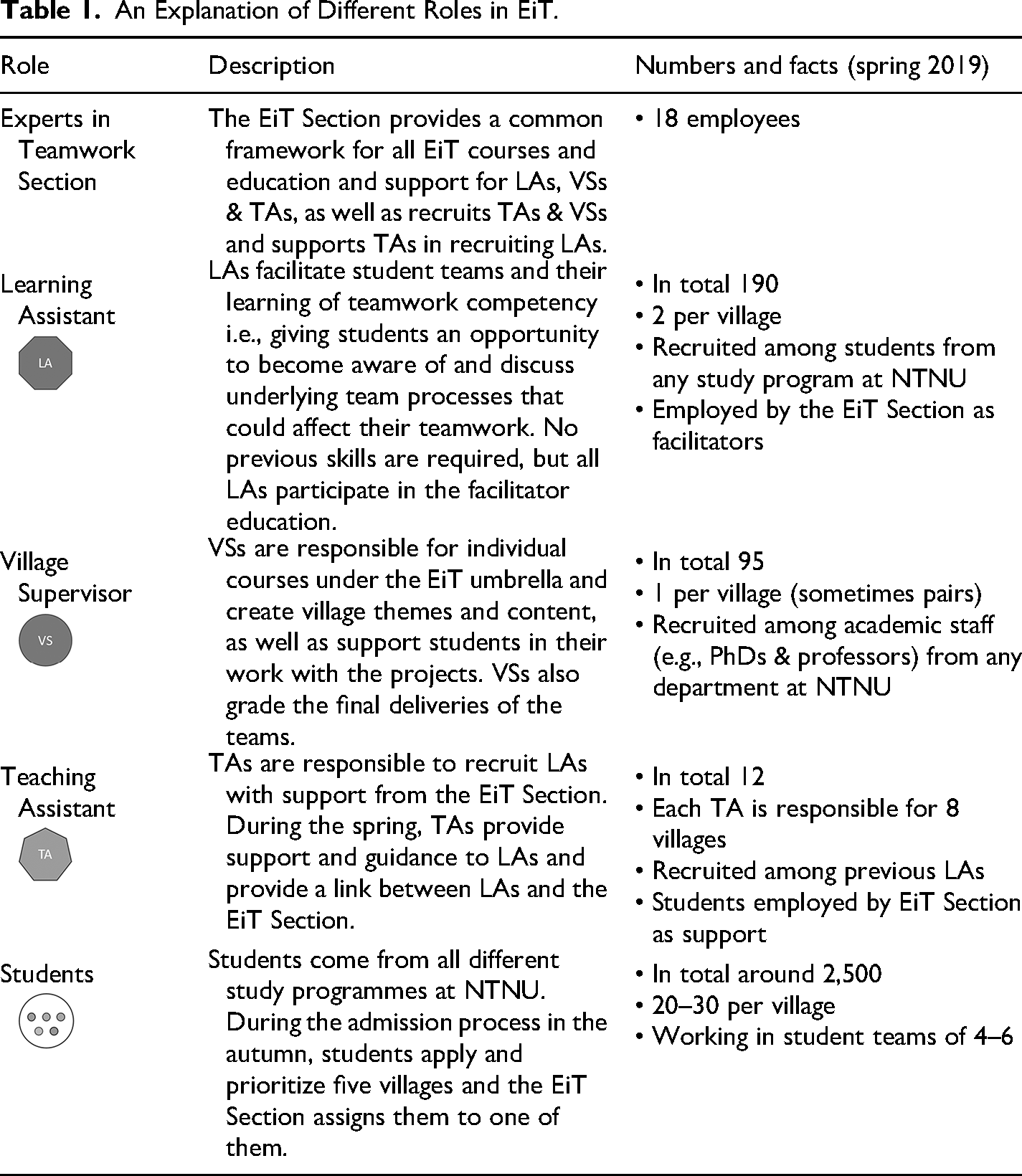
The context of this study is EiT at the Norwegian University of Science and Technology (NTNU). EiT is a university-wide umbrella framework that in 2019 included 95 individual and interdisciplinary courses at second-degree level (7.5 credits). Each course or class, called an EiT village, accommodates about 30 students, and students from across all study programs at the university are required to take one EiT course during their masters. In EiT courses, students work for 15 full days in interdisciplinary student teams consisting of four to six team members. Table 1 provides an overview of the different roles, and Figure 1 an overview of the overall course structure in EiT. EiT was developed and introduced in response to the expressed need from business and industry for graduates that have the enhanced ability and skills to work and collaborate in teams with people from different fields (Sortland, 2015).
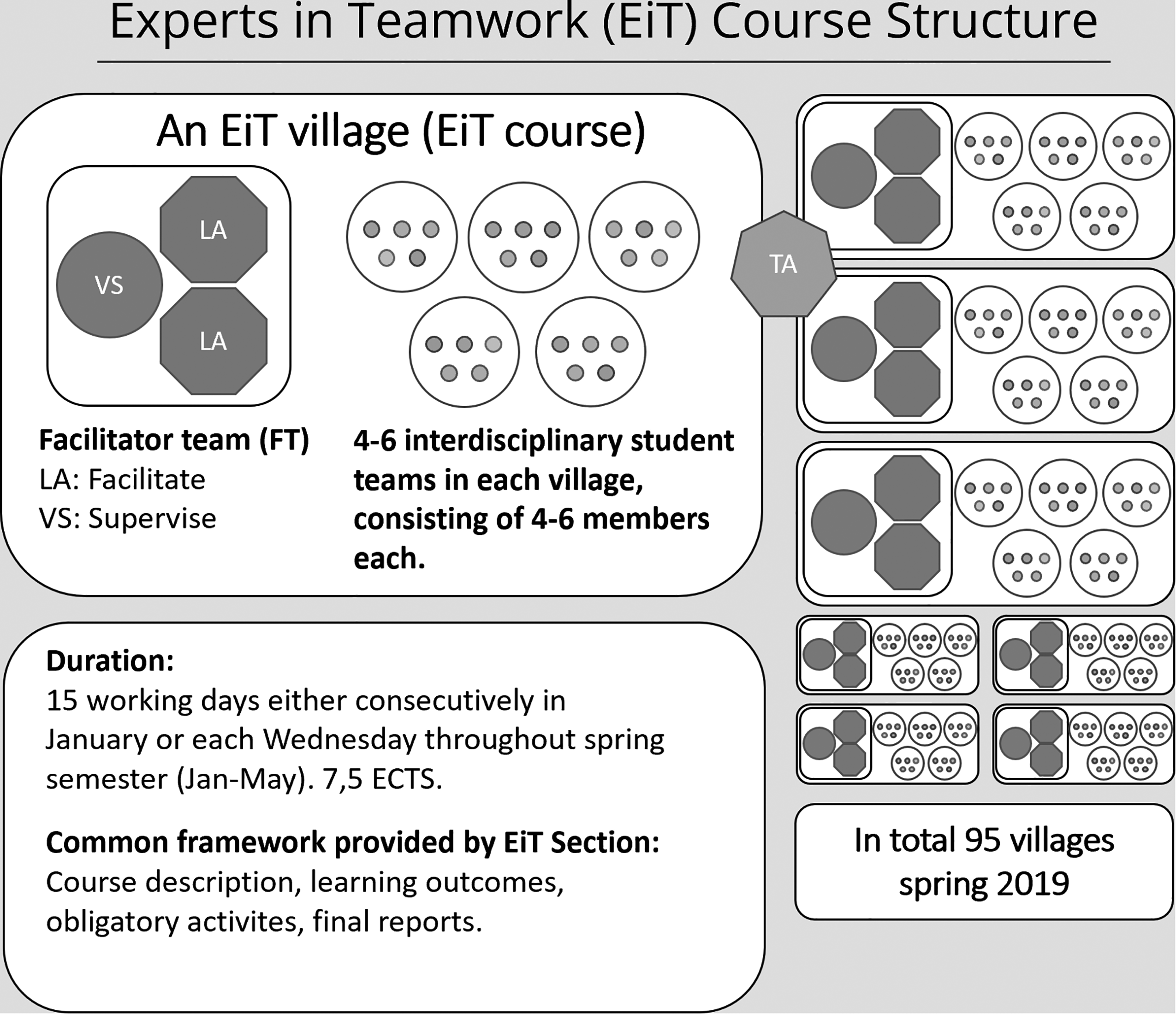
An EiT course/village description.
An Explanation of Different Roles in EiT.
The underlying educational approach in EiT is based on experiential learning with a focus on the development of students’ collaborative team behaviors and skills, which, among other things, involves gaining experience in giving and receiving feedback in the student team and being able to put into words and change one's own behavior in a team. Rather than learning about collaboration in teams using a theoretical entry point, students in EiT acquire interdisciplinary team process skills by becoming aware of and reflecting on their teamwork experiences and perhaps change how they communicate, plan, make decisions, solve tasks, handle disagreements, and relate to academic, social and personal differences in their work with the task (Schein, 1988; Veine et al., 2020; Wallin et al., 2017).
To coordinate, administrate, and further develop the EiT umbrella framework, there is a close collaboration between the EiT Section and research environments across the entire university. Whereas the EiT Section is responsible for the framework and for hiring LAs, teachers, called village supervisors (VSs), come directly from research environment and are responsible for the disciplinary and thematic focus for each village (see Table 1). Each EiT village has one or two VSs and two LAs who facilitate the student teams. Together they constitute the facilitator team (FT) in the village (see Figure 1). The EiT Section is also responsible for quality assuring the courses, training the LAs and the FTs, and for dissemination, research, and administration of the courses across the entire university. At the time of this study, there were 12 senior teaching assistants (TAs) with prior experience as LAs responsible for recruiting and supervising the LAs in their facilitation practice.
Ever since EiT started in 2001, students have been employed as paid LA job. In this job, they work as facilitators and their main approach is to encourage student teams to become aware of and reflect on their experiences with teamwork processes (Helgesen et al., 2009; Schein, 1988; Thaulow, 2003; Wallin et al., 2017). The LAs in EiT are characterized by that they usually: (1) have a different professional background than the students they facilitate (see Figure 2); (2) have not taken the EiT course themselves; and (3) have less study experience than those who take the course. The recruitment strategy means that there are considerable variations in pre-knowledge and experience with facilitation among LAs, and this makes the design, scope, and implementation of the facilitator education program particularly important (Thaulow, 2003). To prepare LAs that oftentimes have only one to three years of experience being at the university and come from diverse disciplinary backgrounds for their role as facilitators, EiT's facilitator education program defines facilitation within clear boundaries.
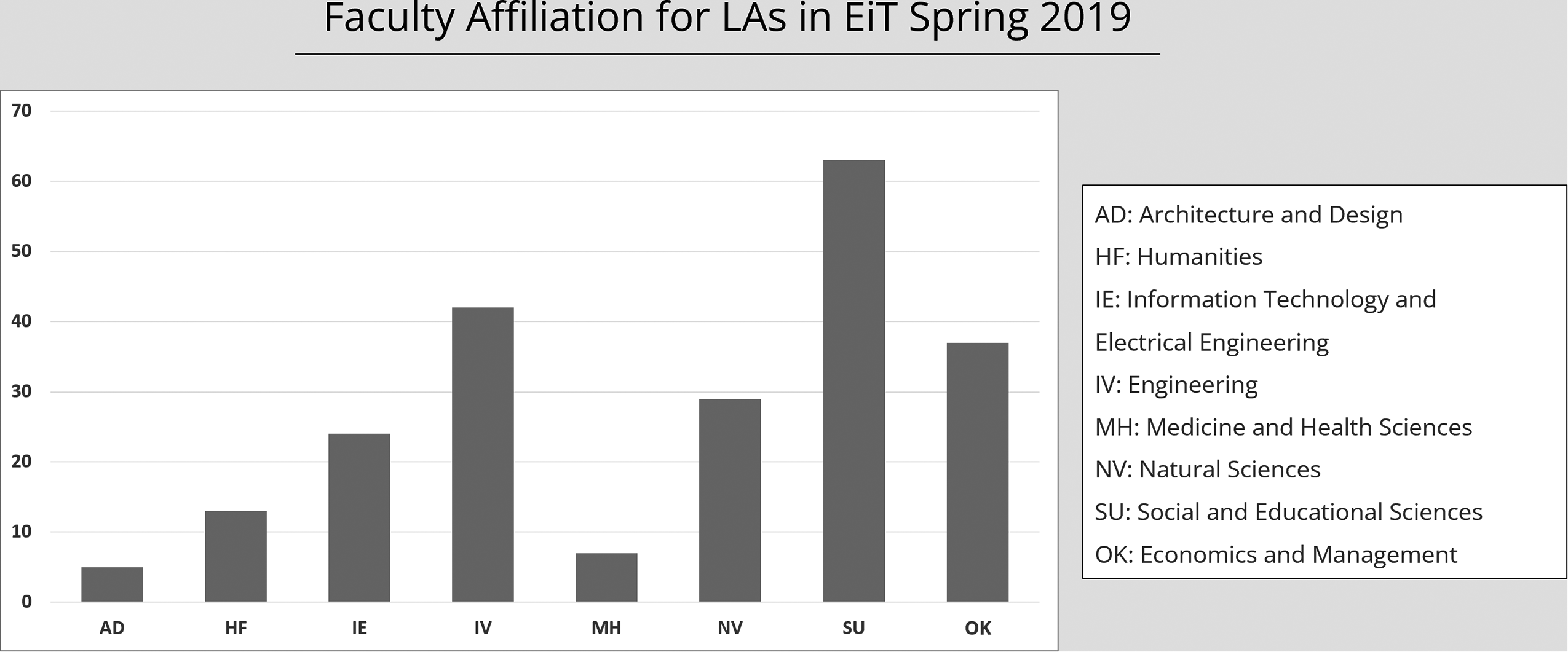
Faculty affiliation for LAs in EiT.
The Design of the Facilitator Education in EiT
Historically, approaches to facilitation in EiT are grounded in Dick's “Helping groups to be effective” (2002) and indirectly in Schein's “Process Consultation” (1988) and “Process Consultation Revisited” (1999). At the same time, EiT's facilitation practice has been developed inductively over nearly 20 years following Kolb's learning cycle (Kolb, 1984). It has been tested and revised reiteratively, inspired by feedback from students, LAs, VSs, and TAs in the course, as well as by theory from both education (e.g., Holen, 2000) and organizational studies fields (e.g., Schwarz, 2017).
The 30-h EiT facilitator education program is designed to ensure that the LAs have sufficient competence for their facilitation tasks in EiT. The program takes place in the fall semester before the villages start in January (see Figure 3). The program is structured around an initial start-up meeting, a seminar focused on practical training in facilitation and various teamwork exercises, a theory seminar with an introduction to team and facilitation theory, and a final two-day seminar where the members of an FT get to know each other well.
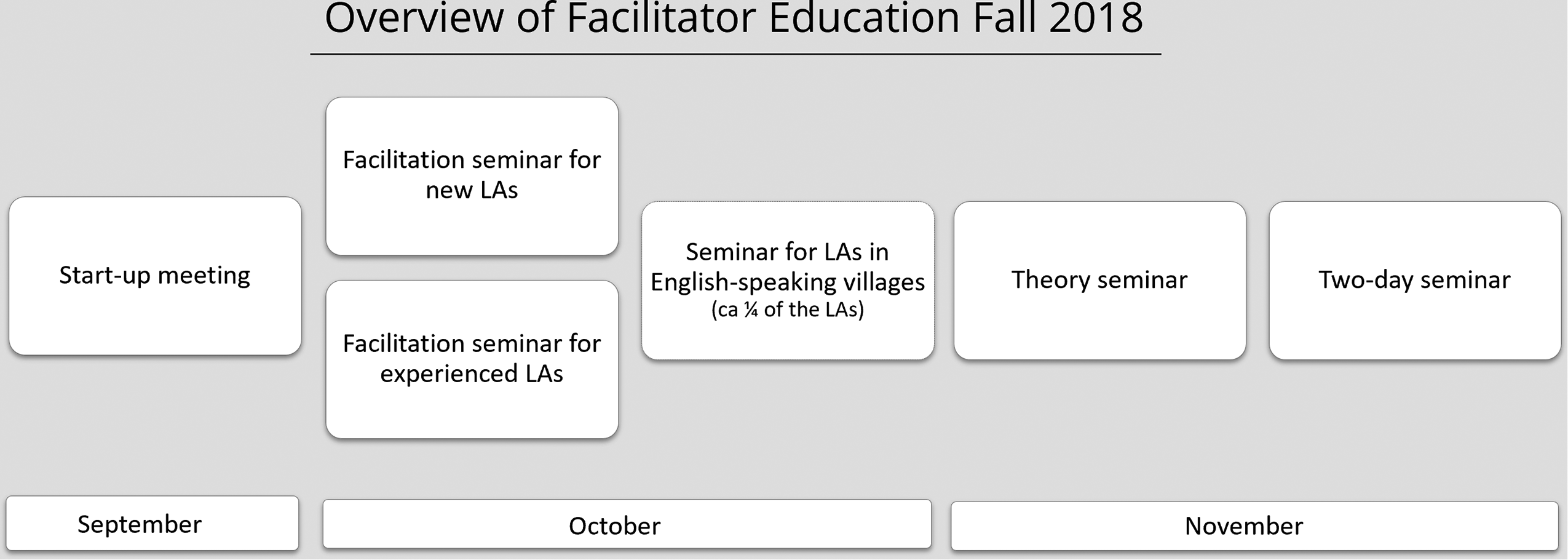
Overview of facilitator education in EiT.
Across the facilitator education all Thomas’ four types of approaches (2004) are to some extent at play in each seminar, sometimes all at the same time, but mainly, type 1, which focuses on skills, is represented in the practical seminar; type 2, which focuses on theory, in the theoretical seminar, and types 3 and 4, which focus on relationship and power, respectively, are in the concluding two-day seminar.
In the experiential full-day seminar on facilitation, the focus is on skills training and reflection on the facilitator's role. An important training arena during this seminar is a staged role-play with hired improvisers who are trained to simulate interdisciplinary student teams. Seen in relation to Thomas’ typology (2004), we found that this seminar includes elements of the first, second, and third types and that the student facilitators foster deeper understanding by trying out and seeing their practice in the light of theory, and by reflecting on the facilitator relationship to the student teams. Moreover, we found that the fourth type, which focuses on power structures, is demonstrated by how the process leaders from the EiT Section in this seminar emphasize, in accordance with Schein (2009), the student teams’ autonomy and “expertise” in their own collaboration. In trying out their facilitation practice on the simulated student teams, the student facilitators experience and practice the core of the facilitation education competence as illustrated by the facilitation cycle (see Figure 4).
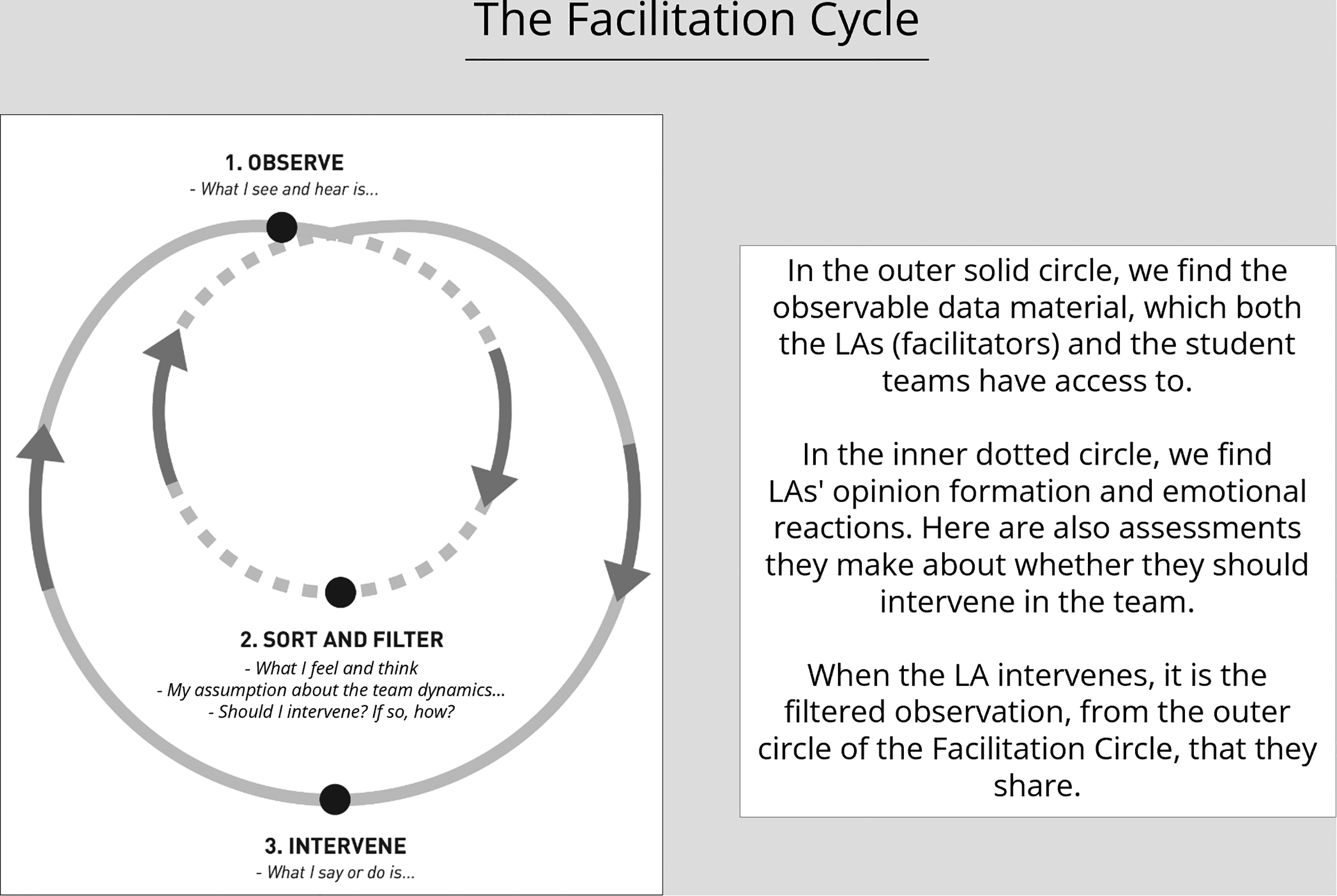
The facilitation cycle.
The cycle conceptualizes facilitation as a three-step process starting with observations, followed by interpretation and filtration, and finishing with interventions. Step 2 is a major challenge because as facilitators observe team collaboration, they will interpret what they see and hear (Dick, 2002). Accordingly, the facilitator will need to filter out as much of the interpretation as possible from their observation to arrive at what is mostly a descriptive observation to make it easier for the student teams to accept and discuss it as a pure representation of their team dynamics. Seen in connection with Thomas’ typology (2004), we find that as the LAs work their way through the facilitation cycle, they need to work with their observation, filtration, and intervention skills (type 1), deal with them in the light of theory (type 2), and focus on having a good, near to neutral, humble, and inquisitive relationship with the student teams (types 3 and 4) (Schein, 2009).
The final two-day experiential seminar is focused on LAs and VSs getting to know each other through icebreakers and feedback exercises, including reflection activities aimed at building a foundation for working together as an FT (Veine et al., 2020). During the two days, several FTs work together in groups of around 10 members. They are observed and facilitated by TAs in the way the students will be in the course. The intention is to raise LAs’ and VSs’ awareness about their task, involving tensions and vulnerabilities within teams to create conditions for an inclusive and sensitive experiential learning environment during the spring (Lapalme & Conklin, 2015). Although subtle and implicit, this points toward Thomas’ fourth type of approach to facilitator education (2004).
In addition to 30 h of practical and theoretical training, the LAs are supervised by the TAs in their respective villages during the spring semester, where the TAs observe, support, and challenge the LAs in their facilitation practice.
Research Design
This study draws on empirical material from a set of reflection prompts that LAs answered anonymously after completing their work in the spring of 2019. The prompts addressed what surprised and challenged the LAs in their practice as facilitators, how they met these challenges; what support they found or missed in the facilitation education and the collaboration with their VS; and what new insights they gained about themselves. In total, 48 LAs (n = 48, response rate = 25.3%) gave their written consent to participate in the study. The authors of the study followed national and institutional guidelines and a self-evaluation scheme for research ethics. In accordance with guidelines from the national review board, the Norwegian Center for Research Data (NSD), the study was exempt from a formal approval process as the answer was submitted anonymously. We acknowledge the relatively low response rate and a potential problem grounded in possible self-selection. However, considering that the data were analyzed qualitatively on how LAs experienced their facilitator role, rather than as the basis for generalization across populations, we argue that the empirical material can still provide very interesting and relevant insights. The material represents a broad range of what LAs experienced as facilitators.
The empirical material from the LAs was analyzed using NVivo software and a critical inductive approach. The methodology originates from a pragmatic tradition characterized by being reflective and self-critical where creativity and innovation are welcomed (Kara, 2015; Wertz et al., 2011).
The aim of the analysis was to understand the experience of the LAs and how they reflect on their work as facilitators. In the initial phase, the material was read several times with openness to what emerges, a process that can be described as “naive reading” (Lindseth & Nordberg, 2004). After all four authors read through the entire material individually, their impressions were discussed together. Capitalizing on the triangulation of perspectives (Krefting, 1991) from all four authors, key themes in the empirical material were identified in an iterative process. Only the passages used in the present paper have been translated from Norwegian (students’ mother tongue) into English.
The authors’ reflections from observing the LAs during their training and subsequently during the semester also played a role in the analysis and discussion of the results. Three of the authors of this article have been processing leaders in the facilitator education program for LAs in EiT over several years; they know the education program from the inside and the LAs’ participation in it. The last author had no direct connection to the facilitator education nor has he been involved in the design of the EiT framework. This co-author, however, has been VS and has observed LAs in their facilitation of students, as well as provided an outside perspective on both theoretical and conceptual grounding in university pedagogy. In and through collaboration and discussion between all the authors, these experiences were also challenged, thus making it possible for all the authors to approach the material as researchers rather than just as practitioners. Finally, the emergent themes from the analysis were approached through the theoretical lens of Thomas’ typology of approaches to facilitator education (2004) and related research literature.
Findings
Bearing in mind, the overriding design of the EiT facilitation education, in the following, we will explore how LAs experienced their practice and conclude by looking into how they assessed the various parts of their facilitation education program.
One overarching finding from the qualitative inductive analysis of the empirical material is that there is notable variation in the way the LAs experienced facilitation. This is not surprising considering that they have been recruited from across the entire university. Moreover, the contextual boundaries for their work differ from village to village and while there are some fixed structures under the EiT umbrella, each village is also influenced by the VS and the disciplinary context. The way LAs and VSs work together differs depending, for example, on the LAs’ and VSs’ competence, motivation, and understanding of experiential education (Veine et al., 2020). Bearing this variation in mind, we were still able to identify three main categories within the empirical material related to how LAs experience being a facilitator with a focus on team processes: (1) the facilitator education—both useful and inadequate, (2) facilitation and the facilitator role—different and demanding, and (3) the LA's job—great, but potentially overwhelming.
The Facilitator Education—Both Useful and Inadequate
The value of the training in, observation of, and reflection on practice during the education program is something that many LAs experienced as very useful: “FASEM [the full-day seminar in facilitation] was extremely useful! I learned a lot about what facilitation involves and how to do it in different ways.”
Several LAs highlighted the importance of providing opportunities for the FT, that is, the VS and the two LAs, to become well acquainted with each other at an early stage: “The seminars were helpful in that the facilitator team got to know each other before the course started. And, it was useful to practice facilitating and observe how others do it, and to share thoughts and experiences.”
A few LAs also would have liked to have had more training as they felt that they did not have enough facilitation practice before starting in the villages: “Teaching materials and seminars helped me to understand the team exercises, but I didn’t feel that I was getting enough training in facilitation.”
The training and teaching materials provided insight into EiT's facilitation practice and served as a general guide to organizing the teaching in the village during the spring. However, some practical tasks are not covered by the training and written material. As one LA put it: The seminars and teaching material from EiT were very helpful to me in terms of how one should carry out facilitation, as well as perform various exercises, but there was something missing when it comes to how far they prepared me for practical tasks that you can often come across in everyday life as an LA.
Overall, it appears from the empirical material that the seminars provided a useful introduction to the LAs’ facilitation practice and created an arena in which to establish an FT. However, one of the shortcomings of the seminars might have been that they provided too few opportunities for the LAs to practice facilitation, and neither did they prepare enough for practical tasks.
Facilitation and the Facilitator Role—Different and Demanding
The second category that emerged from the analysis of the empirical material is related to how the LAs understand their own facilitation practices and facilitator role. For many LAs, facilitation is unfamiliar and something that they are not acquainted with from other educational contexts: “What surprised me the most was getting used to facilitating a team. This is the first time I have worked with facilitating others, and it isn’t something you’re accustomed to….”
In the process of getting used to the facilitation practices, several LAs pointed out that it was more demanding than they had expected. They experienced that despite the training and education program, they were not always able to create and maintain an environment where the entire student team reflected and discussed their interaction freely: “It was more demanding than expected, even after all the courses, to facilitate in a way that motivated the whole team to reflect.”
In some cases, unfamiliarity with the practice led to resistance among the students. This resistance was something that surprised several LAs, as they saw themselves as supporting the team. They also explained that this resistance made facilitation difficult: What surprised me most as an LA was the challenges in the response from the teams regarding facilitation. Several times, both I and the rest of the facilitator team experienced that team members were defensive, which made our job more difficult.
The empirical material revealed that many LAs saw unfamiliarity as the reason for resistance to facilitation practices; the students were not used to the facilitator role. Therefore, a very direct approach that many LAs reported was to talk with the students and accustom them to their role by explicitly informing them about what they did as a facilitator and asking the students to tell them what they were expecting from them: “By informing them about my role and listening to their wishes. As well as giving them time to get accustomed to it ….”
Although the LAs were trying to explain and discuss their own role with the students, they also realized that they were not always sure themselves about what the facilitator role entailed. For some LAs, a sense of insecurity about their own role caused them to take on the role of an expert giving instruction rather than focusing on facilitation. Although they realized that the facilitator role was different from the role of a teacher or supervisor, they found it difficult to relate to this role: “What have you learned about yourself? That I tend to be too eager to help and thus undermine opportunities for experiential learning.”
Two factors that LAs identified as helping them to remain in the facilitator role are courage and time: “… The challenge was solved by ‘leaping into it’ at the beginning and after a while the students got used to being facilitated, which helped me feel confident about it.”
In more general terms, it appeared from the analysis of the empirical material that many LAs needed time to become experienced in the concrete context, familiarize themselves with facilitation practices, and understand their own role. The facilitation education program provided them with a good starting point, but it was not enough; they needed direct situations in the villages so they could experience facilitation in a more holistic way. In their facilitator practice, the LAs needed to adapt to a VS and a diverse group of students, adjust their relations and practices continuously, and find their own role and practice in the intersection between context, theory, and themselves.
The LA's Job—Great, but Potentially Overwhelming
Related to the previous category on facilitation practice and the facilitator role, many LAs experienced that they had major responsibility for creating a learning environment that was conducive to exposure of and reflection on the students’ interactive experiences. The data material reveals that not all the LAs realized this responsibility before they started working together with the students. Once they understood the scope of their role, several of the LAs found that what they had learned about facilitation did not seem to be enough to facilitate the students and they had to constantly modify their approach as they gained more experience: What I found most surprising was the amount of responsibility and the freedom of choice that the LAs had. We arranged the program in the way we thought would work out best, and we could choose exactly which exercises we wanted to carry out. This was surprising and a bit challenging because we were a little unsure about the arrangements at first, but it fell into place as we gained experience.
However, not all the LAs found the scope and amount of responsibility of their work problematic or challenging. Some LAs pointed out that they were pleasantly surprised and appreciated the responsibility and freedom given to them: “That I like the feeling of having a responsible role in a learning situation …” and “We gave each other great freedom combined with responsibility. We had our responsibilities, the VSs had theirs. That worked out fine.”
Although this clear division of tasks between the LAs and VSs worked well for some LAs, others found it challenging. Some expressed that they were surprised at how little their VS engaged in the discussions on how to structure the village and facilitate the students’ collaboration processes. What surprised me most was that the VS did not have a clear preference for how he wanted to implement the village. This was challenging for me, but I also learned a lot from it, because I had to take a great deal of responsibility for this myself. All the same, it would have been great if he had stated more preferences, especially because this was my first time as an LA.
As described by this LA, the responsibility to design and implement facilitation practices on their own can be surprising, challenging, and rewarding as it gives LAs an opportunity to learn. However, it is especially important for first-time LAs to be given the necessary support from the VS to handle the responsibility they have been given and to avoid being overwhelmed. In addition to this support and more training in the preparation phase, several LAs also mentioned that more help from TAs and the EiT Section in their practical facilitation work in the village would have been helpful: “If the TA had observed the LA during facilitation and given feedback, I could have been even better at facilitating.”
All in all, many of the LAs experienced that their role entailed a surprisingly large degree of responsibility, which they were not totally prepared for. On the one hand, this opens numerous possibilities and fits with the idea that LAs need to find their own way and adapt practices to the context of their village and the students they are working with. On the other hand, as apparent in the empirical material, it is important that the LAs receive the necessary support to manage this responsibility.
Discussion
The reflections from the LAs illustrate three important areas of tension that arise from the way EiT employs LAs as facilitators: (1) facilitator education, (2) the facilitator role, and (3) the responsibility that comes with the job. As illustrated in the findings section, there is tension both between and within LAs about the usefulness and adequacy of facilitator education. Moreover, the role of facilitator is described as demanding, potentially overwhelming, and different from other roles, while simultaneously being experienced as a great and rewarding responsibility. In the following, we will discuss the empirical findings in the light of Thomas’ typology of approaches to facilitation education (2004), as well as other relevant research literature and our own observations. Through a focus on facilitation education as a lifelong process and the unfamiliar aspects of the role and the practice, our aim is to highlight two important areas that we argue are highly relevant for involving LAs as facilitators in experiential higher education across contextual boundary conditions.
Facilitation Education as a Lifelong Process
Even though many facilitation educators argue that everyone can facilitate, it is clear from our and Thomas’ study (2004) that learning to facilitate involves a maturation process. Although a 30-h education program for student facilitators clearly has its limitations, we argue that it provides a good platform to facilitate interdisciplinary team processes, in particular, in combination with a facilitation practice with clear boundaries regarding responsibilities and methods. Based on the empirical material, we further argue that the experiential learning-based approach used in the program is suitable and effective for the purpose.
One challenge that emerges from the empirical material, however, is to give LAs sufficient practical facilitation experience before the work in the village starts. As pointed out by the LAs, facilitation practices are different from other practices that they are used to. In line with Thomas’ typology (2004), second type, intentional facilitator education, the practice requires a greater degree of understanding. This is consistent with findings from similar studies. Students as facilitators in a teacher-training program reported that they would like the program to contain more in-depth educational theory and provide more time for small group learning activities (Van Diggele et al., 2015). Another study has highlighted the need for student facilitators to receive further preparation to bolster their confidence (Baker et al., 2018).
The underlying general understanding of facilitation practices differs widely between LAs. One trend we have observed over the years is that there is considerable variation in how familiar LAs are with approaches and concepts in facilitation and what resources they draw on from their own studies. This clearly actualizes the need that facilitation practices are grounded in theory, as highlighted in type 2 (Thomas, 2004). The disciplinary diversity within the student facilitators can, however, also be seen as a pedagogical advantage rather than a limitation as it mirrors the student population in EiT. We argue that this can potentially make it easier for students taking an EiT course to relate to and understand the LAs. At the same time, it is important to keep in mind that students who are recruited as facilitators in EiT are in addition usually younger than those who take the course and have not taken an EiT course themselves. This means that student facilitators also need to be aware and take into account relational aspects and power dimensions in their facilitation practices, thus it is important that the facilitation education considers and integrates Thomas’ typology (2004), types 3 (relationship) and 4 (power).
Another element that was highlighted by several LAs is to familiarize themselves with their FT before the course starts. Doing so had given many LAs the confidence to deal with the various challenges they faced in the village. Therefore, it is concerning to see that some FTs do not develop close collaborative relationships that appear to be beneficial.
Within the EiT context, it appears, based on the analysis that it is highly relevant to not only understand the frontstage dynamics in the facilitation practice itself but also take into account backstage dynamics between VSs and LAs. This aspect of student facilitators is rarely considered in the research literature. One study that indirectly touched on it focuses on pedagogical philosophies. This study points out that sometimes there appears to be a conflict between the pedagogical philosophies presented in the LAs’ education and the professors’ own philosophies who are supposed to teach together with the LAs (Top et al., 2018). Initial meetings between LAs and teachers can provide an opportunity to discuss those differences and potentially help to resolve them to find a shared pedagogical philosophy for the course.
It is here that we see some of the vulnerabilities of using students as facilitators within experiential education, especially in the EiT case that involves almost 100 academics as VSs. The wide variation of experiences, interests, and pedagogical competences among the VSs is challenging as student facilitators need both support and supervision in their facilitator practice. In the future, we plan to place more emphasis on a mentoring scheme where the TAs and the EiT Section will continue the training of the LAs into the spring. We see from similar studies that the opportunity to contact experienced facilitators may reduce the anxiety the LAs have as novices on the job (Baker et al., 2018).
The Unfamiliar Aspects of the Role and the Practice
Similar to the work by, for example, Andernach and Saunders-Smits (2006), facilitation education in EiT tries to make LAs aware of their role using role-plays and seminars. Still as seen from both our empirical material and the literature (e.g., Thomas, 2010), the LAs unfamiliarity with the facilitator role may complicate their practice in the EiT villages.
Adding to this complication, in the EiT context, is the fact that LAs should on the one hand focus on observing and intervening in the team processes, while, on the other hand, they are also conducting structured collaborative and feedback exercises with the student teams (see also Campbell, 2014; Groccia & Miller, 1996; Linh et al., 2019). When facilitating exercises, they are more in an expert role; they take control and give instructions, which also mean that the power dimension in the relationship with the student teams (types 3 and 4) changes (Thomas, 2004). The instructor role can be further substantiated if the VS makes the LAs responsible for key practical tasks, such as taking roll calls and giving feedback on written texts. In the literature, it is strongly recommended that these practical “expert” tasks should be limited so that facilitators can primarily focus on the near to neutral facilitator role (Schein, 2009). In more general terms, it is also important to point out that facilitation in EiT has an underlying democratizing goal, where everyone can participate and take responsibility within the student team (Dick, 2002).
One problem that we see resulting from the unfamiliarity with the role is that some LAs are not used to focusing so much on other students. As pointed out by Hogan (2002), many inexperienced facilitators resort to ways to protect themselves if they encounter resistance to their facilitation efforts. As apparent from our empirical material, insecure LAs may become defensive and protect themselves from the unwillingness and resistance of their fellow students. This might result in making many interventions, thinking this can be equated to doing a good job, or in refraining from making interventions due to the fear of making mistakes. As Schein (2013) points out, this slipping out of the facilitator role could also be linked to cultural norms. The relatively short facilitator education program, combined with the student facilitators’ age, unfamiliarity, and disciplinary diversity, are important factors to consider in this context.
Hogan (2002) maintains that to some extent facilitation requires working on one's ego. The facilitator role is demanding because it centers on the needs of the student team, which concerns the relationship with the student team (type 3) (Thomas, 2004). Placing others at the center requires a sense of security because the facilitator must accept not having full control. This is probably more difficult for novice facilitators as they lack previous experience and may, therefore, remain uncomfortable with this lack of control. Therefore, it is vital for novice facilitators to exercise their practice without being too afraid to “fail.” In the future, we plan to take a closer look into how we can create an environment where student facilitators can keep growing and developing while at the same time facilitating student teams. Relating to the second approach in Thomas’ typology (2004), we plan to put more emphasis on Schein's theories, in particular, his recommendation to focus primarily on task processes and less on interpersonal processes in the student teams (Schein, 1999). This might be a way to sharpen and define the focus of the LAs’ facilitation practice.
Furthermore, the students in the student teams (that are being facilitated) oftentimes do not immediately understand the LAs’ role as facilitators because it is different from the roles, they generally encounter in a teaching situation. Students may also feel insecure or uncomfortable when they have to reveal their experiences and may, therefore, resist facilitation. Many students are also unfamiliar with the idea of reflecting on their own team processes and on their own ability to work together with others. The LAs themselves provide examples of what can be helpful in this context, very much in line with lowering their status as a facilitator in relation to the student team (Schein, 2009), as described in connection with the third type of approach to facilitator education (Thomas, 2004): (a) inform the student teams about the facilitator role, (b) ask the student teams for feedback on their facilitator practice (meta-facilitation), and (c) give the student teams opportunities and some time to get used to facilitation.
Finally, the empirical material reveals that many LAs experience that through the facilitation education program they have acquired basic skills, attitudes, and tools to start facilitating learning by focusing on the team's processes. We also see that as students there is much to be gained from their facilitation practice. As one LA puts it: I’ve become more aware of how both I and others behave in a professional collaboration that will also be useful outside the LA position. I also feel that I have become more independent and better at taking responsibility in my studies.
Bearing this in mind, we argue that while the primary goal of student facilitators is to be able to offer experiential education across the entire university, working as a student facilitator is in itself a powerful learning experience. It allows students to develop skills, attitudes, and tools that are useful in many other contexts where collaborative skills are needed and where they are not commonly included in higher education curricula.
Outlook
In this article, we have looked at what it takes to design a facilitator education program where the role of student facilitators is to give fellow students an opportunity to become aware of and discuss underlying team processes that can affect their teamwork. We have used Thomas’ typology of approaches to facilitation education to examine aspects of the program in the EiT case (Thomas, 2004). We have also explored how student facilitators have experienced their facilitator education and facilitator practice in EiT.
Our findings support the idea that facilitator education can help to reinforce the very facilitation skills that facilitators are expected to practice. The education program aims not only to develop facilitation skills but also use theoretical perspectives, which can be built a more consistent and integrated perspective on their facilitation practice, types 1 and 2 (Thomas, 2004). We also found that facilitator education has had and should have an explicit focus on the relational dimensions of facilitation, type 3 (Thomas, 2004), even if there is still a potential to integrate this dimension further in EiT. We found that the LAs not only find education useful but also incomplete in some ways. This was particularly true when it comes to the facilitator's role being perceived as somehow different and unfamiliar. We believe that a stronger focus on building relationships can alleviate the problems linked to the role being perceived as different by both the LAs and the student teams members who are being facilitated.
Furthermore, the findings underline that the responsibility that comes with the role is perceived as not only overwhelming by some but also inspiring and rewarding by many. In this context, we can remedy this insecurity by delimiting both the practical tasks and the responsibility of “expert” tasks for the student facilitator, connected to type 4 (Thomas, 2004). It is also proposed that LAs to a greater extent should receive supervision and training from the TAs and the EiT Section during their practice. It can be argued that critical facilitator education (Thomas, 2004) is also indirectly at play in EiT's facilitator education, in the sense that it is students who facilitate students. We think, in line with the literature on the importance of using peers, for example, in project-based learning, that closeness in age and experience can empower the student teams in the learning situation (Andernach & Saunders-Smits, 2006; Shiner, 1999). Nevertheless, themes in the article connected to the use of students as facilitators should be further explored in future research. We will here specifically point to more research on inexperienced facilitators, other facilitator education programs seen in the light of Thomas’ typology (Thomas, 2004) and the use of facilitation in higher education in general.
Finally, we argue that this work contributes to an increasing body of research at the intersection of peer-learning (e.g., Andernach & Saunders-Smits, 2006; Campbell, 2014; Groccia & Miller, 1996) and facilitation by providing concrete examples on how to structure facilitation education programs. We hope that the approaches outlined here, in combination with the empirical material, illustrate the potential of student facilitators in experiential-based higher education, as well as provide practical pointers for other educators. It is by employing, educating, and using students as facilitators that it is possible to overcome some of the limitations often raised with respect to experiential and project-based higher education and also scale these approaches in meaningful and sustainable ways.
Footnotes
Acknowledgments
The authors would like to thank the EiT Section and Bjørn Sortland. We would also like to thank Professor Emeritus MD PhD, psychologist and psychiatrist Are Holen. Finally, the authors are grateful for all the students who have taken on the role as facilitators in EiT over the years.
Declaration of Conflicting Interests
The author(s) declared no potential conflicts of interest with respect to the research, authorship, and/or publication of this article.
Funding
The author(s) received no financial support for the research, authorship, and/or publication of this article.

Correction (January 2023):
Article updated to correct the corresponding author postal code “7491 to 7034”