




Abstract
Although more than 1.38 million students receive accommodations and supports accorded by Section 504 of the Rehabilitation Act of 1973, many teachers report not knowing about their responsibilities under Section 504. The purpose of this article is to educate teachers about Section 504. Specifically, teachers will learn about ways to evaluate and support students with disabilities under the auspice of Section 504. Based on data collected from more than 100 students with disabilities and their families, this article is framed around frequently asked questions and answers in relation to Section 504 plans. Resources are provided to help teachers support students who are protected by Section 504.
Over 1.38 million students are served under Section 504 of the Rehabilitation Act of 1973 (hereafter, referred to as “Section 504,” Congressional Research Service, 2024). Section 504 is a civil rights law that protects students with disabilities in school settings. While Section 504 is broad, many students served by Section 504 have learning disabilities, emotional and behavioral disorders, other health impairments (e.g., attention-deficit/hyperactivity disorder [ADHD], anxiety), and/or autism (Zirkel, 2009). Section 504 requires that students with disabilities receive a free and appropriate public education from public schools. To this end, Section 504 entitles students with disabilities to aids and services to meet their needs—this includes support provided during the school day during academic and non-academic time (Charmatz, 2018) and extracurricular activities (Yell et al., 2014). To qualify for Section 504, a student must have a physical or mental impairment that substantially limits one or more major life activities. Although they can be verbal plans (Zirkel, 2011), Section 504 plans constitute best practice when they are written (deBettencourt, 2002).
Unfortunately, students with disabilities, family caregivers, and teachers alike report non-compliance with and little knowledge of Section 504. For example, Zirkel and Gullo (2024) found that 8,492 public schools do not have a single student with a Section 504 plan—that is approximately 1 out of 8 schools and school districts in the United States. Thus, it is likely that many students with disabilities are not receiving needed access to Section 504. Non-compliance with Section 504 may, in part, stem from a lack of knowledge, empowerment, and advocacy about the provisions of Section 504 (Goodman-Scott & Boulden, 2020; Horner et al., 2020; O’Connor et al., 2016; Rodriguez et al., 2021). In a study of knowledge about Section 504 among school personnel, 59% of teachers reported “never” or only “sometimes” having received information about Section 504 policies or procedures (Madaus & Shaw, 2008).
To help inform teachers about Section 504, this manuscript presents frequently asked questions and answers about Section 504 plans. The questions and answers are based on interviews with more than 100 students with disabilities and their families about their experiences with Section 504 in school settings. Students and families were recruited through disability organizations; all interested individuals were interviewed. The interview protocol was developed based on extant literature about Section 504 plans in K–12 schools (e.g., Madaus & Shaw, 2008; Zirkel & Gullo, 2024). The protocol was vetted by students with Section 504 plans, families of students with Section 504 plans, and attorneys who specialize in Section 504. The protocol included questions about the evaluation to receive a Section 504 plan, the process of developing the plan, and the implementation of the plan. The participants were from all 50 states in the United States, and most participants reported having a learning disability, ADHD, and/or behavior disorders. This manuscript reflects the commonly asked questions and answers about Section 504. Furthermore, attorneys reviewed this manuscript to ensure that the answers are correct and comply with the law. Each question includes an example, based on the interview data, about a student’s experience with Section 504.
Frequently Asked Questions and Answers About Section 504
How Does a Student Qualify for a Section 504 Plan?
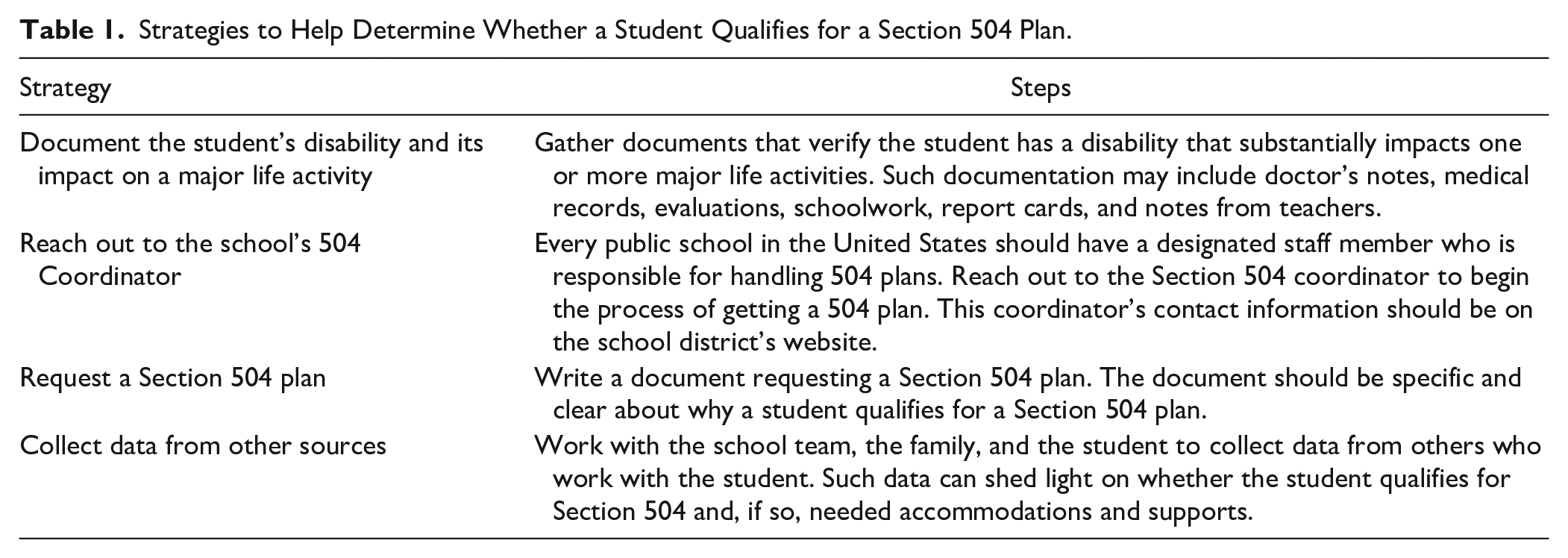
To qualify for a Section 504 plan, a student must have a disability that impacts one or more major life activities. Disability is characterized as any mental or physical impairment (Zirkel & Weathers, 2016). A major life activity could include learning, breathing, walking, and eating. There is no age limit for a Section 504 plan. The process to qualify for a Section 504 plan may differ across schools and depend on the student. There is no uniform process. However, there are some guidelines to facilitate the process of determining whether a student qualifies for a Section 504 plan. For example, the school, student, and family should consider whether different data sources should be used to inform whether a student is eligible for Section 504. This may include collecting information from the family, the student, school professionals, and/or outside professionals (e.g., therapists, psychologists, doctors). The type of data source may also vary depending on the student. Types of data sources may include standardized testing, psychological assessments, progress notes, grades, observations, and interviews. As a teacher, consider the student’s school day. Identify all potential times, settings, and/or individuals who are a part of the student’s day and may have valuable information to inform whether the student qualifies for Section 504. Table 1 provides a list of ways to help inform whether a student qualifies for a Section 504 plan.
Strategies to Help Determine Whether a Student Qualifies for a Section 504 Plan.
Can a Student Qualify for a Section 504 Plan if the Student Has Good Grades?
A student may have a disability and be eligible for a Section 504 plan, even if the student earns passing grades. To qualify for Section 504, the student must have a disability that substantially impacts a major life activity, regardless of the student’s academic performance. Indeed, if a child is receiving passing grades but struggles with social and behavioral skills, the student may be eligible for a Section 504 plan (Sparrow, 2015). For example, as a fifth-grader, Vaden received excellent grades. However, he struggled with learning. Because of his behavior disorder and anxiety, Vaden’s parents reported that he spent 4-5 hours a night on homework that should take 20 minutes. Vaden’s mental health was deteriorating given the extreme toll of the extra effort he put forth in school. Even though Vaden received excellent grades, he was eligible for a Section 504 plan given the effect of disabilities on his health and well-being. His 504 plan included accommodations for taking a break when Vaden was frustrated. When considering eligibility for Section 504, it is important to focus not only on academics but also on other aspects of education (e.g., behavior, social skills, functional performance).
Can a Student With an “Invisible Disability” Qualify for a Section 504 Plan?
Regardless of whether a disability is visible, a student may qualify for a Section 504 plan. Indeed, Section 504 protects the rights of individuals with visible disabilities as well as disabilities that may not be apparent (Cernius, 2017). To qualify for Section 504, a student must demonstrate that they have a disability that substantially impacts one or more major life activities. The visibility of the disability does not impact qualifying for a Section 504 plan. For example, Simren was in middle school. He was an athletic child often doing well on the football field with his friends. He had a learning disability. At first glance, Simren did well at school. He navigated the school independently, engaged with peers, and sat quietly in class. However, because of his learning disability, he struggled to pick up on social cues with friends. He also became frustrated when he could not complete assignments within the allotted time during class. He required accommodations and supports through Section 504. For example, per his Section 504 plan, Simren was able to take all unfinished schoolwork to complete at home; in this way, he would be less frustrated when he could not complete assignments within class time. Simren’s story may inform how teachers identify students for Section 504. Specifically, teachers should not limit eligibility for Section 504 to students with visible disabilities.
What Is the Difference Between an IEP and a Section 504 Plan?
An individualized education program (IEP) is a document for a student with a disability who qualifies for special education (Individuals with Disabilities Education Improvement Act [IDEA], 2004). Specifically, to qualify for an IEP, a student must (a) have one of the thirteen types of disabilities outlined by IDEA, (b) the disability must adversely impact the student’s educational performance, and (c) the student must thus, need special education. An IEP is required to include the following components: present levels of performance, annual goals, reports of progress, supplementary aides and services, and related services.
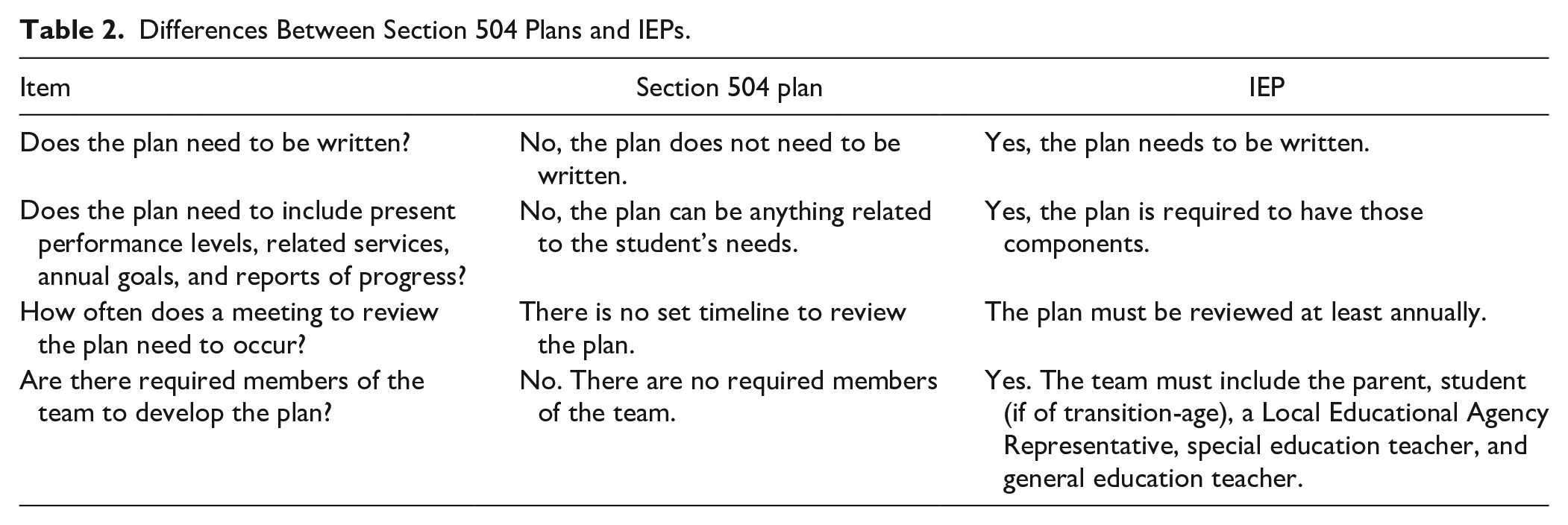
A Section 504 plan is for students who qualify under Section 504 of the Rehabilitation Act. A Section 504 plan can include accommodations and supports for students with disabilities. Both an IEP and a Section 504 plan should provide a free and appropriate public education (Zirkel, 2023). However, unlike an IEP, a Section 504 plan meets the free and appropriate public education standard by providing reasonable accommodations. For example, Zoubida and Shan were third graders in the same public school. Zoubida was active in sports and had a lot of friends. She had a Section 504 plan to address her learning disability, which impacted her ability to learn. Specifically, her 504 plan provided extra time for assignments and tests. Shan also had several friends and he excelled in hands-on activities in science. He had dyslexia, impacting his ability to read. Sam had an IEP addressing his learning needs by providing specially designed instruction in reading. His IEP also provided extra time for assignments and tests. Teachers are often involved in discerning whether a student may need an IEP or a Section 504 plan. See Table 2 for detailed differences between IEPs and Section 504 plans.
Differences Between Section 504 Plans and IEPs.
What Types of Accommodations and Supports Can Students With Disabilities Receive Under Section 504?
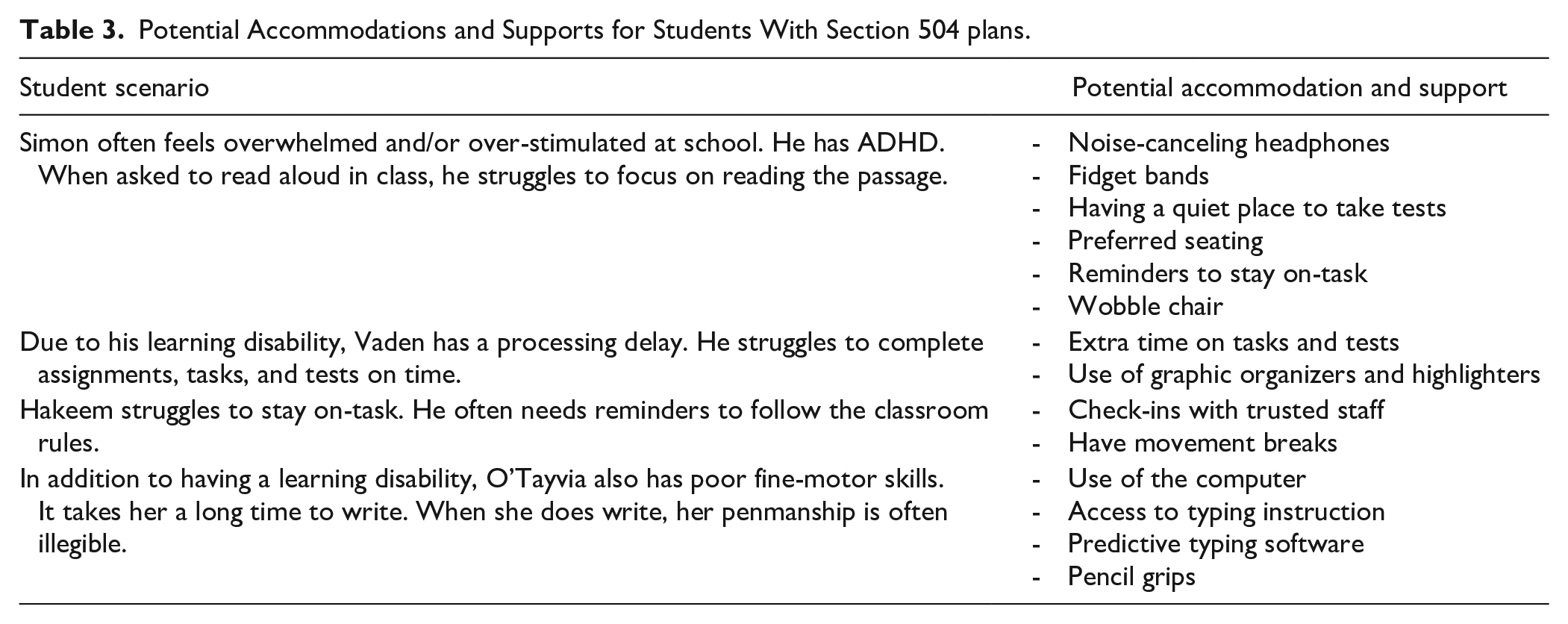
There is no exhaustive list of accommodations and supports that can be provided by Section 504. All accommodations and supports are individualized and based on the needs of the student with a disability. However, there are some common types of accommodations and supports such as extended time on tests, longer time to complete assignments, use of a timer, and access to a fidget toy. For example, Makenna was active in the high school choir and was on the honor roll. She had a learning disability (which impacted her learning) and Type 1 Diabetes (which impacted her eating). For her learning disability, her Section 504 plan provided her with extended time on tests. For her diabetes, she used a DexCom—a patch that intermittently checked her blood sugar. Her Section 504 plan allowed her to have access to her phone which displayed her blood sugar levels throughout the day. As needed, her Section 504 plan also allowed her to visit the nurse to receive insulin. See Table 3 for student scenarios and potential accommodations and supports.
Potential Accommodations and Supports for Students With Section 504 plans.
Who Is in Charge of the 504 Plan?
It is at the discretion of the school or district which staff person leads a Section 504 plan. Staff may include general or special education teachers, social workers, school nurses, or administrators. While one staff person may coordinate the Section 504 plan, there should be input from multiple individuals to develop the Section 504 plan. For example, Patrick had a Section 504 plan since he was in kindergarten. His mother was in the military, so his family moved often. Accordingly, Patrick received Section 504 supports from different schools across several states. In each school, there was a different person who oversaw the Section 504 plan. The staff person in charge of Section 504 plans ranged from the principal in elementary school, a social worker in middle school, and a therapist in high school. Thus, while every school may differ in regard to who oversees Section 504 plans, there must be a designated person with that role. A teacher should ask their principal who is the designated person for Section 504 plans.
Can a Student Have an IEP and a 504 Plan?
It is possible for a student to have an IEP and a Section 504 plan (National Institute on Disability, Independent Living, and Rehabilitation Research, 2023). Typically, if a student has an IEP, the student will not have a Section 504 plan. However, it is possible to have both types of plans in the case of health issues. Some individuals in schools will address health issues in an IEP. Other schools may provide an IEP along with a separate health plan for health issues. Other schools may allow the student to have an IEP (for educational concerns) and a Section 504 plan to address health issues. Notably, individual states may have unique statutes or regulations dictating the creation and implementation of health plans and their relation to IEPs. For example, Joey had multiple disabilities, including dyslexia, ADHD, anxiety, developmental coordination disorder, allergies, and connective tissue disorder. His disabilities impacted his ability to learn, breathe, and move. In preschool, Joey had an IEP. Upon entering kindergarten, the school drafted a Section 504 plan to address Joey’s medical needs (i.e., allergies and connective tissue disorder). The example of Joey shows that some students may have an IEP and a Section 504 plan.
Once a Child Is Eligible for a Section 504 Plan, What Is the Process for Developing and Reviewing the Plan?
To develop the Section 504 plan, the team may draw on a variety of sources, including reports, grades, notes from teachers, and family and student input. They should use data to inform the types of accommodations and supports included in the Section 504 plan. If there is disagreement or confusion about whether an accommodation or support is needed, the team may agree to collect data about the use and effectiveness of the accommodation or support. The team may then reconvene to discuss whether the accommodation/support is needed (as determined by the frequency of its use by the student) and whether the accommodation/support is helpful (as determined by the grades of the student, their health, social skills, etc.).
How Can Families, Students, and Teachers Learn About Their Rights Under Section 504?
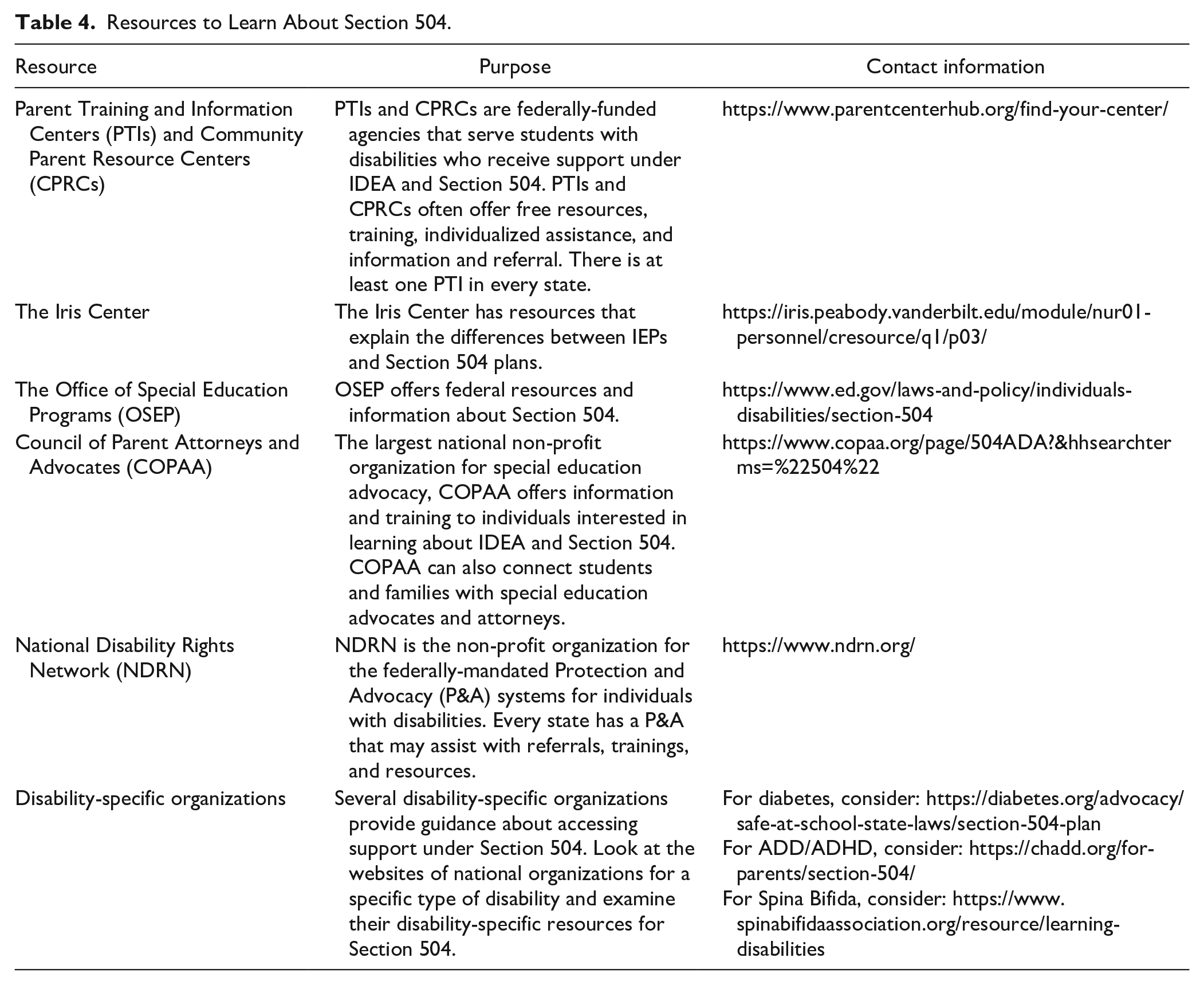
It can be difficult to learn about Section 504 and its rules (M. M. Burke et al., 2019). However, research suggests that when students, families, and teachers are educated and empowered about their rights under disability policies, they are more able to access needed supports for students (e.g., M. M. Burke et al., 2019; Taylor et al., 2017). For example, Irma was a high school student. She was very social and loved working with young children; she aspired to be an early childhood teacher. She also had ADHD and an emotional behavior disorder. With her mother’s support, she requested a Section 504 plan from the school to address the impact of her disabilities on her learning and behavior. To learn about her rights under Section 504, Irma and her mother found CHADD (Children and Adults with Attention-Deficit/Hyperactivity Disorder [CHADD]) which provided guidance for students with ADHD about potential accommodations they would need from the school. They also reached out to the National Alliance for the Mentally Ill to learn more about the mental health challenges that Irma faced. They used this guidance to navigate the Section 504 plan. In Table 4, there are resources for individuals to learn about Section 504.
Resources to Learn About Section 504.
How Can Students Become Self-Advocates in Relation to Section 504?
Students need to take the reins of their own advocacy (K. M. Burke et al., 2024), especially in relation to Section 504. Unlike IDEA, Section 504 has no age limits. Thus, students with Section 504 plans in K–12 school settings may benefit from ongoing accommodations and supports under the auspice of Section 504 into adulthood. Indeed, they may receive accommodations and supports through Section 504 for their post-secondary education and/or employment. To that end, students need to be self-advocates to receive needed supports. To do this, it is important to start early. When possible, the student should be included in Section 504 meetings. At the meetings, the student can be given opportunities for meaningful participation. It is important to consider the student’s input in the development of the Section 504 plan and ensure that the student becomes familiar with their Section 504 plans, so they understand their own accommodations and supports. For example, June, an honor-roll high school student, noticed herself feeling anxious during school. Her anxiety impacted her learning and her mental health. She sought help from a therapist and was diagnosed with anxiety. On her own volition, she contacted her guidance counselor. She shared her diagnosis and requested a Section 504 plan to receive additional breaks when needed.
Conclusion
Section 504 is the first federal civil rights law designed to protect people with disabilities. It grants important rights to students with disabilities. By becoming knowledgeable about how students with disabilities may qualify for Section 504 and ways to develop Section 504 plans, teachers can support students with disabilities. This manuscript provides information, examples, and resources to help teachers ensure that students with disabilities are appropriately identified and, if needed, served by Section 504.
Footnotes
Declaration of Conflicting Interests
The author(s) declared no potential conflicts of interest with respect to the research, authorship, and/or publication of this article.
Funding
This project is supported by the Administration for Community Living (ACL), U.S. Department of Health and Human Services (HHS) as part of a financial assistance award with 100 percent funding by ACL/HHS (grant no. 90DPGE0101). The contents are 2023 NIDILRR Standard Terms and Conditions those of the author(s) and do not necessarily represent the official views of, nor an endorsement, by ACL/HHS, or the U.S. Government.
