



Abstract
The COVID-19 pandemic affected the ways in which school districts provide educational services to all students, especially students with disabilities. Eligible students with disabilities have a right to a free appropriate public education (FAPE) under the Individuals with Disabilities Education Act (IDEA) and students with disabilities who are not eligible under the IDEA may also have a right to receive a FAPE under Section 504 of the Rehabilitation Act. School personnel need to attend to both of these important federal laws when providing educational services. Shortly after the pandemic began, the U.S. Department of Education, through the Office of Civil Rights and the Office of Special Education and Rehabilitation Services, issued guidance to school districts making it clear that despite school closures, school district personnel had to continue providing FAPE under the IDEA and Section 504. Following the return to school, the Office of Civil Rights investigated the Los Angeles Unified School District in California and the Fairfax County Schools for discriminating against students with disabilities by failing to provide educational services during the pandemic. In this article, we briefly review the guidance from the U.S. Department of Education and discuss important implications for teachers of students with disabilities.
Keywords
The COVID-19 pandemic, which was declared by the World Health Organization in January 2020, resulted in the closure of almost all public schools to in-person instruction across the United States by May 2020. During this time, many schools throughout the country began educating students through remote learning. Because of the protections available to students with disabilities under the Individuals with Disabilities Act (IDEA), Section 504 of the Rehabilitation Act of 1973 (hereinafter Section 504), and Title II of the Americans with Disabilities Act (ADA), it was inevitable that educational programming for these students would be subject to challenges during and after the COVID-19 pandemic (Americans with Disabilities Act of 1990). Indeed, the challenge of ensuring that qualified students with disabilities are afforded a free appropriate public education (FAPE) was exacerbated.
In this Policy and Law Brief, we review policy guidance from the U.S. Department of Education that was released during the pandemic and investigations by the Office for Civil Rights (OCR) of special education programming in school districts after the pandemic. How individualized education program (IEP) and 504 teams responded to the challenges posed by the cessation of in-person schooling and how they acted to ensure that FAPE would be provided during and after the pandemic was vitally important. We end this policy brief by drawing implications of the COVID-19 pandemic for teachers of students with disabilities (U. S. Department of Education, 2020; ; U.S. Department of Education, Office for Civil Rights & Office of Special Education and Rehabilitative Services, 2020, 2021).
The U.S. Department of Education Addresses FAPE During School Shutdowns
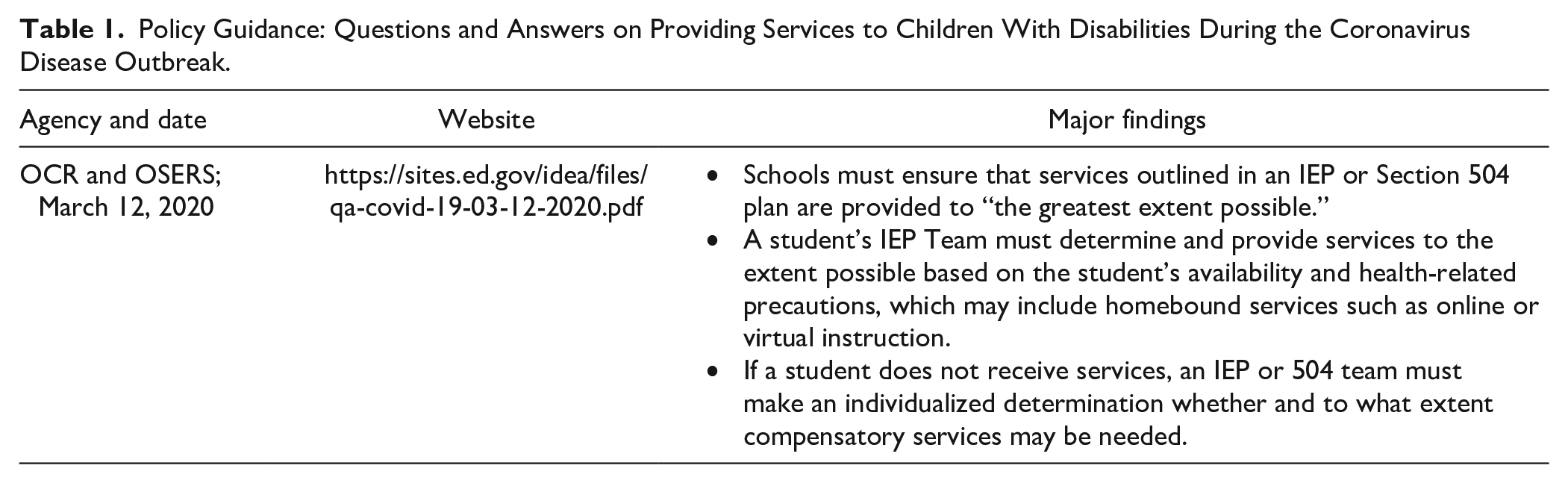
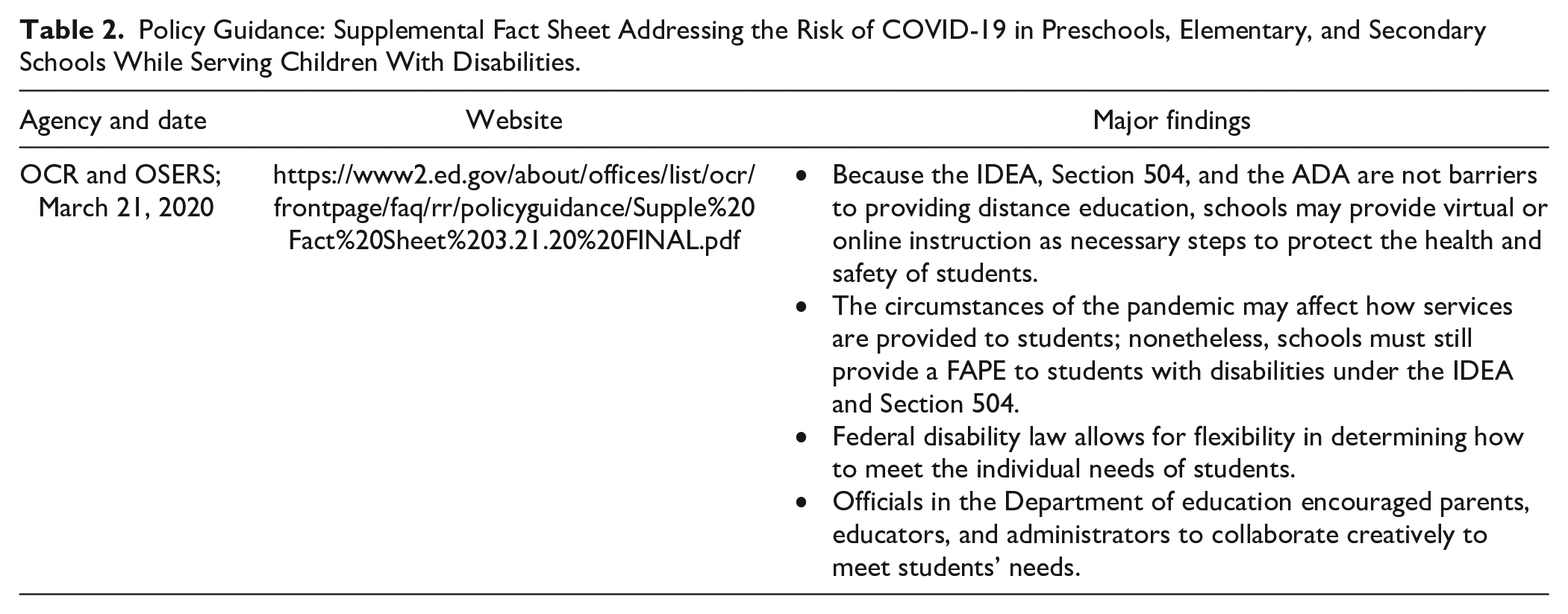
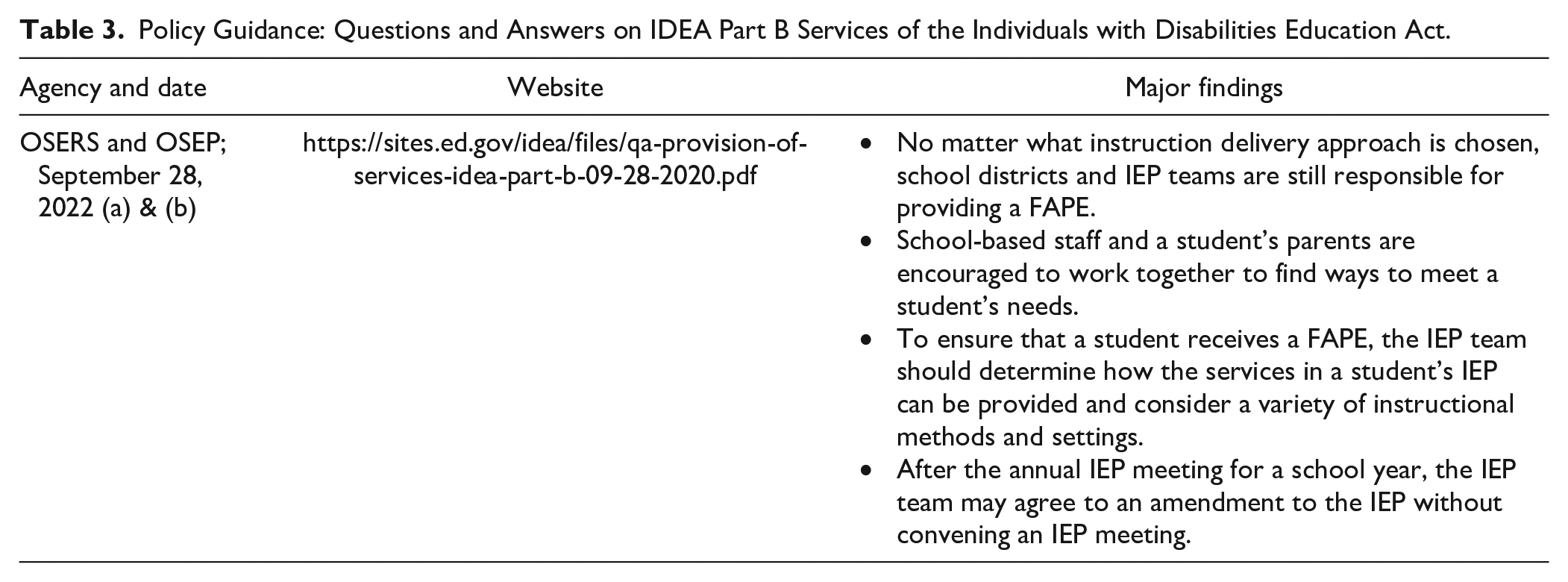
When shutdowns began in March 2020, the U.S. Department of Education Office of Special Education and Rehabilitative Services (OSERS) and OCR released a series of policy statements 1 establishing that during the pandemic the IDEA, Section 504, and Title II of the ADA needed to be upheld and FAPE had to be provided to students with disabilities (U.S. Department of Education, Office of Special Education and Rehabilitative Service, 2021a, 2021b). Tables 1, 2, and 3 provide (a) the agency issuing the policy document, (b) the websites where these statements may be found, and (c) the major findings issued in these policy documents. The overriding message of these early policy statements was that despite the pandemic school districts still had an obligation to provide services to students with disabilities through virtual or distance instruction under the IDEA, Section 504, and the ADA.
Policy Guidance: Questions and Answers on Providing Services to Children With Disabilities During the Coronavirus Disease Outbreak.
Policy Guidance: Supplemental Fact Sheet Addressing the Risk of COVID-19 in Preschools, Elementary, and Secondary Schools While Serving Children With Disabilities.
Policy Guidance: Questions and Answers on IDEA Part B Services of the Individuals with Disabilities Education Act.
The U.S. Department of Education Policy Statements on Returning to School
As schools began returning to in-person instruction, the U.S. Department of Education issued the “Return to School Roadmaps” series. The series consisted of four policy guidance documents, “Return to School Roadmap: Child Find Under Part B of the Individuals with Disabilities Education Act” issued on August 24, 2021, “Return to School Roadmap: Development and Implementation of Individualized Education Programs in the Least Restrictive Environment under the Individuals with Disabilities Education Act” issued on September 30, 2021, the “Return to School Roadmap: Child Find, Referral, and Eligibility Under Part C of the Individuals with Disabilities Education Act” issued on October 29, 2021, and “Provision of Early Intervention Services for Infants and Toddlers with Disabilities and Their Families Under Part C of the Individuals with Disabilities Education Act” also issued on October 29, 2021.
The purpose of the first two roadmaps was to provide information on ensuring FAPE to students with disabilities once schools were back in session. Officials at OSERS noted that school officials needed to open schools safely but that, nonetheless, had to ensure that students with disabilities were provided FAPE under the IDEA, including having IEPs in place by the beginning of the 2021–2022 school year. The roadmaps addressed several issues regarding IEPs in general and issues specific to COVID-19 in particular. Table 4 provides information on the first two roadmaps, including the (a) issuing agency, (b) the websites where these statements may be found, and (c) the major findings addressed in these policy statements.
Policy Guidance: Return to School Roadmaps.
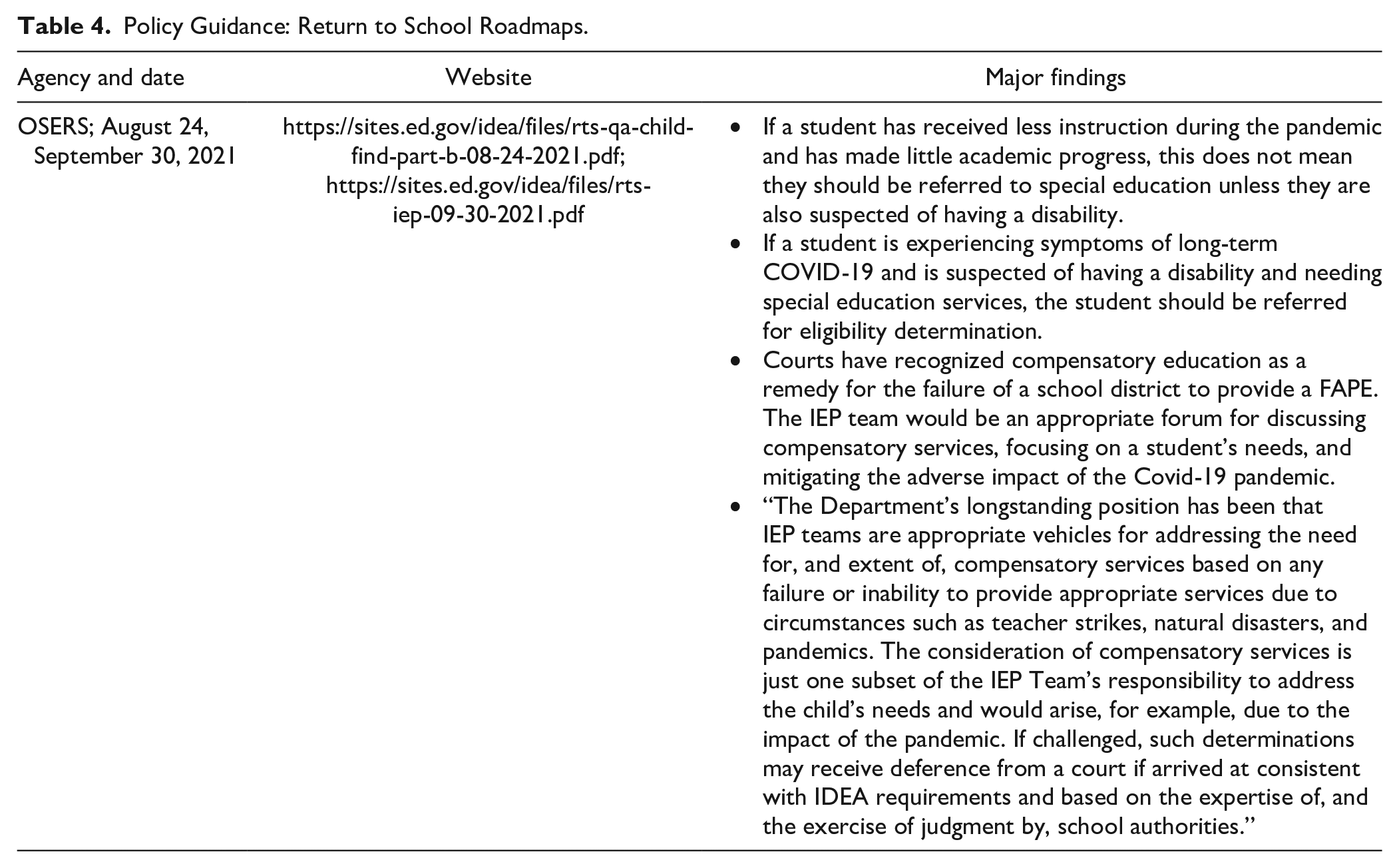
The overriding message of the roadmaps as schools were returning to in-person instruction was that students’ IEP teams were required to make individualized determinations regarding a student’s needs for compensatory services for any disruptions or delays of services during the pandemic. The Department also noted that teams should consider the following factors when making these decisions: (a) students’ present levels of academic and functional performance, (b) the rate of a student’s progress toward his or her goals, and (c) the frequency and duration of special education and related services.
Long COVID and Disability Under IDEA or Section 504
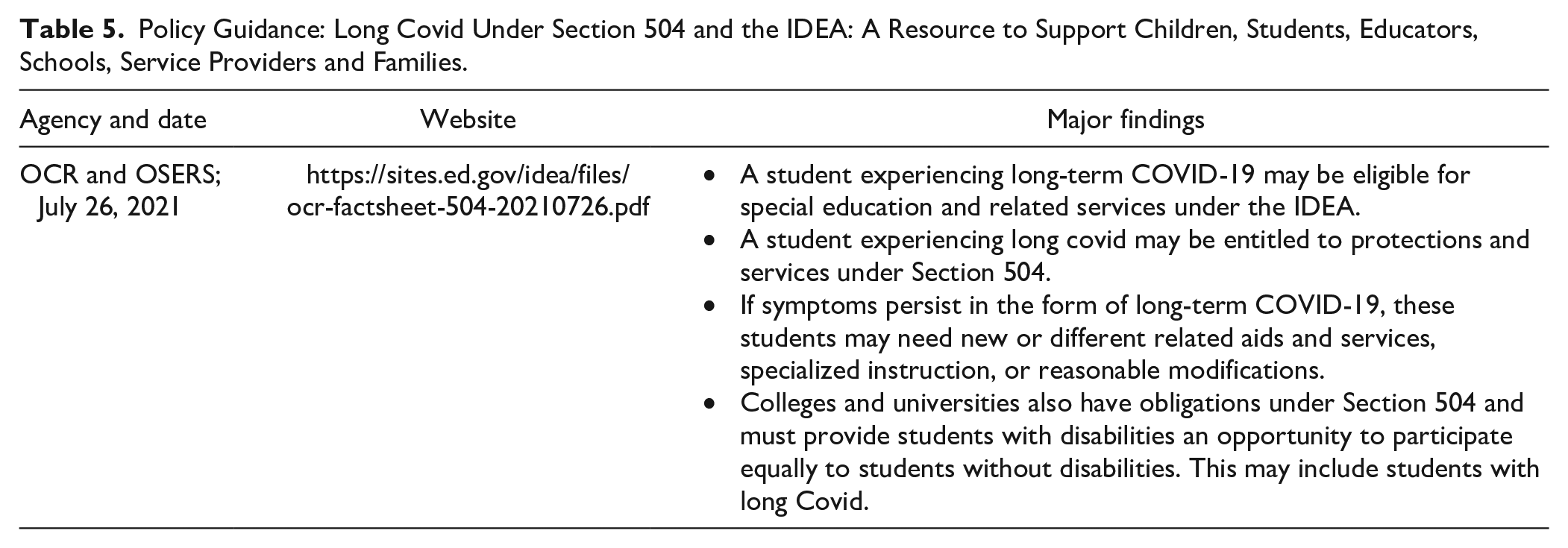
In July 2021, OSERS and OCR jointly issued a policy statement, Long COVID under Section 504 and the IDEA: A Resource to Support Children, Students, Educators, Schools, Service Providers, and Families, to provide information about long COVID as a possible disability and inform school officials of their responsibilities to provide services and reasonable modifications to children and students for whom long COVID is a disability under the IDEA or Section 504. According to the U.S. Department of Justice, long COVID may also be a disability protected under the ADA. Long COVID occurs when a person has recovered from COVID-19, but the debilitating symptoms of the disease persist (Centers for Disease Control and Prevention, 2021). These symptoms may include, but are not limited to, difficulty in thinking or concentrating, and tiredness or fatigue.
Under the IDEA, a student may be determined eligible for special education services in the category of other health impairment (OHI) if he or she has limited strength, vitality, or alertness resulting from long COVID. Moreover, an infant or toddler experiencing long COVID may be entitled to services under Part C of the IDEA if the child is found eligible. A student may also be eligible for services under Section 504 if the child experiences symptoms because of long-term COVID-19 that substantially limits a major life activity such as learning, concentrating, or attending. Furthermore, a student with long COVID may be protected from disability discrimination if the student has a record of impairment or is regarded as having an impairment. Table 5 includes (a) the issuing agency, (b) the website where these statements may be found, and (c) the major findings issued in the long COVID policy statement.
Policy Guidance: Long Covid Under Section 504 and the IDEA: A Resource to Support Children, Students, Educators, Schools, Service Providers and Families.
OCR Investigations of School Districts and COVID-19
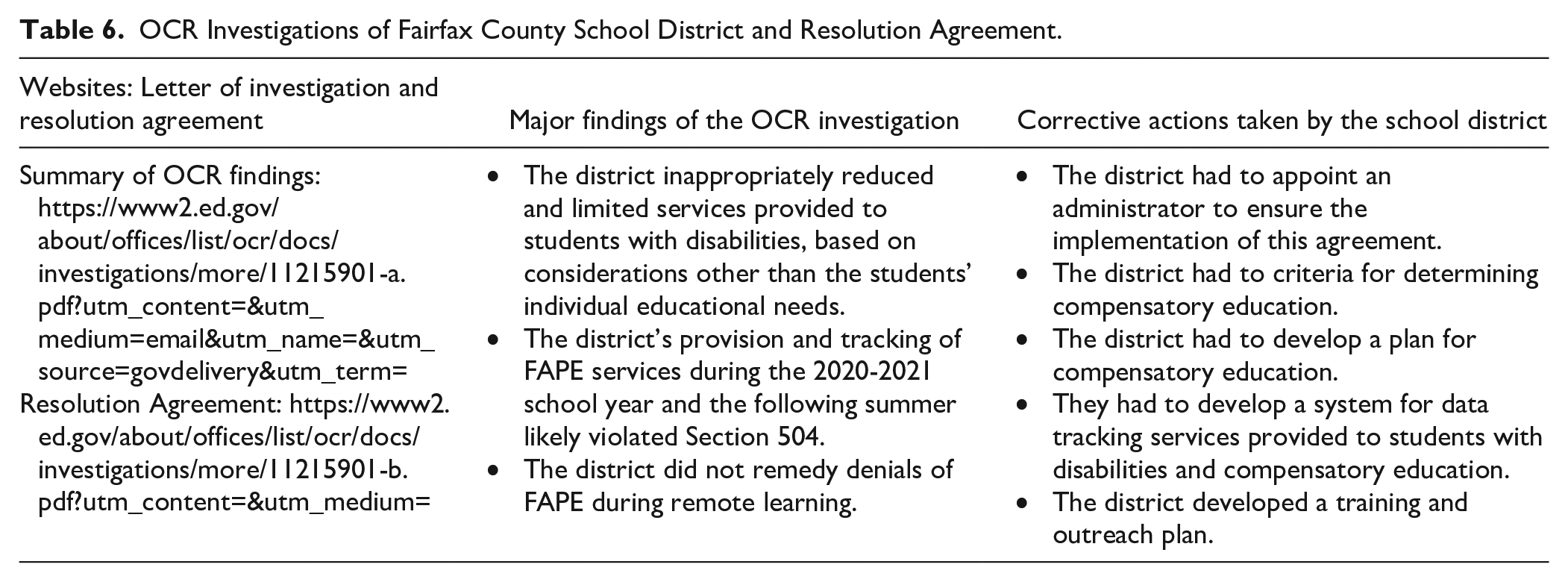
On January 12, 2021, OCR initiated investigations of two large school districts in the United States regarding the provision of educational services to students with disabilities during the COVID-19 pandemic. The two investigations were of the Los Angeles Unified School District (hereinafter LA Unified) in California and the Fairfax County Schools in Virginia (Fairfax County Public Schools Resolution Agreement, 2022; Los Angeles Unified School District Resolution Agreement, 2022). Usually, OCR investigations are initiated upon the receipt of complaints; however, both these investigations were directed investigations initiated by OCR. The Office for Civil Rights may initiate a directed investigation when they have reasonable suspicion that discrimination has occurred (U.S. Department of Education, Office for Civil Rights, 2020, 2022a, 2022b).
Office for Civil Rights opened these investigations to determine if FAPE had been delivered to eligible students with disabilities during the COVID-19 pandemic. During the OCR investigations, the districts’ data and documents were reviewed and interviews were conducted. The investigation of the Fairfax School District was concluded on November 22, 2022, and the investigation of the LA Unified School District was concluded on April 28, 2022. In both investigations, OCR determined that during the COVID-19 pandemic, the districts had denied qualified students with disabilities FAPE in violation of Section 504. Both school districts entered into a resolution agreement with OCR to address the concerns raised in the investigations. As OCR always does, both districts were warned that the districts must not harass, coerce, intimidate, discriminate, or otherwise retaliate against any individual because that individual asserts a right or privilege under a law enforced by OCR or files a complaint, testifies, assists, or participates in a proceeding under a law enforced by OCR. Any such actions, if proven, would be a violation of Section 504. Furthermore, OCR will monitor the school district’s compliance with the resolution agreements, which usually include site visits. Tables 6 and 7 list the (a) website where the resolution agreements may be found, (b) major findings of the OCR investigations, and (c) corrective actions to be taken by the school district.
OCR Investigations of Fairfax County School District and Resolution Agreement.
OCR Investigations of LA Unified School District and Resolution Agreement.
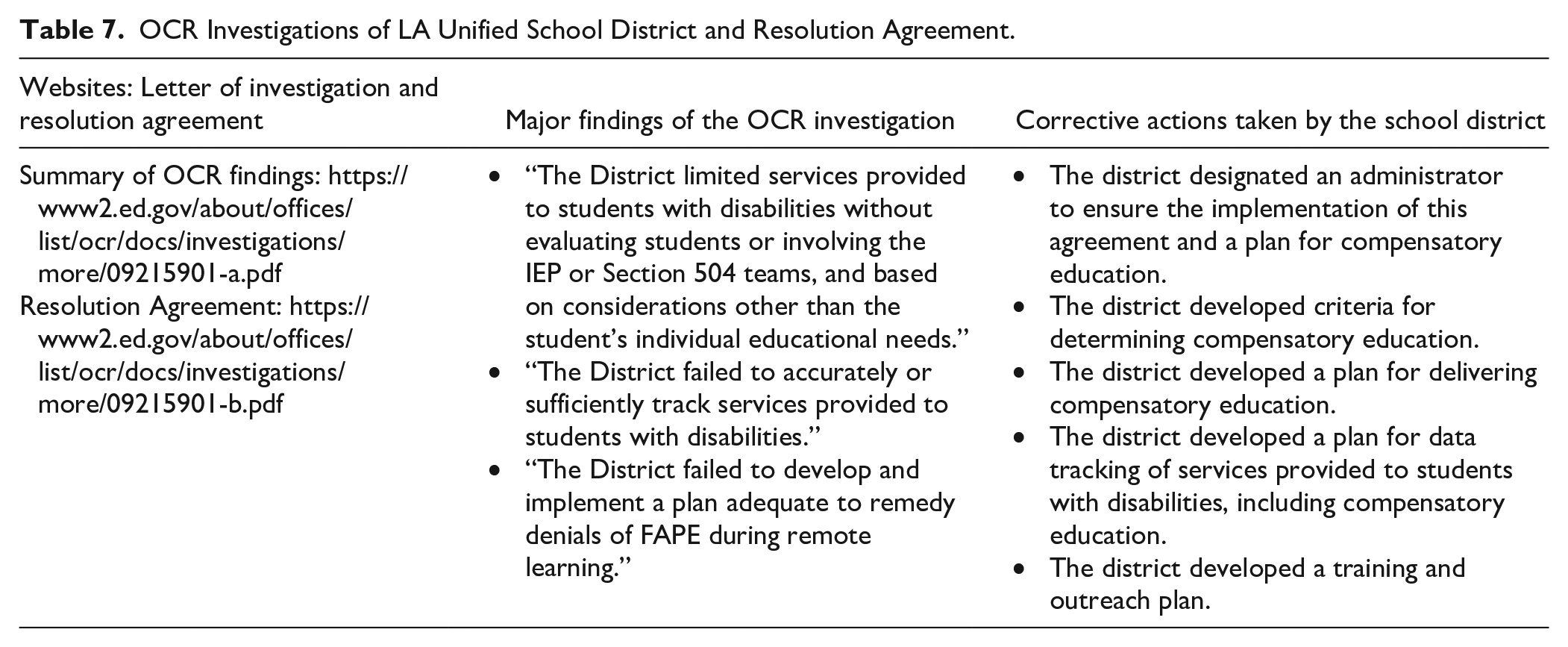
The review by OCR officials concluded that both school districts had violated section 504 of the Rehabilitation Act by discriminating against students with disabilities and that both districts had to take steps necessary to ensure that students with disabilities receive educational services, including compensatory services, during and resulting from the COVID-19 pandemic. Specifically, the districts (a) limited the services provided to students, (b) failed to monitor student progress during the pandemic, and (c) did not develop or implement programming for students to compensate them for the districts’ failure to provide a FAPE during the pandemic.
Advice from Officials at OSERS and OCR Regarding Compensatory Services
On July 27, 2022, Officials at OSERS and OCR conducted a webinar titled “Lessons from the field: Providing compensatory services that help students with disabilities in response.” During the webinar, Dr. Valerie Williams, the Director of OSEP, confirmed that the COVID-19 pandemic changed how schools delivered special education services but it did not change the requirement that schools provide FAPE, including setting measurable annual goals, providing the services necessary to meet a student’s needs, and measuring progress. Dr. Williams also stated that compensatory services may be necessary to mitigate the impact of pandemic-related disruption or delays in providing services to a student and that the proper forum to consider learning loss and providing compensatory services was the student’s IEP team. Information that Dr. Williams suggested that IEP teams should consider when making decisions about compensatory services include (a) the individual needs of a student, (b) whether the student received appropriate services during the pandemic, (c) what and how additional services could support a student in making progress, and (d) any other adverse impact the COVID-19 pandemic may have had on a student. Furthermore, Dr. Williams maintained that to make these decisions, IEP teams should determine whether students had new or different needs compared with their needs before the pandemic if they lost skills or failed to make expected progress toward their goals during the pandemic, and if the students received the special education and related services required by their IEPs.
Jasmine Bolton, the senior council in OCR also presented during the webinar. She affirmed that the requirements of Section 504 were not suspended during the pandemic and students with disabilities maintained their right to receive a FAPE under that law. She further acknowledged that in their enforcement activities, OCR found that schools sometimes violated the FAPE requirement by (a) limiting or eliminating services provided to students based on considerations other than a student’s needs, (b) failing to reevaluate a student before changing a student’s services during remote learning, (c) denying parents their procedural safeguards when making such changes, and (d) failing to keep accurate records of services provided. If these or other errors were committed during the pandemic, Ms. Bolton advised that a school had an obligation to make an individualized determination about a student’s need for compensatory services through the child’s 504 team. The webinar and transcripts of the webinar may be found at https://safesupportivelearning.ed.gov/events/webinar/lessons-field-providing-required-compensatory-services-help-students-disabilities.
Implications for Educators
What do these policy documents and OCR rulings mean for educators? We believe there are five important implications of these documents and rulings.
First, although the COVID-19 pandemic caused shutdowns of in-person instruction and is the first event of its kind to occur during almost 50 years since the passage of the IDEA, we should not assume long-term suspensions of live instruction will not happen again. In addition to suspensions of in-person caused by a pandemic, similar suspensions may also occur because of natural disasters or illnesses. Thus, IEP teams should create contingency plans so they are prepared for how the IEPs will be implemented when schools are not operating under standard conditions (Nissman, 2020). Such plans should be flexible but also specific and individualized to student’s unique needs.
Second, although it is permissible to change the mode of instructional delivery to virtual or another format during a suspension of in-person instruction, the decision as to what the programming should look like must be made by a student’s IEP team and must ensure FAPE. Of course, students’ parents must be meaningful participants in the decision-making process. If a student’s parents cannot be located or choose not to be involved, the IEP team must ensure that the unsuccessful efforts to involve the parents are documented. In situations in which the school-based personnel change and deliver special education services without involving a student’s parents, although parents are available and willing to participate, it is likely that predetermination has occurred, a FAPE violation.
Third, ensure that a student’s annual goals are measurable as required by the IDEA. If goals are not measurable, it is impossible to monitor a student’s progress. Moreover, students’ progress toward their goals must be measured frequently and systematically and reported to students’ parents regularly.
Fourth, if in-person instruction ceases, the IEP team should continue providing services and measuring students’ progress toward meeting their annual goals. If monitoring shows that a student is not making progress, the IEP team must change or modify instruction and continue to collect data.
Fifth, when in-person instruction is suspended a student’s IEP team or 504 team (if the student is a 504-only student) is the proper forum to determine if learning loss has occurred and if services need to be provided to assist the student to recover lost skills.
Conclusion
Pandemic-related FAPE matters will most likely continue to rise for the next several years as students, guardians, and advocates seek to compensate for the skills lost amid shutdowns and remote learning. In cessation of in-person instruction, the U.S. Department of Education encouraged students’ IEP teams to (a) focus on the individual needs of the student, (b) determine whether the student received appropriate services, and (c) decide how additional services could support the student to make progress in light of the student’s unique circumstances.
School district personnel should always keep equity and individualization a priority in special education, continue to communicate effectively with the parent and guardians of the student, review or revise IEP and 504 plans to meet changing needs, and develop contingency plans for students with disabilities in situations in which in-person instruction is suspended. Such plans should specify the amount of service minutes the student will receive and that students’ progress toward achieving their goals be monitored and reported to parents. If in-person instruction is suspended, resulting in lost skills, IEP teams should determine whether a student needs compensatory services to address the learning loss.
Footnotes
Declaration of Conflicting Interests
The author(s) declared no potential conflicts of interest with respect to the research, authorship, and/or publication of this article.
Funding
The author(s) received no financial support for the research, authorship, and/or publication of this article.
