



Abstract
While youth with disabilities have unique knowledge of their support needs, little is known about their involvement in Section 504 plans. To ensure Section 504 of The Rehabilitation Act of 1973 which appropriately serves students with disabilities, it is critical to hear directly from students with disabilities about their experiences. In this qualitative study, we interviewed 20 youth with disabilities, between the ages of 12 and 18, to understand their experiences throughout the eligibility process for the Section 504 plan, the development of the Section 504 plan, and the implementation of the Section 504 plan. Overall, participants reported limited involvement in each part of the Section 504 plan process. Many participants reported that parent advocacy and knowledge were key to eligibility, development, and implementation; participants also reported that unsupportive educators hindered their involvement. Implications for practice and directions for future research are discussed.
Introduction
Over 1.38 million students are served under Section 504 of The Rehabilitation Act of 1973 (U.S. Department of Education, 2018). Any school that receives federal funding must provide students with Section 504 plans a free and appropriate public education which meets their needs. Such supports may occur during academic and non-academic times of a school day as well as extracurricular activities (Charmatz, 2018). A Section 504 plan can be solely verbal, but best practice suggests that a Section 504 plan should be written (deBettencourt, 2002). The Section 504 plan can include many types of supports (e.g., extended test-taking time, a screen reader). However, especially given that there is no federal funding for Section 504, the supports need to be reasonable. Supports are meant to allow the student to have equal access to their education.
When considering access to needed supports, it is critical to elicit feedback directly from individuals with disabilities. Individuals with Section 504 plans must have a physical or mental impairment that limits a major life activity (e.g., learning). In the 1970s, many individuals with disabilities advocated for the passage of Section 504 of The American Rehabilitation Act. Such advocacy calls for individuals with disabilities to be involved meaningfully in all decisions about individuals with disabilities (Scotch, 2009). In tandem with the self-advocacy movement, researchers have examined constructs such as self-determination and self-advocacy. Self-determination is defined as “acting as the primary causal agent in one’s life and making choices and decisions regarding one’s quality of life” (Wehmeyer, 1996, p. 24). Self-advocacy often accompanies self-determination (Test et al., 2005). Self-advocacy refers to: being aware of one’s legal rights, communicating about one’s needs, possessing leadership skills, and understanding one’s preferences, learning styles, and needs (Test et al., 2005). Learning to be a self-advocate from a young age promotes a sense of power and autonomy that positively impacts school and post-school outcomes (Eisenman et al., 2015; Test et al., 2004). Despite the importance of self-advocacy among people with disabilities, to date, no studies have explored the experiences of students with Section 504 plans. By hearing directly from youth with disabilities about their experiences with Section 504 plans, there can be a more holistic understanding about ways to access support under Section 504. Thus, the purpose of this study was to explore the lived experiences of students with Section 504 plans in school settings. Because there is no research about student experiences with Section 504 plans, we turned to the broader disability literature to explore themes related to eligibility, development, and implementation of disability policies.
Across all aspects of Section 504 (i.e., eligibility, development, and implementation of a Section 504 plan), parents may facilitate their child’s success. Indeed, parent advocacy is predictive of service access for their youth with disabilities (Lee et al., 2022). As a child’s biggest supporter, parents may be best able to secure needed supports. To that end, parents often report that their advocacy matters. Wright and Taylor (2014) conducted a study with 400 parents of children with disabilities, wherein 71.2% reported they have advocated in a school setting and 62.7% reported that their advocacy was effective in securing needed educational supports. Notably, all the parents had children with individualized education programs (IEPs). Yet, little research has explored whether parent advocacy is also important in facilitating access to supports for their child under Section 504 of The Rehabilitation Act of 1973.
There may be unique barriers and facilitators during the eligibility process for Section 504 plans. For students to qualify under Section 504, they need to demonstrate an impairment that impacts a major life activity (e.g., learning). One way to meet the criteria for Section 504 could be to receive a formal evaluation, which can be conducted by the school or an independent provider (Zirkel, 2009). Unfortunately, pursuing independent evaluations can be costly and involve waiting lists (Pohlman et al., 2005). It is important to identify facilitators and barriers to eligibility for Section 504 to ensure timely receipt of services for students with disabilities.
Once eligible, the team must develop the Section 504 plan. The Section 504 plan details the necessary supports and accommodations a student may need. Because the student is the direct consumer of the Section 504 plan, their input is critical to the plan’s development. Yet, to our knowledge, there is no prior research on youth participation in the development of Section 504 plans. Accordingly, we turned to literature about student involvement in IEPs. Such research suggests that students infrequently attend and, if they do attend, often do not participate in their IEP meetings (e.g., Goscicki et al., 2023; Sanderson & Goldman, 2022). It is important to discern whether such experiences extend to Section 504 plan meetings.
Perhaps most critical is understanding the actual implementation of the Section 504 plan. While there is insufficient national data about the implementation of Section 504 plans in school settings, the limited research suggests that there are problems in the implementation of the Section 504 plans. For example, among the more than 19,000 complaints filed annually to the Office for Civil Rights (OCR), the majority pertains to lack of access to services among students with disabilities, including Section 504 violations (Oettinger, 2025). In an analysis of due process hearings under Section 504, Zirkel (2024) found that most conflicts were related to the lack of implementation of Section 504 plans. To better understand implementation of Section 504 plans, it is critical to elicit feedback directly from students who should be reaping the benefits of Section 504 plans.
Some other disability policies (e.g., the Individuals with Disabilities Education Act [IDEA], 2004) provide more explicit guidance about the involvement of students with disabilities in accessing services. Perhaps relatedly, there is research about the involvement of students with disabilities in developing their individualized education programs (e.g., Sanderson & Goldman, 2022). Yet, none of the aforementioned studies include students with Section 504 plans. Further, Section 504 regulations do not specify the roles and expectations for students with Section 504 plans. Research is needed about student experiences with Section 504 plans to better understand their lived experiences. By characterizing student experiences, targeted interventions can be developed to improve student experiences and access to supports. For this study, our team interviewed 20 youth with disabilities with Section 504 plans. There were three research questions: among students with disabilities, how do youth characterize their experiences with: (1) becoming eligible for Section 504?; (2) developing the Section 504 plan?; and (3) implementing the Section 504 plan?
Method
Researcher Identity and Positionality
The authorship team was comprised of five individuals: one professor, two master’s students, a study coordinator, and an intern. Three team members identify as individuals with disabilities. One team member identifies as the parent of an individual with a disability. The team believes that every student who has a Section 504 plan should be involved in the Section 504 process. Throughout the data collection and analysis, the team met weekly to discuss their values and biases. During the meetings, they discussed how findings resonated with their lived and/or professional experiences. For example, the tension between self-advocacy and privacy resonated with the individuals with disabilities on our research team.
Research Design
Due to the limited research about the lived experiences of youth with Section 504 plans, a qualitative, exploratory study was appropriate to answer the research questions. Specifically, individual interviews were conducted with youth with Section 504 plans.
Participants
This study is part of a larger project that explores the experiences of caregivers and students with disabilities with Section 504 of The Rehabilitation Act of 1973. To be included in the larger project, the individual needed to identify as a student or family member of a child who applied for and/or received a Section 504 plan from their school. Given the research questions for this study, the sample was restricted to youth (i.e., participants between the ages of 12 and 18) who applied for and/or received Section 504 plans. There were 20 participants in this study; all participants used spoken language. The research procedures were offered in English or Spanish; in this study, all participants opted for English. On average, participants were 14.70 years of age (SD = 2.13, participant ages ranged from 12 to 18 years of age). With respect to race and identity, 80% (n = 16) of participants identified as White. The participants lived in 12 states (Tennessee, Illinois, Michigan, Oregon, Nevada, Arizona, California, Louisiana, Colorado, Connecticut, Washington, and Georgia). See Table 1.
Youth Demographics.
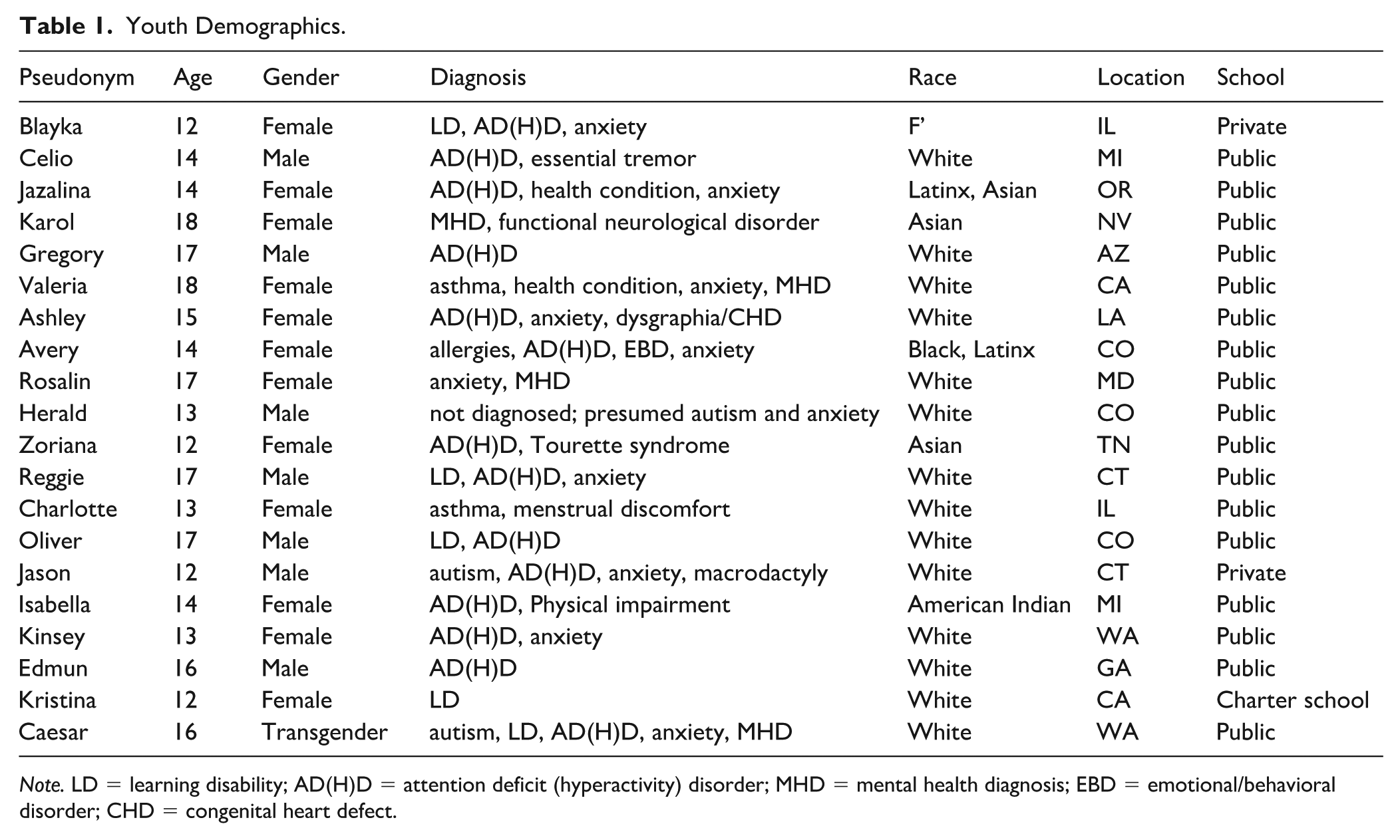
Note. LD = learning disability; AD(H)D = attention deficit (hyperactivity) disorder; MHD = mental health diagnosis; EBD = emotional/behavioral disorder; CHD = congenital heart defect.
Recruitment
Participants were recruited in many ways. A recruitment flyer, in English and Spanish, was shared via social media, websites, and emails to school personnel, disability organizations (e.g., Council of Parent Attorneys and Advocates, Learning Disabilities Association, The Arc), and parent support groups throughout the USA. After completing an interview, each participant received a $50 gift card. If the participant completed the member check, then they also received a $10 gift card. Recruitment stopped after themes were found to be redundant.
Instrumentation
Demographic Survey
Each participant completed a 5- to 10-minute online demographic survey. The survey asked demographic questions (e.g., gender, race, ethnicity, socioeconomic status) and experiences with the Section 504 process (e.g., “How long have you had a Section 504 plan?”). The survey responses were used to characterize the sample.
Interview Protocol
Our team created three types of semi-structured interview protocols for students with disabilities: comprehensive interview protocol, plain language interview protocol, and brief interview protocol. The comprehensive protocol included detailed questions and probes (e.g., “Who attended the meeting to decide eligibility for a Section 504 plan?” and “Did your parent provide consent for an evaluation?”). The plain language interview protocol included few probes and simplified language (e.g., “How old were you when you received a Section 504 plan?” And “Was the school willing to give you a Section 504 plan?”). The brief interview protocol did not include probes or detailed questions (e.g., “What supports do you need at school?” and “What supports does the school provide you?”). Each interview protocol was developed based on the literature about Section 504 plans in schools (e.g., Zirkel & Weathers, 2016). Each interview protocol had three sections of questions: (a) eligibility for a Section 504 plan; (b) developing the Section 504 plan; and (c) implementing the Section 504 plan. The protocols were piloted, in English and Spanish, with three individuals with disabilities. In response to the piloting, some minor changes were made (e.g., change the order of questions, clarify the wording of a question). Each protocol had main questions as well as probes. See Supplementary files for the interview protocols.
Procedures
All research procedures were approved by the university institutional review board. Upon seeing the recruitment flyer, interested individuals provided consent/assent and completed a brief demographic survey via REDCap, an online survey platform. All participants completed the demographic survey form independently. Then, a research team member contacted the participant to find a preferred date and time to conduct the interview. Although the research team offered to conduct the interview via phone and Zoom, all participants chose Zoom. All interviewers were trained to conduct interviews with fidelity.
Each interview was recorded. The interview began with the interviewer introducing themselves and sharing their connection to the disability community to establish rapport with the participant (O’Toole, 2013). For all interviews, initially, the interviewer used the comprehensive interview protocol. Thus, each participant was asked “Describe your experience about initially accessing a Section 504 plan.” If a participant responded with brief, unspecific answers (e.g., “I don’t know much about my Section 504 plan” or “I don’t know”), the researcher switched to the plain language interview protocol. The participant was then asked, “How old were you when you first started thinking about Section 504?.” If the participant responded with generic and/or short answers (e.g., “I don’t know” or “My parent does all of that”), then the research team member switched to the brief protocol. There were ten comprehensive interviews, seven plain language interviews, and three brief interviews.
Regardless of the type of interview protocol used, participants were offered accommodations during the interview. In the demographic survey, participants were asked about needed accommodations. For example, participants were asked whether they would like to have visual supports accompany each interview question, receive the interview questions in advance, and have breaks during the interview. Each interview was close-captioned. Each participant was also offered to have a support person attend the interview (Caldwell, 2014). Further, participants could suggest additional accommodations.
On average, each interview was 22 minutes and 40 seconds (SD = 15:40, range 6 minutes to 1 hour). The comprehensive interviews ranged from 15 minutes and 26 seconds to 1 hour and 1 minute (SD = 12:53, average = 34:22). The plain language interviews ranged from 7 minutes and 46 seconds to 17 minutes and 14 seconds (SD = 3:07, average = 11:46). The brief interviews ranged from 5 minutes and 52 seconds to 12 minutes and 7 seconds (SD = 3:10, average = 8:51). All interviews were transcribed verbatim. The interviewers checked each recording and transcript to ensure it accurately reflected the interview. After the interview was completed, an artificial intelligence mechanism summarized the interview. The interviewer reviewed the summary to ensure its accuracy and completeness. The summary was emailed to the participant for their approval and/or revisions.
Fidelity to the Interview Protocol
An independent researcher checked each interview for fidelity. Specifically, the researcher checked whether each main question was asked of each participant. Altogether, 100% of all questions were asked for each participant.
Data Analysis
Initially, four team members read each transcript to familiarize themselves with the data (Tesch, 1990) and record initial thoughts. Then, the team members independently read four random transcripts and, using emergent design (Patton, 2002), developed a formal codebook. The initial codebook included 75 codes. Notably, four interviews were chosen as the team saw redundant themes within the four interviews. Then, each of the four team members independently coded the remaining 16 interview transcripts. Line-by-line coding was conducted for all data. Each piece of coded data was compared across all four team members using highlighting and annotations from the codebook (Creswell et al., 2003). The team met weekly to compare codes. If the team agreed on the code, it was marked as the agreed upon code. If they disagreed about a code, they discussed it until they came to consensus. Once all data were coded, it was grouped into categories, which reflected a unifying characteristic among a set of codes. The authors then reviewed the categories to group them into themes.
The codebook was organized by the three research questions: eligibility for a Section 504 plan, development of a Section 504 plan, and implementation of a Section 504 plan. Each theme had categories which were comprised of codes. For example, with respect to eligibility, there were six codes under the theme “invisible versus visible disabilities.” The codes were grouped into two categories (i.e., facilitators and barriers to providing eligibility for Section 504) which then were combined into the theme. Under facilitators, there were five codes: health disability, doctor documentation, visible disability, counselor documentation, and other documentation from another provider. Under barriers, there was one code: invisible disability.
Trustworthiness
Several methods were used to ensure the trustworthiness of the data collection and analysis (Brantlinger et al., 2005). For example, peer debriefing was used throughout the data collection and analysis process. The team met biweekly to discuss the project, identify themes, and potential patterns in the data. Two-level member checking was used in the project. As a first-level member check, the interviewer summarized what was said at the end of each interview. As a second-level member check, each participant received a summary of their interview. Altogether, 15 participants responded to the member check. There were no suggested changes.
Findings
Overarching Themes During the Section 504 Process
Across eligibility, development, and implementation, many participants relayed the importance of parent advocacy and parent knowledge of the student’s rights under Section 504. The negative impact of unsupportive educators was also prevalent throughout the Section 504 process. See Figure 1.
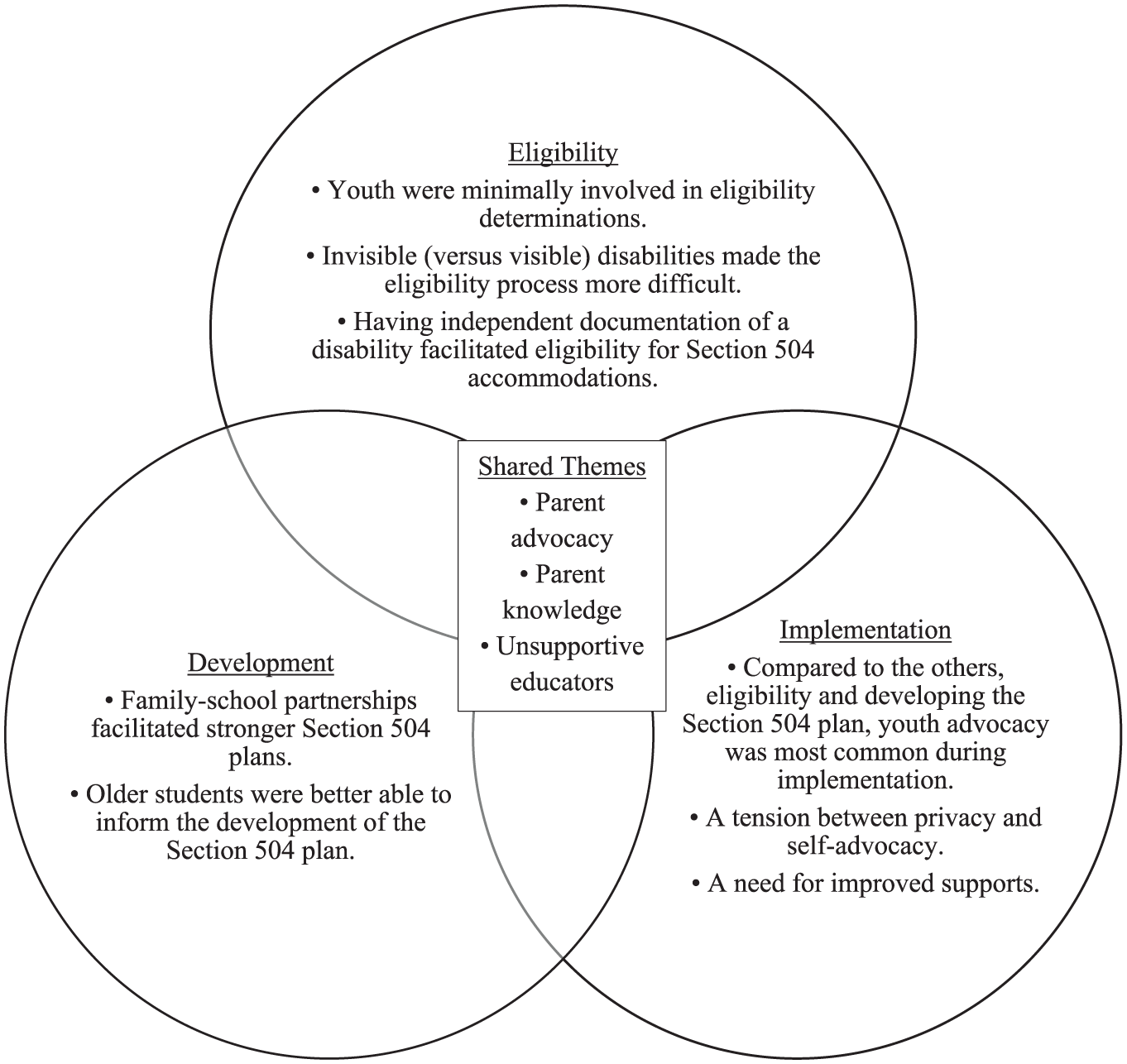
Themes Across Section 504 Eligibility, Development, and Implementation.
Parent Advocacy
Across eligibility, development, and implementation of Section 504, parent advocacy was a consistent theme. Karol, an 18-year-old female with a mental health diagnosis and functional neurological disorder, emphasized the importance of her mom’s advocacy throughout the Section 504 process. Karol reported “My mom helped me a lot with being able to get it [the Section 504 plan] and being able to just like have availability to [receive] accommodations, and it be like set in stone.” Karol reported that, without her mom’s advocacy, she would not have qualified for the Section 504 plan and, accordingly, received needed accommodations. With respect to development of the Section 504 plan, many participants reported that parent advocacy was key. Isabella, a 14-year-old female with attention deficit (hyperactivity) disorder and a physical impairment, explained how helpful it was having parents who advocated for her needs while developing the Section 504 Plan. Isabella remarked that her parents identified and advocated for relevant accommodations to be reflected in her Section 504 plan: “My parents were the ones who really planned it [the Section 504 plan] out.” During implementation of the Section 504 plan, many participants underscored the importance of parent advocacy. Jazalina, a 14-year-old female with attention deficit (hyperactivity) disorder, a health condition, and anxiety, reported struggling to advocate for the implementation of her Section 504 plan. Because she struggled to self-advocate, she relied on her mother’s advocacy. Jazalina reported: “My mom’s pretty like, pretty good at all of this [advocacy]. Like, she’s been able to advocate for me more than I can myself.”
Parent Knowledge
Participants often reported the importance of parental knowledge about Section 504 of The Rehabilitation Act of 1973. Caesar, a 16-year-old, transgender student with multiple disabilities (i.e., autism, learning disability, attention deficit (hyperactivity) disorder, anxiety, and a mental health diagnosis), reported that their parents were knowledgeable about Section 504 because their older sibling had a Section 504 plan. They explained: “It was easier because my family kind of like knew what they were doing. . .and she [mom] just like researches all the time.” With respect to developing the Section 504 plan, some participants reported that parental knowledge was the most important attribute in developing a strong Section 504 plan. Many participants explained that educators often refused to include relevant supports in the Section 504 plan unless their parents had knowledge about their rights. Rosalin, a 17-year-old female with anxiety and a mental health diagnosis, reported that her mom was very knowledgeable during the development process: “My mom, knowing all of the laws, she knows how much time they’re [schools] legally allotted . . . how much time legally they can put in [the Section 504 plan] . . . my mom can be very insistent, as a nice way of putting it.” Some participants reported that parent knowledge was key to the implementation of the Section 504 plan. Celio, a 14-year-old male with attention deficit (hyperactivity) disorder, a health condition, and anxiety, reported being proud of his mom’s knowledge of his Section 504 rights: “I got a good mom that taught me how to deal with lots of things [poor implementation of the 504 plan]. So that’s all thanks to her.”
Unsupportive Educators
Across eligibility, development, and implementation, participants often reported that unsupportive educators made the Section 504 process difficult. With respect to eligibility, many participants reported struggling to prove their eligibility for a Section 504 plan due to educator resistance. Jason, a 12-year-old male with autism, attention deficit (hyperactivity) disorder, anxiety, and macrodactyly, summarized the struggle with educators to prove his eligibility: That [eligibility process] was kind of a hassle. We went back and forth about receiving it [the Section 504 plan]. We received it, but you know it’s kind of a lose-lose situation. You know, they’re [educators] not gonna get what they want. We’re [Jason and his family] not gonna get what we want. So, it’s kind of like, you know, we have to meet in the middle somewhere, but I don’t think where we’re gonna meet is gonna do it [result in a satisfactory Section 504 plan].
Jason further reported that the eligibility process felt like a war between him and his family and educators: “They [educators] always say ‘You [Jason] don’t need the services. You don’t need the services.’ . . . I did not feel supported.” Other participants reported that educators often claimed that the student did not qualify for a Section 504 plan. During a Section 504 eligibility meeting, Caesar recalled a negative experience with their teacher: My teacher came into the meeting and was like “Well, you have some of the best grades. Like, you have friends in that class. Like, you raise your hand. You don’t need this [Section 504 plan].” And, I was just like, “I appreciate like noticing me as a student and like whatever, but my academic ability as a student really doesn’t speak anything to how hard it is for me to do those things.” And I just felt very like the way those meetings were not in my best interest.
After this interaction, Caesar reported that the educator did not have their best interest at heart.
Compared to qualifying for Section 504 and implementing the Section 504 plan, participants reported that educators were most resistant during the development of the Section 504 plan. Many participants perceived that educators were resistant because the Section 504 plan was a legally binding contract requiring educators to provide supports to the student. Accordingly, many participants perceived that educators did not want to include the needed supports in the Section 504 plan because they worried about implementing them. Reggie, a 17-year-old male, explained the difficult process in developing his Section 504 plan: “It seems like a lot of back and forth. My mom will ask for something, and then school comes back with something else. Then my mom will like continue to give reasons. And it’s kind of not like bickering, because it’s not arguing but it’s a lot of back and forth.” Reggie further explained that educators often ignored aspects of his Section 504 plan. He stated that his Section 504 plan allowed him to use fidgets in class; however, when he used fidgets, he recalled, “I got yelled at a lot for using them [fidgets].” Similarly, Caesar reported that educators refused to include needed supports in his Section 504 plan because they overtaxed teachers: They [educators] didn’t even tell me why. They were just like “No, that’s not gonna happen”. I think the school kind of just maybe prioritizes the teachers more than they try to prioritize the student. They [educators] said that was because teacher inconvenience. I’m supposed to get notes, but that was also taken away for teacher convenience. They did not budge. The people [educators] in the meeting were like “This is how it is.”
Altogether, participants reported that educator resistance made it difficult to develop a Section 504 plan that met their needs.
During the implementation of the Section 504 plan, several participants reported that educators were not understanding of their needs; accordingly, there was little implementation of their Section 504 plans. Some participants reported that the lack of teacher understanding manifested in educators making fun of students with disabilities. For example, Jazalina reported, “I think one time someone [teacher] made a joke about like, ‘What are we supposed to do? A dance party every time she [Jazalina] does well?’” Other participants reported that educator resistance manifested in refusing to implement needed supports, acknowledging student self-advocacy, and lacking knowledge about the Section 504 regulations. Caesar reported: “I wish they [educators] were a little more understanding. So, I guess that’s just the barrier . . . they’re [educators] not really accommodating the people.”
The Eligibility Process
With respect to eligibility, youth were often minimally involved. Also, youth with invisible (versus visible) disabilities reported struggling more in qualifying for a Section 504 plan. Finally, independent documentation of a disability facilitated the eligibility process.
Youth Were Minimally Involved in Eligibility Determinations
Few youth reported being involved in the eligibility process. Most participants reported not attending their eligibility meetings. Ashley, a 15-year-old female with attention deficit (hyperactivity) disorder, dysgraphia, and a congenital heart defect, reported her lack of involvement in her own eligibility for a Section 504 plan: “I wasn’t involved in the process at all. I just knew I needed the extra help.” While Zoriana, a 12-year-old female with attention deficit (hyperactivity) disorder and Tourette Syndrome, attended her Section 504 plan meeting, she reported feeling uncomfortable and, as a result, not participating in the meeting. When asked if she would attend her future Section 504 meetings, Zoriana reported “Probably not cause I mean, my teachers are gonna be there and it’s gonna be awkward.”
Of the two participants who reported being involved in their eligibility process, both reported feeling empowered when they participated in their Section 504 meetings. Reggie, a 17-year-old male with a learning disability, anxiety, and attention deficit (hyperactivity) disorder, reported that he was his biggest advocate. Accordingly, Reggie stated that he needed to attend his Section 504 meetings to ensure his needs were met: “I think it’s important that I have a voice, and I know what’s going on rather than just being told by someone who was there.” Notably, Reggie was one of the older participants in the sample.
Invisible (Versus Visible) Disabilities Made the Eligibility Process More Difficult
According to the participants, invisible disabilities are disabilities that cannot be physically observed. Participants characterized invisible disabilities as learning disabilities, attention deficit (hyperactivity) disorder (ADD or ADHD), anxiety, mental health diagnosis, and functional neurological disorder. Participants with invisible disabilities often commented that it was difficult to qualify for Section 504 plans because educators did not see their impairments. Rosalin reported that she had to prove her struggles to educators: “I already had a diagnosis to be able to get a Section 504 plan. It was a bit like; ‘How do we prove it?’ because it was mainly just anxiety and chronic pain at that point. How do we prove that like that’s enough to get like a Section 504 plan?” Participants with invisible disabilities often remarked that, even though their disabilities were not immediately visible, they should qualify for Section 504 supports. Rosalin suggested that stigma surrounding invisible disabilities negatively influenced her eligibility, “The barriers of stigma around chronic pain and illnesses. And you know just like the ‘Oh you seem fine.’”
Independent Documentation of a Disability Facilitated Eligibility
Some participants reported that independent (i.e., outside of the school) documentation of their disability made it easier to prove eligibility for Section 504. Kinsey, a 13-year-old female with attention deficit (hyperactivity) disorder and anxiety, reported going to a therapist prior to initiating the evaluation process for a Section 504 plan at school. By receiving a diagnosis from the therapist and then starting the eligibility process at the school, Kinsey reported she was able to show she qualified for a Section 504 plan: “I got diagnosed with ADHD when I was in 3rd grade . . . And I’ve gone to a therapist before that. So, I think it was easier . . . to be able to access it.” Many participants reported that educators were more willing to provide a Section 504 plan when there was independent documentation of a disability. Jazalina reported that educators were more responsive to her need for a Section 504 plan because she had independent documentation: “I went to a [outside] counselor, and he was able to get documentation and recommendations of what should be in my [Section] 504 plan. So, the teachers would listen more.”
Developing the Section 504 Plan
Family-school partnerships facilitated stronger Section 504 plans. Also, older (versus younger) students were better able to inform the development of the Section 504 plan.
Family-School Partnerships Facilitated Stronger Section 504 Plans
Many participants reported that when families and educators were collaborative, they were able to develop appropriate Section 504 plans. Gregory, a 17-year-old male with attention deficit (hyperactivity) disorder, reported that his Section 504 plan was appropriate because his family and educators were able to dialog about his accommodations: I think we had a list of accommodations that I could use, and we kind of just went through those and talked about them. Then they [educators] asked me, “Would this be helpful?” or would I never use this. Going through that they just kind of gave me a list of options I could choose from. Then, as years go on, I took some off or added on some more that might have been more helpful.
Similarly, Karol reported that educators worked with her and her family to develop her Section 504 plan. She characterized developing the Section 504 plan as a collaborative experience: I think the meeting was good because I was able to have most teachers there, and it kind of gave a space for them to understand what was happening, and then for them to also say different ways that like for them to have input and share their ideas, for ways that they would be able to help me in the classroom.
Many Older Students Were Better Able to Inform the Development of the Section 504 Plan
Participants who were between the ages of 17 and 18 (versus participants who were younger than 17) reported that their older age made it easier for them to develop the Section 504 plan to meet their needs. Oliver, a 17-year-old male with a learning disability and attention deficit (hyperactivity) disorder, reported that he was better able to inform the accommodations in his Section 504 plan because of his age and his understanding of his strengths and support needs. He explained that, in middle school, he knew that he needed more time to write longer essays. However, it was only as he got older that he realized the importance of extended time as an accommodation in his Section 504 plan. He stated, “With having ADHD, the extended time helped. I think those I knew originally and then I added components to my Section 504 plan as time went on. Using trial and error I knew exactly what I needed to be successful.” Many participants reported that, with older age, they were better able to self-advocate when developing their Section 504 plan. Karol reported that she started self-advocating so educators would listen to her opinions rather than only feedback from her parents: I think it might be my age because I am in high school. I think it is important for me to attend and be able to advocate for myself, because a lot of times people will just talk to my mom, and my mom will talk for me. But I think it’s important for me to like, have the skills and use, like my own advocating skills to talk for myself.
Altogether, age played an important role in the youth’s ability to develop their Section 504 plan.
Implementing the Section 504 Plan
Youth advocacy was most common during implementation of the Section 504 plan. Some participants reported a tension between privacy and self-advocacy. Also, there is a need for improved supports for students with Section 504 plans.
Youth Advocacy Was Most Common During Section 504 Implementation
Many participants reported that, if they engaged in any self-advocacy, it was often in relation to the implementation of the Section 504 plan. Many participants reported self-advocating by asking for their accommodations and/or requesting that the teacher implement an accommodation. Edmun, a 16-year-old male with attention deficit (hyperactivity) disorder, reported that he engaged in self-advocacy because, without it, teachers would not implement the accommodations listed in his Section 504 plan. He concisely stated that, to receive accommodations, “You would have to tell teachers that you had a Section 504 plan.” Similarly, Ashley reported that it was uncomfortable for her to advocate. Although she reported feeling awkward about having to remind the teacher of her accommodations, Ashley reported that, without such reminders, she would not receive needed supports: “Most of the time when I need something I usually ask. . .it makes me uncomfortable to do so. But I think most of the time I’m capable of asking, it was more the fear of asking, I would say anxiety.” Oliver reported advocating for his supports. He also reported that many students with disabilities may struggle to self-advocate: “Unfortunately, that is how it is for a lot of kids. If they [students] have a 504 and a teacher tells them ‘no,’ they can get scared away from asking for help and self-advocating.” Reggie explained the importance of self-advocacy, “I think it’s important that I have a voice, and I know what’s going on rather than just being told by someone who was there.”
A Tension Between Privacy and Self-Advocacy
Several older participants (aged 17 and older) reported not wanting to stand out from their peers. However, participants reported that self-advocacy often revealed their disability. Altogether, some participants reported struggling to balance the desire to keep their disability (and corresponding support needs) private while also ensuring that their Section 504 plan was implemented. Zoriana reported that, while she wanted privacy about her disability, her tics were uncontrollable. Further, Zoriana reported that her teacher often commented on her tics making it impossible for Zoriana to retain any privacy: “I think in 5th grade, I told my teacher that I had Tourette’s. And then, like sometimes, the teachers forget about it. So, I’ll make random noises. And they’ll [educators] be like ‘Everyone please be quiet.’” In this example, Zoriana discretely self-advocated by disclosing her disability to her teacher. However, she also reported that her teacher was not able to implement her Section 504 plan as Zoriana should not have been publicly addressed for making noises. Avery, a 14-year-old with allergies, attention deficit (hyperactivity) disorder, emotional/behavioral disorder, and anxiety, reported that, while she appreciated having a Section 504 plan, it often was not implemented unless she disclosed her disability and self-advocated with the teacher. Avery reported: I have kind of like social anxieties to go up to the teacher and ask for it [accommodations]. And sometimes it’ll be really hard for me to go up. So, I wish it was like they [educators] had to follow it [Section 504 plan] because then it would be easier for me and then I could still advocate with the teachers. If it’s hard for them [educators],
like we can find a way, but like, just make it work. It is complicated for me because most of the time I just can’t reach out because of that social anxiety gap.
For Avery, the fear around self-advocacy was not due to worrying that the teacher would refuse the accommodation but rather around social anxiety. This sentiment was echoed by Valeria, an 18-year-old female with asthma, a health condition, anxiety, and a health diagnosis. Valeria explained her struggle in receiving accommodations from her teacher: “It’s scary asking a teacher for extended time and not that they [educator] were going to say ‘No.’ But just like having to go up and ask. It’s just really hard for me, personally.”
A Need for Improved Supports
Participants often reported that the implementation of the Section 504 plan was often inadequate. Jason reported that he has had a Section 504 plan for 4 years. Yet, the implementation of the plan did not meet his needs: They [educators] started realizing, you know, “He’s [Jason] behind in reading. He’s ahead in math. He’s good at science. He’s not great at handwriting.” And they started identifying what I needed support in, but by that time, it was too late. You know, and it was what it was. I did not want to do it, because they had four years to help me, and they chose not to. And, on the other hand, the services I was receiving were not enough.
Discussion
While more than 1.38 million children have Section 504 plans in the USA, there is little research about youth experiences with Section 504 plans. This study is a launching point to exploring the student perspective. Our study has three main findings. First, parent advocacy and knowledge matter across Section 504 eligibility, development, and implementation. These findings are consistent with literature about students with IEPs, wherein parents advocate across their child’s lifespan (Burke, 2012). The study extends the literature by showcasing that parent advocacy matters beyond the confines of IEP meetings to include the Section 504 plans. With respect to special education and adult disability services, parent knowledge and advocacy skills are often predictors of service access (Casagrande & Ingersoll, 2017; Lee et al., 2022). This study extends the literature by suggesting that parent knowledge and advocacy may also promote access to Section 504 supports as well as suggesting that youth with disabilities perceive the positive impact of parent knowledge and advocacy on service access.
Future researchers should delineate the impact of parent advocacy on student self-advocacy. While parent advocacy is critical, it is also critical to center the voices of individuals with disabilities (Scotch, 2009). This belief echoes the sentiment that students with disabilities should take the reins of their own advocacy. Yet, it is unclear where parent advocacy should stop (or slow) and student self-advocacy should begin. Some literature suggests that self-advocacy can begin in early childhood (Palmer et al., 2013). While not in the context of Section 504 plans, there has been some research about the impact of parent advocacy on youth self-determination. In a study of transition-aged autistic youth and their parents, Moser and colleagues (2025) identified a positive association between parent advocacy and youth self-determination. Research is needed to determine whether this result extends to students with Section 504 plans, suggesting that parent advocacy may facilitate self-advocacy for students with disabilities.
Second, there were generally more barriers than facilitators throughout the process of the Section 504 plan. This finding aligns with the limited prior research about Section 504 plans (Rodriguez et al., 2020) showcasing some of the challenges in complying with Section 504 of The Rehabilitation Act of 1973. The struggle to effectively evaluate students for Section 504 plans, develop the Section 504 plan, and implement the Section 504 plan with fidelity may stem from the broad nature of Section 504. Unlike IDEA, Section 504 is a completely unfunded mandate that has tremendous ambiguity in its roles and expectations for schools (Zirkel, 2024). Thus, the finding of more barriers (than facilitators) is unsurprising.
Given that there are many barriers to compliance with Section 504, families may need to have knowledge of their rights to ensure its implementation. Because of its broad nature, Section 504 does not delineate the role of families—including students—or specify if or when a family and/or student needs to be informed of their rights. In contrast, IDEA requires families to attend IEP meetings and encourages students to attend meetings during transition planning (i.e., age 16). Further, IDEA accords specific rights to parents (e.g., the right to consent, access to procedural safeguards) (Rights, 2020). Such protections and clear roles should be considered in the Section 504 regulations. Regarding the former, Section 504 regulations should require that the parent and the student attend Section 504 plan meetings. With respect to the latter, Section 504 dispute resolution options should also be available for families and students. That being said, it is also important to ensure that such safeguards are accessible to parents. The IDEA safeguards have poor readability and are often inaccessible to many families (Lo, 2014). Thus, Section 504 regulations and related resources should be available and accessible for families.
Third, family–professional partnerships matter. When students had receptive educators, they reported better experiences; conversely, when they had unsupportive educators, they reported poor experiences. Extant research in general and special education (Epstein, 2013; Welch & Sheridan, 1993) underscores the importance of supportive educators. Unfortunately, general and special education teachers report receiving little to no pre-service training on the Section 504 process (Chiasson, 2004). The limited knowledge of Section 504 may lead to communication breakdowns between educators and families (Ozmen et al., 2016).
Future research should include triads of parents, students, and educators to have more of a holistic understanding of the Section 504 experience. By hearing the perspective of each stakeholder, there can be a well-rounded understanding of the Section 504 process. To accurately evaluate the process, it is important to collect data from all relevant stakeholders (Wilczenski et al., 1997). To date, there has been limited triadic research in special education. In one of the few extant studies with triads, Ballard and Dymond (2019) examined the involvement of students with disabilities in their healthcare procedures in schools. Their research found that, while parents wanted their children to be involved in their procedures, students were only passively participating, and educators often did not include instruction for students to engage in the procedures. The implication of this study suggests that, to understand a phenomenon that involves multiple stakeholders, it is important to elicit each stakeholder in the research process. Triadic research could involve interviewing parents, students, and educators about the Section 504 process, observations of Section 504 meetings to compare the participation of parents, students, and educators, and intervention studies testing advocacy interventions for families and students. Put simply, this study is a jumping-off point to understand the Section 504 process; more research with different participants and diverse data sources is needed.
Limitations
While this is one of the first studies to explore the experiences of students with Section 504 plans, there are some limitations. Because this sample was primarily White, there is limited transferability of the findings to other racial groups. The homogeneity of the sample is problematic as Black and Hispanic students are under-identified for Section 504 plans (Zirkel & Weathers, 2016). Further, the sample included participants primarily with high-incidence disabilities; therefore, there is also limited transferability for students with low-incidence disabilities. Also, due to the interviews being cross-sectional, the data may not reflect how Section 504 implementation changes over time. Lastly, the interviews were of different durations. The different protocols may have precluded more detailed participant responses.
Directions for Future Research
There is a need for longitudinal research to understand how Section 504 experiences ebb and flow over time. Longitudinal research (e.g., interviews at multiple points over one’s educational career) can identify how experiences change over time as well as when to provide interventions to support students during the Section 504 process. Longitudinal research should also explore self-advocacy with respect to the Section 504 process. While self-advocacy should start in early childhood, it often does not begin until late adolescence (Palmer et al., 2013). Given that this study found a pattern between student age and self-advocacy, longitudinal research can explore this pattern to pinpoint when targeted supports should be provided to students to improve their self-advocacy during the Section 504 process.
Future research should dive deeper into the relation between self-advocacy and privacy. For students with disabilities, self-advocacy is critical and often encouraged by disability and education policies. However, extant policies also underscore the importance of privacy (e.g., the Family Educational Rights and Privacy Act). Yet, there may be tension between advocating for one’s self and retaining privacy. Research suggests that the benefits of self-advocacy could outweigh concerns about privacy. Fenn and Scior (2019) found that self-advocacy has several positive outcomes (e.g., greater empowerment, increased confidence, greater belonging, increased social connections, improved self-identity). When students self-advocate, teachers are likely to respond to them (Gilmartin & Slevin, 2009). Future research should more closely examine how to enable students to self-advocate while mitigating concerns about privacy.
Implications for Practice
There is a need to educate students about Section 504, starting at a young age. To that end, Parent Training and Information Centers (PTIs, federally funded centers that educate and empower families about their special education rights) may create resources about Section 504. Such resources may include videos, tip sheets, and/or modules educating students about Section 504. For example, when a student is deemed eligible for a Section 504 plan, they could be referred to a PTI to learn their rights and gain self-advocacy skills. In this way, students can learn their rights under Section 504 as well as ways to advocate for themselves.
Professional development is needed for educators about Section 504 and appropriate professional behavior. Regarding the former, current pre-service and in-service preparation programs often do not prepare educators to understand Section 504 (Chiasson, 2004). General and special education teachers and related service providers (including counselors) need to have training about Section 504 so they can implement Section 504 plans with fidelity. Regarding the latter, training for professional behavior may be needed. For educators, professional (i.e., respectful) behavior is important with other educators, administrators, families, students, and other stakeholders (Anitha & Krishnaveni, 2013). To address these competencies, schools may offer professional development to build educator knowledge and improve professional behavior.
Given that students with disabilities are the direct consumers of Section 504 plans, it is critical to explore their perspectives. By centering the student with a disability, we can better understand the experiences with Section 504 plans in school settings. Such experiences can inform future research, interventions, and practice.
Supplemental Material
sj-docx-1-sed-10.1177_00224669261427030 – Supplemental material for The Experiences of Youth With Disabilities in Accessing Supports Under Section 504 of The Rehabilitation Act of 1973
Supplemental material, sj-docx-1-sed-10.1177_00224669261427030 for The Experiences of Youth With Disabilities in Accessing Supports Under Section 504 of The Rehabilitation Act of 1973 by Isabelle Burakov, Cate Rosenthal, Alex Cobb, Sarah Demissie, RaeAnne Lindsay and Meghan M. Burke in The Journal of Special Education
Footnotes

Funding
The authors disclosed receipt of the following financial support for the research, authorship, and/or publication of this article: The contents of this study were developed under a grant from the National Institute on Disability, Independent Living, and Rehabilitation Research (90DPGE0101). NIDILRR is a Center within the Administration for Community Living (ACL), Department of Health and Human Services (HHS). The contents of this poster do not necessarily represent the policy of NIDILRR, ACL, or HHS, and you should not assume endorsement by the Federal Government.
Declaration of Conflicting Interests
The authors declared no potential conflicts of interest with respect to the research, authorship, and/or publication of this article.