



Abstract
In the past five years, studies have demonstrated the intense challenges of COVID-19 on school leadership. In this study, we build upon the body of research and explore how principals re-imagined their leadership purpose, priorities, and practices from a human-centered care perspective. The study takes place in Florida, an epicenter of culture wars that politicized numerous economic, social, and scientific issues, including COVID-19, which adds nuance to the complexity in principals’ leadership. The purpose of this study is to explore how principals reconceptualized their roles during the pandemic and how their practices and priorities aligned with humanism, using a humanistic values of care framework. Data were collected through semi-structured interviews with nine principals in South Florida, as well as corresponding school district documents. Our findings revealed that principals adopted health professional identities in response to a health and human safety crisis. They embraced human-centered mindsets and skills that prioritized the diverse challenges and trauma that students and staff were experiencing. Principals not only revamped communication channels but also strategically used these communications to heal, create meaning, and instill a sense of togetherness amid isolation, uncertainty, trauma, and grief. In practicing humanizing leadership, principals were transparent and vulnerable about their own physical, mental, and professional limitations. For a time, these leadership changes replaced traditional models of school leadership. However, we find tensions between humanistic leadership practices and the dehumanizing political and normalizing educational contexts, raising questions about the sustainability of humanistic leadership beyond life-and-death crisis contexts.
Introduction
Principals play an essential role in school improvement by developing positive climates, building the professional capacity of teachers, creating an environment conducive for learning, and ensuring everyone’s safety in the school community (Bryk & Schneider, 2003; Grissom et al., 2021; Leithwood et al., 2004; Murphy, 2013). During the pandemic, principals shifted into crisis mode as most schools moved first into virtual classrooms and then, into hybrid formats where principals balanced tensions between learning and safety amidst the viral threat. Undeniably, school leaders found themselves in extraordinary circumstances that few could have predicted, prepared for, or received the necessary training for to lead schools through a global health pandemic (Grissom & Condon, 2021; Harris & Jones, 2020; Mutch, 2020). For example, principals were tasked with new responsibilities such as virtual learning, resource inequities at home, contact tracing, food insecurity, homelessness, and mental health issues among their school community (Anderson et al., 2020; Barakat et al., 2024; DeMatthews, Reyes, et al., 2021). As such, research has touched upon elements of critical care, health, and stability in education which suggests that humanistic aspects of leadership became critical in principals’ roles and responsibilities (Anderson et al., 2020; Ferguson et al., 2021).
While most of the U.S. and the world took lockdown and protective measures seriously, Florida became an epicenter of culture wars that politicized the global health pandemic. Florida’s lack of COVID-19 public health policies showed a disregard for the impacts of a dangerous and unknown viral contagion (Goodman & Fleshler, 2021). In the summer of 2020, Rebekah Jones, a data scientist for the Florida Health Department, leaked that she was told to change COVID-19 cases and deaths ahead of the state’s decision to relaxing protective measures and become one of the first states to re-open after lockdown (Friedersdorf, 2023). When many restrictions became common practice across the country, Florida’s Governor, Ron DeSantis, issued executive orders banning mask mandates and proof of vaccinations in schools in the middle of the Delta variant surge (McKay, 2021) citing the right to individual freedom and choice. A year later, the governor backed a proposal to strip school districts in Democratic counties nearly $200 million in educational funding who defied the mask ban executive order further straining already taut budgets (Luscombe, 2022). Further, the governor was a leader in executive orders banning equity and diversity-related efforts in schools including the ‘Don’t say Gay’ and ‘Anti-W.O.K.E.’ bills (Brugal, 2022; Pendharkar, 2022) and while not the focus of this study, the effects of these policies created chilling effects that slowed, stalled, or mitigated positive school leadership efforts. This politically charged context created an environment of political hostility for principals to navigate as they were morally tasked to lead safe schools during the onset of the pandemic and years following.
Recent studies have demonstrated the widespread impacts of COVID-19 on principals’ leadership practices and priorities. These studies hinted at more humanistic leadership approaches as the focus shifted to aspects of care. Indeed, a small base of literature argued that school leadership paradigms had changed, and that researchers needed to explore ways in which school leadership was reimagined during and beyond the pandemic (Harris, 2020; Ladson-Billings, 2021; Stone-Johnson et al., 2023). Some researchers and practitioners who first wrote about school leadership during his time argued that the principalship had likely undergone a paradigm shift (Harris, 2020; Netolicky, 2020). Harris and Jones (2020) said, “school leadership practices have changed considerably, and maybe, irreversibly because of COVID-19. As a result, school leadership has shifted on its axis and is unlikely to return to ‘normal’ anytime soon, if ever at all” (p.245). Many previous studies on crisis leadership did not include health crises (Striepe & Cunningham, 2022); yet we hear the call for a new model of crisis leadership by these authors. There is a need to build on the research that has been done on crisis leadership in schools to create a model of leadership that is distinct from current conceptions. Such work would develop a more comprehensive and robust understanding of this topic, give empirically based meaning to this neglected aspect of educational leadership and potentially take the field in new directions. (p. 144)
The purpose of this study is to examine the early assertion made by Harris and Jones (2020) from a human-centric framework. Specifically, we are concerned with how and what school leadership became, not necessarily the permanence of change though we will discuss implications. We ask the following research questions: 1). How did principals reconceptualize leadership roles, decision-making, and school priorities during the COVID-19 pandemic? (2) How do these changes and re-imaginings of school leadership align with humanism? (3) What tensions exist between principals’ crises-induced conceptualizations and the politicized systems within which they operate? We ground our findings within current and emerging research literature on school leadership and COVID-19 to conceptualize humanistic school leadership. In the following sections, a literature review on school leadership during crisis contexts, school leadership during COVID-19, and reconceptualizations of school leadership post-2020 are provided. The methods and research design are then presented, followed by the study’s findings and implications.
Literature Review
Crisis School Leadership
The definition of crisis takes on a plurality of conceptualizations from personal to global perspectives. In a recent literature review of crisis leadership, crises take on several key characteristics (Wu et al., 2021). Firstly, crises are relatively unexpected in their occurrence either in frequency or the nature of the event. As such, most leaders may be ill-prepared for such events when they occur (Gainey, 2009; Grissom & Condon, 2021). Crises also have a degree of salience that leaders need to identify such as the degree of impact that the crises may have and thus, the urgency of the response. Embedded within this second characteristic is also the pressures, risks, and uncertainty of the crises and leaders’ responses to perceived threats. Furthermore, Wu and colleagues (2021) add that crises are unique for leaders to navigate because they require adept leadership that will navigate them out of crises while also taking advantage of crises contexts as opportunities for change.
Prior to COVID-19, literature on school leadership and crisis contexts were relatively limited. Mutch (2020) argued that developing crisis school leadership theories should be based on actual experiences. Moreover, the experiences in these situations should be outside what is considered normal duties of school leaders. Doscher and Normore (2008) developed a crisis leader framework that centered morality and change agency during ambiguous and uncertain crisis contexts. They used Starratt's (2005) framework of moral responsibility to outline leadership dilemmas particularly in times of conflict and crisis (Doscher & Normore, 2008). Smith and Riley (2012) developed an attribute-based crisis school leadership framework based on crisis management literature that includes traits such as decisive decision making, creativity, communication skills, intuition, flexibility, empathy and respect, optimism, etc. Other seminal scholars’ work on the influence of context and change such as force field theory (Lewin, 1947), sensemaking (Weick, 1995), and turbulence theory (Gross & Shapiro, 2004; Shapiro & Gross, 2013) help frame the forces for change and sustainability; create understandings out of ambiguity; and illuminate the degree and severity of issues in schools, respectively. Other school leadership theories and frameworks, though not directly related to crises, touch tangentially upon leadership during times of loss, grief, and uncertainty including caring leadership (Louis et al., 2016), radical care (Rivera-McCutchen, 2021), masculine caring (Bass, 2020), and sympathetic leadership (Liou & Liang, 2021) that touch upon the critical emotional and relational aspects of school leadership (Wang, 2021).
Other literature germane to school leadership and crises include case studies—both empirical and constructed—that depict crises including student(s) or teacher(s) death (Macpherson & Vann, 1996; Yamamoto et al., 2014), school shootings (Brown & DeMatthews, 2022; Crepeau-Hobson et al., 2012) earthquakes, and other natural disasters (Fletcher & Nicholas, 2016; Goswick et al., 2018; Howat et al., 2012). Across these findings and case examples, common themes around emotions, loss, danger, and death should be noted. For example, Brown and DeMatthews (2022) noted that after aschool shooting, it is critical that school leadership focus on efforts and communications that develop unity and a sense of safety. After the Christchurch earthquakes in New Zealand, Fletcher and Nicholas (2016) found that principals collectively focus on safety and care especially beyond their school walls. These studies provide important insight and grounding into school leadership in crisis contexts and how principals navigate delicate situations, make decisions in times of uncertainty, bring people together, and move school organizations forward and out of crises paving the context for school leadership during the COVID-19 pandemic.
School Leadership During COVID-19
When COVID-19 became a global health pandemic, it was clear that school systems and school leaders did not possess knowledge or experiences necessary to navigate this unprecedented context (Grissom & Condon, 2021; McLeod & Dulsky, 2021; Mutch, 2020). The pandemic posed numerous challenges for school leaders to navigate. Principals were addressing unique challenges at a large-scale including food, housing, and job insecurity in the community; technical, virtual learning challenges and teacher inexperience; extreme resource inequities in schools and communities; and teachers’ and students’ mental health needs (Anderson et al., 2020; Barakat et al., 2024; DeMatthews, Reyes, et al., 2021; Metcalfe & Perez, 2020; Schechter et al., 2022; Virella, 2025). As schools moved back to in-person instruction, principals were navigating inconsistent and ever-changing public health information such as masking policies, contact tracing requirements, quarantining protocols, and vaccination information while revamping organizational routines and channels of communication to accommodate the fluidity of COVID-19 threats and demands (Grooms & Childs, 2021; Okilwa & Barnett, 2021).
Globally, school leaders were faced with similar challenges and responded with similar priorities. In times of great uncertainty, principals emphasized frequent and transparent communication to help make sense of the ambiguity for their schools, but also to build unity within their community at a time of physical isolation and loneliness (DeMartino & Weiser, 2021; Ferguson et al., 2021; McLeod & Dulsky, 2021). In many instances, principals focused on care as a central theme in their leadership. Principals in Scotland focused on relational skills such as reciprocity and empathy to center their responsibility in care as school leaders (Ferguson et al., 2021). A study that explored principals’ role in the first three months of the pandemic, showed that leaders were intensely focused on communication, care, resilience in their schools and community (Reyes-Guerra et al., 2021). In a systematic literature review, Chatzipanagiotou and Katsarou (2023) found that challenges for school leaders fell into three distinct categories: (a) logistical challenges posed by the lack of infrastructure, technical equipment, funding and efficient planning in schools limiting effective responsive strategy; (b) academic challenges associated with transitions to emergency remote online learning both in cognitive and emotional terms and (c) organizational challenges related to obstacles encountered by school leaders in their effort to ensure a positive school climate by safeguarding the physical and psychological safety of all school members and engaging all stakeholders of the school community in the common effort.
The COVID-19 pandemic also disproportionately impacted students from marginalized backgrounds, low socioeconomic families, and students with disabilities (Trinidad, 2021). Principals were aware that challenges with distance learning, job and food insecurity, and comorbidities of COVID-19 disproportionately impacted marginalized communities (Grooms & Childs, 2021; Okilwa & Barnett, 2021). As such, principals sought out ways to lead equitably by ensuring technology accessibility (DeMatthews, Reyes, et al., 2021) and being flexible with academic and behavioral expectations (Jackson et al., 2022; Reyes-Guerra et al., 2021). Virella and Cobb (2021) showed that COVID-19 allowed principals to forcibly address teachers’ deficit mindsets and advocate for tangible resources for marginalized students. In other instances, principals were able to bend rules and maintain flexibility in meeting students’ unique needs (Reyes-Guerra et al., 2021).
Reconceptualizations of School Leadership from COVID-19
COVID-19 has diminished as a severe threat for most people because of decreased virulence, herd immunity, and vaccinations. However, the residual impacts on schools and reconceptualizations of school leadership remain. At the beginning of the pandemic, Gloria Ladson-Billings (2021) called for a hard reset to our educational systems arguing that pre-pandemic normal education was problematic particularly for marginalized groups of students. Furthermore, school leadership researchers and practitioners argued that school leadership had changed both drastically and perhaps irrevocably (Harris, 2020; Harris & Jones, 2020; Netolicky, 2020). Indeed, several research groups have explored ways in which school leadership has changed, expanded, or become re-imagined post-pandemic. Broadly, researchers argued that certain types of leadership styles came to the forefront out of necessity such as servant, distributive, and adaptive leadership (Fernandez & Shaw, 2020). Within school leadership literature, Stone-Johnson and colleagues (2023) conceptualized responsible school leadership in times of crisis that focuses on enhancing, developing, and sustaining educational communities through stewardship (Stone-Johnson, 2014). Others conceptualized the importance of human connection, compassionate leadership, and care that were valued attributes of good leadership but became central to their practice during the pandemic (Ferguson et al., 2021; Lasater & Lasater, 2021; Zoll et al., 2024). Care was not only extended to individuals within the school, but also to the broader community and importantly to themselves through self-care (Ferguson et al., 2021; Hayes et al., 2022; Urick et al., 2021). Other scholars like Da’as et al. (2023) took a different approach by examining school principals’ perceptions of their roles during the pandemic through metaphors. Principals used metaphors like octopus, juggler, captain of a ship in a storm and more to describe leadership during COVID-19 capturing the workload, unfamiliarity of tasks, uncertainty of the context, and reflections of principals’ roles and of their ability to respond and function effectively within a specific educational crisis (Da’as et al., 2023).
Research on how school leadership has been reconceptualized in practice, theory, and sustainability is still emerging and some researchers have found pressure points for meaningful, positive change. Indeed, many researchers have alluded to Churchill’s ‘never let a good crisis go to waste’ sentiment that crises, uncertainty, and turbulence present new or innovative opportunities (Gross & Shapiro, 2004; Lewin, 1947; Wu et al., 2021). Using a radical care framework, Alvarez Gutiérrez and colleagues (2022) highlight new ways in which school leaders engaged with their community and conceptualized these new practices as aperturas or cracks in traditional understandings of family engagement which allow for the emergence of radical care and a new approach to community focused school leadership. Similarly, Wharton-Beck and colleagues (2024) found that principals were redefining leadership through non-traditional approaches by leaning into visionary leadership, innovation, forward thinking, and leading actively rather than traditional, managerial approaches. Our attempt, in this study, is to build upon the emerging literature to reconceptualize school leadership from a humanism perspective within life-threatening, dangerous, and volatile contexts. At the same time, it must be stressed that the pandemic differed from previous studies on crisis and disaster leadership: that is, the mortal lives of these school leaders were—in the moment—truly put to the test with COVID-19.
Conceptual Framework
For the study, we adapted a humanist care framework (Todres et al., 2009) from the health sciences to inform humanizing school leadership. Though qualitative research processes are rarely linear, few researchers typically describe the ways in which conceptual frameworks come to being in exploratory studies especially when the context under study is changing and evolving. Here, we detail our research approach and arrival at Todres et al.’s (2009) framework. At the time of data collection, COVID-19 was a fluid context that required a high degree of learning on school leaders’ part. We initially used Weick's (1995) sensemaking theory, Lave and Wenger's (1991) situated learning theory, and Senge's (2006) mental model frameworks to guide the methods and design of this study. As we collected interviews, conducted preliminary data analysis, and engaged in the constant comparative analysis method, we found surprises in the data that ultimately sent us on a path towards a humanistic framework (we describe the process of uncovering these surprises and the analytic path towards a new conceptual framework in the methods below). As we searched for a school leadership humanism framework, we found that researchers have cited the importance of centering humanistic practices (Bogotch, 2016; Lomotey, 1993; Marshall & Khalifa, 2018; Mincu et al., 2024) especially during COVID-19 (Alvarez Gutiérrez et al., 2022; Ferguson et al., 2021; Lasater & Lasater, 2021), but ultimately, there was a lack of humanistic-oriented frameworks fit for the COVID-19 context.
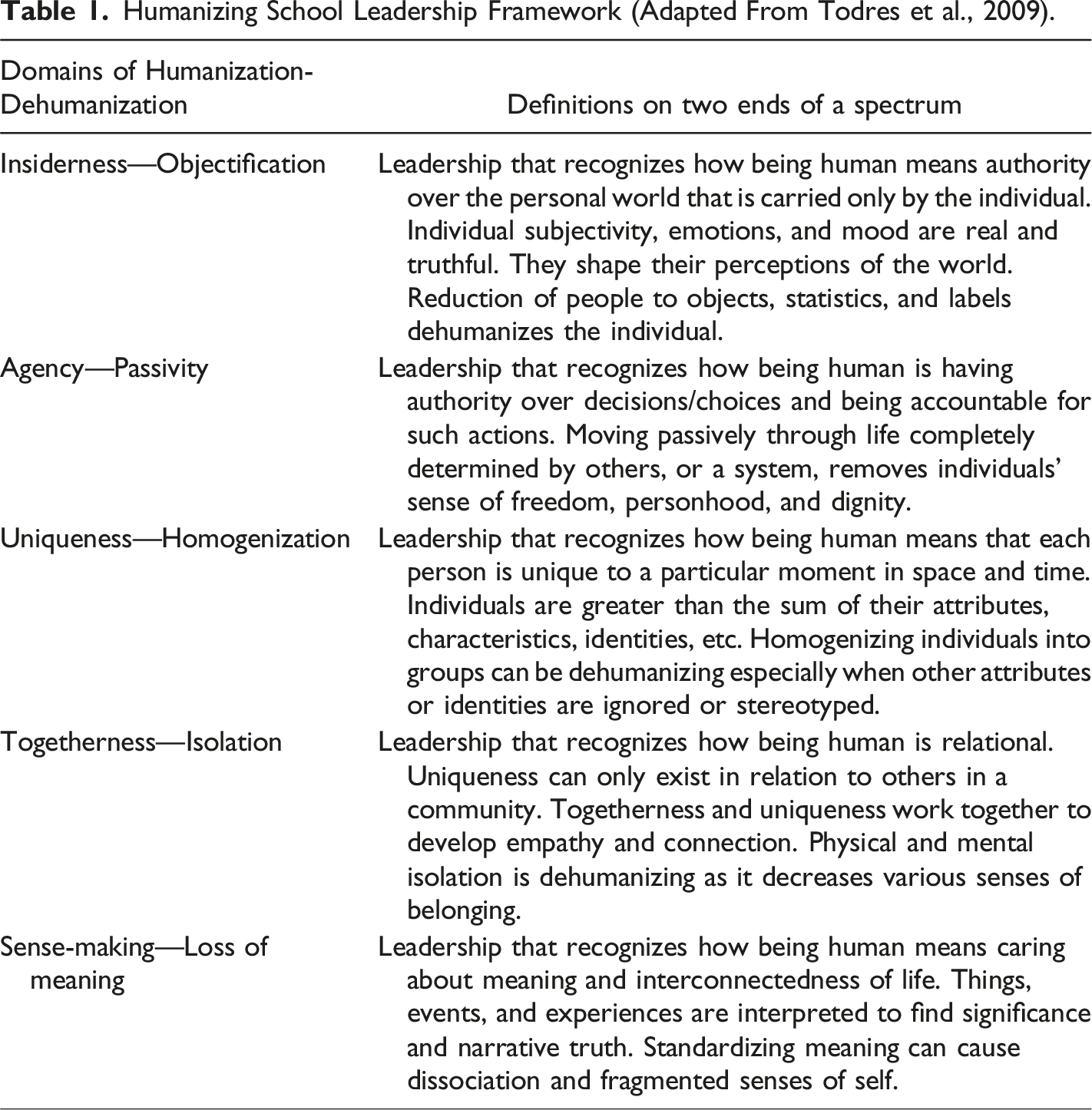
Given the limited conceptual frameworks on humanism within educational leadership research coupled with the fact that schools were contending with a public health crisis, we pivoted to other fields, especially health sciences, where we found a value framework for humanizing care (Todres et al., 2009). Todres et al.’s (2009) framework was developed to inform qualitative research in health science to humanize medical care and expand beyond positivist and reductionistic approaches in care delivery. Their framework is grounded in humanism philosophy from Husserl’s (1970) seminal work in phenomenology and the lifeworld, and Heidegger’s (2010) philosophical argument for the Dasein which involves the whole existence of a Being; a designer and author to represent particularities of human existence. In doing so, Todres et al. (2009) attempts to “articulate the essential constituents of humanization in relation to caring” in research and practice by providing eight dimensions where “each dimension is heuristically expressed as a continuum stretching from the term that characterizes humanization in a positive sense; through to the term that characterizes the barrier to such a possibility” (p. 69). For example, the first dimension of humanization is insiderness where the researchers argue To be human is to live in a personal world that carries a sense of how things are for the person. Only individuals themselves can be the authorities of how this inward sense is for them. Such subjectivity is central to human beings’ sense of themselves. Our sense of feeling, mood and emotion is the lens by which our worlds are coloured. This provides important human textures for valuing the qualities of things. (p.70)
When this dimension is ignored in any context, be it health or education, then objectification permeates and acts as a barrier to humanization. People are made into objects by focusing excessively on how they fit into a diagnostic system, part of a statistical picture or any other strategy by which they are labelled and dealt with that does not fully take account of their insiderness. There is a whole psychology of how we separate ourselves from one another through dissociation when something important is missing when responding to human need. (p.70)
An example in the health system is when physicians share bad outcomes with patients by focusing on the statistic or diagnostic aspects of the disease rather than the impacts on the individual’s life or family. Parallels of this insiderness/objectification dimension can be found in education regarding students, be it their joyful experiences in school versus assessment data tied to their names.
One justification for using this framework is because the emergent research has overlapping themes focused on personal and relational attributes of leadership that were prioritized over the traditionally functional approaches (Alvarez Gutiérrez et al., 2022; Harris, 2020; Lasater & Lasater, 2021). For example, attending to individual’s emotions, trauma, and psychological needs is a recognition of individuals’ uniqueness and insiderness. While this framework was developed for qualitative research in healthcare systems, education systems share several parallels. Both are human-oriented organizations that are concerned with the progress and outcomes of those who are within their care—physical, mental, emotional, etc. Both contend with systems, structures, policies, and other bureaucratic elements that can marginalize vulnerable populations. And, both systems are plagued to some degree with positivism, reductionism, and scientific values that have reduced the importance of the humanistic operational dimensions. These justifications, parallels, and public health context of COVID-19 make the humanist care framework (Todres et al., 2009) a relevant lens for exploring principals’ leadership in this study.
Humanizing School Leadership Framework (Adapted From Todres et al., 2009).
Methodology
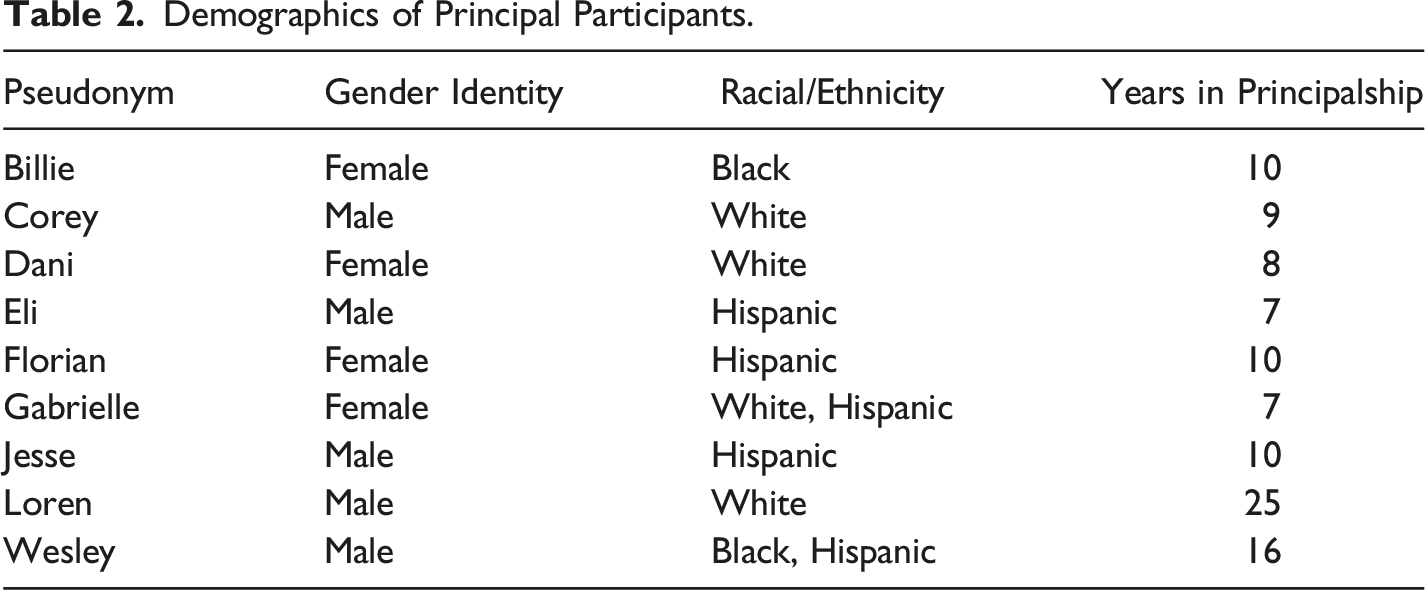
Participants
Demographics of Principal Participants.
Data Collection and Analyses
Semi-structured virtual interviews were conducted with each participant and lasted approximately an hour. The lead author developed the interview protocol that was reviewed by the co-author and other faculty on her dissertation committee. The interview questions aimed to answer research question 1). How did principals reconceptualize leadership roles, decision-making, and school priorities during the COVID-19 pandemic? by asking questions like “In what ways has your leadership changed or stayed the same? What aspects have become prioritized? Can you provide one or two critical or difficult decisions you’ve had to make? Can you describe the process?” We also collected documents released by the participants’ respective school districts that mentioned COVID-19 or were related to the pandemic context. These included formal district and school-based reopening documents, school communications, district strategic plans, and school improvement plans. These documents along with data from interview questions like “What kind of factors added to the tensions of your leadership? That is, what supports and barriers did you come across?” were analyzed to answer research question 3. Data collection occurred between March 2022 to May 2022.
Data were analyzed through an ongoing, iterative coding process. As described in the conceptual framework, preliminary rounds of coding began with a set of a priori codes pulled from Weick’s, Lave and Wenger’s, and Senge’s framework (Table 3). We used deductive, top-down coding approaches with these a priori codes and an inductive, bottom-up approach using in-vivo and descriptive coding schemes to understand the emerging themes in school leadership under the context of COVID-19. In the constant comparative process, codes emerged out of the inductive process that fell outside deductive guardrails. These included codes such as first responder, grace, life/death, emotion(s), care, and health which were surprising at the time, though now, documented in other similar studies (Da’as et al., 2023; Ferguson et al., 2021; Hayes et al., 2022). It was here that abductive reasoning kicked in, calling for us to shift our attention to these surprises as focal points for new understandings (Timmermans & Tavory, 2012). Abductive thinking forced us to look at our data reflexively and ask whether there might be alternative explanations (i.e., hypotheses or frameworks) to better explain what we were hearing and understanding. According to Kruse and Gray (2018) When we acknowledge that there are potentially multiple explanations and analyses of any given occurrence, we open ourselves to serendipity. We are better able to learn from the ideas of others and to accept that our knowledge is limited and bounded. By looking beyond the obvious, abductive reasoning can open the door to imaginative and elegant responses to the problems we face. (p.10) A Priori Codes From Initial Deductive Coding Approach.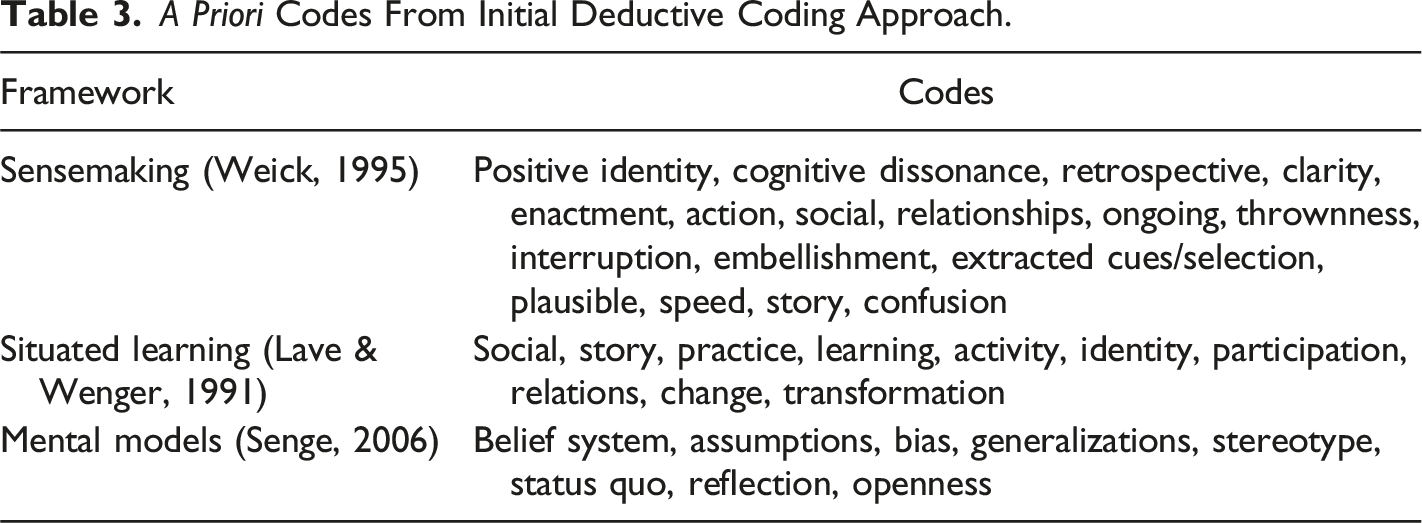
Thus, we made a critical pivot towards a humanizing framework to guide this study since our original frameworks did not sufficiently meet the emotional, individual, and humanistic leadership elements that came into focus in the initial analysis. We considered Rivera-McCutchen’s (2021) radical care and Lomotey's (1993) ethno-humanism conceptualizations, but since the pandemic was a global health crisis and surprising elements focused on life and death, we felt Todres et al.’s (2009) framework was justified. Once selected, we applied the same top-down, and bottom-up approaches to analyze the interviews and documents (Corbin & Strauss, 2014; Creswell & Poth, 2018; Saldaña, 2021) though this time, a priori codes were extracted from the humanist care framework which included the humanizing and dehumanizing pair constructs (e.g. insiderness, objectification, etc.) listed in Table 1. We conducted several rounds of coding to seek fit between the humanization values framework and our data to construct bins, sub-categories, and then categories to support the development of themes and findings (Creswell & Poth, 2018; Saldaña, 2021). Memoing was also employed throughout the research process to create interactions with the data, extract meaning, and bring depth to the participants’ experiences (Corbin & Strauss, 2014). Triangulation from nine participants and document data enhanced the credibility and reliability of the findings. Rich, thick descriptions were also generated for member checking to validate the findings (Birt et al., 2016; Merriam & Tisdell, 2015).
Positionality Statement
At the time of data collection, the lead author was a graduate student, and the co-author was a faculty member in the same department as the adjunct faculty/principal participants. The lead author was conducting this study as part of her dissertation. She did not have established relationships with the participants or perceived conflicts of interest in their recruitment. While the co-author was a former instructor for some of the principals, these participants had since graduated from the program. Additionally, the co-author had no supervisory role over any of the adjunct faculty. Other than providing suggestions for the lead author, the co-author/faculty member was not actively involved in the recruitment of participants or data collection process. During recruitment and the consent process, the lead author assured the participants that their willingness to participate or desire to leave the study would not affect their positions or working relationships as adjunct faculty. Furthermore, the lead author identifies as Chinese American, cis-gender female whose experiences in Florida where COVID-19 was not only politicized but also racialized (e.g. “Kung Flu”, “Wuhan virus”, “China virus”, etc.) influenced her sensitivity towards people’s social constructions of the pandemic. Her former training in health sciences served as permission to lean away from traditional educational leadership and organizational frameworks in search of humanism in other applied fields such as medicine. This background amid the pandemic served highlights how a framework in health sciences came into focus.
Findings
Principals’ Reconceptualizations of School Leadership
In reference to research question 1, we found that principals’ experiences with the severity of the crisis, life and death, and life-threatening decisions re-shaped their leadership conceptualizations to encompass first responder roles and identities. Additionally, these roles were paired with negative emotions used to describe this tumultuous time such as challenging, difficult, horrible, intense, sad, and depressing. All nine principals shared that their biggest priority was the physical health, safety, and well-being of students, teachers, and staff in their school communities. As a result, principals elevated, centered, or adopted first-responder roles that aligned to a public health crisis. This was partly due to principals’ experiences with COVID-related death through their personal or school community network. Billie, who spent the last decade working as a principal within small region of South Florida, was very well-connected across the community. She said, A staff member’s father passed away and all of a sudden another one, and another one, another one…then you're hearing calls from parents, students, this cousin, this brother, this sister, this father, this mother and it's hitting your staff and students.
This proximity to death and loss was profoundly difficult for principals to process but ensured that keeping individuals safe was an enormous priority especially when in-person learning resumed. Principals were performing new tasks like contract tracing; distributing public health information; creating social distancing protocols, procedures, and policy; changing the master schedule to reduce student contact; and creating multiple lunch schedules to increase the safety of students and staff on campus. In addition, principals were managing indirect effects of the pandemic. Some examples include pervasive teacher shortages (a result of COVID-19 infections or infections within their family that required quarantining), chronic student absenteeism, and behavioral changes due to trauma and mental health struggles.
Seven principals made explicit references to adopting professional identities oriented towards safety and health. They used words like first responder, nurse, doctor, epidemiologist, or phlebotomist when describing changes to their leadership roles. Since all the principals had at least seven years of leadership experience, they were confident in making operational, budgetary, and educational decisions. However, the last two years required making decisions under new circumstances, that at times, felt like life-or-death decisions. Florian said, “we heard about people going to hospitals, we heard about COVID killing people and getting very sick.” Florian had been a principal for the last ten years and carried a sense of duty to protect not only her school, but also herself and her family from viral contagion. When schools initially shut down, Florian shared that she was required to be on campus to distribute laptops to children and their families so that they could participate in online learning. She struggled internally with her personal exposure that put her family at risk. It’s very hard for me to reconcile my thoughts. I have 700 families at my school. I don't know who's has the virus. One of my daughters just had surgery so all I kept thinking about is what if I bring this virus home to my daughter who is recuperating. And, I expose her to it and she ends up in the hospital.
Florian’s sense of responsibility for other’s health was also extended to her faculty and staff. I had to persuade and recruit a team of people with me to give out devices when we knew that this virus was being spread at a rapid pace. So for me to have to ask somebody to come in and expose themselves was one of the hardest decisions I had to make in my career. And I remember I put in so many precautions because I want to make sure that everybody was safe but at night, it was very hard to reconcile these decisions.
Similarly, Dani who had worked eight years at her elementary school felt a deep sense of responsibility for her teachers’ lives. She said that asking teachers to come back to teach felt like “I was asking people to put their life on the line every day.” Principals were tasked with maintaining safety but also had to make decisions that put individuals at increased risk of harm. Similarly, Eli who was a principal at a large, diverse high school shared that in the past year, he had to make difficult decisions around remote work approval for teachers. He said, This teacher might be a little at risk, but we've got plenty of math teachers, so I'll approve this one. Another teacher has diabetes and hypertension, but they are the only art teacher, so they must come to school. So, having to make those kinds of decisions was just awful.
Eli joked that he was a doctor, but one in educational leadership who never thought he would be making medically based leadership decisions. Gabrielle also shared I am not an epidemiologist, and I don't pretend to be. I have my doctorate, but it is not the same thing. I tell people all the time, my doctorate does not mean that I have studied medicine. It just does not. I am not a phlebotomist.
Before the pandemic, principals felt responsible for students’ lives metaphorically through their educational outcomes and opportunities, but experiences with the intensity, severity, and consequences of COVID-19 reshaped their priorities, roles, and perceptions of leadership. Principals adopted first responder identities out of necessity as they grappled with decisions that endangered their school community and personal families due to exposure. Some principals were able to justify these decisions as par for the course. Jessie said, “the job’s the job, it has to get done, right?” Similarly, Wesley said, “just like the nurse doesn't have the right to just stay home because she's afraid, I mean so it is in education. We were part of those first responders in a different way.”
Other principals had a more difficult time coping with these decisions. Gabrielle shared that her job has become exhausting, and she’s questioned staying in her position. I have thought about moving to another state. I have thought about doing something else…. I'm tired. I am 43, and I am tired and I'm not old enough to be tired. If you would have asked me three years ago, four years ago, I would have been like ‘oh absolutely not’.
At the time of her interview, Florian had just left her campus for a leadership position in central office.
When principals were asked about specific challenges in their re-imagined roles, two principals made explicit mentions to Florida’s politicization of COVID-19. Corey, who was at a predominately white and affluent middle school said, “we have a community that is very much against wearing masks and getting vaccinated.” Corey identified as politically progressive and when tasked with ensuring everyone’s safety, he was deeply concerned about how to enact “common sense” safety when his school board upheld the Governor’s mask ban. However, he noticed that students at his middle school who were 12 or older seemed be immune. He said, “that was interesting because even though a lot of the families were anti-vax, anti-mask, there were a lot of people that were like covertly getting their vaccinations when the time came. They were just talking a big game.” In larger school districts, principals shared that their school boards tried to enforce mask wearing as long as possible. Jesse said, “out of responsibility, our school board ignored the ban until it became an executive order, then we complied”. Later, Jesse's school/district was punished for not initially complying. A-rated schools, like Jesse’s, receive additional merit funding which is often used to support resource inequity for his low SES students. However, schools/districts that ignored the mask ban (predominately left-leaning counties) were no longer eligible for these additional funds. Jesse said, “so essentially we’re getting penalized.” Our data show that principals in this study were not only navigating the complexities of leading through a life and death crisis, but also navigating hostile political contexts that created additional barriers to ensuring everyone’s safety.
Alignment of School Leadership with Humanism
In reference to research question number 2, we found that principals leaned into humanizing mindsets, communications, and actions to connect with their school community, but revealed vulnerabilities that humanized themselves as people first, leaders second. Specifically, we found that principals emphasized humanizing care values that emphasized insiderness, agency, uniqueness, togetherness, and meaningful sense-making.
Humanizing Mindsets
When principals were asked how their priorities changed, all principals shared that their leadership changed or shifted towards more humanistic approaches since the pandemic. Principals used words like human, grace, compassion, emotions, empathy, and connection to describe their focus on the whole person be it a teacher or student. Dani, Florian, and Gabrielle said that in addition to life-threatening circumstances, their schools were not doing well because the pandemic induced isolation, trauma, and grief that impacted the well-being of the school community. Gabrielle said The pandemic really caused me to shift and reprioritize. If the children aren’t good, if they’re not where they need to be, none of the learning matters. And if the adults aren’t where they need to be, if they aren’t being taken care of and they aren’t in a good headspace and a good heart space, then they’re not going to be able to facilitate that learning.
Gabrielle’s humanizing practices focus on insiderness where subjectivity, well-being, and psychological health was prioritized as a prerequisite to learning. She pushed back against the focus on accountability testing and said, That accountability hasn't gone away, but now it's back full force and there are times I sit in meetings and go, are you kidding me? You're not taking into consideration that they're still living in trauma. It didn't just go away.
Florian shared that she was grateful that her school was a social-emotional learning (SEL) pilot campus when the pandemic began. She believed SEL and related skills reduced the pandemic’s impact and elevated skills that focused on insiderness such as emotions, mood, and subjectivity. This allowed for individual human beings who were experiencing different emotions, realities, and grief to be in community with one another. She said You're teaching people how to deal with their emotions, how to identify them, what to do when you feel a specific way and then how are you going to articulate that and get along with each other and how we're going to work together to solve a problem.
Florian added that these leadership skills had been traditionally classified as “soft skills” which was problematic. If we are thinking about something being soft versus something being hard, then people get the impression that ‘okay, soft is something unimportant’. But I think it is very powerful if done correctly and its hard work! So when we say ‘soft skills’, we are limiting ourselves.
These findings suggest that the pandemic brought forward, and centered omnipresent leadership practices focused on care, emotional wellness, relationships, and support.
When principals were asked explicitly how their leadership had become more humanistic, all nine principals described a need to focus on relationships specifically through empathy, love, flexibility, compassion, and grace. However, each principal varied in the degree of emphasis in their responses. For example, empathy and compassion were themes that aligned to a majority of principals’ responses, but the degree of explicitness was variable. Jesse was the least explicit and said that COVID-19 did not change his leadership, but rather deepen his commitment to his core values which included empathy. However, most principals were very explicit about the ways in which their leadership became human-centric. Gabrielle shared I’ve always done really well connecting with people and that’s my strength. COVID allowed that strength to shine because our families, teachers, and students needed it. I think that compassion was really important.
Here, Gabrielle highlighted the humanitarian dimension of togetherness, where leadership is a relational act that creates a sense of belonging and community. The word grace was used by two principals to describe their leadership. Billie and Gabrielle described their ability to work with others, be patient, be understanding, and provide flexibility as a form of leadership termed synonymously with grace. Billie hoped that by extending grace to her teachers and staff that humanistic practices could be instilled throughout the school. She said I really push and stressed, please stop failing these children because I'm giving you a lot of grace. I'm leading with grace because you have to be out because your child is sick, your child has Covid and I was there for you. I let you stay at home or you found out you needed to sign out early or you forgot to turn in something that was due to me by certain date…I gave you grace and never got upset. I'm asking you to give the same grace to your students. It's hard for them to juggle being on this computer turning in assignments. This is a new way of learning for them they've never done before so I'm asking that you'd be patient and give them grace.
Though Jesse, mentioned earlier, was the least explicit about how his leadership aligned with humanism, he shared a statement similar to Billie’s where he prioritized the personhood over traditional academic priorities. Jesse told his teachers Make students’ mental health a priority. Make sure that they're in a good place. You take care of yourself, don't get stressed out over this and I actually said, ‘if we want to be on the right side of history here, then we're going to look out for the kids’ best interest and not necessarily a test score or anything else’. I mean that's something we never say.
Together these data showed that most principals were being explicitly and consciously human-centered in their leadership approaches.
Humanizing Communications
In hindsight, the pandemic was a major global public health crisis, but the day to day living and leading for principals within this context was ambiguous, confusing, and ever-changing. Principals in this study shared that they focused on communications to interpret and create meaning for their schools through the process of sense-making. Given the various forms of isolation, principals intentionally created a sense of togetherness through various communications so that isolation and loss of meaning were minimalized. In the early days of COVID-19, principals said they were making calls and sending emails 24 hours a day to manage virtual learning, internet access, food insecurity, and student truancy issues. Billie shared that she was checking in on individuals’ well-being, inquiring about COVID-positive recovery, and comforting families who lost loved ones to the virus. When school went back in-person, Gabrielle said she recorded weekly call-outs to keep families and teachers up-to-date with ever-changing school and public health policies. Corey said they started weekly newsletters to manage the amount of information that needed to be shared. While there were many technical aspects to communication, all principals said that communication created a sense of connectedness, care, and significance that allowed for meaning-making amid the ongoing threats, dangers, and uncertainties. Principals like Florian said that regardless of was happening, she would emphasize to her school community that they would “get through it together”.
Communications were also used to affirm individuals’ insiderness—their unique experiences, current journey, and subjective needs—during the crisis context. Out of the nine principals, Loren had the most experience as a school principal. Prior to the discussion on leadership changes, Loren shared that he had a difficult childhood, and it was his teachers that made a positive impact on his life. After college, he joined the Peace Corp and went to West Africa before returning home and becoming an educator. Loren recognized through personal experience the everyone had unique needs, but that became critical for his leadership during the pandemic. When schools returned to in-person instruction, he set the tone of empathy and care as part of the school climate. Loren believed that everyone was going through unique challenges so “being compassionate and empathetic for families and children coming to us with all these unique backgrounds” was fundamental for the school during and beyond this crisis.
Humanizing Themselves Beyond the Principalship
As noted earlier, principals described leading schools during the last two years as challenging, difficult, intense, sad, and depressing. Their jobs felt heavy and untenable from the onslaught of new tasks, roles, and workload. Billie compared the principalship during this time to being on a treadmill where the crises increased the speed, and principals were barely able to stay on. Our data showed that leading schools through crises had taken an emotional and psychological toll on principals. Florian said, It’s been very emotionally draining because, as a leader, you need to keep your composure and be strong for everybody. But you know, we're worrying about their health and the health of their loved ones so it’s draining.
Florian hits on an important tension in the principalship: principals, by nature of their roles, are required to be strong and the outfacing figure in crises, but even principals are human beings with limits. Dani talked about the physical and mental toll of the principalship since the pandemic. She shared, “I used to walk all the time and to be honest, now I get home and I hit the couch. I can’t even get myself out there…I just don’t have the energy.” Jesse said, “this job was going to kill me” so he intentionally created space between himself and the principalship recognizing that he needed to take care of himself if he wanted to take care of others. He shared When I leave here, I do not look at my emails anymore. I've turned off notifications of all kinds, no red numbers, no beeping, no nothing…I don't look at my email until the next day.
It’s important to note that all principals in this study were veteran principals who had years if not decades of experience. Regardless, all principals shared that the last few years of the principalship under the COVID-19 pandemic were untenable. Some principals sought agency to cope with the stress. For example, Jesse drew boundaries between his work and personal life from the quote shared above. Other principals intentionally sought out human connections to cope with difficult times. Seven principals shared that the pandemic deepened their appreciation for family and friendships—relationships they always valued but took for granted. Creating meaningful connections in their personal and professional lives helped principals regain some level of control. For example, Gabrielle said The serving others made me feel useful and like I was doing something worthwhile and in the midst of COVID when there was so little I had control over. I couldn't prevent you from getting COVID, I couldn’t prevent a kid from having the trauma, but if I could just serve a little bit while you were there and do something then I felt like I was contributing.
Humanizing others helped principals humanize their positions as principals. Gabrielle also created a corner in her office where teachers, staff, and students could cry, grieve, and be emotional. She said, “I can’t always fix the problem, but I can listen.” Principals believed that caring for others was important because it tapped into their purpose, eudaimonic happiness, and professional wellness. Principals were putting the needs of their students and teachers before themselves not only because it gave them a sense of agency, but because it made them feel good to help someone, in a context where they could do little to prevent individuals from getting sick. Our data suggested that the ability to take care of others was a self-care practice that made principals feel positive in return. However, some principals struggled to balance humanistic leadership practices and personal well-being. Principals who emphasized humanism (e.g., Billie, Dani, Florian, and Corey) were less likely to attend to their own needs. Time and emotional energy taken to support others meant less energy to support oneself.
Tensions in Humanistic Leadership and Dehumanizing Systems
In reference to research question number 3, we found that traditional school expectations and the politicized context of COVID-19 in Florida created tensions in principals’ humanistic leadership practices. Our analysis of district documents revealed a stark contrast to principals’ interviews in that we found little human-centered priorities. District strategic plans and school improvement plans from principals’ respective districts emphasized academic performance, proficiency benchmarks, graduation rates, and post-secondary attainment which essentially ignored the crisis context. At the time of data collection, two districts had a couple goals that acknowledge pandemic-related challenges such as student mental health and social-emotional learning. However, it was unclear whether these goals were established as a result of the pandemic since Florian shared that her school was a designated SEL campus prior to 2020. It is possible that other documents were present and then taken offline by 2022, but the lack of material focused on the sustained impacts of COVID-19 did not affirm, validate, or acknowledge the hardships, experiences, and trauma that were ongoing within the schools. Instead, these documents were heavily technical—providing numbers, statistics, and labels around students’ identities, performance, markers of marginalization, and graduation rates—which aligned to objectification and dehumanization of the school community’s experiences.
The return of state accountability systems also created friction with principals’ humanistic practices. At the time of data collection in 2022, Florida’s standardized testing and accountability systems returned to pre-pandemic expectations. Principals were in disbelief about having to prepare teachers and students for a standardized test after all they experienced in the last two years. Principals felt subjected to pre-pandemic normality aligning to a sense of passivity. Gabrielle said I have to care [about accountability] because that's my job. The state will come in and do something to my school. I’ll be rated a D or an F, but they’re not even taking into consideration that students are still living in trauma.
The state’s decision to resume testing forced schools to return to pre-pandemic priorities in a way that ignored the ongoing impacts of the pandemic.
As stated earlier, isolation, quarantining, virtual learning, and trauma meant principals shifted priorities away from business-as-usual mentality, but a sudden return to testing and performance-based funding mechanisms meant that principals no longer had agency in setting priorities. As such, principals felt tensions between their pre-COVID leadership and newly conceptualized leadership. Dani made this tension explicit as she reflected on her decision-making process in regards to academic performance. She said she was just happy that teachers showed up to do their best for the students because it was such a difficult time. But now, she was apprehensive about the potential consequences of her decision. She said I guess the children are the ones that suffered, and I can see that now. I really wasn't asking my teachers to do as much progress monitoring and academics because of COVID, and some of it was very difficult because of the situation. But should I have done more? Like I always say, should I have maybe asked for more?
Dani struggled internally to be the humanistic leader that was necessary under a crisis context, but not valued within normalizing systems that prioritized academic achievement.
The return of Florida’s education accountability system created pressures for districts and schools to return to pre-pandemic priorities, routines, and mentalities. Principals who pivoted towards humanistic leadership practices shared their internal turmoil around the loss of agency in decisions that ignored pandemic-related consequences. For example, Corey, who was deeply committed to social justice efforts and supporting all students had recently transferred a student to an alternative school. The student had frequent conflicts with his teachers and the dean of students, but Corey knew that the student was coming from a challenging home life. He said I could have shut it down and said no, let him stay. But I also felt like I had to let him face the music and deal with the consequences. It was a tough call to make I must say, given his circumstances.
As he continued, Corey hinted that he wanted to keep the student but returned to pre-pandemic compliance narratives to justify his decision. Similarly, Gabrielle said she had to pull the “principal card” to (re)establish boundaries in absenteeism and grades for her elementary students. She said You have to set certain expectations, adhere to things, and sometimes you have to make that unpopular call. We have a choice program and sometimes you have to threaten to remove them from the program. I get that there’s COVID and that everything is hard, but your kid has to come to school.
Though Gabrielle emphasized a humanistic approach in her leadership, grace only went so far. Her practice was still bounded by policies that she could not circumvent. Both these principals are justifying decisions using pre-pandemic leadership dispositions around expectations, standards, and compliance even as it de-contextualized students’ circumstances, experiences, and challenges over the last couple of years.
The hostile political environment also created tensions in principals’ humanizing leadership practices. These tensions were most apparent through the states’ conservative weaponization of the pandemic, and the return of high-stakes accountability systems. Unlike most states, Florida installed an executive order banning mask mandates in schools which threatened the number one priority of principals during this time—the safety of students and staff. All but one of the school districts initially defied the mask mandate ban, but by the end of 2021, all school districts had to comply. Principals still enacted standard safety precautions to the best of their ability, such as social distancing policies and revamping schedules for multiple lunch times. Gabrielle shared that even though she could not enforce masking, the district was supportive of providing the resources. Our attention to health and safety has greatly improved. We've gotten HEPA filters, we've gotten masks. Our district has done a really good job of making sure PPE and cleaning products and everything were readily available for us.
However, the series of dehumanizing state policies that were blatantly unscientific created discomfort and tensions in principals’ practice. When Eli was asked about the impacts of state policies, he said Yeah, I'm afraid. The writings already kinda on the wall. It started with the masking, don't mask. Vaccinate, don't vaccinate as we were just informed. It's just a matter of time before a parent files a suit because they hear something they don’t like.
As noted in the introduction, Florida’s hostile policies encompassed other aspects of education including what teachers were allowed to teach, what they were allowed to say about their identities, and what books they were allowed to have in their classrooms and libraries. As a result, principals felt that these policies and rhetoric dehumanized their school community, especially along markers of gender and race. Prior to 2020, Billie was proud of the way her school elevated diversity and enacted inclusion within her school. Students and staff wore pronoun buttons on their school ID lanyards, her school had a very active Student Muslim club, and her school made efforts to showcase the role of racially diverse historical figures and their contributions to American society. As a principal, Billie aimed to establish an “environment where teachers, students, staff, everyone feels accepted, supported, and loved no matter their gender, no matter their race, no matter their sexual orientation, all that.” But, with the onslaught of hostile policies and rhetoric, she questioned her ability to maintain that open environment. When her hand was forced to remove certain book from the library, she said “I feel like they’re not censoring the books they’re censoring our children” because the students were no longer seeing representations of themselves in school, and politicians were sending the signal that these students do not belong.
Our data and findings showed that the pandemic context sparked a reconceptualization of leadership concerned with the humanity of schooling. As forces attempted to move schools back to “normal”, some principals believed their leadership had permanently changed. Loren said I don't think we'll go back to what was normal, nor do I think that's even necessarily a good idea. I think we've learned lessons over the past several years...being compassionate and empathetic for families and children that are coming to us with all these unique backgrounds…Quite honestly, I don't want to go back to what was normal.
Similarly, Florian believed that societal views of education changed because schools became a critical component of a functional society. She said, Time will tell, but I don't think that we can move the same way as before. I think that experiences we have had in the last couple years are really going to impact how we move forward. I don't think we ever realized how important educators are to our families as first responders and keeping that in perspective is very important to provide them the place in society they really deserve.
The data showed that COVID-19 was an important catalyst for changing leadership priorities, practice, and conceptualizations. However, normalizing systems objectified schools by ignoring the crisis context entirely which made some principals question their leadership practices and/or feel compelled to make decisions that conflicted with their new conceptualizations towards humanism. Systems that focused on pre-pandemic normality made it difficult for principals to sustain these new conceptualizations within normalizing and sometimes dehumanizing systems.
Discussion
Findings from this study showed how nine principals expanded their roles to include first responder identities as they led schools through a public health crisis, similar to Da’as et al.’s (2023) study. All nine principals shared that their biggest priority was the physical health, safety, and well-being of students, teachers, and staff in their school communities which aligned with what others have found (Castrellón et al., 2021; et al., 2023a; Ferguson et al., 2021). However, we found that principals' experiences with life, loss, grief, and trauma centered the importance of humanity in their leadership mindset and decisions. The pandemic served as a catalyst that allowed principals to adopt humanizing leadership practices. Like other studies, we found that channels of communication were central aspects of crisis school leadership (McLeod & Dulsky, 2021; Smith & Riley, 2012) to bring individuals together (Fletcher & Nicholas, 2016) and to make meaning out of the new and ambiguous context (Lewin, 1947; Weick, 1995). Using the humanist care framework, we add to this base of knowledge by focusing on the content of the information beyond the technical and towards humanistic communication approaches. That is, the feelings, emotions, safety, and warmth of human connection through verbal exchange and language played an essential role in feeling seen and safe amid crisis contexts. Principals increased channels of humanizing communications to verbalize empathy, compassion, understanding, and forgiveness to recognize and support the varied challenges in individuals’ lives. In helping and supporting others, principals were able to humanize themselves by recognizing their own needs and importantly, their own limitations. All nine principals shared that the principalship was stressful and challenging in and beyond the pandemic. However, only three principals discussed specific self-care strategies such as exercise and boundary drawing to cope and promote well-being. At the time of this publication, only four participants remain as principals. Three principals transitioned into district leadership positions, and two have since retired.
Principals believed that their leadership practices had changed to become more human-centered, though normalizing systems that focus on pre-pandemic priorities created internal struggles for principals to sustain their humanistic conceptualizations. Our findings suggest that in some instances, the principals’ race and gender played a role in the degree they leaned towards humanistic leadership practices. Female principals and principals of color including Billie, Dani, Florian, and Gabrielle provided far more examples of humanizing efforts and decisions such as remote work approval, content of communications, and listening to others’ stress, worries, and grief. Though principals like Corey, Eli, and Loren shared a deep emphasis and vision for humanizing leadership. Nevertheless, all principals were sensitized to the fragility of life brought about by the pandemic. Their shared experiences with their students, teachers, and community enhanced their capacity for understanding, connecting, and having empathy and grace for others and themselves.
Conclusions and Implications
We need to emphasize the uniqueness of this study: for our participants, there was a beginning and a continuing, but not a recovery stage. No one knew when or how this was going to “return to normal” – that is very different from other “crises.” Moreover, the COVID-19 crisis is about health, including the health of the school leader. However, we see that when humanism was incorporated into previous studies, it was subsumed under leadership for equity. In their systematic literature review, Chatzipanagiotou and Katsarou (2023) found that humanistic leadership was conceptualized under equity. School principals in our sample exhibited a propensity towards a more humanistic leadership approach targeting the provision of equal opportunities for all students in digital education by mitigating adjustment problems at school both during and after the pandemic crisis. Constrained by inadequate funding and technological equipment, principals still tried to promote inclusive education at all costs, behaving patiently, compassionately and humbly and emphasizing the importance of overcoming COVID-19 crisis as one following a more loving, understanding and just management approach…However, as schools already move into a recovery mode of teaching and learning, it becomes imperative that educators and policymakers reimagine effective interventions at the school level to abate and negate COVID-19 learning losses and consequent exacerbated inequities in the educational process within a supportive school environment that can effectively promote and nurture cognitive as well as social/emotional skills (p. 19).
However, we see humanism as larger and distinct from equity. We argue that attention to traditional equity—a concern for resource distribution; learning outcomes and disparities; and academic achievement—is but a step towards a holistic understanding of humanity and personhood.
The broader purpose of humanistic education is to uplift humanity, collectively. According to Dewey in 1917, “Education should not be so practical; so devoted to the gains that the great object in life is obscured” (as quoted in Stallman, 2003, p. 18). Rather, “knowledge is humanistic in quality not because it is about human products in the past, but because of what it does in liberating human intelligence and human sympathy” (Dewey, 2012, p. 244).
Our use of the humanization of care framework (Todre et al., 2009) was an attempt at moving beyond technocratic leadership and towards humanistic leadership. Principals repeatedly prioritized humanizing elements like insiderness, agency, uniqueness, togetherness, and sense-making. Principals’ intentional communications created a sense of togetherness and unity in a time when people were physically separated. In the return to in-person learning, principals became sense-makers of ambiguous, ever-changing, and evolving information. Principals provided examples of teachers’ and students’ unique struggles that recognized the plurality of experiences during the pandemic which emphasized their understanding of insiderness and uniqueness of the school community. The humanistic framework helped to explain how humanism could co-exist when situated within normalizing systems that objectifies students through labels and decontextualizes educators’ experiences within and beyond schools. It was not that principals did not have to contend with standardized testing, hostile state politics, and pre-pandemic leadership belief systems that created tensions, but rather the priorities in the push-pull between humanizing leadership and decontextualized school systems.
Perhaps most dramatically, the pandemic revealed principals as human beings with limitations. As one of the principals stated, “they’re still living in trauma. It didn’t just go away.” This sentiment holds true for principals too. Principals struggled and continue to struggle with the demands of the job and secondary trauma (DeMatthews, Carrola, et al., 2021; Mahfouz, 2020). For decades, researchers have shown that the principalship is stressful, but only recently has the field considered the impacts on personal health and the effects on principals’ leadership efficacy and sustainability (Ray et al., 2020; Su-Keene et al., 2024a; Su-Keene & DeMatthews, 2022). Recently, the lead author found that mental and physical health play critical roles in the principalship affecting perceptions of effectiveness and longevity (Su-Keene et al., 2024b). As other studies have suggested, research on school leadership well-being will need to be prioritized in a post-pandemic era especially when principal turnover has been predicted to increase (Anderson et al., 2020; Hayes et al., 2022; Steiner et al., 2022; Urick et al., 2021). Moving forward, educational researchers and preparation programs may need to consider the role of mental health, physical health, and well-being in the development of sustainable school leadership.
While our study found evidence of principals reconceptualizing their leadership, we cannot determine the sustainability of such changes though many aspects of the pandemic are still lingering. Principals in our study had gained a mountain of experience that they could not imagine returning to pre-pandemic school leadership. But, how will school leaders resist the re-formation of school walls as closed system boundaries to maintain the care, empathy, and values of human life within their schools? To date, the literature is clear: the ordinariness (Jansen, 2008), the predictable failure of reforms (Sarason, 1990), the grammar of schooling (Cuban, 2020; Tyack & Tobin, 1994), and cultural reproduction (Bourdieu, 2018) predominate. Was this historical moment the wedge to allow for the organizational learning ideas of Lewin (1947), Fullan (2015), and Senge (2006) re-emerge in professional development and interventions? While this study aimed to illuminate the unique struggles of principals in a politically hostile context such as Florida, the context of this study has become increasingly relevant as authoritarianism and political hostility increases nationally, emboldened by Donald Trump’s re-election in the US. In this study, Florida’s hostile political context no longer serves as an outlier, but rather a leading example of how hostile policies and rhetoric can dehumanize educational contexts. Humanizing school leadership under socially, politically, and economically challenging contexts will be more critical than ever as one executive order after another (e.g., defunding science, dismantling the Department of Education, and banning diversity) aims to dehumanize an entire populace.
Footnotes
Declaration of Conflicting Interests
The author(s) declared no potential conflicts of interest with respect to the research, authorship, and/or publication of this article.
Funding
The author(s) received no financial support for the research, authorship, and/or publication of this article.
