



Abstract
The study examines the impact of middle leaders’ cognitive complexity (CC) on team performance and conflict management, focusing on their positive perception of diversity. This study is quantitative; the Person’s R test was used. The proposed model was examined using (ML-SEM) equation modeling in the M-Plus program. To determine whether the model fits, I used the fit indices of comparative fit index (CFI) and root mean square error of approximation (RMSEA). A fit index of more than.90 and RMSEA of less than.10 indicates adequate validity. Aggregation was conducted to address conflict and performance at the school level, within-group interrater agreement (rWG), and intraclass correlations (ICCs): ICC1, ICC2. ICC1 examines the within-group variance by answering the question: To what extent can variability measures be predicted from team membership? ICC2 examines the between-group variance by answering the question: How reliable are the team means within a sample? The data comprised 71 middle leaders who constituted 71 teams and 228 team members with a minimum of 3 teachers in each team (according to the G*Power program) from 12 Israeli schools. Results showed that middle leaders' CC affects team performance through its effect on their positive perception of the diversity of their team members. Further, the diversity perception of middle leaders was negatively related to teachers’ perceptions of conflict (relation conflict and process conflict). Conflict in teams was not related to performance. The current study can enhance school management strategies by promoting diversity and heterogeneity among middle leaders, thereby improving decision-making and performance outcomes.
Introduction
School leaders and middle leaders recognize the importance of effective teamwork (Harris & Jones, 2017) in today’s competitive environment. Middle leaders, such as heads of departments and subject coordinators, play a crucial role in leading teamwork, managing diversity, resolving conflicts, improving communication, and implementing curriculum reforms (Li et al., 2018), and also represent the team before senior management. That is why Somech and Naamneh (2019) argue that effective middle leadership is the kind that can move back and forth across the team boundary, utilizing internal activities that focus on internal team processes and external activities that focus on connecting the team with the external environment in which it operates. Thus, the current research seeks to answer the question of how do school middle leaders promote teachers’ performance within teamwork.
Although team effectiveness is not limited to middle leaders and is also dependent upon the leadership style and behavior of all levels of leadership within schools (Mahaputra & Saputra, 2021; Maryati et al., 2020), which are school principals and senior leadership, leading processes within a team can sometimes be flawed and yield unwanted results, such as diversity mismanagement and lack of communication (Grootenboer et al., 2015; Levi & Askay, 2020; Oplatka, 2015) or unresolved conflicts within the team (Hackman & Johnson, 2013; Levi & Askay, 2020). This may harm team members’ productivity (Levi & Askay, 2020), performance, and cooperative tackling of issues related to student outcomes (Stronge & Xu, 2021). Previous research has indicated that leadership behavior predicts teamwork performance and influences team performance outcomes, not only among middle leaders (Burke et al., 2006; Ceri-Booms et al., 2017; Cole et al., 2011), yet the effect of middle leaders' characteristics on team performance has not been given consideration. The current study attempts to understand teamwork performance through cognitive and information-processing approaches in a school context, addressing how school middle leaders’ CC affects teachers' performance in teamwork (Figure 1). The proposed model.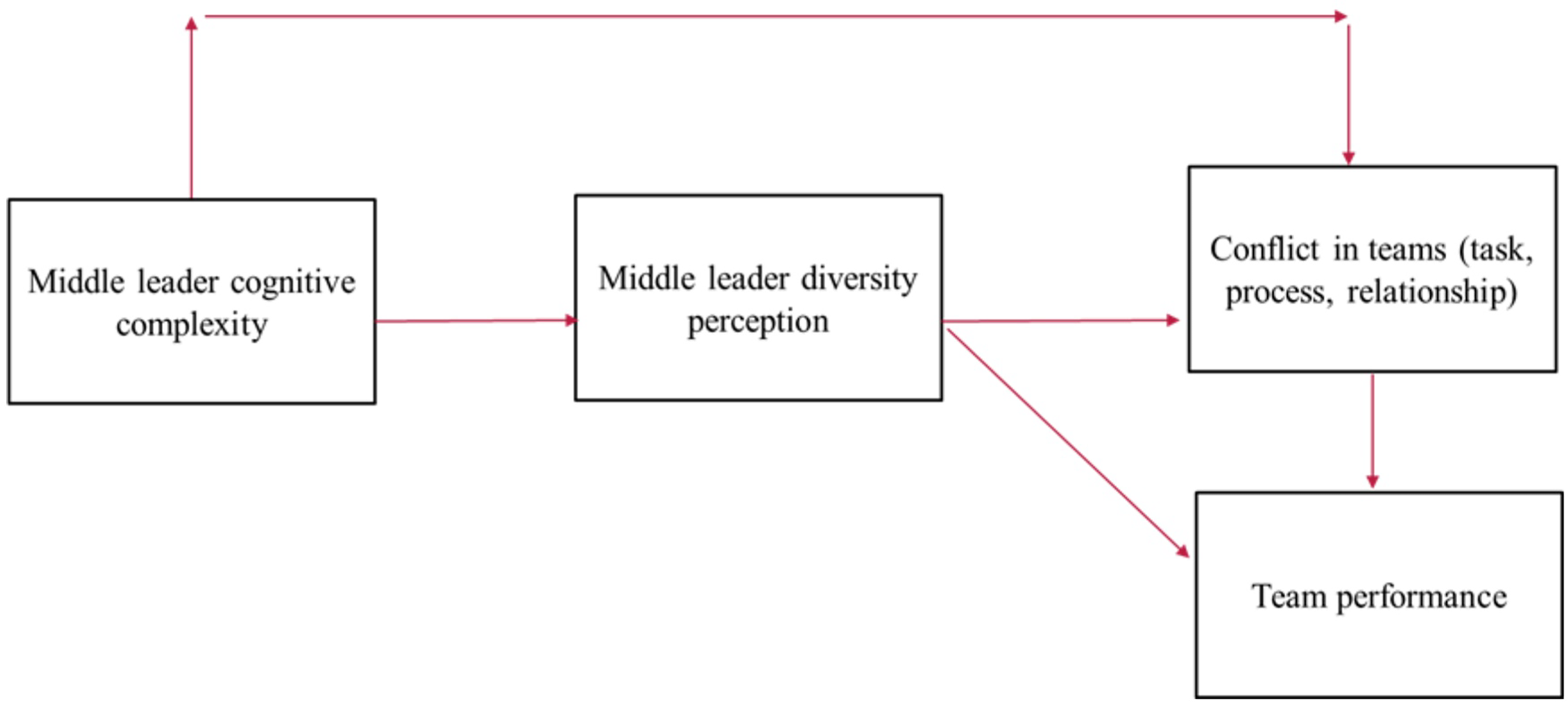
Theoretical Framework
The Context
The Israeli Ministry of Education and principals delegate responsibilities to school middle leaders, who are seen as key figures in implementing school goals (Israeli Ministry of Education, 2017). Among the major challenges faced by school middle leaders are: developing interpersonal relationships; tensions between collegiality and accountability; and a lack of allocated time (Bassett, 2016).
Middle Leaders’ Cognitive Complexity
Cognitive ability is a trait that individuals who can conceptualize their environment and structure their social world have (Suedfeld, 2010). Cognitive complexity, a theory of personality based on Kelly’s theory (1955/1991), focuses on an individual’s ability to process information and structure their social world and environment (Carraher et al., 2004) from a multidimensional perspective. It includes dimensions of differentiation and integration, where differentiation refers to the number of constructs used to evaluate and interpret events (Green, 2004; Tetlock, 1985); for example, a self-concept described by four features is considered more complex than a self-concept described by only one or two features (Da’as, 2022). Integration refers to their systematically related nature (Burleson & Waltman, 1988). In other words, a concept described by a single assertion is less complex than a concept that integrates multiple assertions (Bagdasarov, 2009).
Diversity Perception
Diversity perception is how individuals categorize themselves and others into and out of groups based on their perceived similarities and differences (Hentschel et al., 2013). Perceived diversity captures “members' beliefs about the diversity within their team” (Hentschel et al., 2013, p. 35). Perceived diversity also reflects individual awareness that others differ along their salient dimensions (Shemla et al., 2016). By and large, perceived diversity reflects the psychological evaluation and cognitive construal of actual diversity (Harrison et al., 2002). Perceived diversity reflects individual awareness that others differ along any salient dimension (Shemla et al., 2016). Other common perceptions of group heterogeneity denote the degree to which members construe their team to be composed of individuals who differ from each other on a particular attribute (Shemla & Wegge, 2019).
Team Conflict
Team conflict is a common issue in teamwork (Levi & Askay, 2020), where members have different perspectives, beliefs, and values. There are three types of conflicts: relationship, task, and process. Relationship conflicts involve interpersonal incompatibility (Jehn & Mannix, 2001), while task conflicts involve disagreements about goals and interests (De Dreu & Gelfand, 2007). Process conflicts involve issues of duty and resource delegation, leading to frustration and animosity within the team (Jehn & Mannix, 2001). Team conflict yields adverse outcomes and requires efficient management. There is agreement that conflict can result in either positive or negative outcomes, yet none disagrees that conflict needs to be managed effectively (Tekleab et al., 2009; Vigil-King, 1999).
Team Performance
Team performance is a goal-oriented process where team members manage individual tasks and processes, utilizing resources, collective effort, and specific performance indicators (Guzzo & Shea, 1992; Hackman, 1973). It involves goal-oriented activities, where members utilize personal and shared resources to produce goods and services (Kozlowski & Klein, 2000). According to Dess and Miller (1993), because specific performance indicators and the availability of certain resources may vary from team to team, they represent team performance only as process-type performance, meaning team process-based performance may include levels of collective effort expended or the quality of interpersonal relationships (Klimoski & Mohammed, 1994).
Middle Leaders’ CC, Diversity Perception, and Conflict
Middle leaders with high CC levels are open to experience, innovation, change, and communicating better with teachers (Da’as et al., 2018, 2020). In this sense, they respond more accurately to a rapidly changing, highly diverse, and competitive environment (Hockerts, 2014). However, educational leaders with low levels of CC prefer a stable environment and are less able to make changes in that environment. Low CC is related to having a simplistic view of events and using simple connections between dimensions and constructs (Suedfeld, 2010), where individuals tend to understand their surroundings less dimensionally (Green, 2004). When considering circumstances, issues, choices, or people, people with CC such as integration and differentiation skills may view things from several angles (Cheng & Chang, 2010). Moreover, those with high CC have excellent listening skills and can recognize a variety of possible reasons behind the actions of others. Meaning, school leaders with high CC may accept the acts of people who have opposing views and show empathy for them (Da’as et al., 2018). As a result, middle leaders who possess higher levels of CC are inclined to anticipate and implement more proactive measures to cater to the demands of diverse stakeholders (Wong et al., 2011). They can tolerate the conduct of others who have opposing views and feel empathy for them (Yan-hong & Jing, 2010). This is why middle leaders with CC will perceive diversity as valuable and be more sensitive to it. Individuals with higher levels of CC have a variety of perspectives when thinking about situations, problems, decisions, or individuals (Cheng & Chang, 2010); they are good listeners and can identify multiple potential causes of others’ behaviors; for example, school leaders can manage conflicting viewpoints among their team members and accept their actions using effective communication skills (Da’as et al., 2018). Consequently, managers with higher levels of CC are more likely to address and balance the needs of various stakeholders, even if doing so requires considering responses that are far from or alien to established organizational routines (Wong et al., 2011). Therefore,
Diversity Perception, Team Conflict, and Team Performance
Diversity perception is linked with the reduction of team conflict (Otaye-Ebede, 2018; Van Leeuwen, 2017). Research has found a positive correlation between diversity perception among school leaders and work effectiveness among school teams (Ashikali & Groeneveld, 2014). Previous research has indicated that diversity perception impacts group processes and behaviors of team members and influences the level of conflict experienced by individuals in the team; that is, once a deep diversity level (non-visible traits such as valuing attitudes and beliefs) is perceived as positive, there is less conflict in teamwork and performance outcomes take place (Van Leeuwen, 2017). In addition, previous research has indicated that diversity perception impacts group processes and behaviors of team members and influences the level of conflict experienced by individuals in the team, that is, once a deep diversity level (e.g., non-visible traits, such as valuing attitudes and beliefs) is perceived as positive, there is less conflict in teamwork, and performance outcomes take place (Van Leeuwen, 2017). Once leaders know how to manage diversity effectively, they bring about group harmony, which prevents conflicts in many situations (Acar, 2010; Tekleab et al., 2009). When middle leaders perceive and value the differences between teachers in their teams, this will have implications for team processes and conflict, and teachers will experience less conflict in teamwork, which is also articulated by its three dimensions. Thus, I argue that Middle leaders’ positive perception of the diversity of their team members will be negatively correlated with team conflict dimensions:
Perceived diversity can have positive effects on team performance outcomes (Fujimoto & Härtel, 2004; Van Dick et al., 2008; Van Knippenberg et al., 2007); however, this depends on how open leaders are, and, in this case, we are looking at middle leaders’ attitudes toward dissimilarity and what their beliefs about diversity are. When leaders believe in working with diverse others, diversity leads to fewer team conflicts and positive outcomes such as group identification or greater performance (Van Knippenberg et al., 2007). When school middle leaders value team differences and are sensitive to teacher differences, teachers will perform better in their teams. Therefore,
Furthermore, teams that have not suffered from a high rate of conflict experience team cohesion and greater effectiveness (Tekleab et al., 2009). Longe (2015) found that conflict was an unavoidable phenomenon in organizational life and could contribute to or detract from organizational performance depending on the conflict management methods adopted in the workplace. It was found that relationship conflict indirectly negatively affected both the task performance of teams and social-based aspects of group performance (Manata, 2016). Members who experience more process or relationship conflicts are less likely to share knowledge, and team performance is also impacted (Hewitt et al., 2020). Therefore, it is essential to prevent task conflicts from escalating into relationship conflicts, which can subsequently hinder performance (Thomas, 2022).
Task conflict can be beneficial for teams, but it can also lead to relationship conflict, negatively impacting performance and team morale (Jehn et al., 1999). While discussing ideas can improve engagement, relationship conflict can hinder positive work engagement (Costa et al., 2015). A study on student design project work found a negative relationship between team conflict and performance (Neumeyer & Santos, 2020), but inconsistent literature suggests a positive relationship (Humphrey et al., 2017; Tekleab et al., 2009). Therefore,
Middle Leaders’ CC Effect on Team Performance Through Diversity Perception
Finally, I argue that middle leaders’ CC affects performance through its negative effect on conflict dimensions and through valuing diversity and its sensitivity to the diversity of teachers. Previous research found that middle leaders indirectly affect teachers’ outcomes (e.g., Da’as et al., 2020). Previous research has indicated that diversity perception impacts group processes and behaviors of team members and influences the level of conflict experienced by individuals in the team, that is, once a deep diversity level (non-visible traits) is perceived as positive, there is less conflict in teams, and performance outcomes take place (Van Leeuwen, 2017). Once leaders know how to manage diversity effectively, they bring about group harmony, which prevents conflicts in many situations (Acar, 2010; Tekleab et al., 2009). Conflict was found to be a mediation variable. The mediating effect of the constructive-cooperative conflict management strategy on the relationship between team identity and team innovation was found, and relationship conflict was negatively associated with a team integrating pattern, while a positive association of task conflict with the cooperative strategy was significant (Desivilya et al., 2010). Further, it was found that school leaders CC affect a teacher’s intent to leave the profession through the mediation of the school’s absorptive capacity (the organization’s ability to “identify, assimilate, and exploit knowledge from the environment” (Cohen & Levinthal, 1989, p. 569) and teachers’ commitment (Da’as et al., 2020). Thus,
Methods, Participants and Procedure
Seventy-one middle leaders (subject, pedagogical, and grade level coordinators), 71 teams, and 228 team members (a minimum of 3 teachers in each team) from 12 Israeli schools participated in this study. It included 71 teams and 228 team members, with a minimum of 3 teachers in each team. A calculation was conducted using the G*Power program to estimate the smallest sample size needed for this study, given a required significant level, statistical power and effect size. Not all schools cooperated, and when there were insufficient responses, the schools were dropped from the study. In some schools where there was cooperation, some team members chose not to answer, or some teams did not have enough team members, to begin with, so they were eliminated from the study. The Chief Scientific Officer of the Israeli Ministry of Education approved the research. All participants were assured that their responses would remain confidential. Schools, middle leaders, and teachers were selected by convenience. To minimize common-source bias, two sources were used to collect data: middle leaders filled out a questionnaire on CC and diversity perception and provided demographic variables and their team members responded to questions about team conflict and teacher performance and provided demographic variables as well. Teams within schools as well as team members were selected randomly, minimum of 3 teachers of each team received a survey, therefore the convenience sample technique used in the study does not restrict how far results can be applied. The participants completed a survey via Google Form. I used middle leaders to help distribute questionnaires to team members through WhatsApp. The questionnaire was distributed in google forms in Hebrew and Arabic via WhatsApp during COVID-19 restrictions. Schools, middle leaders, and teachers were selected by convenience method. All questionnaires were translated from English to Hebrew and Arabic and back translated to verify the validity of the items (Brislin, 1986). In the efforts to translate the English-language survey into two languages I decided to focus on equalizing meaning, wording, and scaling of the items, which are like the conceptual, linguistic, and metric types of equivalence. Every team member was given a specific code to identify them with their middle leaders.
Measures
Cognitive Complexity (CC)
Cognitive complexity (CC) was measured using a questionnaire developed by Bagdasarov (2009). The questionnaire included 14 items: seven items of integration and seven items of differentiation. Middle leaders rated the items on a 5-point Likert scale ranging from strongly disagree (1) to strongly agree (5). A confirmatory factor analysis (CFA) was conducted using the AMOS 20.0 software program. I used fit indices recommended by Byrne (2013): the values of the comparative fit index (CFI), incremental fit index (IFI), and Tucker-Lewis’s index (TLI) are recommended to be greater than.90; the root mean square error of approximation (RMSEA) is recommended to be up to.05 and acceptable up to.08 (Steiger, 2007). The two-factor construct showed acceptable fit indices: χ2 (50) = 69.96, RMSEA = .07, CFI = .93, TLI = .91, and IFI = .94.
Diversity Perception of Middle Leaders
A three-item scale compiled by Hentschel and colleagues (2013) was included to measure middle leaders’ perceptions of diversity. These items describe perceptions about diversity and differences between teachers in the team. Teachers rated the items on a 5-point Likert scale ranging from strongly disagree (1) to strongly agree (5). Construct validity showed an adequate fit to the data: χ2 (26) = 36.19, RMSEA = .07, CFI = .99, TLI = .98, and IFI = .99.
Team Conflict
Relationships and task conflict were measured using Jehn and Mannix (2001) questionnaire. Process conflict was measured using Shah and Jehn (1993) questionnaire. Teachers rated the items on a 5-point Likert scale ranging from none (1) to a lot (5). Construct validity by Amos, showed that the three-factor construct had acceptable fit indices, χ2 (61) = 101.73, RMSEA = .09, CFI = .95, TLI = .93, IFI = .95.
Team Performance
Team members completed a questionnaire rating team members’ effective performance, adopted from Alper, Tjosvold, and Law’s (2000) questionnaire. 17 items were used, and four were adjusted for team members since the items were designed for business context. The items involved productivity and quality of teamwork. Middle leaders rated the items on a 5-point Likert scale ranging from strongly disagree (1) to strongly agree (5). Construct validity showed adequate fit to the data: χ2 (110) = 175.90, RMSEA = .09, CFI = .96, TLI = .94, and IFI = .96.
Reliability Cronbach’s Alpha, Correlation Between the Study Variables, Means (M), and Standard Deviations (S.D.) for the Study Variables.
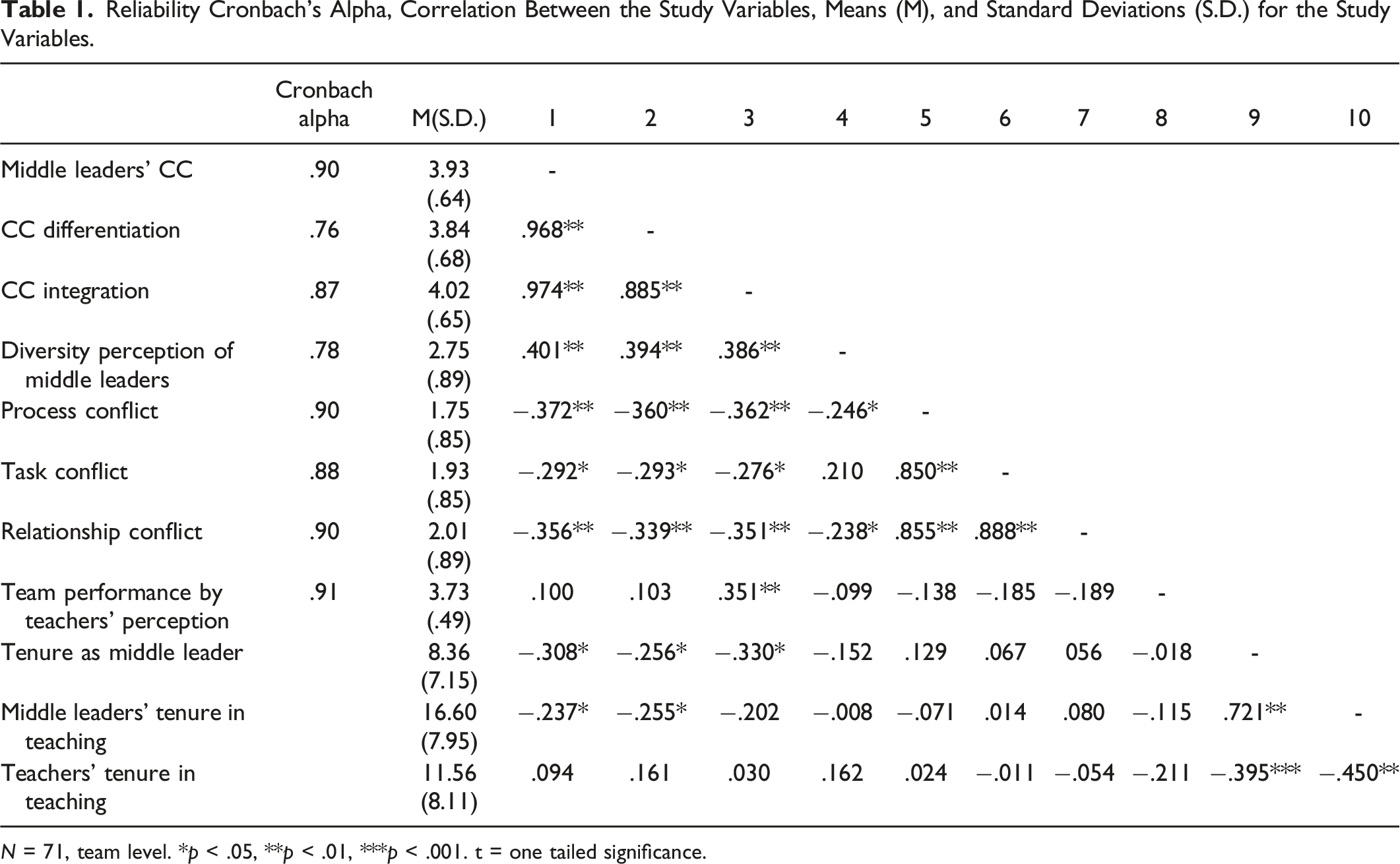
N = 71, team level. *p < .05, **p < .01, ***p < .001. t = one tailed significance.
Control Variables
Middle leaders’ tenure in teaching, middle leader tenure as a coordinator, type of middle leader, and team members' tenure in teaching were included as control variables in the study. The type of middle leader was mentioned in previous research as affecting teachers’ outcomes, such as teachers' change in pedagogical practices (e.g., Li et al., 2018). Tenure affected diversity perception, team processes, and outcomes (Henttonen et al., 2014; Otaye-Ebede, 2018; Somech, 2006). Teachers who have more experience also have students with better learning achievements (Phytanza & Burhaein, 2020). There is a significant effect of job tenure on teacher performance. One of the factors influencing teacher performance is job tenure or years of service. The longer the teacher’s job tenure, the longer the teaching experience at school. Teachers who have more experience with their students have better achievements in learning; the longer the job tenure, the more experience they have and the better their performance is (Phytanza & Burhaein, 2020). Therefore, it was found that students’ achievements and learning objectives are better achieved due to teachers' tenure; hence, tenure affects the school process (Phytanza & Burhaein, 2020). Another example is a study that Somech conducted (2006) regarding the effect of leadership and processes on heterogeneous teams, where tenure was used as a control variable. She found a negative relationship between tenure heterogeneity and team reflection (which involves behaviors such as questioning, debating, planning, exploratory learning, analyzing, etc.) and between tenure heterogeneity and team role performance (Somech, 2006). In addition, Phytanza and Burhaein (2020) found that teachers’ tenure affects their students' learning achievements.
Data Analysis
The research model’s unit of analysis is team level (CC and perception of diversity were team constructs). Thus, aggregation was conducted to determine conflict and performance using within-group interrater agreement (rWG) (James et al., 1984; Newman & Sin, 2020) and intraclass correlations (ICCs) (Bliese, 2000): ICC1, ICC2. ICC1 examines the within-group variance by answering the question: To what extent can variability measures be predicted from team membership? ICC2 examines the between-group variance by answering the question: How reliable are the team means within a sample? (Bliese, 2000; Bliese et al., 2019). ICC1 for conflict task, relationship, process, and performance are.18, .09, .06, and .16, respectively. ICC2 for conflict task, relationship, process, and performance are.40, .33, .51, and .38, respectively. Rwg for conflict task, relationship, process, and performance are.70, .75, .78, and .79, respectively. Overall, these results provided sufficient statistical justification for aggregating performance and conflict at the team level (Bliese, 2000; James et al., 1984). The theoretical model was examined using structural equation modeling (SEM) by the AMOS program. To determine whether the model fits, fit indices of comparative fit index (CFI) and root mean square error of approximation (RMSEA) were used. A fit index of more than .90 and an RMSEA of less than .10 indicate adequate validity (Byrne, 2013). Further, mediation was examined using the bootstrap method recommended by Preacher and Hayes (2008). The advantage of this procedure lies in evaluating the confidence interval measure of the population from the data. A non-zero confidence interval means that mediation exists. As previously recommended, I used 2000 iterations to obtain confidence intervals for acceptable precision (Preacher & Hayes, 2008).
Results
Table 1 presents correlations between the study variables. Cronbach’s alpha for reliability means, standard deviation, and correlations are reported in Table 1. Table 1 shows a significant (one-tail) correlation between middle leaders’ CC and their diversity perception (rp = .215; p = .07; one-tail significant). A significant negative correlation was found between diversity perception and conflicts (rp = −.270; p < .05). A non-significant correlation was found between diversity perception and task conflicts (rp = −.183). A significant negative correlation was found between diversity perception and process conflicts (rp = −.279; p < .05). A significant negative correlation was found between diversity perception and relationship conflicts (rp = −.300; p < .05). A significant negative correlation was found between conflict in teams and their performance (rp = −.283; p < .05). A non-significant correlation was found between task conflict in teams and their performance (rp = −.221; p = n. s.). A significant negative correlation was found between process conflict in teams and their performance (rp = −.261; p < .05). A significant negative correlation was found between relationship conflict in teams and their performance (rp = −.313; p < .01).
Hypothesis Tests
Figure 2 shows the results of the SEM model, which indicated a good fit between the model and the data (CFI = .949; TLI = .912; IFI = .953; RMSEA = .0.086). Figure 2 shows a significant positive relationship between middle leaders’ cognitive complexity and their perception of diversity (β = .22; p < .05); thus, hypothesis 1 was confirmed. No direct relationship was found between middle leaders CC and task conflict β = −.138; and with relational conflict β = −.173 (n.s.). However, a one-tailed significant relationship was found between process conflict and middle leaders CC (β = −.212; p = .06). Thus, hypotheses 2 (a and b) were not confirmed, and hypothesis 2 partially confirmed hypothesis 2 (c). There is a negative relationship between middle leaders' positive perception of diversity and team process conflict (β = −.234, p < .05) and a negative relationship between middle leaders’ positive perception of diversity and relationship conflict (β = −.263, p < .05); thus, hypotheses 3 (a & c) were confirmed. No significant relationship was found between middle leaders' positive perception of diversity and task conflict (β = −.15; n. s.); thus, hypothesis 3 (b) was not confirmed. Middle leaders’ positive perception of diversity was related positively to performance (β = .537; p < .001); thus, hypothesis 4 was confirmed. Furthermore, there was a non-significant relationship between process conflict, relationship conflict, task conflict, and team members’ performance (β = −.005, −0.13, −0.005, respectively); thus, hypotheses 5 (a, b, c) were not confirmed. Finally, none of the control variables were related to the research variables. Results of the hypothesized model.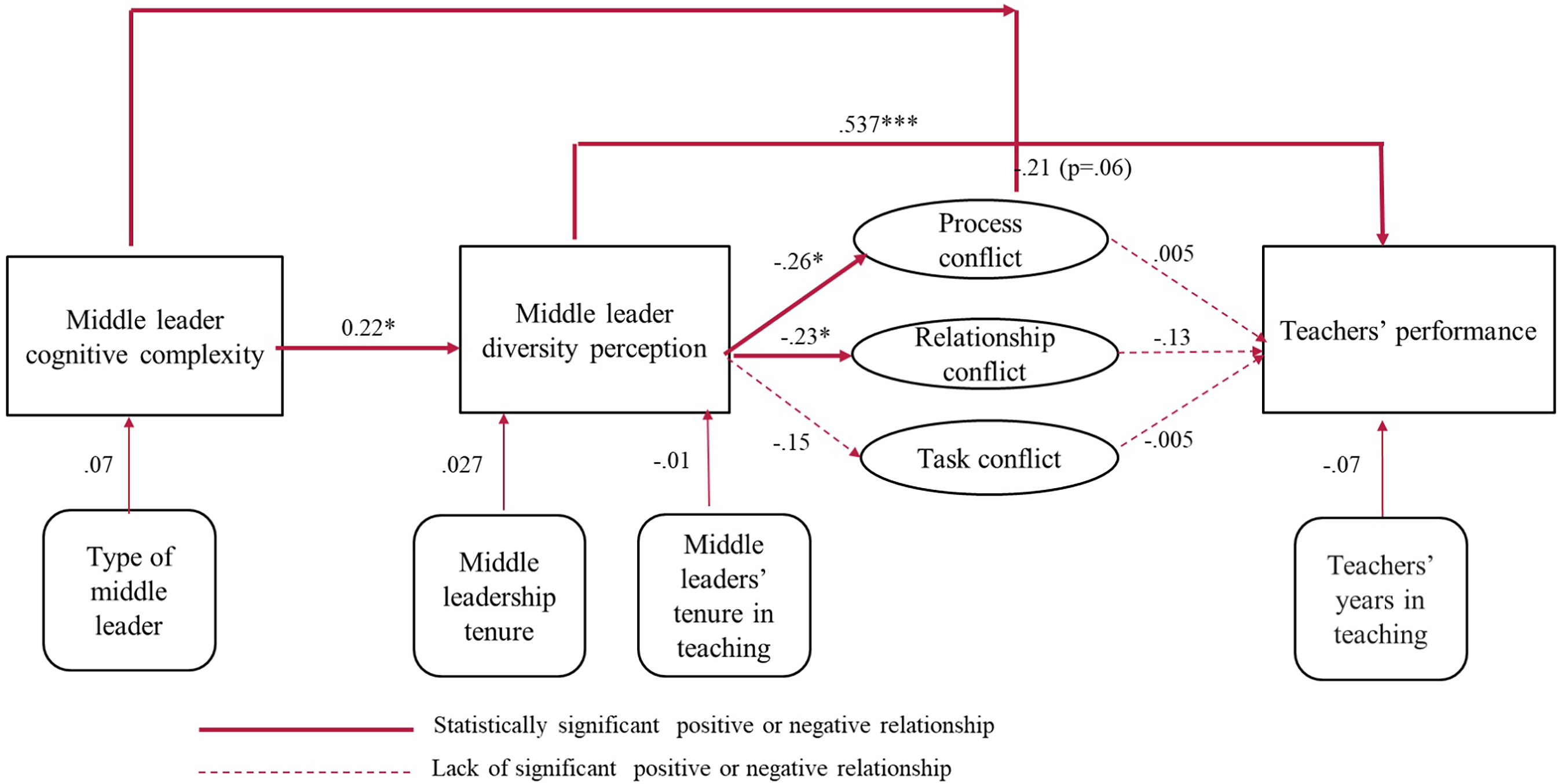
Indirect Effects
In line with Preacher et al. (2010) and their determined confidence intervals for the indirect effects (Selig et al., 2008), mediation was examined only between middle leaders’ CC and performance through diversity perception (hypothesis no. 6a). Hypothesis no. 6 was confirmed because of the lack of a relationship between types of conflict and performance. The indirect effect of middle leaders CC on performance through diversity perception was positively significant (.12; p < .05). The 95% confidence interval (lower 5% and upper 5%; 2000 bootstrap samples) ranged between .004 and .288, thus confirming the hypothesis. This is full mediation; the relation between CC and performance is non-significant (.05; n. s.). Yet, limitations in establishing causal relationships might exist since confounding variables are factors that may influence both the independent and dependent variables, leading to a spurious association. For example, teachers’ performance outcomes may be influenced not only by their tenure but also by their level of education.
Discussion and Theoretical Implications
This present study explores the concept of cognitive complexity, revealing that middle leaders’ ability to think in complex, multidimensional ways allow them to understand and respond to their environment effectively. This ability, valued in their teams, can be learned and developed, potentially leading to more effective middle leadership (Thompson, 2000). The relationship between middle leaders' CC and the positive perception of diversity of their team members is positively significant and was confirmed. This shows the significant positive impact of middle leaders’ CC on the positive perception of diversity of their team members. With higher CC, middle leaders can think in a multidimensional and more complex manner and they can use various constructs to describe and understand the environment. This has implications on their perceptions of diversity as they value diversity in their team. This result is in line with previous claims that educational leaders with higher CC can identify more attributes of information and integrate it into their perceptions and decision-making, and therefore, deal more efficiently with complex information (Yan-hong & Jing, 2010). They see more differences and value them (Da’as et al., 2018). Further, they tend to be less stereotypic and dogmatic when communicating with others (Da’as et al., 2018). This result adds to the limited literature on school middle leaders' CC (Da’as et al., 2018) by emphasizing CC in the context of teamwork and its relation to diversity.
The relationship between middle leaders’ positive perception of team members’ diversity, process, and relationship conflicts is negatively significant. Previous research has proven that diversity has great benefits to organizational and group performance (Duchek et al., 2020; Van Knippenberg & Mell, 2016; Guillaume et al., 2017), where diversity in work units can enhance resilience capabilities (anticipation, coping, and adaptation) (Duchek et al., 2020). However, team diversity has been shown to create conflict, which might affect team effectiveness and have consequences on performance outcomes (Tekleab & Quigley, 2014). The present study highlighted that middle leaders’ positive perception of diversity is an important variable that can influence conflict. For example, when a middle leader perceives differences among their team members as positive and values these differences, fewer team members view conflict as taking place in their team. When differences between teachers in the team are salient and middle leaders perceive it as positive and value it, teachers will perform better and be productive to the system. Thus, the relationship between middle leaders' positive perception of diversity and teachers’ team performance is confirmed, and in accordance with previous studies where diversity management is linked to the reduction of team conflict (Hentschel et al., 2013; Karademir et al., 2012; Otaye-Ebede, 2018; Van Leeuwen, 2017).
The relationship between team conflict and performance is negatively significant; this hypothesis was not confirmed. There is no relationship between team conflict and performance. In other words, conflict within the team does not impact team performance outcomes. Furthermore, the relationships between task, relationship, and process conflicts and team performance are negatively significant and therefore were not confirmed, that is, according to these results, conflict does not affect a teacher’s performance in a team. These results do not align with previous research that claims that there is a relationship between conflict and team performance (Guenter et al., 2016; Neumeyer & Santos, 2020). Research suggests that aspects that affect performance, such as leaders’ emotional intelligence (Berkovich & Eyal, 2015) and leadership styles (Kadiyono et al., 2020), are variables that greatly impact how leaders operate, which in turn, affects their team members or subordinates, this requires further investigation by researchers. Last, middle leaders’ positive diversity perception is related negatively to process and relationship conflicts but not to task conflict. Valuing diversity and sensitivity to differences impacts the process and social relations more than task completion. Middle leaders’ perception of diversity can negatively influence conflict within a team, while other research shows it can create conflict and affect performance outcomes. (Tekleab & Quigley, 2014).
Previous educational research has not considered examining CC as a variable among middle leaders and its impact on team performance outcomes and investigating their diversity perceptions, which is why it is of great value to the body of knowledge in educational leadership. This present study demonstrates that the cognitive characteristics of CC are considered a critical factor affecting middle leaders’ positive diversity perception on teamwork performance. It indicates whether leaders perceive diversity positively and how it affects team member conflict. The indirect effect of middle leaders' CC on performance through diversity perceptions indicates that middle leaders’ cognitive abilities also affect teachers in teams' performance by changing their perspective towards teachers’ differences. The finding that middle leaders’ cognitive abilities affect teachers’ perspectives toward teacher differences adds to the few research studies that have examined the indirect effect between middle leaders and performance (Da’as et al., 2018; Shaked & Schechter, 2017). The indirect effects of leaders’ characteristics and performance have been discussed in the literature (e.g., Hambrick, 2007; Da’as et al., 2020). An example is principals' CC and teachers’ intent to leave the profession through the mediation of the school’s absorptive capacity (the organization’s ability to “identify, assimilate, and exploit knowledge from the environment” (Cohen & Levinthal, 1989, p. 569)) and teachers’ commitment (Da’as et al., 2019). Thus, future research should examine the indirect effect of middle leader characteristics and other performance indices at the teacher level, such as teacher innovation.
Practical Implication
Clearly, middle leaders’ CC affects a positive perception of diversity, which impacts team members' teamwork performance and negatively affects teachers’ perceptions of conflict within a team. The findings of this study may help school principals and professionals understand and improve those processes that will encourage principals and middle leaders to initiate significant changes and reveal ways of overcoming the barriers to achieving their goals. Therefore, the ministry of education should initiate middle leaders' professional training. It should emphasize multidimensional thinking and strengthen it to promote understanding and value diversity in school teams. This will enable middle leaders to deliver high-performance outcomes for their team members and effectively manage team conflicts. These training programs should focus on the development of CC through the development of a “growth mindset.” This mindset might be acquired through reflective, collaborative analyses with a mentor or coach or by viewing and addressing problems from different perspectives, considering different solutions to problems, and using cognitive flexibility to implement strategies (Da’as, 2022).
Limitations and Future Research
Because of the importance of teamwork, research on middle leaders’ characteristics of teamwork performance is crucial. Research has indicated that leadership behavior predicts teamwork performance and influences team performance outcomes (Ceri-Booms et al., 2017; Cole et al., 2011). Yet, the effect of middle leaders’ characteristics and performance on teams is not known. Therefore, a theoretical gap had to be filled; that is why the current study demonstrated that teamwork performance through cognitive and information-processing approaches in a school context affects teachers' performance.
However, the study has several limitations. First, middle leaders filled out the self-report CC questionnaire. Self-reported data might be subject to bias and common-method variance. However, when participants were assured anonymity and that there were no right or wrong answers, thereby reducing common method variance (Podsakoff et al., 2000), the study found no relationship between conflict and performance, despite previous research that has found this relationship (Dada et al., 2022). Second, although the current research highlights sensitivity and valuing diversity in teams where differences are accommodated, this is considered a motivational mechanism that affects teamwork effectiveness and performance rather than managing conflict in the team. Where conflict does not meet the needs of the teachers in the teams, managing differences and diversity bypasses the question of conflict, where managing differences is more powerful than managing conflict to increase performance. The result regarding conflict does not align with previous research that claims that there is a relationship between conflict and team performance (Guenter et al., 2016; Neumeyer & Santos, 2020); this difference requires further investigation.
Third, the present study did not examine the role of school principals in promoting team performance. In addition, research indicates the importance of deep and surface-level diversity perception impacts. Perceived surface-level diversity of a team refers to the perception of team members’ heterogeneity in terms of demographics (Bodla et al., 2018; Harrison et al., 2002). Previous research about leadership and perception of diversity found that surface-level diversity perception is negatively linked to conflict, unlike deep-level diversity perception, which is positively linked to emotional conflict (Acar, 2010; Meeussen et al., 2014). It has been found that deep-level diversity, unlike surface-level diversity perception, predicts team performance, group development, and interaction with team leaders (Abu Bakar & McCann, 2018). Future research should examine middle leaders' perceptions of deep and surface-level diversity and their effects on team processes (e.g., solving problems).
Furthermore, research needs to examine other aspects that affect performance, such as leaders’ emotional intelligence (Berkovich & Eyal, 2015) and leadership styles (Kadiyono et al., 2020), since research suggests that these variables greatly impact how leaders operate, which in turn, affects their team members or subordinates. These relationships are still underdeveloped in the literature on middle leadership in education. Research indicates the importance of deep and surface-level diversity perception impacts. It is important to extend the research on cognition to include the emotional dimension, where effective leaders' practices require a willingness to embrace emotions and build caring and trusting relationships (Boyatzis et al., 2005; Cliffe, 2011; Crawford, 2009; McWilliam & Hatcher, 2007). Previous researchers in cognitive theory, have also emphasized the importance of cognition and emotion. For example, Morrison (2010) applied complexity theory to leadership and concluded that the application of the theory to educational leadership remains problematic.
Last, future research should examine the relationship between middle leaders’ cognitive complexity and diversity perception in relation to Hackman (1987) normative model of group effectiveness, which emphasizes performance quality outcomes alongside benefiting individuals. Where the role of middle leaders has become essential, it is important to examine how middle leaders' CC is manifested in various tasks and at different times and contexts, such as in crises. Suedfeld (2010) suggested that CC is domain-specific; CC can be manifested in one situation or context, not in another. Future research needs to examine performance by individually evaluating middle leaders’ and teachers' performance or examine outcomes such as creativity. Because this research indicated that conflict does not impact performance outcomes, further research is needed, that is, how conflict might affect educational aspects such as student achievements or the implementation of the ministry reforms by teams.
Footnotes
Acknowledgements
This article is based on my M.A. thesis study, which I conducted during my graduate studies in Educational Leadership, Policy, and Administration at the Hebrew University of Jerusalem under the supervision of Dr. Rima’a Da’as. I am grateful for Dr. Da’as’ guidance in this research and her assistance with the statistical analysis.
Declaration of Conflicting Interests
The author(s) declared no potential conflicts of interest with respect to the research, authorship, and/or publication of this article.
Funding
The author(s) received no financial support for the research, authorship, and/or publication of this article.
