



Abstract
In response to Laasch’s call for radical transformation in Responsible Management Learning and Education (RMLE), we explore how evolutionary approaches can achieve paradigm shifts toward sustainable futures that climate urgency demands. While acknowledging the moral imperative underlying revolutionary frameworks, we identify three fundamental implementation challenges: institutional constraints limiting anti-paradigmatic performative politics, cognitive barriers inadequately addressed in paradigmatic transformation, and sustainability concerns surrounding civil disobedience pedagogy. Our evolutionary framework integrates three complementary theories addressing these barriers: Incremental Change Theory enables paradigmatic transformation through gradual theoretical flexibility; Complex Adaptive Systems Theory facilitates cognitive transformation through sustained social support; and Diffusion of Innovation Theory ensures adoption through strategic stakeholder alignment. Drawing on Habermas’s communicative reason and prescriptive theorizing, we demonstrate how evolutionary processes enable radical transformations to emerge organically from institutional dynamics. Through practical evidence including a twelve-year greenhouse gas consultancy project engaging 2,100 students and 360 organizations, alongside documented outcomes from leading business schools, we illustrate how evolutionary approaches achieve comprehensive climate education integration while maintaining institutional sustainability. Our implementation frameworks demonstrate how systematic transformation processes can equip future business leaders with competencies needed to address global sustainability challenges through systematic rather than disruptive change processes.
Keywords
Introduction
In his provocative essay, Laasch (2024) calls for significant changes in Responsible Management Learning and Education (RMLE) to effectively address pressing climate challenges. Laasch suggests that substantial recalibration of RMLE is necessary, advocating for transformative approaches beyond incremental strategies, which he views as insufficient. In response, we explore the potential of an evolutionary approach, characterized by incremental advancements and adaptations, to achieve significant and sustainable transformations in RMLE. While both approaches share the common goal of deeply integrating sustainability and ethics into business education, they differ primarily in their methods and implementation pace. While acknowledging the urgency and theoretical sophistication of Laasch’s argument, we identify three fundamental challenges with his proposed radical practices that suggest evolutionary approaches may prove more effective in achieving the comprehensive transformation that climate education demands.
First, the operationalization of anti-paradigmatic performative politics encounters significant implementation barriers within contemporary business school contexts. Laasch advocates for management academics to engage in “working the theories” (Laasch, 2024, p. 115) to make alternative theories become true, moving from descriptive to performative academic practices. However, this approach may not fully account for the institutional constraints that govern academic practice within accredited business programs. Faculty members operate within complex webs of performance evaluation criteria, promotion requirements, and disciplinary expectations that constrain paradigmatic flexibility (Prasad et al., 2019). The practical mechanisms for “de-realizing growth and realizing degrowth through teaching, research, engagement, and academic administration” (Laasch, 2024, p. 115) require further development given these institutional realities. Moreover, accreditation bodies and industry stakeholders exert powerful isomorphic pressures that limit the extent to which individual faculty members can engage in anti-paradigmatic practices without risking institutional legitimacy (Cardona Mejía et al., 2019).
Second, Laasch’s framework for anti-paradigmatic thought, while intellectually compelling, might benefit from greater attention to the cognitive and emotional dimensions of paradigmatic transformation. His call for transcending “problematic mainstream management paradigms” (Laasch, 2024, p. 110) through “critical acknowledgement of the paradigm, deconstructing paradigmatic thought, and adopting anti-paradigmatic thought” (Laasch, 2024, pp. 120–122) assumes a level of cognitive flexibility and emotional readiness that may not characterize the majority of management faculty. Research on belief change and paradigmatic shifts reveals that such transformations typically require sustained social support, gradual identity reconstruction, and careful attention to psychological safety, conditions that revolutionary approaches may disrupt rather than enable (Dolata, 2011; Illeris, 2014; Slavich & Zimbardo, 2012). The risk of cognitive dissonance and defensive reactions may actually impede the paradigmatic transformation that Laasch seeks to achieve (Holmer, 2018).
Third, the integration of civil disobedience pedagogy raises significant concerns regarding institutional acceptance, student preparation, and long-term sustainability. Laasch’s vision of “mobilizing civil disobedience” (Laasch, 2024, p. 126) and encouraging students to explore the boundaries of their own learning and practice may exceed the capacity of most business schools to implement while maintaining their core educational mission. The approach assumes that students are prepared for and committed to engaging with potentially confrontational pedagogical methods, and that institutions can sustain such approaches despite potential resistance from administrators, alumni, and industry partners. Furthermore, the emphasis on disruption and disobedience may inadvertently undermine the systematic skill development and collaborative problem-solving capabilities that effective climate action ultimately requires (Brundiers et al., 2010; Wiek et al., 2014).
These critiques do not diminish the importance of Laasch’s contributions or the urgency of climate action in management education. Rather, they suggest that evolutionary approaches may offer more robust pathways for achieving the fundamental transformation he advocates. We propose that evolutionary changes, characterized by incremental advancements and adaptations, can lead to significant and sustainable transformations in RMLE. Unlike revolutionary changes, which involve abrupt and often disruptive transformations, an evolutionary approach emphasizes incremental advancements and adaptations that collectively result in substantial shifts in educational paradigms. We argue that evolutionary changes are not only feasible but may also result in more sustainable and effective outcomes in the context of RMLE.
The appeal of evolutionary changes lies in their capacity to integrate deeply into existing educational frameworks, allowing for gradual adaptation and learning that fosters comprehensive transformation. Unlike revolutionary approaches, evolutionary changes leverage existing structures and resources to minimize resistance while enhancing the likelihood of long-lasting impact. By drawing upon both theoretical insights and empirical evidence, we demonstrate that paradigm shifts in RMLE can emerge from sustained, progressive changes rather than disruptive events. While acknowledging the merits of Laasch’s call for revolutionary transformation, we illustrate how thoughtful, continuous, and contextually aware evolutionary changes can achieve equally significant educational reform.
Our evolutionary framework integrates three complementary theories that systematically address the implementation barriers identified in revolutionary approaches. Incremental Change Theory, grounded in continuous improvement principles like the Kaizen philosophy (Singh & Singh, 2009), demonstrates how small, consistent modifications accumulate into significant transformative outcomes. Complex Adaptive Systems Theory (CAS; Dooley, 1997) provides a lens for understanding educational change dynamics within business schools, emphasizing how gradual iterative modifications foster institutional resilience and adaptability. Diffusion of Innovations Theory, developed by Rogers (1962), offers frameworks for understanding how sustainability and ethics innovations spread within educational institutions through alignment with existing values and practices.
This integrated theoretical approach enables comprehensive transformation while maintaining institutional sustainability. We begin by establishing how each theory addresses specific revolutionary implementation challenges, then demonstrate their synthesis through practical strategies for integrating climate solutions into RMLE. Our discussion emphasizes climate change mitigation education across disciplines and systems thinking for complex problem-solving. Through empirical evidence from successful implementations and detailed guidance for educators at all levels, we show how evolutionary approaches can achieve the fundamental transformation that climate urgency demands while working within rather than against institutional realities.
Theoretical Foundations
The debate between revolutionary and evolutionary change is central to discussions on organizational transformation and educational reform (Fullan, 2006; Van De Ven & Poole, 1995). Revolutionary approaches aim for immediate and dramatic shifts by seeking rapid and comprehensive changes to overturn existing paradigms. Conversely, evolutionary approaches focus on gradual incremental changes that accumulate over time, leading to significant transformations. Revolutionary change can address urgent issues swiftly, while evolutionary change enhances resilience and adaptability within the system, promoting long-term sustainability. The theoretical underpinning of evolutionary change draws upon change management theories and real-world academic insights that support the efficacy of this approach in RMLE, while simultaneously addressing the specific implementation challenges identified in Laasch’s revolutionary framework.
Incremental Change and Continuous Improvement
Incremental change, grounded in the principles of continuous improvement and exemplified by the Kaizen philosophy, posits that small, consistent modifications can lead to significant transformative outcomes over time (Imai, 1986). This approach is particularly relevant to RMLE, where integrating sustainability and ethical considerations must be managed with sensitivity to established educational structures and cultural norms (Imai, 1986). The practical constraints that limit faculty members’ capacity to engage in “working the theories” within existing institutional frameworks can be effectively navigated through incremental approaches that gradually expand the scope of acceptable paradigmatic flexibility.
Adaptive incrementalism, a key component of this theory, involves making gradual adjustments to curricula in response to emerging educational needs and societal shifts. This allows business schools to remain agile and responsive while systematically addressing the performance evaluation criteria, promotion requirements, and disciplinary expectations that constrain revolutionary paradigmatic transformation. Rather than attempting to “de-realize growth and realize degrowth” through immediate comprehensive restructuring, incremental change facilitates the gradual introduction of alternative theoretical frameworks that can gain institutional legitimacy over time. By building on existing frameworks, incremental change can facilitate deep integration of sustainability and ethics, fostering a culture of continuous improvement and long-term commitment to responsible management education.
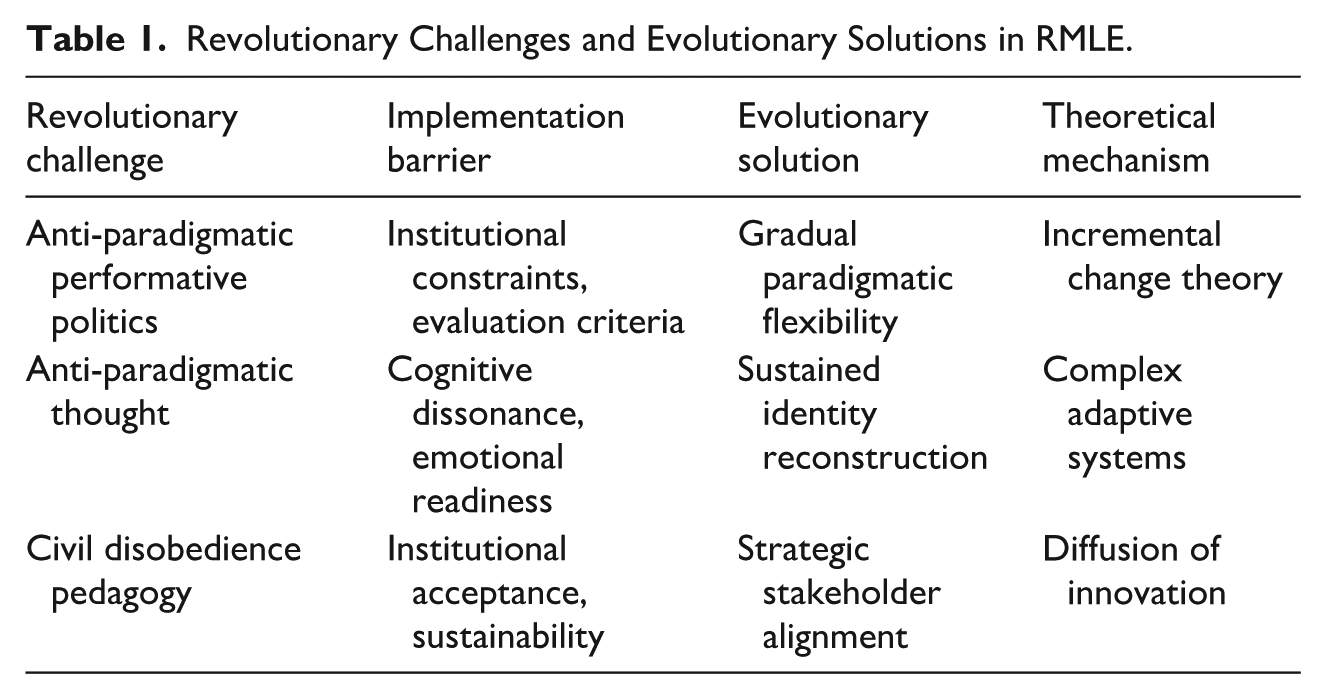
Empirical support for this approach demonstrates superior outcomes compared to revolutionary alternatives. Studies such as those conducted by Godemann et al. (2014) have shown how universities incrementally adapting their programs to incorporate the United Nations Principles for Responsible Management Education (PRME) can deeply embed sustainability into the curriculum without triggering the institutional resistance mechanisms that typically accompany paradigmatic disruption. This gradual integration helps in fostering a deeper understanding and acceptance among students and faculty while simultaneously addressing the accreditation and stakeholder pressures that limit revolutionary transformation possibilities. Moreover, the integration of sustainability topics into existing courses, rather than creating standalone sustainability courses, has been demonstrated to be less resource-intensive and disruptive, while enhancing student learning experiences and avoiding the institutional delegitimization risks associated with radical paradigmatic shifts (Moon & Orlitzky, 2011). Table 1 provides a comparison of revolutionary challenges and evolutionary solutions in RMLE.
Revolutionary Challenges and Evolutionary Solutions in RMLE.
Complex Adaptive Systems Theory
CAS theory, with its origins in disciplines as varied as ecology, economics, and systems theory, offers a powerful lens for understanding why Laasch’s framework for anti-paradigmatic thought encounters cognitive and emotional implementation challenges within business schools. This theoretical framework, built upon foundational work by Dooley (1997), demonstrates that educational systems exhibit greater resilience and adaptability when they evolve through gradual, iterative modifications rather than abrupt, large-scale paradigmatic disruption. The cognitive flexibility and emotional readiness required for transcending “problematic mainstream management paradigms” emerges more effectively through evolutionary processes that accommodate the psychological safety and identity reconstruction needs identified in belief change research.
Business schools with their intricate networks of stakeholders, policies, and cultural norms, can be effectively conceptualized as complex adaptive systems where significant changes emerge through dynamic interactions and adaptations rather than imposed paradigmatic transformation (Davis & Sumara, 2006). The process Laasch (2024) describes as “critical acknowledgement of the paradigm . . . deconstructing paradigmatic thought . . . and adopting anti-paradigmatic thought” (pp. 120–121) requires sustained social support and gradual identity reconstruction. From the perspective of Complex Adaptive Systems Theory, such reconstruction develops more effectively through evolutionary rather than revolutionary processes. Understanding business schools as complex adaptive systems highlights the role of connectivity and interdependence among elements of the educational ecosystem, where faculty members’ professional identities, research trajectories, and disciplinary affiliations create both opportunities and constraints for paradigmatic transformation.
The systems-based approach addresses the cognitive dissonance, and defensive reaction risks inherent in revolutionary paradigmatic transformation. Research by Uhl-Bien and Arena (2017) demonstrated how adaptive leadership within university settings facilitated emergent network dynamics that promoted innovative responses to sustainability challenges without triggering the psychological resistance mechanisms associated with imposed paradigmatic change. These findings suggest that leadership in business schools can guide the evolution of anti-paradigmatic thought through facilitation and support of adaptive networks rather than direct paradigmatic confrontation. The practical application of this theory in RMLE enables curricular innovations to emerge organically through faculty experimentation and adaptation, allowing successful paradigmatic shifts to develop naturally rather than through imposed revolutionary transformation.
Diffusion of Innovations Theory
The Diffusion of Innovations Theory provides crucial insights into why Laasch’s vision of civil disobedience pedagogy encounters significant adoption challenges regarding institutional acceptance, student preparation, and long-term sustainability. The framework explains how innovations spread within societies through specific channels over time among members of social systems, revealing why the integration of potentially confrontational pedagogical methods faces systematic resistance within educational institutions (Karakaya et al., 2014). It demonstrates that innovations achieve sustainable adoption when they are perceived as advantageous, compatible with existing values and practices, relatively simple to implement, trailable through pilot programs, and observable in their educational effects.
The challenges associated with “mobilizing civil disobedience as pedagogy” (Laasch, 2024, p. 125) and encouraging students to explore their boundaries within management education can be understood through the lens of compatibility and complexity factors that influence innovation adoption. Educational institutions possess established cultural norms, administrative expectations, and stakeholder relationships that create compatibility challenges for pedagogical approaches emphasizing disruption and disobedience (Clark, 2004). The theory underscores the importance of gradual implementation strategies that align with existing institutional norms and values, ensuring smoother integration and greater acceptance among faculty, students, and external stakeholders. This alignment proves critical in RMLE, where concepts such as systematic skill development and collaborative problem-solving capabilities must be integrated without fundamentally disrupting the professional preparation expectations that characterize management education.
The application of Diffusion of Innovations Theory to educational contexts provides strategic guidance for implementing transformative pedagogical approaches without triggering institutional resistance mechanisms. Research by Karakaya et al. (2014) on the diffusion of eco-innovations demonstrates that environmental technologies and practices achieve adoption when they are strategically introduced in ways that stakeholders find accessible and aligned with existing practices. This principle applies directly to the challenge of integrating civil disobedience pedagogy, suggesting that such approaches must be positioned within existing educational frameworks and demonstrated through pilot programs that showcase educational benefits without threatening institutional legitimacy. For educational leaders aiming to embed transformative pedagogical approaches, the theory emphasizes communicating relevance and advantages, facilitating trialability through controlled experimentation, and visibly demonstrating educational outcomes that support rather than undermine systematic skill development objectives.
Resistance Dynamics in Incremental Change Implementation
While incremental change strategies are widely advocated as effective pathways to integrate sustainability within business school curricula, we suggest that explicit recognition of potential resistance from students and educators is crucial to ensuring successful and sustained adoption. Students may express resistance to incremental approaches if they perceive these changes as overly cautious or inadequate for addressing the immediacy of climate-related challenges. Prior literature suggests that educational initiatives not visibly linked to tangible outcomes or clearly articulated as part of a coherent long-term vision risk being seen as fragmented or symbolic rather than genuinely transformative (Godemann et al., 2014). Consequently, there is a potential for reduced student motivation, particularly among those who align strongly with more activist or revolutionary stances on climate change education.
Educators may also show resistance, driven by several interrelated factors, including perceived threats to disciplinary autonomy, additional workload pressures, or skepticism regarding the efficacy of incremental interventions within existing institutional frameworks. Incremental pedagogical changes often require sustained adjustments in teaching approaches, assessment methods, and content integration, potentially leading educators to experience “change fatigue” or skepticism regarding the meaningfulness of incremental shifts (Molthan-Hill et al., 2020). Moreover, entrenched views about the primary objectives of business education, typically rooted in traditional economic paradigms and professional identities, can act as barriers to embracing incremental sustainability integration (Leal Filho et al., 2019).
Proactively managing such resistance necessitates clear institutional communication articulating the cumulative and strategic importance of incremental measures, accompanied by robust support mechanisms. These could include targeted professional development opportunities, transparent evaluation metrics aligning sustainability integration with academic performance, and participatory platforms that allow stakeholders to co-create and regularly refine incremental initiatives. Successful examples, such as Nottingham Business School’s greenhouse gas management consultancy project, illustrate how initial small-scale curriculum changes can organically expand, leveraging student enthusiasm and industry engagement to mitigate resistance and reinforce incremental transformations (Molthan-Hill et al., 2020; Thomas, 2022). Explicitly acknowledging and systematically addressing these resistance dynamics thus enhances the viability and effectiveness of incremental approaches to sustainability integration in management education.
Addressing Implementation Barriers Through an Evolutionary Approach
This integrated theoretical approach offers pathways to addressing the implementation challenges identified in revolutionary frameworks. Incremental Change Theory enables paradigmatic transformation through gradual expansion of acceptable theoretical flexibility, directly addressing the institutional constraints that limit anti-paradigmatic performative politics. Complex Adaptive Systems Theory facilitates cognitive and emotional transformation through sustained social support and gradual identity reconstruction, accommodating the psychological safety requirements that revolutionary anti-paradigmatic thought approaches may disrupt. Diffusion of Innovation Theory ensures sustainable adoption through strategic alignment with existing institutional norms and systematic stakeholder engagement, overcoming the acceptance and sustainability barriers that constrain civil disobedience pedagogy. This integrated approach enables comprehensive transformation through systematic implementation while maintaining institutional legitimacy, faculty engagement, and stakeholder commitment.
The theoretical synthesis reveals that evolutionary and revolutionary approaches need not be conceptualized as mutually exclusive alternatives. Strategic evolutionary processes can create enabling conditions for increasingly radical transformations to emerge organically from institutional dynamics rather than being imposed through external intervention. This reconceptualization suggests that evolutionary approaches may provide more effective pathways for engaging with the “performative politics,” “adopting anti-paradigmatic thought” and “mobilizing civil disobedience as a pedagogy” techniques that Laasch advocates, while simultaneously addressing the implementation barriers that limit revolutionary effectiveness. Such an approach enhances the likelihood of successful and lasting educational transformations, ensuring that changes are sustainable and effectively integrated into the broader educational objectives while achieving the comprehensive transformation that climate urgency demands.
To visually synthesised the theoretical foundations of our argument, Figure 1 presents an integrated model of evolutionary change. It illustrates how Incremental Change, Complex Adaptive Systems, and Diffusion of Innovations theories intersect to support sustainable transformation in RMLE, offering a balanced framework for navigating institutional, psychological, and systemic challenges.
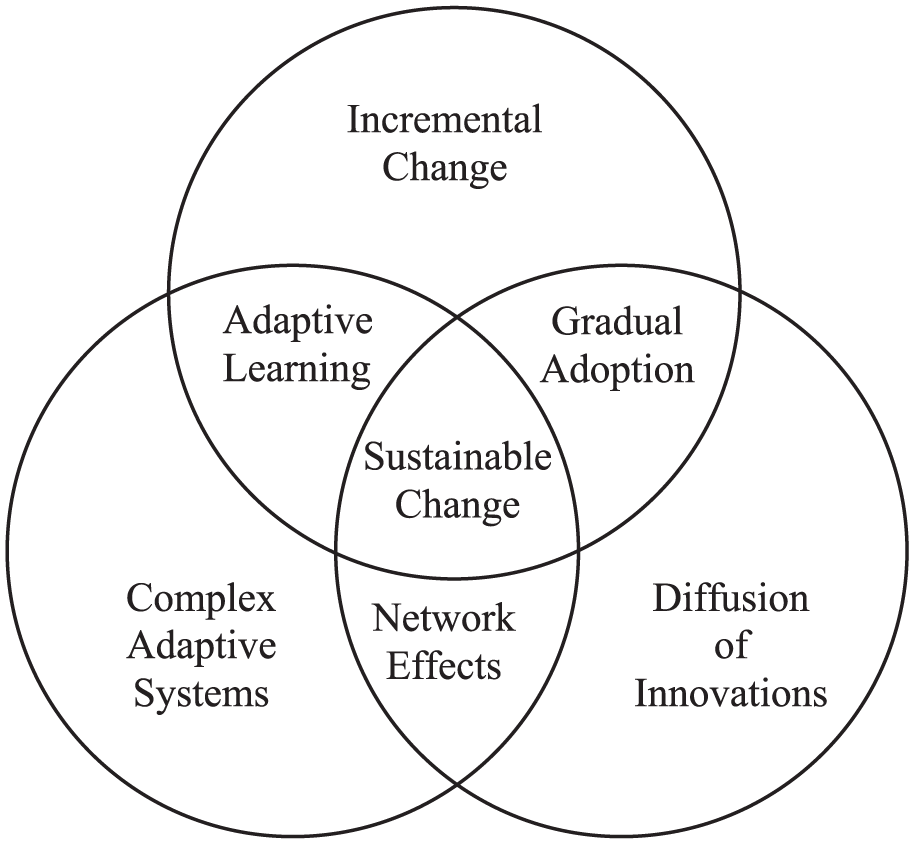
An integrated theoretical model for sustainable evolutionary change in management education.
Paradigm Shifts: Evolutionary Pathways to Fundamental Transformation
Paradigmatic concepts in management education rarely shift through sudden rupture; instead, they evolve gradually across different cultural and institutional contexts. A central example is economic rationality, the logic that frames business decisions around efficiency and competitive advantage. Far from being fixed, this construct has taken diverse forms over time, revealing its historically situated and malleable character (Jackson, 2011; Raworth, 2017). Habermas’s (1984, 1987) distinction between instrumental reason and communicative reason helps explain how such paradigmatic shifts occur. Instrumental reason reflects the efficiency-driven logic that underpins economic rationality, while communicative reason creates scope for questioning these logics by incorporating broader ethical and social considerations. Through communicative engagement, institutions and actors can preserve useful aspects of existing systems while simultaneously introducing new interpretive possibilities. Paradigmatic transformation thus arises incrementally, not through abrupt replacement but through the gradual embedding of alternative rationalities.
Cross-cultural variation illustrates this dynamic. In the Anglo-American context, economic rationality is often expressed through the need to demonstrate “business sense” or to make a convincing “business case.” By contrast, German business discourse frequently draws on notions such as “Mitbewerber” (co-applicant), which frames competition as collective survival rather than zero-sum struggle (Le Ber & Branzei, 2010; Sorge, 2005). These differences underscore that economic rationality is not universal but evolves in multiple directions depending on context. For RMLE, such variation highlights how exposure to alternative rationalities can incrementally reshape educational and institutional paradigms without requiring revolutionary rupture.
Prescriptive Theorizing: Forward-Looking Educational Development
In response to grand challenges such as climate change, Hanisch (2024) advocates for embracing prescriptive theorizing in management research an approach that proves equally valuable for educational transformation. Descriptive theory-building focuses on analyzing existing social phenomena to define, explain, and predict outcomes (Bacharach, 1989; Pfeffer, 1997; Sutton & Staw, 1995). In contrast, prescriptive theorizing addresses normative and instrumental questions of “how things should be” and “how they can be achieved” (Freeman, 1999; van Aken, 2004). This approach takes a forward-looking perspective, aiming to actively elicit or produce desired outcomes rather than merely analyzing existing conditions (Landa, 1983).
While some prescriptive theories, like Freeman's (Freeman, 1983) Stakeholder Theory, have driven positive societal change in management education, many researchers prefer descriptive theorizing, viewing prescriptive approaches as normative and unscientific (Moon & Orlitzky, 2011; Springett, 2005). However, this preference overlooks the inherent norms and values within current research paradigms. Hanisch suggests that confronting pressing issues demands not only articulating ideal outcomes but also providing a roadmap for their realization, bridging the gap between theoretical conceptualization and practical application. This aligns directly with evolutionary approaches to climate education, which require systematic pathways for transformation rather than revolutionary disruption (Hanisch, 2024). Gümüsay and Reinecke (2022) argue that by articulating how transformative ideas can become real, they can no longer be dismissed as 'unrealistic'. These ideas can be discussed in mainstream debates, taught to students, and legitimized as viable alternatives. This methodology enables paradigmatic transformation through forward-looking theoretical development that maintains empirical rigor while generating transformative educational alternatives, perfectly complementing evolutionary approaches that work within existing institutional frameworks while enabling systematic change.
The integration of prescriptive theorizing and disciplined imagination, the systematic yet creative exploration of possible futures to generate novel but plausible courses of action (Tsoukas, 2009; Weick, 1989), within climate education development enables paradigmatic transformation through structured envisioning of sustainable business education futures and collaborative development of implementation strategies. Rather than attempting immediate paradigmatic replacement, this approach fosters gradual paradigmatic evolution by sustaining engagement with alternative possibilities and systematically testing transformative educational approaches. In doing so, it provides practical mechanisms for achieving the fundamental transformation advocated by revolutionary approaches while addressing implementation challenges and sustainability concerns.
Translating Theory into Practice: Evidence from Climate Education Integration
The theoretical frameworks of paradigmatic evolution and prescriptive theorizing find concrete expression in successful climate education initiatives that demonstrate how evolutionary approaches achieve comprehensive transformation while maintaining institutional sustainability. These examples illustrate the practical application of disciplined imagination and communicative reason within existing educational structures.
Climate Education has gained significant momentum in RMLE, increasingly demanded students, faculties, and industry partners (Cort et al., 2015; Maloni et al., 2021; McKenzie, 2021). Harvard University’s (2022) Climate Education Report highlights that “90% of student survey respondents said they would like to engage with alumni on climate topics as part of courses or in an extracurricular capacity” (Harvard University, 2022, p. 13). The report recommends several strategies such as faculty hiring, establishing a standing committee on climate education, staffing and funding a climate education accelerator program, and creating an external climate education advisory committee. However, successful implementation requires understanding that climate change education encompasses three distinct dimensions: climate change science education, climate change mitigation education, and climate change adaptation education (Mochizuki & Bryan, 2015; UNESCO, 2019). For business schools, climate change mitigation education proves most relevant, involving integration across disciplines such as accounting (carbon accounting), economics (low-carbon transition policies), and strategy (future-oriented corporate planning).
The compelling demonstration of evolutionary implementation of climate change mitigation education involves a greenhouse gas (GHG) management consultancy project, an initiative in which undergraduate business students conduct organizational carbon footprint assessments and recommend measures to reduce emissions (Molthan-Hill et al., 2020). Developed at Nottingham Trent Business school in 2010 and inspired by climate solutions designed by students in “The Sustainable Organization” module, this project exemplifies how prescriptive theorizing and disciplined imagination can generate practical transformation. Beginning as a single course integration, the project was embedded in the core undergraduate curriculum and has operated for twelve years, engaging approximately 2,100 students and 360 organizations, primarily Small and Medium Enterprises. The work was showcased at COP21 in Paris as exemplary climate education practice (United Nations, 2015), won The Guardian University Award for Business Partnership in collaboration with NetPositive Ltd (Thomas, 2022), and received a British Academy of Management Education Practice Award in 2021 (Molthan-Hill et al., 2021).
This project demonstrates several key principles of evolutionary implementation aligned with our theoretical framework. First, it began as a small-scale intervention within existing curricular structures, avoiding institutional resistance while demonstrating educational value. Second, it leveraged student enthusiasm and industry demand to generate organic expansion rather than imposed institutional mandates. Third, it maintained academic rigor through real-world application while achieving measurable sustainability outcomes. Finally, it created replicable models adopted by other institutions, demonstrating the scalability advantages of evolutionary approaches over institution-specific revolutionary transformations.
Building systems thinking capabilities is a critical element of our evolutionary model, since it equips students to see connections across interventions rather than treating climate solutions in isolation. Systems thinking proves essential for effective climate education implementation, enabling students to identify high-impact solutions and achieve co-benefits.
The En-ROADS (Energy-Rapid Overview and Decision-Support) simulator, designed by Climate Interactive in collaboration with MIT Sloan and Ventana Systems (Climate Interactive, 2020), provides an excellent teaching tool demonstrating connections between different climate solutions and their temperature-reduction impacts. Implemented as interactive learning exercises, En-ROADS activities reveal that achieving Paris Agreement targets requires simultaneous implementation of multiple solutions while challenging preconceived notions about solution effectiveness. By embedding such tools incrementally within existing course structures, educators can cultivate systems thinking in ways that exemplify evolutionary change; gradual, integrative, and scalable, while also building student competencies for addressing complex sustainability challenges (Rooney-Varga et al., 2018).
These practical examples demonstrate how evolutionary approaches can achieve the comprehensive transformation advocated by revolutionary frameworks while avoiding implementation barriers that typically constrain radical change efforts. The systematic application of these principles across institutional contexts requires comprehensive implementation frameworks that address faculty development, program coordination, and institutional leadership challenges.
Implications for Educators and Academic Leaders
Embedding climate change education through evolutionary approaches requires practical frameworks that help faculty, program directors, and institutional leaders navigate implementation challenges while achieving measurable outcomes. Evidence across more than 800 business schools shows that successful transformation follows identifiable patterns, with particular strategies proving consistently effective (AACSB, 2020; PRME, 2024). The following examples move from the faculty level to discipline-specific practices, to program frameworks, and finally to institution-wide initiatives, illustrating how evolutionary change unfolds across scales.
Faculty-Level Implementation
At the foundation, individual faculty members serve as primary transformation agents, yet they require systematic support structures and proven pedagogical frameworks. The Burns Model of Sustainability Pedagogy provides the most comprehensively documented approach, validated through action research across multiple institutions (Burns, 2024). This five-dimensional framework encompasses Content, Perspectives, Process, Context, and Design. Measured outcomes demonstrate increased systemic understanding, enhanced critical thinking, stronger civic responsibility, and deeper community connections among students (Bhuttah et al., 2024). As such, the Burns Model exemplifies the type of instructional design framework that enables evolutionary integration of sustainability into curricula, supporting our argument that incremental but structured pedagogical innovation can generate transformative outcomes over time.
Next, professional development infrastructure proves critical for faculty engagement and competency development. Leading business schools exemplify successful support frameworks by operating as internal consultants, co-authoring teaching materials, and funding research projects. Penn State’s Major Sustainability Platform demonstrates such faculty development through a structured two-year process engaging over 30 faculty members, producing integration guides, and building online resources across business disciplines (Penn State, 2022). Student feedback shows significantly improved understanding of sustainability applications following such systematic faculty development.
Discipline-Specific Integration
Building on this, discipline-specific strategies allow faculty to maintain academic credibility while incrementally embedding climate education. In some leading or innovating programs, particularly in European and UK contexts, finance education has begun to integrate Environmental, Social, and Governance (ESG) factors through offerings such as the Cambridge Institute for Sustainability Leadership’s Sustainable Finance course. Marketing and strategy courses are increasingly experimenting with circular economy principles, sustainable brand positioning, and stakeholder capitalism frameworks. Operations and supply chain management curricula in selected schools have introduced modules on ethical sourcing and sustainability tracking, while some accounting programs are piloting ESG reporting methodologies, triple bottom line approaches, and integrated reporting frameworks that combine financial and non-financial metrics (Cambridge Institute for Sustainability Leadership, 2021). These emerging examples illustrate how incremental adjustments within established disciplines preserve academic rigor while extending sustainability coverage, but they also remain unevenly adopted across institutions.
Program-Level and Institutional Frameworks
At the program level, the PRME Curriculum Tree framework offers systematic curriculum mapping, helping directors identify integration opportunities, avoid redundancy, and ensure comprehensive sustainability coverage (Hope, 2017). At the institutional level, the UN PRME Champions Program represents the most advanced coordination mechanism, engaging 47 schools worldwide in structured two-year implementation cycles across five transformation areas. Tools such as the PRME SDG Compass and Blueprint for SDG Integration (Wersun et al., 2020) provide step-by-step guidance, while collaborative workshops build capacity and international networks (PRME, 2018).
Taken together, these examples show how evolutionary approaches operate at multiple levels of educational practice. Rather than relying on disruptive or wholesale reforms, they demonstrate that incremental, structured, and scalable interventions ranging from individual teaching innovations to institutional frameworks can generate systemic transformation over time. This confirms the central argument of our evolutionary model: that gradual yet coordinated change offers a more sustainable and feasible pathway to embedding climate education in management schools.
Institutional Leadership
At the institutional level, senior administrators require comprehensive frameworks that coordinate individual and program-level efforts while addressing culture, resource allocation, and performance evaluation systems. Accreditation standards represent a first key aspect in this process. The AACSB 2020 Standards Framework, for example, provides structured but flexible mechanisms that institutions can adopt incrementally. Schools can begin by creating modest societal impact committees (Standard 1), piloting sustainability-linked curriculum reviews (Standard 4), encouraging sustainability-focused scholarship in selected departments (Standard 8), and gradually embedding community engagement activities (Standard 9; AACSB, 2020). Over time, such incremental adoption allows schools to meet accreditation expectations while building internal momentum and legitimacy for broader institutional cultural change.
A second key aspect concerns institutional investments. Leading business schools show that dedicated funding for climate initiatives produces measurable results. Stanford Graduate School of Business (GSB) developed a transformation plan (2021–2025) that established initiatives such as the Stanford Initiative on Business and Environmental Sustainability (SIBES) and the Ecopreneurship Program, alongside targeted faculty hires and new climate-focused courses (Majumdar, 2023; Stanford Univeristy, n.d., 2023). Outcomes include 70 MBA students currently pursuing joint MS Environment and Resources degrees and new sustainability-focused courses across all departments. Similarly, Wharton has invested in dedicated center structures through the Wharton Climate Center, the ESG Initiative (the first ESG major and concentration), and the Business, Energy, Environment, and Sustainability (BEES) Program enabling cross-university courses (Wharton Climate Center, 2022). These investments have generated significant results, including 53% of MBA students reporting ESG career interest, 33 hr of mandatory ESG content, and the launch of a Net-Zero Transformation Executive Education program.
A third key aspect of institutional transformation is the adaptation of performance evaluation systems, which are critical for sustaining engagement. Leading institutions that have implemented Sustainability Balanced Scorecard (SBSC) approaches (Figge et al., 2002) have been able to link financial perspectives with sustainability ROI, measure stakeholder satisfaction, integrate sustainability into internal processes, and develop faculty capabilities. Evidence from cross-institutional research covering 969 teaching staff in 104 countries demonstrates that PRME signatory schools not only adopt such mechanisms more frequently but also see stronger results, including higher levels of institutional support, more resources for faculty development, and greater recognition for sustainability-focused scholarship compared to non-signatories (Doherty et al., 2015). These findings suggest that incremental alignment with frameworks such as PRME not only improves faculty support in the short term but also builds the institutional capacity and legitimacy needed for the evolutionary integration of climate and sustainability across teaching, research, and engagement.
Taken together, these examples illustrate how institutional leaders can adopt an evolutionary approach by leveraging accreditation standards, resource allocation, and performance systems in stepwise fashion. Rather than attempting wholesale transformation, incremental alignment with external frameworks like AACSB or PRME enables schools to strengthen internal capacity and legitimacy while steadily advancing systemic change.
Implementation Phases and Assessment
Successful transformation in management education typically unfolds through recognizable phases rather than abrupt overhaul. Research on sustainability integration in higher education confirms that institutions tend to progress through sequential stages of commitment, development, and consolidation (Lozano, 2006; Lozano et al., 2015; Rasche et al., 2013). In the initial phase, leaders establish strategies, form sustainability committees, select frameworks (AACSB, PRME, etc.), and begin faculty engagement. The development phase introduces curriculum redesign, faculty development and hiring, new or expanded research centers, and external partnerships. The integration phase embeds performance metrics, mainstreams sustainability across programs, implements reporting systems, and commits to continuous improvement. This staged progression reflects established change models (Kotter, 1997) and exemplifies evolutionary transformation through gradual, structured adoption.
Although these phases usually extend over years, executive education demonstrates that compressed teaching formats can complement longer-term institutional processes. Harvard Business School’s 3-week Sustainable Business Strategy program (Harvard Business School, 2022) and INSEAD’s 1-year Sustainability Leadership Program and 4-year Business Sustainability Certificate illustrate how intensive models deliver significant learning outcomes within shorter cycles (INSEAD, 2024). Such pathways are particularly valuable for executive and continuing professional education, where they reinforce institutional commitments rather than substitute for the broader change process.
Assessment frameworks provide mechanisms to ensure that both phased and accelerated initiatives achieve lasting impact. The AACSB 2020 Societal Impact Framework requires schools to document and measure sustainability initiatives across curricula, scholarship, and engagement, with Standard 9 mandating systematic evidence through tools such as the Societal Impact Canvas and SDG Alignment Framework (AACSB, 2020). Likewise, PRME’s Sharing Information on Progress (SIP) requires bi-annual reporting on the six principles, SDG contributions, and institutional transformation, while also disseminating best practices (PRME, 2024).
Taken together, phased implementation, accelerated models, and assessment frameworks show how institutions can evolve incrementally yet systematically. Incremental alignment with global standards such as AACSB and PRME legitimizes institutional efforts, builds capacity, and reinforces our central argument that evolutionary approaches offer a feasible and sustainable route to embedding climate education in business schools.
Case Study Applications: Documented Transformation Outcomes
Leading institutions provide comprehensive implementation blueprints through documented transformation processes. At Griffith University, the MBA transformation unfolded over more than a decade, with major milestones including the integration of the UN SDGs across the curriculum (2012 onwards), abandonment of traditional textbooks lacking ESG content, recruitment of sustainability-expert faculty and practitioners, and integration of sustainability across all courses and assessments (Griffith University, 2025; Lee & Hales, 2022). Documented outcomes include Griffith achieving the number 1 global ranking for sustainability in the Corporate Knights Better World MBA ranking (Buck, 2024) and development of its distinctive “Triple A” candidate focus on Aspiration, Ambition, and Awareness (Rocha, 2025). This demonstrates how comprehensive evolutionary change, implemented systematically over multiple program cycles, can generate outcomes that appear revolutionary.
Bocconi University illustrates a different trajectory. Since the appointment of sustainability expert Stefano Pogutz as Director of the MBA at the Scuola di Direzione Aziendale (SDA) Bocconi School of Management in 2021, the institution has adopted a continuous curriculum review process, developed new MSc programs in Transformative Sustainability, and established cross-disciplinary partnerships to strengthen the strategic integration of sustainability across programs and disciplines (Bocconi University, 2023). This leadership-driven approach highlights the importance of incremental structural changes through strategic appointments and program-level experimentation that maintain transformation momentum and institutional commitment.
At the Darden School of Business, sustainability initiatives have been phased in since the late 2010s, culminating in the launch of the ESG concentration in 2023 (van der Voort, 2022). Darden’s 2030 Sustainability Goals link operational and educational commitments, combining “How We Live” goals (internal operations and carbon neutrality, achieved in 2019 via the Hollyfield Solar Plant partnership) with “How We Learn” goals (educational and research integration). Supporting infrastructure investments, including the LEED-certified Forum Hotel and Taija Arboretum, further demonstrate the embedding of sustainability principles across institutional functions (UVA Darden School of Business, 2024)
Taken together, these cases show how different institutions implement sustainability incrementally, whether through long-term curriculum transformation (Griffith), strategic leadership and program review (Bocconi), or phased infrastructure and academic integration (Darden). Each example underscores that evolutionary, stepwise processes extended over years rather than enacted in a single moment provide a practical pathway to achieving systemic transformation in management education.
Conclusion
This paper responds to Laasch’s (2024) call for significant changes in RMLE by exploring how evolutionary approaches, characterized by incremental advancements and adaptive changes, can achieve the fundamental paradigm shifts toward positive futures that climate urgency demands. While acknowledging the moral imperative and theoretical sophistication underlying Laasch’s revolutionary framework, our analysis demonstrates that evolutionary approaches may offer more robust pathways for achieving sustained, and scalable educational transformation within contemporary institutional realities. Our critique of revolutionary approaches identified three fundamental implementation challenges: the operationalization barriers facing anti-paradigmatic performative politics within institutional constraints, the cognitive and emotional dimensions inadequately addressed in anti-paradigmatic thought frameworks, and the institutional acceptance and sustainability concerns surrounding civil disobedience pedagogy. These critiques do not diminish the urgency of climate action in management education but rather suggest that evolutionary approaches may paradoxically achieve faster and more comprehensive transformation by working with rather than against institutional dynamics.
The theoretical synthesis of Incremental Change Theory, Complex Adaptive Systems Theory, and Diffusion of Innovations Theory provides robust foundations for evolutionary transformation that addresses Laasch’s concerns about urgency while offering superior implementation pathways. Through the integration of prescriptive theorizing and disciplined imagination (Tsoukas, 2009; Weick, 1989), we demonstrated how evolutionary processes can enable increasingly radical transformations to emerge organically from institutional dynamics rather than being imposed through external intervention.
The practical evidence, ranging from systematic curriculum mapping frameworks to documented transformation outcomes at leading institutions, illustrates how evolutionary approaches achieve measurable impacts while maintaining institutional sustainability. Examples such as faculty-led consultancy projects, discipline-specific curriculum redesign, and institution-wide accreditation alignment demonstrate how small-scale interventions, when scaled incrementally, can generate significant societal and educational impact.
Several limitations constrain the generalizability and application of our evolutionary framework. First, the temporal dimension of evolutionary transformation may prove insufficient for addressing the most urgent aspects of climate change, particularly given the 2030 emission-reduction targets emphasized by Laasch. Second, our framework may exhibit cultural and institutional biases reflecting primarily Western higher education contexts. The evidence base draws heavily from European and North American business schools, potentially limiting applicability to institutions operating within different cultural paradigms, governance structures, or resource constraints. The cross-cultural variations in managerial rationalities that we identified as supporting evolutionary change may equally constrain the universal applicability of our implementation frameworks.
Third, the evolutionary approach may inadvertently preserve problematic elements of existing educational paradigms that revolutionary approaches would more effectively eliminate. While we argue that evolutionary processes can achieve fundamental transformation, the question remains whether certain aspects of business education such as growth-oriented assumptions or shareholder-primacy frameworks require more dramatic disruption than evolutionary approaches can provide. Finally, our analysis focuses primarily on educational transformation within existing institutional structures and may inadequately address the systemic changes necessary for broader societal transformation. The relationship between educational change and broader economic and political transformation remains underexplored, potentially limiting the ultimate impact of even successful evolutionary educational initiatives.
Future Research Directions
Several critical research questions emerge from our analysis that warrant systematic investigation. First, research should prioritize pedagogical-level studies that examine how instructors and curricula can most effectively integrate climate education into management learning. Longitudinal studies could track how sustainability competencies develop across programs, while experimental and simulation-based approaches (e.g., systems thinking tools such as En-ROADS) could be evaluated for their effectiveness in building cognitive and affective learning outcomes. Additional research might also explore how prescriptive theorizing and disciplined imagination can be operationalized in course design, or how assessment strategies can best capture student learning across these dimensions.
Second, comparative studies examining the relative effectiveness of evolutionary versus revolutionary approaches across diverse institutional contexts would provide empirical evidence for the theoretical arguments advanced in this paper. Such research should examine not only implementation success rates but also long-term sustainability, stakeholder satisfaction, and measurable learning outcomes across different cultural and institutional environments. Third, research examining the optimal sequencing and timing of evolutionary interventions could enhance implementation effectiveness. Our framework suggests general principles for phased implementation, but additional research could identify critical transition points, optimal resource allocation strategies, and early warning indicators for potential implementation challenges. Complexity science methodologies may be especially useful in capturing the non-linear dynamics of educational transformation.
Fourth, investigation of hybrid approaches combining evolutionary and revolutionary elements could explore whether strategic integration of these approaches achieves superior outcomes compared to purely evolutionary or revolutionary strategies. This acknowledges that the evolutionary–revolutionary distinction may represent a false dichotomy and that optimal transformation strategies might involve careful integration of both. Fifth, research examining the relationship between educational transformation and broader societal change could address the limitations identified in our framework. How do evolutionary changes in management education contribute to or constrain the wider economic and political transformations necessary for addressing climate challenges? Finally, cross-cultural research examining how evolutionary principles apply within non-Western educational contexts could enhance the global applicability of implementation frameworks. Such research should examine how different cultural paradigms, governance structures, and resource contexts influence the effectiveness of evolutionary transformation strategies.
Invitation to Scholarly Dialog
We recognise that our evolutionary framework represents one perspective within broader debates about educational transformation and climate action urgency. The challenges facing management education in addressing climate change are too complex and urgent for any single approach to provide comprehensive solutions. We therefore invite critiques, extensions, and alternative perspectives that can enhance understanding of effective transformation strategies. Scholars advocating for revolutionary approaches may challenge our assessment of implementation barriers or argue that evolutionary approaches inadequately address the systemic nature of climate challenges. We welcome such critiques and hope they generate productive dialog about optimal transformation strategies within specific institutional and cultural contexts.
Similarly, scholars working within traditions such as critical pedagogy, critical management studies, decolonial approaches, or indigenous knowledge systems may offer frameworks for understanding educational transformation that transcend the evolutionary–revolutionary dichotomy. Such perspectives could enrich our understanding of transformation possibilities while addressing the cultural limitations identified in our analysis. Practitioners implementing climate education initiatives in diverse institutional contexts can also provide crucial feedback about the applicability of our framework: Which elements prove most effective within specific contexts? What additional support structures or modification strategies enhance implementation success? How do local conditions influence the sequencing and timing of evolutionary interventions? Finally, we encourage empirical research testing the propositions advanced in our theoretical framework. While we have provided illustrative examples and cited supporting evidence, systematic empirical investigation of evolutionary versus revolutionary effectiveness across diverse contexts would substantially advance understanding of optimal strategies.
By fostering dialog between advocates of different approaches, we can advance collective understanding of how management education can most effectively contribute to addressing climate challenges while serving the diverse needs of students, institutions, and society. The urgency of climate action demands not ideological entrenchment but collaborative exploration of all promising pathways to educational transformation.
Footnotes
Declaration of Conflicting Interests
The authors declared no potential conflicts of interest with respect to the research, authorship, and/or publication of this article.
Funding
The authors received no financial support for the research, authorship, and/or publication of this article.
