



Abstract
In this essay, I argue that we should radicalize managerial climate change education given that incremental and accommodative forms of responsible management learning and education (RMLE) are at odds with the urgency, nature, and magnitude of the climate crisis. I argue for three practices to radicalize RMLE, and illustrate them through examples from a degrowth context. First, management educators should engage in anti-paradigmatic performative politics to disrupt the reality-making of climate damaging theories, and “realize” better alternative theories. Second, as management educators, we should engage ourselves, our students, and wider stakeholders in anti-paradigmatic thought that transcends and challenges problematic mainstream management paradigms. Third, we should explore what and how we and our students can learn from radical climate movements’ civil disobedience, in order to disrupt climate-damaging practices. In this paper, I aim to provoke and facilitate urgently needed discussions about the radicalization of RMLE for climate change education and beyond. Therefore, I close this essay with an invitation for rejoinders and suggest salient implications for educational practitioners and researchers.
Keywords
Why Should We Radicalize Responsible Management Education for Climate Change?
All you can talk about is money and fairytales of eternal economic growth. How dare you! . . . Right here, right now is where we draw the line. (Thunberg, 2019, para. 15).
This radical stance presents growth-as-solution narratives as “climate change fairy tales” (Good, 2019, para. 1). A climate activist whom I had invited to one of my management classes simply called it “growth bull****.” From the sociological study of “business bullshit” we understand the empty and misleading nature of this type of communication and its dangerous tendency to “take over” (Spicer, 2020, p. 1). Radical stances like that of the climate activist are easily justified by the status quo of climate change mitigation: Limiting warming to around 1.5°C (2.7°F) requires global greenhouse gas emissions to peak before 2025 . . . and be reduced by 43% by 2030 . . . emissions in industry . . . accounts for about a quarter of global emissions. (IPCC, 2022, para. 12)
Actual commitments to addressing emissions imply that we are headed toward only a 1% reduction (United Nations, 2021), indicating that we are falling short of even these insufficient goals, and that there is “no credible pathway to 1.5°C in place” (UNEP, 2022, para. 1). Emission levels have also reached an all-time high (United Nations, 2022), and human extinction-type “endgame” climate scenarios are increasingly likely (Kemp et al., 2022). Companies’ climate pledges (Calma, 2022) are rarely undergirded by feasible plans (Partsinevelos, 2021; Peters, 2021; Timmins, 2021), and declarations of a climate emergency by universities are often “promotional statements that detract from new commitments and action” (Latter & Capstick, 2021, p. 1).
There are similar ‘not good enough’ sentiments toward responsible management learning and education (RMLE) (Laasch et al., 2020; D. Moosmayer et al., 2020) and the United Nations Principles of Responsible Management Education (PRME) (Forray & Leigh, 2012; Haertle et al., 2017). PRME member schools have often been found to not walk their RMLE talk (Cornuel & Hommel, 2015) and lack curriculum change (Burchell et al., 2015; Rasche & Gilbert, 2015). A major cause of this inaction is that RMLE dominantly operates from within the confines of the neoliberal paradigm, with inbuilt growth at all cost, profit-first, and exploitative management logic (Cornuel & Hommel, 2015; Dyllick, 2015; D. C. Moosmayer et al., 2019; Painter-Morland, 2015). As a result, RMLE reinforces the logic, which causes the very problems we want to solve (Millar & Koning, 2018). Therefore I echo Louw’s (2015, p. 184) assertion of “Paradigm change, or no change at all?”
Business schools have a crucial role to play in developing responsible leaders who can respond to the climate crisis (Adams et al., 2011). Despite business schools’ immense influence over business management, they have historically lagged behind in addressing climate change (Rasche & Gilbert, 2015), making them partially responsible for the corporate sector’s immensely destructive climate impact (Patenaude, 2011). Even when business schools’ ambitions to address climate change are expressed as formal commitments, implementation of actions, for instance, in curriculum change, frequently does not meet these aspirations (Rasche & Gilbert, 2015). In terms of occupational practices, management educators are still caught up in some of the most climate damaging practices that are deeply rooted in our identities, and these practices are largely unquestioned. For example, many faculty still fly extensively for academic travel (Gill, 2020). To effectively address climate change, management education must engage in transdisciplinary efforts that go beyond and break with many of the accepted economic and commercial tenets (Molthan-Hill et al., 2022). Business schools must be radical in their climate change education by breaking with and going beyond “neoliberal solutions . . . and economically oriented approaches to climate change” (Cator, 2022).
My intention behind calling out the lack of radical climate education practices is not meant to obscure the worthy contributions of management educators who promote managerial climate change education. Such contributions range from climate change gamification (Carreira et al., 2017) to student-led improvement projects to transform business schools’ own carbon impact from within (Molthan-Hill et al., 2020). Nor am I trying to downplay the contributions of business schools that engage in responsible management learning and education, especially in contrast to many other schools that still do not engage in such efforts. My intention, instead, is to call on management educators to make such contributions through practices that are more radical and to make the intended outcomes of such practices more radical in nature too.
Radical Practices for Managers’ Climate Education
My proposal for radical practices builds on recent work outlining forms of management academics’ intellectual activism (Callahan & Elliott, 2020; Contu, 2020). These practices are aimed at radically countering neoliberal capitalist practices (Grosser, 2021; Rhodes et al., 2018) including those related to the neoliberal growth paradigm. With radicalization, particularly in the managerial climate change education context, I aim to change RMLE practices that support an established climate-damaging management paradigm to climate-restorative alternative practices. I use the adjective “radical” in this essay to qualify another entity (e.g., a person, thought, theory, or action) as undermining a dominant paradigm or regime. For instance, degrowth thought is radical as it undermines the dominant growth paradigm and the regime that enacts it. Radicalization refers to a process through which entities increasingly undermine dominant paradigms and regimes.
Radical Degrowth
I use illustrations from the context of degrowth throughout this essay, including cognate terms such as a-growth and post-growth (Lehmann et al., 2022). The (economic) growth paradigm’s “multiple tentacles” (Bobulescu, 2022, p. 194) have a firm grip on managerial practices across disciplines. Economic growth demands that companies compete with industry peers to grow market share (strategy), to grow sales and fuel consumption (marketing), to design products for planned obsolescence to trigger new sales growth (innovation management), and scale ventures as the main measure of entrepreneurial success (entrepreneurship). Most management educators and students are likely to agree and would find it difficult to refute the macro argument that endless economic growth is not possible on a finite planet. Thus, criticizing growth is a common discussion in sustainability management courses, and many management instructors are likely to be personally concerned about the negative consequences of economic growth. Nevertheless, common teaching practices still seem to reproduce most of the tentacles of growth paradigms across management sub-disciplines. The growth paradigm also reaches into managers’ occupational and private practices, through pressure to fulfill continuous salary growth aspirations including larger houses and cars, and relentless personal growth (self-improvement) (Cederström & Spicer, 2017).
Sustainable degrowth instead is “an equitable downscaling of production and consumption that increases human well-being and enhances ecological conditions” (Schneider et al., 2010, p. 511). Degrowth offers a radical agenda for business schools and “needs to start with teaching it as part of (business) education” (Kopnina & Benkert, 2022, p. 51). Degrowth is also of crucial importance for mitigating climate change (R. U. Ayres, 1996; Meadows et al., 1972, 2005; Minos et al., 2016; Rosales, 2008), and a key demand of climate activists as “to achieve decarbonisation on the required scale demands economic degrowth . . . [and is] the radical action now needed” (Scientist Rebellion, 2023a).
Radical Practices
The learning intended in this essay is a positive radicalization of management educators and students, manifesting in their adoption of radical practices. The logic undergirding these practices is that many taken-for-granted paradigmatic assumptions and practices of our socio-economic system are fundamentally flawed and that we can only achieve the necessary change by unlearning them (Prádanos, 2015). Accordingly, the radical practices I will propose imply a fundamental break with many normal business management practices.
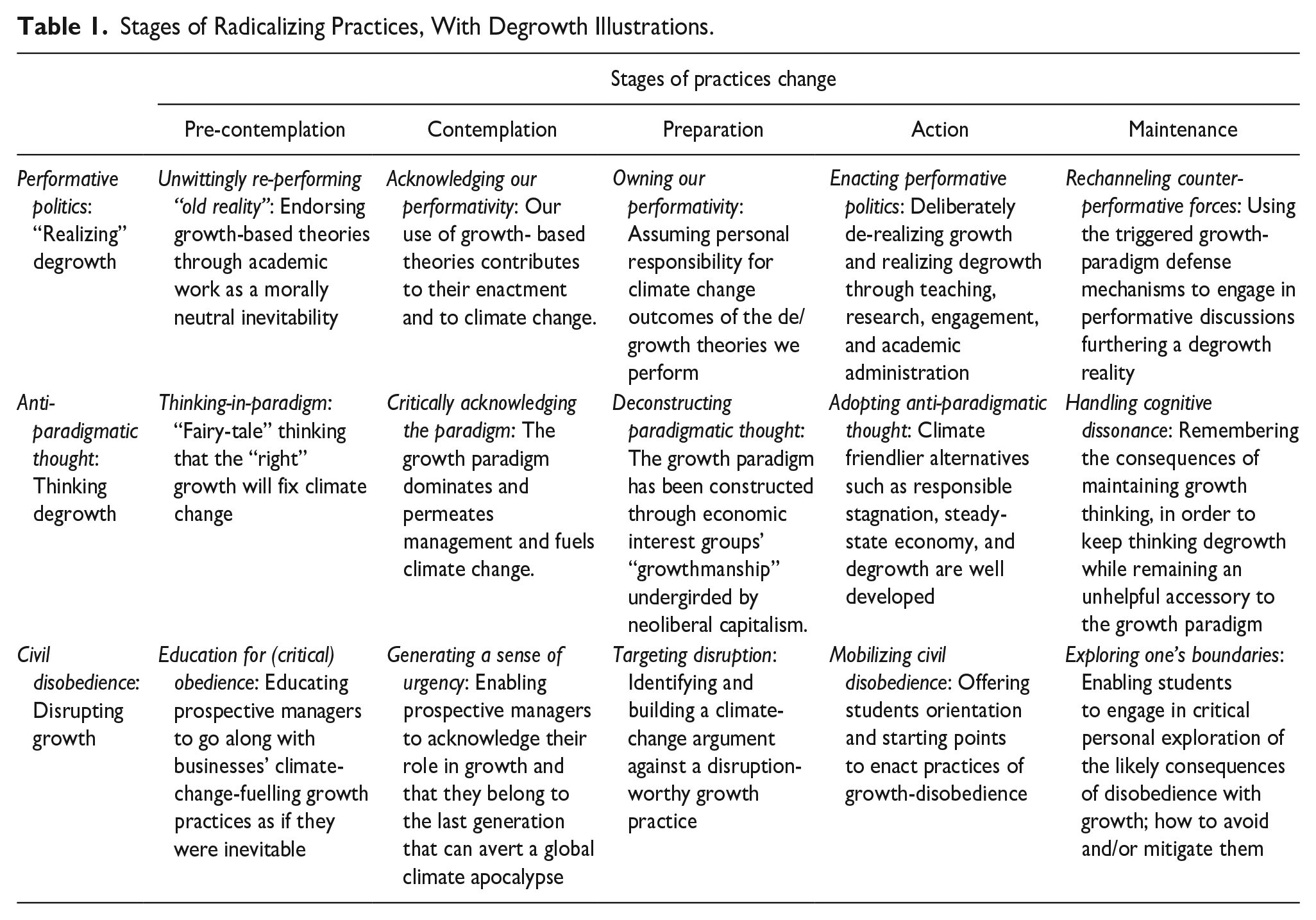
To understand anti-paradigmatic thought, performative politics, and civil disobedience, Table 1 offers an overview of the change journey through the stages of pre-contemplation, contemplation, preparation, action, and maintenance (Prochaska et al., 1992). In performative politics, the academic practitioner is in the foreground when moving from descriptive to performative academic practices. Anti-paradigmatic thought may involve both students and instructors in the classroom, and also management educators’ personal transformation. Finally, fostering civil disobedience has characteristics of a student-centric classroom pedagogy, but may also involve management educators to enact civil disobedience.
Stages of Radicalizing Practices, With Degrowth Illustrations.
Performative Politics: “Realizing” Degrowth
In a recent radio interview, a strategy professor in a globally renowned business school discussed the inevitability of renewed growth in the coal mining industry: It would be unrealistic to abstain from opening up new coal mines. When there’s a market opportunity like this, business will use it to grow. This is simply how business works and some 300 years of research, starting from Adam Smith, confirm that there is nothing we can do about it.
This same argument came from a German energy company, RWE, justifying the growth of coal mining (RWE, 2023). Theirs was an incredible decision considering that burning coal generates 40% of global CO2 emissions (Jakob et al., 2020). It led to a movie-worthy showdown between climate activists disrupting mine expansion work and representatives of RWE, including a large police force detaining Greta Thunberg (Gregory, 2023). However controversial this growth action might seem, it appears to be easily justified by the same type of argument on the theoretical inevitability of growth.
My proposal for business school academics’ performative practice builds on the notion of performative truth. From a performativity angle, truth does not mean to accurately represent reality when a theory is first presented. Instead, performative truth hinges on theories’ success to shape future realities according to their tenets (D. MacKenzie, 2008). Such success centrally depends on management academics “working the theories” to become true. The following proposal for a practice of performative politics—working to make the “right” theories become true—is radical because it aims to change the paradigmatic theoretical foundations on which business management realities rest.
I draw from both the economic sociology strand of the performativity discussion which is concerned with performative effects of theory on business and management realities (Callon, 2007; Latour & Woolgar, 1979; D. A. MacKenzie et al., 2007), and feminist performativity to help us understand how “our” theories shape our academic selves and identities (Butler, 2010; Butler & Shusterman, 1996). I also draw from ontological politics, which invites us to promote the most desirable version of reality (Law & Urry, 2004; Mol, 1999, 2002), by selectively promoting particular theories and corresponding realities through academic practices (Gibson-Graham, 2008; D. MacKenzie, 2003) to engage in performative politics.
Unwittingly Re-Performing “Old Reality” (Pre-Contemplation)
The colleague asserting the theoretical inevitability of coal mining growth in the anecdote above contributes to the socially constructed inevitability of such growth. He engaged in the performative maintenance of a growth-theory-based reality. If management educators are unaware of our performative, managerial reality-making role, we are most likely engaged in a similar form of unwitting performative maintenance. As educators, we may be teaching the same old theories that have been the foundations of managerial practice and reality for generations of business school students. We teach how managers “naturally” exploit resources, compete against other companies, use humans as “resources,” and build supply “chains.” We are likely to present growth as if it were a given natural law that managers exploit to increase demand, maximize profits and shareholder value, increase market share, and “achieve” company growth.
Acknowledging Our Performativity (Contemplation)
Performative politics requires reflexive introspection into the role of management educators. Are we and should we be cameras or engines of business and management reality (D. MacKenzie, 2008)? Reflexive practice allows us to discover managerial reality-making elements in our roles (Hibbert et al., 2014; Nadin & Cassell, 2006; Ripamonti et al., 2016). We may arrive at the insight that if theories have a performative quality, our academic work also is inescapably performative, as we teach, generate, and disseminate theory. In teaching work, we train (future) practitioners in the theories undergirding their management practices, which makes management’s social reality. In research, we strive to contribute to theory either contributing to the “protective belt” of old paradigms (Lakatos, 1970), or attack them. In impact work, we weaken and/or strengthen the social enactment of old or new theories. Therefore, we inescapably engage in performative practices that maintain the past or shape future theory-reality bundles, like those related to de/growth, for better or worse.
Owning Our Performativity (Preparation)
Owning our performativity involves assuming responsibility for our personal academic practices and their managerial-reality-making effects. It requires a move away from copying the value-free ideal of natural sciences, and instead deliberatively practicing research and teaching that shapes managerial realities corresponding to our values (D. C. Moosmayer, 2012; Tsui, 2016). Doing so makes us morally responsible for the realities we co-create and empowers us to engage in the “realization” of desirable realities. For instance, Harvard professor Michael Jensen had been one of the most outstanding promotors of principle agent theory and of values-free shareholder value maximization (Dierksmeier, 2019). After the 2007 financial crisis hit, Jensen owned his “personal contribution to the mess generated” (Erhard & Jensen, 2011, p. VII). He expressed a general sense of puzzlement that the crisis was typically “explained away as simply unavoidable as in ‘that’s just the way life is’” (Erhard & Jensen, 2011, p. VII). He expressed an incredulity about the expressed sense of natural unchanging nature of laws of business management behavior, which he himself had co-created. These quotes appeared in the foreword of his book promoting an integrity-based theory of management and assuming his personal performative responsibility.
Assuming that our performative responsibility requires an exploration of implications for our behavior, how do I feel about my performativity, and how should I behave to feel good about my performative effects? For instance, a finance educator, whose work revolves around theories that favor profit maximization or continuous revenue growth, could start feeling personal responsibility for a business reality pursuing growth at all cost, and for how that that fuels climate change. The colleague could begin to wonder about how to undo this reality and/or generate different realities of financial management that could mitigate climate change.
Enacting Performative Politics (Action)
Enacting performative politics is aimed at realizing a particular desirable reality (D. MacKenzie, 2006), maintaining good managerial realities that already exist, or de-realizing existing undesirable realities and opening up space for alternatives (Wickert & Schaefer, 2015). It could consist of a particular type of counter-performativity (D. MacKenzie, 2006) through which we keep novel theories with the potential to leave undesirable managerial realities unrealized. For instance, we can do so through “working the theories” in performative management education against taken-for-granted climate-damaging business realities. We can throw the proverbial spanner into the works of the dominant growth-based business theories and practices to create an opening for degrowth alternatives. For instance, when teaching venture growth in an entrepreneurship course, we could discuss Colombo et al.’s (2023) fascinating study of how Italian agricultural ventures have scaled their impact without increasing the size of the organization. Both radical practices discussed below, teaching anti-paradigmatic thought and civil disobedience, are explicitly aimed at enabling students to performatively enact degrowth theories, which are a type of “degrowth pedagogy in business schools” (Bobulescu, 2022, p. 188).
Rechanneling Counter-Performative Forces (Maintenance)
Counter-performativity describes a performative effect by which a reality becomes less like what a theory describes or promotes (D. MacKenzie, 2006). Promoting theories for a new type of reality is an open attack on the dominant reality, just as degrowth theory is an attack on growth-based management theories and realities. Established realities that were once widely practiced tend to be very sticky (Cabantous & Gond, 2011), reproducing themselves even if they are problematic or unnatural. An attack on such taken-for-granted institutionalized realities and the interests vested in them is, therefore, likely to trigger defensive counter-performative responses (Maguire & Hardy, 2009; Rodner et al., 2020), such as delegitimating strategies (Roos et al., 2020).
Encountering strong counter-performative forces against our own performative endeavors, may indicate that we have hit a nerve of a strongly institutionalized reality. The attack is being taken seriously, and that the defensive mechanisms of the old reality have been triggered. We may even be successful in rechanneling the energy by engaging defensive actors in generative dialogue (Wiener & Kayser-Jones, 1989).
Fostering Anti-Paradigmatic Thought: Thinking Degrowth
During a session at the annual meeting of the Academy of Management, an esteemed climate education leader suggested that “We only have eight years [referring to the 2030 emissions reduction goal]” and that we have to “ramp up our efforts to get this done.” I suggested considering degrowth as an approach. To my surprise, the colleague felt that we should not talk about degrowth as its radical nature might scare people away from climate change mitigation instead of inviting them in. However, young people demand honest answers enabling them to tackle climate change (Tickle, 2022), similar to the answer that reaching sustainable levels of emissions requires radical paradigm shifts in the underlying logics of management thought (Radoynovska et al., 2020; Schüßler et al., 2022).
Anti-paradigmatic thought is radical as it breaks with the fundamental logics undergirding climate-damaging business practices, such as when moving from growth to a degrowth perspective. We know that radical responsible management concepts like degrowth (instead of growth), circularity (instead of take-make-waste chains), or humanistic management (instead of humans-as-resources), can become threshold concepts if learned reflexively (Hibbert & Cunliffe, 2013; Montiel et al., 2020). This type of anti-paradigmatic thought may irreversibly transform learners’ perspective (Mezirow, 1997). By facilitating this process, we as educators can contribute to changing one prospective manager and practice at a time, and thus rewrite management’s underlying logic of action (Bacharach et al., 1996; Bacharach & Mundell, 1993).
Thinking-in-Paradigm (Pre-Contemplation)
Many management professors might still believe in the ubiquitous fairy tale of eternal economic growth. Paradigms are often so taken for granted that it is difficult to realize they are present. They lie hidden in plain sight behind an invisible veil (McManus, 2001; Talwar et al., 2004). The taken-for-granted growth paradigm is rooted in and legitimized through neoclassic economics (Göpel, 2017), which, in turn, creates “an invisible barrier constraining thought and action” so there seems to be no alternative to growth (Fisher, 2009, p. 16). Therefore, we and our students may unwittingly become stuck in the pre-contemplation phase. However, climate experts like Hofmann (2022, p. 2) stress how important it is for business schools to move beyond degrowth pre-contemplation: The time is right to rethink and redefine growth, especially for researchers and lecturers at universities who deal with topics on organizations, firms, business models and economics . . . What constitutes economic success in times of climate change?
How could we start contemplating a growth to degrowth paradigm shift for ourselves and our students?
Critical Acknowledgement of the Paradigm (Contemplation)
We may not notice we are “thinking-in-paradigm” until we become aware of the characteristics of a particular paradigmatic logic, and that there may be alternatives. Acknowledging the existence of the growth paradigm and its reach could start by generating a nuanced appreciation of what is meant by economic growth and of the rationale behind it (e.g., Achtenhagen et al., 2010). We could then critically discuss where the underlying assumptions of the growth paradigm are brittle (e.g., economic growth as welfare increasing) or problematic (e.g., incompatibility of growth and environmental protection) (R. U. Ayres, 1996).
Management educators could revisit the Club of Rome’s (Meadows et al., 1972, 2005) argument about the limits to growth implying the logical impossibility of eternal economic growth. We can use the popular nested circles diagram (United Nations, 2005) to visualize how economic growth is limited by the size of the consuming global society and by the shrinking natural resources. In the climate change context, professors could look at the Scientist Rebellion (2023b, last para.) materials and their leaked IPCC report. The implications they summarize are that “we must abandon economic growth.”
Deconstructing Paradigmatic Thought (Preparation)
Even once a paradigm has become visible and people are convinced that it is problematic, they might still believe it is inevitable. This belief is easily reinforced by seeing a business world functioning based on the tenets of the paradigm. It is important to counteract the perceived, self-fulfilling inevitability of the paradigm. People must understand the historical process that has created the paradigm. If it has been created, it can also be unmade, changed, or replaced with a new paradigm. Deconstructing and thus weakening a reigning paradigm interrupts the cycle of inevitability. Accordingly, an important element of anti-paradigmatic degrowth thought is to understand that economic growth is not a natural law.
As educators, we could engage our students in a critical deconstruction of the historical emergence of the growth paradigm (Dale, 2012). This could involve historical accounts of “growthmanship” and the role of global commercial organizations such as the OECD (Caradonna, 2017; Schmelzer, 2016, 2017). We could discuss how the growth paradigm is protected by players with vested interests. For instance, they have censored harsh criticism of eternal economic growth in the IPCC reports (Scientist Rebellion, 2023b).
Adopting Anti-Paradigmatic Thought (Action)
To establish degrowth thought as an alternative to growth, we could cover the most recent IPCC reports on degrowth in our courses as a crucial aspect of climate change mitigation (Good, 2022). We could also stress the crucial need for alternatives: Self-referential growth obsession has gradually manifested in almost all political, economic, and corporate agendas as the purpose of economic activity. This implies that economic growth can solve complex social problems such as poverty; it is even believed to stop climate change . . . Consequently . . . business strategy roadmaps that unleash economic growth are generally favoured, because there is simply a lack of alternatives. (Hofmann, 2022, p. 2)
We could then explore under what conditions growth could be “fixed” to become “green” or not, and to discuss the prospects of decoupling it from environmental impacts (Albert, 2020; R. U. Ayres, 1996). However, we are likely to conclude that these tactics are insufficient. Thus, going one necessary step further, we need discussions of what the end of the dominance of the growth paradigm could look like (R. Ayres, 2014). We could help students explore alternatives to growth such as responsible stagnation, steady-state economics (Daly, 1991; De Saille et al., 2020; De Saille & Medvecky, 2016), or a-growth where de/growth is not the main concern (Van den Bergh, 2011).
Teaching alternatives would enable us to develop a more nuanced appreciation in which growth and degrowth alternatives can become mutually complementary (Lehmann et al., 2022; Van den Bergh & Kallis, 2012; Xue, 2015). At this point, our thought might be open enough to consider replacing growth-based with degrowth-based climate change mitigation (Keyßer & Lenzen, 2021) and implement the practices in a socially acceptable way (Kallis, 2011). We can reinforce this thought by showcasing already materialized patterns of degrowth in business management courses using case studies (Froese et al., 2023). For example, in a marketing class, we could discuss the logic and practice of demarketing (Kotler & Levy, 1971) aimed at reducing demand for a particular product using the case of Patagonia’s “Don’t buy this jacket” campaign (Allchin, 2013).
Handling Cognitive Dissonance (Maintenance)
Cognitive dissonance-inducing events are all around us. For example, at the latest COP summit, UK Prime Minister Rishi Sunak called for a push toward “clean growth” as the solution to climate change (Andersson, 2022). The natural tendency to reduce cognitive dissonance (Festinger, 1962) may pressure us to give up degrowth thinking, which could make us vulnerable to the seductive power of quick fixes applying the old-established growth paradigm logic. What if some new miracle technology allowed us to grow endlessly after all, without negative climate consequences (Lehmann et al., 2022)? What if space exploration yielded a liveable new planet on which to grow further? Or maybe, a bit less outlandish, what if we could actually decouple economic growth from our environmental footprint (Albert, 2020)? All of these dreams are variations of the fairytale of eternal economic growth.
Unfortunately, even if one of these fairytales were to become reality, it would not change the need for humanity to learn to live within our limits, to recognize when we are exceeding them, and to be able to right-shrink our economic activity and its impact. Coping with cognitive dissonance may mean reminding ourselves that not shrinking to a survivable size means quasi-extinction of humanity as we know it. Coping requires a cognitive split between thinking that degrowth is the only survivable alternative while inevitably still being a participant and accessory to growth paradigm practices.
Educating for Civil Disobedience: Disrupting Growth
I was recently drawn into the park in front of my home by loud rhythmic drumming. I was greeted by a young man handing me a flyer that read “people are fed up with sitting at home worrying about what the climate emergency means for our future. So, we’ve decided to do something about it. We’re inviting you.” The young activist was a member of the Extinction Rebellion group, whose main aim is shrinking (degrowing) the fossil fuel industry (Grossman, 2020). He did not want to be identified as “some of the things we have to do are a bit radical.” He told me that he was a business school student, and that he actually had applied to my school. He could have been my student, and for all I knew, among my students there may be many like him! Extinction Rebellion (2023, para. 1) is self-defined as “an international movement that uses non-violent civil disobedience.” What can we, as instructors and students, learn from their civil disobedience practices? How can educators tap into and harness young peoples’ potential for productive rebellion (Velez et al., 2020)? Extinction Rebellion’s confounder Dr. Gail Bradbrook blames economic growth as the root cause of the practices targeted by their civil disobedience: “It’s a deeply toxic system . . . based on the idea that we have to have constant economic growth. But you cannot have constant economic growth on a finite planet” (Extinction Rebellion, 2019, min. 1.28).
Civil climate disobedience is radical as it seeks to disrupt and weaken the dominant growth-based regime of climate-damaging business practices. I imagine students in their role as future managers may use civil disobedience to disrupt such business practices from within. A disobedience pedagogy may draw from existing critical degrowth pedagogy that furthers students’ personal emancipation from the dominant growth paradigm (Bobulescu, 2022; Kopnina & Benkert, 2022; Prádanos, 2015). However, it should go one step further by enabling future managers to translate their dissent from growth into civil disobedience, at least against the most blatant climate-damaging practices.
Education for (Critical) Obedience (Precontemplation)
Western education, and the dominantly Western-originated business school model, has been portrayed to promote obedience among students (Martin-Sanchez & Flores-Rodriguez, 2018), and to deter critical questioning of authority (Bridgman & Cummings, 2022). Naturally, if business schools remain geared toward “producing” the hired hands that keep capitalist businesses running smoothly (Khurana, 2010), there is no place for disobedience. Consequently, the type of pedagogical disobedience (Murrey, 2019) I propose is an uphill struggle since it breaks with institutionalized curricular contents like those related to growth. For instance, the editor of a well-known higher education magazine recently questioned me: “Are you suggesting that managers should be rebelling too? Isn’t the role of managers, rather, to . . . pre-empt rebellions?” Admittedly, management education in some places also fosters critical skills and reflexivity in future managers (Hibbert & Cunliffe, 2013; Kearins & Springett, 2003). However, these approaches typically stop short of disobedience, as their emphasis is to enable students’ critical questioning of their own role (Maxey, 1999), not primarily to support them in enacting resistance and activism. In a degrowth context, this stance translates into critical intellectual engagement with the problems of growth-based theories and practices without enabling actual resistance at this stage.
Generating a Sense of Urgency (Contemplation)
Generating a sense of urgency is crucial for enabling students’ contemplation of disobedience in their managerial jobs. Again, we can harness the content from climate activists. For instance, Last Generation (Letzte Generation, 2022, quote 1) explicitly connected to the global climate emergency by citing UN secretary general Antonio Gutierrez’s words: “We have the choice: Collective action or collective suicide.” On their website, they also mobilize IPCC reports’ expressions of urgency: “Any further delay in concerted anticipatory global action on adaptation and mitigation will miss a brief and rapidly closing window of opportunity to secure a liveable and sustainable future” (Letzte Generation, 2022, quote 2).
They then invite others in, by it stating that “we still have two to three years in which we can leave the fossil-fuel path of annihilation. What will you do in these two to three years (Letzte Generation, 2022, below quotes)?” To awake management students’ sense of urgency, I have facilitated student engagement with activist groups. For instance, I have invited radical activists to discuss with my students. This could also help co-develop tactics for translating climate activists’ civil disobedience into the managerial workplace.
Targeting Disruption (Preparation)
Learners need to build a firm personal argument for what practices are unacceptable and need disruption. For instance, Last Generation justifies their disruption of “everyday practice at Europe’s third largest port [Hamburg]—a symbol of the higher, faster, further ideology—so that drives us into the abyss” (Letzte Generation, 2023b, para. 1). Examples like this could be used in operations and supply management courses to target this management subdiscipline’s role in growth and climate change. More detailed insights into the rationale behind targeting particular practices comes from the Tyre Extinguishers (2022, para. 1), who describe themselves as pursuing one aim: To make it impossible to own a huge polluting 4x4 in the world’s urban areas. We are defending ourselves against climate change, air pollution and unsafe drivers . . . Deflating the tyres of these massive, unnecessary vehicles, causing inconvenience for their owners.
Every time a Tyre Extinguisher sees an urban SUV, they see a problem that calls for action. By the civil disobedient practices of deflating tires, they not only call for attention, but also transform an abstract societal problem into a problem felt by the ones reproducing it through their daily practices. This example could be used fruitfully in a variety of management classes, such as product design, innovation, and R&D management, to target problematic product designs or innovations due to their respective roles in fuelling climate change.
Mobilizing Civil Disobedience (Action)
Extinction Rebellion first blocked London’s bridges on “Rebellion Day” in 2018 as “one of the biggest acts of peaceful civil disobedience seen in the UK in decades” (Gale, 2018, para. 1). This magnitude may seem daunting to emulate and create an impression that smaller acts of disobedience may not matter. How could we enable actual civil disobedience among management students in an accessible way? For instance, engagement with whistleblowing as an essential, but largely institutionalized and protected practice of disobedience could be an entry point (Carollo et al., 2020). One could also explore the type of nonviolent practices of minor rebellions described in the paper titled “Spitting into the salad” (Välikangas & Carlsen, 2019), or discussing the Giving Voice to Values methodology (Tams & Gentile, 2020) to help students start speaking up and resisting. We could point them toward enablers such as Patagonia “Action Works” (Patagonia, 2023), which supports individuals to start activist practices, ranging from donating to environmental causes, to becoming part of an environmental movement, or joining local protests and disobedience actions. From there we could approach larger-scale civil disobedience examples, such as classic cases of civil disobedience from Gandi to Rosa Parks. This could then be translated into content to be covered in our organizational behavior or people management classes, by exploring the recent case of Amazon’s global employee walk out in an attempt to force their employer to end climate inaction (Matsakis, 2019).
Exploring the Boundaries (Maintenance)
Physical hardship, social pressure, economic, and potential legal consequences of civil disobedience call for caution. Our duty of care for students calls for a facilitated exploration of involved risks and boundaries. Climate activists offer helpful materials. For example, Scientist Rebellion (2023b, para. 3) leaked a preliminary version of an IPCC report stating that, “because governments–pressured and bribed by fossil fuel and other industries, protecting their failed ideology and avoiding accountability–have edited the conclusions before official reports were released.” They consciously accept the risks by stating that they “leaked it to show that scientists are willing to disobey and take personal risk to inform the public.” Thirteen members of the group were held in a Munich jail after having glued themselves to cars in the BMW headquarters’ showroom (Pressenza, 2022). This kind of risk-taking behavior and its consequences for corporate risk management could be an interesting lever to bring episodes of anti-corporate climate activism into our financial risk management classes. Last Generation also exemplifies how activists could accept the risks involved by stating that they “are ready to take all consequences imposed upon us by the state. This frees us from the possibility of being intimidated by state repression and having our determination broken by it” (Letzte Generation, 2023c, para. 1). They have been ridiculed as “Klimakleber” (“climate gluers,” due to their practice of gluing themselves to streets for protest), and have been compared (unjustifiably) to the German murderous 1970s guerrilla group called Red Army Fraction (RAF) (Bochow, 2022).
Balancing the acceptance of particular risks with taking precautions, and navigating consequences seems advisable. For instance, Last Generation has built a financial support scheme that pays back fines incurred by members when protesting (Letzte Generation, 2023a). Avoiding risks and navigating consequences involves allies. For instance, the occupation tactic of students from End Fossil Barcelona was backed by 200 professors (Mannion, 2023). Allies may also emerge unexpectedly. Lawyers including prominent politicians have offered legal support to Last Generation members (Kring, 2023; Tagesspiegel, 2023), and a large number of lawyers have defied the Bar Association and enacted their own version of civil disobedience by committing to abstain from prosecuting peaceful climate protesters (Gayle, 2023).
Students’ reflexive exploration of boundaries could also be enabled through a critical engagement with radical practices in the workplace, including civil disobedience as one option. Critically exploring the extreme ends of the spectrum may involve, for instance, juxtaposing Malm’s (2021) practical guide for activists titled “How to Blow up a Pipeline,” with the humorous corporate sabotage pranks played by “The Yes Men” (2023), who even offer “to corrupt your students” and to attend our business school classrooms in person (para. 2). We could then offer Nielsen’s (1987) very diverse seven responses to unethical management practices, such as protest, conscientious objection, sabotage, negotiation, and public or private whistleblowing. On the less risky end of the spectrum and to enable radical action even by the most cautious students, Meyerson (2001, p. 93) offers low-risk practices for “tempered radicals,” including disruptive self-expression, verbal Jujitsu, variable-term opportunism, and strategic alliance building. More broadly, Agle et al. (2016) offered guidance with the goal of enabling managers to remain unscathed in the “scary place” that is business for people with high moral aspirations.
Conclusions and Implications
Here, I briefly offer advice for management educators wanting to engage in the proposed practices. In particular, I call for a discussion in the form of rejoinders. I then highlight opportunities for future research, and the importance of radical RMLE beyond just the cause of climate change mitigation.
Seeking Complementarities in Radical Practices
For educators engaging in the proposed radical practices, it is important to stress their interrelated complementary nature (see Figure 1). All practices have a radicalizing element in common with performative politics radicalizing our theories, anti-paradigmatic thought radicalizing our thinking, and civil disobedience radicalizing actions. Engaging in these practices together has the potential to generate synergies in enacting them (arrows between practices) and in their disruptive effects (arrows emanating from practices to the outside).
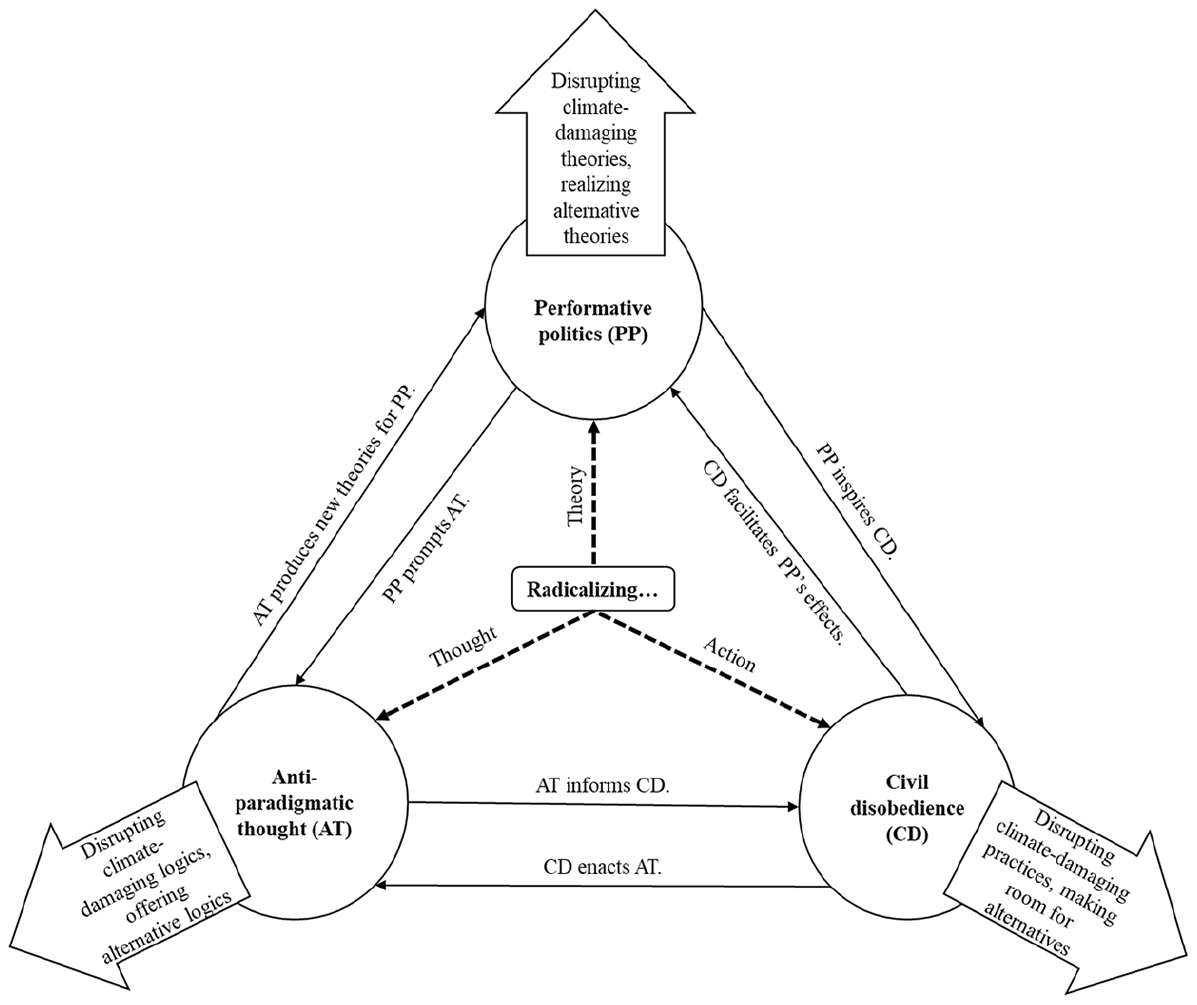
The complementary nature of radical practices.
For instance, anti-paradigmatic thought might be prompted by management educators’ engagement in performative politics’ search for alternative theories. For instance, we could require an essay assessment in teaching in which we invite learners to reflect on radically alternative practices. As an example, in a financial management course, students might reflect on carbon budgeting practices that restrict the amount of business activities based on a maximum amount of allowable carbon emissions generated through them. These essays could serve as input for a visioning exercise in which financial management academics reflect on what theories we would need for such practices to become real. Conversely, anti-paradigmatic thought may also generate new theories to be realized by performative politics. This exemplifies how practices may be mutually complementary in their enactment. Similarly, performative politics’ disruptive effect on climate-damaging theories may offer scientific legitimacy to the paradigm-disrupting effect of anti-paradigmatic thought, which would add legitimacy to the disruption of climate damaging practices through civil disobedience. For instance, we could use the frequent prompts from accreditation agencies to bolster our business school’s portfolio of RMLE practices to legitimize a targeted change of courses from growth to degrowth theories. In a consumer behavior course, we could move from marketing theories aimed at maximizing consumption to those related to enabling sufficiency in consumption. This approach could prompt learners, future marketing professionals, to disobey when asked to engage in consumption-furthering that ameliorates climate change.
Enacting such an interrelated, radical texture of multiple academic RMLE practices (Laasch & Gherardi, 2019) can have a potential impact due to the accumulation of the disruption and alternative-generating effects of the practices. Enacting a combination of practices can also be more feasible than engaging in any individual one of these practices due to this kind of complementarities.
Call for Rejoinders
This essay is meant to spark a series of rejoinders that could go deeper into and/or against the radicalization argument. It could be that radicalizing can be understood to be counterproductive. There may be arguments against or in support of the three radical practices. Maybe, there will be suggestions for further radical practices. Some might even argue that what is proposed here is not radical enough. The degrowth theme is also likely to provoke strong reactions. Do we really need to do away with growth altogether in business and management education? How do regional, sectorial, or other contextual differences matter in our relationship to de/growth? Or maybe there is an argument that the growth versus degrowth narrative misses the point altogether and that business school academics and students should direct our climate mitigation efforts at something entirely else.
Research Directions
The three radical practices also imply opportunities for RMLE research. For instance, it would be exciting to empirically capture if and how academic colleagues engage in performative politics, in order to generate what versions of reality correspond to specific theories. In particular, there might be interesting differences based on the disciplinary theories, levels of analysis, and approaches of performative politics practitioners. For anti-paradigmatic thought, I would love to see ethnographic studies in which colleagues share their experience and internal life-worlds when engaging in anti-paradigmatic thought journeys. Finally, it would be insightful to study the effectiveness (both how much and what kind of learning) can be realized through RMLE for civil disobedience. Future research could also center on the degrowth theme. It would be especially insightful to take stock of approaches and pedagogies for teaching degrowth in business schools, and to study the dynamics of such pedagogies when being confronted with the dominant growth paradigm.
Radicalization Beyond Climate Change
Given the urgency of climate change, it is easy to enter into a carbon tunnel vision mode (Gloor et al., 2022; Konietzko, 2022). However, it is crucial to not forget that the urgency extends beyond the context of the climate crisis, which is just one of the interrelated grand challenges ready to turn into another grand crisis such as Covid, the Russia-Ukraine war, and a looming collapse of biodiversity (Laasch et al., 2022). Humanity has entered into the era of accelerating grand crises (Steffen, Broadgate, et al., 2015). This situation is well conveyed in a viral cartoon by Graeme MacKay, in which a Covid wave is threatening to swallow humanity, but hard on its heels there are even bigger waves of recession (not necessarily a bad thing from a degrowth perspective), climate change, biodiversity collapse, and war (MacKay, 2020).
Many of these issues and crises can be linked to the “capitalocene,” a geological epoch characterized by economic practices shaping the planet (Calás et al., 2018; Haraway, 2015; Moore, 2017), and which have driven humanity to exceed planetary boundaries (Steffen, Richardson, et al., 2015). Given that business management practitioners are key actors in this crisis, these grand issues and crises can be tackled through anti-paradigmatic management and organization research and practice (Ferraro et al., 2015; George et al., 2016; Whiteman et al., 2013). Accordingly, the need for the radicalization of responsible management learning and education transcends the cause of climate education.
Footnotes
Acknowledgements
I am grateful to Jennifer Leigh for encouraging me to submit this provocative essay, to Petra Molthan-Hill and Alex Hope for allowing me to engage them as sparring partners for my argument, and to the two anonymous reviewers, in particular to Reviewer 1, who proposed and encouraged me to use the provocative subtitle of this essay. I am also grateful for being given the opportunity to develop and discuss the ideas in this essay with doctoral students and colleagues at workshops and keynotes at the annual meeting of the Norwegian Group of Organization Studies (NEON), at the annual convention of the Swedish Academy of Business and Management (FEKIS), and at invited presentations at the University of Birmingham, Jonkoping International Business School, the University of Manchester, and the AOM Impact Scholar Community. Finally, I am deeply grateful to the countless members of radical climate change movements, whose relentless efforts and positively disruptive practices have served as an inspiration for the central radicalization proposition of this essay.
Declaration of Conflicting Interests
The author declared no potential conflicts of interest with respect to the research, authorship, and/or publication of this article.
Funding
The author received no financial support for the research, authorship, and/or publication of this article.
