




Abstract
In this article I review trends in teaching environmental sustainability over 50 years in the Journal of Management Education (JME) to help instructors and institutions develop effective pedagogy for this complex and consequential subject. Given the current planetary emergency many instructors now grapple with how to teach change in societal and global systems. Already they have moved the sustainability field forward by integrating climate science with management topics and enhancing integrative learning that builds individual student autonomy, agency, and leadership. This examination of the JME literature suggests that at least three fundamental challenges remain: (1) applying systems theory to frame change and make meaningful pedagogical choices, (2) balancing traditional and experiential pedagogies in light of the need to teach about macro level systems, and (3) teaching sustainability for the planet in an academic sector that mainly values sustainability for business organizations. These challenges are inspiring critical thinking that is driving the field forward. At the same time, some recent research suggests that business schools may be unlikely to recast their missions to encompass societal change. As a result, concerned educators may turn increasingly to their universities, with their broader educational missions, to develop curricula that will help save the planet.
Keywords
Introduction
In recent decades, editors of the Journal of Management Education (JME) have repeatedly advanced the theme of teaching and learning about environmental sustainability, or SiME (Sustainability in Management Education). The editors of this 50th anniversary issue invited authors to consider the “then, now, and next” for such major themes. This review suggests that in JME the “then” content on SiME is slim, but the “now” is strong and the “next” is downright compelling. Of course, “next” is our primary concern. So the fundamental issue I address here is: How can teaching about environmental sustainability, especially climate change, help curious, ambitious, worried people, which is to say our students and ourselves, understand what the future holds for the planet and what we can do about it?
I first look back to examine how the theme of environmental sustainability has developed over time in the pages of JME, with additional reference to its journal cohort. I then look forward to explore how JME can help instructors do the best possible job of teaching environmental sustainability. The point of these explorations is to help us decide what to teach and where and how to teach it. This review suggests numerous avenues for pedagogical development. I hope it will inspire course and curricular innovation and research. I hope it will encourage leadership among faculty and students to address the threat of environmental instability, and to take on this challenge both within and beyond their university roles.
I begin by establishing definitions and describing the methodology I used for choosing articles and themes. For context, I then offer a timeline and overview of world events and climate milestones juxtaposed against key developments in teaching SiME. I then report on how authors incorporated environmental sustainability into management pedagogy in the early years of JME and how the field has since evolved by integrating climate science, promoting integrative learning, and fostering a passionate commitment to environmental sustainability. In several major sections, I examine how systems theory has framed content innovation in SiME, explore potential adaptations in the core practices of experiential and traditional learning, and discuss how, and even whether, we should teach sustainability in business schools.
Methodology
In this review the terms “environmental sustainability” and “sustainability in management education” have the same foundation. Sustainability is defined as development that meets the needs of the present without compromising the ability of future generations to meet their own needs. It requires that human impacts do not exceed the capacity of the planet (Brundtland, 1987). It is worth noting that these days the term “sustainability” is used in many different contexts and is defined in many different ways. Sometimes these definitions expand or improve upon the concept, but at other times they co-opt it (Urdan & Luoma, 2020). Both this writer and you the reader must be vigilant about pursuing the definition of sustainability wherever you find the term.
This article is an integrative review of five decades of publications in JME. An “integrative review” is a “critical analysis and creative synthesis of the literature included in the review” that aims to find patterns and gaps in understanding (Elsbach & van Knippenberg, 2020, p. 1284). An integrative review is “not a data dump. It is a creative activity that produces a new model, conceptual framework, or other unique conception informed by the author’s intimate knowledge of the subject” (Torraco, 2005, p. 362). Integrative reviews have been called “reviews with an attitude” (Elsbach & van Knippenberg, 2020, p. 1278). They offer a “clear point of view that defines important research questions that should be (and should not be) examined” (p. 1279). An integrative review is much more comprehensive than a conceptual review. In the same way, it differs from theory manuscripts that focus on “forwarding a specific theoretical perspective or framework” (p. 1282).
Integrative reviews begin by setting boundaries. For this article initial boundaries were clear. Most obviously, the special edition editors established that the timeline for the review should begin in 1975 with the informal publication of a pedagogical newsletter. I submitted my first draft near the end of 2023, early enough to allow the 50th anniversary issue to be reviewed and populated by 2025. Coincidentally, this timeline corresponds roughly to a period in which climate change has been more obviously impactful and more widely recognized as a crucial societal concern.
The editors also asked authors to focus on JME, while encouraging us to include articles from the JME journal cohort. I began this review by reading in JME and then following significant and intriguing leads to related work in other journals. However, I did not deeply review any other journal. At the outset, I read the JME special issues on sustainability and used the JME online search tool to identify articles on “climate change” and “sustainability.” I also revisited articles that I had discovered in my own research and as many other relevant articles as I could discover through general reading. My goal was not to summarize and critique all of the 50 years of material, but to reveal important connections, trends, and possibilities. I have also included as many pertinent articles as reasonable, both as a way to celebrate the JME community of authors and as a way to indicate cutting edge work that warrants future research. Consider a short citation of an article here to be a portal to what this author thinks is an article worth reading.
In integrative research a third, less obvious boundary is embodied in the author himself or herself. This article reflects this author’s academic work and point of view as revealed in my research, teaching, and lived experience. For example, in recent years, I have focused on developing theory and pedagogy that address planetary sustainability by pursuing change on a global systems level. My time constraints have also been a boundary. Engaged reviewers have asked me to address additional important topics, such as how to find truth in today’s information-saturated environment. However, I remained focused as discussed above, and for once I rejoiced in the Journal’s space limitations.
In terms of life experience, this article is written from my perspective as an academic who has taught mainly in research universities in the United States. The history and culture of U.S. business schools imbues the field and has influenced pedagogy internationally. We do not know a lot about that influence as it pertains to this article, and this review, with its focus on teaching climate change, did not turn up such a discussion. Yet even a cursory knowledge of international journals and conferences suggests that in other educational traditions, pedagogy differs quite importantly. For this article I asked colleagues in several other countries to characterize their sustainability pedagogy. This informal exploration turned up a large range of answers, including, from a developed country, “We don’t really discuss pedagogy; we don’t think it’s important,” and from a developing country, “We don’t have enough local information to even begin to know.”
Although we refer casually to the international dimension as a boundary to our work, we also know that nationality is generally an imprecise indicator of culture. Taking culture into consideration, Long et al. (2022, p. 143) point out that there is a “significant gap in our understanding, as a field, of how to teach for conceptual and cultural change, scientifically and politically, among conservative people in rural spaces” (see also Lübke, 2022). They point out the pedagogical importance of working with cultural differences between instructors and their students. So in addition to, or perhaps instead of, nationality, instructors should be designing pedagogies that consider boundaries like social class, local economics, presence or absence of an extractive industry, and economic and cultural dependencies on fossil fuels.
Throughout this discussion I see opportunities for further thinking and research. For brevity’s sake I identify them simply as research questions (“RQ’s”). Perhaps they will suggest to researchers some interesting directions (comparing international and U.S. approaches to SiME comes to mind) and, as a whole, they point to a wealth of research opportunities in sustainability pedagogy.
Overview and Timeline
Table 1 provides a starting point for following the development of the field as it contributes to the scholarship of teaching and learning (SoTL).
Milestones for the World, the Journal of Management Education (JME), Sustainability in Management Education (SiME), and Atmospheric CO2.
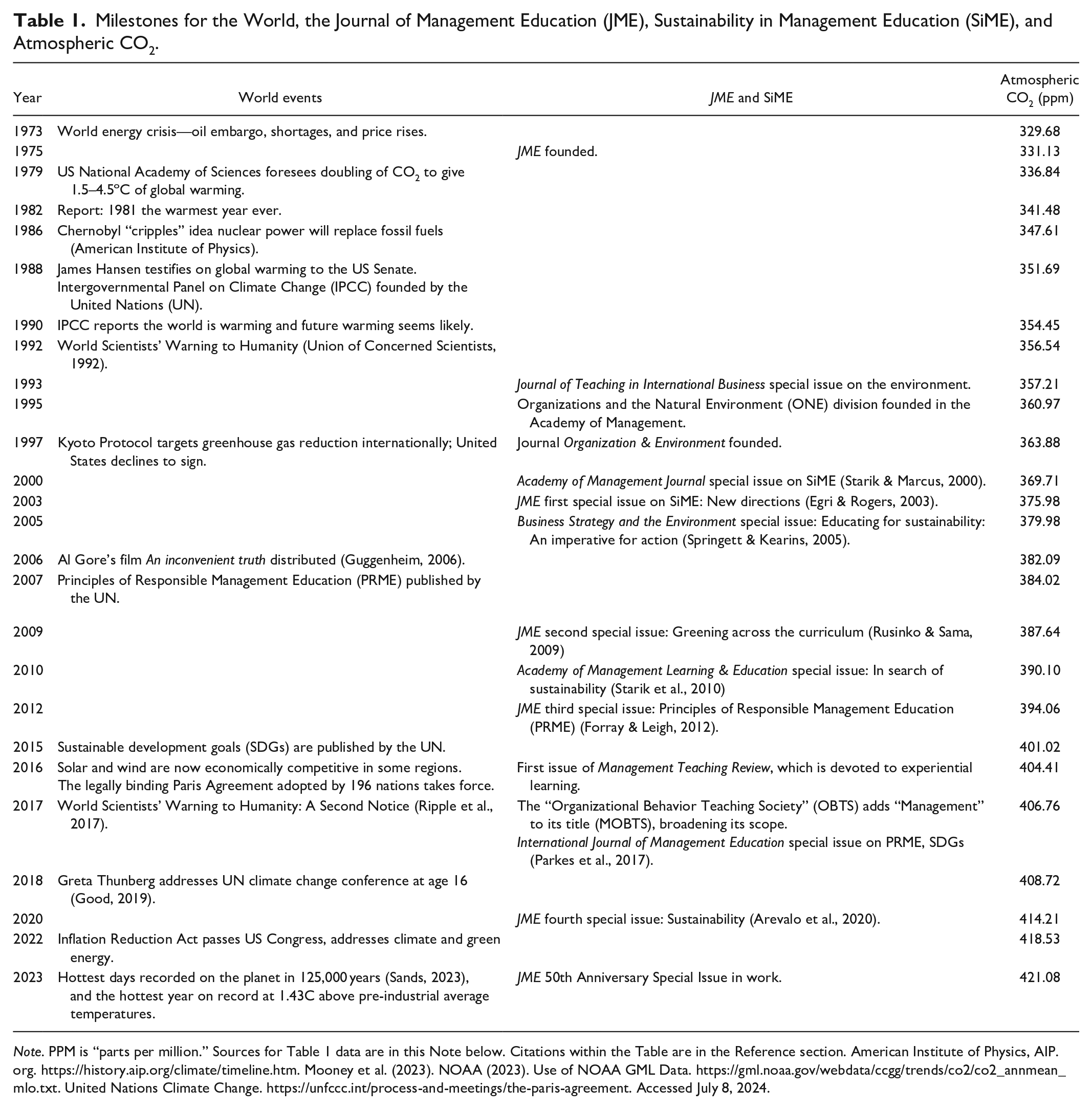
Note. PPM is “parts per million.” Sources for Table 1 data are in this Note below. Citations within the Table are in the Reference section. American Institute of Physics, AIP.org. https://history.aip.org/climate/timeline.htm. Mooney et al. (2023). NOAA (2023). Use of NOAA GML Data. https://gml.noaa.gov/webdata/ccgg/trends/co2/co2_annmean_mlo.txt. United Nations Climate Change. https://unfccc.int/process-and-meetings/the-paris-agreement. Accessed July 8, 2024.
Articles in JME are presented along with other significant pedagogical contributions. The Table displays mileposts for SiME and JME in the context of world climate events and increases in carbon dioxide in Earth’s atmosphere. I imagine it will provoke poignant memories among long-time scholars and academic climate activists, while early career academics may appreciate the historical perspective and seek to become part of it.
The information included in Table 1 is not meant to be comprehensive, that is, to include every scholarship of teaching and learning (SoTL) article in SiME in the last 50 years. For that sort of review of the literature, see the recent JME special issue “Sustainability in management education” (Arevalo et al., 2020). In addition to a review of major journal articles, that issue includes various other scholarly contributions like edited book volumes that began to appear around 1994 and also significantly advanced the field. See also Forray and Leigh’s (2012) presentation of the intellectual roots of the Principles of Management Education (PRME).
The Table shows that in the first two decades or so after JME was founded, only a few pioneers took on sustainability pedagogy. The honor of publishing the first special issue was claimed by the Journal of Teaching in International Business (JTIB) in 1993, and JME’s first special issue appeared a decade later. Looking back, it is tempting to develop hypotheses about these early gaps in coverage. They beg such questions as: Why were there not more publications earlier? How did this early publication pattern reflect the popular discourse in business and the paradigms of business education of their era? How did the campaign by the fossil fuel industry to hide early concerns about global warming factor in? How can we today design curricula that keep up with rapidly changing climate science? How do we teach our students to stay up-to-date? These are all interesting questions that are unfortunately beyond the boundaries of this article.
In recent decades there has been much more academic activity. In 1995, soon after the 1993 JTIB special issue and after a 4-year campaign, concerned educators launched the Organizations and the Natural Environment (ONE) division of the Academy of Management. This division now provides an influential network and publication outlet that supports interdisciplinary research. Between 2003 and 2020 JME published four special issues that showcase theoretical and pedagogical developments in SiME, and other journals launched similar publications. Meanwhile, peoples of the world were waking up to climate change. The United Nations established the Intergovernmental Panel on Climate Change (IPCC) to monitor and publicize scientific developments (but not make policy). Al Gore launched his influential educational film An inconvenient truth in 2006 (Guggenheim, 2006). Unfortunately, over the decades, the amount of CO2 in the Earth’s atmosphere has grown steadily.
What follows is first, a review of these early transitions as discussed in JME and then an examination of the subsequent progress in SiME. After that we will tackle several of the fundamental challenges that SiME instructors face today.
Early Years
Back in the day, environmental sustainability was seldom taught in business schools. In 1993 Dr. James Hansen of Columbia University had already warned the United States Senate about impending global warming. The IPCC had published its first report on global warming. Yet, environmental researcher and activist Mark Starik still found it necessary to argue for the inclusion of the natural environment in business school curricula: Nearly every business course begins or ends with some consideration of what has been referred to as “the business environment” . . . The definition of “the business environment” typically includes political, legal, social, economic, and technological environments, but seldom mentions or develops the most obvious (and currently, perhaps, the most salient) “business environment” of all – the natural environment (Shrivastava & Scott, 1991) . . . The truism that every organization and profession (related to business or otherwise) operates in the natural environment is beyond refutation, yet this obvious and typically overlooked fact may need recognition somewhere in each business course (Starik, 1994, p. 49).
Thirty years on, SiME has made progress and the natural environment is now widely considered a major factor in the business environment. Originally most discussion of business and the natural environment had been limited to profit-making factors and opportunities. Today, following on early models (Barbier, 1987) and an increasingly influential systems perspective, environmental sustainability is also widely discussed as a social and ethical concern.
“Frond Lake” Marks a Transition
In 1992 JME published a role-play exercise in which students interact as senior managers weighing whether to install antipollution equipment at a paper mill. The fundamental learning goal of “Frond Lake: An environmental policy role-play” was to examine the interpersonal processes among managers in a variety of organizational roles (Moore et al., 1992). The exercise instructions directed participants to pay special attention to the decision-making process of the group, and the student evaluations of the exercise centered exclusively on the quality of the group interaction. The exercise encouraged students to practice particular behaviors in their managerial role, such as active listening and supportive versus threat-producing communication, along with developing moral awareness of sustainability issues. The environmental problem provided the situational material for the group’s discussion, but, notably, it was not itself the learning focus of the exercise.
“Frond Lake” represents an early stage of the inclusion of environmental sustainability in SiME pedagogy. The authors wrote that it “sensitizes participants to issues they may not have considered before” (p. 152) [Emphasis added]. Addressing a systems issue, the exercise was designed in part to encourage comparison of the “traditional North American economic paradigm” with its focus on short-term efficiency and profits, and the Canadian “new environmental paradigm” in which the focus is on conservation and survival (p. 146).
Within SiME pedagogy, “Frond Lake” is a bridge between years ago and now, between ignoring environmental issues and mainstreaming them. The exercise was an advance because it built awareness at the macro systems level. Also, it recognized an environmental issue as consequential both practically and morally. However, it did not go so far as to make the environmental issue the main focus of the analysis. Unlike what many authors are doing today, it did not demand that studying the environment be central to management thinking or a reason to get involved in societal (macro) level change.
“Frond Lake” had a great run. The authors noted that before it was published in 1992, they had been using it for “the past two decades” (Moore et al., 1992, p. 153). 1972! Thank you! For a further discussion of environmental attitudes in business see Shetzer et al. (1991).
Of course, in today’s complicated world, ideally our SiME pedagogy attempts more. Certainly, to reflect current aspirations for saving the planet, SiME teachers are much more likely to elevate the environmental material from being context to being core content. Also, we are acutely aware that when pedagogy is focused and debriefed at no higher than the organizational level, it is vulnerable to the criticism that, as critical theorists put it, students are “colonized”: Having restricted their thinking to organizational concerns, they remain ignorant about the big picture, which is exactly the opposite of what we want and need from our future leaders. I will have more to say about these important systemic issues below.
Progress Since the Early Years
In recent decades SiME pedagogy has advanced significantly. Three themes in particular have shown substantial progress. One is that educators today work with climate science very differently than they did decades ago. Another is that educators are pursuing learning outcomes like encouraging student autonomy and agency that, among other benefits, help to develop sustainability leadership. Finally, one can observe in the literature that the passion to teach SiME continues, as is sometimes expressed in very un-scholarly terms.
Faculty Scientific Knowledge: Roadblocks Removed
In their introduction to the JME special issue “Sustainability in management education: Advances and future directions,” Arevalo et al. (2020) pointed out that the editors of the first special issue in the field (Mintu-Wimsatt et al., 1994) identified “faculty competence” as perhaps the most serious concern for the future of SiME. To teach an environmental course effectively, they argued, faculty would need training programs in environmental concepts and issues.
Fortunately, with the rise of the Internet teachers and students alike can now study climate science far more easily than 30 years ago. Even for deep dives like understanding the carbon cycle or climate tipping points, it is easy to find excellent authoritative tutorials online, and teachers can readily become scientifically literate themselves at some workable level. Moreover, they can model this autodidactic approach for their students (RQ: Are natural scientists in turn being encouraged to teach about human systems and leadership?).
This is not to argue that business academics are never cowed by studying natural science. Yet many valuable resources have been developed to aid them. The MIT Sloan School of Management and Climate Interactive offer training about climate change impacts in several immersive, interactive climate simulation tools including the award-winning En-ROADS. En-ROADS is also a component of the macro-oriented Climate Action Simulation for groups (Climate Interactive, 2023). In-depth carbon literacy training for professionals is offered by Nottingham Trent University in the UK (Nottingham Trent University, 2023). The National Aeronautics and Space Administration (NASA) offers numerous high level educational modules on earth science at its website https://climate.nasa.gov/. In JME Craig et al. (2022) demonstrate how STEM subjects can be integrated in business and intra-university curricula using interdisciplinary modules and the case method.
Having access to scientific information also opens up the opportunity to teach basic principles of scientific investigation. In today’s sustainability curricula, developing the skills to identify and interpret science is often a learning goal. Teaching students how to work with high quality scientific research (data driven, peer-reviewed, replicated) goes a long way toward broadening their world view and preparing them for contributing to science-based decisions in their future organizations and communities (André, 2020a, 2020b).
It is helpful that in most schools teaching climate change has moved beyond the contentious early stage in which instructors had to prove that climate change exists. No longer tasked with proving climate change through detailed and comprehensive science, instructors today can turn both their classroom time and their own study time to more forward-looking science-based topics. As a result, in many management classrooms conflict around climate issues has devolved into less pressured and more cooperative explorations of scientific issues. Indeed, students and teachers often become partners in researching the facts, as we shall see next.
Advancing Integrative Learning is Now Easier
The primary goal of integrative learning is to help students develop their own claims to knowledge: Learners themselves confirm what they know, believe, and value so they can defend their claims. Integrative learning theory suggests that the best pedagogy for developing claims to knowledge is knowledge acquisition in combination with experiential learning. In the process, students develop the autonomy of their own viewpoints, a sense of realism and practicality based on real world observations, excitement about the learning process itself, critical thinking, and a sense of competence and agency (André, 2020b; Dehler & Welsh, 2014; Quintero-Angel et al., 2023). Integrative learning is a kind of learning that is ideal for students engaging with our complex, fast-changing, and environmentally threatened world.
Integrative learning is enhanced by having available abundant information. Instructors are likely to find that when facts must be checked in the moment, as in the classroom, enlisting a smart phone is more realistic and comfortable than claiming to be an expert on every point. Indeed, today students and instructors alike are open to fact checking and sharing the results in real time. With information at their fingertips, teacher and learner become allies in discovering, sharing, debating, and contextualizing basic facts and truths. In the term popularized by integrative learning theory, they “construct knowledge” (Hursh et al., 2015), and they do it together.
Passion Endures
Between then and now, one thing that has endured is the absolute passion some teachers have for protecting the natural environment and future generations. Decades ago audiences were treated to this academic presentation: “CASTRATED Environment: GREENING Organizational Science” (capitalization in the original) (Shrivastava & Scott, 1991). In 2010 Shrivastava returned to actively encouraging students to develop a passion for sustainability (Shrivastava, 2010). These days academics can encounter emotion like that found in the rhetoric of the JME article entitled “Radicalizing managers’ climate education: Getting beyond the bull**** fairy tale of eternal economic growth” (Laasch, 2023). Colombo et al. (2024, p. 210) refer to a “‘sustainability turn’ that signals the existence of a growing number of driven faculty and students committed to making a difference and transforming the discipline” (RQ: How do we teachers express emotion when doing this work? And how does expressing emotion impact learning outcomes?).
In recent decades we have witnessed a surge of writing on SiME, articles that examine how instructors are teaching SiME today and may be teaching it tomorrow. In the next three major sections I examine three vital pedagogical challenges that appear in this literature: (1) the appropriate application of systems theory to frame change, (2) the effective use of both experiential and traditional pedagogies to teach macro level change, and (3) the perils of teaching sustainability for the planet in a sector that heavily values teaching sustainability for business alone. These core challenges are sparking critical thinking that is now driving the field forward.
Using Systems Theory to Frame Change and Focus Pedagogy
To grapple with the first significant challenge requires a short refresher on systems. An early progenitor of systems theory as applied to modern organizations was Robert L. Kahn (Katz & Kahn, 1978). As his student at the University of Michigan, I vividly recall him going to the board (black) and drawing the essence of a system—inputs, throughputs, outputs, boundaries, and feedbacks. Today the theory is still foundational, although widely interpreted. In a more recent and detailed explication, Meadows (2008) described a system as any set of interconnected things, such as people, that produce their own pattern of behavior over time. Think the military-industrial-governmental complex or the energy sector. Meadows asserted: “A system isn’t just any old collection of things. A system is an interconnected set of elements that is coherently organized in a way that achieves something” (p. 11) [Emphasis added]. In short, a system has power. Today systems are typically represented in models, including complex computer models of everything from how the oceans warm to how decision makers address environmental risks. Such models drive complex pedagogical tools like the En-ROADS simulation.
Fundamental to systems theory is the concept of levels. For our purposes here, we identify three levels: individual (micro) level processes, organizational (meso) level processes, and global societal (macro) level processes. In my view, the problem of environmental sustainability requires macro level interventions and a pedagogy that addresses societal and global systems. Society must now pursue change at the macro level if for no other reason than individual and organizational level change has not effectively addressed, let alone solved, the problem of destructive climate change. Naturally, all levels of a system interact: Macro level change is generated in both individual and organizational ideas and strategies; leadership often works across levels. It is useful to recognize that management learning and education themselves are embedded in social and ecological systems (Colombo et al., 2024).
Systems Thinking, Systems Critique, and Systems Change
To address environmental sustainability effectively, SiME educators distinguish systems thinking from systems critique and systems change. This three-part model of systems management aligns with the three “necessary transformations” of management theory and research on sustainability identified nearly 30 years ago as (in simplified terms): identification of necessary shifts in human thinking, identification and critique of the purpose of organizations within society and the biosphere, and the implementation of transformational change (Gladwin et al., 1995).
When engaged in systems thinking, we say informally that students “get the big picture”: They can identify and describe existing systems, their interactions, and their own place within them. They may also develop complicated understanding, which combines complex thinking skills with an awareness of a multiplicity of perspectives (Weathersby et al., 1982). On the other hand, when students examine the strengths and weaknesses of particular systems with the goal of improving them, they are performing a systems critique. And when they are identifying levers of change, such as key feedbacks and effective leaders, they are working with systems change.
More than 20 years ago in JME, Bradbury (2003) introduced systems thinking to provoke student interest in environmental sustainability. She designed a series of exercises in which students connect their own lives (the “inner”) with the larger world (the “outer”). As Bradbury illustrated, students can readily learn to identify a broad range of systems and their elements, and to understand their own role in these systems. Observing that at the time environmental and sustainability issues were new to many management students, she argued that as students learn how the outer world sustains and influences them and their organizations, they become better systems thinkers and may become more interested in working holistically on sustainability (RQ: What factors influence whether students who connect the inner and outer become change agents?).
Bradbury quoted a philosopher that, “I believe that our very survival depends on our becoming better systems thinkers” (p. 175). This has the ring of truth to your current author: Not thinking in systems leaves us vulnerable to the power of a system and to the collapse of a system. Thinking in systems is also important for achieving justice. An important outcome of connecting the personal with the systemic is to “educate the marginalized to be aware of systemic dynamics (in contrast to assumed personal failings)” (Freire, 1994, quoted in Jamil et al., 2023). A few years after Bradbury’s article, Porter and Córdoba (2009) defined three approaches to systems thinking that reveal its characteristics, strengths, and limitations. They point out pitfalls in the application of systems theory, such as a lack of clear definitions and systematic rigor, and they discuss how more systematic rigor can improve practical application of the theory.
A close reading of a seminal set of JME articles on reflexivity exemplifies how systems theory has now entered pedagogical discourse. Anne Cunliffe, recipient of JME’s Lasting Impact Award (Cunliffe, 2016) for her 2004 article on reflexivity (Cunliffe, 2004), at first defined critically reflexive practice as embracing “subjective understandings of reality as a basis for thinking more critically about the impact of our assumptions, values, and actions on others” (p. 407). In a more recent article her definition became “questioning what we, and others, might be taking for granted—what is being said and not said—and examining the impact this has or might have” (Cunliffe, 2016, p. 741) [Emphasis added]. Still later, Cunliffe has explicitly acknowledged the systemic nature of individual reflexivity: “Reflexivity works at two levels—being self-reflexive about our own beliefs, values, and so on, and the nature of our relationships with others, what we say, and how we treat them (Cunliffe, 2014), and being critically reflexive about organizational practices, policies, social structures, and knowledge bases” [Emphasis added]. She concludes that, “Both self- and critical-reflexivity are important in working toward ethical, responsive, and responsible organizations” (Cunliffe, 2016, p. 741).
This sort of evolution in systems thinking suggests instructors are moving toward addressing systems level problems, and away, perhaps, from excessively individualistic approaches (RQ: What is the role of reflexivity in the context of change at the sector or global level?). However, to address environmental sustainability SiME scholars must connect individual systems thinking (micro) and organization level processes (meso) with societal (macro) level change. This will be challenging. It is comparatively straightforward and uncontroversial to teach individuals how to think more broadly, while researching and teaching about how actors interact in actual systems of power is complicated and politically sensitive. In short, systems critique and systems change are more difficult to teach than systems thinking.
It is also important to recognize that individuals cannot engage in systems critique or systems change without systems knowledge, defined as having a familiarity with events and behavioral patterns in macro level institutions and leaders. Such knowledge is not easy to acquire or impart. I will develop this thought below in our discussion of experiential and traditional learning. Before that, let’s examine how academics have reacted to an important global-level action—and found it wanting.
The PRME as an Opportunity for Macro Level Change
As we educators were busy developing SiME, along came a real-life macro level intervention that validated our climate concerns and intrigued us with its potential to create societal change. As a macro level institution, the United Nations is in a unique position to address societal and global change. In recent decades, its real-world initiatives have addressed environmental concerns globally. Notably, in 2007 it created the Principles of Responsible Management Education (PRME) to bring environmental sustainability into the management classroom. JME devoted a special issue to the PRME in 2012.
Among the PRME’s main principles are to “develop capabilities of students to be future generators of sustainable value for business and society at large and to work for an inclusive and sustainable global economy” and to “create educational frameworks, materials, processes, and environments that enable effective learning experiences for responsible leadership” (Principles of Responsible Management Education, 2007). Importantly, PRME does more than set goals. Signatories, mainly universities, agree to report regularly on how their institution is implementing the PRME principles. With this reporting requirement the PRME encourages change, and its own organizational practices serve as an example of the values and attitudes the PRME wants to convey to students.
In the JME special issue, editors Forray and Leigh (2012, p. 307) describe the PRME as “fundamentally a platform for educational reform.” They selected articles that focus on institutional characteristics and impacts of the PRME, such as building faculty support for it, and on course designs that address how to integrate PRME values into courses on subjects as disparate as subsistence marketplaces and ethics. In line with the argument that systems thinking alone is inadequate, they emphasize “the need for more connection to the organizational development and change literatures, and the need to identify the key issues and new models for change management within the higher education context that address fundamental barriers to PRME adoption and implementation” (p. 307).
The Limitations of PRME as a Catalyst for Macro Level Change
Subsequently JME published a critique of the claim that the PRME represent a paradigm change. For one thing, according to Louw (2015), key issues and the PRME model are not well defined. In an analysis of the PRME in UK business schools, he also finds that the PRME conversation is a managerialist (meso level) intervention, for example one that serves business interests while ignoring other interests (Mir, 2003). He wrote, “The PRME present a highly contestable set of propositions without acknowledging or encouraging the types of analysis, critique, or graduate capabilities essential to embedding sustainability and responsibility in organizations across all sectors” (p. 202). In other words, despite the UN imprimatur, and even though it is a widely used vehicle for promoting systems thinking, the PRME presents “business schools as servants of the corporate sector” and clearly fails to specify the macro-level change necessary to address the climate crisis (p. 184).
In JME more recently Audebrand and Pepin (2022) aim additional criticism at the PRME. They point out that the PRME argue for the importance of “the values of global social responsibility” but do not define them or operationalize such values. They assert, “It would be useful to specify what values business schools should be concentrating on to foster critical reflection on their research orientations, teaching content, and interactions with society—on their actions beyond their discourse” (Audebrand & Pepin, 2022, p. 911) [Emphasis added]. Addressing this shortcoming, they offer a set of seven core values for responsible management and make a unique and important contribution by showing how each value is manifest at the micro, meso and macro levels of change. (RQ: What is the relationship between individual, micro-level values and macro-level economic systems like capitalism?).
In 2015 the United Nations published The 2030 Agenda for Sustainable Development (United Nations Department of Economic and Social Affairs, undated). It includes 17 Sustainable Development Goals (SDGs) that have created considerable academic (and other) interest but have also drawn critiques similar to those of the PRME. In 2017 Parkes, Buono, and Howaidy edited a special issue of The International Journal of Management Education that examines what has been achieved by PRME and how the SDGs can contribute going forward. They point out that critics of the “UN endeavors” see them as having a “pro-market spin” that over time “will ultimately reduce its global legitimacy” (Thérien & Pouliot, 2006, p. 67; see also Kopnina & Benkert, 2022, and Öztürk, 2022). They also point out that proponents see the SDGs as “a far reaching voluntary social responsibility initiative for progressive businesses” (Parkes et al., 2017, no page) that supplements rather than replaces regulation (Rasche, 2009, p. 513). Audebrand and Pepin’s 2022 article describes a MOOC in which students explore the interconnected and interdisciplinary nature of the SDGs. Andreoni and Richard (2023) also present a game that guides students to see how the SDGs are interrelated.
It follows from these discussions that PRME and the SDG’s make interesting subjects for a systems critique, and that instructors might well choose to teach them critically. Their analysis might address such questions as: What kind of change do they motivate? Is that change evident at the micro, meso, or macro systems level? At the same time, when establishing learning goals for their courses, instructors should weigh how much time to devote to them versus other topics that do specifically address macro level change (RQ: Model, or find a model, that addresses avenues for systemic change to improve environmental sustainability. Consider building on Gladwin et al., 1995).
Weighing Traditional and Experiential Pedagogies
The second significant challenge I encountered in the literature is the neglect of traditional pedagogies to teach a subject that seems to demand them. In this section I develop the idea that since we want to understand and teach macro level change, we should examine our assumptions about what pedagogies are a best fit to teaching that complex topic.
In a 2009 article revisiting the JME vision and editorial mission, editor Jane Schmidt-Wilk endorsed the concept that JME has meaningful consequences because, in part, it “[affects] the intellectual community of scholars through the discovery of new ideas, new methods, and new ways of understanding the consequences of pedagogy” (Bilimoria, 1999, p. 334; Schmidt-Wilk, 2009). I call to your attention the phrase “the consequences of pedagogy” and urge us all to weigh the consequences of relying too heavily on experiential learning in light of students’ need to know about complex realities.
For instance, consider that to make room for learning about complex and consequential macro level systems, we might choose to do less experientially. Certainly we should scrutinize currently popular experiential learning approaches to see whether they meet evolving pedagogical goals. Shantz et al. (2023) found that MBA programs seldom describe how leadership addresses grand challenges like climate change. They report that consulting projects, although popular, tend to focus on only a few disciplines, hold out a false promise of including multiple stakeholders, and assume a profit maximization motive. Yet SiME students should be exposed to how decisions are actually made in complex systems. They need to know, for instance, how energy sectors influence governments and how communities and their business sectors adapt to climate change.
Systems Thinking Versus Systems Knowing
When teaching SiME I use experiential learning, including cases, judiciously (André, 2020a). Some kinds of content are best conveyed through the so-called traditional pedagogies that focus on processes like information acquisition, recall and analysis. These teaching approaches focus on systems knowing. How effective are international efforts to meet global energy goals? How does a carbon fee differ from a carbon tax? We have in-depth discussions on topics like these, but first the students had to study them.
When teaching about macro level systems, instructors must grapple with how students can best learn about those systems and know them well enough to be able to influence them. Although individuals can only touch the elephant in one spot, they can acquire broad knowledge from books, media, interviews, and the like. Such learning is necessary for understanding macro level sustainability and change. The question here is how to balance it with other pedagogies.
As SiME educators we need to consider that any tendency to introduce too much individually-focused and organizationally-focused experiential pedagogy may create courses and even entire programs in which students learn little about crucial macro level systems. Is it more important for a student to study how to change their personal climate footprint or the footprints of major polluters? If a student spends their entire semester studying and recommending changes to their university’s energy system but never studies the ongoing world transition from fossil fuels to renewable energy, have we served them? Have we served the planet? (RQ: To foster systemic change, in any given course or program what is the best mix of developing individual systems thinking, analyzing important systems critically, and learning how to spark systemic change? What is the interaction between pedagogical mode and comprehending, remembering, and applying sustainability topics?).
To enter deeper into this research topic management scholars might begin with Bowen (1980, p. 8), who pointed out that all learning involves some kind of experience: “Are not most students in traditional cognitive classes also doing and feeling something with the materials when they are taking notes, reading about the ideas, manipulating the idea in term papers and exams?”. Bowen also quoted Aristotle (Politics V. v.) that “Learning is not child’s play; we cannot learn without pain,” an admonition that is germane to a subject as multifaceted as environmental sustainability.
New Roles for Stone Age Tools, and a New Tool
Given that in order to understand and change systems students must have a meaningful amount of knowledge about those systems, it follows that SiME instructors should carefully weigh how to utilize traditional pedagogies. To begin with, we might revisit the nature and impacts of reading—yes, reading, with all its spinoffs—as a pedagogical tool. It may be that longer pieces like books and other long form media are the most effective vehicles for teaching complex, systemic processes.
For example, the book Fire weather: A true story from a hotter world covers in memorable detail topics from the societal and environmental impact of tar sands exploitation in Alberta, Canada, to the uniquely destructive nature of modern wildfires like the one that incinerated much of Fort McMurray in that province (Vaillant, 2023). In other integrative works, Nyberg et al. (2022) examine social movements and new economic and social systems, and André (2020a) applies a range of social sciences to study leadership for climate change. Westerman and Westerman (2009, p. 661) find social protest novels to be particularly effective because “they are descriptive in their context, dramatize the personal (although there is collective harm), and provide a basis for making connections between business and society.”
Consider that reading may be absorbed differently and have different impacts on a person’s thinking and behavior than playing a game or watching a video, and its effectiveness may be influenced by whether or not it is digitized (Cavanaugh et al., 2015) (RQ: What more do we need to know about reading as pedagogy? Can we, should we, entice students to read?).
As we reconsider the didactic value of reading, let’s also examine how and why we lecture (Van Eynde & Spencer, 1988). This is a communication mode in which an informed and concerned human offers students information and a particular view of these challenging times. Lecturers model not only public speaking but also speaking out. These are core skills for many professions and for leadership. What makes an effective SiME lecture? What is unique about lecturing that positions the lecturer as change agent? For a discussion of intellectual activism by business scholars and a path into the relevant critical literature see Contu (2020).
Another way to learn about complex systems is to view change-oriented documentaries like The age of consequences (Scott, 2016), Tipping point: The end of oil (Thompson & Radford, 2011), and Gasland (Fox, 2010). These documentaries reveal both environmental and social problems. Further, they point to political roadblocks and solutions, often interviewing politicians, local citizens, and non-profit leaders who are at the forefront of change. Class discussion of such documentaries can extend to how students can continue to be informed about the current complex systems and networks that were introduced and how they themselves can find a path toward creating change. Of course, as with any medium, instructors must consider who vets the veracity of these videos. I once found myself on a long road trip to check out video content I thought important. Fortunately, the content was fine, and the trip (to attend a trial about fracking) was fascinating. Yet, collectively, are we doing enough to assess the truth of what we see in documentaries?
Another concern is that, in contrast to the videos just listed, many environmental documentaries view change as an afterthought. They spend most of their screen time showing a problem (often with gorgeous photography) and consider solutions for only a few minutes at the end of the video. All too often their default solutions boil down to finding ways to cooperate and stay hopeful. Because actual solutions are extraordinarily complex and difficult to achieve, involving numerous stakeholders, consequential investments and conflict, such films do not constitute effective pedagogy. Did we not just waste our students’ time?
Recently JME authors and others have begun to develop a promising tool: serious games. For an overview of this emerging pedagogy see Stanitsas et al. (2019). Games present an excellent opportunity to teach macro level concepts. They can combine information acquisition with experience on different levels and even imbed individuals in systems to see how they might change them. For example, the En-ROADS model can be used as a group game in which participants craft and test climate interventions against what current models predict for global temperatures. En-ROADS is exemplary because it is based on the up-to-date science of climate and existing models for systems change (Climate Interactive, 2023).
Authors working in the gaming space include Hallinger et al. (2020), who reviews simulations and serious games with an eye to teaching environmental, economic, and social sustainability and offers insights into how research on serious gaming can advance this potentially important pedagogy. Strada et al. (2023) offer the augmented reality game “Sustain” to illustrate gaming design principles. The Celsius game is a board game that shows the functioning of climate change as a complex system (Carreira et al., 2017). Katsaliaki and Mustafee (2013) review several popular games that include sustainable development themes, albeit with an emphasis on the fun factor. The recent explosion of AI products should boost productivity in this emerging pedagogy.
In sum, for all the reasons we can imagine, from time constraints to lack of knowledge on the part of the instructor to navigating political conflicts in class and in the university, teaching macro level solutions is hard. You protest: Too much! Not enough room! Who can possibly know all this stuff? And you are not wrong. Furthermore, SiME teachers must design pedagogies that help students to look both inward and outward, at levels that range from the individual to the global inclusively while concentrating on macro level change. In the face of many obstacles, they must find the wisdom to understand how learning takes place at the individual level yet inspires people to influence systems (Hibbert & Cunliffe, 2015).
The Business School Challenge: Can a Sector with Meso Level Goals Drive Macro Level Change?
The third challenge for SiME instructors is teaching macro level change from our particular perspectives and resources as business school educators. Engaged business professors have been trying but not yet succeeding to significantly expand sustainability pedagogy beyond the organization level to the societal level. I include myself among those advocates who look longingly across intellectual and practical barriers to try to discern how change works at a macro level and how it can be taught in the typical business school, a meso level organization that does not know how to do that and may not care to learn. It may be that businesses and the business sector are not going to adequately address climate change all by themselves, if at all (Wright & Nyberg, 2018). Yet we ourselves don’t know quite how to theorize and teach beyond the organizational level with which we are so familiar. For a parallel discussion about how to do this see Grosser (2021) on academic activism in organization studies, including social movement theory, political opportunities, and how to mobilize.
Evidence is mounting that businesses and their business school partners remain heavily oriented toward organizational level analysis and change to the exclusion of macro level analysis and change. One line of research defines “weak sustainability” as sustainability for the company and “strong sustainability” as sustainability for the planet. Analysis of corporate sustainability reports reveals that the dominant worldview of businesses is to pursue weak sustainability (Landrum & Ohsowski, 2018). Also, in a sample of American companies the sustainability guidelines that companies use to direct internal change set weak, business-as-usual goals and never once set the goal of achieving strong environmental sustainability (Demastus & Landrum, 2023). In other research, Shantz et al. (2023, p. 309) analyzed curricula from the Financial Times’s top 100 global MBA programs and found that only about 5% of the identified courses (86 of 1,688) teach at the macro level of “leading in complex and uncertain environments.” Where such subjects are taught, they typically focus on economic and technological challenges that rely on short term solutions and downplay moral issues.
Likewise AACSB, the influential business school accrediting agency, does not identify the importance of studying macro level change let alone mandate that it be covered in curricula. Its 2020 guidelines for societal impact require only that schools make “a positive impact on the betterment of society, as identified in the school’s mission and strategic plan. Societal impact can be at a local, regional, national, or international level” (AACSB, 2023, p. 62). Further, AACSB guidelines for curriculum development require that, “The school provides a portfolio of experiential learning opportunities that promote learner engagement between faculty and the community of business practitioners” (p. 43), but not the community writ large.
In short, “SiME” is an oxymoron. On the one hand, it addresses “sustainability,” which is a macro level problem. On the other hand, it confronts this problem through “management education,” which draws almost exclusively on organizational, business-level knowledge. Why and how should a meso level actor like a business school take on a macro level concern? Should management education also take on, for example, poverty? University education, on the other hand, is more likely to take on such grand challenges and to be able to claim status as a macro level change agent. As a complex, multidisciplinary actor a university’s pedagogical skills and resources may be a fair match with macro issues. In the future the role of SiME might be to contribute meaningfully to discussions at the university level. In the meantime, while bravely improving the content of their own courses and curricula, individual SiME educators may face broad resistance from their school and their colleagues. They will continue to grapple with how to teach sustainability for the planet and be rewarded for it in organizations designed to pursue company sustainability.
How are SiME educators addressing these circumstances? On the downside, instead of offering pedagogical innovations that work on the macro level, we sometimes fall back on the rather suspect belief that if we can heighten students’ awareness of environmental problems they will pursue solutions after they leave our class. Yet, as pointed out by Shantz et al. (2023), research suggests that even when people have moral awareness and character, they may still act immorally (Schwartz, 2017; see also Baker, 2014). When our students leave the university to enter the business world, they move from one system to another. In the university there is some likelihood they will encounter norms that support sustainability for the planet. In business they are more likely to encounter norms that support sustainability for the organization alone. This must be quite a shock. What do you think?: Do our students promote planetary sustainability when they enter the new system, or do they choose to adapt? (RQ: What influences their choice? How does their choice affect them personally?) A related downside is that heightening awareness of a problem without offering prospects for change increases anxiety and often leads people to avoid the subject altogether (Hart & Feldman, 2014).
On the positive side, recent SiME literature offers many intriguing innovations on macro level themes. Audebrand and Pepin (2022) list values for responsible management and suggest actions that can be taken at various levels (individual, organizational, societal) to achieve them. To support change, Shantz et al. (2023) identify several barriers to progress in facing grand challenges like climate change. These include consulting projects (as above) that offer a false promise of multiple perspectives, business analytics that promise more than they can produce, and managers who are reluctant to address moral issues. Other scholars recommend adopting a radical approach that challenges management paradigms by modeling itself after the civil disobedience of radical climate movements (Edmondson et al., 2020; Laasch, 2023).
Ideally SiME teaching tools demonstrate integration across levels, including micro, meso, and macro elements. For instance, the implementation of a carbon fee is a topic that illustrates feedbacks across levels and systems. Along these lines, we could consider teaching how to foster degrowth (Froese et al., 2023) and how to develop moral frameworks for regulated capitalism. For an interesting exercise that exemplifies how to bridge across systems levels see Mooney et al. (2023), which combines empathy training with an experience of microfinance and social entrepreneurship. For further systemic variables and experiential exercises, see Abzug et al. (2020).
Yet another path to effective pedagogy might be to systematically research and teach particular components of macro level systems as demonstrated by Bagley et al. (2020) in their exploration of law as an institution. Similar research could be done on nongovernmental actors like business lobbying groups and nonprofit advocates, and related structures internationally. Building out information sources across macro systems with the explicit goal of addressing change for climate change would be the goal. We could also search in such holistic disciplines as economics (Nordhaus, 2019), government, policy, and sociology for ideas on teaching macro level change (RQ: Where exactly should we look? What is the range of academic specialties and journals that address pedagogy for teaching environmental sustainability? On teaching sustainability in economics see Barile et al., 2023, 2024).
In terms of instructors’ own process, perhaps we can learn from others’ failures at academic activism (Callahan & Elliott, 2020). In terms of content, we might avoid a wrong turn by heeding the advice of Young-Ferris and Voola that, “Stakeholder theory does not disrupt but maintains and reinforces the central premises of individualism, ownership, exploitation of humans, [and] detachment from nature” and “To tackle privilege within our management education curricula we need to completely transform our understanding of how business relates to humanity and nature” (Mazzocchi, 2020, in Young-Ferris & Voola, 2023, p. 137).
Finally, SiME educators may find motivation in Rands’ (2009, p. 301) warning that teaching environmental sustainability development, a macro approach he espouses, is “very challenging, but is possible and essential” [Emphasis added].
Research Contribution
In this article I have reviewed historic and current challenges and opportunities in environmental sustainability pedagogy as discussed in JME, with supporting articles from related journals. The mission of JME is to enhance teaching and learning in the management and organizational disciplines. While today its domain is wide, in the past it was narrower, and the relatively recent inclusion of SiME is challenging its boundaries. This research answers the call of Colombo et al. (2024) to “cultivate a socio-ecological approach” (p. 208) and to “encourage critically examining the teaching content in management learning and education. What do we teach? And what do we not teach?” (p. 210).
Pursuing individual and organizational level change, the traditional domain of JME, is clearly insufficient to save the planet, so in this article I report how colleagues in the SiME field are moving beyond the individual and organizational levels to investigate how to induce societal level change. I suggest that when the learning goal is to understand a complex system like society and the natural environment, instructors should consider devoting more resources to traditional pedagogies that can handle such complexity. This article has explored a variety of traditional pedagogies, from reading to viewing, that warrant more consideration. In light of current student interests, of particular promise is the development of serious games that can be both content intensive and engaging. Creating online versions will become easier as sophisticated game development becomes less expensive.
Most business school specialties, including strategic management, share the constraint that they focus on the organization as the basic unit of interest and do not address societal level change. This situation suggests that, despite SiME instructors’ best intentions, within the university the business school may not be the optimal location for teaching and fostering macro level change. This review points toward developing a new model for interdisciplinary content and university-wide curricula to address the grand challenge of global climate disruption, with business schools possibly playing an auxiliary role that reflects their business sector expertise in analysis and leadership.
An unintended consequence of this review is that it advances understanding of integrative research itself by upholding some of that theory’s key propositions. The theory predicts that reviews of mature topics are likely to identify distinctive research streams while reviews of emerging topics tend to identify issues across different levels of analysis and areas where research findings are thin.
On the one hand, in JME experiential learning is a mature topic—foundational, long-lived, deeply analyzed and widely applied. As foreseen by Elsbach and van Knippenberg (2020), critical analysis of mature topics prompts researchers to “(segment) the literature into distinctive streams” (p. 1283). Indeed, in this article I identify experiential learning, or “learning by doing,” as distinct from other forms of learning known historically by such terms as “passive learning” and “traditional learning” (RQ: Can we begin a rethink of these categories by identifying less loaded terms for learning that is not experiential?). Further research should address how traditional pedagogies can be combined with experiential pedagogies to enhance understanding and teaching of macro level systems change.
On the other hand, in JME sustainability pedagogy is an emerging topic—new, scattered, and potentially catalytic. Elsback and van Knippenberg suggest that critically examining emerging literatures often reveals what has been neglected. They argue that integrative reviews reveal the importance of multiple levels of analysis and “highlight important interactions and mediating variables that should be considered in future studies . . .” They “clearly show where knowledge is thick and thin (what are the places in which we know a lot vs. a little), giving direction for high impact empirical studies” (p. 1285). This research supports their theory by identifying the importance of levels and by indicating how in business school pedagogy macro level change to address environmental sustainability has been neglected in favor of micro and meso level changes.
One limitation of this article is that it sees the SiME domain primarily through the lens of JME. Other journals and other pedagogical traditions may have other approaches and different answers to the questions of what change for climate change actually is and how to teach it and encourage it (RQ: Would it be useful to find and compare those other traditions in the existing cohort of journals?). Another limitation is that this review has found some initial exploration but certainly no consensus about what content should be taught to address grand challenges (RQ: How can this be modeled? How would an ideal curriculum for a business school differ from that of a university?). Finally, it may be that in some schools courses and curricula are changing at such a rapid pace that recent innovations are not yet reflected in the JME and SiME literature.
Conclusion
To study and influence the global leadership and systems that will play a pivotal role in achieving environmental sustainability we must all learn to look outward, beyond ourselves and our organizations, to the far edge and breadth of our social and environmental systems. In this review I have discussed the evolution of pedagogies that address change for climate change in business schools. In a reading of the SiME literature in JME I have reported on the history of SiME; analyzed systems thinking, critique and change; contextualized the hegemony of experiential learning and evaluated more traditional pedagogies; and discussed researching and teaching sustainability for the planet in academic institutions that focus on business sustainability alone.
To move SiME forward, the editors in the JME cohort of pedagogical journals might discuss their unique role. How can each make a particular contribution to nudging their contributors to write more about macro systems and systems change? Certainly, more research could be done at the intersection of goals for environmental sustainability and the best pedagogies to teach them, and this research might usefully apply to other grand challenges.
Going forward it may be that we should eschew teaching environmental sustainability in business schools and look for more fertile ground elsewhere in the university. Cede to business schools their vested interests in business sustainability and do not count on them to be responsible for comprehensive kinds of change. Somewhere in the university, find the people who are teaching, or might consider teaching, putting a price on carbon, degrowth and the reduction in consumption, promoting green innovation, and related systemic interventions, and then build out the curriculum from there across the university. Make sure that every student in the university takes that curriculum.
It is often said that today’s business students will play a significant role in determining the state of tomorrow’s planet. If true, this means that you, their teacher, have an important responsibility. Carbon dioxide in the atmosphere has increased by 111 parts per million, or 36%, in my lifetime (Nature Conservancy, 2023). How much will it go up during yours? During that of your students? What’s your plan? What are you telling them, our future business leaders? For you students who may be reading this, welcome, and do consider that this article suggests what you should be learning about environmental sustainability. If macro level change to address environmental sustainability is not being taught in your school, speak up. You deserve to know the whole truth.
Colleagues, if you find that you really cannot squeeze the big picture into the all-too-crowded curriculum in your business school, or if in your role as business school educator you find that teaching change for climate change is a career stopper, consider that a cross-disciplinary approach might just work. Would you please assume the responsibility to ensure that developing societal systems that address climate change is taught, and will continue to be taught, in your university?
Because believe me and believe the science: 50 years goes by really fast.
Footnotes
Acknowledgements
The author wishes to thank the reviewers and the JME editors for their assistance with this article.
Declaration of Conflicting Interests
The author declared no potential conflicts of interest with respect to the research, authorship, and/or publication of this article.
Funding
The author received no financial support for the research, authorship, and/or publication of this article.
