




Abstract
This article investigates the impact of socio-technical and cultural factors on business management students’ learning of ethical skills in a serious gaming environment. A survey study (n = 302) was conducted with participants from two British universities. SEM (structural equation modeling) was used to test the empirical model, and the results of this study show that technical enablers and social enablers impact learners’ performance and perception of serious games as pedagogically effective learning tools. Additionally, we observe cultural differences in learners’ conative behavior toward serious games when learners are drawn from Anglo and Confucian cultures, high-performance and low-performance orientation cultures, and emotionally oriented shame and guilt cultures. By applying and extending the socio-technical theory of information systems to a serious gaming environment, this article has identified some key social-technical and cultural enablers that can influence and facilitate the adoption of serious games as an effective practice-based learning or training instrument.
Keywords
Introduction
There is a consensus in the business and management education literature that ethics is a core and requisite management skill (Melé, 2008; Rutherford et al., 2012; Sims & Felton, 2006), which is also reflected in the call by accreditation bodies (e.g., AMBA and AACSB) to embed a deeper understanding of corporate and social responsibility and business ethics into the business management curricula. Business ethics can be a challenging topic to learn and teach. Most business ethics courses focus predominantly on applying ethical theory and principles and often draw on simple ethical dilemmas and case studies to stir ethical debates among learners in the classroom. While this approach might equip learners with an understanding of the principles of business ethics, it does not provide learners with sufficient training and experience on how to apply these ethical concepts or precepts to complex ethical dilemmas that occur in real-time corporate environments (Bodkin & Stevenson, 2007; Hagenbuch & Mgrdichian, 2020; Jagger et al., 2016; Salas et al., 2009). Prior research suggests that behavioral simulations can effectively prepare students for real-life ethical dilemmas in organizational contexts by allowing them to assess and solve issues through role-playing and experiential learning (Bodkin & Stevenson, 2007; Harviainen et al., 2020).
Serious games refer to the use of technology-mediated (Chittaro & Sioni, 2015; Jagger et al., 2016; Poplin, 2014) or non-technology-mediated (Sousa, 2020; Sousa et al., 2022) games for purposes beyond entertainment, namely, education, upskilling or reskilling, real-life simulations (e.g., urban planning or crisis management), and professional training (Salas et al., 2009; Sousa et al., 2022; Wouters et al., 2013; Zyda, 2005). By blending theory with practice, these games create environments that facilitate the development of practical skills, bridging the gap between academic knowledge and real-world application (Pando-Garcia et al., 2016). Moreover, serious games enhance technical understanding and critical soft skills essential for professional success, including teamwork and communication (Allal-Chérif & Makhlouf, 2016).
Prior studies suggest that technology-mediated serious games can effectively support learning business ethics (Jagger et al., 2016; Siala et al., 2019). However, a deeper understanding is needed of how socio-technical enablers (see Section 3.1) and cultural influences (see Section 3.2) impact learning in these gaming environments. Socio-technical enablers are crucial factors that can increase absorptive capacity and facilitate knowledge acquisition and sharing, and organizational learning (S. Y. Choi et al., 2008; Handzic, 2011). These enablers comprise social and technical aspects, with social factors often playing a more instrumental role (Bartol & Srivastava, 2002; Bock et al., 2005; Wasko & Faraj, 2005). For example, trust and reward mechanisms have been identified as key social enablers for knowledge acquisition and sharing (S. Y. Choi et al., 2008; M. Handzic, 2011).
Technical enablers represent the quality of the functions provided by an information system or technology and can be appraised using several dimensions, such as availability, reliability or stability, ease of use, and response time (Hall, 2001; J.-H. Wu & Wang, 2006). Several studies in information systems have stressed the importance of adopting a holistic approach to investigate the interplay between social and technical enablers (Bostrom & Heinen, 1977; S. Y. Choi et al., 2008; Choi & Lee, 2003; Gillani et al., 2024; B. Handzic, 2011; Hendricks & Vriens, 1999; Huysman & Wulf, 2006; Ipe, 2003).
In the contemporary technological era, culture was found to be instrumental in shaping students’ learning processes in culturally diverse higher learning institutions (Nicholson, 2015). Indeed, Schrier (2019) argues that games produce culture, which needs to be reflected on and examined to “ensure it is inclusive and respectful, support and empower plays and enable secure private but expressive place for play” (p. 326). Moreover, the concept of culture itself is often the subject of study within Business Management Programs (Blasco, 2009), and culture in general plays a crucial role in determining individuals’ acceptance of technology (Al-Oteawi, 2002).
Understanding the target population’s cultural particularities is essential for effectively integrating technology-based teaching (Al-Hunaiyyan et al., 2018). Research indicates that students’ cultural norms significantly influence the effectiveness of technology-based teaching, emphasizing the need to carefully consider students’ perceptions during material planning and design (Hamidi & Chavoshi, 2018). Moreover, although findings of prior studies suggest that culture plays a pivotal role in shaping individual learning styles (Joy & Kolb, 2009; Yamazaki, 2005), the effect of cultural influences on learners’ perceptions and the use of alternative teaching instruments such as serious games is an under-researched topic. Therefore, this study investigates the following research questions:
RQ1: What socio-technical enablers influence the pedagogical effectiveness of a serious game nuanced for teaching a core management skill (business ethics)?
RQ2: Do cultural influences impact the learning of a core management skill (business ethics) in a serious gaming environment?
This study investigates the socio-technical enablers influencing the pedagogical effectiveness of serious games tailored for teaching core management skills, particularly focusing on business ethics. By exploring the impact of cultural influences on learning within a serious gaming environment, we seek to contribute to the existing literature by providing insights into the intersection of technology, culture, and education. Thus, this research aims to enhance understanding of how serious games can be optimized to teach essential, complex management skills like ethics. It will also examine the role of cultural factors in shaping learners’ perceptions and experiences. By addressing these research questions, we hope to enhance the theoretical understanding of gamification in education and provide practical implications for educators and curriculum designers seeking to leverage technology for more effective and culturally sensitive teaching methods.
Theoretical Background
Serious Games in Education
In recent years, serious games have gained traction in the gaming industry (Durova, 2024; Ritterfeld et al., 2009) and ongoing debates focused on how to effectively integrate serious games into teaching practices (Leemkuil & De Jong, 2012; Marengo et al., 2023; Salas et al., 2009; Siala et al., 2019). Technology-mediated serious games leverage high interactivity, advanced graphics, and high-fidelity sound to capture learners’ attention and accelerate understanding of complex concepts and theories (van der Spek et al., 2013; Y. Wang et al., 2016; Yiannakoulias et al., 2020). This technology-mediated edutainment approach can immerse learners in a virtual world that simulates, for example, a corporate environment, enabling learners to impersonate and play the role of a real-life corporate character who engages in various decision-making scenarios (Jagger et al., 2016; Siala et al., 2019; van der Spek et al., 2013).
Research has demonstrated the efficacy of serious games in promoting learner engagement, knowledge retention, and satisfaction (Salas et al., 2009; Wouters et al., 2013). In the academic environment, student engagement has been linked to positive consequences such as increased retention rates, improved academic performance, perceived learning gains, and higher learner satisfaction (Hu & McCormick, 2012; Paulsen & McCormick, 2020). Table 1 displays the difference between serious games and traditional learning in a classroom setting using the six dimensions of learning environments (Piccoli et al., 2001).
A Comparison of Learning Environment between Traditional Learning and Serious Games.

Serious games and gamification are sometimes referenced together in discussions about digital learning tools, but the two concepts are distinct from each other. Gamification involves integrating game-like elements—such as points, badges, and leaderboards—into non-game contexts to enhance motivation and engagement (Deterding et al., 2011; Krath et al., 2021; Schrier et al., 2024; Taggart, 2023; Thorpe & Roper, 2019; Trinh et al., 2024). Serious games can incorporate gamification elements, such as badges and leaderboards, to motivate users and enhance engagement (Chittaro & Sioni, 2015; Dicheva et al., 2015; Siala et al., 2019); however, unlike gamified approaches that primarily use game-like rewards to boost engagement, serious games rely on interactive, immersive gameplay to promote deeper learning. By simulating real-world scenarios, they offer learners hands-on practice in a controlled environment, allowing them to experiment, make decisions, and observe the consequences of their actions (Allal-Chérif & Makhlouf, 2016; Dallaqua et al., 2024; Durova, 2024; Salas et al., 2009; Sousa et al., 2022). The immersive elements of serious games particularly support the development of complex cognitive and soft skills, including critical thinking, problem-solving, teamwork, and communication (Allal-Chérif & Makhlouf, 2016; Darina et al., 2015; Durova, 2024; Liu et al., 2013; Pando-Garcia et al., 2016; Salas et al., 2009). Thus, while serious games and gamification use similar game elements, their objectives differ. Serious games aim to create an immersive and in-depth learning experience, whereas gamification uses game mechanics to boost motivation and participation without building a complete game (Kapp, 2012). Real-life examples of gamification include (i) Khan Academy, a non-profit project that uses game mechanics such as digital achievement badges to enhance user engagement, and (ii) SAP’s Road Warrior, a serious game designed to train salespeople, allowing them to earn points and digital badges (Kumar & Herger, 2013).
Mechanics of Serious Games and Dynamics of Play
Empirical evidence suggests that serious games can improve learning effectiveness (Chen & Hsu, 2019), and they are increasingly recognized as strategic learning tools that enable the learning and transfer of practical skills and knowledge to users (Jagger et al., 2016; Romero et al., 2015; Salas et al., 2009), as long as the goals of the games are clearly defined (Y. Wang et al., 2016). Serious games in a cloud-based form made good candidates for alternative technology-mediated pedagogy during the COVID-19 pandemic, and research shows how these went in some way to mitigate the negative consequences on students’ mental and physical well-being and engagement during the pandemic (Baloran, 2020; Cao et al., 2020; Gupta et al., 2022; MacIntyre et al., 2020; Odriozola-González et al., 2020). To design an effective serious game, prior research suggests that the game design needs to balance the use of a set of elements and rules (mechanics) against patterns of interaction that emerge (dynamics of play) as learners engage with the game (Staines et al., 2019). This configuration can stimulate users’ perceptions of usefulness, perceived ease of use, and goal clarity (Finneran & Zhang, 2003). Serious game mechanics is defined by Arnab et al. (2015) as the design decisions that transform a mechanical learning activity/goal dynamic gameplay environment for higher user engagement and an enjoyable learning experience. The mechanics of the game are composed of elements and rules, where dynamics relate to the multitudinous potential outcomes that distinguish serious games from static mechanical choices. Elements include the theoretical concepts that are applied in the game activities, dilemmas, clearly defined goals, scores, resource management, and realism (Arnab et al., 2015). Rules prescribe how to play the game and achieve the intended results (Arnab et al., 2015; Ibanez et al., 2014).
In providing concrete examples of the dynamics of play—Y. Wang et al. (2016), suggest five typical experiential elements: narrative, progression, assessment, action points, and emotions. Narrative refers to a consistent storyline in the game learning environment, thus explaining and providing context for learners. Progression refers to the complexity of the structures in a serious game where a gradually higher level of challenge awaits the player as they progress to subsequent levels. In games that relate to ethics, this may be characterized by increasing the moral ambiguity of potential outcomes. Assessment is defined as gaming performance depending on how well the players have achieved the goals of each level in a game; in the case of moral games, this may involve authentic and/or self-assessment. Action points provide a structure to reflect the time constraint relevant to the game, which can create a fast-paced work environment where players would feel a sense of completion during the game and mimic, for example, a crisis at the board level or a more elongated game that evolves over the duration of the module. Emotions are a consequence that ensues from learners’ interaction with the game, and they will vary based on learners’ achievements, where positive emotions are expected to result in better knowledge acquisition and assimilation and enjoyment of the taught subject (Ibanez et al., 2014; Y. Wang et al., 2016). Thus, a serious game should ideally incorporate said elements in its design to enhance learner engagement, stimulate intellectual curiosity, enable learners to sail through complex concepts and augment their problem-solving skills (Marsh & Nardi, 2016; Robson et al., 2015; Y. Wang et al., 2016; Yedri et al., 2018). Within the context of serious games, players rewarded by the gamified system for completing tasks perceive the game as easy to use and effective in enhancing self-efficacy (Hsu & Chen, 2018),—an individual’s belief in their capability to execute appropriate actions, handle situations, and produce desired outcomes (Bandura, 1982, 2012; Benight & Bandura, 2004).
Socio-technical Enablers in a Serious Game
Socio-technical theory suggests that successful implementation of information systems requires careful consideration of both social and technical perspectives (Bostrom & Heinen, 1977). Bostrom and Heinen (1977) suggest that system designers should consider users’ skills, knowledge, values, relationships, and reward mechanisms when designing the social aspects of the system, emphasizing that the technical and social subsystems need to work in harmony with each other to produce optimized outputs (Mumford, 2006). Drawing on the socio-technical theory (Bostrom & Heinen, 1977), a serious game might be considered as an archetype socio-technical system. The technical subsystem comprises the technical elements (processes, tools, technologies, and functionalities) of a serious game that allow its users to experience the psychological pleasure (Pelletier, 2005) derived from interactive scenarios and potential engagement with other learners in open gameplay. The social subsystem not only encompasses users’ skills, previous experience, and knowledge regarding the concept of business ethics’ reward mechanisms but also sociocultural values and personal beliefs (Kiani et al., 2016; Smith, 2019; M. S. Wu et al., 2011), which can influence the ethical decisions and judgments an individual makes (M. S. Wu et al., 2011).
The globalization of higher education has, in many cases, led to highly diverse classrooms, and the influence of culture on individual learning preferences is well established (Kolb & Fry, 1975, Pratt, 1991). Yet research suggests that while diverse classrooms generally exhibit considerable variation in learning styles or preferences, over 75% of international students display a preference for visual rather than verbal inputs, and this is at least partially explained by the global familiarity of television, computer screens, and electronic games (De Vita, 2001). Although the format of games may be familiar to diverse groups of students, De Vita (2001) remind us that “Teaching across cultures and ways of knowing should involve the problematization of one’s teaching style and the recognition that due to cultural conditioning individuals from diverse backgrounds learn differently,” and that attention should be paid to “exploring issues pertaining to the challenges of the added dimension of cultural diversity” (p. 392). With this in mind, the contribution here is to explore two key aspects of educational games, namely the “learning by doing” approach, which allows for individualized rewards, achievement, and risk-taking and the “experimental” aspect that facilitates the experience of self-directed decision making often before having achieved basic subject mastery in the context of cultural fit.
Hypothesis Development
Serious game developers usually consider ease of use and the design features of a serious game to be the most important element for successful user engagement, which leads to a tendency to focus on the technical aspects of a serious game. However, we contend that both social and technical aspects should inform the design, given that research shows game adoption and engagement can be significantly influenced by an individual’s culture (Huang & Ng, 2021; Larson, 2020; Siala et al., 2019). Learning from a serious game is inherently a personal learning activity. An individual’s personal beliefs and culture can shape their in-game decisions, such as ethical choices. Consequently, we contend that culturally driven social factors can significantly impact users’ learning performance in serious games. This includes how ethical decisions are made. Furthermore, the previous discussions suggest a symbiotic relationship between the alignment of a serious game’s technical and social subsystems and learners’ engagement, performance, and potential adoption of the game (Bostrom & Heinen, 1977; Mumford, 2006).
Cultural Influences in a Serious Game Learning Environment
Prior research in cross-cultural management education suggests that culture plays an instrumental role in shaping an individual’s cognition, information processing, and learning styles (Boland et al., 2011; Joy & Kolb, 2009; Manikutty et al., 2007; Yamazaki, 2005). High-performance orientation cultures tend to prefer the “learn by doing” approach and prioritize rewards, individual achievements, and risk-taking; thus, members of such a culture feel confident in handling a risky decision (Boland et al., 2011; Joy & Kolb, 2009). In contrast, low-performance orientation cultures tend to be more risk-averse and prefer the “learn by watching” approach to accentuate collective group achievements and cohesion over individual achievements (Boland et al., 2011; House et al., 2004; Joy & Kolb, 2009). Countries associated with high-performance orientation cultures include Iraq, Iran, the United States, and Australia while countries associated with low-performance orientation cultures include China, Japan, Germany, France, Russia, and the United Kingdom (Hofstede, 2010; House et al., 2004).
These differences between high-performance and low-performance orientation cultures suggest that learners from high-performance orientation cultures will find, for example, action-based ethical decision-making scenarios and reward schemes to be conducive to learning ethical decision-making skills and knowledge. Learners from low-performance orientation cultures might find the ethical challenges and risk-bearing decisions of the game overwhelming and challenging, thus inhibiting their learning of ethical decision-making skills and knowledge. Therefore, the following hypotheses are formulated:
H1: A performance orientation culture moderates the positive relationship between perceived ease of use and the perceived effectiveness of a serious game in enabling the learning of practical ethical decision-making skills and knowledge, where the relationship will be comparatively stronger for learners affiliating to a high performance-oriented culture than a low performance-oriented culture.
H2: A performance orientation culture moderates the positive relationship between reward and the perceived effectiveness of a serious game in enabling the learning of practical ethical decision-making skills and knowledge, where the relationship will be comparatively stronger for learners affiliating to a high performance-oriented culture than a low performance-oriented culture.
An important nuance is to understand that at the individual level, within performance-oriented cultures, the literature shows that some individuals will want to “prove” their performance with visible displays while others may “avoid” showing their performance if they are not confident of a positive outcome (VandeWalle, 2001; VandeWalle & Cummings, 1997; VandeWalle et al., 2001, 2019). This may be directly relevant to ambiguous scenarios or scenarios that have a degree of ethical judgment attached to them.
Learners from Confucian cultures may struggle to learn in a self-regulated virtual learning environment because, unlike learners from Anglo cultures who are often encouraged to be self-motivated in initiating their learning, they tend to adopt strategies such as “rote learning” (Dennehy, 2015), participate less in debates and class discussions (Joy & Kolb, 2009), and view in-person teaching as essential for effective learning (Sørebø et al., 2009; Sun et al., 2008). Additionally, Confucian learners employ a four-stage sequential learning process that involves memorizing, repeating and understanding, applying, and questioning the pedagogy (Pratt et al., 1999). Thus, Confucian learners might find a challenging activity in a serious game to be inconsistent with their cognitive learning style as it skips the two preceding stages of the four-stage sequential learning process: memorizing and repeating and understanding (Hardy & Tolhurst, 2014; Pratt et al., 1999). In addition, unlike Anglo cultures, individual achievements in Chinese Confucian culture are measured internally by personal diligence and self-improvement rather than reward-driven rivalry and outperforming others (Chan & Elliott, 2002). These theoretical arguments, therefore, suggest the following hypotheses:
H3: Anglo cultural context moderates the positive relationship between perceived ease of use and the perceived effectiveness of a serious game in facilitating the learning of practical ethical decision-making skills and knowledge, where the relationship will be comparatively stronger for learners from an Anglo cultural context than a Confucian cultural context.
H4: Anglo culture moderates the positive relationship between reward and the perceived effectiveness of a serious game in facilitating the learning of practical ethical decision-making skills and knowledge, where the relationship will be comparatively stronger for learners from an Anglo cultural context than a Confucian cultural context.
In cross-cultural management education research, it was found that emotions and culture intermingle to produce two types of emotionally driven cultures, shame and guilt cultures (Bierbrauer, 1992; Markus & Kitayama, 1994), and that members of such cultures may adopt different learning modes (Yamazaki, 2005). Shame cultures display similar traits to collectivist cultures by focusing on social harmony and group cohesion (Bierbrauer, 1992). Morality and behavior in shame cultures are driven by extrinsic motives such as rewards. They are sensitive and conscious of how others in the outside world (external environment) will perceive and judge their actions or decisions. Countries associated with shame cultures include Japan, China, and other Asian countries (Bierbrauer, 1992; Markus & Kitayama, 1994).
In contrast, guilt cultures display traits similar to individualistic cultures, emphasizing personal responsibility in thought and action. In these cultures, morality and consciousness are driven by intrinsic motives and self-discipline. Members of guilt cultures also engage in introspective critical reflection of their actions and behaviors. Western societies and countries such as France and Germany, are typically associated with guilt cultures (Bierbrauer, 1992; Markus & Kitayama, 1994). The differences between shame and guilt cultures suggest that learners from guilt cultures are more likely to find the game useful for developing practical ethical skills and knowledge. This is because learners from a guilt culture, being self-disciplined and intrinsically motivated, are less likely to become demotivated by competitive elements in serious games, such as leaderboards. Based on this reasoning, we propose the following hypothesis:
H5: An emotionally driven culture moderates the positive relationship between perceived ease of use and the perceived effectiveness of a serious game in enabling the learning of practical ethical decision-making skills and knowledge, where the relationship will be comparatively stronger for learners from guilt cultures than shame cultures.
Conversely, since learners from shame cultures are extrinsically motivated, we posit the following hypothesis:
H6: An emotionally driven culture moderates the positive relationship between reward and the perceived effectiveness of a serious game in enabling the learning of practical ethical decision-making skills and knowledge, where the relationship will be comparatively stronger for learners from shame cultures than guilt cultures.
Figure 1 illustrates our research model.
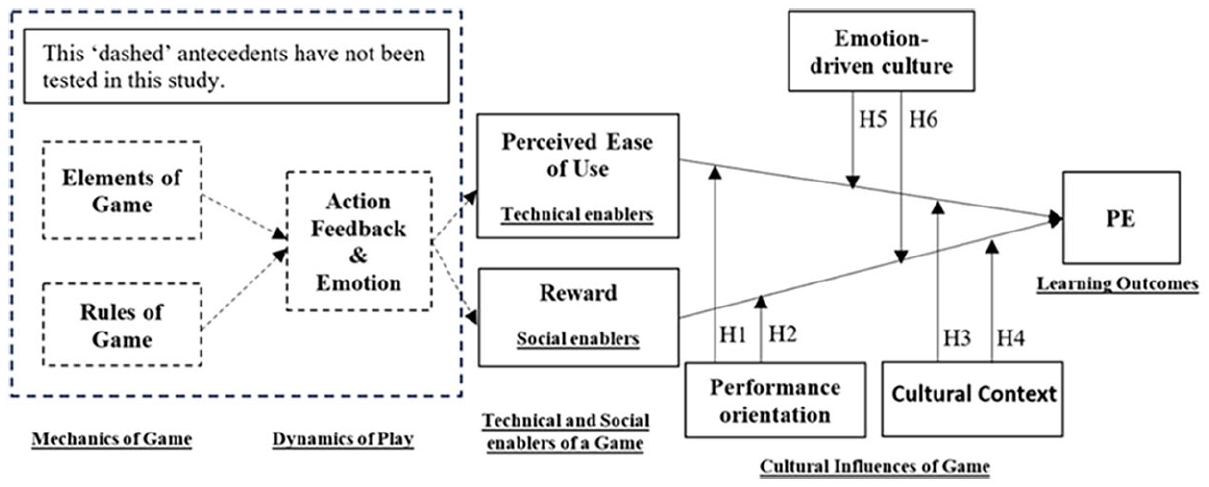
Research model of this study.
Research Methodology
Empirical Setting
The empirical setting is a proprietary 3D ethics game, Virtual Values, developed exclusively for our academic institution to provide a unique and controlled environment for research and learning. This serious 3D ethics game is based on virtue ethics where learners practice their ethical skills virtuously through a virtual character. It incorporates rules and values-based approaches in a simulated 3D corporate environment, as prior research suggests that immersive 3D environments enhance learners’ engagement and potentially facilitate the acquisition of transferable managerial skills and knowledge (Finneran & Zhang, 2005; Kebritchi et al., 2010; Papagiannidis et al., 2017; Schrader & Bastiaens, 2012; Zhou et al., 2014). The learning tasks were based on the lectures and contemporary case studies about ethics taught in two UK academic institutions.
The narrative element of dynamics of play is represented by the storyline of this 3D ethics game, which includes a fictitious marketing manager employed by a marketing company who is set to encounter various ethical dilemmas in familiar 3D environments: an office, a park, and a party. The progression and assessment elements are represented by different game levels and the scores and prompt feedback that learners receive based on their decisions, respectively. In addition, the assessment element is represented by an online self-assessment quiz that appears when a game level is completed.
The action element is represented by the ethical dilemmas that involve a timed interactive dialog between the player and some virtual characters. The player then needs to make a decision in response to the said ethical dilemma. These interactive dialogs provide the players with an opportunity to put into practice what they have learned through the decisions they make in response to the various ethical dilemmas that they encounter during the course of playing the game. In general, the gamification element (Klopfer et al., 2009) has been applied in the form of autonomous play, progression levels and point accumulations (cumulative score) that could lead to a place on the top ten leader boards. Figure 2 shows a screenshot of the serious 3D ethics game.

Example of a full interaction and decision completed with a reflection.
Data Collection
Final year undergraduate students (n = 324) from the B.Sc. Business Management Program of two British universities were recruited to evaluate the serious 3D ethics game adopted for this study. Both universities used similar pedagogical materials, teaching methods, and assessments to deliver a core Business Ethics module. The module convener briefed the participants about the objectives of the study and reassured them that all data collected would remain confidential and anonymous. The participants were then asked to complete a survey after signing an informed consent form. Convenience sampling was used to recruit the students, and despite its criticism in the extant literature, convenience sampling is deemed appropriate for studies that aim to explore new ideas and generate new insight, which is focal to this research enquiry (Churchill & Iacobucci, 2005).
Table 2 presents the demographic information of the respondents: 38.1% and 45.7% were identified as male and female, respectively, and 16.2% had not specified their sex. The ethnic proportion of most of the respondents was White (42.4%) and Asian (41.4%). Additionally, 63.2% of the respondents have no work experience, and their gaming experience varied between playing online games frequently (25.5%), occasionally (27.5%), and never or seldom (47.1%). Table 3 shows the relationship between the countries and the cultural groups.
Demographic, Cultural Orientations, Work, and Gaming Experience of Respondents.

Based on what participants reported as their permanent residence or home country.
Relationship Between Home Country and Cultural Categories Based on Cross-Cultural Studies in the Literature.

Measurement Constructs
The measurement items were adapted from established Likert-type scales (ratings between 1 = “strongly disagree” and 5 = “strongly agree”) used in prior studies (see Table A1 in Appendix A). Reward (REW) is a self-reported measure that reflects the feedback and points system in the game, which is designed to motivate participants to complete it (Yusoff et al., 2010). Ease of use (EOU) is a self-reported measure representing the perception that minimal effort is required to learn and play the serious 3D ethics game (Davis et al., 1989; Kim & Malhotra, 2005; Malhotra et al., 2006; Shen & Chu, 2014). Perceived effectiveness (PE) is a self-reported compound measure comprising three dimensions—perceived usability (PU), transferability of skills (TS), and situated learning (SL)—that reflects the game’s effectiveness in teaching practical ethical decision-making skills and knowledge (Siala et al., 2019).
Participant’s home country was used as a proxy for culture to assign them to different cultural groups (Hofstede, 2010; House et al., 2004; Joy & Kolb, 2009; Yamazaki, 2005). While some scholars have questioned the validity of using home country as a proxy for culture (Hofstede & McCrae, 2004), this approach remains widely adopted in cross-cultural management and education research (Joy & Kolb, 2009; Yamazaki, 2005). It is also acknowledged that acculturation to a host country’s culture may occur over time. Despite these critiques, the method has proven useful in numerous studies.
Participants were categorized into high and low groups based on their home country, using a nominal dichotomy (0 = “low” and 1 = “high”). For example, as described in section 3.1, participants from Australia, Iraq, Iran, or the United States were assigned to the high-performance orientation category, while those from China, France, Germany, Japan, Russia, or the United Kingdom were assigned to the low-performance orientation category (Boland et al., 2011; House et al., 2004; Joy & Kolb, 2009). A similar process was applied to classify participants into Confucian or Anglo cultural contexts (Joy & Kolb, 2009), as well as shame- and guilt-based cultures (Bierbrauer, 1992; Markus & Kitayama, 1994).
The size of each cultural group resulting from this group-splitting process is shown in Table 2. It is important to note that participants’ home countries were assigned to cultural groups based on evidence from the literature. Consequently, the size of a specific cultural group, such as the emotional culture group (n = 279), may not equal the total sample size (n = 302) due to overlapping or unassigned cases. To ensure the validity of measures, a pretest was conducted with 15 students (Hardesty & Bearden, 2004), leading to minor amendments to the wording of some questionnaire items to improve clarity, enhance their relevance, and better align them with the study’s research objectives.
Harman’s single-factor test (also known as the one-factor test) is a commonly used technique for detecting common method bias (CMB; Fuller et al., 2016; Podsakoff et al., 2003). This approach employs either exploratory or confirmatory factor analysis to identify CMB. In explanatory factor analysis, a single factor accounting for more than 50% of the variance in the unrotated solution (using all measured items) suggests the presence of common method bias (Fuller et al., 2016). Similarly, confirmatory factor analysis can assess whether a single factor predominantly explains the variance in the measurement items (Podsakoff et al., 2003). Common method bias is indicated if a simple one-factor model fits the data as well as the hypothesized model (Korsgaard & Roberson, 1995). The results from a Harman single factor test showed that the single factor solution accounts for approximately less than 25% of the variance, indicating that common method variance is not an issue in this study (Podsakoff et al., 2003).
Another approach to addressing common method bias is the unmeasured latent method construct, also known as the unmeasured latent method factor (Chin et al., 2012; Podsakoff et al., 2012; Richardson et al., 2009). This technique introduces a latent variable measured solely by the observed items from the primary study constructs, specifically capturing method variance. To corroborate our examination of common method bias, we applied the latent common method factor approach (Collier 2020), combining all the measurement items used in this study into a single factor. The results showed an insignificant chi-square difference between the original model and the latent common method factor model (∆χ2 = 2.53, p > .05), along with comparatively lower model fit indices for the latent common method factor model (CFI = 0.861, IFI = 0.882, and RMSEA = 0.062). These findings suggest that common method bias is not a significant concern in this study. After accounting for missing data and removing outliers, the final number of valid responses was 302.
Data Analysis
IBM SPSS AMOS version 29 was used to conduct Anderson and Gerbing’s (1992) two-step approach to estimate the measurement and structural model. Table 5 displays the correlation matrix of the exogenous and endogenous variables. A confirmatory factor analysis revealed that the factor loadings (see Table 4) and Cronbach’s alpha, composite reliability (CR), and average variance extracted (AVE) scores of all scales (see Table 6) were acceptable (Hair et al., 2010); thus, convergent validity is not an issue. Furthermore, as shown in Table 6, discriminant validity is not an issue, as the square roots of the AVE of each construct (listed on the diagonal) are higher than their correlations (Malhotra, 2010).
Factor Loading for Construct Items (N = 302).

Note. EOU = ease of use; REW = reward; PE = perceived effectiveness of serious game in enabling learning of practical ethical decision-making skills and knowledge.
Correlation Matrix.

Model Validity Measures.

Note. The values on the diagonal (in bold) represent the square root of the AVEs of the individual constructs, and the values underneath the diagonal are the correlations between the constructs.
The VIF value for the exogenous constructs was 1.84 (below 5), which suggests that multicollinearity is not present in this data set (O’Brien, 2007), but Mardia’s normalized estimate of multivariate kurtosis revealed the presence of multivariate non-normality in the data set (Bentler & Wu, 2005). Therefore, to address this issue, a radial parceling technique was applied on the scales (Cattell & Burdsal 1975; Matsunaga, 2008), where the pair of items with the smallest difference in factor loadings is assigned to the first parcel, the pair with the second smallest difference in factor loadings to the second parcel, and so on and so forth.
The results of the final measurement model (χ2/df = 1.424; GFI = 0.948; AGFI = 0.924; NFI = 0.967; IFI = 0.990; TLI = 0.987; CFI = 0.990; SRMR = 0.023; and RMSEA = 0.038) demonstrated an overall good theoretical and statistical fit (Byrne, 2016).
Results
The overall fit of the structural model (χ2 = 249.127, df = 142, p < .05; CFI = 0.980; and RMSEA = 0.045) was acceptable. The R2 value of the structural model, which is 89.8%, suggests that our research model fits the empirical data well. An SEM test that involved the whole sample was conducted to establish the baseline effects between the exogenous and endogenous variables without taking culture into account. Figure 3 illustrates the results of the SEM baseline test. The results show that both the technical enablers (perceived ease of use) and the social enablers (reward) had a significant positive effect on the outcome variable: perceived effectiveness of a serious game enables the learning of practical ethical decision-making skills and knowledge.
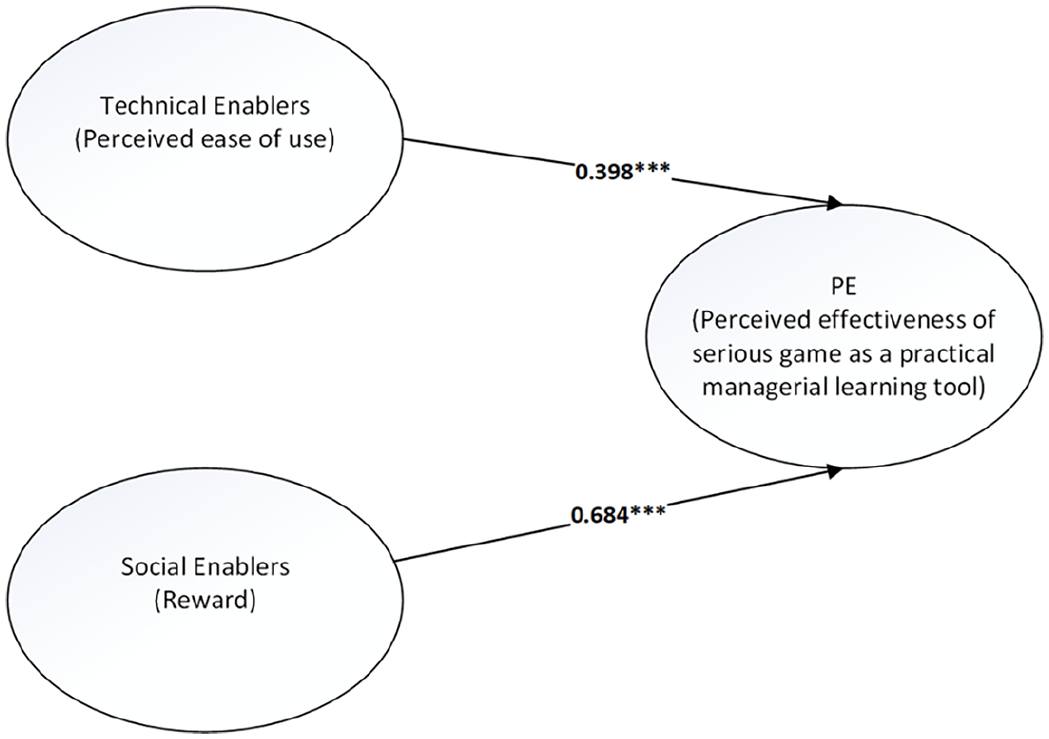
Baseline model illustrating the effects between the exogenous and endogenous variables.
The effect of the cultural moderators was tested using multi-group analyses after assigning each cultural moderator to a subgroup category (Sideridis et al., 2014). A chi-difference test (see Table 7) was then conducted to determine if there are significant differences between the sub-groups (Byrne, 2016).
Subgroup Analysis of the Research Model Based on Moderators.

Note. values in brackets represent the R2 of the baseline model; Δχ2 (df = 11) is the chi-difference between the two groups after constraining the structural weight parameters; Δχ2 (df = 1) is the chi-difference between the two groups based on constraining a parameter of interest which represents a standardized effect; standardized path coefficients are used to report the values representing the effect sizes. n.s. = not significant.
p < .001. **p < .01. *p < .05.
The results indicate that contrary to expectations, learners from high-performance orientation cultures found the game difficult and not conducive to enhancing their learning of practical ethical skills and knowledge. In contrast, learners from low-performance orientation cultures found the game easy to use and conducive to enhancing their learning of practical ethical skills and knowledge (Δχ2 = 5.915, df = 1, p < .05). Therefore, H1 is not supported. H2 is also not supported as there was no significant difference in the moderating effect for rewards between the high-performance orientation and low-performance orientation culture groups. The moderating effect between the Anglo and Confucian culture groups for perceived ease of use (Δχ2 = 4.675, df = 1, p < .05) and rewards (Δχ2 = 5.182, df = 1, p < .05) was significant; thus, H3 and H4 are supported.
Finally, unlike learners from guilt cultures, learners from shame cultures (Δχ2 = 3.238, df = 1, p < .05) found the serious 3D ethics game difficult and not conducive to enhancing their learning of practical ethical skills and knowledge. Therefore, H5 is supported; however, the moderating effect for rewards was not significant between learners from shame and guilt cultures, and thus, H6 is not supported.
Discussions and Conclusion
We conducted empirical research to examine the social, technical, and cultural aspects of game-based using concepts from game design and socio-technical theory to explore how the mechanics and dynamics of serious games can effectively facilitate the learning of practical managerial skills and knowledge in culturally diverse educational settings. We use a multicultural sample of final-year students to evaluate the pedagogical effectiveness of a serious game in enabling the assimilation and transfer of ethical skills and knowledge in the context of business management. The results of our SEM analysis and the outcome of the game’s evaluation ascertain that cultural and socio-technical factors in a game-based learning environment influence students’ performance, conative behavior, and perception of the serious game as a practical learning instrument.
Implications for Theory
The theoretical implications of this study are twofold. First, over the years, researchers have explored the antecedents of pedagogically effectual learning outcomes in various game-based learning environments using theoretical underpinnings such as the technology acceptance model, flow theory, cognitive absorption theory, and socio-technical theory (Liu et al., 2013; J. Wang et al., 2017). However, the academic literature has neglected the role of societal and cultural factors in game-based learning in the business and management environment.
Our findings reveal that the effect of users’ cultural backgrounds or affinities varies across cultural dimensions. Specifically, in the case of the serious ethics game, preferences of those from Anglo and Confucian, high- and low-performance orientation cultures and emotionally driven shame and guilt cultures should be heeded in the decisions pertaining to the design or adoption of serious games. These findings advance our knowledge of the socio-technical theory by highlighting the social and cultural dimensions of information system (IS) implementation that is embodied in the cultural sub-system; this IS implementation includes technology-enhanced learning environments.
Second, this study empirically confirms that a learner’s culture can play an instrumental role in improving the interdependent link between the social (reward mechanisms) and technical (perceived ease of use) enablers of a serious game and its learning outcomes, which are represented by a self-reported measure of the perceived effectiveness of a serious game as a practice-based managerial learning instrument for learning practical ethical decision-making skills and knowledge. Given that game-based learning research in business and management education is still in its infancy, these findings provide researchers, game designers, and educators with insights into conducive ways to augment the learning of core managerial skills, such as business ethics in a virtue ethics-based serious gaming environment.
It is noteworthy to emphasize that the scope of learners we are referring to extends to corporate environments, such as trainee employees and graduates who could potentially become business managers and leaders because serious games as training tools are becoming common in corporate environments (Allal-Chérif & Makhlouf, 2016; Ibanez et al., 2014; Pando-Garcia et al., 2016). The next section elaborates on how to support the cultural drivers that influence learners’ conative behavior and perception of a serious game as a practical learning instrument.
Pedagogical and Managerial Implications
For educators and managers, a growing view is that business ethics games can shape and improve learners’ ethical decision-making skills. Specifically, the findings of this study indicate that when a serious game includes a character-based role-playing decision-making learning activity (Moshavi, 2001) in an immersive 3D learning environment, it will impact the learning experience, performance and engagement of learners, but the impact will be different for learners from different cultural backgrounds. This alludes to applying a virtue ethics-based approach in the game design where learners practice their ethical skills virtuously through a virtual character (avatar).
This character-based approach to learning business ethics could potentially lead to more responsible, ethical decision-making in a corporate environment (i.e., the game assesses the ethical decisions that players make in the game and provides comprehensive feedback to players). The effectiveness of the virtue ethics approach substantiates the argument raised in prior research that morality and virtue may be attained through practice (Whetstone, 2001), and that a serious game may cultivate or elicit virtuous traits in learners playing the game (Audi, 2012; Song & Kim, 2018).
Our findings also stipulate that learners’ potential adoption of serious games as a learning instrument will vary across cultural groups. To enhance the learning performance and engagement of learners from different cultures, educators should address cultural diversity issues of learners through educational strategies, such as introducing competition between learners and peer training interventions to foster a collaborative and social learning environment (Huber & Lewis, 2010), which could ultimately lead to positive changes in learners’ performance, conative behavior, and perceptions of a serious game as a practical learning instrument (Siala et al., 2019). For instance, learners from high performance-orientation, Confucian, and shame cultures found the serious game difficult to use.
This suggests that the adoption rate for serious games among said target audience can be improved by incorporating a comprehensive training intervention with an accessible technical support package when the game is promoted as a learning instrument since the provision of an appropriate training and support package was found to both enhance self-efficacy and alleviate technology-related stress and anxiety (Dong et al., 2020; Fuglseth & Sørebø, 2014; Kay, 2008; Li & Wang, 2021; Ragu-Nathan et al., 2008). Technical support and training can also be offered through a community-driven online forum or social networking site that enables learners to post questions and exchange knowledge with other peer learners (Fuglseth & Sørebø, 2014; Ragu-Nathan et al., 2008) from Anglo, low performance-orientation, and guilt cultures.
Although introducing competitive elements such as publishing leaderboards of top-scoring players was touted by many scholars as an effective means for enhancing learners’ engagement and performance, cultural foundations could inform learners’ appreciation or resentment of competitive elements. For example, learners from shame cultures could potentially experience distress when a leaderboard of the top-scoring players is displayed in a serious game. This suggests that learners should be empowered to control the serious game through custom settings that enable them to hide those competitive elements that they consider causing stress or inhibiting their learning.
Learners from Anglo, low performance-orientation, and guilt cultures found the serious game easy to use. Learners from these cultural groups make good candidates for becoming peer trainers of novice learners from “polar opposite” cultures such as Confucian, high performance-orientation, and shame cultures. It is imperative that the peer-training intervention be held at the early stages to ensure that the positive disposition toward a system persists over time (Venkatesh et al., 2002).
For serious game designers, it is necessary to consider the importance (and interdependence) of the social, technical, and cultural sub-systems of IS implementation when designing a serious game. To ensure that learners get the best learning experience, the serious game should enable its users to control and configure the settings of the competitive elements. Designers should identify their target students’ home country and culture (if it is designed for international students), educational backgrounds, and level of business knowledge and skills, and then design games with proper levels of challenge to enhance students’ learning (Lopes & Bidarra, 2011; Paraskeva et al., 2010).
Game designers should advise instructors who contemplate infusing serious games into their teaching practices to deliver an induction session for beginners, as an instructor-led induction session can alleviate concerns about the change in the learning environment, and it can also significantly boost the learners’ attitudes and conative behavior toward a new technology (Sørebø et al., 2009; Sun et al., 2008). Additionally, in the induction training event, instructors should demonstrate how the game features can be customized and controlled to address the needs and preferences of learners from different cultures (Ba et al., 2001). For example, Confucian learners would appreciate if a serious ethics game had a feature that implements the memorization stage of the four-step rote learning method, which purportedly is the preferred method of Confucian learners (Pratt et al., 1999). Thus, an instructor could demonstrate to students a specific gaming feature such as a “clue inventory” that memorizes the clues they collect from each game level.
A serious game should also provide a dashboard learning analytics interface that learners can access anytime to generate an improvement plan at the end of each game level. The improvement plan should inform learners of the actions that lost or would have awarded them score points to close the feedback loop (Lameras et al., 2017) and enhance engagement with the learning task. This approach is generally applicable across various cultural categories, as prior research highlights the importance of feedback in fostering active participation and motivation (Leemkuil & De Jong, 2012; Salas et al., 2009). Serious game designers should also include a comprehensive training and technical support package for academics and learners to reassure them that help is at hand when needed. Furthermore, the technical support component should ideally include a community-driven digital platform to enable the exchange of knowledge amongst peer learners.
Future Research
Several limitations have been identified in this study, presenting interesting opportunities for future research. While this research explored the social, technical, and cultural aspects of serious game-based learning, future research could investigate how user’s personality traits (e.g., self-esteem, self-concept) interact with these factors and influence learning outcomes in serious gaming environments. Furthermore, although this study focused on final-year undergraduate students from diverse cultural backgrounds, the cultural dimensions influencing learning styles extend beyond this sample. Learners from Anglo, low performance-orientation, and guilt cultures found the serious game easy to use. These learners are likely self-motivated, driven by intrinsic motives rather than extrinsic ones, and therefore may require minimal training, support, and incentivization to exhibit positive conative behaviors toward a serious game. Future research could investigate the potential and effectiveness of such individuals in mentoring peers or leading training sessions and programs in corporate environments.
Future studies could explore the effects of additional cultural dimensions on learning styles and perceptions of serious gaming environments. Examining serious games through the lens of corporate trainees or executive MBA (EMBA) professional students could provide valuable insights from a practitioner’s perspective. Additionally, while this empirical study employed quantitative methods, qualitative research could capture a deeper sense of learner experiences, emotions, and opinions regarding serious gaming environments. Future research should also evaluate the potential of serious games as a cost-effective alternative to traditional work-based training schemes and job placements.
Conclusions
This study has provided valuable insights into the social, technical, and cultural dimensions of serious game-based learning, particularly in enhancing learners’ perceived ethical decision-making skills within business management education. The findings highlight the importance of considering learners’ cultural backgrounds when designing serious games to foster effective learning experiences. By integrating character-based role-playing and immersive environments, educators can enhance the learning outcomes for students from diverse cultural perspectives. Overall, our research contributes to the theoretical understanding of game-based learning and offers practical guidance for educators and practitioners. As businesses increasingly recognize the value of ethical leadership, serious games can serve as powerful tools to cultivate the necessary skills in future business leaders. By prioritizing cultural considerations in game design, we can optimize the learning potential and ensure a more inclusive and effective educational experience for all learners.
Footnotes
Appendix A
Measurement and Items.

| Construct | Description | Measurement | Source |
|---|---|---|---|
| Reward (REW) | The feedback arrangement and points awarded in the game to motivate participants to complete the game. | REW1: I felt rewarded when I got points REW2: I felt encouraged to learn more when I completed levels REW3: Gaining points motivates me to keep on playing REW4: I found that the points system was important to my learning |
Yusoff et al. (2010) |
| Ease of use (EOU) | Ease-of-use is where participants feel that minimal effort is required to learn how to play the 3D game. | EOU1: To use this game I would need expert help EOU2: Learning how to play this game is easy for me EOU3: It is easy to do what I want to do in the game EOU4: The game was flexible to interact with in most types of play EOU5: I find this game easy to use EOU6: Interacting with the game is clear and understandable EOU7: I could quickly become skillful at the game |
Davis et al. (1989), Kim and Malhotra (2005), Malhotra et al. (2006), and Shen and Chu (2014) |
| Perceived effectiveness of serious game in enabling the learning of practical ethical decision-making skills and knowledge (PE) | A self-reported reflective compound measure of the perceived effectiveness of a serious game as a practice-based managerial learning instrument for learning practical ethical decision-making skills and knowledge. | PU1: The game will make ethical decisions easier in the future PU2: I find the game useful to practice ethical decisions PU3: The game will make me more efficient at making ethical decisions PU4: Using this game helps me to make an ethical decision more quickly PU5: The game will improve my performance when making ethical decisions TS1: It was easier to retain knowledge learned in this game than in a textbook or lecture TS2: The game helped me appreciate the skills needed in ethical decision making TS3: From the game I have learned ethical decision making skills which can apply in different situations TS4: From the game I have acquired new knowledge useful in day to day business decisions SL1: The game motivates me because it deals with real issues SL2: The issues presented in this game helped me to see from others’ perspectives rather than just my own SL3: The game is close enough to real life to be useful to me SL4: I feel that I can make an appropriate ethical decision in the workplace after playing this game |
Siala et al. (2019) |
Acknowledgements
Special thanks and gratitude are also extended to Dr. Suzy Jagger, the founder of this serious game. The authors would also like to express their gratitude to Professor Jennifer S.A. Leigh, Co-Editor of the Journal of Management Education, for her invaluable guidance and support throughout the publication process. Our heartfelt thanks also go to Professor David Kaplan, Associate Editor, for his thoughtful feedback and constructive suggestions. Additionally, we extend our appreciation to the two anonymous reviewers whose insightful comments and detailed critiques greatly enhanced the quality of this work. Your collective expertise and dedication have been instrumental in shaping this manuscript, and we are deeply thankful for your contributions.
Declaration of Conflicting Interests
The author(s) declared no potential conflicts of interest with respect to the research, authorship, and/or publication of this article.
Funding
The author(s) disclosed receipt of the following financial support for the research, authorship, and/or publication of this article: The authors would like to thank ORT and the University of Roehampton Business School for supporting this research study, as the software development was part of a matched funding project between the University of Roehampton and the European NGO, ORT France.
