



Abstract
Background
Although gamified sustainable consumption apps (SCAs) have been on the rise, only a few have survived longer than two years. While most existing research focuses on how gamification contributes to engagement and the formation of more sustainable consumption habits, there is little about how their survival is secured.
Intervention’s Purpose
Twenty-one SCA creators shared their considerations and experiences managing SCAs, providing valuable insights into the field of gamified sustainable consumption and practical insights for their stakeholders.
Methods
Ideal-type and narrative analyses of the interviews unraveled some relevant survival strategies and lessons learned.
Results
The creators' motivation and background play a role in the app's survival. Their experiences exposed several aspects affecting their gamification strategies and their relevance for the apps, highlighting traps to avoid and opportunities to improve their standing in an increasingly competitive market.
Discussion
Most creators shared stories of “learn as you go,” presenting how the flexibility to adjust the apps' business models rather than the creators’ professional background is a critical success factor. Since their apps represent their understanding of sustainability, SCA creators should find practical and emotional ways to engage their users while considering the objectives of their apps.
Conclusion
Awareness of the risks and pitfalls when creating an SCA may not be enough for successfully undertaking this enterprise. The creators should be capable of strategically plan for all the activities that creating and managing an SCA convey even before the app is conceptualized.
Keywords
Background
Mobile apps keep increasing their popularity as assistants to perform everyday activities, being recognized for their potential to drive sustainability forward by engaging individuals in adopting or creating new behaviors (Nghiem & Carrasco, 2016; Ouariachi et al., 2020), leading to an increasing number of studies about how these impact the formation of new habits and attitudes (D’Arco & Marino, 2022; Douglas & Brauer, 2021; Whittaker et al., 2021), and illustrating how mobile apps facilitate sustainable business models (Aagaard, 2019; Nghiem & Carrasco, 2016).
Most of the sustainable consumption apps (SCAs) aim at promoting sustainable behaviors, often called environmental citizenship (D’Arco & Marino, 2022; Middlemiss, 2010) or pro-environmental / eco-friendly behaviors (Douglas & Brauer, 2021; Tomș;a et al., 2021). Notwithstanding the terminologies, the present study is based on the notion of sustainable consumption behavior as the “individual acts of satisfying needs in different areas of life by acquiring, using, and disposing of goods and services that do not compromise the ecological and socioeconomic conditions of all people (currently living or in the future) to satisfy their own needs” (Geiger et al., 2018. Pp. 20). Thus, sustainable consumption apps are mobile applications that enable users to intentionally make choices related to acquisition, use, and disposal – including exchanging, recycling, and other activities to prevent the use of landfills - of goods and services that consider socio-environmental impacts today and in the future.
Gamification, defined as the application of systems, activities, and organizational structures to offer experiences similar to those of games - a gameful experience – for technological, cultural, economic, and societal development (Hamari, 2019), has proven to be a valuable approach for apps to engage users and shape attitudes toward sustainability (AlSkaif et al., 2018; Berman et al., 2019; D’Arco & Marino, 2022; Douglas & Brauer, 2021; Huber & Hilty, 2015; Johnson et al., 2017; Könnölä et al., 2018; Mendez et al., 2020; Mulcahy et al., 2020). Thus, gamified SCAs represent a unique type of mobile application, as they invite users to act today to create long-term impacts for themselves and others. While SCAs seemingly follow the same patterns as other apps regarding their creation and market presence, they tend to disappear after less than two years (Guillen M. et al., 2022). These apps frequently feature gamification strategies that are meaningless for the users, like collecting points that generate nothing (Guillen M. et al., 2022), exemplifying how the application of gamification may lead to the apps’ eventual failure and the importance of strategically planning its implementation. Since most of these apps operate as a business, the people behind them are prone to face conflicts related to value trade-offs vis-a-vis managerial decision-making, where individual-level cognitive factors and perceptions of the organizational context are crucial to the business' sustainability outcomes (Benkert, 2021). Small and medium-sized companies drive the app-making industry, many operating with slim budgets and limited quality control systems (Arora et al., 2017). It is also documented how the app creators’ woes lie mainly on the business side rather than the technical one (Szczepański, 2018). However, most of the existing literature about gamified SCAs explore their design processes (Hunger et al., 2023; Mulcahy et al., 2020), applications (Douglas & Brauer, 2021; Whittaker et al., 2021), and gamification characteristics (Guillen M. et al., 2022; Huber & Hilty, 2015; Johnson et al., 2017) leaving unanswered the questions of how SCAs operate to ensure their survival and eventual accomplishment of their goals, and what were the creators’ considerations to implement gamification as part of their business value proposition.
Intervention Contributions
By interviewing 21 SCA creators, we collected their personal stories, including how they operate as an organizational entity and discussing the dynamics that play a role in the app's survival process. Some theoretical contributions include addressing a gap in sustainability and information systems literature by providing a first-hand account of the SCA creators’ journeys, examining some factors influencing their managerial choices. On the practical front, this study contributes to the ongoing exploration of app-making as a business opportunity, postulating valuable insights that current and future SCA creators can consider when deciding their business models and organizational structures.
Methods
This qualitative research comprises subjective data, presenting the results of semi-structured interviews with 21 SCA creators considered key informants (Tremblay, 1982, in Burgess, 2003), given their role in the community, knowledge, and willingness to join the study to share their personal stories. Interviews with app creators have proven to be a practice that leads to a better understanding of the apps' objectives, the data management processes, and the choices and techniques behind their designs (Balebako & Cranor, 2014; Ekambaranathan et al., 2020). This study distinguishes between creator and developer since the latter is often referred to as the person with the technical skills, and the former is the person behind the app's creation and is currently managing their operations. The interviews revealed that two people were not part of the initial app-making process; however, they have been responsible for the apps’ survival for several years, hence their inclusion in the group.
Considering the existing knowledge gaps regarding the creators’ journeys to design and manage SCAs, the research question is:
SQ1. What is the origin of these apps, and how does it relate to their business model choices and gamification considerations?
SQ2. What are the main challenges SCA creators have overcome (or not) as an organization, and what role do their professional and/or educational backgrounds play in managing the app?
SQ3. What opportunities exist to improve the apps’ creative and managerial processes that current and future SCA creators can consider?
Data Collection
SCAs selection criteria and clustering
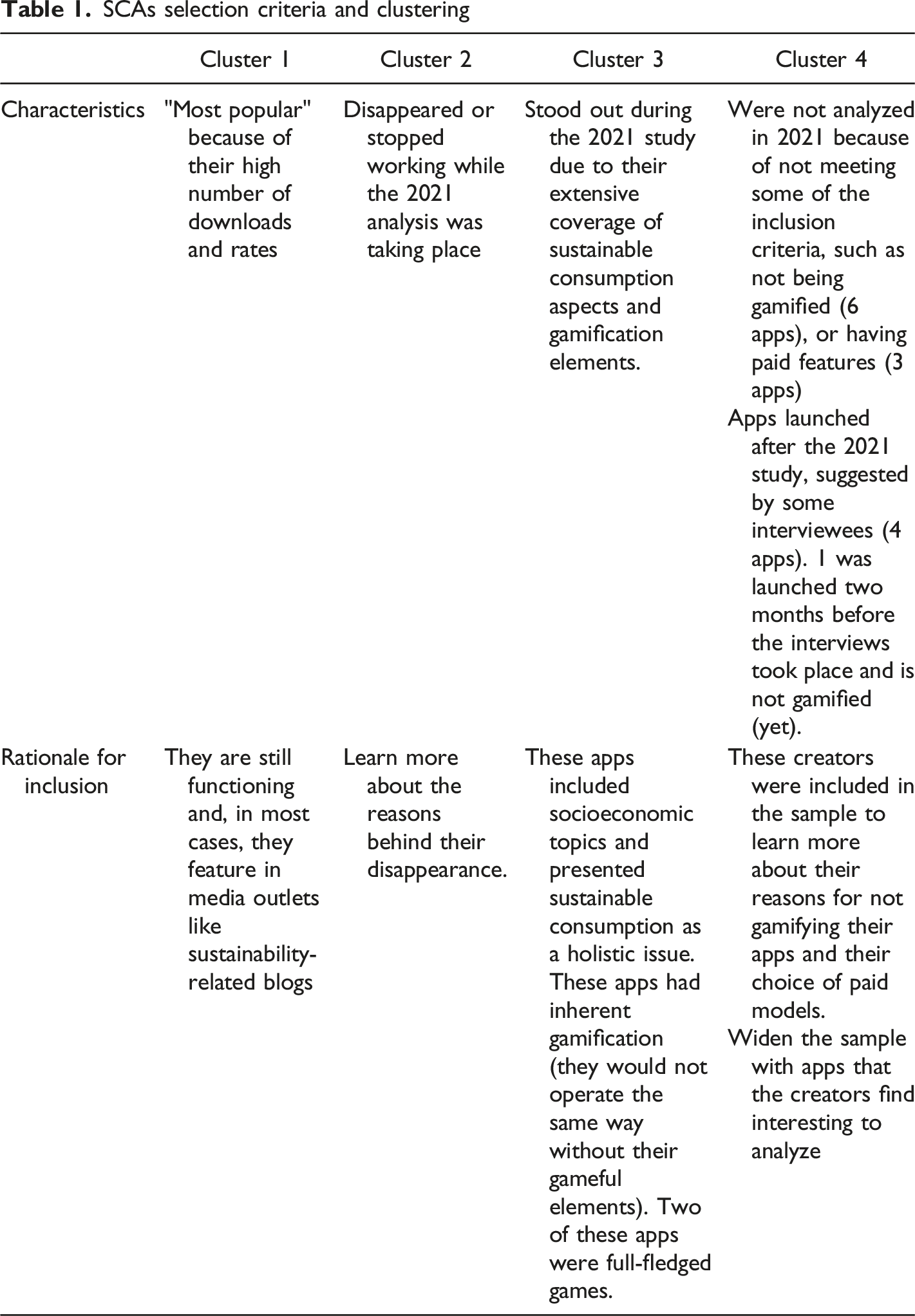
Direct LinkedIn messages were the most efficient channel for receiving a reply from the creators, even though most apps include contact information in their store or website descriptions. While 27 creators replied to the invitation, 4 declined because of time limitations, and 2 canceled shortly before the interviews, citing that their apps no longer exist. In the end, 21 creators were interviewed, and 19 self-reported additional information through an online, anonymous survey completed after the interviews.
All interviewees received a detailed description of the study’s objectives and the data management procedures and storage, which follows the guidelines established by Tampere University. The interviewees provided recorded consent to be taped, agreeing that their information would be anonymized and that no personal identifiers would be used. To ensure the reliability and validity of the study, three experts in the research fields of this study reviewed and provided feedback on the research questions, aims, design, and methods. These experts, professors from China, Finland, and the Netherlands, assessed the quality of comprehension and overall content of the interview guideline and the online survey. A fourth expert, a SCA creator with a Ph.D. in game design and more than ten years of experience, was involved in testing the material. The feedback of these four experts was meticulously considered for the execution of the study and subsequent analysis and presentation of results. The interview guideline is available in Annex 1, and the survey questions are in Annex 2.
The video interviews took place via Zoom and MS teams between April and August 2022; they lasted an average of 50 minutes and were conducted by the first author. All interviews were in English. After the conversations concluded, the data was anonymized and transcribed using MS Word. Besides the interviews, the SCA creators answered an anonymous survey, developed in MS Forms, to provide demographic details. The results were downloaded to an MS Excel database to facilitate their analysis. The interview records are stored on Tampere University’s server per the Finnish research privacy and data protection guidelines.
Data Analysis
To answer its research question, this qualitative study explores the personal experience of SCA creators, who represent a unique yet diverse group of people motivated by a common goal: enabling sustainable consumption behaviors. Using MAXQDA software, the transcribed interviews were inductively analyzed to develop codes clustered into a series of categories (Saldaña, 2013). The development of thematic networks, an analytical tool that summarizes the main themes and illustrates the results of qualitative analyses (Attride-Stirling, 2001), allowed the distinction of patterns among the themes and laid the groundwork for the next steps.
Typologies are often used as instruments to describe and explain social occurrences, as they represent a “theoretically or empirically derived concept which systematically orders complex phenomena according to a limited number of attributes” (Lehnert, 2007. Pp:63). These typologies are dynamic, and their value lies in their ability to express an array of opportunities with diverse organizational types, orientations to the problem, and intended accomplishments (Mandell & Steelman, 2003). An ideal-type and narrative analyses, both qualitative, were conducted to investigate how the creators’ motivations and backgrounds influenced their choices to make and manage an SCA. These approaches look for commonalities and points of divergence between participants’ accounts of their experiences and stories, allowing the identification of cross-story themes (Stapley et al., 2022). The ideal-type analysis follows seven steps to organize people according to their within-group similarities and between-group differences; the results are presented as an overview of the types found, illustrated with sample cases (Stapley et al., 2022). These steps are i) familiarization with the data set; ii) reconstructing the cases by summarizing the interviews, highlighting the content related to the study; iii) systematically analyzing the participants’ similarities and differences to construct the ideal types, pinpointing patterns across their experiences or perspectives; iv) identifying the optimal cases, which are representations of each ideal-type as they illustrate what each pattern represents and serve as an orientation; v) forming the ideal type descriptions; vi) checking the types’ credibility with an external researcher; and, vii) making comparisons between and within each type.
The narrative analysis aims to understand how people sense their life events and experiences (Stapley et al., 2022; Ylijoki & Henriksson, 2017). To conduct this analysis, the interviews’ transcripts were turned into stories, following the same structure, describing the time, place, situation, characters, sequence of events, and the outcomes of the decisions made. Combining the typologies with the stories made it possible to depict the areas where most challenges emerge for creating and managing SCAs. These accounts also offered a map of strategies and opportunities that may help SCA creators avoid pitfalls and plan their processes and management practices to make their apps last longer. Figure 1 summarizes the research protocol. Research process.
Results
This section outlines the answers to the research question and sub-questions, presenting the apps' origin first, followed by the gamification considerations and the creators’ typology. The second section provides an overview of the SCA creators’ journeys, highlighting the most common drawbacks they encountered and how they sorted them out. These reflections serve as recommendations that SCA creators can heed; they also may help potential partners and users understand how they can contribute to creating and improving SCAs, further benefitting from them.
Organizational Considerations
Considering that the mindset and understanding of sustainability influence the apps’ managerial decision-makers, one of the first questions asked invited the interviewees to describe why they created their apps and how they chose their organizational entity type.
The Apps’ Origin and Purpose
The narrative analysis led to the identification of 3 storylines depicting the origin of the apps and the rationale behind their business models. These storylines are
Personal use apps – these apps were first created without a business model or a plan to be used on a larger scale. A business plan is a strategy that provides a future perspective of where the organization wants to go and the choices that need to be made; the business model explains these choices and operating implications, facilitating the analysis, testing, and validation of the causes and effects of the strategic decisions made (Shafer et al., 2005). Therefore, the lack of a business plan means that the creators did not have a roadmap describing their activities as an organization bringing the app to market; since it was meant for their personal use, they did not need one. A lack of a business model means that the creators were uncertain about how they would capture and create value within their networks; this includes their type of association and how they would interact with other users than themselves. Without a model, they could not define their plan.
These respondents noted they were aware and interested in different sustainability-related topics and could not find an app to address them, hence creating their own. Three people created the app to respond to friends and relatives asking for advice about specific topics within the creators’ knowledge (e.g., how to save energy at home). After their testing activities, these creators realized the business potential, which led them to rethink their approach and bring their apps to market. Three opted to do it as not-for-profit entities; six chose the small-business route, and one had no association registered.
Service portfolio apps - Two creators noted that their business model consisted of developing games for publicly funded cooperation projects and that the analyzed apps were just part of the various other products they had in their portfolio. Other two creators commented not having been involved in the original conceptualization of the app, instead “inheriting” it as part of their jobs; however, the two individuals are now the main responsible for the app management and ultimate survival. The two apps that belong to the creators’ service portfolios and one of the company-inherited apps are among those that have surpassed the 5-year longevity mark.
Business opportunity apps - Six people declared starting the app due to an identified business opportunity having a clear business plan when released. Two disappeared less than two years after their launch, one was sold to a larger company, and the other three are still operating with seed funding. The reasons behind the app's creation played a relevant role in their design process and overall performance and survival. 50% of the apps that resulted from projects conceived during COVID lockdowns with the purpose of becoming a business disappeared within the first two years of their launch, even if created with a clear business plan in place because their creators had to choose between working full time for their apps or returning to their regular activities.
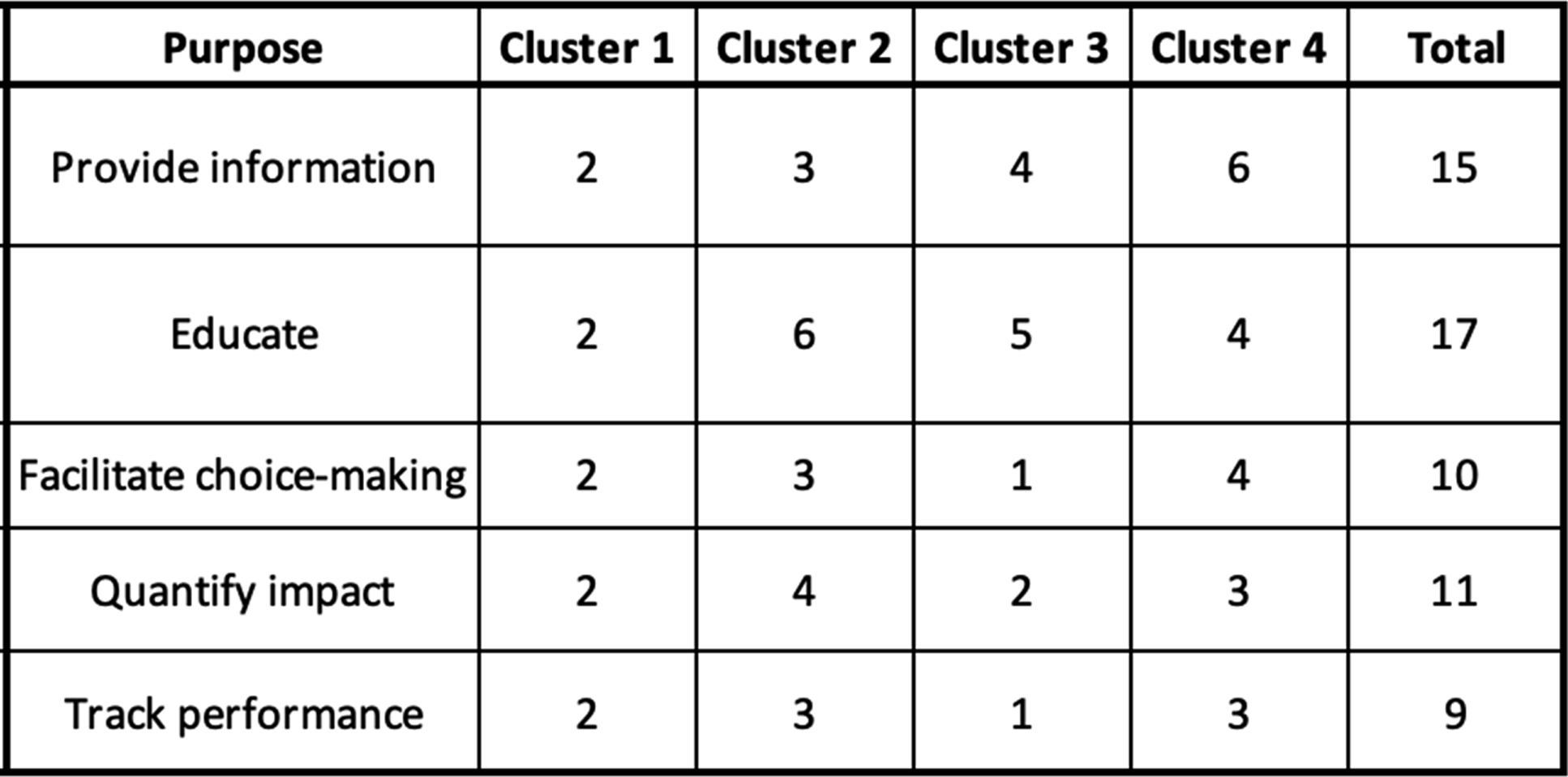
Overview of apps by purpose and cluster. Several apps have multiple purposes.

Implementing Gamification
The main difference between a gamified system and a game is how people interact with the app, as they share the same medium and pragmatic objective of attracting and retaining users (Ferri, 2014). With games, particularly serious games, which are the most used for sustainability (Ouariachi et al., 2020), the user is a player who completes challenges or quests designed to educate while entertaining them (Johnson et al., 2017) and inviting them to reflect on their behavior (Douglas & Brauer, 2021). In contrast, gamification is the application of games’ elements through the app to motivate real-time actions in the real world. Gamified apps feature a series of elements and mechanics that induce gameful experiences within the system (Koivisto & Hamari, 2019). What previous research on gamification and sustainable consumption showed (Guillen Mandujano et al., 2021), is a prevalence of nine gamification elements applied across approaches designed to address sustainable consumption. These are goals and missions, points, leaderboards and rankings, badges, social media features like sharing and tagging, rewards, progress bars and levels, reputation systems, and avatars. On average, the apps that are not games feature about half of these elements (Guillen M. et al., 2022). Therefore, for this study, minimum gamification means having between one to three gamification elements, and a “fully gamified” app entails the application of over four gamification elements, and the app could not be experienced the same way without these features.
The apps’ purpose also played a role in the gamification implementation choices. Three of the creators steered clear from gamification, declaring the reasons for not using it in their apps because they consider it a "dopamine rush," "shallow," and "distracting from the real objective"; their apps were meant to inform. The fourth creator of a non-gamified app noted that it is still too young, and the team (3 people) did not have the knowledge or capacity to develop any gamified feature. Nine gamified apps presented one to three elements, a minimum level of gamification (e.g., getting a stamp). These creators noted that gamification helped get users to return to the app but was optional for fulfilling the purpose of the app. Eight apps were fully gamified with individual leaderboards, leagues, and progress levels featuring among the most used elements. Three of these apps are games, with two created by professional game designers as part of publicly funded projects elected via open tenders. Of the other five fully gamified apps, only one is no longer working, while four developed a "business" version of their apps, offering them as solutions for employee engagement in environmental actions and as a corporate social responsibility strategy. Of the four apps aiming at meeting all five purposes (inform, educate, support decision-making, quantify impacts, and track progress), three are fully gamified, the other only moderately. Three have a B2B version as the revenue stream; a foundation entirely supports the fourth one.
The above results present gamification as a value-add for the SCAs, even though most feature minimum elements. Teams may need more expertise to develop a complete gamification strategy consistent with the app's purposes and objectives; thus, their current application of gamification comes across as a cosmetic measure. The apps with more than four gamification elements have it as a part of their apps' value proposition, and they have someone responsible for the strategy.
The Business Models and Revenue Streams
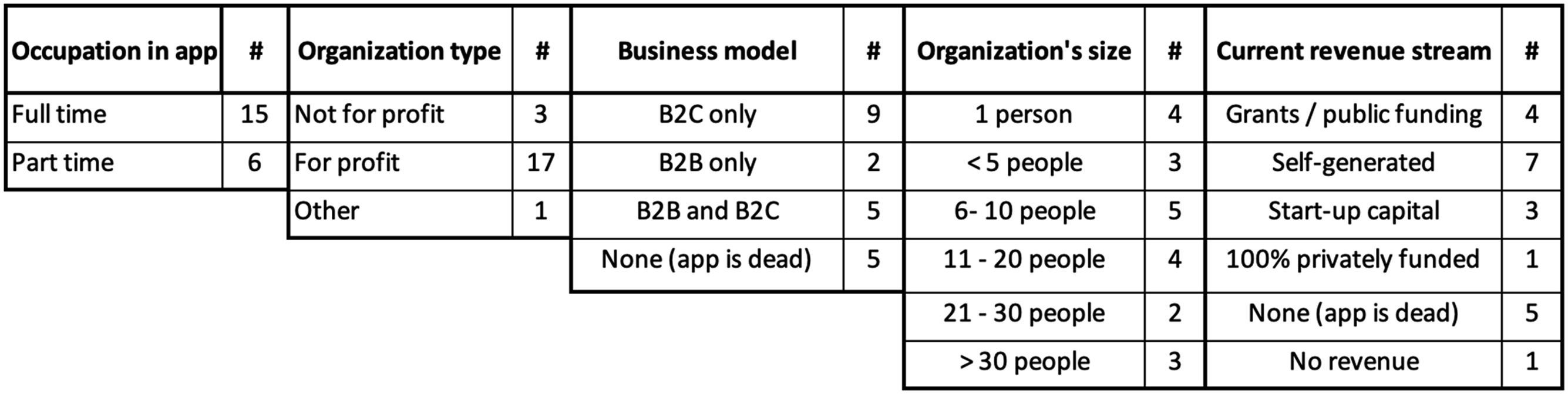
Among the myriad of business model definitions, this study considers a business model is “a representation of a firm's underlying core logic and strategic choices for creating and capturing value within a value network […] it is the role a firm chooses to play” (Shafer et al., 2005. Pp. 202). This is, it justifies the organizations’ strategic choices to explain its relationships with other agents in their value network (e.g., partners, suppliers, end customers, etc.) and defines its approach to secure the means to carry on their activities, determining how they create and capture value within the ecosystem it operates. This study revealed two types of models: value creation directly to individual consumers (not necessarily in a profitable approach) – B2C or business to consumer; and B2B, value creation from business to business, where the app services another organization.
Summary of organizational details.

The Creators’ Typology
The depiction of a typology summarizing knowledge about contextual factors helps to understand some of the action paths undertaken for developing strategies to achieve their goals. All but one creator declared having completed university-degree studies, with five creators having doctoral degrees. The one creator who did not attend university had technical training as a tertiary education experience. Of the 21 creators, only six had studies or work experience directly connected to sustainability or app development. Learning about the creators' academic and professional backgrounds led to identifying patterns to map their most common challenges and how these were overcome.
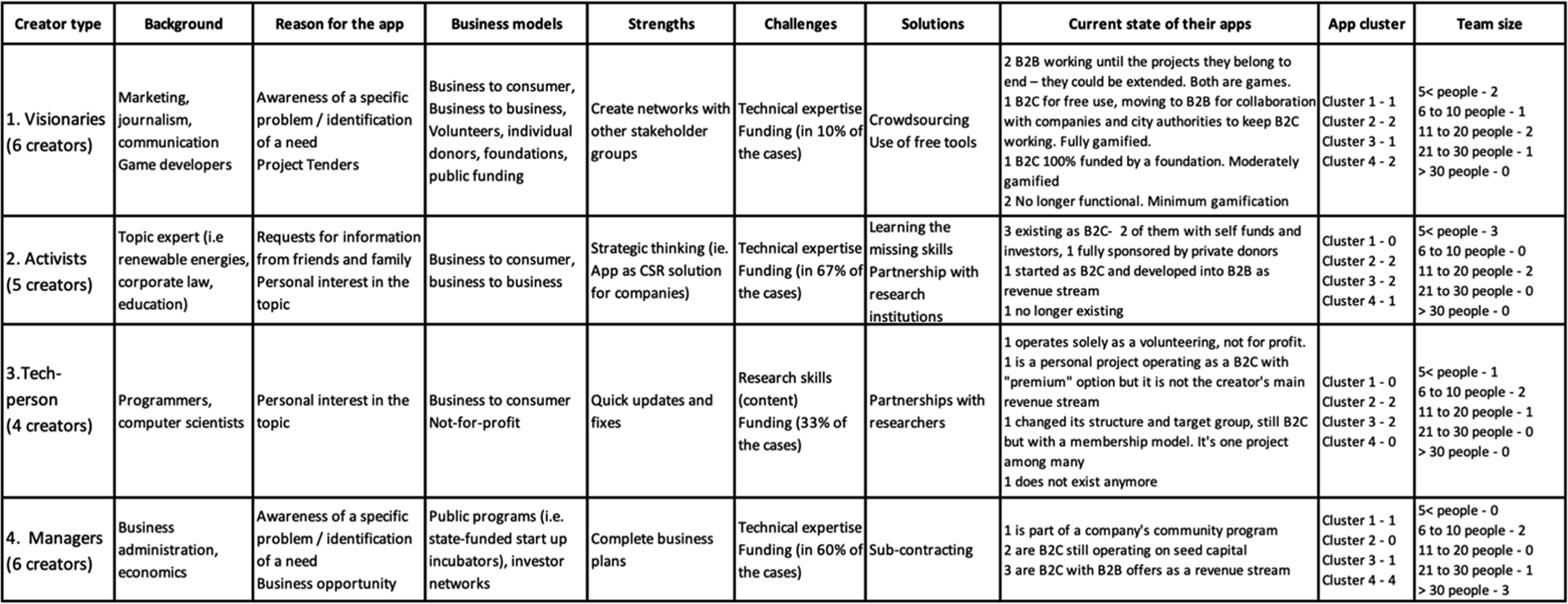
The visionaries (6 creators) have backgrounds in marketing, communications, journalism, and game development. They tend to work in small teams; larger groups consist of volunteers or part-time employees who are typically technical developers. Most of these apps emerged as a solution to particular problems (i.e., plastics, confusion about labels). These creators also have the broadest spectrum of revenue streams. While funding is a potential source of struggle, this group reported the least problems in this area because they are mainly maintained through foundations and public funding.
The activists (5 creators) have knowledge in areas such as engineering, architecture, and urbanism. Three creators hold engineering degrees in renewable energies and environmental and material sciences. All these creators revealed investing time to learn the skills they missed for starting their apps, such as learning to code or perform marketing analyses. Two apps from this group are no longer available; both had one or two people behind them. The only app with a team of 5 to 10 people has a free B2C and a B2B version. The other two apps operate as B2C models entirely funded by external investors under a shareholder structure.
The tech-persons (4 creators) can create and maintain the apps from a technical point of view but often require support for the managerial and content aspects. Two of these apps were COVID lockdown projects developed and maintained by one or two people. Another creator noted that the app is undergoing an overhaul, and it belongs to the portfolio of products of their 6-people company. A team of over 20 volunteers operates the fourth app, registered as a not-for-profit. The interviewed creator keeps the technological back end and coordinates the communication among the team. The app accepts donations for licenses and related expenses, not for salaries.
The managers (6 creators) have business development, management, and economic backgrounds. These creators tend to sub-contract the technical developers and researchers. All these apps are still working; two do so with their initial seed capital obtained through incubator programs. Three started as B2C but invariably moved on to B2B models to secure their financial stability; these three apps are maintained by teams of 6 to 10 people working full time. One app is part of a company community program, and the creator noted that its maintenance is part of the unit's budget.
While belonging to a specific creative group does not entail a particular design/survival strategy, the longer-lasting apps seem to be managed mainly by visionaries and managers. These people have been capable of switching business models, mainly from free B2C apps, into tailoring the app to companies, schools, or municipalities that pay a license or subscription. The results also show it is not possible to conclude if the size of the team plays a relevant role in the apps' survival. Seven creators mentioned starting their apps as a single or small-group enterprise and growing over time. Also, the team sizes reported include paid full- and part-time staff and volunteers.
All the interviewees reflected on their main learning from their journeys as SCA creators. All noted the challenge of the time needed between the initial conceptualization of the app and its deployment and the time necessary to generate results to report back to investors. The second biggest challenge was related to the skills needed to make the app and business operate correctly and how important it was to team up with the right people. The technical expertise to program, bring the apps to market, and improve the user interface was the most outsourced skill (except for the technician-led apps). The second most sought-after skills were related to marketing and communication. Similarly, content managers – researchers and /or fact-checkers – were also deemed essential to provide reliable, accurate, and updated data, particularly scientific content. Although only three creators reported having a person in their team appointed to keep up with privacy laws and regulations, 17 acknowledged having measures to secure anonymity and manage users' data. Abiding by the online app market regulations was quoted as the first measure to follow in their quest for transparency.
Summary of the results by typology.

Reflections from the Journey
Turning Ideas into Products
All 21 interviewees elaborated on the reasons behind creating their apps. Thirteen noted choosing to develop an app because it is a ubiquitous, fast, and personalized way to convey information. Seventeen creators – the six managers, six visionaries, three activists, and two technicians – developed a vision as part of their project planning. While identifying the need to tackle, some creators did not have an app as the first solution, with two of them (both activists) noting that the app was the result of users' feedback, as they had initially developed other solutions to reach their objectives (websites, one of them with social media features, the other one only with information to browse through). Two SCA creators (tech-people) commented on developing the app for their personal use, sharing it with a few people, and encountering challenges in getting enough resources to keep up with the growing demand.
Defining their target groups was one of the activities that presented the most dispersed results among the SCA creators. Six declared personally conducting interviews and surveys in their communities to learn about their target users. At the same time, those who first developed the app for personal use started modifying it according to the suggestions from their friends and relatives. Finally, three creators noted using published market studies and personal experience as references for their target groups. Ten creators alluded to their ideation processes, with one detailing how they keep returning to the ideation point when it comes to their gamification strategy, as they have found it challenging to identify what works best for their users and partners. The "user journey" was mentioned by seven creators, with one noting how this process made them realize they needed to bring a gamification planner on board. Two creators highlighted how engaging their clients (who are not their users) as well as the target users in the ideation process is part of their unique selling points, as this helps to set expectations and revisit the project plan to align with both the clients' and the users' needs. “I sit down with the client and plainly ask them why, why they want an app, why they want to do it in a certain way […] this is the most challenging part of the process, but the most important one because all expectations are clarified from the beginning […] this is my unique value proposition” (creator E).
Bringing the Apps to Market
Fourteen creators cited undergoing iterative test rounds before launching their apps, although only one could do this in a living lab environment. Three mentioned resorting to focus groups – however, two were for the second phase of these apps, when testing the B2B versions, not for identifying their users at the beginning of their creative process. Six creators noted that they launched the app after the second testing round, usually with a circle of acquaintances, and seven mentioned the existence of beta versions made publicly available to request users' feedback. The number of active users and in-app analytics are the most used measurement mechanisms. However, several creators emphasized the relevance of forming feedback loops with the users and enabling trust. Three apps have a person dedicated to quality control and user interaction. Responding to users' feedback was deemed one of the most important tasks for keeping the app relevant and improving over time. The inclusion of gamification was one of the focus areas for most of the creators, with four of them reckoning that getting the “right” gamification strategy remains a priority even after launching the app and for which users’ feedback has been crucial “…about gamification […] we have been trying different strategies, but we haven’t nailed it yet, saying otherwise would be a lie” (creator T). “For the first version of the app, we went all in with gamification; it had absolutely everything […] the users’ feedback helped […] by the third iteration we had removed at least two thirds of it” (creator D). “My beta testers wanted so many things! […] we checked them all and selected those that the majority suggested” (creator M).
From the Creators to the Creators – Recommendations and Issues to Consider
Several issues stood out when reflecting on the experiences, particularly concerning the challenges and dilemmas of applying gamification and keeping their apps alive. While these pertain mostly to business models, it was not until the apps were implemented that various creators, particularly the less experienced ones, became aware of their existence. These were also issues brought up by experienced creators as recommendations for other SCA creators to bear in mind. The first three represent a unanimous understanding from all interviewees, offering solid advice to support current and future SCA creators. The other three issues, which attain directly to the app creation process, had very polarized stances, providing SCAs' creative teams with distinctive viewpoints worth considering.
Recommendations
(1) Capitalize on the teams’ skillset, craft a common understanding of the sustainability challenges to address and avoid “Frankenapps” - The term “Frankenapp” was coined by one of the creators reflecting on how their somewhat chaotic design process (they just wanted to make an app to help their families tackle climate change) led them to bring to life an app that felt like a “Frankenstein monster, with patches of stuff from here and there” (creator W). This is because the small team had managed to put together an app using free, online tools to develop mobile apps without any of them having the technical skills to do so, pulling information from open sources – Wikipedia mainly - and applying gamification features presented as a default option in the platforms they were using. The app was first perceived as a success when introduced to their target group, and they were surprised by the popularity it gained. The positive response led the team to consider commercializing the app and getting investors, facing issues they could not cope with. The interviewee reflected that the main challenge was that the creative team realized they did not share the same vision of what the app was meant to stand for or where it was supposed to go. Other four creators shared similar thoughts about the importance of forming teams that, while ideally having different skillsets, share a similar vision, a common understanding of sustainability, and clarity about where they want to be heading as a team. One creator noted that the main roadblock they encountered at the beginning was that their team shared the same skills, which helped them to get seed funding but then led to gridlock because tasks were challenging to distribute. Ultimately, this person decided to create the app alone and rely on an international network of freelancers to develop the app. The creator mentioned how this process led to finding the right team, as some of these freelancers became the company that operates the app today. In retrospect, the SCA creators must consider their strengths and weaknesses as a team to consolidate their strategies to move forward. Part of this process includes aligning their understanding of the problem to address and what the app will be for.
(2) Steer clear of in-app advertising as a potential revenue stream. None of the 21 apps in this study contain third-party, in-app advertising. While eight apps allow for purchases, the products/services commercialized through the apps are not presented in the form of advertisements; these are either user-offered products that comply with the app's guidelines or are carefully curated products in line with what the app stands for (e.g.., substituting plastic products for bamboo ones). There are two reasons for this choice; one is economical: the creators receive cents per click on sponsored ads, and the risks of annoying the users are very high. Even if the creators can choose the category of ads (i.e., games), these are often perceived as obnoxious and can compromise the app's content. A second reason is the user experience. As most apps are used in handheld devices with small screens, saturating the screen with content such as ads decreases their overall interaction and usability. “Our first version advertised games. The testers said they only clicked on those by mistake, but they were not interested […] like them, I found them annoying, some take a lot of screen space […] they pay cents and are not worth the trouble” (creator J).
(3) Stakeholder expectation management is crucial - Nine creators reflected on the importance of expectation management, particularly when developing a business plan to present to potential investors, as many demands were unrealistic to meet without compromising what the app stands for or are beyond the timeline envisioned when developing the project plan. “…they (potential investors) kept asking things like ‘but how many tons of CO2 will be saved in six months?’ I had projections for every 100 users, but there is no guarantee we would have so many in six months […] it is really frustrating” (creator H). Ten creators set their apps as self-funded enterprises before adapting their project plans to look for external investors or switching business models. Their original plans included revenue-generating mechanisms, such as offering premium services, subscriptions, and in-app advertisements. Of these ten apps, four moved from free B2C to B2B models, and three are no longer active, one secured shareholder investment, and one is being maintained at a minimum level (when the creator has time). One remains with its original model, as it is not-for-profit. Its survival does not depend on external funding but rather on the involvement of its growing network of volunteers. Two creators noted their initial intention to develop SCA that worked with models similar to a top-rated fitness app, particularly the gamified features that keep the user coming back and engaging with the activities proposed by the app. However, part of their learning was that a fitness app provides immediate feedback about the progress made, and users could also witness the impact of their using their apps (i.e., losing weight, being fitter), while an SCA can give feedback such as CO2 reduced or tons of plastic saved, the actual impact of individual actions in the global context are not that short-term, nor easy to see (or feel, touch); therefore, it is also harder to make individual users pay for using the app.
Considerations
Given the discrepancies between the creators’ views on the following issues, all relevant for defining the target users, business models, and stakeholder relationships, current and future SCA creators can consider these topics when envisioning their apps and consolidating their teams. Each consideration point presents a description of the issue at hand and various takeaways reflecting how the creators overcame some of the challenges these situations posed.
(4) Understand the user perceptions about the value of sustainability-related services. Arguably, products deemed sustainable tend to have a higher price than their non-certified sustainable counterparts; people acquiring these more expensive items do so as a way of value recognition. However, this argumentation does not reflect when it comes to sustainability-related services, such as apps, as several creators noted they are considered as a "must be free" offer. One creator indicated that, after presenting the app at various events, the question that always emerged was related to why charging for the service if sustainability actions are meant to be accessible for everyone. Four other creators shared a similar thought as to why their B2C versions did not meet their expected financial projections, and they opted to switch business models: if the app had limited free features, the users would drop out; if they had plenty of free features, the users would refuse to pay for anything additional. This delicate balance made them consider licensing options, memberships, and tailoring their apps for companies and other organizations. However, the "must be free" notion is not exclusive to the user. Two apps operate through volunteer work and donations; one is registered as a not-for-profit, and the other is not registered as anything. Both apps aim to provide information for the users to make consumption choices and are not gamified. The third app created under the notion of free access to sustainability services has a shareholder model, where the app and its content are free; however, the app offers paid services that are unique to the transactions happening through it (e.g., insurance for the goods exchanged through the platform).
Main takeaways: Unless already having secured external funding, as is the case of two of the most popular apps, meant-to-be free apps should not rely on B2C models or the generosity of their users if they want to be self-sustained for the mid and long terms. A way to overcome this challenge is to have a not-for-profit organizational status or no status at all and be operated by volunteers. The cautionary tale offered by the creators functioning under this structure is to expect slow growth rates and ensure that at least one person is responsible for coordinating the volunteers' contributions, moderating discussions, and keeping people accountable for commitments. “It’s an all-volunteer based organization […] We don’t grow as fast as other apps, but we don’t need to” (creator I).
(5) Understand the consumers' motivations to use a sustainable consumption app. Six creators emphasized that the users need to be guided throughout their consumption-habit change journey, "people do not really know what they want, and even when they do, they don't know how to get/ do things" (creator F); therefore, the creators considered their apps as aids to overcome existing barriers such as facilitating the location of recycling centers or identifying vendors of specific products. Contrarily, six creators elaborated on how the apps should recognize the users' volition and use SCAs to channel their energy and intentions to act. Either way, each of these apps is a representation of the creators' understanding of sustainability; thus, the design choices made for these apps also reflect the contexts and narratives that drive the creators' motivations to engage in the development of these apps since they are their first and most critical users. The same rationale applies to choosing partners to implement their apps' "business" version. While three creators declared having various filters to select their partners (i.e., B-Corp certified only, featuring in their ledger of responsible companies, providing certifications), one stood out for offering a completely different argument: the app should be offered to the companies deemed as the most unsustainable ones (i.e., oil, tobacco) alluding how when employees use the app, they are engaging in actions to mitigate some of the impacts from their employers.
Main takeaways: The apps’ management teams must clearly define what they look for in a partner (besides the financial aspects). Two creators noted they constantly received calls and notifications of interest from companies of all sizes and industries; however, hardly any of them turned into a real partnership, but the experience taught them to create information packs – an animation for one app, a slide deck for the other - that served as gatekeepers “at the beginning, we were answering every email, every call…. We spent so much time in meetings and pitches that led to nowhere! […] we first look up the company to see what the areas we have in common are. The video helped a lot […] we had less meetings than at the beginning, but it was worth our while” (creator D)
(6) The unspoken topics: unsustainable outcomes and ethics. The questions related to unsustainable outcomes and ethics were interpreted in two ways: one, bringing ethical issues as part of the apps’ content, and the second one about the apps' potential unsustainable outcomes, mainly in terms of being ethically servicing their users. For the apps' content, three creators remarked that doing something towards sustainability was an ethical act itself: “we are actively tackling climate change; how can that be in any way unethical?” (creator N). However, two noted that bringing the notion of ethics into the discourse of the app would go against the purpose of motivating individual action as it would be somewhat influencing the users’ perception of what is ethical, thus biasing them. Other three creators, all behind choice-making apps, noted that the products commercialized or suggested through their apps were ethical as the users had access to the information about the products' supply chains, production process, and, in some cases, even direct contact with the producer. “It is all about transparency; if you know what you are getting […] it comes from your neighbor […], you can choose if this is truly what you need” (creator O). The second approach to ethics and unsustainable outcomes prompted many responses about risk identification, prevention, and mitigation measures. Seventeen creators explained the criteria for safeguarding their users' privacy. In the case of apps dealing with minors or that requested the use of photographs (4 apps), the creators declared being aware of potential risks; they shared some examples of how to prevent these, such as having strict moderation of posted material, ensuring it met their safety criteria, before releasing the image to the app and the community. Regarding privacy regulations, all creators comply with the app commercialization platforms' requirements; moreover, 18 creators claimed not to collect any personal data and only work with anonymized statistics. In their pursuit of users’ privacy, two creators noted open sign-ups to their apps, meaning that the app does not require an email or social media identifier. However, by the time of the interviews, only one app had this feature.
When the risks related to using gamification or any different persuasive strategy were mentioned, two creators brought up the "opt-out" possibility as the ethical way to implement gamification, explaining to the users what it is for and how it is presented so they can opt out of these functions. Moreover, three creators agreed that overusing the app would yield positive outcomes “the more people use the app, the more change happening” (creator C), although four were skeptical about the possibility of any unintended consequence happening because of the way their apps work “you only log in, input your use of the day, get your stamp and log out… I don’t see how anyone could get addicted or be affected by this” (creator X).
Only one creator reflected on how the app was an ethical product, noting that the organization tried to lower the app’s environmental impact by working only with local servers and being completely transparent about the CO2 emissions generated by their operations.
Main takeaways: Inviting SCA creators to consider the ethical aspects of their apps, beyond compliance with privacy regulations or operational risks, may help to strengthen the users' trust in the apps. Starting this dialogue among the creative teams may be challenging but worthwhile, as having a clear understanding of potential unexpected outcomes and ethical issues is part of an organization's value proposition, which in turn can become a unique selling point, as noted by the creators of the two oldest apps. SCA creators can present their code of ethics as part of their organizational description. On a similar line, while not exactly being an “opt-out” function, an alternative is to explain what gamification is about and why it is used in the app as part of the information the user gets before downloading the app. Moreover, SCA creators can enable reporting mechanisms (e.g., a factsheet) about the impact of their operations and their strategies to minimize those, also including potential risks for the users and showing how they comply with safety and privacy regulations.
Discussion
This study aims to understand the survival strategies of gamified sustainable consumption apps from the perspective of the people behind them, learning from their journeys as technical developers, business managers, promoters, and various other hats that SCA creators wear, most of the time simultaneously. The results presented are the outcome of interviews with 21 SCA creators, who spoke about their experiences and shared their critical learnings as people striving to help achieve sustainable development. This study first presents an overview of the creators' backgrounds and organizational structures sorted by ideal-type typologies. Secondly, the results summarize the patterns to approach common challenges that SCA creators face, thus providing insights related to the success or failure of the apps with implications for their implementation and potential impact on practice.
Regarding the origin of the apps and the creators' backgrounds (SQ1, SQ2), the patterns identified through the typologies point to the flexibility to adjust the apps' business models rather than the professional background as a critical success factor. This flexibility is largely the result of the work of multidisciplinary teams that allow a sufficient diversification of tasks to respond to the users' and other stakeholders demands and their feedback (Hunger et al., 2023). This situation leads the creators to confront quantitative trade-offs, mainly when engaging with the business sustainability decision-making processes (Benkert, 2021). These trade-offs allow managers to reflect and reconcile their values and objectives of the app with their organizational goals and operations. For example, the creators of apps enabling access to second-hand markets often face the prerogative of commercializing new products as an opportunity to increase their revenue. However, by doing so, they not only become similar to many other bigger and more established platforms, they jeopardize their unique selling proposition and risk losing their market share among second-hand consumers. Is it worth the risk? One interviewee reflected that while the move to shift target consumers and commercialize new products allowed to recoup some of the cost incurred when creating the app, in the end, the app was shut down. The creator noted that its gamified sales approach was the only thing differentiating the app from its competitors; however, it became too time-consuming and expensive to maintain, so the creator moved on to a different opportunity. Addressing these trade-offs was the breaking point for many creators, particularly those with small teams and little business experience.
Exploring existing opportunities that current and future SCA creators can consider for their creative and managerial practices (SQ3) revealed the need for two crucial investments every creative team must sort out as a starting point: creating the management team and getting to know their target users. For the former, the people behind the app idea must first identify and map their strengths, weaknesses, opportunities, and threats as a team. The reflections revealed a big difference between the creators with established teams and organizational practices and those who started the app as individual or two-person (usually a friend or a partner) endeavors. While familiarity and friendship bonds among team members may seem an advantage for smooth sailing, what the creators shared was that, in reality, these ties are put to the test as the app development process unfolds. From mismatching understandings about the problem to solve to implementing gamification and managerial tasks distribution, having a clear understanding of where they stand helps teams depict the next steps. This knowledge can, for example, help them choose from an ever-growing market of free and licensed tools created for building cross-platform applications. Since these tools are not equal in terms of quality and functionality, the creators still need to invest time in learning how to operate them; thus, knowing each other’s strengths can help maximize these tools, reduce costs, and improve the app’s development. The second cornerstone brought forward by the reflections about opportunities to enhance creative and managerial processes was how crucial it is to spend enough resources defining and understanding the target users – what are their attitudes towards sustainability services? What do they expect? Would they be willing to pay for a sustainability app? – This is necessary to define the in-app user experience while managing expectations across different fronts. For example, the creators need to keep their users engaged long enough to produce the desired results, which can be difficult as many of the impacts of using the app are not immediate or tangible; hitherto, if they are applying for or receiving external funding, the creators need to come up with quantifiable results to report on a specific timeline (i.e. CO2 emissions reduced by using the app, number of customers purchasing “sustainable” products), this calls for the concise business plans and reporting mechanisms to not over promise and under deliver results. On a similar line, the difference in willingness to pay for a sustainable product versus a sustainability service brings an additional challenge to the creation of SCAs in general, increasing the complexity if these are gamified. Notwithstanding the creators that consider gamification in a negative light, most of them perceive gamification as an opportunity to add value to their apps; therefore, they are cautious about their application. As noted by several creators, using some platforms' “default” gamification features may be counterproductive (e.g., giving out points for the sake of it). A proper gamification strategy demands the presence of someone who can develop, implement, and ensure that the gamified experience is aligned with the app’s objectives and the user and even partners' expectations. However, implementing gamification should not happen as a cosmetic measure, as many SCAs seem to have (Guillen et al., 2022), but rather be part of the design process since it conveys considerations beyond implementing a reward system or “feel good” messages. As the creators against implementing gamification voiced, the application of persuasive approaches may hinder the users’ sense of agency or imprint a sense of shallowness to their apps, and to prevent this from becoming true, SCA creators need to be careful about what the meaning behind the gamification elements applied is, and what unintended outcomes and ethical implications their apps may convey; after all, the apps represent their understanding of sustainability and influence the users’ conceptualizations of consumption as a practice (Hawkins & Horst, 2020).
While some gamification design methods may note that the project preparation phase "commonly does not need further adaptation" (Morschheuser et al., 2018), this does not hold for sustainable consumption apps. Except for the creators of apps commissioned by companies or multilateral organizations, all the others returned to their project plans (if having any) to figure out their apps' way forward.
Limitations and Suggestions for Further Research
This empirical, qualitative study has many limitations that offer further research avenues. The thematic maps and typologies facilitated the interpretation of the creators’ sometimes vague answers, leaving room for other interpretation approaches that could lead to more survival strategies. Also, there is an opportunity to develop quantitative analyses to explore the correlation between the creative teams' backgrounds and the success of their business models. The interview did not include questions about the tools for creating and managing the apps, leaving the door open to explore the SCA creators' toolboxes. Additionally, more SCA creators could be interviewed, for example, those behind the most popular and longer existing apps or more freemium and fully-paid apps, to check if the identified success factors hold with a more diverse sample. This opportunity also entails exploring the experiences of SCA creators based outside industrialized nations. For the present study, of all 21 creators, only one provided an emerging market perspective.
This study provides a practical contribution to the development of gamified sustainable consumption apps, with many of the suggestions provided by the creators being applicable to other types of apps too. Considering how the use of artificial intelligence is shaping research, development, and innovation practices (Haefner et al., 2021; Kim & Shim, 2022; Tan & Cheah, 2021), another avenue for further research consists of comparing the results of this research with those provided by AI to complement and expand the recommendations and considerations to develop and manage SCA apps herewith depicted.
Conclusion
This study set out to identify how gamified SCAs could be managed to survive longer than two years. Developing a creators’ typology helped to discern the relationships between the motivations to make a sustainable consumption app, the teams behind them, and their planning and management processes. The narratives’ analysis facilitated an overview of the areas where creative teams struggle the most, highlighting the challenges and strategies to deal with them. These challenges are not unique to sustainable consumption apps; however, addressing these could be more complex, as the apps’ content depends on what the creator considers is sustainable consumption, their personal understanding of a sustainable lifestyle, and how they manage to communicate these values and ideals to their users. The creators of gamified sustainability apps must find a way to provide an enjoyable experience and be informative, functional, and capable of helping users implement real-life changes. Lastly, as technological development keeps evolving, so does the ingenuity to approach complex grand challenges, such as those posed by sustainable development. Studies like this collect and present existing knowledge to help improve the solutions of people committed to making a change. They also acknowledge their work and help encourage others to continue their efforts despite the drawbacks. There may be some losses when trying to make a difference; however, there is much more to lose if doing nothing.
Supplemental Material
Supplemental Material - Live and Let Die - Battle Stories of Gamified Sustainable Consumption App Creators
Supplemental Material for Live and Let Die - Battle Stories of Gamified Sustainable Consumption App Creators by Georgina Guillen, Juho Hamari in Simulation & Gaming
Footnotes
Declaration of Conflicting Interests
The author(s) declared no potential conflicts of interest with respect to the research, authorship, and/or publication of this article.
Funding
The author(s) disclosed receipt of the following financial support for the research, authorship, and/or publication of this article: This work was supported by the Academy of Finland, 337653 - Forest-Human-Machine Interplay (UNITE), Fortum and Neste Foundation; 20200029, Liikesivistysrahasto; Grant No. 210301 - GAMETH.

Supplemental Material
Supplemental material for this article is available online.
References
Supplementary Material
Please find the following supplemental material available below.
For Open Access articles published under a Creative Commons License, all supplemental material carries the same license as the article it is associated with.
For non-Open Access articles published, all supplemental material carries a non-exclusive license, and permission requests for re-use of supplemental material or any part of supplemental material shall be sent directly to the copyright owner as specified in the copyright notice associated with the article.
