




Abstract
Researchers claim that experiential learning approaches (e.g., gamification) are well-suited to management and entrepreneurship education. However, this research has been conducted mostly in small classroom settings. With the increases in the number of university business students, many business courses have also increased in size. The large classroom setting introduces new pedagogic concerns, in particular regarding the complexity of the teaching–learning environment, as a result of students having diverse educational backgrounds, skills, and learning styles. This article explores this concern in its investigation of the ways in which business higher education can prompt various business behaviors among students in large classrooms.By utilizing the gamification of concepts, we created an experiential learning exercise—the Strategic Business Game. Questionnaire surveys conducted with the 126 university students enrolled into two majors during the game reveal that this educational learning experience prompts the students’ causation and effectuation behaviors. In this educational learning experience, the complexity of the large classroom is seen as an advantage and gives the educators an opportunity to increase the quality of the student interaction. Furthermore, this study emphasizes the appropriateness of experiential learning through gamification on individuals’ business behaviors as revealed in large classes in management and entrepreneurship education.
Keywords
Introduction
The management literature frequently argues that organizations owe their success to their employees’ knowledge and skills (e.g., Macey et al., 2011; Richman, 2006). Employees acquire much of this knowledge and many of these skills in the learning process that occurs in higher education. For this reason, management and entrepreneurship courses at universities and colleges often focus on education centred on dynamic business environments, strategic decision making, global competition, and rapid technological changes (e.g., Shrivastava & Grant, 1985). The expectation is that this education will give students the knowledge and teach them the skills needed to undertake creative activities, identify and react to opportunities, take risks, and solve problems using a critical mind-set essential for organizations’ survival and success (Collins et al., 2004; Roffe, 1996). This knowledge and set of skills are referred to as entrepreneurship knowledge in the management literature (e.g., Morris et al., 2013; Sarasvathy, 2008). The increasing popularity of classes in higher education that offer instruction in these areas suggests there is a demand by students for such entrepreneurship knowledge (Katz, 2003; Kuratko, 2005; Solomon, 2007).
As business school enrolment increases (Robinson, 2018), business class sizes also increase. Inevitably, larger class sizes mean more and more classes are lecture-based (Lund Dean & Wright, 2017). In these larger classes, students’ opportunities to interact with their educators and fellow students decrease (e.g., Isbell & Cote, 2009; Lund Dean & Wright, 2017). Researchers have found that this lack of engagement with others in the classroom has a negative impact on students’ learning (Exeter et al., 2010; Mulryan-Kyne, 2010). Higher quality of students’ learning is achieved by an engaging and interactive teaching approach in which the complexity level of the teaching–learning environment is considered (Cano, 2007). The complexity level of the large classroom environment depends on the students’ characteristics in that classroom. With larger class sizes, greater diversity is found among the students, which is directly related to students’ knowledge, skills, and learning styles (Cano, 2007; Exeter et al., 2010). Larger class sizes thus tend to increase the complexity of the teaching–learning environment. The management and entrepreneurship education (i.e., education that teach entrepreneurship knowledge) has to consider this complexity when implementing teaching approaches that involve hands-on experiences and experiential learning that reflects the evolving body of knowledge of entrepreneurship (Alabduljader et al., 2018).
From a pedagogical perspective, learning about entrepreneurship benefits from an experiential learning environment (Mäkimurto-Koivumaa & Puhakka, 2013; Ratten & Usmanij, 2020) in which students acquire knowledge through experience (Joshi et al., 2005; Kolb, 1984, 2014). Experiential learning engages the students in their learning process and reduces one-way communication and memorization (Biggs et al., 2001; Entwistle & McCune, 2004). This approach to learning is consistent with entrepreneurship knowledge, and it places the learner at the centre (Blair, 2016) by focusing on learning by doing (Munge et al., 2018).
In large business classes, defined as more than 50 students (Hayes, 1997), the execution of an experiential learning approach is challenging. Additionally, management education researchers stress that the nature of the theory of entrepreneurship,—that is, effectuation theory—should be considered when teaching entrepreneurial knowledge to business students (Mäkimurto-Koivumaa & Puhakka, 2013; Ratten & Usmanij, 2020). Unlike causation theory, effectuation theory focuses on the elements needed for entrepreneurial decision-making processes and adaptive resource allocation strategies (Sarasvathy, 2001, 2008). According to Fayolle and Gailly (2008), this distinction between the two theories is a powerful way to differentiate between entrepreneurial action and causal action. Thus, management researchers argue that given the adaptive and opportunity-oriented nature of entrepreneurship theory, it is a weakness to focus on traditional teaching approaches when teaching entrepreneurship concepts (Günzel-Jensen & Robinson, 2017; Mäkimurto-Koivumaa & Puhakka, 2013).
Management education literature (Katz, 2003; Klein, 2008; Kuratko, 2005; Shane & Venkataraman, 2000; Solomon, 2007) has addressed entrepreneurship and entrepreneurship knowledge in extensive detail. It is evident that this literature has produced various opinions about these topics. This debate has been highlighted by researchers (e.g., Florin et al., 2007; Neck & Greene, 2011; Sarasvathy, 2001; Van de Ven & Engleman, 2004), who describe that there are different understandings in entrepreneurship literature. One understanding is describing entrepreneurship as a linear phenomenon with causal relationships rather than perceiving entrepreneurship as the outcome of a series of processes that unfold over time. Another understanding is that entrepreneurship is an innate personal trait that cannot be taught. These different opinions influence how students are taught entrepreneurship knowledge (Fayolle & Gailly, 2008; Turner & Gianiodis, 2018), and consequently, educators tend to overlook the effectuation theory. They focus on teaching students causation-based business logics using traditional teaching methods, such as lectures, exercises, case studies, and business plans (Günzel-Jensen & Robinson, 2017; Mäkimurto-Koivumaa & Puhakka, 2013). According to Politis (2005), these traditional methods have no direct impact on the entrepreneurial knowledge.
Despite the extensive research on the challenges educators face when teaching entrepreneurship knowledge (e.g., Fayolle & Gailly, 2008; Florin et al., 2007; Kuratko, 2005; Mäkimurto-Koivumaa & Puhakka, 2013; Ratten & Usmanij, 2020), limited studies have explored large classroom experiential learning in higher education especially when teaching the characteristics of business actions—that is, entrepreneurial action and causal action—driven by the two business theories, causation and effectuation.
Therefore, in the present article, by considering three aspects related to the topic of entrepreneurial education in the large classroom (1) the issue of the high complexity of the teaching–learning environment in large classrooms (i.e., high diversity regarding the knowledge, skills and learning style of the students, and low interaction among the educators and students), (2) the advantages of the experiential learning approach in such classrooms, and (3) the nature of entrepreneurship theory in the context of entrepreneurial education, we seek to shed light on the teaching approach in large business classrooms by asking How can business higher education prompt various business behaviors in large business classrooms?
To answer this question, we build on the research that stresses entrepreneurship is a game 1 that needs to be played (Mäkimurto-Koivumaa & Puhakka, 2013). We further relied on the discussion that innovative teaching–learning environment (e.g., the experiential learning environment) is beneficial for entrepreneurship education. Such an environment can be created via gamification of a concept. Gamification is used to teach and train students about business behaviors, situations, and processes (Pasin & Giroux, 2011) in which the distance between students and between students and educators is reduced (Kapp, 2007; Oblinger, 2004).
We justify our selection of the gamification approach for the following reasons: First, we argue that the gamification approach compensates for the negative effect of the low interaction among students and educators in large classrooms; second, the gamification approach provokes curiosity in students and motivates them to become engaged in the learning process (Buckley & Doyle, 2016; Kim, 2012); third, the gamification approach can be used to mirror conditions in practical business environments. For these reasons, gamification is recommended for teaching and training students for their future roles as employees. Gamification allows students to make mistakes and poor decisions without suffering the punishing consequences they might experience from such actions in the workplace (Kim, 2012; Lee & Hammer, 2011).
For our research, we created a pedagogical game in which we encouraged students to use their knowledge and skills in an experiential learning exercise where they prompt to exhibit different business behaviors. We tried to capture the essence of the business environment with its complex business relationships, globalization, multinational enterprises, and an increasing expatriate workforce. We were imitating a scenario that was reflective of the kinds of business environments presented in many management studies (e.g., Shrivastava & Grant, 1985). We also considered causation and effectuation theories (Sarasvathy, 2001) to create an experiential learning exercise in which students needed to adapt and change their behavior depending on their goals and other students’ behaviors.
Next, we present a literature review on experiential learning theory and its implications for management studies. Thereafter, we discuss business behaviors and causation and effectuation theories. We then present our hypotheses followed by the description of the game we created and used in our study and by comments on our methodology. We next present our results followed by a discussion of these results and our conclusions. We conclude with suggestions for future research.
Literature Review
Experiential Learning Theory and Its Implication in Management Studies
Experiential learning theory, which gained popularity through the seminal work of Schön (1983) and Kolb (1984), is based on pedagogical approaches rooted in cognitive and social constructivist learning theory (Kolb, 1984, 2014). Fenwick (2000) describes the concept of learning in experiential learning theory as a process of human cognition in which the learner draws on lived experiences to create structured knowledge. Learning begins with the conscious or unconscious internalization of experience in which the learner reflects, thinks, and acts on experiences and on prior structured knowledge (Beard & Wilson, 2002). At the same time, the learner develops a sense of personal belonging and accomplishment or failure with respect to the results of the learning experience (Walter & Marks, 1981). Thus, experiential learning theory posits that learning cannot occur without experience (Morris, 2019). Although scholars have proposed many variations of experiential learning theory and have created various models of experiential learning (Conklin, 2013), Kolb’s model of experiential learning remains one of the most popular learning models (Morris, 2019) and the most influential theory on management learning (Kayes, 2002; Vince, 1998). Kolb (1984) writes, Learners if they are to be effective, need four different kinds of abilities—concrete experience abilities (CE), reflective observation abilities (RO), abstract conceptualisation abilities (AC), and active experimentation (AE) abilities. That is, they must be able to involve themselves fully, openly, and without bias in new experiences (CE). They must be able to reflect on and observe their experiences from many perspectives (RO). They must be able to create concepts that integrate their observations into logically sound theories (AC), and they must be able to use these theories to make decisions and solve problems (AE).(p. 30)
Experience has an important role in the learning process of the learner. This has been the central focus of experiential education, and it is being addressed in different teaching methods—for example, place-based learning (Gruenewald & Smith, 2014), problem-based learning (Barrows, 2000; Torp & Sage, 2002), and project-based learning (Hmelo-Silver, 2004; Markham et al., 2003). The commonality among these methods is the requirement that students must be involved and engaged in some activity (i.e., in an experiential exercise). In management education, experiential learning is used to increase students’ ability to think and reflect critically (Albert & Grzeda, 2015). It is also used as a way to give students knowledge about business life and managerial behavior (Conklin, 2013; Kayes, 2002), and it is commonly discussed in the form of the adoption of a gamification approach. Gamification is not the use of an actual game or information technology (Buckley & Doyle, 2017; Domínguez et al., 2013). Instead, game design elements and principles (adapted to nongame settings) are used in gamification to create new games intended to solve problems or to reveal behaviors (Deterding et al., 2011; Faiella & Ricciardi, 2015; Simões et al., 2013).
Prior research shows that gamification is highly effective in education (Silva et al., 2019). Students find games to be a fun tool that captures attention and interest (Kim, 2012; Perrotta et al., 2013). Games can be used to create experiential environments that give students the opportunity to learn about behavioral, situational, and processual changes (Pasin & Giroux, 2011). The use of gamification in classrooms allows students to engage in activities similar to those they will experience in life while simultaneously giving them the opportunity to practice critical thinking and decision making and to reflect on their own behavior and that of others in safe environments (Domínguez et al., 2013; Keys & Wolfe, 1990; Kim, 2012; Lee & Hammer, 2011).
Researchers have used games to teach business concepts and to imitate business situations; for example, Avolio et al. (1988) used games to teach transformational and transactional leadership. Margaret (1995) used games in industry simulations for managers. Alarcon and Ashley (1999) used games with simulations on production strategies. Curland and Lyn Fawcett (2001) used financial accounting simulations to teach operation management issues. Santos (2002) used games to teach the consequences of monetary policies. Sparling (2002) used a beer game with supply chain management issues. Chua (2005) used gamification in knowledge management simulation. Siddiqui et al. (2008) used games in supply chain simulations. Parris and Mcinnis-Bowers (2017) used simulation games to teach decision making, sustainability, and social entrepreneurship.
These studies highlight the interest of educators in experiential learning and stress the value of the gamification approach within management education. Research on gamification shows that game creators must think carefully about game designs to ensure the games achieve their intended learning outcomes. In this way, management games are useful in students’ learning since it encourages students’ engagement and influences performance (Faiella & Ricciardi, 2015). Prior research advises educators who use gamification to consider the students’ individual differences concerning knowledge, skills, and learning styles to achieve the benefits of gamification. Addressing such differences is a challenging task for educators, especially given the large class sizes in many higher business education courses.
In the present article, we address this complexity by gamification of the two business behaviors, causation and effectuation (Sarasvathy, 2001). In the following section, we elaborate on the theoretical foundations of the “Strategic Business Game” (SBG) that we have developed for our students by considering the business studies and the business environment.
Capturing the Business Environment: The Theoretical Foundation Behind the SBG
Students who plan on business careers need to be prepared for the numerous uncertainties that are characteristic of the business world. These uncertainties include unstable environment, information ambiguity, and unexpected industrial fluctuations—any of which can interrupt plans and strategies. These interruptions force the individuals in practice to deviate from the planned strategy and act with an emergent strategy to achieve specific performance (Baker et al., 2003; Hmieleski & Corbett, 2008; Mintzberg, 1994).
In general, there are two possible responsive business behaviors to such challenging environments (Figure 1). One behavior follows rational and planned approach to decision making; the other behavior is action-based or “act first” method to decision making (Mintzberg & Westley, 2001). These two behaviors are driven and defined by the two theories of causation and effectuation (Sarasvathy, 2001).
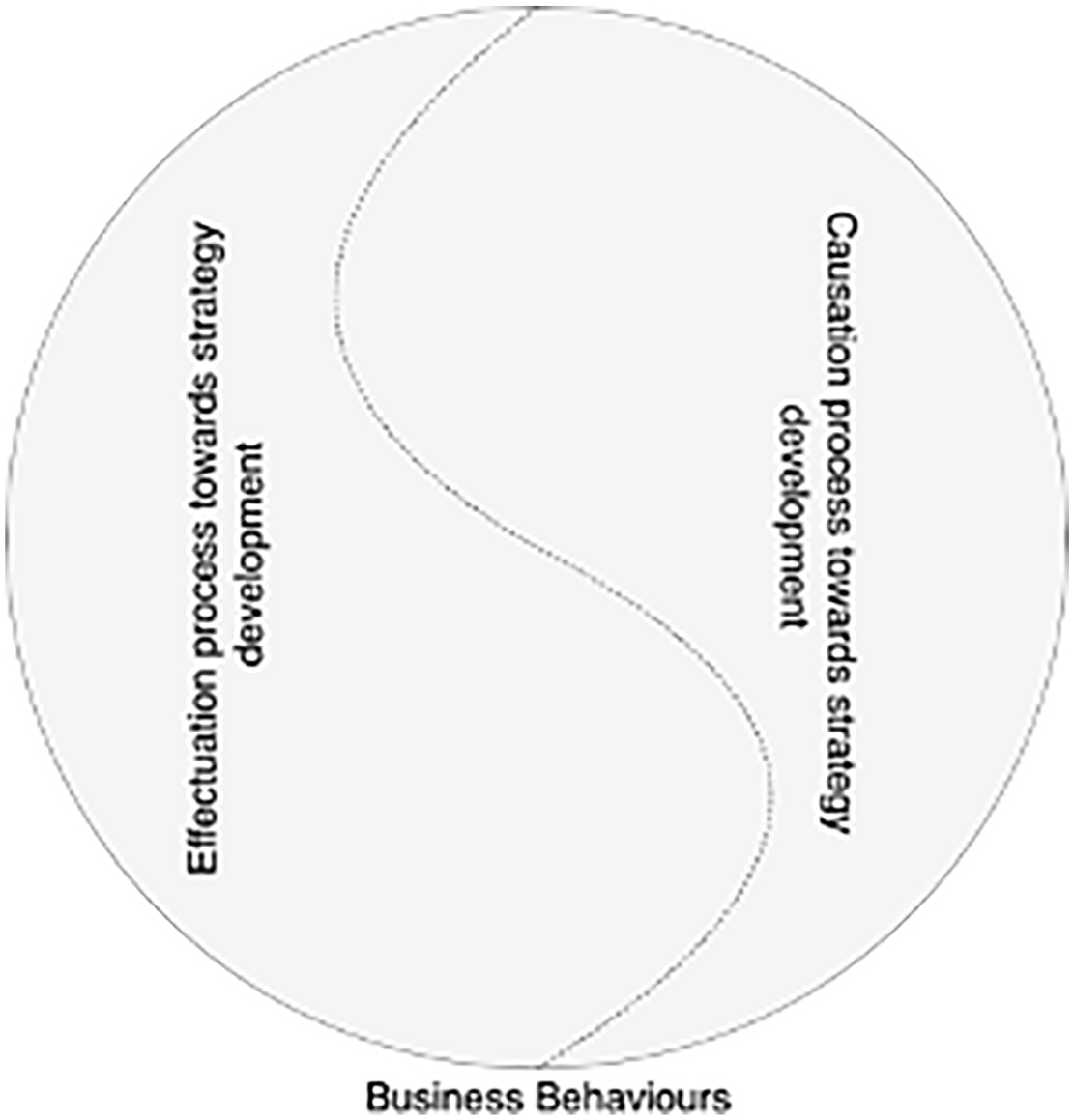
Business behaviors in performance.
Entrepreneurship research and management research address both theories (see the meta-analysis by Brinckmann et al., 2010). In a business context, the two theories, despite their differences, help understand business processes and, consequently, the performance of individuals and companies. However, each theory takes a different approach to performance (Sarasvathy, 2001). Causation theory, which focuses at specific outcome, emphasizes choosing among available means and resources to achieve intended effect (Ansoff, 1991). On the contrary, effectuation theory emphasizes the means and resources at hand as the starting point to achieve various effects.
Causation theory is rooted in market research, forecasts, and a detailed analysis of the competitors and cooperators who enable practitioners to predict the future and prepare for its challenges (Andrews, 1971; Ansoff, 1965; Armstrong, 1982; Brinckmann et al., 2010; Porter, 1985; Wiltbank et al., 2006). As a result, causation logic takes a formal, strategic development approach to achieving specific goals. This logic helps the organization to predict the future and be effective in an unstable and volatile business environment using business planning and risk calculation (Dean & Sharfman, 1996; Delmar & Shane, 2003; Goll & Rasheed, 1997; Miller & Friesen, 1977; Priem et al., 1995).
Effectuation theory, which is rooted in a flexible and adaptive view of strategy development, posits that effective strategy emerges and is not necessarily following the formal and predefined plans (Mintzberg, 1994). This theory emphasizes that, in an unstable environment, adaptive strategies enable practitioners to seize opportunities (Mintzberg & Waters, 1985) and facilitate organizational learning (Brinckmann et al., 2010), which consequently increases the performance of the company. This theory acknowledges that, in a dynamic environment, it is unlikely an effective strategy can be prepared in advance (Bird & Jelinek, 1988; Dew & Sarasvathy, 2007). Contradictory to the causation theory, the effectuation theory states that, by emphasising on the resources at hand, practitioners can control the future. Therefore, there is no need to predict the future (Sarasvathy, 2001; Wiltbank et al., 2006).
In the fundamental nature, both causation and effectuation theories address how business managers can utilize strategy efficiently and productively. Research in management stress that managers have different flexibility in strategy depending on their background characteristics. Considering the context of a volatile market, upper echelon theory research assumes the characteristics of the managers; that is, background knowledge plays an important role in how practitioners form their decision-making model and approach strategy development (Hambrick, 2007; Hambrick & Mason, 1984). Previous research shows that managers draw on their previous knowledge and experience when they analyze information and develop suitable strategic plans (Taylor, 1975). Other researchers describe how prior knowledge of business processes increases managers’ cognitive ability in ways that allow them to seize opportunities to implement their strategic options (e.g., Jiang et al., 2018). It should also be noted that managers and entrepreneurs exhibit behaviors that reflect causation and effectuation theories simultaneously as they react to the uncertainties in their environments (Sarasvathy, 2001, 2003).
Hypotheses
We follow this review of previous research and theories on managers’ behaviors with the presentation of our research hypotheses related to our SBG. We claim that SBG can prepare students for the business environment by prompting the students to manage various business situations and to adapt to various business behaviors.
To test our hypotheses, we used data obtained from surveys given to the participants in the large classroom experiential exercise—the SBG (see Figure 2).
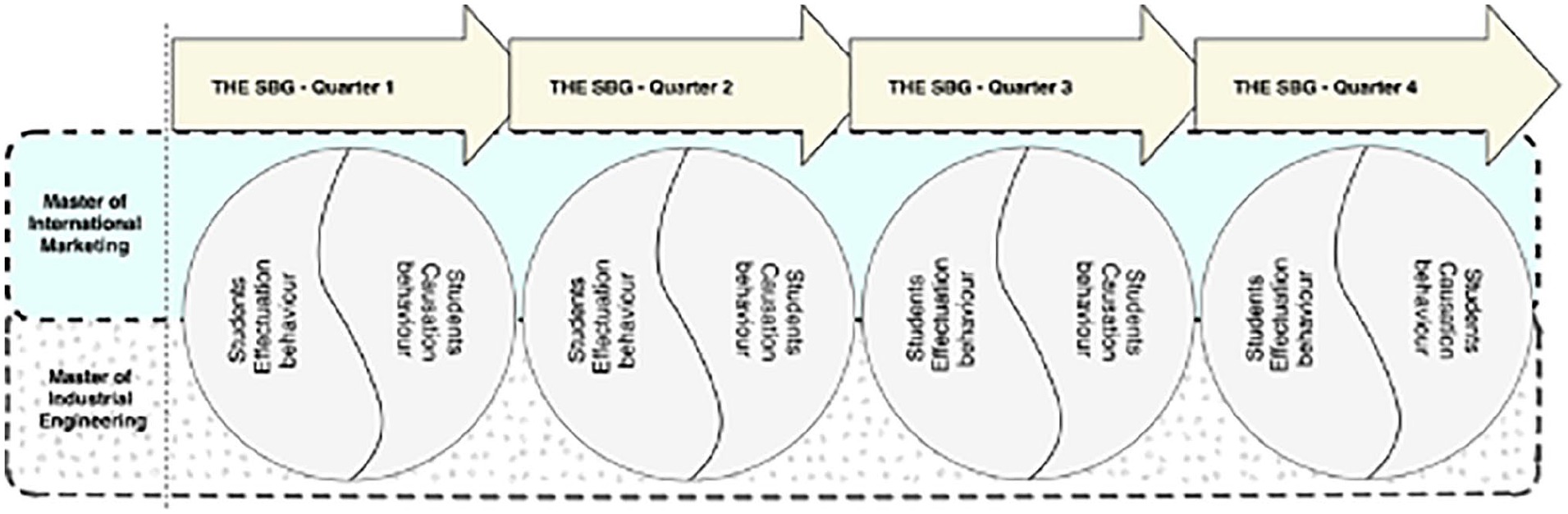
Model of the study and hypotheses overview.
Methodology
Description of the SBG
The SBG is designed to provide participants with an experience in a mock business setting that provides them with insights into strategy, management, marketing, organization, and accounting. The SBG is a production–trade game centred on the strategic evaluation of a competitive business environment performing business undertakings and in a volatile environment in which the participants’ actions are driven by the two business theories, causation and effectuation.
The SBG is suitable for undergraduate and graduate students who have at minimum a basic understanding of business activities, functions, and strategies. The SBG is played to manage companies with large and diverse groups of students with different educational backgrounds. These companies form clusters for the SBG. Each cluster consists of minimum five companies that are similar as far as the students’ individual educational background is concerned. The SBG consists of four sessions (about 3 hours each) held in four quarters that represent one fiscal year.
The SBG, as played in this study, was a segment in two master’s programs: international marketing and industrial engineering. The core curriculum of this shared segment is oriented toward strategic learning. The SBG is not intended as a stand-alone course.
The SBG Environment, Roles, and Rules
A game-master (GM), who moderates the SBG, is the course instructor or another educator. At the beginning of each session, the GM releases information about the session. Since the students have no advance knowledge of the sessions, they are unable to preplan their behaviors. Therefore, the participants of the game are required to reevaluate and adapt to their environment continuously.
At the beginning of the SBG, the participants of the game—that is, the students—are divided into four-member groups to form companies. Each company receives its unique company profile that lists with sources needed for the production process in each quarter. This list contains information on production cost, production capacity for each source, and transaction cost (Appendix A). This game design creates a competitive business environment that allows higher costs of production to be balanced by higher production capacity. Additionally, the design allows the GM to control the session by interventions as circumstances warrant (see the section Playing the SBG).
Each company has two functions (production and trade) and two roles (producer and trader). These functions and roles allow each company to interact with the other companies. The participants in each company may shift between the two roles at any time during the SBG as long as they always maintain the two functions.
The traders in each company acquire products from the producers in other companies. All companies sell their purchased products to the main customer (the government, who is played by the GM). A company’s traders cannot acquire products from their own producers. The rule means the companies must develop business relationships with other companies. By acquiring products, the companies respond to the government’s bid proposal for the products. The companies determine their bid offers based on their costs and desired profit margin. Although the companies know their own costs, they do not have these facts for other companies. Nor do they know which production sources are needed for production by the other companies. Winning bids are disclosed publicly in Quarters 3 and 4 only; other bids are never disclosed publicly.
Playing the SBG
Quarter 1
Quarter 1 design and purpose
The companies begin doing businesses (based on their company profiles) by trading only with the companies in their cluster (Appendix A). In this quarter, the clusters are unaware of the existence of the other clusters since they are based in different locations. Quarter 1 is designed for participants to learn how SBG is played by focusing on the game’s design and rules. The purpose of Quarter 1 is for the participants to learn their business functions and their success parameters as they collect information about other companies’ products, production capacity, and sales prices and thus acquire knowledge on business contexts and ecosystem.
Quarter 1 session
The companies initially lack knowledge about other companies’ products or their sales prices. As Quarter 1 progresses, the companies learn the demand for their products, and the purchase price the main customer (the government) will pay for their products (Appendix B). Each company receives its individual order (without public disclosure) from the government after fulfilling its previous order by purchasing products from a combination of suppliers (i.e., other producers) in the market. Since the government is the only customer and its purchase prices are fixed, there is little financial competition among the companies with respect to sales to the government. Moreover, the government places the same orders with all companies. This procedure is not disclosed to the companies but can be observed by the producers.
Quarter 1 outcome
Participants learn that their companies can maximize their profit by scanning the market and comparing the selling prices quoted by the various companies. With this information, the companies can choose the producer that has the cheapest products. Other market parameters are fixed: the government demand for products and the price it will pay.
Quarter 2
Quarter 2 design and purpose
Quarter 2 is continued in the cluster structure. However, the clusters now are in the same location with the other clusters although they have not yet been introduced. The companies trade only with companies in their cluster; and thus, the clusters do not interact with each other. This is an indication that the market is changing. This design mimics the expansion of the market.
The purpose of Quarter 2 is to prepare the participants to make strategic decisions under conditions of increased market uncertainty 2 . This is done by increasing the complexity of the government orders (Appendix C). In this quarter, the government places two alternative orders (without public disclosure) at fixed prices. Each company must find a producer or a combination of producers to fulfil one of the orders.
Quarter 2 session
Each government order has two alternatives with specified rules on sources. The companies must choose one alternative. In this way, no producer knows the competition exactly since traders can switch between the alternatives depending on the products’ sales prices. The traders know the government will pay for the orders once their companies fulfil one of the alternative orders. Each cluster can only trade within their own cluster; trading across clusters is not possible due to the design of the game and profile of the companies (although participants are unaware of this restriction at the beginning of Quarter 2).
Quarter 2 outcome
The participants gain an awareness of the existence of other companies and other company clusters. They also increase their knowledge of the market’s volatility when demand is uncertain. The companies continue to try to maximize their profit by using their market knowledge and by negotiating with other market actors. Thus, companies are expected to learn they have a choice between developing secure, long-term trader–producer relationships and maximizing short-term profits.
Quarter 3
Quarter 3 design and purpose
At the beginning of this quarter, participants are familiar with the increased market uncertainty and are aware of the other clusters. All companies receive the same government order (publicly disclosed). The order requires the companies to interact outside their own clusters as they compete to fulfil the order. A sealed-bidding round follows. Now the clusters, based in the same location, can trade within their cluster and across clusters. This design mimics the international business environment. The purpose of the quarter is to focus on business dynamics and strategic decision making when market competition and uncertainty increase.
Quarter 3 session
To incentivize the companies to interact outside their clusters, all companies are notified of the same order from the government but without a specified purchase price (there is no upper price limit; Appendix D). The bids on the order are time-limited to 15 minutes, which means the traders must make their bids within that time frame. The company with the lowest bid will receive the order. To increase uncertainty in the market, traders submit sealed bids. Only the winning bid is revealed after the order is awarded. In this session, for the first time, direct competition is introduced between traders.
Quarter 3 outcome
The expected outcome of Quarter 3 is for participants to learn how competition influences their businesses and competitor relationships. They see how their companies need to develop competitive strategies by using their knowledge of other companies in a highly competitive situation. Furthermore, the companies have the option of choosing profit maximization or relationship development.
Quarter 4
Quarter 4 design and purpose
At the beginning of this quarter, the participants have an even better understanding of business dynamics in a competitive and uncertain market. As in Quarter 3, all companies receive the same government order (publicly disclosed). By design, they must interact outside their own clusters as they compete to fulfil the order. A time-limited sealed-bidding round follows. Now as the clusters are based in the same location and may trade within their cluster and across clusters, this design mimics the international businesses environment with its complex business relations and global environment. The purpose of Quarter 4 is for the participants to practice strategic decision making in a highly competitive, fast-paced, and volatile market.
Quarter 4 session
Market pressure increases when all companies receive the same publicly disclosed government order (Appendix E). Once the sealed bids are received (typically one third of the total companies in the SBG offer bids), the bidding war stops, and the government accepts the lowest bid. In this quarter, companies are encouraged to present their bid as quickly as possible; thus, they need to rely on relationships developed in the previous sessions so as to avoid bottlenecks and other constraints in the bidding process. If, as is likely, the companies form cartels and present unrealistic bids, the government intervenes and blocks involved traders in the cartel for a round or two to ensure fair competition in the market.
Quarter 4 outcome
The participants learn to be cooperative as well as competitive and strategic. Thus, the companies that use established relationships and have the capability of scanning the market are more likely to submit the winning bid. The participants realize that good performance depends on an understanding of business as a cooperative competition. They learn that the SBG is not a zero-sum game in which a gain for one company is a loss for another.
Data Collection and Sample
To explain how we collected our data and how we gathered our sample, we now return to our primary question for this research: How does business higher education prompt various business behaviors in large business classrooms? To answer this question, we posed a secondary question: To what extent does the experiential learning exercise SBG changes students’ causation and effectuation behaviors?
Three surveys were distributed to participants in the SBG. The first survey, which was distributed before the SBG began, asked questions about the characteristics of the students and their understanding of business environments in general. The second survey, which was distributed after each of the four quarters, asked questions about the business behavior and relationships observed and experienced in that particular SBG session. In total, this survey was distributed four times in different points of the SBG. The third survey, which was distributed at the end of the SBG, also asked questions about the perception of participants’ general business behavior and relationships observed and experienced in the SBG. These surveys create a database which is aim to discover the development and changes in the business behaviors of the participants as a result of the experiential learning in the SBG.
The participants—that is, students in our sample (N = 126)—were enrolled in an industrial engineering master’s program (59 students) and in an international marketing master’s program (67 students) and played in 32 groups (typically four-member groups) as companies. All students had a basic understanding of strategy and business behavior acquired in previous courses. Both master’s programs have strategic orientation learning in their core curricula, which entails dealing with strategic evaluation of and adaptation to volatile environments. The SBG uses this same strategic focus and structure.
Procedures and Dependent Variables
The two dependent variables of this study are the causation and effectuation behaviors of the participants during the four points of time—that is, the four quarters of the SBG. The two dependent variables are defined and established by Sarasvathy (2001, 2003) and operationalized by Brettel et al. (2012), Chandler et al. (2011), Read et al. (2009), and Roach et al. (2016). In this study, we adopted these measurements. Using the survey responses, the participants evaluated their pursued behavior during each quarter on the 5-point Likert-type scales (from 1 as strongly disagree to 5 as strongly agree). Each survey began with the same phrase: Please evaluate the following statements based on your group’s behavior during this session.
We used six items to compute the causation behavior variable of the participants in each point of time. These items were (1) we analyzed long-run opportunities and selected those we thought would provide the best returns, (2) we developed a strategy to best take advantage of resources, (3) we designed and planned business negotiation strategies, (4) we organized and implemented control processes to make sure we met our returns goals, (5) we researched markets and carried out meaningful competitive analysis, and (6) we had a clear and consistent vision for where we wanted to end up (either financially or others).
We measured the effectuation behavior variable of the participants in each point of time in five dimensions: experimentation, affordable loss, flexibility, precommitments/partnership, and means reflecting on a total of 13 items.
We used two items to compute the experimentation of the participants in each point of time: (1) We experimented with different business negotiation models, and (2) we tried a number of different approaches until we found a business negotiation model that worked the best. For affordable loss of the participants in each point of time, we used two items: (1) We were careful not to commit more resources than we could afford to lose, and (2) we were careful not to risk more money than we were willing to lose with our initial idea. To compute flexibility of the participants in each point of time, we used three items: (1) We adapted our deals to the resources we owned, (2) we were flexible and took advantage of opportunities as they arose, and (3) we avoided deals that restricted our flexibility and adaptability in future deals. Additionally, to compute precommitments/partnership of the participants in each point of time, we used three items: (1) We used agreements with other groups (officially or unofficially) to reduce the amount of uncertainty, (2) we used agreements with other groups (officially or unofficially) as often as possible, and (3) we focused on uncertainty reduction by approaching a potential partner and customer. Finally, to compute the means of the participants in each point of time, we used three items: (1) Our networks helped us to enhance and solidify our deals, (2) we relied on our business network established in the game to assist us in improving our performance, and (3) our network assisted us in improving the quality of our deals.
Results
Before testing our hypotheses, we performed confirmatory factor analysis (CFA) in AMOS with maximum likelihood estimation procedure for the two dependent variables in all four points of time. For Session 1, CFA showed a model fit with a nonsignificant χ2 of 134.077, with the p value of .362, and the degree of freedom of 129; the root means square error of approximation (RMSEA) was .036; the comparative fit index (CFI) was .974; and the Tucker–Lewis index (TLI) was .966. For Session 2, CFA showed a model fit with a nonsignificant χ2 of 158.157, with the p value of .115, and the degree of freedom of 138; the RMSEA was .069; the CFI was .895; and the TLI was .870. For Session 3, CFA showed a model fit with a nonsignificant χ2 of 155.107, with the p value of .114, and the degree of freedom of 135; the RMSEA was .069; the CFI was .897; and the TLI was .869. Finally, for Session 4, CFA showed a model fit with a nonsignificant χ2 of 162.291, with the p value of .106, and the degree of freedom of 141; the RMSEA was .070; the CFI was .913; and finally, the TLI was .894. Thus, all model fit measures for all sessions are acceptable and within the standard scales (see Browne & Cudeck, 1993), and it indicated an appropriate fit between observed data and theoretical assumptions regarding the business behaviors.
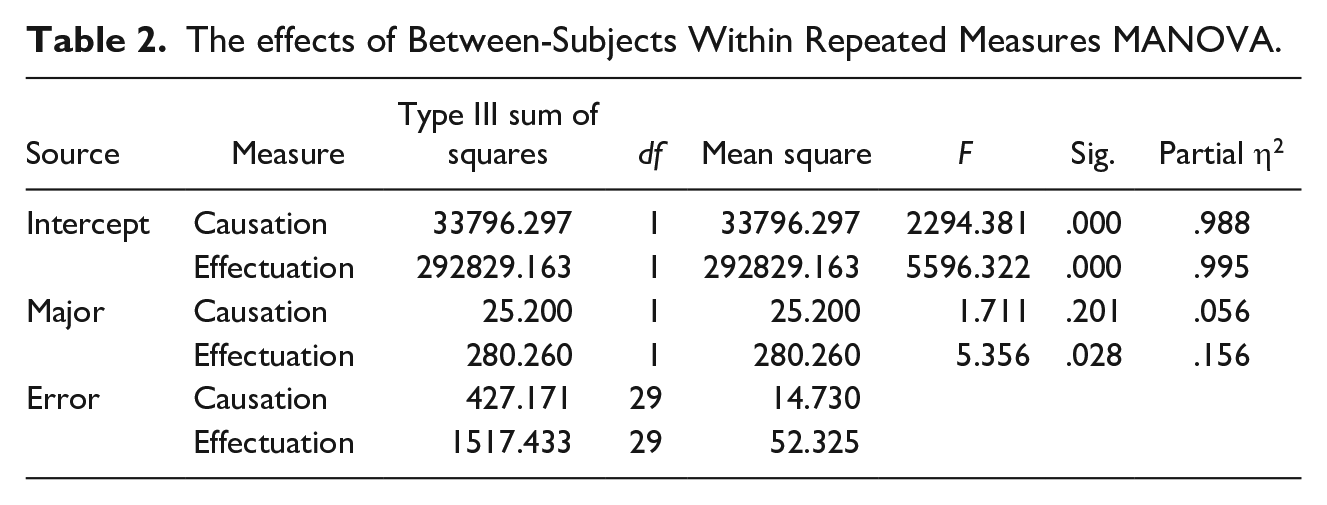
To test our four hypotheses and answer our research questions, we conducted a one-way repeated measures multivariate analysis of variance (i.e., the one-way repeated measures MANOVA or a doubly MANOVA) on two measures of the business behaviors of participants: Causation behavior and effectuation behavior over the 4 points of time in the SBG. By considering the knowledge background of the participants, the following two groups of the between-subjects independent variable were formed: the International Marketing major and the Industrial Engineering major. The within-subjects variables (causation and effectuation) treated multivariately (at the 4 points of times), n = 16 and n = 15 for the International Marketing major and the Industrial Engineering major, respectively. We had no missing data, and we found no univariate or multivariate outliers at α = .01. All the assumptions on the doubly MANOVA were met (i.e., normality, linearity, homogeneity of covariance matrices, and multicollinearity).
The within-subject effect of time by major interaction was not statistically significant with Wilks’s Λ = 0.72, F(6, 24) = 3.7, p = .218. However, there was a substantial main effect for time on within-subject variables with the Wilks’s Λ = 0.51, F(6, 24) = 3.7, p = .009, partial η2 = 0.48, suggesting relatively moderate effect on differences between the behaviors at different time periods.
The main effect of between-subjects variable—that is, major was not statistically significant—with Wilks’s Λ = 0.84, F(2, 28) = 2.5, p = .093, partial η2 = 0.15, suggesting no differences in the behavior of the groups depending on the major.
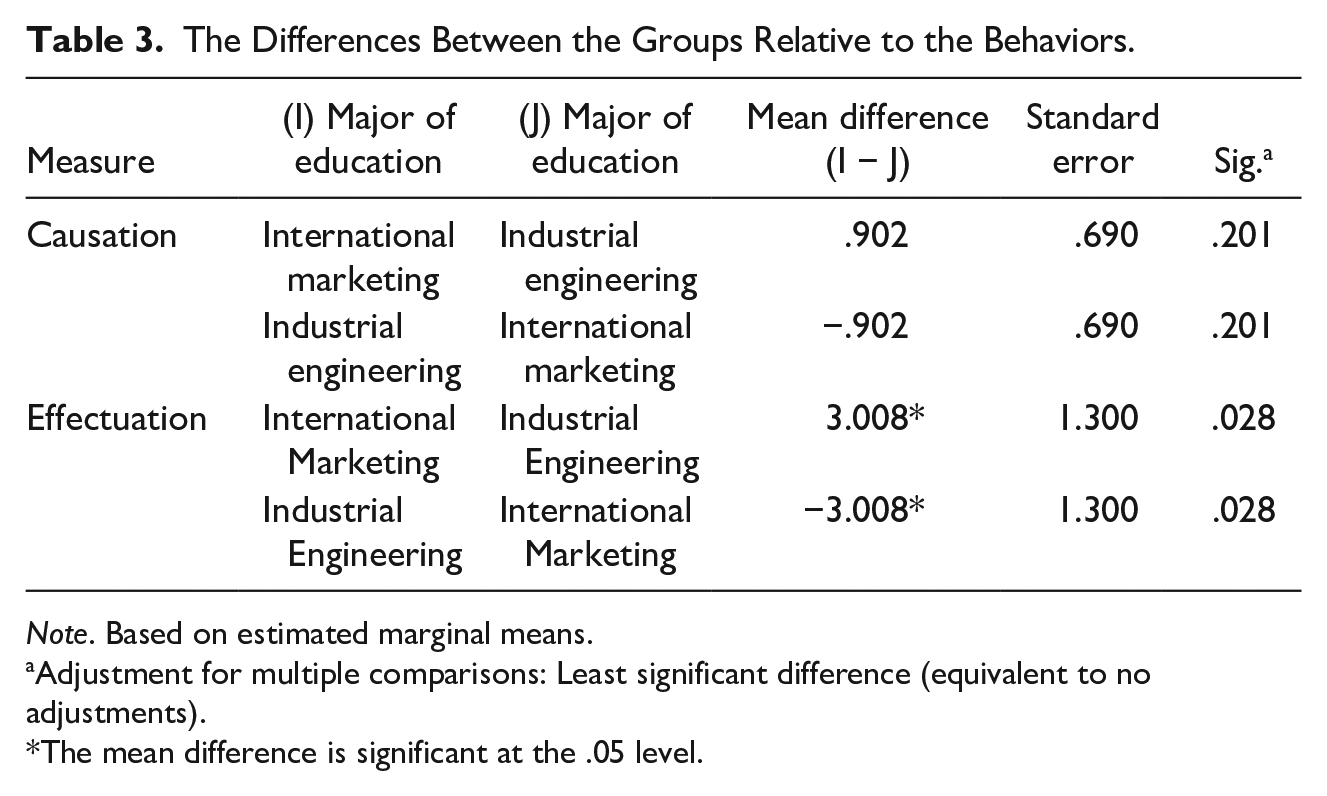
Nevertheless, on closer examination, major had an effect on one behavior—effectuation with F = 5.3 and partial η2 = 0.15 (Tables 1 and 2). After adjusting, we observed that during the SBG, the international marketing students had statistically significant higher effectuation behavior and nonstatistically significant higher causation behavior than the industrial engineering students (Table 3). The explanation may be that the international marketing students had more training in entrepreneurial knowledge than the industrial engineering students. Thus, this result is not far from expectation.
The Effects Within Repeated Measures MANOVA.
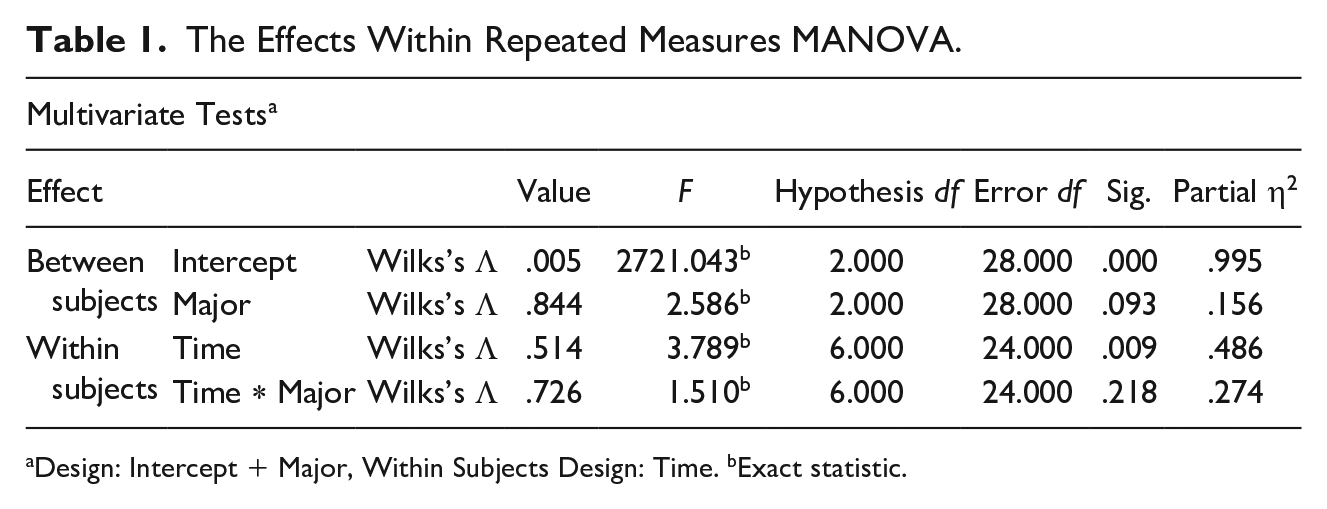
Design: Intercept + Major, Within Subjects Design: Time. bExact statistic.
The effects of Between-Subjects Within Repeated Measures MANOVA.
The Differences Between the Groups Relative to the Behaviors.
Note. Based on estimated marginal means.
Adjustment for multiple comparisons: Least significant difference (equivalent to no adjustments).
The mean difference is significant at the .05 level.
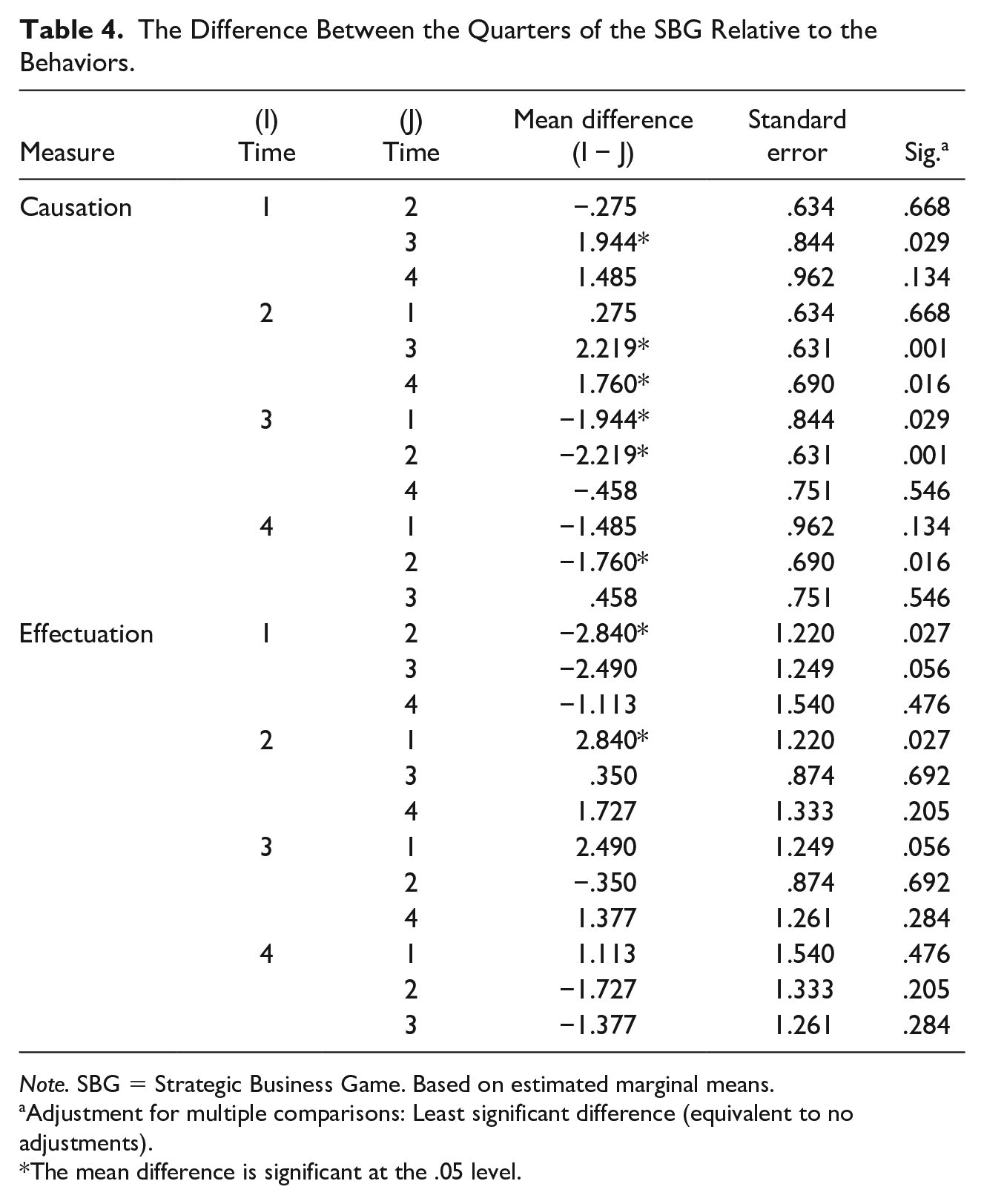
Furthermore, in examining the behaviors of the participants in each quarter, we found a significant decrease in causation behavior in Quarter 3 compared with Causation behavior in Quarter 2. This result was expected since in Quarter 3 the participants are introduced to greater market uncertainty and stiffer competition due to the integration of the clusters. These conditions diminished the effect of causation behavior and required the students to deviate from their planned strategy and act according to effectuation behavior. Moreover, in our examination of the effectuation behavior in each quarter, we found a significant increase in behavior change in Quarter 2 than in Quarter 1. This result was also expected since participants overlooked the need to adapt when they were in the stable market environment of Quarter 1.
In short, the SBG prompted a statistically significant increase in effectuation behavior and a statistically nonsignificant increase in causation behavior from Quarter 1 to Quarter 2. The SBG also prompted a statistically significant decrease in causation behavior and a statistically nonsignificant decrease in effectuation behavior from Quarter 2 to Quarter 3. Finally, the SBG prompted a nonstatistically significant increase in causation behavior and a nonstatistically significant decrease in effectuation behavior from Quarter 3 to Quarter 4 (see Table 4 and Figures 3–6). Thus, we conclude that the four hypotheses of this study are supported.
The Difference Between the Quarters of the SBG Relative to the Behaviors.
Note. SBG = Strategic Business Game. Based on estimated marginal means.
Adjustment for multiple comparisons: Least significant difference (equivalent to no adjustments).
The mean difference is significant at the .05 level.
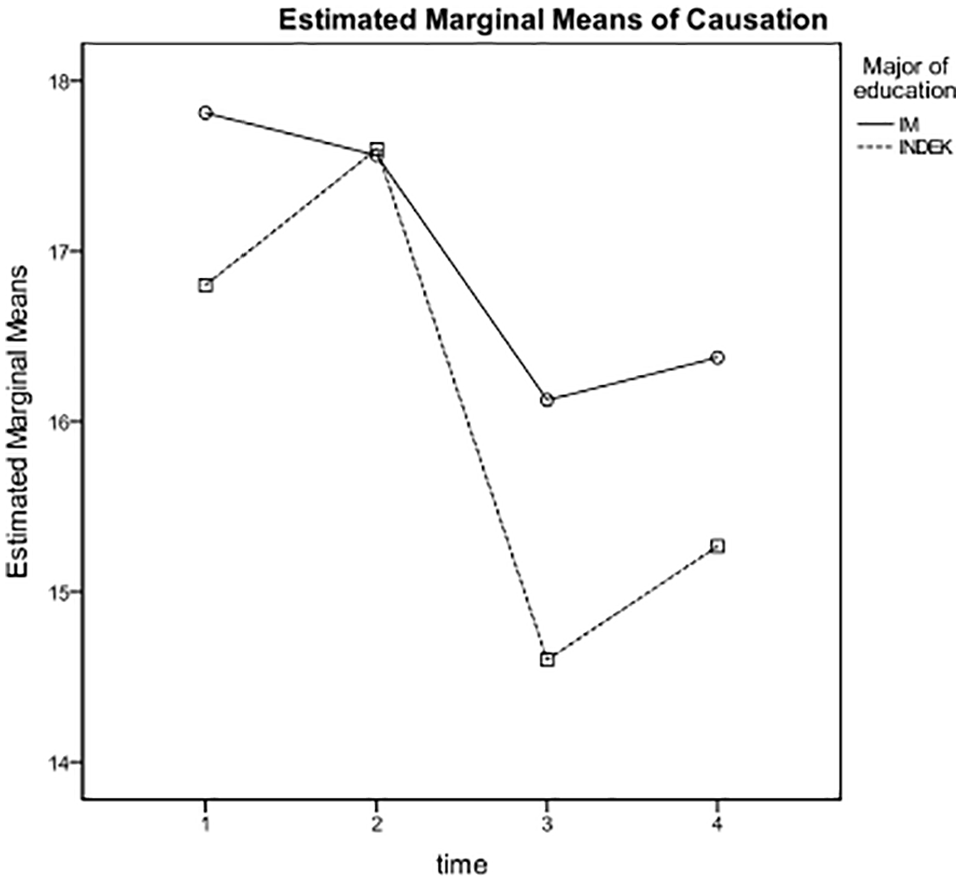
Profile analysis of different participants’ educational backgrounds on causation business behaviors during the four quarters of the SBG.
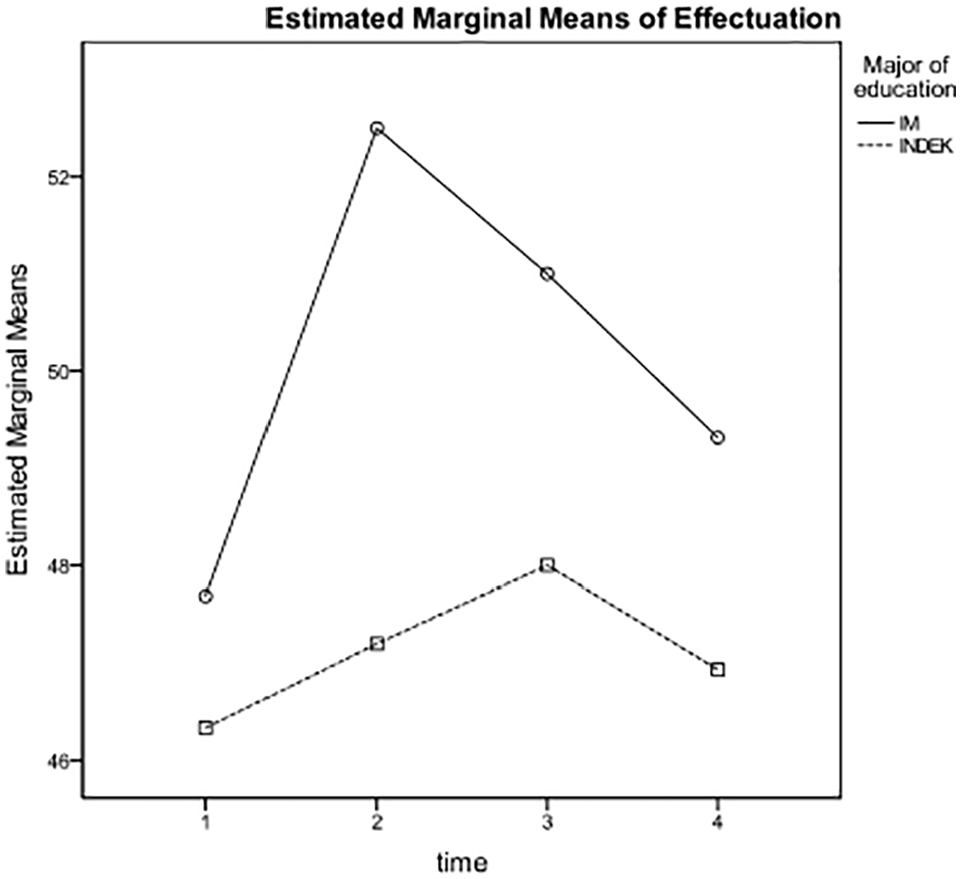
Profile analysis of different participants’ educational backgrounds on effectuation business behaviors during the four quarters of the SBG.
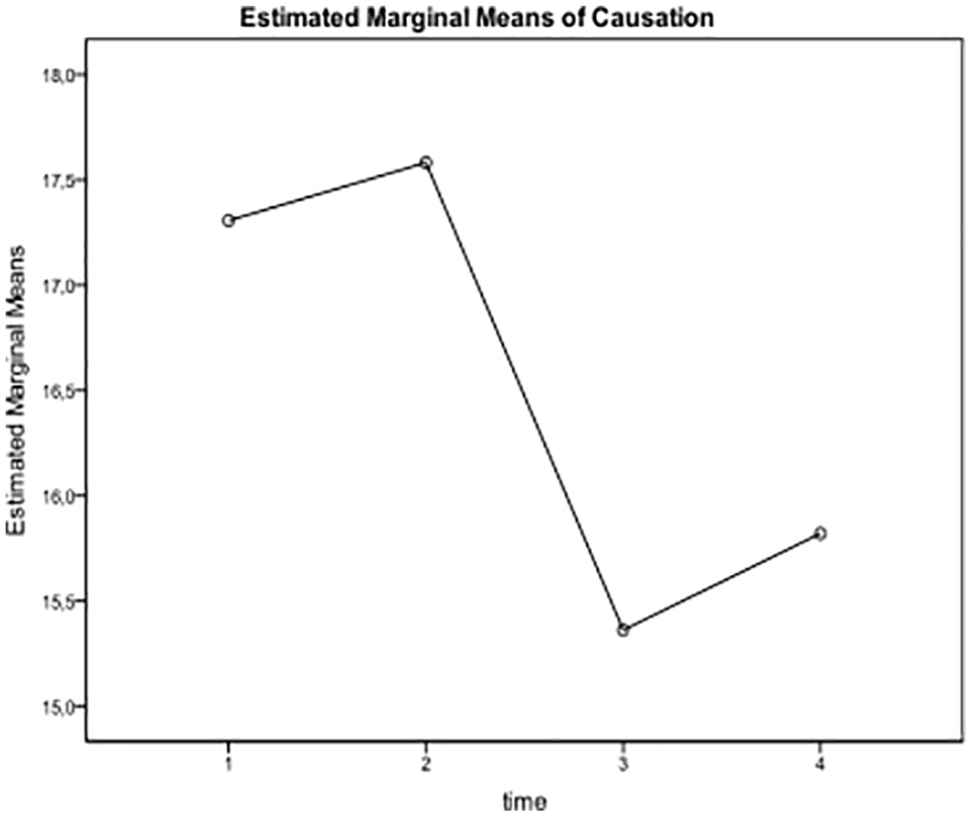
Profile analysis of causation business behaviors during the four quarters of the SBG.
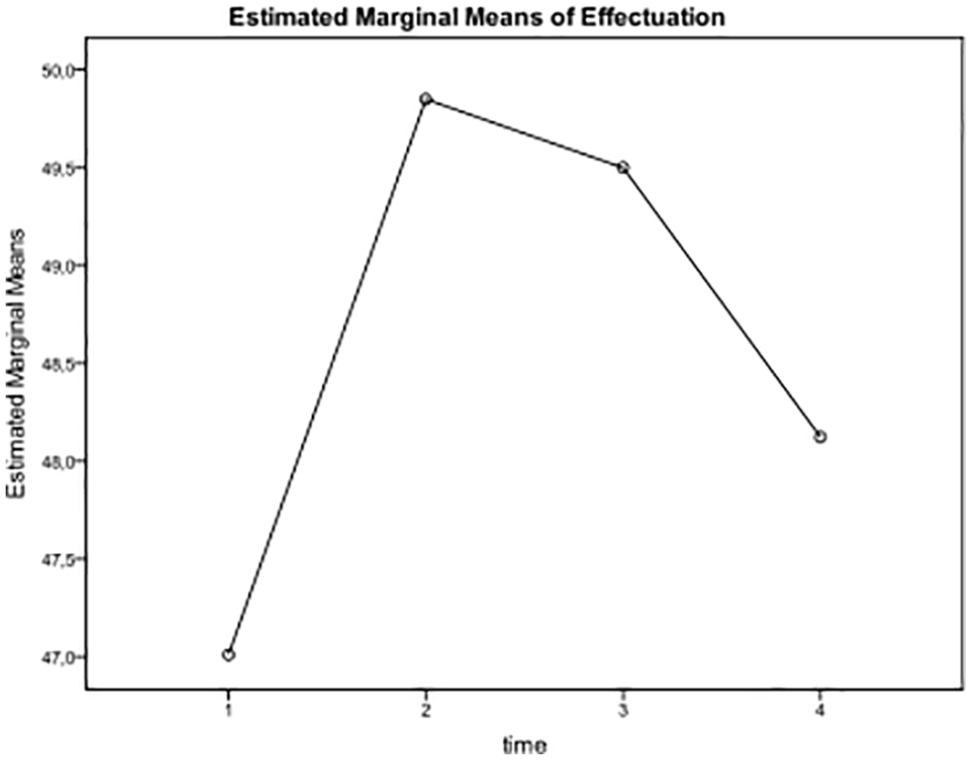
Profile analysis of effectuation business behaviors during the four quarters of the SBG.
Discussion and Conclusions
Previous research on experiential learning recognizes that knowledge is created by experiences (Conklin, 2013; Kayes, 2002; Kolb, 1984, 2014; Morris, 2019; Vince, 1998). This understanding of how knowledge is acquired has provoked changes in teaching styles and methods. One change has been an increased focus on activating and engaging students in the learning process (Blair, 2016). The logic is that students learn by doing—that is, by taking part in experiential exercises (Munge et al., 2018).
The steady increase in the number of students enrolled in undergraduate and graduate business courses means that business class sizes have also increased. The related increase in the number of large classrooms has introduced new pedagogical problems associated with the classroom complexity where large groups of students with various knowledge, skills, and learning styles are taught. To date, most research on experiential learning has been conducted in smaller classes. Therefore, much more can be learned about experiential learning as a teaching method in large classes (Isbell & Cote, 2009; Lund Dean & Wright, 2017).
Considering the ontological and epistemological foundation of entrepreneurship theory (Sarasvathy, 2001), educators can introduce students to experiential learning in entrepreneurial education (Mäkimurto-Koivumaa & Puhakka, 2013; Ratten & Usmanij, 2020). Using gamification of entrepreneurship concept, educators can provide students with classroom opportunities to learn and practice business behaviors (Parris & Mcinnis-Bowers, 2017).
In our research, we created a game SBG—in which we used gamification as an experiential learning approach for a large class. The purpose of the SBG is to facilitate student learning by developing awareness in students’ knowledge of business and entrepreneurship concepts. The students “learn by doing” as they play the SBG in a volatile and dynamic mock business environment in the classroom.
The SBG was created to reflect various conditions and choices common in the business world in a way that prompts students in large classrooms to practice two business behaviors as they confront various market situations. In theory, each business behavior driven by either causation theory or effectuation theory has a different relationship to the market. In reality, practitioners tend to shift between the two behaviors depending on the situation at hand when dealing with a stable or unstable market. The two business behaviors complement each other and transpire simultaneously.
In our research, we set out to examine the behaviors exhibited by 126 students under different market conditions of SBG that required attention to competition, negotiation, and collaboration. We found that the SBG prompts students’ causation behaviors and effectuation behaviors. We also show that the students’ previous education did not influence their overall business behaviors. However, consistent with research on management behavior of practitioners (e.g., Hambrick et al., 1996), students with different educational backgrounds responded differently to the situations introduced in the SBG. These results support the claim that gamification is a suitable teaching method in large classrooms in which the teaching–learning environment is complex owing to the diversity of students’ education backgrounds.
The use of gamification in a large classroom allows the educators to take advantage of the student diversity that is characteristic of such classrooms. The greater the number of students with different educational backgrounds, the more their behaviors will differ. Thus, each student has the opportunity to observe and react to a variety of diverse behaviors that, in their entirety, make the individual experience more valuable.
The use of the SBG in our case facilitated the students’ demonstration of their own behaviors and their reactions to the behaviors of other students. In this way, students learned and developed their awareness about the entrepreneurial knowledge. This extends the knowledge on how to develop awareness about entrepreneurial knowledge by gamification of concepts in a large classroom of students. Hence, the challenges typically associated with large classroom became learning opportunities and a path to success. This solution is reminiscent of Sun Tzu’s recommendation on turning weaknesses to strengths when strategizing a battle (Griffith,1963).
In sum, the main finding in this article is that gamification, when used in higher education business courses with large class sizes, can increase the experiential learning among students. This finding supports the use of the experiential learning approach to instilling entrepreneurship knowledge over the use of traditional teaching approaches. Gamification, as a form of experiential learning, can prompt causation and effectuation behaviors in large classroom settings. This article increases the knowledge that experiential learning can improve students’ ability to engage and to learn (Conklin, 2013; Kayes, 2002; Kolb, 1984, 2014; Morris, 2019; Vince, 1998).
Suggestions for Future Research
The literature on gamification claims students who have an interest in what they learn are more likely to show higher motivation in experiential learning exercises and think game exercises are engaging and educational (Buckley & Doyle, 2016). It is argued that gamification in education has a beneficial effect on students’ ability to think critically and creatively in self-reliant situations as well as on their communication and decision skills. Gamification even help students develop their social relationships seeing the results of their efforts in the process and the feedbacks they receive to adjust their future actions (Perrotta et al., 2013). Hence, we suggest that researchers in business education to examine students’ responses and range of emotions toward learning when educators use gamification in their courses. This research would further our understanding of the advantages and disadvantages of gamification as an approach in experiential learning.
Another area of research interest is the effect of gamification on learning motivation. Students are motivated to learn when game exercises are used (Domínguez et al., 2013). Especially, they are motivated by the points, trophies, and other rewards that gamification awards for successes (Simões et al., 2013). Even failures can be motivating since it is part of the learning process, and the negative emotions that it triggers are to a certain level acceptable. Thus, we suggest future research to exploit the area of the game design and investigate how games in higher education can be designed to allow students to go through a range of different emotions and motivation in large classrooms. This research would contribute to our knowledge regarding learning and developing new knowledge within groups, communities, and societies.
Another interesting investigation on SBG is concerned with the exhibition of different behaviors. We found variations in the behaviors exhibited by the participants—that is, students in the SBG’s four quarters. The behavior changes were more pronounced in some quarters than in others. It would be interesting to investigate qualitatively why the behavior changes differed among the four quarters. It would also be interesting to test the SBG using a shorter time period (e.g., two time periods that suggested a significant effect on business behaviors rather than the four time periods of our study). If the result stays the same, a shorter time frame might make it possible to use the SBG at large workshops and conferences with practitioners, researchers, or educators.
Last, we recommend research be conducted on the use of the SBG with different participants. Since student participants are motivated by a course grade or other evaluations (Bradford, 2019), they may exhibit behaviors different from the behaviors of nonstudents.
Researchers could also include participants with little or no familiarity with business and strategy to determine how much their characteristics affect their approach in the experiential exercise like SBG. Furthermore, it is insightful to run the SBG in mega classes – that is 500 or more students (Pryor, 2016), to examine the student behavior changes in the SBG in such a context.
Footnotes
Appendix A
Strategic Business Game (SBG) is a gamification of the entrepreneurship concept. SBG can be played in different industries and markets.
Here we illustrate the SBG in the energy market with eight companies from the same geographic area. In the example, the participants consist of students from two programs: Education Major 1 and Education Major 2.
Appendix B
Table B1 presents an example of the orders (i.e., government demand, and price for each order) provided directly and confidentially to the companies’ traders by the government in Quarter 1. Each order is provided to the groups in a stepwise manner.
Appendix C
Table C1 presents an example of the orders (government demand, and price for each order) provided directly and confidentially to the companies’ traders by the government in Quarter 2. Each order is provided to the groups in a stepwise manner. Additionally, companies can choose one order to fulfil from a choice of two alternatives.
Appendix D
Table D1 presents an example of the orders that the government announces publicly to all companies in Quarter 3. There is no fixed price set by the government. Instead, the government makes a specific order and sets the rules related to the sources needed to generate electricity in the plant. The companies are required to follow these rules when they make their bids. Sealed bids may be stated and adjusted within a specified time period (i.e., 15 minutes). The companies are encouraged to trade with several companies because the government’s required amount exceeds the capacity of any single producer. The order is awarded to the lowest bid, thus invalidating other bids.
Appendix E
Table E1 is an example of the government orders presented simultaneously to all groups in a stepwise manner in Quarter 4. The companies are encouraged to bid as quickly as possible. Some orders have two criteria that must be met. The government announces the orders publicly to all companies and does not set a fixed price. Instead, the government asks for a specific amount in its order and specifies rules regarding the sources needed to generate electricity in the plant. Companies are required to submit their sealed bids based on these conditions. The order is awarded to the lowest bid each time. As a result, losing bids are invalid and no sales are possible. The companies may adjust their bids before the government closes the bidding window. This closure occurs when a fixed set of bids is submitted (typically about one third of the companies in the SBG).
Acknowledgements
We would like to show our gratitude to the editor and three anonymous reviewers for their insightful and constructive comments on our article. Furthermore, we would like to thank our colleague, Professor Ulf Andersson, from Mälardalen university, who guided us throughout the path of publication process with his insightful comments. We also thank our students who committed to the production–trade game and made our data collection process a fun experience.
Declaration of Conflicting Interests
The author(s) declared no potential conflicts of interest with respect to the research, authorship, and/or publication of this article.
Funding
The author(s) received no financial support for the research, authorship, and/or publication of this article.
