




Abstract
In this article, we illustrate how ideas and practices of mindfulness can be integrated into management education, drawing from our work on postgraduate programs run with working managers. Our purpose is particularly to show how mindfulness can be introduced into the curriculum in a way that is acceptable for participants and clients, and brings benefit to participants. Following a brief review of literature on mindfulness in organizations, we share the curriculum innovation we designed and provide detail of its effectiveness derived from our follow-up evaluation.
Introduction
In a world of organizational turbulence and increasing complexity, surviving the pressures managers face is a growing concern (Bardoel et al., 2014; James et al., 2011) and in recent years, there has been increasing interest in the contribution mindfulness can make to maintaining well-being in the face of such pressures (Reitz et al., 2016). In this article, we illustrate how ideas and practices of mindfulness can be integrated into management education, drawing from our work on postgraduate programs run with working managers. Our purpose is particularly to show how mindfulness can be introduced into the curriculum in a way that is acceptable for participants, in this case, the students and clients such as the commissioning organization, and brings benefit to participants. Following a brief review of literature on mindfulness in organizations, we share the curriculum innovation we designed and provide detail of its effectiveness in enabling managers to learn about mindfulness and self-care based on our follow-up evaluation.
Literature Review: Mindfulness and Learning
In this section, we first elaborate on what is understood by mindfulness, its origins and contemporary Western organization applications. Second, we consider the introduction of mindfulness to management and leadership development.
Mindfulness
In the past decade, there has been an upsurge of Western interest in mindfulness, defined as the state of “paying attention in a particular way: on purpose, in the present moment, and non-judgmentally” (Kabat-Zinn, 2011, p. 291). Mindfulness can be understood as a mental state achieved by focusing one’s awareness on the present moment, while calmly acknowledging and nonjudgmentally accepting feelings and thoughts. The practice of mindfulness aims to gain greater insight into the processes of the mind, in the sense of becoming more aware of patterns of thought and preoccupations, such as repeated patterns of fear, anxiety, self-criticism, or denigration of self and others (Carmody, 2015; Lomas et al., 2017). Mindfulness meditation is an ancient practice (Hanh, 1975), probably currently most associated in the West with Buddhism and secular yoga, although meditation is also practiced in Hinduism, Islam, and Christianity (Shear, 2006). The practice involves two key ingredients, samatha (sustained concentration) and vipassanἀ (experiential enquiry) (Batchelor, 2011). During a mindfulness meditation practice concentration is commonly focused either on the breath while sitting, or on the sense of movement, sounds, or the sensation of air while walking. People are encouraged to simply note the coming and going of thoughts that intrude into their concentration, without getting drawn into a specific train of thought or making judgments. Learning to practice mindfulness is to counteract the habitual tendency of “mindlessness” (Langer & Moldoveanu, 2000), characteristics of which are described as including continually ruminating about the past or planning the future, while paying scant attention to the present; feeling separate from both life and oneself; and being caught up in the mind, while detached from the body.
Mindfulness has a dual purpose, to quieten the mind to allow insights to emerge, and also, through stillness to develop a meta-awareness of the interpretative patterns of one’s mind. Mindfulness practice develops deep listening in the sense of encouraging people to remain present in the moment, to “sit with” what is going on in the “here-and-now.” It encourages practitioners to notice and observe physical sensations and mind patterns while remaining detached. Rather than ignoring discomfort or willing a way through it, acknowledgement and acceptance helps resolve it and/or brings conscious insight. The relationship of mindfulness with learning, therefore, is not just about discovering a technique to help slow down and relax but also about becoming more aware of our habits of thought, our unrecognized assumptions and unconscious reactions, and why these might be significant. The promise of mindfulness to help individuals maintain well-being flows from such enhanced self-awareness, and an increased ability to manage emotions (Rupprecht et al., 2019) as well as lessen anxiety (Kerr et al., 2013).
Systematic research from fields as diverse as medicine, psychology, neuroscience, school education, business, and leadership development (King & Badham, 2018; Williams & Kabat-Zinn, 2011) reports positive impacts on brain activity, producing increased control over chronic pain, anxiety, and depression (Kerr et al., 2013), curtailing negative functioning and enhancing positive outcomes in mental health, physical health, behavioral regulation, and interpersonal relationships (Desbordes et al., 2015). Mindfulness is increasingly referred to in the organization literature, and has become popular in Western business and health sectors as a remedy for personal anxiety and well-being (Brown et al., 2007) as well as offering promise for complex organizational decision making (Weick & Sutcliffe, 2006). It was these qualities that attracted us to try to introduce mindfulness into our management education work.
Management Education and Mindfulness
Recent thinking on leadership and management has been influenced by a relational, social, and situated perspective which sees managers’ development as a process of “becoming” (Cunliffe, 2009; Kempster & Stewart, 2010). It is suggested that use of noncognitive “learning” methods to access intuition, feelings, emotions, stories, experience, active listening, empathy, and awareness in the moment can contribute to this process of “becoming” a leader (Taylor & Ladkin, 2009; Vince, 2010). Interest in the purpose of leadership development has also extended beyond building capabilities, knowledge, behavior, and performance (Collins & Holton, 2004) to include improvement of well-being and health (Holmberg et al., 2016) as well as coping ability (Romanowska et al., 2013).
This alternative view on management and leadership development opens up a potential of mindfulness to contribute to leaders’ ability to preserve what Goldman Schuyler (2010) describes as “integrity” or “the capacity to hold one’s shape in the face of . . . perhaps unimaginable difficulties” (p. 26). However, despite a burgeoning literature on mindfulness in organization studies (Brown et al., 2007; Weick & Putnam, 2006), literature on exposure of managers to mindfulness as part of formal management/leadership development is only recently developing, including, for example, Goldman Schuyler (2010), Reitz et al. (2016), Sinclair (2015), and, in this journal, Kuechler and Stedham’s (2018) account of introducing mindfulness within an MBA. The picture is further complicated by the different intentions underlying the uses of mindfulness. Discussions of workplace mindfulness have been dominated by the pursuit of better decision making and information processing (Dane & Brummel, 2013; George, 2014; Hedberg, 2017). In this tradition, the purpose for Kuechler and Stedham (2018) was to support cognitive restructuring. A second and distinct strand in the management and organization studies literature emphasizes mindfulness for well-being and self-care. Despite early studies investigating leaders’ engagement with mindfulness (Reitz et al., 2016), there remains a dearth of material linking mindfulness explicitly to self-care in management education (Ng & Purser, 2016). Our interest is this latter strand.
Despite the increasing uptake within diverse organizations, a challenge for introducing mindfulness into management education comes from the pressure of time and space within the curriculum to do more than superficially introduce it. Some critics argue that mindfulness should not be divorced from its spiritual and philosophical origins (Kudesia & Tashi Nyima, 2015) or that it risks being hijacked for performative ends by the corporate world (Ng & Purser, 2016), just so employers can seek out more effort from employees. We recognize the related arguments that mindfulness can therefore only properly be appreciated as part of a comprehensive thematic program of meditation or at the very least as a full 8-week MBSR (mindfulness-based stress reduction) secular, intensive mindfulness training. However, when faced with designing a management education program within a finite and limited timeframe and where participant or client expectations will not be met purely by offering MBSR or a full yoga or other meditation course (see, e.g., Reitz et al., 2016), the challenge for educators is to identify how we can introduce mindfulness into the curriculum in a way that is acceptable for participants and clients, and can also benefit participants. The contribution of this article is therefore to offer an example of an instructional innovation intended to meet this challenge.
The Context for the Instructional Innovation
The management education context to which we introduced mindfulness comprised a 1-year, part-time, Post-Graduate Certificate in Leadership and Management program delivered by a British university. The program was commissioned by a specific health agency to develop their managers’ capacity to manage people and lead change, as well as to support their personal leadership development. Participants had a mix of clinical and nonclinical backgrounds and were all mature adults working as service managers in the agency, either as direct line managers or project managers. Of particular relevance to the instructional innovation we describe, the health agency (hereafter referred to as the client) had requested that one of their desired learning outcomes for the program was to support participants’ well-being, because they were concerned that continuous change in the organization was having a detrimental effect. The client’s reasoning is expressed in their rhetorical question: “how can they manage people well if they can’t manage themselves?” This was the rationale for introducing mindfulness into the curriculum, based on its potential to enhance self-care explained in the literature above. Two cohorts took the program, but at the instigation of the client the design for Cohort 2 was changed. This enables us to compare the outcomes between Cohorts 1 and 2.
The experience of mindfulness within the program design and delivery team was mixed. For two of the three academics who ran the program it was totally new. The third had a deep familiarity with meditation, but not with mindfulness per se. Design of the mindfulness activities was assisted by an external adviser (the second author) who had a regular mindfulness meditation practice.
Mindfulness Within the Curriculum
In this section, we describe how mindfulness was introduced into the learning activities of Cohorts 1 and 2. Design for both cohorts combined thematic workshop days interspersed with four-day-long action learning meetings. Action learning is a well-established approach to management development (Pedler, 2008; Pedler et al., 2004; Raelin, 2009; Revans, 1982) characterized by the use of groups of peers who offer “critical friendship” to one another in the form of insightful questions and help with reflection on problematic (messy) work issues that each person brings to the group. An action learning group (or set) will generally meet several times over a series of weeks or months to support members in their cycles of action and reflection, each meeting typically lasting anywhere from a couple of hours to a full day. Because action learning already has a reflective, attentive orientation (Jordan et al., 2009; Rigg, 2018), we identified this aspect of the program as a space to integrate mindfulness practices into the action learning set meetings. We found this synergy eased the amalgamation of mindfulness and action learning within the curriculum, and helped participants be open to practicing mindfulness within the program.
A typical opening for an action learning meeting is “check-in” in which participants are invited to focus their attention on the moment and to temporarily leave aside any distractions from work or home such as e-mails to respond to or plans to pursue. On this program, we augmented the traditional action learning opening with short mindfulness exercises, such as a 4-minute breathing exercise. Participants were guided to acknowledge any sense of discomfort or unpleasant feelings without trying to make them different; to scan the body to pick up any sensations of tightness and to acknowledge these without trying to change them in any way; to become aware and note any feelings without getting drawn into them further; to accept thoughts as mental events. At the end of the exercise, the facilitator invited participants to share any feelings or insights they wished (see online supplementary materials for further detail on the structure of a typical action learning set meeting and the mindfulness activities introduced).
Both Cohorts 1 and 2 contained four full day action learning set meetings as described here, however, they differed in the design of thematic workshops as we now describe.
Cohort 1 program
Following an induction day that introduced action learning, principles and practice of mindfulness, and other content, the program design of Cohort 1 included six full thematic workshop days besides the four facilitated action learning days described above. The approach was to thread ideas and practices from mindfulness into learning interventions throughout the entire program to reinforce the ideas of mindfulness and its relevance across the panoply of management activities such as managing teams, listening to service users, or leading change. We did this explicitly, taking a secular approach to mindfulness ideas and practices (Kabat-Zinn, 2011) with only brief mention of the philosophical or spiritual origins. We substantiated principles of mindfulness and its neurological effects by introducing the work of Rock et al. (2012) and Scharmer (2009). Rock et al posit a “healthy mind platter” of seven neurocognitive activities to optimize mental well-being: sleep time (to refresh mind and body, and consolidate memory); play time (to experience joy and creativity); down time (moments of psychological detachment without any goals); time in (being aware of what is going on within your body or mind in the present moment); connecting time (cultivating positive relationships); physical time (exercise) and focus time (concentrating attention on performance of a task). Scharmer’s (2009) U theory is an approach to changing unproductive patterns of relating to others and decision making, based on the thinking of Zen Master Nan Huai-Chin (Scharmer, 1999) that good leadership requires seven meditative spaces: awareness, finding the essential question, calmness, stillness, grace, true thinking, and attainment.
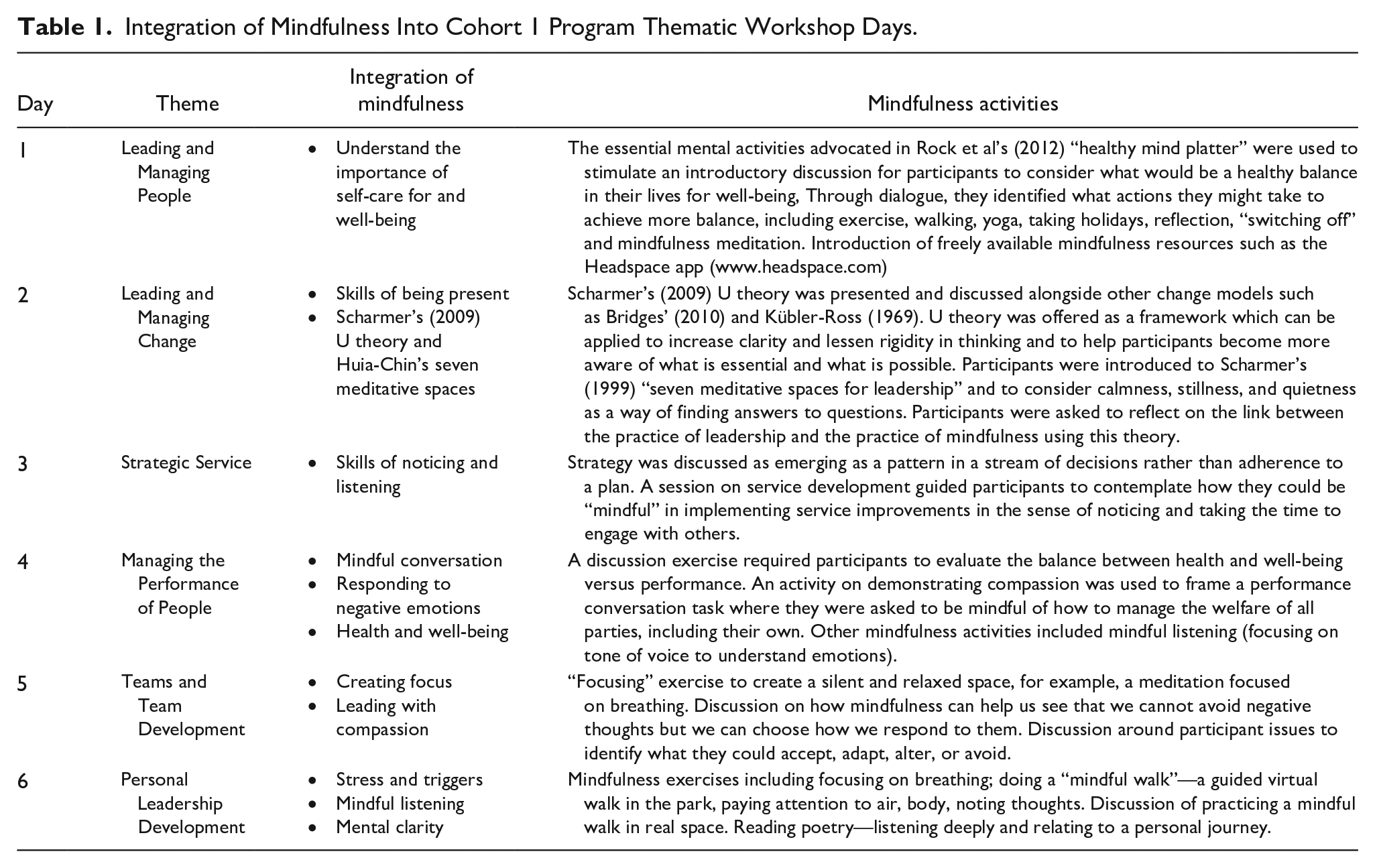
Table 1 provides detail of the six thematic workshop days and how mindfulness ideas were woven into their content by the planned learning activities. For example, within the Strategic Service thematic day (Day 3), a session on service development guided participants to contemplate how they could be “mindful” in implementing service improvements in the sense of noticing and taking the time to engage with others. In a day on Leading and Managing Change (Day 2) participants were introduced to Scharmer’s (1999) “seven meditative spaces for leadership” and asked to consider calmness, stillness, and quietness as a way of finding answers to questions. Participants were asked to reflect on the link between the practice of leadership and the practice of mindfulness using this theory. Within the thematic workshops simple and short mindfulness exercises were offered as verbal instruction to create a space for quiet meditation. For example, a breathing exercise guided students to breathe in through the nose and out through the mouth slowly, letting go of thoughts and letting themselves be still. A guided imagery exercise led the participants through a “mindful walk,” asking them to pay attention to the environment around them and to notice any sensations or feelings (see online supplementary materials for detailed activity descriptions). This mindfulness content was in addition to the more traditional content provided on the themes of managing people, leading change, team development, and performance management, but we do not go into detail on this. Overall, mindfulness constituted approximately 20% of the thematic workshop time.
Integration of Mindfulness Into Cohort 1 Program Thematic Workshop Days.
Cohort 2 program
For Cohort 2, changes were made to the program by the client following a change in their Learning and Development lead contact. They elected to make greater input to the curriculum themselves on specific challenges facing their organization, and to reduce costs they cut back on overall contact time. Although the learning outcome for participants of self-care and well-being was maintained and the client wanted to retain the inclusion of mindfulness, the result of the changes was a decrease in time available to integrate mindfulness practice.
In the design of Cohort 2, the four action learning days were retained and they ran as described above, but the number of thematic workshop days was reduced from 6 to 4. As in Cohort 1, mindfulness exercises were integrated into the check-in activity at the start of action learning sessions, however, within the workshops the mindfulness ideas and activities from Cohort 1 were replaced by organization-specific exercises and content. Overall, the consequence was that mindfulness was far less integrated, reinforced, or practiced in Cohort 2 compared with Cohort 1. In the next section, we look at the consequences of this reduction for the comparative learning by each cohort.
Evaluation of Learning
Since the whole purpose of introducing mindfulness into the curriculum was to support managers’ well-being and self-care, we conducted a comparative evaluation of Cohorts 1 and 2 to ascertain how receptive participants were to mindfulness and their application of it. Data collected included precompletion and postcompletion questionnaires and postcompletion interviews. For the purpose of this article, we draw on the interview data and one relevant questionnaire question which ascertained prior experience of mindfulness.
Cohort 1: Evaluation Evidence
Cohort 1 had 15 participants, 12 female and 3 male. Precompletion and postcompletion questionnaires were completed by all, and individual semistructured interviews, face-to-face, or telephone (as per availability) were conducted with 14 of the 15 participants by one of the authors 3 months after the end of the program (Phase 1 interviews). One of the male participants declined to be interviewed. Two years after completion of the program, further follow-up interviews were conducted with seven of the participants by the same author (Phase 2 interviews). The other eight were either noncontactable (n = 4) because they had left the organization or did not accept the invitation for a follow-up interview (n = 4). Phase 1 interviews asked participants about the following:
completion of their understanding of the meaning of “mindfulness”
completion their use of mindful practice to take care of themselves and keep resilient in the face of a very challenging job
completion examples of ways they manage others at work that have been influenced by the introduction of mindfulness ideas or practices within the leadership program.
Phase 2 interview questions probed their ongoing use of mindfulness in their personal lives or within their work roles. Full questions can be found in the appendix.
Interpretation of the interview data was undertaken independently by the two authors, one of whom had helped design the mindfulness activities within the program, but had no direct involvement with the delivery or participants. After comparing our analyses, we found considerable overlap and discussed any differences of interpretation until we reached consensus. For the purpose of this instructional innovation article, we present illustrative quotations to demonstrate how students made use of the mindfulness learning activities they were introduced to. The number in parenthesis after quotes refers to the participant number.
Question 1: How do participants understand the meaning of “mindfulness?”
Fourteen of the 15 managers articulated a variety of ways in which they had developed a personal understanding of the term “mindfulness.” Only 4 of the 15 participants said they had experienced any kind of meditation prior to the program. They described it as looking after their own well-being through taking time out, detaching from challenging situations, being aware of their own stress triggers, and developing meta-awareness of certain patterns such as always feeling the need to have the answers. Quotations below illustrate what the participants understand by being mindful as they talk about their self-care and their management at work.
The single disconfirming individual said that he did not find the mindfulness exercises to be a positive learning activity: I found it quite stress inducing and not very helpful. It felt like too related to yoga and some meditation exercise and did not feel beneficial to me. (15)
Question 2: How are participants using mindfulness ideas and practice to take care of themselves and keep resilient?
Fourteen of the 15 managers said the program was effective in helping develop a personal understanding of how the practice of mindfulness helped them cope with work pressures. For example, they said, I don’t work from a place of anxiety no more. Anxiety and stress do not fuel the function that is not how I function any more, I operate from a premise of peace. And I don’t get anxious any more, I will say this is what I can do and I will endeavor to have this done by this particular date. (3) I don’t feel guilty that I don’t have all the answers. I work in . . . complex care . . . we are dealing with complex cases, I felt as a manager I need to know everything, and I do know a lot, I do have experience but I don’t know it all. (8) I am a little bit more boundaried as well, because I did tend to take on too much. I am able to use the word “no.” I am polite about it but I have learnt to say no. (6)
As highlighted in the earlier discussion of literature above (e.g., Brown et al., 2007; Williams & Kabat-Zinn, 2011) such self-insights are essential for coping with challenging situations.
Question 3: How are participants making use of mindfulness in managing others at work?
Eight of the participants described doing things differently in the way they manage staff or organize work, which they attributed to the influence of mindfulness. Their actions included making a point of encouraging others to take breaks from work: I am telling them to take a break, even if it is to go outside and get some fresh air . . . (2)
They show more awareness of the well-being of others: I do encourage people [to] look after themselves. I have now one particular person, she disclosed that she suffers from panic attacks, in her return to work interview was talking to her about her well-being, mindfulness, looking after herself, yoga, meditation. Maybe I wouldn’t have explored with people before but now I do. (1) In team meetings, last year when I was managing and even wrote in their objectives to have reflective time, to reflect on what they had done rather than be reactive. (9)
All 14 talked of ways in which they were bringing mindfulness into their management practice. Examples include being more attentive to others: I take more time to listen, listen to my subordinates, people who are more junior to me. (1) I tend to listen more now, step back to see what is going on that helps me in my decision making process. Listen to other people’s view, realized that this counts not just mine. Look at things from others’ eyes. (2)
Being less reactive in response to behaviors from others was another instance: I am normally a reactive person, for example, I would get stressed about if things have not been done I could verbally say “what, this has not been done, you were told about this, this needs to be done, we do have a deadline.” Now, through mindfulness helps you to take a step back, apply pause button, and come to a calmer level and then tackle issues in a more calm, mindful and productive way. (1) . . . different to what I was doing 5/6 months ago. Taking more time to make decision, so decision-making is better. Yesterday, someone walked in one hour late, before I would have said in front of everyone, “what, are you late?” But, I said to her, “can I talk to you after the meeting” and then we had our one-to-one in the office . . . I am being more mindful. (11)
These comments show the participants describing being mindful as paying closer attention to how they relate to and listen to others, being more aware of and noticing their team members and colleagues. The quotes provide evidence of how they find themselves more nuanced in their responses to challenging situations and tempering their reactions so as not to escalate conflict. This increase in self-insight and self-management is known to help improve well-being (Kaplan et al., 2013; Tice et al., 2007).
Cohort 1: Phase 2 Interviews
Two years after completion of Cohort 1, we invited the 14 participants who had previously been interviewed for a further follow-up interview. By this stage many had moved jobs, and some had lost contact, nevertheless, seven gave a second in-depth interview. Their responses show ongoing practice of mindfulness, as well as integration in the ways they managed their staff. Only one described a daily extended meditative practice and this was integral to their religious practice as a Muslim. However, all seven recounted ways they have consciously and deliberately assimilated the mindfulness ideas and practices introduced on the PG Certificate in Leadership program into their daily working lives. For example, If I am stressed, I move away from my desk . . . Will take a mindful walk as well. (1) I tend to do the mindful walk in the summer: observe things around, take in the buildings, scenery . . . (2) during lunch break I take a mindful walk and this helps me not to personalize things and look at the systems rather than the individuals. (3] do my mindfulness twice in a day in the toilet between 5 and 7 minutes. I find it comforting and it makes me still. (6)
These interviewees describe various ways of deliberately making time in their working days to pause their mental activity, to detach themselves from what is preoccupying them, to focus on their breathing or walking or similar, which they attribute to learning to practice mindfulness within the leadership program activities. In various quotes, they describe how this helps them contain anxiety and keep calm in challenging situations: I am able to sustain myself, it keeps me calm, and the peace has helped me not get caught up in the anxiety, look at things in an objective manner. (3) Managing my own stress and anxieties . . . I have been confrontational in the past but I can now take a step back, helps to manage such relationships and stress at work. (4) Mindfulness helps my breathing, that helps me focus more, it helps me to be present in myself and then it, it helps me to be grounded and see my vision/plans clearly (7)
The interviewees also describe the influence on their interactions with work colleagues, for example, encouraging others to be mindful: I tell my staff that if there is an incident, they should take time out, take a break . . . before you come back. (1) I continue to encourage staff to take a break. (3)
Through integrating ideas from the program learning activities into the way they manage, for example, introducing mindfulness breathing exercises at the start of meetings, the interviewees gave examples of how they see this improving team relations: Introducing mindfulness in team meetings grounds us, there are multiple teams and there is competition and sometimes animosity; it connects us as a team. . . . For me it has helped with the dynamics and frictions within the team. (4) . . . we are better together as a team, less disjointed, good contact among each other. (5)
Cohort 2: Evaluation Data
Evaluation evidence for Cohort 2 (4 female and 5 male) conducted through precompletion and postcompletion questionnaires, showed that mindfulness, as was integrated into the action learning sessions, was again well received by the participants. They were happy to participate and saw its relevance. Indeed, some commented that they would have liked to see more time allocated to mindfulness within the workshops element of the program. However, none of the participants described any specific impact or continuing use of mindfulness practices either in their daily lives or in their management practice. In other words, their learning about and application of mindfulness was appreciably lower than the participants of Cohort 1. It is this stark difference that we now discuss with particular reference to the comparative designs for each cohort program.
Summary of Findings
As we have outlined above, mindfulness was introduced to support managers to learn about self-care and to support them to find ways to maintain well-being in the face of work pressures. From the comparison between Cohorts 1 and 2, we can see that all participants with one exception, accepted being introduced to mindfulness, as we defined it. They also saw the relevance of practicing a short mindfulness exercise integrated into the start of action learning meetings. However, there is a sharp contrast in the level of benefit gained by participants of Cohort 1 compared with Cohort 2. Evaluation of Cohort 1 confirms that participants felt they developed capacity to manage pressures by better adapting to the demands of their managerial role. They dealt with difficult situations and were able to make adjustments such as giving themselves permission to not be in complete control. Through the mindfulness practice of “being in the moment,” they strengthened their ability to stand back, delay responses, and make more thoughtful reactions, which had a positive impact on how they communicated with and managed others.
Evaluation of Cohort 1 also provides evidence of managers taking deliberate actions to improve self-care and well-being. First, taking “time out” during the working day for thinking and reflection suggests that cultivating mindfulness can enable managers to raise self-awareness and develop self-regulatory capacity which are essential to effective leadership (Welsh & Dehler, 2013). Second, increased self-control (Vogus & Welbourne, 2003) in managing workload, specifically the ability to say “no” in an overstretched work situation also demonstrates enhanced self-care in these managers. Third, another element of self-care was seen through the deliberate attempt to maintain work–life balance by creating boundaries between work and home life. Fourth, the mindfulness practices such as breathing exercises and mindful walking raised awareness of the need to maintain physical fitness alongside mental fitness to be effective in their roles as managers. Finally, there is evidence that managers have shared their experience of mindfulness with staff and colleagues and have started to put this into practice within their teams. This offers potential for wider improvement of employee self-care with potential impact on the overall organizational health and well-being.
In contrast, Cohort 2 did not show the learning outcomes from mindfulness that we have outlined for Cohort 1. Although our integration of the mindfulness exercises within AL was acceptable to them as a method of leadership development, their lack of continued application suggests they did not learn enough within the program either to see the relevance or to be able to apply it to their working lives. In contrast, half of Cohort 1 were still doing so 2 years after the program. We attribute this contrast to the design difference between the two cohort programs. Cohort 2 had less reinforcement of mindfulness ideas than Cohort 1, and less time within the program dedicated to practicing mindfulness. Because in Cohort 2 mindfulness was not revisited and reinforced within the thematic workshops, these participants did not have links drawn out for them between mindfulness and a leader’s role such as leading change, managing people, service development, or performance management. From this comparison, we draw the conclusion that Cohort 2 derived less benefit from the introduction of mindfulness compared with Cohort 1 because insufficient time was dedicated to it and it was not integrated across the curriculum.
In relation to work-based programs such as this, there is an element of consultancy and collaboration in the delivery and review process with the client-organization. First, between Cohorts 1 and 2 there was a change in the Learning and Development lead person working with us on the program and a new Head of Organization Development who was keen to ensure that current organizational strategies and practices were integrated into the content of the program. Key personnel from the client organization provided direct input into the teaching of Cohort 2, and as a result, integrating mindfulness exercises within the content had to be abandoned. Although health and well-being of the staff remained on the agenda and our introduction of mindfulness continued to be supported by the client, we were restricted in the extent to which we could revisit and reinforce both the principles and practices in Cohort 2 compared with Cohort 1.
Implications for Management Educators and Study Limitations
Our focus in this article has been to contribute to the challenge facing management educators of how to introduce mindfulness into the curriculum in a way that is acceptable to participants and clients, and brings benefit to participants. The rationale for introducing mindfulness was to enhance participants’ ability to self-care in the face of considerable work pressure, although, as Kuechler and Stedham (2018) have shown, this is not the only reason management educators might seek to introduce mindfulness. We draw out two main conclusions for management educators. First, our experience provides positive indications of the benefit that mindfulness integrated into the curriculum and pedagogy can offer to managers’ capacity to deal with intense work pressure by the provision of ideas and activities, which managers can integrate into their lives that help them self-care, manage boundaries, and assuage anxiety. The Cohort 1 design offers a model for interlacing both mindfulness ideas and practices across a management education curriculum, in an institutional context where extensive mindfulness sessions, such as a full program of yoga or an 8-week MBSR course (e.g., Reitz et al., 2016) are not feasible. Second, the contrasting experiences of Cohorts 1 and 2, indicate that for managers to learn enough to enable them to bring mindfulness into their daily work practice, it must not only be introduced but also reinforced through integration across the curriculum content as well as supported through practice.
From this experience, we offer the following implications for program design to aid other management educators. First, it is easier to convince a client or participants of the relevance of introducing mindfulness within a management development program when it can be explained that there is evidence for its potential to help managers cope with challenging working lives. This means introducing this evidence and providing readings at the start of teaching, for example, during Program Induction (see online supplementary material—Introduction to Mindfulness) Second, if the practice of mindfulness can be linked to a more established management education approach such as action learning, this also eases its acceptance, as well as providing opportunity for repetition and practice, for example, by adding a short mindfulness exercise into the usual “check-in” time at the start of an action learning session (see online supplementary material—Action Learning Set meeting: An example). Third, to achieve benefit, mindfulness has to be reinforced by threading ideas into the program content (such as leading change, managing people, working with service users (see Table 1), and providing the opportunity for participants to make links between their daily tasks and evidence from the mindfulness literature. This can also be reinforced by assignments that require them to explore such links. The fourth design implication is to include multiple opportunities for practicing mindfulness (see online supplementary material—Mindfulness Exercises). This can be within the program, through exercises such as attentive listening, breathing, and mindful walking, for example, and also with “homework exercises” such as practicing attentive listening in work situations, and reflecting on that experience for assignment.
There are other implications for management educators to consider. Like any education innovation, it helps if educators have a strong grounding in their subject. Educators can develop their own understanding and practice of secular mindfulness through engagement in a program such as MBSR or accredited academic mindfulness programs as offered by some universities. Educators might also have to be prepared for skepticism or reluctance to engage from some students. We suggest this is no different from other contexts where students are asked to engage with unfamiliar ideas and practices, such as critical reflection (Rigg & Trehan, 2004) criticality or yoga (Sinclair, 2007).
A final implication from the experience recounted in this article is the question of when to say no, or in other words, some minimum conditions that need to be in place in order to consider introducing mindfulness within management education. If working with a client, like we were, there must be organizational buy-in. If the concepts of mindfulness, well-being and self-care are already encouraged in the organization then all the better. Participants have to be briefed and given the option to participate. If a majority did not what to engage with mindfulness, this would have challenged the viability of using the program design we have described for Cohort 1. Similarly, facilitators of the mindfulness exercises, would have to believe in mindfulness as a method of leadership development, as well as being open to furthering their own understanding and practice.
We recognize the limitations of generalizing from the two small cohorts we report on here. Our context for developing this instructional innovation was a postgraduate management development program with working professionals. As such, the approach might be expected to translate well to other programs with similar participants, such as an executive MBA. However, it could also be that the context we describe, of working managers engaged in postgraduate management education, would not translate to other kinds of management education. It may be that young full-time management students, undergraduate or MBA, who are not yet in the swell of full-time working would not see the relevance. We also recognize that it could well be that the seven Cohort 1 participants that responded for follow-up interview were the only ones maintaining a mindfulness practice, while the others were not. Nevertheless, even these responses illustrate how managers can learn enough about mindfulness when it is introduced and integrated into management education to have benefit on their well-being at work.
Supplemental Material
Action_Learning_Set_meeting_-an_example – Supplemental material for Integrating Mindfulness Into Leadership Development
Supplemental material, Action_Learning_Set_meeting_-an_example for Integrating Mindfulness Into Leadership Development by Chandana Sanyal and Clare Rigg in Journal of Management Education
Supplemental Material
Mindfulness_exercises – Supplemental material for Integrating Mindfulness Into Leadership Development
Supplemental material, Mindfulness_exercises for Integrating Mindfulness Into Leadership Development by Chandana Sanyal and Clare Rigg in Journal of Management Education
Supplemental Material
Mindfulness_Handout – Supplemental material for Integrating Mindfulness Into Leadership Development
Supplemental material, Mindfulness_Handout for Integrating Mindfulness Into Leadership Development by Chandana Sanyal and Clare Rigg in Journal of Management Education
Footnotes
Appendix
Declaration of Conflicting Interests
The author(s) declared no potential conflicts of interest with respect to the research, authorship, and/or publication of this article.
Funding
The author(s) received no financial support for the research, authorship, and/or publication of this article.

Supplemental Material
Supplemental material for this article is available online.
References
Supplementary Material
Please find the following supplemental material available below.
For Open Access articles published under a Creative Commons License, all supplemental material carries the same license as the article it is associated with.
For non-Open Access articles published, all supplemental material carries a non-exclusive license, and permission requests for re-use of supplemental material or any part of supplemental material shall be sent directly to the copyright owner as specified in the copyright notice associated with the article.
