




Abstract
This article explores doctoral students’ emotional experience as they learn about conducting qualitative research. Emotions emerging from a shared learning experience provided doctoral students with opportunities to reflect on their experience as qualitative researchers and on the practice of qualitative research. Explicit links are made between students’ learning how to do research and their research as learning, to provide an example of experiential and engaged teaching practice within a doctoral program in management. A study of a module on qualitative research focused on the emotional experience of being a doctoral student, captured a range of emotions, and offered students the opportunity to understand the importance and value of emotional reflexivity within their qualitative research.
Keywords
Introduction
In this article, I explore doctoral students’ emotional experience as they learn about conducting qualitative research. My study focuses on students’ reflections from a 5-day, experiential module on learning about qualitative analysis. Self-reflexive inquiry into emotions mobilized by a shared learning experience provides doctoral students with insights about the role of qualitative researchers and the practice of qualitative research as well as generating data for this study. The article contributes to our understanding of doctoral students’ individual and collective emotional experience as (early-career) researchers, which I believe should be a persistent theme of doctoral education in Business and Management Schools. This is important because doctoral students too often ignore their own emotions as self-reflexive data in qualitative research; and because Business and Management Schools can encourage doctoral students to engage more directly with the relationship between their learning how to do research and their “research as learning” (Vince, 1995).
The study points toward three important issues for our teaching practice with doctoral students. First, the acknowledgment of doctoral student emotion invites engagement with the contradictions that are part of their experience of working toward a PhD. Second, students defend themselves against feelings generated by doctoral work, and such feelings are also integral to the role of researcher and to the depth of insight that can be generated from qualitative research. Finally, engaging with emotional experience opens up the possibility for self-reflexivity, deepening analysis of the complexities of students’ lived experience as researchers as an integral part of research. These themes are developed in the Discussion and Conclusion section.
The practical aim of this article is to provide an example of experiential and engaged teaching practice within a doctoral program in management. I engage overtly with doctoral students’ emotions connected to their research as part of their learning about the practice of doing research. From this perspective, the module offers students an in-depth examination of the experience of qualitative analysis; and it explores the joys, pressures, frustrations, and anxieties involved in undertaking qualitative research. The module encourages students to reflect on the dynamics of the learning group and to use these reflections to understand emotional and relational processes and issues that are common in qualitative research.
The article is informed by existing theories of “research as learning” (Vince, 1995). This conceptualization of human inquiry is concerned with emotional and relational dynamics that are part of processes of both research and learning about research. Emotional and relational dynamics are “evoked by involvement in . . . human inquiry for both researcher and researched” (Vince, 1995, p. 62). Research creates “footprints of learning” (French, 1999), bringing self-reflexive engagement, not only with the words that are generated by inquiry but also with the emotional experience of being a researcher. Recent work on self-reflexivity in research has expanded these ideas to consider “research as a dialogic process of learning” (Corlett, 2013, p. 456) that encourages participant learning through the identification of “striking moments” (Cunliffe, 2002, p. 42). Such moments can be emotional realizations (located in respondents and/or researchers) that help individuals and groups to make sense of and to learn from their experience within a research process (Corlett, 2013) as well as supporting imaginative interpretation of qualitative data (Clancy & Vince, 2019b).
From the point of view of educating management researchers, the research as learning approach invites exploration of the experiential and interpersonal aspects of management research and highlights the importance of social learning processes in acquiring the skills and practices, as well as the knowledge that is needed to become a competent management researcher. (Bell & Clarke, 2014, p. 250)
Such exploration involves “embodied enactment” that relies on imagination and belonging to create a context for research as “a broadly inclusive system of social learning” (Bell & Clarke, 2014, p. 249). Here, I talk about an example of a system of social learning focused on two groups of qualitative, doctoral researchers within a School of Management in the United Kingdom who were involved in a 5-day learning experience on qualitative analysis in management research.
Two theories influenced the development and design of this module as a form of “research as learning,” psychodynamic experiential learning and reflexivity in research. Psychodynamic approaches to experiential learning engage directly with emotions and with implicit structures that are created in the classroom (see Clancy & Vince, 2019a, for a fuller description and example). Here, the aim of psychodynamic experiential learning is to help doctoral students acknowledge and reflect on emotional dynamics mobilized by their role as researchers and by their research practice as it is enacted and embodied within the classroom. Reflexivity is a process that helps unsettle what is known, given, or taken-for-granted by exploring alternative interpretations (Cunliffe, 2016). This includes, for example, being self-reflexive about the emotions that inform the interaction between researcher and respondent. It includes being critically reflexive about the underlying dynamics that influence research (see Long, 2013, for descriptions and examples of these dynamics). It includes being both self-reflexive and critically reflexive as part of the process of coming to terms with the impact of emotion on what and how we research.
This study makes a contribution to our understanding of research as learning, specifically in relation to PhD students’ emotional experience of learning about research, and how this informs their research in practice. In the following sections of the article, I introduce the educational context in which the research was conducted. I explain my methods and approach to analysis and summarize the findings of my inquiry into doctoral students’ experience. In the final section of the article, I discuss and develop three broad dimensions from my data that help elaborate on the emotional experience of being an early career researcher at a Business or Management School. I conclude with some reflections on the importance of emotion for doctoral students’ learning about research.
The Educational Context of the Study
Students’ learning takes place in a 5-day, experiential module called “Qualitative Methods in Management 2: Qualitative Analysis” (QMM2). The themes of the module and an outline are presented in the Supplemental Appendix available online. Most students who attend methodology training at the School of Management will become early career academics and are full-time for 3 to 4 years (depending on their funding). Participants in QMM2 are usually (but not exclusively) students who are within the first 12 to 18 months of their doctoral research. A small proportion of participants are part-time research students.
This module is the second part of our students’ training in qualitative research. During their first year, in Qualitative Methods in Management 1 (QMM1), they learn about a range of different qualitative methods over a number of weeks. In QMM2, the 5-day format offers an intense focus on understanding the skills, processes, and experiences of qualitative analysis. The 5-day learning experience is designed to mirror the intensity students are likely to face as they immerse themselves in the analysis of their qualitative data. Qualitative researchers often have to analyze large sets of primary data (whether from interviews, observations, focus groups, ethnography, or diaries). This is time-consuming. It demands individual concentration on and shared conversation about the data. All students are asked to keep reflective diaries throughout the module, and these form the basis for their assignments. This article used students’ reflections from three elements of the module.
First, students work together in Qualitative Analysis Groups (QAGs; with three or four students in each group) to analyze a data set of 10 transcribed, hour-long interviews. Students code the material (manually or electronically), develop themes from the data, and select dimensions from the data that are relevant to theory building. This involves working alone, in conversation with others inside their group, and with others outside of the group. Toward the end of the week, the groups present their analysis and findings from the data. The only stipulation for the presentations is that they should reflect a well-focused analysis that illustrates how their QAGs moved through their initial coding, through the identification of themes, toward a set of findings and/or aggregate dimensions that can provide the basis for constructing theory.
Second, at the start of each day, the students all work together in a Research Reflexivity Group. They reflect on the emotional experience of conducting research and the role of researcher. They reflect on individual feelings and collective emotions that are mobilized during the module. Reflection on the emotions present within the module provides students with insights about the emotional experience of conducting research. These sessions also consider the dynamics of the system that is being collectively constructed during the week and its implications for understanding the broader academic context within which their research and publication is situated. For example, students’ anxieties about their research can contribute to the idea that doctoral research is “a solitary process” (Student C) despite being surrounded with relationships (supervisors, other students, respondents, stakeholders, family, faculty).
Third, the students learn from a Visual Analysis exercise using participative, visual research methods to undertake a self-contained research project. Visual methods have been shown to be particularly effective in generating emotional data, both individual feelings and collective emotional dynamics (Kjellstrand & Vince, in press; Vince & Broussine, 1996). The students are asked to create “projective drawings” to generate data on emotions (Jensen et al., 2007; Ward & Shortt, 2013). The exercise begins with each student being asked to “picture your experience as a PhD student (and make sure to include yourself in your picture).” They have flip chart paper and pens. On completion of the image, they are asked to write up to five representative words on the reverse of the paper, so that the person who creates the drawing is given the first opportunity to code it. Each student presents their image and then their words. The other students are asked to associate with each image. This means resisting intellectual interpretations of the images or questioning the creator of the image. Instead, they are asked to focus on expressing the feelings evoked within them by the image. This brings out personal articulations of the shared experience of being a PhD student. Once all the data have been generated, the group considers the research question:
What is the emotional experience of being a PhD student at the School of Management?
The exercise thus involves students in data collection, thematic analysis, and the development of dimensions for theory building.
This experiential exercise contrasts with the extended work on the analysis of interview transcripts they are doing in their QAGs. The analysis of text can seem to be endless even with only 10 interviews. This exercise generates an analysis for theory building in less than 3 hours. It is a very immediate and shared experience for students. Whereas the QAGs continue throughout the 5 days, the Visual Analysis session is a brief and focused analysis of data. The PhD students on the module are much more familiar with the use of interviews than images for data collection. This exercise broadens their understanding of qualitative analysis and places a particular focus on how to research emotion in qualitative research. For example, Something that I had not expected at all was the intense afternoon session on visual analysis. I am still impressed how what seemed like a simple exercise to learn more about ourselves and each other turned into a practical learning experience on how visual methods can be used in praxis, as we in the end had both conducted the data collection collectively, done the group interpretation/analysis, and used that material to conduct some kind of final/more overarching analysis. It was a great way of learning, as it very practically demonstrated some of the advantages (such as getting insights that one cannot get in an interview, providing new ways to understand different perspectives or group dynamics, etc.) and disadvantages/problems (such as making people feel uncomfortable) of this method, and it certainly made me consider using it during my own research, which I had not done before. (Student M)
Taken together, these three experiences of learning in QMM2 offer opportunities to focus on, interrogate, and understand the emotional experience of doctoral students as well as their ability to engage reflexively with the emotions generated by their research and their understanding of research practice.
Research Design, Analysis, and Findings
This study of doctoral students’ emotions uses students’ module assignments as primary data. For this study, the assignments from 12 students were used out of a total of 14 assignments submitted over two deliveries of the module (between 2016 and 2018). Two former participants in QMM2 did not respond to my request for permission to use the assignments as data, and these were not included. Nine female students and three male students provided me with permission to analyze their assignments, which were produced within 6 weeks of the completion of QMM2. The assignments took the form of a reflective essay on their learning during the 5-day module. They focus on two questions: What did you discover about qualitative analysis in practice? What did you learn about the experience of doing qualitative analysis?
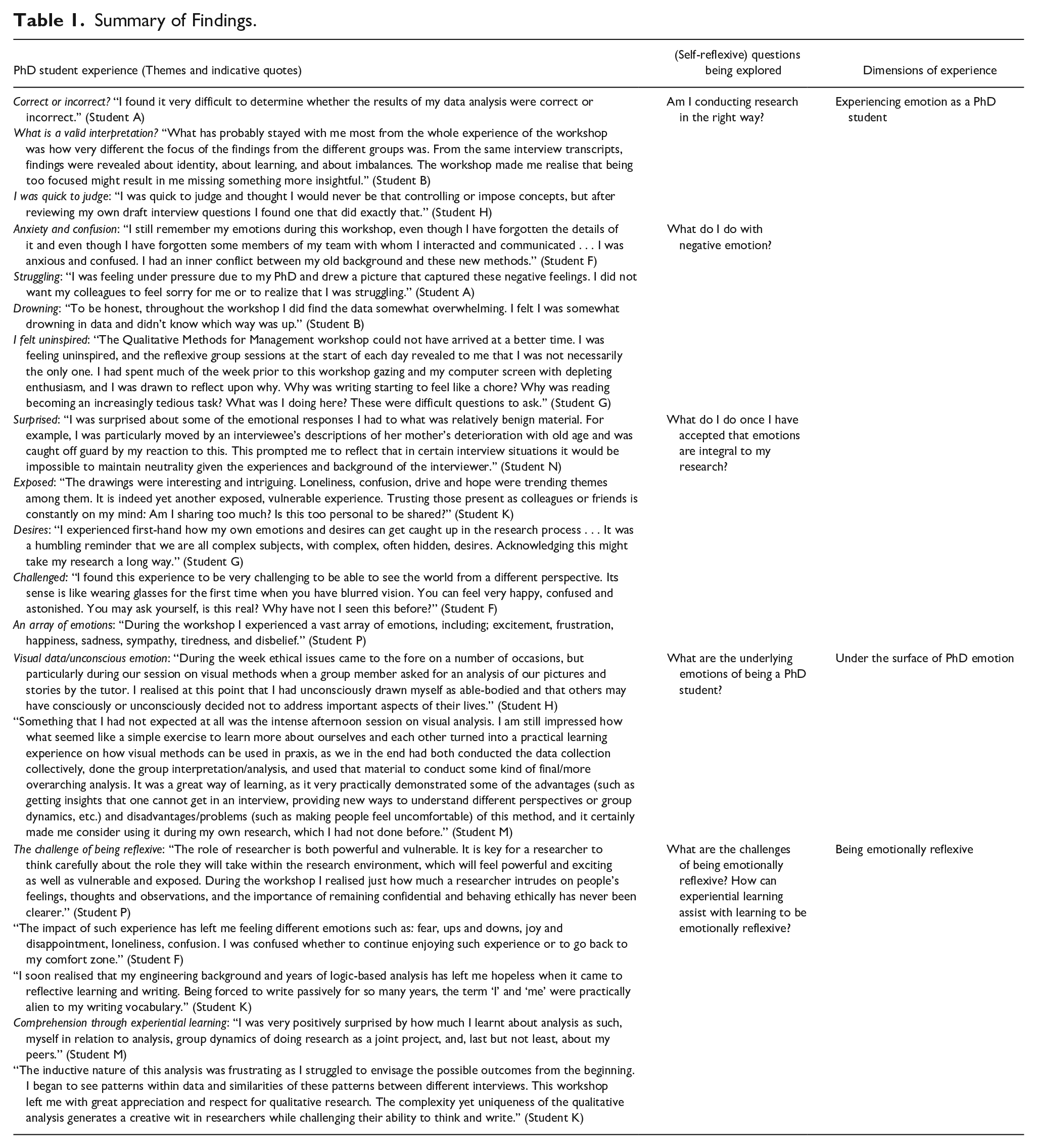
The assignments were analyzed using the same broad, qualitative analysis strategy introduced to students in the introduction to the module. The analysis model is taken from Saldaña’s (2016) “coding manual.” After an initial coding process to get an overall sense of the data, I developed categories to reflect articulations of students’ emotional experience of QMM2. I grouped these thematically and linked them with five self-reflexive questions that I perceived students to be exploring in their reflections into the learning experience. From this, I developed three aggregate dimensions of experience. These are presented in Table 1. To summarize, first, there are a range of emotions associated with key, ongoing questions. These are as follows: Am I conducting research in the right way, what do I do with my negative feelings, and what do I do once I have accepted that emotions are integral to my research? Second, (as it is designed to do) the use of visual data accesses emotions that connect with both internal and relational aspects of peoples’ experience. This provides data on the underlying dynamics of being a PhD student in the organizational context of Business and Management Schools. Third, there are a range of emotions associated with the challenge of being emotionally reflexive about the role of researcher. For example, that emotions are both desired and unwanted at the same time within the role. In addition, I highlight data to address the question of how experiential learning assists with learning to be emotionally reflexive as a researcher.
Summary of Findings.
Discussion and Conclusion
The focus of this article is on connecting with the emotional experience of being a PhD student at a Business or Management School. I use an example from experiential and engaged teaching practice within a doctoral program to reveal a contextually specific understanding of emotional experience. I have analyzed students’ written reflections to identify three themes: the emotional experience of being a PhD student, the under-the-surface emotions that affect being a PhD student, and the challenges of being emotionally reflexive.
Experiencing Emotions in Conducting Qualitative Research
Students are anxious to discover the right way to analyze qualitative data, even though they know that there are many different options for analysis (Reay et al., 2019). In this group, the focus of this feeling was whether or not their interpretation is valid as well as uncertainty about what makes an interpretation valid. The process of working with other PhD students on the same data set brought this issue out and helped the students feel more comfortable with the inevitability and importance of varied interpretations: What has probably stayed with me most from the whole experience of the workshop was how very different the focus of the findings from the different groups was. From the same interview transcripts, findings were revealed about identity, about learning, and about imbalances. The workshop made me realize that being too focused might result in me missing something more insightful. (Student B)
The data provide evidence of a range of negative emotions (being confused, struggling, drowning in data, and feeling uninspired) that make PhD students feel anxious, under pressure, overwhelmed, and de-energized. However, such feelings sat alongside feeling surprised by their emotional response to the interview data, exposed and excited by “sharing too much” (Student K), and challenged by seeing the world differently. They are daunted and energized by research. The role of doctoral researcher and the process of conducting research is a balance of tensions between negative and positive emotions; one that offers an insight that such feelings are integral to qualitative research, not a contradiction or bias to be excluded from it: I experienced first-hand how my own emotions and desires can get caught up in the research process . . . It was a humbling reminder that we are all complex subjects, with complex, often hidden, desires. Acknowledging this might take my research a long way. (Student G)
These interlinked experiences suggest that part of what constitutes an engaged teaching practice for doctoral students is the willingness of faculty to provide opportunities to explore emotional contradictions that are integral to the experience of doing research.
Under the Surface of PhD Emotion
Doctoral students learn that different methods of data collection will produce different types of data. However, the contrast between 5 days of work on a set of interviews and a 3-hour inquiry using visual methods allows them to feel this difference. Visual methods such as projective drawings are used because they are particularly effective at getting under the surface of individual and collective emotions (see Sievers, 2014, for an example of getting under the surface using visual methods). For example, “insight would suddenly hit the person who had made the drawing; showing that she or he had not fully realized what she or he had drawn. One participant realized that during this phase she had depicted herself as naked!” (Jensen et al., 2007, p. 348). A similar realization occurred for a student in the group with a physical disability, who recognized that I had unconsciously drawn myself as able-bodied and that others may have consciously or unconsciously decided not to address important aspects of their lives. (Student H)
Being Emotionally Reflexive
We often encourage doctoral students to be reflexive, but we do not necessarily also explore how such practice might relate to their emotional experience of being a PhD student. To do so reveals some important insights: The role of researcher is both powerful and vulnerable. It is key for a researcher to think carefully about the role they will take within the research environment, which will feel powerful and exciting as well as vulnerable and exposed. During the workshop I realized just how much a researcher intrudes on people’s feelings, thoughts and observations. (Student P)
Psychodynamic experiential learning is an important pedagogic approach for helping students to be emotionally reflexive, because it recognizes that emotions that are common to doctoral students’ experience of their research will be consciously and unconsciously brought into the here and now of the classroom (Clancy & Vince, 2019a). For students’ learning, it is important to exploit the similarity between emotions experienced in the classroom and emotions generated by their research. This provides a continuous, reflexive link between researcher emotions and research practice: I was very positively surprised by how much I learnt about analysis as such, myself in relation to analysis, group dynamics of doing research as a joint project, and, last but not least, about my peers. (Student M)
The students on QMM2 gained insights about the importance of emotions in research. In the final section of this article, I reflect on the impact of these insights in support of engaged teaching practice with doctoral students.
Broader Reflections
What can this contextually specific, single study tell us about our teaching practice with doctoral students? My answer to this begins with an acknowledgement that my inquiry represents one illustration of doctoral education. However, I assume that academics working in Business and Management Schools can associate with my findings, and that these may resonate with their own experiences of teaching methodology to PhD students. On this basis, I hope that my conclusions will be part of a continuing conversation within management learning and education about the emotional experience of being a PhD student as well as the importance of building opportunities to engage with this experience into our methodology teaching.
I have three reflections to share on the importance of this theme for teaching practice with doctoral students. First, I think that a focus on the emotional experience of doctoral students within our courses is not necessarily a comfortable proposition, but it is a necessary one. The acknowledgment of the emotional lives of doctoral students invites engagement with the contradictions of their experience of undertaking a PhD. For example, Student M identified tensions between the advantages (“providing new ways to understand different perspectives”) and disadvantages (“making people feel uncomfortable”) that made her interested to consider using visual methods in her own research. Similarly, once academics have accepted the anxiety involved in promoting such contradictions as an integral aspect of their methodology teaching, then they can be used in the service of doctoral education. In my experience, doctoral research mobilizes strong feelings of both excitement and anxiety, and these emotions are acted out in a variety of ways.
Second, much is happening underneath the surface of doctoral students’ lives. Working toward a PhD is a significant intervention into personal lives, affecting friends, families, peers, and colleagues. While the individual researcher might feel that their work is “a solitary process” (Student C), they also know that the ripples of the work needed to produce a PhD are likely to touch many personal and interpersonal issues. It is quite natural and sensible that students defend themselves against the vulnerabilities that such feelings generate. However, these feelings are integral to the role of researcher and the depth of insight that can be generated from data (see Clancy & Vince, 2019b, for an example). Finally, engaging with emotional experience creates knowledge about emotional reflexivity within doctoral research, raising the possibility, for example, that students might write their doctoral thesis “differently” (Weatherall, 2019) or that methods might emerge that deliberately engage with researchers’ unconscious projections onto respondents (Gilmore & Kenny, 2015). Such approaches deepen and add to the opportunities we have to develop new methods for qualitative research into the complexities of lived experience in business and management.
My reflections have implications in relation to future research practice and doctoral students’ learning. I believe that it is important for business and management school academics to move beyond the idea that emotions in research are intrusive (Harlos et al., 2003) or that researchers need to learn to “cope with the degree of detachment” (Saunders et al., 2015, p. 209) to manage feelings of becoming overwhelmed by large amounts of data. Emotions are integral to our experience and practice as qualitative researchers, and our methodological training needs to help doctoral students (and other early career academics) to be attached to the insights that are available through emotional self-reflexivity within a researcher role (Clancy & Vince, 2019b). Through our methodology teaching, we can support doctoral students’ understanding that a researcher must not only notice the emotional impact of participation in a research encounter but also be able to reflect on the emotional experience evoked by it (Hollway, 2016; Vince, 1995).
Supplemental Material
sj-docx-1-jme-10.1177_1052562920910170 – Supplemental material for Experiencing Emotion in Conducting Qualitative Research as a PhD Student
Supplemental material, sj-docx-1-jme-10.1177_1052562920910170 for Experiencing Emotion in Conducting Qualitative Research as a PhD Student by Russ Vince in Journal of Management Education
Footnotes
Declaration of Conflicting Interests
The author declared no potential conflicts of interest with respect to the research, authorship, and/or publication of this article.
Funding
The author received no financial support for the research, authorship, and/or publication of this article.

Supplemental Material
Supplemental material for this article is available online.
References
Supplementary Material
Please find the following supplemental material available below.
For Open Access articles published under a Creative Commons License, all supplemental material carries the same license as the article it is associated with.
For non-Open Access articles published, all supplemental material carries a non-exclusive license, and permission requests for re-use of supplemental material or any part of supplemental material shall be sent directly to the copyright owner as specified in the copyright notice associated with the article.
