




Abstract
This article proposes a framework for reflexive choice in qualitative research, centering on social interaction. Interaction, fundamental to social and organizational life, has been studied extensively. Yet, researchers can get lost in the plethora of methodological tools, hampering reflexive choice. Our proposed framework consists of four dimensions of interaction (content, communication patterns, emotions, and roles), intersecting with five levels of analysis (individual, dyadic, group, organizational, and sociocultural), as well as three overarching analytic principles (following the dynamic, consequential, and contextual nature of interaction). For each intersection between dimension and level, we specify analytical questions, empirical markers, and references to exemplary works. The framework functions both as a compass, indicating potential directions for research design and data collection methods, and as a roadmap, illuminating pathways at the analysis stage. Our contributions are twofold: First, our framework fleshes out the broad spectrum of available methods for analyzing interaction, providing pragmatic tools for the researcher to reflexively choose from. Second, we highlight the broader relevance of maps, such as our own, for enhancing reflexive methodological choices.
Interactions are the building blocks of society (Luckmann, 2008). It is through interaction that the self emerges (Bucholtz & Hall, 2005), power relations are formed and maintained (Hehenberger et al., 2019), ideology is constructed (Barley, 2017), and organizing is carried out (Kalou & Sadler-Smith, 2015). Methodologically, interactions can be used to decipher a wide variety of organizational phenomena—from meaning construction (Hallett & Ventresca, 2006), through emotional dynamics (Godbold, 2015), identity (Ybema et al. 2016), power and control (Kunda, 2006), resistance (Gagnon & Collinson, 2017), leadership (Crevani et al., 2010), knowledge creation (Tsoukas, 2009), and strategy (Jarzabkowski et al., 2019), to the formation, emergence, and change of organizational practices and social structures (Barley, 2017). In qualitative organizational research, interaction is everywhere: Interviews draw on interviewer–interviewee relationships (Spradley, 2016), and observations track interaction in everyday organizational life (Locke, 2011), as well as in formal and informal meetings (Schwartzman, 1989) and conferences (Mair & Hehenberger, 2014). Recently, video methods have gained increasing recognition in organizational literature precisely because of their contribution to the collection of interactional material—allowing a close and detailed inspection of the actions, words, and environments in which interaction occurs, opening a door for multiple analytic pathways (Heath & Luff, 2018; LeBaron et al., 2018).
The methodological literature recognizes the importance and complexity of interaction, with its multiple facets and diverse social contexts—both proximate (the here and now of the interaction) and distal (societal influences) (e.g., Hallett & Ventresca, 2006). Accordingly, multiple analytic traditions have been introduced over the years to assist in its analysis (e.g., Conversation Analysis, Symbolic Interaction, Interactional Sociolinguistics, and System Psychodynamic Theory).
Nevertheless, interaction is often glossed over in empirical papers. When interaction is attended to, it is often through its content dimension alone, highlighting primarily the function of meaning in the interaction (Christianson, 2018; Leibel et al., 2018). The abundance of methods, spread across the different methodological literatures, and relatively scant attendance to the analytic connections between them, make it difficult to consider and reflexively choose one's interpretive path. The challenge of reflexive choice was recently accentuated within qualitative research more broadly (Howard-Grenville et al., 2021), highlighting scholars’ need to navigate among multiple options. In the absence of “objective” standards guiding researchers’ choice, reflexive choice is viewed as an indicator of quality (Harley & Cornelissen, 2022; Zilber & Meyer, 2022).
To facilitate researchers’ ability to explore beyond their taken-for-granted methodological approaches and make pragmatic and reflexive choices among alternatives (Alvesson, 2003) for studying interaction, we constructed a framework from the bottom up: First we identified what researchers actually did when deciphering specific social interactions, and then we moved to categorize these analytic steps into dimensions and levels. The framework that emerged consists of four dimensions of interaction: content, communication patterns, emotions, and roles; five levels of analysis: individual, dyadic, group, organizational, and sociocultural; as well as three overarching principles of analysis, sensitizing scholars to the dynamic, consequential, and multimodal-contextual nature of interaction. The framework cross-tabulates the dimensions and levels, creating a matrix of 20 cells. For each cell, representing the intersection of one dimension and level, we offer relevant analytical questions and empirical markers, along with references to exemplary methodological or empirical studies.
The contribution of our framework is twofold. First, it contributes to the methodological literature on analyzing social interaction by offering a detailed mapping of the various analytic routes, and a pragmatic way to reflexively navigate between them. In so doing, the framework enhances awareness of taken-for-granted applied methods and choice among the options, facilitating coherence with the research questions, research design, and data collection methods. Second, it contributes to the evolving debate around reflexive choice in qualitative research, highlighting analytic maps as relevant means to advance the use of methodological tools, particularly in areas where much has been written and different approaches prevail.
We commence by reviewing previous methodological works on analyzing interaction, building the case for why a further mapping of this terrain is needed, and situating our project within current concerns about reflexive choice in qualitative research. Next, we elaborate on the method we employed to construct the framework, and on the framework itself. We then describe and illustrate its usage via a vignette taken from a managers’ meeting. We conclude with a discussion of how our framework assists reflexive choices in the analysis of interaction, marking its contribution.
Social Interaction and Its Study
Social interaction, the exchange between two or more individuals, is as challenging to study as it is ubiquitous. First, interaction is multifaceted. It is analytically irreducible to mental states, narratives, practices, materials, power dynamics, or the like (e.g., Blumer, 1969; Garfinkel, 1967; Kalou & Sadler-Smith, 2015; Sawyer, 2003). Second, interaction is multilayered, embedded within and emerging from manifold contexts (Hallett & Ventresca, 2006). It is a sociocultural site of society and organizations, yet it is also “furnished internally with its own constitutive sense” (Wetherell, 1998, p. 392). It is influenced by individual patterns, dyadic relationships, and the give-and-take between interactants, all inextricably tied to time and space (e.g., Kalou & Sadler-Smith, 2015; Sawyer, 2003). Third, interaction is simultaneously enduring and in constant flux (Goffman, 1981; Collins, 2004). It is an emerging phenomenon, changing from moment to moment and never fully predictable (Weick, 2004). Yet, it is governed by taken-for-granted rules that synchronize the ways people act toward one another (Bion, 1961; Fine & Hallett, 2014; Goffman, 1981), and is shaped by specific actors to achieve certain goals, common or contested, through others (Fleming & Spicer, 2014). It involves compliance with, but also the violation of, covert rules, and constant improvisation by participants (Luckmann, 2008; Sawyer, 2003) as they “get out of breath, sweat and stumble and […] step on one another's toes” (Luckmann, 2008, p. 279).
Various analytical foci for analyzing interaction have been suggested over the years in long-standing philosophical and methodological traditions, yielding many exciting works by qualitative scholars. In the following section we follow Kalou and Sadler-Smith (2015), LeBaron et al. (2018), and Spradley (1980), briefly outlining the suggestions made across traditions according to their analytic focus: sequence, topics, language, actions, the body, materiality, and setting. 1
Sequence
Alertness to the sequence means following how people respond to one another, capturing the emergence and co-creation of interaction from turn to turn (Have, 2007; Sawyer, 2003). The concept of sequence is primarily linked to the Conversation Analysis tradition (Jefferson et al., 1987; Sacks, 1992; Sacks et al., 1974), positing that actions attain their meaning once an act has occurred and received a response (Sawyer, 2003). Consequently, analysis extends beyond examining isolated utterances, to understanding how they unfold from turn to turn. For example, if one side asks a question, conversation analysts would follow the responses of the other side. Accordingly, individual behavior may be understood by asking: “why that now?” (Schegloff, 1996, pp. 111, 112). The analysis of sequence was also picked up by other traditions. For example, Symbolic Interaction (Blumer, 1969; Goffman, 1959; 1974) also sees meaning production as a joint activity, constructed through speakers’ choices and their counterparts’ reactions (Goffman, 1981).
Analyzing sequence in interaction has yielded many insights about organizing. For example, studying the conditions for developing long-lasting relationships between entrepreneurs and mentors, Van Werven et al. (2023) followed interactions between early-stage entrepreneurs and feedback providers. Following adjacent utterances and acts (e.g., noticing whether feedback was elicited by the entrepreneur, or how the feedback provider responded), they demonstrated that the feedback sequences shape the intention of both parties to meet again.
Topics
The issues discussed during interaction are analyzed across nearly all methodological traditions. Some streams, such as Discourse Analysis, explore how local topics introduced in interaction unveil broader social constructions (Alvesson & Kerreman, 2000; Wetherell, 1998). Other streams, such as Symbolic Interactionism and Conversation Analysis, focus on the topics invoked during the immediate interaction context. For example, Ybema, Thomas and Hardy (2016) center on the issues being raised and silenced by participants during an organizational change workshop, demonstrating how members use self/other talk to construct their identities.
Language
As language is readily accessible for empirical investigation (Alvesson & Karreman, 2000), it has been a central focus in analyzing interaction across various traditions, each accentuating specific linguistic aspects. Discourse Analysis prompts researchers to explore language patterns, such as specific words that reflect societal-level texts (e.g., Jakob Sadeh & Zilber, 2019). In contrast, Symbolic Interactionism focuses on how language reflects the immediate interaction and the subjective meanings that emerge. Through language, symbolic interactionists track “frames” (Goffman, 1974)—the schemas guiding individuals’ understandings and behavior, and “framing moves” (Abolafia, 2004), such as casting doubt, countering, and questioning benefits; social labeling (e.g., when interactants refer to a person as a leader) (DeRue & Ashford, 2010; Pierce, 1995).
Ethnographic and linguistic approaches—Interactional Sociolinguistics, Linguistic Ethnography, and the Ethnography of Communication (Gumperz, 1999; Hymes, 1974; Kalou & Sadler-Smith, 2015; Rampton, 2017)—all follow micro-analytical linguistic signals through which tacit messages are conveyed in interaction. Each tradition focuses on specific empirical markers, such as rhetorical questions, metaphoric language; lexical signs and “contextualization cues” such as accent, or “code-switching” (e.g., shifting between formal and casual language).
The Systems Psychodynamic Approach also relates to the language-focused study of interaction (Petriglieri & Petriglieri, 2020). Unraveling unconscious processes, it involves the examination of “the language of the unsayable” (Rogers et al., 1999)—tracing silences, repetitious denials, slips of the tongue, and words as symbols of hidden emotions. For example, Triest (1999) lingers on the word “fall,” as he closely observes interaction during a “role analysis” workshop—where managers examine their organizational roles through their past and present relationships. He interprets the word “fall,” mentioned twice as a glass cup nearly tumbles and participants manage to catch it, as reflecting the (annihilation) threat felt by the highly ranked managers. By interpretating the symbolic meanings of language, he contributes to the leadership learning and development scholarship.
Actions
Alongside language, action 2 is also central to interaction (LeBaron et al., 2018), and has been examined across various traditions (e.g., Hymes, 1974; Kunda, 2006). The practice-based approach is the most notable of these (Feldman & Orlikowski, 2011; Schatzki, 2001), following what people actually do: how the micro-activities that people engage in during their everyday work “iteratively shape and are shaped by the social ordering of organizations” (Jarzabkowski et al., 2019, p. 7). For example, to understand how frontline workers realize their organization's strategy, Balogun et al. (2015) trace different activities performed by museum guides and their audiences and show their relation to the museum's strategy. For instance, by posing questions to visitors, the guides realize the museum's strategy of engaging with various audiences.
The Body
The focus on the body in interaction involves the analysis of gestures, facial expressions, body movement, and vocalizations (Mauss, 1973), and is associated with different methodological approaches. Conversation analysts, drawing on Ethnomethodology (Garfinkel, 1991), stress the physical aspect of speech and action, such as emphasis, speed of delivery, and volume. Gestures Studies (Clarke et al., 2021; Congdon et al., 2018) focus on gestures as the reflection of individuals’ inner thoughts (Kendon, 2017), as well as carrying communicative functions (Clarke et al., 2021).
The emphasis on the body has grown with the development of the embodiment literature, which recognizes that “organizations are not solely based on symbolic interaction but are also fundamentally based on the use of bodies as facta bruta, as tangible organizational resources” (Styhre, 2004, p. 101). For example, Wetherell (2013) spotlights how bodies are assembled in space during a suburban Anzac Day Commemoration in New Zealand. She notices the several hundreds of people assembled in the car park at the beginning, the crowd following a marching band, the veterans lining up in front of a memorial wall, then standing to attention, saluting, and finally placing their spring of rosemary on the bench in front. Her emphasis on the bodily presence, emerging through the collective, allows her to unravel the unbidden and controlled qualities of emotion. In Wetherell's description, the analysis of bodies involved cars, musical instruments, and the memorial wall. Indeed, analysis of the body in interaction often involves material objects.
Materiality
Similarly to actions and the body, the approaches to analyzing interaction have, for the most part, not placed materiality—artifacts, physical setting, and material practices (Baldessarelli et al., 2020)—as a primary analytic focus. Yet, following the multimodal turn, empirical examples highlight the vital role played by material aspects in interactions within organizations. For example, Cornelissen et al. (2014) studied the material objects that police officers had at their disposal (e.g., guns, hollow point bullets, video and film equipment, a picture of a suspect) leading up to the Stockwell Shooting. They demonstrated how these materials, coupled with an emotional contagion process and communication practices that discouraged questioning agreed-upon courses of action, shaped the sensemaking that resulted in the shooting.
Setting
The setting concerns the time, space, and other circumstances in which the interaction takes place, often embedded within cultural understandings that grant shared meaning to the occurrences. Symbolic Interaction highlights front and backstage arenas (Goffman, 1959; Shortt, 2015), the “frontstage” being where social or organizational expectations are assumed to be present and the “backstage” often being liberated from these sorts of pressures (Goffman, 1959). The location, the goals of the event, the people present, and physical appearances determine whether a particular setting will be understood as front/backstage (e.g., Kunda, 2006). Interactional Sociolinguistics (Gumperz, 1999) highlights “speech events,” bound in time and space such as religious ceremonies or staff meetings, viewing them as illuminating for both the local and the social.
Other traditions direct our analytic focus to particular aspects of the setting. For example, Ethnography of Communication stresses the participants (active or absent) involved and their goals; the type of event under study, including its cultural definition (e.g., lecture, tale, and commercial) (e.g., Keating, 2001) and purposes (Hymes, 1974; Saville-Troike, 2003); the medium by which messages are conveyed (e.g., oral, written, and electronic); and the arrangement of communication. Dacin, Munir and Tracey (2010) analyzed interactions that took place during a formal dining event at Cambridge University. Tracing the ways in which the dining room was used during the ceremony, the authors note, for instance, that university fellows and students were not allowed to eat at the same tables. They interpret this orchestrated setting as contributing to the maintenance of the British class system, and use this example to show, more generally, how rituals contribute to institutional maintenance.
While interaction can be deconstructed into elements such as sequence, topics, language, actions, the body, materiality, and setting, nearly all of the mentioned traditions and studies combine the various analytic foci in some way (e.g., Cornelissen et al., 2014; Kalou & Sadler-Smith, 2015; Wetherell, 2013). Nevertheless, the complexity inherent to interaction begs a suitably sophisticated methodological approach. Interaction is influenced by multiple contexts simultaneously, including individuals’ patterns, dyadic relationships, the unfolding group dynamic, and the organizations and societies in which it is immersed. Interaction also manifests through many nuanced markers that were explored in various traditions and studies, yet were not necessarily included in reviews of interaction analysis. To make mindful choices regarding their analytic pathway, researchers may benefit from a framework that brings together different options for analysis and provides pragmatic means to consider and choose between them. This challenge is particularly relevant in the context of the now-vibrant conversation about reflexive choices in qualitative research.
Reflexive Choices in Qualitative Research
Qualitative studies engage with intricate social phenomena. Typically, they encompass a variety of field materials, which may be approached through multiple theoretical questions and analytical pathways (DeCelles et al., 2021). Moreover, qualitative research is often a spiral process (Auriacombe & Schurink, 2012), in which researchers move back and forth between the data and relevant literatures. Thus, the theoretical approach and contributions may change along the way, as directed by the data. Every step of this process, full of discovery and surprise (Locke, 2011), entails many choices. Further, leaning on a constructionist epistemology (Amis & Silk, 2008), “there are no ‘right’ choices, and each methodological option opens a space of possibilities and limits others” (Zilber & Meyer, 2022, p. 2). The choices researchers make may be directed by the empirical phenomenon, alongside researchers’ pre-understandings and interests (Alvesson & Sandberg, 2022).
Reflexivity is seen as essential in guiding these choices. Qualitative researchers are expected “to be reflective on the choices they have made in designing and conducting their research, and explicit about how these choices show up in their data collection and analysis, as well as how these relate to the research question(s) pursued” (Howard-Grenville et al., 2021, p. 1315). Similarly, quality in qualitative research has been linked to reflexive choices (Harley & Cornelissen, 2022).
Reflexivity involves “opening up the phenomena through exploring more than one set of meanings and acknowledging ambiguity in the phenomena and the line(s) of inquiry favored” (Alvesson, 2003, p. 14). It is through reflexivity that we can bring to the fore our tendencies and pre-understandings, allowing us to acknowledge them, question them (Mees-Buss et al., 2022), and make them transparent to readers (DeCelles et al., 2021; Harley & Cornelissen, 2022), or make use of them as we enrich and develop our investigations (Alvesson & Sandberg, 2022; Alvesson, 2003). Reflexivity at each step of the research process is also connected to the ability to “transcend and engage with difference—in that different knowledge, ideas, speculations, feelings and theories” (Osmond & Darlington, 2005, p. 3), extending our horizons (Mees-Buss et al., 2022). Furthermore, reflexive choices enable researchers to ensure internal coherence between research question(s), data collection and analysis, and theory development, and to make sure there is a fit between all these and “the broader assumptions underpinning the research” (Howard-Grenville et al., 2021, p. 1313).
To enhance reflexive choices, the literature on qualitative research directs us in several ways. Dialogue with other people may help open our minds to our taken-for-granted pre-understandings and choices, and to consider alternatives (Gadamer 1960/1994, in Alvesson & Sandberg, 2022). Self-reflection, often facilitated by asking and answering questions, provokes reflexive choices as well (e.g., Brownhill, 2021). Finally, reflexive choices require both reflexivity and pragmatism recognizing that not all avenues are equality productive (Alvesson, 2003).
We join attempts to enhance reflexive choice in qualitative research, by mapping the various pathways for analyzing social interaction and arranging them in analytical relation to each other.
Method: The Development of the Framework
The development of our framework stemmed initially from the pressing need of the first two authors during their doctoral studies, to analyze interactional episodes documented in their ethnographic data. Both experienced the difficulty of delving into the vast and complex methodological traditions for analyzing interaction, each tradition associated with a distinct theoretical agenda that was not necessarily relevant for their own research. Initially, both also felt that despite the wealth of perspectives and suggestions, the actual analytic tools available to them were not sufficient. This motivated us to embark upon a systematic exploration of the diverse methodological alternatives.
The exploration consisted of three broad stages: (1) literature search for papers discussing the analysis of social interaction; (2) analysis of these papers; and (3) construction of the framework. While presenting these three stages as analytically distinct, in practice we shifted back and forth between them in crafting our framework.
Literature Search
Using ABI/INFORM Complete, we looked for titles, abstracts, and keywords that included one of the following keywords: “group interaction”; “social interaction”; “interaction analysis”; “conversation analysis” 3 ; or “group process”; along with: “methodological” or “methods.” From this search we initially collected only methodological papers discussing interactions. Later, based on citations in the methodological papers, we also traced empirical papers.
As we worked on the construction of our framework (stage 3), we realized that we did not have sufficient empirical markers concerning the second-order categories of emotions and roles that had emerged. This was due to the overwhelming focus in both the methodological and empirical writings on linguistics, content, and form of communication. We therefore returned to the searching phase (stage 1), this time looking for methodological articles and book chapters focusing on the analysis of emotion and roles in Organization and Management Studies.
Our search for papers came to an end as we felt that we had reached saturation—when methods repeated themselves and no new insights were obtained (Strauss & Corbin, 1998). Overall, our framework is built on the careful analysis of 157 articles, books, and book chapters that offered relevant methodological tools for analyzing interaction.
Analysis of Articles and Book Chapters
Our analysis, conducted in parallel with the literature search, comprised two steps: coding—wherein we generated a list of empirical markers; and categorizing—through which we came to define the dimensions of interaction and analytic principles.
We began our analysis by systematically identifying and characterizing the analytic steps presented in the papers. To do this, we generated codes from each of the empirical markers discussed in the papers (e.g., laughter, use of metaphors, and material objects), and the analytic procedures used (e.g., turn-taking analysis, content analysis). For methodological papers and methods’ sections, this was straightforward. To extract empirical markers and methodological procedures from the findings’ sections of empirical papers, we interpreted what scholars looked at and how they reached their interpretation. For example, in analyzing a classroom discussion, Lefstein and Snell (2011, p. 53) stated: “the students address their comments to her (the teacher, Ms. Leigh), speaking of Harry in the third person and orienting their posture and gaze toward Ms. Leigh.” We coded these findings as nonverbal forms of interaction, including gaze and body postures; and form of address (use of third person).
After generating these first-order codes, we combined them into higher, second-order interpretive categories (Strauss & Corbin, 1998): grouping together codes that seemed to relate to the same, analytically discrete, dimension of interaction. We recursively moved between first-order categories and the emerging broader second-order themes, until we felt that we had reached an adequate level of coherence within the second-order categories. For instance, we noted that some studies focused on the issues that were discussed by interactants. Other studies identified their procedures as “content analysis,” “discourse analysis,” or “narrative analysis.” All of these relate to topics and meaning formation, and therefore we grouped and categorized them as “content.”
During this stage, we noticed that three of the emerging second-order categories (emotional expressions, division of roles, and power relations) drew on the same empirical markers as other second-order categories (content, communication patterns, or linguistics). Nonetheless, these empirical markers contained distinct information related to emotions, roles, and power. For example, the empirical markers of “emotionally charged vocabularies” (e.g., hate, sadness, and love) or “boundary setting strategies” (e.g., othering and distancing/embracing) draw on markers related to linguistics and communication patterns but contain information pertaining to more specific categories—emotions, in the former case, and power relations and roles, in the latter. We decided to preserve these second-order categories as distinct, rather than converging them with “content,” “communication patterns,” and “linguistics,” to create a framework that broadens the scope of interpretation and includes distinct sociological and psychological aspects of interaction. Therefore, at this stage, we defined six dimensions: content, communication patterns, emotion, roles, linguistics, and power relations.
Simultaneously, as we examined the texts and the dimensions that emerged, we noted that they related to different levels of analysis, which are also discussed in the literature on interaction (e.g., Kalou & Sadler-Smith, 2015; Rampton, 2017; Wells, 1995). We initially identified six levels of analysis: individual, dyad, intergroup, group as a whole, organizational, and sociocultural, the latter referring to all extra-organizational aspects including the field, profession, nationality, etc.
Constructing the Framework
In the third stage, we organized the dimensions and levels into a matrix, classifying the previously identified empirical markers according to the different cells, representing the intersection between different dimensions and levels. We then reexamined each cell, constructing analytical questions that both accurately capture the corresponding empirical markers in the cell, and are congruent with the respective dimension and level of analysis of the cell. For example: analytical questions under “content” use what, while those under “communication patterns” mostly use how. Additionally, we went back to the various papers analyzed in stage 2 to identify relevant exemplary work for each of the questions that appear in the table. Throughout this development phase, the ongoing discussion between the authors helped in refining the framework.
As we situated our dimensions and levels in the matrix, placing empirical markers and analytical questions in each cell, we noticed that two dimensions—linguistics and power—overlapped with other dimensions, creating redundancy.
Linguistics, highlighting language resources (e.g., the choice of particular words, metaphors, and pronouns) as the building blocks of social communication (Davies & Harre, 1990), overlapped with each of the other dimensions. We identified words—the basic unit of meaning production—as markers of our “content” category; formal and informal language as indicators of “communication patterns”; the articulation of “emotion words” as indicators of “emotion”; and linguistic articulations that position the speakers, as indicators of “roles.” We therefore chose to view linguistic analysis as an overarching interpretive tool, making sure its empirical markers are included in our framework, yet without labeling it as a distinct dimension.
We also noticed that the analytical questions and empirical markers relating to power relations largely overlapped with those relating to emotions and roles, the latter indicating critical thinking about issues of power and control. For instance, the analytical question, “How do participants respond to one another's positioning?” (roles), reflects a critical view of power relations between central and peripheral positionings of individuals. Similarly, the question, “How are social identities enacted in the emotional dynamics?” (emotion), reflects a consideration of the possible influence of power asymmetry between social identities on the emotional aspect of the interaction. We thus decided to eliminate power relations as a distinct analytical dimension. Ultimately, we defined four dimensions of interaction: content, communication patterns, emotion, and roles.
In a similar process, we experimented with the various analytical levels, looking at their intersections with the emerging dimensions and examining the relevant markers for each intersection. Since the intergroup level largely overlapped with the group level, we ultimately defined five distinctive levels: individual, dyadic, group, organizational, and sociocultural.
While constructing our framework, we also noticed that some codes, both empirical markers and analytical procedures, which we had identified in the first analytic stage, did not have a place in a particular cell or cells in the matrix. These codes either applied to the whole matrix (e.g., following how interaction evolves from moment to moment), or remained constant as we moved from one level of analysis to the next (e.g., the examination of elements of time, of material objects). We grouped these into three guiding principles that go beyond the specific dimensions and levels, including: procedures for capturing the dynamic nature of interaction; tracing their consequences; and appreciating their multimodal contexts (e.g., the design of space and material artifacts).
An Analytic Framework for Deciphering Interaction
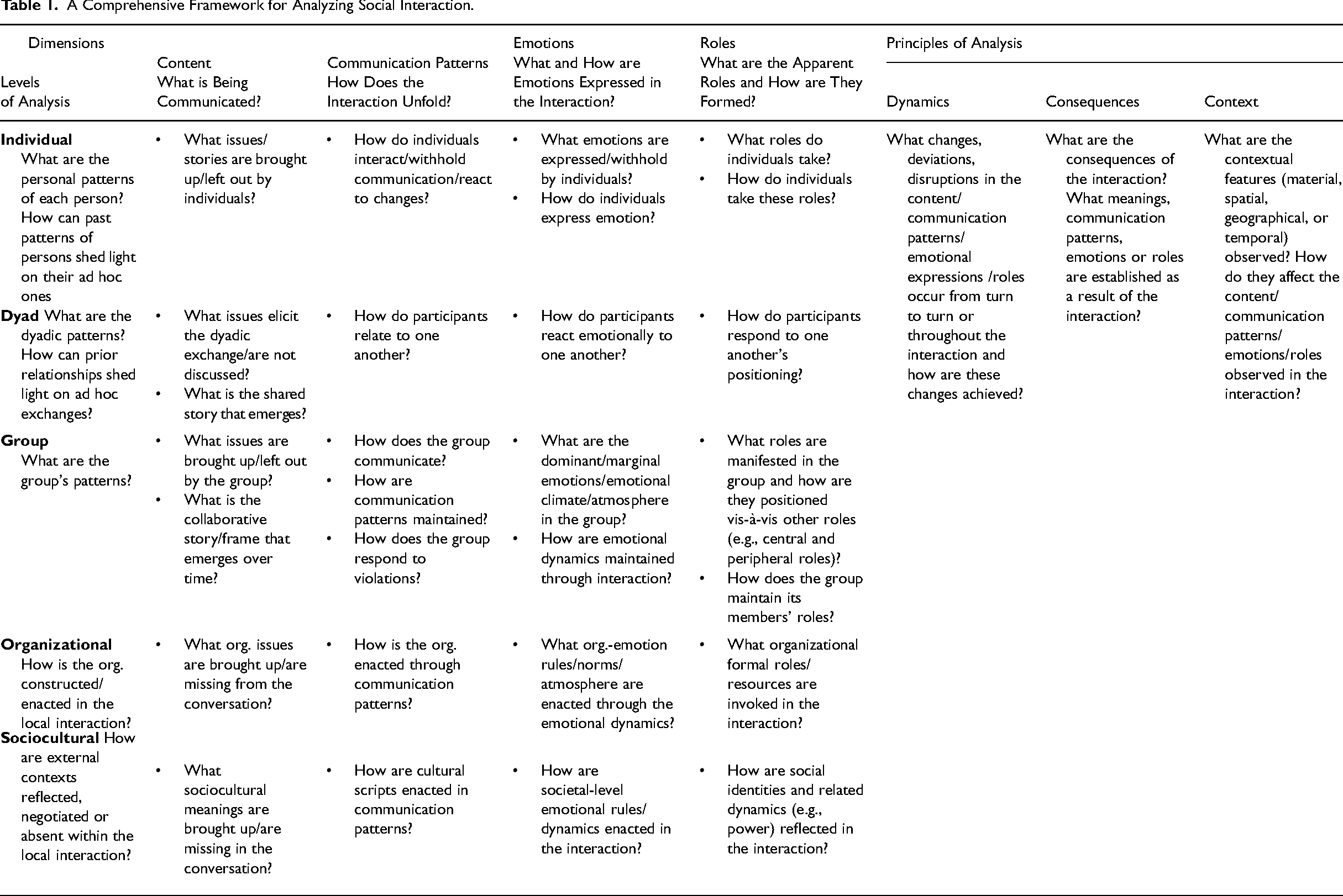
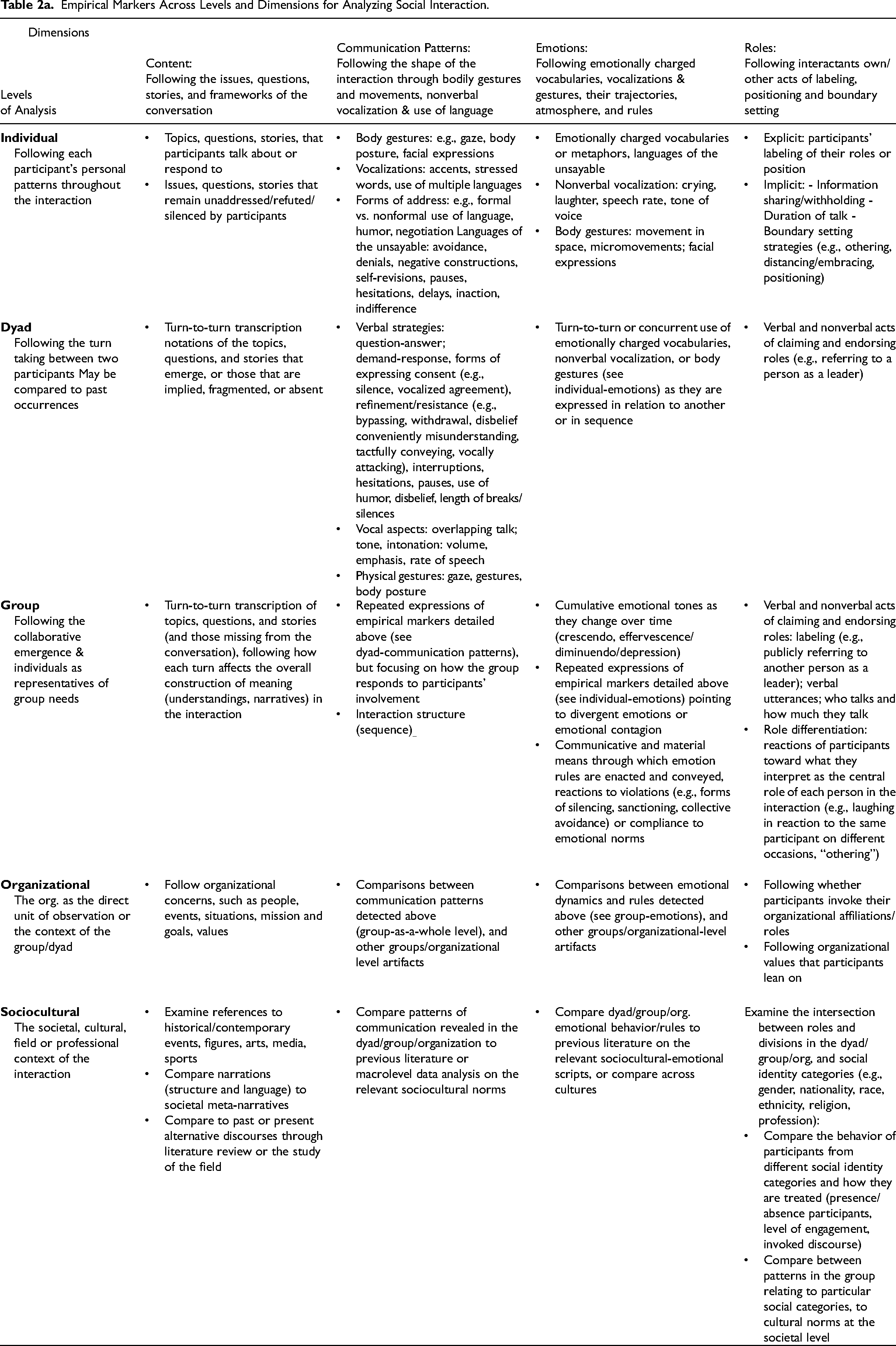
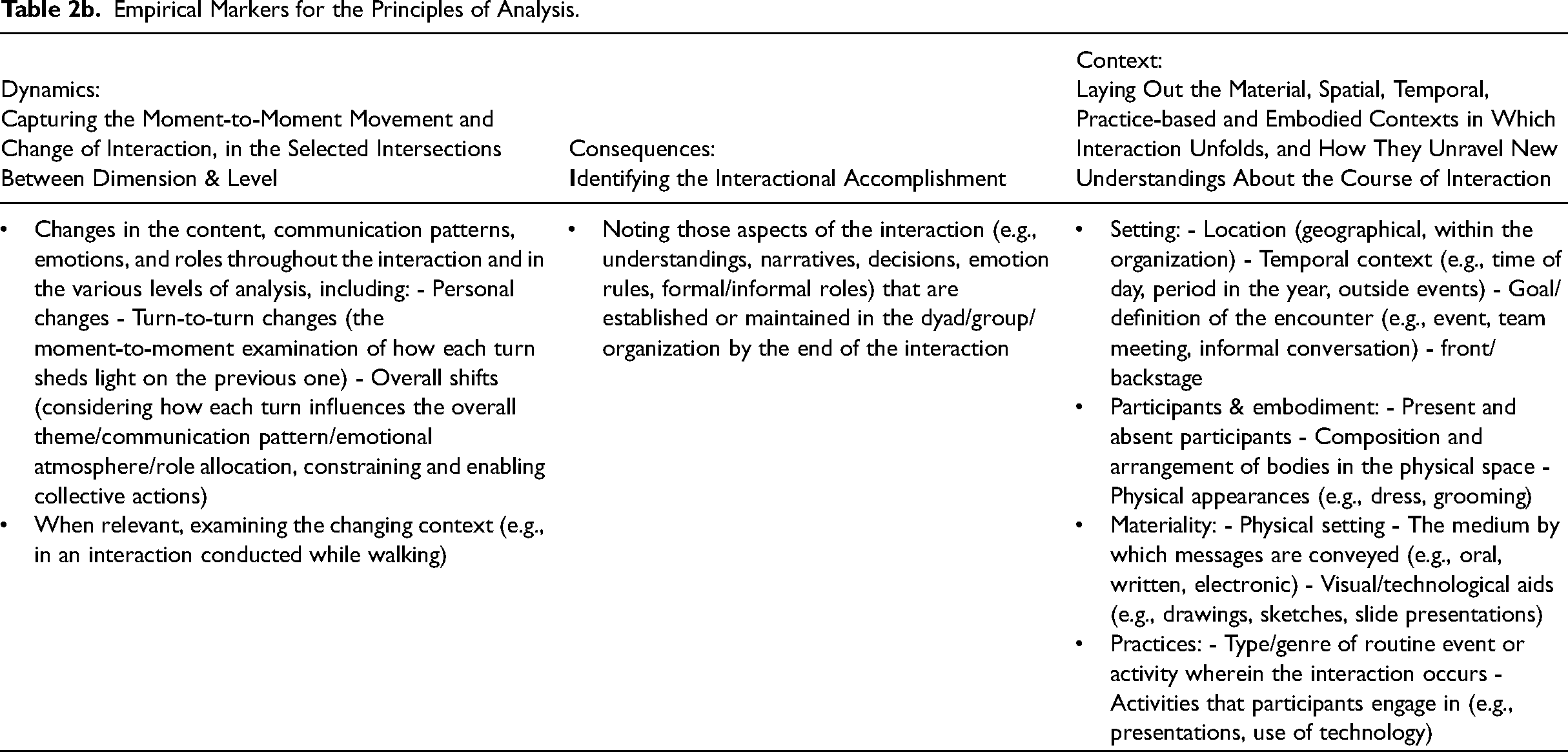
To analyze interaction, we introduce a framework which cross-tabulates five levels of analysis: individual, dyadic, group, organizational, and sociocultural; with four dimensions of interactions: content, communication patterns, emotion, and roles. Each of the twenty cells in the matrix represents a specific intersection between one dimension and one analytical level. The framework also applies three overarching principles to the entire matrix: following the dynamic nature of interaction; attending to its consequences; and examining its multimodal contexts. For each intersection of dimension and level, and for each overarching principles, we detail a set of analytical questions (see Table 1), relevant empirical markers (see Table 2a and 2b), and references to exemplary empirical or methodological articles (see Table 3). The framework is primarily intended for data gathered through direct observation, which has the potential to capture the multiple nuances unfolding from moment to moment. Yet, researchers often uncover stories of social interaction through interviews, or during informal conversations as part of organizational ethnographies. In these instances, and especially when different informants pertain to the same interaction episode, our framework may also apply.
A Comprehensive Framework for Analyzing Social Interaction.
Empirical Markers Across Levels and Dimensions for Analyzing Social Interaction.
Empirical Markers for the Principles of Analysis.
Exemplary References Across Levels, Dimensions, and Principles for Analyzing Interaction.*
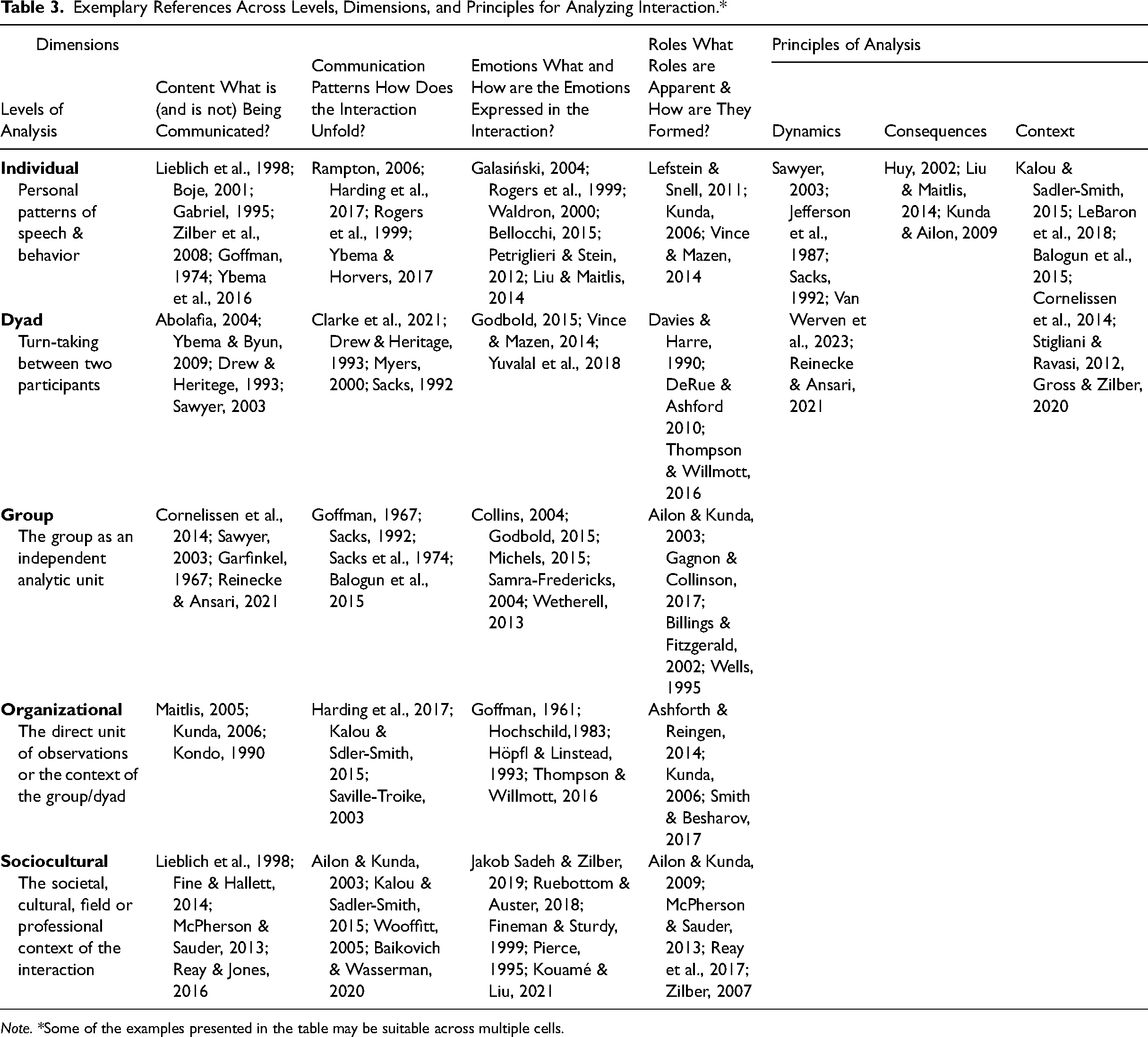
Note. *Some of the examples presented in the table may be suitable across multiple cells.
Interaction at Various Social Levels
Interaction is grounded in a variety of simultaneously occurring contexts, providing diverse explanations for what is going on. As we analyze these contexts from the prism of the researcher, we refer to these as “levels of analysis.”
The individual level refers to participants’ personal patterns of speech and behavior in the interaction, and possibly in other contexts and times. Focusing on the individual level, scholars can follow the same individual across interactional contexts to reveal patterns relevant to their research question. This individual-level analysis may also shed light on the influence of participants’ personal attributes and tendencies on the ad-hoc interaction when focusing on other analytical levels.
The dyadic level analysis centers on the interaction between two people. The dyad may constitute the entire interaction (e.g., meeting between two people) or may be part of a larger group or organizational encounter (e.g., a team meeting). Whereas individual level analysis follows each individual's input separately, at the dyadic level we follow the evolution of interaction from turn to turn. If the dyad takes part in a group or organizational interaction, we examine how interpersonal relationships—whether formed ad hoc or carried forward from the history of the dyad—affect the larger emerging interaction.
The group level focuses on the group as an independent analytic unit (Bion, 1961; Wells, 1995). We follow the ways in which overarching themes emerge through moment-to-moment interaction (Sawyer, 2003), observing how each turn affects the overall themes and shared patterns of the group's interaction. We also interpret individual voices and acts as reflecting group themes (Ashforth & Reingen, 2014). The group may constitute the immediate situated interactive context (e.g., team meeting) or serve as a wider context for a dyadic exchange.
The organizational level may be the direct unit of analysis (e.g., an organizational event), in which case we follow how organizing shapes and is shaped through interaction. It may also constitute the wider context in which a group or dyadic interaction takes place. In this case we analyze how the organization is reflected or challenged in the group or dyadic interaction.
The sociocultural level concerns the broad context of the interaction, such as organizational fields, professions, communities, societies, and local or global cultures. Assuming that interaction is entrenched within these multiple, at times contradicting, social orders (Friedland & Alford, 1991), we follow interactants as they may accept, resist, negotiate, or alter the various discourses, cultural scripts, and social identities embedded within these diverse macrolevel contexts.
The organizational and sociocultural levels are manifested through collective knowledge (Hymes, 1974; Kalou & Sadler-Smith, 2015), be it taken-for-granted or negotiated. Overt shared orientations may be traced through direct references to events, people, and sayings that originate in these environments (Lieblich et al., 1998). Covert shared orientations may be traced through narratives (e.g., Zilber, 2008, 2009), discourses (e.g., Wetherell, 1998), or logics (Jakob Sadeh & Zilber, 2019). In order to establish that these markers, found at the dyad or group levels, relate to organizational or sociocultural contexts, we decipher them in extra-local texts: artifacts or other interactions in the organizational setting; cultural artifacts, such as media or public writings; or previous literature concerning the relevant discourses or logics (Reay & Jones, 2016).
All social levels are interrelated and work simultaneously. For example, individual patterns stem not only from personal attributes, but also from one's role in a specific group dynamic, and from taken-for-granted organizational and societal prescriptions. The distinction we make between these levels is therefore analytical, aiming to support researchers in making mindful choices about their analytical directions, and in searching for alternative explanations for their interpretations.
Dimensions of Interaction
Our reading of previous methodological writings and empirical studies of interaction highlighted four key dimensions: content, communication patterns, emotion, and roles.
Content refers to the issues discussed and the meanings ascribed to them. The exploration of what is said and what remains unsaid (Rogers et al. 1999; Ybema et al., 2016) can be achieved through various analytical tools, such as Content Analysis (e.g., Denzin & Lincoln, 2011; Lieblich et al., 1998), Narrative Analysis (Boje, 2001; Gabriel, 2000), Discourse Analysis (Alvesson & Kerreman, 2000), and Frame Analysis (Cornelissen & Werner, 2014; Goffman, 1974; Reinecke & Ansari, 2021). Beyond the differences between these methodological traditions, all are invested in decoding the meanings that are co-constructed during interaction, following interactants’ linguistic choices as they prompt “schemas of interpretation” (Goffman, 1974, p. 21).
Communication patterns pertain to the repetitious verbal and nonverbal forms of talk and behavior through which interaction unfolds (Myers, 2000; Sacks, 1992; Sacks et al., 1974; Rogers et al. 1999). Verbal patterns include physical features, such as intonation (e.g., volume, emphasis, rising, or falling intonation) (Cornelissen et al., 2014; Jefferson et al., 1987), rate of speech (various length of pausing, lengthening) (Tobin & Ritchie, 2012), and overlapping talk (Jefferson et al., 1987). Additionally, verbal patterns include discursive strategies, such as forms of address (request, command, promise, credit, formal, and informal) (Lefstein & Snell, 2011), contextualization cues (Gumperz, 1999; Lefstein & Snell, 2011) such as use of accents or multiple languages (e.g., Hinds et al., 2014), and other norms of communication (e.g., agreement, disagreement, or conflict) (Billig, 1997). Another aspect of verbal patterns is interaction structure, referring to the arrangement of turn-taking (e.g., centered on a single or a few individuals) (Bales, 1950). Nonverbal forms of interaction include physical gestures such as gaze, facial expression, and body posture (Heaphy, 2017; Clarke et al., 2021). They also include the composition and arrangement of bodies in the interaction (Balogun et al., 2015), including present and absent participants and their overall number (e.g., Balogun et.al., 2015); their bodily position (e.g., standing, sitting, walking; or more particular gestures such as pointing, “cutting”) (Clarke et al., 2021); and their arrangement in space and vis-à-vis one another (e.g., all together, in subgroups, and spread apart).
Emotion is the primary source of motivation at the individual level (Jarrett & Vince, 2017); it is quickly shared at the dyad and group levels—shaping and altering the interaction in important ways (Samra-Fredericks, 2004); and is also embedded in organizational and sociocultural scripts (Voronov & Vince, 2012). Empirically, analyzing emotion builds on the analytical questions of “what” and “how,” affiliated with content and communication patterns, yet zooms in on their emotive facets. To follow overt emotion, we analyze the “language of emotions,” that is, words that reflect explicit emotions (e.g., anger, frustration, pain, pride, and embarrassment) (Waldron, 2000); charged trajectories of talk, that is, transitive verbs designed to affect the speaker (e.g., blaming, justifying, and comforting) (Samra-Fredericks, 2004; Yuvalal et al., 2018); along with nonverbal vocalization (e.g., laughter, crying, and speech rate) (Bellocchi, 2015); and physical gestures (e.g., split-second microchanges in position or facial expressions) (Bellocchi, 2015). To detect covert emotion, we follow linguistic markers such as use of metaphors (e.g., Domagalski, 1999), which convey powerful emotions without their explicit pronouncement. We may also follow explicit signs that leave traces of less explicit or conscious processes, such as “the languages of the unsayable” (e.g., repeated denials, hesitations, diversions from topics, silences, missing information, internal contradictions, and errors) (Rogers et al., 1999); actions and their sequence within the interaction (e.g., not opening the door for someone, calling or writing someone instead of coming to talk with them at their desk) (Vince & Mazen, 2014); and comparing emotional trajectories of talk (e.g., one person blaming another) to prior acts, declared experiences, or values (Petriglieri & Stein, 2012). Analysis may also pertain to the emotional climate (Bellocchi, 2015) or affective atmosphere (Anderson, 2009)—deciphering the collective emotional state that is incrementally formed by observing the simultaneous effect of the physical context (time and space), external events (e.g., time of war; Remembrance Day), and turn-to-turn communication (Wetherell, 2013). Finally, systematic attention may be given to the socialization of emotion and emotion rules (Hochschild, 1983): those instances or artifacts that signal prescribed or prohibited emotional displays, and offenses of the norm—through which we can “be reminded of its usual operation” (Goffman, 1961, p. 23). Through this type of analysis, control of emotion by managerial power, as well as participants’ resistance to it, become apparent (Jakob Sadeh & Zilber, 2019).
Roles pertain to “pattern(s) of situated activity” (Barley, 1989, p. 50) that shape the particular parts that members take in interaction. Roles may reflect people's agency, as they position themselves in distinct ways (Davies & Harre, 1990), or structural pressures, such as ad-hoc dyadic or group needs and processes (Wells, 1995), as well as organizational and social embeddedness (e.g., Reay et al., 2017). Roles also accentuate different boundaries and divisions (e.g., leadership/followership; center/periphery, social and professional identities) (e.g., Ybema et al., 2009, 2012), revealing power relations—whether created or reproduced during the interaction (Kondo, 1990; Harding et al., 2017), or indicating the broader, systemic power dynamics in which the interaction is embedded (Lawrence, 2008; e.g., Gagnon & Collinson, 2017). Furthermore, since roles are often interpenetrating, reflecting the needs of the ensemble and co-created through interaction (Wells, 1995), analyzing roles also reveals the paradoxes entailed at the group or organizational level (Ashforth & Reingen, 2014). The empirical analysis of roles builds on the analytical questions of “what” and “how,” affiliated with the analysis of content and communication patterns, and on the interpretation extracted from analyzing emotion. However, the analytical questions and empirical markers focus on boundaries and divisions. Roles may be captured by following their labeling—the explicit framing of an individual or group as having or lacking particular qualities or influence (e.g., Ailon & Kunda, 2003). Yet one's social role may also be scrutinized by following how individuals position themselves and are positioned by others. For this purpose, relevant markers include: the duration of talk or number of interventions by participants (Billings & Fitzgerald, 2002); information sharing/withholding (Goffman, 1959); acts of claiming and endorsing roles, such as choosing to speak in a meeting only when called upon (DeRue & Ashford, 2010); boundary setting through distancing/embracing the organization or expected membership roles (Ailon, 2007); “othering” practices, wherein identity is reflexively constructed through what it is not (Petriglieri & Stein, 2012). Markers also include the resources that interactants lean on to maintain their roles, and which they invoke during the interaction. These include formal organizational roles (Kunda, 2006); affiliations with higher ranked individuals, or with shared organizational values (Ashforth & Reingen, 2014); knowledge in fields of expertise (Thompson & Willmott, 2016); logics and discourses (McPherson & Sauder, 2013); and socially (cultural, religious, national, and gender) or professionally based identities (e.g., Baikovich & Wasserman, 2020).
All these dimensions of interaction—content, communication patterns, emotions, and roles—are interrelated and co-constitutive. Beyond the examination of each dimension separately, an examination of the dimensions in the context of other dimensions may also enrich our understanding of the interaction and the phenomena under study. For example, when taking an interest in persuasion tactics and concentrating primarily on communication patterns, it may also be valuable to explore their variations across different contents (e.g., Samra-Fredericks, 2004). Or, when studying emotional displays, an analysis of the contents that incite strong or minimal emotions may help to create a more nuanced understanding of the work of emotions (e.g., Liu & Maitlis, 2014).
Guiding Principles for the Analysis of Interaction
On top of the 20-cell matrix of dimensions and analytical levels, we offer three overarching principles for the analysis of interaction, highlighting its dynamic, consequential, and multimodal-contextual nature.
Principle 1: Following the dynamic nature of interaction. Interactions unfold in time, and so approaching them as a process—noting similarities and changes over time, situating different moments in what happened before and what happens next—is helpful for appreciating the dynamic nature of interaction. For example, when analyzing content, we closely observe changes in the issues being raised, as well as the turn-to-turn negotiations influencing the frame of the conversation (Reinecke & Ansari, 2021; Sawyer, 2003).
Principle 2: Attending to the consequences of the interaction. While interaction is inherently dynamic, it also has consequences: shared meanings, communication patterns, emotions, and roles may be established in the here-and-now of the interaction, while others may be denied, overlooked, or dissolved (Huy, 2002; Liu & Maitlis, 2014). These short-term consequences of an interaction episode may reflect, reestablish, or challenge established power dynamics in organizations and societies (Kunda & Ailon-Souday, 2003). Interactions may also have broader consequences, such as decisions made, relationships established, or agendas set. Thus, alongside the emerging quality of interaction, attending to its consequences may enhance our understanding of organizing.
Principle 3: Examining multimodal contexts. Interaction unfolds in multiple contexts. Beyond the five analytical levels, which function as context for other levels, each interaction is embedded within specific material, spatial, temporal, and practice-based contexts, all of which are interwoven with the four dimensions of interaction. Interaction is situated in a physical context—be it the geographical location (Zilber, 2017) or spatial context, such as a building or room layout design (Balogun et al., 2015). It may involve physical aids or accessories, such as drawings, sketches, or presentations (Kaplan, 2011; Stigliani & Ravasi, 2012). Interaction is also grounded in a temporal context—be it the time of day, period in the year, or outside events. Lastly, interaction is embedded in practices (Jarzabkowski & Bednarek, 2018), such as the type of event or activity (e.g., formal routine meeting, informal corridor conversation, special event), or its genre (e.g., lecture, workshop, and open conversation) (Gross & Zilber, 2020; Kalou & Sadler-Smith, 2015; Saville-Troike, 2003). To unearth as much interpretive wealth from the unfolding interaction, analysis may follow how practices, materials, space, place, and time constrain, enable, and are applied within interaction in situ. For example, interpreting how the group-level emotional atmosphere is affected by the spatial arrangement of the room, can serve as material context.
We now turn to illustrate how to work with the framework via the analysis of one interaction. Then, we elaborate upon how the framework can be used to facilitate reflexive choices, and again turn to demonstrate our claims through the same illustration.
Applying the Framework: An Illustration
The following vignette is taken from a qualitative study of “Together” (pseudonym) 4 —a Jewish-Palestinian organization located in a mixed city in Israel, aiming to bring Palestinians and Jews together, in a reality of an intractable conflict between them (Jakob-Sadeh & Zilber, 2019). The meeting took place during an event that had been upsetting Together's Jewish community. As part of a summer camp run by Together for Palestinian and Jewish-Israeli children—themed “Journey Around the World”—the flags of many countries to be “visited” on the “journey” were displayed in front of the Together building. While the flags of various Arab countries were displayed, the Israeli and Palestinian flags were missing, and Together was widely accused of “hiding the Israeli flag.”
In the midst of this tumult, the usual weekly department head meeting is held—at 9am on Monday morning, in the boardroom of the Together building. The design of the building, with its tall tower overlooking the city, stands in contrast to the architectural style common in the local Israeli landscape, Arab or Jewish. This colonial style is reiterated in the boardroom itself. With its high ornamental ceiling, monumental wooden door, fireplace, display cabinets, and antique chairs, the room embodies a foreign atmosphere and a world of associations detaching its inhabitants from their local circumstances. Small portraits hanging on the wall, mostly of men and some women who headed the organization in the past, give the room a serious air, a reminder of the organization's colonial heritage. Fifteen minutes into the meeting, after some routine updates, the following discussion unfolds. Chezi [senior Jewish manager, leading the forum's discussions]
5
: You can't always put the genie back in the bottle. That's why the smart thing to do is not to get the cork out. So, we see the many sensitivities in Israel. Yesterday, in Israel Today [a local newspaper], another article was published. Dani Buchbut [a Jewish municipal councilmember] wrote a very harsh letter to Hasan (CEO, Palestinian), cc’ing the Prime Minister and many others. But what happened since is that we received many interesting phone calls—for and against. Yesterday we received a letter from some of our city's councilmen [reading from the letter]: “Dear Mr. Hasan Mahajneh. We received a letter from Councilman Dani Buchbut, wherein he complains that the Israeli flag is not hoisted in the front of your organization. We hereby wish to strengthen you, not to give in to the pressures imposed by right-wing political parties that don't mind setting the city on fire, just for the sake of hoisting an Israeli flag. Your organization is a precious stone in this city, an oasis in which Jews, Christians, and Muslims work together in harmony, a rare cooperation in our divided city. If that means refraining from hoisting flags, then so be it. No flag is more important than coexistence. If only there were fewer flags and more spaces for cooperation between the three religions in our city. We encourage you to stick to your convictions and not to cave to the pressures of nationalist politicians who have forgotten that human beings are at the center, rather than flags or the like.” Debbie [Jewish department manager]: That's what we call the home team. Chezi: That was in reaction to Buchbut's letter, which was a very harsh letter. Yesterday Hasan (CEO) and Rebecca [CEO's secretary and fundraiser] published an official response. Do you have it here, Rebecca? Rebecca: [Shakes her head] Gila [Jewish department manager]: I do. Chezi [Reading the CEO's response from a paper]: “… Any attempt to imply that Together does not recognize the State of Israel is totally baseless. As an Israeli Charitable Organization, Together has always been and will continue to be an integral part of our city […] Together's official protocol calls for an Israeli flag to be hung on the front of the building three times a year: Holocaust Remembrance Day, Memorial Day, and Independence Day. Together believes in fostering brotherhood and friendship between Jews, Christians, and Muslims and will continue to foster relations between the peoples. Yours, Hasan.” So, this is the official Together. This is our talking point. It was sent to all the city's councilmen and to Together's members. Someone said that we don't hoist the flag because we don't want to hurt others. That's fine. Whatever was said was already said. But here's the official Together. So again, summer camp is a game. It isn't about the flags in the front of the building. And it's very important to refute the claim that we hoisted a Palestinian flag. That's not true. We didn't hoist the Palestinian flag. Debbie: I think that in this case, we should have taken preventive measures. Those who wish to complain will not come looking for you or Hasan. It's in our interest to make our message clear. Chezi: We didn't say that. Read the protocol! Debbie: We should distribute this letter to everyone because sometimes Hasan is abroad, and there's nothing we can do. Chezi: Last week, we tried to explain what Together stands for. So, you’re the kind of person who can do that. You live among us. I personally think that this message shouldn't have been distributed to all of Together's members. Yesterday everyone was like: “What's going on here?” It was complete chaos. Ruthie [Jewish department manager]: This conversation exposes the personal conflict we all deal with. I don't think it's something you carry around without having some conflict. Chezi: Ruthie, it's OK for you to disagree. Not everyone agrees. Ruthi: That's why I say that this explanation should be sent out. Chezi [tone going up, excitedly]: That's precisely how we blow the discussion out of proportion! My responsibility is not to spread the message! My responsibility is to keep things quiet [tone and rate of speech going up]! Melanie [Jewish department manager]: We had some waves too [Melanie details complaints concerning the flag incident, heard in her department]. Gila [Jewish manager]: This whole thing can be used to our advantage [Gila talks about using the event as leverage to strengthen the message of coexistence]. Ghada [Palestinian manager]: “It's momentum. We should use it now. Chezi: If we receive positive feedback from the parents, like you said Ruthie, it will strengthen us. OK. We said all there is to say. Thank you, Ruthie. Shall we start the weekly round? Dani [turning to another manager for his weekly update]?
Analyzing the Vignette
Due to space constraints, we demonstrate the use of the framework by analyzing five intersections between levels and dimensions, each time covering a different dimension and a different level. 6 For a comprehensive analysis, encompassing each intersection of level and dimension, please refer to the supplementary materials available online. Throughout the presentation, we move between the analytic questions and their empirical markers, continuously building on the three overarching analytic principles.
Content at the individual level. We demonstrate the analysis of content at the individual level by focusing on Chezi. We ask: What does Chezi talk about? And what are the issues that he refrains from talking about? Examining the issues, questions, and story lines that he constructs, we notice that Chezi's account of the “flag incident” portrays Together as the hero, its outside critics as villains, and its outside supporters as the supporting characters. Chezi lays out three central morals: First, the need for restraint with regard to sensitive issues; second, the highly inflammatory nature of organization-environment relations; and third, the unfounded accusations that the organization regularly faces from the outside. We also notice what Chezi refrains from talking about. He does not attend to the question raised by critics: whether in fact the Israeli flag should have been hoisted. Seeking to understand the context of the content produced at the individual level, we find that in informal conversations with various managers, both before and after this meeting, Chezi does express his opinion that the Israeli flag should have been hoisted. 7 This may suggest that it is the context of the formal group meeting that inhibits him from attending to this issue.
Communication patterns at the dyad level. Exemplifying an analysis of communication patterns at the dyad level, we follow how Ruthie and Chezi relate to one another through their verbal strategies, intonation, and physical gestures. Applying the first principle—the dynamic nature of interaction—we analyze these markers from turn to turn, noticing changes and mutual responses. First, Ruthie delicately insinuates a different understanding of the event described by Chezi. Chezi responds dismissingly. Ruthie then responds in a defensive manner and sticks to her message, followed by a direct, harsher response by Chezi—his tone and rate of speech going up, reflecting his power over her. Attending to the consequential analytic principle, we note that the interaction between them ends with him saying the last word, silencing her. We note that such a confrontational interaction is rare in Chezi and Ruthie's relationship. The two usually interact through mutual consent, while disagreement is mostly expressed through actions or gossip. This signifies there was something out of the ordinary in the meeting or the issue discussed.
Emotion at the group level. We observe the overall emotional climate. Attending to the dynamic principles, we are sensitive to the changes of emotions and potential struggles or examinations of emotion-rules, and notice how breaches are dealt with in the group. Following the consequential principle, we note those emotion rules that are eventually established or reinforced. Following the contextual principle, we notice how the temporal and material contexts, such as the time of day and the design of the room, or the practice of “management meeting,” affect emotions. We notice that the emotional tone in the group ascends from the tranquil exposition to an emotional climax, and then descends back to a calm and hopeful emotional baseline. The group's initial emotional tranquility is established through the meeting's setting, which is held at its usual time and place; the timing of the conversation about the flag incident, which starts fifteen minutes into the meeting, implying that the incident is no different from the usual updates; and—Chezi's self-contained presentation of events at the beginning of the meeting. Debbie's response resonates with this positive spirit (“What we call ‘home team’”). The initial serenity may seem surprising given the upsetting context of the “flag incident.” A rapid ascent in the emotional intensity occurs as Chezi conveys anger, while Debbie and Ruthie take defensive positions in response. Then, an emotional diminuendo appears once again, established via Melanie, Gila, and Ghada, who cover up the conflictual intensity that arises in the group. By using the plural form “we” to detail the various opinions they have heard, and discussing opportunities to leverage the public debate for the organizational good, they shift away from Ruthie's proposal to engage with the inner conflict that the flags symbolize, and restore the calm and balanced affective atmosphere of the interaction. Both the emotional baseline and the short-lived diversion from it emphasize the emotion rule of maintaining emotional restraint. Alongside the emotion rule of restraint, we find the process of splitting (Halton, 1994), wherein positive feelings such as pride and self-righteousness are aimed at the organization, and negative feelings such as disgust and patronization are directed at outsiders.
Roles at the organizational level. We look at formal organizational roles or resources that are invoked in the interaction. This is critical for understanding the dynamics described thus far: Chezi is the most senior manager in the interaction at hand. This may explain his current positioning as the leader—demarcating the discussion's boundaries (beginning, end, and course of conversation, defining legitimate and illegitimate contents); rhetorically placing himself as representative of the organization's voice (e.g., using a generalized “we”); and taking a dominating stance toward Debbie and Ruthie (i.e., responding dismissively and angrily, cutting off Ruthie's speech), who are both Chezi's subordinates and new to Together. Debbie and Ruthie's organizational positioning as “new” may explain why they (unknowingly) enter the opponent role, and their minimalistic and restrained reactions to Chezi ratify their organizational roles as subordinates.
Roles at the sociocultural level. We note how social identity categories, such as gender and nationality, play a role in the interaction. Looking through the prism of national identities, we detect similarities between Jews and Palestinians during the meeting. Both “sides” function as defenders of the local social order. When conflict arises, it is among Jewish participants, and not between Jewish and Palestinian ones. Thus, the interaction resonates with the norms of universalism, stressing common ground instead of national divisions. Simultaneously, the limited involvement of Palestinian managers may indicate the perpetuation of unequal power relations in the organization.
The current illustration aimed to show how to analyze interaction according to the framework (for the full analysis, across all dimensions and levels, see supplementary materials available online). We now turn to elaborate how the framework can be used to facilitate reflexive choices.
Using the Framework to Make Reflexive Choices
Notably, the model we propose is not a rigid matrix necessitating attention to all its cells, but a flexible framework that allows the researcher to make informed choices in different stages of their research. The framework functions both as a compass, showing potential directions with regard to research design and data collection methods, and as a roadmap, illuminating available pathways from which they may choose relevant analytic questions and markers at the analysis stage.
Using the Framework as a Compass for Research Design and Data Collection
The framework may be used as compass, allowing researchers to make informed choices as they plan their research design and data collection. The first step includes identifying the dimensions and levels that best fit the research question and researchers’ epistemological stance. Being asked to choose between levels of analysis prompts us to consider our positioning in relation to the question “How do we know interaction?”. Is it sufficient to focus on the immediate interaction, occurring at the level of the dyad, group, or organization? Do we also need to understand the local interaction in its organizational or societal context? This decision is often linked to the researchers’ theoretical approach. For example, in the research from which the illustration is taken (Jakob-Sadeh & Zilber, 2019), we were interested in intra-organizational dynamics that stem from contradicting societal pressures—universalism versus ethnonationalism. Our approach banked on a critical epistemology, assuming that interaction is embedded in societal structures of power. Engaging with our own assumptions and interests while observing the possibilities laid out in the framework, we decided to focus on three of the five levels of analysis: group, organizational, and sociocultural. From the four dimensions offered by the framework, we intended to analyze content and communication patterns.
After identifying the relevant levels and dimensions, researchers may go through the analytic markers that stem from their various combinations, to determine the research design and data collection procedures that will help them collect these markers. In our case, the decision to focus on the organizational and sociocultural levels led us to design the research in a way that gave us access to multiple organizational interactions (to establish interpretations, and to be able to interpret how the organizational is reflected within group-level interactions). To this end, conducting an organizational ethnography was most suitable. Collecting markers at the sociocultural level required a literature review that allowed us to make subsequent comparisons between the immediate interaction and the sociocultural context (Reay & Jones, 2016). Lastly, our interest in content and communication patterns directed our attention to empirical markers such as the turn-to-turn development of content, as well as visual information (e.g., body postures, gaze, facial expressions, data relating to the material context of the interaction). Once these markers are laid out as relevant, they may help notice relevant data-collection techniques (e.g., video-based data, or working in a team, so multiple researchers can capture the interaction in its richness, or even just making sure the single researcher is attuned to these aspects of the interaction while documenting it).
This process of identifying data-collection tools and constructing the research design based on the empirical markers we would want to analyze—can lead to a greater acknowledgment of the fit or lack thereof between our epistemology, research question, design, and data, and realign them by making the appropriate adjustments to any of the moving parts.
Navigating the Map During the Data Analysis Phase
Researchers can also employ the framework as a map during the data analysis phase. The selection of levels and dimensions is similar to selecting the map scale and map type, respectively. The levels determine the focus of the analysis, while the dimensions serve as different perspectives, highlighting different aspects in the same material. Choosing the map scale and type guide researchers along specific paths—comprising analytical questions and empirical markers.
The decision regarding the map scale (i.e., levels) is influenced by the research focus. For example, researchers investigating interactions to illuminate individual psychological mechanisms may prioritize the individual level as their main focus of analysis. Researchers interested in group or team behavior may favor the group level as the primary analytical level. Those aiming to explore local interactions to gain cumulative insights into macrolevel phenomena (e.g., societal discourse, culture, and gender relations) or to understand organizational factors may consider the phenomenological level of interaction (the dyad or group), interpreting it as indicative of society or the organization. Nevertheless, scholars’ theoretical conceptualization of organizational processes often relies on multiple analytical levels, which requires shifting between them. For instance, scholars interested in understanding how individual members experience organizational processes can focus on both the individual and organizational levels. Researchers studying how societal pressures influence organizations might focus on the group, organizational, and societal levels.
The selection of specific dimensions, akin to choosing a particular type of map (e.g., topographic, geologic, or street maps), should be guided by the specific challenge faced by researchers—namely, their theoretical interests. Certain topics and theoretical perspectives are directly associated with specific dimensions. For example, an interest in discourse often leads to a focus on content; Conversation Analysis aims to understand the taken-for-granted rules of interaction, therefore relating to communication patterns. Exploring emotions is particularly relevant for studies on emotion in organizations, while the dramaturgical approach revolves around roles.
In addition, the choice of particular dimensions can be informed by the extent to which the researcher is interested in explicit or implicit aspects of interaction. While content predominantly reflects an interest in the explicit processes and implications of interaction, scholars interested in more implicit constituents of interaction and the tacit or unconscious ways interaction unfolds may find resonance in each of the other dimensions. For example, an interest in management's espoused values and norms, through which organizational culture is established and distributed (e.g., Ailon & Kunda, 2009), may lead to a focus on content. Alternatively, studies of organizational control often revolve around the division of resources or explore the implicit manifestations of various power relations in organizations, making the dimension of roles relevant (e.g., Gagnon & Collinson, 2017).
The selection of levels and dimensions remains flexible throughout the discovery process, a fundamental aspect of qualitative research (Locke, 2011), as unexpected elements of interaction emerge, capturing researchers’ attention. Based on empirical materials, researchers may opt to shift their focus to lines of inquiry that stand out in their interactional material or appear most conducive to theory building. In the study of Together, the prominence of emotions in our data prompted us to systematically track emotion and theorize their political aspects (Jakob-Sadeh & Zilber, 2019).
Discussion
In this article we have introduced a methodological framework designed to assist qualitative researchers in appreciating the multiplicity inherent in the phenomena of interaction, while being pragmatic, reflexive, and explicit about their methodological choices. The suggested framework is comprised of three guiding analytic principles (following the dynamic, consequential, and contextual nature of interaction) laid over a matrix of four dimensions of interaction (content, communication patterns, emotions, and roles) with five levels of analysis (individual, dyadic, group, organizational, and sociocultural). Its breadth and inclusivity stem from the expansive literature search conducted and from the bottom-up approach—starting from empirical markers to the identification of dimensions and locating them according to their relevant level. Our framework offers two main contributions: First, it advances the methodological literature on social interaction. Second, it contributes to the evolving theoretical debate around reflexive choice in qualitative research, highlighting the potential found in using analytic maps.
Advancing the Methodological Literature on Social Interaction
Our article contributes to the methodological scholarship on social interaction by facilitating scholars’ choices in the design, data-collection, and analysis stages of the research. Numerous scholars have explored social interaction, sketching some of the broad analytical foci available for researchers (e.g., Goffman, 1959; Hymes, 1974; Jefferson et al, 1987; Kalou & Sadler-Smith, 2015). While these writings have provided important insights into the analysis of social interaction, their suggestions are scattered across method sections of empirical papers, and methodological pieces written from diverse theoretical and methodological perspectives. This abundance, we argue, not only makes it hard to “see the forest for the trees.” It also impedes our ability to reflexively choose which path to take within this “forest,” as we often make decisions drawing on familiar research methods, or taken-for-granted approaches. Our framework enhances researchers’ abilities to open up to new lines of inquiry and make mindful decisions in two ways:
First, our framework offers opportunities for researchers to consider particular, fine-grained, analytical procedures in a practical manner, by introducing pragmatic suggestions from a wide array of methodological traditions (i.e., empirical markers and procedures). Moreover, the framework brings together different dimensions of interaction, some of which have frequently been neglected in empirical writings. It draws attention to nonverbal aspects of interaction (e.g., setting, materiality, and temporality), which are often glossed over in the analysis of interaction. It also incorporates methodological markers for analyzing emotions and roles, which have been investigated at length in organizational literature and often referred to in empirical studies on interaction (e.g., Hӧpfl & Linstead, 1993; Kondo, 1990), but have not, for the most part, been conceptualized in methodological writings on interaction (e.g., Lebaron et al., 2018; Kalou & Sadelr-Smith, 2015).
Second, our framework opens the door for researchers to look beyond broad analytic procedures and foci suggested so far (e.g., sequence, language, and materiality), allowing instead the mindful selection of specific angles and lines of interpretation (dimensions and levels), leading to an analysis that combines between analytical tools according to the research objectives. Such choices may be significant not only during the analysis of the data collected, but also prior to commencing the research—by providing researchers with the tools to critically shape and evaluate their research design and data collection methods. Finally, working with the framework encourages reflexive engagement with one's own assumptions, ultimately facilitating a better fit between the research question, theoretical approach and epistemology, and analytic tools.
While utilizing the framework as an analytic tool, researchers need not schematically attend to all aspects of the matrix. That said, the analytical questions presented in each cell provide guidance for reflecting on the issues they highlight, without dedicating excessive time. Researchers can decide when to conduct a more in-depth, data-driven examination based on empirical markers, and when to forego this option. Thus, the framework provides both the heuristics (Mees-Buss et al., 2022) (i.e., the analytic questions) with which one can experiment loosely and intuitively to choose the most productive lines of inquiry, as well as the means to conduct a more in-depth analysis of the chosen directions, through its mapping of empirical markers and exemplary references.
Ultimately, since theory and methodology are closely linked, with methodology mediating our ways of seeing and thinking (Van Maanen et al., 2007; Zilber, 2020), the analytic exercises advanced by our framework enhances researchers’ ability to open up to new lines of inquiry that emerge from their interaction data and to flexibly explore potential interpretive directions, moving between data and theory. Therefore, it may stimulate a process of discovery (Mees-Buss et al., 2022) that has the potential to enrich the theoretical imagination and lead to theoretical novelty.
Contributing to the Understanding of Reflexive Choices in Qualitative Research
Our suggested framework joins other mapping approaches relating to different methodological foci (e.g., interviews, Alvesson, 2003; Langley & Meziani, 2020; research design, Zilber & Meyer, 2022). In this section we go further to highlight the broader relevance of maps for enhancing reflexive methodological choices.
Qualitative research entails an iterative process of choice, each choice unveiling certain opportunities and understandings while obscuring others. In this process, reflexivity has become a criterion of quality, connected to the transparency and trustworthiness of the research (Harley & Cornelissen, 2022). Reflexive choices indicate researchers’ ability to employ self-criticism (Mees-Buss et al., 2022) and open up to alternative interpretations (Harley & Cornelissen, 2022; Mees-Buss et al., 2022), to engage in difference (Osmond & Darlington, 2005), to enhance fit between the different stages of research and writing (Howard-Grenville et al., 2021, p. 1313; Zilber & Meyer, 2022) and to be creative (Alvesson & Sandberg, 2022; Harley & Cornelissen, 2022).
As methodological knowledge becomes vaster and more bifurcated, crossing multiple disciplines, fields of knowledge, and expertise, it becomes harder to familiarize oneself with the full range of the literature and make reflexive choices. Theoretical and methodological reviews often aim to handle this difficulty, but they bear the risk of oversimplifying the phenomenon under study or the research methods available, limiting practicability. On the other end, templates provide structure and practical guidance, yet reduce reflexive choices. A growing body of literature cautions against the automatic adoption of templates, which induce conformity to standardized protocols (Cornelissen, 2017; Mees-Buss et al., 2022), go against a reflexive reasoning process (Harley & Cornelissen, 2022; Howard-Grenville et al., 2021; Pratt et al., 2022), and miss out on the discovery process typical of the qualitative inquiry (Grodal et al., 2021; Howard-Grenville et al., 2021). The question of what constitute preferable models and practices for enhancing reflexive choice in fields that are saturated with research approaches and methods, has remained unresolved.
In this article we have suggested the metaphor of a map, to highlight that our tool preserves the multiple options for studying interaction, while allowing scholars to navigate their own way to diverse destinations (Ingold, 2007). Indeed, a map contains an abundance of information, most of it not relevant for everyone, or for every journey. Yet, by enabling us to find our current location, to locate our point of departure even before the journey beings, the map contributes to our sense of confidence. And as we progress along the landscape of our case and data, the map does not limit our ability to choose our particular path, but only indicates its route and characteristics vis-à-vis other potential paths. Similarly, methodological maps highlight the variety of options available for scholars, while also arranging them according to analytic considerations. Therefore, they may serve as tools for advancing reflexivity and pragmatic choice of the most fitting research pathway.
Critical Considerations and Limitations
The promise of maps should also be considered critically. While maps can be viewed as accurate, objective representations of the world, we follow the developments in the science of cartography, viewing them as constructions, not representations (Crampton & Krygier, 2006; Kitchin et al., 2011): involving assumptions and interests that determine “many choices—of boundaries, scales, and visual and linguistic tools that transform three-dimensional places into a two-dimensional representations” (Dacin et al., 2023, p. 22). Our framework, like all frameworks, is but one possible construction of the methodological landscape in the study of interaction. As such, its value depends on its pragmatic use. Finally, maps are often not as dynamic as the real world, and just as hazards, construction, and other human activity require us to constantly update our maps, so are theoretical and methodological maps subject to the unexpected. We view the proposed framework as open for further adjustments and developments. Notwithstanding these limitations, we hope our framework will help fellow travelers, enchanted and fascinated by interactions, to navigate their research journeys and enrich their thinking, research, and insights.
Supplemental Material
sj-docx-1-orm-10.1177_10944281241245444 - Supplemental material for Analyzing Social Interaction in Organizations: A Roadmap for Reflexive Choice
Supplemental material, sj-docx-1-orm-10.1177_10944281241245444 for Analyzing Social Interaction in Organizations: A Roadmap for Reflexive Choice by Linda Jakob Sadeh, Avital Baikovich, and Tammar B. Zilber in Organizational Research Methods
Footnotes
Acknowledgments
We extend our gratitude to the editors, Jane Lê and Tine Köhler, along with the two reviewers in the editorial team, for their close reading that challenged us to develop our ideas. We also thank the conveners of the Organizational Ethnography Sub-theme during EGOS, 2017, Juliette Koning, Sierk Ybema and Merlijn van Hulst, for their helpful comments and suggestions. The third author thanks the Recanati Center in the Hebrew University Business School for its generous support, and Yehuda C. Goodman for the ongoing conversation on this project.
Declaration of Conflicting Interests
The authors declared no potential conflicts of interest with respect to the research, authorship, and/or publication of this article.
Funding
The authors received no financial support for the research, authorship, and/or publication of this article.

Supplemental Material
Supplemental material for this article is available online.
Notes
Author Biographies
References
Supplementary Material
Please find the following supplemental material available below.
For Open Access articles published under a Creative Commons License, all supplemental material carries the same license as the article it is associated with.
For non-Open Access articles published, all supplemental material carries a non-exclusive license, and permission requests for re-use of supplemental material or any part of supplemental material shall be sent directly to the copyright owner as specified in the copyright notice associated with the article.
