




Abstract
Keywords
Introduction
The modeling of complex systems has become increasingly important to social work and, more broadly, human service organizations, making it essential for practitioners to understand and navigate the complexity of these systems. One such example is the use of agent-based modeling (ABM), which provides us with a useful method to simulate interaction effects that emerge from the individual decisions of practitioners and young people from within the systems in which they operate and live. There are varying levels of abstraction possible within ABMs, some with fixed rules and some with more advanced models where agents can learn and adapt (Axtell, 2000; Gilbert & Troitzsch, 2005; Wilensky & Rand, 2015). The former (as in this study) do not allow for experimentation and the development of new rules, whereas the latter do (e.g., models; see Epstein & Axtell, 1996). Nonetheless, with respect to understanding and reflecting on the self in the context of highly bureaucratized and procedural systems, we argue for the usefulness of ABMs as a heuristic in applying and developing the principles of complexity theory. Particularly, risk assessment and risk management have become a defining feature of social work interventions whereby standardized risk assessment tools seek certainty and predictability but are fundamentally flawed in trying to make certain that which is fundamentally uncertain. Danisch (2011) referred to this as ‘ironic mathematics’. This uncertainty and unpredictability emerge from the natural complexity inherent in the interrelated biological, psychological, social, and environmental determinants and agentic factors that may contribute to youth offending. In this respect, traditional linear modeling has severe limitations, notwithstanding the fact that as humans we are more than the sum of our parts. As stated by Case and Haines (2014): When examined through the lens of complexity, modern youth justice policy and practice falls alarmingly short. Overly simplistic, often crude, quantified measures of risk are used uncritically to populate insensitive analyses of the risk factor-offending relationship, and these unsatisfactory measurement and analyses processes conspire to produce the self-fulfilling, invalid and unreliable conclusions that ‘inform’ youth justice. (p. 130)
Rather than seeing that complexity as a problem to be solved through reduction to try to build a more accurate model of risk assessment, we argue for approaches that embrace that complexity and uncertainty (e.g., Fowler et al., 2019). To demonstrate this, this paper argues for and provides an example of ABM in social work that embraces the realism (in both the philosophical and the practical sense) of that complexity, and the context and nuances of young people's lives through the heuristic of complex adaptive systems (CASs). ABM is a computer simulation approach that creates an artificial environment. Within our artificial environment, we can systematically alter and relax our assumptions concerning emergence and path dependence until the artificial environment captures our observations of the real world (Lee & Wolf-Branigin, 2020). Building on a postpositivist position, we argue that quantitative work applied to social work is necessary but needs to be developed in line with our growing understanding of complexity theory (the study of nonlinear dynamical systems) (Pycroft & Wolf-Branigin, 2016).
Focus
The focus of this paper is on how to understand and model the complex and emergent dynamics of youth offending that enables appropriate and ethical responses. Complexity theory, as conceptualized through CAS and operationalized using ABM, is increasingly used to measure the impacts of social interventions, including those related to working with young people at risk of involvement in legal systems (Leaw et al., 2015; Lee & Crooks, 2021; Lee & Taxman, 2020; Schuhmacher et al., 2014). Inquiry through these methods seeks to identify and explain nonlinear, emergent, and novel patterns in phenomena disconnected from past events and occurring without the deliberate actions of the persons involved (Guastello & Liebovitch, 2009). ABMs have developed as an approach to apply complexity theory to the nonlinear nature of social, health, and criminal justice phenomena, and in the following study, we use ABM to explore the interaction of young people and their social environments (e.g., school, family, and environmental risk) to potentially identify underlying order in what might appear to be chaotic or random situations. A crucial strength of the complexity approach is modeling the ways in which practitioners are a part of rather than separate from the environment in which they are intervening and thus are a key part of what emerges.
This emergence is always more than the sum of its parts (Pycroft, 2014) and is the product of the environment as a CAS, itself having unclear boundaries (systems within systems and overlapping with other systems). The postpositivist (realist) approach is to identify causal mechanisms that contribute to this emergence but with the understanding that there are limitations to being able to map the whole system or to know its boundaries. Support for the postpositivist approach can be found in Kurt Gödel's ‘Incompleteness Theorems’, proven in 1931. These theorems demonstrate that it is not possible to find a complete and consistent axiomatic set across all of mathematics. The first of Gödel's theorems states that there is no consistent system of axioms whose theorems can be listed by an effective procedure that is capable of proving all truths about the relations of numbers. For any such system, there must be statements about the natural numbers that are true but are not provable within the system. The second incompleteness theorem expands upon the first to demonstrate that such a system cannot demonstrate its own consistency. As such, all cannot be known about, for example, social work and criminal justice program; however, the overall trends occurring within these systems can be understood (Wolf-Branigin, 2014). Following from Gödel, our systems can only ever be, at best, a reasonable level of abstraction from the possible whole system because a theory about them cannot be formulated in a finite number of statements (Pycroft, 2018), and so Gödel (1999) argued that we need to develop phenomenological approaches- “… as a procedure or technique that should produce in us a new state of consciousness in which we describe in detail the basic concepts we use in our thought, or grasp other basic concepts unknown to us” (p. 383, as cited in Kennedy, 2015).
Within the field of complexity and from a scientific realist perspective (Byrne, 1999), the goal is to identify regularities, patterns, and outcomes, such as those arising from the delivery of programs, that can be generalized to inform the delivery of other programs; the aim is then to be able to measure change that can be attributed to the program. Within a realist framework and addressing the problems of reductionist thinking, we are seeking to articulate a reasonable level of abstraction from the totality of data available on individuals and their environmental context to inform effective professional practice.
Some of the patterns and regularities that we can identify within systems are examples of path dependence. For example, Hathaway (2000) argued that it is impossible to understand the law as it is practiced now without understanding the law as it has been practiced in the past. Hathaway in examining the role of history in law highlighted the importance of tradition in constitutional interpretation, the role of historical narrative in decision-making, and the value of precedent. Furthermore advances in complexity theory demonstrate the nature of cultural and organizational path dependence, with Sydow et al. (2009) arguing that the process has the following properties: that outcomes are unpredictable and indeterminate, that several outcomes are possible, and that history selects from the alternatives; trapped actors cannot shift the patterns once established; and the path lock eventually leads to inferior and suboptimal outcomes.
Risk assessments are designed to measure cumulative risk and promotive factors for delinquency and recidivism and are used by criminal and juvenile justice systems to inform sanctions and interventions. Yet these risk assessments tend to be reductionist with a focus on individual risk (despite risk tools not being able to predict individual behavior) and thus failing to capture each individual's interaction with environmental factors (Case & Haines, 2009; Haines & Case, 2015). The use of ABM enables the creation of a virtual environment that seeks to model the “whole system” of the individual, family, school, and neighborhoods where each is in constant interaction with the other in real time (in this sense, an absence is also an interaction).
In social policy interventions, the necessity of whole-systems approaches is increasingly recognized. However, such approaches lack the underlying theoretical and conceptual basis necessary to frame these interventions (Pycroft & Bartollas, 2014). In this paper, we argue that the complexity theory provides a useful conceptualization for whole-systems approaches and that the development of tools such as ABM has the potential to powerfully transform the impact of social work and criminal justice interventions. ABM can be viewed as a data science approach that uses statistics and computation while being applied to a richly granulated content area. In this instance, such an approach moves beyond traditional statistical approaches that tend to rely on point-in-time measures and are well suited to exploring dynamics and processes, especially those that evolve from interactions between agents and their environments. Within this framework, experiments are conducted by adjusting variables and observing how outcomes change (e.g., Lee & Wolf-Branigin, 2020). Through the dynamic nature of agent-based models, we are also able to identify some potential unintended consequences to proposed policy changes. While not predictive, ABM provides the opportunity to observe the range of possible outcomes over the course of a user-defined timeframe, providing insight into potential second- and third-order outcomes that traditional statistical models cannot yield.
Limitations to Current Knowledge of Young People's Risk
Criminologists have developed standardized risk assessments to identify risk factors that are predictive of recidivism (Andrews et al., 2006; Baglivio, 2009; Andrew & Bonta, 2007). The field has evolved beyond identifying only risk factors that increase the probability of delinquency or recidivism, to identifying factors that decrease the likelihood of delinquency as well (Farrington et al., 2016). Protective factors have a buffering effect—they operate by reducing the impact of risk only in the presence of risk factors (i.e., a moderator; Farrington et al., 2016; Stoddard et al., 2012). Today's fourth-generation assessments used in juvenile and criminal justice identify both risk and protective factors across 8–12 domains (Andrews et al., 2006; Baglivio, 2009; Jones et al., 2016). These domains typically cover the “central eight” risk factors for crime, delinquency, and recidivism: antisocial cognitions, antisocial peers, antisocial personality, offending history, family, school and/or work, leisure and/or recreation, and substance abuse (Andrews et al., 2006; Andrew & Bonta, 2007; Papp et al., 2019). These fourth-generation risk assessments have demonstrated the predictive validity of recidivism (Andrews et al., 2006; Jones et al., 2016; Olver et al., 2009; Welsh et al., 2008).
While current fourth-generation risk assessments differentiate between static and dynamic risk factors (Andrews et al., 2006), these risk assessments provide only a point-in-time measure of a young person's risk. The use of ABM highlights the limits of using point-in-time snapshots of youth risk in understanding how risk and protective factors interact, accumulate, and demonstrate emergent properties. For example, the best mathematical functional form for combining various risk and protective factors is unknown, which is uniquely highlighted through the development of an ABM that requires this type of knowledge to program the computer simulation (Lee & Crooks, 2021). To put this another way, ABMs have the potential to model behavior as emergent and process driven (Byrne & Callaghan, 2013) and arise in part from the actions and interactions between many actors and their history and complexity (Guastello & Liebovitch, 2009). Emergence (and the potential for nonlinearity that follows) is always more than the sum of its parts, and so the ABM is a metaphor for what we are studying, and not reality itself. While not predictive, a real value of ABM is its ability to map interactions that the human agent has not perceived or understood, and in this sense, it can add real value and understanding to social work practice.
Additionally, risk assessments are limited by their actuarial, reductionist approach to risk (Jennings & Pycroft, 2012). Researchers have begun to move beyond reductionistic analytic strategies by employing person-centered approaches to examining risk assessments and have consistently identified subgroups, including overall low-risk and high-risk groups (Brown et al., 2021; Harder et al., 2015; Lee & Taxman, 2020; Onifade et al., 2008; Schwalbe et al., 2008). These subgroups suggest that risk and protective factors are not identically and independently distributed throughout the population but rather cluster among subgroups of young people. Furthermore, the clustering of risk and protective factors raises the question of how factors may interact with each other to affect a youth's overall risk for recidivism.
Limitations to a Deficit Approach to Youth Development
In addition to limitations to knowledge of risk, limitations arise because risk assessments are focused exclusively on predicting recidivism. Yet predictors of recidivism do not necessarily predict prosocial development (Lee et al., 2022). Preventing a young person from engaging in delinquent behavior does not ensure a positive future for that young person. Yet a young person engaged in prosocial activities may prevent their delinquent behavior (Catalano et al., 2004). Additionally, while studies often focus on risk scores (Baglivio et al., 2017; Barne et al., 2016; Mulvey et al., 2016), there is evidence that it is the balance of risk and promotive factors (i.e., the cumulative promotive and risk scores) that is important (Baglivio et al., 2017). This suggests that current approaches are limited by an overfocus on risk factors and delinquency and that knowledge could be advanced with more attention to protective factors and prosocial outcomes.
Beyond limitations to understanding risk accumulation, this focus on understanding risk for recidivism also guides our thinking about interventions. For example, interventions for youth who are considered “at risk” or “high risk” often focus on disrupting risk often without attention to cultivating protective factors and positive youth development. Within youth justice field, there has been a debate about whether deterrence, punishment, or rehabilitation should be the objective of intervention (Feld, 1999; Hazel, 2008). Yet conducting an experimental test of these objectives may face ethical and political challenges. However, ABM provides a low-cost, noncontroversial method for exploring the potential dynamics of these issues.
CASs and Agent-Based Models
The use of ABM lends itself to model building in the social sciences and has the potential to significantly advance our knowledge of young people's risk. A CAS framework provides a bottom-up, holistic approach to studying youth development through “bottom-up” rather than “top-down” interactions. Figure 1 presents an example of youth development, specifically of risk accumulation, as a CAS. A CAS is a multiagent system that is connected through local agent–agent interactions that tend to be nonlinear and feed back on each other. The boundaries between the internal agents and the system and its environment are indistinct and dynamic. Energy and other resources are taken from the environment and are continuously dissipated, keeping the system far from equilibrium, and although there is a turnover of components, structure and information are preserved over time. Importantly, the system can adapt to changes in the internal and external environments, and there is an overlap between subcategories of the agent in the system so that an individual may belong to more than one subcategory. Because of this connectivity, the existence of fuzzy boundaries, and overlap, it is difficult to simply remove a part of the system and to replace it. The system has a history that determines its current structure, internal organization and behavior, so that it is capable of learning. Emergent properties may arise through the lower-level interactions between agents, and such properties cannot be understood at the level of the agents themselves (i.e., the sum is more than the total of the parts). Thus, an understanding of complexity is to move away from the idea of linear relationships with singular causes to a focus on decentralized interactions and feedback loops, which emerge from simple interactions. Pycroft and Bartollas (2014) covered the key debates in CAS including those from positivist, postpositivist (realist), and postmodern perspectives.
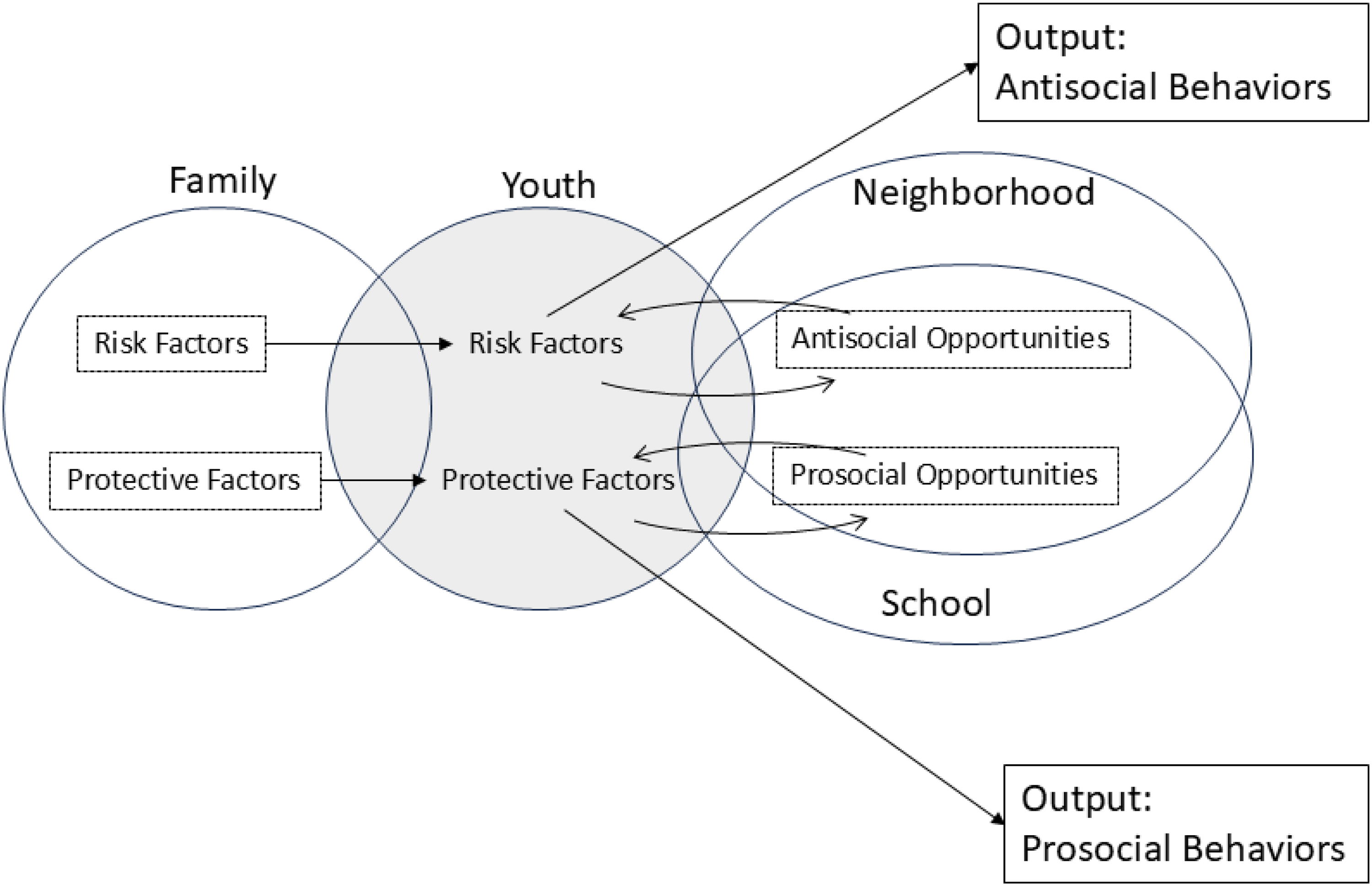
Youth risk accumulation as a complex adaptive system (CAS).
Young people are perceived as autonomous agents who have agency within their own lives. A CAS emphasizes the roles that young persons have in contributing to the overall system through their interactions with each other and their environment. Thus, the risk that an individual accumulates can be understood as being generated through the choices the individual makes about whether to engage with risk or protective factors in the individual’s social environments (as illustrated in Figure 1 with arrows pointing away from the youth), and approaches that do not consider these interactions will be incomplete. Thus, the central eight risk factors can be mapped onto a young person's social environment (which are represented in Figure 1 as the overlapping circles around the youth): individual risk factors (antisocial cognitions, antisocial personality, substance abuse), family (family), school (school and/or work), and neighborhood (substance abuse, leisure and/or recreation, antisocial peers; Jenson & Fraser, 2016). Furthermore, these interactions will generate feedback processes that either maintain the system or mobilize the system to change—in Figure 1, for example, the more risk factors the youth have, the more likely they are to engage in antisocial opportunities, which is likely to increase their risk factors. Path dependence arises when the feedback process maintains the trajectory of the system (through time and geographical space), which can lead to either optimal or suboptimal outcomes.
Complexity encourages us to look at the person in context/environment, which may be difficult with mathematical and statistical approaches typical of reductionism in social sciences. For example, the traditional formula to risk assessment decontextualizes the youth by positing that risk factors minus protective factors equal antisocial behaviors. By using a CAS approach and embedding this equation within the youth’s environments, we illustrate in Figure 1 the significance of also understanding both the risk that exists within the family, neighborhood, and schools and the interactions that occur between the youth and their environments over time. As already stated, it is not that numbers are not important, but in studying social processes, ABMs are still useful where mathematical models are known and applied to generate risk scores. Generating these risk scores have garnered much attention. Yet Lee and Crooks (2021) developed an ABM for examining how risk is generated, which also demonstrates how ABM can illuminate knowledge gaps since programming (e.g., creating rules for how a youth's risk score changes based on a new interaction) highlights the need for information that may not be available. Their model highlights the limited attention that has been paid to how a young person's interactions with others and one’s environment may contribute to cumulative risk and how antisocial and prosocial experiences may accumulate for a youth.
This ABM systematically explores how introducing an authority figure (e.g., police officer, probation officer) will impact a young person's acquisition of risk and promotive factors, as well as their accumulation of antisocial and prosocial experiences. Within our artificial environment, we can introduce passive authority agents and subsequently layer on additional active elements. Consequently, ABMs allow us to forecast the range of possible outcomes, not necessarily to certainly predict, but to “measure the unmeasurable” by exploring the interactions between agents (young people) and their environments. In this example, risk assessments are designed to measure both cumulative risk and protective factors.
Mathematical Foundations of ABM
Several mathematical concepts often undergird ABMs when building a model to sufficiently address risk. First, Boolean logic through the terms AND, OR, and NOT facilitates the use of a binary language that is instrumental in a digital environment (Caramani, 2009). Second, decision theory applies as agents make choices in order to optimize a decision. Third, networks can be easily incorporated into ABMs. Fourth, cellular automata are used to assess the impacts on surrounding areas occurring through spatial autocorrelation. These concepts form the basis upon which we apply risk in a model based on cellular automata to test whether tipping points are reached in order to influence surrounding areas in a two-dimensional space. Cellular automata are a critical way to conceptualize the whole system as the interactions of all the variables within any system occur concurrently rather than one by one. This enables us to model the ways in which youth offending is an emergent outcome of a CAS (or the interaction of nested systems) where The behaviour of a system composed of interacting micro-level components is ultimately derived from its micro-level behaviours and the influence of its environment. If we can simulate these interactions explicitly, we can simulate the dynamic that generates the emergent property, and thus we can replicate the emergent macro state of that system. (Silverman et al., 2021, p. 3)
Research Questions
This leads to our two research questions:
(1) What are the possible outcomes of introducing agents into the social lives of young people for the purposes of intervening for the prevention of risk and the accumulation of protective factors?
(2) What are the outcomes when we adapt the model to ideal (normative) conditions?
In an ideal world, our youth justice interventions would perfectly target antisocial youth and effectively reduce risk and increase protective factors (this is the logic of Andrew & Bonta, 2007, risk, need, and responsivity model). Accordingly, we modified the code to (1) intervene only with “antisocial” youth and (2) ensure every intervention is effective (i.e., every youth experiences a decrease in their risk level and increase in their promotive level when they finish probation). This is based on the assumptions of the normative “resource follows risk” and “hotspot” approach to targeting antisocial behaviors through a focus on policing the most antisocial young people to reduce crime. Then we compare the outcomes from the two approaches to see how much the aggregate results are changed based on a “perfect” intervention.
Method
In this section, we begin by providing details about our ABM that will allow the reader to assess its quality. Additionally, the program code and details explaining the program are available on the web (https://bit.ly/YaTASERPS1_1), as is the convention for computational social science. After describing the model, we provide information on the data that resulted from multiple runs of the ABM and report on the analysis of those data.
This agent-based model allows us to frame young people’s development through the lens of a CAS and systematically explore how attempts to intervene in the acquisition of risk and promotive factors may impact their engagement in prosocial and antisocial activities within a North American context. This model allows us to observe how youth development is inextricably linked to their cumulative environmental experiences.
Model Background
When creating an ABM, we investigate previous work to identify existing models and related code and adapt them. Building on an existing ABM, we sought to explore how risk and promotive factors accumulated among young people through their interactions with their social environments (Lee & Crooks, 2021). The original model was an abstract, theory-driven model based on Thornberry's interactional theory of delinquency designed to explore the accumulation of risk among adolescents (Thornberry, 1987; Thornberry & Krohn, 2005; Thornberry et al., 1991). Interactional theory is well suited to an ABM since it posits that delinquent behavior results from a process defined by interactions between the youth and their social environments and extending across the life course (Thornberry & Krohn, 2005).
In our model, we examine the introduction of authority figures (law enforcement) who move to hotspots and intervene to alter a young person's acquisition of risk and protective factors. The evaluation context for this study is then one of practitioners and their potential to engage in both therapeutic and punitive outcomes to demonstrate an ABM approach. Given that knowledge of risk accumulation is surprisingly limited, the original model, as does this one, takes a stylized facts approach to model development (Agar, 2005; Heine et al., 2005). Thus, youth engagement with their environments is highly abstract, where based on a location, a youth may be faced with a positive or negative opportunity. Specific events are not explicitly modeled; rather, the probability and nature of the interaction is modeled. Although there are aspects of risk accumulation that remain unclear, our stylized facts approach allows us to generate outcomes that approximate our observations of the world.
The original model creates an artificial world that consists of the primary socializing contexts for most youth: home, school, and community. This is aligned with interactional theory specifically and life course theories of deviance more generally, in that during adolescence, the main social environments are families, schools, and neighborhoods (Sampson & Laub, 2005; Thornberry & Krohn, 2005). These youth move throughout their lives and, depending on their location, are presented with prosocial or antisocial opportunities. In this study, prosocial is used in the criminological sense of positive engagement in society. Since the model is highly abstract, each location can represent a variety of opportunities and events that are typical for youth, such as extracurricular clubs or sports teams, religious groups, and volunteer opportunities. Depending on their risk or promotive factors, they may accept or decline the opportunity.
The original model includes one primary type of heterogeneous agent, namely, young people. For this current model, we added a second type of heterogeneous agent, an authority figure. As an abstraction, these agents could be youth justice staff who arrest and/or supervise the youth in the community. Our model explores the impact of differing approaches to youth justice: deterrence, punishment, or rehabilitation (Feld, 1999; Hazel, 2008). First, there is a passive intervention scenario where the authority figure simply acts as a deterrent—a youth, if presented with an antisocial opportunity near the authority figure, will decline the opportunity. The authority figure provides surveillance without actively intervening but will move to adjacent “hotspots” or locations where there is a higher incidence of antisocial activities. Alternatively, there are two active intervention scenarios where youth may be put “on probation” if they engage in an antisocial act near an authority figure. After a certain number of visits to an authority figure, the youth may be released and their risk for recidivism may be reduced. In the fourth scenario, their promotive level may be increased in addition to the potential decrease in their risk level. To make systematic comparisons, the model can run as originally written (i.e., without intervention) and compared to three extended scenarios involving the authority figure agents. Figure 2 shows how each of these approaches are operationalized as an intervention in the ABM, highlighting the differences in what is targeted by each intervention.
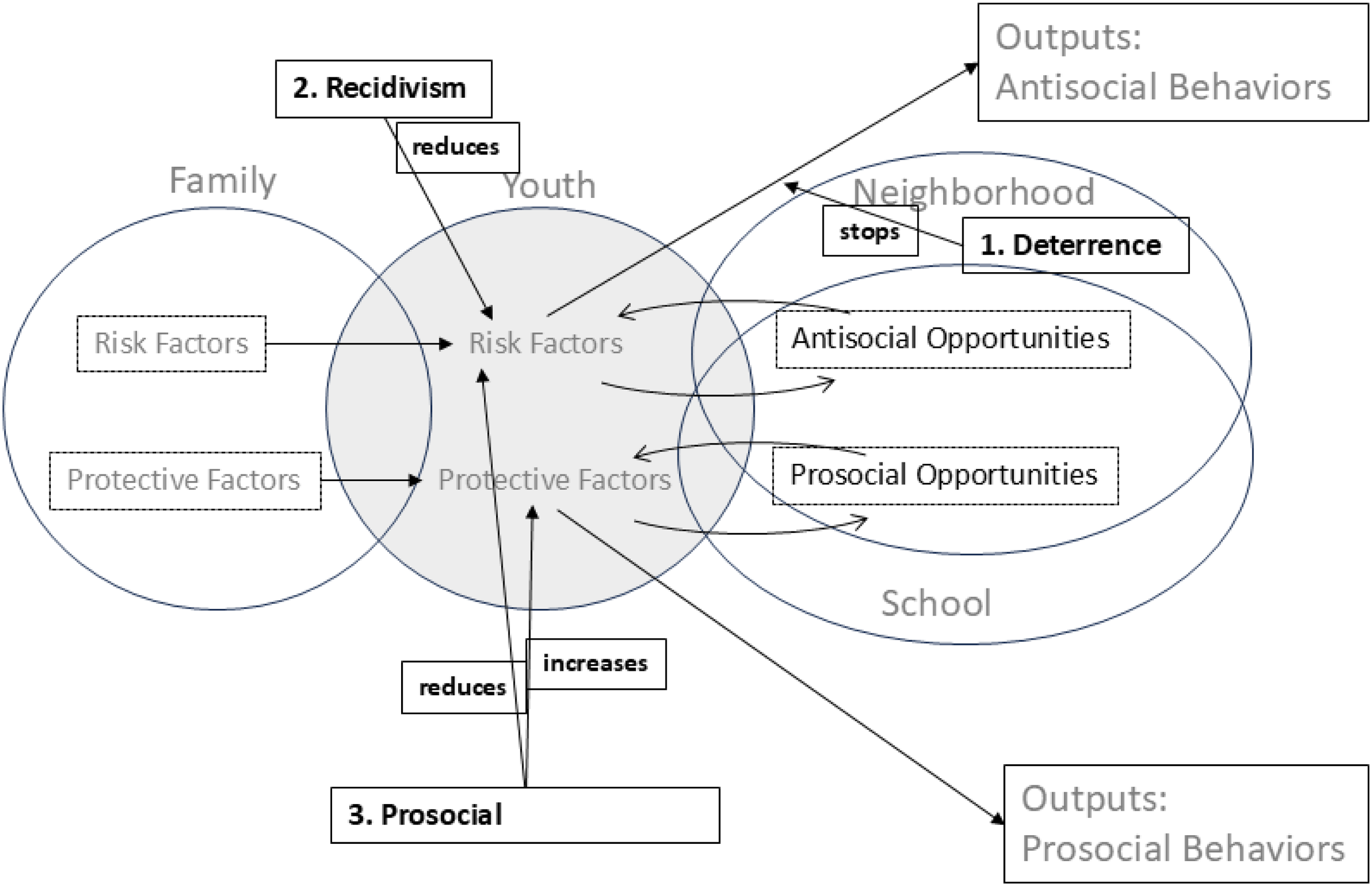
Potential points of intervention (in bold) within youth risk accumulation as a complex adaptive system (CAS).
As is common in many agent-based models, there is randomness in how certain attribute values are assigned at the initialization of the model. These values are assigned based on a distribution centered on a value. The distribution is based on the observed distribution of risk assessment data previously acquired from a local probation agency, whether exponential (family risk and protective scores centered on user-set value) or normal (individual risk and protective scores centered on family risk and protective scores). For the location, the probability of a prosocial or antisocial opportunity is randomly assigned following an exponential distribution and centered on a user-set value, based on studies that have indicated risk clusters (Harris et al., 2011; Rodriguez, 2013; Thornberry, 1987). Thus, whether a youth encounters a prosocial or antisocial influence when they are in that location is based on these probabilities. Additionally, whether a youth tally of prosocial or antisocial experiences is increased is also stochastic, since they will be faced with multiple opportunities, but not every opportunity will be so impactful that it affects their behavioral trajectory.
There is stochasticity associated with the authority figures as well. Their personal orientation toward punishment versus treatment is randomly assigned and defines the probability that they will arrest a youth. For youth who are on probation, once they reach a minimum number of visits to a probation officer, there is a stochastic element to whether their case will be closed if they are medium or high risk.
A single run of the model consists of approximately 5 years (e.g., teenage years between 13 and 18) for 200 youth. Each day is broken into approximately hourly increments, where youth spend 6 h at school, 5 h in the community after school, and 4 h at home. The youth move around this artificial world (see Figure 3) and, depending on their location, are presented with prosocial or antisocial opportunities. The youth may choose to engage in the activities depending on their risk and protective scores. Based on the prosocial and/or antisocial experiences they choose, their risk and protective scores can increase. The youth can encounter only the authority figures (e.g., interventions) in the community who intervene depending on the condition.
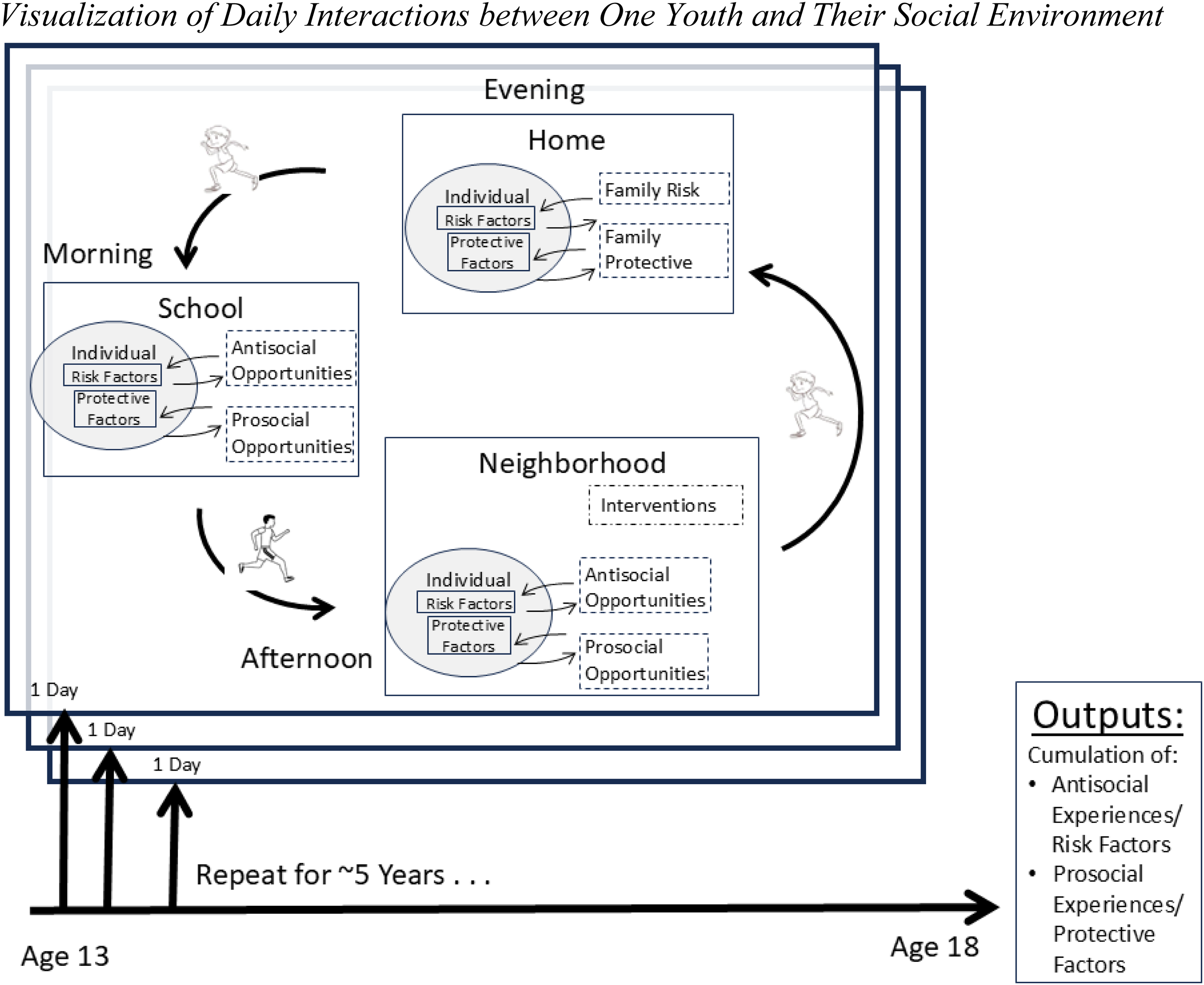
Visualization of daily interactions between one youth and their social environment.
To ensure the model was implemented as intended, verification was conducted throughout the programming of the model. Code walkthroughs were conducted to ensure no apparent logical or programming errors were made, and the displays in the console were used to make sure the model was run as designed. Additionally, we observe elements of Level 1 validation, where the model produces qualitative agreement with empirical macrostructures (Axtell & Epstein, 1994). For example, as reported in the results below, a focus on reducing risk may reduce recidivism but does not necessarily result in prosocial outcomes. As reported from the Pathways to Desistance Study (Mulvey et al., 2004; Schubert et al., 2004), about 80% of the sample of serious adolescent offenders eventually desist from crime and delinquency (Piquero et al., 2013), but only about 40% of the sample are likely to be engaged in school or work at the end of the study (Lee et al., 2022).
To answer our second question, we adapted the model to ideal (normative) conditions. In an ideal world, our youth justice interventions would perfectly target antisocial youth and effectively reduce risk and increase protective factors. Accordingly, we modified the code to (1) intervene only with “antisocial” youth and (2) ensure every intervention is effective (i.e., every youth experiences a decrease in their risk level and increase in their promotive level when they finish probation).
Data
We generated data by systematically altering several variables: number of probation officers (5, 7, 10, 15, 20, 30) and risk and promotive levels for the family, schools, and neighborhoods (1, 25, 50). We ran a total of 87,480 simulations, where one simulation consisted of 200 artificial youth living 1,800 days (approximately 5 years).
Variables
The outcome variables are based on model outputs. We track the number of prosocial and antisocial opportunities each youth chooses to accept, assuming that each opportunity translates to a prosocial or antisocial experience. Based on the balance of these experiences, we classify a youth as “antisocial” if they have more antisocial experiences and “prosocial” if that one youth has more prosocial experiences overall. At the end of each simulation, model outputs reflect aggregate statistics: average number of antisocial experiences, average number of prosocial experiences, percentage of “antisocial” youth, and percentage of “prosocial” youth. Given our interest in path dependence, we include a count of the number of times a youth switches category from the “prosocial” into the “antisocial” category and vice versa.
The primary independent variable for this study is the probation condition, which is determined by the behavior of the authority figure. The original model, without any authority figures, is the none condition. The passive intervention scenario is the deterrence condition, where the youth may decide not to engage in antisocial behaviors when they are near an authority figure. The active intervention scenario where the authority figure focuses on reducing risk is the recidivism condition, and the active intervention scenario where the authority figure seeks to both reduce risk and increase protective scores is the prosocial condition.
Analyses
Rather than predicting outcomes, ABMs should be viewed as providing insight into the range of possible outcomes. For this reason, we provide descriptive statistics of our model outputs (i.e., outcome variables) by probation condition. We also report statistical significance based on ANOVAs to compare the four probation scenarios or t-tests to compare the none and passive intervention conditions with the two active intervention conditions. However, statistical inference based on data generated by computer simulations should be considered with caution, since the sample size can easily be increased to yield statistically significant results without adding substantively new information (Hofmann et al., 2018). Thus, descriptive results (e.g., effect sizes) should be the focus for stimulation data. While patterns can be gleaned from the descriptive results, given the abstract nature of this study, the reported means are difficult to translate into real-world terms. Thus, we report on statistical significance, which is informative but limited.
Results
Figure 4 shows that the percentage of youth classified as antisocial overall is comparable in the none, deterrent, and recidivism conditions, but the results are noticeably more compressed in the prosocial condition. The difference in means overall is statistically significant, F(3, 87,476) = 244.09, p < .001, where the mean for the prosocial condition (0.22) is much lower than the means for the none (0.29), deterrent (0.28), and recidivism (0.28) conditions. Thus, only the prosocial condition yields an overall average lower percentage of antisocial youth.
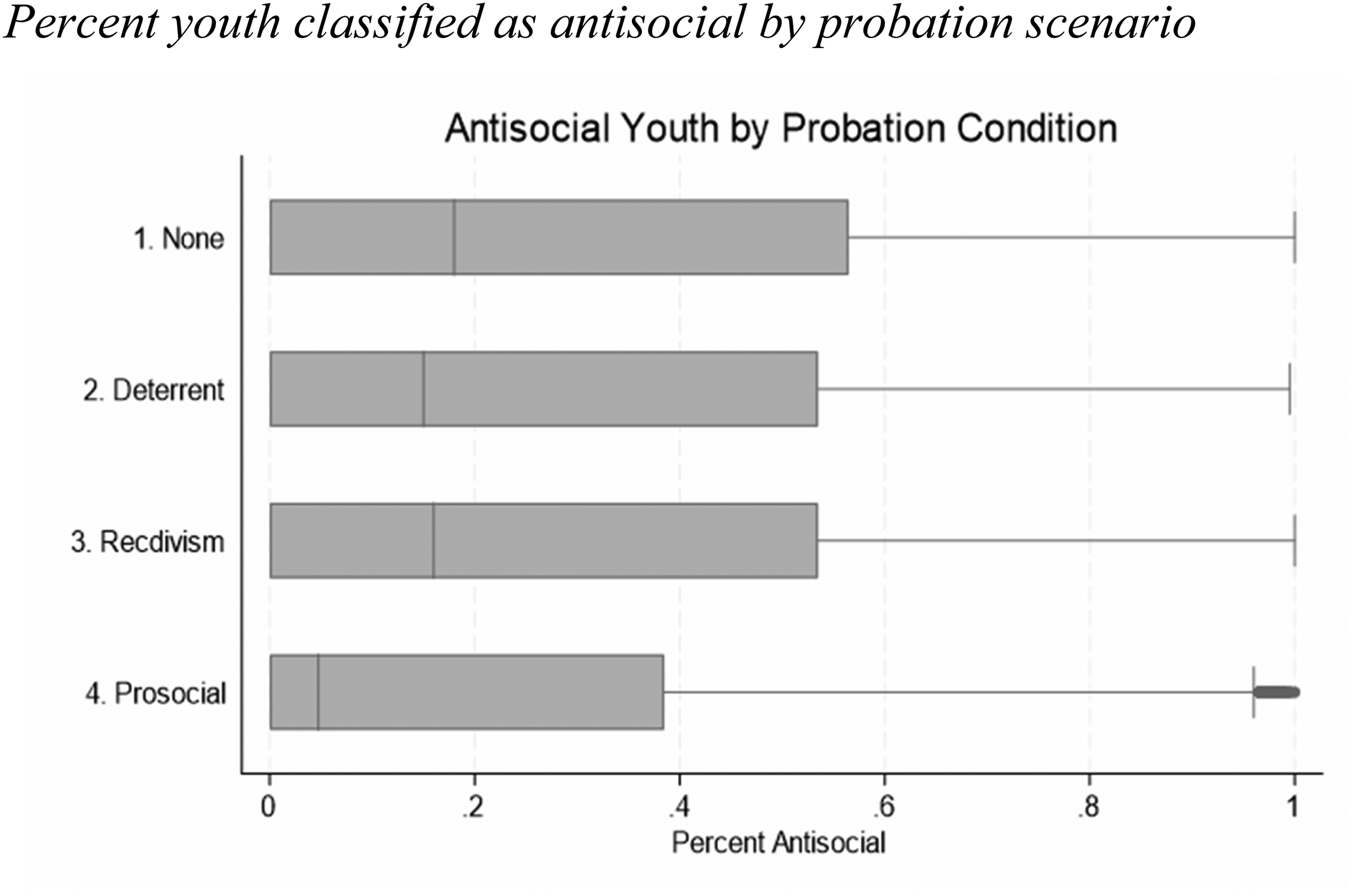
Percentage of youth classified as antisocial by probation scenario.
Second, we note that both antisocial and prosocial experiences should be examined (see Figures 5 and 6). When looking at the antisocial experience results in Figure 5, there are no obvious differences in any of the conditions, which suggests that none of the interventions reduce antisocial experiences. Still, the difference in means overall is statistically significant, F(3, 87,476) = 27.46, p < .001. The lowest mean occurs in the deterrence condition (37.26), followed by the recidivism (38.33) and prosocial conditions (38.13) and, finally, the none condition (40.91).
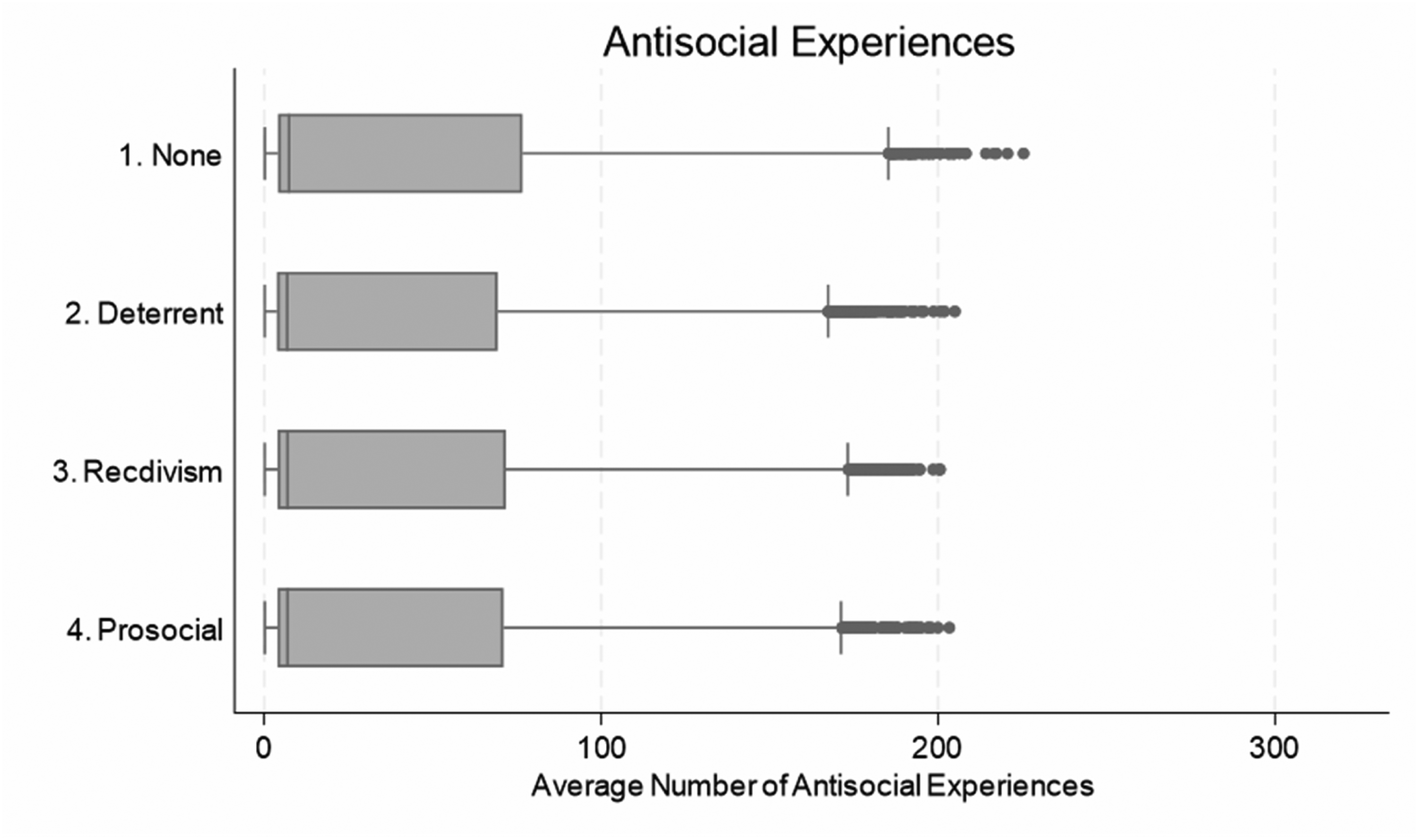
Average tally of antisocial experiences.
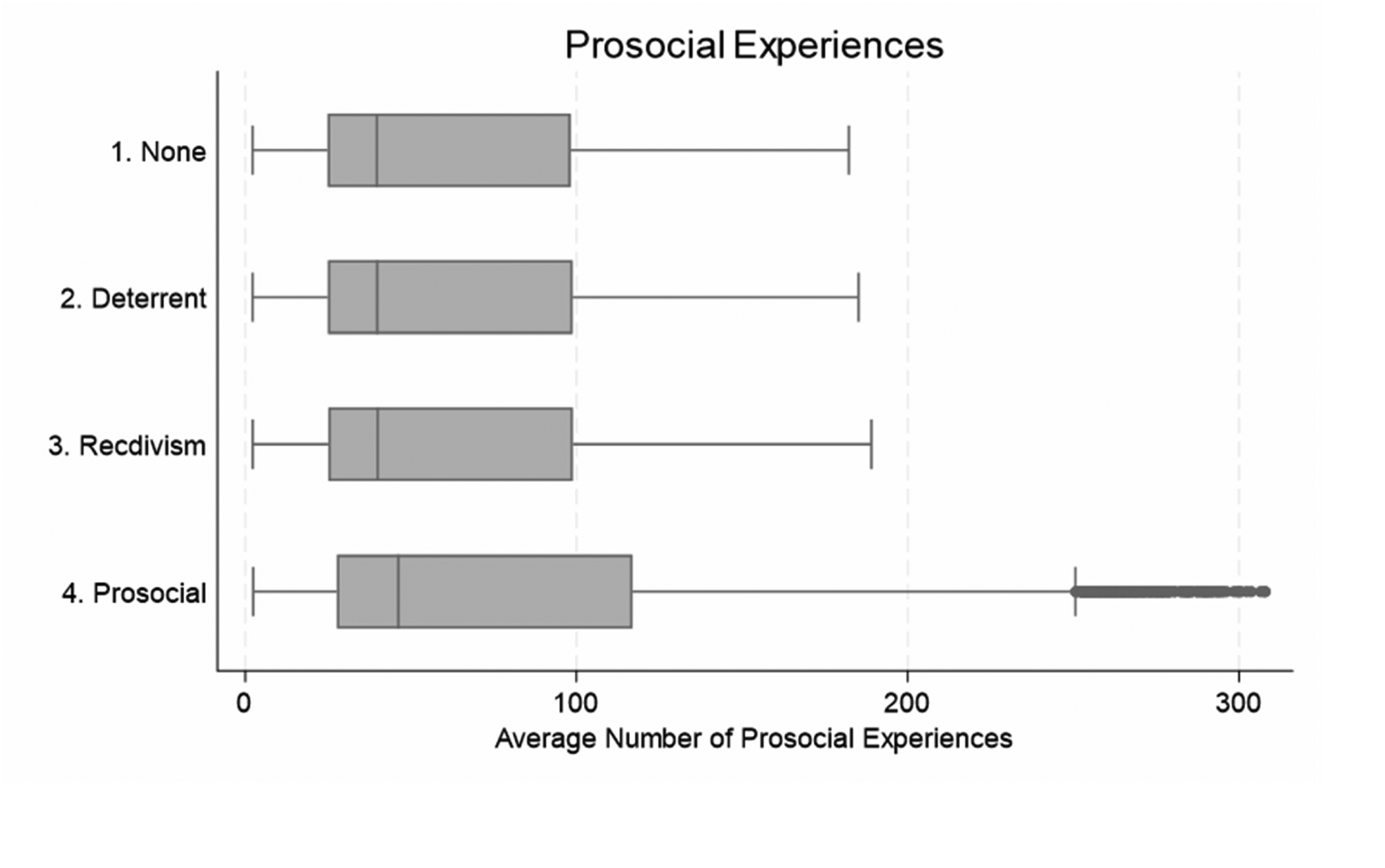
Average tally of prosocial experiences.
Yet the prosocial experiences presented in Figure 6 suggest that there is an increase in prosocial experiences in the prosocial condition: the range appears larger, with quite a few outliers falling above the upper tail of the box plot. The difference in means overall is statistically significant, F(3, 87,476) = 570.50, p < .001. The highest mean occurs in the prosocial (75.60) condition, followed by the deterrence (59.50) and none (59.50) conditions and, finally, the recidivism (57.48) condition. Taken together, it is an increase in prosocial experiences, not a decrease in antisocial experiences, that appears to drive the lower percentage of antisocial youth as reported in Figure 4.
As shown in Figures 7 and 8, there appears to be more youth switching between antisocial and prosocial categories in the passive intervention scenarios (i.e., none and deterrent conditions). Note that a youth was not restricted to switching between prosocial and antisocial categories a limited number of times; rather, it is possible that a youth could switch categories multiple times and, in fact, oscillate between states. The box plots in Figure 7 show the results for the number of times a youth moved from the prosocial category to the antisocial category, whereas those in Figure 8 show the number of times a youth moved from the antisocial category to prosocial category. The difference in means for the number of youth switching to the antisocial category is statistically significant, F(3, 87,476) = 397.16, p < .001. The lowest mean occurs in the recidivism (129.15) and prosocial (130.72) conditions, followed by the deterrence (156.33) and none (157.92) conditions. And in the comparison between the the two active (129.94) conditions and the passive (157.12) conditions, the difference in means, t(87,478) = 34.46, p < .001, is also statistically significant. The difference in means for the number of youth switching to the prosocial category is also statistically significant, F(3, 87,476) = 447.47, p < .001. The lowest mean occurs in the recidivism (99.81) and prosocial (103.75) conditions, followed closely by the deterrence (124.09) and none (124.88) conditions. And in the comparison between the two active (101.78) conditions and the passive (124.49) conditions, the difference in means, t(87,478) = 36.35, p < .001, is also statistically significant. Thus, with the introduction of active authority figures (i.e., prosocial and recidivism conditions), there is less overall switching between categories and more compression in the distribution, in both directions. It appears that the active authority figures play a role in supporting path dependence.
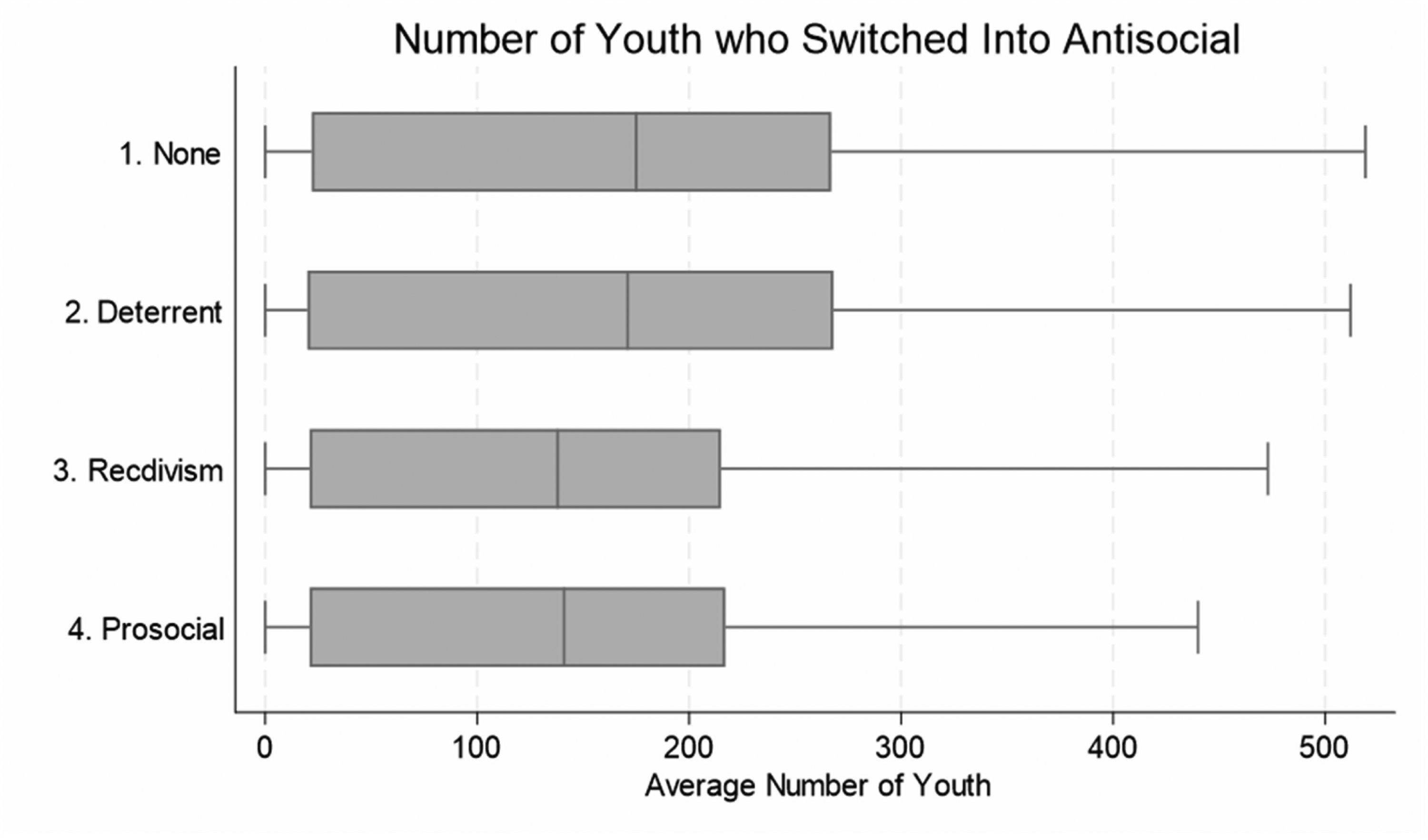
Youth who became antisocial.
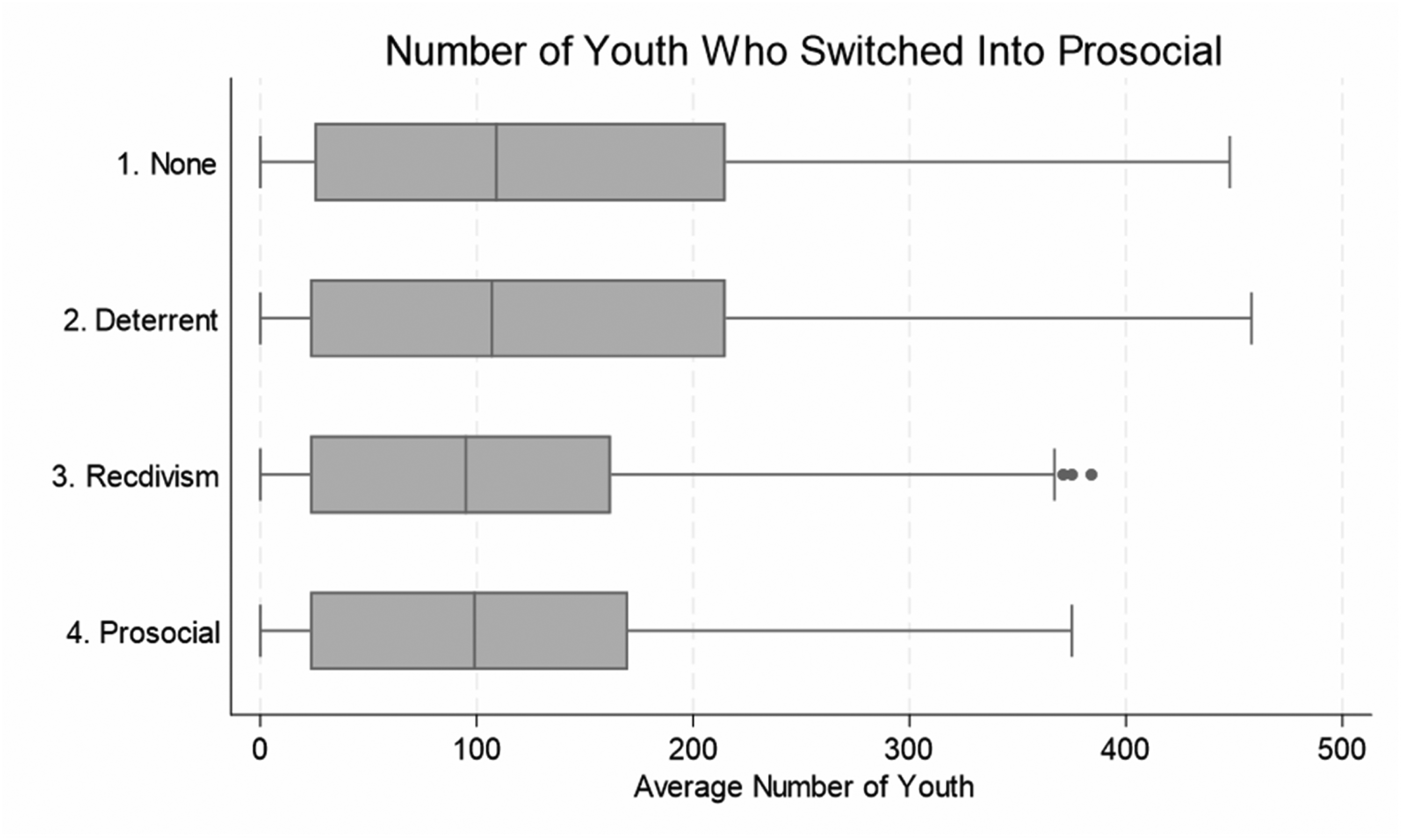
Youth who became prosocial.
A key benefit of an agent-based model is that, since it is “solved” by running it, there is “an entire dynamical history of the process under study” (Axtell, 2000, p. 5), which allows us to observe the system beyond the resulting equilibrium. In order to observe this “dynamical history of the process,” we examine the percentage of antisocial youth throughout the course of a simulation. Figure 9 shows five example runs for each condition, which shows that there is variability in the potential results. We highlight the overall pattern across the multiple runs with a fitted black line: the percentage of antisocial youth noticeably declines only in the prosocial condition while it appears steady in the other three scenarios. In other words, the deterrent and recidivism conditions do not reduce the likelihood of a youth being classified as antisocial—only the prosocial condition shows that a youth is less likely to be classified as antisocial over time.
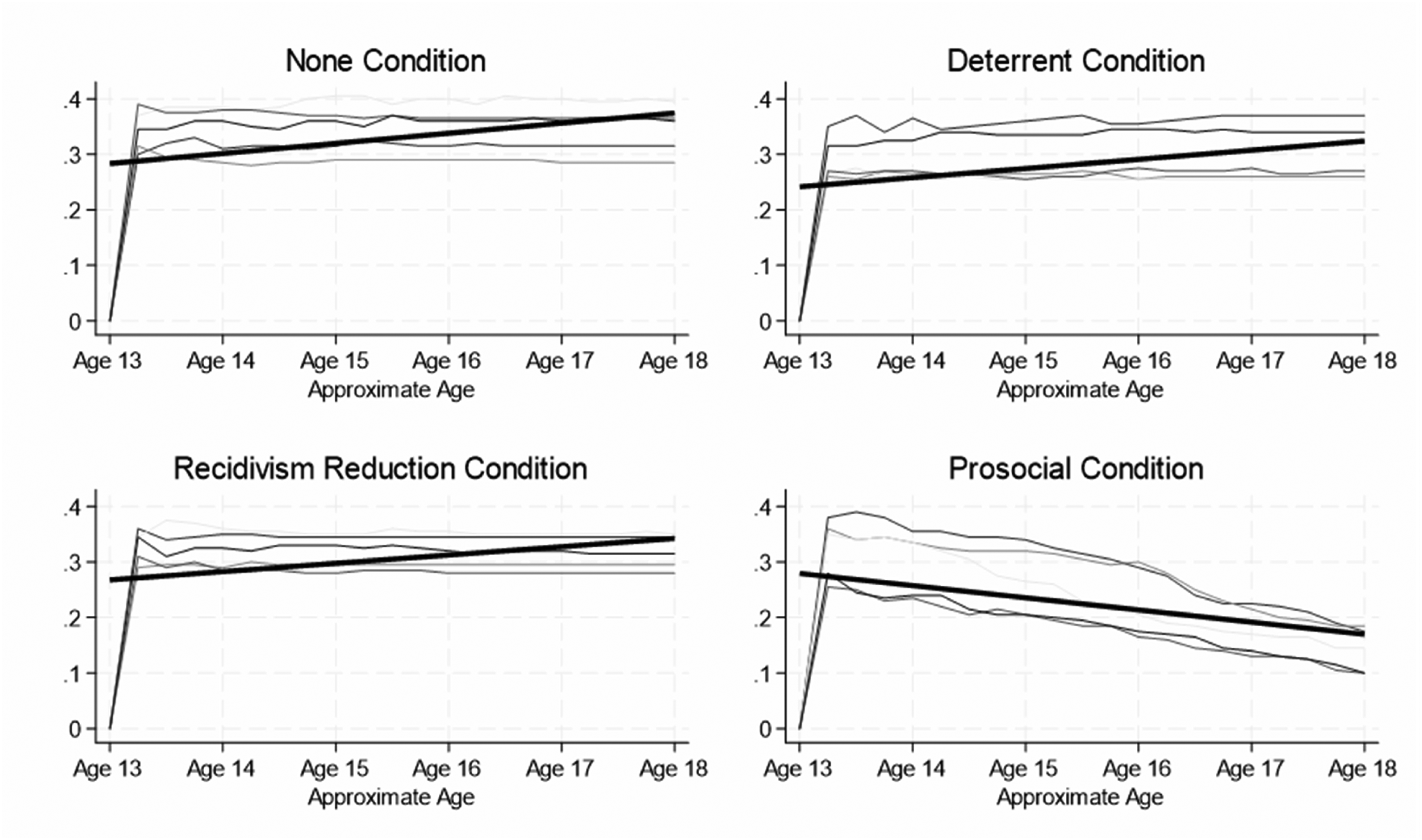
Percentage of youth classified as antisocial every 90 days within each simulation, by probation condition.
Additionally, we observe the pattern of youth switching between the antisocial and prosocial categories throughout the course of a simulation. Figures 10 and 11 show five example runs, which show that switching is most likely to occur in early adolescence (represented by the almost vertical portion of the line in each graph). Furthermore, again, we highlight overall patterns with a fitted black line, which allows us to more readily compare conditions. The slope appears steepest in the none condition (i.e., there is more “switching” between categories) and flattest in the recidivism condition (i.e., there is less “switching” between categories). This suggests that more youth are most likely to experience path dependence (i.e., become “locked in” on their current trajectory) in the recidivism condition and least likely to experience path dependence in the none condition.
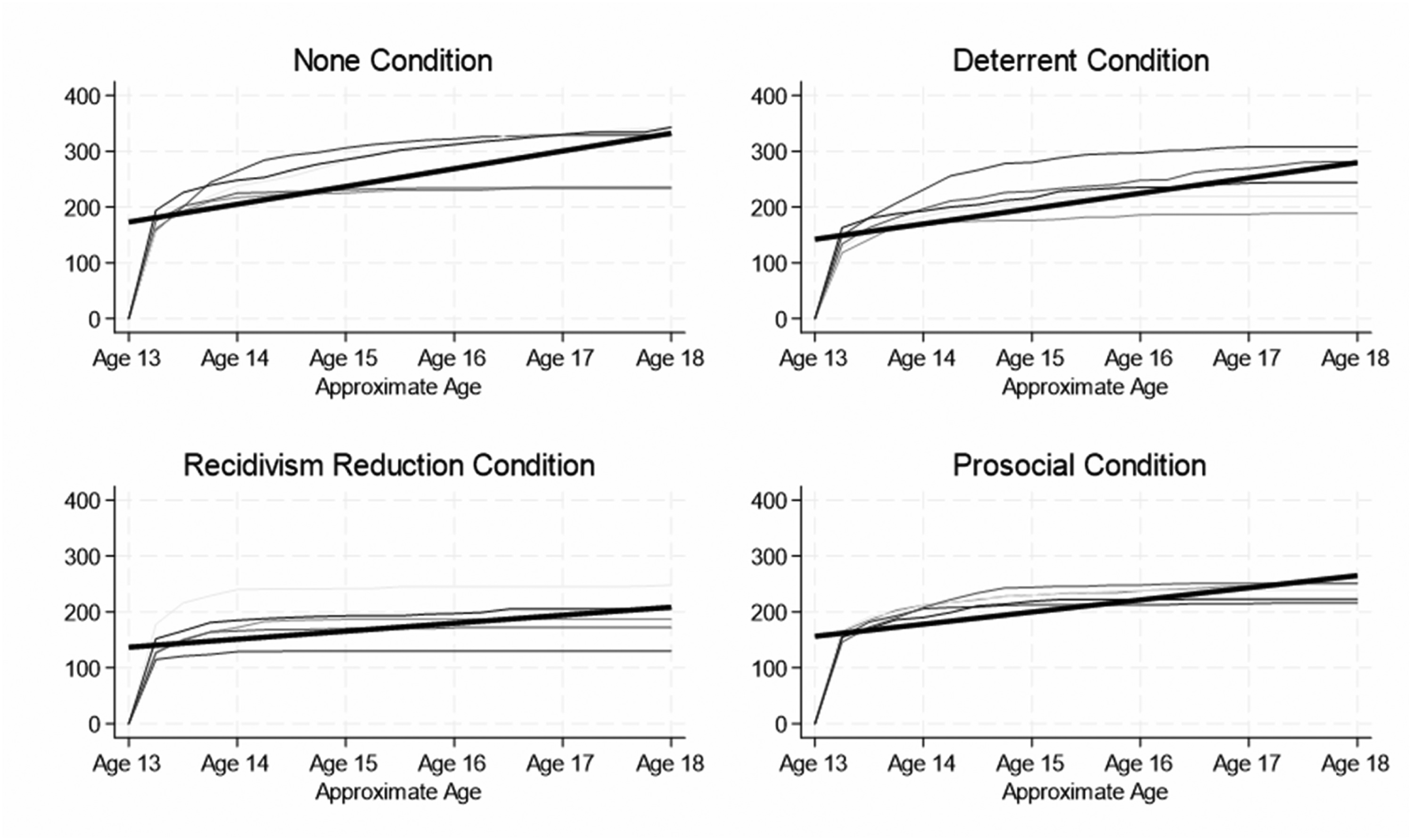
Youth switching into the antisocial category every 90 days within each simulation.
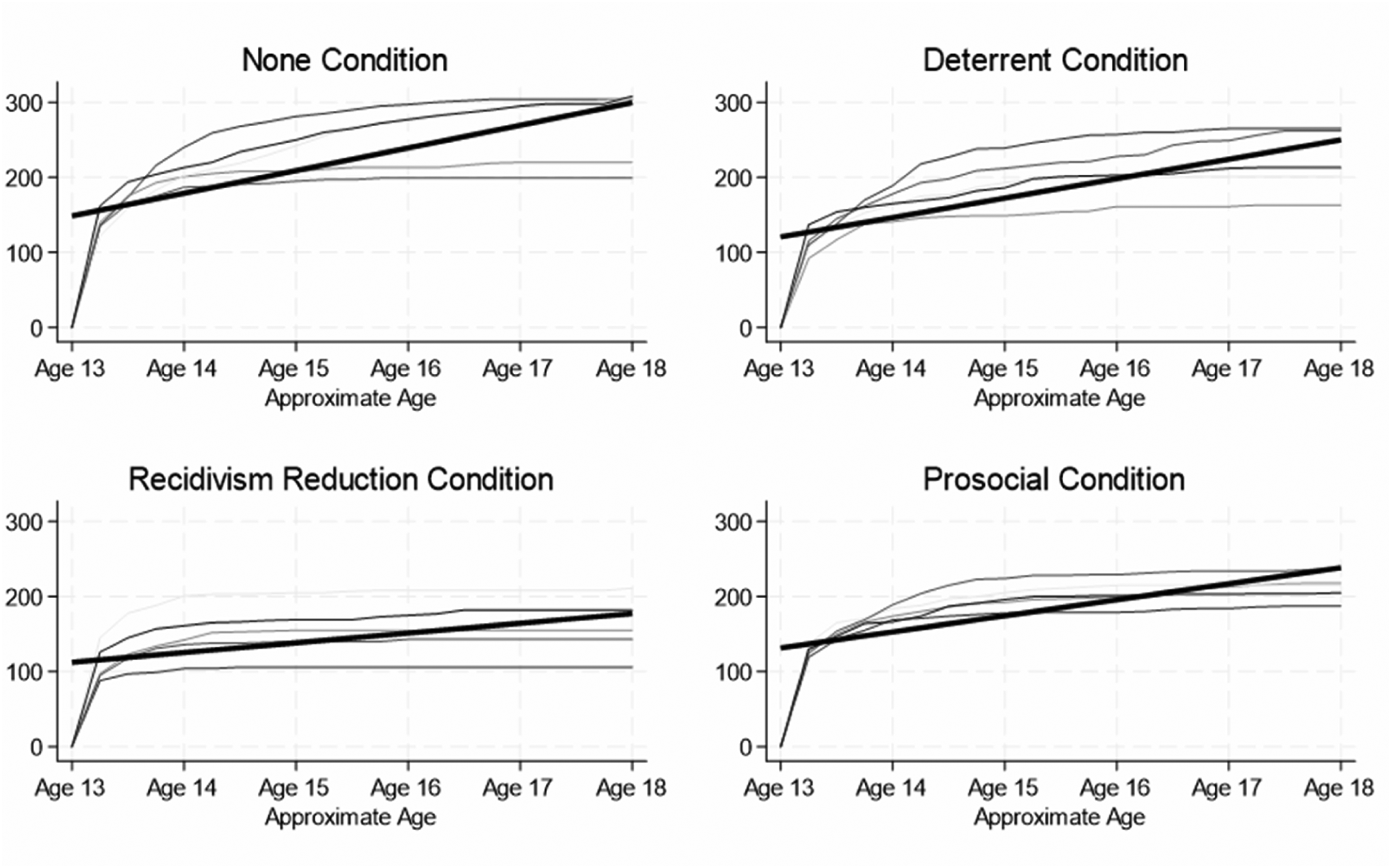
Youth switching into the prosocial category every 90 days within each simulation.
Exploring an Ideal Model
In the ideal version of the ABM, we confirm that the targeting of intervention appears accurate since the number of young people on probation never surpasses the number of youth who are classified as “antisocial” (in contrast to our original model, where there were frequently more youth on probation than were classified as “antisocial”). Yet there are decreases in the percentage of antisocial youth only in the prosocial condition, not the recidivism reduction condition. It does appear that the number of low-risk youth who move into the high-risk category was reduced. In the “realistic” model, the high-risk group often grows, which reflects the endogeneity “problem” as an example of path dependence where risk assessments consider legal history, which means a youth's involvement with the youth justice system automatically increases the youth's risk on a standardized risk assessment. We do not report on statistical significance given the limitations to statistical inference with simulation data (Hoffman et al., 2018). It would be interesting to compare this with Bayes’ theorem approach where decisions about the relevance of past history are assessed. As argued by Jennings (2014): It is easy to mistake statistically independent events for events with a causal connection, and vice versa … there are many mathematical approaches to identifying and evaluating conditional probability … but one useful and relatively simple tool is Bayes’ Theorem. If there are two events with known probabilities, Bayes’ Theorem shows the mathematical link between the probability of each event happening and the probability of either event happening, given that the other has happened. (p. 51)
Discussion and Application to Practice
Returning to the first research question—what are the effects of introducing agents who seek to intervene in the accumulation of risk and protective factors—results from our simulations indicate that the passive intervention (deterrence) yields comparable results to the risk-focused approach (recidivism), and both produce results with little difference from no intervention. The only intervention with a positive impact is the balanced intervention (prosocial), which, in addition to reducing risk, also increases protective scores. This increase in protective scores translates into more prosocial experiences, which appears to be a critical piece of the developmental puzzle.
This dynamic between risk and protective scores also translates into the percentage of youth who switch categories between antisocial and prosocial. Surprisingly, there is less switching of categories in the interactive intervention (recidivism and prosocial) conditions. This suggests that there is more path dependence in these conditions. In fact, when we examined the likelihood of switching categories over time (i.e., throughout the simulated 5 years), not only does all three interventions appear to increase path dependence (i.e., reduce the likelihood of category switching), but this was especially true for the recidivism condition. For antisocial youth, this means that probation intervention itself can become part of the problem (path dependence), especially if efforts are focused solely on risk reduction rather than protective factors that are associated with strength-based models (e.g., Ward et al., 2025)
On the second research question—based on what we currently know about risk, what happens when we adapt this model based on more ideal conditions—this reveals the difficulty of disrupting path dependence since targeted intervention has some positive effect, but its effects were minimal at best. Our ABM models the generation of youth risk level and antisocial categorization as a CAS; following the principle of mechanism, youth outcomes are generated by social relations and interactions. The interventions “tested” in the model were at the individual level—they target specific individuals. Yet our model demonstrates that these individual-level interventions are minimally effective at interrupting the system dynamics that are at play.
While this model provides useful insights into general processes, it is quite abstract and thus does not help us understand specific, individual decisions that a youth or probation officer should make (in the same way that standardized risk tools cannot predict or understand individual behaviors). In other words, the ways antisocial and prosocial experiences shape a young person's life are abstractions in this model: our artificial young person makes a simplistic decision to do something “good” or “bad.” Perhaps a youth chooses to join a soccer team (“good”) or to drink alcohol (“bad”). We assume that with the “good” decision come positive development and opportunities, such as learning discipline, consideration for others through being part of a team, and possibly leadership skill. In addition to acquiring these skills that can translate into positive performance in the classroom, the soccer team may open opportunities for the youth such as coaching or mentoring younger players. On the other hand, doing something “bad” such as drinking alcohol may get a youth kicked off their soccer team, grounded from participating in extracurricular activities, and establish a negative reputation for that youth. Ultimately, it is difficult to know whether a given “good” or “bad” decision will have cascading effects for the youth, and even so, it is difficult to know how relatively concurrent “good” and “bad” decisions will ultimately impact the youth's development and trajectory. Yet, as we discuss, there is value in describing and understanding the general processes.
Several issues arise when applying ABMs. First, it is helpful to understand that the starting point for developing an ABM is different from that of traditional statistical modeling. It can be challenging to decide on the level of abstraction and the scope of the model. However, moving away from a sole objective of prediction to considering the multiple reasons for building a model (Epstein, 2008) can help the researcher establish the purpose of the model. For us, we began by considering how we could intervene to disrupt risk accumulation, which we conceptualized as a process of cumulative disadvantage. In explaining this dynamic through CAS terminology, we focused on issues related to path dependence.
Second, while ABMs provide value in simulating and forecasting emergence of social phenomena, these models for use by practitioners need to be clear in identifying the client. In community settings, multiple system levels can apply: in this study, was the model intended primarily for individual young people or the community in which they live? A need exists to integrate complex dynamics at the level of the team (Pycroft & Wolf-Branigin, 2016). Further study needs to be conducted to quantify the increased use of monitoring and surveillance through mechanisms such as closed-circuit television (CCTV), which act as an additional authority figure, to measure the effects of further creating path dependence.
This study illustrates both the benefits and challenges, when applying CAS, to forecast and measure the behavior of individual agents rather than the simple aggregate outcomes of program participants. Modeling youth risk accumulation as a CAS provides predictive insight into each intervention approach by identifying the leverage point for each intervention. In other words, as reflected in Figure 2, the differential impact of the three intervention approaches is predictable. More specifically, the result of fewer antisocial youth in the prosocial condition due to overall increased prosocial experiences is not surprising. Yet challenges to effectively using CAS include defining the boundaries, verifying and validating the model, keeping the model agent based, and deciding when a CAS approach best fits (Epstein, 2008).
At the same time, this study reflects the ways that ABMs can identify outcomes that are surprising. Even though this ABM is a rule-based model, and as such is a simplification of the world, it still allows us to observe how changes to the system (i.e., interventions) change the outputs of the system, with implications for practice. This ABM allows us to “fast-forward” our artificial world, which allows us to observe nonlinearity and provide unique insights into how the system operates and responds to intervention. In other words, this study demonstrates how ABMs can allow researchers to model the effects of different policies and interventions, allowing users of the model to adjust levers in order to forecast outcomes.
The original model was written to demonstrate path dependence in youth development (Lee & Crooks, 2021). Yet path dependence was robust to attempts to disrupt it. It was surprising that the active interventions (e.g., recidivism and prosocial interventions) may actually reinforce path dependence. This model shows the value of complexity theory in clearly demonstrating that path dependence has a history and a trajectory that comprises the emergent behavior from the interactions of the actors and their environments. Thus, the current model reveals not only how difficult it is for individual-level interventions to disrupt path dependence that arises from the dynamics of the system but also that interventions can unintentionally contribute to the existing dynamics of the system. As a rule-based system, every decision of each agent follows the same set of standardized rules in our artificial world. In the real world, biases can develop over time, further accentuating a self-fulfilling prophecy that could reinforce the path dependence we observed in this model.
The British statistician George Box famously said, “all models are wrong, some are useful” (Clear, n.d.), and actually, the issue of epistemic fallacy in the case of ABM becomes a strength with respect to social work practice. That is because the model by definition cannot be an end in itself given the emergent nature of reality and our inability to describe this in a finite number of statements. What it does allow for is a point of departure for participatory methods of discussion based upon the modeling as an approximation of reality. In moving beyond statistical models and the arguments of Gödel for a phenomenological approach, this ABM provides visualization of data that can be more intuitive to grasp and may assist in training social work staff and also service users participating in services. This visualization based upon data from lived experience can be taken and developed for significant impact beyond the traditional approach to write up research. In the design of models and their uses for coproducing new knowledge and bringing about social change, both the implicit and explicit knowledge of stakeholders are essential (Ramanath & Gilbert, 2004). Some of the challenges of this approach are outlined by Jordan et al. (2018), who interestingly used panels of “experts” to determine those questions, including the problem of technical expertise. In social work, any genuine coproduction needs to include all stakeholders and, in our experience, needs to be used as a useful tool to inform existing coproduction relationships, to increase understanding of the individual within the context of systemic issues, and to drive change from the bottom up rather than be imposed as yet another top-down control mechanism. This approach then ensures that model building includes all stakeholders in seeking to understand the uncertain nature and boundaries of the system being studied.
This ABM demonstrates the ways that enforcement can reduce opportunities for young people to flourish. This sounds intuitively obvious but begs the question of why we have persevered with punitive approaches rather than dealing with young people as children first and offenders second (Haines & Case, 2015). To alleviate practice bias, the provision of frameworks for training and practice that introduce concepts of complexity to examine the consequences of decision-making is essential. Likewise, in multiagency systems, enabling the workers to understand their important role of keeping the system bound within societal and legal standards is essential (Wolf-Branigin, 2013). We have argued elsewhere (Pycroft & Wolf-Branigin, 2016), in adapting complexity for practice, the importance of using reflective practice at the team level to best understand the context of decision-making and the processes that enhance or diminish its effectiveness: At the heart of the discussions of what is procedural and what is judgemental is a familiar organisational paradox that policy makers have to grapple with, in that organisations that are procedurally driven lose dynamism and creativity (at the team and practitioner level), and that looser controls may encourage creativity but lose accountability and consistency. Within modern multi-agency and interdisciplinary models of service delivery (enshrined in an ethos of new public management) which increase complexity, the complexity cannot be ignored. It is our contention that in practice that the role of the team becomes more significant. The team is a reasonable level of abstraction from the system that is able to consider the relationships between the whole and the parts in more detail, address the problem of boundary setting, address professional values and the ways in which problems are constructed and understood, work with uncertainty and crucially harness difference to enhance collaboration … and improve individual judgement making. (Pycroft & Wolf-Branigin, 2016, p. 71)
Conclusion
As initial models are created, attempts to identify and mitigate risk will be advanced through future development and testing. Applying the practitioner's understanding of their organizational approach to risk will require additional training for personnel involved in making decisions regarding these young people as results suggest that environmental risk and promotive factors play a role in shaping youth outcomes. However, as we seek to improve models for practice, we need vigilance in avoiding an epistemic fallacy as models by nature are simplifications (or at best metaphors). The delivery of human services (e.g., social work, probation, nursing, medicine) has become increasingly model and data driven, raising questions of validity, accuracy, measurability, generalizability, and predictive value. The building of rich, detailed, and granular pictures of reality that are relevant to the practices of youth justice requires an understanding of both risk and promotive factors that does not lend itself to reductionism. Utilizing ABM lends itself to the study of this emergent richness to explore the relationships between the parts and the emergent whole(s). This also assists human services to address highly deterministic factors (poverty, inequality, disease, crime, etc.) and to engage with human agency to ameliorate and prevent these factors at the individual, local, and national levels.
Footnotes
Declaration of Conflicting Interests
The authors declared no potential conflicts of interest with respect to the research, authorship, and/or publication of this article.
Funding
The authors received no financial support for the research, authorship, and/or publication of this article.
