



Abstract
Decisions regarding out-of-home placement of children are complicated and of high impact for children and parents. Previous studies show low agreement between professionals on these decisions, and research regarding the influence of characteristics of decision-makers on the content of the decisions taken remains inconclusive. This study explored the relation between general and psychological characteristics of 144 professionals (child welfare professionals, children’s court judges, and master students) using vignettes and questionnaires. Professionals’ mind-set regarding the ability of parents to achieve change (parent-specific mind-set) and their attitude toward the harmfulness of out-of-home placements were related to their decision-making. General decision-maker factors (the professional’s background and work experience), the mind-set toward the ability of people in general to change (dispositional mind-set), and professionals’ attitude toward the effectiveness of out-of-home placements were not related to their decisions. This field of practice needs to reflect on the role of implicit beliefs in making placement decisions about children.
Introduction
Out-of-home placement decisions are complex and have a great impact on the child, the parents, and the professionals involved. In 2016, 18,590 children in the Netherlands were placed out of home and were allocated to foster care, which translates to approximately 5 per 1,000 children (Central Bureau for Statistics, 2017). These numbers are quite similar to the estimated number of foster care placements in the U.S. and the UK; 6 per 1,000 children (U.S. Department of Health and Services, 2017) and 7 per 1,000 children (Office of National Statistics, UK, 2017), respectively. A growing body of research is dedicated to the decision-making process concerning out-of-home placements (e.g., Baumann, Dalgleish, Fluke, & Kern, 2011; Budd, 2005; Davidson-Arad & Benbenishty, 2016; Munro, 2004). Generally, the agreement between professionals regarding out-of-home placement decisions was low, suggesting that these decisions are influenced by unsystematic and subjective factors (Bartelink, Van Yperen, Ten Berge, De Kwaadsteniet, & Witteman, 2014; Britner & Mossler, 2002; Rossi, Schuerman, & Budde, 1999). Previous studies regarding decision-maker factors that may explain this low agreement are inconclusive or explain only a small amount of variance in these decisions (e.g., Benbenishty, Segev, Surkis, & Elias, 2002; Benbenishty, Osmo, & Gold, 2003; Britner & Mossler, 2002; De Ruiter, de Jong, & Reus, 2013; Drury-Hudson, 1997; Gold, Benbenishty, & Osmo, 2001). To gain more insight into the relation between, on the one hand, general and psychological factors of professionals and, on the other hand, out-of-home placement decisions, this study investigates both types of factors in a multivariate model.
Several studies have tried to explain the variance in professionals’ decisions by focusing on professionals’ approach to case characteristics, such as characteristics of the parent, child, or family (e.g., Benbenishty et al., 2002; Delfabbro, Barber, & Cooper, 2003; Kortenkamp, Green, & Stagner, 2004; Rossi et al., 1999; Wulczyn, 2004). Other researchers have argued that the influence of professionals’ characteristics on out-of-of-home placement decisions is much larger than the characteristics of the family, parent(s), or child, because professionals guide the family through the evaluation process (Goerge, 1994; Stone & Stone, 1983). Although already decades ago (Munro, 1999; Portwood, 1998), researchers pointed out the importance of studying decision-maker factors such as professionals’ experience, background or implicit beliefs and attitudes, few studies investigated these characteristics while the results thereof are inconclusive (Ryan, Garnier, Zyphur, & Zhai, 2006). For instance, where some studies find significant differences in the decision-making of experienced professionals and students (De Ruiter et al., 2013) or experienced professionals and novices (Davidson-Arad, Englechin-Segal, Wozner, & Gabriel, 2003), other studies find no significant differences between groups (Bartelink et al., 2017). Moreover, most studies that did investigate decision-maker characteristics focused on the role of work experience or professional background and on this basis were able to explain only a small amount of variance between professionals taking these decisions (e.g., Benbenishty et al., 2002; Benbenishty et al., 2003; Britner & Mossler, 2002; De Ruiter et al., 2013; Drury-Hudson, 1997; Gold et al., 2001).
In addition to these general characteristics of decision-makers, psychological decision-maker characteristics such as professionals’ attitudes and opinions may explain part of the variance in out-of-home placement decisions, but these are only examined by a handful of studies while giving mixed results (e.g., Bartelink et al., 2018; Davidson-Arad & Benbenishty, 2016; Rodrigues, Calheiros, & Pereira, 2015). Garb (2005) argued that the implicit beliefs of professionals, for instance about the capacity of parents to achieve change regarding their child-rearing capacities, influence their decision-making. Implicit beliefs can be defined as unconscious beliefs or theories that influence people’s behavior, motivation, and judgment (Dweck, 2000; 2006). To our knowledge, no studies have yet examined this promising factor. More insight into the influence of these individual characteristics on out-of-home placement decisions could contribute to a better understanding of the reasons why professionals decide these decisions differently to one another and could furthermore assist in the development of tools which increase consistency between professionals. A higher consistency between professionals in out-of-home placement decisions may indicate a higher quality of decision-making.
This study investigates the roles of professional background, work experience, attitudes to out-of-home placements, and two types of mind-set: professionals’ dispositional mind-set toward change in people and professionals’ parent-specific mind-set regarding the change in parents, in relation to decisions about out-of-home placement. Acquisition of knowledge in which individual characteristics play a role in out-of-home placement decisions is the first step toward identifying the subjectivity in such decisions and provides information which can be useful when taking measures to achieve improvement of the decision-making process.
Professional background
Deciding about the out-of-home placement of a child is complicated because different types of professionals are involved in the decision-making process (Britner & Mossler, 2002). Social workers and children’s court judges are often involved in these decisions and both groups have different perspectives. Previous research showed that children’s court judges, guardians ad litem, child advocates, social workers, and mental health professionals attach different weight to specific case factors in child protection cases and that they furthermore differed regarding to the services requested for families (Britner & Mossler, 2002). More specifically, judges and guardians ad litem were more focused on child factors (e.g., the possible recurrence of the abuse) and referred more to services involving protective child care, whereas child advocates, social workers, and mental health professionals were more focused on family factors (e.g., the services already provided to the family) and referred more often to family support services such as parenting classes or family therapy (Britner & Mossler, 2002). This suggests that judicial professionals make different decisions regarding out-of-home placement than professionals with a background in social work, education, or psychology and are more inclined than these other professionals to impose measures constraining the authority of parents. To study whether these differences are present in the decision-making process regarding out-of-home placement, this study will examine the relation between decisions and decision-maker factors for the two groups of professionals that are involved in the decision-making regarding child protection in the Netherlands, children’s court judges on the one hand and child welfare professionals on the other hand.
Work experience
Studies indicate an association between the knowledge and skills of professionals and out-of-home placement decisions, suggesting that not only the professional group to which the professional belongs to has a bearing upon his or her decision-making, but also that the work experience which the professional has may play a role (Baumann et al., 2011). A study comparing the approach of psychology students, who lacked work experience, with that of social workers to the substantiation of child maltreatment revealed that students evaluated information about child abuse and neglect more systematically than experienced social workers did and that they were more inquisitive about missing information (De Ruiter et al., 2013). Furthermore, research concerning the implementation of placement decisions shows that novices are more inclined to directly implement decisions than experienced professionals (Davidson-Arad et al., 2003). Contrariwise, other studies report no difference in the decision-making process of students and professionals (Bartelink et al., 2017). Although these studies did not examine the specific decision-making process concerning out-of-home placement, they indicate important differences in the decision-making process of child welfare professionals in comparison to novices or students. Other studies report mixed results, with students being less opposed to the out-of-home placement than experienced professionals, while maltreatment assessments and intervention recommendations were the same (Davidson-Arad & Benbenishty, 2016). Moreover, research in which novices were compared with more experienced child protection professionals revealed that whereas novices are strongly focused on risk assessment, their ability to weigh different factors of the case is significantly less than the ability of experienced social workers (Drury-Hudson, 1997). Although these studies show that professionals with different levels of experience use different types of information when deciding about child protection measures, it has not yet been examined whether this use of different information results in actual different decisions about out-of-home placement.
Psychological factors
Two important models regarding decision-making in child welfare emphasize psychological decision-maker factors in order to explain the variance between professionals when taking out-of-home placement decisions. The “Decision Making Ecology” illustrates decision-maker factors as an important part of the model and explains these factors as personal opinions or values of professionals (Baumann et al., 2011). Moreover, the “Judgments and Decision Processes in Context Model” shows that child maltreatment substantiation, risk assessment, and recommendations for intervention are influenced by attitudes of professionals regarding child welfare (Benbenishty et al., 2015). Notably, this model shows that professionals who have a negative attitude toward removal and a positive attitude to parents’ and children’s participation in decision-making make fewer recommendations for placement of the child out of the home (Davidson-Arad & Benbenishty, 2016). Moreover, professionals with a more positive attitude toward placement in care are more inclined to propose an out-of-home placement than professionals with a more negative view of out-of-home placement (Bartelink et al., 2018). This suggests that professionals who have different opinions about the effectiveness and harmfulness of an out-of-home placement for children may decide about out-of-home placement differently, namely, where a professional who considers an out-of-home placement effective and not harmful might be more inclined to place a child out of the home than a professional who views an out-of-home placement as a harmful and a not so effective intervention.
Besides professional opinions and attitudes, it is suggested that individuals’ implicit cognitive theories, such as their mind-set toward change, are reflected in their decision-making and can influence their judgment (Garb, 2005). Mind-set toward change refers to the implicit belief that a person has about human attributes (or explanations for human behavior), which can either be fixed (i.e., believing that human attributes are fixed or nonmalleable entities), or flexible (i.e., believing that human attributes can change), the latter group being incremental theorists with a growth mind-set (Dweck, Chiu, & Hong, 1995). Research into the difference between people with the two types of mind-sets found that individuals with a fixed mind-set are more inclined to make judgments about other people based on initial or preliminary information than people with a growth mind-set (Dweck et al., 1995). Moreover, another study showed that people with a fixed mind-set make judgments about other people more quickly, use less information to justify their judgments and make more extreme judgments based on minimal information, than people with a growth mind-set (Levy, Stroessner, & Dweck, 1998). This tentatively suggests that professionals with a fixed mind-set maybe more inclined to decide on a more extreme measure such as an out-of-home placement, based on less information, than professionals with a growth mind-set. Mind-set may thus explain the additional variance between professionals when taking out-of-home placement decisions, but it has thus far not been investigated in this context.
This study
The current study examines the relation between several individual characteristics of professionals and their decisions about out-of-home placement in a multivariate model. In addition to general factors, namely professional background and work experience, psychological factors are examined (i.e., professionals’ dispositional mind-set toward change in people and their parent-specific mind-set and professionals’ attitude toward an out-of-home placement).
The hypotheses of the study are: It is expected that the discipline in which a professional is educated (judicial vs. psychological), and the professionals’ work experience influence these decisions, with higher numbers of out-of-home placement decisions being taken by professionals with a judicial background and experienced professionals than is the case with psychological professionals and professionals with less experience; Next, it is hypothesized that professionals with a fixed mind-set are more inclined to place the child out of the home than professionals with a growth mind-set; and Finally, it is expected that professionals who considered an out-of-home placement in general to be effective and less harmful will choose an out-of-home placement more often than professionals who consider the measure to be ineffective and harmful.
All individual characteristics are examined in a multivariate model to investigate the unique effects of all factors on the decision-making by professionals regarding out-of-home placement. Moreover, we investigated whether the influence of work experience, mind-set toward change, and attitude toward an out-of-home placement on out-of-home-placement decisions was similar in the different professional groups.
Method
Sample
In the Netherlands, three different groups of professionals are involved in out-of-home placement decisions: social workers (in Dutch: gezinsmanagers), professionals of the Child Protection Board (raadsonderzoekers en gedragsdeskundigen), and children’s court judges (kinderrechters). Social workers can provide support on a voluntary basis for families with problems and when this support is not sufficient can request an investigation by the Child Protection Board. When the safety of a child is at risk the Dutch Child Protection Board investigates the family situation (often following an alert about child abuse or neglect) and can request the children’s court judge to constrain parents’ authority by imposing a supervision order in combination with an out-of-home placement. Moreover, social workers can request an out-of-home placement for children who are already under their supervision. For the current study, we recruited participants from all three groups of professionals and we furthermore recruited upcoming professionals (master students) in these areas. In total, 144 participants were included: 13 social workers and 21 professionals from the Child Protection Board (hereafter: child welfare professionals, total n = 34, 93.2% female), 25 children’s court judges (92.0% female), 42 master students in Education and Child Studies (92.9% female), and 43 master students in Child Law (95.3% female). The average work experience for child welfare professionals was 10.76 years (SD = 9.97) and for children’s court judges 7.76 years (SD = 4.18). Ethical approval for the study was obtained by the Ethical Review Board of Education and Child Studies at Leiden University and the ethics committee for Legal and Criminological research at the Vrije Universiteit Amsterdam.
Recruitment
In order to recruit professionals from the Child Protection Board, approval was obtained from the Dutch National Board of Child Protection. After approval, the National Board of Child Protection asked the supervisors of the different regional Child Protection offices to send out an e-mail with a flyer explaining the study to their staff. Five out of 10 regional offices were willing to send out these e-mails. Social workers were recruited through the National Board of Youth Care and received an e-mail via their supervisors with information about the study. Both professionals from the Child Protection Board and family guardians who wanted to participate contacted the researchers via their supervisors or directly through e-mail.
Approval to recruit children’s court judges was obtained from the National Board of Justice. After approval, an e-mail with an information flyer was sent to the National Board of Family and Child Law in which all the children’s court judges of the Netherlands are united (N = 164). Interested children’s court judges could send an e-mail to the researchers to participate. Master students in Education and Child Studies, of Leiden University, and Child Law, of Leiden University and Vrije Universiteit Amsterdam were given a short presentation about the study by one of the researchers during their classes. Students who were interested in participating could subscribe by providing their e-mail address to the researchers.
Procedure
Appointments with the professionals took place at home after business hours or at their office, whatever they preferred. The appointments with the master students took place at the universities. After obtaining written informed consent, participants were asked to read and evaluate vignettes describing assessments of parenting capacity in child protection cases. Participants were asked to independently evaluate four vignettes and decide whether or not the child should be allowed to stay with the parent(s). Child welfare professionals and master students in Education and Child Studies were asked to provide an advice for the children’s court judge, whereas master students in Child Law and children’s court judges had to make a decision about the placement of the child. Furthermore, participants were asked to give an indication – on a 10-point scale – of the degree to which they were convinced of their advice or decision.
The evaluation of the vignettes took place in several steps. Participants were asked to (1) read the vignette and make notes if they wanted to, (2) think aloud when reasoning about the case and discuss their notes, and (3) fill out questions about the case described in the vignette. The reasoning was recorded with a voice recorder, and afterwards transcribed and coded. After evaluating a vignette, the children’s court judges and Child Law students received some additional information, namely an advice from the Child Protection Board to the children’s court judge about the case, after which they were asked to evaluate the case for a second time. This second evaluation included reading the advice, thinking aloud, and making a second decision concerning out-of-home placement. This second evaluation was done to make the process of deciding about out-of-home placement for judicial professionals comparable to their usual practice.
After evaluating the four vignettes, participants were asked to fill out questionnaires concerning their opinion about out-of-home placement in general, their experience with out-of-home placement, and their dispositional and parent-specific mind-set.
Design
The vignettes were based on reports of the Child Protection Board, which were anonymized and shortened to four pages for research purposes. Information about the child’s development, parenting context, previous interventions, and support was described in the vignettes. Two types of vignettes were developed: (1) vignettes including information based on regular parenting assessment methods or information as usual; and (2) vignettes including information about the parent’s capacity to improve or information on change capacity, which was based on an evaluation of the change after a short-term evidence-based parenting intervention. There were eight unique vignettes, which were all presented with and without information on parents’ capacity to improve. Each participant received two vignettes containing only information about the regular assessment methods and two vignettes with additional information about the parent’s capacity to improve. A predefined order of vignettes per participant was used. The order in which the two types of vignettes were presented was counterbalanced. The vignettes were piloted within a small group of child welfare professionals and children’s court judges to make sure that the vignettes were realistic and comparable to the reports usually used for out-of-home placement decisions. Based on the pilot, small adaptions were made to ensure that the vignettes matched reality.
Measures
Background information
At the start of the research appointment, professionals and students were asked to fill out questions on their gender, age, and educational background. Professionals also reported their occupation and number of years working as a social worker, professional of the Child Protection Board, or children’s court judge.
Effectiveness and harmfulness
To measure participants’ attitude toward out-of-home placements, two general questions were asked: “How effective do you find out-of-home placement in general?” and “How harmful do you find out-of-home placement for children in general?” Questions could be answered on a range from 1 to 10, with 1: Very ineffective to 10: Very effective and 1: Not harmful to 10: Very harmful.
Mind-set toward change
The dispositional and parent-specific mind-set were measured with 10 statements based on the Implicit Person Theory (Levy et al., 1998). Three statements about change in people in general were translated from Levy, Stroessner, and Dweck (1998) to Dutch. The other seven statements about the dispositional mind-set toward change in general and the parent-specific mind-set regarding parents’ ability to change were constructed based on Levy et al. (1998). A general statement was, for example, “Everyone is a certain kind of person, and there is not much that they can do to really change that” (Levy et al., 1998). An example of a parenting statement is “Parents can change their parenting style during the upbringing of their children.” The statements could be scored on a 6-point scale ranging from 1 = Strongly disagree to 6 = Strongly agree. Mean scores were calculated for the two scales separately (dispositional mind-set and parent-specific mind-set). Items were recoded so that a higher score represents a more flexible mind-set toward change. Factor analysis confirmed the two scales with loadings higher than .45.
Out-of-home placement decisions
After evaluating the vignettes, participants were asked to provide an advice or a decision about the out-of-home placement of the child. The advice or decision could be (1) case can be closed, no further care needed; (2) supervision order, but the child can live at home; (3) supervision order and out-of-home placement of the child within the family network (for instance, living with grandparent(s)); (4) supervision order and out-of-home placement in foster care; (5) supervision order and placement of the child in residential care; or (6) other (followed by an open question). These six categories were recoded into a dichotomous variable with 0 = “no out-of-home placement” (Options 1 and 2) and 1 = “out-of-home placement” (Options 3–5). Option 6 was recoded into one of the two categories based on the written answer and handled as a missing when it did not fit into either one. A combined sum score was calculated for the four vignettes to represent the total number of out-of-home placement decisions for each participant.
Data analysis
To test group differences between the variables, several analyses of variance were performed. To test the relation between individual characteristics and the decision about out-of-home placement in a multivariate model, a hierarchical regression analysis was used within Step 1: work experience and professional background; in Step 2: the attitude toward out-of-home placement (i.e., effectiveness and harmfulness); and in the final step the two types of mind-set (i.e., dispositional and parent-specific), as predictors. A second hierarchical regression analysis was performed with the same steps and predictors as the first, but with the decision after the advice of the Child Protection Board as the outcome variable (for children’s judges and Child Law students). Also, interaction effects were examined for the different groups (based on work experience and professional background) in the relation between mind-set toward change and the decision. All variables were normally distributed, only work experience was skewed to the right, whereas master students had zero years of work experience. Analyses taking the inverse of work experience showed converging results, so the results of the original variable are reported. There were no missing data for any of the variables nor were there any outliers.
Results
Group differences
Table 1 provides the means and standard deviations for the individual characteristics and the decision for the whole group and the four subgroups of participants. Children’s court judges had less work experience than child welfare professionals, F(1,142) = 7.56, p = .01, η 2 = .05. In addition, group differences were found for the dispositional mind-set, F(3, 140) = 3.05, p = .03, η 2 = .06, and the parent-specific mind-set, F(3, 140) = 2.77, p = .04, η 2 = .06. Post hoc tests using the Bonferroni correction showed that the children’s court judges had a more fixed mind-set toward change than child welfare professionals, indicating that they believed less that parents are able to achieve change in their child-rearing capacities. Furthermore, no group differences were found in the number of out-of-home placement decisions in the vignettes, F(3,140) = 2.13, p = .10, η 2 = .04; the attitude toward the effectiveness, F(3,140) = 0.52, p = .67, η 2 = .01; and the attitude toward the harmfulness of an out-of-home placement, F(3,140) = 0.83, p = .48, η 2 = .02.
Descriptive statistics of individual characteristics and the decision by subgroup.
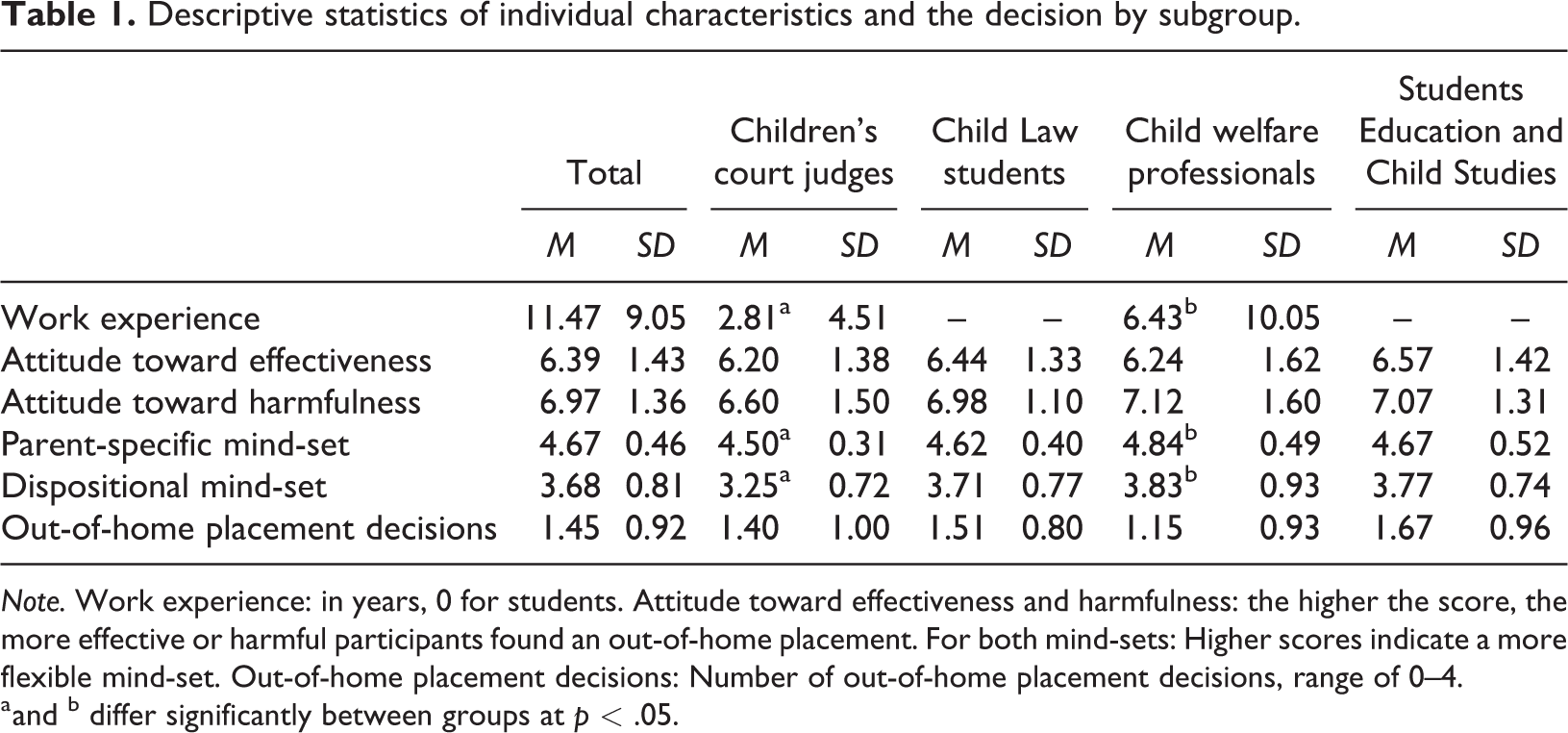
Note. Work experience: in years, 0 for students. Attitude toward effectiveness and harmfulness: the higher the score, the more effective or harmful participants found an out-of-home placement. For both mind-sets: Higher scores indicate a more flexible mind-set. Out-of-home placement decisions: Number of out-of-home placement decisions, range of 0–4.
a and b differ significantly between groups at p < .05.
Individual characteristics and out-of-home placement decisions
The relation between the different individual characteristics and the decision were examined with Pearson correlations (Table 2). First, professional background was related to work experience: judicial professionals were less experienced than child welfare professionals. Second, work experience was not related to any of the other factors. Third, attitudes toward the effectiveness and harmfulness of out-of-home placement decisions were not related, which confirm that these factors are separate constructs. Fourth, professionals with a more flexible dispositional mind-set found an out-of-home placement more effective than professionals with a fixed dispositional mind-set. In addition, a more flexible parent-specific mind-set and the view that an out-of-home placement is harmful were related to fewer out-of-home placement decisions. The number of out-of-home placements was not significantly correlated with work experience, attitude toward effectiveness of out-of-home placements, and the dispositional mind-set.
Correlations between individual characteristics and out of-home placement decisions.
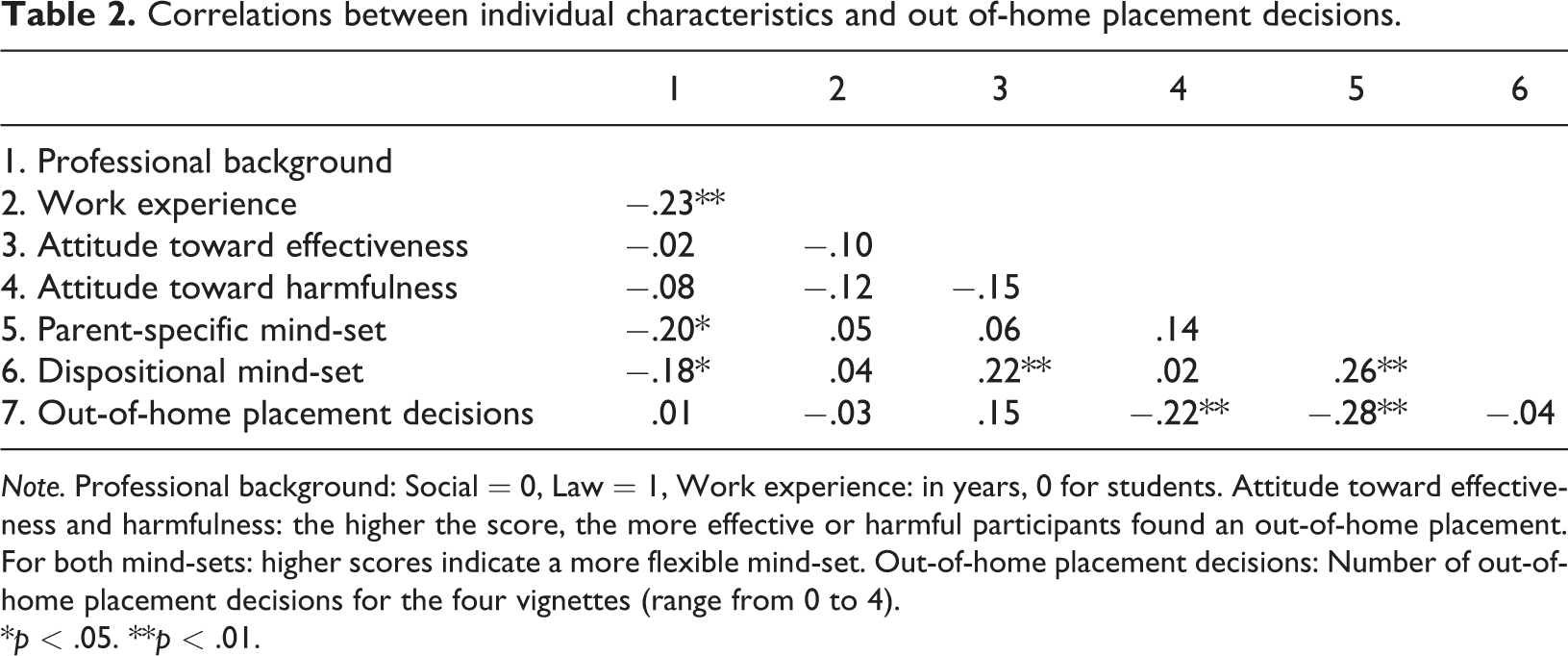
Note. Professional background: Social = 0, Law = 1, Work experience: in years, 0 for students. Attitude toward effectiveness and harmfulness: the higher the score, the more effective or harmful participants found an out-of-home placement. For both mind-sets: higher scores indicate a more flexible mind-set. Out-of-home placement decisions: Number of out-of-home placement decisions for the four vignettes (range from 0 to 4).
*p < .05. **p < .01.
Furthermore, for children’s court judges and Child Law students, the relation between their decision before the advice of the Child Protection Board and the decision after the advice of the Child Protection Board was r = .92. Of the children’s court judges, 54% changed their decision after the advice for one of the four vignettes (in both directions: from out-of-home placement to no out-of-home placement and vice versa). This was furthermore true for 58% of the Child Law students. Three children’s court judges and three Child Law students changed their decision for more than one vignette. Paired t-tests showed no significant difference between the first and second decision, t(144) = .45, p = .66.
A hierarchical regression analysis was used to test the relation between individual characteristics (work experience, professional background, the extent to which the professional considered an out-of-home placement decision to be more-or-less harmful or (in)effective and their dispositional and parent-specific mind-set) and the decision about out-of-home placement (Table 3). Work experience and professional background were entered in Step 1, explaining 0% of the variance in the out-of-home placement decision. In Step 2, attitudes toward effectiveness and harmfulness were added to the model, explaining 7% of the variance in the decision about out-of-home placement. The dispositional and parent-specific mind-set toward change were added in Step 3, adding another 7% to the explained variance in the decision. In the final model, only the attitude toward harmfulness and the parent-specific mind-set were significantly related to the decision about out-of-home placement. Participants who found an out-of-home placement more harmful and had a more flexible mind-set toward change in parents were less likely to place a child out of home than participants who considered an out-of-home placement less harmful and had a fixed mind-set toward change in parents. Work experience, professional background, effectiveness, and the dispositional mind-set were not related to the decision. Results did not differ when using the decision after the advice of the Child Protection Board as the outcome measure. Moreover, possible differences between the four groups were examined, no significant interaction effects were found for the relation between the decision about out-of-home placement and any of the predictors.
Multiple regression for individual characteristics and out-of-home placement decisions.
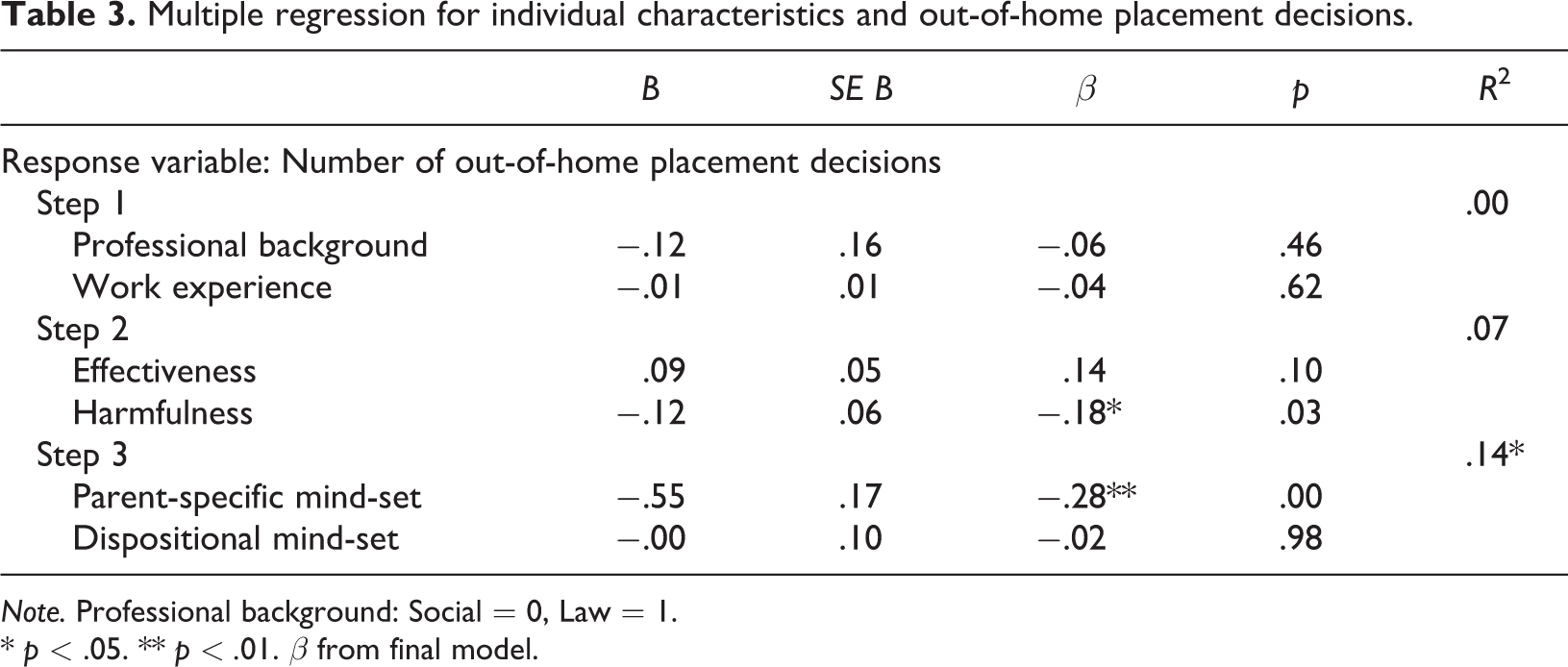
Note. Professional background: Social = 0, Law = 1.
* p < .05. ** p < .01. β from final model.
Discussion
Several psychological characteristics of professionals are related to their decisions regarding out-of-home placement of children. Professionals with a flexible mind-set toward parents’ ability to change, and professionals who considered an out-of-home placement more harmful, were less inclined to place children out of home than professionals with a fixed mind-set and who considered out-of-home placement less harmful. Work experience, professional background, the dispositional mind-set, and professionals’ attitude toward the effectiveness of out-of-home placements were not related to the decisions.
These results indicate that psychological characteristics of professionals (e.g., the parent-specific mind-set and attitude about harmfulness) play a role in the decision to place a child out of home, whereas more general factors (e.g., work experience and professional background) do not. Although the association between psychological factors of professionals and their decisions about out-of-home placement was predicted in other studies (Baumann et al., 2011; Garb, 2005), the current study is the first study to demonstrate a specific relation between professionals’ mind-set toward change in parents and their decisions concerning out-of-home placement. The belief that parents cannot change was the strongest predictor of an out-of-home placement in our multivariate model. The effect of a dispositional mind-set toward change was not significant, indicating that only the specific belief regarding the change in parents is related to decisions about out-of-home placement.
A fixed parent-specific mindset assumes that parents’ character, intelligence, and abilities are static and a given. They cannot be changed in a substantial way. It further assumes that any outcome in parenting, be it positive or negative, is the result of inherent abilities. On the contrary, a flexible mindset assumes that parents can learn and change, and any failure offers the opportunity for improvement and strengthening of abilities. Our results reveal that a fixed parent-specific mindset, the belief that parents are unable to change their behavior toward their child, and that their abilities cannot be improved, was related to more out-of-home placements. This finding is in line with our predictions. Possibly participants with a fixed parent-specific mind-set assumed that the placement would benefit the child, because they did not believe that the parents were able to change their parenting capacities. Another possibility is that participants with a flexible parent-specific mind-set felt that it may be preferable to work on factors in the family (e.g., parenting interventions or therapy) to improve the situation of the children. More research is needed to examine the mechanisms underlying the association between a parent-specific mindset and out-of-home-placement.
Moreover, the significant association between professionals attitudes toward harmfulness and out-of-home placement decisions shows that a professional’s perception of a child protection measure in general is related to his or her decision-making. These results are in line with previous research showing that attitudes of professionals toward the removal of the child are related to their decision-making (Davidson-Arad & Benbenishty, 2016). A professional’s perception of an out-of-home placement as harmful has been explained by professional’s personal experience with child maltreatment or neglect in his or her own life or in working with previous families (Pecnik & Bezensek-Lalic, 2011). Although the amount of work experience has not been shown to be related to out-of-home placement decisions, the type of experience professionals had with previous families and in their own family may explain how harmful they perceive an out-of-home placement (Pecnik & Bezensek-Lalic, 2011).
Although several studies found an association between work experience and professional background and the information professionals use in their decision-making (Britner & Mossler, 2002; De Ruiter et al., 2013; Drury-Hudson, 1997), the results of this study showed that these factors are not related to the actual decisions regarding out-of-home placement for child protection professionals. These different results may be due to the fact that previous studies focused on the information professionals used to evaluate child protection cases, instead of analyzing the actual decisions professionals would make. Moreover, previous studies examined the decision-making process in slightly different groups, that is, psychology students without specific education in decision-making and child protection measures, whereas we examined students of Child Law and Education and Child Studies who did receive this education. However, our results are consistent with a study that investigated out-of-home-placement decisions and found no significant association between professionals’ work experience and the actual decision about out-of-home placement (Sieracki, 2010).
Nonetheless, attitudes toward effectiveness of out-of-home placements and professionals’ dispositional mind-set toward change were not related to out-of-home placement decisions. A possible explanation for this may be that these factors are too general and not focused enough on these cases. Several professionals indicated that effectiveness was highly related to the specific case and a general statement about how effective out-of-home placements are was difficult to make, whereas the measure of harmfulness was more applicable for decisions in general.
Strengths and limitations
A strength of this study is the use of case vignettes based on official reports of the Dutch Child Protection Board, which were piloted to ensure that the vignettes were realistic and valid. A second strength is the recruitment of the different groups of professionals involved in the decision-making process regarding out-of-home placement decisions. By investigating all groups, it was possible to examine the variance between the groups and investigate the child protection system as a whole. Also, the individual assessments of the decision-making process instead of group assessments allowed for a careful consideration of personal beliefs and attitudes.
These results should be viewed in the light of some limitations. The individual evaluation of the vignettes differs from the way professionals decide about these cases in real life, which influences generalizability. Professionals were not able to ask for additional information, consult with other professionals, or speak to the family. Furthermore, it should be noted that the size of the subsamples of professionals was relatively small and participants were not selected at random, which reduces the generalizability of the results. Moreover, the questionnaire concerning the attitude of professionals toward out-of-home placement in general consisted of only two items (effectiveness and harmfulness) and more research into these constructs is needed.
Implications
The child protection field should reflect on the role of beliefs and debate to what extent decision-making should be based on beliefs that are most widely shared and supported by evidence (e.g., evidence that parents may be able to improve given the proper support). Moreover, professionals should be made aware of their beliefs and of the fact that these may influence their judgment and should be encouraged to use evidence-based protocols in the decision-making process in order to ensure that decisions are reliable and less influenced by decision-maker characteristics. Further research should examine whether the influence of these psychological factors can be reduced by making professionals aware of their beliefs and should investigate ways of enhancing the reliability of decision-making concerning out-of-home placement between professionals.
Footnotes
Acknowledgements
The authors would like to thank the student assistants for coding the vignettes. In addition, we greatly appreciate the assistance of the child welfare professionals, children’s court judges, and master students who participated in the study.
Declaration of conflicting interests
The author(s) declared no potential conflicts of interest with respect to the research, authorship, and/or publication of this article.
Funding
The author(s) disclosed receipt of the following financial support for the research, authorship, and/or publication of this article: Whitney de Haan and Lenneke Alink are supported by the “Jan Brouwer Fonds.”
