




Abstract
The purpose of the study is to describe how young care leavers conceptualize their subjective sense of wellbeing, as a lived experience during the “Odd Year” which refers to the first year of the COVID-19 Pandemic—from 2020 to 2021. Qualitative data from seven young people's open discussions by using the Time Out Method and essays. Principles of Joint Research were used. Fattorés theory of children and young people's subjective well-being as well as Eskelineńs (2020) themes of social philosophy during a disaster were employed in the analysis. The Odd Year's effect was to restrict agency relating to study and employment but simultaneously highlight moral agency. The downscaling of services created a sense of uncertainty. Background in Foster Care strengthened the sense of resilience and agency for some. The transformative resilience of society can be strengthened by peer support and by utilizing digital services in social work.
Care leavers are in a vulnerable position (Kuronen & Virokannas, 2020), especially as they enter adulthood. Their safety net is often fragile and there are generally few supporting social relationships. After-care in child welfare should support young people entering adulthood (Lastensuojelun käsikirja, 2022). Foster care for a child refers to managing the care and upbringing of a child taken into care, either urgently placed or placed pursuant to the temporary order outside the home. Aftercare refers to comprehensive, ongoing support offered to a child or young person after the period of foster care or long-term outpatient placement is finished, regardless of the child's age. There are around 8,000 children in aftercare in Finland. The major challenge of this group is the continuing disadvantage regarding education and employment (Cameron et al., 2018, pp. 163–172). The state is responsible for legislation and well-being counties arrange services (before 2023 municipalities were responsible for organizing services.)
The COVID-19 pandemic has impacted significantly on many areas of well-being of young people; resulting in increased levels of anxiety, symptoms of depression, and psychological strain (Suvisaari et al., 2022, pp. 43–45). The assessment of the Finnish Institute for Health and Welfare (THL) has shown that the service needs of young people in general (Aalto-Setälä et al., 2021) and those of young people in after-care, have increased (Eriksson et al., 2021). Most municipalities have reported that they have been able to respond to the increase in service needs to some degree (Eriksson et al., 2021). On the other hand, the operating preconditions for services at maternity and child health clinics, in pupil health care and in student welfare have deteriorated because of issues such as the transfer of staff from these facilities to COVID-19 services. This negative effect also applies to social welfare services. The pandemic has significantly restricted everyday life and social relationships, work, hobbies, and the freedom to travel with vulnerable people (Tiili et al., 2020; Wennberg et al., 2020).
We utilized, as the theoretical framework of the study, the theory of children's and young people's subjective well-being as described by Fattore et al. (2007) and the societal philosophical perspectives of the disaster period (Eskelinen, 2020). Unpredictability has been the base effect on the human experience during the disaster (Eskelinen, 2020, p. 234). Catastrophic times can be examined from the perspectives of justice, the human image, morality, and the possibility of change. The theory of “fairness” during a disaster period is based on identifying vulnerabilities, interdependencies, and the problems of marginalized people as problems for all (see above, 240).
In unexpected situations, the motivation to act changes, this being able to affect moral norms. The collective transition to a new code of conduct requires not only individual responsibility and functional capacity, but also moral feedback, communication, and also communal actions. It implies a balance between egoism and altruism, and in this process, solidarity can vary. After a disaster, the issue of returning to normal processes and norms arises. Transformation and a return to normal requires flexibility and resilience both from individuals as well as communities.
Narrow resilience, that is, a return to “normal” can be problematic if it is based on unfair work and an imbalance of burden sharing. A disaster as a significant societal interruption may function as an example of transformative resilience, that is, an opportunity for transformation, when society directs resources, so they are to benefit vulnerable groups (Eskelinen, 2020; Nagenborg, 2019). Disasters can speed up a positive transformation in society, and alter values and concrete behaviors, some of which may result in permanent changes. The material in this article has been collected during an extensive period of a state of disaster—during the first odd year in a situation where there was no indication of when and how a return to normality would occur.
Sociologists Fattore et al. (2007) have studied the subjective experience of the well-being of children and young people. For both children and young people, the most important aspects of subjectively experienced well-being are interpersonal relationships and emotional life. In fact, the subjective welfare of young people can be examined through the lens of three interacting areas: a sense of security, a positive self-image, and agency. Positive feelings, such as happiness, enthusiasm, and satisfaction, are associated with well-being. Interestingly, some young people also have the ability to integrate the emotions of hate or sadness into their lives as a part of their overall well-being (Fattore et al., 2007, p. 17). In the study conducted by Fattore et al. (2007), the subjects were aged 8–15, and it can be assumed that security, a positive self-image, and agency were key factors in well-being at this stage when young people enter adulthood. Good and bad events, either build on or weaken a sense of security, positive self-image, and agency. The feeling of positivity about one's own sense of agency and kindness, and the “I am OK”—is built on feedback from others. Agency is the opportunity to have an influence on everyday situations and social relationships, for example, in the context of school, in a housing community and in the network of friendship. The experience and feeling of safety result from not being taken advantage of, not being neglected, and not experiencing violence, bullying, and discrimination from one's own peer group and community. A feeling of self-respect is linked to the experiences of positive acknowledgement (Fattore et al., 2007, pp. 61–65).
The overall aim of our study is to understand how young people conceptualize their subjective well-being during this odd period in the light of their life experiences, in their own words. Their subjective experiences may highlight as yet, unknown themes and complexities, that have not previously been put into words. Our interests are the young people's “here and now” experiences, which have been impacted by the pandemic.
Method
We performed the study in cooperation with the Finnish Institute for Health and Welfare (THL) and child-welfare organization Pesäpuu. The research material included thematic discussions with young people and two statements written by the young people. Pesäpuu and the Finnish Institute for Health and Welfare invited care leavers, to speak about their experiences of the odd year at three discussion events which were organized during the spring and autumn of 2021, each session lasting from 1.5 to 3 hr. Discussions were advertised widely on Pesäpuu's social media channels and communicated to young “experts,”, belonging to the target group. Participation was possible for anyone, but in practice, the discussions took place with young people who had had previous experiences of participation. Some minority groups were represented among the young people who participated, but the goal was to make participation safe for everyone, without any special attention drawn to any minority group. The number of young people's participation was influenced by a number of factors, but this did not affect the study. Increased marketing and communication would have allowed more young people to attend. However, the number recruited to this study was sufficient for useful data analysis. Young people were encouraged to participate in more than one thematic meeting, but this was not mandatory. A total of seven young people participated in the discussion events, with five of them participating in both the first and second events. Four participated in the third event. All had participated in the first and second discussions. The age range for the subjects was between the ages of 18 and 25 years and all had been placed either in a child welfare institution, a foster family and/or a family home. The client relationship with child welfare after-care had already ended for some of the young people who took part in the interview, as they had reached the age of 21 years before the age limit was raised in 2020 (the current age is 25 under the Child Welfare Act 417/2007). Some were still covered by after-care from the service. The discussions relating to after-care included those young people who had already left the service by posing the hypothetical question “What if you were still a client of after-care during the pandemic year?”
The young people were asked to provide detailed, in-depth explanations of their experiences and they also had the invitation and encouragement to write about them. In this regard, we received texts from two young people, neither of whom had participated in the discussions. These texts are just over two pages in length with a font of 12 and line spacing of 1.5.
The Timeout discussion method was utilized in the discussions (Erätauko-säätiö, 2021). “Timeout” is a mechanism to engage in a constructive and balanced discussion, with partners on an equal footing, with the aim of increasing mutual understanding. The discussion was facilitated by an expert with experience employed in Pesäpuu. The meetings were attended by the young people, a facilitator and three to four THL researchers.
The process was as follows: all attendees were introduced and welcomed. The facilitator then initiated the conversation and reviewed the rules of discussion. With the help of common rules, young people were instructed on how to engage in dialogue as follows; listen to others; do not interrupt; join in others’ speech; talk about your own experience; ask if you don't understand; be present; respect others and the atmosphere of trust; think calmly and give room for incomplete thoughts (Suomen itsenäisyyden juhlarahasto Sitra, 2018).
The discussion commenced with the facilitator's introduction of the coronavirus year and its impacts on people. After the introduction, a joint discussion began on the participants’ experiences of the discussion theme, that is, the odd year. As the discussion progressed, the facilitator added depth to the discussion by asking more detailed questions on the issues raised by the participants that were in accordance with the themes agreed in advance by the researchers. The discussion had the characteristics of an open thematic interview. It included themes, but it was not essential to the discussion that the participants being interviewed all understood the topics in the same way, in accordance with the theoretical framework (Tuomi & Sarajärvi, 2018, p. 77). Researchers from the Finnish Institute for Health and Welfare participated in the event and reflected on what they had heard during the discussion, when the facilitator provided them with a suitable opportunity for them to give their impressions. The themes of the discussion were: (a) What good experiences, challenges, or problems you experienced that related to the exceptional circumstances caused by the COVID-19 pandemic? (b) What are you optimistic about? (c) What would you like to happen in the future?
During the first discussion in May 2021, young people had the opportunity to talk about how the first pandemic year has felt, what thoughts it has raised and how it has affected their own lives. The second discussion in June 2021 focused on the themes that emerged during the first discussion. The third discussion took place in October 2021, at which time we spoke with young people about how the process had progressed until that point and what the next steps were. After this, we considered the structure of the article and the results that resulted from previous discussions. Thus, the process contained some features of joint research (see Palsanen & Kääriäinen, 2015). In this regard, young people commented on the results and analyses and suggested the themes for the second and third discussions. Even though one of the researchers is a registered social worker, as a research team we did not have direct contact with service providers. The results of this research have been utilized in the THĹs development programs for social workers working in the area of aftercare.
Collection of the material from discussion events was carried out using the Microsoft Teams application. According to the instructions of the Finnish Institute of Health and Welfare (19 February 2021), only public or nonconfidential information in its preparatory stage can be processed within Teams meetings. Confidential matters are allowed to be discussed during meetings, as long as the session is not recorded in Teams. The conversations in Teams were recorded on a dictaphone. THL researchers then transcribed the recordings. After the transcriptions were completed, the recordings were destroyed. A total of 47 pages of transcribed text were accumulated in font size 12, with a line spacing of 1.5. The material is put in THL's system for storage of confidential information, with only THL researchers involved in the research have access to.
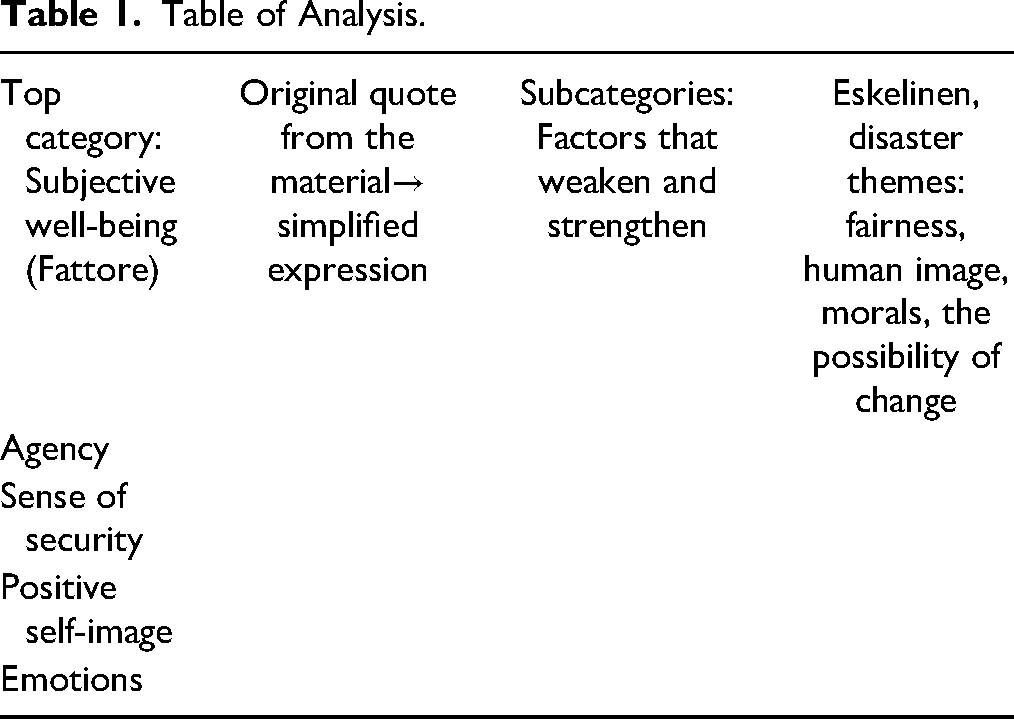
We analyzed the material using the principles of theoretical content analysis (Tuomi & Sarajärvi, 2018, p. 117). All four researchers participated in the analysis of the data in two groups. According to the principles, theoretical connections are identified, their purpose being to assist the process of analyzing the material. (Tuomi & Sarajärvi, 2018, p. 96.) We prepared an analysis table (Table 1.) of subjective well-being contents, according to the theoretical core concepts of Fattore et al. (2007). The feeling of one's own agency, sense of security, and a positive self-image were the top class. We identified and selected those factors that strengthen and weaken these as subcategories, then the expressions related to the top category and subcategories from the material, the latter being in the forms of quotes. The quotes were edited to create simplified expressions, and these formed the logic structure used in reporting the results by subcategory. The themes of social philosophy during a disaster were linked to the analysis table because the quotes reflected these themes. The themes included the following: fairness during a disaster, human image and morality, and the possibility of change (Eskelinen, 2020). Data relating to emotions was analyzed as a separate topic, as this was a key content in one discussion according to Fattore et al.’s theory (2007).
Table of Analysis.
Ethical Aspects
We invited the participants to the discussions with an open invitation. We published the nature of the discussions in the event notification (Pesäpuu ry). In addition, we sent information letters on the study to those who had registered before the first two discussions. At the beginning of the discussion, the participants were told that the discussions should remain confidential and that the young people would not disclose any information on themselves that could be published and utilized anonymously in the context of research. We explained to the participants that the conversations would be around their own experiences and views of life as well as about the everyday support and general services that they had. We facilitated group discussion, based on the principles of open dialog, focusing the discussion on the preagreed main themes and introducing depth to the discussion as the themes emerged. The facilitator ensured that the participants had equal opportunities to participate in the discussion and limited the focus to a sufficiently general level through reflective listening and highlighting certain points. During and at the end of the discussions, the participants were given the opportunity to discuss how they felt about the discussion and were provided the chance for a one-on-one reflection with either the facilitator or researchers. In this way, we wanted to ensure that if the young person needed additional support, we could refer them appropriately. At the end of the event, we verified once again with the young people whether we could use their communications as research material.
Results
We used Fattore et al.'s (2007) theory to describe how the COVID-19 pandemic has undermined or partly strengthened the agency of young people as well as in what way it affected their self-image and feeling of safety. Eskelinen's (2020) theoretical framework for the disaster period was used to examine the issues of moral agency and resilience at the level of both individuals and society. At the conclusion of the result chapter, we focused on how young people felt that society and in particular, how child welfare after-care responded to their need for support and services, during this odd year and how support and services could be developed.
The COVID-19 Pandemic as a Period That Undermined and Strengthened Agency
The participants highlighted how restrictions related to the pandemic impacted their agency. These were in the context of study, pressures related to coping alone and new practices that they implemented when they became ill. The prolongation of the pandemic created additional challenges. The pandemic brought out coping methods which could be considered as being both negative and positive.
The agency changed as physical facilities and the implication of those facilities changed. Young people pointed out the changes that related, as a result of the pandemic, to facilities such as the home, the school, and where they could either study or attend a social gathering such as a party. Facility-related issues relating to substitute care were also discussed from the perspective of the young people's home holidays and their rights. The significance of the home changed so that for many, the home became a place of work and study, in addition to being a traditional home where they could spend their leisure time. The home became an isolated learning environment for some. For example, those young people who had gone to study, alone, in another municipality felt that their apartment was a trap where they were unable to experience social relationships and use their new study environment. During the pandemic, there was also limited access to other facilities, such as the library.
Changes took place in the significance of social relationships simply because social contacts had to be restricted. Various emotions, such as fear of being infected or infecting others with the virus, affected the maintenance of social relationships. Getting and receiving support became increasingly difficult; traditional face-to-face community activities were discontinued or significantly reduced. For example, the usual activities taking place in student communities were discontinued abruptly and often completely and new students found it impossible to get to know fellow students. This made it more difficult and uncertain to create new contacts. For many, studies were carried out remotely, which generally meant working alone. Just maintaining the momentum of one's studies was considered challenging. Because of the pandemic, the effect of the restrictions on movement and contact was amplified; and this increased the experience of loneliness and that of missing loved ones. It has been a bit disappointing that not all my relatives want to meet with me because of the COVID thing, because I really like to visit relatives. (Discussion a, young person 2)
Contact with relatives and social support received from relatives decreased as young people could not meet their relatives as they had done before, a restriction which undermined their experience of agency.
The pandemic was also described as affecting workload. One subject reported that the amount of workload he had to carry in his salaried position had become increasingly unreasonable. On the other hand, it was also discussed that the pandemic had negatively impacted the employment of many people. The COVID-19 pandemic also had the effect of strengthening agencies in a more conscious direction. Strong agency was observed in the ability to examine the impacts of COVID-19 on other people. Young people assumed responsibility for others and mentioned the importance of providing guidance to their loved ones. They found new ways of letting loved ones know that they were important and their many levels of concern to others such as the elderly, and other young people who are marginalized or who have dropped out of their studies. Discussion on morals was also related to travel.
Young people pointed out that their previous adaptation to child welfare practices, “project life,” helped them cope during the pandemic. Unpredictability did not have as much of a paralyzing effect: I am really quick to adapt … I like to live project-based life in great part because of child welfare, because I have always lived in those 6-month and 1-year target cycles. (Discussion a, young person 1)
Some felt that conversations with friends, friends and loved ones have deepened. Many felt that love for one's fellow man and a sense of community had increased during the odd year, and that the desire to be of assistance had increased, strengthening the sense of agency. During the pandemic, a need emerged to do such things to develop one's own competence and in relation to loved ones, how to keep in touch. One subject mentioned that the grandparents had been taught to make video calls. I don’t know if it's a love your neighbor type of thing or a desire to help someone closest to me or what, but at least here … where I live, a COVID-19-assistance-facebook group was established right away, and it has been really nice to see that people genuinely want to support those who are slightly less well-off than they themselves or something. (Discussion b, young person 1)
Young people felt increasingly responsible for other people and their health. Being ill changed the nature of the illness. Notably, COVID-19 tests, quarantine and the related extra stress added a burden to the agency. The young people spoke about domestic travel or meeting friends and family who lived in other locations.
…It is very stressful in a certain way when you know that you yourself are healthy and free to go. Then you're responsible for the lives of everyone else and you have to behave like this….
Future orientation was a feature of the agency that was negatively impacted by the COVID-19 pandemic. Time management was a challenge and weakened the feeling of agency because the duration of the Odd Year could not be predicted. Personal coping was regulated by setting time limits, which in turn caused disappointment when set time limits were not able to be kept. Because we’d been prepared for it to last just a year, and had a power through it attitude, and then it was no longer a year, but an unspecified amount of time. Then there was uncertainty. (Discussion b, young person 2) My coping is beginning to be really limited because this situation has continued for a year, and it's not ending or not easing up, so I’m fed up. (Discussion a, young person 3)
The extension of the COVID-19 pandemic reduced the sense of control and thus caused uncertainty in young people's lives. If the future becomes blurred, the agency will turn inwards, perhaps even into practices that are harmful to oneself, such as an increase in alcohol consumption. Some described increased alcohol consumption and emotional eating as means to alleviate negative emotions. Some found themselves working excessively despite being exhausted. The time spent on social media and computers increased, which did not seem either positive or negative. On the other hand, activities such as self-care, for example, smoking cessation gained momentum during the pandemic year. An increase in physical activity had been beneficial for some. Young people also described reanalyzing their relationship with their life situation and their support networks. During the pandemic, one's life and life circumstances were seen in a new light. The pandemic was described as created new ways of analyzing life and stimulating moral reflection. The pandemic hampered agency and put a strain on people, but on the other hand, it offered the opportunity to simply stop, the right to stay at home and to quieten down. In this way, the Odd Year allowed people time to think about their own lives, circumstances, and social relationships, which provided building blocks for creating a new kind of self-image and agency. For one respondent, the pandemic contributed to a positive change: they found a new direction in life in the form of studies and a change of field.
Impacts of the COVID-19 Pandemic on Self-Image and Sense of Security
Young people highlighted their experiences in relation to the challenges brought about by the Odd Year. Self-image was now created through both extroversion or introversion, performance-centeredness, incompleteness, escapism, moral agency and the emergence of past experiences in the pervasive crisis situation.
Those who felt they were extroverts suffered more from the restrictions concerning social contacts, whereas those who felt more like introverts thought that the Odd Year was favorable, as they did not need to expend as much energy on social interactions. The Odd Year reduced performance-centeredness and provided some people with an opportunity for escapism when they were allowed to spend time alone. It also prompted people to dwell on questions such as “who am I,” “what kind of things do I feel are important,” and “what are the areas in which I still need to develop.” So, it got me to thinking about how incomplete I am in other matters, if you know what I mean. The COVID-19 year made me think about who I am and what I think is important. (Discussion b, young person 6)
The Odd Year enhanced the experience of those who had previously experienced substitute care in a novel way in relation to the majority population. The young people felt that the setbacks they themselves experienced were comparable to the challenges faced by all people during the COVID-19 pandemic. For example, some young people felt that the pandemic has taught people (in general) a lesson—others have now had to experience restrictions and thus identify with the experiences related to the restriction of movement of young people in foster care: In the child-me an angsty teen awakes, who has lived in an institution and a tiny flicker of schadenfreude emerges with thoughts like now you know how it feels when your freedom of movement is restricted and you can't get out, just look and suffer, because I too have suffered (laughter). (Discussion b, young person 2)
From the perspective of self-image, the Odd Year may thus have affected some young people in a way that allowed a healing of their self-image.
The sense of security among the young people interviewed was influenced by individual factors, such as their personal history and nature, the way the media reported the pandemic as well as their own personal experiences and those of their loved ones. A sense of security was manifested in different feelings to which young people reacted as active actors. At some point, you just learned to live with these feelings, disbelief and fear. Writing helped me a lot, as did jogging and occasionally blacking out the news entirely. (Text b)
The way the media reported on the COVID-19 pandemic had a negative impact on people's sense of security. Young people encountered many opinions and arguments related to issues such as wearing masks and taking vaccines. News coverage was also contradictory at times, and this led to difficulties in formulating personal opinions. The Odd Year produced many kinds of feelings that could be considered negative in young people. Young people described both conflicting feelings and fears, feelings of guilt, uncertainty, disbelief, and concerns about other children and young people, as well as increased anxiety and loss of security. Fear due to the current situation, and of course I've thought about the future, will it ever be normal? Is it now normal for us to be careful all the time? (Discussion b, young person 6)
Feelings that were considered positive, such as hope, gratitude and compassion, and showing yourself and others mercy, were highlighted during the discussions. The sense of security was strengthened by being in Finland, which was considered a safe place, and which has managed the COVID-19 pandemic well. Well, I realized I felt grateful for living in Finland and for the fact that things have been going considerably well this entire time, despite the situation, and no one close to me has fallen ill with coronavirus, so grateful for that. (Discussion b, young person 1)
The sense of security was also strengthened by relating the current situation to history—“crises have been overcome before, and this one will be beaten as well.” In this way, young people identified factors related to their sense of security and actively strengthened their own sense of security through actions and internal speech.
Child Welfare Aftercare—Potential Support During the Crisis?
Lastly, we examine how young people analyzed the role of child welfare after-care during the COVID-19 pandemic in relation to improving the sense of well-being of young people. The role of after-care did not come up spontaneously in the discussion. In part, this reflects the young people's culture of independence and resilience and in part that although the young people had gained independence from substitute care, the researchers did not ask whether they were subject to after-care. In fact, only one young person brought up the client relationship spontaneously. The young people's perspective was their previous aftercare, and this was compared to their experiences during the pandemic and how their own aftercare would have responded to the needs that the pandemic had created. The discussions did not highlight service or support dependency as the primary regulatory mechanism or a safety net for the challenges related to the pandemic. However, when asked specifically, the young people said that they felt that becoming independent of substitute care was a major event in a young person's life and that it required support from a social worker.
The postdisaster period mentioned by Nagenborg (2019) and Eskelinen (2020) could not be examined in this study, but it was clear after 1 year of enduring the pandemic that, according to the principle of transformative resilience, resources had not been specifically allocated to child welfare after-care. Overall, young people tended to emphasize that child welfare after-care had not responded proactively and promptly to young people's needs at the time of the pandemic. There was no crisis communication implemented to support young people. COVID-19 restricted physical encounters, which is why the discussion focused on the implementation of remote meetings as part of good aftercare.
Threats and Opportunities of Remote Communication
The facilitator of the discussion asked the young people whether they felt that meetings with after-care social workers would have been possible remotely. Young people saw the use of digital tools as an opportunity and noted that in many situations, it would have been both possible and relatively easy to meet the after-care social worker remotely even during the restrictions caused by the COVID-19 pandemic if the tools and practices had been agreed upon. Young people did consider and question as to whether the general public has equal opportunities to participate in remote meetings as regards devices and online connections. Young people were unanimous that remote connections cannot fully replace the physical contact, which played a major role in the child welfare setting. At least when I was younger, I wouldn't have minded if it was done via video, and it you ask for help with attachments, it would have been fine to take a picture the paper and show it via video and the other person then reads it for example. In my opinion, everything like that could at least be done through video. (Discussion b, young person 3)
In the absence of national guidelines, young people who are clients of child welfare services have been at a disadvantage, even before the COVID-19 pandemic as to whether they receive support from social workers through remote connections (Kaijanen et al., 2020, p. 37). Young people would like equal treatment and be able to determine what methods of contact would be suitable for them to communicate (Liukkonen et al., 2020, p. 10). It is clear that Child Welfare services need to develop national guidelines on the ways that contact can be implemented remotely. This is one important way to encourage positive transformative resilience to support young people in vulnerable situations, during and after the crisis.
Challenges and Opportunities of After-Care in Child Welfare Highlighted by the Pandemic
Young people mentioned that they would like more permanence in their relationship with a social worker and also would appreciate proactive contact from the social worker. Some of the young people reported that their social worker changes often and that communication from the social worker is sporadic, intermittent, or, in some instances completely nonexistent. From a practical point of view, young people felt that they simply did not have the support they needed. When no sustained, trusting relationship had been established, the bar for contacting after-care when teens encountered challenging situations was simply considered too high. Another factor that increased the threshold for contacting a social worker was the feeling that the social worker was constantly rushed and overburdened. On the other hand, some young people had good experiences with their social workers with whom they could spend unpressurized time together. However, the pandemic had clearly caused a reduction of contact and, because of the physical restrictions had prevented face-to-face meetings between young people and their social workers. In this way, support had been poor in the crisis situation caused by the pandemic. The young people emphasized the need for consideration of their individuality during the discussions; individual needs and finding the most suitable means of communication and meeting were considered important so that the meetings could be unhurried, relaxed, and useful. Young people said they also needed individual guidance to get the right kind of assistance. As young people considered child welfare after-care as a form of support for adulthood and as an activity that strengthens a young person's sense of security, they often expressed a desire for, as an example a relationship-based social work (e.g., Ruch et al., 2017)—in which the social worker gets to know the young person. There were good experiences which were described: My social worker is so good. The worker wanted to meet up with me so I’d have something to do and wouldn’t always be at home …. They wanted to get to really know me and chat about whatever. (Discussion b, young person 4)
Young people longed for positive encouragement. A feeling of self-respect is linked to experiences where there is positive acknowledgement—both formal and informal (Fattore et al., 2007, pp. 61–65). For example, some young people interpreted the poor proactive communication by child welfare after-care during the COVID-19 pandemic as escapism by social workers to avoid contacting them. This interpretation by young people is likely to negatively impact the young person's experience of self-respect and prompted young people to think: “am I an important, valuable, appreciated person to the social worker, or just a burden.” One of the young people emphasized the importance of positive encouragement and the attention provided by a social worker such as being positively rewarded as an incentive for going to drug screenings, as well as the feeling that someone would be happy that the screenings showed a negative result for drugs also during the pandemic. If the young person had experienced such a motivating atmosphere in the relationship, this would have been useful to maintaining sobriety—especially in the setting of the coronavirus pandemic—but instead, the opportunity was presented of going down the wrong track with the added danger that the relationship with the social worker could end.
The young people pointed out that there was no uniform understanding of the best location to meet, either at home or at the office. According to the young people, a good social worker is flexible and has good situational awareness. Young people highlighted that they would like for after-care social workers not to simply assume that the young person is doing well and that the client/social worker relationship would not be terminated easily. They were aware and indicated that maintaining close contact was considered important. I’ve had the same kind of experience that I had a nice after-care social worker, but as I was conscientious and managed my affairs well, I was rarely asked how I was doing, which is also a dangerous starting point for many things, as many things can be going on under the surface, even if they never hear about it. That's why we need them to take more initiative, both during the Pandemic year and otherwise. (Discussion b, young person 5)
It is essential that child welfare after-care support and services workers reflect on how this “societal parenting” meets a young person's need for support, guidance and services as a parallel element; when a young person or society is experiencing a crisis or challenges, but also when the young person and or society is experiencing more even periods. The question could be asked as to whether a young person's biological parents would generally leave a young person alone and without encouragement and support when the appearance was that their everyday life is under control.
Discussion and Applications to Practice
The COVID-19 pandemic had been ongoing for almost 2 years when this article was written. Discussions with young people focused on the situation they experienced when the COVID-19 pandemic lasted for more than a year. Young people's experiences have evolved in a systematic manner in terms of both the uncertainty created by the sudden closure of their society at the onset of the pandemic and the optimism resulting from the gradual opening of society as the pandemic evolved as well as the effect of the prolonged duration of the pandemic.
The odd year restricted young people's agency in their studies and working life but also highlighted moral agency. The downscaling of services as a result of COVID-19 had the effect of detrimentally affecting young people's self-image and emphasized the feeling of uncertainty. In contrast, while the pandemic year had a negative impact on young people's sense of security, it also, in some, highlighted their resilience and willingness to support their loved ones.
A background in child welfare strengthened the agency of some young people—they were already used to everyday life, where their movements were curtained, and life was very regulated and project-like. Interestingly, catastrophic events can strengthen moral agency. In this context, altruism requires awareness of other people's activities (Eskelinen, 2020), and young people are aware of the widespread impacts of the coronavirus on their friends and family as well as more extensively on different groups of people. They described active deeds for the benefit of loved ones. The stronger role of central government control during the odd year both increased moral reflection and challenged agency. On one hand, young people considered how instructions and regulations created security in the battle against a mutual threat, while on the other, the forced compliance with restrictions frustrated them. At the individual level, young people grappled between the two horns of compliance and noncompliance as well as altruistic and egoistic solutions. From the perspective of young people, the odd year was unique, but it challenged agency. During the COVID-19 pandemic, the everyday life of young people was overshadowed by the increased difficulties and the uncertainty of work and studies, which was emphasized when a social support network not being available due to the restrictions caused by the pandemic. This applies to many young people in the process of becoming independent irrespective of their status as a Child Care client. As a result of the restrictive measures, young people were isolated in their homes and could not meet their loved ones in the manner they usually did, and concerns related to falling ill or a loved one getting COVID were constantly present. The pandemic had, in fact, a significant impact on young people's sense of security. Their sense of security was negatively impacted by many factors, such as the conflicting information received from the media and the uncertainty of the situation. Conversely, it was positively impacted by factors such as the sense of belonging and trust in authorities and the instructions from them. The prolonged COVID-19 pandemic affected future planning. Alcohol consumption and emotional eating increased in some participants. On the other hand, discussions with friends and other loved ones were common and peer support brought a sense of security.
Young people highlighted their concerns about the diminished services during the COVID-19 pandemic and that communication was simply not up-to-date. The young people hoped for a contact-driven work approach from the social worker, in which he/she would be contacted, even when the young do not initiate contact. The young people's message was that after-care was observed to be not equal—some received strong support while others simply did not. After-care is a special service, because when society has assumed custody when taking a child into care, responsibility for a kind of parenthood continues in the space of after-care. The COVID-19 pandemic has highlighted the significance of this aspect of child care. The transformative resilience of society could be increased for future crises by creating flexible structures for peer support for young people. Location-independent support can be organized using digital services. Well-being services counties could facilitate such activities. Due to the rise in the number of young in after-care, peer support groups in this regard are becoming increasingly important and should be organized by social workers.
Although the results from this study cannot be generalized, it has served to highlight, how the pandemic affected different groups of people and in particular, what consequences the restrictions brought about by the pandemic have had on the subjective sense of well-being of young care leavers. The results have also informed social work practices.
Footnotes
Declaration of Conflicting Interests
The authors declared no potential conflicts of interest with respect to the research, authorship, and/or publication of this article.
Funding
The authors disclosed receipt of the following financial support for the research, authorship, and/or publication of this article: This work was supported by the European Social Fund Plus,
