



Abstract
Keywords
Social work regulators and professional associations require practitioners to keep up to date with research as part of their continuing professional development; the UK (Northern Ireland Social Care Council, 2023; Scottish Social Services Council, 2016; Social Care Wales, 2017; Social Work England, 2019), USA (National Association of Social Workers, 2021), Australia (Australian Association of Social Workers, 2013) and many other countries have similar requirements. Consequently, qualifying social work programs at Bachelors or Masters level often provide research training, which may include a requirement to complete a dissertation. This is usually an in-depth piece of work that enables a student to focus on a particular issue or problem in relation to social work practice. This typically takes the form of a long essay or a systematic review, or an empirical study with the collection or analysis of data. Its primary purpose is to enhance students’ learning about social work research through in-depth study on a topic of interest to them. However, they have potential value beyond determining an individual's degree outcome and can generate original knowledge for social work practice. This narrative review synthesizes papers published from practice research dissertations of a postgraduate social work program with the aim of exploring the potential value for social work practice of empirical research training on qualifying programs.
There is some debate about the value of student dissertation research in qualifying social work programs. They are typically small scale and often use qualitative methods to collect and analyze data (Carey, 2013). Unlike doctoral dissertations, they are usually unpublished and are not generally expected to contribute to knowledge in the profession (Dellgran & Hojer, 2001). (However, even the publication rate of doctoral dissertations is reported to be low, with one study of 593 dissertations finding fewer than 30% were published (Maynard et al., 2014)). Publication is not the primary purpose of student dissertation research on qualifying programs; they perform their role by providing research training and supporting students to immerse themselves in a social work topic. They also help students to understand the evidence underpinning social work practice and to connect research with practice.
Graduates from a postgraduate social work program in the UK perceived their research training to be an important element of their professional development as it fostered their research mindedness in practice (Vincent & Hamilton, 2021). However, practitioners are less positive than social work students about using research evidence in practice (Prock et al., 2022). This is supported by studies which have found a partial adoption of evidence-based practice by practitioners (Liedgren & Kullberg, 2022; Parrish et al., 2023). Time, cost, lack of relevant and reliable research, and service user preferences were cited by social workers as barriers in one study (Washburn et al., 2021). Whereas another found that social workers’ attitudes to evidence-based practice were more positive where there was support and encouragement to implement research in practice from colleagues and their organization (Kagan, 2022).
The (real or perceived) gap between research and practice in social work is frequently discussed, with challenges being faced by both practitioners and researchers. On the one hand, there is evidence of social work in many high-income countries becoming increasingly process-driven with less latitude in practitioner decision-making, which stifles the use of research in practice (Higgins, 2015). On the other hand, there is some evidence that social work academics lack time and skills in teaching research to their students, although its importance was recognized (MacIntyre & Paul, 2013), in addition to academics’ existential concerns about their ability to inform social work practice (Webber et al., 2014). Further, a study in the US found that social work academics were generally ambivalent about the extent to which their research had an impact on social work practice (Teater, 2017). However, as research funders such as the Economic and Social Research Council and the National Institute for Health and Care Research in the UK require plans for impact to be specified at the outset, it is likely that the gap between research and practice has narrowed since these earlier studies. In addition, the international growth of practice research in social work (e.g., Austin & Carnochan, 2020; Joubert & Webber, 2020) indicates that practitioners and researchers are now working closer together to answer practice-based questions (Joubert et al., 2023). Bringing insights from practice research back into social work dissertation teaching provides an opportunity to connect the domains of practice and research in social work at source.
The practice research dissertation option of a postgraduate qualifying program in mental health social work provided training to students in using empirical research to answer practice-based questions. Students developed their own research projects in response to questions which arose from their practice learning during the program. The curriculum (Webber, 2020) provided training in research methodology linked with supervisor support throughout the research process. This included how to: undertake a literature review to assess existing evidence and define the gap in knowledge; develop a research question which is feasible to answer within a postgraduate practice research project; select an appropriate methodology with a particular focus on common methodologies used in practice research; use an appropriate method of data analysis (this included training in both qualitative and quantitative methods); consider ethical issues in the design and conduct of practice research (including completing an application to an ethics committee); and write up the research. The module assessment focused on utilizing the findings in practice and included the submission of a 6,000-word paper in the format of a journal article and a plan for students to disseminate their findings to increase the potential for impact on social work policy and practice. It thereby aimed to provide students with a grounding in practice research methodology alongside a focus on connecting research findings with practice.
This narrative review aims to explore the papers reporting research conducted on this dissertation module which were subsequently published in peer-reviewed journals. It is acknowledged that this is a small proportion of all the studies which were conducted in the first three cohorts (11 out of 75; 14.7%), but they represent those which met the discipline's publication standards. It thereby permits an exploration of the potential for students on a qualifying social work program to contribute to the evidence base for the profession. This review aims to explore the types of topics covered, methods used and their potential impact on practice.
Method
Protocol
This review was structured according to the PRISMA extension for scoping reviews (Tricco et al., 2018). A protocol was written but was not published.
Eligibility Criteria
The eligibility criteria for inclusion in the review were all papers published in peer-reviewed journals reporting research conducted on the practice research module of the MA Social Work Practice (Think Ahead) program at the University of York by students in the first three cohorts (starting in 2016, 2017 or 2018; n = 75). All papers published before April 2023 were included in the review.
Information Sources and Search Strategy
To identify papers for inclusion in the review, all academic supervisors working on the program were contacted for details of papers which were published by their students. In addition, an author search was conducted in Web of Science, Medline and Google Scholar of students who completed the module to identify any papers which were published independently of academic supervisors. Students who were known to be submitting their research to a journal were also contacted so that their papers could be included if published prior to April 2023, the cut-off point for the review. Details of these search strategies are not published to ensure the confidentiality of students whose work was not published.
Selection of Sources of Evidence
The first two authors screened the papers which were identified in the search and applied the inclusion criteria. As they led the program and the module, they were able to identify research which had been conducted on the program. All papers which were screened met the eligibility criteria for the review.
Data Charting Process and Items
The following data were extracted from each paper by the second author into a Microsoft Excel spreadsheet: research design, participants, key findings, main limitations, and practice implications. The number of views, Google Scholar citations and Altmetric attention scores (AAS) were recorded for each paper. AAS values are calculated by an automated algorithm to give an estimate of digital reach (García-Villar, 2021). In addition, lead authors for each paper were contacted for information on the dissemination activities they had conducted. This data was recorded in a spreadsheet designed and piloted by the research team. It was reviewed by the other two authors for accuracy and completeness.
Critical Appraisal
The papers were quality appraised by two researchers, which included an independent author who had not been in involved supervising students or writing papers. Studies were quality appraised to assess their risk of bias, their reliability, and the validity and utility of the findings. Three separate tools were used to assess different methodologies. Qualitative studies were assessed by the Critical Appraisal Skills Program (CASP) for qualitative studies (Critical Appraisal Skills Programme, 2018) and cross-sectional survey studies were assessed using the Appraisal Tool for Cross-Sectional Studies (AXIS) (Downes et al., 2016). Where studies used a combination of cross-sectional surveys and qualitative methods, an approach recommended by Hong et al. (2018) was utilized, that involved first assessing each component of the study (in this case, we used CASP and AXIS), before then using a Mixed Methods Appraisal Tool (MMAT) to assess the appropriateness and effectiveness of the two methods being used together. Any differences in scores were resolved through discussion.
Synthesis of Results
Extracted data were analyzed thematically to explore the themes and findings of the research, and to summarize implications for policy and practice in mental health social work. This followed Braun and Clarke's (2006) process of coding data; collating codes into potential themes; and reviewing and confirming themes. The potential impact of these practice research studies was also summarized in a narrative review.
Results
Paper Selection
Eleven papers met the criteria for the review. They were all identified by the authors through personal contact with the paper authors and additional searching returned no additional papers. A PRISMA diagram is not included as additional screening was not required.
Paper Characteristics
Seven papers used qualitative methods (semi-structured interviews) (Cochrane et al., 2021; Kang & Moran, 2020; Martins & Tucker, 2023; Meadows & Moran, 2022; Samuels & Moran, 2021; Thornton-Rice & Moran, 2022; Wakeman & Moran, 2022); two used quantitative methods (online cross-sectional surveys) (Dunlop & Cetrano, 2022; Hines & Leishman, 2022); and two used both of these methods (Bonnet & Moran, 2020; Lonsdale & Webber, 2021). The four studies which used cross-sectional surveys were recruited nationally in England, though the seven qualitative studies were conducted solely within the first author's own agency. Sample sizes were between five and twelve participants for the qualitative components and between 70 and 160 in the quantitative components. Nine papers recruited practitioners (Bonnet & Moran, 2020; Dunlop & Cetrano, 2022; Hines & Leishman, 2022; Kang & Moran, 2020; Lonsdale & Webber, 2021; Martins & Tucker, 2023; Meadows & Moran, 2022; Samuels & Moran, 2021; Thornton-Rice & Moran, 2022) and two recruited unpaid carers (Cochrane et al., 2021; Wakeman & Moran, 2022). One study captured service user views and experiences alongside those of practitioners (Samuels & Moran, 2021). All data extracted from the papers can be found in Table 1.
Characteristics of Included Papers
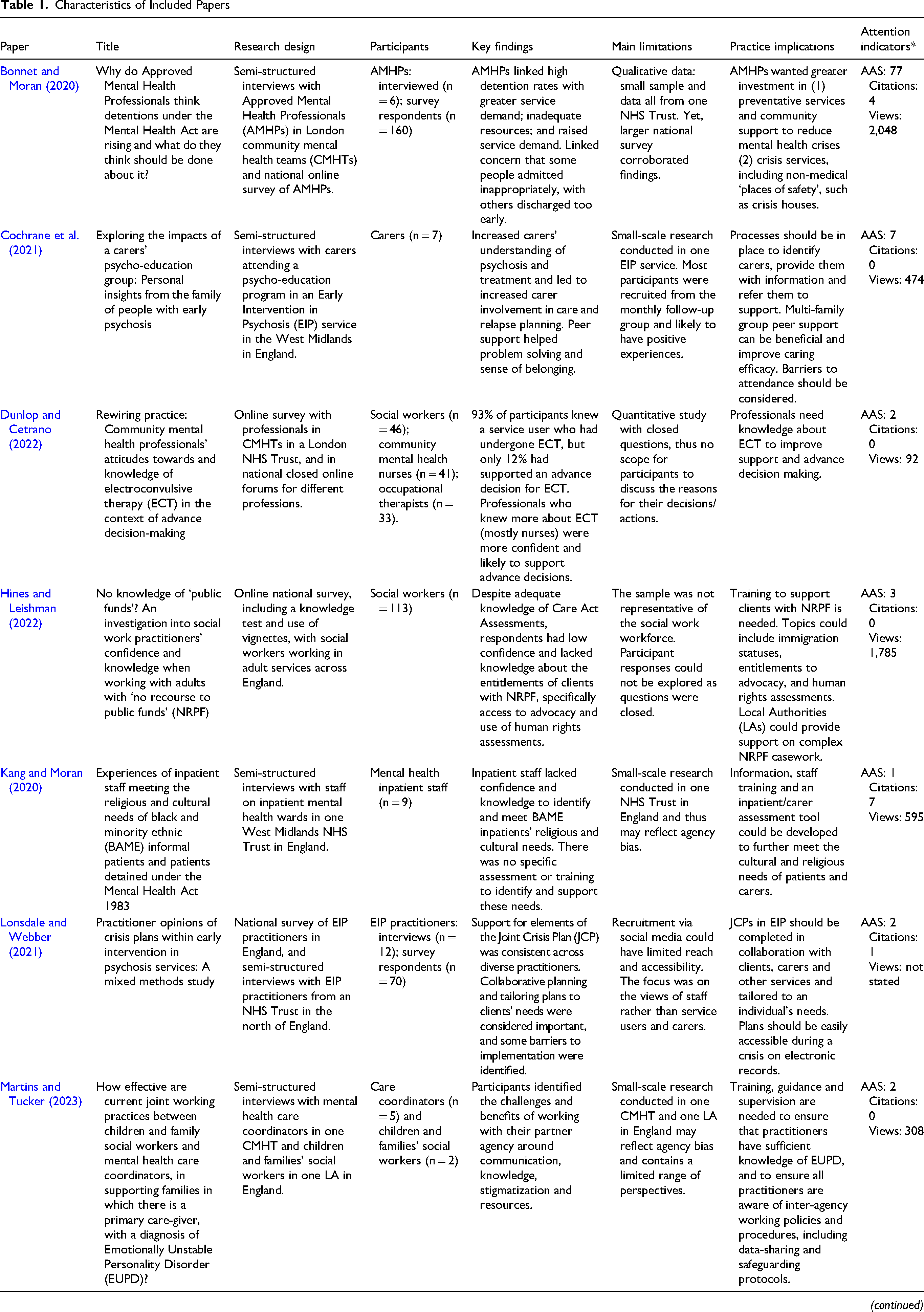
*Figures correct on 31st July 2023
Quality Appraisal
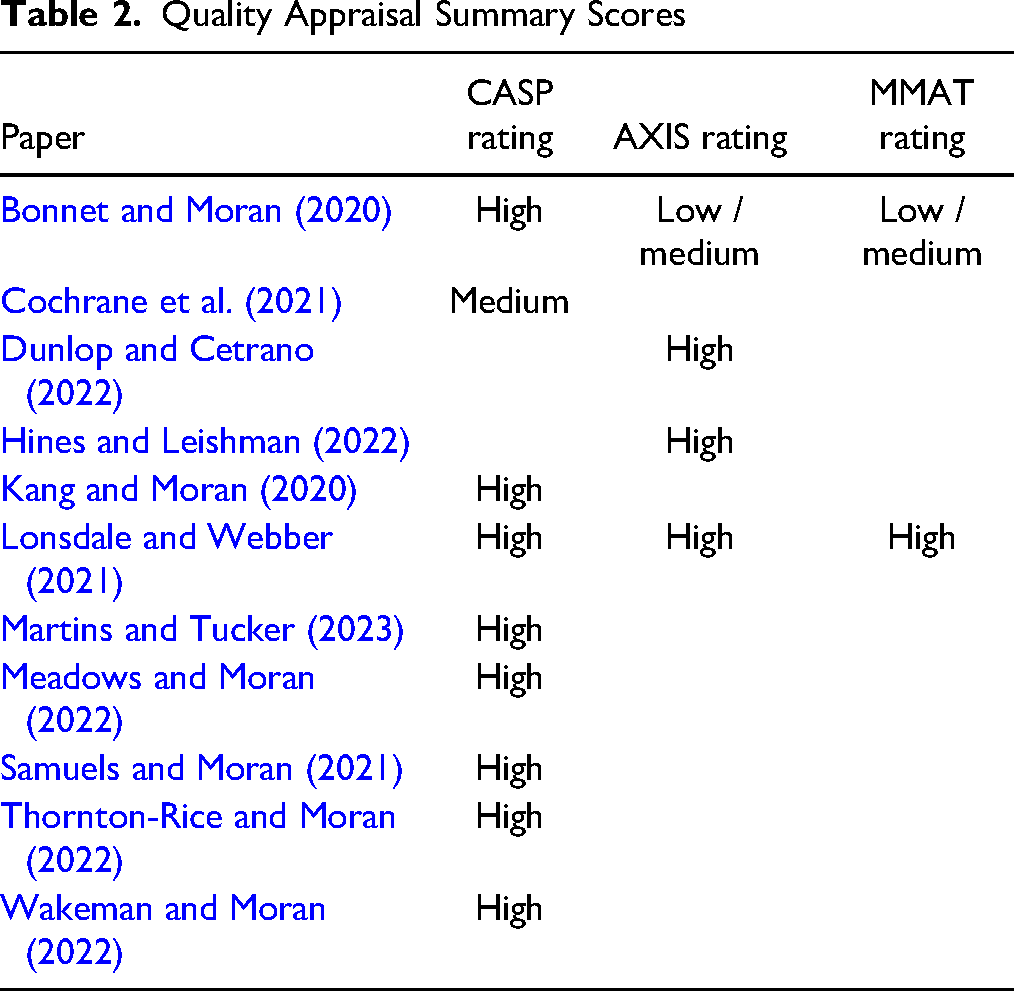
The overall quality of the research papers was high (Table 2). Methodological quality was only rated as low or medium in two studies: one lacked clarity on the aims and the implications of the findings (Cochrane et al., 2021); and the other provided limited details about the quantitative component (Bonnet & Moran, 2020).
Quality Appraisal Summary Scores
Synthesis of Findings
The topics of the papers were diverse, though focused on issues of concern to mental health social work practitioners: Mental Health Act 1983 detentions (Bonnet & Moran, 2020) and carers’ experiences of s.17 leave (Wakeman & Moran, 2022); carers’ psycho-education (Cochrane et al., 2021); religious and cultural needs of Black and Minority Ethnic (BAME) inpatients (Kang & Moran, 2020); crisis planning (Lonsdale & Webber, 2021); joint-working with children and families social work (Martins & Tucker, 2023); human rights (Meadows & Moran, 2022); accessing primary health care (Samuels & Moran, 2021); service users’ social media (Thornton-Rice & Moran, 2022); advance decision-making for electroconvulsive therapy (Dunlop & Cetrano, 2022); and social care entitlements of adults with no recourse to public funds (Hines & Leishman, 2022).
A focus on issues affecting inpatients or access to healthcare services, including crisis planning, was apparent in almost half the studies (n = 5) (Bonnet & Moran, 2020; Dunlop & Cetrano, 2022; Kang & Moran, 2020; Samuels & Moran, 2021; Wakeman & Moran, 2022). The frequency of attention to these issues is somewhat surprising as the practitioners were typically not located in inpatient settings, though it perhaps reflects the health orientation of the NHS Mental Health Trusts many were located in. However, community support or social interventions, more commonly associated with the mental health social work role, were referred to in four papers (Bonnet & Moran, 2020; Cochrane et al., 2021; Martins & Tucker, 2023; Wakeman & Moran, 2022). Additionally, human rights featured prominently as a topic area with three papers exploring different rights-based questions (Hines & Leishman, 2022; Meadows & Moran, 2022; Thornton-Rice & Moran, 2022).
The diversity of studies made a narrative synthesis of findings difficult, though there were some common themes. In particular, the studies highlighted deficits in practitioners’ awareness, knowledge and confidence in particular areas of practice, for example: meeting the cultural and religious needs of BAME inpatients (Kang & Moran, 2020); the rights of people with no recourse to public funds to adult social care (Hines & Leishman, 2022); the application of human rights principles in practice (Meadows & Moran, 2022); and joint working with children and families’ social workers with parents who have a diagnosis of emotionally-unstable personality disorder (Martins & Tucker, 2023). As these topics were identified by early-career practitioners, they are perhaps indicative of their interests. However, they suggest that specialist post-qualifying training may be required to supplement qualifying training and knowledge acquired through practice learning. Alternatively, it could be possible that in-service training or practitioners who ‘champion’ particular issues and share their knowledge with colleagues may support them to increase their knowledge and confidence.
Carers and service users’ experiences only featured in three papers (Cochrane et al., 2021; Samuels & Moran, 2021; Wakeman & Moran, 2022), which is likely to reflect the difficulties in arranging data collection with these groups in Masters research projects. Obtaining ethical approval, recruiting service users or carers for the research and analyzing their data in a short timeframe can be challenging. However, carers’ experiences of a psychoeducation group (Cochrane et al., 2021) and of hospital leave arrangements (Wakeman & Moran, 2022); and service user experiences of transitioning from secure services to living in the community (Samuels & Moran, 2021); have been captured, which demonstrate that this is feasible within a Masters research project.
Synthesis of Study Limitations
There were some common limitations in these studies and their findings need to be understood in this context. In particular, the samples for the qualitative studies were small and could over-represent the perspectives of those most interested in the topic under discussion. In addition, a short timeframe for the research often meant all the potential perspectives on a topic could not be explored. For example, Cochrane et al.'s (2021) study only recruited carers who were attending, or had previously attended, a psychoeducation group for carers; they were unable to explore why carers did not join or stay with the group. Similarly, Samuels and Moran (2021) recruited service users who had transitioned from secure services to living in the community at least three months earlier, which excluded those who had struggled with the transition and returned to a secure setting, and those who were potentially having their first direct contacts with primary health care services since leaving a secure setting. Also, some studies reported a lack of diversity in their samples. For example, in Wakeman and Moran's (2022) study, there was no diversity in relation to ethnic background or the relationship of the carer to the participant.
The recruitment strategies were frequently pragmatic. In seven studies, researchers recruited practitioners in whole or in part from within their own agency (Bonnet & Moran, 2020; Kang & Moran, 2020; Lonsdale & Webber, 2021; Martins & Tucker, 2023; Meadows & Moran, 2022; Samuels & Moran, 2021; Thornton-Rice & Moran, 2022). The cross-sectional survey samples were not representative of their populations as participants were self-selecting and recruited online (Bonnet & Moran, 2020; Dunlop & Cetrano, 2022; Hines & Leishman, 2022; Lonsdale & Webber, 2021). They were also limited to recruiting only practitioners and the views of service users and carers were not included in the surveys. Targeted recruitment strategies may mean that participant experiences may not reflect practice or lived experience in other settings or services.
Further methodological limitations were highlighted in the choice of questions asked in some papers. For example, the use of closed questions that did not enable participants to query, or researchers to clarify, the meaning of particular questions or response options, raised the potential for misunderstanding of the questions and/or the responses and deny the opportunity to probe the reasons behind some of the responses (Dunlop & Cetrano, 2022; Hines & Leishman, 2022; Lonsdale & Webber, 2021). The use of vignettes (Hines & Leishman, 2022) and an old validated questionnaire (Dunlop & Cetrano, 2022) were also raised as potential limitations.
Synthesis of Implications for Policy and Practice
Deficits in knowledge, confidence and understanding reported in many of the papers led to calls for training for practitioners on the specific issues studied: knowledge of electroconvulsive therapy (ECT) (Dunlop & Cetrano, 2022); social care support for migrants (Hines & Leishman, 2022); religious and cultural needs of black and minority ethnic (BAME) mental health inpatients (Kang & Moran, 2020); access to primary care for patients discharged from secure services (Samuels & Moran, 2021); enacting human rights legislation in practice (Meadows & Moran, 2022); accessing service users’ social media (Thornton-Rice & Moran, 2022); support needs of carers (Wakeman & Moran, 2022); and knowledge of emotionally unstable personality disorder (EUPD) and joint-working policies and procedures (Martins & Tucker, 2023). Using supervision or team meetings was suggested in four papers as potential mechanisms to address these deficits (Hines & Leishman, 2022; Meadows & Moran, 2022; Thornton-Rice & Moran, 2022; Wakeman & Moran, 2022).
In addition to practitioner training, implications of the study findings for policy and practice included: the need for greater investment in preventative services and crisis services for people with mental health problems (Bonnet & Moran, 2020); the development of new resources around religious and cultural beliefs to assist inpatient practitioners (Kang & Moran, 2020); the provision of information, support and guidance to other groups of practitioners (Samuels & Moran, 2021); social work teams appointing a ‘champion’ to provide guidance on complex NRPF casework (Hines & Leishman, 2022); and educating service users about privacy controls and the potential reconfiguration of theoretical boundaries to include a ‘public domain’ around social media usage (Thornton-Rice & Moran, 2022). There were also calls for robust national guidance around crisis planning with service users (Lonsdale & Webber, 2021); identifying, involving and supporting carers (Cochrane et al., 2021; Wakeman & Moran, 2022); and practitioners’ engagement with service users’ social media (Thornton-Rice & Moran, 2022).
Potential Impact
Ten of the eleven papers included in this review had received a total of 12,885 views by 31st July 2023 (data for one paper is unknown). The papers have attracted 15 citations to date, and two papers have particularly high attention scores compared to papers of the same age and source (95th percentile (Bonnet & Moran, 2020) and 93rd percentile (Thornton-Rice & Moran, 2022) respectively), indicating a reach significantly beyond the practitioners’ teams. Other dissemination methods have included articles for the UK social work trade periodical, Community Care, (Bonnet & Moran, 2020; Kang & Moran, 2020); discussion of study findings on the Social Work Research Podcast (Thornton-Rice & Moran, 2022); national conference presentations (Bonnet & Moran, 2020; Dunlop & Cetrano, 2022; Kang & Moran, 2020; Samuels & Moran, 2021; Thornton-Rice & Moran, 2022; Wakeman & Moran, 2022); practitioner workshops or seminars (Kang & Moran, 2020; Lonsdale & Webber, 2021; Martins & Tucker, 2023; Wakeman & Moran, 2022); and staff training (Hines & Leishman, 2022; Lonsdale & Webber, 2021; Meadows & Moran, 2022).
As a further enhancement to practitioner-research capacity, the first author of one paper (Wakeman & Moran, 2022) became a co-investigator on a study funded by the National Institute for Health and Care Research School for Social Care Research (NIHR SSCR) that built upon their research findings. The subsequent study developed good practice guidance for inpatient staff on supporting carers around leave from hospital for people detained under the Mental Health Act 1983 (the findings are currently under review). Wakeman also contributed to a scoping review undertaken as part of the same study (Naughton-Doe et al., 2022).
Although it is beyond the scope of this review to evaluate the impact of the included studies on policy and practice in social work, there are indications that publication in peer-reviewed journals is helping to extend their reach and enhancing their contribution to knowledge in the profession.
Discussion and Applications to Practice
This review has brought together eleven papers written by social work practitioners reporting research undertaken as part of their qualifying Masters program. Each study addressed questions arising from practice and highlights some of the interests of new social work practitioners. The methods used are necessarily modest and there are some common limitations. However, each study addressed a gap in knowledge and reported findings of relevance to social work practitioners. Above all, they demonstrate the art of the possible: that research undertaken on Masters qualifying programs can be of sufficient quality to contribute to knowledge and practice development in social work. Providing support with publishing study findings can also help to produce a high quantity of papers: although eleven papers are presented here from three cohorts, there are a further six papers in preparation.
Several studies have found that many practitioners lack confidence in understanding research and few have experience in undertaking research – whether pre- or post-qualifying (Goel et al., 2018; Pulman & Fenge, 2023a; Ståhl & Lundälv, 2022; Wakefield et al., 2022). For a profession which states its intent to become better informed by research (Research Advisory Group for the Chief Social Worker for Adults, 2023), this is somewhat concerning. Although providing post-qualifying research opportunities is one route to achieving this, enhancing research training on qualifying programs will ensure that all practitioners have some exposure to this (Pulman & Fenge, 2023b). This review indicates that there may be some merits in this approach.
These studies were conducted in collaboration with an academic supervisor, who co-authored these papers. Academic supervisors helped to ensure methodological and ethical rigor in the studies, and supported the analysis and reporting of study findings. This academic-practice collaboration illustrates what is feasible for practitioners to achieve. These studies were conducted with no external funding and the practitioners had received research training only within the dissertation module of their qualifying program. If this model of practice research training was adopted by all qualifying programs, there would likely be a significant uptick in research knowledge, experience, and utilization in practice. Furthermore, the publication of research findings from these studies can enhance practice knowledge and influence developments in social work policy and practice.
A limitation of this review was that the first author developed the curriculum for the practice research module and the first and second authors were co-authors on eight of the included papers. Bias cannot be ruled out, though the third author was not connected with the program in order to increase the objectivity of the review. In addition, the review was necessarily descriptive due to the diverse nature of the topics being studied. The practice research module may not be replicable in other universities as academic supervisors provided up to twelve hours of supervision for the students over 11 months, which may not be feasible elsewhere. Further, this review has highlighted several limitations in the studies conducted, which were typically modest in scale, and their contribution to knowledge may be overstated as this is largely unknown.
Footnotes
Declaration of Conflicting Interests
Two of the authors are co-authors of eight papers included in this review. The third author conducted the critical appraisal to minimize the potential for bias.
Funding
The author(s) received no financial support for the research, authorship, and/or publication of this article.
