




Abstract
The evidence on public health regulation of the unconventional gas extraction (fracking) industry was examined using a rapid evidence assessment of fifteen case studies from multiple countries. They included scientific and academic papers, professional reports, government agency reports, industry and industry-funded reports, and a nongovernment organization report. Each case study review was structured to address strengths and weaknesses of the publication in relation to our research questions. Some case studies emphasized inherent industry short-, medium-, and long-term dangers to public health directly and through global climate change impacts. Other case studies argued that fracking could be conducted safely assuming industry best practice, “robust” regulation, and mitigation, but the evidence base for such statements proved generally sparse. U.K. regulators’ own assessments on fracking regulation are also evaluated. The existing evidence points to the necessity of a precautionary approach to protect public health from unconventional gas extraction development.
Introduction
This article seeks to review the existing evidence surrounding the public health impacts of fracking for shale gas, and the regulation of the unconventional gas extraction (UGE) industry to safeguard public health. Before we present our analysis based on the case studies selected for this rapid evidence assessment (REA), we briefly contextualize current policy concerns regarding regulatory capacity and competencies in relation to fracking and public health. While we have a deliberate focus on the United Kingdom in this article, much of the underpinning evidence and our analysis has global applicability. This article is organized around three key research questions. We outline the methodology used and case studies selected, followed by the findings of the REA related to our research questions. We then use this to offer an analysis of the U.K. regulatory position and specific agency regulatory perspectives on fracking, and our key conclusions from this review.
The health and environmental impacts of fracking for shale gas, and the regulation and enforcement of the unconventional gas industry, are being debated globally as different countries and regions consider the costs and benefits of onshore UGE which includes fracking—the primary focus of this review. Not all of these debates and the issues raised regarding regulation are addressed in key U.K. policy reports assessing the viability and desirability of fracking development. The U.K. government and the fracking industry often argue that the problems associated with fracking in the United States are not applicable to the U.K. context and emphasize different geology and geography, especially connected to groundwater. Past industry bad practice is acknowledged, but it is argued that it was largely a product of inadequate regulation and poor enforcement in the United States.
A number of problems emerge with such an analysis. First, regulations and their enforcement vary markedly from state to state in the United States. Second, U.S. federal agencies such as the Environmental Protection Agency (EPA), the National Institute for Occupational Safety and Health (NIOSH), and the Occupational Safety and Health Administration (OSHA) have established some of the best global health, safety, and environmental standards although as the case studies reveal, states rather than the federal government in the United States have the major role on fracking regulation and enforcement. Third, the fracking industry in the United States has created problems in very recent years that confound arguments about lax regulation and poor industry practice being a thing of the past. These problems merit full discussion when examining the future of fracking and UGE development globally.
The focus in the United States is often on mitigating risks in an industry that already exists. In the United Kingdom, and in Scotland (where there is currently a moratorium on UGE), more fundamental questions arise about climate change, energy policy, and environmental protection, and specifically to our concerns in this review, whether public health can ever be secured through effective industry regulation.
Research Questions, Design, and Methods
The three key questions addressed in this review are as follows: (i) What is the evidence that effective U.K. fracking regulations currently exist or can be produced? (ii) What is the evidence that such regulations can and will be enforced to protect public health? (iii) What are the major regulatory and enforcement problems regarding fracking?
Our focus on these key research questions is in part because the evidence base surrounding regulatory design, capacity, and enforcement, and the lessons that can be drawn from existing practice, have been relatively neglected in the U.K. context when fracking and its regulation have been discussed. This REA seeks to redress the deficit. The case studies discussed below provide much of the evidence for our analysis, supplemented by the detailed discussion and references later in this article. We have organized the article so as to minimize duplication of material as much as possible within this article, and with the available case study reviews. 1
Methodology
An REA was used for the analysis. REAs provide a more structured and rigorous search and quality assessment of the evidence than a literature review but are not as exhaustive as a systematic review. They can be used to gain an overview of the density and quality of evidence on a particular issue; to support programming decisions by providing evidence on key topics and; to support the commissioning of further research by identifying evidence gaps.
2
We found both a very small number of peer-reviewed papers dealing with U.K. regulation and a smaller number of official reports addressing the issue. With regard to the gray literature, there are very many reports and other documents not in peer-reviewed journals, available on the web, which have limited distribution and are produced by organizations whose principle activity is not publishing. The review may have missed analyses that were useful, a density issue, but the quality of the gray literature we did explore was generally poor in terms of depth of analysis and did not meet our criteria on rigor. However, we did include two representative reports—one from industry and one from an environmental group—that addressed some of the core themes of this research.
Literature Search Results.
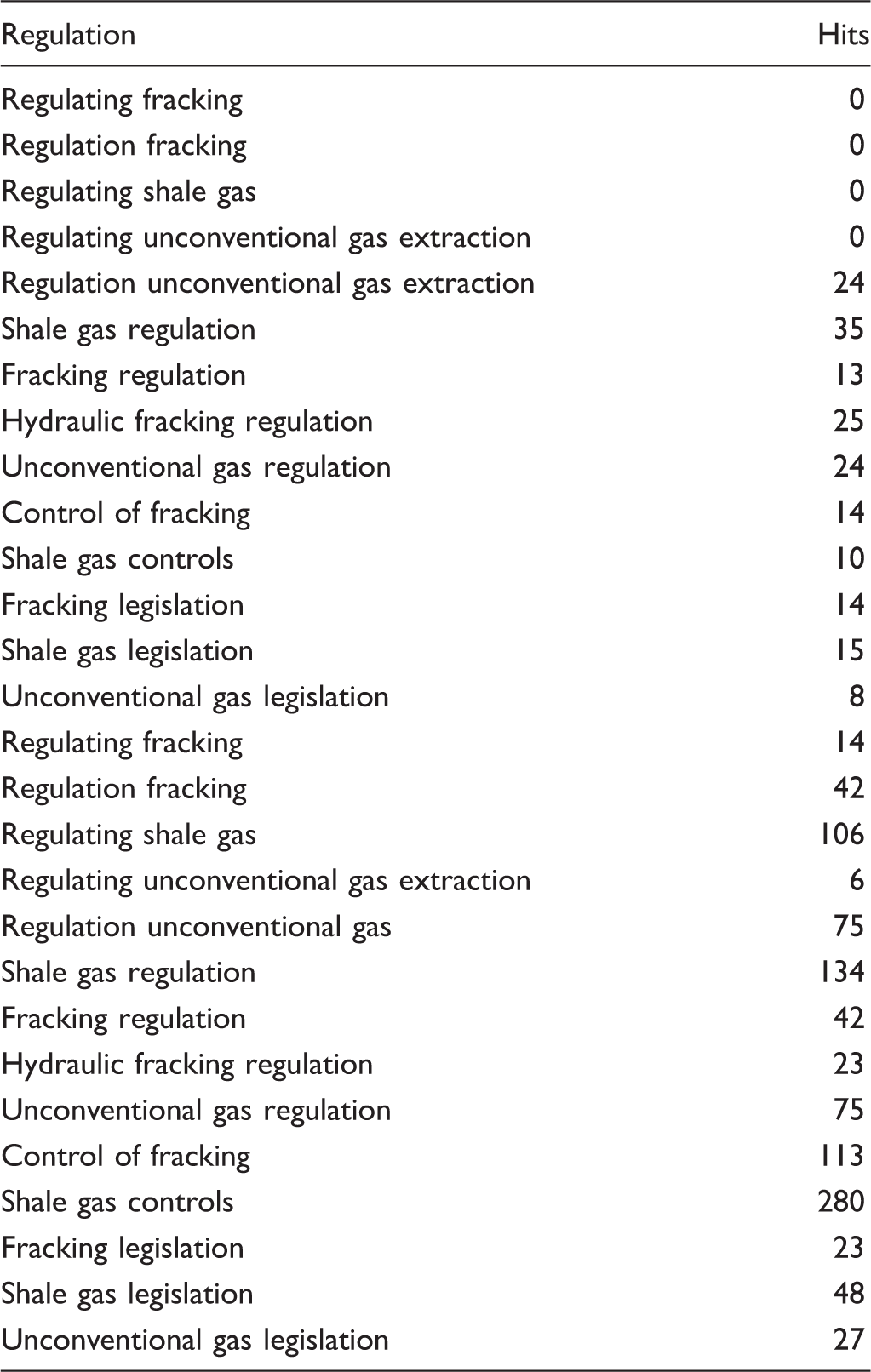
The papers were each reviewed independently by both authors using the standard approach (Figure 1).
Rapid Evidence Assessment of Fracking Regulation and Enforcement.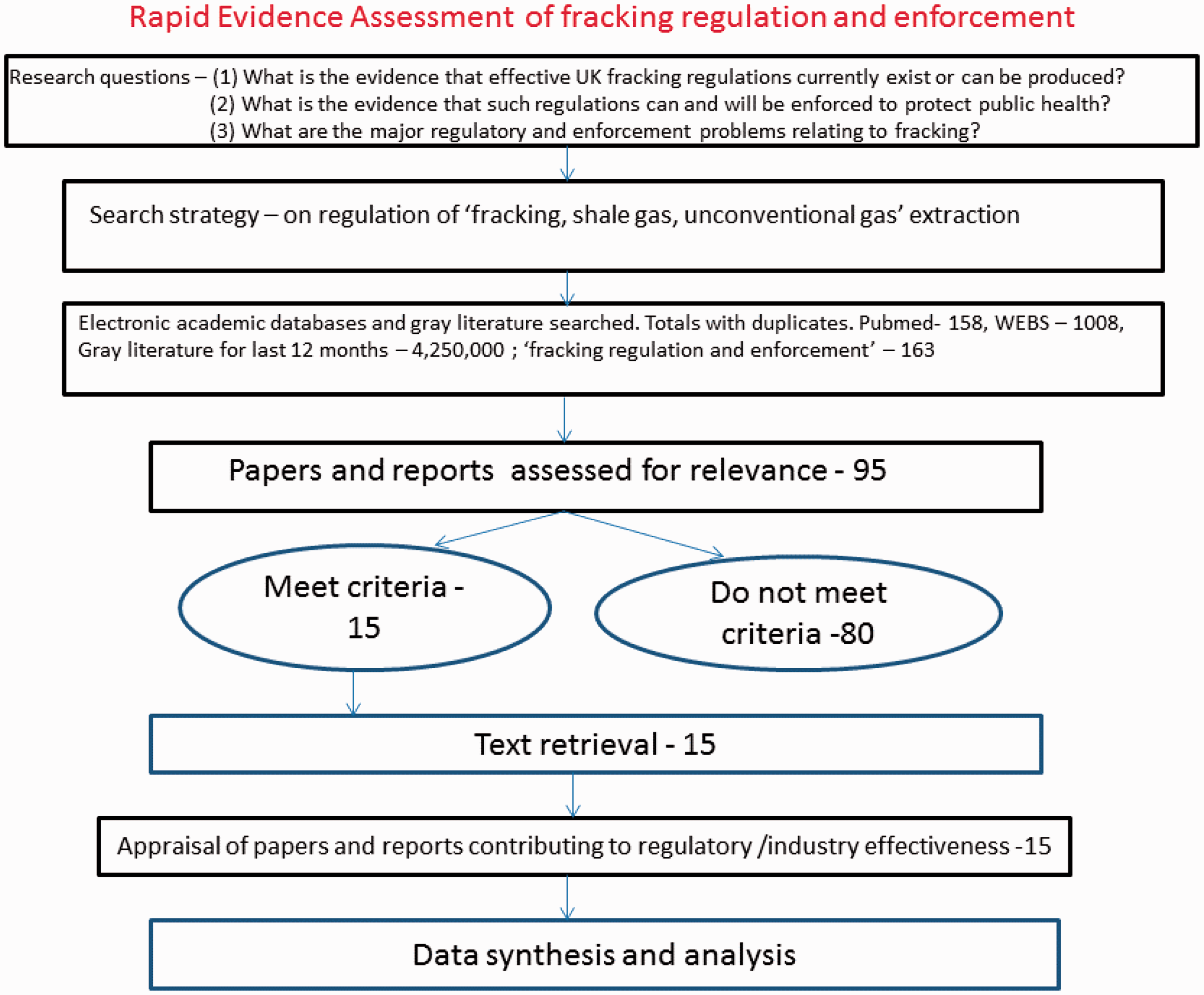
Papers were assessed for relevance linked to our key research questions using abstracts and summaries available and then retrieved. Many of the papers and reports we examined did not cover public health regulation at all but dealt with energy or economic and business topics. We selected for final review only those publications that addressed either in part or whole the public health dimensions of regulating fracking from the public health, academic, legal, industry, and nongovernment organization fields. We included major government and state reports and reviews. Because fracking is not yet underway commercially in the United Kingdom, we drew heavily on U.S. material. We did not find any peer-reviewed or referenced publicly available assessments or analyses of fracking regulation produced by U.K. regulators and none were excluded. We include later in this paper, however, descriptions from U.K. regulators of their anticipated roles in relation to fracking.
The analysis considers the strengths and weaknesses of each case study in terms of our three key research questions about evidence of effective U.K. regulation or likelihood of such regulation, likelihood of effective enforcement, and problems that exist in relation to regulation and enforcement. These are quite fundamental upstream or overarching questions that are appropriate at this moment in the development of policy in the United Kingdom. In the United States, a more detailed approach looking at, for example, staffing, budgets, and resources, or identified enforcement problems and outcomes could have been adopted. However, since large-scale commercial fracking is not currently underway in the United Kingdom, our current review could not include papers addressing these issues in the United Kingdom.
The cases examined in the REA were as follows:
Royal Society/Royal Academy of Engineering. Shale gas extraction in the UK: a review of hydraulic fracturing, June 2012. Public Health England. Review of the potential public health impacts of exposures to chemical and radioactive pollutants as a result of the shale gas extraction process, June 2014. Shale Gas Task Force. 1st interim report. Planning, regulation & local engagement, 2015. Scottish Government Independent Expert Scientific Panel. Report on unconventional oil and gas. Edinburgh, 2014. Hawkins JF. Minding the gaps. Environ Law Rev 2015; 17: 8–21. American Public Health Association (APHA). Policy statement on the environmental and occupational health impacts of high-volume hydraulic fracturing of unconventional gas reserves, 2012. Environment America Research & Policy Center. Fracking failures: oil and gas industry environmental violations in Pennsylvania and what they mean for the US, January 2015. New York State Department of Health. Public health review of high volume hydraulic fracturing for shale gas development, December 2014. Wiseman HJ. The capacity of states to govern shale gas development risks. Environ Sci Technol 2014; 48: 8376–8387. Small M, et al. Risks and risk governance in unconventional shale gas. Environ Sci Technol 2014: 48: 8289–8297. UKOOG. Guidelines for addressing public health in environmental impact assessment for onshore oil and gas. United Kingdom Onshore Oil and Gas, 2015. Cook JJ. Who’s regulating who? Fracking policy in Colorado, Wyoming, and Louisiana. Environ Pract 2014; 16: 102–112. Bomberg E. Shale governance in the European Union. Issues Energy Environ Policy, 15 October 2014. Centner TJ. Oversight of shale gas production in the United States and the disclosure of toxic substances. Resourc Policy 2013; 233–240. Centner TJ and O’Connell LK. Unfinished business in the regulation of shale gas production in the United States. Sci Total Environ 2014; 476–477: 359–367.
REA Questions and Findings
Evidence That Effective U.K. Fracking Regulations Currently Exist or Can Be Produced in the Future
Although several reports and papers, including some from the U.K. government and its agencies, state that fracking would be safe assuming there is or will be industry best practice and “robust” regulation (Case Studies 1–4, 10, and 11), the evidence base for such statements is remarkably sparse (Case Study 5). Government and agency reports and other papers fail to reference any evidence at all to support their regulatory and industry practice assessments, and no substantial evidence was available to support such a conclusion. The fact that effective regulation does not yet exist is clearly recognized in some case studies, as is the necessity of on-going monitoring of airborne health risks to “inform regulation of each phase of operation” (Case Study 2). There is some recognition of the impact of political and industry influence on existing regulatory structures and enforcement environments (Case Studies 5, 7, 12, and 13).
The key question of effective enforcement of regulations in a soft regulatory regime where regulatory agencies would inspect and oversee what could be thousands of fracked wells is not addressed (Case Study 4). Claims regarding effective regulation are largely based on conjecture and prompted public health experts on fracking in the United States to observe: “a focus on mostly hypothetical regulatory and engineering solutions may mistake best practices for actual practices, and supplants the empirical with the theoretical.” 3 Yet other researchers in the United States were clear that “the sheer number and severity of risks posed by fracking operations make constructing an adequate regulatory regime—much less enforcing it at thousands of wells and other sites—implausible” (Case Study 7). This conclusion on the public health threat from fracking is echoed by U.K. researchers. 4 It would also be wrong to automatically assume that the United Kingdom has better regulatory structures, better laws, and better agencies with more resources than, for example, the EPA and NIOSH in the United States. Yet even with an improved regulatory system and supposedly industry best practice, the most detailed well-informed and lengthy study on the health impacts of fracking concluded the industry should not be permitted (Case Study 8).
There is confusion too in several U.K. reports about the technology underpinning shale gas extraction, which is new and may be conducted in new areas, not always in coal mining districts. Case Study 1 highlighted the lack of knowledge about unconventional gas and groundwater contaminants and the need for more surveys, while another was clear that “fracking must be recognized and regulated as a new and uncertain technology” (Case Study 5). The capacity of regulators to deal with the new UGE industry over similar periods of time to the conventional gas and oil industry is inevitably speculative. An industry-funded report has cast doubt on the capacity of the various agencies now responsible for onshore gas development to work together to ensure effective regulation (Case Study 3), a problem well illustrated by the lack of clarity that exists on waste disposal (Case Study 1). One trenchant analysis written by a legal scholar indicated significant problems with current regulations: “The very way in which the risks have been assessed assumes that a ‘robust’ regulatory system will be in place; this has fed the justification for significant instances of regulatory inaction. Clearly the current regulation is not ‘robust’, and the framing of such risks as ‘low’ based on this assumption highlights the deficiencies in this cyclic determination” and “maintenance of the current approach is beneficial in that it requires minimal effort and expenditure, whilst allowing the shale gas industry to develop. However, it risks allowing regulatory gaps to remain until problems materialize.” (Case Study 5)
Evidence That Such Regulations Can and Will Be Enforced to Protect Public Health
Some case studies contained no public health experts, no legal specialists, no members who had independent research expertise in assessing regulation, or no independent members with research expertise in assessing this industry’s health, safety, and environmental performance (Case Study 1, 3, 4, and 11).
The budgets, resources, and staffing of the key central and local governmental agencies and departments dealing with fracking-related issues in the United Kingdom have been cut—a trend that in some instances predates the latest economic crisis. The need for increased regulatory capacity and regulator cooperation, highlighting the potential problems with well inspection and the need for more independent verification is recognized (Case Study 1). The important and complex settings within which regulation will be made attracts some attention (Case Study 13), a matter arguably likely to be exacerbated with “Brexit,” the term used for the U.K. government’s decision to leave the European Union (EU), recently approved by the U.K. Parliament, which may entail the U.K. Parliament changing regulations relating to fracking and deviating from existing EU environmental standards and guidance.
There is therefore a regulatory deficit in the U.K. relating to the infrastructure needed to ensure effective oversight of existing industrial activities. If fracking is permitted across the United Kingdom, then potentially many thousands of wells will be developed. Planning staff and local environmental health professionals who may play key roles in approving or monitoring large numbers of fracked wells and the communities around them are already under substantial pressure and lack capacity. The inspection and enforcement issue is compounded further by the “better regulation” agenda. It has damaged both inspection and enforcement regimes and appears to be geared towards making regulation better for business, rather than those social groups who may carry the burdens of business externalities not protected by regulation. Case Study 1 called for specific guidelines to ensure that effective “goal-based” risk assessments were prepared and submitted to regulators for both scrutiny and enforcement with compulsory reporting of well failures.
Problems of inspection and enforcement to prevent adverse health impacts may be compounded by a lack of data available prior to fracking. It is evident that not only are baseline environmental monitoring studies lacking but consideration of wider socioeconomic impacts remains a blind-spot. Although the problem of cumulative health impacts of many wells in relatively small areas was recognized, it was not possible to establish how this factor played into risk assessments that indicated fracking was low risk (Case Study 2).
Evidence from the United States has revealed the continued failures in fracking industry practice despite the creation of an industry/nongovernment organization collaboration—the Center for Sustainable Shale Development. 5 This points to the ongoing problem of enforcement in several states and the dangers of over-reliance on industry initiatives and in-house industry surveillance (Case Study 7). There are salutary lessons here for any decision-makers considering permitting UGE and fracking.
There is also evidence about wider failures of regulators to identify, prevent, or reduce exposures to a range of past pollutants that now present major public health problems. Fracking will add to this pollution burden: a fact that highlights the urgent need for cumulative environmental health impacts and the development of metrics to inform exposomes (a measure of all the exposures of an individual in a lifetime from birth to old age and how those exposures relate to health). The WHO International Agency for Research on Cancer estimates 7%–19% of cancers world-wide are due to environmental exposures causing thousands of U.K. deaths each year.6,7 Air pollution is now estimated to cause 40,000 deaths each year in the United Kingdom. 8 UGE will be an additional source of exposures to such environmental and workplace pollutants.
Evidence on the Major Regulatory and Enforcement Problems Relating to Fracking and Public Health
There are important lessons to be learned in relation to securing public health. Regulation, experience, and practice elsewhere should inform policy making on fracking and other UGE in the United Kingdom. Also it is clear that good regulation without effective enforcement is meaningless (Case Study 15). These lessons suggest a much more cautious approach is required, and that the regulatory frameworks and capacity must be established well in advance of operations. For example, after two decades of fracking in the United States, in a complex regulatory environment, a lack of understanding about some risks persists. Moreover, there were still regulatory gaps and problems with information and training needed for enforcement (Case Study 9). U.S. experience also highlights “current practices and regulations which often do not adequately consider long-term and compounding health effects” (Case Study 15).
The economic value of effective controls reducing public health threats from air pollution was flagged in one case study, but the difficulty of making similar calculations for water pollution was noted due to lack of information on costs and risks. Research has noted the failure of some U.S. state regulators to consider the cumulative externalities generated by fracking through air, soil, and water pollution; loss of water resources; and added health service costs (Case Study 14). The solution to the problems of estimating the economic costs of fracking in the United Kingdom is no closer than in the United States. A recent economic impact assessment report on UGE commissioned by the Scottish Government barely discussed potential environmental costs, and the variance in projected economic benefits between high and low return scenarios suggests much more detailed modeling is required. 9
How particular groups can be protected in both regulations and enforcement practice if fracking occurs is a significant challenge. For example, the issue of exposure of vulnerable groups, and very low-level exposure to endocrine disruptors, is not addressed (Case Study 11). Crucially, for public health, to protect vulnerable groups as well as local populations, baseline monitoring, and data gathering must be first undertaken. This appears to be severely lacking or limited and fragmented in many areas with regard to environmental and health data (Case Studies 1, 2, 4, and 6). This evidence gathering should then be used to inform any subsequent decision-making around permitting or licensing extraction.
Monitoring and data-gathering to fill gaps are considered vital to best regulatory practice (Case Studies 6 and 14). Yet because of the dearth of data, the many public health uncertainties of fracking and the lack of peer-reviewed studies in certain subjects (Case Studies 1 and 2) mean major public health problems with the industry in future cannot be ruled out on the evidence currently available. Proper recognition of many public health-related problems is not achieved, partly because of the absence or limited input of public health and regulatory expertise in several U.K. case studies (Case Studies 1, 3, 4, and 11).
One solution offered to a lack of regulatory resources is that industry might fund regulation through fees and levies drawn from operators (Case Study 3). Such an approach is in itself problematic as has been shown with a similar U.K. Health & Safety Executive (HSE) scheme now running, creating tensions with industry, workers, and communities alike. The approach could also imply regulation would lag behind industry practice. Would industry be first expected to fund regulation and then begin operations? This seems an unstable and unsatisfactory regulatory solution, as the independence of a regulator reliant on industry for its survival would be extremely difficult to establish in the eyes of other stakeholders.
Several other elements were considered in a number of the case studies that were either marginalized or taken for granted by other case studies. These elements were linked to environmental justice, transparency, and meaningful community engagement. For example, there was a view that a community’s right to know in detail about the hazardous substances used in fracking, including detailed toxicity information, is vital (Case Study 14). The legal right of the public to disclosure of information on fracking fluids, rather than reliance on voluntary agreements, has exercised industry, regulators, and academics and has not yet been fully resolved either in the United Kingdom or United States (Case Studies 11 and 14).
Several studies advocated or noted a precautionary or preventative approach to future shale gas development (Case Studies 5, 6, 8, and 13), but the detail on how exactly such approaches could be implemented were often lacking. This may be because there is a widely recognized problem of applying the precautionary principle in policy domains where the evidence base is absent, emerging, or contested. These studies largely focus on U.S. or EU cases (Case Studies 5, 8, and 13). The precautionary principle has many definitions across a wide spectrum. They can include bans when faced with compelling evidence about significant harm to public health, or the possibility of such harm when other less risky technologies exist, or where there are significant data gaps about health impacts. They might also include the use of a moratorium (one purpose of which would be to allow regulators and policy makers to gather more evidence to inform future decision-making) or tight regulation (where regulation is very stringent and designed to minimize potential known risks and externalities). In practice, it is the precise configuration of tight regulation that concerns many authors who favor a strong precautionary approach. All these versions of the precautionary principle have been floated for fracking and may be interpreted in many ways by those arguing for or against its adoption.
It is notable that the precautionary principle is one that has not been adopted readily in the United Kingdom. A House of Commons Library Briefing Paper on fracking prepared for MPs in October 2015, touched on and described the existing regulatory regime, reiterating statements from U.K. government bodies. No detailed analysis was offered on regulation and the merits of a precautionary approach were not considered. The briefing re-iterated the conclusions of what it described as “a short review” of fracking risks produced by the Royal Society and Royal Society of Engineering in 2012. 10 The briefing document did explore pollution incidents and cited sources that made it clear regulation of fracking in the United States varied in levels of stringency. This is a point frequently forgotten by several U.K. commentators who simply categorized U.S. regulation as universally poor when it was not. A recent report by Health Protection Scotland recommended that any future UGE development in Scotland, if permitted, should proceed with “relative precaution.” 11 It is a highly ambiguous term that is not defined in the report, but suggests a greater sensitivity to the problems associated with fracking and UGE than is evident in U.K. policy.
The Commons briefing also drew on the Tyndall assessment of shale gas regarding environmental and climate change impacts. The Tyndall researchers highlighted some issues that are not mentioned in the Commons briefing note: for example, on data gaps and regulatory problems; they considered at that time in 2011, “Concerns remain about the adequacy of current U.K. regulation of groundwater and surface water contamination and the assessment of environmental impact.”
12
Even with stringent regulatory controls, the Tyndall report recognized contamination risks could not be “fully eliminated” and their key conclusion was that Evidence from the US suggests shale gas extraction brings a significant risk of ground and surface water contamination and until the evidence base is developed a precautionary approach to development in the UK and Europe is the only responsible action.
12
Specific Agency Regulatory Assessments: The View From U.K. Regulators
Reports produced by U.K. regulators—the Health & Safety Executive (HSE), Environment Agency (EA), and Scottish Environment Protection Agency (SEPA)—were not used as case studies in this REA because they were generally written as guides for policy users, politicians, and civil servants and hence rarely engage with or reference independent literature dealing with assessments of fracking industry practice, regulation, and enforcement. They are not research reports, and none of the above agencies have produced research reports on UGE regulation and industry practice. Regulators’ reports tend towards descriptions of the agencies’ regulatory and enforcement responsibilities, structures, and practices, now and in the future. They provide information about application of existing laws and are self-assessments of what can be done based primarily but not exclusively on the U.K. government’s early commitment to fracking. Although some indicate the need to expand or revise legislation to deal with fracking, they cannot independently evaluate their own practices, staffing, and resources. Hence these agency documents, or assessments by those they commission, are open to challenge. Regulators’ claims, at this stage, to be able to regulate fracking effectively are simply opinions and assertions lacking in evidence and independent scrutiny. There are additional forces that influence fracking regulation not least with the “better regulation” approaches recently adopted by several U.K. agencies.
No publicly available and independent assessments of what the regulators now do or propose to do on fracking were identified in this REA beyond those already included as case studies, but literature on regulation and regulatory philosophies provide an invaluable backcloth for the REA and contain positive and negative analyses of the U.K. regulation.13–15 There are also critiques of the monitoring and enforcement policies and practices adopted by various regulatory agencies. Information on some of the regulatory debates and industry practice relevant to UGE and fracking regulation is available in the critical analyses done by independent researchers such as Tombs and Whyte.13,16–18
The problem for the agencies that may be responsible for monitoring and enforcing fracking regulation is further compounded by the fact that there is currently no experience of dealing with the on-shore fracking industry at scale in the United Kingdom. Moreover, the cuts in resources and staffing that many agencies have experienced over the last decade or more raise pressing concerns about regulatory capacity. The recently published Scottish Government review of public health impacts of unconventional gas noted concerns among regulators of “potential overstretch.” 11 If UGE, including fracking, entails the sinking of thousands of wells, the public and communities in areas where fracking is most likely to occur may be skeptical of statements from regulators that they can effectively oversee such large developments with existing staff, resources, and expertise.
The role and function of regulatory agencies in various governance arrangements have been subject to increasing scholarly attention over the last twenty years as partnership and new public management approaches have been adopted. This voluminous literature is not easily summarized, but can be broadly located between two key poles. One argues that agencies are largely independent of government interference and relatively free to make their own judgements and fulfill their functions without political micro-management. A more critical perspective suggests many agencies lack autonomy. They can be captured by those they oversee or must increasingly align regulation with government preferences. 18 There are also several positions between these poles. The debate about whether precaution or prevention informs regulators dealing with fracking has been explored in recent years in the context of legal and other drivers. 19 In light of the key finding of the REA above, a brief commentary is offered here on how it compares with what U.K. regulators have stated about their roles and functions, before we reflect on the key conclusions that can be drawn from this research.
Environment Agency (EA)
The EA operates under the Department for Business, Energy & Industrial Strategy (DBEIS) (formerly Department of Energy & Climate Change DECC). DECC had oversight of UGE and in April 2015 gave up some of its functions to the Oil and Gas Authority. The Environment Agency still deals with “appropriate permits or authorization” for exploratory and production phases. The Environment Agency’s environmental permitting regulations pertain to water resources, and they assess the use of chemicals in hydraulic fracturing fluids. The Environment Agency also has a function in respect of treatment and disposal of wastes produced during borehole drilling and hydraulic fracturing processes. It is a statutory consultee in the planning process, advising local government on the potential risks to the environment from individual gas exploration and extraction sites. 20 “If an environmental regulator finds that an operator is in breach of an authorization or permit, it will take action to stop any activity, prevent further impacts and remedy those that have happened.” 15 DECC relied heavily on the Royal Society/Royal Academy of Engineering 2012 (Case Study 1) report and the PHE 2014 (Case Study 2) report to support its assessment that fracking is safe if well regulated. They assert: “Before any shale operation can begin in the United Kingdom, operators must pass rigorous health and safety, environmental and planning permission processes.” 20 The official guidance does not test if the existing regulations and permitting processes are adequate and will be effectively enforced by an agency with sufficient staff, resources, and expertise to ensure proper regulation.
Scottish Environment Protection Agency (SEPA)
SEPA has similar responsibilities and powers in Scotland to the Environment Agency in England regarding fracking and other forms of unconventional gas extraction and has identified in the recent past a range of duties and functions relevant to UGE regulation. It is a statutory consultee in the local authority planning permission process and in this sphere, has an authorization role regarding exploration wells. Along with HSE and what was DECC, it issues well consents. Health Protection Scotland may have a role to advise government, industry, and planning authorities on the public health impacts of UGE.
In terms of well operations, SEPA will be responsible for the Water Environment (Controlled Activities) Scotland Regulations 2011, and related licenses that deal with water abstraction, treatment, and possible pollution issues; the Management of Extractive Waste (Scotland) Regulations 2010; the Radioactive Substances Act 1993; the Pollution Prevention and Control (Scotland) Regulations 2012. 21 SEPA also has a regulatory role under the Control of Major Accident Hazards Regulations 1999 (COMAH) and the Environmental Liability (Scotland) Regulations 2009 and has “a duty to consider how Scotland can reduce the greenhouse gas emissions from regulated industry and businesses, under the Climate Change (Scotland) Act 2009.” 22 As well as contributing to climate change, fugitive emissions have the potential to impact human health and the environment.
The regulatory challenges for SEPA relate to resources, staffing, and data gaps in key areas related to UGE that currently exist both globally and within Scotland. While not as savagely cut as the Environment Agency or HSE, the impacts of Westminster economic retrenchment policies on Scottish environmental regulation and enforcement are very real. In terms of assessing the likelihood that fracking can or will be effectively regulated in Scotland, there are no independent judgments available. SEPA has repeated its commitment to deliver “robust and proportionate regulation” of UGE 23 but exactly what this means in terms of overseeing potentially thousands of wells in the densely populated central belt of Scotland for example is not clear.
SEPA has indicated it believes existing staff can deal with any regulatory challenges they face. However, others outside the agency may not share this confidence in SEPA’s enforcement activity and practices. There is also potential for perceptions of conflict of interests. For example, the agency has used a former chemical industry senior executive who worked for a company that produces fracking fluids, to train hundreds of its staff on how to regulate for sustainability and economic growth.24,25
Health and Safety Executive (HSE)
The HSE locus in relation to UGE, including fracking, focuses on well design, construction, operation, and decommissioning and borehole regulation. Occupational health and safety is a reserved matter and so the HSE has responsibility across Great Britain (England, Scotland, and Wales) but not the United Kingdom for worker health and safety, and related risks to the public from workplace hazards. It requires operators to “notify HSE, at least 21 days before drilling is planned, of the well design and operation plans to ensure that major accident hazard risks to people from well and well-related activities are properly controlled.” 26 To what extent HSE could guarantee the necessary scrutiny within the specified twenty-one-day period is unclear. How “joined up working” with other agencies can be ensured and be effective remains untested. While a memorandum of understanding between HSE and the Environment Agency 27 has existed for a few years there is currently no large-scale shale gas production from fracking anywhere in the United Kingdom. No one knows whether these agencies will work well together in joint initial inspections, review inspections, and other regulatory activities. For example, there is considerable uncertainty about how to ensure effective oversight of fracking chemicals. Currently, the EU’s REACH directive applies in the United Kingdom, but with Brexit uncertainty, and numerous data gaps regarding fracking fluid toxicity, the challenge facing these regulators on this aspect of fracking regulation alone is considerable.
Much is made by HSE of its established regulatory regime on health and safety but there is widespread agreement from independent assessors (and even within the HSE itself) that it has failed to address the longstanding issues with occupational disease in the United Kingdom. There are legitimate concerns now that such failures will be replicated in the fracking sector. The position is further compounded by declining HSE inspections, limited enforcement and court penalties, and the use of “independent” well examiners who “can be an employee of the operating company or a contractor,” according to the HSE. 26 Staffing and resources are key concerns. HSE itself notes they believe they have sufficient “if undefined wells expertise” but “would need to reassess the situation if it [fracking] moved into large-scale production.” 26 When considered against their existing national health and safety record, resources, and staff, there are clear grounds for concern surrounding the capacity of HSE to fulfill its regulatory obligations vis-a-vis worker and public health should fracking develop even at modest scale across the United Kingdom.
The HSE produced an Onshore Gas and pipelines sector strategy for 2014–2017 in which it stated its main concern was to eliminate “the risk of major hazard incidents in which many workers and/or members of the public might be killed or injured”
28
through fire and explosion risks. Nowhere in the document does it refer to the need to regulate the occupational disease threats to workers and the public that might be posed by the onshore gas industry. The operational regulatory regime is largely business-friendly. Our regulation is undertaken within a wider context. Whilst we will always take the protection of the safety and health of onshore gas and pipelines industry workers and members of the public as an overriding priority, we also recognize that the industry operates within a complex environment. This strategy looks to encourage industry cooperation and leadership in a context that supports all aspects of good business practice.
28
The HSE Delivery document linked to this states that “in general, the industry has a good record regarding the management of conventional health and safety issues.” 29 The use of regulation specifically to reduce occupational ill-health does not feature as something the HSE seeks to deliver. Occupational health is mentioned only once in the Aims and Objectives document that focuses again on catastrophes, rightly a major issue. “Personal health and safety” is seen as separate and the HSE does not set aims and objectives for the industry because it considers it has a relatively good record. 30
Such an approach downgrades the population and epidemiological approach to sectoral occupational ill-health. This is reflected in HSE’s historic inability or neglect over recent decades, to take national regulatory and enforcement action on occupational diseases. Identified on-shore gas and oil pipeline issues are confined for example to concerns about hand-arm vibration whereas it is clear that on-shore gas presents many more occupational health challenges. If on-shore fracking develops on a large scale, the range of occupational health concerns will likely mirror those reported and documented in places where the industry is already operating.
Regulators need to know all of the hazards and related risks to check for,31–33 all the substances that may be used and their interactions in the fracking process and in the wider environment,33–37 all the pathways that may exist around each well along which those substances and pollutants may travel,32,38,39 and what known and potential adverse health ill-effects, including on mental health and well-being, may result from such exposures.34,39–47 If data gaps exist in these fields, they should be noted. It is clear from peer-reviewed research papers and reports published during 2016 that regulators still lack the necessary knowledge to regulate the fracking industry fully and effectively, and there is also growing knowledge about serious potential threats to public health not available in 2015.
Conclusions
The fifteen case studies within the REA all contained a variety of strengths and weaknesses but provided answers, albeit sometimes only partial ones, to our three main research questions.
The evidence base for robust regulation and good industry practice is currently absent. There are multiple serious challenges surrounding location, scale, monitoring, and data deficits facing regulators overseeing on-shore UGE including fracking in the United Kingdom. The evidence from peer-reviewed papers suggests fracking in the United Kingdom will not be effectively regulated. It is highly likely that regulatory agencies may lack the staffing and resources necessary to monitor and enforce effective regulation of the industry. The precautionary principle and prevention as keys to dealing with fracking recur in the literature. This is underpinned by findings from the peer-reviewed public health literature that already identify significant hazards and major potential risks from the industry. In the United Kingdom, there appears to be an absence of evidence of both effective prevention and precautionary thinking in UGE laws, guidance, and policy.
There is undoubtedly a great deal of debate about effective regulations, inspection, and enforcement. Much of the focus has been on regulating well construction. Relatively less attention has been devoted to what goes into the wells, comes out of the wells and is disposed of, or sealed in, when wells are decommissioned. Figures on well failures and orphaned wells in the United States and United Kingdom vary. In the three-year period, 2010–2012, in the United States, 6%–7% of Pennsylvania’s 100,000 fracked well casings failed. 48 Without any fracking underway in the United Kingdom, existing data relate to other hydrocarbon wells and boreholes that do not involve the same risks as fracked shale wells. Of the 2152 U.K. hydrocarbon wells drilled on-shore between 1902 and 2013, there was in 2013/14 no visible evidence of 65.2% of well sites and no monitoring was conducted. The ownership of perhaps 53% of wells in the United Kingdom is unclear and researchers estimated between 50 and 100 were orphaned and one of 143 active U.K. wells producing at the end of 2000 had evidence of well integrity failure. 49 Such surveys and several reviewed case studies raise significant and as yet unanswered questions about how wells and their related inputs and outputs can be effectively regulated and monitored during production and decades afterwards.
However, some of the primary drivers for U.K. fracking policy relate not to scientific or legal evidence but to ideology and economic interests and is revealed in several reports and position papers published at the request of the Westminster government. This is a highly contested approach in the fields of environmental and public health protection, and critics view the current policy trajectory as highly speculative and risky. For example, the U.K. government’s Business and Industry Ministry, along with its Better Regulation Executive Task Force, has been keen to curtail EU regulation.
50
While mention is made of the need to protect the environment and public from shale gas hazards, the Task Force opinions were clear. There were unnecessary proposals in the EU to regulate shale gas extraction, and “New European legislation could increase costs to business and threaten the exploitation of this valuable source of energy, without offering any additional environmental protection.” They advised A new (Shale Gas) Directive would bring years of uncertainty, deterring investors. Instead, guidance should be produced to clarify how existing EU environmental regulation applies to the new possibilities of shale gas exploitation. This would minimize scope for differences in interpretation, and enable safe and sustainable exploitation of shale gas.
50
The background too of growing concerns in the European Parliament is germane as studies reveal “existing (European) treatment plants are ill-equipped to treat hydraulic fracturing waste water and may be discharging pollutants into rivers and streams” at a time when the exact impacts of fracking were uncertain. 51 Reins recognizes there are still real challenges with “the regulatory requirements applicable to shale gas development prior to operation, the regulation of surface water issues, the framework applicable to underground injection and groundwater, and wastewater management.” 51 And there is a high level of uncertainty about fracking and water regulation in the EU with a possible race to the bottom on regulation from member states faced with minimum standards. 51
Our case study assessments also confirm earlier research on the subject. In 2015, some of the failures on fracking risk assessment and control came from either poor or inadequate regulation or problems with well-construction. However, others relate to the intrinsic nature of the industry. These factors, including well construction and failures, were carefully and rigorously analyzed by an environmental scientist.
4
The author criticized the assumption by Public Health England that “all reported health risks from fracking could simply be overcome by regulation and engineering.” She commented: Exposure to harmful chemicals due to fracking activity cannot be eliminated through regulation as there are technological and economic limitations to the treatment of emissions into the air, into groundwater and from waste; thus fracking is an inherently risky process in terms of human health.
4
UK regulations claim to minimize the risks derived from fracking; however, in England and Wales there is no set minimum distance between industrial activity and populated areas. This ignores evidence that geographical distance is a key variable affecting cancerous and non-cancerous health effects in residents near fracking sites.
4
It is this kind of salutary and precautionary analysis that is largely missing from official- and industry-commissioned reports on UGE and fracking in the United Kingdom. Based on our reading of the available evidence, we believe a much more precautionary policy stance is necessary to protect public health. Caution, with significant margins of error built in, should underpin all rigorous evaluations of what can and cannot be done with regard to assessing the viability and credibility of effectively regulating, monitoring, and inspecting the U.K. fracking industry. It may be that the public health risks and challenges presented by the industry outweigh any benefits and are beyond effective regulation in which case prevention becomes a major policy option.
Footnotes
Declaration of Conflicting Interests
The author(s) declared no potential conflicts of interest with respect to the research, authorship, and/or publication of this article.
Funding
The author(s) received no financial support for the research, authorship, and/or publication of this article.