




Abstract
Health impact assessments (HIAs) across the globe may be used by governments and industries to secure approval for unconventional gas extraction developments. HIA is an umbrella term that covers an array of health review and assessment practices, ranging from the very general to quite specific and technical health studies. Our concern in this paper is principally with the specialist end of the HIA continuum and particularly its application to unconventional gas extraction in the UK. We outline the context within which HIAs in unconventional gas extraction may be conducted. We then explain what HIAs may do. HIAs are often commissioned from consultancy companies to assess unconventional gas extraction project risks and benefits and propose mitigation measures. Communities can rarely afford HIAs in the planning process and may consider them biased when commissioned by vested interests. The oil and gas industry uses these techniques for its own ends. Hiring experts, be they specialist consultants, researchers, lobbyists, ex-government officials, or regulators, to influence planning and regulation is a well-tried tactic and structural advantage exploited by industry in seeking license to operate. Equitable and ethical HIA principles are urgently needed in the UK in relation to unconventional gas to secure the integrity and probity of the emerging regulatory system and address concerns regarding unregulated practitioners.
Introduction
There are many public health concerns raised by the widespread application of risky and novel technologies associated with unconventional gas extraction (UGE) currently on the policy agenda. These concerns pertain to the processes and technologies deployed, as well as to the emerging regulatory landscape surrounding UGE. Given the uncertainties in risks involved, health impact assessments (HIAs) globally have become key to securing approval for UGE developments. However, a critical analysis of the way in which HIAs have been used suggests that, in the exploitation of natural gas resources, ideology and expertise play a key role in downplaying hazards for workers and communities. We outline in this report the scope of different types of impact assessments and how they relate to UGE, the regulatory context within which HIAs are applied to UGE in the UK and draw attention to how the precautionary principle should inform policy on UGE. The latter part of the paper examines the use of science in HIAs for UGE approval in the UK.
Health Impact Assessments
Types of Health Impact Assessment.

Note. UGE = unconventional gas extraction; HIAs = health impact assessments; EIAs = environmental impact assessments; ESs = environmental statements; PHIAs = public health impact assessments; EHIAs = environmental health impact assessments; SEA = strategic environmental assessment.
Many questions are raised as to how and why HIA practitioners can and do build consensus and exactly how and by whom positive and negative health consequences of a development can be accurately assessed. Best practice in HIAs suggests industry should consult and listen to communities, but this can simply be used by companies as a superficial way, after a few public meetings, of arguing that consultation requirements have been fulfilled and their developments can proceed. Assessing the potential positive and negative health effects of a development is equally problematic and open to manipulation with positive effects sometimes inflated and negative effects downplayed.
A comprehensive impact assessment would include an investigation of behavioral impacts that covered likely effects on not just physical health but also mental health and well-being. The indirect environmental health impacts in terms of sustainability (fuel, products, transport, packaging, disposal, energy and water use, and so on linked to resource usage and public health effects), pollution, and contamination also require assessment. Tools for such assessments may not be readily available or easily applied and assessing impacts of environmental health policy can be highly problematic. Various forms of risk analysis and cost–benefit analysis may be used to justify findings in environmental health impact assessments. 1 Benefits can be inflated and risks and costs not fully quantified. Professional HIA practitioners often rely on exposure indicators to assess if the outcomes from an HIA have been met rather than reductions or increases in ill-health, as the latter are difficult to measure due to multiple causes. However, such an argument marginalizes epidemiological and other health studies and may lead to industry and governments trying to dispense with these approaches all together in HIAs. This removes a public health obligation from companies and is likely to disadvantage communities. Simply because health research is complex does not provide an excuse for abandoning it in favor of the equally fraught field of accurate multiple exposure assessment and the determination of what are safe exposure standards. What should be avoided is an approach that favors exposure measures simply because these offer developers a more compliance-friendly evaluation tool-kit than robust epidemiological metrics.2,3
Occupational HIAs are also necessary in HIAs but may be superficially addressed. Work environment is the Cinderella of the public health world. 4 HIA papers published in occupational and environmental health journals often do not directly fully consider occupational health although they do so for environmental health. 5
A public health impact assessment (PHIA) could in theory bring all these elements together. In practice, however, technically and legally HIAs and environmental impact assessments (EIAs) do not reveal if an industry from a public health perspective is one that should be approved. Instead, they offer measures to “mitigate” project effects. There is considerable variability in the metrics, methodologies, and motives of HIAs. These can range from the very general (and indeed superficial) to quite specialized and detailed studies using methodologies and assumptions that can withstand peer review and scrutiny.
Strategic environmental assessments (SEAs) are meant to be used to support sustainable development, to improve the evidence base for strategic decisions, to facilitate and respond to consultation with stakeholders, and to streamline other processes such as EIAs of individual development projects. SEAs are used throughout the European Union (EU) but do not replace EIAs. The EU directive aims to provide a high level of protection to the environment and to contribute to the integration of environmental considerations into the preparation and adoption of plans and programs with a view to promoting sustainable development, by ensuring that . . . a SEA is carried out on certain plans and programs which are likely to have significant effects on the environment.
6
UGE in Context: Processes and Regulation
UGE may involve coal bed methane, underground coal gasification, or fracking depending on geological and related features. Coal bed methane is a form of natural gas extracted from coal seams underground in various ways that may include drilling and removing water from the seams to lower pressure and so extract the methane gas. Underground coal gasification, in some varied forms, involves drilling under land or sea to get air and oxygen into coal seams. Coal is heated or burned in situ and the gases produced (such as methane, hydrogen, carbon monoxide, and carbon dioxide) are captured. The process presents threats of groundwater contamination. Fracking again in various forms involves fracturing of shale rocks using considerable quantities of pressurized water, sand, and other additives to obtain the gas underground.
While the industry often claims that UGE is a tried and tested process, it remains the case that some of the technologies and materials used in these processes are relatively new and do not yet have an established risk or safety profile. In essence, many but not all of the public health impacts of these technologies at different levels are as yet unknown, though there is an emerging body of evidence to suggest that these impacts may be much more significant than previously assumed by regulators and policy makers.8,9 Given the population densities where UGE licenses have been auctioned, we argue that under conditions of uncertainty the precautionary principle should become a lodestar for how policy makers should orient to UGE-associated risks.
In the UK, UGE has been approved and developed in often fragmented, complex and even contradictory ways. Successive UK government policies have been informed by neoliberal ideological assumptions that promote free markets and deregulation. A key feature of neoliberalism in practice has been the vital role of the state in creating markets, business-friendly regulation, and the conditions for private accumulation. Neoliberals do not necessarily oppose regulation per se; rather they oppose those regulations that impede profit-making. Such regulations are often located at the nexus of public health and environmental protection. Governments committed to UGE and the associated industries argue that it will be tightly and effectively regulated, carried out by companies who can and will demonstrate good practice, and that communities are consulted and empowered in the planning process. Some governments acknowledge the fact of global climate change linked to fossil fuel consumption but still pursue major UGE growth in what appears to be an untenable long-term policy. 10
This paper analyses the use of HIA in UGE regulation. First, the development of the UGE industry is contextualized and related to conventional understandings of risk assessment as a development evaluation tool. The problems with industry-commissioned science are then examined in the context of public health and public interest questions. The parallels between the use and abuse of scientific evidence in other health and public interest domains (tobacco and climate change) and the ongoing debate about the safety and benefits of UGE are considered.11–13 We then focus on the substantive issue of PHIA and address how this is deployed in planning processes. We devote some attention to the role and regulation of HIA consultants. This raises far-reaching questions about the nature and independence of regulatory processes which we discuss in the context of the pressing question of equity and ethics in regulating for public benefit.
Risky Business? Shale Gas, UGE, and Assessing Risk
Significant shale gas reserves for UGE exist in the Americas, Europe, the Indian subcontinent, Asia, Africa, and Australia. Pumping sand, water, and other substances into the ground where shale is present releases gases for use as an energy source. 14 Such extraction methods may not be new, 9 but the scale of extraction, the range of chemicals used to facilitate such extraction, and the huge water usage sometimes involved is. 15 Globally accurate estimates of the human populations exposed to UGE chemicals, by-products, and contaminants do not yet exist. Detailed exposure studies of the potential effects of UGE on short-, middle-, and long-term health of those exposed are emerging and discussed later, but there are many gaps in our knowledge on health impacts. We do know that some owners of land or those supplying plant, equipment, and materials for UGE may sometimes but not always gain “short-term” benefits. 16 There will always be economic winners and losers with UGE, and the former have a strong vested interest in expanding the industry.
The UGE industry is committed to developing its energy and feedstock resource. Industry and several governments (including the UK) have argued over several years that UGE will be well regulated through government and agency actions, industry will adopt best practice, public and community consultation will be effective and extensive, and overall impacts on global climate change will be beneficial. Little weight is attached to broader arguments that UGE will not significantly reduce carbon emissions, slow down global climate change, and so impact on public health globally. The UGE industry produces natural gas—and so contributes significantly to global climate change that now endangers public health globally. The American Public Health Association (APHA) in 2012 noted, Although natural gas burns more cleanly than coal, a recent study argues that replacing all of the world’s coal power plants with natural gas would do little to slow global warming this century. Switching from coal to natural gas would cut the warming effect in 100 years’ time by only about 20%. Although a 20% decrease in warming over 100 years is significant, the consequences of the warming not prevented will have grave implications for public health. In addition, some projections suggest that obtaining natural gas through (fracking) actually produces more greenhouse gas emissions than does coal production and burning.
14
Risk, Complexity, and Precaution: Assessing UGE Development
Risk assessments represent a set of tools for examining industrial processes and chemical and engineering hazards. There are a variety of approaches to assessing risk, and while there have been considerable efforts to harmonize risk assessment, even the International Standards Organization still cautions that its guidance is “not intended for certification, regulatory or contractual use.” 18 Given the variability of methods and metrics, it is unsurprising that governmental risk assessments of UGE are often incomplete and frequently contested in the scientific community. The risk management strategies that flow from these may be questioned, but they nevertheless prevail in many policy and regulatory processes.
Drawing on generic risk assessments, project-specific assessments occur in EIAs and Environmental Statements (ESs). Whilst the tools and principles of HIA are the same worldwide, how exactly they have been implemented may vary greatly, for example, in scale and scope and between industry-employed HIA consultants and those in regulatory agencies or academia in the way data are validated. Moreover, there are no universally agreed standards for incorporating or ignoring geographical, demographic, geological, scale, and socioeconomic variables in HIAs. So various risk assessments can be used in HIAs looking at a wide range of possible health effects—negative and positive—of a proposed project and how to mitigate adverse effects. UGE uses chemicals in the extraction process and in the construction and transport stages that may endanger air and water quality and present occupational and environmental threats to workers. There is incidental or accidental methane leakage in UGE production processes. UGE may also produce a wide range of other pollutants deliberately or accidentally such as benzene, particulate matter including PM2.5 s and radon which can all contribute to a significant European as well as global environmental burden of disease sometimes at very low levels. 19
Past risk assessments of UGE have explored what might be termed well-established risks similar or identical to those in the conventional gas industry but also some new risks. For instance, in 2012, in Germany, in a risk assessment study of fracking funded by Exxon-Mobil, scientists identified what they viewed as new risks associated with UGE including the proximity of gas reserves to usable groundwater reserves and proximity to ecosystems depending on groundwater. The research also suggests new risk dimensions are associated with the high number of wells required, greater land usage, and more people affected by necessary infrastructure developments: “more people and in particular agriculture, tourism, and nature conservation are directly affected in a given region.” Fracking in tight spaces, greater water usage, and greater energy use in drilling are also identified in the overall risk profile of fracking. 20 The study discusses the need for precaution in risk assessment but does not explicitly draw on the “precautionary principle” approach. Similarly AEA, environmental consultants in 2012 looked at some aspects of fracking and risk for the EU, and, although noting the precautionary principle, neglected exploring any significant application of the approach. 21
The principle has been defined so that “when an activity raises threats of harm to human health or the environment, precautionary measures should be taken even if some cause and effect relationships are not fully established scientifically.”
22
The precautionary principle includes taking action in the face of uncertainty, shifting burdens of proof to those creating risks, analysis of alternatives to potentially harmful activities, and participatory decision-making methods. In essence, the precautionary principle reframes questions around the environmental and public health impacts of development in terms of developers fully scoping and justifying proposals rather than opponents having to unequivocally establish that developments are dangerous or harmful. The precautionary principle invites a new set of questions that reflect the need to avoid harm before it is done: “How much contamination can be avoided while still maintaining necessary values?” “What are the alternatives to this activity that achieve a desired goal (a service, product, etc.)?” and “Do we need this activity in the first place?”
23
Expertise, Hazards, and Risk Assessment: The Role of HIA Consultants in UGE
Hazards and Risks of UGE.
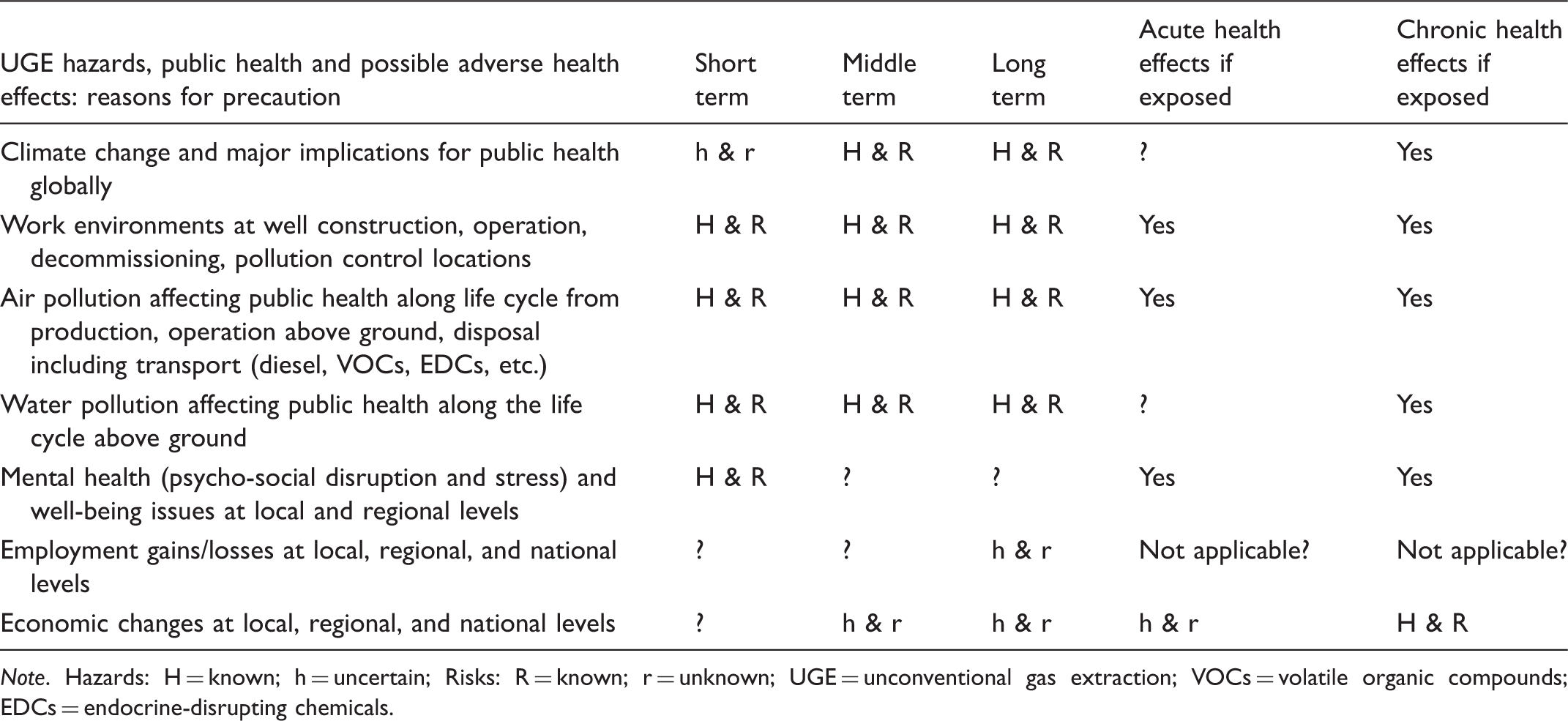
Note. Hazards: H = known; h = uncertain; Risks: R = known; r = unknown; UGE = unconventional gas extraction; VOCs = volatile organic compounds; EDCs = endocrine-disrupting chemicals.
In the case of UGE, the practice of HIA consultants from the commercial and academic sectors is varied. Some HIA practitioners have concluded that they believe all necessary information is available to assess UGE, and they consider the industry safe if risks are mitigated. These consultants tend to work more frequently for the UGE industry rather than in academia or for the public sector. Some companies like the multinational RPS have a strong UGE focus in their work for the private sector. They aim to help “clients develop natural energy resources across the complete asset life cycle, combining our technical and commercial skill with a wide knowledge of environmental issues.”
25
The emphasis is clearly on commercial development. Similarly, the environmental consulting corporation, AMEC Environment & Infrastructure UK (AMEC) has worked for local authorities and government as well as the private sector on UGE. AMEC stresses its role on EIA is to adopt a “risk management” approach that involves informing our clients as soon as we identify potential environmental effects that could be a risk to them obtaining consent so that they can modify the relevant aspects of their scheme - early identification of these risks can avoid unnecessary design and assessment costs.
26
Our environmental specialists can predict the likely environmental effects and recommend appropriate mitigation. Our engineers can help design these mitigation measures into your process, saving money on more costly “end of pipe” solutions….We can even provide advice to clients in the developing area of Corporate Responsibility; leading the way to a more sustainable future for the oil and gas industry.
27
When various reports and statements from health and environmental consultants on UGE are examined, it becomes clear that a range of “opinions” are offered. A 2014 report by an HIA consultant for a coal bed methane application was able to state categorically that the proposed project was compliant “with all environmental standards set to protect health and changes in environmental health pathways neither present a concentration or exposure sufficient to quantify any adverse health outcomes.” 28 The conclusion was supported by the consultant’s view that no environmental regulations to protect health had ever been breached, and no regulatory body had issued any enforcement notice about earlier operations.
The questions of regulation and enforcement, industry practice, and limits to current knowledge linked to risk assessments and the lack of data on health risks associated with UGE are at the nub of the debate about the health impacts of UGE. One of the key functions of impact assessment in this contested policy field appears to be building consensus and engaging in some form of consultation with communities, if only as a means to secure regulatory consent. However, one RPS report alleges communities reflected a “level of misunderstanding of the concepts of hazard and risk.” 28 Communities resist such an assessment and have also strongly contested the view that the company involved and its consultants had engaged in any meaningful consultations with them on the planned development. Nowhere in this report does the consultant fully address mental health and well-being issues that should be a significant part of many researchers’ assessments of potential health impacts of UGE. The consultant also appeared to rely heavily on the Public Health England (PHE) report 17 on shale gas chemicals. 28 This report has been heavily critiqued by public health professionals working in the field and is discussed later. 29
An example of a very different approach to UGE health impacts is illustrated in a report commissioned for Lancashire County Council on a fracking project conducted by Ben Cave Associates in 2014. 30 It is far more measured in its judgments, openly recognizes the data gaps that exist in the field, frequently acknowledges the burgeoning literature on UGE exposures and effects, and was based on enabling communities to have an active role in monitoring and oversight of an HIA. The report also called for the collection of baseline health data (in contrast to the RPS assessment even though the company had been active for some years), and the report was circumspect about UGE health impacts. “We do not make definitive statements on the potential effects on health arising from the current applications. . . . .Uncertainties remain, for example the range of potential health effects and the timescale over which monitoring should take place.” 30
The report further noted: The over-riding responses about the two proposed exploration sites voiced by members of the local communities who attended the workshops were those of fear, anxiety and stress, which are affecting their mental wellbeing, with some people experiencing sleep disturbance and depression.
30
With regard to the UGE industry, it is fundamental that the risks associated with it are well understood, properly analyzed, and fully described before any project-specific EIA and associated HIA is conducted. The industry, its constituent companies, and their preferred consultants commissioned to conduct EIAs and HIAs on occasions fail to acknowledge these requirements
Serviceable Science? The Abuse of Science and Technology
The notion that science remains disinterested and pursued independently of wider political and economic interests is an increasingly untenable position. Power and influence can be exercised in the commissioning and focus of HIAs conducted on behalf of the UGE industry. Reviews of research can cherry-pick the work to be reviewed or simply exclude papers indicating potential problems for public health. Moreover, superficial and flawed industry-funded studies can feed into HIAs. Work that points to inconclusive or supportive results are repeatedly referenced and cited. Some of the “no effect” UGE studies from institutes in Texan and Pennsylvanian universities have since been discredited and some of these institutes closed as a result of conflicts of interest linked to funding from and investments in the UGE industry. 32 Other nonindustry studies have, however, recorded adverse health effects near UGE sites. Some of these focus on the very young, the old, and the ill. 33 These are exactly the groups that the World Health Organization and bodies such as the APHA have highlighted as vulnerable to even low-level chemical exposures and so meriting special attention in HIAs. 14
The HIA process is often considered to be sufficient by politicians and planners when it meets legal and planning requirements and is technically feasible. However, industrial and commercial manipulation of science, law, and policy to downplay occupational and environmental health risks remains a pressing concern because it may subvert HIA processes. It is not uncommon for industry to create doubt and uncertainty to attack science and public health indicating established risks or potential risks from industrial activity.34,35 The tobacco industry provides the classic and most thoroughly investigated example of manipulation of science and unethical research. The industry first cast doubt on early high-quality research identifying the health hazards of smoking, then on the hazards of passive or secondary smoking, and now we are entering debates about third-hand smoke, the smoke on fixtures and fittings, toys, and materials around us.
There is a voluminous literature on the abuse of science in relation to public health issues. The evidence of co-opted and corrupted science is perhaps most starkly revealed in the tobacco archive, based on internal industry documents disclosed after successful class actions against the tobacco industry in the United States.35,36 Similar concerns exist in relation to the evidence base surrounding the efficacy of some pharmaceuticals, and there are issues about how conflicts of interest are assessed and the ways in which consultant scientists sponsored by industry produce industry-friendly expert opinion.11–13 It is therefore very important that the lessons around how science is deployed in public and regulatory affairs are properly drawn from other domains and applied to the relatively new field of UGE, and associated HIA practice. Just as industry contested each set of arguments about the various hazards and related risks due to tobacco, so now the UGE industry and its consultants may employ similar strategies.
Factions of the oil and gas industry have a recent record of promoting dubious science and funding advocacy organizations in relation to climate science, in order to foster doubt about the causes of climate change.37,38 The pursuit of such public policy strategies draws some key lessons from the lobbying and propaganda tactics of the tobacco industry in terms of staving off meaningful regulation by creating doubt and uncertainty regarding public health and scientific evidence. This is a key component of the corporate strategy of some companies in the extractive industries 39 and is a strategy that crucially relies on the imprimatur of scientific authority to articulate these criticisms undermining the evidence, usually in the form of some so-called independent consultants and hired experts.
Linked to claims of safety for materials and processes, the UGE industry has made statements that equipment and processes will not fail, and therefore there will be no pollution, accidents, and incidents.
40
Such claims are fanciful. As the United Nations Environment Programme accurately observed in 2012: Hydrologic fracking may result in unavoidable environmental impacts even if UG is extracted properly, and more so if done inadequately.
41
Even if risk can be reduced theoretically,
42
in practice many accidents from leaky or malfunctioning equipment as well as from poor practices regularly occur. This may be due to pressure to reduce costs, poor staff training, or to undetected leaks leading to contamination of the ground water.
41
The HIA Process
Evidence of sound PHIAs should be reflected in ESs, EIAs, and environmental impact statements. PHIAs should consider the short-, medium-, and long-term impacts of projects. 45 Specifically for UGE, they should include consideration of the public health effects on climate (micro and macro), the possible impact on the development of sustainable energy in a country because funding for UGE could, for example, move funding away from wind or wave energy developments (which of course again impacts directly and indirectly on public health), impacts on worker health and safety, a proper estimate of jobs created and jobs lost by UGE again over its complete lifetime, a community wellness, and mental HIA. 8
The standard template for “HIAs” produced by companies within their ESs is usually not comprehensive and may be seriously inadequate. 45 They often rely on secondary studies and out-of-date reviews of the scientific literature. Crucially, they contain many gaps in terms of addressing all the public health issues associated with UGE. For example, the assessment of public health impacts of unconventional gas production made by the UK Royal Society lacked any public health author and contained only a chapter on risk management which did not address public health. This limited assessment 46 simply asserted rather than demonstrated that health, safety, and environmental risks could be managed by operational best practice and strong regulation. Similarly, the PHE agency assessment excluded significant risks and data. 17 The PHE draft review notes many data gaps and specifically excludes consideration of wider public health impacts involving socioeconomic effects, work environments, and climate change. This is a case where absence of evidence is definitely not evidence of absence, as PHE appear to believe. The report considered shale gas risks were low if operations were properly regulated and run, yet noted failures exactly because of these reasons! This very superficial assessment has become a politically significant report, as it is repeatedly cited by industry and associated UGE boosters as evidence that fracking is safe.
The PHE report was widely criticized and described as a “leap of faith unsubstantiated by scientific evidence” for its claim that U.S. public health problems would probably not apply in the UK. 29 Critics argued that the conclusions that shale gas presented a low public health risk “is not substantiated by the literature” and that PHE ignored the inherent industry risks whatever regulation applies (casing failures, cement failures, wastewater spillage) as well as the fact that UGE in the UK would often occur in heavily populated areas. 29
Far more cautious approaches to UGE, including bans and moratoriums, exist in France, Germany, the Netherlands, and Scotland. Yet, those promoting UGE in the UK repeatedly cite the PHE report without qualification and fail to mention the APHA policy on high-volume hydraulic fracturing of unconventional gas reserves
14
which details many concerns and demonstrates the necessity of robust public HIAs. Policies that anticipate potential public health threats, require greater transparency, use a precautionary approach in the face of uncertainty, and provide for monitoring and adaptation as understanding of risks increases may significantly reduce the negative public health impacts of this approach to natural gas extraction.
14
Moreover, public health life cycle analyses, which include cost–benefit analyses to assess the overall implications for society and its citizens and which enable public engagement over the consequences, 43 should ideally be conducted for UGE projects, but these either do not exist or are not publicly available. While there may be more transparency in the future on UGE chemicals used, this will not address the fact that many past “negative” studies of UGE hazards which were compromised by a lack of information about specific chemicals or mixtures used will likely continue to be cited in future without critical appraisal. HIAs often rely on industry-generated data and opinion either disclosed only to government agencies or through UGE companies and their chemical suppliers. That some HIA professionals appear to accept such industry data with little query or qualification is highly problematic. There have been few attempts outside the United States (where the industry is most developed) to conduct more detailed assessments of UGE substances in light of current literature for significant potential public health problems.
Assessing the health impacts of water and air pollution illustrate some of the difficulties. Practitioners often rely on summary data or industry data and pass their draft reports to companies for comment before publication. Whilst there are arguments that the methods and controls for handling wastewater from UGE will vary between the United States and the UK, nevertheless the process inevitably requires vast quantities of water and treatment and disposal. Up to eight million gallons of water could be used to frack a single well. In the United States, lagoons have been used to store wastewater. In the UK, such water may be treated and tankered off-site. There are suggestions that wastewater could be piped from sites in Central Scotland where there are many disused coal mines and related subsidence. Neither the companies nor their HIA consultants seem to have fully factored these local conditions into their risk assessments of pipes for gas and wastewater extraction.
The extent of exposure to hazardous chemicals in UGE is substantial. The APHA estimated that up to one hundred thousand gallons of chemical additives could be used in the life of a fracked well and wells could be fracked up to eight times 14 Links exist between many of these chemicals and their effects on the respiratory and gastrointestinal systems, the brain/nervous system, immune and cardiovascular systems, and the endocrine system. 50 One recent U.S. study identified a range of toxicity concerns related just to biocide use in UGE including evidence of carcinogenicity, endocrine disruption, chemical interactions, chemical degradation, and several data gaps. 47 A number of known and suspect carcinogens have been identified in UGE processes including benzene and silica.
Industry argues that these exposures are likely to be rare because of effective engineering controls, of very low levels so as not to be hazardous and confounded by the presence of carcinogens produced by other (sometimes natural background) sources. However, even very low levels of carcinogens still present a public health threat when there is low-level exposure of large populations. Additionally, studies from other sectors show that safe levels of exposures to carcinogens such as benzene do not exist. 48 Yet, commercial HIA practitioners have frequently repeated these flawed arguments and all too often express an innocent and unfounded belief in infallible engineering solutions and closed systems. 20
However, reports of failures in engineering controls and well safety are well documented.16,29,54 Recent studies suggest that effective regulatory regimes will require very significant resources if UGE goes ahead on a large scale. For example, researchers flagged leaks and poor monitoring at existing UK onshore oil and gas sites with a review of 2152 wells drilled from 1902 to 2013 where they found up to one hundred “orphaned” wells for which no firm is responsible. Although only two cases of well “failure” were recorded, the legacy sites were not monitored for leaks. 54
An underlying problem in risk assessment of UGE is both the lack of data on chemical hazards (where the identified data gap has not been closing 51 ) and the lack of transparency in what the contents of UGE chemicals are. Extensive risk assessments are essential before proper HIAs can be conducted on particular projects, but these do not yet exist for UGE. 14 In the late 1990s, the U.S. Environmental Protection Agency found that 43 percent of high-volume chemicals used had no toxicity information available, and only 7 percent had a full set of basic toxicity information available. By 2006, the percentage of high-volume chemicals with partial hazard assessments in the United States was only around 10 percent, and none had complete hazard assessments. This means that, in 2011, when the U.S. Congress identified over 2500 fracking products containing 750 chemicals and other components, 14 the majority of these agents lacked proper toxicity characterization.
This problem is further compounded by the lack of disclosure of chemicals used in UGE highlighted by the APHA 14 and others. 52 Operational risk assessments often do not supply details of the drilling fluid chemicals and all too frequently tell us what the compounds do not contain rather than exactly what they do contain. In 2015, it was acknowledged by an industry-funded task force on shale gas that fracking companies still only disclosed the chemicals they used to the English Environment Agency by agreement in principle, and there was no requirement to disclose to the public. 53
This has severely compromised the ability to characterize risk from UGE appropriately. For example, recent assessments of the environmental disease burden across Europe for airborne pollutants, including some present in UGE, noted the inability to estimate health impacts in highly exposed (e.g., occupational exposures) and particularly susceptible groups (gender, age, genetic predisposition). 55 Knowledge gaps related to environmental equity, feasibility of policy measures, accountability studies, evaluating health benefits, well-being and risk perception, and associated uncertainties are severe in relation to UGE HIAs, and until they are comprehensively addressed, precautionary responses to planning applications for UGE should be adopted.
Moreover, waste management plans for UGE rarely provide proper risk assessments of what is used, what is released, what is a pollutant, and what is a waste product, and often perfectly illustrate the failure to adopt a transparent approach that enables public health risks to be assessed just from the waste management process. These plans frequently do not properly describe how human health may be affected by contaminated wastewater, by-products, and pollutants or by accidental methane releases during extraction. There is little, if any, detailed and regular independent validation or monitoring of these processes. Typically, full material safety data sheets and any published research studies attesting to the accuracy of those data sheets are not provided or referenced. This means that a proper assessment cannot be made of chemicals that may go into the wells and then come back in various forms in the produced water and so then potentially have waste management health impacts. Wastes are defined as nonhazardous, but often no detail of the content of the drilling fluids (beyond an assertion that they are nontoxic and harmless) and sludges is disclosed.
In summary, recognized international and national public health bodies14,56 have identified a lack of complete risk and HIAs for the UGE industry and concluded that UGE will do little to slow global warming while posing substantial potential risks to public health through water, air, worker, and other exposures. 14 Many data gaps exist as well as some evidence of the adverse effects of materials at extremely low doses. 52 Very recent research indicates increasing causes for concern relating to the substances that may be used in UGE.14,51,57 Risk assessment should lead to the prevention of potentially major public health adverse effects, but the risk–cost–benefit analysis of UGE at local and national level based on the available evidence reveals the existence of far greater potential public health risks than benefits.
Given the emerging evidence about the public health impacts of UGE, 49 the fact that exposed populations in the UK are likely to include dense urban settlements, and the acknowledged climate challenge associated with our use of fossil fuels, the policy trajectory favoring UGE in the UK appears to be unintelligible from a public health or environmental perspective. Thus, one can only conclude that the political economy of UGE is the prime driver of the UK’s “dash for gas.”
Planning and UGE: Scaling and Scoping HIA in the Public Interest
HIAs are viewed as an important tool to inform planning in EIAs of UGE proposals. However, environment statements and EIAs are not comprehensive, often omitting to address wider public health impacts, and there is no EU directive to cover all aspects of UGE. 43 A further problem is one of scale and scope of UGE applications. All too often planning applications are submitted for a local site with just a few wells. However, further separate applications may generate an overall scale and impact that can be huge. Yet, there will only have been fragmented and isolated HIAs for each smaller development which cannot address the cumulative impact of multiple planning applications. While planning applications “preclude” looking at the bigger picture, for effective HIAs, this should be required. Issues raised by ten wells versus six hundred wells may be rather different.
Even when proposals are initially rejected, refusal of proposals may be overturned in planning bodies’ HIA thinking in favor of approvals with mitigation without evidence for such decisions, including baseline health studies. This ignores the application of the precautionary principle to public health actions. 58 In 2008, researchers in Colorado found “Data necessary to completely assess the health and social impacts of the oil and gas industry are missing in all areas, including: population demographics, health status, psychological status, social measures, worker health, and environmental exposure.” 59 In many parts of Europe, Africa, Asia, and South America, that remains the position despite repeated warnings from researchers about “balancing the need for energy with the protection of the public’s health” in the “rush to drill for natural gas.” 60
Planning regulations in the northern hemisphere may still restrict, either directly or indirectly, the participation of communities affected by UGE and their access to information. In the southern hemisphere, regulation may be even weaker. HIAs should prevent this happening. However, the UGE planning process tends to favor large multinational companies with considerable legal, financial, and technical resources which can buy expertise. The parameters for appeals are often narrow and technical. Local authorities, unlike industry, also have very limited resources and often have limited expertise, as do some governmental agencies dealing with environmental protection and worker health. Small communities usually have no external financial resources. Yet, as one U.S. researcher presciently observed with regard to Marcellus shale activities: Any attempt to understand and respond to the potential adverse health consequences of Marcellus Shale activities will fail unless the community is involved… . Causally related health impacts will be missed … . Negative findings will be dismissed and . . . multigenerational equity is central. What happens to the community when the gas runs out?
61
Experts for Hire? Commissioning and Contesting HIA Consultancy
Companies tend to use particular consultants for their EIAs who rarely focus in detail on health impacts. We are unaware of any evidence that a UGE company has ever employed an EIA consultancy company that produced and published an ES containing an HIA highly critical of that company’s plans. Mitigation is by definition the default process proposed. Some HIAs and related statements for UGE companies appear to have come off a production line. This may be due to the HIA process itself because it relies on a fixed framework and an easily replicable technical approach. The data that are used in them, however, sometimes look highly selective as we discussed earlier in the paper.
There are assumptions that politicians and communities are either all biased, ill-informed, or victims of scaremongering in their resistance to UGE developments and do not understand the science underpinning this industry. However, communities do not resemble this caricature and community members can challenge HIA professionals quite strongly partly because some are scientists and lawyers themselves and fully understand the technical and planning arguments. 65 The HIA process expects meaningful engagement with communities but is not always achieved by consultants.
There has been a growing stream of scientific papers and reports on exposures and knowledge gaps, regulatory and industry deficiencies. These cast serious doubt on UGE risk assessments and risk management responses if consultants have limited resources and staff to keep up to date with the large and increasing volumes of scientific literature on UGE. Thus, exactly on what basis HIA practitioners acting as consultants from UGE companies assess such impacts accurately and come to conclusions suggesting little risk is unclear. There are assumptions by some HIA consultants that the UGE industry can be trusted in its own assessments of risks and how it engages in community consultation. Again communities and their representatives would challenge this in terms of a lack of transparency and meaningful consultation.66–68
UGE HIAs for industry largely ignore questions of mental health and well-being, which are far more than simplistic statements about communities misunderstanding risks and needing assurances their jobs, homes, house prices, and livelihoods will not be affected by UGE developments. Sometimes, discredited research institutes (for example, in Texas and Pennsylvania) have been used both by the industry and indeed governments to promote a pro-UGE case.
32
Conflict of interest may be the source of this problem: those with vested interests (e.g. the oil and gas industry) can and do fund the study [of HIA] as part of their statutory obligation to conduct an EIA. Furthermore, the lack of public health resources and capabilities to undertake HIAs has driven a growth in international HIA consultants. If an HIA is commissioned the likelihood is that it will be paid for by a developer. . . .Clearly this could be construed as a conflict of interest and compromise the study findings.
69
Shifting Sands? UGE Regulation, Imperfect Information, and the “Dash for Gas”
UGE regulation remains highly problematic.29,56,58,59 UK commentators have identified major problems with the UK UGE regulatory system, its lack of specific regulations, the absence of an independent competent body, and the downsizing or scrapping of key parts of agencies charged with safeguarding the environment, public health, and worker safety. 70 The recommendations of the UK industry-funded Task Force on Shale Gas 71 for a bespoke regulator for onshore underground energy (potentially assuming powers from the Environment Agency, Health and Safety Executive [HSE] and the Department of Energy and Climate Change) and a diminished EIA that was to be “more succinct and approachable than a full-blown EIA” 71 highlight clearly that the regulatory battleground for UGE will be the subject of concentrated lobbying and policy activism. It is unlikely that such a regulatory system will properly protect public health and the public interest. In the United States, the regulation of UGE has historically been deficient. 72 Current rules will only target air emissions and stop flaring from 2015. Companies like BP, active in unconventional gas operations across Africa, Asia, and the United States, also have poor records on health and safety management flagged by the U.S. government. BP even produces briefings on fracking that do not specifically mention public health. 73
Part of the reason is that shale gas production is a tricky regulatory target. The sector is diverse (spanning large transnational corporations and various contractors, comprising “drilling companies, hydraulic fracturing service companies, chemical suppliers, waste haulers, water purveyors, and cement contractors”); the sources of potential pollution vary (comprising wells, compressors, storage tanks, wastewater management) and are geographically dispersed, meaning “compliance determination becomes a frustrating and necessarily arbitrary process, compounded by public sector budget cuts, and loss of key agency personnel to industry” 74 ; governance is dispersed; the industry is often hostile to regulation, meaning that industry is also “reluctant to acknowledge risk”; and there remain significant data gaps. 74
Many countries including the UK have adopted an openly deregulatory agenda that privileges industry. 75 The UGE industry enjoys both very close financial links with the oil industry and privileged access for industry leaders to ministers and senior civil servants. The powers, staffing, and resources of regulatory bodies dealing with worker and community health and safety, and environmental protection, both north and south of the English/Scottish border, have been significantly diminished. The HSE budget was cut by 13 percent from £228 million in 2009–2010 to £199 m in 2011–2012, with further cuts planned. Its staff numbers were reduced by 22 percent from 3702 in 2010 to 2889 up to 2012. 75 Where they have not been cut, they are very limited in what they can do and, as currently resourced, are incapable of effectively monitoring either applications or operations of UGE.
Little readily publicly available detailed information exists on how exactly regulators will tackle the environmental challenges presented by UGE. 76 In the UK, UGE is covered by general and specific provisions including the Borehole Site and Operations Regulations 1995, the Offshore Installations and Wells (Design and Construction, etc.) Regulations 1996 that has some relevance to onshore shale gas wells. HSE Mines Specialist Inspectors and Offshore Inspectors may therefore cover UGE. Proactive HSE inspections have declined significantly over more than a decade. It is noteworthy that no breaches have ever been recorded by HSE in recent years with regard to the 1995 Borehole Regulations in industrial sectors known to be highly hazardous even before UGE appeared on the health and safety scene. If a large number of approvals are granted, the extent to which drilling will be scrutinized closely by specialist wells inspectors from the HSE or any new bespoke regulator for onshore underground energy therefore remains a contentious point.
In 2006, for example, the Scottish Environment Protection Agency noted: “The protection of human health is not a primary duty of SEPA. This rests with a number of other agencies, principally Local Authorities and the Food Standards Agency.” 77 Yet, updated guidance in 2015 provides for the Scottish Environment Protection Agency to contribute to “improving the health and well-being of people in Scotland, and achieving sustainable economic growth.” 78 Although UK agencies and government departments such as the Department for Energy and Climate Change, the Environment Agency and PHE consider there is a high degree of protection provided by EU regulations that may apply to UGE, several reports submitted to the EU draw very different conclusions and indicate problems with regulation. 42 There is an urgent need for impartial advice on UGE to be available to regulators, local authorities, workers, and communities, which currently is not the case.14,43,56,58,79 Industry arguments about the efficacy of the regulation and their management of UGE are simply not borne out by the facts and this should be carefully considered in assessing any UGE ESs.29,44,75
Ethics and Equity
Ethics and equity are regarded as important components of HIA. However, there is often a built-in inequity in the HIA process related to access to funding and expertise. UGE developments in areas of rural and industrial deprivation, where poorer communities with poorer health status may be even less able to contest planning applications, can compound existing inequalities.
No formal body exists to control the conduct and practice of those carrying out HIAs within ESs or environmental impact statements. However, guidelines have been issued that could address some of the technical and democratic deficits that have emerged. The key values that should govern how HIAs promote and maximize public health are “democracy, equity, sustainable development and ethical use of evidence.” 80 The International Association for Impact Assessment (IAIA) has added a fifth “guiding principle” for HIA, namely a “comprehensive approach to health.” “HIA is most fundamentally concerned with the principles ‘do good and do not harm’… …HIA provides a well-established approach to identifying both positive and negative impacts that may arise from a proposal.”81,82
UGE environmental impact statements containing HIAs rarely address either equity or sustainable development and therefore do not reflect best practice. In addition, some UGE HIAs do not demonstrate an ethical use of evidence by making sweeping generalizations about risk and citing only those studies suggesting no significant public health risks. IAIA promotes the application of holistic, integrated, and participatory approaches to impact assessment, conducted to the highest professional standards and with freedom of access to information and addressing broader social and health impacts. Yet, there are major problems with how UGE HIAs have been conducted, including fragmentation; disregard for community well-being and mental health; belittling community concerns; and lack of true participation (related to lack of consultation and information/power skewed in favor of developers). Perhaps of greatest concern is that the IAIA “acknowledges a duty of care to both present and future generations”; yet, UGE impact assessments do not address global or local public health consequences of using a greenhouse gas energy source. While the IAIA commits to sustainable development, 83 the unresolved questions regarding UGE’s sustainability present IAIA members, all voluntary, with a huge problem.
One additional professional responsibility is that members “do not advance our private interests to the detriment of the public, our clients or employing institutions.” 83 How public interests can be safeguarded when consultants’ reports are paid for by the UGE companies themselves is unclear and merits urgent attention.
Some health bodies have also provided useful recommendations about key guiding principles for dealing with shale gas developments that include both public health ethics considerations and technical elements.
84
For example, Section 41 of the Canadian Medical Association Code of Ethics requires that a physician should “recognize that community, society and the environment are important factors in the health of individual patients.” These elements merit serious discussion yet are routinely ignored in the dash for gas in Europe and the United States. A notable exception is the Chief Medical Officer’s report “Recommendations concerning Shale Gas Development in New Brunswick Province” which adopts an integrated approach to the prevention of public health hazards, insisting public health assessment should: Identify, prevent and respond to health hazards that pose a risk to public health during all phases of the shale gas industry in New Brunswick. Fulfilling this objective will involve planning, implementing and evaluating risk assessment and management strategies to address these hazards, as well as enforcement, and enhancing data collection systems for population health assessment, surveillance and dissemination.
84
Conclusions
There are technical and democratic deficits in the way that UGE proposals are assessed by HIAs and in the evidence base used to inform decisions about the public health impacts of such projects. The rigor and independence of parts of the HIA industry is questionable. Changes in both UGE and regulatory practice in relation to HIA are necessary. In particular, the vexed question of how the public interest is secured via planning, environmental, and occupational health and safety laws is pressing in relation to vetting UGE proposals, regulating the UGE industry, and establishing and monitoring good practice and ethics among HIA consultants. The wider question of the intergenerational equity of continuing to use fossil fuels is one that requires serious consideration, thoughtful policy development, and leadership. The recent UK government decision to scale back subsidies for renewable energy 85 makes this a particularly charged policy field. Independent experts, including HIA specialists, are very likely to become important arbiters in whether and how UGE develops in the UK.
The one key defense of the UK UGE proposals by government and industry has been a claim that industry will surpass existing best practice, in particular, improving on practice in the United States—and that regulation and enforcement will be effective. Neither claim stands up to close scrutiny. Multinational industry practice has been flawed, 40,86 and the existing regulatory structure in the UK for UGE is seriously fragmented, deficient in scope, and lacks regulatory expertise and capacity. Moreover, the assessment of UGE as a low-risk activity is unsupported by evidence and calls for the application of the precautionary principle,
87
particularly if planning bodies are to ensure that public health and community well-being are prioritized in decision making around UGE. As one commentator recently observed: Delayed recognition of adverse effects due to the some of the above [list of substances including asbestos, tobacco, mercury, endocrine disruptors, benzene] incurred not only serious environmental or health impacts, but massive expense and reductions in competitiveness for firms and economies persisting in the wrong path. . . .Innovations reinforcing fossil fuel energy strategies – such as hydraulic fracturing – arguably offer a contemporary prospective example.
88
While the precautionary principle has been incorporated into many European directives and policy statements since the 1990s, it has been the subject of an intellectual backlash and political assault by those who believe it places intolerable burdens on business and stymies development.
The issue of public health in relation to UGE has a number of dimensions that recommend a strong version of the precautionary approach, regardless of how policy makers might orient to the wider debate about climate change. The emerging evidence from those places where UGE and fracking have been undertaken is suggestive of a number of significant public health risks.89–92
A recent and extensive review of UGE environmental health impacts that omitted any exploration of HIA techniques and emanating from an institute with some industry funding came to the following conclusion. Many studies lacked rigor and could not demonstrate adverse effects from UGE but significantly added “there is also no evidence to rule out such health impacts” and “public health concerns remain intense.” 93
To deploy this technology on an industrial scale in more densely populated regions is a highly risky policy route given the current state of knowledge, industry, and regulatory practice. The absence of reliable data on the chemicals used means that fully assessing the likely short- and long-term impacts associated with UGE is virtually impossible. What is already known of the chemicals used points to the need to avoid exposures.50–52 The conclusions of the most exhaustive analysis to date of the health impacts of fracking by New York State are instructive in this regard: “In the end, there are no feasible or prudent alternatives that would adequately avoid or minimize adverse environmental impacts and that address the scientific uncertainties and risks to public health from this activity.” 49
Action at local and municipal level is also called for. In the United States, even very small communities within counties have commissioned meaningful HIAs of proposed UGE developments. 94 These impact assessments have noted adverse as well as neutral and potentially positive effects of these developments in ways far more balanced than those from professional HIA and EIA consultants employed by the UGE industry.
The case for applying the precautionary principle in dealing with UGE is supported by the European Environment Agency’s approach to carcinogens and endocrine disruptors 95 and in the APHA’s recommendations on UGE, explicitly noting that where the effects of chemicals are unknown and where the potential for long-term effects (such as cancers) and endocrine disruption exist, their use should be discouraged. 14 The failure to apply the precautionary principle with regard to Scottish shale oil plants has a long history with the first occupational cancers reported in 1875 and still many cases were being reported occurring in 1922.
As the United Nations Environment Programme observed: “given the uncertainty in terms of Green House Gas emissions, public health, environmental issues and depletion of water resources, the continued development of UG reserves is an option which brings with it great responsibility.” 41 Industry-funded HIAs too often have failed to grasp that responsibility. Explaining how HIA’s can produce such seemingly perverse outcomes requires some understanding of the political economy and governance of UGE and related industries.
Science has often been used in service of the interests of powerful commercial actors. Such actors, be they mining, extraction, engineering, or investment companies, develop their business strategies based on the regulatory and political environment within which their executives and lobbyists are located.37,39 This means, in effect, that companies make their assessments of what is viable, profitable, and indeed sustainable in relation to the prevailing climate of elite opinion. In the UK, there have been clear and consistent signals from government encouraging investment in UGE (not least in recent budget announcements) in an overarching political climate sympathetic to the basic nostrums of neoliberalism.
The SEAs available for onshore UGE do not yet answer whether such activities should be conducted at all and what global and national threats to health they may present because their focus is on sustainable development whilst enhancing benefits and avoiding, reducing or managing adverse effects. 7 Moreover, the very concepts of sustainable development and sustainability have been effectively captured by business interests37,96 and reshaped so as to present little threat or constraint to virtually any business development. This includes UGE, which by any other recognizable environmental or public health standard would be considered unacceptable and at the same time, public health can often be sidelined in UGE development plans.58,79,97 For such ideologies to be successful also requires the quiescence of regulators. They are also aided by national or global policies and practices that play down both public health and effective community engagement in the debate about UGE benefits and risks. Hence, a key battle ground in the future development of UGE in the UK will be the regulatory complex that governs these technologies and processes. PHIA will be at the center of such contests between public and private interests. It is therefore vital that such assessments are independent, robust, enable equitable participation by all stakeholders, including local communities, and above all, are guided by the precautionary principle.
How HIA professionals respond to this challenge and to what extent the UK nations will follow the example set by the APHA and New York State,49,98 in their different ways model examples of what is needed, remains to be seen.
Footnotes
Acknowledgments
The authors would like to acknowledge the contribution of Rory O’Neill with whom we discussed the paper. They would also like to thank the reviewers, the New Solutions editor, and especially the editor of the special issue and his colleagues for their helpful and constructive comments on earlier drafts and their rapid processing of the paper.
Declaration of Conflicting Interests
The author(s) declared no potential conflicts of interest with respect to the research, authorship, and/or publication of this article.
Funding
The author(s) received no financial support for the research, authorship, and/or publication of this article.