



Abstract
Background
Being able to care for and cope with one’s stoma adequately may significantly impact patient’s wellbeing. A well-designed mobile application (app) may improve and solve some of the difficulties patients encounter. This study aims to gain a better understanding of the problems patients face in ostomy care and to determine how to improve these problems by an app.
Method
A qualitative study using six focus group interviews was conducted between March and April 2020. Patients with a stoma, representatives of patient associations and stoma-related healthcare providers participated to provide insights. A thematic content analysis method was used to analyse the transcripts.
Results
Participants indicated that perioperative information could be improved, information should be applicable for all patients and the amount of stoma materials to be overwhelming. Moreover, the contact with fellow peers could be utilised more and it was unclear which healthcare provider should be contacted. All participants expected an app would be beneficial. The app should provide reliable and up-to-date information which is presented in a visually attractive manner, and facilitate peer contact in which patients can support each other.
Conclusion
Adequate self-care and coping is essential for patients’ quality of life. A personalised, mobile app may be promising to overcome some of the problems related to adequate self-provision of stoma care at home, improving self-efficacy and overall well-being.
Background
In the Netherlands, it has been estimated that annually, over 7000 patients undergo stoma surgery to treat various diseases.(V&VN Stomaverpleegkundingen) Getting a stoma is likely to impact one’s body image and daily functioning, which may lead to insecurities affecting mental health.(Sharpe et al., 2011; Herlufsen & Brødsgaard, 2017; Bekkers et al., 1995) As coping might be difficult, patients may face several psychosocial problems such as depression, stress, anxiety, less social participation and sexual problems.(Ayaz-Alkaya, 2019) Moreover, the incidence of stoma-related morbidities varies between 20-80%.(Bakx et al., 2004; Formijne Jonkers et al., 2012) Due to its broad impact, the quality of life is significantly decreased.(Schiergens et al., 2017) Patients with high self-efficacy have decreased risk of psychosocial problems and stoma-related morbidities.(Bekkers et al., 1996; O'Connor, 2005) Therefore, providing good preoperative and postoperative stoma care is essential for patients to adequately cope with a stoma and achieve a good quality of life.(Danielsen et al., 2013a)
To date, patients have been moderately satisfied with their received care in the Netherlands.(van der Storm et al., 2023a) Several shortcomings in the information provided during the pre-operative workup routine, in postoperative care, and especially during care in unforeseen acute situations have been reported. Even if patients have years of experience with having a stoma, they still regularly browse the internet to search for stoma-related information. In an increasingly digitalising society, a mobile application (app) for use on mobile phones may be an easy-access route to health-related information for patients. An app with on-demand information may better fit patients’ individual needs and daily routines, and can improve patients’ self-management.(Wang et al., 2018; Tang et al., 2016; Li et al., 2013) Compared to providing information on paper or via internet, apps may offer additional functionalities such as easy access to information, personalisation of information, and the possibility of online peer-to-peer contact. Indeed, representatives of Dutch patients with a stoma feel that an app with these functions is of interest and possibly beneficial.(O'Connor, 2005) However, it is not yet known how such an app should be developed to best support and accommodate patients.
Methods
Design
A qualitative study using semi-structured focus group interviews was conducted between March and April 2020. The study was reported in accordance with the Standards for Reporting Qualitative Research (SRQR).(O’Brien et al., 2014) This study aimed to gain a better understanding of the perceptions and experiences of patients and caregivers regarding stoma-related problems, and how an app should be designed aiming to help stoma patients to best cope with their stoma in real life setting.
Sampling and Participants
Patients, representatives of patients (e.g. from patient associations), and healthcare providers were invited to participate. The patient associations (“Ostomy Association” or “Foundation Stomaatje”) recruited patients aged 18 years or older who had an ileostomy or colostomy among their members. Patient were selected using purposive sampling to acquire a broad scope and a wide range of perspectives, taking into account sex, age, operation indication, and stoma type.(Smith & Fieldsend, 2021) To help broaden the perspectives of patients, representatives of the aforementioned associations were also present. In addition, healthcare providers, including doctors or nurses, working in the field of stoma care were recruited from a large university and a teaching hospital in Amsterdam, the Netherlands. This approach ensured a diverse range of perspectives from multiple stakeholders.
In total, 23 participants were recruited to assure for a balanced distribution of patients, healthcare providers, and representatives. Participants were assigned to one or multiple focus groups based on their availability. We intended to include between 6 and 8 participants in each focus group interview to ensure every participant had the chance to discuss their experience.(Onwuegbuzie et al., 2009) Insights on the participants’ experiences in stoma care and their perspectives on what a good ‘stoma app’ should entail above the currently available information were collected. Participants had no previous work or care-related relationship with the first author, except for the last author who participated three focus groups. She had a work-related relationship serving as surgeon, not as primary surgeon but involved in supervising care of patients admitted at the surgical wards. The participants provided oral and/or written informed consent and received a travel allowance for participating in the face-to-face interviews.
Data Collection
Interview schedule.

Interview schedule of the six focus groups. Focus group 1 and 2 contained the same questions, which also implies for group 3 and 4.
Data Processing and Analysis
All data were collected, analysed, and reported anonymously. The interviews were audio-recorded and transcribed verbatim by the second author. To ensure credibility, all participants received summarised transcripts and were asked for comments or corrections. The transcripts were checked repeatedly for mistakes by the first author. Relevant quotes have been added to the focus group data table.
All data were analysed using the thematic content analysis method described by Sundler (2019).(Sundler, 2019) The transcripts were read multiple times to establish a global overview of the topics discussed and familiarity with the data. The first two authors interpreted the quotes of the participants and searched for meanings and underlying themes. Quotes were jointly coded into topics using the software ‘MAXQDA 2020 plus (version 22.0.2). Patterns were sought in the identified topics, and were iteratively organised into the subthemes. In addition, subthemes were divided into overarching themes. After coding, the data were reduced by the second author by removing quotes that had no contribution or were merely repetitions of previous quotes. The first two authors read the reorganised text, including the coding, independently, and in several consensus meetings, themes were critically examined, further refined, and reduced to main themes. Field notes and the results of our qualitative study were re-read to contextualise and check the coding. This triangulation deepened our understanding of the patients’ experiences and needs and increased the credibility of our results. Subsequently, the categorised quotes were analysed. All the steps were performed under the supervision of the last two authors, both with previous experience in qualitative research.
Ethical Considerations
Approval from an institutional review board was not applicable, as participants were not subjected to procedures or were required to follow rules of behaviour.(Central Committee on Research Involving Human Subject) Secondly, the study was conducted directly via the patient associations’ network, not via a hospital or caregiver institute.
Results
The participants.
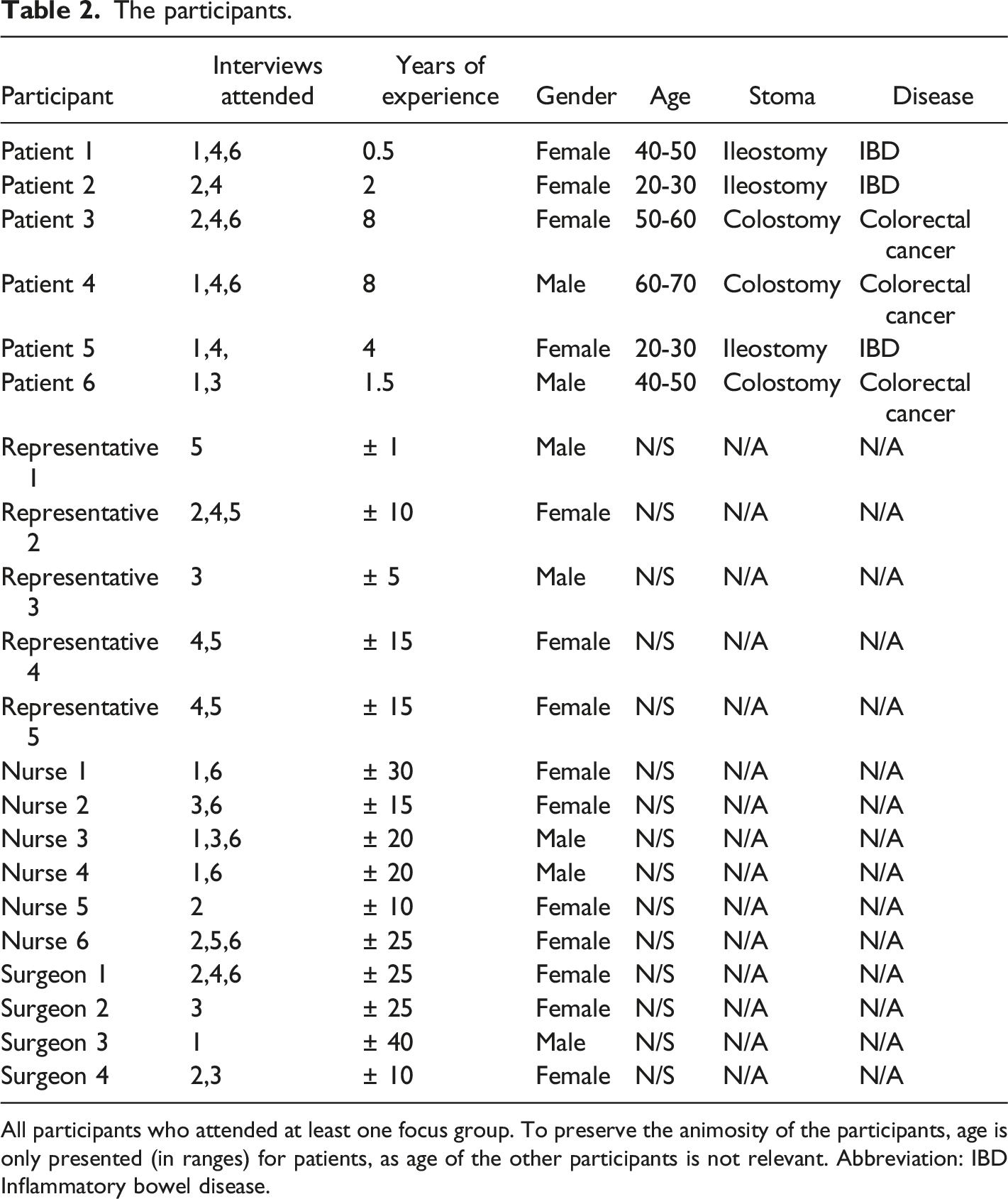
All participants who attended at least one focus group. To preserve the animosity of the participants, age is only presented (in ranges) for patients, as age of the other participants is not relevant. Abbreviation: IBD Inflammatory bowel disease.
Thematic qualitative analysis of the interviews identified five themes 1) perioperative information provision, 2) the need for information applicable to all patients, 3) the shortage of opportunities for peer contact, 4) contact with healthcare providers, and 5) information about stoma materials (see Figure 1). For the (sub)themes, it was discussed whether a mobile app would be beneficial, and this was supported by quotes. Participants were hopeful that a mobile app could solve some of the problems discussed, and expressed their insight into important aspects of developing an app and the functionalities it should have. Thematic diagram.
Perioperative Information Provision
Inadequate or Contradictory Information Provision
Stoma nurses reported that patients tend to forget a lot of provided information during patient counselling, and they often had to replicate the information multiple times and /or on multiple occasions; in diverse settings. Patients recognised this and explained that they are under a great amount of stress when a surgeon explains they have to undergo surgery. This message is often so impactful, that having any other information just cannot be processed. Hearing about their disease and the surgery itself is a lot of information to take on at once, it simply prevents them from capturing or remembering additional information about dealing with a stoma. Not being able to process information about getting a stoma, inevitably results in patients unable to remember what is needed with respect to their stoma care, possible preparations before surgery, and how to set up adequate care at home. Patients also reported that different, but sometimes also the same healthcare providers at different times; give inconsistent, and even contradictory advice, which makes them feel insecure. Therefore, patients felt compelled to ask for the same or more information multiple times. Patient 1 (FG4): “One doctor says: ‘You have to put the stoma bag on the left side’ and the other doctor says otherwise. You know, this confuses people and they will get them in trouble”.
Underexposed Topics
Patients who are new to a stoma face many challenges and questions during their care pathway. For instance, how should a stoma normally look, how do they recognise stoma-related problems in a timely manner, and how will a stoma impact daily life? Moreover, patients explained that healthcare providers fall short of advice on mental health, sexuality, and overall stoma care, and that it led to insecurity. Patients wished to have had better advice regarding these topics and emphasised the importance of providing adequate information on the impact of having a stoma on their mental health. Following that, patients indicated that psychosocial aspects and sexuality should be discussed in the app to prepare patients for their lives after surgery and how to cope with possible mental health problems. Cultural aspects can influence one’s acceptance of a stoma, and should therefore be discussed in the app as well. Patient 1 (FG1): “...if there is a problem with my stoma... And, these problems are never told to me, how should I know how to solve them?” Patient 4 (FG1): “I was once directed to that topic [sexuality] by a radiologist, and he discussed it with us. I found that very pleasant. None of the other doctors I have encountered paid any attention to this matter.”
Some patients had experienced uncomfortable situations with customer employees when travelling abroad, in which patients have to explain what a stoma is. They recommended that the app should provide a brief explanation of what a stoma in several languages. Moreover they recommended a small ‘tips & tricks’ function for the most common problems abroad, such as obstipation, dehydration or not having enough stoma materials. Patient 3 (FG2): “Things like ‘I have a stoma or I have stoma materials with me’, if that could be translated in a few languages, it would be very helpful.”
Providing Reliable and Easy to Find Information in the App
Participants suggested that reliable up-to-date information in the app could benefit many patients, as inaccurate, contradictory and confusing information can be given by various caregivers. According to them, patients should be properly educated on how to prepare themselves for the operation, what happens during the operation itself, and what is considered appropriate after-care. Participants recommended that stoma care, stoma problems, self-management, and choice and use of different stoma materials should all be major topics in the app. Representative 3 (FG3): “…What is the moment you have to contact someone, so, what are dangerous situations? In that way, patients can be more aware and if they have a problem, they can see in the app: ‘If you have this problem, you should immediately contact a healthcare professional, and if you have this problem, you can wait and see.”
Participants suggested a ‘search function’ which helps patients to easily find desired information without searching through the entire app, and an index list from A to Z. One patient suggested that the search function should include a ‘descriptive function’ that enables patients to describe the word or concept they are trying to find. However, one surgeon explained that implementing this function is difficult and expensive. Patient 5 (FG 4): “Suppose you have 'skin irritation', and you type 'skin irritation ' and the color of the skin. That can be searched through the text in the app.”
Timing of Information
Participants discussed that the timing and quantity of information in the app should be carefully considered and ideally, triggered when most likely to be relevant. Some recommended that patients receive information up to 6 months prior to surgery, while others recommended a timeline of only a few weeks before surgery, arguing that patients would most likely forget information when given too early. Information provided just before surgery (‘just in time’) was considered problematic too, as patients reported considerable stress just before surgery. Participants agreed that general information such as ‘what is a stoma’ and ‘importance of exercise before surgery’ could be given weeks or months before surgery, and topics such as stoma care, stoma materials, and fluid intake could be given only a few days before and after surgery. In this way, the information provided will be more relevant to the patient’s situation and will therefore be more beneficial.
Patients who undergo emergency surgery cannot be provided with information weeks or months before surgery. For these patients, the information provision after surgery must be different. During hospital admission, emergency patients must be able to receive a limited amount of essential information, whereas less essential information should be provided later. Participants agreed that only important topics should be provided during the hospital phase, such a basic information of a stoma (‘what is a stoma’, and ‘what does it look like’), and information on stoma care. All other information would be better to provide over the next few weeks. Participants emphasised that the information should be repeated multiple times. Patient 3 (FG2): “It is the own choice of patients what to with it, but…. It is a great start if patients can be notified with information or exercises before or after their surgery, or when they are back home.”
Presenting Information with a Good Balance Between Videos, Pictures, and Texts
Most participants preferred pictograms, pictures, videos, and not too much text. Although one patient preferred the opposite: “I do not like to watch videos, I always skip them. I always read the text.” All participants agreed that the visual aspect is important. Having too much text would increase the risk of the app not being appealing and the app would look like a textual website, rather than use the opportunities of an app. An app should be inviting, easy to use and appealing. Patient 3 (FG 2): “You should provide multiple options, because one may like to read a text, and someone else prefers a video or pictures.”
Information Should be Applicable for All Patients
Mainly Focused on the Older Patient
Patients noticed that written information was often focused on older patients, thus not adequately addressing the needs of younger patients. Often, only older patients are displayed in flyers, websites, and other resources. Patients mentioned that there is a stigma that only ‘older’ people have a stoma. Younger patients felt that they are invertedly placed in the category of older patients, which feels unjust and may revoke a younger patient from further reading. Younger patients wanted more ‘neutral’ information, which is not specifically focused on the older patient. Representatives involved in stoma-related information resources recognised this problem. Surgeon 4 (FG2): “Of course, I have seen these websites myself and the information is focused on the older patients. However, there are so many young patients with a stoma. I get what you [the patients] are saying.”
Personalisation of Information
Some participants recommended providing personalised information in the app, because some information may be less important to some patients than others. For example, information regarding urostomy is not informative for patients with an ileostomy. Participants agreed that information should be personalised based on stoma type, age, sex, and underlying disease. In this way, all information provided is relevant, as information shown is tailored to the situation. However, some doubted the benefit of a personalised app because they felt that it may be too difficult to cater to all individual needs. Participants recommended that all information should be accessible so that, if needed, patients could read topics that were not included in their personalised app.
In addition, stoma care protocols can differ among hospitals, and, therefore, it can be challenging to inform patients about certain themes, as there is not always an ‘apply to all’. For example, one nurse explained that patients should contact their hospital if they have a stoma output of > 900 ml, whereas another nurse defined a high-output stoma as an output of more than 1200 ml. To prevent patients becoming confused about possible contradictions between the information in the app and the information given by their caregivers, participants agreed that the app should contain a statement that patients should always follow the protocol given by their own caregivers. Surgeon 2 (FG3): “Can I go to a festival?’ Those questions I get from younger patients. But there are also 35 years old patients who are sitting home with their three children, so... It is difficult to personalize something so specific, because it will never include every patient.”
Contact with Fellow Patients
The Need for Peer Contact
Patients and their representatives explained that contact with fellow patients is important. Patients can benefit from exchanging their experiences and useful information. To date, patients have experienced difficulties in contacting fellow patients. Some participants mentioned that the threshold to get in contact could be too high, or that patients were not matched according to their personal situation and preferences. One patient reported that he was connected to a 30 years older patient whose interests and experiences did not match with his as a result of their age gap. Patients expressed that contact with fellow patients should be easier, preferably with patients of the same age and interests. Patient 4 (FG4): “If I look at what I wanted back then, I had the desire to talk to someone. Not on a forum, there is sufficient information on the internet. I just wanted to talk to someone who shared the same experience as me, but the threshold was too high.”
Peer Contact in a Mobile App
Participants expressed that contact with fellow patients facilitated in an app would be helpful. Three types of fellow peer contact in an app were discussed. A forum could be implemented in the app, in which a patient can ask a specific question and all other patients can respond to share their experience or knowledge on this topic. A forum can provide access to opinions and insights of many patients, rather than just one opinion. However, participants suggested that patients have less privacy if specific questions can be read by all other patients, and the representatives of patient associations explained that they already have an online forum on their website and in Facebook groups and recommended using the forum on the existing platforms instead of building it in the app.
The possibility of integrating a platform with peer-to-peer contact in the app was discussed, so that patients could interact with others to give or receive advice, or with the intention to become friends. As such, patients can bond and share experiences and feelings that non-peers may not understand easily. Another option would be to provide patients with a one-to-one chat selected expert patients, who have more experience in giving advice to other patients and dealing with difficult questions. Here, the goal is to ask about stoma-related problems and advice, and not to become friends. This option would require an extensive budget, as expert patients should be hired, trained, and managed. Representatives of stoma-related associations expressed their preference for experts in a controlled environment. Patient 6 (FG1): “I really missed having some fellow patient contact.” Interviewer: “How can we solve this problem though a mobile application?” Patient 6: “I think… a sort of community chat group. So, you can ask questions.” Representative 4 (FG5): “We have two possibilities: there are people wishing to become friends with other ostomy-patients, or get a relationship. But if they know they did a special course and are trained, then they are more like semi-professionals.”
Contact with Healthcare Providers
Unclear Contact Person in Case of Issues/Problems
Patients expressed that it can be difficult to know which healthcare providers should be contacted to address a specific question. Normally, a stoma nurse is the first contact person for all stoma-related questions. However, patients see many healthcare providers during the perioperative period, and they struggle to have a good overview which healthcare providers should be contacted. An overview in the app is considered helpful. Patient 2 (FG2) “There are so many channels you can ask questions. This also creates a problem. You think ‘To who am I going to ask that question?’ because I have so many contacts at once right now. If there is perhaps such an overview in an app… “
Contact a Healthcare Provider in a Mobile App
Patients suggested that direct contact with stoma nurses would make it easier for patients to ask questions and prevent unnecessary hospital appointments. However, a surgeon explained that it would demand that nurses answer in a short period, putting too much pressure on them, and that the system should be waterproof, guaranteeing that all questions indeed arrive at a nurse. It would not be possible to create such a large organisation for this app. Furthermore, hospital systems do not advocate patient information to ‘land’ outside the hospital record in an independent app, risking lost to follow-up of information in the patient file. Therefore, participants suggested a list of nurses, dieticians, and physiotherapists, so that patients could find these healthcare professionals more easily if needed. Representative 1 (FG2) “Actually, you would like to have a page somehow. So, you know the physiotherapists described in this app really understand it. This applies for dieticians as well.”
Overwhelming Amount Stoma Materials
Patients experience the choice of stoma materials and suppliers as excessive and overwhelming. After surgery, patients often receive a large amount of stoma materials from different suppliers in an attempt to acquire more customers. A stoma nurse explained that over 300 types of stoma plasters are available, and patients were indeed overwhelmed by the choice of materials, unknowing what type of material fits best. Stoma nurses stated that hospitals purchase stoma materials from only a few suppliers, which makes it difficult for them to counsel patients about all materials. In addition, a stoma nurse explained that insurance companies determine which material from which supplier is reimbursed, resulting in a limited choice for the patient. And on top of that, patients may have different insurance providers and packages. Therefore, it is difficult for nurses to have a full overview, and also difficult for patients to switch suppliers -based on their preferences. Patient 4 (FG1) “You are talking about a convex skin plate. Well, I don't know what that is. I can imagine it, but I don't know what it is. That should be in the app, it should say that there is a one-piece system: what it is, what the advantages are, what the disadvantages are, and there are two-part systems, what the advantages are, what the disadvantages are. But it doesn't have to be that there are green, yellow or blue, or dots.”
Participants agreed that general information about stoma materials and suppliers should be provided in the app. Stoma nurses indicated that too much detailed of information would be unnecessary and may even increase the problem of patients feeling overwhelmed. They expressed that patients need to be properly informed by a nurse on different materials fitting their requirements. In addition, patients suggested an ability to order stoma material through the app to be of high value. This, to ease the process of ordering material, and obtain a better overview of all suppliers and materials. Other participants also stated this could be used to create funding to maintain the app by asking suppliers for a fee for an order. Representative 3 (FG2): “If you have an app where you can see if the stoma material is a right fit for you and you get a web-link to the supplier, it could be a funding.”
Discussion
Providing adequate stoma care is essential for patients’ well-being and quality of life. This enables them to cope adequately with a stoma and reduces psychosocial problems and stoma-related morbidity. Although patients were generally satisfied with their received stoma care, several shortcomings were identified in preoperative information and care in acute and postoperative situations. As patients indicated that a mobile app may be beneficial, it may provide a sustainable solution to improve stoma care.
Our findings identified five key themes in stoma care: 1) perioperative information provision, 2) the need for information applicable for all patients, 3) the shortage of opportunities for peer contact, 4) contact with healthcare providers, and 5) information about stoma materials. These problems, especially when combined, may affect patients’ insecurity and self-efficacy and thereby their quality of life. All participants expected that an app would be useful, and be able to improve information provision and peer contact. They emphasised that it is essential that the app provides up-to-date and reliable information which can be consulted and searched anytime, and that the information is presented in a visually attractive way. Topics on mental health and sexuality deserve attention in the app, as this is usually insufficiently explained by caregivers, which has also been reported by other studies.(Ayaz-Alkaya, 2019; Black, 2004; Borwell, 2009; Persson & Wilde Larsson, 2005) Personalisation of the information could improve the relevance and user convenience of the app, mainly for the younger patients. However, it is challenging to consider all individual needs or hospital-specific protocols; therefore, it should be considered to limit personalisation to a few factors; triggered by important moments such as time of surgery and hospital discharge. Furthermore, patients expressed that fellow patient contact is important and that the app can improve peer contact. In other studies, patients also indicated that peer contact is essential.(Danielsen et al., 2013b) Peer contact in the app should considered to be designed as peer-to-peer chat contact next to the existing platforms in the Netherlands.
Developing and maintaining a medical app is costly, as it must comply with the European Medical Device Regulation (MDR), incurring additional expenses.(Shuren et al., 2018) Therefore, spending of available budget to build app functionality is something to consider carefully. It's crucial to prioritize functionalities when allocating the limited available budget. What is nice to have, and what is a need to have? Participants suggested that cooperation with different stoma material suppliers could increase options in case of budget constraints. During the interviews, several expensive functionalities were suggested, such as the possibility to have direct contact with a stoma nurse, a ‘descriptive’ search function, and contact with expert-patients. Although the wish of having a ‘direct line’ with a stoma nurse is understandable, one should be careful not to build an app that interferes with the regular caregiver interaction or hospital policy in terms of having all patient advice solely being routed via the hospital electronic patient file; not accepting alternative routes.
To date, healthcare is on the lookout for the smart use of digital solutions in times of limited care provider availability and -resource. A well-designed mobile app has the potential to support healthcare, contributing to several aspects, such as information provision, communication between patients or between patients and their healthcare provider, and perioperative guidance.(van der Storm et al., 2023b) Research indicates that a Chinese app improved patient outcomes for those with a stoma, while a Turkish app did not.(Danielsen et al., 2013a; Yiğitoğlu & Şendir, 2021) However, both apps had limited functionality that did not fully align with patients’ desires described in this study, with the Chinese app primarily focused on appointment scheduling, chat communication with stoma nurses, and photo uploading, while the Turkish app offered information and contact details for Turkish stoma care units. The clinical effectiveness of an app is reliant on proper design and development. To ensure usability, we conducted a quantitative study(O'Connor, 2005) and this qualitative research on stoma care, studying patients' specific needs and desired functionalities. It’s crucial to involve the target group and stakeholders actively in the development process to guarantee usability. Additionally, recognizing patients’ varying levels of digital literacy is important, as not all may have the necessary proficiency with mobile devices.(O'Connor, 2005) As such, the app should cater to this as much as possible and provide support for patients who need help in using it.
Limitations
Patients, representatives, and healthcare professionals participated in a combined setting (focus group) to obtain insights from all relevant parties in stoma care and discuss problems and their possible solutions. Although not reported in literature, a strong opinion, role or verbalism of a sole participant in a focus group may influence others in the same group - or even prevent others from verbalising their thoughts.(Kitzinger, 1995) Such risk was mitigated by strong focus on creating a comfortable atmosphere on forehand, a group leader aware of this and asking all participants for their opinions during the interviews. We did not notice any limited expressions of the participants. In addition, the setup of the participants was different in every interview, as it was not possible to organise interviews with the same participants. This could have led to different dynamics between the participants in the interviews and, ultimately, to different outcomes. It is important to note that participating patients may not be a good representatives of the ‘average’ patient. Most likely, our participants were more actively involved in their own stoma care, or perhaps better educated or skilled as they were members of patient associations. Purposive sampling was used to minimize this limitation. Finally, the last three interviews were conducted online because of Dutch COVID-19 restrictions. Based on previous studies showed virtual focus groups may result in participants being more relaxed and involved in the group discussion.(Dos Santos Marques et al., 2021) However, in our study, we experienced that discussions in online meetings were less fluent because of connectivity or audibility problems.
Conclusion
Stoma care can be much improved to date, as patients face important problems that cannot be well addressed in the traditional care pathway. They are in need of on-demand, and reliable information they can revisit when needed, fitting their personal circumstances. In this study, we discovered some key problems that the participants thought could be overcome by the development of an app. The app must provide up-to-date and reliable information, be visually attractive, and facilitate peer contact. After development, the safety and effectiveness of the app should be evaluated in clinical research.
Footnotes
Acknowledgements
We thank the patient associations “Stomavereniging” and “Stichting Stomaatje” who provided support for conducting this study.
Declaration of Conflicting Interests
The author(s) declared no potential conflicts of interest with respect to the research, authorship, and/or publication of this article.
Funding
The author(s) disclosed receipt of the following financial support for the research, authorship, and/or publication of this article: This study was funded by the Dutch foundation “Maag Lever Darm Stichting” (Stomach Liver Intestine Foundation), grant number ZP19-09.
Category
Semi-structured focus group interviews

Data Availability Statement
Data sharing not applicable to this article as no datasets were generated or analyzed during the current study.