




Abstract
Intro
With the rapid expansion of the esports industry, many esports training programs and academies have emerged. According to research, esports may lead to cognitive, metacognitive, academic and professional competencies if appropriately supported (Adachi & Willoughby, 2013). However, there is no systematic curriculum or guidance on how to identify and support these competencies through esports training.
Methods
This paper conducts a systematic review of literature from the learning sciences to provide a systematic rubric of competencies and instructional approaches to support them through esports training. The competencies that may be supported through esports are mapped along the game design principles as categorized along Mechanics, Dynamics, and Aesthetics (MDA) framework. Current training programs were analyzed to identify training approaches that can support these competencies across different contexts.
Results
There is a wide range of cognitive, self-regulation, social, academic, and career competencies that were found to be supported through video games. However, the development of such competencies depend on the availability of the learning opportunities and appropriate support provided to engage these opportunities, thus requiring a systematic framework for esports training. The training approaches that can be implemented to support diverse competencies from esports training, whether amateur or professional, are varied in modality, style, and structure.
Conclusion
The goal of this study is to inform the esports industry more largely, as well as the trainers, researchers, and designers with systematic and research-informed approaches to support future esports athletes, both professional and amateurs. Learning from the traditional field of athletic training, esports training should take more systematic approaches to design training curriculum and programs, as well as preparing the trainers.
The Need for Systematic Approach for Esports Training
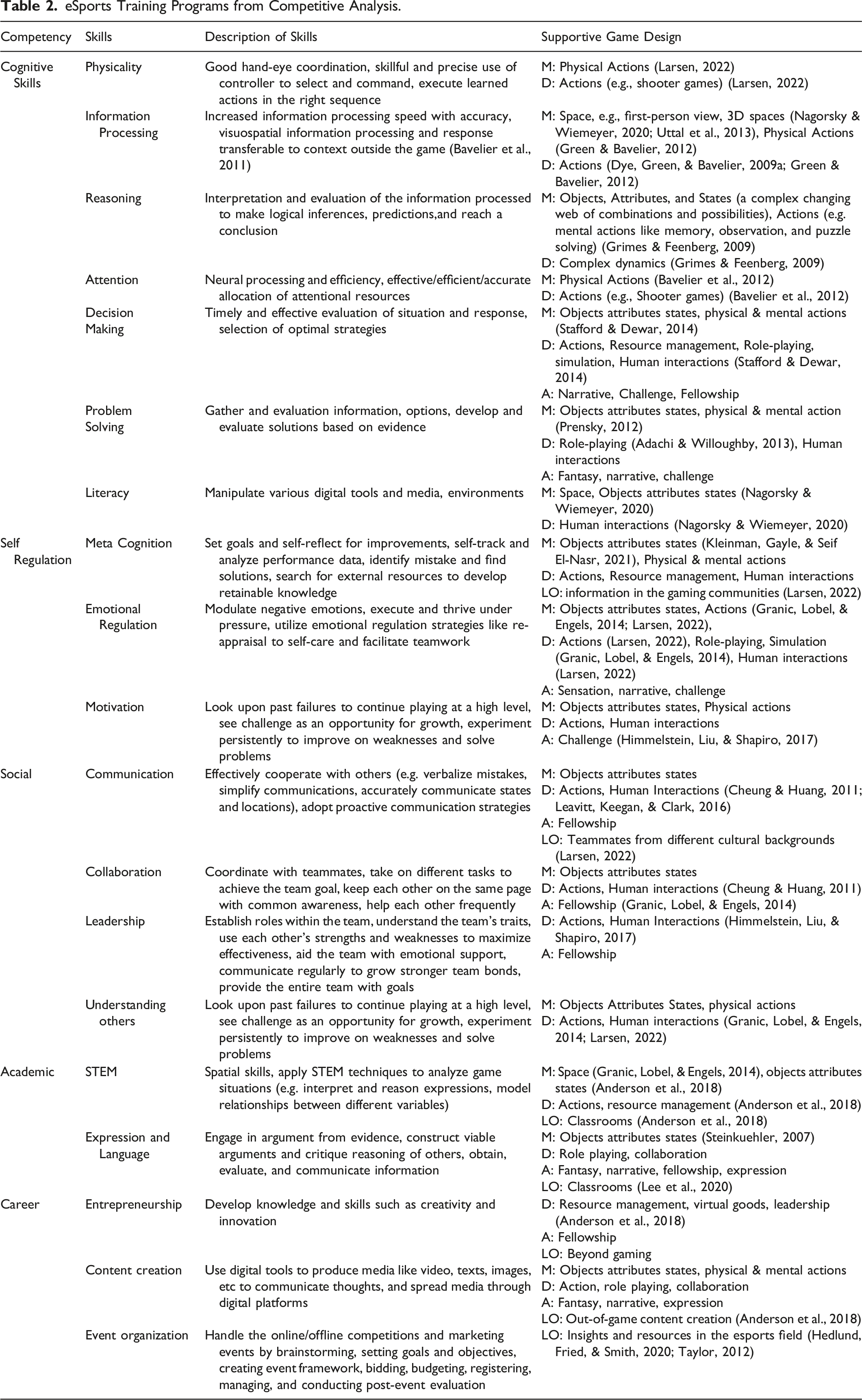
eSports Training Programs from Competitive Analysis.
Increasingly, empirical studies are examining esports from various disciplines, such as media studies, informatics, business, sports science, and cognitive science. However, little attention has been paid to developing competencies through effective support in esports training (Reitman, Anderson-Coto, Wu, Lee, & Steinkuehler, 2020). Effective instruction and training require well-defined goals of the training that consist of knowledge and skills, or competencies, that are necessary to become good at playing games. A research-informed curriculum should also be designed to support the training of these competencies (Reiser & Dempsey, 2012). Trainers should understand the necessary competencies and how to support their development across games with different cognitive, physical, and socioemotional characteristics. Currently, there is no systematic approach to identify the goals, curriculum, and strategies for esports training (Nagorsky & Wiemeyer, 2020), and current programs primarily focus on developing cognitive strategies that allow players to immediately improve their game ranking without considering the complexity of necessary competencies and ways to support them.
In comparison, the field of athletic sports began a systematic approach to train athletes and their trainers as early as the 1950s in the US when the National Athletic Trainers’ Association (NATA) was created (Delforge & Behnke, 1999). The early efforts included development of a model curriculum to guide athletic trainers with knowledge and skills necessary for scientific approaches to training athletes into professional level. The curriculum included a wide range of foundational skills and knowledge on physiology and psychology of athletes, and the skills necessary to continue developing as a professional athlete. Such systematic and research-based education of trainers and the subsequent training of athletes spread widely across all fields of sports. While there are some controversies over the nature and scope of the theory, deliberate training as a theoretical framework proposed by Ericsson et al. (1993) emphasizes the need for systematic approach to training and practice in developing expertise in a field. This applies to training expertise in all fields, including sports, art, music, chess and more.
Similarly, esports training should take a systematic approach to identify the competencies necessary to become expert gamers and trainers, design and implement esports training to support the development of in-game competencies that can be transferred beyond gameplay. These competencies may include cognitive, metacognitive, and socioemotional skills necessary for successful gameplay, as well as academic and professional success (Adachi & Willoughby, 2013).
Research Questions
This paper addresses the need for a more systematic approach to esports training by asking two questions. First, what are the competencies that can be supported through video gameplay? Second, when and how can we expect the competencies to be developed?
We address these questions by presenting a rubric of competencies that can inform the design, implementation, and evaluation of esports training, as well as trainer education. The rubric was constructed through comprehensive review of empirical research. The rubric identifies the competencies that can be supported through video gameplay based on the game design. Then, an overview of training approaches and strategies are presented to inform the design of esports training and the trainer education.
Theoretical Framework
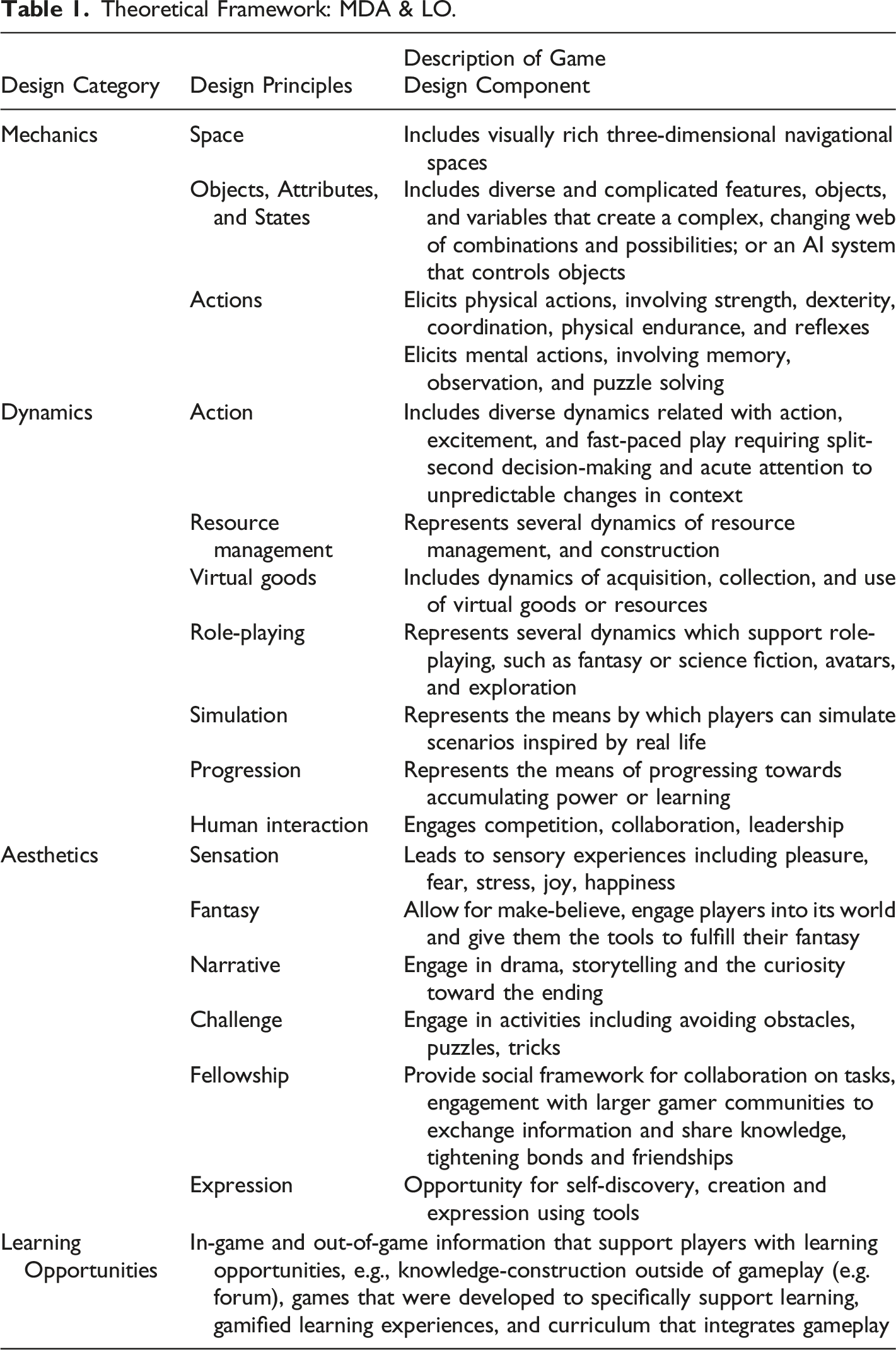
Theoretical Framework: MDA & LO.
Rubric of eSports Competencies
In this paper, game design components are categorized into four categories: Mechanics (M), Dynamics (D), Aesthetics (A), and Learning Opportunities (LO). With the analysis and mapping of competencies across game design components, the rubric can be applied to any video games to identify competencies that can be developed through deliberate training with the game. The framework builds on the well-known Mechanics-Dynamics-Aesthetics (MDA) framework developed by Hunicke, LeBlanc & Zubek (2004), with the addition of a category for Learning Opportunities. This framework was developed to guide systematic review and categorization of competencies that were observed in relation to the game design in previous studies. In other words, for each of the competencies that were discussed, game design in relation to MDALO were identified. Each of the categories consist of sub-components as synthesized from Hunicke et al. (2004) and additional sources when necessary .
Rubric of Competencies
Description of the Rubric
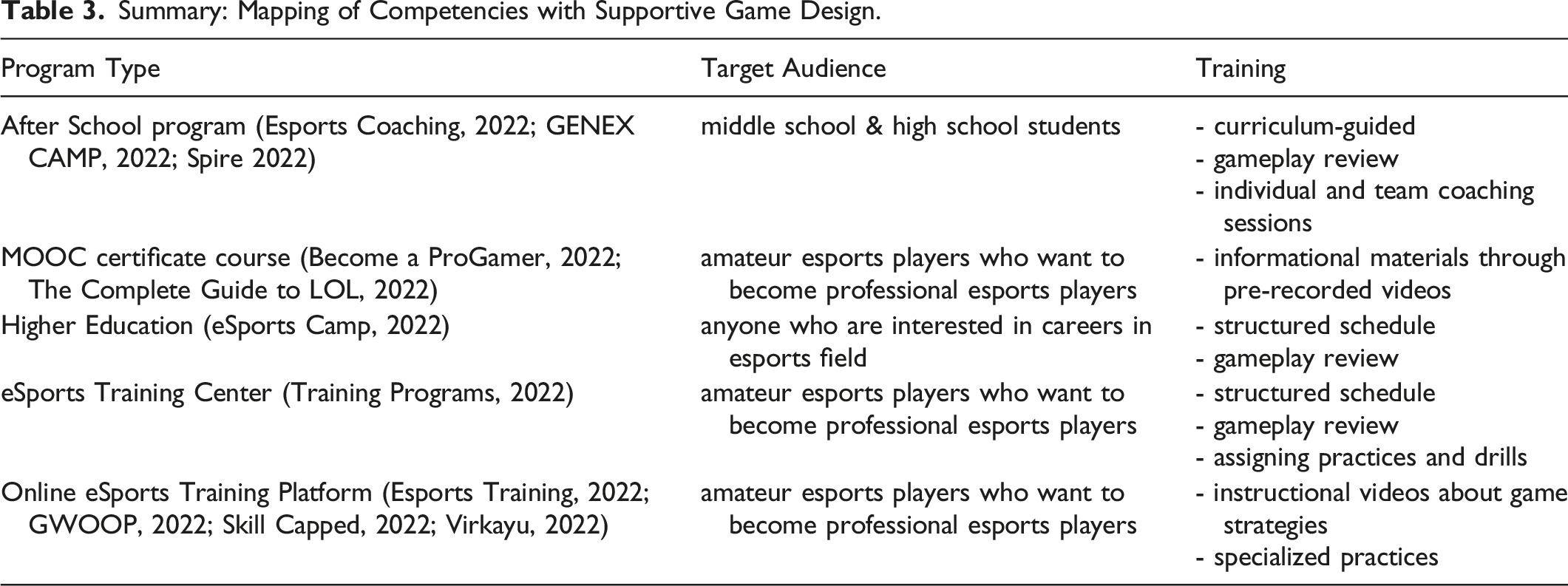
Summary: Mapping of Competencies with Supportive Game Design.
The following section takes a closer look at each competency, as well as how specific game design components and strategies were found to support the competency.
Cognitive Competencies
Cognitive competencies refer to the mental skills that could help gamers perceive and process information in the environment to perform subsequent reactions and actions. Bavelier, Green, Han, Renshaw, Merzenich & Gentile (2011) described video games as a highly motivating context of training that can elicit transferrable changes in neural functioning and cognitive performance. When engaging with video games, gamers are expected to show enhancement in the following six types of cognitive competencies:
Self-regulation Competencies
Self-regulation is the ability to modulate behavior to achieve long-term goals over time and across contexts, including managing attention, thoughts, emotions, and behaviors (Uzun & Kilis, 2019). Bandura (1986) divided the process into three components: (a) self-observation or behavioral monitoring; (b) self-evaluation of progress; and (c) self-reaction, including both affective and tangible consequences. In other words, one needs to first recognize and track their status, reflect on and assess it, then take actions to achieve a higher goal. There are three kinds of outstanding self-regulation competencies that can be developed deliberately through training and gaming in esports:
In esports, having good
Finally,
Social Competencies
Social competency is defined as a capacity to maintain effective social interaction through social skills, sociometric status, relationships, and functional outcomes (Halle & Darling-Churchill, 2016). In the context of esports, professional gamers display four most common types of competencies, including
Effective
Academic Competencies
Counter to the common belief, video games can nurture academic competencies if given the right contexts of implementation and support. Gamers, coaches, and analysts in the esports industry must exercise similar expertise as in the field of math, data science, concept learning, or STEM (science, technology, engineering, and mathematics) more generally. For example, understanding polynomial equations, interpreting expressions, reasoning with expressions, interpolating functions within context, and building functions to model relationships between different variables are necessary to be successful with increasingly complex gameplay (Granic et al., 2014). It is also common for gamers to use STEM techniques to analyze game situations. Players approach strategic games like LoL in data-driven ways, like using statistics provided by online third-party analytical tools to analyze the play. Roles like theory crafters demonstrate even more devotion in these skills. They take the game mechanisms, rules, variable values in, dissect the codes and equations, use augments to test which combination of mechanics would be the best fit in different scenarios and identify the most effective strategies. Wai et al. (2010), as cited in Granic, Lobel, & Engels, 2014)’s 25-year research shows that academic success in STEM subjects can be predicted by spatial abilities. Spatial abilities are essential information processing competencies that can be strengthened by action games, especially shooter games.
Diverse competencies related to English language art learning or language expressions can also be cultivated through opportunities in and out of games. These competencies can be fostered through verbal analysis and content creation for narrative-based games, engaging in argument and discussion based on evidence from game mechanics, construct viable arguments and critique reasoning of others, obtain, evaluate, and communicate information in collaborative gameplay. For Massively multiplayer online game (MMOG) players, the experience usually involves shifting in different narratives inside the game, and also creating and consuming online fandom content outside the game, which both require extensive text reading and comprehension (Steinkuehler, 2007 as cited in Mills, 2015). Some educators have integrated games to a high school English Language Arts (ELA) curriculum that uses esports as an instructional tool for literacy development (Lee, Wu, Lee, Fleming, Ruben, Turner, Brown, Steinkuehler, 2020). In this curriculum, students in the 9th and 10th grade explore game design elements to understand the narrative structure, while 11th and 12th grade students dive deeper into rhetoric and writing practices through entrepreneurship and marketing simulations in esports business.
Career Competencies
Engaging in esports as gamers as well as stakeholders in the industry provides opportunities to develop diverse career competencies that can be applied to a wide range of professions.
Through gameplay, esports engage and develop players’ tangible skills that are crucial to business management and entrepreneurship such as managing and constructing resources, leadership, creativity, and innovative thinking. Anderson et al. (2018) observed that gamers often engage in informal learning opportunities such as in-person workshops and online clinics during, launching and managing their own game-related content such as through streaming channels. Such content creation require multifaceted skills including content planning and research, using digital tools to produce media including tutorial video, fandom creations (texts, images, etc.), and live streaming, use of digital platforms to communicate thoughts, investigation, evaluation, and creative content while implementing strategic plans for monetization. The core competencies underlying content creation are also developed through more general gameplay as players engage in role playing and fantasy where they are actively engaged in developing and engaging with the narratives, and observation, comprehension, and reaction to complex game contexts. Lastly, skills and knowledge such as competitive rivalry, staged performance, institutionalized practice behind event organization can be fostered through playing video games (Taylor, 2012), as well as from following and monitoring esports competitions. The skill of event management is also transferable to different industries in that the ability to plan, bid, budget, and evaluate are generalizable in marketing events in other fields (Hedlund et al., 2020).
Training Approaches
Providing effective esport training requires research-informed definition of learning goals delivered through supportive methods of training. To address the question of How can we support competencies through video gameplay?, a synthesis of training approaches and strategies was developed through a competitive analysis. (see Table 3) A total of 12 training programs were selected for analysis based on the diversity in goals, platforms, format, and learners, based on a search using keywords such as “esports”, “training”, “curriculum”, “coaching”, “bootcamp”.
For each of the selected programs, the official website, information handbook, course syllabus, and course material (when available) were reviewed to identify the learning objectives/competencies, modality, learning format, target audience.
Modality & Learning Format/Technology
Esports training is offered in diverse forms and modalities. Learning modality refers to how (delivery mode) and when (conveying method) the program is delivered. The delivery mode includes online, in-person, or a blended (mix of both) modality. The conveying method includes synchronous (meeting at specific times and locations) or asynchronous modality.
Online synchronous learning programs in the esports field include live bootcamp and individual online coaching sessions/courses where instructors can engage with students at the same time (Spire Esports Camp, 2022; Training Programs, 2022). Those online sessions often use live streaming services and video conference applications such as Twitch, Discord, and Zoom to deliver their training. The fully online courses are generally more accessible to students regardless of where they live. Online synchronous learning format not only allows students to ask questions and get answers in real-time but also provides instructors the opportunities to understand students’ progress and adjust sessions accordingly. While there is a vast amount of esports instructional videos online (Esports Training, 2022; Virkayu, 2022), the opportunities to receive feedback for personalized support and learning may be limited. Depending on the size of the training session, students may not have sufficient opportunities to communicate with their peers and their trainers informally. For example, students’ messages may be easily neglected by trainers with the bombardment of information from games and students’ communication channels during the training session.
Online asynchronous learning is one of the most common training approaches that amateur players choose to train their gameplay skills for its flexibility, affordability, and convenience. Common online, asynchronous esports learning include online courses (Become a ProGamer, 2022; The Complete Guide to LOL, 2022), professional esports training video platforms (Esports Training, 2022), general esports cognitive skills training platforms (GWOOP, 2022), and informal esports learning videos on Youtube and Twitch (Virkayu, 2022). Students who adopt this training approach have control over their learning and have agency in choosing what and when to learn based on their needs and interests. Yet, similar to what has been discussed in much of the literature in online asynchronous learning (Morse, 2003), this kind of learning formats do not provide personalized guidance to students, thus, students may not be fully aware of their strengths and weaknesses and not know what to learn and how to learn. Especially, in the field of esports training, students often require a more specific guidance in terms of what game strategies should be used in the gameplay to improve their game skills. The lack of instant feedback can hinder how students make progress in improving their gameplay and underlying competencies.
There are many esports bootcamp and afterschool training programs that take place in the offline settings in school clubs, student centers, or other student extracurricular centers (Esports Coaching, 2022; GENEX CAMP, 2022; Spire 2022). Most programs offer lectures, invited guest speakers, and organized learning activities (e.g., live gameplay, VOD review and drills). Compared to online training programs which underscore training experience based on students’ interests and preferences, some offline training programs provide a more established schedule or curriculum. The curriculum often places their focus on building peer learning environments through team building activities such as game competitions. Students’ engagement with trainers and other students are fostered by setting up the physical space where trainers/ instructors can move around students’ playstation and provide students with real-time feedback and personalized guidance. Yet, students might feel lost after the offline sessions as the trainers’ instruction and feedback may not be well documented and tracked during real time interactions. Furthermore, the offline learning environment depends heavily on instructors/coaching styles, capacity, and availability and the learning goals are often not clearly identified. With lack of established esports curriculum nor trainer education, the outcome of such training may vary widely.
Blended learning integrates virtual and face-to-face learning, and can be customized with support of technology. Learning can happen online in a format where students have control over their path and pace while the instructor-led classroom or lab provides additional guidance. For example, GamingConcepts’s curriculum uses online esports management system Gameplan to provide educational content online and keep track of students' progress (Esports Training, 2022). Under blended learning, online learning is offered through instructional videos of gameplay and strategies or practice of general cognitive game skills through online mini-games or modules. This allows students to learn and practice esports strategies remotely and independently, while applying these strategies during in-person class sessions as coaches observe and provide feedback. Also, in-person sessions can be used to assist players to overcome challenges they encountered during self-directed learning. While blended approaches allow for efficient use of instruction time, they require higher motivation and self-regulation from the learners.
Learning Goals/Competencies
We applied the rubric of competencies from esports to analyze the learning goals of the selected 12 esports training programs. The goal of the analysis was to identify the diversity, opportunities, and limitations of learning goals in the current offerings.
Common competencies supported by the programs fall under the four categories of competencies: cognitive skills, self-regulation skills, social skills, and career development. Current programs support cognitive skills related to basic gaming skills and understanding of specific in-game mechanics (eSports Camp, 2022; Esports Coaching, 2022; Esports Training, 2022; GWOOP, 2022; Skill Capped, 2022; Spire Esports Camp, 2022; The Complete Guide to LOL, 2022; Training Programs, 2022; Virkayu, 2022). Not all, but a subset of programs that offer esports gameplay training defined physicality, information processing, decision-making, and problem-solving as their learning goals. The second category, self-regulation skills focus on emotional regulation skills. To achieve advancement in esports, players are often required to be able to regulate their game performance, emotions, and motivation during gameplay. Current esports programs foster self-regulation skills to help players advance in such competencies (Become a ProGamer, 2022; eSports Camp, 2022; Esports Coaching, 2022; Esports Training, 2022; GWOOP, 2022; Skill Capped, 2022; Spire Esports Camp, 2022; The Complete Guide to LOL, 2022; Training Programs, 2022; Virkayu, 2022). Under social skills, current esports programs focus on teamwork, leadership, and social skills. Being able to collaborate and communicate with their teammates is also an important competency in team-based games. Finally, support for career development in the esports field include developing the mindset as one transition to professional gamer, and insights about the esports industry. This learning goal is offered specifically in programs that support those aspiring to become professional esports athletes (Become a ProGamer, 2022; eSports Camp, 2022; Esports Coaching, 2022; GENEX CAMP, 2022; Skill Capped, 2022; Spire Esports Camp, 2022; Virkayu, 2022).
Target Audience and Program Goals
Two main categories of audience were identified in the 12 programs under review. The target audience had different goals for training, which determined the structure of the training programs. The first category of learners include youths in middle and high school (Esports Coaching, 2022; Esports Training, 2022; GENEX CAMP, 2022; Spire Esports Camp, 2022). For this audience, esports training programs aim to improve students’ gaming performance, while using esports games as a venue to learn life skills such as communication, leadership, teamwork, business, marketing, and game development skills. Programs often partner with schools or communities to provide in-game skills training, review of game strategies, lectures about relevant gaming topics (e.g. mental health, communication) and related subject areas (e.g., game industry history, content creation, marketing) to gain understanding of the esports world. Some programs integrate hands-on STEM activities to solve problems, make sense of information, and make decisions (GWOOP, 2022). During training, students can hone their cognitive skills and soft skills through game practices. Moreover, to cultivate students’ sportsmanship and a sense of community, some esports training programs participate in tournaments, hold intra-school or inter-school competitions.
Second category of learners are aspiring amateur esports players (eSports Camp, 2022; GWOOP, 2022; The Complete Guide to LOL, 2022; Skill Capped, 2022; Training Programs, 2022; Virkayu, 2022). For them, the goal of training is directly tied to improving gaming skills and is measured by the increase of the rankings in the particular game. Most programs include asynchronous lectures in the form of pre-recorded videos and live sessions that include classes and training feedback. The live sessions are offered in the form of Video-On-Demand (VOD) reviews or real-time comments. Feedback from the instructors or coaches is the most essential part of the training experience as they help players identify the specific context of when, how and why to use certain cognitive, motivational, and self-regulatory strategies, identify and enhance personal strengths and address weaknesses, and promote students’ reflection on their performances to make improvements.
Coaching Styles
Although most esports training programs rely heavily on individual coaches and their capacity to train players, few programs specify how they are delivering the training and coaching to the players (Esports Coaching, 2022; GENEX CAMP, 2022; Spire Esports Camp, 2022; Training Programs, 2022). This may be due to lack of systematic curriculum and training for the coaches, as well as low retention of the coaches. Without theoretical understanding of competencies developed in video games and the knowledge from the learning sciences, coaches in esports tend to focus more on achieving immediate results (e.g. ranking improvement) and less on building a systematic coaching process in general. In personalized training sessions, esports coaches need to observe players, identify their needs, and provide appropriate feedback and support. Coaches use their expertise in gaming to instruct amateur players to think in the way expert players would think in certain scenarios. However, the difference between how novices and experts organize and structure their knowledge might set back amateur players’ understanding and processing of the game strategies used in the related scenarios, thus not supporting amateur players to develop long-term, transferable skills.
Suggestions for Training Approach
Players should be supported across a range of cognitive, metacognitive as well as self-regulation skills as defined in our rubric. This will allow players to continue to improve themselves as a player, but also in the contexts beyond gameplay.
Conclusion
As the esports industry expands, there’s an opportunity to more effectively support esports players to develop competencies within the gameplay, as well as those that can be transferred into real life context. Further, the trainers who support esports players need research-informed curriculum to better understand the needs of the players and how to support their development. Training in athletic sports established a systematic approach to understand the diverse competencies needed for professional athletes and to educate trainers with these competencies as well as pedagogical competencies to train the athletes. The field of athletic training evolved overtime as informed by research and practice. Such systematic and scientific approaches to develop competencies in esports can also contribute to more effective training within the esports context, as well as transfer of skills beyond the gameplay if appropriately supported. The paper presents a foundation for such a scientific approach through a rubric of competencies that are needed and practiced through video gameplay. Also, a review of current esports training programs were conducted to analyze the opportunities and limitations in the current esports training, specifically in terms of the learning goals and the training approaches.
The competencies that can be fostered through video gameplay are diverse in nature, ranging from cognitive, self-regulatory, social, academic, and professional skills. These also reflect the complexity of the game design and mechanics as manifest in commercial video games. The diverse skills are developed during gameplay due to the particular game design that allows for players to engage with and apply the skills. The rubric of competencies captures such diversity of learning goals that can be supported through video gameplay in relation to the particular game design that could lead to the development of the skills. The game design components that fall into mechanics, dynamics, aesthetics, and learning opportunities to specifically support certain skills were mapped to the competencies. The analysis shows that the different types of skills are supported through different game design components. Understanding which game design allows for certain competencies, and understanding how to engage in deliberate practice of these competencies will be the first step to systematic esports training.
A review of current esports training programs reveal that not all but a wide range of the skills as captured in the rubric are fostered in the programs, although the focus and training approaches vary widely depending on the target audience and their needs. The programs actively employ different modalities and platforms to provide training opportunities, ranging from online, in-person, to blended learning. There is a mix of modularized learning experiences in the forms of lectures and skill-based mini-games, as well as individual feedback and coaching. The coaches, who are often former players, are invaluable resources in these training programs, but without appropriate pedagogical education, the coaches may be limited in how they can understand, train, and support players with such diverse competencies. Therefore, esports training can benefit not only from a systematic design of the curriculum for the training programs, but also to educate the trainers who facilitate these programs. Learning from the athletic training field, where decades of research has led to an understanding of effective training approaches, will be helpful not only for the players themselves, but also for the coaches who work with them.
Footnotes
Declaration of Conflicting Interests
The author(s) declared no potential conflicts of interest with respect to the research, authorship, and/or publication of this article.
Funding
The author(s) received no financial support for the research, authorship, and/or publication of this article.
