



Abstract
Background
Due to the social nature of esports (i.e., organized video game competitions), recognizing common values and norms can be leveraged as a positive driver in online gaming communities. Different game categories such as sports simulation (i.e., esports based on real-life sport events) are driving their expansion through social interactions that foster new relationships among players, known as social capital (i.e., value created from social connections, relationships, and networks within the gaming community). Despite recent studies showing the social role of esports (e.g., on satisfaction, loyalty, or well-being), little empirically derived insight exists regarding its sport values, social capital formation and positive word-of-mouth in different gamer communities on the Internet.
Aim
This study aims to achieve two objectives: (a) to examine how sports values (excellence, friendship and respect) influence the in-game social capital formation (bridging and bonding) and word-of-mouth intention by the esports players; and (b) to determine whether differences occur according to sports simulation and non-simulation games.
Method
Data were collected among esports players (n = 509), and the results were analyzed using structural equation modeling to test hypothesized relationships between the constructs and multigroup analysis to verify if the path coefficients differ among both game groups.
Results
Friendship value was the strongest predictor of bonding and bridging capital formation in both groups. The excellence value showed a positive effect on strong social ties created towards non-simulation games, while playing well or reaching high in-game performance did not contribute to creating bonding capital in sports simulation games. Both bonding and bridging capital were strong predictors of behavioral intentions.
Conclusion
Social implications focus on cultivating the sportive values and enhancing social ties on player community as a way to share good experiences or to talk positively about the game. Esports industry should consider the well-established and mediating construct of social capital, strengthening in-game bonding, and bridging relations as a broader theoretical basis.
Introduction and background
In the last two decades, esports (i.e., video game competitions spanning multiple genres) has evolved into a hyper-connected, highly social, and competitive environment in different grassroots communities (McCauley et al., 2020). Its growth is attributed to the value of the experience, the gaming popularity, gamer recognition, and its positive externalities (Abanazir, 2019). Different game categories are driving their expansion by integrating social experiences and interactions that merge games and gaming into the existing societal and cultural context. As practical evidence, the 2018 Asian Games was the first event to recognize and integrate five esports games (e.g., DOTA 2, FIFA22, LoL) as a social demonstration sport. Although there is a lively debate between the Olympic Movement and the esports industry, the International Olympic Committee (2018) has already acknowledged that certain competitive game genres are acceptable within the spirit and shared values of the Olympics, paving the way for its future social acceptance.
The social role of esports is increasing in simulation and gaming literature by researching different impacts on player communities. Following a positivist approach, recent studies have shown that gaming can promote socialization (Chang et al., 2018), form stronger social ties (Perry et al., 2018), share norms and values (Seo, 2016), and build in-game social capital (Mandryk et al., 2020). At this point, a distinct element of the esports ethos is the shared values that emerge around different competitive gaming and that are accepted by the gamers to varying degrees (Seo, 2016). These values can convey sport virtues such as the pursuit of competitive mastery (excellence), the spirit of togetherness (friendship), or the appreciation of diversity (respect), thus building social capital in the grassroots community. The need to form lasting and valuable relationships are fundamental human needs (Coleman, 1988), and esports can offer a viable structure to build social capital through these shared interactions in the gaming environment (Mandryk et al., 2020).
Within this stream of research, several studies have evidenced positive effects on both bridging (tentative relationships) and bonding (close-knit relationships) social capital (Trepte et al., 2012). The social capital framework formalizes the value of social ties, placing video games as resources that will return value to an individual in the form of social support, experiences, and information (Mandryk et al., 2020). This means that for these gamers, playing video games is no longer a form of casual leisure, but it is also about becoming better, sharing experiences, and reinforcing social ties (Williams, 2006). As players build these bonds, they are connected to a broad array of information, sharing links, ideas, and media. This can be explained by positive word-of-mouth (WOM), which denotes a player’s intent to share positive information about esports to others (Abbasi et al., 2020). In this case, it is possible that gamers who engage in social interactions in the game are more likely to contribute with positive WOM, yet empirical research has yet to prove or refute these assumptions.
Problematically, little empirical insight exists regarding the social capital’s effect on different gaming environments (Mandryk et al., 2020), so this can represent an important contribution to the simulation and gaming studies. Previous studies on the determinants and consequents of social capital in esports are limited (Trepte et al., 2012) and recent research has tended to focus exclusively on a single game category (e.g., MMO games; Raith et al., 2021) without distinguishing gamer profile nor characteristics (Kelly & Leung, 2021). While there are labels and terms of what is commonly understood as a particular genre (Faisal & Peltoniemi, 2015), new standards of categories seem to be in constant evolution due to each game’s particular qualities and characteristics (Sjöblom et al., 2017). Recent studies have argued that esports game genres need to be better identified and explored in the literature (Jang & Byon, 2020). As social interaction in esports surges, the need to explore each game group has also increased. This exploration can address questions such as: Is there a different pattern regarding values perceived for each genre-based group? Which gaming groups are more or less likely to create social capital? In the end, which social determinants affect the WOM intention of players? This is exactly the problem we want to address in our article, namely the lack of understanding of how sport values can influence the social capital formation and WOM intention in different gamer communities on the Internet.
Objective and structure
The purpose of this study is twofold: (a) to examine the influence of sport values (excellence, friendship, and respect) on in-game social capital formation (bridging and bonding) and positive WOM intention by the esports players, and (b) to verify if differences occur depending on the gaming group. We propose two broad categories of esports game genres: Sports Simulation Games (SSG), which emulate real-life sport event rules, teams, or players, and Non-Simulation Games (NSG) that represent virtual, unreal, and imaginary world-based themes. Our study provides at least two main contributions. First, we develop a conceptual model and an associated set of hypotheses that allow us to test our value perception effects on a social capital formation and the behavioral intention of players. Additionally, we use game genre categories as a moderator to examine the path coefficients in the relationship between predictors and behavioral intention of players. Second, our study points to important theoretical and managerial implications. Theoretically, this study primarily advances the simulation and gaming literature by empirically investigating the role of sport values on a specific social capital. Different values can be shared across the competitive online environment representing guiding principles that create in-game bonding and bridging relations on player community. Practically, our findings evidence that different value perceptions can emerge around different competitive gaming, which tell us something about its online gameplay. Esports publishers and developers need to understand the WOM behaviors and consider strategies to increase sport and social value according to the online gaming category.
The remainder of the article is organized into five sections. The next section will coincide with the theoretical background based on social capital framework and game genres in esports. Next, the method section shows the hypothetical model (see Figure 1) with support for eleven tested paths (hypotheses) followed by data collection, measures, and analysis procedures. Results are presented in the third section. We conclude with a theoretical discussion of our results, offering managerial implications for the Olympic and esports industries. Finally, the limitations and suggestions for future research are given. Hypothesized path model with hypotheses labeled. Note: Solid lines indicate direct effects and dotted lines show indirect effects for these paths.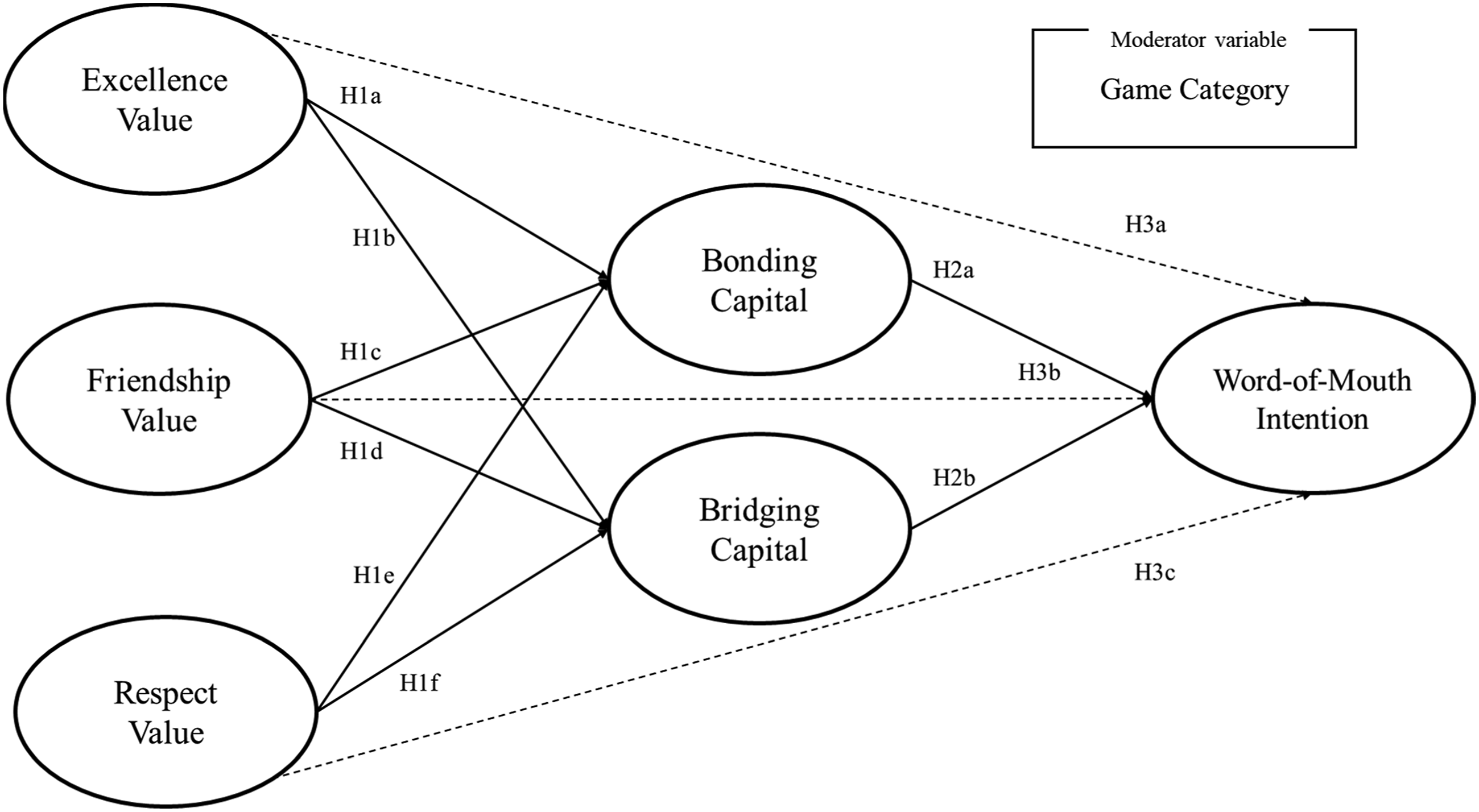
Review of literature
Social capital in esports
Social capital has become a key concept in analyzing personal interactions and relationships among esports players (Trepte et al., 2012). It assumes positive outcomes as both an individual element (Brehm & Rahn, 1997) and a characteristic of communities (Coleman, 1988). In both cases, social capital is a return function embedded in social ties among gamers (Zhong, 2011) that can be leveraged for individual or collective benefit. As noted by Bourdieu (1986), social capital is a sum of the resources, actual or virtual, that an individual or a group acquires through a relationships network. Social capital is anchored in the reciprocal relationships embedded in broader online gaming communities, influencing the relational behavior of players (Trepte et al., 2012).
Understanding social capital can be broken down into two dimensions: bridging social capital (i.e., tentative relationships that may lack depth, but make up for it in breadth) and bonding social capital (i.e., personal connections that provide strong and emotional support) (Putnam, 2000). Both constructs have been tested in the competitive gaming environment and some studies have added relevant constructs for the in-game social capital formation. For instance, Cole and Griffiths (2007) identified high levels of social engagement on competitive gaming and they found that these interactions enhanced the gaming experience and led to making new friends. Zhong (2011) highlighted how the in-game social experience can contribute to gamers bridging social capital and their civic engagement, while Skoric and Kwan (2011) found a significant connection between the gaming practice and online bonding social capital. Meanwhile, Kaye et al. (2017) noted that gaming engagement can also influence the gamer identity and create online social capital, while more recently Mandryk et al. (2020) demonstrated that passion for playing esports promotes both bridging and bonding capital, thus contributing to the social well-being of players. Despite these findings, most gaming studies in literature have shown that the bonding social capital seems to be a harder outcome to acquire in a gaming environment (Trepte et al., 2012). Furthermore, none of the previously mentioned studies tried to find underlying effects of social capital acquisition through perceived in-game values and seem to focus only a single game genre such as massively multiplayer online role-playing games (Raith et al., 2021). These concerns are addressed in the following sections.
Values as determinants of social capital in esports
Sociological research indicates that social capital is created when values are simultaneously experienced (Bourdieu, 1986). Among the values of sport that best predict the development of social relationship are achievements in competition, appreciation of diversity, and friendly relations with others (Prüschenk & Kurscheidt, 2020), which support the Olympic values. Considering that social capital may result in building friendships (Trepte et al., 2012), respect returned in a social exchange within a gaming environment, and at the same time in showcasing excellence in sport performance (Prüschenk & Kurscheidt, 2020), we take a closer look at the core values of sport as antecedent factors of social capital in the esports context.
Excellence value
Excellence in competition has been shown as a key determinant to explain individual preferences to a game (Hilgard et al., 2013). As a sport value, excellence is often associated with the pursuit of high standards and the achievement of outstanding results or performance. In the esports case, excellence can refer to the commitment to improving one’s skills and abilities, striving to achieve personal bests, and aiming for victory or success in competitions (Ribeiro et al., 2023). At this point, value creation through esports makes sense from a sports motivation perspective as enjoyment may derive from in-game achievement such as when a player wins a match or achieves the highest score.
Friendship value
Esports also creates interpersonal dynamics that engender team connectedness and friendly play (Falkenthal & Byrne, 2020) while fostering social and community rules and building patterns of fairness, civility, and decency. Values related to honesty, trust, and team spirit are indicators of friendly relations (Schulenkorf &Edwards, 2012) and they have an impact on the way esports players behave (Abanazir, 2019). The more the players socialize with each other, the closer they get and feel comfortable with each other (Trepte et al., 2012).
Respect value
The value of respect represents tolerance, fairness, equality, and anti-discrimination (Koenigstorfer & Preuss, 2018) in a player community. It can be evidenced by the appreciation of diversity and mutual respect such as when a player accepts and behaves respectfully toward other players. Previous studies have found that players may exhibit patterns of fairness and justice during the game (Seo, 2016), while others have highlighted the relevance of fair play in competitive tournaments and in the codes of conduct of esports governance bodies (Seo & Jung, 2016). While these advances offer societal opportunities that may extend to esports player communities, scarce empirical data exists to understand how these values can influence the in-game social capital formation.
Transferring social capital into WOM in esports
A focus on WOM intention is important when examining online communities (Hsu, 2015) especially within an esports context. One of the videogame consumption behaviors is the WOM intention among player community (Badrinarayanan et al., 2015). As noted by Huang et al. (2017), the concept of word-of-mouth refers to a player’s intent to share positive information, experiences, and feelings with others about the game. Recent studies have shown that player social engagement can positively influence their consumption behavior, including heightened WOM (Abbasi et al., 2020), while others have revealed that online player experience can affect their intention to spread WOM (Huang et al., 2017). Social capital theory (SCT) recognizes an inherent value in those interactions among community members (Skoric & Kwan, 2011), allowing the creation of weak or strong social ties. The stronger a player’s social ties on online gaming, the more (s)he will tend to share it or to talk about it with others (Huang et al., 2017). Consequently, the effect of this social interaction is conducive to positive WOM as individuals view the game as a way of establishing personal relationships (Pang, 2021), satisfying their social needs such as companionship, competition, or socialization (Chang et al., 2018). However, despite seeing gaming communities using the power of WOM to diffuse their games, their social role remains unexplored (Huang et al., 2017). Moreover, though gaming social capital has been shown to act as a significant driver of different social behaviors such as satisfaction, loyalty, or wellbeing (Mandryk et al., 2020), little empirically derived insight exists regarding its effect on the positive WOM intention. Therefore, exploring the existence of the positive WOM in esports and explaining the occurrence of it in different game genres will contribute to simulation gaming research and practice. The following section outlines the common game categories, critiques existing genres, and suggests two broad categories of esports (i.e., sport simulation and non-simulation games).
Game categories in esports
The game category/genre was a control variable in this study. Genre is a major means of classifying information in different domains and is one of the most important informational elements for searching and belonging in a player community (Lee et al., 2015). Academic literature on esports game genres has distinguished a set of common game categories such as multiplayer online battle arena (MOBA), role-playing (RPG), first-person shooter (FPS), third-person shooter (TPS), real-time strategy (RTS), sport simulation, fighting action, and battle royale (Sjöblom et al., 2017). However, not all video games can be classified as esports games. The aforementioned genres represent a particular type of video game as they must meet certain criteria in terms of structure, organization, and institutionalization before they can be classified as an esports game (Pizzo et al., 2018). Wolf (2001) was one of the earliest scholars to create genre categories of games based largely on gameplay and interactivity. Despite his findings (42 different categories), the author’s model is commonly critiqued for neglecting emerging genres and for lacking content definitions. Lucas and Sherry (2004) distinguished three video gaming categories: traditional (e.g., card/dice or quiz/trivia games), physical enactment (e.g., first/third-person shooter), and imagination (e.g., fantasy or adventure). Despite the differences found, their findings essentially focus on genre differences, while neglecting the role of each videogame-related category. Jang and Byon (2020) have also explored three esports genres based on imagination, physical enactment, and sport simulation, but their findings did not show differences among the physical and sport simulation groups, which can be explained by the real-world activity-based background. While there are labels and terms of what is commonly understood as a particular genre (Faisal & Peltoniemi, 2015), new components, levels, or modes generate completely separate titles or even establish new game sub-genres (Sjöblom et al., 2017). In addition, esports players may belong to and interact in various gaming communities that partially overlap (Del Bosco et al., 2020), engaging with multiple groups of players and games simultaneously (Eklund, 2015). The social perspective offered by the development of grassroots communities (McCauley et al., 2020) may indicate that broad categories emerge across the traditional boundaries of videogame genres according to the needs of the industry in general and the esports player preferences in particular.
Crucially for this study, a distinction is made between two relevant genre categories, sports simulation and non-simulation. From a theoretical view, this distinction is focused on the divide between situations in which action (of a sort) is possible and situations in which the action is not possible (Matravers, 2014). This means that there are genres whose possibilities of simulation action can occur since they represent possible actions in the real world, while others, non-simulation, represent what is outside people’s real reach (Pike, 2021). These two categories could entail all the game genres. Sport simulation games present the player with a simulation focused on a real-life scenario and are modelled after traditional sport competitions (Peterson et al., 2020). Therefore, players can more easily understand and immerse in this esports content because of the similarity of real-world performance and rules. Non-simulation games represent virtual and imaginary world-based themes involving exciting characters, rewards, and challenges (Hedlund et al., 2021). This esports category requires prior knowledge of the gameplay and rules (Jang & Byon, 2020), which means that players have a more complex and reflective understanding gameplay given the need for prior understanding and familiarity with the game. The most popular genres within this game category include RPG, FPS, TPS, RTS, or MOBA. Next, we define these two game categories as a moderator variable.
—
—
Method
This empirical research followed a cross-sectional design to develop our understanding of the association between the variables in the esports context. We next develop our conceptual framework (Figure 1) and an associated set of research hypotheses followed by data collection, measures, and analysis.
Hypotheses and hypothesized model
In this study, we have hypothesized that sport values are positively related to bridging and bonding capital in a gaming environment and, consequently, this can lead to sharing information about that experience. Such an environment is suitable for those players to fulfill their personal achievement and socializing needs (Chen et al., 2015), foster social ties, and practice WOM intentions. Player motivations may derive from in-game achievement (e.g., when they demonstrate their competence compared to others), from the spirit of togetherness (e.g., when a player forms friendships with others towards a common goal), or from the appreciation of diversity (e.g., when they respect each other within their grassroots community). Based on these assumptions, we developed a research model that explains the structural relationships between perceived in-game values, social capital formation, and WOM intention of players through eleven hypotheses.
From an excellence perspective, esports provide an opportunity for players to show their skills development in concrete interaction within the gaming community. Through achievement, effort, and reaching one’s personal best (Koenigstorfer & Preuss, 2018), the excellence value can influence the players’ attitude towards their connections to other community members (Chen et al., 2015). By sharing common wins and goals, players make new friends and form social support networks (Trepte et al., 2012), creating a feeling of accomplishment by achieving their goals. Since the excellence value plays an important role in an esports player’s motivation influencing the social peer relationships and interactions (Chen et al., 2015), the following hypotheses are proposed:
Excellence in competition positively influences player bonding capital formation.
Excellence in competition positively influences player bridging capital formation. Esports game genres such as sport simulation or non-simulation can represent new forms of community, collaboration, and social interactions among interest groups and online communities. Following social capital theory (Coleman, 1988), players are more likely to create strong bonds when they have favorable game attitudes as a result of attaining shared values in their community (Molyneux et al., 2015). These values can influence and guide the player behavior (Chen et al., 2015) as well as forge strong friendships and emotional relationships (Zhong, 2011). This suggests that social capital in an online community can be a result from in-game warm relations, leading to bridging and bonding ties among players. Considering that friendly relations with other players should serve as a predictor for both dimensions of social capital, bridging as well as bonding, we state:
Friendship positively influences player bonding capital formation.
Friendship positively influences player bridging capital formation. Esports games encourage the ways in which players connect with others, particularly for those who share similar interests and values (Seo, 2016). A player who creates a good impression and has positive attitudes to others will become a well-respected member within the game community (Zhang & Kaufman, 2015). Previous studies have noted that players socially engage with others in order to maintain acceptance, respect, and power within their community (Badrinarayanan et al., 2015), allowing them to strengthen relationships and collaborate in an enjoyable atmosphere. As a result, building positive attitudes can join players through values such as respect, diversity, and solidarity (Seo, 2016), leading to in-game social capital formation. Thus, H1e and H1f predict that:
Respect positively influences player bonding capital formation.
Respect positively influences player bridging capital formation. Recognized as a key relational outcome, positive WOM is an important construct for enhancing social capital in games. Player interaction with others involves sharing game-related ideas, experiences, feelings, and information (Huang et al., 2017). Positive experiences can lead to social capital formation in a gaming environment (Kaye et al., 2017), encouraging players to spread favorable word, including by inviting new individuals to play. At this point, social capital is seen as a salient factor in knowledge sharing in gaming communities (Hsu, 2015), allowing to form strong personal connections (bonding) or less profound tentative relationships (bridging) among players. Therefore, it is possible that individuals who engage in social interactions in the game are more likely to contribute with positive WOM (Huang et al., 2017). To this end, we assume the following hypotheses:
In-game bonding social capital positively influences player word-of-mouth intention.
In-game bridging social capital positively influences player word-of-mouth intention. In this study, we have hypothesized that values of sport are positively related to bridging and bonding capital and, subsequently, influence the word-of-mouth intention of players. Therefore, it seems plausible to argue that bridging and bonding social capital will act as mediators for the effects of sport values on WOM intention. Previous studies have highlighted that social capital is a significant mediator variable that leads to positive effects on training frequency and player involvement (Trepte et al., 2012) as well as on the relationship between gaming and wel-lbeing (Mandryk et al., 2020). Though none of these studies explored the indirect effects of in-game social capital, the path between values of sport and WOM was included in the model as it can lead to different social implications for practitioners and academics. Thus, three mediation hypotheses are posed:
Excellence has a positive indirect effect on WOM intention through social capital.
Friendship has a positive indirect effect on WOM intention through social capital.
Respect has a positive indirect effect on WOM intention through social capital. Drawing on these assumptions, we propose the hypothetical model by exploring how sport values will act on social capital formation and on player WOM intention (see Figure 1). In addition, this model seeks to verify if differences occur as a function of game categories (i.e., SSG and NSG), supporting the proposition that each game can lead to stronger or weaker social relationships on the player community. To this end, our study is focused on understanding the social perception of esports players and compares the strength of the relationships between the constructs specified for each game group. In doing so, we seek to contribute to a better understanding of the social effects of esports for both the sport simulation and non-simulation gamer community. Figure 1 shows the model hypothesized including all hypotheses and the control variable (game category).
Data collection and sample
Data were collected among amateur esports players by using an online questionnaire (December 1 to 31, 2021). Cross-sectional samples were obtained in two game categories (SSG and NSG) and the participants were recruited through adverts in 10 esports player groups on social media (Discord: 2 groups; Facebook: 8 groups). The following criteria were considered for participant selection: (i) individuals who were members of an esports player community; (ii) individuals who had played an esports game for at least 1 year; and (iii) individuals who lived in Portugal. Individuals under the age of 18 or who are not regular esports players (at least 1 year) were excluded from the study.
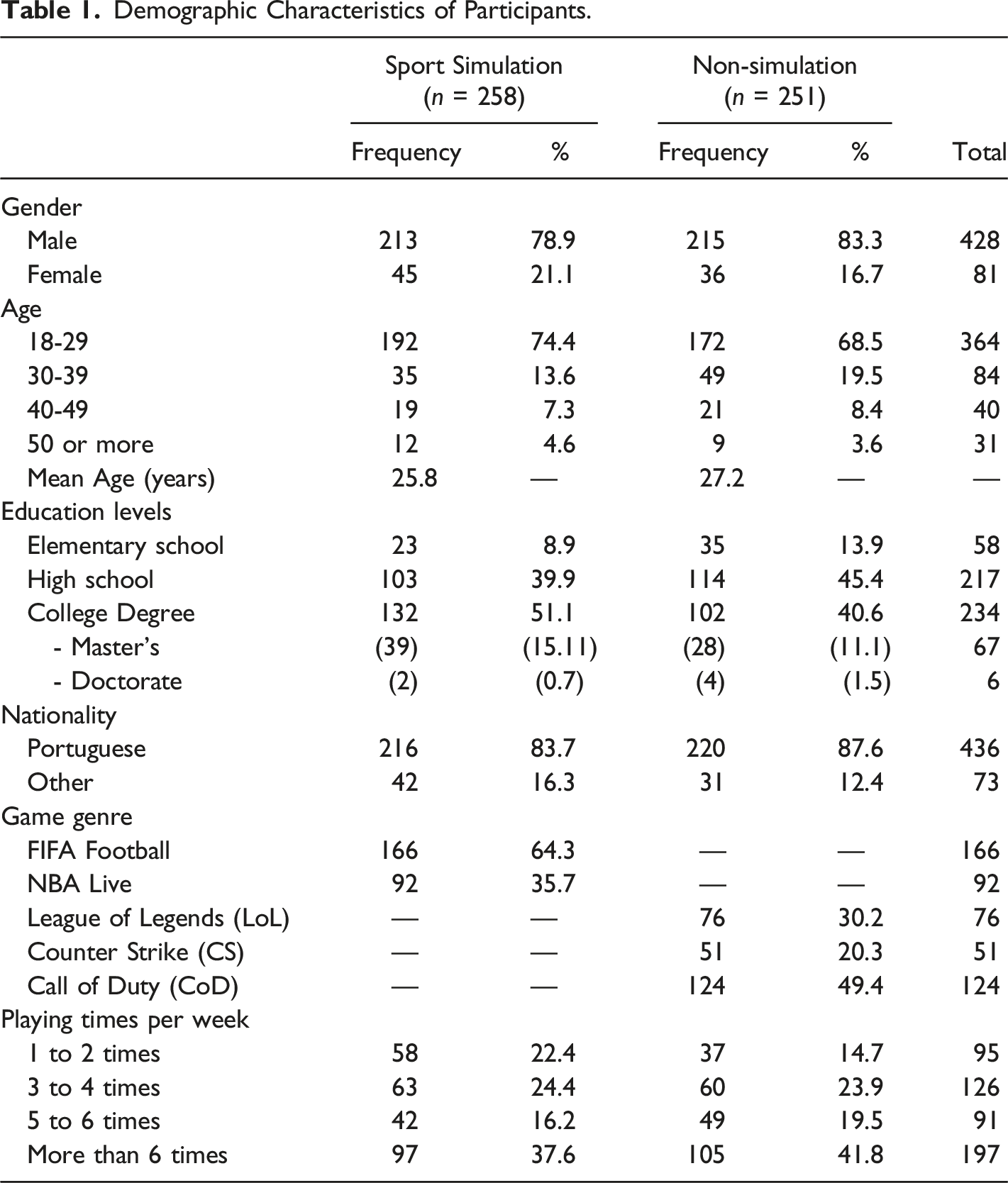
The URL link of the questionnaire was posted on the social media of esports communities in the Portuguese market (e.g., E-Sports Portugal; FIFA 22 Portugal, League of Legends Portugal, etc.) after permission from their content moderators, inviting players to participate in the study. Five esports games were selected (i.e., FIFA, LoL, CS, CoD and NBA Live) taking into account their prevalence and popularity across the player community in the country selected (Statista, 2021). All participants voluntarily participated in the survey and accepted the informed consent form. To ensure that each subject answered only once, the IP address was stored on the server, preventing further access to the survey. A total of 603 surveys were returned and responses that were not fully completed or that did not meet the defined criteria were excluded from the study. After these data screening procedures, a total of 509 surveys were deemed usable for data analysis considering the two genres: SSG (n = 258) and NSG (n = 251).
Demographic Characteristics of Participants.
Instrument
The online survey included a pool of 20 items used to assess the social variables alongside the above-mentioned sociodemographic questions (see Appendix). The values of sport captured player perception of sport values based on the Olympic Value Scale (OVS). It was adapted from Koenigstorfer and Preuss (2018) and contains 12 items loading on three factors: Excellence, Friendship, and Respect.
The social capital factor refers to the value of social ties one obtains through engaging in video games (Mandryk et al., 2020). In-game social capital was assessed using Williams’ (2006) Internet Social Capital Scale (ISCS) to measure bridging (4 items) and bonding (4 items) capital dimensions. The WOM factor focuses on the player’s intent to share positive information and experiences regarding esports to others (Huang et al., 2017). A 3-item scale measuring player intention was adopted by Abbasi et al. (2020) in an esports consumption context.
These measures used in the study were originally constructed in English. Measurement items were translated into Portuguese and back translated into English to ensure precision between the original scales, the translated version, and redaction accuracy of the cultural context (Banville et al., 2000). First, four experts (three Portuguese and one English native) with experience in sport social studies were invited to review the translation into Portuguese and rate all items related to relevance, clarity, and representativeness (DeVellis, 2016). Then the translations were compared and accepted followed by a content validity. Three researchers were asked to raise any concerns while completing the scale and carrying out the content analysis of the items. After this step, six items were reworded in response to suggestions from these experts (see Appendix), and the back translation did not reveal differences between the first and the final survey versions. The items were then randomly placed in a questionnaire for a pre-test with master’s degree students (n = 126) from the University of Lisbon. The final survey version evidenced no changes and included a total of 20 items to assess the psychometric dimensions.
The survey consisted of two parts. The first section collected sociodemographic information (i.e., age, gender, education level, nationality, and play time). The second part examined player perception toward sport values, in-game social capital, and WOM intention. A guide question invited the respondents to assess the items according to their level of agreement. The stem for the items read, “Considering the esports game selected, please indicate your level of agreement with the following statements”. The survey initially included two filter questions related to the subject being or not a member of an esports community and if they had been playing for at least 1 year. Respondents who answered “No” to any of these filter questions were forwarded to the end of the survey. All items were measured based on positive statements phrased in Portuguese, and they were randomized within each section. A 7-point Likert-scale ranging from 1 (Strongly Disagree) to 7 (Strongly Agree) was used in the second survey section. The Appendix shows the survey items.
Data analysis
Descriptive statistics were calculated using SPSS 26.0 and data were subsequently analyzed using AMOS 26.0. A Confirmatory Factor Analysis (CFA) was conducted to verify the structure proposed on our model in each game group (SSG and NSG) followed by the structural equation model (SEM). Assumption tests associated with CFA and SEM were tested for normality, multicollinearity, and outliers. The appropriateness of the data for the measurement model was examined using the ratio of chi-square (χ2) to its degrees of freedom, fit indexes (TLI, CFI, and GFI), and root mean square error of approximation (RMSEA) (Hair et al., 2009). Convergent validity was assessed in terms of factor loadings through the average variance extracted (AVE), while discriminant validity was assessed by comparing squared correlations between constructs (Fornell & Larcker, 1981). Regarding internal consistency, Cronbach’s alpha and composite reliability were measured. The model’s invariance was tested between both models and the significance of the structural weights was evaluated using the statistical significance, CFI, and TLI differences (Cheung & Rensvold, 2002). Finally, a simultaneous multigroup path analysis was performed to test whether the path coefficients for the hypotheses differed between the models. The following section shows the results obtained across the two game groups.
Results
Descriptive statistics and assumption tests
Descriptive Statistics, Correlations, and Summary Results of the Measurement Model.
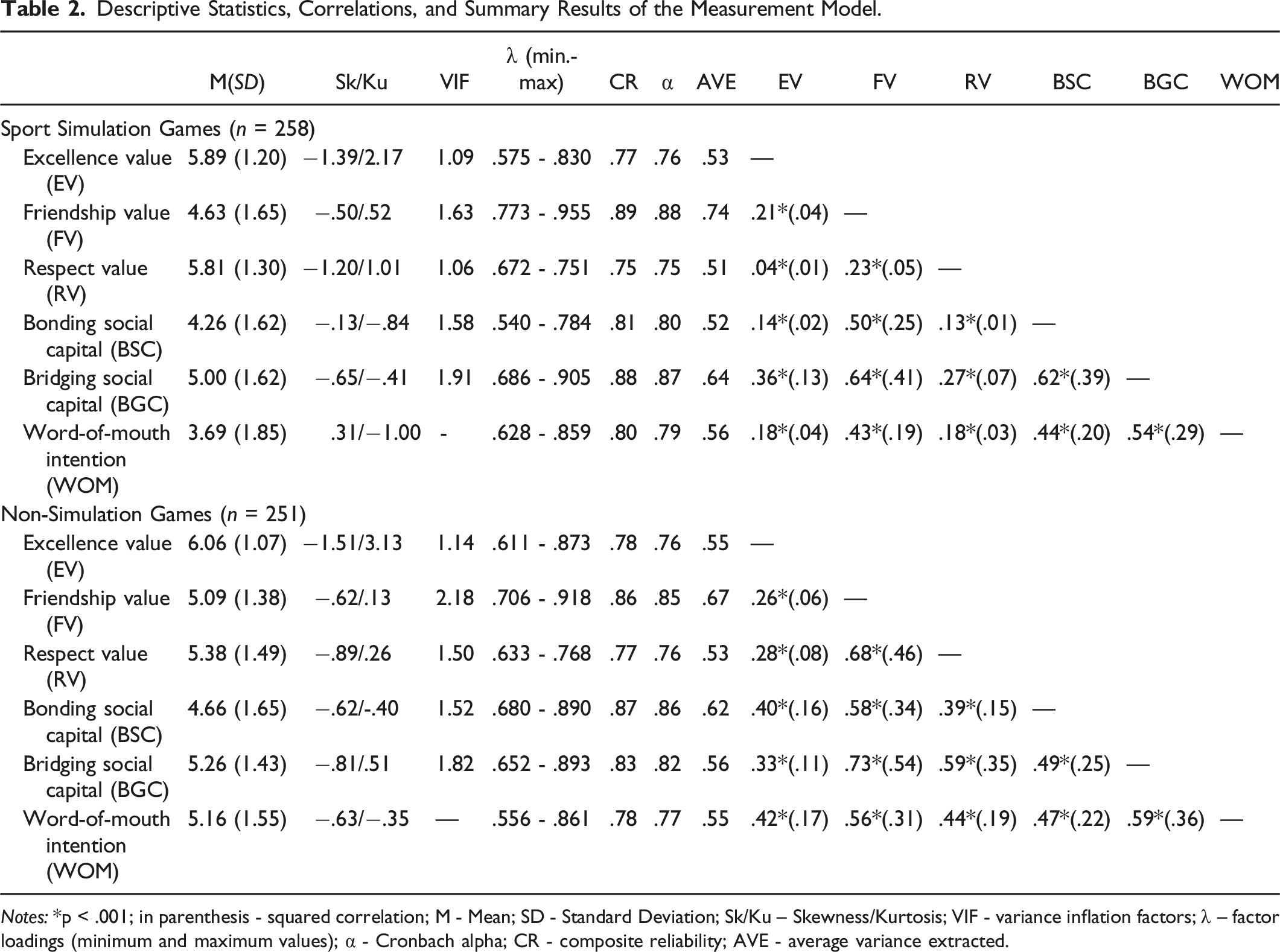
Notes: *p < .001; in parenthesis - squared correlation; M - Mean; SD - Standard Deviation; Sk/Ku – Skewness/Kurtosis; VIF - variance inflation factors; λ – factor loadings (minimum and maximum values); α - Cronbach alpha; CR - composite reliability; AVE - average variance extracted.
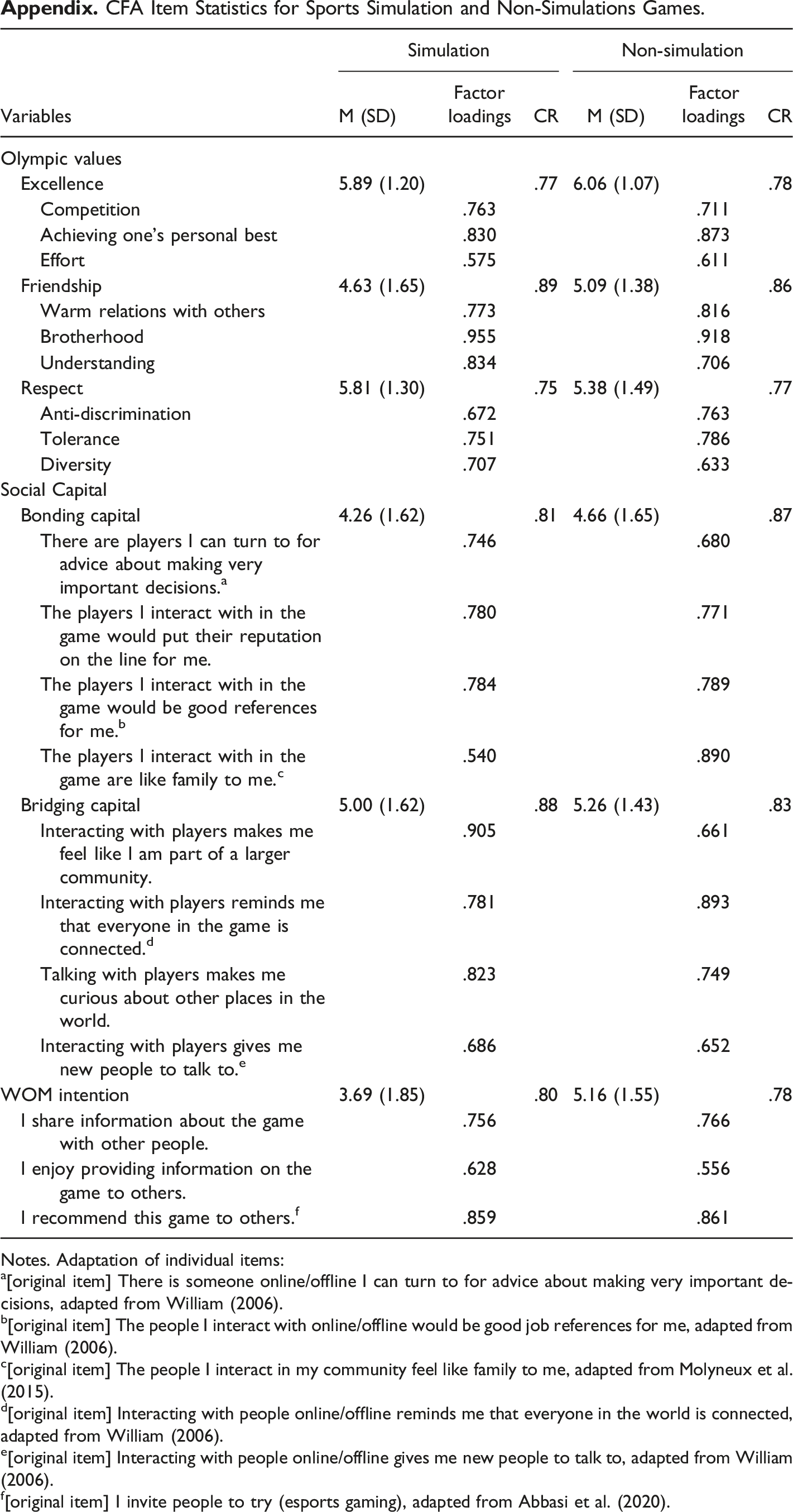
The descriptive statistics also revealed that participants on average provided high scores exceeding the midpoint (i.e., above 3.5 values) for all of the perceived factors, suggesting that playing esports generated a high level of perceived social outcomes. The means of values pertaining to ‘Excellence’ (MSG = 5.89; MÑS = 6.06) and ‘Respect’ (MSG = 5.81; MÑS = 5.38) were those with the highest mean scores, showing a positive perception of social values stemming from playing esports. Regarding the social capital factors for both groups, they also showed high score means. These two factors (bonding and bridging) were above 4.2 on a 7-point Likert scale, showing that players have a positive perception of social ties within the game in both groups. Meanwhile, the players of NSG declared high intention for word-of-mouth (WOM = 5.16) related to subjects of SSG (MSG = 3.69). In summary, the descriptive statistics revealed positive perception for all factors, but the SSG tended to have lower perceived sportive values, a lesser strengthening of in-game social capital, and the players expressed a lower intention level for word-of-mouth when compared to the NSG group.
Measurement model
The results of the measurement model for SSG [χ2 (159) = 306.60 (p <.001), χ2/df = 1.92, CFI = .92, GFI = .88, TLI = .91, RMSEA = .06 (CI = .049–.072)] and NSG [χ2 (159) = 348.51 (p <.001), χ2/df = 2.19, CFI = .91, GFI = .87, TLI = .90, RMSEA = .07 (CI = .064–.086)] revealed a good fit to the data. Even though the χ2 value was significant, its ratio to the degrees of freedom was below the threshold of 3.0 (Kline, 2005). All fit indices were above .90, except for GFI values, and the RMSEA value ranged from 0.06 to 0.07, suggesting an acceptable fit to the data (Hair et al., 2009). As shown in Table 2, all factor loadings were above the cut-off point of .50, therefore providing evidence that each item appropriately captured their respective factor (Hair et al., 2009). The composite reliability values ranged from .75 to .89, indicating that the constructs were internally consistent in both groups (Hair et al., 2009). Evidence of convergent validity was accepted according to the values obtained (above .50) as well as discriminant validity given that all AVE values exceeded the squared correlations. CMV was evaluated through the Harman’s single factor test (Podsakoff et al., 2003) and the latent variable correlations (Bagozzi et al., 1991). First, the factor analysis revealed 6 distinct factors and the emerging single factor explained 35% of the total variance, suggesting no evidence of CMV. Second, the correlation among all the constructs was found to be less than 0.9 (see Table 2), indicating no major concerns of CMV. Consequently, the structural model testing procedure was appropriate to follow.
Structural equation modelling
The fit indices demonstrated good fit to the aggregate data in each model. For the SSG model, five of the five paths were significant. The excellence value showed a significant positive effect on bridging capital (β1a = .24, p < .01), but non-significant in predicting bonding capital (p > .05), therefore H1b was supported and H1a was not. The relationships between friendship value and social capital were significant for both social dimensions (BSC: β1c = .51, p < .01; BGC: β1d = .58, p < .01), confirming H1c and H1d. In contrast, the respect value was not significant in predicting neither bonding nor bridging capital in SSG (p > .05) and thus H1e and H1f were not supported. To a large extent, social capital occurs by friendly relations among SSG players (see Figure 2). The path coefficients between social capital dimensions and WOM intentions were positive and significant (β2a = .21, p < .05; β2b = .44, p < .01) providing support for H2a and H2b. The model proposed explained 28% of the variance in bonding social capital (R2 = .28), 51% of the bridging social capital (R2 = .51), and 30% of the variance of player behavioral intentions regarding WOM (R2 = .31). This finding supports that both bonding and bridging capital were strong predictors of behavioral intentions of SSG players. Figure 2 illustrates the SEM results. Standardized estimates of the structural models. Note: SSG – Sport Simulation Games; NSG - Non-simulation Games; * p < .05; ** p < .001; n.s. = Not Significant.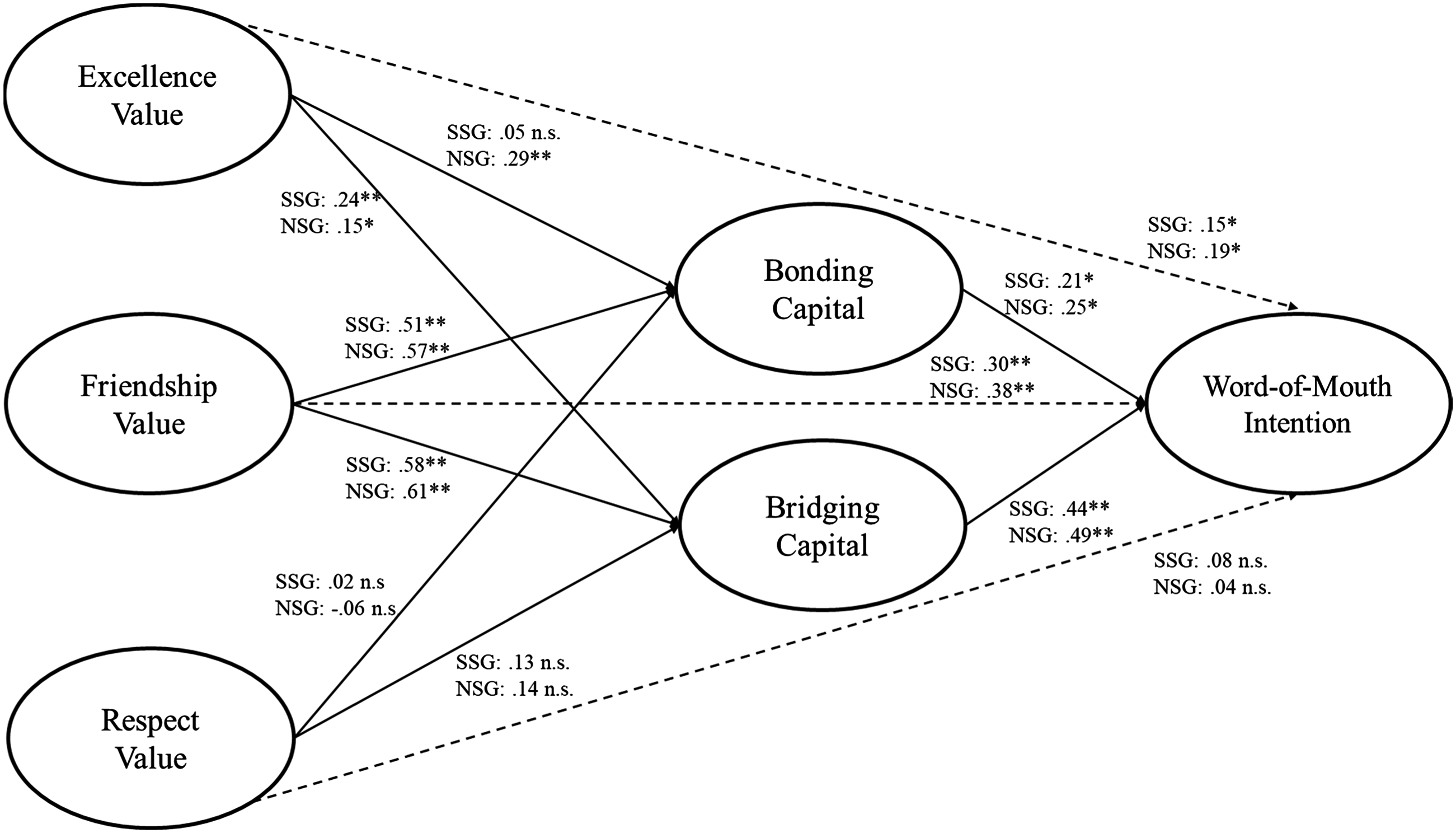
For the NSG model, the path coefficients between the excellence value and social capital factors were significant for both bonding (β1a = .29, p < .01) and bridging capital dimensions (β1b = .15, p < .05) providing support for H1a and H1b. Hypotheses H1c and H1d were confirmed as the effect of friendship values on social capital dimensions was significant (β1c = .57, p < .01; β1d = .61, p < .01). The respect value again showed a non-significant effect on bonding and bridging social capital (p > .05), leading to rejecting H1e and H1f. Subsequently, social capital dimensions showed a significant effect on behavioral intentions for positive WOM (β2a = .25, p < .05; β2b = .49, p < .01), supporting H2a and H2b. Jointly, these relationships accounted for approximately 42% of the variance of WOM intentions (R2 = .45), indicating a medium effect size (Cohen, 1992) and supporting the theoretical relevance of the study.
Mediation effects and group comparisons
Hypotheses 3a–3c predicted a positive indirect effect of excellence, friendship, and respect values on behavioral intention of players mediated by social capital. When controlling the influence of social capital for SSG, neither the excellence value (β = .11, p = .24) nor the respect value (β = .12, p = .26) had a significant direct effect on WOM intention, whereas friendship showed a significant and positive direct effect (β = .31, p < .001). For NSG, the direct effect of excellence and friendship on WOM intention was significant and positive (βexcellence = .39, p < .001; βfriendship = .38, p < .001), while the respect value did not show a significant effect. This suggests that the search for achievement in competition and friendly relations with others plays has an important role in WOM intentions for NSG players.
Path Coefficients, Indicator Weights, and Structural Model Variances Explained.
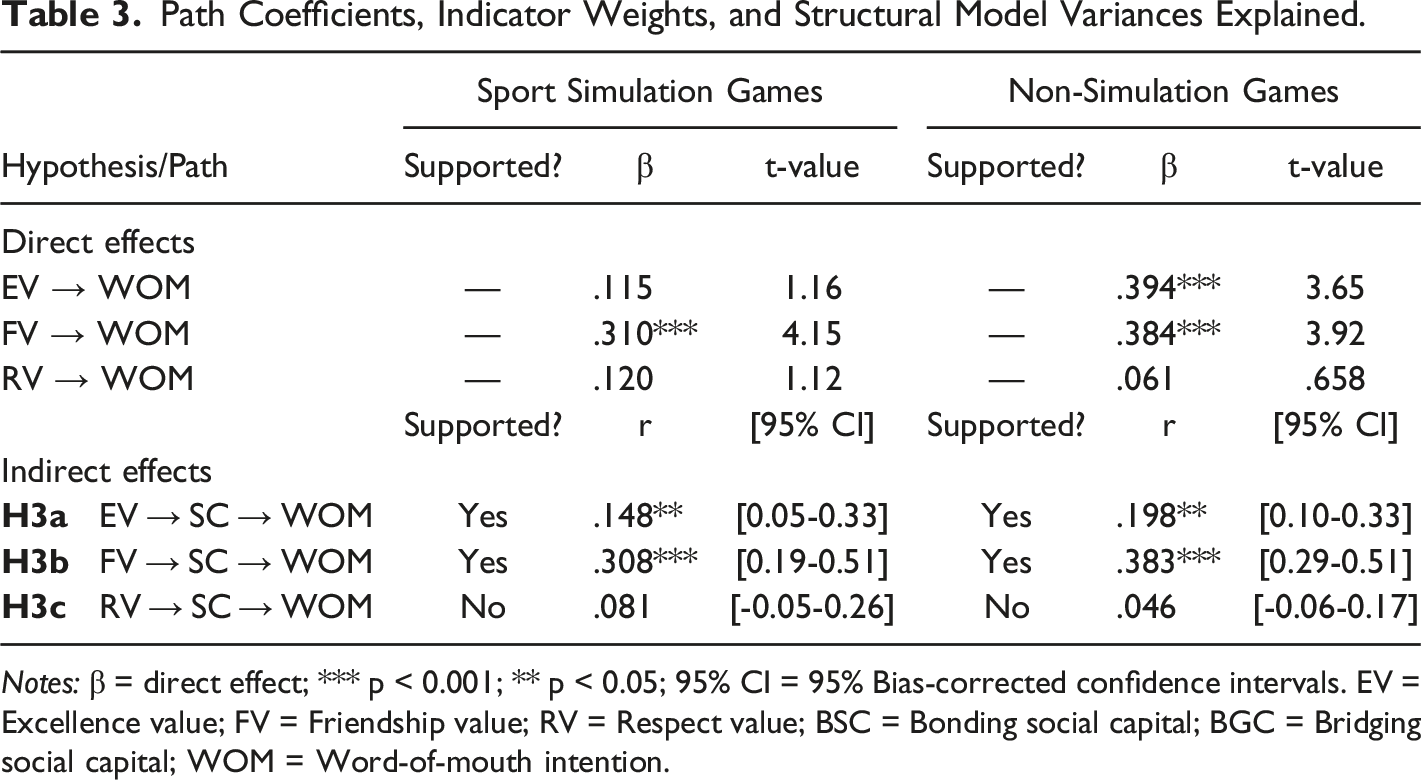
Notes: β = direct effect; *** p < 0.001; ** p < 0.05; 95% CI = 95% Bias-corrected confidence intervals. EV = Excellence value; FV = Friendship value; RV = Respect value; BSC = Bonding social capital; BGC = Bridging social capital; WOM = Word-of-mouth intention.
Measurement Invariance Tests.

Notes: *** p < 0.01.
Path Comparison Results Across Each Group.
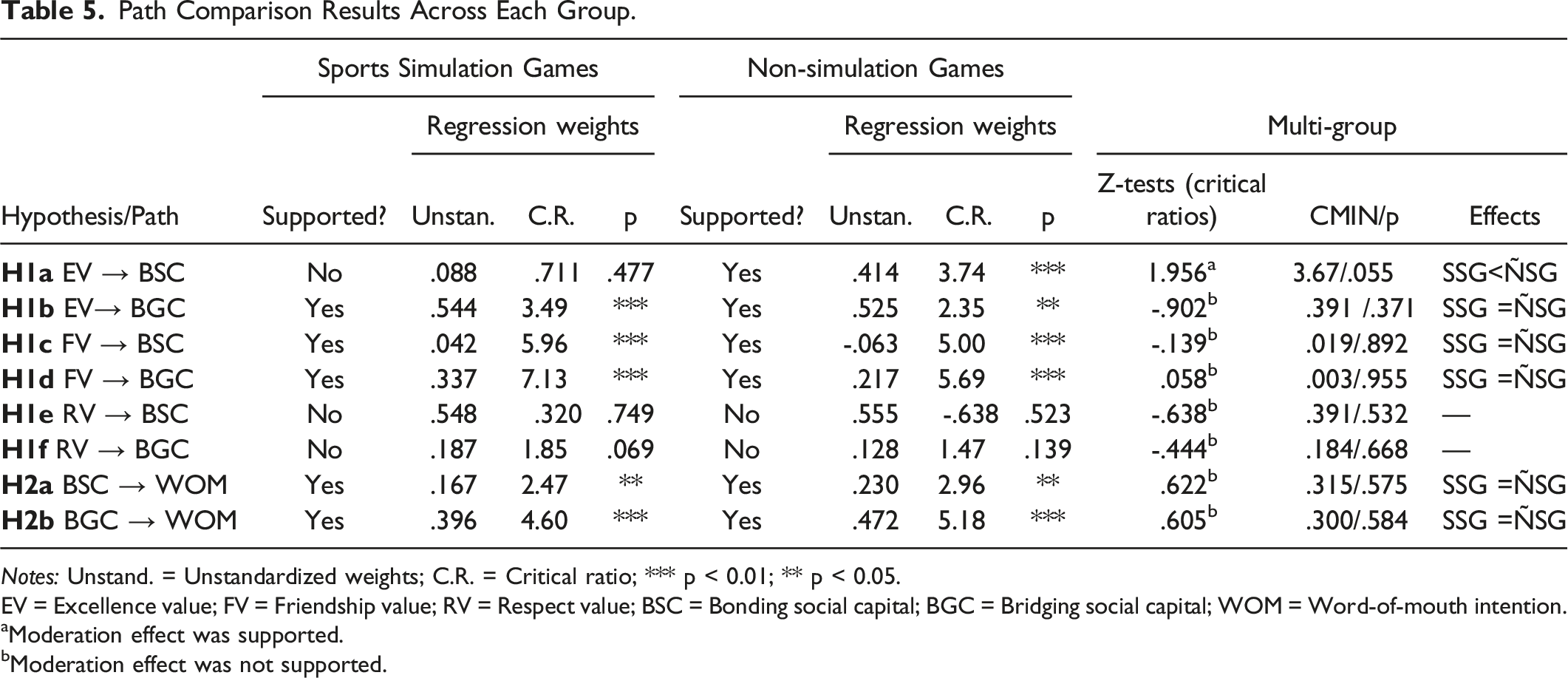
Notes: Unstand. = Unstandardized weights; C.R. = Critical ratio; *** p < 0.01; ** p < 0.05.
EV = Excellence value; FV = Friendship value; RV = Respect value; BSC = Bonding social capital; BGC = Bridging social capital; WOM = Word-of-mouth intention.
aModeration effect was supported.
bModeration effect was not supported.
Using a multigroup comparison, the two models were evaluated to determine whether the path coefficients differed between the SSG and NSG groups. A path was constrained to make it invariant between the two game groups and then we freely estimated it. The results showed that there are no statistically significant differences in the effects of the sport values on social capital dimensions nor on WOM intention between gaming groups. Notwithstanding, the path analysis revealed marginally significant differences in the effects of the excellence value on bonding social capital and on WOM intention (through SC). Specifically, the excellence value perception evidenced a significantly different effect on bonding capital formation toward game type (Z = 1.96; p = .05). This finding suggests that achievement in the competition is significantly more relevant for non-simulation players than for sports simulation players. All results are showed in Table 5.
Discussion
The structural equation analysis revealed that the friendship value was a relevant and significant predictor of social capital for both gaming categories (see Figure 2 and Table 3). This finding supports previous evidence (Kaye et al., 2017) and leads us to support the notion that friendly relations are an important construct that leads to both bonding and bridging attitudes of the players in an online environment (Perry et al., 2018). Results suggest that gamers who develop a spirit of togetherness are likely to build strong social ties with others as well as to share new experiences or social opportunities in their gaming community. This finding confirms Zhong’s (2011) claim that there is a social capital in online games inherent in tightly knit players who establish friendly relationships through successful cooperation and desirable social interactions. These friendship relations may remain as social ties (weak or strong) and move to other virtual communities in order to share resources and exchange emotional or substantial support (Zhong, 2011). When considering how online gaming builds friendships, we can turn to the useful lens of social capital framework, which helps us situate game-based social interactions in a broader theoretical grounding of the social benefits of video gaming. Therefore, one may argue that when esports is embedded in friendship relations, social capital formation may occur, leading to build strong social ties in different gaming groups. The rationale underlying this finding is also supported by the need satisfaction approach (Chen et al., 2015) suggesting that the relatedness need leads players to believe in their capabilities of establishing meaningful emotional bonds (Herodotou et al., 2014). Following this theory, esports games allow to form social groups/guilds and informal connections (Zhong, 2011), creating inherent sociability (Mandryk et al., 2020) and satisfying the gamers’ relatedness needs in an online gaming environment. Given individual’s natural tendency to seek friendships in the social matrix (Putnam, 2000), it is logical to contend that the opportunity to bond with other players and socialize in gaming through esports supports the needs satisfaction approach.
Findings from this study also showed that the value of excellence in competition on social capital constructs toward the gameplay type was significantly different for the two categories (see Table 3), highlighting the importance of examining each game group in particular. Competition achievement was not found to be a significant predictor of the bonding capital in the SSG type, but showed a significant positive effect on creating strong social ties in the NSG type. When considering that non-simulation esports such as RPGs and MOBAs require teamwork actions and individual motor and spatial skills (Lin et al., 2015), these results may suggest that the search for achievement in competition (i.e., achieving one’s personal best) and effort plays an important role in building bonding social ties. This competitive game category (NSG) is essentially associated with a preference for games requiring teamwork (Johnson et al., 2015) considering that scoring frames depend on the individual performance of each of the team members. As a result, it is important that non-simulation players know how to play as a team consistently, and particularly to know how to play well to create strong social bonds. This indication is in line with previous studies identifying the importance of teamwork as a key motivational driver in this category (Neidhardt et al., 2015). Theoretically, these players can obtain multiple achievement values, including victory and adventure (Lin et al., 2015), satisfying their competence needs and therefore supporting the relatedness need satisfaction theory (Chen et al., 2015).
In the case of simulation esports (e.g., FIFA or NBA Live), playing well or having high in-game performance does not contribute to creating bonding social capital. This can be explained because the in-game interaction takes place in a single player mode (Nagorsky & Wiemeyer, 2020), predominantly played individually (one-on-one) and focused on each player’s physical skills. While the achievement of competition is relevant for most players, it does not build strong social bonds among esports players. This aligns well with the fact of sports-related games presenting greater opportunities for indirect competitive gameplay and interactions (Kaye et al., 2019), which may lead to more bridging impacts than bonding relations. Sport organizations involved in simulation games (FIFA series, NBA Live, etc.) need to encourage a sense of connection within the field to increase the sporting value of esports in this category. This can be achieved through wider collaboration between esports developers and sports organizations, as well as through ongoing testing and feedback from players, coaches, and other stakeholders. Furthermore, our findings also corroborate the excellence value in predicting bridging social capital for both game groups, supporting previous literature indicating that players with a strong in-game social experience are more likely to create bridging social relations (Zhong, 2011). That way, the players looking for a placed-on competition and a sense of achievement from the game tend to broaden social horizons and open up opportunities for new relationships.
Finally, social capital constructs toward both game groups showed a significant positive effect on the intentions to WOM of players, confirming previous empirical evidence (e.g., Hsu, 2015). In fact, both bonding and bridging capital were strong predictors of behavioral intentions, which is consistent with the idea that the stronger a player’s social bond and connection with the online environment is, the more (s)he will tend to positively talk about the game to others (Huang et al., 2017). In this sense, the effect of in-game social interaction is conducive to social capital formation since players view the game as a way of establishing friendships and personal relationships (Perry et al., 2018), satisfying their social needs and of proactively sharing positive game-related experiences (Chang et al., 2018). SCT theorizes that the interaction among online gamers promotes trust, reciprocity, and enhances the building of long-term relationships with their community (Kaye et al., 2017). At this point, esports provides a competitive gaming environment for players where they can interact with one another for building ties and strengthening emotional or substantial relations (Zhong, 2011). Hence, considering WOM intention as an underlying factor of social capital formation is justifiable given that players tend to share their experiences with others when their play allows them to build meaningful social relationships. Furthermore, in line with the needs satisfaction theory, when conditions or situations that support strong relatedness are present, subsequent need fulfilling activities (e.g., acting on behalf of the group through positive WOM) are most likely to occur (Cheung & Lee, 2012).
Implications for Olympic and esports industries
Sport organizations and the Olympic Movement should be receptive of esports trends as it allows them to share sport values and to strengthen social reciprocity with a broader community. Specifically, this trend could give the IOC a new perspective on sports non-simulation games and their connections to the women’s and youth markets. Gaming series such as Call of Duty, Counter Strike, and League of Legends may become the bases of future Olympic events in addition to influencing real-life scenarios.
Furthermore, esports publishers and developers should actively work on their social commitment to the players community, creating discussion forums on in-game respect while fostering social awareness initiatives that enhance the appreciation of diversity in the competitive online environment. Our findings can also help the esports industry to enhance the social role of sport values, identifying areas where it is possible for sharing them (e.g., creating fair-play ads or ratings) and fostering the reinforcement of social capital in a gaming context (e.g., rewarding social best-practices).
The same applies to the mediating role of social capital. If the excellence value can lead to positive WOM through additional social support, it is important to considered it by the esports industry. Developers and publishers should strengthen social relationships by further interpersonal connectedness of in-game communities. For instance, it is possible to design convenient communication channels to exchange game experiences or value the prosocial behaviors of users when they are playing games. This might be even more relevant for sport simulation gamers as they have a lower positive WOM intention (M = 3.69). In other words, it might be more efficient for developers to provide social support tools in their communities in order to spread values and attract or retain new players.
Limitations and future research
Some limitations should be addressed for future research. The first relates to the game’s categorization into two groups. Our findings might be limited to the two-dimensional approach of SSG and NSG. It is possible that specific features in each game influence how players engage with the game and with other players (Mandryk et al., 2020) such as building more bonding than bridging social capital depending on the game genre. In this sense, the relationships between constructs cannot be generalized to each game genre and therefore should be replicated considering different contextual settings. Future studies should include more representative samples for each game category (e.g., massively-multiplayer online; Abbasi et al., 2020) to strengthen the findings of this study.
Second, our sample is skewed towards male, young people, and frequent online players (over 6 times a week), which offers potential for sample bias. This is likely a consequence of the games selected as well as the sampling strategy of posting the survey on social media groups. It is certainly possible that subsets of the player community (online vs. offline), particularly different age groups or genres, could exhibit contrasting value perceptions and social capital. Future studies should survey larger samples including different perceptions by genre (e.g., other non-binary identities such as agender or genderfluid) and other game types (e.g., imagination or physical enactment) to estimate how well our results can be replicated. In addition, the sampling method used does not allow the results to be generalized and the sample does not fully represent the player community in Portugal. Furthermore, our sample did not distinguish the participation mode in esports games, nor does not fully represent the player community in Portugal. Further research needs to provide further generalizability for the model’s results (i.e., not rely on a single source of data) and to encompass different game modes (i.e., in person vs online streaming), as each mode is influenced by latency, connection quality, and other factors that affect gameplay and performance.
Third, a cross-sectional study was conducted in which all constructs were measured at the same time period. Although the hypothesized paths support previous research, we cannot infer a case for causality or time order. Our results suggest how sportive values perceived, in-game social capital, and WOM intention might be connected for two videogame categories, supporting theoretical relationships that make sense for our data. However, causal estimates of the influence of one variable on another are time specific (Zhong, 2011), which confirms the need for future experimental or longitudinal research that can demonstrate causality. The lack of full invariance across the models can also be stated as a limitation, encouraging further researches to compare and validate the results found in this study.
Fourth, our hypothetical model might be considered exploratory in some paths such as when exploring the effects of sportive values (respect and excellence) on social capital in different game types. Indeed, there can be a number of external factors that can influence value perceptions for the play. In the case of non-simulation gaming, toxic behaviors related to social concerns such as mocking, insulting, racism, homophobic comments, and hate speech (Darvin et al., 2021) can evidence their relevance in the model. Future studies examining value perceptions should include these external factors, and therefore our findings should be acknowledged with this consideration in mind.
Finally, while the sport values might influence bonding and bridging relationships across SSG and NSG, each game genre has its own unique features that can be evaluated with regard to motivation and need satisfaction. For instance, the motivations behind sport simulation games have to do with the application of sport knowledge (Jang & Byon, 2020), while imagination/fantasy games require achievement and social interaction as positive motivators (Greenberg et al., 2008). Such implications encourage the use of need and motivation theories through further studies clarifying how shared values can be created within each game genre context.
Additionally, it would be worth exploring how these motivations can enlarge our knowledge on basic psychological need categorization, and how they influence the future behavioral intentions of players. Some factors such as game passion, commitment, or relatedness need are frequently used in the literature (Mandryk et al., 2020), so future studies could explore how these factors would enrich our model, e.g., moderating the link between shared values and social capital. Also, it is encouraged to study the way in which gaming environments can be created based on players’ Olympic values (Ribeiro et al., 2023).
Conclusion
This study has sought to provide initial empirical evidence related to structural relationships between sport values, social capital, and WOM intentions towards distinct game categories. In doing so, this study extends the body of knowledge in the simulation and gaming literature. First, it highlights the role of friendship value in both bonding and bridging capital creation for the genre categories. Second, it shows that the excellence value is a distinctive intergroup element with an important contribution on creating strong social ties in non-simulation gamers. Third, it demonstrates that in-game social capital formation is conducive to player’s intent to share positive information, experiences, and feelings with others. Fourth, it reveals the mediating role of social capital in influencing the indirect effects of sport values (excellence and friendship) on WOM intentions of players.
As previously discussed, the two game genres provide a way to address player social needs and of proactively sharing their game-related experiences. The two game categories distinguish certain attributes by game genre, categorizing esports player regarding their sport or non-sport consumption preferences. This two-pronged approach provides a more holistic understanding of game genres within a competitive online environment, encouraging developers to better understand their players’ behavioral intentions through a broader social matrix.
This article supports the social perspective that both excellence in competition and friendship relations provide a feeling of pleasure and belonging, fulfill social needs, and strengthen ties to the player community. Understanding esports values in the current study provides useful insights for esports developers to create collaborative game designs, which can help players to have greater social engagement in their gaming community. The article concludes that the esports industry should consider the well-established and mediating construct of in-game social capital, strengthening in-game bonding and bridging relations as a broader theoretical grounding for fostering positive behavioral intentions of players.
Footnotes
Declaration of Conflicting Interests
The author declared no potential conflicts of interest with respect to the research, authorship, and/or publication of this article.
Funding
The author(s) disclosed receipt of the following financial support for the research, authorship, and/or publication of this article: This paper is financed by National Funds provided by FCT- Foundation for Science and Technology through project UIDB/04020/2020.
ORCID iD

CFA Item Statistics for Sports Simulation and Non-Simulations Games.
| Variables | Simulation | Non-simulation | ||||
|---|---|---|---|---|---|---|
| M (SD) | Factor loadings | CR | M (SD) | Factor loadings | CR | |
| Olympic values | ||||||
| Excellence | 5.89 (1.20) | .77 | 6.06 (1.07) | .78 | ||
| Competition | .763 | .711 | ||||
| Achieving one’s personal best | .830 | .873 | ||||
| Effort | .575 | .611 | ||||
| Friendship | 4.63 (1.65) | .89 | 5.09 (1.38) | .86 | ||
| Warm relations with others | .773 | .816 | ||||
| Brotherhood | .955 | .918 | ||||
| Understanding | .834 | .706 | ||||
| Respect | 5.81 (1.30) | .75 | 5.38 (1.49) | .77 | ||
| Anti-discrimination | .672 | .763 | ||||
| Tolerance | .751 | .786 | ||||
| Diversity | .707 | .633 | ||||
| Social Capital | ||||||
| Bonding capital | 4.26 (1.62) | .81 | 4.66 (1.65) | .87 | ||
| There are players I can turn to for advice about making very important decisions. a | .746 | .680 | ||||
| The players I interact with in the game would put their reputation on the line for me. | .780 | .771 | ||||
| The players I interact with in the game would be good references for me. b | .784 | .789 | ||||
| The players I interact with in the game are like family to me. c | .540 | .890 | ||||
| Bridging capital | 5.00 (1.62) | .88 | 5.26 (1.43) | .83 | ||
| Interacting with players makes me feel like I am part of a larger community. | .905 | .661 | ||||
| Interacting with players reminds me that everyone in the game is connected. d | .781 | .893 | ||||
| Talking with players makes me curious about other places in the world. | .823 | .749 | ||||
| Interacting with players gives me new people to talk to. e | .686 | .652 | ||||
| WOM intention | 3.69 (1.85) | .80 | 5.16 (1.55) | .78 | ||
| I share information about the game with other people. | .756 | .766 | ||||
| I enjoy providing information on the game to others. | .628 | .556 | ||||
| I recommend this game to others. f | .859 | .861 | ||||
Notes. Adaptation of individual items:
a[original item] There is someone online/offline I can turn to for advice about making very important decisions, adapted from William (2006).
b[original item] The people I interact with online/offline would be good job references for me, adapted from William (2006).
c[original item] The people I interact in my community feel like family to me, adapted from Molyneux et al. (2015).
d[original item] Interacting with people online/offline reminds me that everyone in the world is connected, adapted from William (2006).
e[original item] Interacting with people online/offline gives me new people to talk to, adapted from William (2006).
f[original item] I invite people to try (esports gaming), adapted from Abbasi et al. (2020).