




Abstract
Background
Play is an important part of the childhood. The learning potential of playing and creating non-digital games, like tabletop games, however, has not been fully explored.
Aim
The study discussed in this paper identified a range of activities through which learners redesigned a mathematics-oriented tabletop game to develop their ideas and competencies in an integrated STEM (science, technology, engineering, and mathematics) class.
Method
Third and fourth graders worked as teams to make changes on Triominos over a period of six weeks. Considering what could be changed from the original game, each group provided a different design for Triominos to accommodate the changes introduced. We gathered data through weekly observations of two classes (about 45 learners, ranging from age eight to ten) in a west-Canada school. In this paper, we present the works of three groups of three teammates.
Results
We found that any change made by learners not only influenced mechanics, dynamics, and aesthetics of the game but also helped engage learners, encourage unconventional ideas, promote learning, and solve problems. Based on our findings, we suggest redesigning games facilitated learners deepen their understanding of mathematical concepts as part of a designed game system in STEM classes.
Introduction
Researchers have observed that creating tabletop games could engage learners in problem-solving, strategic-thinking, decision-making, communicating, and social learning where learners work and learn together (e.g., Barta & Schaelling, 1998; Guberman & Saxe, 2000; Saxe, 1992; Squire, 2006). Moreover, playing tabletop games can provide learners with opportunities to use concepts meaningfully, especially for mathematics (e.g., geometry of shapes, and logic) and to engage in reasoning processes, such as, estimating, measuring, classifying, and comparing (Charlesworth & Leali, 2012; Clements & Sarama, 2014; Jaques et al., 2019). While understanding numbers and shapes in everyday life is a part of the mathematics curriculum for grade three and four (Alberta Education, 2005), there are few studies that focus on early learners’ design of games for using mathematics (e.g., Barta & Schaelling, 1998; Jaques et al., 2019), especially in an integrated STEM (science, technology, engineering, and mathematics) classroom. Learners’ creating artifacts by using STEM concepts can be important as it situates “real-life and domain knowledge and skills in doing project-like work” (de Vries, 2006, p. 214). When creating artifact is collaborative and participatory, learning can become even more meaningful for learners — it can activate collaborative exploration, articulation, reflection, and assimilation or accommodation for improved knowledge representation (Ke, 2014). When the artifact that learners make in the classroom is a game, it can engage learners, encourage unconventional ideas, promote learning, and help solving problems (Amriani et al., 2013; Enders & Kapp, 2013; Kapp, 2012).
Although play is an important part of the childhood (Almon, 2003; Bloch & Choi, 1990; Csikszentmihalyi, 1981; Kuschner, 2015), the potential that playing and creating non-digital games, like tabletop games, can bring to learners has not been fully explored. Particularly, the potential for using mathematics for an integrated STEM project when learners are both the players and creators of a game has not been explored as it should. To create a tabletop game, one does not need to start from the scratch. Learners may create tabletop games by changing an existing game’s structure like the rules, scoring mechanics, forms, and arrangements (Mattlin, 2018; Poor, 2014). For example, defining new states for winning and losing the game (i.e., rules), earning bonus points for certain actions newly specified by players (i.e., scoring mechanics), altering the geometry of the tiles or dice (i.e., forms), and intuitive categorization of tiles into bonus and regular tiles (i.e., arrangement) are all among the structural changes that can cause irregularities in an existing game. Such structural changes to an existing tabletop game may need redesigning the game. What we consider as redesigning is the process of introducing such changes to an initial state of a game system and designing to accommodate these changes in a unified and newly defined state of the game system. A redesigned game by learners can either serve existing purpose of the original game or a new purpose. In this process, learners quantify, categorize, and systematize relevant objects, relationships, and actions (Lesh & Doerr, 2003).
In this study, we explore how learners engage in STEM learning when provided opportunities to express their creativity when collaboratively redesigning a tabletop game, called Triominos. We discuss how differences in game redesign can emerge from learners looking at a single tabletop game through different lenses. In our research, third and fourth graders (age ranging from eight to ten) in a West-Canada school transformed Triominos into paper-crafted games and explored how using different regulations, scoring mechanics, shapes, numbers, and symbols change the game rules, its look, and the experience of play. We collected qualitative data during the classroom sessions that spanned six weeks. We took observation notes, video-recorded the whole class sessions, took photos of students’ progress, collected their artifacts, and interviewed them and their teachers at the end of the project. We analyzed the data through different lenses (i.e., mechanics, dynamics, and aesthetics) to position the activities of redesigning tabletop games (i.e., identifying and modifying their varying components and aspects) as an approach to disciplinary engagement in the STEM classroom.
Theoretical Framework
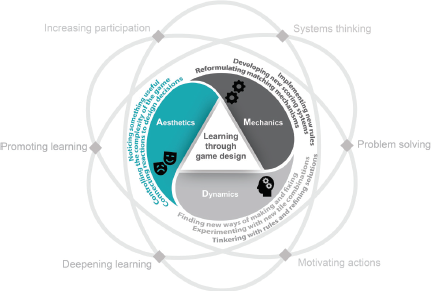
Hunicke et al. (2004) proposed the basic game components of mechanics, dynamics, and aesthetics (MDA framework). Game mechanics is about designer or developer’s specifying rules (e.g., what are possible moves in each turn, how to score and win) in the game. Dynamics portrays how the rules work in action through player interaction with the game (e.g., how an opponent’s actions influence a player’s ability to score in a turn). Aesthetics is concerned with how the game influences the sensual and emotional perceptions of the player (e.g., how a player feels about the progress). MDA has been useful in allowing game designers to consider the perspective and experience of players as a meaningful part of the design and development process, especially for videogames (Kim & Lee, 2015). For researchers, examining how MDA components work together or influence each other can help understand how players engage in meaningful play. These three basic game components can influence each other as part of the design process and through game play (Figure 1). LeBlanc (2004) argued that “each component of the MDA framework can be thought of as a ‘lens’ or a ‘view’ of the game – separate, but casually linked” (p. 1724). Mechanics is the lens through which designers and developers make the game, while players perceive the game through the lens of aesthetics. Dynamics mediates mechanics and aesthetics lenses. While Hunicke et al. (2004) proposed MDA for videogames, it is useful in examining other forms of games, such as board and card games. For example, in a game of chess, each piece has properties relevant to mechanics, such as possible actions relative to its position. When a player changes the position of a piece or takes actions to do certain moves, dynamics emerge. For example, a player’s first move of a pawn influences how the other player puts certain mechanics and strategies into practice, by choosing which piece to move. If a player mentions, for example, “it was a weak opening”, the player refers to aesthetics, an interpretation based on the game play experience.
The reciprocity among the game components of mechanics, dynamics, and aesthetics (MDA) along with the learning outcomes emerging from the application of MDA framework in different studies.
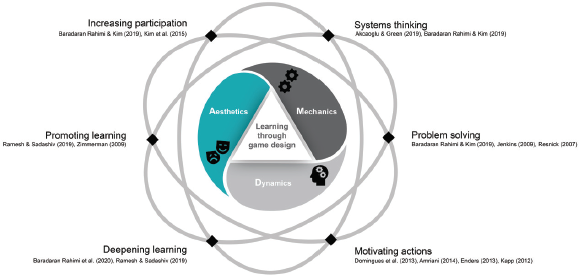
As interacting and interrelating components, mechanics, dynamics, and aesthetics work as a unified whole towards a common goal (e.g., entertaining, learning, training, etc.). Designing a game can help learners to develop systems thinking (Akcaoglu & Green, 2019) as any change to the game, as a relatively complex system, can introduce disorder, irregularities, and chaos to the system. Redesigning a game can be considered as the process of introducing a change to an initial state of a game system and modifying different aspects of it to accommodate the changes toward a unified and new state of the game system. Many iterations may take place throughout this process: even a small difference in initial conditions of a game, such as those made to alter looks, can yield widely diverging outcomes. For example, if the range of the numbers used in a matching tabletop game increases by adding two more numbers, the number of the possible combinations of numbers drastically increases as well. Depending on the situation, such increase may not be reasonable for a game designer or a game company as producing the tiles will require more time, resources, and labor. Sometimes, the iterations are related to accommodating a feasible change in a better way. For example, a game design team finds that adding bonus tiles to a same matching tabletop game is feasible. Thus, designers make bonus tiles with a special sign on top of it to make it different from all other tiles. Then, the design team reconsiders this after playtesting and decides on changing the color of the bonus tiles as well, to make them stand out better for the players. The game design process has always depended on playtesting wherein players’ feedback on the game is pivotal to the development of the final product. Similarly, playtesting is important in redesigning a game. It gives opportunities to see how well a change is accommodated in the redesigned game and at which points the designer needs to go back and refine the game for another round of playtesting.
Since its inception, the MDA has been used for framing how we understand, design, and use games in non-game contexts and various disciplines (Deterding et al., 2011). Amriani (2014), Enders (2013), and Kapp (2012) showed creating games, using MDA framework in educational research, can support learners in trying unconventional ideas in solving problems (i.e., motivating actions). Ramesh and Sadashiv (2019) used MDA framework for game-based learning and analyzing the differences between traditional method of teaching chemistry and board game-driven learning. Their study showed “better learning and more in-depth understanding in favor of the board game” (Ramesh & Sadashiv, 2019, p. 975). Domingues et al. (2013) applied game design elements in learning management system and found that students who used game design elements in their practice scored higher marks in practical assignments that encouraged taking new approaches, such as designing and problem solving, in an unconventional way.
Learners engagement in a participatory game design project can take the forms of seeking inspiration from beyond the classroom or learning from peers (Baradaran Rahimi & Kim, 2019; B. Kim et al., 2015). In redesigning games, the inspirations may come from a game that learners play and be used for changing mechanics, dynamics, and aesthetics of another game. For instance, adding bonus tiles to a matching game, wherein having bonus tiles is not defined, alters the mechanics of matching as a bonus tile may be played with any tile and at any moment. Learning from peers can take place in the exchange of thoughts and feedbacks within a team. For example, a learner may see an idea in a single way but when this idea is shared with teammates, the learner may see it from different perspectives through the feedbacks received from teammates. Participatory game (re)design projects may encourage a variety of new approaches (Baradaran Rahimi & Kim, 2019; Jenkins, 2009; Resnick, 2007). To exemplify, experimenting with tile shape, finding new ways of combining tiles, and tinkering or refining solutions to accommodate changes in the game system in a matching tabletop game can motivate actions and get learners to actively learn systems thinking (Baradaran Rahimi et al., 2020). Promoting learning can take different shapes in redesigning a game depending on the topic of the course. For instance, redesigning a game in a mathematics classroom may promote and pave the way for exploring complex topics in math like division, combination, and topology 1 . Moreover, the social interactions within and between the teams can promote learning in terms of giving and receiving feedback as well as group decision making (Baradaran Rahimi & Kim, 2019; Zimmerman, 2009). The main problem that learners solve in redesigning a game is that they introduce a change to the game system of an existing game (initial state) and accommodate these changes within a new game system (new state) through design and playtesting (Baradaran Rahimi et al., 2020). The changes can be made to the game mechanics, dynamics, and aesthetics, each introducing a sub-problem to be solved by learners. For example, implementing new rules, reformulating matching mechanism, developing a new scoring system, or changing shape and looks of the tiles in a matching tabletop game, each introduce a sub-problem that are related to one or more of the game components (MDA) and influence the initial state of a game system.
Research Design
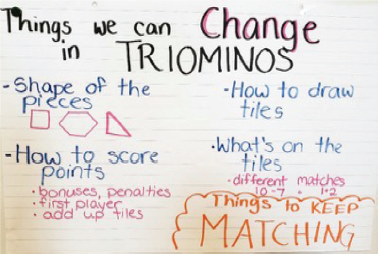
The study was conducted in an inner-city elementary school in western Canada, after obtaining the ethics approval for the study from the Conjoint Faculties Research Ethics Board at the University of Calgary. We worked with a teacher who was facilitating STEM classes across different grades. Her STEM classes were intended for learners to use their disciplinary knowledge from their regular classroom meaningfully through various projects. Based on her previous experiences, the teacher selected the game, Triominos for learners to play and redesign, in order for them to engage in STEM learning. Triominos has 56 triangular tiles with three numbers (between 0 and 5) in three corners. Two to four players compete to reach 400 points and win the game by matching two numbers on one side of the triangle and earning points. The redesign process took six weeks for three and four graders (two or three 45-minutes sessions per week). Learners made several paper-crafted versions of the game. The process started with an introduction to Triominos’ rules followed by a discussion of strategy versus luck in Triominos. In a following session, the teacher discussed the changes that could be done to the game with learners (Figure 2). They considered the changes in shape, size, rules, scoring system, the symbols appearing on each tile, and interactions like how to draw tiles for redesigning Triominos. Learners began with working on their individual ideas for redesigning Triominos. The teacher then teamed up the students based on the similarity of their individual ideas in groups of two to four students. As teams, learners and the teacher discussed board-game design and made a rough version of their tiles and developed the rules for their game. Later, the teacher provided learners with a printed checklist to determine if their tiles are created identical in terms of shape and size, if the symbols, letters, or numbers are organized consistently, and if their rules and scoring systems work properly. Learners play-tested their games and adjusted their games. After discussing what they would need in a rulebook, the teacher provided a template for students to start recording the rules as they play-tested.
Students and the teacher decided to change several aspects of Triominos.
Our data collection combined intrusive and obtrusive approaches. Influenced by research methods in anthropology, the intrusive approach involves researchers building rapport and interacting with participants, whereas in the obtrusive approach researchers only observe the participants and take notes without interactions (Bernard, 2017). For obtrusive data collection, one researcher was a silent observer taking detailed notes on all the students within their groups while video-recording the progress of the learners. The teacher carried a GoPro to record her interactions with team members. Learners were informed about videorecording by the GoPro, but it did not change the interactions between the teacher and the students based on our observation. This was useful since the GoPro could record the organic and natural interactions of the learners. For intrusive data collection, another researcher made conversations with learners while video-recording the progress of redesigning Triominos. Data collection was followed by a semi-structured interview with the teacher and learners at the end of the sixth week. Data analysis included transcribing the interviews and logging observational videos. Video logging was event-based to note ongoing interactions. Textual materials, including the video logs, transcriptions, and observation notes, were initially analyzed using margin coding approach (Baradaran Rahimi & Kim, 2019; Bertrand et al., 1992).
We took an open coding approach and thematically analyzed data that we collected. There was no master list of competencies for us to create codes and themes. Instead, we expected that STEM learning would emerge differently in each group as learners bring their own interest and ideas. As we progressed through the analysis process, we could link the codes and themes to those competencies we identified from literature (Figure 1). One researcher was responsible for coding, categorizing, and interpreting the data in line with the research goal (i.e., exploring how learners engage in STEM learning by redesigning a tabletop game). Another researcher independently checked the interpretations, and then researchers discussed the interpretations for consensus. To establish the trustworthiness of our findings, we triangulate our findings from multiple sources of data between the researchers. After we went through this process multiple times a systematic analysis of the findings using mechanics, dynamics, and aesthetics categories was conducted and both researchers discussed the codes and categories as well as the interpretations for the consensus. After we went through this process multiple times, the codes, categories, and comments were selected for inclusion in this paper.
Findings
While starting from the same game (i.e., Triominos), learners’ redesigned games were diverse in their components and elements. Using the lens of mechanics, dynamics, and aesthetics as basic game components (Hunicke et al., 2004), we analyzed the changes made by different groups to some elements in Triominos, such as rules and shapes. We also explored how decisions made by learners on components and elements of the Triominos resulted in different versions of the game and how thinking about scoring system, game rules, and tile shapes could expand the capacity of students for learning mathematics. Although we sent out consent forms through the school authorities to all the parents, we only received consents from the parents of 11 learners. We were able to select three groups of three participants with consent. In the following sections, we discuss these three groups who redesigned Triominos, paying attention to the actions, discussions, and learning that took place in each group through the lens of mechanics, dynamics, and aesthetics. To protect confidentiality and anonymity, all names used in this paper are pseudonyms.
‘Squareominos’ and the Creative Strategies and Rules
This group (one girl and two boys) decided to go with rectangle (square shape) for the tiles. This decision and selection of shape added another corner to the triangular tiles of the original game. Primarily, learners wanted to use numbers, one to eight, on their tiles. Discussing this with their teacher, learners discovered that they needed to make too many tiles based on the numbers they chose and the number of the corners their tiles had: Teacher: Do you remember how many tiles are there in Triominos? Mimas: Like 56. Teacher: Yes. How many numbers they have on Triominos? Mimas: 1 to 5. Teacher: I think it is 0 to 5. Remember that 5,5,5 is the biggest tile and 0,0,0 is the smallest tile. So, in Triominos with 3 numbers on each tile going from 0 to 5 there are 56 tiles. So, think about you are doing square and choosing to go up to 8. How many tiles do you have? Mimas: Oh, a lot.
Understanding that they needed a lot of tiles, learners considered reducing the numbers and adding a few shapes. They wanted to match the number of sides that a shape has with a number written on other tiles (Figure 3). For example, number four could match with a square or three with triangle. However, this solution did not really reduce the large number of tiles they needed, and the game was still complex to create: Teacher: Over here I can see that you started planning to put circles and squares together on your tiles. You need to come up with a system to include all combinations. Are you planning to do some tiles with shapes and some with numbers? Mimas: Yes, like circle with zero, triangle with three, square with four. Yoda: No, I do not want. Teacher: It is easier to go with one of them and if you still want the numbers, you can add them later.
Based on the feedback received from the teacher, learners reduced the complexity of the game by only keeping shapes on all the tiles (Figure 3). They started with five shapes (circle, square, star, triangle, and hexagon). Later, in another session, they decided to remove hexagon after group discussions about the number of sides that a hexagon has. After removing hexagon, they eventually listed 35 different combinations of their tiles (Figure 3). The process of listing all the combinations on a piece of paper was suggested by the teacher to several groups.
Making shapes and scoring bonus point (left). Pairing edges and scoring 40 points (middle). Partial listing of different tiles combinations (right).
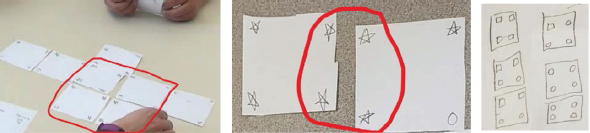
To define the player who starts the game, the shape drawn on the tile and the number of the edges for each shape was important. For example, star has ten points as it has ten edges. Square has four points as it has four edges. Triangle has three points as it has three edges and circle has one point as it has one edge. Each player gets five tiles and a player with the highest points for a tile starts the game. For instance, a player having a tile with four stars on it begins as there is no tile with a higher score than 40. In the game, players score the points of the edges (both sides) that they match. As figure 3 shows, a player matching stars on both edges gets 40 points. If players create a bigger rectangle (4 regular square tiles or more) the one who puts the last tile gets all the points on the bigger square or rectangle (Figure 3). There was a score keeper role in this game marking the scores of the players on a blank paper. When all players ran out of the tiles, the score keeper adds up the scores earned by each player and defines the winner based on the highest points earned.
These observations show that learners developed the matching rule of the game based on the shape they chose for the tiles. Making connections between the chosen geometrical shapes and the matching rule of the game provided opportunities for students to think mathematically through the game redesign. Changing the tile shape implicitly changed one of the main rules of the game and encouraged learners to think about all the combinations they may have by increasing or decreasing corners. In this case, redesigning the game helped learners familiarize themselves with the complex topic of combination in mathematics in a simpler way: writing down the combinations on a piece of paper. Changing the shape, not only influenced the mechanics (i.e., matching rule) but also the dynamics and aesthetics of the game. More corners and one additional edge to the tiles meant more opportunities for matching. Moreover, such a change could make the game more complex and time consuming as more corners and wider range of numbers on the tiles makes score calculation more complex. Making a game more complex or giving extra opportunities for matching tiles by a single change could influence the dynamics of how players interact with the matching mechanics and rule of the game. The changes that learners made in terms of scoring system, rules of the game, and creating tiles not only influenced the mechanics, dynamics, and aesthetics, but also provided a context for understanding how a seemingly small change could destabilize the game system and motivate learners to further modify the game.
‘Rhombinos’ (Wild Edition) and the Iterative Process of Redesigning Game
This group (three boys) decided to change the triangular shape of the Triominos tiles to rhombus. Primarily, learners within this group had different ideas for the tiles’ shape based on their individual ideas. However, after discussions within themselves the teammates agreed to go with rhombus: Teacher: What is going to be your scoring rule? Aron: Adding up all the numbers on the matching tile. Kia: Adding up the numbers on the matching edges. Dennis: The edge that you match you get the points for. Teacher: Can you write this rule in the rule book please and draw a picture to show what that means.
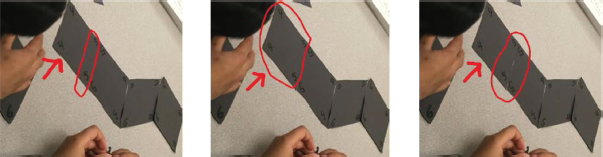
After group discussions, they came up with an agreement on using rhombus tiles and a numbering system from zero to six where they put a number on each corner of a tile. These numbers were used for matching tiles and scoring points equal to the numbers written on a matching edge. All these decisions, changes, and discussions influenced the dynamics of the game where the behavior of the rules and mechanics in play are different from Triominos. The scoring system underwent several iterations and developed over time (Figure 4). Based on our observation, the scoring rule change had three main benchmarks. Switching among different rules was often facilitated by the discussions within group, between group and teacher, as well as game playtesting. The three rules that Aron, Kia, and Dennis mentioned above are shown side by side on a single frame in figure 4. In the first scoring rule, players got the points of the edge that they match (i.e., the edge of the tile that they put down). The second rule was that the player adds up and scores all the numbers written on the tile that s/he plays. The third rule was that a player gets the points of the edges (both tiles) that s/he matches. Rhombinos had 24 regular tiles (in black) and six wild cards (in green) with each player getting three tiles to start with:
Various tried scoring system, first (left), second (middle), and third rules (right).
Teacher: Can we play an example of your game?
Aron: Three pieces for each player.
Teacher: Why do you only start with three?
Aron: Because we did this, we have 24 pieces. 3, 6, 9, 12, 15, 18, 21, 24.
Dennis: If we started with more pieces there were less pieces left on the floor to continue with.
Teacher: I see. so, you select small number that more people can play your game.
Kia: And there are more tiles to draw from.
This conversation shows that the learners wanted the number of tiles in Rhombinos to be divisible by three maybe as their team had three members and this could make the game very specific to three players. The wild cards (in green) could be used everywhere, and players could match it with all the tiles in the game regardless of their numbers. When a player matched a wild card with another tile, s/he gets five points for each edge (Figure 5). Another way to score bonus point in Rhombinos was completing a star shape (6 rhombuses) with a regular black tile to score 50 points or completing a star shape (6 rhombuses) with a wild card, to score 40 points. Whenever a player did not have a matching card s/he had to draw a card from the stacks of the cards and lose a point per draw. Moreover, a player would lose one point when placing a card that does not match and must skip the turn. For the score keeping, the players wrote down their points in each turn on a blank paper until a player earned 200 points (winning state).
Scoring bonus points: matching a wild card with two regular cards and scoring 5 bonus points for each matching edge (left), completing a star with a regular card to score 50 points (middle), and completing a star with a wild card to score 40 points (right).

As per these observations, there was a range of shapes that a player could create with the tiles to get a bonus point in this game (Figure 5), including two- and three-dimensional geometries like star (2D) and cube (3D) or hexagon (2D). Thinking about a certain number of the tiles to be divisible by three in the redesigned game implied learners to touch upon a more complex topic in mathematics, divisibility. Losing points in this game was a new mechanics, that influenced its dynamics as well as aesthetics by requiring players to be more meticulous in their matches and score calculations. The three benchmarks in developing the scoring system fall into those changes made to mechanics. Changes in the way that players score points can influence the complexity and difficulty of the game as a result. Moreover, the iterative process of developing the scoring system provided learners with a context to familiarize themselves with the iterative process of game design and how it can evolve to overcome complexity and disorder.
Type-Ominos' and the Incorporation of Inspirations and Ideas
This group (three boys) decided not to change the triangular shape of the Triominos tiles and used this shape for the tiles. The game included 35 regulars and five Star tiles (bonus). Regular tiles had different symbols on their corners and a number in the middle. The number in the middle of each tile showed the points each player earned when matching tiles (Figure 6). The Star tiles had a star in the middle.
Random numbers in the middle of tiles indicates the points that a player gets when s/he matches (left). Using ruler (middle) and a cardboard template for tracing and cutting the tiles (right).
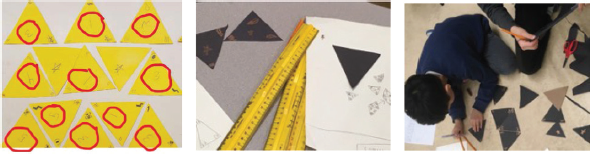
Learners chose six symbols to go onto their tiles: grass, star, water, fairy, steel, and lightning. Except the star that went on top of the star tiles (bonus), these were placed on the corners of the regular tiles. Based on the rule book of this game, players get six tiles to begin with (i.e., mechanics): Teacher: What system did you use to create your pieces? I do not see steel, steel, grass and steel, steel, star. I think you guys do not have all the pieces made yet. Have you tried playtesting your game? Bob: we will try. Teacher: So, you have six different symbols same as in Triominos. How many tiles are in Triominos? Bob: fifty… Teacher: There are 56 tiles in the Triominos. You have the same number of symbols, and your tiles are the same. But because you are placing one of your symbols (i.e., star) on the whole tile, you have fewer than 56… There is only one star piece? Bob: There are five. Teacher: I see you did some matches here. How did you play your game? Winston: weird because this one is like a random number; we do not know what to do with this one. Teacher: Often, there are handful of pieces in front of me and I cannot play any of them. right? That happens a lot in games and that is why you have to draw. So, that is ok. Teacher: Playtesting is not just playing the pieces that are matching. Playtesting would be dividing up your pieces and taking turns to play them to make sure there is enough to choose, make matches, and draw to make matches. Winston: There are two pieces that match here. Teacher: Yes, there are times that you can choose between two pieces that work. What strategy we use to say which piece is better to play? Winston: Highest. Teacher: Exactly. the highest.
In this game, a player with the lowest number written in the middle of a tile started the game. This rule is different from the original rule in Triominos wherein the player with the highest combination of numbers on a tile starts the game. When a player matched regular tiles, s/he got the points written in the middle of the tile that s/he played. A player could put a wild card anytime and anywhere to earn 20 points since it could go with all the tiles. Players could also attach any tile to a Star tile. Matching a Star tile with a regular tile had 20 bonus points. Making a shape (e.g., rectangle) with the tiles earned a player 10 extra points. The game continued until there was no more tiles to play. Consequently, a player with the highest score was the winner.
Although their redesigned game has similarities with Triominos, changing scoring system, rules of the game, and conceptual inspirations from other games, like Pokémon, transformed the mechanics, dynamics, and aesthetics of the original game. One of the researchers overheard the learners within this team talking about Pokémon among themselves. They were also excited to show us Pokémon and explain the types during the interview. As such, the changes in rules and mechanics of the game were inspired by the aesthetics, their enthusiasm toward the symbols adopted from Pokémon types. This observation was supported by the teacher’s remark that Winston is an artistic person. This skewed enthusiasm about aesthetics came with its own cost as learners struggled to incorporate the idea of having types in the game. Matching different symbols (types) added to the complexity of play while adding Star tiles increased the possibility of playing when there is no matching tile. Switching from the numbers in Triominos to the types in Type-ominos implicitly involved learners with a more complex topic in mathematics, equivalence relation. Instead of matching numbers, different symbols (i.e., types) were considered equivalent and were paired by players for scoring points. Although learners did this accidentally, it also demonstrates that redesigning the game could expand the capacity of students for learning mathematics.
Discussion
Activities, outcomes, and competencies emerging in three groups thrughout the (re)design process
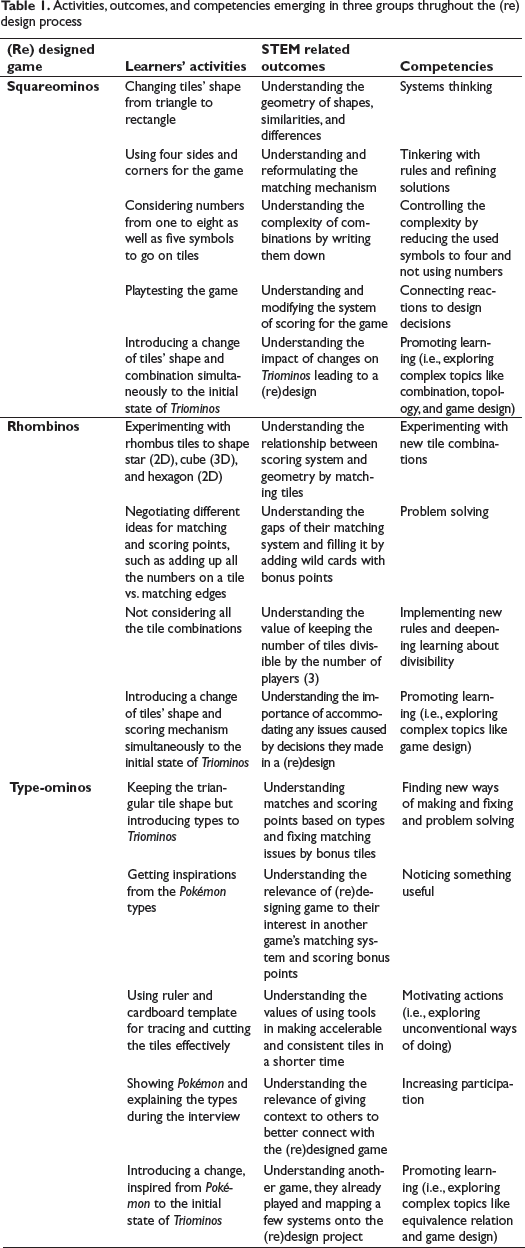
It seems that when learners are involved in (re)designing a non-videogame irregularities and changes in any of the mechanics, dynamics, and aesthetics can open doors for further changes on all aspects of the game and encourage learning subjects like mathematics while paving the way for developing certain competencies and engaging in various activities (Figure 7). Some of these activities and competencies emerged when learners worked on mechanics (Figure 7). For example, implementing new rules, reformulating the matching mechanisms, and developing new scoring systems in all the three games that learners redesigned targeted the mechanics of the Triominos. Some other activities, such as experimenting with new tile combinations, numbers, and symbols were complemented by the playtesting sessions where learners could put the changes into play (Figure 7). Moreover, when learners discovered that a change in the shape or symbols on top of the tiles can cause other problems to solve (e.g., larger number of tiles than expected), they found new ways of making their game and dealing with the new problem by reducing the number of symbols and combinations or prioritizing divisibility of the number of the tiles by the number of the players. Tinkering with rules and refining solutions also emerged from the dynamics specially when the learners play tested their game. For instance, learners who worked on Rhombinos refined the method of scoring points when matching tiles during a playtesting session and conversation with their teacher. A series of competencies emerged when learners focused on the aesthetic aspects of their games (Figure 7). Learners’ activities and developing competencies were associated with controlling for the complexity of the game by keeping it simple but entertaining and connecting emotional feedback and reactions from other players of the game to the design decisions. For example, in Type-ominos, one of the learners (i.e., Winston) expressed that their game acts “wired” on some occasions during the play. Yet, the teacher explained that it is very normal for the games to act like this. Their conversation shows that a learner as a designer and player had an emotional response to the game and looked for external emotional responses from others. These discussions also show that even though a change may seem cosmetic at the first glance, such as changing the shape of tiles, it can profoundly engage the players in thinking critically and designerly about the mechanics, dynamics, and aesthetics of the game.
Authors’ assumption of different components of MDA model encouraging learning..
The changes that learners made to Triominos not only engaged them in the process of game design but also encouraged learning simple and complex mathematical concepts, ranging from addition and subtraction to division, combination, and topology. For example, the triangular shape of the tiles in Triominos changed to rectangle in Squareominos and Rhombinos. Topologically, triangle and rectangle are homomorphic (Lawson, 2003). This means that, if a point in the triangle be mapped to by some point in the rectangle, no other point in the rectangle maps to the same point in the triangle (Armstrong, 2013). Moreover, any point in rectangle should have some point in triangle that maps to it (Armstrong, 2013). This does not mean that learners knew about topology, but it shows that it is possible to contextualize and facilitate learning complex mathematical topics in game (re)design practices. Another example is the concept of combination that was practiced by learners in a simple way when the teacher asked them to write down all the possible combinations of symbols on their tiles. For Triominos with triangular tiles and numbered from zero to five (i.e., six numbers). the number of multisets of 6 (n) items taken 3 (k) at a time equals 56, according to the following equation (Benjamin & Quinn, 2003):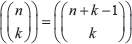
If we use the same equation for Squareominos, the number of multisets of four items (i.e., symbols selected by the learners in this group) taken four at a time (i.e., as each tile has four corners in squire) equals 35. As data shows, the number of tiles that learners reached by writing down all the combinations – as per teacher’s suggestion – that could go on top of their tiles was also 35. The case for Type-ominos was a bit different. This group had six selected symbols to go on top of the tiles. However, as they kept one symbol only for bonus tiles, the number of multisets of five items (i.e., remaining symbols selected by the learners in this group) taken three at a time (i.e., as each tile has three corners in triangle) equals 35. Adding the five bonus tiles with the star on top, the total number of tiles for Type-ominos equals 40. As data shows, learners reached the same number of tiles (i.e., 40) by arranging and making matches during the playtesting. As per Rhombinos, this team used another strategy for making tiles that was connected to divisibility rule in mathematics. According to the data, this group selected six symbols to go on top of their tiles with four corners. This makes the number of possible combinations 126. However, they only made 24 regular tiles and six bonus tiles for their game. The reason was that this game was designed by learners for three players, and as data shows, learners tried to keep the number of tiles to start with and the total number of regular and bonus tiles divisible by three.
Conclusion
In this study, we positioned the activities of redesigning a tabletop game, (i.e., Triominos) as an approach to disciplinary engagement in a STEM classroom. In this study, we attended to how learners’ activities could encourage different disciplinary learning and social engagements within and around the classroom. Redesigning game gave learners opportunities to express their creativity and generate ideas collaboratively. In our research, third and fourth graders (age ranging from eight to ten) in a West-Canada school transformed Triominos into paper-crafted games and explored how using different shapes, numbers, and symbols change the game rules, looks, and experience of the game. The outcomes show that any changes, even trivial at the beginning, can fundamentally influence aesthetics, dynamics, and mechanics of the game. Learners engaged in various activities and developed competencies, such as tinkering with rules and refining solutions. The outcomes from this study demonstrate the role of redesigning games in deepening their understanding of design and mathematics in STEM classrooms. The outcomes help teachers identify strengths of redesigning games in encouraging learning complex mathematical concepts, such as, topology, combination, and divisibility rule. Instead of solving prefabricated math problems, learners were engaged in solving problems that were composed throughout the process of redesigning Triominos. One may consider learning through redesigning a game as an open-ended way of encouraging learning mathematics. This resonates with the open-ended nature of redesigning a game wherein there is no ending for the possibilities to change game components and accommodate the changes in a new state of the game components. In a deeper level, this project can help teachers develop an improved curriculum for mathematics and STEM classrooms based on redesigning tabletop games. The outcomes also show the differences between the approaches that children take for redesigning a same game with the same assumptions.
The scale of this study was small as only about a quarter of the parents provided their consents for including data collected from the learners within both classrooms (i.e., 11 out of 45) in the study. This introduced another limitation in terms of the participants’ gender as three groups with complete consents had dominantly male students. As such, discussions of gender and its influence on the results remained out of the scope of this research. Moreover, conducting the research in an inner-city elementary school in western Canada, might make it specific to location, and influence the generalizability of the study. Future studies may focus on the application of this approach in other K-12 grades, with more diverse groups in term of gender and geographic locations. The role of the teacher in guiding the projects and providing feedback is another area to pay attention to in the future studies. Although several times the guidance from the teacher encouraged learners to develop their work, we observed few occasions that learners lost their interest because of the feedback they received from their peers and teacher. Thus, a deepening their understanding of the role that these guidelines and feedbacks can shed light on the individual differences of learners and their development over time in the classroom. It is interesting to study how other games can offer opportunities for redesigning and learning subject-specific matters. This research paves the way for further studies and opens the door for more question to be answered in the future studies.
Footnotes
Acknowledgments
We thank the teachers and the students who participated in this research. Special thanks to reviewers and the research team members at the University of Calgary who contributed to the project.
Declaration of Conflicting Interests
Funding
The author(s) disclosed receipt of the following financial support for the research, authorship, and/or publication of.this article: This research was supported by Government of Alberta, Canada and the University of Calgary.
