




Abstract
Background. To facilitate game sessions for purposes beyond mere entertainment a facilitator needs to act like an ‘Unseen Helmsman’: steering their ship clear from rocks and storms without the players in the ship realizing. Previous work laid down a competency model for
Methods. This contribution elaborates on the
Conclusions. First, lessons for novice game facilitators include familiarising themselves with the core notions of the
Introduction
Game facilitators are of great importance for successful game sessions that aim for more than entertainment alone (see, e.g., Greenblat and Duke, 1981; Steinwachs, 1992; Leigh, 2003; Kato, 2010). A game facilitator needs to act like an ‘Unseen Helmsman’: steering their ship clear from rocks and storms without the players in the ship realizing (Kortmann and Peters, 2017). The challenge is that the literature on facilitation is disjointed and sparse on guidance for game facilitators. Below, we review what is understood about facilitator competencies and draw lessons for novice and experienced (game) facilitators.
Clear guidelines to select and train successful game facilitators are hard to come by. For instance, in 1998, Leigh and Spindler stated: “While there is a great deal of material concerning the development of facilitation skills in general, [...] less specific information is available on ways to apply such knowledge to game/simulation” (Leigh and Spindler, 1998, p.389). Ten years later, Van Kessel and Datema (2008) observed that comprehensive lists of requirements for game facilitators were still lacking. Therefore, Van Kessel and Datema studied facilitation styles by themselves that enabled them to be more effective when selecting facilitators for their game sessions. Two years later, Kriz (2010) studied game facilitation from a systemic-constructivist perspective which yielded a range of quality aspects of game facilitation and three approaches for successful game facilitation. In addition, he identified the phases of the debriefing process and several debriefing methods. Although Kriz’ work is valuable from a theoretical point of view, there remains a need for more practical, hands-on guidelines for becoming a successful game facilitator – an ‘Unseen Helmsman’.
The studies cited above provided a starting point for work on developing a practical competency model for game facilitators (Kortmann and Peters, 2017). Competency modelling is a method for providing insight into the effective performance of a job (cf. Knowles, 1980; Spencer and Spencer, 1993; Campion et al., 2011). Application of this method yielded the knowledge, skills, and attitudes required for successful game facilitation. The 2017 study employed a mixed-methods approach consisting of a top-down literature review and a bottom-up, participatory study with facilitation experts. The former investigated several existing competency models for generic group facilitation. In the latter a group of game facilitation experts was guided through a custom-made process to identify competencies for game facilitation more specifically. The work resulted in a rich and comprehensive set of competencies (knowledge, skills, and attitudes) for game facilitators. However, the outcomes required more elaboration and interpretation to provide practical lessons for (game) facilitators. The latter is the aim of this article.
This contribution focuses on the facilitation of games in which players interact with each other, with a facilitator, and within a model of reality in order to understand and/or design complex systems (cf. Lukosch et al., 2018). In these games players and facilitators are typically physically co-located to promote a rich and embodied interaction (Gee, 2007; Klabbers, 2009; Kortmann et al., 2014), but part of the interaction may also be mediated through ICT tools (Aan het Rot, 2021). The model of reality that forms the backbone of the game is usually implemented as a set of tactile, analogue game materials augmented by one or more digital (simulation) models. The model of reality may also contain non-player characters (human or artificial) that represent certain social aspects of the system of interest. The aim of such games is predominantly for players to learn about the system of interest and to make it better. For instance, to improve the cooperation in a group, acquiring new skills, knowledge, and attitudes, or exploring alternative solutions for a problem.
The facilitation of complex systems games comprises four phases as shown in Figure 1 (cf. Peters et al., 1998a; Kriz, 2010). First, in the preparation phase a facilitator selects the game that will be played and aligns it with the objectives of the game session. Second, during the briefing phase the players are introduced into the model of reality and the game rules that apply there.
The four phases of facilitating complex systems games.

Third, the game execution phase requires the facilitator to maintain game flow. Note that the ultimate aim of a game facilitator is not to reach one of a set of predefined game outcomes. Instead, a facilitator creates a supportive environment for players to experience and explore; even if that exploration does not fit in the designer’s original idea of the game’s outcomes. Finally, in the debriefing phase, the facilitator supports players to construct meaning collectively based on their experiences during the game session. While playing the game, players obtain tacit knowledge (Klabbers, 2009). The debriefing makes this knowledge explicit and shared in the group of players.
The remainder of this paper elaborates and interprets, first, the literature review of existing competency models for generic, non-game group facilitation and, second, the game facilitation competency model. The following section discusses the differences between facilitating games vs non-game group sessions to formulate, in the last section, lessons for novice and experienced game facilitators as well as for non-game facilitators.
Competency Models for Generic Group Facilitation
Earlier work aimed to find guidelines for novice game facilitators (Kortmann and Peters, 2017). It reviewed existing competency models for facilitating groups engaged in activities other than playing games (from here on called ‘generic (non-game) group facilitation’). The study yielded competency models for four main types of generic (non-game) group facilitation:
small-group facilitation (Kelly and Thibaut, 1954; Schwarz, 1994; Baker and Fraser, 2005; Stewart, 2006; Kolb et al., 2008; De Ronde and Geurts, 2012; Franco and Nielsen, 2018) facilitation of learning (Heron, 1999; Marquardt, 2004; McGill and Brockbank, 2004; Thornton and Yoong, 2011) facilitation in group-support systems (GSS) (Clawson et al., 1993; Clawson and Bostrom 1993, 1996; Niederman et al., 1996; Dickson et al., 1996; De Vreede et al., 2002; Den Hengst and Adkins, 2005; Briggs et al., 2010; Adla et al., 2011) facilitation of model-driven methods for group decision support (Ackermann 1996; Vennix, 1999; Ackermann et al., 2005; Rouwette et al., 2011)
Below, we discuss how the existing models for generic (non-game) group facilitation cited above may provide lessons for game facilitators.
The four different approaches to facilitation show a large overlap in the desired competencies articulated. These can be categorised into the following groups:
understanding the context and objectives of the session creating and sustaining a participatory environment understanding and steering group processes communication and interpersonal interactions selecting the most appropriate tools for the session
Although these general categories provide some guidelines, game facilitators need to acquire more specific insights to become effective. Such specific insights may be found in competency models for a particular type of small-group facilitation: ‘group developmental facilitation’ (Schwarz, 1994; Stewart, 2006). In this approach, the group learns how to manage the process and how to correct themselves when the process does not lead to satisfactory outcomes. Also in complex systems games, facilitators empower the group to manage their own process, for instance by explaining the rules of the game. Players are then encouraged to find the strategies that will optimise their performance in the game (Sitzmann, 2011) with as little guidance given by the facilitator as possible.
Other specific insights for novice game facilitators include the three modes for the facilitation of learning mentioned by Heron (1999):
The hierarchical mode the facilitator leads and directs the group; he takes responsibility The co-operative mode the facilitator shares responsibility with the group The autonomous mode the facilitator delegates responsibility to the group
Similarly, Kriz (2010) identified three modes of game facilitation:
Shaper the facilitator acts as a leader and provides direction to the group Obstetrician the facilitator supports the group to “give birth” to their activities Coach the facilitator observes and supports a group that works independently
Heron’s and Kriz’ modes provide guidance on how to approach different groups in different situations with different objectives. For instance, groups that are new to each other and new to the game session may benefit from a facilitator operating in a hierarchical mode (Heron) or as a ‘shaper’ (Kriz). In contrast, if a game is used to empower a group in finding appropriate ways of working together, the autonomous mode of facilitation (Heron) or the ‘coach’ (Kriz) is more appropriate. One essential competency that is not explicitly addressed or missing in all models is the capacity to switch smoothly between these modes when necessary.
Finally, the work by De Ronde and Geurts (2012) may provide valuable lessons for game facilitators. This research investigated the competencies for group facilitation needed in situations where relational aspects play an important role. Although their field of interest is not identical to the facilitation of complex systems games, they came up with ideas that may very well be applicable when thinking about the competencies of game facilitators. Based on theoretical assumptions (Schön, 1983; Hermans, 2010) and a questionnaire among 76 professionals, they came up with three positions / roles that these professional trainers, supervisors and coaches are engaged in. These three roles / positions are:
the Scientist focusing on structure, advice, instruction, and analysis the Sage focusing on meaning, coaching, reflection, and silence the Rascal focusing on humour, imagination, creativity, and fun.
These three roles seem to be appropriate for game facilitators, too, and the may be linked to the phases of the gaming process (see Introduction) as follows. In the briefing phase, the Scientist is the dominant role, during the game play the Rascal may show up, while the debriefing phase calls for the Sage.
Some competencies for group facilitation seem less relevant for game facilitators and it is important to identify these as a way to help novice facilitators of complex games understand how it differs from non-game facilitation. For instance, ‘Guide a group to appropriate and useful outcomes’, as proposed by Baker and Fraser (2005) seems to require facilitators to steer a group towards a pre-defined outcome. Instead, games aim to explore possibly unknown solutions to a problem (cf. Peters et al., 1998b). Therefore, having a preconceived notion of the outcomes of the session and guiding the group towards it may hamper the session’s success. Instead, the competency ‘Valuing: forming a supportive climate that empowers the group to achieve objectives’ (Heron, 1999) seems a more appropriate competence for game facilitators.
With regard to group decision support, the facilitation competencies and learning points proposed by Vennix (1999) and Ackermann (1996) may also apply to game facilitation. However, there is a fundamental difference in the final objective of facilitating decision support sessions and facilitating complex systems games: the former focusses on the creation of a tangible product (a group model or a group decision), while the latter category aims at the (individual or collective) learning of the participants. Both types of group facilitation, therefore, require slightly different facilitation competencies.
Competency models for generic (non-game) group facilitation contain certain lessons for game facilitators, but as a body of knowledge they are fragmented and incomplete. Moreover, certain competencies in the existing models may be appropriate for non-game facilitators, but not for facilitators of complex systems games. Therefore, these competency models do not yield clear guidelines for novice game facilitators. Still, they may be of interest for more experienced game facilitators who wish to broaden their horizon by learning from other types of (non-game) group facilitation.
A competency Model for Game Facilitation
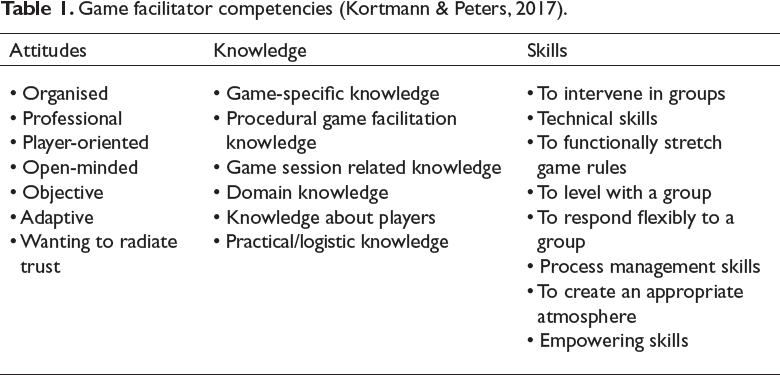
In an attempt to fill in the gaps in existing competency models, Kortmann and Peters (2017) reported on a bottom-up study into game facilitator competencies with the participation of game-facilitation experts. Table 1 organises the resulting competencies in three groups: attitudes, knowledge, and skills. Below we elaborate and interpret the outcomes per group.
Game facilitator competencies (Kortmann & Peters, 2017).
Attitudes
The model comprises several attitudes of importance for good game facilitation, such as being well organised, professional, and player-oriented. Clearly, many of these attitudes are at odds with each other. Facilitating games, therefore, requires finding a delicate balance between different, opposing attitudes.
For instance, while game facilitators need to be well organised, they need to be adaptive as well. This means that ‘organised’ in the table above should be interpreted as being well prepared and willing to provide a certain structure to the players, rather than wanting to adhere very strictly to a plan or procedure for the game session. Conversely, for a game facilitator, being adaptive is not sufficient in itself. To adapt the course of a game in a purposeful and meaningful way, one needs to be organised to manage the consequences of the adaptations.
Moreover, the attitudes ‘player-oriented’, ‘objective’, and ‘professional’ may be conflicting in certain ways: although ‘player-oriented’ facilitators should prioritise the player experience over the game script, they should not lose sight of the learning goals and always remain objective and professional with respect to the aim of the game session. This means that player-orientation should not be confused with, for instance, pampering the participants in the game session; instead, sometimes a limited amount of frustration or other negative affect can be very instrumental to the game’s purpose. Therefore, being oriented towards the players’ experience is important, but should not go at the cost of the overall goal of the game.
Altogether, the attitude sets of good game facilitators comprise most, if not all, of the attitudes in Table 1. Becoming an advanced game facilitator requires finding a balance between the oppositional attitudes mentioned. Although individual differences in balance are unavoidable and represent a certain personal style of game facilitation, it should be avoided that one attitude overshadows one or more other necessary attitudes on the list.
Knowledge
Six types of knowledge were identified in Table 1. It should be noted that depending on the type of game, the game phase, and aim of the game session, certain types of knowledge are more important than other types.
For instance, domain knowledge (about the subject matter that the game deals with) is of great importance in certain simulation games that are based on a high-fidelity model of reality, such as business games. In this type of games, the facilitator should understand in great detail how the players’ actions affect the game state and how (unexpected) outcomes may be explained. Also, domain knowledge is important during the debriefing phase of the game session when the tacit learnings from the game are transferred to explicit knowledge about the real world in which the participants operate. In contrast, domain knowledge is of much less importance when the aim of the game is not strictly related to the model of reality. For instance, when the game model is a metaphor for the real world in which the players act and/or when players have widely varying backgrounds. In these cases, facilitators should have a basic understanding of the domain(s), but may resort to the expert knowledge of the players for the details.
As a second example, we discuss the importance of knowledge about players. While in certain cases it may harm the game session if the facilitator cannot take into account the peculiarities of the player group, in other cases it is beneficial to have as little background knowledge of players as possible. For instance, when players come from a rather hierarchical organisation, it is often important to know the positions of the individual players in the organisation. Failure in acknowledging the hierarchy may lead to feelings of unsafety and insecurity amongst (both highly and lowly ranked) players. This may lead to limited effectiveness of the game, as feeling safe and secure are important prerequisites for players to enjoy and learn from the game session. In contrast, there also exist circumstances in which having little knowledge of players is beneficial for the game session. For instance, in order not to be prejudiced it may be important for the facilitator to know as little as possible about the player group. Knowledge may lead to a bias in which facilitators approach players. As a consequence, these players could feel, for instance, not taken seriously and lose interest in the game session. Therefore, facilitators should know some facts about the group, such as hierarchy, but should remain blissfully ignorant of other player characteristics and group dynamics.
The examples above illustrate that the importance of the different types of knowledge in Table 1 depends on the specific type of game, the game phase, and the aim of the game session. Learning to become a game facilitator, therefore, involves gaining an understanding of what knowledge is important given the game facilitation task at hand.
Skills
Table 1 contains eight skills that are important for facilitating games that aim for more than mere entertainment. It is important to understand that, like with the attitudes discussed above, a balance should be found in applying these skills.
For instance, levelling with a group and creating an appropriate atmosphere are important skills to realise the ideal circumstances for the game session to be effective. However, this should not mean that the game facilitator becomes one of the players themselves. As was explained above, a good game facilitator is an ‘unseen helmsman’ who supervises the game process without the players noticing. Therefore, the players should not feel that the facilitator is one of them or they may experience a loss of agency and autonomy in the game, which may lead to reduced effectiveness of the session.
Also, being able to deal with technical issues greatly helps facilitators not to be over-dependent on other people (technicians) to run a game session, but this skill should be balanced with other skills such as process management. If a facilitator relies on their own technical skills too much, they may find themselves in situations where technical issues draw away their attention from the overall management of the game session. Facilitators that lose sight of the game flow because they are too much focused on technical tasks harm the game session and limit the effectiveness. Therefore, a balance should be sought between not depending on a technician for every issue in the game on the one hand and arranging for sufficient tech support to still be able to supervise the game on the other.
In conclusion, becoming a good game facilitator involves balancing one’s skillset. All eight skills in Table 1 are important to master. However, applying one skill should not go at the cost of applying other important skills.
Game vs Non-Game Facilitation
To understand how facilitating games resembles and differs from generic (non-game) group facilitation, such as small-group facilitation and learning facilitation, we compared existing competency models for generic facilitation to the competency model for game facilitation.
When comparing game facilitator competencies to the competencies identified by Baker and Fraser (2005), Stewart (2006), and Kolb et al. (2008) for small-group facilitators we observed several similarities and dissimilarities. The most important similarities are:
Facilitators are able to work collaboratively with the participants and stimulate them to participate in the process Facilitators provide some structure for groups to support their work or game Facilitators have excellent interpersonal and process management competencies Facilitators understand the context in which the group work or game takes place
The main dissimilarities are:
A game is a very specific instrument to facilitate small groups. Game facilitators need specific knowledge and skills to use this instrument that are not necessary for small-group facilitators that use more general-purpose instruments such as brainstorm techniques. When games are used as an exploratory instrument, game facilitators need not be as goal-oriented as small-group facilitators need. Instead, game facilitators should respond flexibly to a group and the developments in a game even if that would mean dropping some of the original goals. In fact, game facilitators should have more of a ‘standing-back’ attitude than small-group facilitators in general: the players decide where to go and at what pace. Game facilitators should be even better able to immerse participants into the group session: when players enter a game they need to be willing to assume a role and behave according to the rules of the game. In order for this to work well, game facilitators need to belief themselves in the games they facilitate. Also, they should be more capable in creating an appropriate atmosphere than generic (non-game) facilitators.
Game facilitator competencies bear much resemblance to the competencies for facilitation of learning according to Heron (1999) and Thornton and Yoong (2011). In particular, both types of facilitators should:
Motivate participants to explore, discover, get engaged, and learn. For this, facilitators need detailed knowledge about the participants, their learning preferences, and the ways to engage different types of participants. Radiate trust in order to use both ‘carrot and stick’: sometimes a facilitator should seduce and comfort participants to reach a goal; sometimes a facilitator should confront the participants with their negative sides, thus showing them the necessity to improve. For the latter approach to work, trust is pivotal.
The most important dissimilarities are:
Games can serve more aims than just learning. This fact calls for additional competencies for game facilitators than those needed for facilitating learning. For instance, when games are used to support the development of public policy, game facilitators should have multi-disciplinary knowledge about the policy domain (political, economic, technical, social, etc.). Heron proposes that in some cases it is appropriate that the learning facilitator directs the group and takes responsibility for the process. Although in games a facilitator may seem to act as a leader (as in the ‘shaper’ approach mentioned by Kriz (2010)), they should never direct the group or take responsibility for the process. Instead, this is the task of the game design. A game facilitator should stand back and allow the players to find their own way, even if this would initially lead to confusion and disorder: the experience of self-organizing a process by a group of players is very powerful and good game designs will exploit this feature.
Comparison to GSS Facilitator Competencies
The comparison of game facilitation competencies to the literature on GSS facilitation competencies yielded findings very similar to those in the case of small-group facilitation. In general, GSS sessions need much stricter facilitation than game sessions. The reason is that games provide a lot of structure by themselves and, if designed well, have inherent features to keep participants engaged. This means that game facilitators need to put significant effort into guiding a group to become part of a game. Once this has been done, they will be able to facilitate much more loosely than many GSS facilitators do.
As may be expected, many of the attitudes and skills that are considered important for facilitating group decision support processes are also present in the competencies identified for game facilitators; this holds especially for process-related competencies. Both Vennix (1999) and Ackermann (1996) point at the fact that the three phases in the facilitation process (before, during and after) require different sets of competencies, or at least different emphasis on the required attitudes, knowledge and skills. The introduction stressed that this is also the case for game facilitation. The difference between the competency models by Vennix and Ackermann and the game facilitation model is the fact that the latter explicitly distinguished the category of knowledge (of the problem context as well as of the game used) while this category remains implicit in the former models.
The comparison above provided insights into how facilitating games resembles and differs from generic (non-game) group facilitation. A game facilitator may be described as an ‘unseen helmsman’ steering their ship clear from rocks and storms without the players in the ship realizing. In contrast, generic (non-group) facilitators can be much more visible and explicit in guiding the participants. It is important for game facilitators to provide players with a great sense of autonomy and agency in finding their way through the game world. In generic (non-game) group facilitation this is much less of importance.
Conclusions
As argued in the Introduction, the role of the game facilitator is of great importance to the success of complex systems games. Therefore, earlier work provided a competency model to contribute to the professionalization of game facilitators (Kortmann and Peters, 2017). In this article, we elaborated on this model and drew lessons from it. First, the competency model makes tacit knowledge about game facilitation explicit and therefore may be of interest to novices and experts alike. Moreover, above we stated that existing competency models for generic (non-game) group facilitation do not yield clear guidelines for novice game facilitators; still, those models may contain important lessons for experienced game facilitators who wish to broaden their horizon. In contrast, the competencies identified in the competency model for game facilitation presented above should not come as a surprise to experienced game facilitators, but may be of help to novice game facilitators to become an ‘Unseen Helmsman’: a game facilitator who guides the game session without the players realising and, therefore, without hampering the game experience. Above, we established that competencies for generic (non-game) group facilitation partially overlap with those for game facilitation. However, game facilitation also requires specific knowledge, skills, and attitudes that are not contained in the competency models for non-game facilitators. Therefore, the competency model for game facilitators may also benefit generic (non-game) group facilitators who are interested to add game facilitation to their portfolio. Below, lessons are drawn from the research. We distinguish lessons for each of the three groups identified above: novices, experienced game facilitators, as well as facilitators of generic (non-game) group sessions.
Lessons for Novice Game Facilitators
The outcomes of this study may help novice facilitators to familiarise themselves with what it takes to facilitate complex systems games: becoming an Unseen Helmsman. However, facilitators need to realise that there is no single best way of facilitating a complex systems game, so there is no single best set of competencies a game facilitator should acquire. Instead, a novice game facilitator should become aware of the choices they need to make given the specific properties of the game, the objectives of the game session, and the player group.
Several notions are worth knowing in the pursuit of becoming a game facilitator:
the competency areas: what does a game facilitator need to know (‘knowledge’), to be able to do (‘skills’) and to ‘be’ (‘attitudes’) the phases of game facilitation the competences refer to: ‘preparation, ‘briefing’, ‘execution’, and ‘debriefing’ the modes and roles of game facilitation: the hierarchical, co-operative or autonomous mode (as distinguished by Heron, 1999), the approach off the shaper, the obstetrician or the coach (as mentioned by Kriz, 2010), or the roles of Scientist, Sage, and Rascal as defined by De Ronde and Geurts (2012).
In addition to these notions, novice game facilitators may find it helpful to explore the competency model for game facilitators and find ways to train them. Doing so, they should mind the focus of each competency: is the competency important for understanding the context, applying the instrument (the complex systems game) properly, enhancing the learning/design process, or dealing with groups?
Lessons for Experienced Game Facilitators
Above, we listed a range of handbooks, guidelines, and competency models about facilitating non-game group sessions. These sources may provide important insights to more experienced game facilitators, who already understand how game facilitation differs from more generic (non-game) group facilitation. The review yielded five categories of competencies that experienced game facilitators may want to explore. In addition, they should familiarise themselves with different facilitation roles to respond optimally to different types of groups. Every role comes with a different set of competencies to play it out effectively.
The categories identified contain many competencies, such as ‘group developmental facilitation’ (Schwarz, 1994; Stewart, 2006) which refer to the capacity to empower groups to think critically and constructively about the events they encounter during the session. One may conclude, therefore, that competencies like these are also of importance to the facilitation of complex systems games. However, as shown above many game facilitation experts do not consider this capacity to be of prime importance. Therefore, one needs to be very careful when adopting competencies that were formulated for other types of (non-game) group facilitation. Not all of them apply to the facilitation of complex systems games.
Lessons for Generic (Non-Game) Group Facilitators
Experts considered the competencies shown in Table 1 to be important for facilitating game sessions. By comparing these results to competency models for generic (non-game) group facilitation one may conclude that, although many of the latter competencies also apply to game sessions, there exist some striking dissimilarities. Together, they come down to the following ground rule for game facilitators: they need to act as an ‘unseen helmsman’ steering their ship clear from rocks and storms without the players in the ship realizing. Only thus, a game facilitator can provide their players with a sense of autonomy and agency required for the successful execution of a complex systems game. The subsections below conclude some lessons for generic (non-game) group facilitators who wish to add game facilitation to their portfolio.
Playing within a model requires other competencies than playing with a model. Complex systems games, as demarcated in the Introduction, allow participants to play within a model of reality. In contrast, in other types of (non-game) group sessions participants may play with a model. Playing within a model requires a smooth transition from the world of practice into the game world and back again. Therefore, game facilitators should be capable to bring the participants into the game world, to help or challenge them to perform in that environment, and to get them out of the game world back to the real-life situation. And this requires that game facilitators be able to operate in real-life environment as well as in the game environment (sometimes by playing a role in the game). In addition, game facilitators need to be able to make an adequate translation between these two environments. They should be aware that the learning process should not be limited to the game environment itself; the game environment is an instrument to learn about the real-life environment. The learning process of players is empowered by a game facilitator from within the game environment towards the real-life environment. Therefore, the capacity to switch roles is important for the successful facilitation of games. For instance, a good facilitator will be able to switch between the roles of a non-player character and a facilitator during game play. Also, they should be able to adopt different facilitator roles or styles to respond effectively to different types of groups.
Full comprehension of and respect for the game instrument is of vital importance. In game sessions, the use of a specific instrument (i.e., a game) plays a more prominent role than in most other types of group sessions in which more generic instruments such as a flip board, sticky notes or computer-based support systems are used. A well-designed game takes over some of the tasks of a facilitator. For instance, the game’s narrative structure provides the participants with goals; the game rules and materials provide them the means to reach those goals. This study yields that, to monitor the session, to optimally use the game’s features, and to intervene at the right moments, a game facilitator will need to comprehend their session instruments much better than other, non-game facilitators need to. In addition to knowledge of the advantages and limitations of complex systems games in general, a thorough understanding of elements and mechanics of the specific game instrument is essential. This understanding, referred to by the terms structural validity and process validity (Peters et al., 1998a), is indispensable for making correct translations from the game environment to the real-life environment. Besides comprehension of the game, respect for the game is important for a game session to be successful. This means that a facilitator should be able to stand back and ‘let the game do its work’. It takes a lot of trust for the facilitator to do so and it requires the ability to delegate control.
Translating between the game and real world is essential for transfer of learning to take place. Since game environments are based on abstractions and reductions of a real-world environment, a facilitator needs to be able to translate events and insights from the real world to the game and back again. Doing so will enable the players to relate their understanding of the game environment to the real-world environment and, therefore, to transfer their learnings to their professional or personal situation. We emphasize that this ability is not only important for games that were primarily designed for learning. Other games that, for instance, support participatory research, design, and decision taking should as well be facilitated such that players are able to transfer possible learning outcomes to their professional or personal situation easily.
Learn from other types of non-game group facilitation. Finally, generic (non-game) group facilitators may learn from colleagues in related fields. The sources consulted in the literature review above were generally written within the boundaries of one sub-discipline, such as the facilitation of learning processes or the facilitation of sessions for group decision support. Hardly any cross-references between these disciplines exist, which means that generic (non-game) group facilitators may benefit from each other’s knowledge in the same way as experienced game facilitators may.
Becoming the Unseen Helmsman
Altogether, the lessons presented above may help novice and experienced (game) facilitators alike to become an Unseen Helmsman and steer their ship clear from rocks and storms without the players in the ship realizing. Facilitators thus deliver effective game sessions. However, becoming the Unseen Helmsman is a delicate balancing act of finding a middle ground between being unseen and being a helmsman. On the one hand, being unseen helps to maintain the game’s magic circle and promotes a sense of autonomy in the player group. Facilitators should, therefore, stand back and intervene in the game session as little as possible. On the other hand, failure to intervene at critical points will damage the game session as well and render the ship adrift. Therefore, facilitators should understand when they need to act as a helmsman to avoid fatal collisions. Facilitators are encouraged to practise this balancing act in their pursuit of becoming a true Unseen Helmsman.
Footnotes
Acknowledgments
We wish to thank the participants of the ISAGA Conferences and the participants of the Saganet Seminars, who shared their expert knowledge with us. In addition, we wish to thank colleagues at the faculty of Technology, Policy, and Management of Delft University of Technology and six anonymous reviewers for their valuable input.
Declaration of Conflicting Interests
Funding
The authors received no financial support for the research, authorship, and/or publication of this article.

Author Biographies
Contact:
Contact: