




Abstract
Background:
When selecting, managing, and debriefing simulations, facilitators wishing to maintain appropriate standards, face demanding ethical challenges especially in learning contexts.
Aim:
This article considers why facilitators need to attend to ethical issues in facilitating simulation games. Issues examined include the influence of
Intervention:
A multidisciplinary integrative view of ethical
Method:
Literature, interviews and case descriptions were employed to examine what might constitute ethical
Results:
A three layered framework of perspectives on ethical
Conclusions:
While ethical
Keywords
Introduction: Relevance of Ethics and Facilitation
For facilitators of game simulations in general and in the context of learning, dealing with ethics is vital (Jones, 1998; Kato, 2010). This article has a focus on ethical facilitation in the context of learning. Game simulations are powerful learning interventions that can evoke strong emotions possibly causing damage with participants and facilitator. For a definition of ethical facilitation, I borrow insights from Achterbergh and Vriens (2009); ethical facilitation is to behave as ethically as possible given the circumstances. Related to game simulations, it means to have the right intention, for the right reasons with the right kind of preparation (a facilitator has to prepare on what he or she thinks is necessary and achievable given the situation). Currently professional guidance or ethical standards are not available for professional game facilitators and there are no direct answers to how a facilitator can behave as ethically as possible. Since ethical facilitation of simulation games has not been thoroughly studied so far and we have no knowledge yet on comparison to other fields of facilitation such as group facilitation. We can best start at the basis of ethical research which is philosophy. According to Hughes interpretation of the Nicomachean Ethics (Achterbergh & Vriens, 2009; Hughes, 2013), being ethical is about three components of moral behavior:
Moral virtue, meaning doing the right things for the right reasons. Practical wisdom, meaning using multiple situated perspectives and one’s own experience (which means to have a feel for the given situation in context) to judge the given ethical challenge. Skill, meaning having the capability to act as a professional and to act likewise to the best of one’s abilities.
Ethics are intangible, ethical practice consists of going through processes, taking on multiple perspectives making it hard to provide a single definition of the ethical concepts explored in this work. It is only in retrospect that it becomes possible to judge whether a decision/action represented, and resulted in, ethical conduct when viewed from diverse perspectives (Achterbergh & Vriens, 2009; Hughes, 2013). Translated to facilitation, this means facilitators need to develop their own ‘moral virtue’ through reflection on their own decisions and judgement and during deliberation with stakeholders involved in their environment. In doing so facilitators are able to develop their own practical wisdom that provides contextual information thus furthering their skill over time.
However, all stakeholders, including facilitators, can behave unethically (sub) conciously. They may cross moral boundaries unintentionally for example when assuming a comment is just a joke, maybe even recognizing that it was fuelled by participants’ coping behavior, while other participants without this perspective that are playing a game seriously may conceive the comment as an intrusive act (Frank, 2012). The impact of unethical behavior can be extensive, it can bring personal hurt and even
career damage (Van Laere et al., 2021 this special issue), or lead to defensive behavior disrupting conditions for (safe) learning (Jones, 1998; Kato, 2010; Reynolds, 2014). Unethical behavior can take on many forms and shapes as discussed in what follows. In rule-based simulation games (Hofstede et al., 2010) ethical challenges can arise from the interpretation of rules or even disobedience to rules. In open simulation games (Leigh & Spindler, 2004) ethical challenges can arise from participants assumptions or actions that have consequences that cannot readily be anticipated. Before the action no one knows what kind of magic circle (Klabbers, 2009) they enter, nor the exact outcomes and implications of their behavior are. The ethical challenges facilitators may encounter are therefore extensive. The question addressed by this article is: How does an understanding of ethical issues in simulation games contribute to ethical facilitation?
Layers of Ethical Considerations in Facilitation of Simulation Games
From a social systems perspective on ethical facilitation the following co-existing layers and perspectives are relevant:
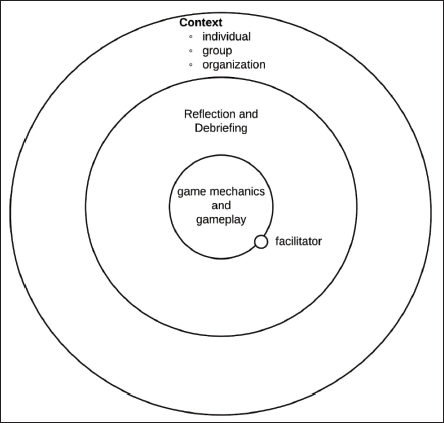
Shows the three Layers of Ethical Facilitation in Relation to each other
The manner in which the design characteristics and gameplay influences ethical facilitation,
The role of the facilitator and its influence on ethical facilitation,
Events outside the gameplay including reflection and debriefing,
The context of the activity and its influence on ethical facilitation.
In figure 1 the inner circle represents the design characteristics and gameplay and concerns how participants interact with and interpret particular game mechanics including rules and symbols. How the game is intended to operate can be different from how it is put into action (Kriz, 2010). Participants’ interactions and game mechanics extensively influence each other (Klabbers, 2009) and cannot be fully known in advance as will be explained below.
The middle ring represents the facilitator. Facilitators are also actors in simulation-based social systems applying their personal frames of reference to events before, during and after the action (Leigh, 2003). The facilitator can enter the gameplay, and/ or also take an observing role and witness game activity ‘as if’ from outside (Klabbers, 2009). The outer ring represents reflection and debriefing those time-out moments when participants and their facilitator purposely step out of the gameplay to reflect on and learn from it. Both facilitator and participants shape the outcome of these phases. The fourth layer is the role of context which may be a training course and/or a change context where organizational culture and dynamics enter the gameplay and can also include individuals’ personal frames of references.
The layers in Figure 1 influence each other and co-exist. For example, moving from the inner to the outer ring of the circles, people may absorb their learning and incorporate them into new frames of reference as part of their own future actions. Conversely moving from outside to the inside of the circle participants bring their organizational culture with them into the activity which influences how they take on roles in the action and interpret the mechanics. Facilitators also traverse these processes bringing their personal preferences in dealing with the rules of the game (Leigh et al., 2005).
Method Section
This publication is part of a PhD research. The aim of the PhD is to study the effects of interventions of facilitators in change and learning contexts and consider what factors influence this process. In the PhD a mixed methods research mode is used (qualitative case studies, in depth interviews, action research and quantitative analysis of intervention response patterns in relation to levels of learning).
Facilitation of learning is inherently manipulative because a facilitator wants to manipulate the learning environment in such a way that learning is optimized within certain ethical boundaries. We have limited insight so far about these ethical boundaries and possibly guidelines that facilitators can use to behave as ethically as possible. Ethics should be viewed in context and from different perspectives. Therefore, we take the layered model in figure 1 as the basis for analysis. For this PhD a series of diverse case studies (in regard to type of simulation game, type of facilitator, country, previous experience with simulation games of facilitator and participants, type of learning goal and duration) have been collected and in-depth open, unstructured interviews with 27 simulation game professionals around the world were conducted. The aim of the interviews was to gain insight into the ideas, assumptions, experiences, and tacit knowledge that facilitators hold with regard to intervention choices and various ethical issues that emerged are considered in this article. The interviews provided data framing the rationale for practitioners and their views on the role and their experiences, since backward and forward reflection can aid in the understanding of ethics in context as Aristotle suggests (Hughes, 2013). In the final dissertation all interviews will be transcribed and information on the cases and simulation games involved will be provided in line with standard confidentiality guidelines.
The literature study started with articles in the Simulation & Gaming journal. In addition a general literature search based on an initial set of five relevant articles was selected, and snowballing led to a limited number of relevant publications in journals from medical, educational and organizational change journals. The term ethi* delivered 363 hits (April 2020) in the Simulation & Gaming journal, mainly consisting of articles describing simulation games or cases in which simulation games were applied in teaching ethics. 15 Of these papers dealt with describing at least some aspects of the role of the facilitator in encountering ethical challenges in gameplay and reflection. This limited result of only a handful of articles touching upon the subject may be due to the wide scope and complexity of the ethical role of the facilitator of simulation games, it is a complicated subject of study. Other methods used to gather information on the ethical role of the facilitator of simulation games include interviews and case studies. Case studies add value because they provide a contextual in-depth perspective on a detailed level, which is necessary to understand ethical facilitation. Ethics are in essence context and multiple perspective dependent (Hughes, 2013).
Layered and Multidisciplinary Perspectives on the Ethical Role of the Facilitator of Simulation Games
Klabbers (2009) and Crookall (2010) argue that to perform research on a complex phenomenon such as simulation games, a multidisciplinary view is needed. The multidisciplinary perspectives can be seen as layered, which means that each perspective can be used as different glasses or angle and also that they can be placed on top of each other to grasp the multidimensional complexity at hand (Raghothama, 2017).
Layer I Influencing Factors from Simulation Game Characteristics on Ethical Facilitation
The results of a simulation game in an ethical sense are dependent on how both facilitator and players perceive these results. Their perceptions are influenced by game characteristics as well as their personal context (Hamdaoui et al., 2018; Onencan et al., 2019; Onencan et al., 2016). How game characteristics and perceptions lead to certain outcomes is explored next. The design of any type of simulation game, from rule based (training) to open (developmental) simulation games influences the results of simulation games, therefore design is considered as influential factor.
Rule Based and Open Simulation Games
In training contexts, simulation games are often rule based simulations with pre-set training procedures and fixed standards applied (Peters & Vissers, 2004). Such simulation games with training purposes are to a greater or lesser extent based on pre-determined rules. The rules are usually grounded in the norms of the designers and allow and/or reward behavior (Christopher & Smith, 1990; Spindler & Leigh, 2003). Such training oriented simulation games can evoke different ethical challenges than open simulation games, often these challenges are related to interpretation of rules and/or the execution of rules. For example, if one team interprets rules differently from another team they might run into conflict.
In developmental simulation games (open simulation games) not all responses and rules are known in advance. Participants in this type of simulation game may be learning to deal with uncertainty, complexity and ambiguity parallel to experiences in real-time (Peters & Vissers, 2004). Such open simulation games employ as few rules as possible to allow for natural behavior and norms to emerge and be explicated. (Klabbers, 2009). Players can show a great variety of behavior including unethical behavior if they for example invent rules or perform actions that might evoke ethical challenges.
Layer II Ethical Issues Arising from Facilitating Processes in and Around Simulation Games
In the second circle visible in Figure 1 the facilitator ‘stands’ on the boundary between the gameplay and the real world. The facilitator has an ethical role here. Elyssebeth Leigh, former Chair of ISAGA and author of several publications and research on facilitation states that all education plays with people's ideas. According to Leigh “Facilitation is about being ethically unethical” (interview May 2016): The facilitator’s purpose is to add value to the learning process of the participants. Ethics play a role in facilitating all aspects and phases of games and simulations. However, research about facilitation of simulation games is limited and fragmented (Alklind-Taylor, 2014; Lukosch et al., 2018) and hence as yet no conclusive outcomes to be written here. In the following section an exemplary of ethical challenges in and around facilitation of simulation games are described. This exploration is intended to aid in developing knowledge about the challenges of ethical facilitation when employed to enhance development of moral virtue, skill and practical wisdom because of the facilitator’s understanding that such knowledge can aid in explaining phenomena. The section concludes with a short exploration of the role of context.
Ethical Facilitation in Relation to Participants
Dealing with ethics is always a balancing act among different viewpoints from all the stakeholders involved at every intervention/decision made by a facilitator. Time is
often limited, and frequent interruptions to point out ethical issues can break up the game flow (Csikszentmihalyi, 1997; Salen et al., 2004) due to the risk of disrupting the immersion and engagement during ongoing meaningful play. Many complex developments can occur within short time frames, often on top of, or crossing over, each other. It is impossible for facilitators to predict what is going to happen or to know in advance what might be the best way to deal with an emerging ethical challenge.
A facilitator has to deal with what is present, use the knowledge and experience he or she posesses possess and prepare to the best they can. In and around simulation game sessions facilitators have to apply moral virtue, skill and practical wisdom. Having knowledge of the following phenomena during gameplay can enhance their ability to do so.
(Un)ethical Behavior of Players During Gameplay
A great variety of possible behaviors of players, both intentional and unintentional, ethical and unethical are possible (Kriz, 2010). A facilitator has a role in keeping the learning environment as ethical and safe for learning as possible (Carrera et al., 2016; Jones, 1998a; Rudolph et al., 2014). Players sometimes do not anticipate consequences of their actions, because they are submerged in the game and do not always realize the seriousness of potential results. However, such behaviors are seldom described in games and simulations literature (De Ronde, 2015). The gamer mode principle described by Frank (2012) deserves more attention in the ethical context. The term ‘gamer mode’ refers to behavior whereby one or more participants do not play the game with serious intent. Participants start to ‘play the system’ to either explore its boundaries, to cheat or avoid the rules of the game. This can cause harm to themselves because they can be perceived as cheaters. A facilitator is needed to protect players in the gamer mode from themselves and shield other players. In addition, there might be factors driving this gamer mode behavior that need attention, for example if its underlying cause is fuelled by feelings of alienation or anxiety. Strong emotions that may arise during gameplay, can cause deep immersion with the downside that the participants do not see beyond their own perspective. Facilitators’ interventions are needed here if/when they recognise the signs.
The Valley of Despair as a Challenge for Ethical Facilitation
Several authors (Geurts et al., 2000; Stoppelenburg et al., 2012; Wenzler & Chartier, 1999), state that it may be necessary for learning in organizations that the facilitator brings people into a so-called valley of despair. This valley of despair consists of a period in the gameplay, in which participants feel unhappy and frustrated about their results in the game, since the behavior they performed was not sufficient to meet their goals. The valley of despair and related emotions can potentially make people feel frustrated and even angry toward the facilitator and/or each other (Carrera et al., 2016; Dieckmann, 2020; Jones, 1998b; Kato, 2010; Kriz, 2010; Rudolph et al., 2014). There are several ways a facilitator can choose to deal with this each depending on the specifics of the situation. ‘Frontloading’ is an intervention whereby participants can be informed of the presence of severe challenges they may encounter in the gameplay. The facilitator can warn participants that they might feel angry and frustrated during the gameplay but that this also probably means they are challenged in ways that can lead to effective learning. Two experienced facilitators Herman van der Bij and Joke Sprietsma confirmed, during interview (April 2018, resp May 2018), they used this method regularly to increase learning resilience during the gameplay.
Layer III Reflection and Debriefing
Rudolph et al. (2006, 2007, 2013) sketch the complex and multiple perspectives involved in ethics in facilitation of medical simulation games and provide recommendations. They acknowledge that a facilitator may want to protect participants by avoiding hurt, frustration or anxiety that (they perceive) might cause damage. Consequently, facilitators sometimes cover up mistakes made by participants using language that avoids discussing what really happened. These authors explain how harmful it can be when a facilitator is not clear and concrete about what went wrong. Concrete feedback helps participants learn. Mistakes are input for learning. If a facilitator covers up incidents it can imply the incidents should not have happened, need covering up and should not be discussed for the purposes of learning. Although direct concrete feedback about mistakes when given by a facilitator is potentially harmful, this does not have to be the case. By trying to achieve safe conditions for learning such as rules for feedback, stressing the importance of experimentation and possibly making mistakes a facilitator can establish a learning atmosphere in which participants and facilitators learn together contributing again to moral virtue, skill and practical wisdom of both facilitators and players. Facilitators can discuss at the group level what can be done and how this relates to the whole group. The authors recommend that facilitators establish the ground rule that anyone can make mistakes and emphasis that mistakes provide all participants involved with opportunities to learn from.
Dealing with Emotions
A lack of attention to emotions emerging during debriefing can cause harm according to Jones (1998, p. 658) because ignoring such “behaviors and beliefs can cause damage to the individuals” which Jones identifies as hidden damage caused when the facilitator is not paying attention to these behaviors and emotions (Jones, 2004) which, in turn, can result in nonethical behavior (Carrera et al., 2016).
Several authors including Crookall, (2014) Hermann, (2015), Kriz (2010) Roungas et al., (2016), Hill and Lance (2002) confirm the need for paying attention to individual and group emotions during debriefing as a source of learning. Stewart (1992) refers to APA (American Psychologist Association) ethical guidelines on debriefing, seeing it as essential to clear up loose ends and pay attention to participants’ emotions. In addition, empirical evidence shows emotion has a prominent role in learning and effective engagement with the learning environment (Argyris, 1986; Barsade, 2002; Kunc et al., 2016; Kunc & Morecroft, 2007; Mandler, 1975; Plass & Kalyuga, 2019).
Debriefing is a process that can be designed and performed in many different ways. Some authors have been developing theory on how to perform debriefs and there is substantial literature on this (Roungas et al., 2016). Kriz (2010) states debriefing should start with explaining how the game system worked so people can understand the dynamics of the simulation game that drew them in. Jones (1992) describes the need for facilitators to pay attention to the different interpretations of the game artefacts by participant, and to consider how participants’ perceptions of certain roles or symbols caused them to behave in certain ways. Without first resolving this, biased observations can remain unchanged while these are not valid in relation to the behavior of participants in reality.
Layer IV Ethical Challenges from the Context of Simulation Games
The outer layer of figure 1 represents the context of simulation games such as when they are used in organizational development contexts which can create unique challenges for ethical facilitation. For example, Eric Treske (interview September 2018), a game designer and organizational consultant explains that game designers and facilitators do not always realize the ethical consequences of having organizational members take part in a game, because they are never entirely free to participate. Non-participation just as much as engagement can have consequences however small or big.
The Inherent Role of Complexity in Simulation Games
Complexity is a cause for the emergence of potentially unethical situations in gameplay and facilitation. Theory and empirical research from a number of different disciplines contribute guidance for ethical facilitation. Facilitation cannot be dealt with through lists and pre-determined rules (comment from an interview with Joeri van Laere, Skövde University Sweden). To take in all relevant theory reaches beyond the scope of this paper. That is the ongoing work of the doctoral research.
Simulation games are social systems (Bekebrede et al., 2015; Klabbers, 2009) that continuously evolve creating their own unique behavior (Achterbergh & Vriens, 2009; Bausch, 2000; Tsoukas, 2017) and hence complexity. At the same time patterns often can be recognized or at least taken into perspective when facilitators encounter ethical issues. For example, the structure of the simulation game, in particular a complex rule-based or bureaucratic structure can be a source both of complexity and ethical issues (Achterbergh & Vriens, 2009; Simon, 1997). Bureaucratic structures tend to cause mistrust (Simon, 1997; Uhl-Bien & Marion, 2009; Vriens et al., 2018) and complex structures cause cognitive load on learning (Achterbergh and Vriens, 2019). A facilitator with knowledge of the impact of organization structures likely to cause irrational behavior can use such theory to depersonalize and give meaning to the irrational behavior caused by the structure. At the same time, a facilitator should take care not to be blind to the unique qualities every social system can display (Achterbergh & Vriens, 2009; Uhl-Bien & Carsten, 2007; Uhl-Bien & Marion, 2009). The facilitator always has to weigh the perspectives and discuss these with the participants as a group to extract meaningful lessons together.
Case Study Examples from Practice to Illustrate the Importance of the Specific Context in Ethical Facilitation
Since ethics is a subject that should be studied in context, in history and from multiple perspectives (Hughes, 2013) it is helpful to provide concrete examples of where ethics can be at stake when facilitating games. Two examples are discussed, one from the game FISHBANKS (
The chance that rule based simulation games (versus open games) cause ethical challenges for the facilitator is higher due to the interdependencies created by the rules. For example, rules can be interpreted or applied differently, rules can create dependencies and rules can restrict autonomy. The more rules present in a simulation game, the higher is the chance of disturbances arising that may or may not be functional in the light of the purpose of the game (De Sitter, 1970; Achterbergh & Vriens, 2009). For this reason, the two games selected as examples both have rule-based characteristics. Foundations for these causes can be derived from socio technique (Achterbergh & Vriens, 2009; Sitter, 1981) and cognitive load theory (Feldon et al., 2019; Kalyuga & Singh, 2016; Petko et al., 2020). Achterbergh & Vriens (2010) describe a summary of socio technique invented by Ulbo de Sitter. They summarize the parameters on which an organizational structure can be scored. The higher the score on the parameter, the higher the complexity. For example, if the parameter of task division, is high there are many dependencies in the split-up of tasks. So if the roles in the game contain a specialized task division, they may have limited autonomy and possibilities to deal with deviations which can cause problems. It is dependent on the goals of the games whether this is functional or not. If for instance the goal is to show deficiencies of organization structure it can be functional as is demonstrated in the Fishbanks simulation. High scores on the parameters indicate complexity and interdependency and increase the chances of problems occurring among which cognitive load.
Cognitive load is defined as the pressure from external or internal stimuli on processing tasks to achieve a task or target (Kalyuga & Singh, 2016). External and internal cognitive load are external and internal stimuli that take energy away from the processing task. Germane cognitive load represents the productive cognitive load where the participants can use their energy to process the task (Plass & Kalyuga, 2019). If the game has many rules and/or mechanics, a large scope and distance, the probability increases that this generates ineffective internal disturbances for learning and hence cognitive load. Under these conditions in the game participants only have very limited influence and are dependent on rules. For some participants this can resemble their organizational reality. Participants can get frustrated from the gameplay. However, the same recipe can also provide unique opportunities for learning, so people develop different understandings and perspectives on the dilemmas as they arise. If parameter scores of a game are too high the chance that it is a fruitful learning environment are low due to the adverse impact of internal and external cognitive load. Chances for ethical dilemmas increase as well. This description adds value in analysing the ethical dilemmas in the following two examples.
Case Example 1: Rule Based Simple Simulation Game FISHBANKS
FISHBANKS was created by Dennis Meadows, John Sterman and Andrew King. The game sheds light on the system dynamics and human decisions driving sustainability and limits to growth (Arantes do Amaral & Hess, 2018; Meadows et al., 1993) using a specific case of over/fishing.
Game Characteristics and Mechanics
FISHBANKS is a classic rule-based game, with simple rules and limited autonomy of participants. Participants can pursue different strategies having different effects for both long term and short-term developments in the scenario. There is also a rule system available for unwanted behavior that the participants regulate themselves and decide whether to assign penalties or not. The scope of the game is tightly constrained. Participants must decide where to fish with their fleet and then get feedback from the game how much fish they caught. In this particular instance the ‘distance of the game’ from more usual life experiences for these participants was high because this was not close to their normal profession or ways of working, many were active as researchers in an academic setting and had no experience with fishing, but many had affinity with the topic of achieving sustainable fishery.
Gameplay and in-between Reflection
Participants can work in teams or alone and can choose to cooperate or not. A situation occurred where some players were working together in achieving long term sustainable goals, while others focused on the short term to maximize their profits. This led to tension and personal accusations (case study in dissertation Speelruimte, De Ronde, 2015). Strong emotions started playing a role and became more intense in a time out reflection. Some participants were accused of acting unethically because they were winning at the cost of others.
Role of the Facilitator
Facilitation input was needed to guide the participants through the reflective process as a group, so that learning is not impeded by personal accusations. The game goal was about obtaining insight into group behavior and its effects on the environment on short and long term; not about blaming and shaming persons who did not do well in the eyes of individuals or the group. The facilitator intervened by stopping the discussion that was going on between participants from different roles and led the discussions to other commercial systems and their failures in the world. The discussion was refocused to address the issue of how difficult it is to achieve cooperation when short term wins can be gained. During the final debriefing the facilitator returned to the emotionally loaded discussion of personal accusations and asked the participants how they felt now on the situation. At that point the participants were able to make a distinction between the emotions that were raised by the game simulation and the roles they performed in the system and were now able to depersonalize the prior discussion. Conduct of FISHBANKS without a facilitator present to guide this process can be considered unethical due to the risk of people starting to blame each other and not learning about the dynamics behind it. In addition, the facilitator needs to functionally address discussions, also on a personal level that arise from the game and related these to the dynamics the game system generates. Long-term negative personal effects are possible when this is not being dealt with adequately by a skilled facilitator. Thus the facilitator has a particularly unique role in depersonalizing feedback from the gameplay and leading to the group learning about effects of sanctions and opportunistic behaviour on a systems level.
Case example 2: Anonymized Rule-Based Management Game X
Example two is retrieved from a series of case studies gathered in the time frame of March 16 to September 18 (2018). This rule based management game was part of an employee introductory programme, to teach employees how they could work together in a proactive and cooperative way.
Game Characteristics and Mechanics
The complexity in this game was rather high due to the number of processes, the abbreviations and specific terminology arising from the metaphor underlying the game design. The metaphor consisted of a process and context that was far from the working experience and professional lives of the participants. Participants were divided into roles and were informed about rules, resources and many technical abbreviations and terminology used in the game. The participants needed to know this information perfectly to act meaningfully in the management game.
Ethical Challenge in the Gameplay
The amount of information, the scope (e.g. the handling options participants had to employ in dealing with challenges in the game) and the distance (the extent to which participants were able to recognize the work processes as relevant to their own working context) were both large, which increased cognitive load and thus resulted in extensive ethical challenges because of cognitive load (Haji et al., 2015; Kalyuga & Singh, 2016; Kolfschoten et al., 2014) due to the detailed information provided which was also new to the participants. Not following the strict procedures and rules can lead to failure in achieving the game goals. The game material did not provide process flow data to assist visual oversight of the game process to help those with different learning approaches to understand what was required.
The Ethical Role of the Facilitator
In this instance the facilitator focused on the gaming instrument and not on the feelings and development of the participants. The simulation was run over four game rounds, each taking about an hour and after each round there was time for reflection and preparation for the next round. Some participants told the facilitator they felt anxious, incompetent and expressed personal hurt resulting from this. The facilitator replied with comments to the effect that “you have not tried well enough, you have not listened well enough, you have not done exactly what I said you are supposed to do, so I will not listen to this, just start working”. The game proceeded with just three participants starting to understand how the game process works. Then the facilitator manipulated the results in such a way they ended positively, and the game ended with distribution of certificates and a positive talk by the facilitator. A considerable range of ethical issues can be discussed from this example, from the nature of facilitators responses to the design and the way the information is provided and the way the game caused cognitive load for the participants. The main ethical concern about the enactment of the role of facilitator was the role of the facilitator was the lack of attention to the participants feelings of the even when they expressed personal hurt. Feelings are to be taken seriously at all times for ethical purposes as well as learning purposes because since emotions play can play an extensive role in learning (Jones, 1998a, 1998b; Kato, 2010; Rudolph et al., 2013; Rudolph et al., 2006; Rudolph et al., 2007). A second issue was the presence of too much cognitive load for the participants stemming from the game design and setup (usage of words/abbreviations, a distant metaphor, a lot of paperwork and limited time, no visualisations and many details to be remembered by the participants before they played their role), this caught away so much concentration and energy reducing the germane load (meaning the energy participant can focus toward the goals of the game) that the game actually impeded the learning what was intended. Extensive interventions of the facilitator on learning to play the game regarding rules, language, content and procedures diverted the focus of the participants to learning to play the game instead of toward the learning goals of the game.
Results
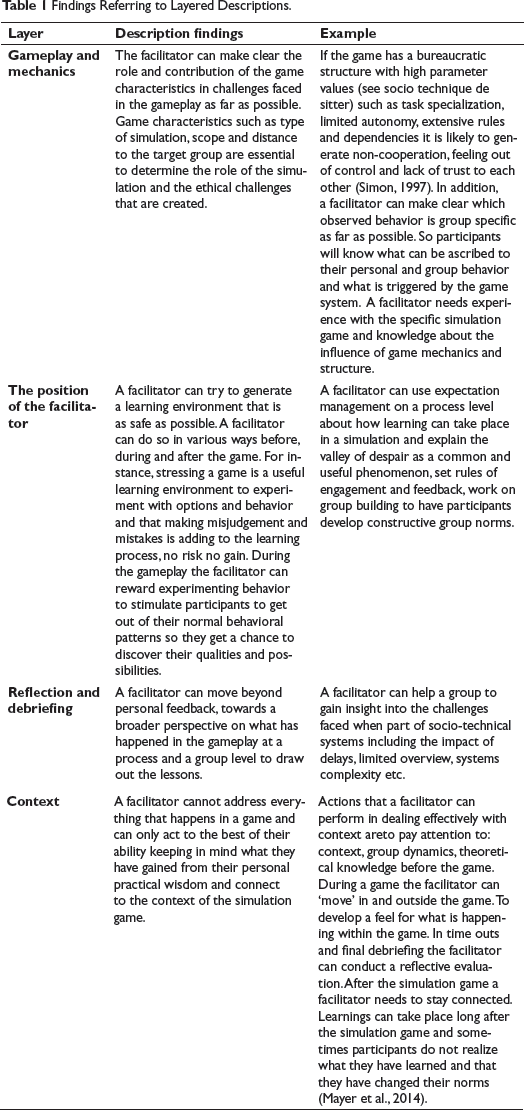
Conclusions arising from a literature search show that a coherent approach to ethical facilitation of simulation is not yet available. Interviews involving the personal visions of facilitators and participants toward learning experiences in simulation games have begun adding to current understanding. From the literature research, interview data and case studies some guidelines can begin to be deducted for the ethical role of the facilitator. These are summarized in Table 1.
Findings referring to layered descriptions.
Discussion
It is now evident that facilitators cannot predict all the ethical challenges, and will need to address many perspectives, for which they can and should anticipate and prepare. This article aims to provide a clearer understanding of the sources of ethical challenges that arise in simulations and provide facilitators with a clearer perspective on how to interpret the phenomena from the perspective of three distinct layers. The search for usable perspectives on the facilitator’s ethical role provides layered perspectives from educational, philosophical, sociological andleadership disciplines providing leading to a kaleidoscopic view on the role ethics play in complex sociotechnical systems simulation games (Bekebrede et al., 2015; Klabbers, 2009; Lukosch et al., 2018).
To address the research question a literature study was conducted, interviews and case studies containing examples of ethical issues in games were identified. All. this contributed to developing an answer to the research question. The layered perspectives ‘simulation game characteristics’, the role of the facilitator, reflection and debriefing and ‘context’ coupled with an understanding of simulation games complex social systems’ have all contributed to structuring the discussion and provided guidance in recognizing potential ethical challenges for facilitators of simulation games. For each layer of the model an example is provided:
Does the ethical challenge derive from the type of simulation game? For example, rule-based games can generate confusion of contribution in the sense that a participant has no clear understanding of what their contribution is to the end result which can cause, among other things, frustration and lack of direct learning.
The personal frame of reference of the facilitator as well as (non)verbal behavior such as word choice and type of interventions influence ethical situations in the gameplay, reflection, and debriefing. Facilitator characteristics need to be considered as well as the perspectives of other participants; they are all part of the social system they recreate.
The type of exchange of information and the level of learning achieved in the reflection and debriefing influences whether gameplay events can become valuable grounds for learning, or whether they result in a blaming circle of unethical and negative behavior. A facilitator has a unique external perspective as well as deeper knowledge of the game characteristics. This adds value to the participant learning as they can take in more perspectives and elevate their learning from individual to group and systems learning, gaining insights into the short and long-term consequences of operational behavior.
Does the ethical challenge derive from the specific gameplay context such as player characteristics, world views, company culture, personal experiences? For example, if management has a directive role in a company culture, this can generate a specific dynamic regarding the fulfillment of a management role. If a participant perceives a director as a directive person this will have consequences for the specific behavior in the role. Assumptions and schemata surface and can provide unique learning opportunities that connect to what is present withing the social system.
Does the ethical challenge derive from social system complexity, i.e. from unique properties that render unique results? For example, a team that is used to working together enacts a certain type of simulation game with a metaphor using specific terminology and processes. The team is confused and tries to use their schemata to make sense of the situation and in doing so, they make their own interpretation of the rules and terms. In this way they create and play their own interpretation of the game and not the game as intended or designed.
From consideration of these layered perspectives one can learn that a facilitator needs to deal with a wide variety of interrelated factors in the simulation game and hope to foresee how these will interact to shape the gaming process and results. Aristotle advises to learn from experience, reflect from different perspectives, and to evaluate and learn (Achterbergh & Vriens, 2009; Hughes, 2013). This article on ethical facilitation is offered as contribution towards helping novices and experts to ‘see’ what the facilitator should prepare for and evaluate on. There are evident limitations related to the complexity and uniqueness of situations. There is no pre-determined list a facilitator can use, but there are useful perspectives for critical ethical challenges and perspectives. Results from this research may also be generalizable to change and learning contexts in general, where similar complex conditions are present.
Simulation games are powerful instruments often involving deep emotions. More in-depth empirical studies need to be undertaken to aid facilitators regarding both general and ethical questions. Facilitators cannot predict all the ethical challenges, and have to address many perspectives, but they can and have to prepare and anticipate.
Future research into the theme of ethical facilitation of simulation games investigating the similarities and differences between the role of the facilitator of change and learning processes in general and the facilitator of simulation games would help gain insight into the unique conditions and requirements necessary to develop theory for ethical facilitation. In addition thick descriptions of ethical challenges of a diversity of types of simulation games and learning contexts would add to our knowledge and insight if specific contexts and situation require a specific ethical approach. Furthermore, action research could provide insight on how facilitators deal with ethical issues in simulation games. Overall, there is a lot more to research necessary to gain insight into the complex of ethical facilitation. It is clear it is not a one size fits all approach from this article and it has to be tailored to the unique context present and researched as such. This article was a first attempt to get a perspective on what ethical facilitation issues and perspectives can be applied to facilitation of simulation games and what theory and empirical sources help us gain insight into this important theme. Simulation games can be powerful, also unpredictable interventions that need to be dealt with carefully and with ethical consideration for all involved.
Footnotes
Acknowledgment
I want to thank especially Dr. Elyssebeth Leigh for her guidance and inspiration, Dr Jan Achterbergh for his contribution from the perspective of philosophy and organizational change and prof. Etienne Rouwette and prof. Sander Meijerink for their wisdom on reducing the complexity around this complicated theme.
Declaration of Conflicting Interests
Funding
The author(s) received no financial support for the research, authorship, and/or publication of this article.
Author Biography
Contact: marieke.dewijse-vanheeswijk@ru.nl