




Abstract
Shared forms of leadership have become increasingly important for organizational success. While research has emphasized that a single leader’s engagement in specific leadership behaviors (vertical leadership) can foster team members’ engagement in shared leadership behaviors, knowledge on the mediating processes is limited. Drawing on social identity theory, we argue that a single leader’s engagement in transformational leadership fosters team members’ identification with their team, which leads to team members’ engagement in shared transformational leadership and shared contingent reward. To test this, we collected data from 698 team members in 92 teams in a German financial services company. Team identification was found to be positively related to shared transformational leadership and shared contingent reward, and mediated the relationships between vertical transformational leadership and shared transformational leadership and shared contingent reward. Our findings underline the importance of team members’ identification processes for the interrelations of vertical and shared leadership.
As modern work is characterized by complex and rapid changes, work is more and more often organized in teams and responsibilities are shared among team members (Mathieu et al., 2017). Even leadership is nowadays often not only executed by a single leader, but collectively by team members (Zhu et al., 2018). Research shows that shared leadership, defined as lateral, interactive leadership processes among group members aimed at achieving group goals (Pearce & Conger, 2003), is pervasive and positively affects team members’ well-being and team performance (D’Innocenzo et al., 2016; Drescher & Garbers, 2016; Nicolaides et al., 2014; D. Wang et al., 2014). Many leadership behaviors that have typically been investigated in a top-down leadership process (i.e., vertical leadership) have recently been examined among team members (i.e., shared leadership, Guenter et al., 2017; Pearce & Sims, 2002; Zhu et al., 2018). Teams that engage in positive shared leadership behaviors, such as transformational leadership, in turn show a multitude of positive outcomes, such as increased performance, creativity, and safety behaviors (Lyubykh et al., 2022; Pearce & Sims, 2002; Zhu et al., 2018).
As shared leadership bears the potential of improving team members’ well-being and performance at work, it is critical to investigate what factors drive shared leadership (i.e., its antecedents; Grille et al., 2015; Zhu et al., 2018). Only by determining the antecedents of shared leadership, organizations can systematically foster shared leadership, benefiting team members, and the organization as a whole (Grille et al., 2015).
Past research has highlighted the role of a single team leader’s vertical leadership as an antecedent of shared leadership (Fausing et al., 2015). Although leadership often occurs as a shared group process (Zhu et al., 2018), most teams still involve a single leader (Zaccaro et al., 2001). Past research has repeatedly shown that vertical and shared leadership are not mutually exclusive, but that by engaging in specific leadership behaviors, single leaders can foster shared leadership among team members (Fausing et al., 2015; Zhu et al., 2018). Specifically, transformational leadership (i.e., behaviors that develop followers and aim to move them beyond self-interest to pursue a collective’s objective, Podsakoff et al., 1990), executed by a single leader, predicts team members’ engagement in shared leadership (Klasmeier & Rowold, 2020). However, theoretical and empirical insights about why transformational leadership positively affects shared leadership are limited.
To address the question of why transformational leadership behaviors, executed by a single leader, foster shared leadership behaviors among team members, we draw on social identity theory (Tajfel & Turner, 1979). Social identity theory (Tajfel & Turner, 1979) holds that humans not only define themselves based on personal characteristics (i.e., personal identities), but also based on group memberships (i.e., social identities). Applied to the leadership context, research has repeatedly shown that leaders can foster and maintain a shared team identity that team members identify with (Haslam et al., 2022). If team members strongly identify with their team (i.e., the extent to which the team is perceived as self-defining and provides an enduring sense of belonging; Huettermann et al., 2014; van Knippenberg & Ellemers, 2003), they in turn align their behavior with the good of the group, leading to multiple positive outcomes (Greco et al., 2022; Steffens et al., 2017; Thomas et al., 2019).
Specifically, transformational leadership behaviors have been shown to increase team members’ identification with their team, as transformational leaders create a joint vision for the team that gathers team members under a common cause (Walumbwa et al., 2008; X. H. Wang & Howell, 2012). If team members strongly identify with their team, team membership becomes part of each team member’s identity, and team goals become each member’s goals (Pearsall & Venkataramani, 2015). Team identification in turn promotes positive team-directed actions, such as positive shared leadership behaviors (Venus et al., 2012). We therefore argue that leaders, who engage in transformational leadership, foster team members’ identification with their team, resulting in positive shared leadership behaviors.
When theorizing about the interplay of vertical and shared leadership, many scholars draw on social cognitive theory (Bandura, 1977) and argue that team members replicate leadership behaviors previously displayed by the team leader (Pearce & Manz, 2005; Pearce & Sims, 2002). However, this explanatory approach has two shortcomings. First, several studies found that a certain vertical leadership behavior is not only related to its corresponding shared leadership behavior but also to other shared leadership behaviors that cannot be explained by role modeling (Ensley et al., 2006; Hoch, 2013; Hoch & Morgeson, 2014; Pearce, 2004; Pearce & Sims, 2002). Second, shared leadership is defined as a collective construct, encompassing employees’ dynamic and interactive engagement in leadership (Pearce & Conger, 2003; Zhu et al., 2018). Therefore, mechanisms that function at the individual level, such as role modeling, do not take into account the collective and interactive nature of shared leadership.
Moreover, we observe a plethora of studies investigating the effects of vertical leadership on shared leadership, but there is a lack of empirical testing of the proposed mechanisms linking the two. We therefore aim to advance the field by empirically testing team members’ identification with the team as a mediator of the effects of vertical leadership on shared leadership. Specifically, we argue that, by engaging in vertical transformational leadership, leaders foster team members’ identification with the team, in turn enhancing team members’ engagement in various positive shared leadership behaviors. Therefore, we empirically test whether vertical transformational leadership fosters team members’ identification with the team, resulting in shared leadership behaviors, such as stimulating co-workers to rethink the way they do things (i.e., shared transformational leadership), as well as shared contingent reward behaviors, such as providing supporting feedback and praise for co-workers when they successfully meet their goals.
The present study contributes to the literature in three ways. First, grounded in social identity theory (Tajfel & Turner, 1979) and shared leadership theorizing (Pearce et al., 2008; Pearce & Conger, 2003), we introduce team identification as a team-level mediator of the effects of vertical leadership effects on shared leadership. We thereby introduce a theoretically derived mediator that can elucidate how vertical leadership affects shared leadership, which has not been addressed by previous explanatory approaches (Pearce & Manz, 2005; Pearce & Sims, 2002). Specifically, by introducing team identification as a mediator, we contribute to the literature by offering a mechanism that, unlike role modeling, accounts for the group-level nature of shared leadership and helps explain why some positive vertical leadership behaviors (transformational leadership) can result in positive shared leadership behaviors (shared contingent reward) that are not previously exemplified by the team leader.
Second, we provide evidence for our reasoning by empirically testing whether team identification mediates the relationship between vertical transformational leadership and shared transformational leadership as well as shared contingent reward at the team-level. Thereby, we present an empirical test that acknowledges the group-level nature of shared leadership, a dimension often overlooked in previous research, which has typically refrained from empirically testing the proposed mechanisms linking vertical leadership to shared leadership.
Third, from a perspective different from existing research, we aim to highlight the unique capacity of certain positive vertical leadership behaviors to promote shared leadership behaviors in teams. In our study, we consider not only leaders’ vertical transformational leadership but also simultaneously their vertical contingent reward behaviors. This approach allows us to present a more comprehensive view of the array of constructive leadership behaviors that individual team leaders exhibit in organizations. Previous research has often overlooked the influence of related but distinct vertical leadership behaviors (cf. Fausing et al., 2015; Grille et al., 2015). With our approach, we can rule out the role modeling effects suggested by social cognitive theory (Bandura, 1977), as vertical contingent reward should have greater effects on shared contingent reward than vertical transformational leadership. Second, from a practitioner perspective, by comparing the effects of two forms of positive leadership behavior, this study can assist organizations with knowledge about which leadership interventions to focus on when aiming to increase shared leadership.
In the next section, we first define shared leadership and summarize previous studies on the interplay of vertical and shared leadership. Then, we introduce social identity theory and point out the importance of considering team members’ identification processes when investigating shared leadership. Last, we derive how vertical leadership can foster shared leadership by increasing team identification.
Theory
Vertical and Shared Leadership
Vertical leadership describes a top-down influence process from a single, formal team leader, whose authority is granted by the organization (Locke, 2003; Morgeson et al., 2010). In contrast, Pearce and Conger (2003) define shared leadership as “a dynamic, interactive influence process among individuals in groups for which the objective is to lead one another to the achievement of group or organizational goals or both” (p. 2). This team-based focus on leadership stands in contrast with a long history of research investigating leadership as a top-down influence process from one leader to many followers (i.e., vertical leadership; Lord et al., 2017). However, as work is currently characterized by many changes, such as the flattening of organizational hierarchies and the increased reliance on teams (Mathieu et al., 2017; Rajan & Wulf, 2006), shared forms of leadership become increasingly important (Zhu et al., 2018). In fact, vertical and shared leadership are not mutually exclusive, but bear the potential to complement each other.
In particular, vertical leadership is typically conceptualized as a formal leadership process, determined by organizational structures. By contrast, shared leadership is conceptualized as an informal leadership process, characterized by group members’ engagement in leadership behaviors without the assignment of such authority by the organization (Chiu et al., 2016; Morgeson et al., 2010). As vertical leadership is typically formal and shared leadership is typically informal, the two forms of leadership differ regarding the sources of their influence and capabilities. For example, formal leadership bases its influence on assigned authority and is, therefore, especially useful for monitoring the team, while informal leadership bases its influence on expertise and is, therefore, useful for providing task-related feedback (French & Raven, 1959; Morgeson et al., 2010). Therefore, vertical and shared leadership fulfill different team needs and thus should have complementary effects on team effectiveness (Morgeson et al., 2010). Providing support for this, studies found that vertical and shared leadership augment each other, resulting in better team processes and higher team effectiveness (Ensley et al., 2006; Hoch, 2013; Pearce & Sims, 2002; Ramthun & Matkin, 2012).
Many empirical studies have found that a single leader’s engagement in vertical leadership can positively influence the team members’ engagement in shared leadership (e.g., Fausing et al., 2015; Grille et al., 2015; L. Wang et al., 2017). The influence of a single leader’s behaviors on team members’ engagement in shared leadership has fundamentally been explained based on two frameworks. First, leadership scholars have drawn on social cognitive theory (Bandura, 1977) to explain that a single leader’s display of leadership behaviors can function as a model for team members. Team members in turn replicate the leadership behaviors that they observed (Pearce & Manz, 2005; Pearce & Sims, 2002). Second, leadership scholars have investigated leadership behaviors that are straightly directed at fostering team members’ autonomy and personal responsibility at work (e.g., Fausing et al., 2015). Such leadership behaviors empower team members to take action and engage in leadership behavior themselves (Fausing et al., 2015; Grille et al., 2015). Research within both frameworks has enriched our understanding of the interplay of vertical and shared leadership. However, we argue that, to extend our knowledge on the effects of vertical leadership on shared leadership beyond the previously established frameworks, team members’ identification processes need to be considered (Miscenko & Day, 2016). We therefore first elaborate on the interplay of team identification and shared leadership behaviors. Then, we extend our reasoning to vertical leadership behaviors.
Team Identification and Shared Leadership
According to social identity theory (Tajfel & Turner, 1979), humans not only define themselves based on personal characteristics (i.e., personal identity), but also based on their group memberships (i.e., social identity). When a group membership becomes part of a person’s self-concept, the person adopts stereotypic group characteristics and aligns their actions to the good of the group (Tajfel & Turner, 1979). Applied to the organizational context, a multitude of studies underline the beneficial effects of team members’ identification with their team. Team identification has been shown to positively affect team commitment, organizational citizenship behaviors, team performance, and well-being (Greco et al., 2022; Steffens et al., 2017; Thomas et al., 2019). When team members identify with their team, they engage in behaviors aimed at benefiting the team, as team members define themselves as part of the team and thus personally benefit from team success (Tajfel & Turner, 1979). As such, we expect team identification to foster team-beneficial behaviors, such as shared leadership (Venus et al., 2012). To delineate the shared leadership behaviors in which team members engage when they identify with the team, we draw on the well-established conceptualizations of transformational leadership and contingent reward (Avolio et al., 2003; Bass, 1985).
Conceptualized as leadership practices exhibited by an individual leader, transformational leadership comprises behaviors aimed at motivating followers to transcend self-interest and align with the organization’s goals, ultimately fostering optimal performance (Bass, 1985). Transformational leadership behaviors are directed at transforming the values, beliefs, and attitudes of followers to enhance their performance (Podsakoff et al., 1990). Podsakoff et al. (1990, 1996) identified six dimensions of transformational leadership: (a) Identifying and articulating a vision; (b) Providing an appropriate model; (c) Fostering the acceptance of group goals; (d) Holding high-performance expectations; (e) Providing individualized support; (f) Intellectual stimulation. Behaviors comprising transformational leadership have repeatedly been shown to positively affect team performance and team member well-being (Arnold, 2017; G. Wang et al., 2011). Moreover, transformational leadership behaviors have been found to be executed by team members as shared leadership behaviors, also benefiting group processes (Lyubykh et al., 2022). An example of shared leadership behavior is when team members motivate their co-workers to commit to the goals of the team or offer individualized support to guarantee group functioning (Lyubykh et al., 2022). As shared transformational leadership behaviors are directed at fostering performance and success of a team, team members, who strongly identify with the team, should engage in such behaviors when they define themselves and their successes based on their team’s success. We therefore hypothesize the following:
Hypothesis 1a: Team identification is positively related to shared transformational leadership.
In contrast to transformational leadership, Bass (1985) conceptualized contingent reward as rooted in an exchange relationship between leaders and followers that motivates followers to achieve team goals by fulfilling their immediate self-interests. Contingent reward refers to a leader’s behaviors that provide a reward for their followers’ work efforts, such as giving recognition or compliments for a good performance (Podsakoff et al., 1990, 1996). While transformational leadership has consistently demonstrated stronger effects on desired work outcomes such as team performance than contingent reward, contingent reward aids leaders in building a distinguishable set of leadership behaviors, which also positively influences work outcomes (G. Wang et al., 2011). Moreover, contingent reward has also been investigated as a type of shared leadership behavior, such that team members engage in rewarding and complimenting each other for high work efforts (Pearce & Sims, 2002). As team members who highly identify with their team prioritize the team’s welfare, they would be inclined to reward and compliment co-workers who engage in positive team-directed behaviors. We therefore argue that highly identified team members not only engage in shared transformational leadership but also in shared contingent reward behavior. Specifically, we hypothesize:
Hypothesis 1b: Team identification is positively related to shared contingent reward.
Vertical Transformational Leadership, Team Identification, and Shared Leadership
After elaborating on team identification as a central factor impacting shared leadership, we now turn to the interplay of vertical leadership, team identification, and shared leadership. As have underlined by many studies, a single leader can foster team members’ engagement in shared leadership behaviors (Zhu et al., 2018). However, past research has fallen short in considering team members’ identification processes when investigating these effects. We argue that team identification plays a crucial role in explaining the effects of vertical leadership on shared leadership.
A multitude of studies has underscored that a single leader can foster the emergence of a shared identity within a team that team members identify with (Haslam et al., 2022; Steffens et al., 2014). Specifically, transformational leadership behaviors have repeatedly been shown to positively impact team members’ identification with their team, as leaders create a collective vision and foster team members’ commitment to the shared goals (Kark et al., 2003; X. H. Wang & Howell, 2012). As such, a single leader’s engagement in transformational leadership can foster team members’ identification with the team, resulting in a multitude of positive consequences, including team members’ engagement in shared leadership behaviors (cf. Venus et al., 2012). Specifically, we argue that a single leader’s engagement in transformational leadership positively impacts team members identification with their team, which in turn leads to engagement in shared transformational leadership and shared contingent reward. Team members who perceive their leader to emphasize joint achievement and a common team vision are likely to identify with the team and should engage in behaviors that align with the vision and contribute to the team’s welfare (Greco et al., 2022). For example, team members that identify with the team would likely cultivate their co-workers’ commitment to team goals and provide individual support to them (i.e., shared transformational leadership), as these leadership behaviors directly work toward the joint vision. Moreover, these team members would likely reward and compliment their co-workers for achievement (i.e., shared contingent reward), as these achievements are beneficial to the team and contribute to the realization of the shared vision. We therefore hypothesize (the proposed mediation model ist depicted in Figure 1):
Hypothesis 2a: Vertical transformational leadership is indirectly positively related to shared transformational leadership through team identification.
Hypothesis 2b: Vertical transformational leadership is indirectly positively related to shared contingent reward through team identification.
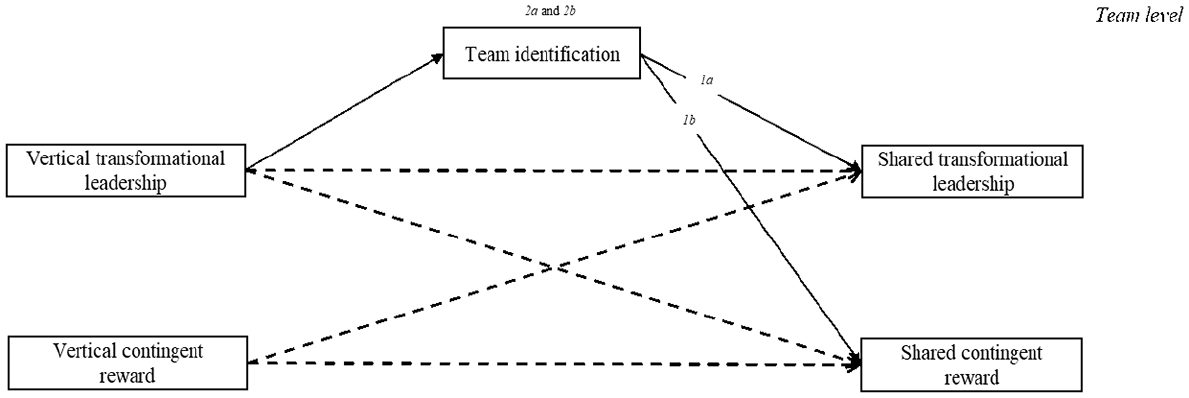
Proposed mediation model.
Method
Procedure and Sample
For the present study, data were collected from employees of a German financial services company. We approached operational teams of the company via an email containing a survey link to our questionnaire. Due to the company structure, each participant worked in one team and each team had one supervisor. Therefore, the supervisors directly supervised their teams, and team members did not report (directly) to any other supervisor. Initially, 918 participants from 93 teams entered the survey. However, we had to exclude 197 participants due to missing data on all study variables. Moreover, 23 participants were excluded because it was not possible to clarify to which team they belong. Our final data set comprised 698 team members in 92 teams. Information on team size was obtained through company records. Mean team size was 16.91 (SD = 3.46). On average 7.21 team members participated per team. More women (59.5%) than men (36.2%) participated in the study. Participant’s age ranged from 21 to 69 years (M = 41.82, SD = 11.64). The participants had worked on average 14.86 years (SD = 11.03) for the company. More participants had a full-time (74.8%) than a part-time contract (24.7%). The mean tenure with the current supervisor was 5.07 years (SD = 5.13) and 7.18 years (SD = 6.89) with the team. On average, participants were in contact with their supervisor 2.14 hr (SD = 3.09) per week and 7.34 hr (SD = 8.13) per week with their team. The age of the supervisor ranged from 26 to 64 years (M = 47.56, SD = 9.42). More male supervisors (72.1%) than female supervisors (26.2%) led the teams. Mean organizational tenure was 20.82 years (SD = 10.28), and mean tenure as a supervisor was 7.78 years (SD = 7.57).
Measures
Vertical Transformational Leadership and Vertical Contingent Reward
We assessed vertical transformational leadership and vertical contingent reward with the German version (Heinitz & Rowold, 2007) of the Transformational Leadership Inventory (TLI; Podsakoff et al., 1990, 1996) comprising 26 items that measure transformational leadership (i.e., articulating a vision, providing an appropriate model, fostering the acceptance of group goals, high-performance expectations, providing individualized support, and intellectual stimulation) and contingent reward. Participants rated their supervisors’ transformational leadership behaviors (sample item: “has a clear understanding of where we are going.”) and contingent reward behavior (sample item: “always gives me positive feedback when I perform well.”) on a 5-point scale ranging from 1 = never to 5 = always. To clarify the hierarchical nature of the questions, we used “My supervisor. . .” as the referent. We aggregated the scores from the six transformational leadership scales into an overall score, as suggested by previous research (e.g., Deichmann & Stam, 2015; Rowold, 2011), which also provided evidence for the reliability of the overall transformational leadership scale (Cronbach’s α = .94) and the contingent reward scale (Cronbach’s α = .83).
Shared Transformational Leadership and Shared Contingent Reward
Following prior studies on vertical and shared leadership, we adopted a direct consensus model (Chan, 1998) with the team as referent. Prior research on vertical and shared leadership has successfully used the direct consensus model to measure both vertical and shared leadership (e.g., Pearce, 2004; Pearce & Sims, 2002). Accordingly, we used the same scales that measured vertical leadership behaviors to measure shared leadership by rephrasing the referent from “My supervisor. . .” to “My team members. . ..” to ensure that the collective nature of the specific shared leadership behavior is addressed. Thus, participants rated the transformational leadership and contingent reward behaviors exhibited by their entire team (sample item: “My team members are always seeking new opportunities for the organization.”) on a 5-point scale ranging from 1 = never to 5 = always.
Team Identification
We assessed team identification with the Four-Item measure of Social Identification (FISI; Postmes et al., 2013) translated into German by Krug et al. (2020). Participants rated their team identification (sample item: “I identify with my team.”) on a 7- point scale ranging from 1 = totally disagree to 7 = totally agree. Krug et al. (2020) reported a high reliability (Cronbach’s α = .88) for the German scale.
Control Variables
We controlled the relations of vertical transformational leadership with the shared leadership behaviors for vertical contingent reward, since studies show that vertical transformational leadership and vertical contingent reward (Podsakoff et al., 1990) are positively related, and that vertical transactional leadership is positively related with shared leadership (e.g., Hoch & Morgeson, 2014). Moreover, in line with previous studies on shared leadership (Carson et al., 2007; Grille et al., 2015; Pearce & Sims, 2002), we controlled for team size and tenure with the team because it is assumed that those variables influence the interaction among team members and, therefore, the emergence of shared and vertical leadership (Pearce & Sims, 2000).
Statistical Analyses
Considering the multilevel structure of our data, we applied multilevel structural equation modeling (mSEM) to test our hypotheses, using Mplus 7 (Muthén & Muthén, 2012). Overall, mSEM provides benefits over using an aggregation approach by allowing for separate estimation of between- and within-group relations (for advantages of mSEM, see Preacher et al., 2010). Since our dataset contained missing values and to prevent biases due to non-normality, we used full information maximum likelihood estimation with robust standard errors (Muthén & Muthén, 2012). Before hypothesis testing, we assessed the validity of the scales used to construct our measures.
Results
Measurement Model and Descriptive Statistics
To assess the quality of our measurement model, we examined the discriminant validity of vertical and shared leadership behaviors. In our study, team members were asked to rate their leaders’ behaviors (vertical leadership) as well as their team members’ behaviors (shared leadership) based on the same measures. We considered that participants might not be able to differentiate between their leaders’ and team members’ behaviors, which would cause biased relations between vertical and shared leadership behaviors. To address this, we compared our proposed model (Model A) comprising the two vertical leadership factors (i.e., vertical transformational leadership and vertical contingent reward) and the two shared leadership factors (i.e., shared transformational leadership and shared contingent reward) to Model B, which includes one transformational leadership factor comprising vertical as well as shared transformational leadership behaviors and one contingent reward factor comprising vertical as well as shared contingent reward behaviors. Moreover, we compared Model A to Model C, which includes one vertical leadership factor comprising vertical transformational leadership and contingent reward and one shared leadership factor comprising shared transformational leadership and contingent reward. Finally, we compared Model A to Model D, which includes one leadership factor comprising all vertical and shared leadership behaviors.
To assess and compare the fit of the models, we followed the principles in Hox et al. (2010) to conduct mCFAs with a saturated model at the within-group level and the respective models at the between-group level. We computed the fit indices at the between-group level based on the χ2 and dfs of the respective models and the χ2 and dfs of the independence model. Then, χ2-difference tests were performed. Results showed that Model A (χ2 (758) = 441.65, CFI = 1.00, TLI = 1.00, RMSEA = 0.00) have an advantageous model fit over Model B (χ2 (851) = 917.93, CFI = .96, TLI = .93, RMSEA = .31, Δχ2 = 476.27, Δdf = 93, p < .001), Model C (χ2 (851) = 896.48, CFI = .97, TLI = .95, RMSEA = .26, Δχ2 = 454.83, Δdf = 93, p < .001), and Model D (χ2 (852) = 928.10, CFI = .95, TLI = .92, RMSEA = .33, Δχ2 = 486.44, Δdf = 94, p < .001), confirming the validity of our measurement model.
Descriptive statistics, internal consistencies, and correlations are provided in Table 1. In terms of the appropriateness of multilevel modeling of the variables, ICC(1) values (vertical transformational leadership = 0.27, vertical contingent reward = 0.11, team identification = 0.11, shared transformational leadership = 0.17, shared contingent reward = 0.17, team size = 0.29, team tenure = 0.23) suggest sufficient between-group variance to warrant multilevel modeling (Hox et al., 2010).
Descriptive Statistics, Internal Consistencies, and Correlations of the Study Variables.
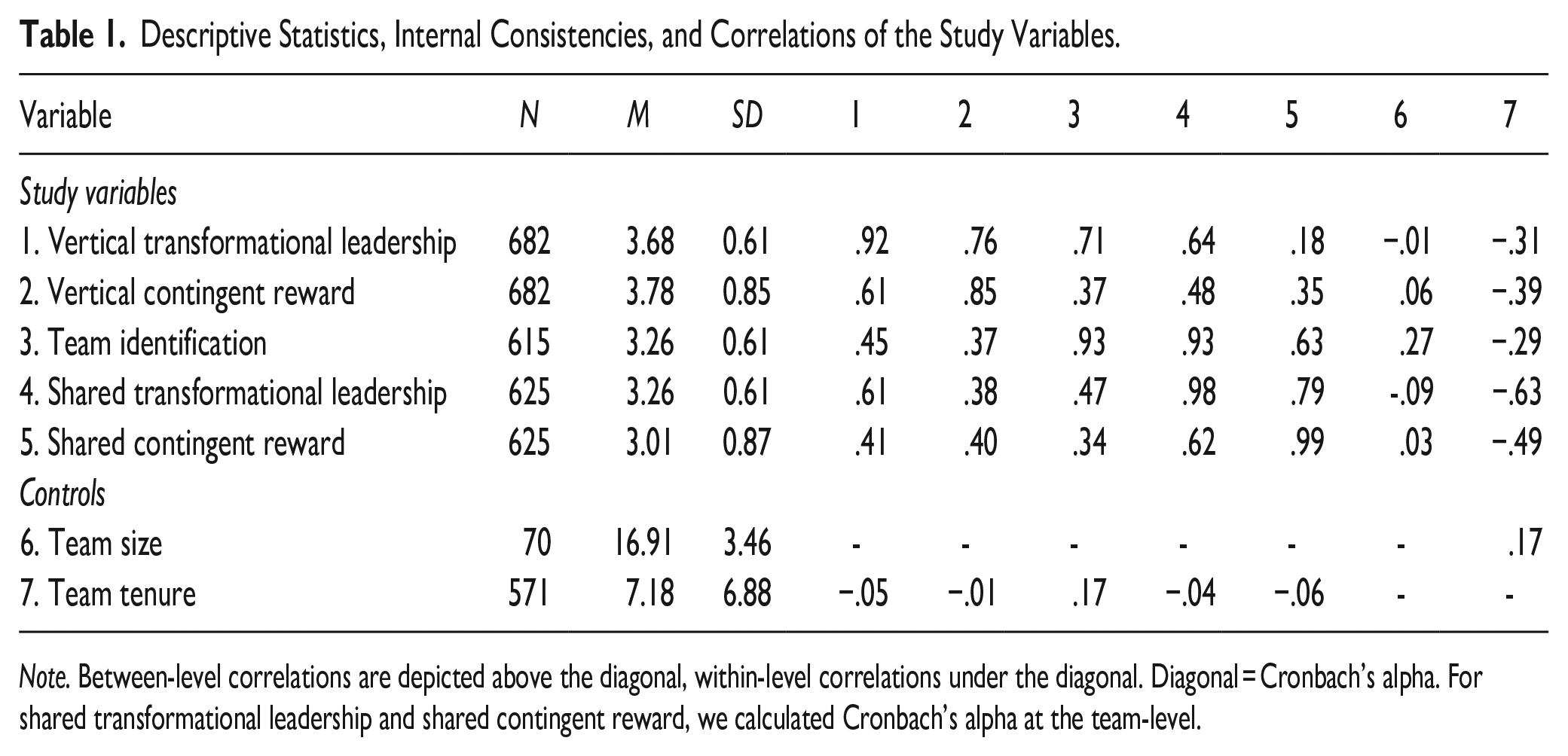
Note. Between-level correlations are depicted above the diagonal, within-level correlations under the diagonal. Diagonal = Cronbach’s alpha. For shared transformational leadership and shared contingent reward, we calculated Cronbach’s alpha at the team-level.
Common Method Bias
Moreover, we used the unmeasured latent variable technique to test for common method bias (Podsakoff et al., 2024). In particular, at the between-group level, we assessed the fit of a model in which the items of the vertical leadership behaviors, team identification, and the shared leadership behaviors loaded on their respective latent factors and on a latent common method factor with unrestricted loadings of all items. Subsequently, we assessed the fit of the same model with the loadings of all items on the latent common method factor restricted to zero and compared the fit of the two models using a χ2-difference test. To compute the χ2 statistics and the dfs, we conducted mCFAs with a saturated model at the within-group level and the respective models at the between-group level. Results showed that the model with an unrestricted common method factor fitted the data better (Δχ2 = 125.82, Δdf = 56, p < .001), suggesting the existence of common method variance in our data. However, the portion of variance explained by the common method factor (R²between = .07) did not exceed the critical value of R² = .25 (Williams et al., 1989), suggesting that common method bias is not a substantial issue for our data.
Structural Model
To test the proposed mediation, we conducted multilevel mediation analysis using a mSEM approach. At the within-group and the between-group levels, we modeled vertical transformational leadership and contingent reward as predictors of shared transformational leadership and contingent reward. Moreover, we modeled team identification as mediator of the relation between vertical transformational leadership and (a) shared transformational leadership and (b) shared contingent reward. We also modeled the covariation among the vertical leadership behaviors and shared leadership behaviors. We controlled for team size and team tenure. The results without control did not substantially differ in significance or magnitude. The model was computed with maximum likelihood estimation with robust standard errors. Results are presented in Table 2 and Figure 2.
Between-level Effects of the Mediation Model Controlled for Team Size and Team Tenure.
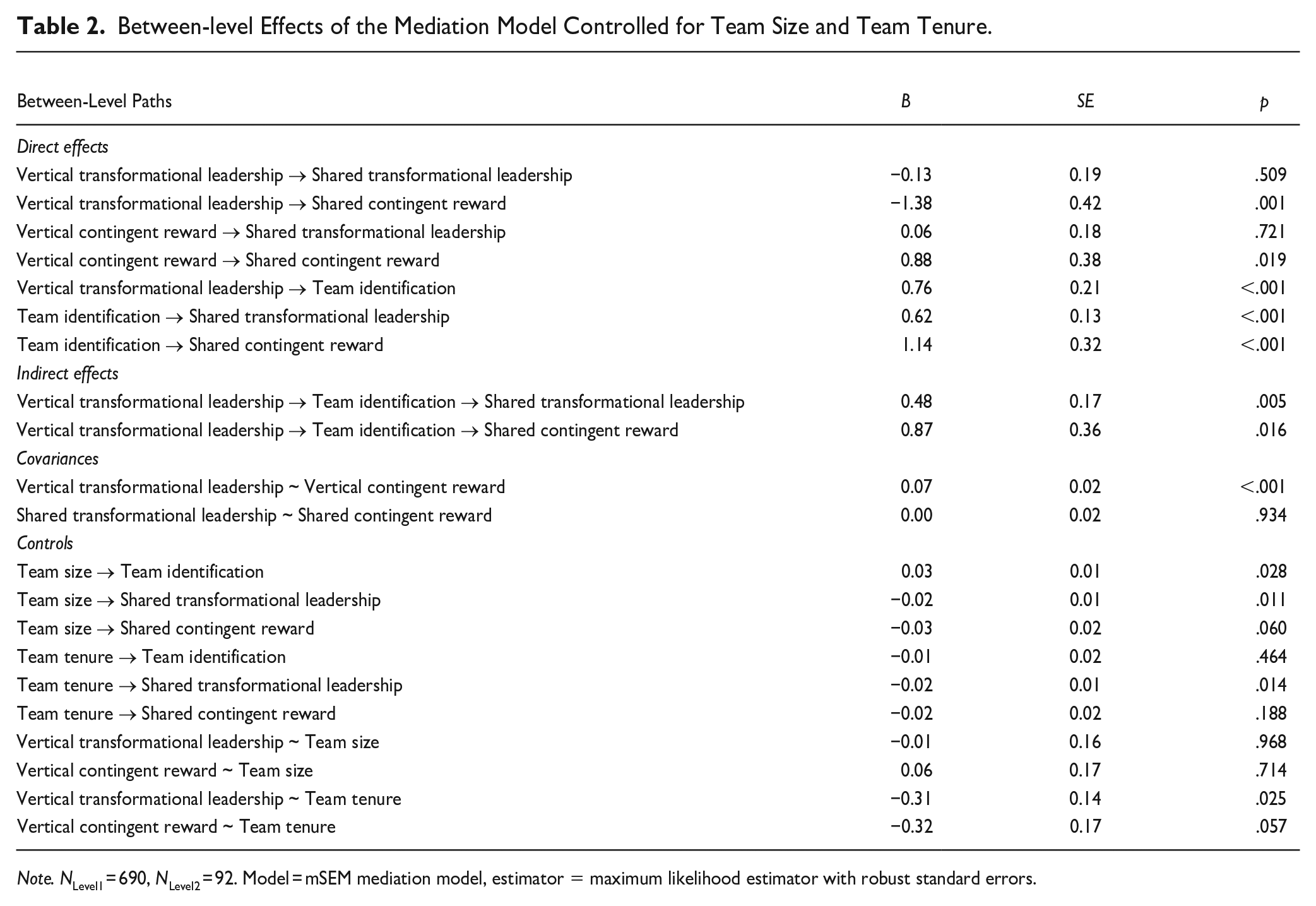
Note. NLevel1 = 690, NLevel2 = 92. Model = mSEM mediation model, estimator = maximum likelihood estimator with robust standard errors.
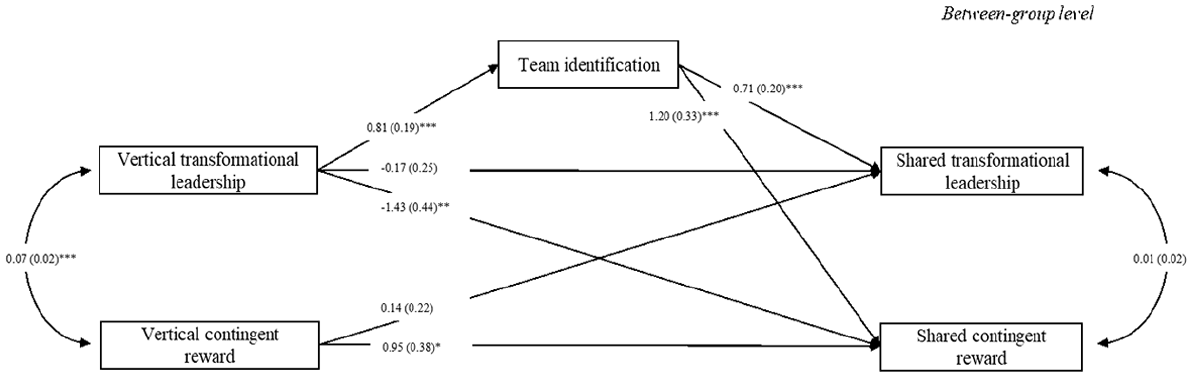
Results of the mediation model.
We hypothesized that team identification is positively related to shared transformational leadership (Hypothesis 1a) and shared contingent reward (Hypothesis 1b). We also predicted that vertical transformational leadership is positively related to team identification and thereby has indirect effects on shared transformational leadership (Hypothesis 2a) and shared contingent reward (Hypothesis 2b). Results of our analyses supported Hypothesis 1a and 1b, showing that there is a significant positive relation between team identification and shared transformational leadership (B = 0.62, SE = 0.13, p < .001) and shared contingent reward (B = 1.14, SE = 0.32, p < .001). Hypotheses 2a and 2b were also supported. We found significant positive indirect effects of vertical transformational leadership on shared transformational leadership (B = 0.48, SE = 0.17, p = .005) and shared contingent reward (B = 0.87, SE = 0.36, p = .016) through team identification.
Although we did not make any assumptions regarding the direct effects of vertical leadership on shared leadership, we found a significant negative direct effect of vertical transformational leadership on shared contingent reward (B = −1.38, SE = 0.42, p = .001), and we found a significant positive direct effect of vertical contingent reward on shared contingent reward (B = 0.88, SE = 0.38, p = .019).
Discussion
This study aimed to investigate team identification as a predictor of shared transformational leadership and shared contingent reward, as well as a mechanism linking the association of vertical transformational leadership with shared transformational leadership and shared contingent reward. Guided by social identity theory (Tajfel & Turner, 1979) and transformational leadership research (Bass, 1985; Kark et al., 2003; Kark & Shamir, 2002), we found support for our hypotheses. Team identification was found to be positively related to shared transformational leadership and shared contingent reward. Moreover, team identification mediated the relationship between vertical transformational leadership and shared transformational leadership, as well as shared contingent reward.
As expected, we found team identification to be positively related to shared transformational leadership and shared contingent reward. This result is in line with the proposition of Venus et al. (2012) that team identification facilitates shared leadership, implying that team identification forms a foundation for the emergence of a multitude of shared leadership behaviors. When team members identify with their team, they align their behavior to the good of the group and engage in positive shared leadership behaviors. This finding complements the long list of beneficial effects of team identification for intragroup behavior (Junker et al., 2019; Levine et al., 2005; Turner et al., 1984; X. H. Wang & Howell, 2010) and is in line with the notion of self-categorization theory that social identity is the foundation for mutual social influence (Turner, 1991).
Further, we found vertical transformational leadership positively influencing team identification, thereby fostering shared transformational leadership and shared contingent reward, even when controlling for vertical contingent reward. This finding highlights the unique ability of vertical transformational leadership to stimulate shared leadership among team members over and above vertical contingent reward. Moreover, our findings are in line with Shamir et al. (1993), who posit that transformational leaders motivate their followers by facilitating social identification, resulting in a multitude of positive outcomes, such as helping behavior and group performance (X. H. Wang & Howell, 2010). Extending this research, we show that by engaging in transformational leadership behaviors, such as articulating a vision and offering individualized support, leaders can foster team members’ identification with the team, resulting in the display of shared leadership behaviors such as motivating other team members to commit to the team goals (i.e., shared transformational leadership) and complimenting other team members for achievement (i.e., shared contingent reward). These positive shared leadership behaviors can in turn positively influence a multitude of organizational outcomes, such as team performance and team member well-being (Pearce & Sims, 2002; Zhu et al., 2018).
Moreover, our results highlight that team identification functions as a team-level mechanism linking vertical and shared leadership. Importantly, this indicates that team identification can account for the interactive and group-level nature of shared leadership (Pearce & Conger, 2003; Zhu et al., 2018). Thus, it is important to consider team identification as a team-level mediator, besides individual-level mediators (e.g., behavioral role modeling), when investigating the relationship of vertical and shared leadership. Further, our study shows that, through team identification, a certain vertical leadership behavior can facilitate shared leadership behaviors that are not directly linked to the vertical leadership behavior, which may help to explain previous findings of the effects of vertical leadership on non-corresponding shared leadership behaviors (e.g., Hoch & Morgeson, 2014).
However, we found a direct effect of vertical contingent reward on shared contingent reward, which can be explained by behavioral role modeling by the leader (Bandura, 1977; Dietz et al., 2020). Moreover, unexpectedly, we found a negative direct effect of vertical transformational leadership on shared contingent reward that may also be the consequence of behavioral role modeling: Drawing from social cognitive theory (Bandura, 1977), scholars propose that leaders model their behaviors onto team members, who in turn engage in shared leadership behaviors that mirror the team leader’s vertical leadership behaviors (Pearce & Manz, 2005; Pearce & Sims, 2002). Prior research found evidence for the impact of behavioral role modeling in the relation between vertical and shared leadership (Grille et al., 2015; Hoch & Morgeson, 2014). According to social cognitive theory (Bandura, 1977), individuals pay attention to others’ behaviors and retain what they have learned when they perceive the observed behavior to be effective. Leaders who engage in transformational leadership behaviors are more effective than leaders who engage in contingent reward behaviors (G. Wang et al., 2011). Transformational leadership behaviors resemble the prototypical behaviors of an effective leader than contingent reward behaviors (Junker & van Dick, 2014). Accordingly, team members who observe their team leader will rather focus their attention on the transformational leadership behaviors than on contingent reward behaviors and will more likely retain the knowledge regarding transformational leadership behaviors. Consequently, modeling transformational leadership may inhibit the learning of contingent reward behaviors and, therefore, hamper shared contingent reward behaviors.
Strengths and Limitations
This study has several strengths and limitations. First, due to nested data collection, we were able to operationalize shared leadership at the team level. This is important because shared leadership is a group phenomenon by nature (Carson et al., 2007; Chiu et al., 2016; Zhu et al., 2018). Moreover, leadership has multilevel effects (Yammarino et al., 2005). Thus, by employing multilevel analyses, we were able to distinguish between team- and individual-level processes and, therefore, prevent estimation biases caused by collapsing within- and between-level variances (Hox et al., 2010). Second, we collected data from a single financial services company. This is advantageous since, by design, we controlled for confounding variables at the organizational level. However, it is also problematic, because the investigated teams may be homogenous in terms of team characteristics, such as team collectivism, which are relevant for shared leadership (for an overview, see Zhu et al., 2018) and may limit generalizability of our findings (Carson et al., 2007).
Third, we controlled for vertical contingent reward when testing the effects of vertical transformational leadership on shared transformational leadership and shared contingent reward. This helps ensure that the indirect effects of vertical transformational leadership behaviors found in our study are not influenced by their correlation with vertical contingent reward behaviors. We thereby expand knowledge on the interplay of vertical and shared leadership behaviors, as previous studies did not control for the influence of related, but different vertical leadership behaviors (cf. Fausing et al., 2015; Grille et al., 2015).
A limitation is the cross-sectional design of this study, which precludes causal and temporal conclusions. This is problematic since mediation analysis using structural equation modeling assumes that causal relations between the independent variable, mediator, and dependent variable unfold over time (MacKinnon, 2008). Violation of these assumptions leads to substantial biases (Maxwell & Cole, 2007). A key issue in the present study is found in the possible reciprocal relationships between the study variables. For example, team identification is argued to be both an antecedent of shared leadership (Venus et al., 2012) and a consequence of shared leadership (Edelmann et al., 2020). The same applies to the relationship between vertical and shared leadership. Team leaders may consider the behaviors of their members when determining which leadership behaviors to adopt. Consequently, they may become more representative of the team, leading team members to accord them greater influence (Hogg, 2001). Research suggests that reciprocal effects between leader and follower behaviors exist (e.g., Güntner et al., 2020). Thus, it is questionable whether the indirect effects we observed are truly a result of vertical leadership influencing shared leadership through team identification, or if there are reciprocal effects between the study variables.
Another limitation to interpreting our results causally is the potential biases introduced by uncontrolled constructs. Specifically, one potential variable that could affect the relationship between the study variables is the overall satisfaction with the team, since people who are satisfied with their team might evaluate interactions with their team leader and among team members more positively than those less satisfied with their team (Lord & Maher, 1993). As satisfaction was not controlled for in our analyses, the positive correlation between vertical and shared leadership could potentially be biased.
Another limitation concerns the assessment of vertical and shared leadership. First, the aggregation approach to measuring shared transformational leadership and shared contingent reward in the present study required participants to rate the entire team. This is consistent with the property of shared leadership as it refers to lateral influences within a group (Zhu et al., 2018). However, it remains unclear whether participants based their conclusion on the behaviors of all team members or only the most sympathetic or influential co-workers (Gockel & Werth, 2010). Therefore, we cannot ensure the distribution of influence, which is another central characteristic of shared leadership (Zhu et al., 2018). The relatively large team sizes in the present study (average = 16) may have exacerbated this problem. Participants may have found it overwhelming to consider every fellow team member when answering the shared leadership questions, and therefore may have focused on only a subset of team members. To ensure the distribution of leadership within the teams, a social network approach could have been used, in which participants are asked about the leadership influence of every fellow team member (cf. D’Innocenzo et al., 2016). However, with this approach, we would not have been able to examine the relation of team identification with different forms of shared leadership.
With the referent-shift approach (Chan, 1998), we measured leadership behaviors by asking participants to rate their team leaders’ and team members’ leadership behaviors on the same scales. This approach bears the risk that team members cannot differentiate between team leader and team member behaviors (Grille et al., 2015). However, the results of the mCFAs suggest that this was not an issue. The use of the aggregation approach in combination with the referent shift approach has been criticized by D’Innocenzo et al. (2016), questioning the validity of applying vertical leadership constructs, such as transformational leadership, to measure shared leadership. They argue that vertical leadership constructs have been developed specifically in the context of hierarchical leadership structures, which are missing in the context of shared leadership. Yet, research has shown that transformational leadership behaviors, such as showing concern for the needs of other team members, and contingent reward behaviors, such as rewarding and complimenting other team members, are also performed among team members (Avolio et al., 2003) and are relevant to team effectiveness (Pearce & Sims, 2002). Hence, while future research should examine how transformational leadership unfolds among team members, prior research suggests that this leadership construct is applicable to shared leadership.
Finally, transformational leadership, like other prominent leadership behaviors, has faced criticism for measurement issues and its underdeveloped theory in recent years (van Knippenberg & Sitkin, 2013). In light of these issues, we used a measure that is less problematic than other measures of transformational leadership (van Knippenberg & Sitkin, 2013) and based our assumptions on social identity theory (Tajfel & Turner, 1979), a well-established theory in leadership research (Haslam et al., 2011).
Future Research
Our findings suggest several avenues for future investigations. To make further claims about causality, longitudinal studies employing a cross-lagged design would be valuable for investigating the possible bidirectional relations of the study variables. Future research should also employ a multi-source design by assessing team leaders’ self-ratings of their behaviors to prevent biases caused by single-source design. Moreover, replication studies could use a social network approach to operationalize shared leadership (Carson et al., 2007), which involves assessing shared leadership through indices of leadership density and decentralization, thereby ensuring the distribution-of-influence requirement of shared leadership (Zhu et al., 2018).
Due to the limited number of teams in our study, we were not able to differentiate between subdimensions of transformational leadership. Kark and Shamir (2002) and Kark et al. (2003) distinguished between group-focused and individual-focused transformational leadership behaviors, showing that group-focused behaviors drive the effects on team outcomes and individual-focused behaviors drive the effects on individual outcomes (Kark et al., 2003; X. H. Wang & Howell, 2010; Wu et al., 2010). Future studies that consider the differentiation between group- and individual-focused transformational leadership behaviors would provide important insights on the relative importance of the two subdimensions of transformational leadership for shared leadership. For example, studies could examine the effects of group-focused transformational leadership behaviors on general engagement in shared leadership at the team level and the effects of within-team differences in individual-focused transformational leadership behaviors on each team member’s tendency to engage in shared leadership at the individual level. Moreover, studies could examine team members’ identification processes with respect to different targets of identification (cf. Greco et al., 2022). Identification with the leader could, for example, be investigated as a mediator of individual-focused transformational leadership on shared leadership at the individual level, whereas team identification could be investigated as a mediator of team-focused transformational leadership on shared leadership at the team level (cf. Kark & Shamir, 2002).
In the same vein, future research should test additional team-level mediators of the effects of vertical leadership on shared leadership. Collective efficacy, team cooperation, and team social support have been conceptualized as antecedents of shared leadership (Hoch, 2013; Zhu et al., 2018) and are all related to team identification (Kark et al., 2003; X. H. Wang & Howell, 2010; Wu et al., 2010). Research that investigates these potential mediators simultaneously would yield insights on their relative importance and relations. Moreover, future research could investigate whether other leadership behaviors that have been shown to positively impact team identification would indirectly affect shared leadership, such as identity leadership (Steffens et al., 2014). Finally, future research could aim to replicate our study using a sample of more diverse teams to ensure the generalizability of our results.
Practical Implications
Our study has two main practical implications. First, our findings suggest that team leaders and organizations should foster their employees’ team identification to provide a motivational foundation for shared leadership. Specifically, organizations can organize team building events to foster close exchange and cooperation within teams that can strengthen each team member’s team identification, leading to team members’ engagement in shared leadership (Fiol & O’Connor, 2005; Hakonen & Lipponen, 2007; Klein et al., 2009). Second, our findings suggest that transformational leadership behaviors should be trained and fostered in organizations, as they positively impact team identification, which leads to positive shared leadership behaviors. In particular, team leaders interested in enhancing shared leadership should emphasize the team’s mission and vision, develop shared values and goals, and communicate high performance expectations (Cremer & Knippenberg, 2004; Kark & Shamir, 2002; Shamir et al., 1993). By engaging in such leadership behaviors, team leaders establish elevated levels of team identification within the team. Consequently, team members will themselves engage in leadership behaviors, thereby boosting team effectiveness.
Conclusion
The present study underlines the importance of considering team members’ identification processes when examining the relationship between vertical and shared leadership. Specifically, we show that a single leader’s engagement in transformational leadership positively impacts team members’ team identification, resulting in team members’ engagement in shared transformational leadership and shared contingent reward. By introducing team identification as a mediator of the link between vertical and shared leadership, we integrate shared leadership theorizing with social identity theory and hope to stimulate further research.
Footnotes
Declaration of Conflicting Interests
The author(s) declared no potential conflicts of interest with respect to the research, authorship, and/or publication of this article.
Funding
The author(s) received no financial support for the research, authorship, and/or publication of this article.
