




Abstract
We investigate whether individual differences predict perceptions of leadership patterns during teamwork. Building on information processing theories, we show that team members’ individual cognitive schemas regarding the distribution of leadership in teams, leadership structure schemas, predict the centralization of individual perceptions of team leadership. Team members’ individual perceptions of communication network centralization partially mediates, and team member’s affective motivation to lead moderates this relationship. Our results indicate that leadership structure schemas, as well as motivation to lead, affect perceived patterns of interpersonal communication as well as the centralization of the individually perceived team leadership structure.
Keywords
Teamwork is one of the most crucial factors for organizational success (Scott et al., 2018). With the increasing prevalence of teamwork in organizational settings (Mesmer-Magnus et al., 2017), research focusing on leadership in teams beyond the influence of a formal leader has gained attention (Denis et al., 2012). Shared leadership, that is, the distribution of leadership responsibilities and activities among multiple team members (Pearce et al., 2010), is linked to team performance (D’Innocenzo et al., 2014; Nicolaides et al., 2014) and explains variance beyond the effects of formal leadership (Wang et al., 2014).
Knowledge about the antecedents regarding the development of mutual and shared influence in teams is necessary for organizations and managers to deduce means for effectively facilitating and utilizing shared leadership in teams (Scott et al., 2018). Previous research has identified interdependence, the team environment, task complexity, and the need for commitment as antecedents of shared leadership in teams (Denis et al., 2012; Serban & Roberts, 2016). However, one important issue that organizations can consider at a very early stage when planning a team collaboration is the selection of team members (cf. Zhu et al., 2018). Insights about individual features that can facilitate or inhibit the development of shared leadership perceptions, and shared leadership as a possible outcome of these perceptions, are crucial to appropriately select the team members. Whereas existing evidence implies that individual predispositions affect the way leadership is perceived and rated (e.g., Keller Hansbrough et al., 2015), information processing theories of leadership (Lord, 1985; Lord et al., 1982; Lord & Maher, 1993) propose that individuals have specific expectations and attitudes toward leadership that influence both the interpersonal behavior and the perception of behavior in team collaborations. Through communication behavior, the team members exchange information (Beyan et al., 2016) on relevant knowledge, competence, which should form the basis for decisions on whom to grant influence within the team (Anderson & Kilduff, 2009).
This article draws to Adaptive Leadership Theory (ALT, DeRue, 2011) and information processing theories of leadership (Lord, 1985; Lord & Maher, 1993) to identify relatively stable individual differences that impact perceived dispersion of communication and leadership in one’s own team. In line with recent theoretical developments applying the concept of implicit leadership theories (ILTs) to the development of informal leadership structures in teams (DeRue & Ashford, 2010; Scott et al., 2018), we propose that cognitive schemas regarding the distribution of leadership in teams, or leadership structure schemas (LSS; DeRue & Ashford, 2010), affect the way individuals perceive shared leadership in their own team and their own interpersonal communication network. Individual beliefs about the most beneficial degree of dispersion of leadership in teams should influence how attentive an individual is to other team members’ attempts to influence, focusing on the behaviors of multiple individuals or one single individual. Moreover, LSS are likely to influence the way that individuals communicate with other team members.
Our study contributes to leadership and team research in multiple ways: First, it demonstrates the necessity of including rater attributes such as cognitive schemas and perspectives regarding leadership into research on shared and informal leadership in teams. Second, it shows that these individual ILTs or cognitive leadership schemas are not limited to dyadic interpersonal relationships such as leader–follower relations, but also apply to how leadership manifests as within-team patterns. Third, it emphasizes the role of individual communication networks for the development of shared leadership perceptions by identifying the individual distribution of communication among the team members as a facilitator of distributed leadership perceptions. Furthermore, this research contributes to management practice as it implies that choosing individuals with certain cognitive schemas and attitudes toward leadership for teams can be critical to enable shared influence in teams and benefit from the positive outcomes of shared leadership. In the current study involving student work teams, we investigate the impact of individual beliefs about the dispersion of leadership in teams (LSS) on the perception of how individuals engage in communication with other team members and how they perceive the distribution of leadership in their team. To assess the pattern of leadership in the teams and the individual distribution of communication among the team members, we use a round-robin design capturing all relationships in the team. We test our hypotheses with mixed models with repeated measurements of individual perceptions of team members across the timespan of the collaboration.
Individual Differences and Leadership Perceptions
ALT (DeRue, 2011), defines leadership as a complex social process in which interactions within dyads emerge into patterns of interactions over the course of time. Over time, the interactions result in the construction of leader–follower identities and relationships (DeRue, 2011). Although ALT specifies the mutual recognition of leadership roles over the course of time (e.g., team member A sees him or herself as following team member B, and team member B sees him or herself as leading team member A), it also accounts for individual differences that can lead to different interpretations of interactions in terms of leadership. This is especially relevant as the majority of studies on shared leadership base their assessment on team-level aggregations of individual perceptions of informal leadership (Cook et al., 2020).
Up to this point, research on individual differences and shared leadership has put a strong focus on personality traits, such as extraversion and integrity, as predictors of shared leadership emergence (Hoch, 2013; Hoch & Dulebohn, 2017) and individual-level behavior as predictor of individual leadership emergence (Gerpott et al., 2019; Palich & Hom, 1992; Sanchez-Cortes et al., 2013) and team performance (Burtscher et al., 2010; Kauffeld & Lehmann-Willenbrock, 2012; Meyer et al., 2016). Although behavior is undoubtedly crucial for the development of leadership in teams (Cook et al., 2020), it is important to keep in mind that behavioral information is extensively and individually processed before resulting in individual perceptions of behavior and, finally, evaluations of leadership (Keller Hansbrough et al., 2015). Looking at the raters of an individual’s leadership behavior, namely the other team members, as “co-producers of leadership” (Keller Hansbrough et al., 2015, p. 222) provides another avenue of how individual differences are related to shared leadership.
Information processing theories state that individuals, even when they experience or witness the same actual behavioral interactions, may process this information in different ways (Lord, 1985). These differences are caused by selective attention, as well as differences in encoding and storage in memory. In a study on the effects of rater sex and rater personality on emergent leadership perceptions, rater effects explained between 17% and 44% of leadership perceptions beyond objective measures of the target’s behavior (Lord et al., 1980). Moreover, rater effects explain additional variance beyond the effects of leader behavior in ratings of transformational, transactional, and passive leadership styles (Bono et al., 2012).
In line with information processing theories, a growing body of research has attended to the role of cognitive schemas (Martinko et al., 2018) in the perception of leadership. When individuals enter new teams, they have preset expectations of and attitudes toward leadership and hold certain ideas of how a leader should look and act (Martinko et al., 2018; Rush et al., 1977; Schyns & Meindl, 2005). They use these ILTs as a basis for their respective leadership judgments through categorization and attribution processes (Lord et al., 1982; Nye, 2002; Schyns & Meindl, 2005). Empirical evidence indicates that ILTs explain a significant proportion of variance to individual ratings of different leadership styles when rating a formal leader (Martinko et al., 2018).
Shared leadership, however, adds a new level of complexity to research on the role of ILTs and cognitive categorization. While meta-analyses on shared leadership provide strong evidence for its positive effects on team performance in general, the effect is highest when shared leadership is operationalized by means of social networks (D’Innocenzo et al., 2014; Nicolaides et al., 2014). Viewing shared leadership as social networks implies that not only the dyadic perceptions and evaluations of leadership matter but also the emerging patterns of (perceived) leadership.
When using a social network approach, researchers use dyadic perceptions of leadership to compile social networks for each team, in which the individual team members are the network nodes, and the dyadic perceptions of leadership are included as weighted ties between the nodes. The tie values are then used to compute team-level values of density (magnitude) and centralization (dispersion) of leadership within the respective teams. Network density is the number of leadership relationships in the team, divided by the maximum number of potential leadership relations in the team. Higher density values express that there is more leadership in the team. Network centralization describes whether or not the existing leadership relations are focused on one single central team member (high centralization), or more or less equally distributed among all team members (low centralization; Gockel & Werth, 2010).
Individuals may, however, have different or even conflicting perceptions of how the leadership in the team is structured. These individual perceptions, which can be described in the form of ego networks, are not necessarily in a positive linear association to the team-level network values. An ego network is essentially a part of an entire network (in this case, the team-level network) that focuses on one particular node or focal team member, the ego (Borgatti et al., 2013). Figure 1 depicts a possible manifestation of individual ego networks of the members of a four-person team. There can be as many individual ego networks as there are team members. An ego network contains two types of nodes: One ego node, representing the team member in focus, and multiple alter nodes that represent the other members in the team. The focal team member’s perceived relations to and judgments of the other team members (or alters) are represented by the network ties. In the case of leadership ego networks, the weight of the ties represents the leadership of the alters as it is perceived by the focal team member (ego). Similar to team-level networks, an ego network can be described in terms of its density and centralization (Borgatti et al., 2013), illustrating whether the focal team member perceives a high overall level of leadership in his or her team (density) and perceives leadership in the team as being exerted by one individual or multiple team members (centralization).
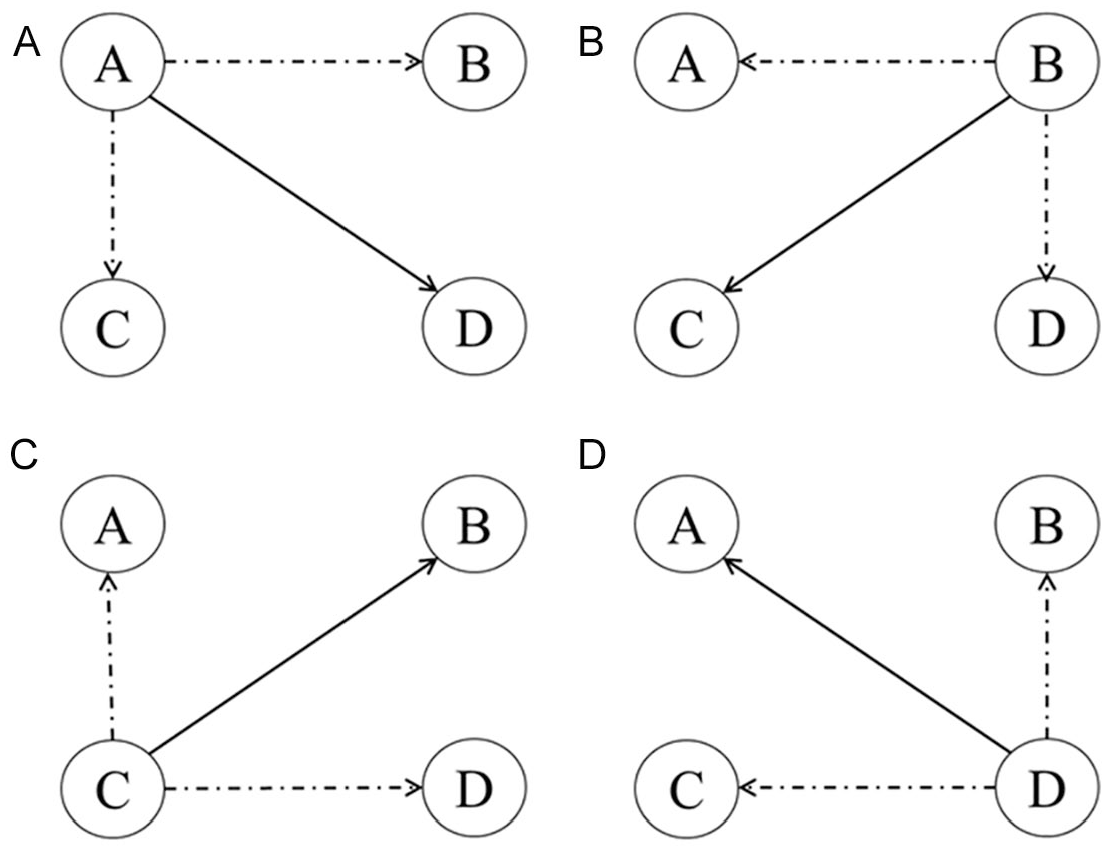
Ego networks in a four-person team: (A) ego network of member A; (B) ego network of member B; (C) ego network of member C; (D) ego network of member D.
Adding the analysis of individual patterns of leadership perceptions in addition to team-level patterns is especially crucial regarding the dispersion of leadership. Network density is a measure of an average (Gockel & Werth, 2010); thus, increasing density of all individual-level networks leads to increases in the group-level network density. As a result, compiling individually perceived networks to the team-level may have a different effect for the data analyses. A team-level network can be low in centralization, therefore implying that ascribed leadership is not focused on one individual team member, but all team members equally, even when the individual perception networks (ego networks) of leadership are highly centralized.
When ego networks are highly centralized, yet every individual sees a different team member as central in regards to leadership (Figure 1), the patterns of ego network centralization can balance each other out when all four ego networks are compiled to the team-level, resulting in a very low team-level centralization. Hence, merely looking at the group-level network of perceived leadership may lead to misjudgments as it may not reflect what the team members actually perceive within the team. Whereas the team-level network centralization implies that leadership is shared among team members (low centralization), the individual team members perceive leadership in their team as highly centralized. Therefore, when analyzing the level of shared leadership in terms of not only density, but centralization, an additional focus on the individual perspectives in terms of ego networks can lead to high-resolution insights into the perceived leadership relations.
Knowledge about individual dispositions that support and facilitate the emergence of shared leadership structures through an increased likelihood of perceiving leadership as dispersed as well as knowledge on how to identify individuals that are less likely to accept shared leadership, could be valuable for the selection of personnel and team composition.
LSS as Predictors of Perceived Leadership Dispersion
Whereas ILTs determine what individuals look for and “want in a leader” (Nye, 2002, p. 338), individuals also have expectations and beliefs regarding the structure and dispersion of leadership within teams (Scott et al., 2018), LSS (DeRue & Ashford, 2010; DeRue et al., 2015). LSS are beliefs about the degree of dispersion of leadership in teams “varying from a belief that groups are best led by a single individual (hierarchical LSS) to a belief that groups benefit from many leadership (shared LSS)” (DeRue et al., 2015, p. 1,198). Hence, an individual holding a shared LSS believes that leadership in teams should be dispersed among multiple individuals. Previous research regarding the effects of LSS is sparse. A study on the effects of group-level LSS showed that team-level LSS moderates the effect of team-level competence centralization, on team-level leadership centralization. High competence centralization only leads to more centralized leadership networks when there is a hierarchical group-level LSS (i.e., when the team members believe that teams are lead best by a single individual; DeRue et al., 2015). In a study on hospital staff, shared LSS among staff were associated with a higher density of leadership (task-focused leadership). However, this effect was only marginally significant (Wellman, 2014).
In line with information processing theories (Lord, 1985), LSS are cognitive schemas that impact the perception and interpretation of behavior in terms of leadership. An individual with a more shared LSS is more likely to assume that leadership should be enacted by multiple individuals in the group. Hence, he or she should be more attentive to other team members’ attempts to influence, and also be more likely to interpret behaviors as exerting leadership, even when they already perceive one or more specific team members to be leading. In contrast, an individual with a hierarchical LSS should tend to view leadership as a zero-sum game. He or she should, therefore, be more selective in his or her attention toward attempts to influence, focusing on the behaviors of one single individual, which they perceive or categorize as a leader. Once a team member with a hierarchical LSS has categorized another team member (or herself/himself) as a leader, the interpretation of other team members (who are not categorized as leaders by the respective individual) will likely be biased. For example, if she sees herself as the sole leader of the team, she should be more likely to interpret the behaviors of the other team members as granting leadership or following (cf. DeRue & Ashford, 2010). Cognitive categorizations lead to “cognitive inertia” (Lord & Maher, 1993, p. 71), as individuals are likely to attribute schema-inconsistent information or behavior to the situation or event instead of the team itself (Lord, 1985; Lord & Maher, 1993).
To give an example, a person with a shared LSS witnessing a situation in which only one team member exerts influence and all the other team members including himself or herself follow the leader’s instructions, he or she will likely look for a situational explanation (e.g., extreme time pressure). The situational or event-related attribution prevents processing this information further and therefore hinders a reevaluation or update of the perceived leadership dispersion in the team. Parallel to theories of cognitive categorization (Lord et al., 1982), which propose that “when different perceivers evaluate the same individual but apply different schemas, their evaluations may very different” (Lord & Maher, 1993, p. 71), we propose that the same logic applies to the way individuals perceive team leadership structures.
Hence, assuming perceivers’ individual LSS impact their interpretation and evaluation of their own and their team members’ behaviors within their respective teams (DeRue & Ashford, 2010), we hypothesize:
The Mediating Role of Perceived Communication
In addition to the effect of individual differences in cognitive schemas and information processing on the interpretation of interpersonal behavior, cognitive schemas also influence the behavior itself, as well as its perception and storage in memory. This encoded and perceived behavior provides important information for the subsequent leadership judgments and, furthermore, can enable a change or adjustment of leadership perceptions (Lord, 1985). Beliefs toward how a group should function best when it comes to leadership are likely to have a strong effect on both the way that the respective individual engages in communication with other team members and the way he or she perceives the communication ties. Individuals holding a shared LSS will be more likely to engage in more dispersed communication as they believe all members of the team can and should potentially engage in leadership (DeRue et al., 2015) by contributing to the team’s decision-making process. As they do not view leadership as a zero-sum game, team members with shared LSS are less likely to focus their communication on one single team member, even if they perceive this team member as particularly competent or leading (DeRue & Ashford, 2010). Therefore, a shared LSS should lead to an increase in behaviors that lead to a decentralized individual communication network, for example, actively seeking others’ opinions to develop a mental model of expertise in the group (Mathieu et al., 2000; Wellman, 2014).
As every individual communicates with the respective other team members to a different extent, individual or ego networks of interpersonal communication develop. Similar to the networks of perceived leadership, communication ego networks are characterized by the magnitude (density) and dispersion (centralization) of ties (Freeman, 1982). A high centralization implies that the communication of the respective team member is focused on one single other team member, while a low centralization of communication expresses that the individual’s communication and interaction is relatively equally distributed among all of the other team members (cf. Leenders et al., 2003).
Analyzing the individually perceived communication networks can tell us a lot about the information that is available to the individual team member for him or her to make social judgments. Through the perception and encoding of interactions and interpersonal communication, team members update their perceptions of leadership (Lord & Maher, 1993). In a study on adapting leadership perceptions (Cook et al., 2019), existing student teams worked on a nonroutine task in the laboratory where interpersonal face-to-face contact was assessed via infrared using wearable sensors. The results show that changes in leadership perception when switching between a routine, ongoing team task, and a new, unexpected nonroutine task is greater if students had more interpersonal contact with other team members in the nonroutine task.
As leadership judgments are made within dyads (DeRue, 2011; DeRue & Ashford, 2010), low availability of interpersonal information can act as a barrier against the development of shared leadership perceptions in terms of perceived leadership decentralization or dispersion. When an individual’s communication is focused on only one other team member, the likelihood of perceiving all team members as exerting influence equally decreases as communication is the main channel through which the perceiver can witness the exertion of influence as well as exert influence himself or herself. In addition, to influence the social judgments, communication does not only need to objectively and observably occur, but it also needs to be encoded, processed, and stored to lead to a leadership evaluation or judgment (Lord, 1985). Hence, selective attention, limited cognitive capacity, and automatic heuristic processing impact whether occurring interpersonal communication has an impact on the subjective leadership perceptions (Lord & Maher, 1993). Therefore, we propose that the individually perceived communication networks, that is, the communication patterns that have been processed, stored in memory, and recalled by the individual team members, have an impact on the development of individually perceived leadership networks. Moreover, we assume that a high centralization of the perceived individual communication network acts as a barrier to the development of perceiving leadership as equally distributed among team members.
However, in line with information processing theories (Lord, 1985), the perception of leadership is not entirely dependent on the actual occurring behavior and interpersonal communication, as cognitive schemas may still have a direct effect on leadership judgments. This is important as communication can be restrained or limited by external factors, such as absence due to illness or problems regarding the communication channels, such as restricted face-to-face communication. In this case, the individual may attribute the communication pattern to situational causes, whereas still judging leadership in his or her team according to his or her LSS. In summary, we propose
The Moderating Role of Affective Motivation to Lead (MtL)
Holding a shared LSS means that all team members (including the respective rater himself or herself) can potentially lead, they should result in more equally distributed (decentralized) communication patterns with all other team members. Hence, shared LSS team members should be less likely to solely communicate with one team member. Nevertheless, a hierarchical LSS does not automatically imply the development of a more centralized communication network. Although hierarchical LSS characterizes the preferred distribution of leadership in the team, the LSS does not include the preferred role of the individual within the leadership network, that is, whether he or she wants to be the sole leader of the team (Scott et al., 2018). As a consequence, holding a hierarchical LSS can imply two different preferences: The preference of an ego-centered hierarchical leadership structure, where leadership is focused on the respective individual himself or herself, and an alter-centered hierarchical leadership structure, where leadership is focused on one other team member.
The preference of the respective rater is significantly influenced by one’s attitude toward oneself in terms of leadership. According to DeRue and Ashford (2010), people who believe that they match their own view of how a prototypical leader should be will be more likely to attempt to exert influence. Therefore, the attitude toward one’s own leadership needs to be included as a possible moderator when analyzing the effect of cognitive schema on individual communication networks. An individual’s attitude toward himself or herself as a leader is expressed by his or her MtL (Chan & Drasgow, 2001), more specifically, its affective dimension. Individuals with a high affective MtL show positive self-comparisons with both leadership prototypes and leadership role models (Guillén et al., 2015). They have higher leadership self-efficacy and, in general, enjoy leading others (Chan & Drasgow, 2001). Affective MtL is associated with extraversion and general cognitive ability and vertical individualism, which is linked to competitiveness and achievement orientation. However, the definition of the construct does not imply a preference for social hierarchies in general (Chan & Drasgow, 2001). Although affective MtL signifies a desire to take over a leadership role or responsibilities (Oh, 2012), the possibility that multiple other team members may also adopt a leadership role is not ruled out. This makes several combinations of affective MtL and LSS possible and implies different effects regarding the way communication is enacted and perceived. Due to the high correlation of affective MtL with extraversion, making individuals with high affective MtL more communicative and engaged in general, the effect of shared LSS on communication dispersion or rather centralization may be diminished.
The combination of a high affective MtL and a hierarchical LSS implies a preference of a self-centered hierarchical leadership and a preference of the individual to be the central person exerting influence in the team, which would require the individual to engage in communication with his or her team members. In terms of the individual communication ego network, the combination of high affective MtL and hierarchical LSS would, therefore, imply a decentralized communication network. In contrast, the combination of a low affective MtL and a hierarchical LSS implies a preference of an alter-centered hierarchical leadership structure and should result in an individual communication network that is more focused on another leading team member, the alter. We therefore propose:
Overall Model
In sum, we expect the effect of LSS to be mediated by perceived communication structure. The mediation effect, however, should depend on the individual’s affective MtL, as a high MtL may inhibit the effect of LSS on the centralization of perceived communication (Figure 2). As there is no theoretical reason to assume that the interaction between LSS and affective MtL as a direct effect on perceived leadership centralization, the overall theoretical model is a moderated mediation.
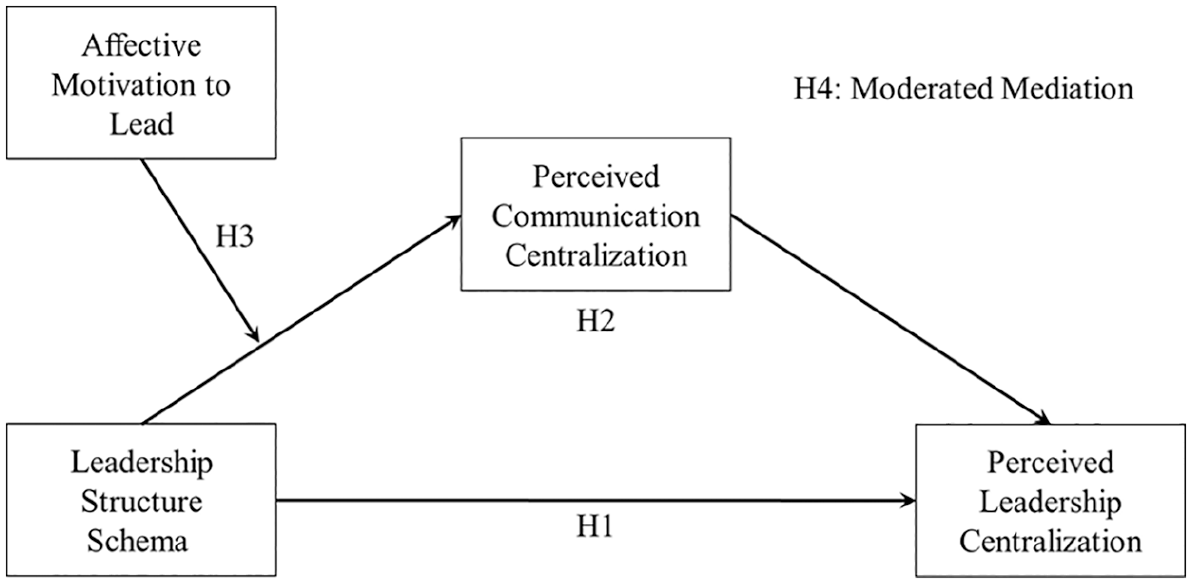
Theoretical model and study hypotheses.
Method
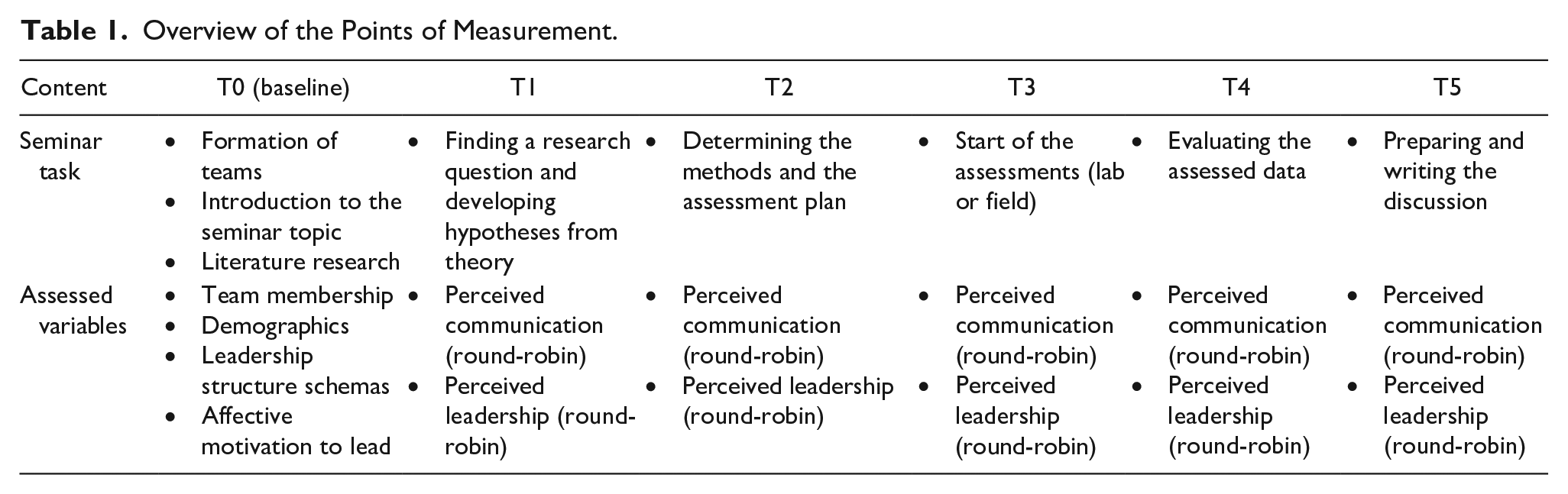
We tested our hypotheses with questionnaire data from student teams of three or four members, which worked together on a research project over the course of a semester. As leadership is time-sensitive (Shamir, 2011; Small & Rentsch, 2011), we collected five repeated measures. This design allowed us to control for possible effects of measurement time on perceptions of communication and leadership, as well as linear and nonlinear developments of behavior and leadership ratings (Zhu et al., 2018). Therefore, the baseline questionnaire was followed by five follow-up questionnaires (T1–T5), including the behavior and leadership measures, which we distributed every 2 weeks, except for the T5 questionnaire, which was distributed 3 weeks after the T4 questionnaire. We determined the exact dates for the distribution of questionnaires according to the seminars structured schedule, which included predetermined dates according to specific milestones (Table 1). At these dates, all teams and team members had to be present for structured seminar sessions and presentations. The last questionnaire was distributed at the last seminar session of the semester. After distribution, the participants had 1 week to fill out and return the questionnaires.
Overview of the Points of Measurement.
Sample
We recruited student workgroups at a German university. Students formed their teams themselves, and we did not interfere in the assembly of the teams in any way. In the seminar, the groups had to plan, conduct, and evaluate an experimental study. The team project resulted in a written report in the style of a scientific paper, and the teams received one team grade for the report. Students were highly interdependent within the groups, and they had to agree on how to divide the work among them, as well as reaching a consensus on their research question, research design, and evaluation approach. There was no internal formal authority structure or hierarchy within the teams, and the team members were free to determine how to coordinate their work. However, the seminar syllabus created a framework for the project process as it formulated milestones with specific dates for the presentation of essential project steps in front of the entire class (Table 1). The final course grade was essential for the overall grade of the students’ undergraduate degree and a requirement for the admission into later courses.
Whereas the seminar was a mandatory class for students in the psychology and cognitive psychology bachelor programs, participation in the study was on a voluntary basis. Of 183 students that filled out the baseline questionnaire, 107 students participated at all measurement points, resulting in 535 measurements of communication centralization and perceived leadership centralization. Participants included in the study did not differ significantly from the dropouts regarding age, sex, or any of the predictors. A total of 107 participants from 41 different teams were included in the analysis. Participants were included in the study when they filled out all questionnaires, irrespective of the participation of their fellow team members. Twelve participants were the only members of their respective teams that took part. The mean age was 22.25 years (SD = 4.9). The majority of participants identified as female (83.2%) and 85.05% were in their second year of studies. One third of the participants (n = 66) were majoring in psychology, whereas the other participants studied cognitive psychology and sensors technology, a joint program by the psychology and physics department.
Measures
LSS
We assessed the individual LSS at baseline (T0) using a five-item instrument (Wellman, 2014), which we translated into German via a two-step translation process (translation—retranslation) involving two native speakers. The instrument measures the LSS on a scale from hierarchical (low scores, minimum = 1) to shared LSS (high scores, maximum = 5). A sample item of the LSS measure is “Groups work best when leadership is shared among multiple group members.” (see the Appendix for the English original versions and German translations of the full scales). The scale showed an internal consistency of α = .76. Due to recent critiques regarding the use of the alpha coefficient as the sole measure of scale reliability, we also computed the Revelle’s omega total (McNeish, 2018), which was ωRT = .84 indicating acceptable to good consistency.
Affective MtL
We used a German adaptation (Felfe et al., 2012) of the affective dimension of the MtL scale by Chan and Drasgow (2001) in the baseline assessment (T0). The instrument measures affective MtL with nine items on a 5-point Likert-type scale. An example item is “I rarely hesitate to take the lead in a group.” Reliability scores were α = .89 and ωRT = .93, indicating very good reliability.
Perceived communication centralization
We computed the project-related perceived communication network centralization on the basis of a one-item measure in a round-robin assessment at Time 1 to Time 5 (Table 1). The item asked the participants to indicate the amount of seminar/research project-related communication with each other team member on a scale from 1 to 5. Higher values indicated more project-related communication. We then compiled individual ego networks for each member of the team, using the value of the one-item measure for each rater–target relation as tie weight. For the subsequent calculation of the network centralization, according to Freeman (1979), we treated the tie weight as degree centrality values for the respective target nodes. Centralization values range from 0 (as decentralized as possible) to 1 (as centralized as possible). As an example, if a team member or rater A states that he or she had the maximum of project-related communication with a team member or target B, and the minimum possible project-related communication with team members/targets C and D, the communication ego network of A would have the maximum centralization value. 1
Perceived leadership centralization
To assess perceived leadership centralization, we computed individual leadership networks, based on the General Leadership Impression Questionnaire (GLI, Cronshaw & Lord, 1987; Lord et al., 1984). Using a round robin-approach, participants rated every other team member, as well as themselves, on the five-item measure at five points (T1–T5) during the collaboration. The GLI assesses general perceptions of the amount of influence exerted by oneself or another person. The scale itself showed good internal consistency with α =.88 and ωRT = .93.
We used the mean values of the GLI made by each individual rater as in-degree centrality for the computation of network centralization of the respective ego networks (Opsahl et al., 2010). For every individual participant at every measurement point T1–T5, we computed individual network measures using the centralization formula by Freeman (1979). In contrast to the computation of the communication networks, the perceived leadership networks included self-ratings. Again, centralization values range from 0 (as decentralized as possible) to 1 (as centralized as possible).
Control Variables
On the team level, we controlled for team size. We assessed age in years and sex as possible control variables. Sex has been identified as a predictor of emergent leadership perceptions in previous research (Lord et al., 1980). To be able to control for friendship with other team members, we asked the participants to state whether they were friends with at least one other team member (yes or no) or whether they had worked with at least one other team member before in the university context (i.e., in a seminar). An additional question asking the participants to state with whom in the team they were friends or had worked before was
As our communication measure focuses on in-task communication only, we controlled for perceived communication outside of the seminar and workgroup with one item that was phrased in a parallel fashion. We asked the participants to indicate the amount of communication with the individual other team members outside of the seminar, respectively, about topics that were not related to the seminar project on a scale from one to five. High values indicated more non-project–related communication. We then used the round-robin values as in-degree values to compute individual values indicating the centralization of non-project–related communication.
Analytical Approach
Our data set was hierarchically organized and included three levels. The lowest level of analysis (Level 1) comprised the individual perceptions per time, which were clustered in individuals (Level 2), which were again clustered in teams (Level 3). Due to the repeated measurement design and to include possible random effects of time within teams or individuals, we decided for a mixed model approach with growth curve modeling (Bliese & Ployhart, 2002). We used the nmle package (Pinheiro et al., 2018) for the R environment (R Development Core Team, 2015) for analyses.
Results
Preliminary Analyses
We conducted correlation analyses on the individual level (Level 2) and on the level of each measurement point (Level 1; Table 1). Age, previous friendship, and previous work experience were unrelated to the outcome and mediator, and we omitted these variables from further analyses. The correlations between LSS to the aggregated leadership centralization and communication centralization values were nonsignificant. Perceived project-related communication centralization (mediator) was significantly correlated to perceived leadership centralization, r = .29, p < .01.
We computed intraclass-coefficients (ICC) of the mediator and outcome for individuals and teams. Perceptions of communication centralization were nonindependent within individuals, with ICC(1) = .32, F(106, 428) = 3.30, p < .01, as were perceptions of leadership centralization, with ICC(1) = .47, F(99, 400) = 5.52, p < .01. Individuals were also distinguishable from each other regarding perceived communication centralization, ICC(2) = .70, and perceived leadership centralization, ICC(2) = .82.
We also computed ICC for teams, including only those teams in which at least two individuals participated (n = 29). Perceptions of communication centralization were nonindependent within teams, with ICC(1) = .15, F(28, 446) = 3.75, p < .01, and teams were distinguishable from each other regarding perceived communication centralization, ICC(2) = .73. Perceptions of leadership centralization were also nonindependent among teams, with ICC(1) = .25, F(28, 446) = 6.54, p < .01, and teams were distinguishable from each other regarding perceived leadership centralization, ICC(2) = .85. The results emphasize the importance of attending to both the team and individual levels in further analyses.
In repeated measures designs, time can have a linear effect on the variables, but also a curvilinear one. It is thus good practice in longitudinal data analysis to not only include time (i.e., the measurement time point) as a linear predictor but also as a quadratic term (Bliese & Ployhart, 2002). Prior to fitting the mixed models, following the recommendations of Bliese and Ployhart (2002), we tested whether time had a linear effect on perceived communication centralization and perceived leadership centralization by fitting general linear models with time and the quadratic term of time. The quadratic term of time had a significant effect on perceived communication centralization, β = −.49, p = .02. We, therefore, decided to include the quadratic term as a further control variable of time into the mediator model. Regarding leadership centralization, the results did not indicate that including the quadratic term of time was necessary as time squared had a significant effect on leadership centralization, β = −.06, p = .61. To determine the appropriate baseline models for both the mediator and the main outcome, we fitted simple random-intercept models with time (for both models) and time squared (for the mediator model) and added random effects in a stepwise manner to determine the best fitting baseline models (Bliese & Ployhart, 2002).
For the perceived leadership centralization, a model with random slopes of time on the team level fit the data better than the random-intercept model, Δχ(2) = 11.64, p < .01. We then added random slopes for the main predictors on level 1. A model with added random slopes for perceived communication centralization for individuals fit the data even better, Δχ(2) = 13.64, p < .01. For the mediator communication centralization, models with random slopes for time and time squared on the individual level did not fit the data significantly better compared with the random-intercept model.
Hypotheses Testing
We fitted two mixed models regressing perceived leadership centralization on the control variables (Model 1a), as well as the predictors (Model 1b) in a stepwise fashion (Table 2). We found a significant negative effect of LSS on perceived leadership centralization, B = −.02, p = .04. As higher LSS values indicate more shared schemas, and higher centralization values imply less dispersion, these results support H1. The effect of perceived communication centralization on perceived leadership centralization was positively and significantly related, B = .03, p < .01. There was no significant linear effect of time on perceived leadership centralization. We used the R-Package MuMIn (Burnham & Anderson, 2002) to compute R²GLMM values for evaluating the explained variance of the models (Nakagawa & Schielzeth, 2013). Adding the predictors to the model explained 5% of the variance in perceived leadership centralization.
Descriptive Statistics and Correlations for Study Variables.
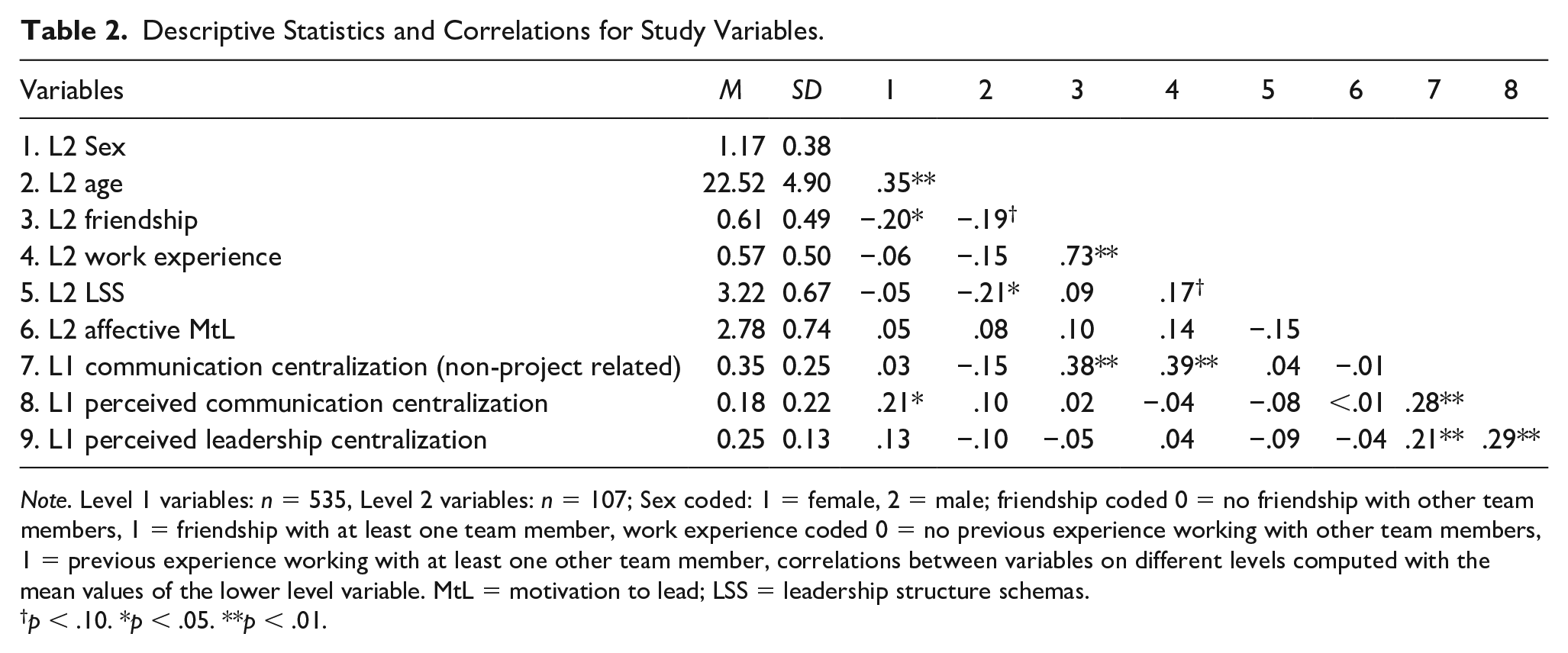
Note. Level 1 variables: n = 535, Level 2 variables: n = 107; Sex coded: 1 = female, 2 = male; friendship coded 0 = no friendship with other team members, 1 = friendship with at least one team member, work experience coded 0 = no previous experience working with other team members, 1 = previous experience working with at least one other team member, correlations between variables on different levels computed with the mean values of the lower level variable. MtL = motivation to lead; LSS = leadership structure schemas.
p < .10. *p < .05. **p < .01.
As the next step, we fitted two models regressing perceived communication centralization on the control variables and predictors (Model 2a), and the proposed interaction term (Model 2b) to analyze the proposed mediation and test the moderation hypothesis (Table 3). There was no significant direct effect of LSS on perceived communication centralization, indicating no support for the unconditional proposed mediation in H2. The effect of the interaction between LSS and MtL was, however, significant, B = −.03, p = .01. We plotted the interaction to evaluate whether the moderation was indeed as proposed in the hypothesis (Figure 3). The direction of the interaction was contrary to the hypothesized effect. The negative effect of shared LSS on perceived communication centralization only occurred when affective MtL was high (+1SD). When MtL was low (−1SD), shared LSS had the opposite effect, leading to an increase in centralization.
Random Coefficient Models Regressing the Perceived Leadership Centralization on the z-Transformed Independent and Control Variables.
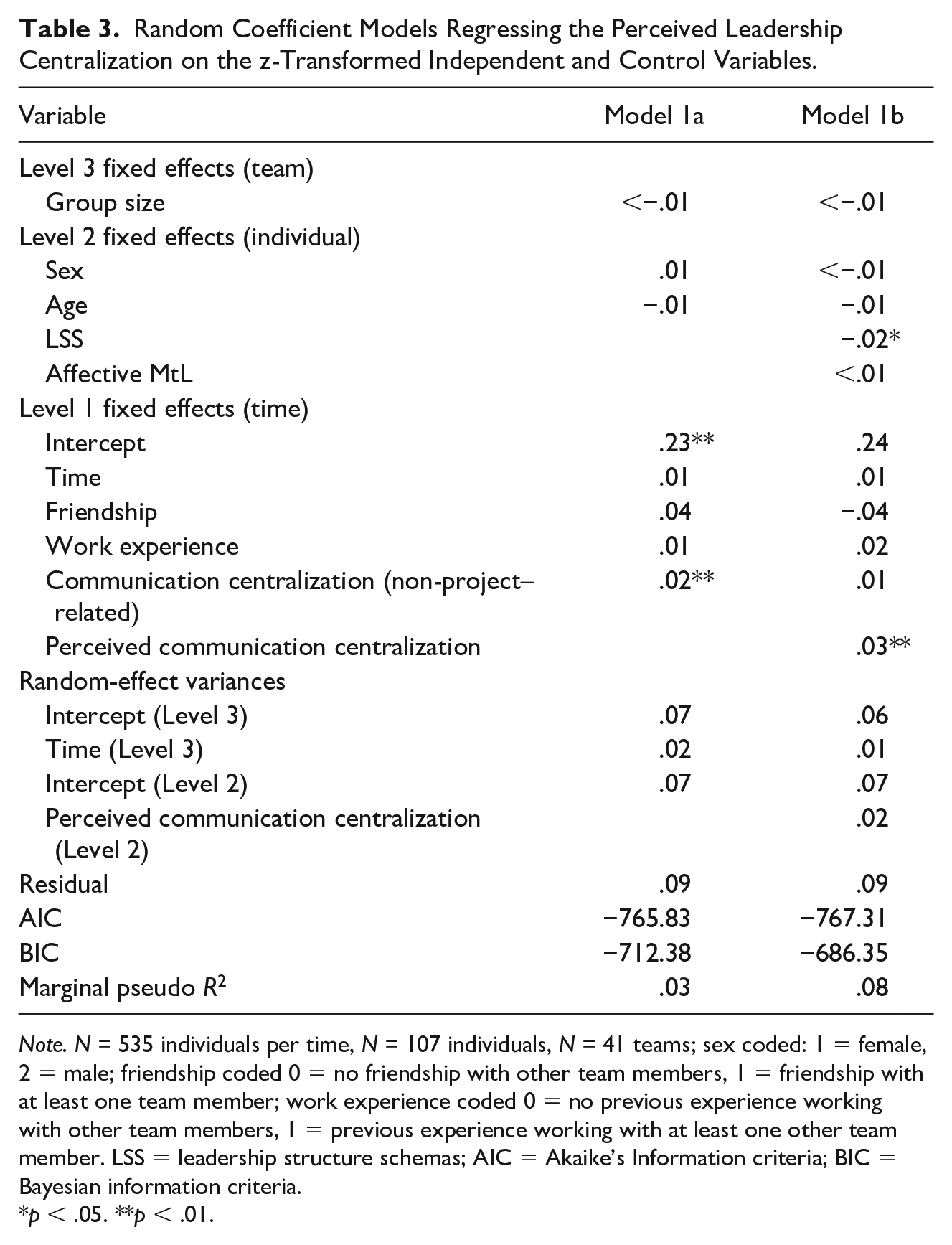
Note. N = 535 individuals per time, N = 107 individuals, N = 41 teams; sex coded: 1 = female, 2 = male; friendship coded 0 = no friendship with other team members, 1 = friendship with at least one team member; work experience coded 0 = no previous experience working with other team members, 1 = previous experience working with at least one other team member. LSS = leadership structure schemas; AIC = Akaike’s Information criteria; BIC = Bayesian information criteria.
p < .05. **p < .01.
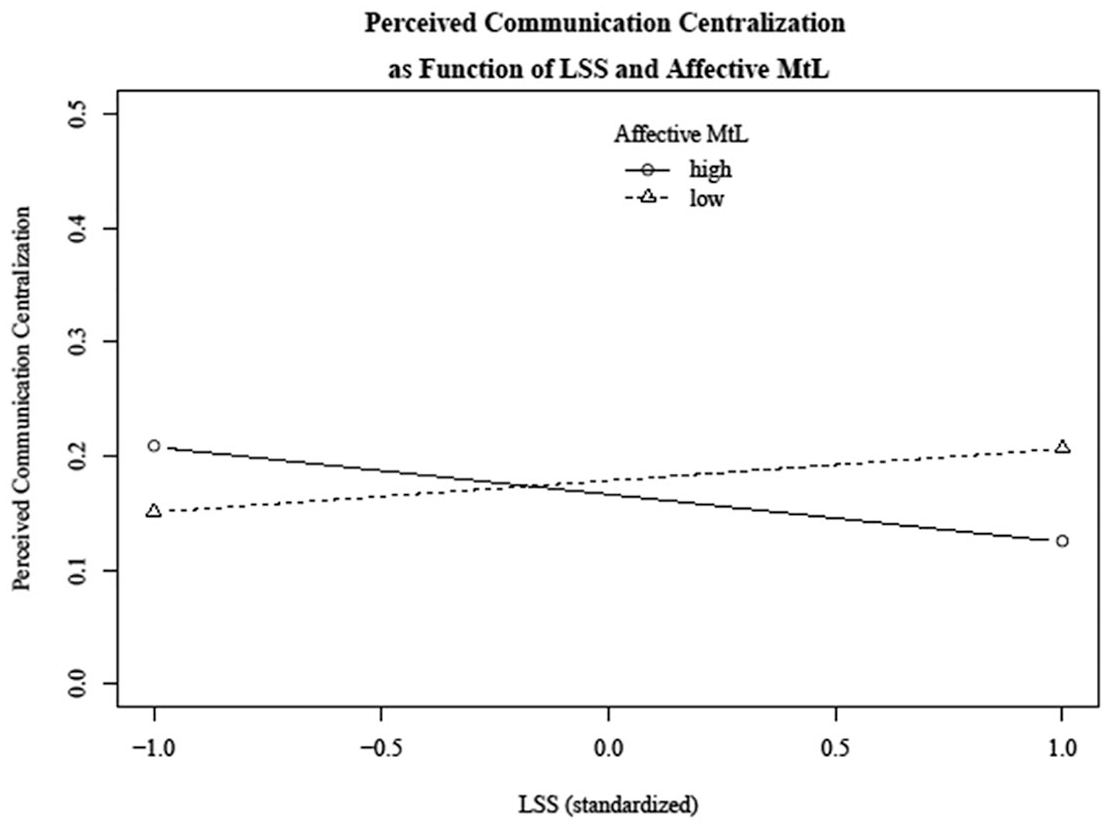
Plot of the Interaction between standardized LSS and standardized affective MtL on perceived communication centralization.
Simple slope test (Preacher et al., 2006) showed that the effect of LSS on perceived communication centralization was significant when affective MtL was high (+1SD), B = −.04, p = .04, however, it was not significant when affective MtL was low (−SD), B = .03, p = .13. Therefore, H3 was rejected. Due to findings of the slope analysis, we also analyzed whether the slopes for the effect of affective MtL differed depending on whether there was a more shared LSS. When LSS were more hierarchical (−SD), affective MtL had a nonsignificant effect on communication centralization, B = .03, p = .10. When LSS were more shared (+SD), affective MtL had a negative effect on perceived communication centralization, B = −.04, p < .05.
To test for the moderated mediation, we aggregated all time-varying variables to the individual level and fitted Level-2 models using the lme4 package (Bates et al., 2015). The individual-level models mirrored the effects found in the Level-3 models (Table 4). We used the two fitted models to run mediation analyses with the R-package mediation (Tingley et al., 2014) and tested the conditional mediation effects for high (+SD) and low (−SD) affective MtL using bootstrapping (1,000 simulations). When affective MtL was high, there was a significant direct effect of LSS on perceptions of leadership centralization, B = −.19, p = .03, and, a significant indirect effect of LSS on perceived leadership centralization mediated by perceived communication centralization test, p = .03, confidence interval (CI) 95% [−0.21, −0.01]. When affective MtL was low, the direct effect of LSS on perceptions of leadership centralization over communication centralization remained significant, B = −.19, p = .04, however, the Sobel-test indicated that there was no significant indirect effect, p = .14, CI 95% [−0.02, 0.17]. The direction of the moderated mediation mirrors the results of the indirect effect found in Model 2b. Although there was an overall indication of a moderated mediation, the conditional effect was contrary to the hypothesized effects. The results, therefore, do not support H4. See Table 5.
Random Coefficient Models Regressing Perceived Communication Centralization on the z-Transformed Independent and Control Variables.
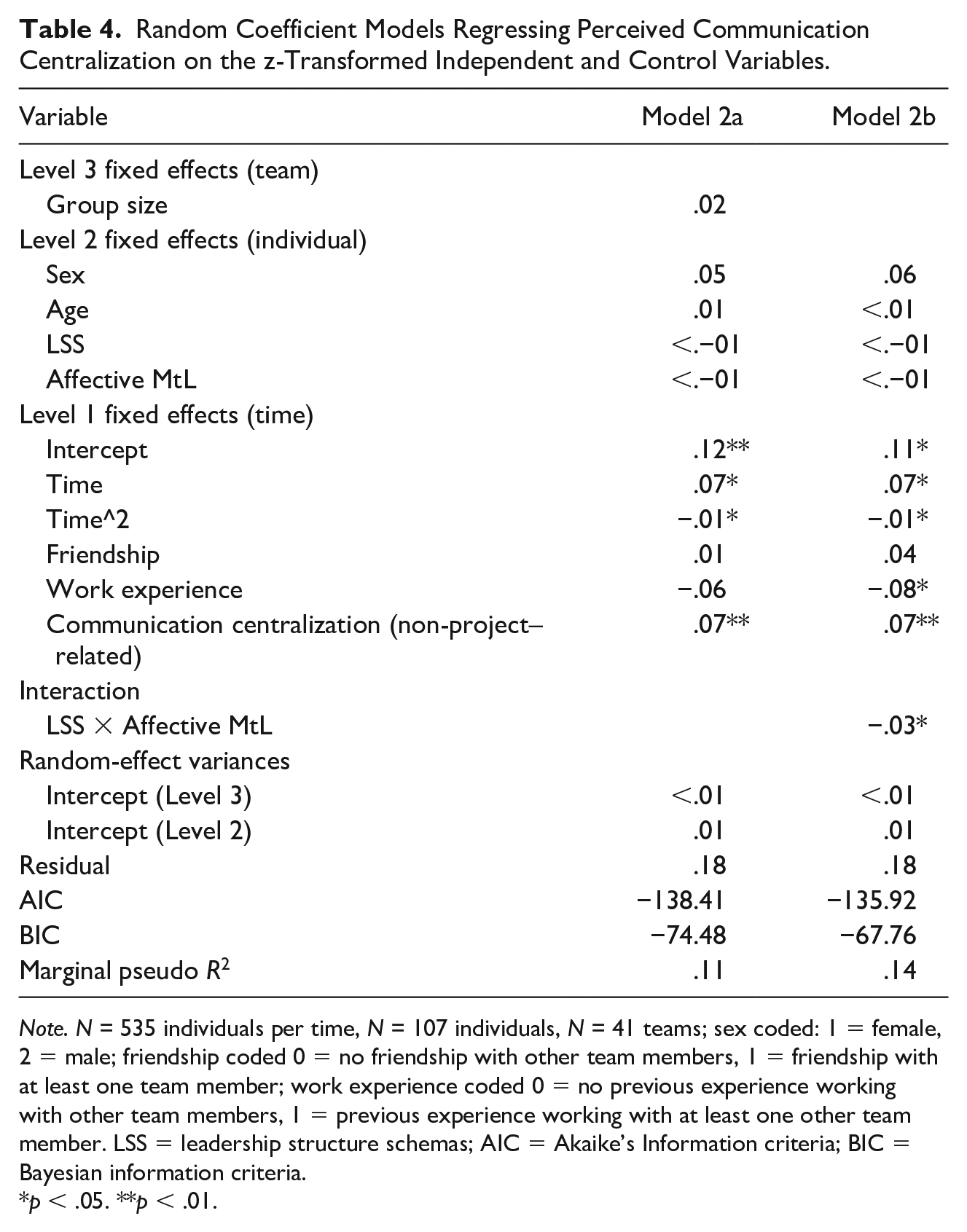
Note. N = 535 individuals per time, N = 107 individuals, N = 41 teams; sex coded: 1 = female, 2 = male; friendship coded 0 = no friendship with other team members, 1 = friendship with at least one team member; work experience coded 0 = no previous experience working with other team members, 1 = previous experience working with at least one other team member. LSS = leadership structure schemas; AIC = Akaike’s Information criteria; BIC = Bayesian information criteria.
p < .05. **p < .01.
Random Coefficient Models Regressing the z-Standardized Mediator and Outcome on Standardized Predictors and Control Variables Aggregated to the Individual Level.
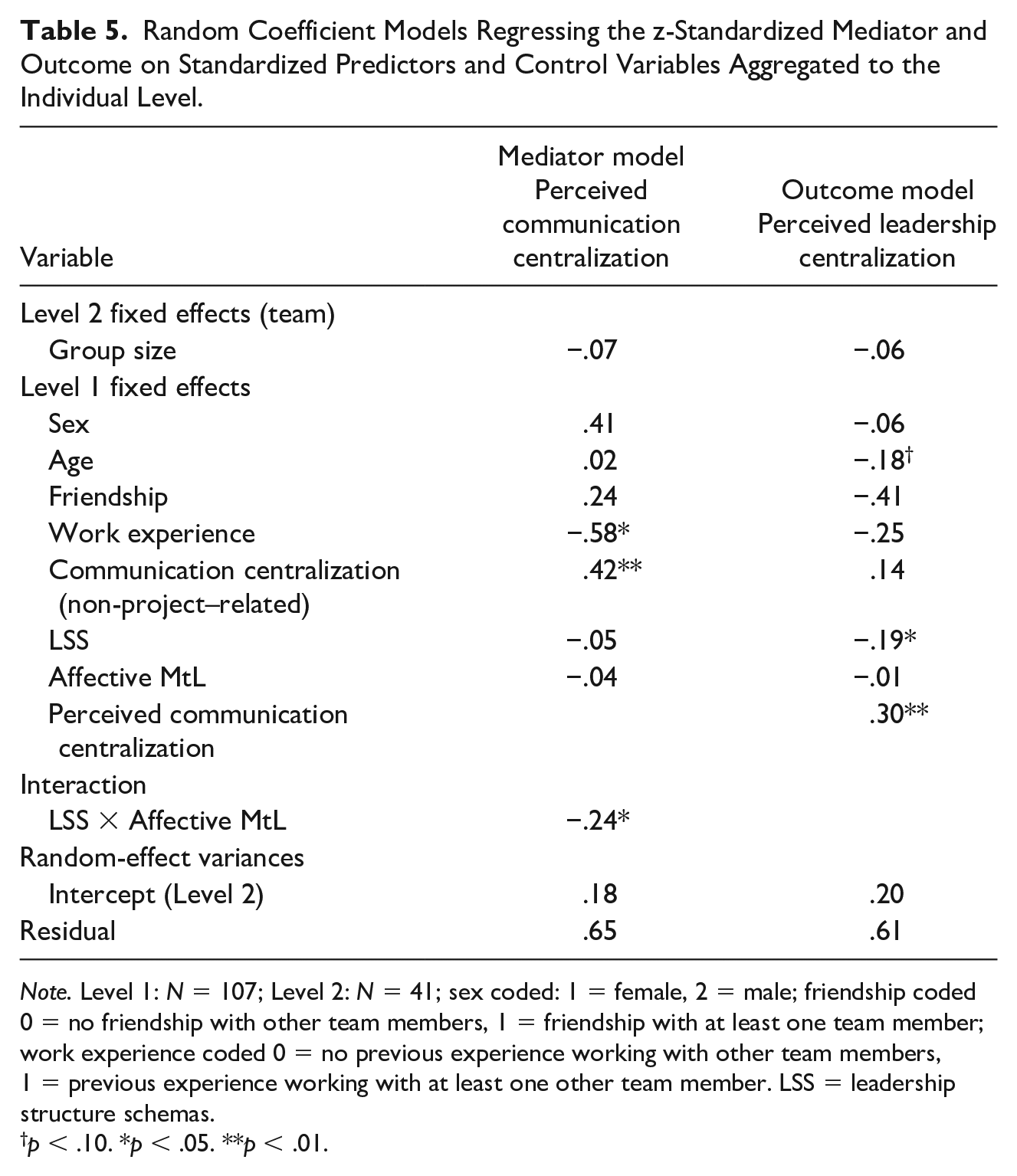
Note. Level 1: N = 107; Level 2: N = 41; sex coded: 1 = female, 2 = male; friendship coded 0 = no friendship with other team members, 1 = friendship with at least one team member; work experience coded 0 = no previous experience working with other team members, 1 = previous experience working with at least one other team member. LSS = leadership structure schemas.
†p < .10. *p < .05. **p < .01.
Discussion
This study results in several key findings. First, shared LSS result in the perception of less centralized team leadership. Second, individuals who perceive their own communication network in the team centralized are also more likely to perceive leadership in teams as more centralized. Third, there is an indirect effect of LSS on the perception of leadership centralization, which is mediated by the centralization of the perceived communication of the rating individual. This mediation, however, is dependent on the individual’s affective MtL, as it only occurs when affective MtL is high. In addition, we found a significant negative quadratic effect of time on perceived centralization, indicating that perceived communication centralization develops in an inverted u-shaped fashion with the highest centralization toward the midpoint of the collaboration. We did not find any implications of a direct effect of affective MtL on perceptions of centralization or effects of time on perceive leadership centralization.
Theoretical Implications
Our research shows that the development of shared leadership perceptions (i.e., perceiving leadership as an activity that is exerted by multiple team members to a relatively equal extent) depends on the team member information processing. It shows that the development of leadership structure perceptions may not only rely on context, team processes, and interactions but are also a result of individual differences of the respective team members. In a nutshell, some individuals are more likely to perceive leadership dispersion than others. In line with information processing theories of leadership (Lord, 1985; Lord & Maher, 1993), our research shows a direct effect of cognitive schemas, that is, assumptions about leadership, on social judgments regarding the leadership in the team. As this effect is only partially mediated by communication as reported by the team members, it implies that the likelihood of shared leadership to develop in teams is partially determined from an early point on, namely, as soon as the team is compiled.
This study focuses on the centralization of leadership on teams as the main outcome. The team members’ ability to view more than one person as a leader is a necessary condition for an overall high magnitude of shared leadership perceptions to develop and may be a facilitating factor for shared leadership behaviors in teams to develop. The magnitude of leadership in a team, expressed as the density of leadership network ties, is also strongly associated with outcomes such as performance (D’Innocenzo et al., 2014). As individuals with a hierarchical LSS perceive leadership as a zero-sum game (DeRue & Ashford, 2010), their capacity to perceive a high density of leadership in their team is severely limited as they tend to restrict their perceptions of leadership to a limited number of team members. Our results suggest attending to the team members’ individual perceptions, or ego networks when conducting research on team-level emergence of shared leadership and controlling for the individuals’ LSS as these could lead to rater biases.
According to information processing theories, cognitive schemas have relatively stable effects on social judgments, which are only likely to change when the respective perceiver is confronted with new, possibly even schema-inconsistent behavioral information is that cannot be attributed to situational circumstances (Lord & Maher, 1993). This behavioral information, however, needs to be encoded, perceived, and stored in a way that enables the individual to use it to update his or her leadership judgments (Lord, 1985). Our results show that, in fact, perceiving one’s own communication as less centralized led to an increased probability of perceiving the leadership in the team as less centralized. This result is in line with research on the antecedents of leadership, showing that a team environment encouraging participation facilitated shared leadership in teams (Serban & Roberts, 2016). Yet, the perception of the own communication network was also impacted by cognitive schemas, implying that cognitive schemas might not only have incremental validity beyond the effects of team interactions but that they affect behavioral perceptions as well. Our research shows that assumptions regarding the distribution of leadership in teams and one’s own preferred role in team leadership impact the perception of team level behavior. This effect can be caused by two mechanisms: On one hand, cognitive schemas may impact the interaction behavior itself, which is then encoded and stored in memory (DeRue & Ashford, 2010). On the contrary, cognitive schemas may lead to biases in the perception of behavior, for example, by guiding one’s attention toward the schema-consistent distribution of influencing behavior in the team. Future research should address the association between actual objective behavioral interactions and the individual and subjective perceptions of these behavioral interactions and investigate whether the effects of cognitive schemas on perceived networks of behavior are (at least partially) mediated by actual observable behavior or whether they can mitigate the effects of objective communication behavior on its perceptions, and whether these mechanisms differ in the magnitude of their effects. A strong impact of cognitive schemas on how actual behavior is translated to perceived behavior would stress the importance of team composition for shared leadership development.
Contrary to H3 and H4, the effect of LSS on communication centralization was stronger under the condition that affective MtL was high. A surprising finding of the slope analysis was that, when LSS were shared, individuals with a high affective MtL perceived leadership in the team as less centralized compared with individuals with low affective MtL. As affective MtL is linked to more teamwork behaviors (Luria & Berson, 2013), it is possible that the wish to exert influence in the collaboration leads individuals to invest resources (Bergner et al., 2019) and engage more into the team’s decision making. As affective MtL is associated with extraversion (Chan & Drasgow, 2001), hindered shared LSS may translate into the individual’s communication behavior, as the individual might be more passive and not actively seeking out communication with multiple team members. It seems that the mere belief that leadership in teams should be dispersed among multiple individuals is not enough to activate communication behavior and hence shared leadership. Referring to theory of planned behavior (Ajzen, 1991), self-efficacy is a key variable to start this process. Due to the strong relationship between self-efficacy and affective MtL (Badura et al., 2020), we assume that affective MtL is an activating variable in our study, which may also be a reason for the missing link between individual LSS and the individual communication behavior in H2. Moreover, our findings suggest that high affective MtL does not diminish shared LSS, but rather shared LSS eliminate the preference of the individual to be the central person exerting influence in the team (high affective MtL) while retaining the motivating aspect for leadership. This finding should be clarified in future research.
Whereas our research adds to the research on implicit theories of leadership in general, it specifically underlines recent theoretical developments that view implicit theories of leadership as a multilevel phenomenon (Scott et al., 2018). In the context of teamwork, cognitive schemas do not only influence the way we perceive and categorize individuals as leading according to their fit with a leader prototype but that they also work on a higher structural level. While existing research and theory has mainly attended to team-level compilations of different cognitive schemas regarding leadership distribution in teams (DeRue et al., 2015; Scott et al., 2018), our research shows that these processes come into effect on the individual level and affect the way individuals perceive their team, beyond team membership.
Finally, the repeated measures design applied in this study allowed us to investigate the impact of the rater-level variables on perceived patterns of leadership and communication across the entire timespan. Although we did not specifically focus on longitudinal developments in this study, the methodological approach allowed us to take a first look at the role of time that may guide future research. When determining the adequate random-effect structure for the mixed models regressing perceived leadership centralization on the predictors, we found that a model with random slopes for time on the team level (Level 3) fit the data best, implying that there are team-level differences regarding the effects of time on perceived leadership patterns. Future research focusing on longitudinal developments of shared leadership perceptions should, therefore, put an additional focus on potential team-level moderators that can determine or influence the trajectories or perceived leadership across the team collaboration. Moreover, the significant effects of the time variables on perceived communication centralization can provide starting points for further investigations into the temporal developments of perceived communication networks.
Practical Implications
Our research pinpoints possible starting points for the development of interventions aimed at increasing shared leadership in teams. First, team compilation is a relevant impact factor for management, as the choice and composition of team members have an effect on the quality of collaboration and team performance (e.g., LePine, 2003). Recruitment tests, annual appraisal interviews, and repetitive employee surveys are opportunities to assess relevant information about employees in an organization that can help to select appropriate candidates for project teams. Integrating information about cognitive schemas and affective MtL into the team compilation process, in addition to factors such as expertise, experience, and cognitive abilities, could enhance the team’s capability of developing shared and mutual influence structures in teams (Badura et al., 2020; DeRue et al., 2015).
Second, further options to enhance shared leadership in teams are training and experiences at the workplace. In general, training can be an effective organizational intervention tool for the systematic acquisition of knowledge, skills, and attitudes (e.g., Aguinis & Kraiger, 2009; Arthur et al., 2003). Communicating knowledge about the presence and effect of cognitive structures in team interventions could lead to more awareness of the factors that influence their judgments and may induce a different reflection of the perceived team processes. Trainings aimed at teaching ILTs for leader development (e.g., Schyns et al., 2011) could, therefore, be adjusted to include LSS for team training purposes. Based on this, employees should have the chance to intensify the content of the training with direct experiences in the workplace. Because of the relevance of affective MtL in our study, opportunities for positive leadership experiences attended by positive feedback and coaching enhance MtL through positive effects of one’s own influence on others (Badura et al., 2020; Bergner et al., 2019). Furthermore, leaders may decrease a centralized leadership structure by increasing the salience of a shared LSS among all group members by situational demands (e.g., situational competence at specific points during a project; DeRue et al., 2015).
Third, managers could attend to the communication networks within the team and increase their awareness of possible physical or psychological barriers that may hinder a more equally distributed communication within the team. Providing ways for each team member to communicate equally and easily with all other team members could enable individuals to perceive and encode vital behavioral information for social judgments. A special focus should be on barriers that apply in some dyadic relations within the team more than others, for example when some team members are not located in proximity to others and therefore rely on computer-mediated communication (Leenders et al., 2003).
Finally, branding of leadership can be an option for developing a shared leadership identity in an organization on a higher level (Hodges & Martin, 2012). Branding of leadership based on a synthesis of leadership identity construction (DeRue & Ashford, 2010) and dialogue theory (Arnett et al., 2008), and requires the following conditions: dialogical philosophy of leadership and communication, identification with this new corporate leadership identity, acceptance of relational roles in a corporate leadership team, working reciprocity, and motivational rewards. Data from a longitudinal case study show positive effects of an implemented LSS emphasizing dialogue and shared values (Hodges & Martin, 2012). Certainly, this approach from Hodges and Martin only focuses on leaders at different levels in multinational enterprises, although the theoretical foundation and the required conditions of leadership branding are also useable for teams with and without formal leadership. Hence, we assume that a cultural transformation process like leadership branding can provide an essential base for the development of shared leadership perceptions in teams where the aforementioned practical suggestions are a part of it.
Limitations
Our study is not without limitations. Although our participants worked in real team collaborations and had an individual interest in the team performing well, it is still a student sample. All teams were relatively homogeneous regarding demographic factors and expertise. Meta-analytic evidence shows that the effects of shared leadership on performance are higher in field samples compared with student and classroom samples (D’Innocenzo et al., 2014). Overall, perceived leadership centralization, as well as perceived communication centralization, was relatively low and showed little variance in our sample. Also, we had no control over the team compilation, and the seminar teachers implied that they also refrained from interfering by assigning individuals to teams. Although we controlled for previously existing friendships and working experiences, we cannot exclude the possibility that individuals chose their teams based on preexisting perceptions of competence or leadership, which may or may not be based on previous collaborations.
An additional limitation is the availability of team-level data. As we focused on the level of individual perceptions, we included individuals in the analysis, even when their team members did not take part in the study. Controlling for team-level effects, for example, of the diversity of cognitive schemas, could provide a fruitful avenue for future research to examine the incremental validity of individual-level predictors.
Conclusion
The aim of this article was the identification of relatively stable individual differences that impact the perceived dispersion of communication and leadership in one’s own team. As communication is the basis for information exchange, it is fundamental for decision making, influence, and leadership perceptions within teams. The results of our study show that LSS and affective MtL are relevant antecedents of the development of shared leadership perceptions in teams. A shared LSS predicted the perception of less centralized team leadership, an effect that was mediated by the centralization of the perceived communication of the rating individual, however, only when affective MtL was high. This implies that the development of leadership structure perceptions may not only rely on context, team processes, and interactions but may also be a result of individual differences in information processing of the respective team members. From a practical point of view, this provides an opportunity for organizations to select team members for team collaboration at a very early stage through recruitment tests, annual appraisal interviews, and repetitive employee surveys. Moreover, organizations have the chance to develop affective MtL and knowledge about the presence and effect of cognitive structures in team interventions by using training, direct experiences, reduction of barriers, and also a cultural transformation process in the direction of shared leadership.
Footnotes
Appendix
Questionnaire Items Used in the Study.
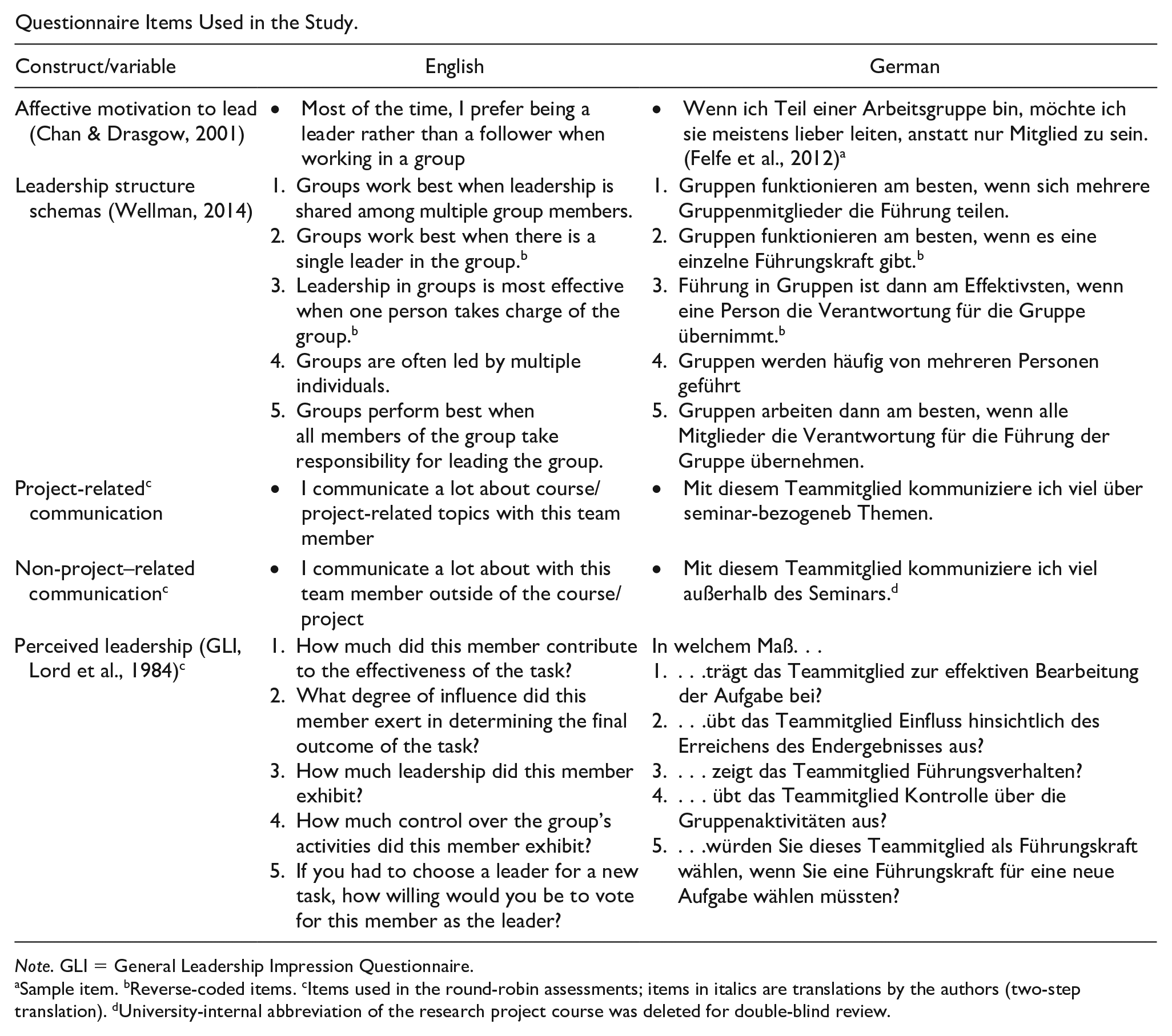
| Construct/variable | English | German |
|---|---|---|
| Affective motivation to lead (Chan & Drasgow, 2001) | • Most of the time, I prefer being a leader rather than a follower when working in a group | • Wenn ich Teil einer Arbeitsgruppe bin, möchte ich sie meistens lieber leiten, anstatt nur Mitglied zu sein. (Felfe et al., 2012) a |
| Leadership structure schemas (Wellman, 2014) | 1. Groups work best when leadership is shared among multiple group members. 2. Groups work best when there is a single leader in the group. b 3. Leadership in groups is most effective when one person takes charge of the group. b 4. Groups are often led by multiple individuals. 5. Groups perform best when all members of the group take responsibility for leading the group. |
1. Gruppen funktionieren am besten, wenn sich mehrere Gruppenmitglieder die Führung teilen. 2. Gruppen funktionieren am besten, wenn es eine einzelne Führungskraft gibt. b 3. Führung in Gruppen ist dann am Effektivsten, wenn eine Person die Verantwortung für die Gruppe übernimmt. b 4. Gruppen werden häufig von mehreren Personen geführt 5. Gruppen arbeiten dann am besten, wenn alle Mitglieder die Verantwortung für die Führung der Gruppe übernehmen. |
| Project-related c communication | • I communicate a lot about course/project-related topics with this team member | • Mit diesem Teammitglied kommuniziere ich viel über seminar-bezogeneb Themen. |
| Non-project–related communication c | • I communicate a lot about with this team member outside of the course/project | • Mit diesem Teammitglied kommuniziere ich viel außerhalb des Seminars. d |
| Perceived leadership (GLI, Lord et al., 1984) c | 1. How much did this member contribute to the effectiveness of the task? 2. What degree of influence did this member exert in determining the final outcome of the task? 3. How much leadership did this member exhibit? 4. How much control over the group’s activities did this member exhibit? 5. If you had to choose a leader for a new task, how willing would you be to vote for this member as the leader? |
In welchem Maß. . . 1. . . .trägt das Teammitglied zur effektiven Bearbeitung der Aufgabe bei? 2. . . .übt das Teammitglied Einfluss hinsichtlich des Erreichens des Endergebnisses aus? 3. . . . zeigt das Teammitglied Führungsverhalten? 4. . . . übt das Teammitglied Kontrolle über die Gruppenaktivitäten aus? 5. . . .würden Sie dieses Teammitglied als Führungskraft wählen, wenn Sie eine Führungskraft für eine neue Aufgabe wählen müssten? |
Note. GLI = General Leadership Impression Questionnaire.
Sample item. bReverse-coded items. cItems used in the round-robin assessments; items in italics are translations by the authors (two-step translation). dUniversity-internal abbreviation of the research project course was deleted for double-blind review.
Declaration of Conflicting Interests
The author(s) declared no potential conflicts of interest with respect to the research, authorship, and/or publication of this article.
Funding
The author(s) received no financial support for the research, authorship, and/or publication of this article.
