




Abstract
The COVID-19 pandemic was a key event forcing an increase in virtual work. Drawing on event system theory, we examined whether virtual teams showed enhanced processes in later stages of the pandemic compared to the early stages of the pandemic. We collected data from 54 virtual teams (N = 152 individuals) who worked on a 30-minute task. We measured team processes and performance. Virtual teams during the post-transition phase (June–August 2020) showed better levels of team action processes and conflict management compared to teams working in the immediate transition phase (March–May 2020), indicative of an adaptation effect.
Keywords
On March 11, 2020, the world as we knew it changed: the new, highly infectious COVID-19 virus had spread so widely that the World Health Organization (WHO, 2020) declared a pandemic. To minimize further spread of a virus that had such high morbidity and mortality rates, multiple nations went into a radical lockdown, reducing in-person, social contact to a minimum. These drastic changes meant that organizations had to quickly change their work practices by shifting into telework and home-office arrangements. Face-to-face meetings became virtual meetings and coordinating work with others moved from physical interactions to virtual platforms (Herath & Herath, 2020). This led to far greater attention being paid to working virtually, and how to do this well (Richter, 2020). In this article, we draw on an event-oriented theoretical perspective to inform our understanding of whether (and how) a critical and disruptive event such as the COVID-19 pandemic could create behavioral change, such as facilitating the adaptation of team members to working more effectively in virtual team environments (Morgeson et al., 2015). We address the question of whether the COVID-19 pandemic has positively affected how team members interact when working virtually on a collaborative task. In 2020, shortly after the declaration of COVID-19 as a global pandemic, we started collecting data from ad hoc teams working on a virtual team task. We explored differences in team processes of these ad hoc teams collaborating at two time periods during the 2020 pandemic; during the COVID-19 transition phase from March to May 2020 (i.e., transition phase), and during the COVID-19 post-transition phase from June to August 2020 (i.e., post-transition phase). We acknowledge that this data was originally collected to address a different research question (i.e., “How do different forms of task interdependence impact team effectiveness?”), and that we re-purposed the data to examine the core question posed by this unique event.
To address the question of how the COVID-19 pandemic, as a global, impactful event, changed the way people collaborate in virtual teams, we will introduce theoretical concepts such as team virtuality, team processes, and event system theory, and elaborate on how these concepts relate to each other, while outlining knowledge gaps and inconsistencies regarding virtual team processes in existing literature. We will subsequently present our research hypothesis directed at how the COVID-19 pandemic changed how people collaborate in virtual teams, that is, whether there is a temporal adaptation effect from working virtually (i.e., indicated by improvements in team processes), and what role work design plays in these team processes.
Theoretical Background
What Is Team Virtuality?
In the literature, the term virtuality is commonly defined by geographic dispersion and technological dependence in work-related interactions among employees (Foster et al., 2015; Gilson et al., 2015; Raghuram et al., 2019). Rather than describing teams as virtual or non-virtual, there is a growing consensus that virtuality in teams should be conceptualized on a continuous dimension—in other words, on a spectrum from low to high virtuality. For example, a firefighting team extinguishing a large bushfire that operates in immediate proximity and communicates face-to-face would be considered having low levels of team virtuality. On the other hand, if team members were distributed across the world and had to rely heavily on electronic technology for communication, the team would be categorized as having high levels of virtuality.
Most teams in modern knowledge work tend to be hybrid teams, characterized by moderate levels of virtuality. Hybrid teams rely on both electronic technology as well as on face-to-face communication. The levels of team virtuality can also fluctuate over time (Handke, Klonek, et al., 2020), and these fluctuations could occur slowly or abruptly, and be driven by internal or external events. For example, the global COVID-19 pandemic is an external event that dramatically affected the levels of team virtuality in 2020, forcing teams from all over the world to switch entirely to virtual collaborations in a very short period. As most organizations had never been exposed to exclusive work-from-home arrangements, team members had to quickly adapt to this rapid and drastic change, and learn how to equip themselves to carry out all job tasks remotely.
Team Processes and Their Role in Virtual Team Functioning and Performance
We are interested in understanding how the global pandemic may have impacted how team members engage in the kinds of team processes that support team performance. Team processes refer to interdependent activities of teams that transform inputs into outputs (Marks et al., 2001), and include task and motivational team processes, such as planning what needs to be done (i.e., transition processes), coordination of activities among team members (i.e., action processes), and interpersonal behaviors that are related toward managing emotions among team members and/or managing conflict between team members (Mathieu et al., 2019). Overall, team processes capture the activities of the team that are crucial to accomplish tasks. Meta-analytic research has shown that processes are crucial proximal indicators of team performance and team member satisfaction (Klein et al., 2009; LePine et al., 2008).
At the same time, research strongly suggests that virtual teams systematically differ from non-virtual teams with respect to how much they engage in these processes. For example, meta-analytic research has found that virtual teams tend to communicate less and engage less in knowledge sharing behaviors (Mesmer-Magnus & DeChurch, 2009; Ortiz de Guinea et al., 2012). Mathieu et al. (2019) also reported that virtual teams engaged less in transition (i.e., planning activities), action, and interpersonal processes than non-virtual teams. Overall, this research suggests that high levels of virtuality make it harder for teams to engage in interdependent activities and smooth coordination.
The Impact of COVID-19 on Virtual Team Functioning
Event system theory is a relatively recent perspective in organizational theory that helps us to understand the nature of events, and when, how and why they shape individual and collective responses. Event system theory defines events as “discrete and bounded in space and time” (Morgeson et al., 2015, p. 516). Events differ in their strength, and thus lie on a continuum from weak to strong. Events that are more novel (different from prior routines), disruptive (magnitude of change), and critical (demand attention and reprioritization) have stronger influences on outcomes. Events that originate at higher (macro) levels also have broader impact, and are more enduring.
Using this perspective, the COVID-19 pandemic can be understood as a macro event (i.e., an event that takes place at a broad economic level, and simultaneously influences multiple individuals; Morgeson et al., 2015), that is likely to impact on virtual team functioning. Specifically, using event systems theory, we propose that a macro event like the COVID-19 pandemic was first followed by a transition phase (i.e., a period of time that required initial learning and adjustment), and then by a post-transition phase (i.e., a period of time in which people exposed to the event have adjusted to the new normal) (Bliese et al., 2017; Herath & Herath, 2020; Richter, 2020). Given that not only the COVID-19 outbreak itself is at a high level (i.e., it emerged globally), novel, disruptive, and critical, but also taking into account how it specifically affected organizations by needing to shift into a new way of working (Carroll & Conboy, 2020), we are building on the event system theory to consider the extent of the impact of the COVID-19 pandemic on how teams work together in a virtual setting.
In particular, we argue that the COVID-19 pandemic has accelerated how well individuals collaborate with one another during virtual team tasks. Although many individuals had already been working and communicating with team members using virtual tools and technology to some extent, the lockdown and stay-at-home policies meant that these individuals now had to use these tools and technology exclusively. We argue that in the immediate period after the start of the global pandemic (March to May), that is, the transition period, most individuals were learning and adjusting to this new way of working. Furthermore, we argue that in the post-transition period (June to August), individuals had gained crucial experiences when working virtually which they could transfer to any virtual collaboration task.
Thus, we hypothesize that the COVID-19 global pandemic has led to a virtual adaptation effect.
Process- and Resource Interdependence in Virtual Teams
A recent review suggested that the way in which work is designed for virtual teams has a major impact on team functioning and performance—in particular, the extent to which a task requires interdependence between team members (Handke, Klonek, et al., 2020). The findings regarding the effect of interdependence on virtual team functioning are still mixed to date. Some studies have shown that interdependence positively influences team functioning (e.g., team learning, planning behaviors, and trust) as well as team performance (Maynard et al., 2012; Ortega et al., 2010; Rico et al., 2009). Yet, there is also research showing that interdependence is negatively associated with team functioning and performance (cf., Handke, Klonek et al., 2020). To resolve these conflicting findings, we follow suggestions by Courtright et al (2015) who showed the importance of distinguishing two different types (or dimensions) of interdependence to understand effects on team functioning and performance, namely, process interdependence and resource interdependence.
Process interdependence is defined as “interconnectedness in terms of creating workflows that require coordinated action” (Courtright et al., 2015, p. 4). Low levels of process interdependence occur when team members can work independently and separately on their tasks, and there is no workflow between members of the team. The team output is equal to the sum of each member’s individual contributions. High levels of process interdependence happen when team members are strongly connected and workflows go back and forth—team members must collaborate intensively with each other in order to produce the team output.
Furthermore, we conceptualize resource interdependence as “interconnectedness in terms of team members depending on one another for access to critical resources” (Courtright et al., 2015). This concept has also been referred to as input interdependence (Mathieu et al., 2008), and inputs refer to skills, data, materials, and information that is required for teams to accomplish their tasks (Kiggundu, 1983). Here, we focus particularly on the role of critical information that virtual teams need to complete their task, because sharing information has shown to be a crucial proximal indicator of virtual team performance (e.g., Eisenberg et al., 2019). With increasing levels of virtuality, teams tend to share less knowledge (Ortiz de Guinea et al., 2012). Meta-analyses indicate that virtual teams tend to be less open in sharing information in comparison to non-virtual (or low-level virtuality) teams (Mesmer-Magnus & DeChurch, 2009). The reason for this phenomenon is that many virtual tools (such as email or virtual chat logs) are asynchronous, that is, sharing information involves time lags, and team members also tend to share information less openly due to virtual communication tools (chat or email) being restricted in allowing free and high volume of communication.
Based on existing reviews of interdependence in virtual and non-virtual teams (Courtright et al., 2015; Handke, Klonek, et al., 2020), we expected that both process interdependence and resource interdependence impact virtual team processes and team performance. Additionally, building on hypothesis 1, which proposed that the prolonged period of working remotely and virtually brought about by the COVID-19 lockdown would result in an adaptation to work in virtual teams, we are interested in exploring whether different periods of the COVID-19 pandemic interacted with these interdependence types in impacting on virtual team processes and performance. Hence, our research question is:
Do process and resource interdependence impact virtual team processes and performance differently during the COVID-19 transition phase in comparison to the post-transition phase?
Method
Participants
In this study, 152 participants from the University of Western Australia, working in 54 teams of two to four members, participated in a virtual teamwork simulation. Participants (72% female) were aged between 17 and 58 years (Mage = 25.38, SDage = 8.52). Participants were undergraduate psychology students (n = 83) who volunteered for the study in exchange for course credits or financial compensation ($15), and postgraduate students (n = 69) who participated in the study as part of a group assignment.
Procedure
Participants took part in a 30-minute virtual teamwork simulation (using their own devices). Prior to the start of the simulation, they were sent detailed instructions about how to set up for the simulation, which involved having several windows open and visible on screen concurrently. Participants followed an online link that directed them to the task, and to an interaction platform that allowed them to communicate with other team members. After completing the task, participants completed a survey measuring team processes.
Virtual Team Task
The 30-minute virtual teamwork simulation included a task adapted from Klonek et al. (2020). The task required participants to work in teams to develop volunteer recruitment materials for the Cancer Council. We selected this organization to give participants a non-artificial and meaningful task. At the start of the simulation, all participants received background information about the organization, and its need for volunteers. The task involved designing recruitment materials for this volunteer role, and included 21 requirements related to the content and design of these recruitment materials (see Appendix A for details of these requirements).
During the task, participants were only able to communicate with their teammates via ChatPlat, an online text-based chat platform (e.g., Brooks & Schweitzer, 2011; Huang et al., 2017). A timer embedded in the online task environment ensured that team members always knew how much time was remaining to complete the task. One team member was responsible for submitting the recruitment materials (using an online link) toward the end of the task.
COVID-19 and Global Pandemic Phases
COVID-19 was officially recognized as a global pandemic by the World Health Organization on the 11th of March 2020. Our virtual team simulation data was collected between the 27th of March and the 18th of August 2020. We categorized teams into a COVID-19 transition phase (March to May), and a COVID-19 post-transition phase (June to August), which resulted in a balanced number of teams per phase (25 virtual teams in the COVID-19 transition phase, and 29 teams collaborating during the COVID-19 post-transition phase).
Experimental Manipulations
Process interdependence
In the low process interdependence condition, team members had to sequentially work on the task. Their instructions were “You will work on the recruitment materials sequentially and pass them on to the next person via email.” The last person in the team had to submit the final work product via an upload link embedded in the task environment. The low process interdependence condition mirrored the work design of a production chain in which a cohesive piece of work is split into parts that are assigned to individual team members. In contrast, in the high interdependence condition, team members were instructed to work collectively and concurrently on the recruitment materials. Their instructions were “To work together, you will be using an online shared google document containing the recruitment materials.”
As a manipulation check, we provided team members with an illustration of four distinct levels of process interdependence (1 = pooled, 2 = sequential, 3 = reciprocal, 4 = intensive; depiction and items used by Maynard et al. [2012] with larger numbers reflecting increasing levels of interdependence), and asked each team member to select the illustration that best described the workflow in their team. Workflow perceptions were significantly higher in the high process interdependence condition (M = 2.52, SD = 0.86) than in the low process interdependence condition (M = 1.90, SD = 0.34), F(1, 52) = 11.91, p < .001.
Resource Interdependence (Shared Information vs. Unique Information)
We manipulated resource interdependence by providing team members with access to shared versus unique information. In the shared resource condition, all team members saw all 21 requirements that needed to be incorporated in the recruitment materials (see Appendix A). In the unique resource condition, each team member saw their own unique subset of the requirements, and team members were dependent on others to access critical information about task requirements.
As a manipulation check, we aggregated team members’ responses to the following two items: “Every team member had all the information needed to fully complete the team task” and “We all had the same information about the team task.” These team member perceptions differed significantly between the two conditions, F(1, 52) = 25.48, p < .001, such that these ratings were higher in the shared information condition (M = 4.06 SD = 0.61) than in the unique information condition (M = 2.97, SD = 0.93).
Measures
Team transition, action, and interpersonal processes
Team processes were measured using items developed and validated by Mathieu et al. (2019), and captured team action processes [four items, e.g., “know whether we were on pace for meeting our goals”; α = .84; ICC(1) = .37, F(53,94) = 2.61, p < .001; ICC(2) = 0.62]; team transition processes [three items, e.g., “identify the key challenges that we expected to face”; α = .84, ICC(1) = .19, F(53,94) = 1.64, p < .05, ICC(2) = 0.39]; the interpersonal team processes of affect management [five items, e.g., “My team actively worked to manage stress”; α = .88, ICC(1) = 0.17, F(53,94) = 1.57, p < .05, ICC(2) = 0.36] and conflict management [five items, e.g., “My team actively worked to maintain group harmony”; α = .86, ICC(1) = −0.25, F(53,94) = 1.46, p = .055, ICC(2) = −0.77]. All items were answered on a five-point Likert scale (1 = not at all to 5 = to a very great extent). ICC(1) provides an estimate of the effect size of group membership (i.e., a significant ICC(1) is argued to make the group the unit of analysis), while ICC(2) can be used to assess the reliability of the group means (Chen et al., 2005). See Appendix B for an overview of all items.
Team Task Performance
Two independent raters blind to the experimental conditions assessed task performance. The raters assessed the extent to which teams incorporated the specified requirements in their submitted recruitment materials (see Appendix A for scoring details; higher scores indicate better task performance). Individual rater scores were averaged to obtain a single task performance score for each team (ICC(2) = 0.93; Cicchetti, 1994).
Analytical Procedure
To test H1, we created a binary variable indicating whether teams participated in our simulation during the COVID-19 transition phase (coded 0) or the post-transition phase (coded 1), and correlated this phase variable with each team process variable (i.e., transition processes, action processes, affect management, and conflict management).
To control for the different experimental conditions, we analyzed the interaction effect between the two experimental interdependence manipulations (i.e., process interdependence, resource interdependence) and the dichotomous between-subjects COVID-19 phases (transition vs post-transition) variables. Thus, we ran 3-factorial ANOVAs for each of the dependent variables (i.e., four team processes, team performance); that is, we ran five ANOVAs. We tested both the two-way interaction between the focal manipulations (process interdependence X resource interdependence), the two-way interactions between each of the experimental manipulations, and the COVID-19 temporal phases (i.e., process interdependence X COVID-19 phase, resource interdependence X COVID-19 phase), and the triple interaction between the two experimental manipulations and the COVID-19 phases (process interdependence X resource interdependence X COVID-19 phase).
Results
Table 1 presents the correlations among all study variables. In H1, we expected an effect of the COVID-19 phase, such that virtual teams that collaborated during the post-transition phase (June to August 2020) would show better team processes than virtual teams in the transition phase (March to May 2020). COVID-19 phase was positively related to team action processes (r = 0.34, p = .011) and conflict management (r = 0.30, p = .028), but showed no association with transition processes (r = 0.17, p = .222) and affect management (r = 0.23, p = .089), providing partial support for H1.
Means, Standard Deviations and Correlations of Study Variables.

Note. N = 54 teams (team-level analyses). Reliabilities (Cronbach’s alpha) are reported in parentheses on the diagonal.
p < .05. **p < .01.
0 = Transition phase (March to May 2020); 1 = Post-transition phase (June to August 2020).
0 = Low (sequential) process interdependence condition; 1 = High (intensive) process interdependence condition.
0 = Unique resources condition; 1 = Shared resources condition.
Figure 1 shows the differences in team processes between the transition phase and post-transition phase. In support of H1, teams showed: (a) higher levels of action processes in the post-transition phase (M = 3.81, SD = 0.61) in comparison to the transition phase (M = 3.29, SD = 0.85), F(1, 52) = 6.87, p = .011, and (b) higher levels of conflict management in the post-transition phase (M = 3.67 SD = 0.53) in comparison to the transition phase (M = 3.28, SD = 0.75), F(1, 52) = 5.13, p = .028. Teams showed borderline significant higher levels of affect management in the post-transition phase (M = 3.60, SD = 0.55) in comparison to the transition phase (M = 3.27, SD = 0.85), F(1, 52) = 3.01, p = .089. Transition processes did not differ between the two pandemic temporal phases, F(1, 52) = 1.53, p = .222. Overall, these results indicate that teams who participated in our virtual team simulation during the post-transition phase showed better team processes than teams who participated during the early lockdown phase.
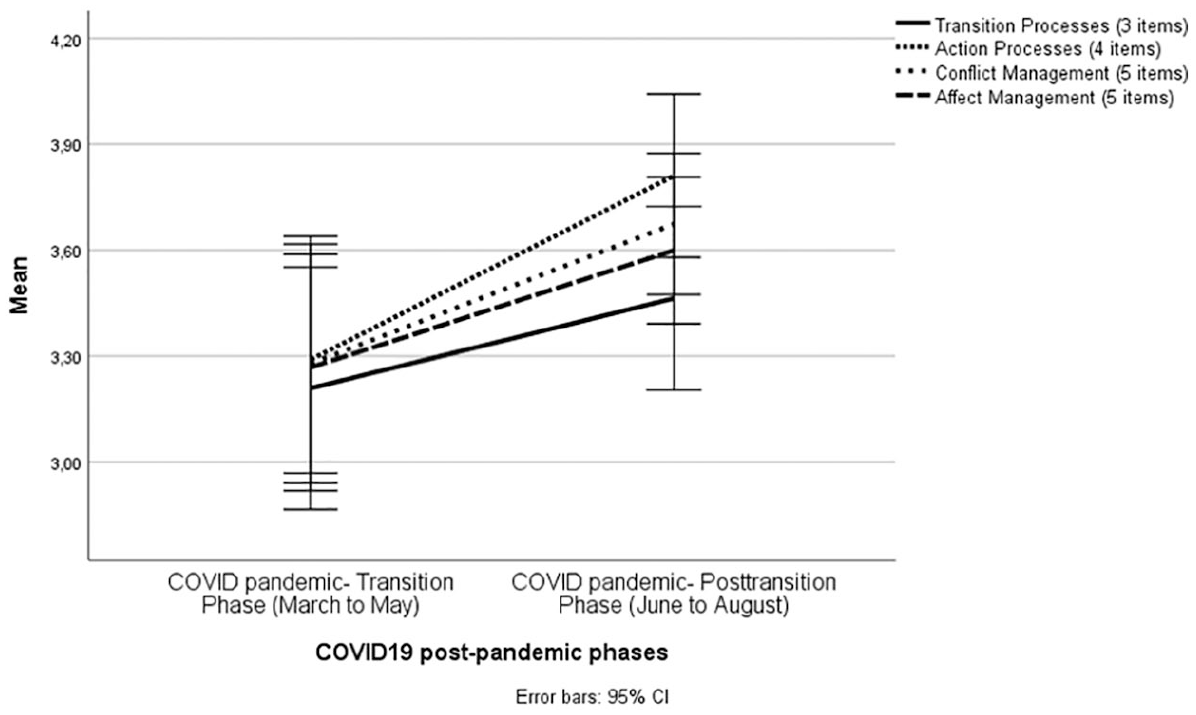
Comparison of team processes during a virtual collaboration task between two COVID-19 pandemic phases.
In our exploratory research question, we wanted to know to what extent the phases of the COVID-19 pandemic interacted with the interdependence conditions in affecting team members’ ability to collaborate in a virtual team task. Since our task involved a manipulation of process- and resource interdependence, we had a multifactorial between-teams, mixed-effects design, with two manipulated variables (process interdependence: low vs. high); resource interdependence: unique vs. shared), and one measured independent variable (COVID-19 phase: transition phase vs. post-transition phase).
Teams showed higher levels of transition processes in the high process interdependence condition (M = 3.60, SD = 0.70) in comparison to the low process interdependence condition (M = 3.10, SD = 0.74), F(1,46) = 7.91, p = .007. There were no other main effects, all F’s < 1.71, p’s > .197, and no two-way interactions, all F’s < 2.49, p’s > .121, and no three-way interaction between the three independent variables, F(1,46) = 0.76, p = .387.
In regard to action processes, teams showed higher levels of action processes in the high process interdependence condition (M = 3.82, SD = 0.74) in comparison to low process interdependence (M = 3.32, SD = 0.72), F(1,46) = 8.89, p = .005. Teams in the later COVID-19 post-transition phase showed higher levels of action processes (M = 3.81, SD = 0.61) than those teams working in the early COVID-19 transition phase (M = 3.29, SD = 0.85), F(1,46) = 7.85, p = .007. There was no other main effect, F(1,53) = 0.09, p = .772, no two-way interactions, all F’s < 3.58, p’s > .065, and no three-way interaction between the three independent variables for team action processes, F(1,46) = 0.60, p = .444.
Regarding affect management, teams showed higher levels of affect management in the high process interdependence condition (M = 3.62, SD = 0.77) in comparison to low process interdependence (M = 3.28, SD = 0.62), F(1,46) = 4.35, p = .043. There were no other main effects, all F’s < 3.45, p’s > .070, no two-way interactions, all F’s < 3.78, p’s > .058, and no three-way interaction between the three independent variables for team affect management, F(1, 46) = 1.27, p = .265.
Teams showed higher levels of conflict management in the high process interdependence condition (M = 3.71, SD = 0.62) than in teams in the low process interdependence condition (M = 3.27, SD = 0.64), F(1,46) = 8.46, p = .006. Furthermore, teams in the later COVID-19 post-transition phases showed better levels of conflict management (M = 3.67, SD = 0.53) than those teams working in the early COVID-19 transition phase (M = 3.28 SD = 0.75), F(1,46) = 5.74, p = .021. There was no other main effect, F(1,46) = 1.08, p = .304, no two-way interactions, all F’s < 2.26, p’s > .139, and no three-way interaction between the three independent variables for team conflict management, F(1,46) = 1.73, p = .195.
Regarding performance, teams showed better team performance in the shared resource condition (M = 8.07, SD = 1.24) relative to the unique resource condition (M = 6.09, SD = 1.94), F(1,46) = 23.21, p < .001. There were no other main effects, all F’s < 1.84, p’s > .182, no two-way interactions, all F’s < 3.96, p’s > .053, and no three-way interaction between the three independent variables for team performance, F(1,46) = 0.72, p = .401.
Discussion
Consistent with our hypothesis, we found different levels of team action processes and conflict management processes between the two COVID-19 phases. Our study did not indicate that the COVID-19 pandemic affected people’s ability to work in a virtual team differently under different (process and resource) interdependence conditions. That is, there were no interaction effects between the pandemic phases and the interdependence manipulations (neither two- nor three-way interactions) on any of the team processes, nor on team performance. Thus, the effects of process and resource interdependence did not differ depending on whether the teams participated during the COVID-19 transition phase versus the post-transition phase; rather, the interdependence effects were consistent across both phases.
However, our study showed a positive main effect of process interdependence for enhancing team processes (action processes, transition processes, affect management, and conflict management), and a positive effect of resource interdependence on team performance outcomes (i.e., shared resources being better for team performance).
Theoretical Implications
To our knowledge, our study was one of the first to apply event system theory (Morgeson et al., 2015) to virtual teamwork, and this has proven to be a useful theoretical framework to interpret the effect of the COVID-19 pandemic on people’s ability to collaborate in virtual teams. Our study implies that macro-temporal events can change team critical processes that occur during virtual collaborations. Future research in the virtual team space should consider using event system theory as a theoretical framework to interpret the effect of other events on team functioning and performance. In doing this, our study contributes toward the literature highlighting the dynamics of team virtuality (Handke, Costa et al., 2020).
Furthermore, by distinguishing different types of interdependence, as previously recommended by Courtright et al. (2015), our research contributes toward a better understanding of different types of task interdependence in virtual teams. In particular, by showing that process versus resource interdependence have unique effects on team processes and virtual team performance, our research helps to address conflicting findings regarding the mixed effects of interdependence (Handke, Klonek et al., 2020).
Practical Implications
Our study has important practical implications. First, our results indirectly imply that macro-temporal events can positively impact team members’ ability to collaborate virtually on a task. Thus, organizations and managers need to consider that strong and significant events alter performance-critical team processes, and take this into consideration when they manage their workforce. This puts a silver lining to the COVID-19 pandemic, and speaks toward people’s ability to successfully adjust to the new normal (cf., Carroll & Conboy, 2020; Herath & Herath, 2020).
Second, managers and team leaders are within a position to manipulate task interdependence within their teams that allows them to positively impact team functioning and performance. Our findings suggest that to improve team functioning, team leaders need to increase process interdependencies between team members, for example, by redesigning how team members work on specific tasks (see also, Klonek & Parker, 2021, for more specific practical recommendations). In virtual teams, team leaders should make sure members can work in a collaborative workflow, for example, by selecting technology platforms that support this work design (e.g., advising team members to use shared digital documents instead of working on locally saved documents). This way, team members have more flexibility in directly altering work output from their team members. Further, our results imply that to increase team performance, managers need to ensure that all team members should have shared access to critical resources (in particular, information required to complete team tasks). Finally, our study implies that these work design recommendations were equally effective in the early and late stages of the pandemic (i.e., regardless of how much experience team members had with virtual work).
Limitations, Strengths, and Future Research Directions
As pointed out before, our study was not originally designed to investigate the existence of an adaptation effect of the COVID-19 pandemic regarding virtual team processes and performance; it was mainly designed to investigate the effect of different types of interdependence on team processes and performance. However, our data collection aligned with the early and late phases of the pandemic (transition and post-transition phase).
Hence, there may be confounding factors that contributed toward the differences in team processes between the two phases, such as differences in education and experience in virtual work that we did not control for (i.e., more postgraduate students participated in the post-transition phase). Furthermore, there were differences in incentives for participation (some participants used the task as the basis for a reflection on work design for an assignment, whereas other participants reflected on the study design through the debrief at the end of their participation). Furthermore, it is possible that some team members knew each other before the task, which could have affected the results; however, this is likely to have affected both pandemic phases equally.
We also acknowledge that we used a between-groups study design, but our hypothesis and research questions would be better tested and answered with a within-groups design, which follows the same teams over time. However, measuring team processes over time is methodologically very challenging to realize (Klonek et al., 2019).
One of the main strengths of our study lies in our standardization of the task and experimental manipulation of key independent variables, therefore giving us control over key parts of the study, which is critical for obtaining high levels of internal validity. At the same time, we used a simulation which involved a realistic and meaningful task (i.e., working on materials for a real and meaningful organization).
Future research should continue to explore the utility of event system theory as a theoretical framework to explore the effect of events on virtual teams and team member behaviors, ideally looking at events that are different in nature (novelty, disruptiveness, and criticality, cf. Morgeson et al., 2015), and how these differences translate into different impacts. Another recommendation is to explore comparable research questions with standing or ongoing teams (also called intact teams) to see if variables like process interdependence, resource interdependence, and the occurrence of macro events have similar effects on team functioning and performance in those kinds of teams. Ideally, future research should include studies with repeated measures over time for the same team.
Conclusion
The COVID-19 pandemic forced us to radically shift into virtual collaborations to minimize physical contact. Using an event system theory perspective, our study indicated that macro-temporal events such as the COVID-19 pandemic can influence virtual team processes, and showed that after a sustained period of working remotely during the pandemic, teams adapted to virtual work, with teams in the early phase of the pandemic showing poorer team processes than teams in a later phase. Our study also highlighted unique benefits of process interdependence for critical virtual team processes (i.e., transition, action processes, and affect management) as well as performance benefits for virtual team members having access to shared resources.
Footnotes
Appendix A
Appendix B
Acknowledgements
The authors are grateful to Bridget Hanavan, Emma Stephenson and Saul Taylor for their contributions to the research project as Honours students.
Declaration of Conflicting Interests
The author(s) declared no potential conflicts of interest with respect to the research, authorship, and/or publication of this article.
Funding
The authors disclosed receipt of the following financial support for the research, authorship, and/or publication of this article: This research was partly funded and supported by an ARC Australian Laureate Fellowship (FL160100033, “Transformative work design for health, skills and agility”). This research was also supported through Honours Scholarships from the Research Network for Undersea Decision Superiority (RN-UDS) from the Australian Defence Science and Technology Group.
