




Abstract
Virtualization fundamentally changes how social relations form, but its effect on network structure in collaborative teams is poorly understood. This paper compares team networks from nine government-funded projects that were conducted virtually because of the COVID-19 pandemic with 15 prepandemic projects from the same funding program. Results of our comparative analysis of 2,746 dyadic ties in 24 teams showed lower levels of network density, clustering, and structural cohesion in virtualized projects, indicating fragmented virtual teams. Furthermore, expressive networks, defined by the sharing of personal information, were affected more than instrumental networks, which revolve around the sharing of expert knowledge.
In recent years, spatially distributed and virtual collaboration has become common practice (Herath & Herath, 2020; Klonek et al., 2022). Although research on virtual teams has grown rapidly, we have only a rudimentary understanding of how teamwork has changed as a result of virtualization. This also applies to team cohesion, which is defined by the interconnectedness of team members, and which influences motivation, openness, and coordination in teams (B. A. Burt et al., 2022; Delfgaauw et al., 2022; van der Voet & Steijn, 2021). Understanding how the virtualization of collaboration affects team cohesion is therefore of vital importance.
Several recent studies have shed light on how collaborations differ between virtualized and onsite teams (Breuer et al., 2020; Hinds & Mortensen, 2005; Malhotra & Majchrzak, 2014). These studies have focused on how the virtualization of collaborations affects the quality of relationships among collaborators. Virtualized relationships intensify more slowly and rarely reach the strength they do between collaborators who meet face to face (Roth & Göbel, 2022; Wilson et al., 2006). Furthermore, physical distance becomes less important for relationship formation, whereas perceived availability increases in importance (Grabher et al., 2018; Wilson et al., 2013; Zhao & Elesh, 2008). While it is increasingly clear that and how virtualization affects the quality of individual dyadic relations, its implications for relationship formation in teams are less well understood. The existing research on virtualization indicates that the conditions for the formation of social networks in virtual teams differ significantly from those in physical teams (Blanchard, 2021; Lewis, 2021; Roth & Göbel, 2022). The findings suggest that the average strength of relations is lower in virtualized teams, but it is initially unclear whether and how virtualization affects team network structures.
Few studies have investigated the structure of social networks in virtual contexts (Kossinets & Watts, 2009; Lewis, 2021; Wellman et al., 1996). Of these, most consider single networks and their evolution over time. Only Yang et al. (2022) offer a systematic comparison of the networks of individuals who work together virtually and physically. While insightful, Yang et al.’s (2022) study draws on digital trace data before and after the introduction of a remote-work obligation; thus, it does not account for face-to-face communication, nor does it account for the content of the traced, media-mediated communication. Insofar as the effect of communication on social relationships depends on the content of communication, the examination of digital traces can only provide an incomplete description of the systematic differences between social networks formed online and offline (Johnson et al., 2012). How virtualization affects the topologies of social networks therefore remains unclear.
Several outcomes seem feasible: For example, if ties become weaker due to a lack of social cues in virtual interaction contexts, all ties may become weaker, or specific ties may be affected to different degrees. If weak ties are affected more than strong ties, this could result in the formation of structural holes. Such holes have a strong effect on team cohesion and are therefore particularly detrimental to commitment, knowledge sharing, and coordination. Because the performance of teams depends fundamentally on the structure of their social networks, considering how the virtualization of collaboration shapes network topology is important.
This paper examines the effects of virtualization on network structure, notably on network density, clustering, and structural cohesion, by comparing social networks from 24 interorganizational collaboration projects. These 24 projects are all part of the same funding line of the German Federal Ministry of Education and Research. The projects are typically consortia of about five to eight organizations from academia and industry that are represented by about 10 to 15 individuals. The aim of these collaborations is to investigate and implement digitization measures in companies. A comparison of the effects of the virtualization of tie formation was possible because nine projects were realized under COVID-19 induced contact restrictions and thus virtually. Two types of relations were studied: expressive ties, in which personal information is shared, and instrumental ties, in which expert knowledge is exchanged.
This paper is organized as follows. In the following section, we elaborate on the origins and importance of social cohesion in teams. Then, we draw on existing literature on network formation to theorize how virtualization affects the formation of social networks in these interorganizational projects. We hypothesize that social networks formed in virtualized collaborations will be less cohesive than networks formed in physical copresence. We further argue that virtualization affects expressive networks more than it affects instrumental networks. We test our hypotheses against data that have been collected on 24 interorganizational collaboration projects. To measure cohesion, we triangulated three well-established measures of network topology: network density, local clustering, and structural cohesion. We discuss the findings and identify opportunities for future research.
Hypothesizing the Effect of Virtualization on Social Cohesion
In the following two sections, we develop our argument and corresponding hypotheses. To this end, we first discuss the extent to which the social cohesion of teams, which is essentially shaped by the structure of their social networks, is relevant for teams’ performance. We then discuss in detail how the virtualization of collaboration might affect characteristics of team networks, and in turn social cohesion.
Social Cohesion
Social cohesion, which refers to individuals’ willingness to develop and maintain social relationships within a group (Carless & de Paola, 2000), has been widely studied in relation to team performance over the past 50 years. Research findings consistently indicate that social cohesion has a positive impact on team performance (Cohen & Bailey, 1997; van der Voet & Steijn, 2021). Teams are typically formed with the goal of accomplishing tasks more effectively as a group than individually. This especially applies when tasks require the dynamic interaction of individuals with complementary skills and perspectives (Broekel & Boschma, 2012; Heringa et al., 2014; Hinds & Mortensen, 2005). One of the major challenges for heterogeneous teams is to integrate different goals, values, and working styles in order to work together effectively (Delfgaauw et al., 2022; Phelps et al., 2012; Reagans & McEvily, 2003). Social cohesion can play a pivotal role in overcoming this challenge by fostering knowledge sharing, coordination, and motivation within teams (Reagans & McEvily, 2003).
Social relationships play a crucial role in the flow and creative combination of knowledge, as they encourage the sharing of information and facilitate coordination among individuals (Ooms et al., 2018; Phelps et al., 2012; Reagans & McEvily, 2003). Furthermore, relationships facilitate information sharing about individuals’ goals and courses of action, thus aiding in the coordination of team efforts (Carter et al., 2015; Sosa et al., 2015). Over time, social relations draw individuals together by creating mutual obligations between them (Borgatti & Halgin, 2011; Coleman, 1988). Reciprocal social exchange is material to this (Blau, 1964; Cook et al., 2013); repeated interactions and growing trust between individuals grounds their willingness to extend favors to each other in reliance on the expectation of reciprocation (Blau, 1955; Uzzi, 1997). Favors traded in social exchange may enhance group members’ willingness to acknowledge mutual interests and take others’ perspectives into account (Das & Teng, 2002; Sydow & Windeler, 2003). Social relations as social bonds therefore lead individuals to coordinate and align their actions (Kukenberger & D’Innocenzo, 2020). Finally, established social relationships are an important source of social recognition, as individuals are particularly motivated to achieve goals that are recognized by others with whom they maintain close relationships (Margolis, 2020; Rapp & Mathieu, 2019).
Taken together, strong social relations among team members promote the teams’ motivation, the coordination of team members, and the exchange and recombination of knowledge in the team. The better all the individual members of a team are connected by social relationships, the more pronounced is the social cohesion of the team-network (Delfgaauw et al., 2022; Moody & White, 2003; Schiefer & van der Noll, 2017). Accordingly, the cohesion constituted by relationships in teams influences the extent to which the team shares and recombines knowledge in a motivated and coordinated manner (Das & Teng, 2002; Phelps et al., 2012; Reagans & McEvily, 2003). Social cohesion is therefore an important driver for the success of teams, especially when complex tasks are to be addressed.
Virtualization and Network Formation
In this section, we draw on the literature on network formation (Rivera et al., 2010; Schaefer & Kreager, 2020) and media-mediated communication (Karl et al., 2022; Leonardi & Vaast, 2017; Yates & Orlikowski, 1992) to hypothesize how the virtualization of interorganizational collaboration projects affects tie formation processes and in turn the structure of social networks in teams. To this end, we first specify what we mean by virtualization and the types of ties that we focus on when we describe the consequences of virtualization for the structure of personal networks.
Virtualization can be meaningfully defined as the partial or complete representation of physical individuals, objects, and interactions through information technology (Overby, 2008). In the case of tie formation, virtualization particularly concerns the information-technological representation of communication processes. Different communication media structure communication processes and thus the formation of relationships in diverse ways. For example, communication and the process of getting to know each other are governed by different sets of rules, depending on whether they are mediated by anonymous internet forums (Weninger & Williams, 2017), dating apps (Thomas, 2020), instant messengers, or virtual realities (Biocca & Levy, 2013). If virtualization entails the substitution of in-person communication with media-mediated interaction, it opens up the possibility of a diverse range of effects on the development of personal networks. However, our study’s focus on the virtualization of collaboration projects during the COVID-19 pandemic suggests a narrower emphasis. Studies of effects of COVID-19 on (inter-)organizational collaborations consistently find that the use of established communication media, such as email, telephony, and databases, persisted without notable changes in usage after the contact restriction were set in place, whereas face-to-face meetings were replaced by video-conferencing (Blanchard & Allen, 2022; Karl et al., 2022; Whillans et al., 2021). Although commonly used video-conferencing software solutions differ to a certain extent and there is scope for different usage practices (Breuer et al., 2020; Karl et al., 2022), the characteristic of virtualization can be specified sufficiently to facilitate a more comprehensive examination of its impact on network formation.
Besides the specification of virtualization, it is also necessary to specify the type of tie that forms the personal networks being investigated (Borgatti & Halgin, 2011). Two particularly important dimensions of personal relationships can be distinguished: instrumental and expressive ties (Casciaro et al., 2014; Kilduff & Tsai, 2011). Instrumental ties are grounded in instrumental interactions that revolve around resources of instrumental utility for the interaction partners. In the context of interorganizational projects, this refers to interactions aimed at obtaining expert knowledge from others. In contrast, expressive ties, which are grounded in expressive interactions, are primarily directed toward mutual recognition and sharing of personal information.
Both instrumental and expressive networks are informal but significant to the success of collaboration projects. The interorganizational collaboration projects considered here are motivated primarily by the fact that participating organizations have complementary stocks of knowledge (Berends & Sydow, 2019; Dahlander & McFarland, 2013). Sharing such knowledge between project partners and combining it in innovative ways is a major goal of interorganizational projects (Dahlander & McFarland, 2013; Windeler & Sydow, 2001). Instrumental ties are fundamental to this, and a cohesive instrumental network fosters project success (Reagans & McEvily, 2003; Tortoriello et al., 2012). This is also true for expressive networks. Although the formation of expressive ties is not a primary goal of the projects, expressive relations foster trust, commitment, and motivation, and thus crucially influence the success of the projects (R. S. Burt & Knez, 1995; McEvily et al., 2021; Nilsson, 2019).
Instrumental and expressive ties tend to interact with one another (Methot & Rosado-Solomon, 2020). More specifically, expressive interactions have been shown to promote the development of instrumental interactions, but not vice versa (Casciaro et al., 2014; Roth, 2023). Individuals who maintain expressive relationships are more likely to discover the partner’s relevant professional expertise and also tend to prefer each other as contacts for instrumental interaction, regardless of attributed expertise (Casciaro & Lobo, 2015). Thus, even though instrumental ties contribute more directly to project success, expressive ties are more fundamental because they aid and condition the development of instrumental ties. We therefore carry the distinction forward in our empirical analysis when examining the effects of virtualization. To develop testable hypotheses, we elaborate on the two types of social networks and their association with social cohesion. To measure social cohesion, we triangulate three well-established measures of network topology: network density, local clustering, and structural cohesion.
Network Density
Network density is defined as the ratio of observed ties to the number of ties possible for a given network (R. S. Burt et al., 2013). For weighted networks, the ratio of observed tie strengths to possible tie strengths can also be considered. Density is thus a simple expression of how connected actors are on average. Applied to instrumental and expressive networks in collaboration projects, network density thus indicates the average intensity of instrumental and expressive interactions in each project team.
Research on media-mediated communication offers well-founded explanations of the extent to which actors in physical and virtual collaboration projects succeed in developing relationships with one another. A central finding from research on media-mediated communication is that communication channels differ in their levels of richness (Daft & Lengel, 1986; Fulk et al., 1990). Richness refers to the extent to which communication media provide immediate feedback and symbol variance (Hinds & Kiesler, 1995; Yates & Orlikowski, 1992). Symbol variance includes addressing different senses as well as the variety of symbol systems (Nohria & Eccles, 1992). Furthermore, the possibility of conveying personal information nonverbally is emphasized. The media richness concept assumes that media-mediated communication is fundamentally poorer than face-to-face communication. Crucial to this assumption is that face-to-face communication incorporates nonverbal communication through various channels in addition to verbalized communication; in the process, a great deal of personal information is also conveyed with a high degree of authenticity (Bathelt & Turi, 2011; Nilsson & Mattes, 2015; Nohria & Eccles, 1992).
Both instrumental and expressive ties flourish in information-intensive interaction contexts that benefit from high media richness. Even if comparatively rich communication media such as video conferencing are chosen as the mode of virtualization, it can be assumed that the media richness of communication in virtualized projects will be significantly lower than in projects in which face-to-face communication occurs in physical copresence. Consequently, we expect that virtualization lowers the density of instrumental and expressive networks in the various interorganizational projects. Even if virtual interactions take place in the same frequency as in-person interactions, they do not exhibit the same richness and intensity due to the limited capabilities of the media. Even if more intensive relationships can occur in individual cases with greater effort, as research on trust-building in virtual teams suggests (Nilsson & Mattes, 2015), we expect that instrumental and expressive relationships are generally weaker in virtual projects and that the density of the networks is correspondingly lower.
H1: The density of expressive networks is lower in virtual collaboration projects than in physical collaboration projects.
H2: The density of instrumental networks is lower in virtual collaboration projects than in physical collaboration projects.
The diminished media richness in virtualized projects affects both instrumental and expressive interactions. However, as face-to-face communication differs from media-mediated communication in the extent to which personal information can be conveyed casually and authentically, it seems plausible that the density of expressive networks will be more affected by virtualization than the density of instrumental networks.
H3: The virtualization of collaboration affects the density of expressive networks more than it affects the density of instrumental networks.
Local Clustering
Local clustering captures the distribution of connectivity in the network. Locally clustered networks are characterized by internally cohesive subgroups that are weakly interconnected. Excessive clustering can hamper the success of collaboration in small project teams pursuing a clearly defined goal (Balkundi et al., 2007). Locally clustered instrumental networks indicate that expert knowledge is shared only in specific cliques but not throughout the whole project team, increasing the likelihood that isolated solutions are developed, that the results produced by disconnected subgroups ultimately do not cohere, and that the project potential is not fully realized (Reagans & McEvily, 2003; Tortoriello et al., 2012). Locally clustered expressive networks can lower team commitment and impede trust-building within the group (McEvily et al., 2021; Nilsson, 2019). Hypothesizing how virtualization affects local clustering in instrumental and expressive networks benefits from considering how such networks arise.
The formation of instrumental and expressive ties in the projects is fundamentally structured by the project’s organization into separate work packages, in which specific individuals are tasked to cooperate intensively. To coordinate and collaborate, these individuals must interact with one another in ways that are defined by the work groups. These formally required interactions often provide opportunities to realize instrumental or expressive ties. They are thus the most important driver for the formation of the two types of ties in projects. Because work packages are usually thematically focused and only connect selected partners at a time, they are an important driver of clustering. Cliques and structural holes in social networks typically correlate strongly with the formal assignment of project partners to work on packages (Brennecke & Rank, 2016; McEvily et al., 2014).
A decoupling of informal networks from formal structure is driven by opportunities for interaction. Such opportunities arise when (a) individuals encounter each other outside a formal occasion and (b) the social situations resulting from the encounter encourage partners to engage in informal interactions (Roth, 2023; Small & Sukhu, 2016). Social situations do this in two ways. First, for example, the sustained physical copresence, low intensity of busyness, and relative privacy of a shared space, such as a kitchen or a break room, can result in situational constellations that are culturally associated with specific forms of informal interaction. These informal settings facilitate certain types of interactions, and it can be uncomfortable when they do not unfold as expected, leading to awkward silences, for example. Accordingly, such situations prompt individuals to engage in particular types of interactions irrespective of their original intentions. Second, social situations also enable intended interactions to take place, although research shows that existing interaction interests are often not pursued because of the risk of reputational harm (Roth, 2023; Tortoriello et al., 2012). The initiation of expressive or instrumental interactions without situational cause may give the impression that the initiator has a particularly strong need to obtain advice or personal information. This can sometimes be legitimate and perceived as appreciative interest. However, there is also some risk that the initiator appears needy or pushy, so interaction interests are often withheld (Leifer, 1988). But if an interaction situation arises naturally, it diminishes the risk of loss of face. As serendipitous interactions arise from spatial and temporal factors, in-person gatherings enable the informal networks to detach from the constraints imposed by formal structures (Roth, 2022; Sailer & McCulloh, 2012; Wineman et al., 2008). Thus, face-to-face encounters can facilitate instrumental and expressive interactions between actors.
Furthermore, informal opportunities for interactions favor the unfolding of homophilic tendencies and triadic closure, two drivers of tie formation that can supersede formal workgroup arrangements. The tendency to triadic closure is explained by a person (person A) informing two of their unrelated acquaintances (persons B and C) about each other (Davis, 1963; Heider, 1946). As both B and C have a relation with A, the person-related information that A conveys is particularly resilient (Granovetter, 1985; Obstfeld et al., 2014). Based on the information conveyed, B and C can thus develop a relation. Research has shown, furthermore, that third party mediation often occurs when unrelated individuals interact with the same third party at the same time (Feld, 1981; Small & Sukhu, 2016). For example, if B is an associate of A and A is acquainted with C, it is possible that B and C will both approach A at the same time, prompting A to introduce B and C to each other. In contrast, when communicating through virtualizing media, A can communicate simultaneously with B and C without thereby creating an opportunity for B and C to interact (Heidenreich et al., 2008; Lewis, 2021). The mediating effect of third parties is therefore considerably promoted by the physical copresence of the three actors. In virtual projects in which communication is media-mediated, we therefore expect a lower tendency for triadic closure and local clustering to occur.
A similar rationale holds true for homophily as a counterbalance for the tendency to form relations according to the formal organizational structure. Homophily describes an individual’s tendency to prefer self-similar partners (McPherson et al., 2001). Research has found that shared characteristics such as age, hobbies, and gender ground relationships between actors who are less close within the formal structure of a work environment (Ibarra, 1993). However, relations that are grounded in homophily require suitable interaction situations in which individuals can discover commonalities on which to base ensuant relationships. For example, formal meetings rarely create opportunities to bond over a shared enthusiasm for theater. Instead, informal opportunities for interaction are needed to identify shared interests to bond over. Insofar as these common issues cut across the organizational boundaries of work packages, informal interactions that enable the unfolding of homophily counteract local clustering.
In sum, opportunities for informal interaction that arise naturally in in-person work environments promote instrumental and expressive interactions across the formal boundaries of work packages because they foster serendipitous interactions, triad closure, and homophily. Such opportunities described in the literature include unplanned encounters at shared facilities, joint trips to project meetings, shared breaks and meals, and leisure events (Pina e Cunha et al., 2008; Thomson & Hassenkamp, 2008; Torre, 2008). It is characteristic of these situations that individuals, while pursuing other goals, are in physical co-presence, allowing them to interact and bond over unplanned situations as they unfold. Accordingly, the spatial overlap of individual paths is important for relations to form based on shared interests and homophily or mutual acquaintances and triadic closure. In virtual collaboration, by contrast, it is difficult for individuals to encounter each other in unplanned settings. When it does happen, for instance, as project partners wait for the other participants of a video conference to arrive, the situation provides only weak incentives for interactions. Of course, project partners may seek to compensate for this lack of opportunities through planned virtual encounters (Blanchard & Allen, 2022; Karl et al., 2022; Whillans et al., 2021). However, due to the explicit purpose of such planned encounters, it seems unlikely that they can fully compensate for an absence of serendipitous encounters. To the extent that virtualization reduces opportunities for unplanned encounters, virtualized networks will tend to split into local clusters around work-packages and planned encounters. This dynamic would result in a lowered clustering coefficient.
H4: The clustering coefficient of expressive networks is lower in virtual collaboration projects than in physical collaboration projects.
H5: The clustering coefficient of instrumental networks is lower in virtual collaboration projects than in physical collaboration projects.
Again, there is reason to believe that expressive networks will be affected more strongly by virtualization than instrumental networks. The crucial factor here is the type of knowledge that project partners typically share in virtual as opposed to in-person encounters. During project meetings, project partners usually present interim results from their own work packages and thus incidentally also their expertise. As there is less scope for sharing personal information in such a professional setting, knowledge about the expertise of project partners will be more prevalent than knowledge about their personal lives. This leads us to predict that knowledge-driven interactions are more likely to compensate for the lack of opportunities for tie formation in instrumental than in expressive networks.
H6: The effect of virtualization on the clustering coefficient is greater for expressive networks than for instrumental networks.
Structural Cohesion
Whereas network density characterizes the average strength of connections and local clustering describes how connectivity is distributed within the network, structural cohesion considers how well individual members are integrated into the team, as measured by how well they each are connected to their fellow team members. A cohesive network binds individuals into a closely-knit group (Friedkin, 2004; Moody & White 2003). Group cohesion can be explained ideationally and relationally. Ideationally, cohesion is defined by the extent to which each individual identifies with the group. Relationally, cohesion is defined by the extent to which the relationships between individuals bind the group as a whole. When considering structural cohesion, we focus on the relational aspect of cohesion. Moody and White (2003, p. 109) define structural cohesion as “the minimum number of actors who, if removed from the group, would disconnect the group.” Accordingly, group cohesion is low if networks of relationships would collapse into disconnected components if key actors were to leave the group. In contrast, groups with high structural cohesion are characterized by networks that do not collapse into disconnected components even if key actors leave.
Structural cohesion is strengthened by relations that connect between groups and bridge across local clusters of relations. These integrating relationships play a crucial role in achieving structural cohesion in project teams. Since there is a lack of opportunities to form relations in interactions that cut across work packages when teams collaborate virtually, we expect that these teams will exhibit lower levels of structural cohesion than teams that collaborate in-person.
In addition to dyadic interactions between pairs of individuals, group interactions are particularly important for the formation of cohesive networks, as they enable the unfolding of group-dynamic processes that affect all the relationships in the group at once. Again, we assume that the conditions for such group-dynamic processes are significantly more favorable in in-person settings than virtual workplaces. As described above, in virtual work settings, group-level communication is conducted primarily through group calls and video conferencing. Two limitations of this medium seem particularly significant. First, research shows that the extent to which situations are shared can increase commitment with the actors involved (Blanchard & Allen, 2022; Fine, 2010; Hinds & Mortensen, 2005). Convening with others in physical space fosters the impression of sharedness because similar sensory impressions are available to all participants. In contrast, video conferencing mainly affords participants the shared experience of participating in the call itself. Cues to individual participant’s physical situations are limited to a small screen excerpt captured by the user’s camera—often arranged, sometimes blurred. The fragmentary nature of these virtualized cues makes it considerably more difficult to bond through shared experiences.
Second, digitally mediated group calls and video telephony limit opportunities for subtle interactions that are important for the development of cohesive networks (Bathelt & Turi, 2011; Hinds & Kiesler, 1995; Roth & Laut, 2023). In face-to-face meetings, participants subtly signal their focus of attention to each other through cues. Verbal and nonverbal expressions of interest, agreement, or disagreement allow persons to casually track how the others react to statements made by speakers or other foci of attention. Thus, the mood of the entire group can be casually inferred (Blanchard & Allen, 2022; Roth & Laut, 2023; Thomson & Hassenkamp, 2008). Even when such subtle expressions are not explicitly agreed upon, they increase chances of group cohesion. When those in attendance are in agreement, consensus is voiced, leading to an instant sense of cohesion. Moreover, participants who are initially undecided can follow the subtle cues of those who have made up their minds, making it more probable for group consensus to form. Further, lines of conflict in groups can become immediately apparent through the subtle forms of expression, so conflicts can be addressed directly and are more likely to be overcome (Hinds & Mortensen, 2005). Nonverbal communication in offline settings tends to promote group cohesion. In digitally mediated situations, on the other hand, these subtle communication processes are significantly impeded. Given participants’ inability to monitor the focus of others’ attention, their capacity to decipher their expressions becomes restricted, making it more difficult to foster cohesive relationship networks via group communication in virtual collaborative projects.
Because both group communication and (opportunity driven) communication between formal cliques are limited in virtual collaboration projects, we hypothesize that both instrumental and expressive networks will exhibit lower levels of cohesion in virtualized projects.
H7: Expressive networks are less cohesive in virtual collaboration projects than in physical collaboration projects.
H8: Instrumental networks are less cohesive in virtual collaboration projects than in physical collaboration projects.
Furthermore, there is reason to assume that the cohesion of expressive networks will be more strongly affected by virtualization than the cohesion of instrumental networks. The prevalence of formal contexts in virtual collaboration projects gives rise to informal interactions that revolve around themes connected to the formal meetings. Given that instrumental interactions tend to be more prevalent in formal meetings compared to expressive interactions, and virtual collaborations primarily revolve around formal meetings, it follows that there should be a greater occurrence of instrumental interactions than expressive interactions. This applies both to interactions between individuals and to interactions within the group, which facilitate the group-dynamic processes that are particularly important for cohesion. Within virtual work environments, teams are deprived of the chance for expressive interactions, such as collective dinners involving all team members. We therefore predict that the cohesion of expressive networks will be more strongly affected as a result of virtualization than that of instrumental networks.
H9: The virtualization of collaboration has a greater effect on the cohesion of expressive networks than it affects instrumental networks.
Empirical Setting
We test our hypotheses using network data collected in 24 interorganizational collaboration projects that were funded as part of a federal program to promote university–industry collaborations. The aim of this program was to bring research institutes together with SMEs (small and medium enterprises with fewer than 1,000 employees and a maximum annual turnover of €100 million) to develop projects that design, implement, and investigate measures to advance the digitization of work processes in companies. The program supports high-risk, company-driven, and application-oriented projects that require work-sharing and interdisciplinary cooperation between companies and research institutions.
The project consortia studied here were selected from submissions to a public call for applications that specified a thematic focus and limited the number of organizations to be involved in each project team. As the funding program aims to foster research collaborations, consortium partners were chosen to complement each other through nonredundant expertise. To allow open and constructive exchange, direct competitors were not paired within the same consortia. Overall, funded projects were selected and designed with the expressed aim of promoting knowledge exchange between organizational partners. The architecture of the collaboration projects aimed to create opportunities for both formal and informal encounters.
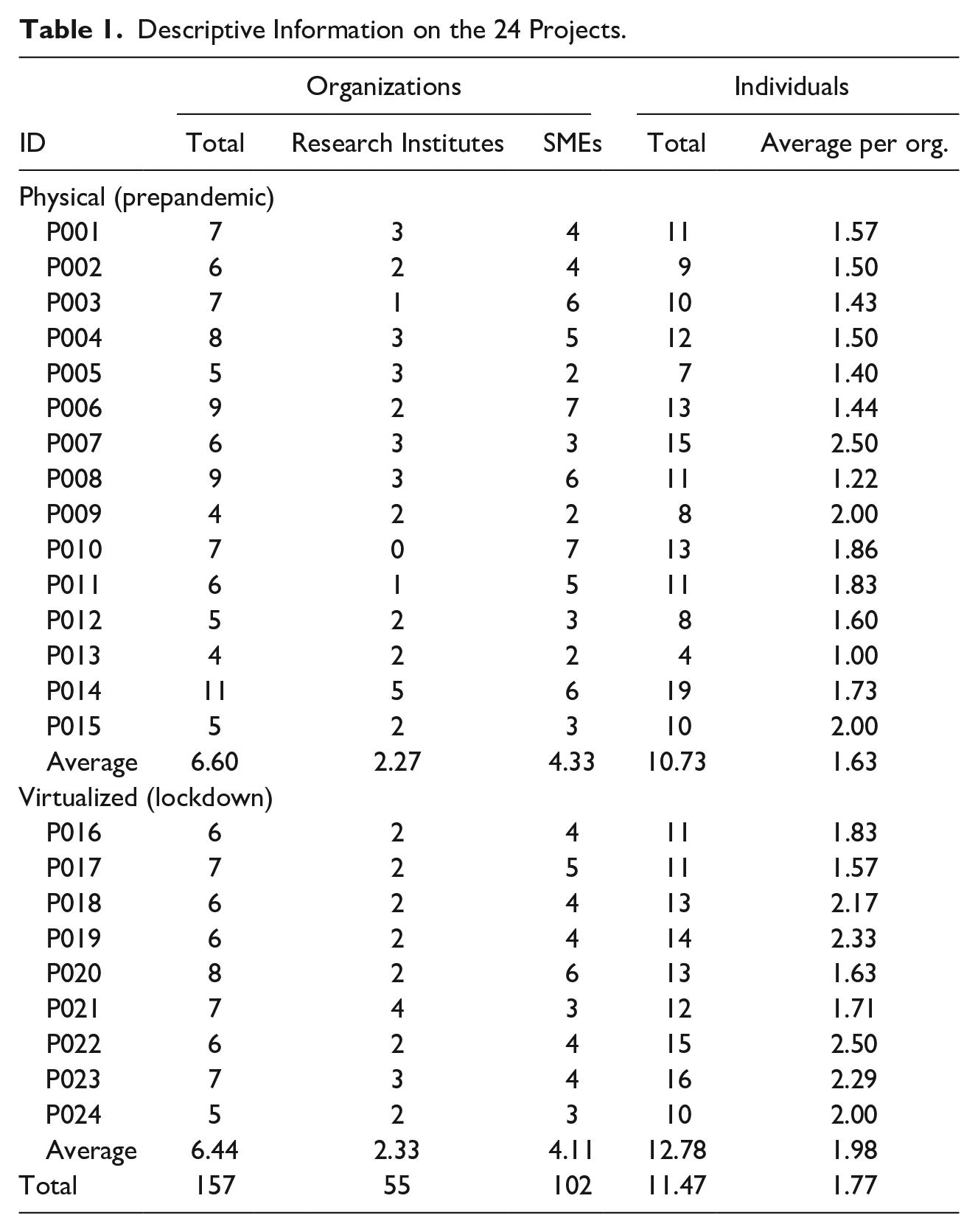
The average funding volume per project amounted to €1.6 million for 3 years and primarily covered personnel costs. Regulations concerning the distribution of funds between project team members, along with the requirement of hourly quotas per project partner as specified in the funding conditions, contribute to the reinforcement of project consortia with comparable sizes and compositions. As Table 1 shows, the physical and virtual project consortia are very similar in terms of their composition. On average, a project consortium comprises 6.54 organizations (SD = 1.64), with each organization being represented by an average of 1.78 team members (SD = 0.39). In line with the program’s call, about two thirds of the project partners are SMEs and one third are research institutes (ca. 70% of which are university-affiliated). In sum, the projects that are in our sample pursue similar goals and are of similar size and composition.
Descriptive Information on the 24 Projects.
Timing is particularly important for this study, and it is significant that the projects started in a staggered sequence between September 2018 and May 2020 (Figure 1). As a result, the project consortia were affected to varying degrees by the contact restrictions imposed in Germany starting from March 2020 as a response to the COVID-19 pandemic. Interviews conducted with partners from all projects confirmed that face-to-face meetings were held approximately once a month prior to the pandemic and were replaced by video calls during the lockdown. The same is true for annual meetings with the funding agency. Thus, even though the projects share similarities in terms of content, structure, and composition, they underwent varying degrees of virtualization in their collaborative processes (Blanchard, 2021; Scheidgen et al., 2021; Whillans et al., 2021).
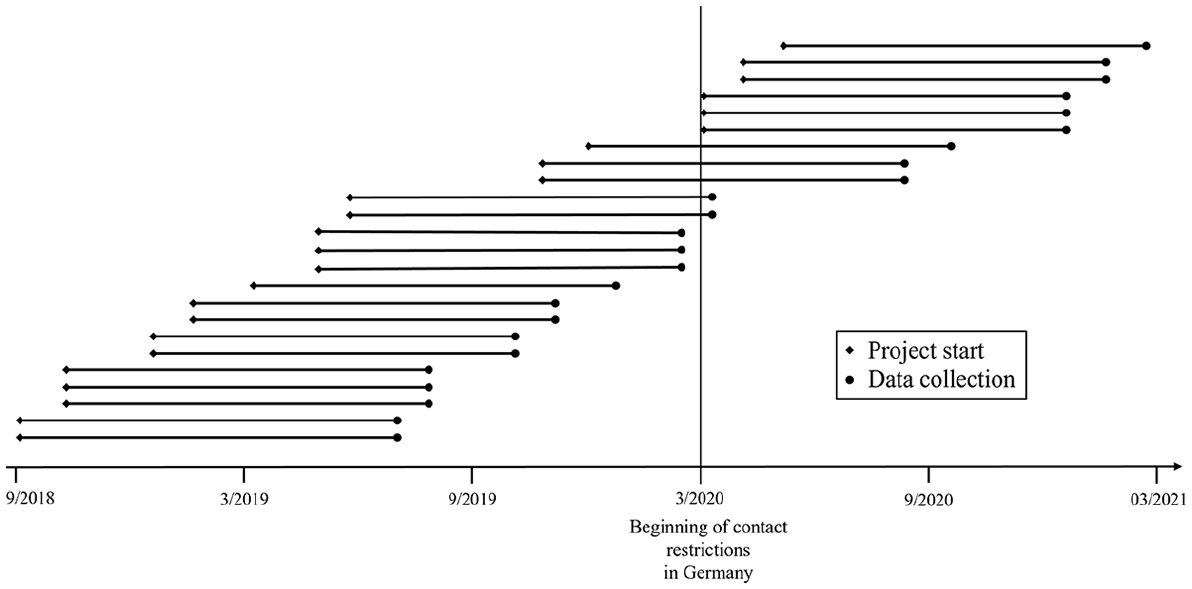
Timing of project starts, data collection, and contact restrictions.
Importantly, the timing of project applications and their subsequent approval enables us to mitigate potential biases that could have otherwise impacted our results negatively. All the projects analyzed here had applied for funding by September 2019. Consequently, the project consortia had all formed and assigned work packages before the global pandemic, which forced them to virtualize their activities during the lockdown. Similarly, the funding decision that secured each project’s inclusion in this program had also been made by December 2019, before the onset of the pandemic. Consequently, we can eliminate the possibility that projects were chosen due to the selection committee foreseeing elements of virtualization that would later become prominent during the pandemic.
In sum, the timing of project applications, project approval, and project starting points are particularly favorable for the analysis intended here: It limits the possibility that differences observed in network topology are due to how project consortia were formed in the first place, as there is no reason to assume that such differences played a role in project selection. The sequence in which projects were initiated effectively amounts to a randomized treatment: The defining difference between the 24 projects is not how they were designed but rather whether they were realized in pre-pandemic conditions or during pandemic lockdown.
In many regards, the projects considered here are structurally similar and therefore suited for comparative analyses. Nonetheless, this is not a perfect experimental situation. In addition to the virtualization of collaboration, the pandemic had multifaceted impacts on participants’ lives, including constraints on childcare, the need for homeschooling, remote work mandates, significant limitations on personal interactions, and the arousal of numerous uncertainties and fears among individuals. Strictly, it is not possible to exclude the possibility that these manifold influences and pressures may have manifested themselves in the network topology of these interorganizational project teams. As these changes coincided with the virtualization of work arrangements, we could not control for their effects on the formation of instrumental and expressive networks in the project teams. However, qualitative research into relationship formation within work contexts during the pandemic indicates that the crisis tended to foster expressive interactions and relationships, as conversations about the pandemic’s impact often delved into personal matters, and social interactions frequently revolved around connections sustained throughout the pandemic (Roth & Göbel, 2022; Whillans et al., 2021). This leads us to consider the possibility that the pandemic’s effects may have counteracted the anticipated impact of virtualization on instrumental and expressive interactions; thus, our study serves as a conservative test of the presented hypotheses. We return to this issue in our discussion of empirical findings.
Methods
Data Collection
Network data were collected in all projects after approximately 1 year of project duration. At this point of measurement, 15 of the 24 project had not been driven toward virtual collaboration by the contact restrictions imposed due to COVID-19; in two cases, contact restrictions had only been put in place for a few weeks (see Figure 1). Out of the remaining nine projects, three were operating under contact restrictions for approximately half of their duration, while the other six projects were affected for the entire duration, although intermittent in-person meetings likely took place even when the project commenced under contact restrictions. Furthermore, we note that among the 15 projects that were unaffected by contact restrictions at the time of our survey, a multitude of communication processes were carried out through various communication mediums. Hence, the division presented here between projects with and without contact restrictions does not imply an absolute demarcation regarding the virtualization of collaboration. However, based on interviews we conducted with the majority of the project partners, it was inferred that in projects subject to contact restrictions, collaboration predominantly took a virtual form, whereas in projects unaffected by such restrictions, collaboration exhibited a markedly lesser degree of virtualization. By comparing these two groups, we can therefore discern the distinct impacts of collaboration virtualization on the development of expressive and instrumental networks.
To survey the social networks, all individuals working in each consortium were first identified by the project leaders. Subsequently, an online questionnaire was sent to the members of each project team (M = 11.5 people per team). Each survey participant was asked to evaluate the strength of their instrumental and expressive relations with each of their team colleagues from partner organizations on a seven-point Likert scale (1 = “none at all”; 7 = “very strong/to a great extent”). The question used to assess instrumental relations was, “To what extent did you discuss professional issues beyond the project work with . . .?,” and the question to assess expressive relations was, “To what extent did you talk to . . . about private issues?.” To aid recollection, a full roster method was employed, that is, each participant was provided with the names of all individuals in their project (Marsden, 2005).
Respondents were not required to evaluate their relations with their direct colleagues, that is, coworkers who work for the same organization. Direct colleagues were excluded for two main reasons. First, relations among coworkers are different in nature from those among project participants. Relations among coworkers are likely shaped by intraorganizational social, formal, and spatial structures (Roth & Diefenbach, 2021; Tortoriello et al., 2012) that differ widely across the project team partners. Moreover, as direct colleagues represent and work for the same organization in the project team, their relation will likely be stronger than those between team members who work for different organizations (Margolis, 2020). Second, assessing the strength of an individual’s relationships with immediate colleagues alters the underlying scales of the survey, consequently affecting individual assessments. During the questionnaire completion process, respondents gauge the queried relationships against one another (Borgatti & Halgin, 2011; Brands, 2013). Due to the representation of several organizations by just one person, we would have had to inquire about direct colleagues from some participants and not from others, which would have led to varying evaluation benchmarks among respondents. To avoid ensuant biases as well as possible conflicts of interest arising from mutual evaluations of direct colleagues, we limited the network survey to encompass only social relations maintained with project team members from different organizations.
Missing data create well-known problems for the comparative analysis of social networks and their structures (Glückler & Hammer, 2013; Kossinets, 2006; Smith et al., 2017). To mitigate such problems, an exhaustive survey was attempted. All participants were provided with detailed information about the survey. In individual cases, team coordinators followed up with nonrespondents. This approach led to the recruitment of a total of 274 out of 276 individuals who were approached for participation. The two nonrespondents were in three different projects, and in all three cases, data was collected from at least one other person in their organization. Consequently, we have a complete dataset of interpersonal relations connecting individuals from 157 organizations operating in 24 project consortia. Overall, a total of 2,746 directed and weighted expressive ties were collected, along with an equal number of instrumental ties. Among the 15 projects surveyed prior to contact restrictions, there were 1,557 relationships, while among the nice projects surveyed after contact restrictions, there were 1,189 relationships.
Data Analysis
The analysis aims to compare network density, clustering, and cohesion in the networks from the virtual collaboration projects with those in the physical collaboration projects. To carry out the analyses, the participants’ assessments of the strength of their instrumental and expressive ties to their team-mates were merged into 24 network graphs.
For each pair of individuals, we have two scores each for instrumental and expressive ties: one representing the intensity of ties from A to B and the other from B to A. This raises the question of how to account for differences in perceived tie strengths (Carley & Krackhardt, 1996). As the network measures that we consider in this paper (density, clustering, and cohesion) are most straightforward to interpret for undirected graphs (Wasserman & Faust, 2014), we merged individuals’ assessments at the dyadic level by summing the weights of incoming and outgoing ties. This yields an undirected network with tie strengths ranging between 0 (neither party acknowledges the other, 0 + 0 = 0) and 12 (both individuals report having interacted to a great extent, 6 + 6 = 12). The mutual evaluation of each relation by both individuals increases the validity and comparability of the weights (Brands, 2013; Krackhardt, 1987).
To construct the networks, we merged person nodes into organizational nodes. This seemed appropriate to our analytical objectives for two main reasons. For one, the intraorganizational distribution of work among direct colleagues will differ by organization, as they are shaped by organization-specific social, formal, and spatial structures (Roth & Diefenbach, 2021; Tortoriello et al., 2012). For example, two representatives of the same organization might (a) participate equally in all project-related activities and complete every single task together or (b) divide the work among themselves so that only one person is in close contact with the other project partners while the other remains in the background. Whereas scenario (a) likely results in two moderately strong sets of relations, scenario (b) likely results in divergent networks, with one person deeply integrated and the other’s network characterized by many weak relationships. Second, as we laid out in the preceding section on “data collection,” we decided early on not to collect data on direct colleagues. This decision was taken to avoid possible conflicts of interest arising from evaluating direct colleagues, as well as to avoid possible priming effects for evaluation of the remaining interorganizational relations. Since we did not survey intra-organizational relations, isolating the impacts of intra-organizational work distribution seems unfeasible. By aggregating individuals into organizational nodes and considering the strongest relationships between organizations for each work team, the importance of the intra-organizational division of labor is minimized, and the resultant networks capture the strengths of interorganizational relationships.
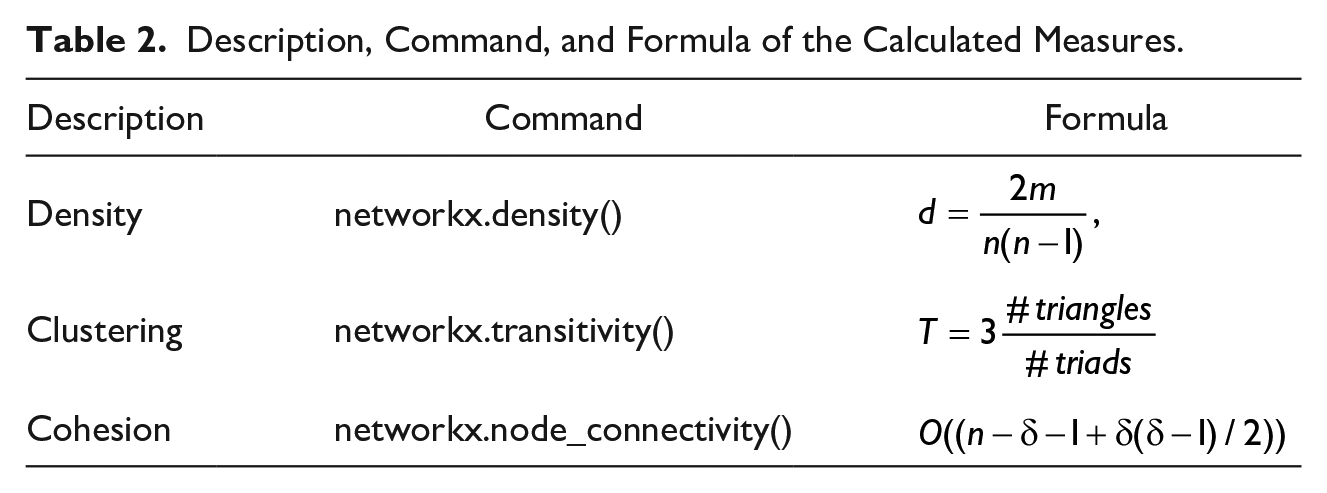
The 48 networks (24 instrumental and 24 expressive) were analyzed in Python, using the package NetworkX. To account for the weighted ties, each network was divided into 12 network layers according to the weight of the ties. For each additional level, the filter criterion was increased by one point. Thus, the first level contains all relationships with a value of 1 or more, and the graph at the final level consists only of relationships weighted by the maximum value of 12. Figure 2 depicts two exemplary expressive networks at three cut-off points (1+, 5+, and 9+). To describe the weighted graphs in terms of density, clustering, and cohesion, the corresponding measures were determined for each of the 12 levels and their mean was calculated (see Table 2). To facilitate comparability between the three measures, the density, clustering, and cohesion scores were normalized to range between 0 and 1.
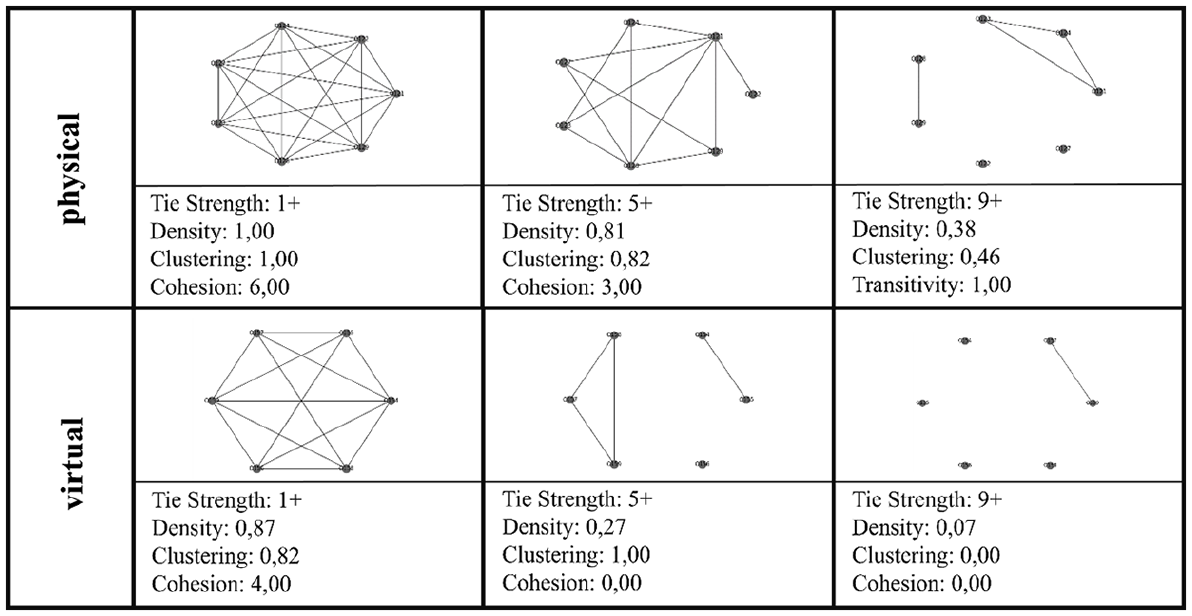
Selected expressive networks from a physical and a virtual project.
Description, Command, and Formula of the Calculated Measures.
The cross-level mean values of the three measures were calculated for the instrumental and expressive networks in all 24 projects. Subsequently, the mean values were compared between the nine virtual collaboration project teams and the 15 pre-pandemic collaboration teams. A systematic comparison of means was then conducted using two-tailed t tests with 95% probability (Bonett & Price, 2002). To test hypotheses 3, 6, and 9, the differences between virtual and physical collaboration projects related to expressive and instrumental networks were contrasted using a difference-in-difference statistical design to test whether the virtualization of collaboration had different effects on expressive and instrumental networks (Abadie, 2005). To test the significance of the correlations, linear regressions were conducted (Draper & Smith, 1998).
Results
In the following, we report the results of the hypotheses tests. Following the order of the hypotheses, we first discuss network density, then clustering, and finally cohesion.
Network Density
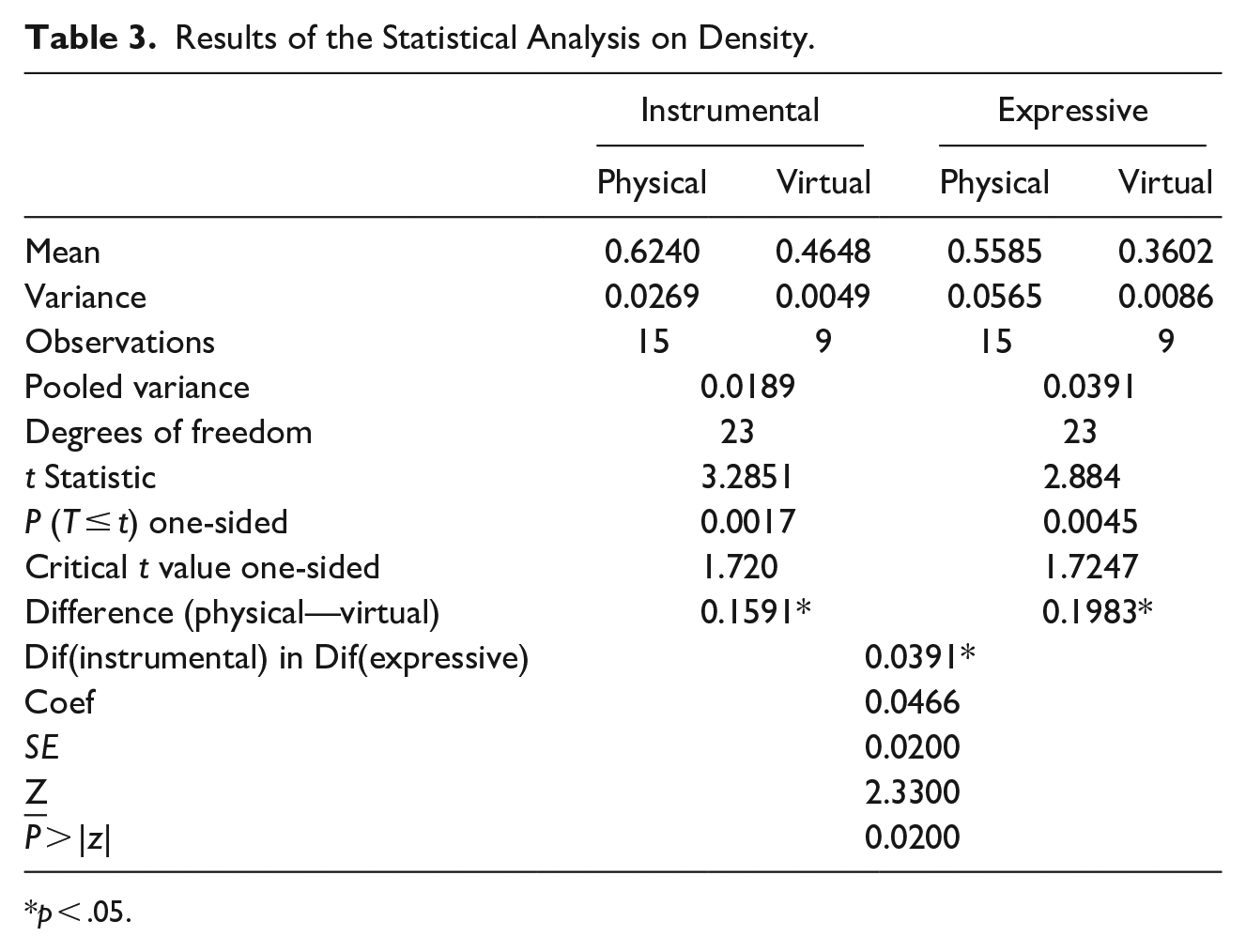
The first three hypotheses are related to the density of the two interaction networks. We first hypothesized that both expressive and instrumental networks would have a lower density in the virtual collaboration projects than in the physical collaboration projects (H1 and 2). The comparison of mean values supports both assumptions. The density of the instrumental networks is 0.62 in physical collaboration projects and 0.46 in virtual ones. Thus, the density is 0.16 points lower in the virtual collaboration, and the t test confirms the significance of this difference (see Table 3). In the expressive networks, the density in physical collaboration projects is 0.56 and 0.36 in virtual ones. The density of the expressive networks is thus 0.20 points lower in the virtual collaboration projects and this difference is also significant (see Table 3).
Results of the Statistical Analysis on Density.
p < .05.
We hypothesized that the virtualization of collaboration affects the density of expressive networks more than it affects the density of instrumental networks (H3). With a value of 0.20, the virtualization effect is 0.04 points larger in the expressive networks than in the instrumental networks, supporting H3. The meaning of these differences can be illustrated by comparing networks with the corresponding properties. A difference of 0.1 can mean that each team member maintains three ties of at least medium strength instead of two. The linear regression for the difference-in-difference analysis also shows a significant correlation (see Table 3), indicating support for all three density-related hypotheses.
Network Clustering
Network clustering describes the extent to which a network is composed of loosely interconnected silos of relationships. Hypotheses 4 and 5 suggest that both expressive and instrumental networks tend to become more fragmented in virtual settings than in-person workplaces because there are few interaction opportunities in virtual collaboration beyond task-related and media-mediated meetings.
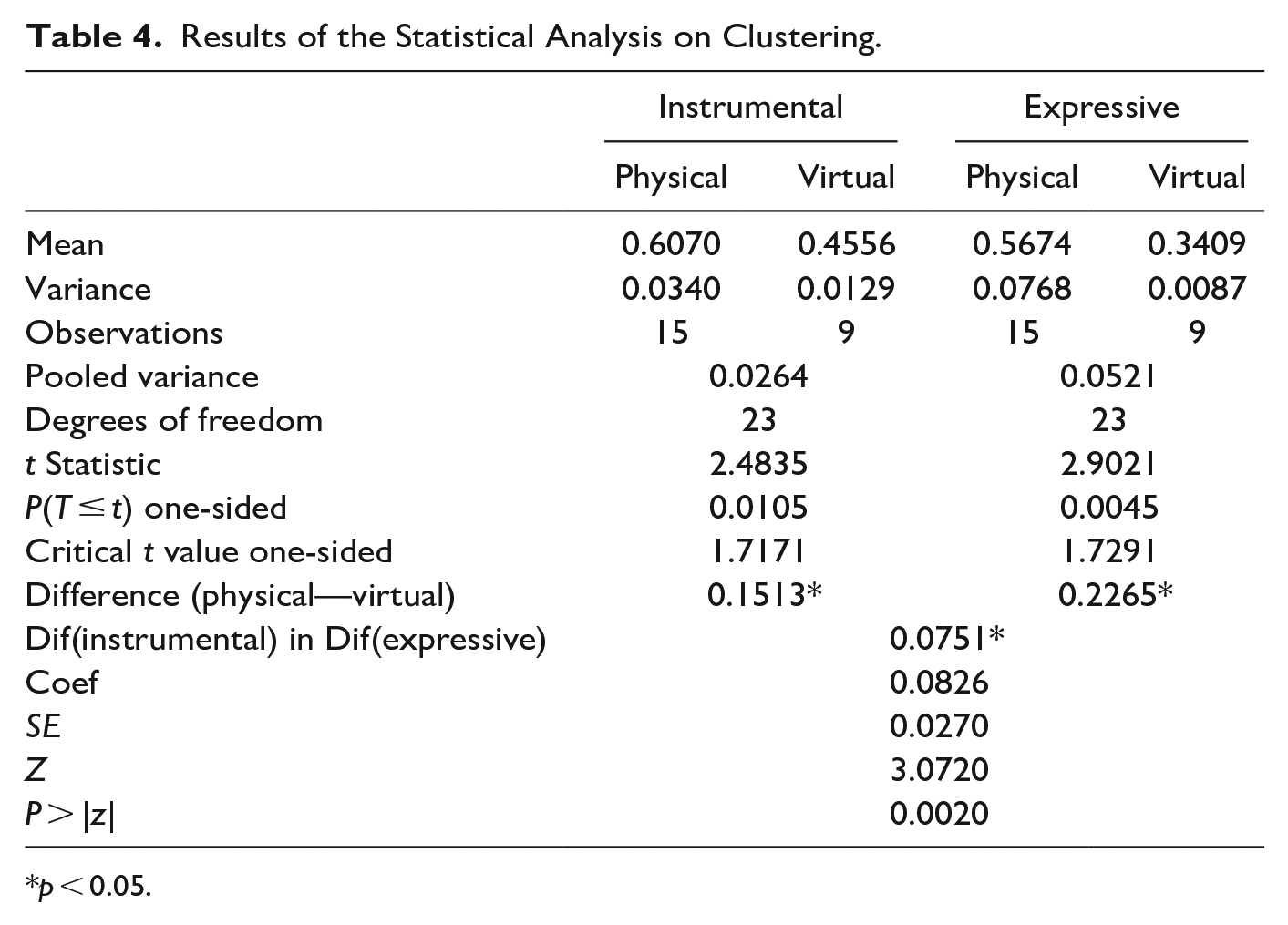
Both hypotheses are supported by the data. The clustering coefficient in the physical collaboration projects is 0.60, but it is only 0.45 in the virtual ones, which is 0.15 points lower (see Table 4). For the expressive networks, the clustering coefficient is 0.57 in the physical collaboration projects and 0.34 in the virtual projects, which is also significantly lower (see Table 4). Corresponding to these significant differences, results of the t test indicates that the mean values differ from each other with a probability of 95% (see Table 4).
Results of the Statistical Analysis on Clustering.
p < 0.05.
We also predicted that the effect of virtualization on clustering would be stronger for expressive than for instrumental networks because expressive interactions are more dependent on unplanned encounters (H6). In line with this hypothesis, the effect for the expressive networks is 0.08 points higher. The linear regression for the difference-in-difference analysis also shows a significant correlation, supporting H6 (see Table 4).
Structural Cohesion
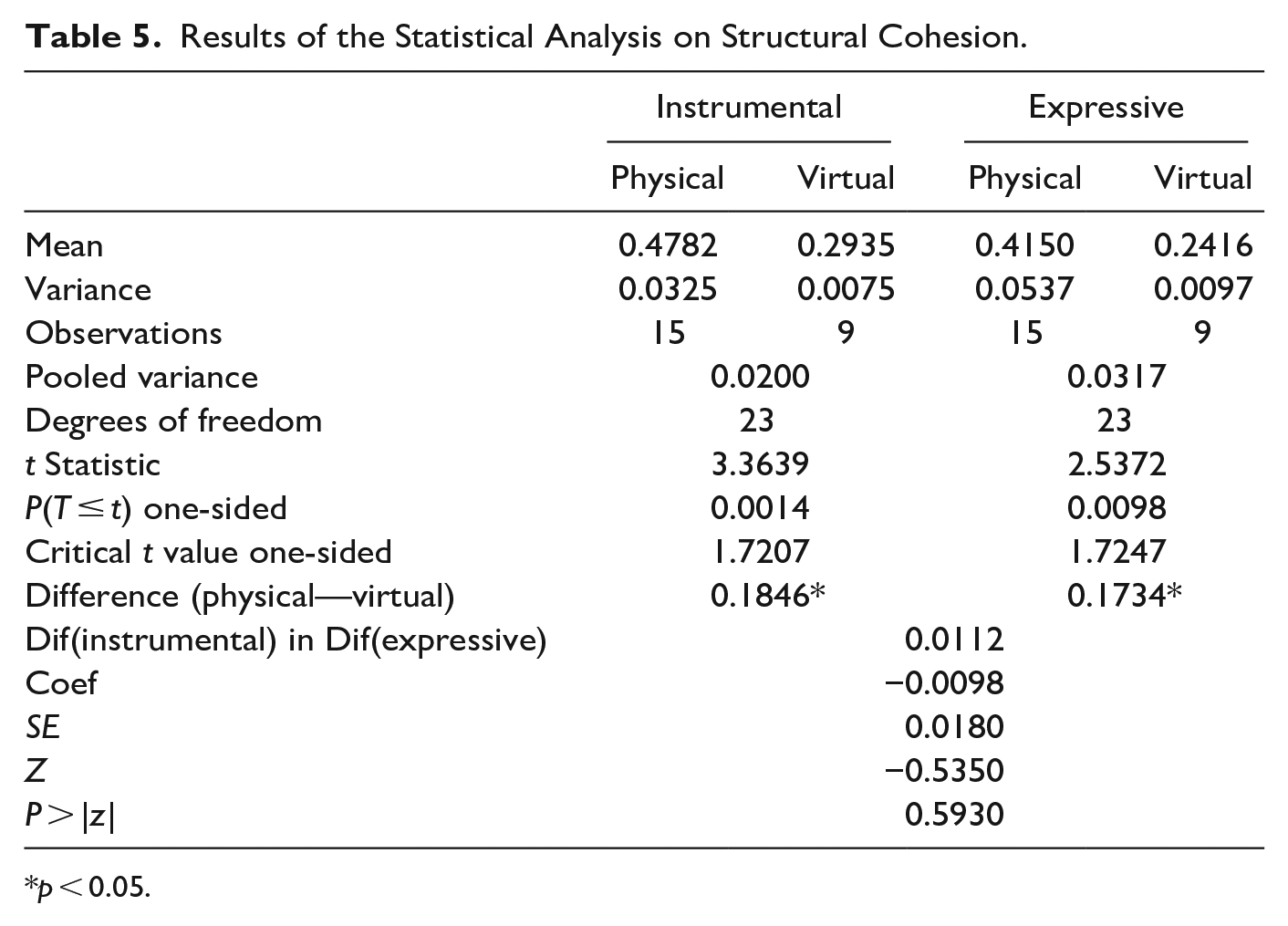
Structural cohesion describes how well all individual members are integrated into a team’s network, as quantified by how well they are connected to their fellow team members. Our discussion of the literature has led us predict a dampening effect of virtualization on structural cohesion in both expressive and instrumental networks (H7 and H8). Both hypotheses are supported. While structural cohesion in the physical collaboration projects is 0.48 on average, it is 0.29 on average in virtual projects, which is 0.18 points lower (see Table 5). For the expressive networks, the cohesion coefficient is 0.42 in the case of physical collaboration projects and 0.24 in the case of virtual projects, which is also significantly lower (see Table 5). Corresponding to these significant differences, the results of the t test indicate that the mean values differ from each other with a probability of 95% (see Table 5).
Results of the Statistical Analysis on Structural Cohesion.
p < 0.05.
Finally, hypothesis H9 predicted that the effect of virtualization on structural cohesion would be stronger for expressive than for instrumental networks. This hypothesis draws on the assumption that instrumental network cohesion is promoted through project-related coordination efforts, recommendations, and brokerage. In a professional context, project coordination and recommendations primarily pertain to professional expertise rather than private issues. In line with this reasoning, the relative effect of virtualization on the expressive networks is 0.01 points higher than it is for the instrumental networks. However, as the small difference already suggests, the linear regression for the difference-in-difference analysis shows no significance at a significance level of 0.05 (see Table 5).
In summary, consistent with our arguments, our analysis suggests that virtualization of collaboration impedes the formation of expressive relationships more than the formation of instrumental relationships overall. No significant difference is found, however, with respect to the effects of virtualization on structural cohesion in expressive and instrumental networks. The extent of structural cohesion is particularly influenced by strong relationships between subgroups in teams. The fact that we did not find significant differences between expressive and instrumental networks can be explained by the multiplex nature of these subgroup relationships indicating that expressive and instrumental relationship dimensions are more strongly coupled. Strong instrumental relationships between subgroups accordingly either presuppose strong expressive relationships or are driven by the same factors as these (e.g., informal contact opportunities). The absence of a significant difference with respect to structural cohesion is accordingly consistent with our more general finding that the virtualization of collaboration affects expressive networks more than instrumental ones.
Discussion
Whether formal members of a team work together successfully as a team depends on their ability to develop a cohesive network of personal relations among one another (Delfgaauw et al., 2022; Tortoriello et al., 2012). The COVID-19 pandemic has driven a dramatic increase in the number of virtual teams in recent years. Our study contributes to a better understanding of the implications of virtualization for social cohesion in teams. As predicted by our theory, the virtualized teams in our sample overall exhibited a lower average strength of ties, as captured by network density. Furthermore, our analyses found that virtualized collaboration resulted in fragmented networks of loosely interconnected subgroups; virtualization thus affected the structure of team networks, notably their clustering and structural cohesion. Fragmented networks are less cohesive because team members form cliques that are weakly interconnected. Prior research has shown that such siloed social structures reduce cohesion in teams and impair performance because the individual cliques in the team network are less likely to communicate with each other and are more likely to develop and pursue conflicting interests (B. A. Burt et al., 2022; Tortoriello et al., 2012; van der Voet & Steijn, 2021). This suggests that the virtualization of collaboration might have broader structural implications beyond just reducing the average tie strength, as it influences the entire network topology. These adverse effects of team network fragmentation on cohesion seem especially relevant when teams must tackle complex tasks that require high levels of motivation, openness, and coordination.
Our findings contribute to a more general debate on the formation of social networks. Research in this field has focused strongly on individuals’ preferences and their rational choices in the past (Casciaro et al., 2015). However, some recent research suggests that the formation and maintenance of personal relationships are instead governed to a large extent by everyday opportunities for interaction (Roth, 2023; Roth & Mattes, 2023; Small & Adler, 2019). Our findings support this view: virtualization of collaboration represents a shift in the landscape of everyday interaction opportunities. Based on our findings, it is indicated that interactions in virtual teams mostly occur around formally shared work packages, whereas in physical teams, everyday opportunities for serendipitous encounters, such as coffee breaks and business trips, are an important driver of interactions. Thus, our findings highlight the pivotal importance of everyday opportunities for interaction in the formation of personal relationships.
Furthermore, our differentiation of expressive relations from instrumental ones suggests that the virtualization of collaboration affects expressive networks, which are particularly important for teams to establish trust and commitment, more than it affects instrumental networks, in which technical knowledge is exchanged. This in turn indicates that the formation and maintenance of expressive relationships are even more dependent on specific opportunities for interaction than instrumental ties. We conclude that specific types of relationships require interaction opportunities with distinct characteristics. Consequently, for future research, a more intricate investigation could be valuable in exploring which type of interaction is favored by particular characteristics of encounters. This may include the investigation of spatial arrangements, demography, social activities, and so forth.
A limitation of our study is that the virtualization of collaborations considered here was unplanned and driven by the COVID-19 pandemic. While this holds the great advantage that all the projects considered were set up in the same way and are therefore comparable in terms of consortia composition, goal setting, and project team design, our data do not allow us to cleanly distinguish between the effects of virtualization and those caused by the pandemic. Nevertheless, ongoing research on the pandemic’s impacts provides a context for interpreting our results. One noteworthy observation is that the pandemic has led individuals to discuss their personal situations and the pandemic’s personal implications within professional settings (Karl et al., 2022; Roth & Göbel, 2022; Whillans et al., 2021). Accordingly, it is conceivable that the disparity between the effect of virtualization on instrumental and expressive networks demonstrated in this paper would have been even more pronounced had virtualization proceeded without the pandemic. Additionally, research indicates that many individuals utilized the newfound time during the pandemic to increase their engagement with work and their colleagues (DeFilippis et al., 2022; Yang et al., 2022). Hence, we have reason to believe that the pandemic prompted members of virtual teams to allocate more time to nurturing deeper social relationships with each other. Overall, we posit that the pandemic likely mitigated the outlined effects of virtualization on network topology, suggesting that the establishment of cohesion and expressive relationships within virtual teams could have been further compromised in the absence of the pandemic.
Conclusion
The virtualization of collaboration is currently being driven by the lessons learned from the COVID-19 pandemic, technological progress, efforts to increase resource efficiency, and employees’ increasing flexibility requirements. In essence, the unfolding scenario resembles an experiment with an uncertain outcome. Established notions about the prerequisites for successful collaboration are being reevaluated, and the urgency of determining how virtualization of teamwork can or should be approached is becoming increasingly evident. Our findings suggest two recommendations. First, the overall network cohesion within teams becomes compromised when relationships are predominantly established and sustained along shared work packages, which leads to the isolation of cliques within teams. To avoid fragmented teams, collaboration should be designed to encourage contact among members who are not formally connected. One approach to achieve this is to assign weakly connected team members to work packages, thereby enhancing their interactions with one another. This could be accomplished, for example, by intentionally diversifying team member combinations.
Second, our findings indicate that the development of the expressive dimension of relationships is particularly challenging in virtual teams. One approach to counteracting this is for managers to deliberately develop media-mediated communication formats that foster unplanned encounters and expressive interactions. Depending on the working environment and team context, examples might include rotating interaction schedules, matched lunch events, and break-out sessions during team meetings. In light of our findings, however, designing appropriate hybrid work modes that include occasional in-person gatherings and physical settings that support group cohesion and expressive interactions appear especially promising.
Footnotes
Acknowledgements
We thank Associate Editor Dennis Kivlighan, three anonymous reviewers, Ronja Rieger, Simone Kauffeld, and Isabel Zorn for valuable feedback on earlier versions of this paper.
Declaration of Conflicting Interests
The author(s) declared no potential conflicts of interest with respect to the research, authorship, and/or publication of this article.
Funding
The author(s) disclosed receipt of the following financial support for the research, authorship, and/or publication of this article: This work was supported by the Bundesministerium für Bildung und Forschung, European Social Fund (grant number 02L17C000).
