




Abstract
To address the increased need of understanding how interdependence affects virtual team performance, we experimentally manipulated process interdependence and resource interdependence in 102 virtual teams. We examined effects on team processes and team task and creative performance. Increased process interdependence improved both types of team performance, whereas resource interdependence decreased creative performance. Further, process interdependence was most beneficial for task performance when resource interdependence was low. Contrary to expectations, team processes did not mediate these relationships. We contribute to a fuller understanding of how interdependence influences key performance criteria in virtual teams and provide practical implications for designing virtual teamwork.
Virtual teams are commonplace in today’s organizations (Handke et al., 2020). Defined as “groups of geographically and/or organizationally dispersed co-workers that [use] telecommunications and information technologies to accomplish an organizational task” (Townsend et al., 1998, p. 18), the use of virtual teams has been expedited by the COVID-19 pandemic and ensuing lockdowns. Now that most pandemic-induced restrictions have been removed, many have suggested that virtual teamwork represents the “new normal” (e.g., Chamakiotis et al., 2021; Kniffin et al., 2021) and is here to stay (e.g., Alexander et al., 2021; Gartner, 2020; Sethi et al., 2020).
Despite its prevalence, virtual teamwork comes with challenges that can be detrimental to team performance, such as increased isolation, reduced interpersonal contact, reduced communication richness, loss of social cues, and more frequent instances of interpersonal conflict and task-related ambiguities (Hertel et al., 2005; L. Martins et al., 2009; Morrison-Smith & Ruiz, 2020). A key success factor is the level of task interdependence between team members, as highlighted in Handke et al.’s (2020) review study on virtual team work design. However, one prevailing problem in our understanding is that there are studies finding positive effects (e.g., Dennis & Valacich, 1994; Ortega et al., 2010) and others finding negative effects (e.g., Faddegon et al., 2009; Rico & Cohen, 2005) of task interdependence on virtual team functioning and effectiveness. These mixed research findings might be the result of task interdependence having been operationalized in different ways across studies (Courtright et al., 2015; Handke et al., 2020). Aligned with Courtright et al.’s (2015) integrative model of team interdependence, Klonek et al. (2022) differentiated between two dimensions of task interdependence—process interdependence and resource interdependence—and used an experimental approach to explore their interactive effects on virtual team processes and team performance. In their study of 54 virtual teams, in which team members communicated via a text-based chat forum to collaboratively design a flyer, Klonek et al. (2022) found that process interdependence improved team processes, whereas resource interdependence deteriorated their task performance; but the two interdependence dimensions did not interact to affect outcomes.
Klonek et al.’s (2022) study had some limitations, including small sample size leading to low statistical power to detect interactions, low external validity in the operationalization of team virtuality, and only a single, narrow performance outcome, without including a mechanism to explain how interdependence is linked to this outcome. As a result, two key questions have still not sufficiently been answered. First, what are the combined effects of the different dimensions of task interdependence on virtual team performance? Second, how does task interdependence affect virtual team performance? Our study aimed to answer both questions. To overcome limitations of Klonek et al.’s (2022) study and answer the first question, we conducted a substantive constructive replication (cf. Köhler & Cortina, 2021): we retained the virtues of the original study (i.e., experimental manipulation of interdependence levels, the team task, and independent performance ratings), whilst adding several methodological improvements. First, to increase statistical power to detect an interaction effect between the two dimensions of task interdependence, we almost doubled the sample size. Second, to improve the external validity of the operationalization of virtuality, in the current study, team members collaborated using the Microsoft Teams virtual meeting platform, instead of only a text-based chat forum. The restriction to only text-based chat is less reflective of how virtual collaborations take place in the real world, where the use of videoconferencing features, such as those offered in Microsoft Teams, is commonplace. We acknowledge that this meant a change in communication media richness (Daft & Lengel, 1986), but for our study to be a constructive replication with improved external validity, more closely mirroring the current working methods of virtual teams was key. Third, to acknowledge that team performance is a much wider construct than merely meeting the team’s task requirements (Gilson et al., 2015), and in light of the growing focus on the possible benefits of virtual teamwork on creativity and innovation (e.g., Alahuhta et al., 2014; Chamakiotis et al., 2013; L. L. Martins & Shalley, 2011; Ocker, 2005), we investigated not only task performance, but also creative performance.
To address the second question, that is, how does task interdependence affect virtual team performance, we drew upon current thinking about team functioning (e.g., Courtright et al., 2015; Ilgen et al., 2005; J. Mathieu et al., 2008), and investigated the role of team processes as the mechanism linking task interdependence with team performance. This is in contrast to Klonek et al.’s (2022) theorizing, which positioned both team processes and performance as outcomes. In the next sections, we briefly review task interdependence and team processes, and how they are interconnected and linked to team performance. Figure 1 shows our research model.
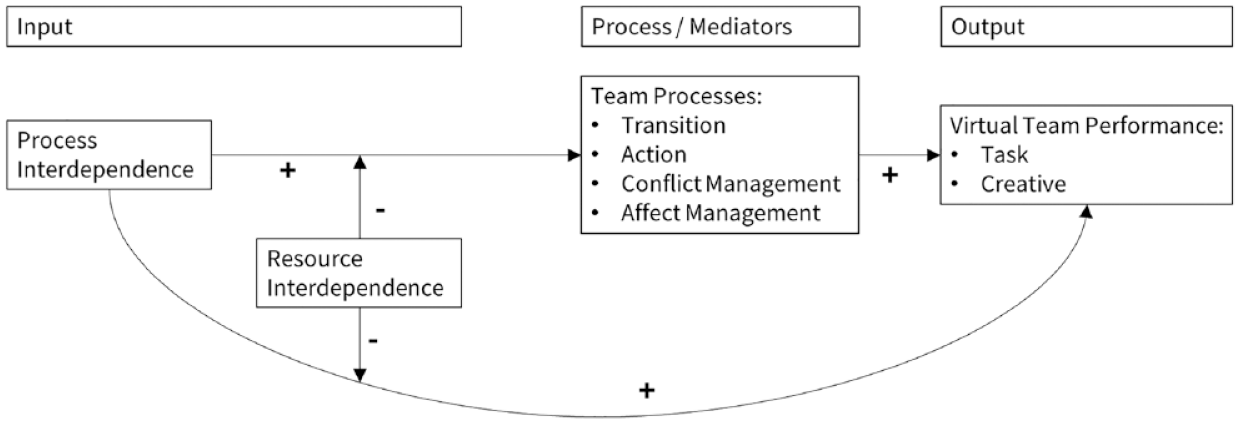
Research model.
How Do Different Dimensions of Task Interdependence Affect Virtual Team Performance?
From the two dimensions of task interdependence distinguished in Courtright et al.’s (2015) integrative model of team interdependence, we propose that each dimension plays a distinct role in virtual team performance, which explains the mixed findings that we described earlier. We argue that process interdependence is beneficial for performance, whereas resource interdependence is detrimental. We expand our arguments below.
Process interdependence refers to the interconnectedness between team members in regard to workflow (Courtright et al., 2015). For example, consider the case of a virtual team that has to write a report. Process interdependence is low if each member of the team is responsible for a certain section of said report, such that one team member cannot begin working on their section until another member shares their section, for example, via email. When process interdependence is high, the team is responsible for the report as a whole and is able to collaboratively work on the report simultaneously—perhaps in an application like Google Docs—where other team members’ work can be seen as it happens in real-time.
We propose that process interdependence is performance-conducive for virtual teams. As argued by Courtright et al. (2015), if workflow is structured so that team members have to engage and collaborate with each other to complete their job, this sets the stage for frequent interactions and more coordination, leading team members to become more familiar with each other’s capabilities. This in turn allows them to optimally use the team’s capabilities to benefit team performance. Providing empirical support for this theoretical argument, Courtright et al.’s (2015) meta-analysis showed a positive correlation of process interdependence with overall team performance across 31 studies. Overall team performance in these studies covered both efficiency and quality, that is, how well or accurately the team tasks were completed, which is considered team task performance in the present study. In regard to creative performance, Bodiya (2010) found a positive link between virtual team task interdependence—operationalized as workflow interconnectedness, hence reflecting process interdependence—and creativity. Furthermore, Ocker (2005) found that collaboration—which is more likely to occur under conditions of high process interdependence—was beneficial for virtual team creative performance. Based on these theoretical and empirical arguments, and to replicate Courtright et al.’s (2015) findings in a sample exclusively consisting of virtual teams, we hypothesize:
H1: Process interdependence has a positive effect on virtual team (a) task performance and (b) creative performance.
Resource interdependence refers to the interconnectedness between team members when it comes to accessing critical resources (Courtright et al., 2015), such as skills, data, materials, and information. Returning to the example given previously of the report-writing virtual team, resource interdependence is low if each team member has access to all the available information about topics to be covered in the report. Conversely, resource interdependence is high if each team member only has access to a unique subset of information about topics to be covered, and depends on other team members to gain a complete picture.
In contrast to the hypothesized positive effect of process interdependence, we propose that resource interdependence is detrimental for virtual team performance. The main proposition of Media Richness Theory (Daft & Lengel, 1986) is that, for equivocal or uncertain tasks, the less rich the communication media, the worse performance will be. Media richness is lower in virtual team communications than in face-to-face communications. Aligned with this theory, Cramton and Orvis (2003) argued that, in virtual team contexts, when there is a lot of individually held information needing to be shared via virtual communication media—that is, when there are high levels of resource interdependence—problems with team performance will manifest. In support of this theoretical argument, empirical findings also highlight the negative impact of resource interdependence on virtual team performance: in their virtual team study where resource interdependence was operationalized as depending on other team members for access to information, Klonek et al. (2022) found that task performance was worse for teams working in high resource interdependence conditions than for those in low resource interdependence conditions. Based on the above, we hypothesize:
H2: Resource interdependence has a negative effect on virtual team (a) task performance and (b) creative performance.
The Interactive Effect of Process Interdependence and Resource Interdependence on Virtual Team Performance
We further propose that the two dimensions of task interdependence (i.e., process interdependence and resource interdependence) have an interactive effect on team performance. Specifically, we propose that resource interdependence weakens the positive effect of process interdependence on team performance. Positioning interdependence as a moderator aligns with recommendations made by Kozlowski and Bell (2003), who emphasized the importance of interdependence as a feature of teamwork and suggested interdependence should be considered as a moderator or as a boundary condition in all teamwork research. Empirical research focusing on (and finding) interactive effects of different dimensions of interdependence is not new. However, with the exception of Klonek et al.’s (2022) study, which, given the small sample of 54 teams, lacked power to detect interactions, research has tended to focus on interactions between other interdependence dimensions (e.g., Allen et al., 2003; Wageman & Baker, 1997), and investigated co-located rather than virtual teams.
In line with the technology-task fit proposition of Daft and Lengel’s (1986) Media Richness Theory, low media richness within virtual teams, where technology is the primary means of communication, makes it less suitable for task designs that require both high process interdependence and high resource interdependence. Instead, it is better suited for task designs that involve high process interdependence and low resource interdependence. We argue that, while teams benefit from high process interdependence, team task and creative performance is diminished when there is high resource interdependence, as the combination of high process and high resource interdependence demands an excessive amount of coordination and communication. In contrast, in teams with low process interdependence, high resource interdependence will not be as detrimental to performance because the teams will not be operating as closely to their limits for coordination and communication. Based on the above, we hypothesize:
H3: There is an interaction effect of process interdependence and resource interdependence on virtual team (a) task performance and (b) creative performance. The positive effect of high process interdependence on (a) task performance and (b) creative performance is weaker when resource interdependence is high.
The Mediating Role of Team Processes
To better understand how process interdependence and resource interdependence affect virtual team performance, we propose that team processes constitute a key mechanism through which these teamwork design characteristics relate to team performance. Team processes refer to “team members’ independent acts that convert inputs to outcomes through cognitive, verbal, and behavioral activities directed toward organizing taskwork to achieve collective goals” (Marks et al., 2001, p. 357). Three main categories of team processes are distinguished: (1) transition processes—occurring when team members reflect on past performance and plan for future tasks; (2) action processes—occurring when team members engage in monitoring, coordination, and helping behavior directly aimed at task accomplishment; and (3) interpersonal processes—occurring when team members manage their interpersonal interactions and relationships, which lay the foundation for how well the other processes work. Further, interpersonal processes can include conflict management (i.e., preventing, controlling, or working through conflict in the team) and affect management (i.e., regulating team member emotions; Marks et al., 2001).
Our arguments are based on the Input-Process-Output (IPO) model of team effectiveness (cf. Ilgen et al., 2005; Kozlowski et al., 1999; Marks et al., 2001). In this model, team processes are considered mediators through which inputs such as task interdependence affect team performance. In support of these theoretical arguments, meta-analytic evidence indicates that team processes mediate the effects of interdependence on team performance (Courtright et al., 2015). Specifically, Courtright et al. (2015) found support for the existence of indirect paths from the various dimensions of interdependence via team processes to performance. For instance, they found paths from task interdependence via task-focused team processes (e.g., transition and action processes) to team performance. In a nutshell, they found that higher levels of interdependence meant better (or higher levels of) team processes, and better team processes meant better team performance. Klonek et al. (2022) investigated team processes as outcomes of high versus low levels of process interdependence and resource interdependence. To our knowledge, they were the first to distinguish between these two dimensions of task interdependence in a study of virtual team functioning. They found that teams with high process interdependence had higher levels of transition, action, conflict management and action management processes. However, since their study had a different aim (investigating the impact of COVID-19 related lockdowns on team processes) they did not test the mediating path from interdependence to team performance via these different team processes, they positioned team processes as outcomes. Yet, understanding the mediating mechanisms between inputs and outputs in virtual teams is critically important to advance theory and derive practical implications for virtual teamwork. In other words, we contribute to the growing literature (e.g., Dulebohn & Hoch, 2017) that applies the IPO model of teamwork to virtual team contexts.
In line with the positioning of team processes as mediators between team inputs and outputs (e.g., Courtright et al., 2015; J. Mathieu et al., 2008), we propose that the combined effects of process interdependence and resource interdependence on virtual team performance will be mediated through team members‘ interactions—that is, team processes. In other words, team processes are a mechanism through which process interdependence and resource interdependence are linked to team performance outcomes. In this relationship, process interdependence is the predictor variable. The various types of team processes (transition, action, conflict management, and affect management processes) act as parallel mediators. Task and creative performance are the two types of outcomes of interest.
As per our earlier hypotheses, resource interdependence is expected to moderate the direct path from process interdependence to team performance. Additionally, we also expect that resource interdependence will moderate the first stage of the indirect path of process interdependence via team processes to performance outcomes. After all, it is the combined effect of the two dimensions of interdependence that sets the scene for the team members’ interactions, and in turn, team performance. Specifically, we propose that resource interdependence will weaken the positive link between process interdependence and each of the team processes, and also weaken the positive link between process interdependence and both performance types.
H4: The positive effect of process interdependence on virtual team task performance is (a) partially mediated by team processes (transition, action, conflict management, and affect management processes); with resource interdependence weakening the positive effect of process interdependence (b) on each of these four team processes and (c) on task performance.
H5: The positive effect of process interdependence on virtual team creative performance is (a) partially mediated by team processes (transition, action, conflict management, and affect management processes); with resource interdependence weakening the positive effect of process interdependence (b) on each of these four team processes and (c) on creative performance.
Method
Participants
An a priori power analysis using G*Power Version 3.1 (Faul et al., 2009) indicated that 81 teams were needed to test our core, interaction hypothesis (H3), that is, if a model with the interaction effect explains significantly more variance than the model without the interaction effect. The base model consisted of five variables (three covariates, a predictor, a moderator) and the interaction model included an additional variable. We assumed a small effect size of f2 = 0.10 and sought to achieve 80% power at p < .05. Therefore, we aimed for a sample of at least 100 teams, which should be sufficient for testing hypotheses 1, 2, and 3. We acknowledge that this sample size offers much lower power for testing hypotheses 4 and 5, for which we were unsure what effect sizes to expect. Preacher et al.’s (2007) simulation study investigating Type I error and power for testing moderated mediation models like those in hypotheses 4 and 5 indicated that a sample of 100 offers a power of 0.11 for medium effect sizes of 0.14, and a power of 0.95 for large effect sizes of 0.39.
We collected data from 102 virtual teams (N = 346) consisting of 53 teams of four members, 36 teams of three members, and 13 teams of two members, made up of students from an Australian university, for whom research participation forms part of achieving learning outcomes. Allocation to teams happened based on participant availability for scheduled timeslots. Participants were free to sign up for the same time slot as others they already knew. Whilst the targeted team size was four members, the study was designed so that a team could go ahead even if one or two of the four participants who had signed up for a team in a given time slot was unavailable. Participants ranged in age from 16 to 64 years old (M = 24.5; SD = 9.0). Of those that reported gender, 74% identified as female and 26% as male. There were no differences between team sizes with regard to age, F(2,95) = 0.07, p = .983, and gender ratio, F(2,95) = 1.45, p = .240.
Research Design
Virtual Team Task
Team members collaborated virtually for 30 min to develop a volunteer recruitment flyer for the Cancer Council’s Transport to Treatment service. Using their own computer, they joined a Microsoft Teams virtual meeting with audio, video, and text-based chat functionality from their respective separate locations for the duration of the task. The teams were given 20 content and design requirements for the flyer. The Cancer Council is an organization well-known in Australia for its support of those directly or indirectly dealing with cancer. Choosing a task for the Cancer Council, even though the organization was not actually involved in the project, was intended to maximize perceived meaningfulness of the task and to optimize participant engagement.
Experimental Manipulation of Process and Resource Interdependence
The study used a two-by-two between-groups experimental design. Teams worked under one of four randomly assigned conditions, with each condition comprising one of two levels of process interdependence (0 = low or 1 = high) combined with one of two levels of resource interdependence (0 = low or 1 = high). The four conditions were applied to the 30-min collaborative team task.
Process Interdependence
Members of teams assigned to a condition with low process interdependence were told to work sequentially, using a Word Document for the flyer, which was passed on via email, while members of teams assigned to a condition with high process interdependence were instructed to work simultaneously using a shared Google Document.
As a manipulation check (Hauser et al., 2018; Wilson et al., 2010) for the process interdependence manipulation, participants were asked to indicate their team’s workflow on a scale of four levels of process interdependence (1 = pooled workflow, 2 = sequential workflow, 3 = reciprocal workflow, 4 = intensive workflow), with higher numbers reflective of higher levels of process interdependence (adapted from Maynard et al., 2012). Analysis of the individual level data revealed that perceived levels of process interdependence were significantly higher in the high process interdependence condition (M = 2.74, SD = 1.14) than in the low process interdependence condition (M = 2.42, SD = 0.83), Welch’s F(1,298.19) = 8.80, p = .003. This indicated that the process interdependence manipulation was successful, and provided reassurance that participants were aware of the sequential or simultaneous nature of the process workflow they were assigned to. There was some agreement between team members with regard to these perceptions, ICC(1) = .34, ICC(2) = .63.
As an additional check, we also asked participants about the extent to which they complied with the task instructions regarding workflow, on a scale from 1 = not at all to 5 = fully, and the mean score calculated at the individual level indicated that participants on average mostly complied with the workflow set for the experimental condition they participated in (M = 3.75, SD = 1.06). There were no significant differences between participants in the high versus low process interdependence condition with regard to compliance, F(1,325) = 3.52, p = .062; Mlow = 3.86, SD = 1.05; Mhigh = 3.64, SD = 1.06. There was not a great amount of similarity between team members in the way they responded to this question, ICC(1) = .30, ICC(2) = .58. After aggregating to team level, there were no significant differences between teams in the high versus low process interdependence condition with regard to compliance, F(1,99) = 1.90, p = .172.
Resource Interdependence
Members of teams assigned to a condition with low resource interdependence each received the full list of 20 requirements for the flyer, while members of teams assigned to a condition with high resource interdependence each received a unique subset of task requirements (the subsets combined reflected the full list). Members of teams assigned to the high resource interdependence condition did not have access to other teammates’ subsets unless they deliberately chose to share their information with each other (which was not specified in the instructions). Hence, they depended on each other for access to information as a critical team resource.
As a manipulation check for the resource interdependence manipulation, participants were asked to respond on a scale from 1 = Strongly disagree to 5 = Strongly agree to four items regarding their perceived dependence on other team members for access to information as a key resource during the virtual team task (e.g., “Each of us had unique information for the team task”). We recoded items so that high scores reflected perceptions that resource interdependence was high. Analysis of the individual level data showed that participants in the high resource interdependence condition perceived resource interdependence to be significantly higher (M = 3.43, SD = 0.96) than participants in the low resource interdependence condition (M = 1.92, SD = 0.76), Welch’s F(1,291.23) = 247.85, p < .001. This indicated that the manipulation of resource interdependence was successful, and provided reassurance that participants were aware of the shared or unique nature of the information they had. There was substantial agreement between team members with regard to these perceptions, ICC(1) = .57, ICC(2) = .81.
Measures
Team Processes
After the team task, the participants each rated individually to what extent they agreed with the statements of 17 items from J. E. Mathieu et al.’s (2020) team process questionnaire on a scale from 1 = Not at all to 5 = To a very great extent. For each of the four team process sub-scales of this questionnaire that were included in the current study, individual scores were calculated and then aggregated to the team level (p values <.001 for the effect of team on all process subscales). Rather than calculating a composite team processes score, the four separate sub-scales were used to allow comparison of our findings to the findings that were reported for the separate sub-constructs in Klonek et al.’s (2022) study, on which our replication study was based. We conducted a confirmatory factor analysis (CFA) on the individual level dataset to test how well the team processes items were related to their four corresponding subconstructs (transition, action, conflict management, and affect management processes). The model fit statistics for the CFA model with four factors corresponding to the subconstructs, χ2(113) = 412.57, p < 001, CFI = 0.92, and RMSEA = 0.09, showed this was an above threshold fit based on a CFI threshold of 0.90 (Marsh & Hau, 1996), with the RMSEA reflecting a mediocre fit (MacCallum et al., 1996). Factor loadings ranged from 0.69 to 0.82 (M = 0.77) for transition processes, from 0.73 to 0.78 (M = 0.76) for action processes, from 0.62 to 0.78 (M = 0.71) for conflict management, and from 0.73 to 0.81 (M = 0.77) for affect management. The four-factor model was a better fit than a single factor model, χ2(119) = 594.16, p < .001, CFI = 0.87, RMSEA = 0.11. Given these fit statistics, combined with substantial evidence from the literature regarding the dimensionality or factor structure of team processes (e.g., Marks et al., 2001; J. E. Mathieu et al., 2020), as well as the opportunity to compare results to Klonek et al.’s (2022) results and uncover any potential differences between the four indirect paths, we proceeded with the four separate sub-scales.
Transition Processes
Transition processes were measured using three items, for example, “Identify the key challenges that we expected to face,” α = .80, ICC(1) = .38, ICC(2) = .67.
Action Processes
Action processes were measured using four items, for example, “Know whether we were on pace for meeting our goals,” α = .85, ICC(1) = .40, ICC(2) = .68.
Conflict Management Processes
Conflict management processes were measured using five items, for example, “Deal with personal conflicts in fair and equitable ways,” α = .83, ICC(1) = .36, ICC(2) = .65.
Affect Management Processes
Affect management processes were measured using five items, for example, “Share a sense of togetherness and cohesion,” α = .88, ICC(1) = .34, ICC(2) = .62.
Team Performance
Based on the flyers produced by the participating teams, team performance was rated by four trained and independent raters.
Task Performance
Two raters assessed the extent to which the 20 requirements specified for the flyer were incorporated, using a scoring sheet that outlined the point values assigned to each requirement (e.g., “Include at least one statement from a patient about their experience in the Transport to Treatment service”—0.5 points, and “Specify that volunteers need to have a valid driver’s license”—0.25 points; see Appendix A). The total assigned points reflected the team’s task performance, with a minimum of 0 and maximum of 10. Inter-rater reliability (Shrout & Fleiss, 1979) was high, ICC(2, 2) = .97.
Creative Performance
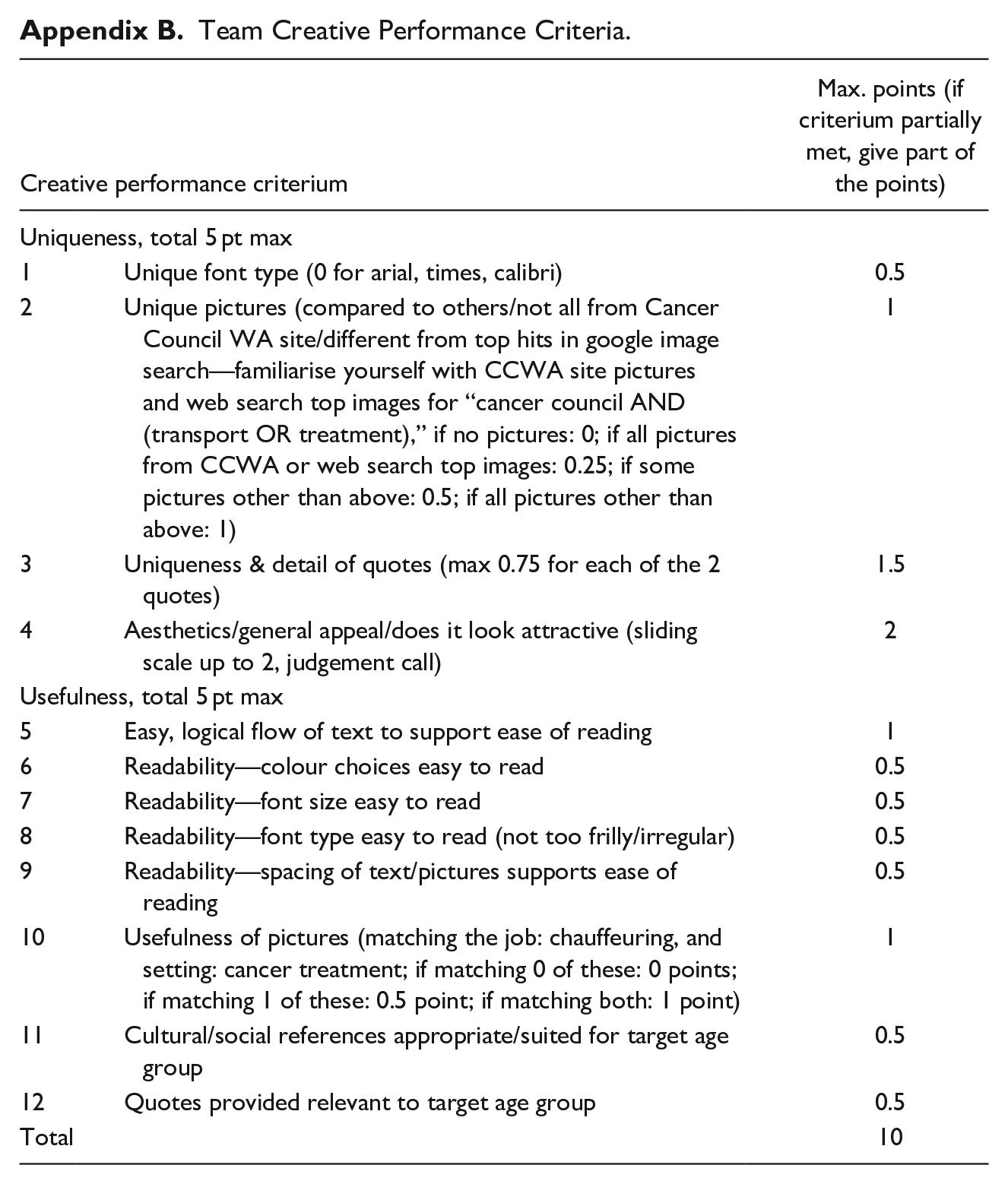
Two additional independent raters assessed the flyers’ uniqueness and usefulness as the two commonly distinguished dimensions of creativity (Amabile, 1983), using a scoring sheet distinguishing four aspects of uniqueness (e.g., “Unique pictures”—1 point) and six aspects of usefulness (e.g., “Quotes provided relevant to target age group”—0.5 points; see Appendix B). The total assigned points reflected the team’s creative performance, with a minimum of 0 and maximum of 10. Inter-rater reliability (Shrout & Fleiss, 1979) was high, ICC(2, 2) = .88.
Control Variables
We included familiarity with the team (cf. Maynard et al., 2019), experience with working virtually (cf. Krumm et al., 2016), and team size (cf. Brown et al., 2021; LePine et al., 2008; Staples & Cameron, 2005) as covariates to account for any effects they may have on the study’s focal variables, as research has shown these variables are associated with team processes and/or team performance.
Team Size
We recorded the size of participating teams, which ranged from two to four team members.
Familiarity With the Team
We asked the participants to indicate how many of the other members of their team they knew prior to working on the team task. A familiarity with the team score was calculated at the individual level by dividing the number the participant reported by the total number of team members excluding the participant (i.e., team size minus one). Individual scores were then aggregated to team level.
Experience With Working Virtually
Participants responded to the question “How experienced are you in working online (virtually) with others?” on a scale ranging from 1 = Not at all to 5 = Extremely. Individual scores were aggregated to team level.
Data Analysis
Data were analyzed at the team-level. We used Hayes (2018) PROCESS Macro for SPSS Model 1 (moderation) to simultaneously test Hypotheses 1, 2, and 3. The advantage of testing the three hypotheses together in a single model is that each focal effect would be estimated whilst accounting for the other two focal effects. We used PROCESS Model 8 (moderated mediation, with the four team processes as parallel mediators) to test Hypotheses 4 and 5. We estimated the regression models using 5,000 bootstrapped samples and heteroscedasticity-consistent standard error estimation (Hayes & Cai, 2007).
Results
Descriptives and Correlations
The means, standard deviations, and correlations for each of the measured variables are shown in Table 1.1,2
Means, Standard Deviations and Correlations.
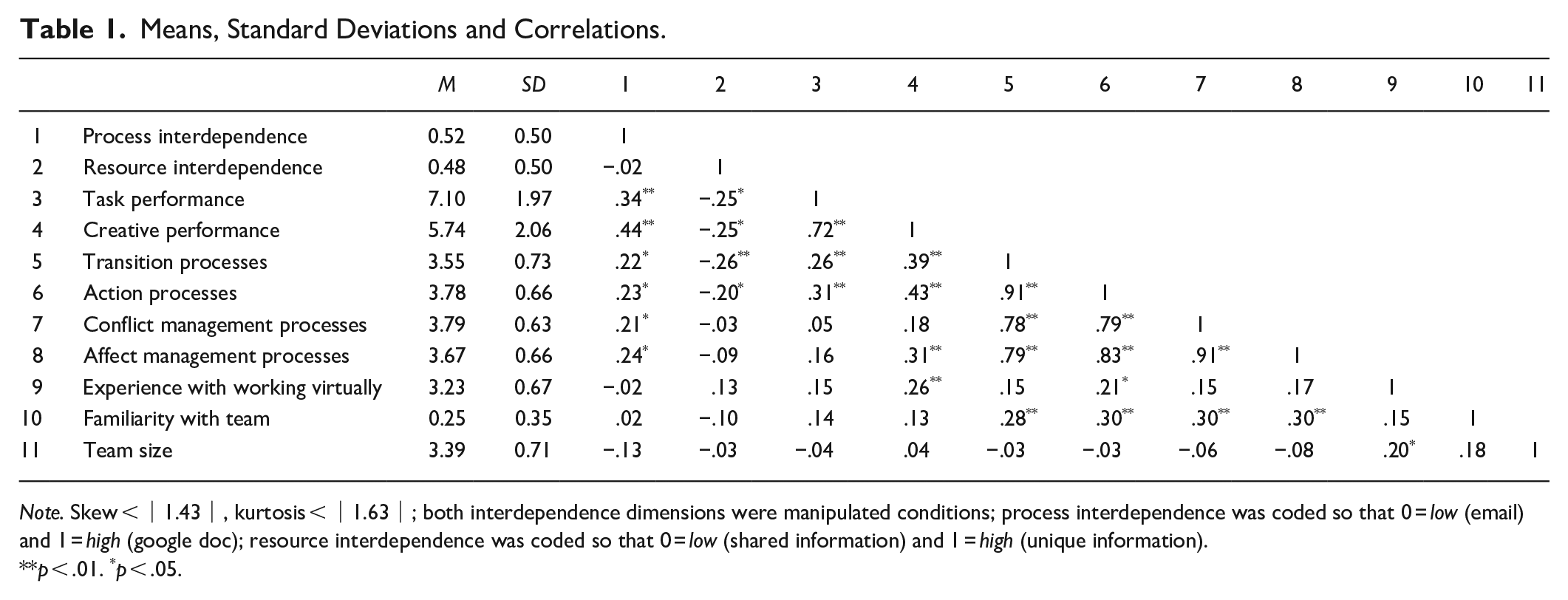
Note. Skew < │1.43│, kurtosis < │1.63│; both interdependence dimensions were manipulated conditions; process interdependence was coded so that 0 = low (email) and 1 = high (google doc); resource interdependence was coded so that 0 = low (shared information) and 1 = high (unique information).
p < .01. *p < .05.
Hypothesis Testing
H1 predicted that there would be a positive effect of process interdependence on virtual team (a) task performance and (b) creative performance. Our analysis (see Table 2) revealed a significant positive main effect of process interdependence on both task performance (B = 2.22, 95% CI [1.29, 3.15]) and creative performance (B = 2.00, 95% CI [0.96, 3.04]), supporting H1a and H1b, respectively. H2 predicted that there would be a negative effect of resource interdependence on virtual team (a) task performance and (b) creative performance. As shown in Table 2, the effect of resource interdependence on task performance was not significant (B = −0.38, 95% CI [−1.44, 0.69]), but we found a significant negative main effect of resource interdependence on creative performance (B = −1.16, 95% CI [−2.18, −0.15]). Hence, whilst H2a was not supported, H2b was supported.
Moderation Models Predicting Virtual Team Task and Creative Performance.
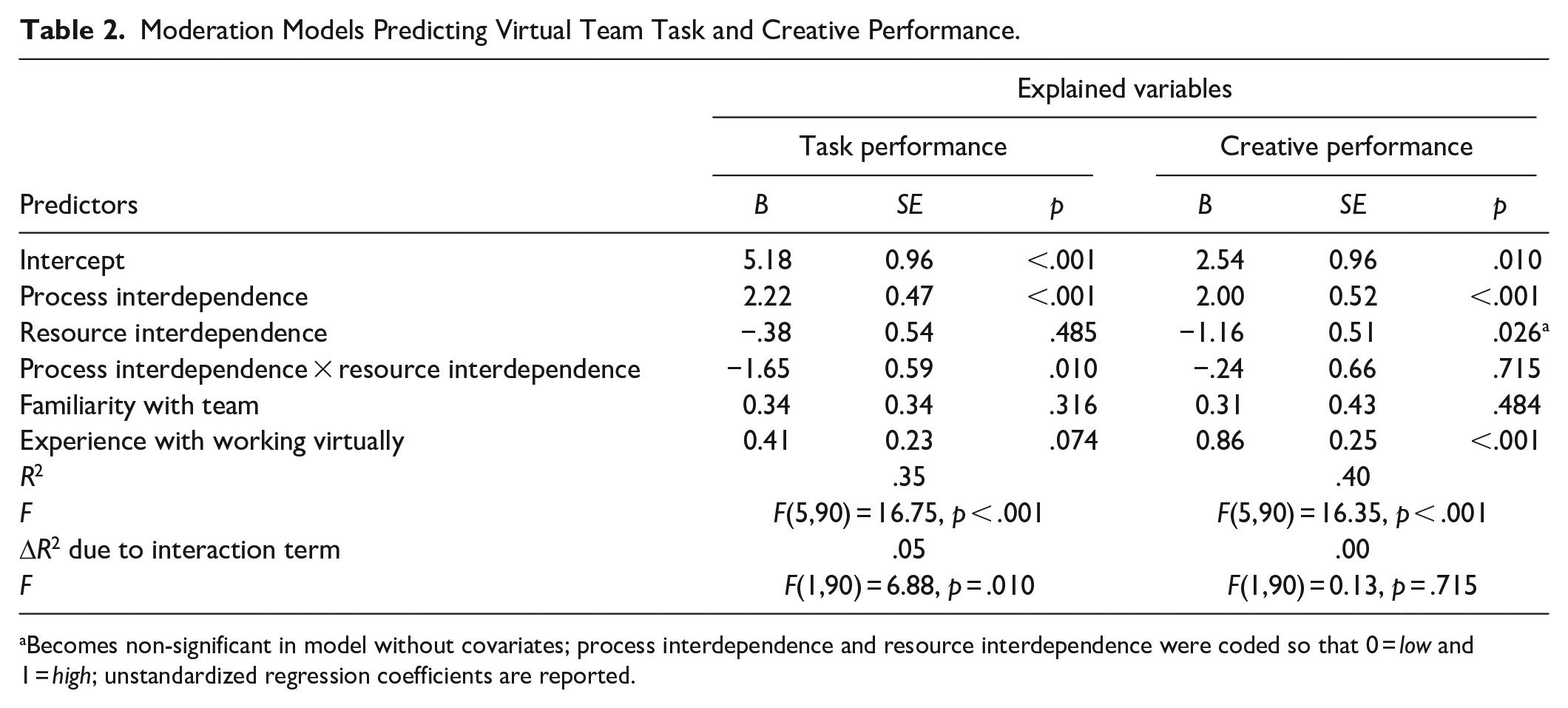
Becomes non-significant in model without covariates; process interdependence and resource interdependence were coded so that 0 = low and 1 = high; unstandardized regression coefficients are reported.
H3 predicted that there would be an interaction effect of process interdependence and resource interdependence on virtual team (a) task performance and (b) creative performance; specifically, that the positive effect of high process interdependence on (a) task performance and (b) creative performance would be weaker when resource interdependence is high. We found a significant interaction effect (see Table 2 and Figure 2) between process interdependence and resource interdependence on task performance, showing resource interdependence weakened the positive effect of process interdependence (B = −1.65, 95% CI [−2.91, −0.40]). The simple effect of process interdependence on performance was significant only at low levels of resource interdependence (95% CI [1.29, 3.15]) and not at high levels (95% CI [−0.30, 1.42]). These results support H3a. However, as shown in Table 2, the interaction between process interdependence and resource interdependence on creative performance was not significant (B = −0.24, 95% CI [−1.54, 1.06]); therefore, H3b was not supported.
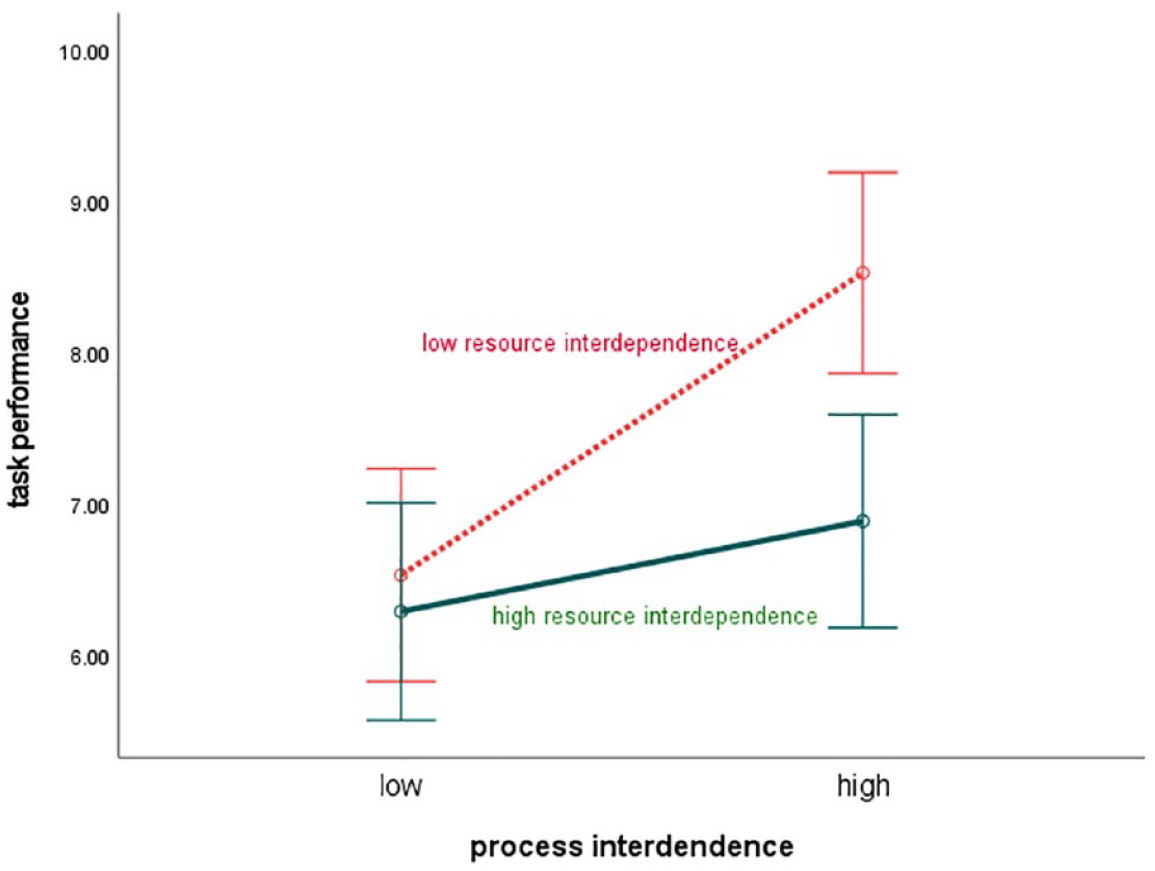
Interaction effect of process interdependence and resource interdependence.
H4 predicted that the positive effect of process interdependence on virtual team task performance would be (a) partially mediated by team processes (transition, action, conflict management, and affect management processes), with resource interdependence weakening the positive effect of process interdependence (b) on each of these four team processes and (c) on task performance. Indices of moderated mediation (Hayes, 2015) were used to test whether the proposed mediation pathways differed significantly between levels of resource interdependence. These indices indicated that the indirect effect of process interdependence via the four team processes on task performance was not significantly different between high and low levels of resource interdependence. Specifically, ω = 0.05, 95% CI [−0.47, 0.69] for the path via transition processes, ω = 0.31, 95% CI [−0.45, 1.16] for the path via action processes, ω = −0.08, 95% CI [−1.00, 0.94] for the path via conflict management processes, and ω = 0.03, 95% CI [−0.34, 0.47] for the path via affect management processes. Hence, H4b (moderated mediation) was not supported.
Furthermore, the indirect pathway from process interdependence to task performance was not significant at either low or high levels of resource interdependence, via any of the team processes. Specifically, at low levels of resource interdependence, the indirect pathway was not significant via transition processes (95% CI [−0.21, 0.24]), action processes (95% CI [−0.19, 0.98]), conflict management processes (95% CI [−1.43, 0.14]), or affect management processes (95% CI [−0.32, 0.64]). At high levels of resource interdependence, the indirect pathway was also not significant via transition processes (95% CI [−0.52, 0.72]), action processes (95% CI [−0.04, 1.42]), conflict management processes (95% CI [−1.35, 0.03]), or affect management processes (95% CI [−0.40, 0.77]). Therefore, H4a (mediation) was not supported. While there was no evidence of indirect pathways, a direct effect was found of process interdependence on task performance, as well as an interaction effect of resource interdependence on this relationship, supporting H4c (moderation of direct path; see Table 3). The simple effect of process interdependence on task performance was significant at low levels of resource interdependence (95% CI [1.48, 3.19]) but not at high levels (95% CI [−0.30, 1.42]). There was also a significant positive effect of action management processes and a significant negative effect of conflict management processes on task performance, and a significant negative effect of resource interdependence on transition processes (see Table 3).
Moderation Models Predicting Team Processes and Moderated Mediation Models Predicting Virtual Team Task and Creative Performance.
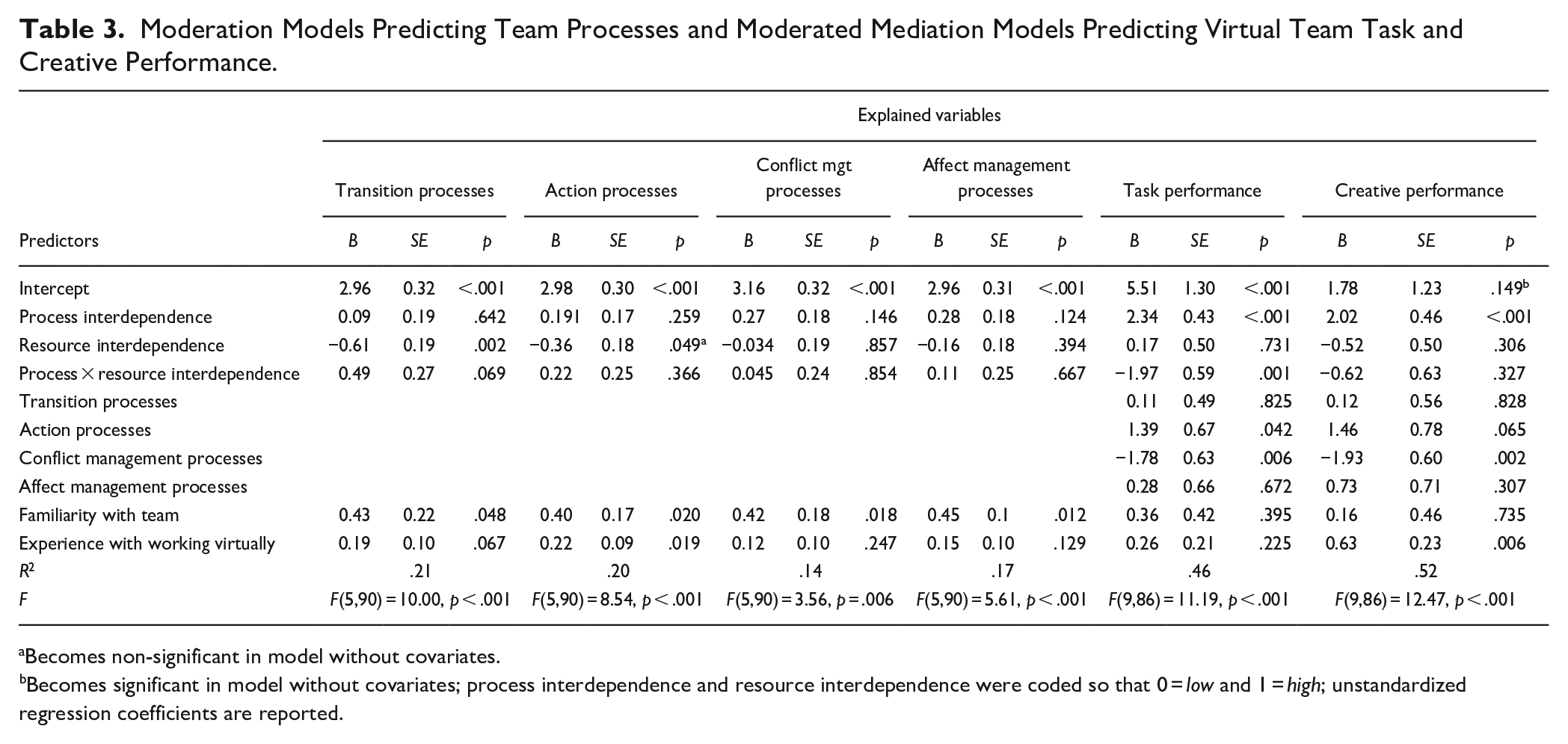
Becomes non-significant in model without covariates.
Becomes significant in model without covariates; process interdependence and resource interdependence were coded so that 0 = low and 1 = high; unstandardized regression coefficients are reported.
H5 predicted that the positive effect of process interdependence and negative effect of resource interdependence on virtual team creative performance would be (a) partially mediated by team processes (transition, action, conflict management, and affect management processes), with resource interdependence weakening the positive effect of process interdependence (b) on each of these four team processes and (c) on creative performance. The indices of moderated mediation (Hayes, 2015) were all non-significant; that is, ω = 0.06, 95% CI [−0.59, 0.62] for the path via transition processes, ω = 0.33, 95% CI [−0.43, 1.16] for the path via action processes, ω = −0.09, 95% CI [−1.09, 0.86] for the path via conflict management processes, and ω = 0.08, 95% CI [−0.40, 0.70] for the path via affect management processes. These results indicate that these pathways did not significantly differ between levels of resource interdependence; thus, H5b (moderated mediation) was not supported.
Furthermore, the indirect pathway from process interdependence to creative performance was not significant at either low or high levels of resource interdependence, via any of the team processes. Specifically, at low levels of resource interdependence, the indirect pathway was not significant via transition processes (95% CI [−0.25, 0.23]), action processes (95% CI [−0.21, 1.02]), conflict management processes (95% CI [−1.37, 0.17]), or affect management processes (95% CI [−0.22, 0.85]). At high levels of resource interdependence, the indirect pathway was also not significant via transition processes (95% CI [−0.67, 0.61]), action processes (95% CI [−0.02, 1.60]), conflict management processes (95% CI [−1.48,0.03]), or affect management processes (95% CI [−0.27, 1.02]). Therefore, H5a (mediation) was not supported. While there was no evidence of indirect pathways, a direct positive effect was found of process interdependence on task performance. Resource interdependence did not have significant impact on this effect; hence, H5c (moderation of direct path) was not supported. Further, there was a significant negative effect of conflict management processes on task performance (see Table 3).
Discussion
In this study, our goal was to answer two key questions: What are the combined effects of the different dimensions of task interdependence on virtual team performance; and what are the mechanisms that explain how these effects happen? Our study was timely, given the increased uptake of virtual teamwork and the accompanying management quest for ways to optimize its functioning. The study was also strongly needed, given the mixed findings regarding the impact of task interdependence in virtual teams (Handke et al., 2020), the disparity in how interdependence more broadly has been operationalized across studies (Courtright et al., 2015), and the methodological shortcomings of previous research into the effects of the different dimensions of task interdependence in virtual teams (Klonek et al., 2022).
To answer our two research questions, we experimentally manipulated the two dimensions of task interdependence, that is, process interdependence and resource interdependence (cf. Klonek et al., 2022), and measured their impact on team processes and virtual team performance. Analysis of our data from 102 ad-hoc virtual teams showed that there were positive effects of process interdependence on task performance and creative performance, and negative effects of resource interdependence on creative performance. Process interdependence was most beneficial for task performance when team members did not depend on each other for access to resources (i.e., low resource interdependence). There was no main effect of resource interdependence on task performance and no interaction effect between the two task interdependence dimensions on creative performance. We found no support for the hypothesized role of team processes as mediators in the relationship between the two interdependence dimensions and team performance outcomes.
Theoretical Implications
The theoretical implications are twofold. First, our results underline the importance of Courtright et al.’s (2015) call on researchers to clearly specify what dimension of interdependence they are investigating. As shown in our study, different dimensions of interdependence had different effects. By distinguishing between process interdependence and resource interdependence, we were able to tease apart the often conflated yet evidently different effects of these task interdependence dimensions. In doing so, we were able to expand on Klonek et al.’s (2022) findings. We found a positive main effect of process interdependence on virtual team task performance and an interaction effect of resource interdependence, weakening the link between process interdependence and task performance. Our findings diverge from Klonek et al.’s (2022), which did not detect these effects, likely due to the limited sample size. We also found a main positive effect of process interdependence and negative effect of resource interdependence on creative performance which was not investigated in Klonek et al.’s (2022) study, and which shows the different effects extend across multiple performance outcomes.
Second, our results provided more nuanced insights in exactly when particular interdependence dimensions have positive or, instead, negative effects. Whilst Courtright et al.’s (2015) meta-analysis found positive effects of both process interdependence and resource interdependence, our study only found positive effects of process interdependence but negative effects of resource interdependence—with the latter either working by weakening the positive effect of process interdependence on task performance, or by directly negatively impacting creative performance. Our findings for resource interdependence, which are different from Courtright et al.’s (2015), align with the Media Richness Theory (Daft & Lengel, 1986). Specifically, Media Richness Theory proposes that, for uncertain tasks (i.e., where a lot of individually held information needs to be shared), low communication media richness (which applies in virtual teamwork) will negatively impact performance. Furthermore, by showing that performance was hindered by depending on others for access to information as a critical resource, our study provides empirical support for Cramton and Orvis (2003) argument that access to information is especially critical but simultaneously more difficult in virtual teams. Importantly, noting that the studies included in Courtright et al.’s (2015) meta-analysis examined co-located teams, our findings indicate that there are likely differences between co-located and virtual teams regarding which dimensions of interdependence are beneficial to team performance, and this difference is likely to extend to hybrid teams as well.
Practical Implications
Our study also has several practical implications, ranging from new insights on how to best design virtual teamwork, to the need to educate leaders on the effects of different interdependence dimensions and on setting up virtual teams in ways that enhance performance. First, our findings suggest that virtual teams perform best when they are highly interdependent in their processes and workflows, and when they are less interdependent regarding access to collective resources. Organizations that are looking to improve both task and creative performance of their virtual teams are therefore encouraged to take these task design features for virtual teams into account. That is, organizations should design virtual teams so that their members have high process interdependence and low resource interdependence. For example, low resource interdependence can be achieved by storing information relevant to the team’s tasks somewhere that can be easily accessed by all team members, such as on shared servers or in a secure shared online environment, rather than in siloed locations accessible only to individual team members. (Re-)designing teamwork to increase process interdependence and gain the associated benefits can be done by providing the teams with (and training them in the use of) collaboration platforms such as Microsoft Teams, Google Drive, Trello, Miro, Mural, or Monday.com. Increasingly, platforms like these allow real-time, live collaborations where people can work concurrently on the same file/item without creating version conflicts. These platforms generally also allow for central storage of information/non-physical resources, hence are beneficial for reducing resource interdependence as well.
Furthermore, organizations should work toward educating their leaders, particularly leaders in charge of virtual or hybrid work teams, on the different dimensions or forms of interdependence, and their differential and combined effects in virtual teams. This knowledge is unlikely to be readily available, given that even academic insights are only starting to emerge. A straightforward approach to incorporating such education could involve including a discussion on interdependence, its diverse facets, and their implications in a management meeting. A more elaborate form of education could be providing training to leaders in the design of virtual teamwork, with a specific focus on interdependence as a design characteristic, complete with examples of how more process interdependence can be built in and how resource interdependence can be kept at low levels.
Limitations and Future Research Directions
There are three limitations of our study that should be taken into account when interpreting our findings and determining future research avenues. The first limitation is that we only tested a setting in which virtual team members collaborated for a relatively short time, that is, 30 min. Future research should examine virtual teams that collaborate for longer durations. This will help to determine if team processes then become a significant mechanism through which the different dimensions of interdependence are linked to performance outcomes, in line with the Input-Process-Output (I-P-O) model of teamwork (Ilgen et al., 2005). Although our study with task interdependence dimensions as inputs, the team processes as process, and task and creative performance as outputs did not find support for applicability of the I-P-O model, the model has a solid theoretical and empirical basis (e.g., Courtright et al., 2015; Ilgen et al., 2005; Marks et al., 2001; for virtual teams see Handke et al., 2020). Both teamwork theory and empirical evidence have highlighted the critical role of time in team functioning (J. Mathieu et al., 2008), and it is likely that, in our study, there was not enough time for the I-P-O relationship to develop.
Future research could also examine whether conflict management processes benefit performance outcomes in longer virtual team collaborations. In our study with a short task duration, we found a negative path from conflict management processes to both task and creative performance when testing Hypotheses 4 and 5. This finding does not align with the prevailing teamwork theory (Marks et al., 2001). Other studies have found positive links between cooperative conflict management and team performance (Somech et al., 2009) and between interpersonal processes (of which conflict management is a subdimension) and team effectiveness (e.g., Killumets et al., 2015). A possible explanation for this contrasting finding lies in the relatively short amount of time given to the team to work on the task. Teams likely only engaged in conflict management if a conflict occurred, and the time taken up by the conflict and its consequent management may have robbed the team of valuable time to work on and complete the task to high performance standards. Thus, whilst conflict management processes are expected to be beneficial on the long run, for virtual teams with a very short task duration, engaging in these processes can be counterproductive.
The second limitation is that, in our study, there were no consequences associated with performing either very well or very poorly. Even though positioning the Cancer Council as client organization was intended to increase motivation and engagement, the lack of implications of the team’s performance may have impacted motivation and behaviors. Future research should include non-student teams working on tasks in which their performance matters substantially to them and to their organization.
A third limitation relates to the observation that virtual team field research has moved away from treating virtuality as a dichotomous concept (e.g., Gibson & Gibbs, 2006; Kirkman & Mathieu, 2005). Research now views virtuality on a continuum, consisting of multiple dimensions, such as information and communications technology use and geographical dispersion. Since the current study was not a field study but an experiment, virtuality was structured into the task to be objectively the same for all teams. However, by giving half of the teams a shared document to synchronously collaborate on, the process interdependence manipulation may have unintentionally somewhat impacted the virtuality dimension of information and communications technology use, with users in the high process interdependence condition possibly making more extensive use of technology. Furthermore, in practice, there may have been a difference in subjectively perceived levels of virtuality (i.e., perceived information deficits and feelings of distance, cf. Handke et al., 2020), which could have played a role in the link between the interdependence manipulations and team processes and performance. Perceived virtuality was not measured in our study but should be assessed in future research.
To expand on our findings, future research should also investigate the impact of other forms of interdependence, such as outcome interdependence, which is the extent to which the team’s work outcomes are specified, measured, and rewarded, at the group level rather than the individual level (Courtright et al., 2015). Such research could experimentally manipulate different dimensions (i.e., goal and reward interdependence) of outcome interdependence, similar to how task interdependence was manipulated in the present study.
Given the reason we did not find support for the hypothesized mediating role of team processes could be that our sample size was too low to provide sufficient statistical power to find mediation effects, future research should consider employing a larger sample. Future research is also needed to explore other possible mechanisms that could explain how process interdependence, resource interdependence, and their interactions are associated with task and creative performance. Such research could focus on teams’ cognitive, affective, and motivational emergent states (e.g., Fyhn et al., 2023; Jehn et al., 2008; Rapp et al., 2021; Waller et al., 2016).
Finally, our finding that different subdimensions of task interdependence (i.e., process interdependence and resource interdependence) work differently to influence performance outcomes also has implications for field studies in which task interdependence is not experimentally manipulated, but rather measured via team member questionnaires. The various existing survey scales measuring task interdependence are either a mix of items covering process interdependence and resource interdependence (e.g., Kiggundu, 1983; Pearce & Gregersen, 1991; Van der Vegt et al., 2001; R. Wageman & Gordon, 2005), or cover only process interdependence (e.g., Sargent & Sue-Chan, 2001). To identify the different impact process interdependence and resource interdependence have on outcomes such as team processes and performance, we advise that future studies should move toward using separate survey scales for each task interdependence subdimension.
Conclusion
Our study advances the scientific and practical understanding of how task interdependence impacts not only task performance, but also creative performance in virtual teams. Such understanding is timely, given the increased use of virtual teams and the growing demand for ways to support them. Our study demonstrates that task interdependence can be a double-edged sword in a virtual team context, depending on the specific task interdependence subdimension. Process or workflow interdependence improves team task performance and team creative performance. On the other hand, resource interdependence (e.g., having to rely on team members for information) negatively impacts team task performance by weakening the positive effects that process interdependence has on team task performance, and it also negatively and directly impacts team creative performance.
Footnotes
Appendix
Team Creative Performance Criteria.
| Creative performance criterium | Max. points (if criterium partially met, give part of the points) | |
|---|---|---|
| Uniqueness, total 5 pt max | ||
| 1 | Unique font type (0 for arial, times, calibri) | 0.5 |
| 2 | Unique pictures (compared to others/not all from Cancer Council WA site/different from top hits in google image search—familiarise yourself with CCWA site pictures and web search top images for “cancer council AND (transport OR treatment),” if no pictures: 0; if all pictures from CCWA or web search top images: 0.25; if some pictures other than above: 0.5; if all pictures other than above: 1) | 1 |
| 3 | Uniqueness & detail of quotes (max 0.75 for each of the 2 quotes) | 1.5 |
| 4 | Aesthetics/general appeal/does it look attractive (sliding scale up to 2, judgement call) | 2 |
| Usefulness, total 5 pt max | ||
| 5 | Easy, logical flow of text to support ease of reading | 1 |
| 6 | Readability—colour choices easy to read | 0.5 |
| 7 | Readability—font size easy to read | 0.5 |
| 8 | Readability—font type easy to read (not too frilly/irregular) | 0.5 |
| 9 | Readability—spacing of text/pictures supports ease of reading | 0.5 |
| 10 | Usefulness of pictures (matching the job: chauffeuring, and setting: cancer treatment; if matching 0 of these: 0 points; if matching 1 of these: 0.5 point; if matching both: 1 point) | 1 |
| 11 | Cultural/social references appropriate/suited for target age group | 0.5 |
| 12 | Quotes provided relevant to target age group | 0.5 |
| Total | 10 | |
Acknowledgements
The authors are grateful to Bridget Hanavan, Saul Taylor, Jenny Rojano, Francis Plando, Julian Sorgiovanni, and Elsje Baker for their contributions to the research project as Honors students.
Declaration of Conflicting Interests
The author(s) declared no potential conflicts of interest with respect to the research, authorship, and/or publication of this article.
Funding
The author(s) disclosed receipt of the following financial support for the research, authorship, and/or publication of this article: This research was supported through Honors Scholarships for Emma Stephenson, Bridget Hanavan, and Saul Taylor, from the Research Network for Undersea Decision Superiority (RN-UDS) from the Australian Defence Science and Technology Group.
