




Abstract
Due to their crucial and highly consequential task, it is of utmost importance to understand the levers leading to effectiveness of multidisciplinary emergency management command-and-control (EMCC) teams. We argue that the formal EMCC team leader needs to initiate structure in the team meetings to support organizing the work as well as facilitate team learning, especially the team learning process of constructive conflict. In a sample of 17 EMCC teams performing a realistic EMCC exercise, including one or two team meetings (28 in sum), we coded the team leader’s verbal structuring behaviors (1,704 events), rated constructive conflict by external experts, and rated team effectiveness by field experts. Results show that leaders of effective teams use structuring behaviors more often (except asking procedural questions) but decreasingly over time. They support constructive conflict by clarifying and by making summaries that conclude in a command or decision in a decreasing frequency over time.
Keywords
Our complex society presents new problems and requires new solutions continuously. Incidents that happen in organizations and society illustrate that clearly. Sadly enough, some incidents happen with a certain frequency, such as a collision on a highway during bad weather. Others are rare or never experienced before such as when two airplanes crashed into the towers of the World Trade Center complex in New York City on 9/11.
The actors that need to deal with such situations at the scene of the incident are the fire department, the police, the medical assistance unit, the government, and other possible related organizations such as the water delivering company. Their people need to cooperatively and interdependently protect, evacuate, quench, restrict, inform, and so on. These processes are coordinated at the scene by a multidisciplinary emergency management command-and-control (EMCC) team, composed of commanders from the different disciplines involved and chaired by a formal leader. In a series of meetings, EMCC teams create an overview and a shared representation of the emergency situation and the team goal that follows from it. They determine the required actions at the scene, assign them to the person or discipline responsible, and report on the actions (Comfort, 2007; Helsloot, Martens, & Scholtens, 2010).
Given the high-stake consequences of the work of EMCC teams (e.g., loss of human lives, environmental disasters), it is important to increase the understanding of what makes these teams effective. Previous research in the domain of emergency management has argued upon the importance of the role of the leader for achieving team effectiveness (DeChurch & Marks, 2006; Lorinkova, Pearsall, & Sims, 2013; Van Wart & Kapucu, 2011). A formal team leader is needed to structure and coordinate the actions of the EMCC team members (DeChurch & Marks, 2006) while addressing the specific challenges of the team, such as the information overload and a significant level of uncertainty (Schaafstal, Johnston, & Oser, 2001), as well as the time pressure and the intense interdependent collaboration (Salas, Burke, & Samman, 2001). Initiating structure is a form of task-focused and directive leadership behavior that organizes work processes through defining team tasks, team goals, task outcomes, and working methods and thereby supporting team effectiveness (Burke et al., 2006; Døving & Martín-Rubio, 2013; Keller, 2006).
Next to organizing the work processes through defining tasks, goals, outcomes, and methods, the structuring behavior of team leaders should also encourage EMCC team members to articulate their opinion and share information to collectively develop an accurate approach for the emergency situation. This requires EMCC members to engage in team learning (van der Haar, Segers, Jehn, & Van den Bossche, 2015), which is defined here as a behavioral process of interaction and exchange among team members (Kozlowski & Ilgen, 2006). Team learning is argued to generate change or improvement for teams, team members, and organizations (Decuyper, Dochy, & Van den Bossche, 2010). Especially the team learning process of constructive conflict makes a difference for EMCC teams (van der Haar et al., 2015). A team that uses constructive conflict has members who handle differences of opinions critically but constructively by addressing them directly, act on comments given on ideas, and verify opinions and ideas of team members by asking each other critical questions (Van den Bossche, Gijselaers, Segers, Woltjer, & Kirschner, 2011). It supports developing a shared idea of what is going on and needs to be done (Boon, Raes, Kyndt, & Dochy, 2013; Van den Bossche et al., 2011; van der Haar et al., 2015) and results in higher levels of team effectiveness over time (Burke et al., 2006; Lorinkova et al., 2013; Tjosvold, Poon, & Yu, 2005).
A formal team leader who initiates structure can support team members in performing constructive conflicts, as structuring behavior promotes speaking up (Edmondson, 2012; Lorinkova et al., 2013; Sarin & McDermott, 2003), guides critical thinking and discussions (Døving & Martín-Rubio, 2013; Keller, 2006; Koeslag-Kreunen, Van den Bossche, Hoven, Van der Klink, & Gijselaers, 2016), and therefore is argued to prevent team members in taking precipitous action (Burke et al., 2006; Edmondson, 1999). It increases the involvement and self-confidence of team members (Duncan et al., 1996; Edmondson, 2012; MacKay, 2006). This support of team leaders is especially important in ill-structured, time-constrained, and complex settings, such as incidents, because in these settings people tend to take intuitive decisions (Hamm, 1988), and act first and think later (Alby & Zucchermaglio, 2006). As a consequence, team members do not automatically engage in team learning behaviors (Yukl, 2009) and thus need the team leader to provide a structure for it.
In sum, it is argued that EMCC team leaders who initiate structure can, on one hand, organize team processes, and, on the other hand, support members in using the team learning process of constructive conflict. The challenge for team leaders is thus to not overstructure the process and, as such, inhibit members in engaging in team learning behaviors (McKeown, 2012). In this respect, scholars have been arguing that team leaders need to adjust the way they initiate structure based on how the situation and the team evolve. Initiating structure has a temporal character and changes over time while it facilitates the dynamic process of team learning and promotes team effectiveness over time (Arrow, Poole, Henry, Wheelan, & Moreland, 2004; Kozlowski & Ilgen, 2006; Santos, Uitdewilligen, & Passos, 2015).
To date, research on how leaders’ initiating structure behaviors structure the work on one hand, and enhance team learning on the other hand is very limited. Many studies use cross-sectional designs, which do not take the temporal nature of team leader structuring behavior into account. Moreover, the results might be prone to bias due to the use of self-rating questionnaires in most cases (Burke et al., 2006; Koeslag-Kreunen et al., 2016). More specifically, despite the indications of the importance of team learning behaviors for EMCC team effectiveness and the arguments for the role of the leader, to date, it is unclear which concrete structuring behaviors leaders of effective EMCC teams use to enhance constructive conflict over time. Previous research on the behavior of team leaders in extreme contexts has merely pointed at skills in general, such as skills in meeting facilitation, decision-making skills, and skills for dealing with the media (Devitt & Borodzicz, 2008), or behaviors of general EMCC team members. (e.g., Crichton, Lauche, & Flin, 2005; Uitdewilligen, 2011). However, they do not make clear which structuring behaviors team leaders show.
A contextual and fine-grained temporal analysis of verbal team leader structuring behavior in EMCC teams is required to understand how team leader structuring behavior over time can benefit team effectiveness, on the one hand, and constructive conflict as a crucial team learning process, on the other hand. Therefore, the aim of this temporal field study of EMCC teams performing a realistic exercise is to shed light on the value of concrete verbal team leader structuring behaviors for EMCC teams. First, we shed light on the procedural statements formal team leaders of effective EMCC teams use over time in two sequential team meetings to explore which behaviors are used and how this use evolves over time. Second, we investigate to what extent effective teams use constructive conflict over time. Third, we explore which structuring behaviors are used by the formal leaders of EMCC teams while accounting for different levels of constructive conflict in these meetings. This way, we develop an in-depth understanding of how EMCC team leadership structuring behavior is beneficial for constructive conflict and, in turn, team effectiveness over time.
EMCC Teams
Whenever there is a crisis, such as a fire in a public building or a collision on the highway, people from the fire department, the police, the medical care assistance unit, the government, and possible other disciplines come together to mitigate the consequences of the crisis (van der Haar, Li, Segers, Jehn, & Van den Bossche, 2014). A crisis is defined as “a sudden occurrence, with a low probability, which, if it arises, has important consequences in terms of losses (human, material, financial, etc.) for a given collective, and provokes tensions in the social fabric of that collective” (Lalonde, 2004, p. 77). A multidisciplinary EMCC team is composed during the crisis to coordinate the interdependent collaboration between the different assistance units (Salas et al., 2001). Characteristics of command-and-control teams (Salas et al., 2001) are that they (a) are heterogeneous in terms of expertise (multidisciplinary), expertise levels, experiences, background, and culture; (b) have to deal with large amounts of information and must be able to clarify, filter, and integrate that information to gain a comprehensive overview of the crisis; and (c) operate in a highly stressful environment.
As a typical example of an EMCC team, we focus on the EMCC team referred to as on-scene-command-team (OSCT) working at the scene of the incident. The task of this EMCC team is to organize and coordinate the multidisciplinary assistance directly at the scene (Salas et al., 2001). This is a so-called intellectual task (Devine, 2002), for it requires taking decisions about required actions by collecting and integrating information from a variety of sources. This EMCC team is composed of the commander-on-site on call of each required discipline and is therefore “composed of individuals who have high levels of skills and abilities, are specialized in their respective duties, and come together for a short period of time to work interdependently towards a common goal” (Salas et al., 2001, p. 312). This EMCC team can be typified as a multidisciplinary ad hoc team: The team members may or may not have cooperated before. The members are thus diverse in expertise, experience, parent organization, and familiarity.
The command-and-control teams have consecutive team meetings during the crisis which are led by a formal and impartial leader (van der Haar et al., 2014), in which team members share their information, discuss what needs to happen next, and decide on an action plan (Uitdewilligen, 2011). Between meetings the enactment of the decisions made takes place as well as the gathering of novel important information for the next meeting (van der Haar et al., 2014). This makes the meetings determine the temporality of the team (Beck, Paskewitz, & Keyton, 2015). A meeting is defined as “a communicative event involving three or more people who agree to assemble for a purpose ostensibly related to the functioning of an organization or a group” (Schwartzman, 1989, p. 7).
The on-scene EMCC team is confronted with an information overload and a significant level of uncertainty (Schaafstal et al., 2001). The team has the task to mitigate crises in a very short period of time by means of intense interdependent collaboration (Salas et al., 2001). Individuals with different angles of expertise (i.e., police, fire fighters, medical assistance, and government representatives) and pieces of information come together and have to build a shared understanding of the evolving situation and the required actions, captured in a team situation model (TSM). The dynamic TSM contains shared task-knowledge concerning the current situation developed by the team members moment-by-moment (Cannon-Bowers, Salas, & Blickensderfer, 1999; N. J. Cooke, Salas, Cannon-Bowers, & Stout, 2000). This process of knowledge development is referred to as intracrisis learning by Moynihan (2009), which is beneficial for a reliable response to the emergency situation (van der Haar, Segers, & Jehn, 2013).
The EMCC team is effective if it functions as a high reliability team which consistently, effectively, and interdependently works toward a shared goal in a complex and dynamic environment while working under high levels of stress (Wilson, Burke, Priest, & Salas, 2005). Reliability refers to the final goal of achieving crisis control, while having low error rates and a high workplace safety (Baker, Day, & Salas, 2006; Wilson et al., 2005). This requires justified, adequate, and coordinated actions at the scene that take safety into account (quality of actions), reduction of causes and a stabilized and controlled situation (goal achievement), and prevention of death and damage (error rate) (van der Haar et al., 2013).
Team Leader Structuring Behaviors and Team Effectiveness
Leadership within the emergency management context is generally defined as “giving purpose, motivation, and direction to people when there is eminent physical danger, and where followers believe that leader behavior will influence their physical well-being or survival” (Kolditz & Brazil, 2005, p. 347). DeChurch et al. (2011) argued that perhaps nowhere good leadership is more important than in the emergency management context, as ineffective guidance of team processes in sometimes life-threatening environments can result in death or injury. More specifically, by initiating structure in the EMCC team’s task, the leader supports the development of a shared understanding of the task and goal, and thereby creates a clear sense of direction and purpose (Benoliel & Somech, 2014; Burke et al., 2006; Keller, 2006). This is beneficial for the effectiveness of EMCC teams (van der Haar et al., 2014; van der Haar et al., 2015). Moreover, initiating structure speeds up discussion (Burke et al., 2006; Drucker, 2004), facilitates the attainment of meeting objectives (Burke et al., 2006; Kauffeld & Lehmann-Willenbrock, 2012; Keller, 2006), and keeps a clear focus in the discussion (Burke et al., 2006; Kauffeld & Lehmann-Willenbrock, 2012; Lorinkova et al., 2013). Without a clear structure to guide thinking and discussions, team members can become confused or overwhelmed by the information overload (Edmondson, 2012), which promotes lengthy monologues, complaining, straying from the topic, and/or losing the train of thought in details and examples (Burke et al., 2006; Kauffeld & Lehmann-Willenbrock, 2012; Lorinkova et al., 2013). In sum, by initiating structure in the EMCC team’s task, the formal leader facilitates the process of taking accurate decisions on the multidisciplinary approach (Alexander, 2004; DeChurch & Marks, 2006; Lorinkova et al., 2013).
What does the team leader behavior of initiating structure entail? It incorporates defining the team’s tasks, working methods, and outcomes (Burke et al., 2006; Døving & Martín-Rubio, 2013; Keller, 2006; Sarin & McDermott, 2003). In their review of team leadership in general, Morgeson, DeRue, and Karam (2009) referred to initiating structure in terms of determining or assisting in determining the working method, clarifying roles in terms of task division, and determining when the work will be done. More specifically, Uitdewilligen (2011) defined structuring behavior in EMCC teams as specifying the agenda of the meeting, asking or allowing someone to talk, urging to hurry, and inquiring whether information is clear. Kauffeld and Lehmann-Willenbrock (2012) provided a more extensive overview of structuring behavior used by team members during unsupervised routine meetings with a self-chosen goal in medium-sized industrial organizations. They identified 10 positive procedural communication statements that structure and organize the discussion during team meetings and support meeting satisfaction, team productivity, and organizational success: goal orientation, clarifying, procedural suggestions, procedural questions, prioritizing, time management, task distribution, visualizing, weighing costs/benefits, and summarizing (Kauffeld & Lehmann-Willenbrock, 2012). Due to the very distinct characteristics of EMCC teams (e.g., ad hoc composition, high expertise diversity, information overload, and time pressure), which can have negative influences on concentration and the speed and the quality of decision making (Salas et al., 2001), it is necessary to explore the value of these verbal procedural statements for the team type in our study.
Table 1 provides an overview of relevant team leader structuring behaviors found in literature and their reported effects on team effectiveness and team learning. The attainment of meeting objectives is supported by goal orientation as it keeps the discussion on target by giving clear direction (Bristowe et al., 2012; R. A. Cooke & Szumal, 1994; Kauffeld & Lehmann-Willenbrock, 2012). Clarifying or sensemaking facilitates team learning in terms of creating a shared understanding of the problem, as it supports identifying new information, guiding discussions, and preventing miscommunication and thereby incorrect decisions (Bristowe et al., 2012; DeChurch & Mesmer-Magnus, 2010; Kauffeld & Lehmann-Willenbrock, 2012). Both are relevant for the EMCC team, because to take decisions that lead to adequate, justified, and coordinated actions, it is crucial to have a clear and shared idea about what is going on and what needs to be done (quality of actions, van der Haar et al., 2013; van der Haar et al., 2015).
Coding Scheme Team Leader Structuring Behaviors.
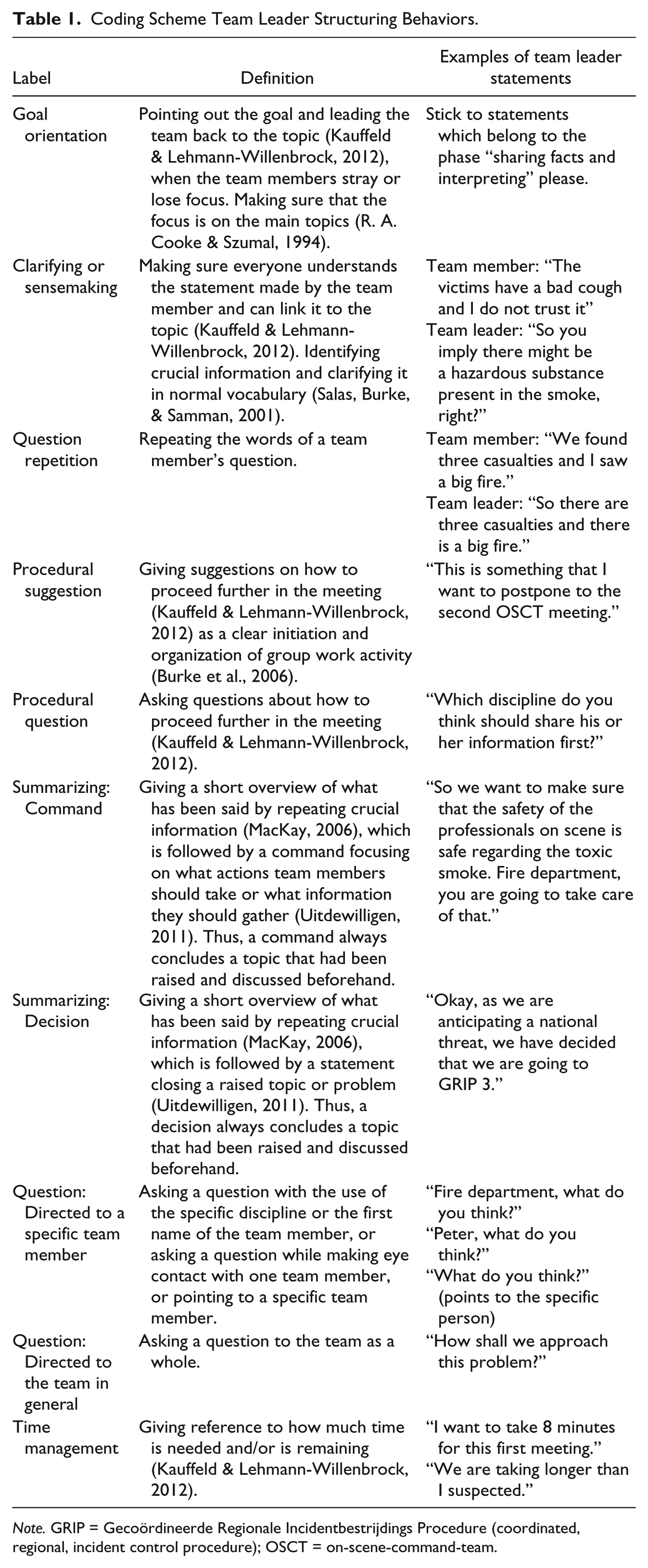
Note. GRIP = Gecoördineerde Regionale Incidentbestrijdings Procedure (coordinated, regional, incident control procedure); OSCT = on-scene-command-team.
Question repetition as well as asking directed questions (by using the name or discipline or by making eye contact or pointing to a specific member) promote the feeling of self-confidence of the team member, which increases speaking up and thus faster execution (Edmondson, 2012; MacKay, 2006). Procedural suggestions speed up the discussion by supporting a shared understanding of how to proceed further in the meeting (Burke et al., 2006; DeChurch & Mesmer-Magnus, 2010; Kauffeld & Lehmann-Willenbrock, 2012). Thus, question repetition, asking directed questions, and procedural suggestions support the efficiency of the meeting by speeding up the process which is relevant for EMCC teams due to the time pressure that comes with emergency situations.
Summarizing in terms of a decision or command promotes implementing action plans effectively as there is a shared and clear understanding of the assigned tasks and decisions (Burke et al., 2006; Kauffeld & Lehmann-Willenbrock, 2012; Uitdewilligen, 2011). For EMCC teams, this should emerge in goal achievement in terms of a stabilized and controlled situation and diminishment of the source of the emergency (van der Haar et al., 2013). Time management increases the team members’ involvement, which leads to higher levels of perceived team effectiveness (Drucker, 2004). In EMCC teams, time management is of high importance due to the need of acting quickly, but accurately (van der Haar et al., 2013). Visualizing by using a white board for collective interpretation processes is also proven to be a beneficial structuring behavior for teams (Kauffeld & Lehmann-Willenbrock, 2012; Uitdewilligen, 2011). However, this is common practice in EMCC teams and therefore not further argued about. Hence, the following hypothesis was formulated:
Some structuring behaviors do not seem to benefit EMCC teams (Table 1). In general, procedural questions about how to proceed further in the meeting appear to slow down the discussion (Kauffeld & Lehmann-Willenbrock, 2012). For EMCC teams, slowing down is not desirable, as it inhibits a fast response to the emergency situation. The goal is to reach a stabilized situation as soon as possible (van der Haar et al., 2013), and that goal is not served by slowing down the meeting process in a way that there may be confusion on the working structure during the meeting. Moreover, the team has a set meeting structure based on the rational choice theory: the team first lists all possible opportunities for action, identifies consequences derived from the different choice options, and finally selects the best decisions concerning the expected consequences (Simon, 1978, in Alby & Zucchermaglio, 2006). This approach enables the team members in this ill-structured, time-constrained, and complex emergency setting to avoid making intuitive decisions (Hamm, 1988) and avoid acting first and thinking later (Alby & Zucchermaglio, 2006). Questioning this set meeting procedure or asking questions about how to proceed will not benefit team effectiveness.
Moreover, asking undirected questions inviting every team member to answer might evoke confusion in terms of responsibility, which slows down the process as well (Edmondson, 2012). The EMCC team has members with specific expertise, which is shown by their function name and uniform. For establishing team effectiveness in terms of justified, adequate, and coordinated actions (van der Haar et al., 2013), the team leader needs to acknowledge role specific expertise by directing his or her questions to a relevant receiver, instead of asking undirected questions to the team as a whole. That way, the leader confirms or clarifies the division of expertise and responsibilities in the team. Hence, the following hypothesis was formulated:
Team Leader Structuring Behaviors and Constructive Conflict
Team learning facilitates the continuous development needed for a team to be effective in dynamic work environments (Burke et al., 2006; Salas, DiazGranados, Weaver, & King, 2008). Team learning is “a compilation of team-level processes that circularly generate change or improvement for teams, team members, organizations, etc.” (Decuyper et al., 2010, p. 128). Previous research has forwarded co-construction and constructive conflict as crucial team learning processes (Decuyper et al., 2010; Van den Bossche, Gijselaers, Segers, & Kirschner, 2006).
During the team learning process of co-construction, team members share facts they know and ideas they have and build meaning by refining, building on, or modifying the original input; it facilitates the exchange of information and ideas and results in a certain level of mutual understanding (Van den Bossche et al., 2006; Van den Bossche et al., 2011). This process incorporates behaviors such as describing the problem situation, sharing information and ideas, active listening and tuning into other team members, and trying to grasp explanations and intentions. The team learning process of constructive conflict supports the team in reaching mutual agreement if members handle differences of opinions critically but constructively, by addressing them directly, acting on comments given on ideas, and verifying opinions and ideas of team members by asking each other critical questions (Van den Bossche et al., 2006; Van den Bossche et al., 2011). It may avoid developing mutual agreement based on inaccurate information and interpretations, which is hindering team learning (Santos et al., 2015). The processes of co-construction and constructive conflict indicate that teams engage in collective sensemaking. This process of collective knowledge building provides the common ground on which the team relies to coordinate its efforts.
Although team learning processes have indeed shown to increase performance (Decuyper et al., 2010), they take on a more complex role when applied to ill-defined situations in which teams engage without all necessary information and under uncertain and dynamic circumstances (Zajac, Gregory, Bedwell, Kramer, & Salas, 2014). Limited research is available on team learning in these contexts (Salas, Guthrie, & Burke, 2007; van der Haar et al., 2015; Zajac et al., 2014). van der Haar and colleagues (2015) showed that in EMCC teams constructive conflict makes the difference. More specifically, a highly similar idea of what will be done at the scene after the meeting is developed under the condition of high constructive conflict when the team shows a high or low level of co-construction (team members sharing facts and ideas and building meaning by refining, building on, or modifying the original input; Van den Bossche et al., 2006). These results indicate that EMCC meetings should especially be used for discovering, acknowledging, and discussing diversity in opinions and interpretations.
To start a constructive conflict, team members need to feel psychologically safe (Van den Bossche et al., 2006), which means they believe that they can take interpersonal risks without having to fear punishment, rejection, or embarrassment (Edmondson, 1999). They need to dare to speak up and share their disagreement. As such, speaking up is key for mitigating errors and can make the difference between life and death (Bienefeld & Grote, 2014). This may be challenging if there are status differences in the team (Edmondson, 2003; Nembhard & Edmondson, 2006). However, as initiating structure in the meeting process promotes speaking up (Edmondson, 2012; Lorinkova et al., 2013; Sarin & McDermott, 2003) and increases involvement and self-confidence in team members (Duncan et al., 1996; Edmondson, 2012; MacKay, 2006), the probability of team members exposing disagreement and engaging in constructive conflict increases. For example, a team leader who relates the content of a disagreement to the goal (goal orientation) acknowledges its value, which may support constructive conflict. Or, if a leader clarifies a disagreement to make sure everyone understands the differences in opinions or interpretations, the value of the disagreement is acknowledged which supports speaking up. As such, the team effectiveness of the EMCC team is served with positive statements that initiate structure, because crucial information may be identified that was otherwise missed or crucial errors in interpretations and conclusions may be prevented. Hence, the following hypotheses were formulated:
Temporal Character of Initiating Structure by the Team Leader
Initiating structure has a temporal character and changes over time while it facilitates the dynamic process of team learning and promotes team effectiveness over time (Arrow et al., 2004; Kozlowski & Ilgen, 2006; Santos et al., 2015). The team leader needs to adjust the way he or she initiates structure based on how the situation and the team evolve. In line with earlier research on teams in general (e.g., Mohammed, Ferzandi, & Hamilton, 2010; Salas, Cooke, & Rosen, 2008; Salas & Fiore, 2004), recent research showed that the quality of actions and goal achievement of EMCC teams are not only served by team members having a shared idea about what is done by whom, but this shared idea needs to evolve over time (van der Haar et al., 2014). This illustrates that the response to the crisis needs to evolve and improve during the process of incident management, which can be referred to as intracrisis learning (Moynihan, 2009). This requires the team leader to evolve his or her structuring behavior as well.
This assumption is in line with research of Lorinkova et al. (2013). In their lab study with student teams performing a simulated Air Force Base task, they found that directive team leader behaviors focusing on the goal and the task were beneficial for team effectiveness if shown at the early stages of the team performance. However, in later stages of the team cooperation, making room for team learning was beneficial for team effectiveness (Lorinkova et al., 2013). Team leader behavior apparently needs to evolve over time from more steering to more inviting in that context. The EMCC task is comparable in the sense that teams can use existing routines to develop an overview of the situation in the early stages, whereas in later stages their routines may not be sufficient for creating an adequate approach for the unique situation they face. For routine situations, it is helpful if a formal leader provides structure, whereas developing new solutions requires a leader to hold back and not provide too much structure (Koeslag-Kreunen et al., 2016). Therefore, we expect that the use of team leader structuring behavior decreases over time in effective teams. Moreover, as interaction patterns that are developed at the early stage of a team’s life tend to be persistent on the longer term (Feldman, 1984; Ginnett, 1987; Zijlstra, Waller, & Phillips, 2012), we assume that the way structure is initiated in the first EMCC team meeting is prolonged to the second meeting, which means that initiating structure by the team leader is less frequently required in the second than in the first meeting. Hence, the following hypotheses were formulated:
Method
Setting and Sample
In this field study, data are collected from 102 respondents from 17 multidisciplinary EMCC teams referred to as OSCTs. These teams were observed during realistic simulation exercises of five different safety regions. The simulation exercises require frequent participation and are regularly organized by the different assistance units (e.g., fire department, police, medical care assistance unit). The general purpose of the simulation exercises was to prepare team members for emergency management tasks (van der Haar et al., 2015). The task for the team members during the simulation exercise was to coordinate their own assistance units and to collaborate during EMCC team meetings.
Each exercise had two to three team meetings. Like in reality, the first meeting included the three key coordinators (fire department, police, and medical assistance unit) and took place at the scene of the incident. As this meeting was not led by a formal team leader, it is not included in this study. The EMCC meetings followed and are analyzed here; these meetings have a formal leader and additional team members (e.g., representative of the government and plotter). The meetings took place in a mobile office that was placed at the incident scene. Each simulation exercise included one (n = 17) or two (n = 11) EMCC meetings.
Each EMCC team had four to six members, with an average size of five persons. The possible roles were EMCC team leader, Fire Officer, Police Officer, Medical Officer, Public Safety Officer, Consultant Hazardous Substances, and Public Relations Officer of the Police Department. The average age of the respondents was 45 years (SD = 7.8), and 67% held a bachelor’s or higher degree. All teams consisted of Dutch members of whom 81% were male and 19% were female. The average experience of working in real-life emergencies was 13 times (SD = 14.6), and of participating in simulation exercises was 19 times (SD = 17.4). Due to the ad hoc nature of the teams, team members had no or little experience in working in the particular team composition.
The team members knew the purpose of the simulation exercises, but they were not informed about the scenarios beforehand and there were no interventions during the exercise. The simulation exercises were realistic, as the teams needed to follow realistic procedures, and each commander-on-site of the different disciplines was represented in the EMCC team. The scene of the crisis was projected on a virtual screen, which could be explored by the use of a joystick and communication was done face-to-face or via walkie-talkies. Team members were able to gather more information by asking questions of trainers, who answered from the perspective of a key player at the scene (e.g., first commander fire department) and based on the scenario script. That way, trainers provided them with information about the development of the incident. The questions asked influenced which information was shared when, which could influence the development of the events at the scene. For instance, teams that ask questions at an early stage about the number of people still in the building and where may organize their rescue activities differently compared with teams that do not. This results in a different development of events over time. The exercise scenarios were therefore interactive to a certain extent. Through face-to-face interaction with team members, the trainers were able to gain insight into the effectiveness of the team.
There were two scenarios that both concerned on a fire in an electronics store. The appendix describes the scenarios and shows that there was a high time pressure due to the expanding fire, the intentional cause of the fire, and uncertainty about the number and place of victims. Eleven teams participated in Scenario A and six teams participated in Scenario B. To confirm that the two scenarios were comparable in nature, team member level of stress, responsibility, and risk were assessed, and group mean differences between the two scenarios were determined. The team member perceived level of stress (four items, M = 3.08, SD = 0.71, α = .84), responsibility (four items, M = 5.33, SD = 0.55, α = .80), and risk (four items, M = 4.39, SD = 0.56, α = .79; van der Haar et al., 2015) were scored on a 7-point Likert-type scale. Results indicate that the teams participating in the different exercises did not differ significantly in their scores on these variables (stress: F = 1.353, p = .192; responsibility: F = 1.061, p = .408; risk: F = 0.813, p = .667). Therefore, we concluded that the scenarios were comparable.
Procedure
The respondents received information regarding the exercise procedure prior to the start of the exercise. The team members were placed in different rooms where they received the call for assistance. After the call, the team members came together in a room where they were able to see the crisis incident virtually. After about 20 min, the team members had a meeting on site with the three key members (officer of the fire department, the police, and the medical assistance unit), which had an average duration of 8 to 10 min. Around 15 min after this meeting, the first EMCC team meeting was initiated which was chaired by a formal leader. Depending on the speed of the processes of the team, the team could have a second EMCC team meeting. Both EMCC team meetings had an average duration of 17 min. This study focuses on the first EMCC team meeting (n = 17) and on the second EMCC team meeting (n = 11). After each meeting, the commander-on-site of each discipline returned to coordinate their own assistance unit, where they were able to gain new information regarding the development of the crisis. The exercise had a duration of 75 min on average and was ended by the trainers. During the exercise, educational experts observed team learning processes and filled out a questionnaire after each meeting. After the exercise, team members filled out a questionnaire regarding their perceived level of stress, responsibility, and risk, and external field experts rated the team effectiveness via a questionnaire.
Measures
Structuring behavior: Procedural statements
We investigated team leader structuring behavior by observing and coding the (one or two) EMCC team meetings taped on video and audio files. The behavior was coded via the coding scheme in Table 1, including goal orientation, clarifying or sensemaking, question repetition, procedural suggestion, procedural question, summarizing: command, summarizing: decision, directed question, undirected question, and time management. Only the behavior of the team leader is coded. The procedural statement visualizing is not included in the coding scheme, as each EMCC team leader used the white board. Weighing costs/benefits, defined by Kauffeld and Lehmann-Willenbrock (2012) as economical thinking, is not applicable in the context of EMCC teams and was therefore not coded.
The duration of the videos (team meetings) ranged from 8 to 17 min. The videos have been coded with Observer® XT 10 (Noldus Information Technology, Wageningen, The Netherlands); this software supports organizing, coding, and analyzing observational data. In sum, 10% of the videos were coded by a second coder to determine coder interrater reliability, which was sufficient (K = .77).
Team learning: Constructive conflict
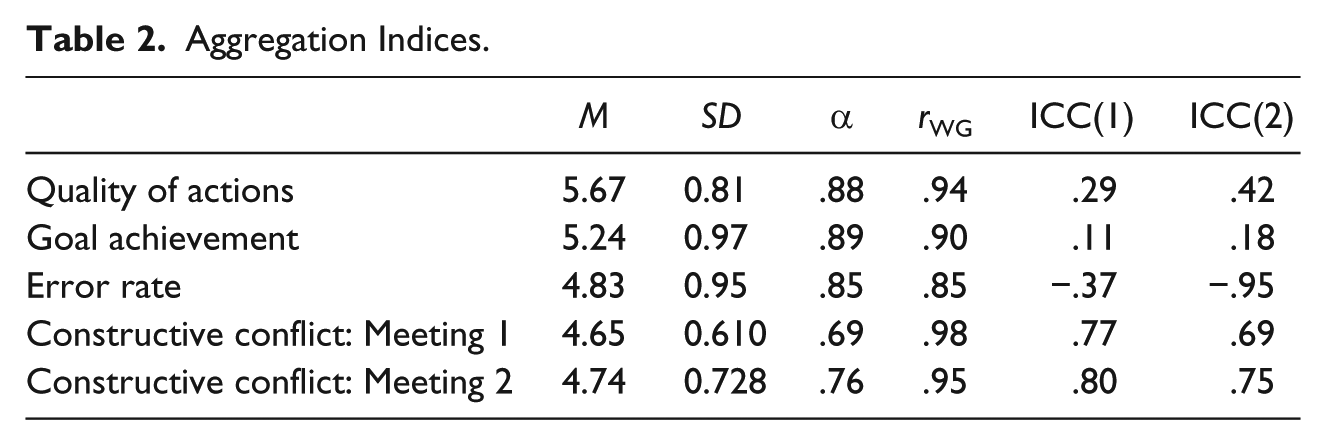
The three items for constructive conflict from Van den Bossche et al.’s (2006) Team Learning Beliefs and Behavior Scale were scored on a 7-point Likert-type scale (e.g., “This team tends to handle differences of opinions by addressing them directly”; Meeting 1: M = 4.65, SD = 0.61, α = .69; Meeting 2: M = 4.74, SD = 0.73, α = .76). All 17 teams were externally rated by one (n = 6) or two (n = 11) different educational researchers. The raters were aged 27 (male), 32 (female), and 34 (female), and had an academic background. The aggregation indices (Table 2) allowed us to aggregate the scores of the two external raters (n = 11) to one team score. The scores on constructive conflict were binned together in teams of low- and high-level constructive conflict. The cutoff point of constructive conflict in Meeting 1 was ≥4.68, and in Meeting 2 this was ≥6.
Aggregation Indices.
Team effectiveness
The effectiveness of the EMCC team was rated by 15 external raters who took on the role of field practitioners, such as a commander of the fire department. In sum, 31 team effectiveness ratings were collected with one to four raters per team (10% women, 53% higher educated). They were aged 32 to 59 years (M = 45.6, SD = 8.1), had a tenure of 3 to 45 years (M = 13.9, SD = 12.2), and worked at different organizations (30% fire department, 20% police, 13% disaster medicine, 27% government, 7% safety region, 3% other). All raters had at least 3 years of experience in emergency management and were all educated for a function in emergency management or had a present function, which could be related to training and development. The raters who did not fulfill the latter criteria had a high education level.
The Emergency Management Team Effectiveness Rating Scale (van der Haar et al., 2013) was used, which consists of three factors: quality of actions (e.g., “The actions at the scene are adequate”; M = 5.67, SD = 0.81,α = .88), goal achievement (e.g., “The crisis is controlled”; M = 5.24, SD = 0.97, α = .89), and error rate (e.g., “There are no unnecessary victims”; M = 4.83, SD = 0.95, α = .85). The response scale ranged from 1 (strongly disagree) to 7 (strongly agree). Aggregation of the external ratings was supported for quality of actions and goal achievement with an acceptable level of interrater agreement and interrater reliability for quality of actions and goal achievement (LeBreton & Senter, 2008), but not for error rate (see Table 2). The error rate did not differ more between teams than within teams and is therefore not included in the data analysis. The scores on quality of actions and goal achievement were binned together in teams of low-level effectiveness and high-level effectiveness. The cutoff point for quality of actions was ≥7 and for goal achievement was ≥6.
Results
The correlations between all variables are presented in Table 3. A Mann–Whitney U test (Table 4) was used to calculate whether there was a significant difference in the frequency of structuring behavior in high- and low-level effective teams in Meeting 1 and Meeting 2 (H1), supposing more goal orientation, clarifying, procedural suggestions, summary command, summary decision, directed questions, and time management (H1) and less procedural questions and undirected questions (H2). Teams that scored high on goal achievement had significant higher scores on “summarizing command” (p = .027) in the first meeting. Teams that scored high on quality of actions showed a higher frequency of using “summarizing decisions” in the second meeting (p = .009). Teams that scored low on goal achievement had a significant higher frequency of “asking procedural questions” in Meeting 1 (p = .046) and Meeting 2 (p = .030). Therefore, H1 and H2 are partly confirmed.
Correlations.
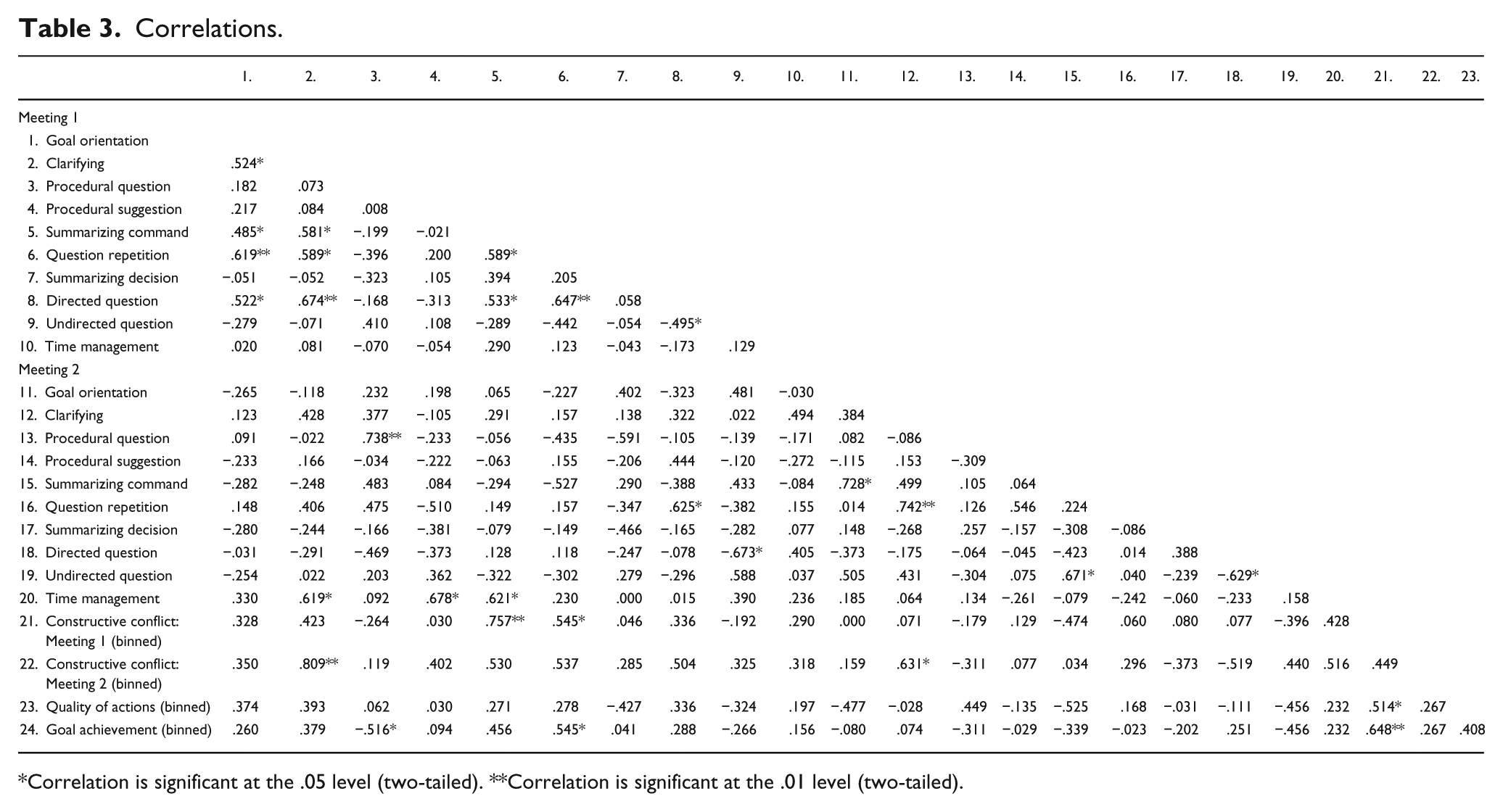
Correlation is significant at the .05 level (two-tailed). **Correlation is significant at the .01 level (two-tailed).
Comparison of Team Leader Structuring Behaviors in Meeting 1 and 2 in Teams With High and Low Team Effectiveness (Quality of Actions and Goal Achievement) and High and Low Constructive Conflict.
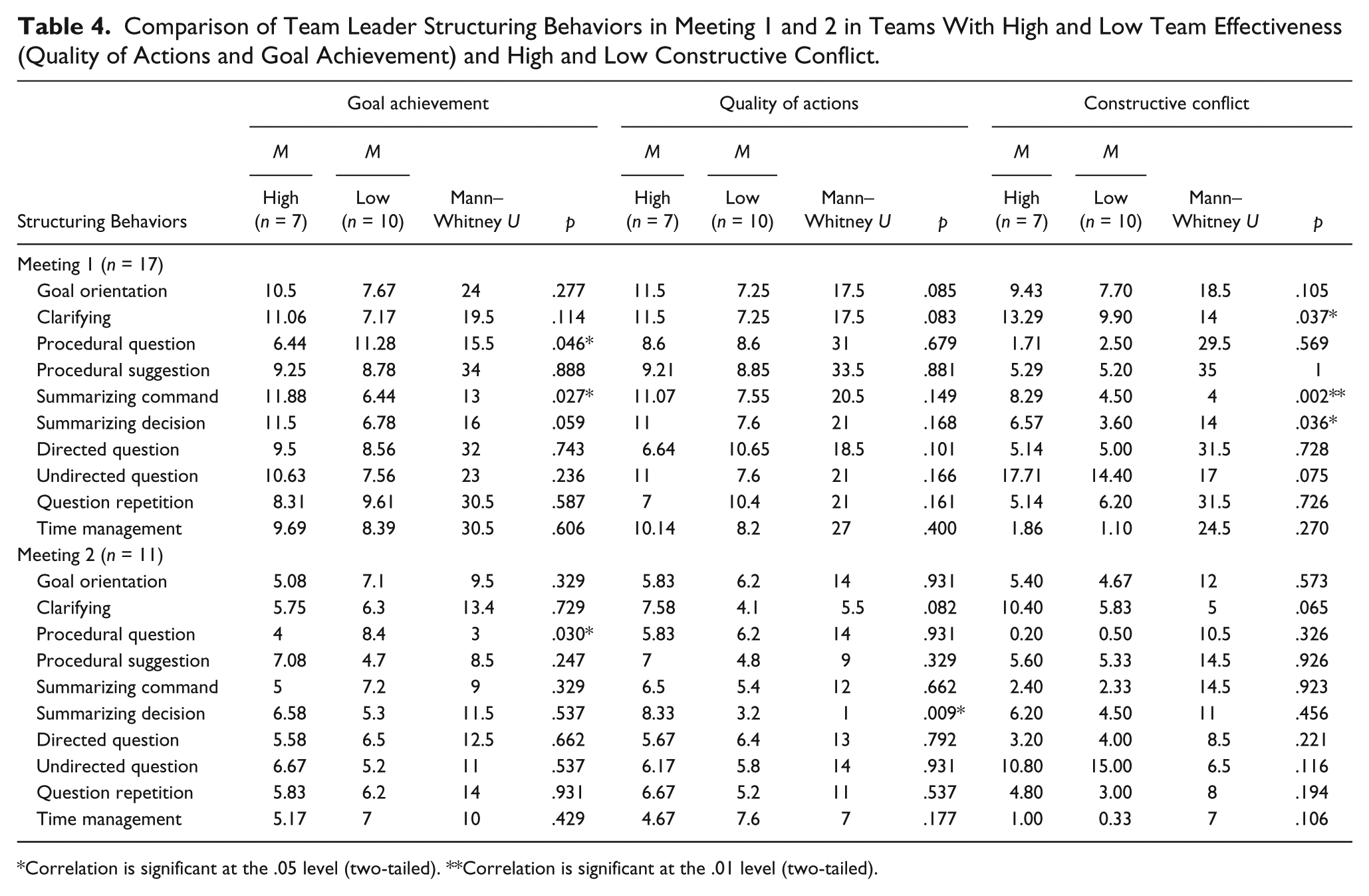
Correlation is significant at the .05 level (two-tailed). **Correlation is significant at the .01 level (two-tailed).
To determine whether effective teams use more constructive conflict (H3), we calculated means and performed an ANOVA. Teams with higher quality of actions have a higher mean on constructive conflict (high in Meeting 1: n = 7, M = 4.79, SD = 0.52 and low in Meeting 1: n = 10, M = 4.55, SD = 0.65; high in Meeting 2: n = 5, M = 4.93, SD = 0.42 and low in Meeting 2: n = 6, M = 4.72, SD = 0.94). However, an ANOVA showed these differences are not significant, not in Meeting 1 (F = 0.632, p = .439) nor in Meeting 2 (F = 0.216, p = .653). Teams with higher goal achievement also have a higher level of constructive conflict (high in Meeting 1: n = 8, M = 4.81, SD = 0.54 and low in Meeting 1: n = 9, M = 4.50, SD = 0.63; high in Meeting 2: n = 5, M = 4.97, SD = 0.66 and low in Meeting 2: n = 6, M = 4.69, SD = 0.81). However, an ANOVA showed these differences are not significant, not in Meeting 1 (F = 1.183, p = .294) nor in Meeting 2 (F = 0.365, p = .591). Therefore, H3 is rejected.
A Mann–Whitney U test (Table 4) was used to test whether there is more structuring behavior of the team leader in teams that use constructive conflict than in teams that do not (H4). Teams that scored high on constructive conflict had significantly higher scores on clarifying (U = 18.5, p = .037), summarizing command (U = 4, p = .002), and summarizing decision (U = 14, p = .036) in the first meeting. In the second meeting, there were no significant differences. Therefore, H4 is confirmed.
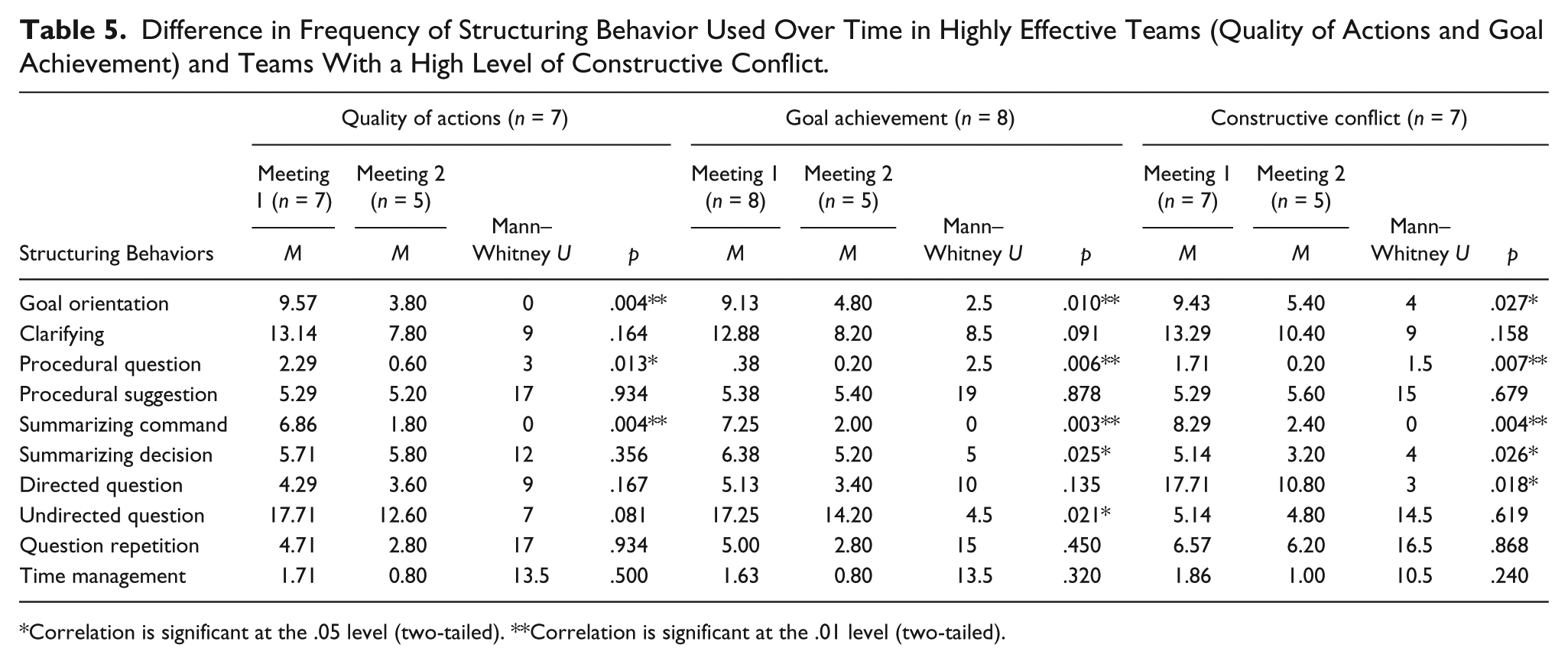
To test whether leaders of high-level effective teams use more structuring behaviors (except for procedural questions and undirected questions) in their first compared with their second meeting (H5), we performed a Mann–Whitney U test (Table 5). Teams that scored high on quality of actions (n = 7 in Meeting 1, n = 5 in Meeting 2) showed a significant decrease in goal orientation (U = 0, p = .004), procedural questions (U = 3, p = .013), and summarizing commands (U = 0, p = .004). Teams that scored high on goal achievement (n = 8 in Meeting 1, n = 5 in Meeting 2) showed a significant decrease in goal orientation (U = 2.5, p = .010), procedural questions (U = 2.5, p = .006), summarizing commands (U = 0, p = .003), summarizing decisions (U = 5, p = .025), and undirected questions (U = 4.5, p = .021). Therefore, H5 is partially confirmed.
Difference in Frequency of Structuring Behavior Used Over Time in Highly Effective Teams (Quality of Actions and Goal Achievement) and Teams With a High Level of Constructive Conflict.
Correlation is significant at the .05 level (two-tailed). **Correlation is significant at the .01 level (two-tailed).
To test whether teams which use more constructive conflict experience more team leader structuring behaviors in their first compared with their second meeting (H6), we performed a Mann–Whitney U test (Table 5). Teams that scored high on constructive conflict (n = 7 in Meeting 1, n = 5 in Meeting 2) showed a significant decrease in goal orientation (U = 4, p = .027), procedural questions (U = 1.5, p = .007), summarizing commands (U = 0, p = .004), summarizing decisions (U = 4, p = .026), and directed questions (U = 3, p = .018). Therefore, H6 is partially confirmed.
Discussion
The aim of this temporal field study of EMCC teams performing a realistic simulation exercise is to shed light on the value of concrete verbal team leader structuring behaviors for the effectiveness of EMCC teams over time, and, more specifically, for using the team learning process of constructive conflict (Decuyper et al., 2010; Van den Bossche et al., 2006; Van den Bossche et al., 2011). The study provides an overview of concrete behaviors of formal leaders of EMCC teams, which enhance team effectiveness and constructive conflict. As such, it adds to team leadership as well as team learning research. Moreover, due to the temporal approach, the study sheds light on the team leader structuring behaviors that change over time to meet the teams’ need to have an organized work process as well as team learning in terms of constructive conflict (McKeown, 2012).
The results show that formal leaders of high-level effective teams use more structuring behaviors over time than formal leaders of low-level effective teams. This result confirms the statements of Van Wart and Kapucu (2011), who argued that high-level effective team leaders in the emergency management context use more directive leadership behaviors. With such behaviors, they support the development of a shared understanding of the task and goal (Benoliel & Somech, 2014; Burke et al., 2006; Keller, 2006) and facilitate accurate decision making (Alexander, 2004; DeChurch & Marks, 2006; Ericsson, Charness, Feltovich, & Hoffmann, 2006).
The structuring behavior that is used more frequently in high effective teams as compared with low effective teams is summarizing (a short repetition of what has been said; MacKay, 2006). More specifically, a summary followed by a command that indicates what action team members should take or what information should be collected (Uitdewilligen, 2011) is beneficial if used in the first meeting. A summary followed by a decision in terms of a statement closing a raised topic or problem (Uitdewilligen, 2011) is beneficial if used in the second meeting. Apparently, in the first meeting, the members benefit from being assigned tasks explicitly so that everyone is alert, whereas in the second meeting, it is more important to have explicitly stated what needs to be done. This finding confirms the argument of Van Wart and Kapucu (2011) that team leaders must make sure that decisions and/or commands in teams are made as comprehensively and clear as possible. It is also in line with the study of Orasanu (1994) describing how captains of effective cockpit crews are more explicit in giving commands and in allocating tasks to crewmembers than those of less effective cockpit crews. Especially in difficult conditions, more effective aviation crews engage in closed-loop explicit communication (Salas, Rosen, Burke, Nicholson, & Howse, 2007). Explicit communication supports building shared problem models, which is essential for avoiding ambiguity or a lack of information that may lead to serious errors (Orasanu, 1994). As such, summarizing, followed by a clear command and/or decision in the EMCC team, supports the development of a shared understanding of the situation and the multidisciplinary approach which is beneficial for team effectiveness (van der Haar et al., 2014; van der Haar et al., 2015). Moreover, summarizing promotes implementing action plans effectively (Burke et al., 2006; Kauffeld & Lehmann-Willenbrock, 2012; Uitdewilligen, 2011), which, in EMCC teams, is beneficial for establishing adequate, justified, and coordinated actions; diminishing the source of the emergency; and stabilizing and controlling the situation (van der Haar et al., 2013).
An EMCC team is not served by a leader asking procedural questions. As Devine (2002) already indicated, knowing a meeting format prior to the start of the meeting increases the ability to give a quick response to a complex environment. The EMCC team has such a meeting format, which the leader has to establish (Helsloot et al., 2010). The leader needs to have a clear idea of how to proceed during the meeting and should not make that a topic for discussion. This follows the idea that the leader should not question the meeting structure to avoid putting another topic to discuss on the table while the task of emergency management in a multidisciplinary team is complicated enough. As the task of the EMCC is to collectively coordinate the multidisciplinary cooperation at the scene of the incident via meetings, it is the function of the formal leader to determine how the meeting is structured, who has what role during the meeting, and how time is managed (Morgeson et al., 2009).
In contradiction to earlier studies (Decuyper et al., 2010), in this study high-level effective teams do not show significantly higher levels of constructive conflict than low-level effective teams. This could be explained by the fact that the relation between constructive conflict and team effectiveness is fully mediated by the development of a shared understanding of the situation and the approach (Boon et al., 2013; Van den Bossche et al., 2006; van der Haar et al., 2015). Another explanation could be that the value of constructive conflict has a curvilinear effect on team effectiveness. DeDreu (2006) showed that moderate levels of task conflict (moderated by collaborative problem solving) promote team innovation but simultaneously reduce short-term goal attainment in teams. Constructive conflict can be seen as a task conflict in terms of a disagreement that is collaboratively and constructively dealt with. Therefore, a moderate level of constructive conflict in Meeting 1 would relate negatively to team effectiveness, while the same moderate level in Meeting 2 would be beneficial for team effectiveness. Future research that indicates three levels of constructive conflict and investigates the curvilinear relationship with team effectiveness can show whether these results on task conflict can be replicated.
The leaders of teams who use more constructive conflict make significantly more use of clarifying, summarizing command, and summarizing decision in the first meeting. By clarifying they make sure everyone understands the statement made by the team member and can link it to the topic (Kauffeld & Lehmann-Willenbrock, 2012). They also identify crucial information and clarify it in a mutually understood vocabulary if necessary (Salas et al., 2001). This may support the discovery of a disagreement, the expression of a disagreement, and the development of a shared understanding of the disagreement. Moreover, by clarifying and summarizing, the team leader reinforces speaking up behaviors by acknowledging the disagreement expressed and taking these issues seriously within their teams. This supports the psychological safety that is required for teams to engage in constructive conflict (Raes, Kyndt, Decuyper, Van den Bossche, & Dochy, 2015; Van den Bossche et al., 2006).
In favor of team effectiveness, the frequency of summarizing as well as asking procedural questions should decrease over time, as well as goal orientation and asking undirected questions. Teams that use constructive conflict also experience a decrease in structuring behaviors over time in terms of goal orientation, procedural questions, summarizing decision, summarizing command, and directed questions. The difference is in the directedness of questions: While for team effectiveness a decrease in undirected questions is beneficial, for constructive conflict a decrease in directed questions is beneficial. This implies that the formal team leader needs to balance between guiding which person is talking and giving the team members a choice in responding.
The required reduction of structuring behaviors over time could be clarified by the fact that teams working on an ill-structured task profit from being given directions via delegating tasks and coming up with a plan of action (Salas et al., 2001) at the early stage, while they benefit from provided support and thus less directive structuring for collectively developing new ideas and creative problem solving in later stages (Lorinkova et al., 2013; Sarin & McDermott, 2003). This implies that a team leader should adapt his leadership behavior to the different phases of the emergency (Aitken et al., 2012) and adjust the level of initiating structure to the current needs of the team (Sarin & McDermott, 2003). In the first stage of the emergency, there is likely more time pressure and more information overload, requiring more directive structuring behavior than in the second stage in which control over the situation is already being acquired (Helsloot et al., 2010). At that later stage, the challenge relocates to proactive adaptation in the sense that different scenario’s need to be explored to foresee what might happen and needs to be prevented or promoted, which requires developmental processes (Gevers et al., 2016).
To conclude, team leaders who meet the challenge of not overstructuring the process and inhibiting members in engaging in team learning behaviors (McKeown, 2012), and thereby supporting team effectiveness, are able to use structuring behavior in terms of goal orientation, summarizing information concluding in commands and decisions, and asking (un)directed questions while reducing this use over time. The current study indicates the importance for formal leaders of EMCC teams to adapt their structuring behaviors to the changing needs of the team as the emergency situation is evolving. Structure helps a team when it is under severe time pressure to control the crises as soon as possible. However, too much structure hurts as well, especially when teams need to move away from routine to find novel answers to novel situations popping up.
Limitations and Directions for Future Research
This study focuses on the first two meetings of 17 EMCC teams during simulation exercises. To validate the findings and fully grasp the evolvement of structuring behaviors over time, it is necessary to not only increase the sample size but also stretch the study over the whole process of emergency management by including more meetings. Such research can also test the validity of the team effectiveness measure used, as the factor error rate was not more diverse between teams than within teams. As error rate measures the acceptance of the number of victims and caused damage as well as the media response (van der Haar et al., 2013), it might be valuable to include in the procedure that before team effectiveness is scored an overview of victims, damage, and media response is given to the raters by the trainers.
Moreover, cross-validating the findings in real emergency situations in different emergency management contexts, including for instance hospitals and chemical industry, would highly benefit the reliability of results. Unfortunately, data collection in real emergency situations is hardly feasible due to the sudden occurrence of incidents, which hinders the planning of research and to the undesired presence of researchers when the EMCC team members need to conduct their respective tasks under real pressure. If simulations are used, it is valuable to take into account the character of the emergency situation and investigate the accompanied need for team leader structuring behavior. Incidents that require a more routine approach may benefit from a leader who supports implicit communication (Rico, Sánchez-Manzanares, Gil, & Gibson, 2008), while if the incident has several challenges for adaptation of routines and generation of new ideas and solutions, more explicit communication, and thus structure, might be needed (Salas, Rosen, et al., 2007).
Several other suggestions for future research come forth from this study. First, although this study video coded team leader structuring behavior, the team learning process of constructive conflict was externally rated by educational experts. If future research extends the coding to the behavior of team members, sequential analyses can be performed to explore the effects of team leader structuring behaviors on team member behaviors in terms of constructive conflict. Second, as we did not find a direct relationship between constructive conflict and team effectiveness and current research has pointed at the mediating role of a similar and accurate understanding of the situation and the task (e.g., Santos et al., 2015; van der Haar et al., 2015), future research can take a next step by including a shared and accurate understanding in the research model. It gives the opportunity to expand the insights in the effects of concrete, verbal team leader structuring behaviors on team effectiveness by supporting team learning and the development of an accurate and shared understanding. Also, three different levels of constructive conflict can be determined so that the curvilinear effect on team effectiveness over time can be investigated. Third, for coding the team leader’s structuring behavior, we have developed our coding scheme based on former literature describing structuring behavior. However, studies identifying structuring behavior of leaders of EMCC teams are very scarce. Therefore, in addition to EMCC leadership literature, we have been using general team leadership literature to describe structuring behaviors of leaders in settings not yet validated in EMCC settings. This might have influenced the richness of our current coding scheme. Future research is needed to validate the concrete team leader behaviors expressed in verbal statements and functions of team leadership identified in other than EMCC settings (Morgeson et al., 2009). In addition, we suggest analyzing a large sample of real-life or video-recorded meetings of EMCC teams to identify EMCC specific structuring behaviors of formal team leaders, which have not yet been described in general (team) leadership literature.
Practical Implications
The results of this study give direction to the training of the team leaders of EMCC teams by showing the need for making use of structuring behavior in favor of team effectiveness and constructive conflict in a different way over time. More specifically, it is especially important for the team leader to summarize information and conclude in a command or decision. Also, the leader needs to set the meeting structure and to take full responsibility for the decisions to be made over how to proceed during the meeting. Asking procedural questions should be avoided. The leader should be flexible in the use of structuring behaviors over time: Being more directive is valuable in early stages when there is high time pressure and an information overload, while in later stages overstructuring hinders the development of new ideas and solutions. The coding scheme of structuring behaviors (Table 1) can be used for the observation and evaluation of team leadership during exercises and real incidents.
Footnotes
Appendix
Declaration of Conflicting Interests
The author(s) declared no potential conflicts of interest with respect to the research, authorship, and/or publication of this article.
Funding
The author(s) received no financial support for the research, authorship, and/or publication of this article.