




Abstract
Team learning behavior is found to be one of the most effective team processes, as learning behavior at the team level (e.g., sharing, discussing, and reflecting on knowledge and actions) enables teams to adapt existing or develop new knowledge. Team leadership behavior is considered a critical accelerant for creating conditions that are essential to engage in team learning behavior, such as a safe environment. Yet despite the growing amount of research in team learning, this relationship remains unclear. Meta-analytic techniques were used to examine when team leadership behaviors support team learning behavior and how the task type moderates that relationship. Forty-three empirical studies reporting 92 effect sizes were synthesized. Analyses show that team leadership behavior explains 18% of the variance in team learning behavior. Furthermore, results indicate that person-focused leaders foster team learning for both adaptive and developmental tasks, whereas task-focused leaders influence team learning for adaptive tasks only.
For more than two decades, research and practice have shown that teams are essential for various organizations in adapting to the ever-changing, competitive, and increasingly complex working environment (Kozlowski & Ilgen, 2006). Teams are defined as “a collection of individuals who are interdependent in their tasks, who share responsibility for outcomes, who see themselves and who are seen by others as an intact social entity embedded in one or more larger social systems” (Cohen & Bailey, 1997, p. 241). Salas, Goodwin, and Burke (2009) reasoned that a team approach allows professionals to integrate their different ideas, viewpoints, and expertise. For this reason, teams have the potential to adapt to changing situations and to improve knowledge, products, and services successfully (Kozlowski & Ilgen, 2006).
Team learning behavior is found to be one of the most effective team processes through which teams are able to adapt to and improve knowledge successfully (Mathieu, Maynard, Rapp, & Gilson, 2008). This behavior is defined as “an ongoing process of reflection and action characterized by asking questions, seeking feedback, experimenting, reflecting on results, and discussing errors or unexpected outcomes of actions” (Edmondson, 1999, p. 353). In this definition, team learning behavior is not perceived as an outcome of interactions but as collective discourse activities that teams undertake to yield new insight into a problem (Edmondson, Dillon, & Roloff, 2007). Van den Bossche, Gijselaers, Segers, and Kirschner (2006) showed that collective discourse activities such as the process of building on each other’s input (i.e., co-construction) develop mutually shared cognitions, and can therefore be observed as examples of team learning behavior. It has been shown that such team learning behaviors enable teams to improve existing or develop new techniques, approaches, products, or knowledge of a high quality in a short time (Sessa & London, 2008).
At the same time, research has also showed that team members do not engage in team learning behavior automatically because it can cause problems. For example, differences in status can lead to obstructive domination by members with more authority (Brooks, 1994), and members can experience a cognitive overload when facing unstructured tasks (De Dreu & Weingart, 2003). For this reason, it is argued that engaging in team learning behavior needs to be encouraged through team leadership behavior (e.g., Van der Haar, Koeslag-Kreunen, Euwe, & Segers, 2017). Team leadership behavior is defined as “the process of influencing others to understand and agree about what needs to be done and how to do it, and the process of facilitating individual and collective efforts to accomplish shared objectives” (Yukl, 2010, p. 8). There is an increasing volume of research on how team leadership behavior can support team learning behavior (Decuyper, Dochy, & Van den Bossche, 2010). For instance, Wong and Tjosvold (2010) found that team leaders who emphasize building social relationships helped members to overcome feeling insecure in expressing opposing ideas. In addition, Somech (2006) revealed that team leaders who defined team goals provided structure and inspired team reflexivity.
However, despite this growing amount of evidence, it remains unclear how leadership behavior best supports team learning behavior. First, it appears that studies on team leadership behavior rarely integrate multiple sources of leadership behavior; even when such studies are available, they relate leadership to team performance rather than to team learning (Burke et al., 2006). Pearce and Sims (2002, p. 172) argued that team leadership behavior can originate from the vertical source (“the behavior of the appointed team leader”) and the shared source (“the distributed influence from within the team”). Traditionally, leadership studies have focused exclusively on the vertical source and provided abundant proof of the significant role of the vertical source (e.g., Burke et al., 2006). More recently, the shared source has been gaining attention (Nicolaides et al., 2014). It is argued that the distribution of leadership among team members fits the contexts in which teams operate, such as highly complex tasks for which single leaders simply cannot provide all the answers (Pearce & Barkus, 2004). Pearce and Sims (2002) showed that both sources coexist among teams. Evidence on how both sources are related to team learning behaviors is absent, as most studies include only one source (mainly the vertical source) or relate both sources exclusively to team performance (e.g., Nicolaides et al., 2014; Pearce & Sims, 2002).
Second, research on how multiple styles of leadership behavior relate to team learning behavior is limited (Zaccaro, Ely, & Shuffler, 2008). Burke et al. (2006) distinguished two sets of leadership behavioral styles: person-focused styles (i.e., inspiring team members) and task-focused styles (i.e., setting team goals). Pearce and Sims (2002) showed that these two behavioral styles can stem from both the appointed team leader (vertical) and the team members (shared). However, studies that integrate both behavioral styles are scarce, or they relate both styles to team performance (e.g., Pearce & Sims, 2002).
Third and final, an empirical foundation is required for the suggestion that the relationship between team leadership behavior and team learning behavior is dependent on the specific team task (Edmondson et al., 2007). London (2014) suggested that the promotion of learning in teams dealing with adaptive tasks, such as production, requires task-focused leadership behaviors to reinforce exploitation. In addition, London (2014) proposed that learning behavior in teams dealing with developmental tasks, such as innovation, is supported by person-focused behavior to promote creativity. Regardless, studies on team leadership rarely integrate multiple leadership styles and sources with team learning behavior, resulting in a lack of evidence for these hypotheses (Edmondson et al., 2007).
The present meta-analysis examines when leadership behavior best supports team learning behavior. For this purpose, we elaborate and extend the preliminary meta-analyses on team leadership behavior by Burke et al. (2006) and Nicolaides et al. (2014). Burke et al. (2006) focused solely on the vertical source of leadership. Meanwhile, research that examines the influence of team leadership behavior on team learning behavior has increased, which calls for an updated synthesis. In addition, Nicolaides et al. (2014) compared the influence of shared and vertical leadership on team performance, but they did not analyze the influence of both sources on team learning behavior, nor did they differentiate between specific styles of leadership behavior.
We aim to contribute to the current literature by focusing on three issues. First, this study examines the overall effect of team leadership behavior on team learning behavior. Second, we will calculate the effect of different sources and styles of team leadership behaviors (i.e., vertical, shared, person-focused, and task-focused team leadership behavior) on team learning behavior. Third, we aim to provide new knowledge on how team task (i.e., adaptive and developmental) moderates the effect of each source and style of team leadership behavior on team learning behavior. Although these research questions might be assessed by synthesizing solely quantitative studies, we will also include qualitative studies. Borman and Grigg (2009) argued that combining quantitative and qualitative studies in meta-analyses can advance the interpretation of the findings, because it supports a deeper understanding of how calculated effects may vary under certain conditions. Paterson, Thorne, Canam, and Jillings (2001) reasoned that this is especially valuable when studying complex social relationships, such as team learning and leadership. To this end, we will meta-analyze quantitative and qualitative studies of the influence that team leadership behavior has on team learning behavior. This meta-analysis is based on the conceptual model and hypotheses presented in Figure 1.
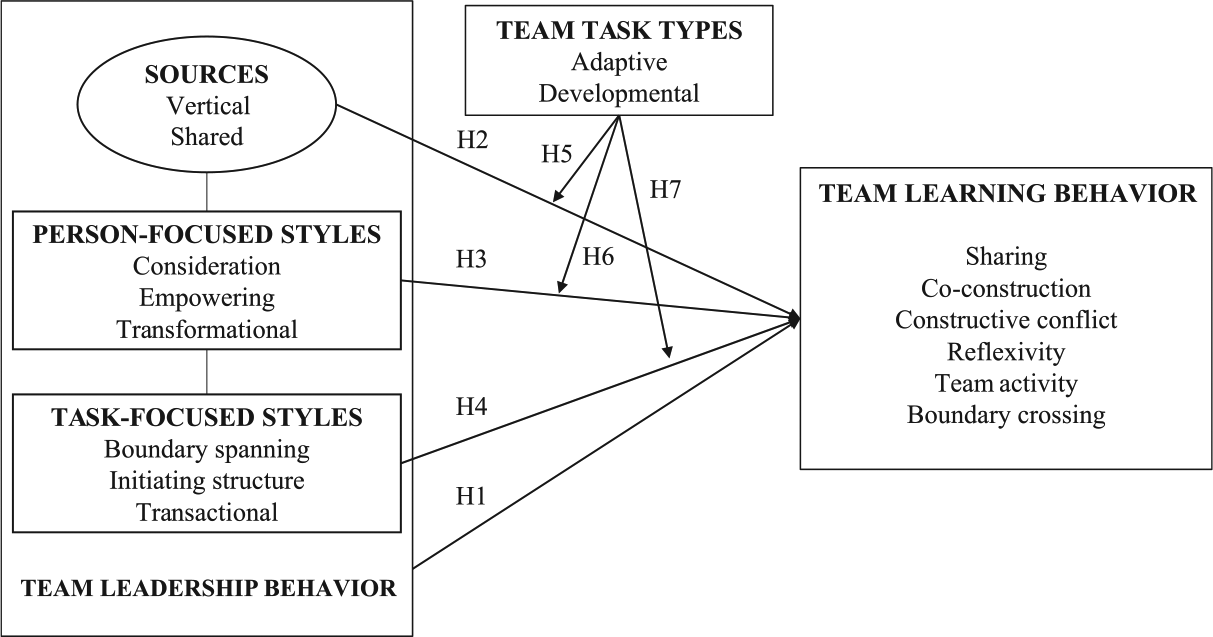
Hypothesized relationships between team leadership behaviors, team task types, and team learning behaviors.
Team Learning Behavior
Senge (1990) was one of the earliest to describe team learning as fundamental for organizational change. The importance of team learning has since been demonstrated in research at an ever-increasing rate. Edmondson et al. (2007) identified three leading concepts of team learning in research: (a) team learning as performance improvement (e.g., a change in knowledge; Ellis et al., 2003), (b) team learning as task mastery (e.g., the ability to coordinate team members’ knowledge to accomplish tasks; Wilson, Goodman, & Cronin, 2007), (c) and team learning as a process (e.g., collectively sharing, discussing, and reflecting; Edmondson, 1999). The present meta-analysis conceptualizes team learning as a process. In this respect, we make a clear distinction between team processes and team outcomes. Widely used input-process-output models to analyze teams and team performance show that inputs (e.g., composition and leadership) to the team have an influence on team processes, which in turn lead to team outcomes, such as performance and viability (Day, Gronn, & Salas, 2004). We adhere to the view that performance improvement and task mastery are outcomes of team processes, because they develop from behavioral learning processes within the team (Day et al., 2004; Decuyper et al., 2010).
This meta-analysis conceives of team learning as learning processes at the team level (e.g., Mathieu et al., 2008). Kozlowski and Ilgen (2006) argued that although team learning is based on individual learning, it exceeds the sum of the individual learning of team members. Team learning processes occur when individual knowledge and experiences are being shared, discussed, and reflected on at the team level (Kozlowski & Ilgen, 2006). These processes are seen as examples of team learning behaviors, because they build shared cognitions that enable teams to modify ideas, change protocols, and develop new knowledge together (Van den Bossche et al., 2006). Decuyper et al. (2010) identified six team learning behaviors in a comprehensive review: (a) sharing, (b) co-construction, (c) constructive conflict, (d) reflexivity, (e) activity, and (f) boundary crossing. Sharing refers to exchanging each other’s ideas, knowledge, expertise, and opinions through interaction and communication (Faraj & Sproull, 2000). Many scholars have found that sharing determines team performance (e.g., Lee, Lee, & Park, 2014; Srivastava, Bartol, & Locke, 2006). Co-construction is defined as building on each other, refining statements, and modifying previous ideas (Raes et al., 2012). Van den Bossche et al. (2006) have shown that co-construction leads to adapted or new meaning and knowledge. During sharing and co-construction, discussions and conflicts may occur as a result of different opinions and opposing interpretations. These conflicts become constructive when team members act on these differences by negotiating the divergences and integrating opposed ideas into an agreement, or an agreement to disagree (Van den Bossche et al., 2006). Research shows that higher levels of constructive conflict relate to better team performance (Van der Haar et al., 2017). Team reflexivity is defined as “the extent to which team members collectively reflect upon the team’s objectives, strategies and processes” (West, 1996, p. 559). Research shows that team reflexivity positively affects team performance (Hoegl & Parboteeah, 2006). Team activity is defined as “learning by doing” (Decuyper et al., 2010, p. 118), such as trying out solutions (Kasl, Marsick, & Dechant, 1997). Team activity enables team members to transfer ideas and expertise that is nonexplicit or nonconsciously present, such as expertise that is embedded in specialized skills (Eraut, 2000). Boundary crossing is defined as “seeking or giving information, views, and ideas through interaction with other individuals or units” (Kasl et al., 1997, p. 230). Research shows that boundary crossing improves team performance because it yields other perspectives on the problem (Liu, Schuler, & Zhang, 2013).
In sum, the process of team learning behavior can help to achieve successful team performance, such as solving problems and team viability (Sessa & London, 2008). However, engaging in team learning behavior requires support because it does not just happen by itself (Zaccaro et al., 2008). Each team learning behavior outlined above implies taking a risk. For example, sharing personal ideas makes people vulnerable (Mayer, Davis, & Schoorman, 1995), co-constructing requires courage to modify known protocols (Edmondson, 2003b), seeking controversy through constructive conflicts implies overcoming natural habits of harmonizing differences (Koeslag-Kreunen, Van der Klink, Van den Bossche, & Gijselaers, 2018), expressing negative feedback during team reflexivity can harm team processes (Kluger & DeNisi, 1996), team activity can lead to ineffective socialization (Ostroff & Kozlowski, 2006), and boundary crossing can disrupt team performance through negative feedback (Ancona & Caldwell, 1992). These examples indicate that engaging in team learning behavior is risky and, as a result, requires support. It is argued that team leadership behavior can support teams in taking that risk (Zaccaro et al., 2008). Edmondson (2003a) argued that team leaders can facilitate engaging in team learning behaviors by, for instance, expressing their own imperfections, tolerating failure, organizing reflection, and setting valuable team goals. In addition, Hoch (2014) argued that distributing such team leadership behaviors among team members can overcome obstructive power differences and support members in providing their unique information. Based on these arguments, we propose our first hypothesis:
Sources of Team Leadership Behavior to Stimulate Team Learning Behavior
We distinguish two sources from which team leadership behavior can originate to influence team learning behavior: the vertical source and the shared source of leadership. Vertical team leadership behavior is defined as leadership behavior that stems from a single leader who is formally appointed to lead the team through a hierarchical influence on the team (Pearce & Barkus, 2004). Shared team leadership behavior is attested when team members are “engaged in the leadership of the team and are not hesitant to influence and guide their fellow team members in an effort to maximize the potential of the team as a whole” (Pearce & Barkus, 2004, p. 48). It is argued that both the vertical and the shared source of team leadership behavior have an influence on team learning behavior. Burke et al. (2006) observed that formal leaders who provide feedback and offer consultation foster knowledge sharing. These vertical team leadership behaviors improve team members’ self-confidence and courage to speak up (Edmondson, 1999). When power is shared, team members share team leadership behaviors (Pearce & Barkus, 2004), which enables them to interact freely and equally without power differences and resulting in richer interactions (Brooks, 1994). These arguments suggest that both sources stimulate team learning, as formulated in our second hypothesis:
Styles of Team Leadership Behavior to Stimulate Team Learning Behavior
To understand when leadership is functional in teams, research usually observes team leadership from the behavioral perspective. Burke et al. (2006) distinguished two main behavioral styles: person-focused and task-focused team leadership behaviors. To be clear, these behaviors can stem from both vertical and shared team leadership sources (Pearce & Sims, 2002).
Person-focused team leadership behaviors (Burke et al., 2006) are behaviors that encourage communication, support self-management, and challenge team members to move beyond their self-interest. Consideration, empowering, and transformational leadership are perceived as specific person-focused leadership behaviors. Consideration means building a positive climate for cooperation and open communication, and emphasizing the relationships and the wellbeing of team members (Carmeli, Tishler, & Edmondson, 2012). It is argued that consideration supports team learning behavior, because it sets the right atmosphere (Somech, 2006) and promotes positive relationships (Hirst, Mann, Bain, Pirola-Merlo, & Richver, 2004). Empowering team leadership means actively developing the self-leadership skills of the team (Burke et al., 2006). Empowering team leadership is also referred to as team coaching (e.g., to encourage teams and being available for consultation; Edmondson, 1999) or participative leadership (i.e., sharing influence; Somech, 2006). Srivastava et al. (2006) showed that empowering leadership encouraged team members to share their knowledge because members found that this situation was crucial to making decisions. Transformational team leadership is defined as helping team members to move beyond their self-interest by challenging them and by stimulating creativity, in their efforts to solve problems (Bass & Avolio, 1994). According to Bass and Avolio (1994), transformational leaders are charismatic, consider individual concerns, challenge members to break with the status quo and seek alternatives, and set a compelling vision and purpose. Schippers, Den Hartog, Koopman, and Van Knippenberg (2008) found that transformational leaders positively influence team reflexivity; for example by encouraging members to reflect on their daily routines. In sum, it is argued that person-focused styles of leadership behavior foster team learning behavior through encouraging communication, supporting self-management, and moving beyond self-interest, as summarized in our third hypothesis:
Task-focused team leadership behaviors (e.g., boundary spanning, initiating structure, and transactional leadership as specific task-focused leadership behaviors) emphasize the task by providing task information, structuring the task, and monitoring team performance (Burke et al., 2006). Boundary spanning means scanning the environment for new information, networking, and negotiating teams’ resources (Ancona & Caldwell, 1992). Burke et al. (2006) argued that boundary spanning activities direct teams toward task accomplishment and guide team tasks according to the available material resources and organizational strategies. Edmondson (2003b) proposed that boundary spanning activities by team leaders stimulate the team’s own boundary crossing, because team leaders have easier access to external networks and set an example that motivates members to seek external information themselves. Initiating structure means defining a team’s tasks, working methods, goals, and outcomes (Døving & Martín-Rubio, 2013). Burke et al. (2006) discerned directive (i.e., organizing processes through methods and outcomes) and autocratic leadership (i.e., decision making without involving team members) as two forms of initiating structure. Somech (2006) showed that directive leaders enhance team reflexivity, because defining team goals inspires members to reflect on those goals and encourages members to criticize each other’s work. Transactional team leadership behaviors focus on task agreements, the required facilities, and the rewards or punishments for achieving them (Bass & Avolio, 1994). This behavior is also represented in a more passive way by only intervening when problems occur (Burke et al., 2006). Ashauer and Macan (2013) argued that focusing on the team’s task and performance can motivate members to show their competence for the task, thereby encouraging them to engage in team learning behaviors. In sum, it is suggested that task-focused styles of leadership behavior foster team learning behavior by providing task information, structuring, and monitoring, as set out in our fourth hypothesis:
Team Task Type as a Moderator
London (2014) has argued that the relationship between team leadership behavior and team learning behavior may be influenced by the team’s task. Ellström (2001) reasoned that tasks vary in their level of structure and novelty. We categorize this variation by distinguishing between two types of team tasks: adaptive and developmental tasks. Adaptive tasks are prescribed, medium to highly structured, and contain some new elements (Devine, 2002; Ellström, 2001). Typical examples of team activities for adaptive tasks are executing, coordinating, service applying, training, caring, operating, and producing (Cohen & Bailey, 1997; Devine, 2002). By contrast, developmental tasks are not prescribed, medium to minimally structured, and contain many new elements (Devine, 2002; Ellström, 2001). Typical team activities for developmental tasks are improving, designing, researching, dissolving, and creating (Cohen & Bailey, 1997; Devine, 2002).
Kostopoulos and Bozionelos (2011) showed that the effective behavioral processes for team learning appear to be different between the two task types. For adaptive tasks, teams adapt their knowledge to the new elements to be effective; as in the case of a medical team following a known protocol in a new situation. These teams can rely on existing knowledge because they can build on known methods and predict results to some extent. By contrast, Kostopoulos and Bozionelos (2011) showed that developmental tasks require the development of new knowledge to be effective because they work with unknown methods and open results (e.g., as in the case of a product development team designing an innovative product). Based on these differences, Vera and Crossan (2004) suggested that the effective team leadership behavior to support team learning behavior is also different for both team types.
First, there might be a difference between the benefits of the vertical and the shared source of team leadership behavior for each task type. For example, Van der Haar et al. (2017) studied command-and-control teams who needed to follow strict protocols to adapt to the situation at hand. They showed that vertical team leadership behavior supported team learning behavior by actively clarifying and summarizing team members’ inputs. It is suggested that team learning behavior for teams dealing with less-structured tasks is supported by shared team leadership behavior. In these developmental tasks, team members cannot rely on existing protocols (Kostopoulos & Bozionelos, 2011). It is argued that this increases team members’ interdependence when teams seek alternative solutions to questions for which single leaders do not have the answers (Day et al., 2004). Therefore, shared team leadership might be more beneficial for developmental team tasks than vertical team leadership behavior (Pearce & Barkus, 2004). As a result, we propose our fifth hypothesis:
Second, there might be a difference between the benefits of person- and task-focused leadership styles for each task type. Person-focused behaviors may support learning behavior particularly in teams dealing with developmental tasks (London, 2014). These teams face high levels of uncertainty because they cannot rely on routines and need to be even more creative. It is argued that person-focused team leadership behaviors facilitate team learning behavior by building a positive climate for communication and challenging members to disrupt their routines (Edmondson, 2003b). Ashauer and Macan (2013) conducted an experiment in teams with developmental tasks and found that teams with person-focused leaders showed more learning behaviors than teams lead by task-focused leaders. The person-focused leaders supported team learning behavior because they emphasized the importance of developing strategies for improvement, while the task-focused leaders concentrated on team outcomes. For this reason, we propose the following in our sixth hypothesis:
London (2014) suggested that the learning behavior in teams facing adaptive tasks might be supported by task-focused leadership behavior. These leadership behaviors reinforce exploitation and production because they structure processes by applying known protocols and methods, as well as by monitoring and rewarding outcomes, which is possible when tasks are more structured from the beginning (London, 2014). Based on these arguments, we propose the following in our seventh and final hypothesis:
Method
Main Literature Search
Figure 2 presents the flowchart for identified and included studies, and contains several approaches to identifying relevant published and unpublished empirical studies (White, 2009). The main search was conducted in February 2017 and included nine different electronic bibliographic databases, which together covered multiple disciplines (e.g., economics, education, management, medicine, psychology, and sociology) and encompassed different source types (e.g., academic journals, dissertations, and books). We used the following search terms (searching all fields and all years): team combined with team learning or sharing or co-construction or constructive conflict or boundary crossing or team reflexivity or team activity, combined with team leadership or leadership. This search yielded an initial output of 2,277 references (Web of Science: 815; Business Source Premier: 765; CINAHL: 57; Econlit: 10; ERIC: 204; Psych and Behavioral Sciences Collection: 35; Psycharticles: 4; PsychINFO: 317; and SocINDEX: 70), which were imported in Endnote™ and screened for duplicates, resulting in 1,968 unique studies.
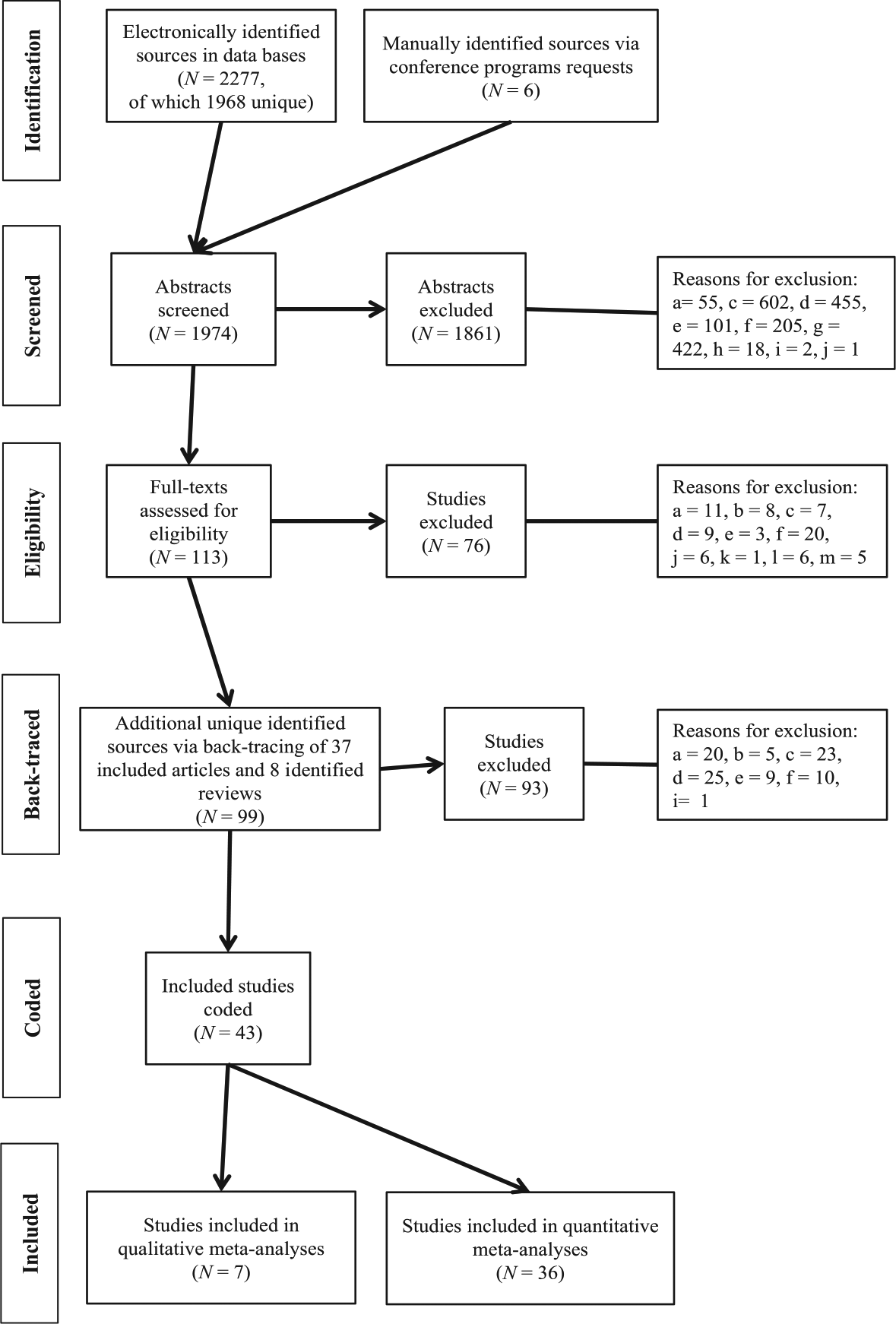
Flowchart of identified and included studies.
Using the same search terms, papers not yet published were identified by manually searching conference presentations between 2013 and 2017 for the Academy of Management (AoM), European Association for Research on Learning and Instruction (EARLI), European Association of Work and Organizational Psychology (EAWOP), and the Interdisciplinary Network for Group Research (INGRoup). Five relevant presentations were found (1 AoM, 3 INGRoup, 1 EAWOP); four papers (three of which were published) were received upon request, and one extra unique paper was attached by one of the contacted authors. In addition, INGRoup’s network was invited to send additional unpublished work, resulting in no further potential studies. Accordingly, this manual search identified six additional studies, resulting in a total of 1,974 identified studies.
Selection criteria
Qualitative and quantitative studies were included in this meta-analysis (White, 2009). Criteria for exclusion were as follows: (a) nonempirical; (b) review article; (c) no team(s) involved 1 (e.g., communities, groups, staff, firms, individuals, followers, minorities, organizations, networks, collaborations); (d) no mention of team learning or no fit to the definition of team learning, sharing, co-construction, constructive conflict, reflexivity, activity, and/or boundary crossing (team processes/outcomes such as creativity, effectiveness, mental models, innovative behavior, problem solving, discourse, conflict, culture, dynamics, team building, collaboration, commitment were excluded); (e) no mention of leadership or team leadership; (f) no empirical analysis of the influence of (team) leadership on team learning; (g) news items; (h) empty records; (i) nonavailable sources; (j) conference abstracts found in the first approach; and (k) studies written in a language other than English. Next, it appeared that some studies reported the same sample (l). For each case, one study was included to maintain independency (favoring: aggregation on team level; more detailed information; a scientific instead of a practical article; and a peer-reviewed article instead of a dissertation). Finally, five studies did not aggregate data on the team level (m). 2
Literature Selection Process
The selection criteria were applied during three selection phases: (a) abstract screening of the 1,974 studies identified (1,861 sources excluded), (b) assessing full-text eligibility (76 sources excluded), and (c) back-tracing (93 sources excluded), as follows. First, the 1,974 abstracts were screened (White, 2009). In case of doubt, the abstract was included. Three authors independently reviewed 10 abstracts to test the reliability of this screening process. The interrater agreement on inclusion/exclusion and the selection criteria was very high (90%). Differences were resolved via consensus. This process resulted in 113 studies for inclusion. Second, the 113 full texts were read and assessed for eligibility (White, 2009). Fifteen studies were double-blind coded for reliability testing. Again, interrater agreement on the criteria was very high (94%). Consensus resolved uncertainties and differences. This effort resulted in the inclusion of 37 studies. Third, to ensure all relevant studies were detected, we conducted the back-tracing method (White, 2009). For this, we manually back-traced the references used in the conceptual models of the eight identified reviews in the main search and the 37 included sources. In total, 99 unique additional references were found, of which six met the selection criteria. In conclusion, 43 studies were included in the sample. Figure 2 shows the exclusion reasons per selection phase.
Sample
In total, 43 empirical studies were meta-analyzed, of which 36 were quantitative that reported 92 effect sizes, and seven qualitative. These studies were conducted between 1994 and 2017 (2000 and earlier: n = 3; 2001 thru 2005: n = 3; 2006 thru 2010: n = 9; 2011 thru 2015: n = 19; 2016 thru 2017: n = 8). One paper was in preparation for submission (presented at a conference in 2015) and one paper was under review. Sample sizes for quantitative studies ranged from 28 to 156 teams (M = 73.27, SD = 37.37), and for qualitative studies one to 16 teams (M = 4.43, SD = 5.19). The teams consisted of 3 to 22 members (M = 6.85, SD = 3.78, missing = 2 studies). Seventeen studies reported the team’s tenure, with a range from no history (ad hoc teams) till 10.2 years (M = 2.72 years, SD = 2.72 years). Table 1 displays the multidisciplinary nature and variety of our sample, including various contexts (e.g., high-tech and IT companies, service industries, health care and banking sectors) and various team types (e.g., medical teams, management teams and project teams).
Overview of the Coded References.
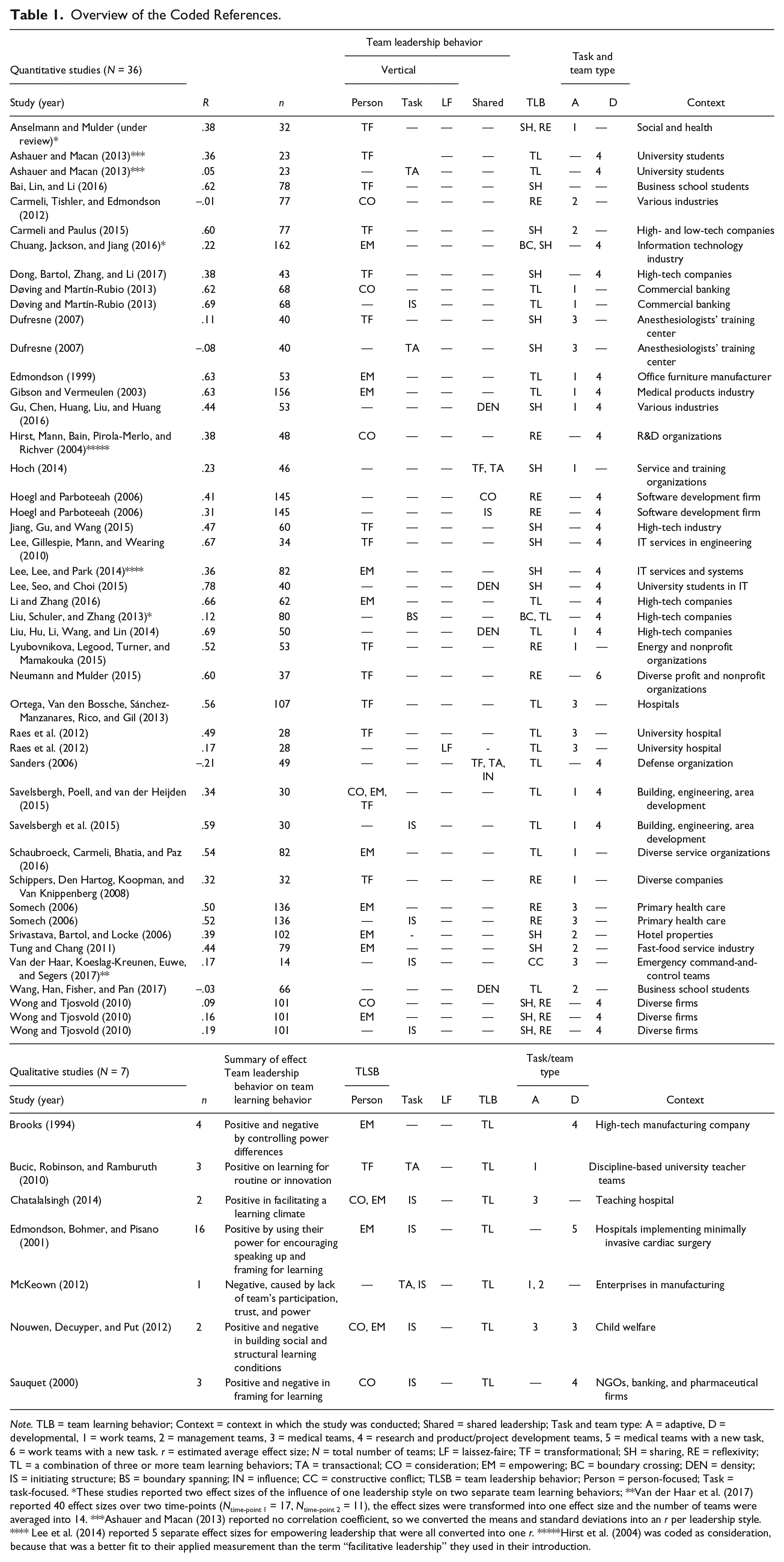
Note. TLB = team learning behavior; Context = context in which the study was conducted; Shared = shared leadership; Task and team type: A = adaptive, D = developmental, 1 = work teams, 2 = management teams, 3 = medical teams, 4 = research and product/project development teams, 5 = medical teams with a new task, 6 = work teams with a new task. r = estimated average effect size; N = total number of teams; LF = laissez-faire; TF = transformational; SH = sharing, RE = reflexivity; TL = a combination of three or more team learning behaviors; TA = transactional; CO = consideration; EM = empowering; BC = boundary crossing; DEN = density; IS = initiating structure; BS = boundary spanning; IN = influence; CC = constructive conflict; TLSB = team leadership behavior; Person = person-focused; Task = task-focused. *These studies reported two effect sizes of the influence of one leadership style on two separate team learning behaviors; **Van der Haar et al. (2017) reported 40 effect sizes over two time-points (Ntime-point 1 = 17, Ntime-point 2 = 11), the effect sizes were transformed into one effect size and the number of teams were averaged into 14. ***Ashauer and Macan (2013) reported no correlation coefficient, so we converted the means and standard deviations into an r per leadership style. **** Lee et al. (2014) reported 5 separate effect sizes for empowering leadership that were all converted into one r. *****Hirst et al. (2004) was coded as consideration, because that was a better fit to their applied measurement than the term “facilitative leadership” they used in their introduction.
Coding Process
The included studies were systematically coded with deductive (based on the theoretical framework) and inductive (refining the codes based on the description and measurement found in each study) categories (D. B. Wilson, 2009). Table 1 displays the coded 43 references of the final sample.
The coding process contained three judgments. First, coding team learning and team leadership was based on the definition presented in the study and instruments (e.g., items or coding schemes). If the study integrated three or more team learning behaviors, the code team learning was applied, otherwise the one or two team learning behaviors were coded as presented. Second, if the examined items represented different or more team leadership behaviors than the definition used in the study, the examined and most suitable code of team leadership was chosen. Third, coding of the task type was based on the description of the sample in the Method section of the study. Two authors coded all studies, of which 10 were double blind. Interrater agreement per code was high (70% to 80%). Coding team leadership behavior on 15 studies in two rounds resulted in an agreement of 100%. The discussion of differences and uncertainties completed the coding scheme.
Quantitative Meta-Analytic Techniques
The reported correlation coefficient Pearson’s r (accompanied by the sample size) served as the effect size index of the influence of team leadership behavior(s) on team learning behavior (Borenstein, Hedges, Higgins, & Rothstein, 2009). Following the example of Burke et al. (2006), meta-analyses were performed at three levels (e.g., Borenstein et al., 2009): (a) Level 1 was the random overall effect of team leadership behavior (testing H1), (b) Level 2 were the subgroup effects of different team leadership behaviors (testing H2, H3, H4), and (c) Level 3 was the moderator effect of task types (testing H5, H6, H7). For Levels 1 and 2, a random-effects model method was used assuming the effect sizes in each study varies randomly (Field & Gillett, 2010). Random-effect models compare scores between and within the subgroups, and balances weights and makes large studies less dominant (Hunter & Schmidt, 2004). We hypothesized that the observed total relative variance in the studies was due to heterogeneity of (between and within) the studies, for which an I² > 75% is considered large (Borenstein et al., 2009). A significant heterogeneity tested validity of continuing the analysis to find reasons for the (expected) variance. For Level 3, we used a subgroup meta-analytical approach to conduct this moderator analysis (Cortina, 2003). Task type served as a dichotomous variable (i.e., adaptive vs. developmental) to calculate its moderation effect on the relationship between team leadership behavior and team learning behavior. We examined the (overall) moderator effect of task type across leadership styles, and the moderator effect of task type per leadership style. We applied a mixed-effect model for these moderator analyses (Borenstein et al., 2009). A random-effects model within subgroups (based on significant heterogeneity tests for allowing random effects within subgroups) was used to calculate the effect of leadership on team learning within subgroups. Next, the Q test (Hedges & Olkin, 1985) within the fixed-effect model was executed to calculate the magnitude of the differences across task types.
Computations were performed using the software program Comprehensive Meta Analysis™ (CMA) version 3. All raw correlations r were first transformed into a Fisher’s z to stabilize variance (for N > 20) by correcting for standard deviations and sample sizes (Hedges, 2009). Then, they were transformed back into an r using the formula (i.e., FISHER.INV in Excel) suggested by Borenstein et al. (2009) to present and interpret the data (e.g., Burke et al., 2006). For effects r = .10 explaining 1% of the variance is small, r = .30 explaining 9% of the variance is moderate, and r = .50 explaining 25% of the variance is large. File-drawer analyses were computed to deal with publication bias caused by the possibility that significant findings are favored for publication. Therefore, a Fail-safe N was calculated indicating the number of unreported studies with a mean effect of zero needed to make the calculated effect size insignificant (Rosenthal, 1979).
Method for quantitative studies reporting multiple effect sizes
We used the shifting units method of Cooper (1989) to deal with studies that reported more than one effect size (e.g., Burke et al., 2006). On the one hand, aggregating multiple effect sizes per study into one effect size yields independence from studies and effect sizes. On the other hand, this aggregation diminishes specific valuable information that each effect size may hold, while the assumed correlation between different effect sizes for aggregation might be invalid (Hunter & Schmidt, 2004). Shifting units mean that the unit of analysis (e.g., study, subgroup, or moderator) and the number of effect sizes (k) may change depending on the hypothesis that is tested. Cooper (1989) argued that this method serves as a compromise strategy to minimize violating the independence from effect sizes and to maximize using specific information within studies.
Of the 36 quantitative studies, 13 studies reported multiple effect sizes, as presented in Table 1. Of those 13 studies, the effect sizes of five studies could be aggregated into one per study and remained independent throughout the meta-analysis. Two of those five studies reported more than one effect size for the same leadership and team learning behavior. For these studies, one effect size was calculated by synthesizing the multiple correlation coefficients into one per study through running CMAs per study. The other three studies each reported two effect sizes for the influence of a single leadership style on two separate team learning behaviors. For these three studies, one effect size per study was calculated via separate CMAs. The multiple effect sizes in the remaining eight studies held specific valuable information for this meta-analysis, to which we applied the shifting units method as follows. For Level 1 (the overall influence of team leadership on team learning, H1), the multiple effect sizes per study were synthesized into one effect size per study to yield maximum independence (kLevel 1 = 36). For Levels 2 and 3 (H2-H7), the effect sizes of the eight studies were kept separate, because they contained the information for which we were searching (Hunter & Schmidt, 2004). This information included separate effect sizes for transformational and transactional leadership, or one effect size for consideration and another for empowering. As a consequence, the values for k in Tables 2 and 3 vary.
Main Effect of Team Leadership Behavior and Subgroup Analyses of the Effect of Leadership Sources and Styles on Team Learning Behavior.
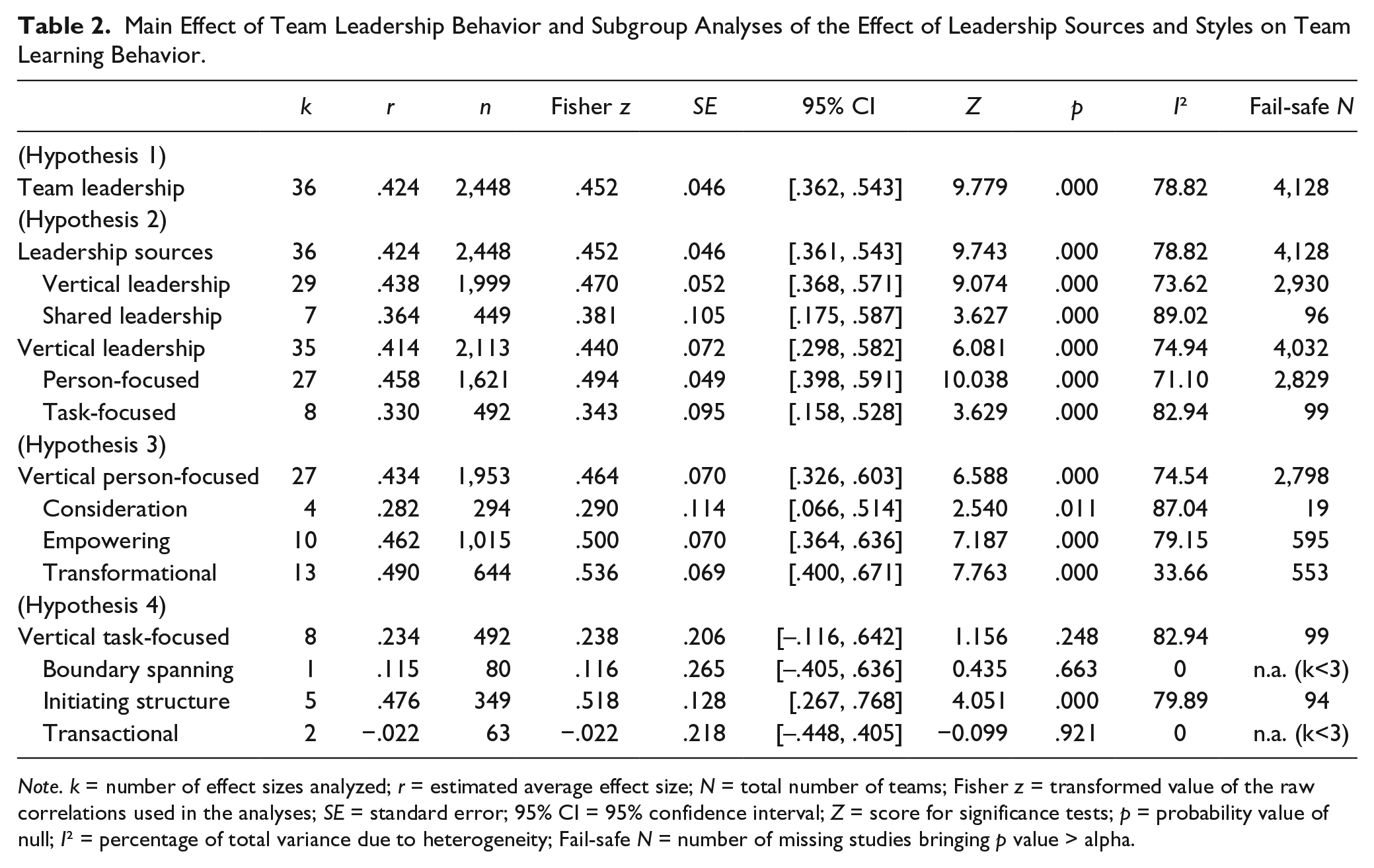
Note. k = number of effect sizes analyzed; r = estimated average effect size; N = total number of teams; Fisher z = transformed value of the raw correlations used in the analyses; SE = standard error; 95% CI = 95% confidence interval; Z = score for significance tests; p = probability value of null; I² = percentage of total variance due to heterogeneity; Fail-safe N = number of missing studies bringing p value > alpha.
Moderator Analyses of the Influence of Team Task Type on the Effect of Team Leadership Behavior on Team Learning Behavior.
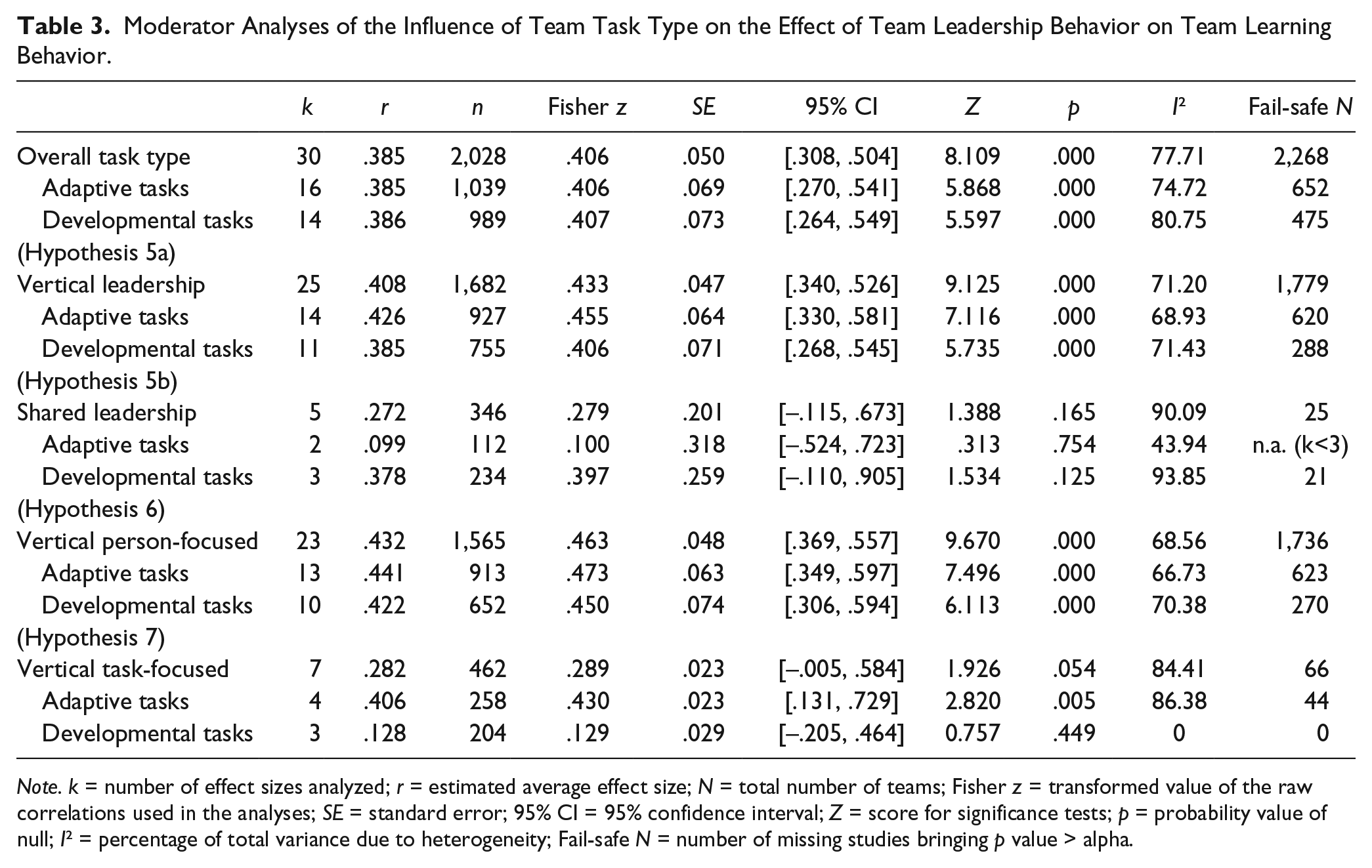
Note. k = number of effect sizes analyzed; r = estimated average effect size; N = total number of teams; Fisher z = transformed value of the raw correlations used in the analyses; SE = standard error; 95% CI = 95% confidence interval; Z = score for significance tests; p = probability value of null; I² = percentage of total variance due to heterogeneity; Fail-safe N = number of missing studies bringing p value > alpha.
Qualitative Meta-Analytic Techniques
For each qualitative study, meaningful findings on how team leadership was related to team learning served as the unit of analysis (Miles & Huberman, 1994). These meaningful findings were mostly detected in result sections, when a clear relation between leadership behavior and team learning was described. These findings were one or more sentences on what team leadership behavior stimulated or inhibited team learning, or they contained descriptions of team leaders’ behavior as an explanation of the success or failure of team learning in teams. Per study, all collected meaningful findings were tracked, analyzed, and summarized in terms of a positive and/or negative relationship. On the basis of the coded team leadership behaviors per study, similarity across the studies was sought. This resulted in a synthesis of the findings in three categories: (a) results for person-focused team leadership, (b) for task-focused leadership, and (c) a combination of both.
Results
The quantitative results will be presented following the three analyses for testing each of the hypotheses: (a) an overall analysis on the main effect of team leadership behavior on team learning behavior (H1), (b) subgroup analyses to gage the effect of specific team leadership sources (H2) and styles (H3, H4), and (c) moderator analyses on how task type moderates the effect of each team leadership behavior on team learning behavior (H5, H6, H7). Finally, the qualitative results will be presented in three categories: (a) person-focused team leadership behavior, (b) task-focused team leadership behavior, and (c) a combination of both.
Quantitative Results
Overall effect of team leadership behavior on team learning behavior
As predicted, the fixed-effect analysis diagnosed that the heterogeneity of the 36 studies was significant (Q = 165.24, df = 35, p < .01), with an I² of 78.82. This validated further analysis, and applying the random-effect model. Table 2 shows the results for the main random effect size analysis.
As Table 2 shows, the coded studies report 36 independent effect sizes between team leadership and team learning behavior, based on a total sample of 2,448 teams. Overall, team leadership behavior explains 18% of variance in team learning behavior, evidencing a moderate correlation (r = .424, p < .01). This overall analysis shows team leadership is strongly and positively related to team learning behavior and provides support for H1.
Subgroup effects of different team leadership behaviors
The fixed-effect model showed adequate heterogeneity for further analysis via subgroup analyses using the random-effect model for (a) testing vertical versus shared leadership (Q = 165.24, df = 35, p < .01, I² = 78.82), and for (b) testing person-focused and task-focused leadership (Q = 135.65, df = 34, p < .01, I² = 74.94).
Table 2 presents the results of the subgroup analyses. First, subgroup analyses on 36 effect sizes in a total of 2,448 teams show that vertical (r = .438, p < .01) and shared leadership (r = .364, p < .01) both have a positive significant effect on team learning (respectively, 19% and 13% of the variance). This supports H2. One study reporting an effect size of laissez-faire leadership was only included in testing H2. Second, we further specified vertical team leadership into person-focused and task-focused team leadership behaviors. The studies on shared team leadership did not report enough effect sizes (k < 3) per specific style of shared leadership behavior for further specification. The subgroup analyses on specific team leadership behavioral styles, based on 35 effect sizes and 2,113 teams, show that vertical person-focused (r = .458, p < .01) and vertical task-focused team leadership behaviors (r = .330, p < .01) explain significant variance in team learning behavior (respectively, 21% and 11%).
Third, we subgroup analyzed specific vertical person-focused behaviors on 27 effect sizes and 1,953 teams, showing that consideration, empowering, and transformational all three have a significant effect on team learning behavior (respectively, r = .282, r = .462, r = .490, p < .05), with a very robust Fail-safe N for empowering and transformational team leadership behavior. This result supports H3. Fourth, subgroup analyses on vertical task-focused behaviors, based on eight effect sizes and 492 teams, reveal that only initiating structure is significant and strongly related to team learning (r = .476, p < .01), which partially supports H4.
Moderator effects of task types
Table 3 presents the results of the moderator analyses based on a total of 30 effect sizes and a sample of 2,028 teams. Heterogeneity was adequate (Q = 130.12, df = 29, p < .01, I² = 77.71) for further analysis using random effects to calculate the effect within subgroups. Fixed effects were used to calculate the magnitudes of the differences across team types.
The moderator analyses are conducted at five levels: (a) overall, (b) vertical, (c) shared, (d) person-focused, and (e) task-focused. First, the overall moderator analysis is conducted on the independent effect sizes (k = 30). This overall level shows that the task type does not influence the effect of team leadership behavior (explaining 15% of team learning variance, r = .385, p < .01), with no differences between the subgroups in the fixed effects (Qbetween = 3.24, df = 1, p >.05). Second, moderator analysis at the level of vertical team leadership behavior shows that the effect of vertical team leadership behavior is significant for adaptive team types (r = .426, p < .01) and for developmental team types (r = .385, p < .01). The magnitude of the differences between the influence of these team types was significant (Qbetween = 6.49, df = 1, p <.05). This finding supports H5a. Third, moderator analysis at the level of shared team leadership behavior shows that the magnitude of the differences between the team types was significant (Qbetween = 6.05, df = 1, p <.05), but the effect of shared team leadership behavior on each team type was not significant. This finding rejects H5b. The studies on shared team leadership did not report enough effect sizes (k < 3) per specific style of shared leadership behavior for further specification.
Fourth, moderator analysis at the level of vertical person-focused leadership shows that the task type did not moderate the effect of person-focused leadership on team learning (r = .432, p < .01, explaining 19% of team learning variance). This result means that vertical person-focused leadership is beneficial for teams with adaptive tasks (r = .441, p < .01) and for teams with developmental tasks (r = .422, p < .01). The magnitude of the differences between adaptive and developmental tasks for vertical person-focused leadership was not significant (Qbetween = 3.52, df = 1, p >.05). This finding rejects H6. Fifth, moderator analysis on the level of vertical task-focused leadership shows that the task type moderates the effect of task-focused leadership on team learning. Vertical task-focused leadership is only supportive of team learning in teams that deal with adaptive task types (r = .406, p < .01, explaining 16% of team learning variance). For teams with developmental tasks, there is no effect of vertical task-focused leadership on team learning. The magnitude of the differences between adaptive and developmental tasks for task-focused leadership was significant (Qbetween = 16.01, df = 1, p <.00). For these reasons, H7 is supported.
Qualitative Results
Our sample contains seven qualitative studies reporting on 31 teams, as displayed in Table 1. Most studies examined both task-focused and person-focused leadership. Our sample did not contain a qualitative study on shared leadership. Overall, in line with the quantitative results, the qualitative studies confirm that both vertical person-focused and task-focused leadership behaviors foster team learning behavior. The findings from qualitative studies deepen this result by suggesting that the positive influence of task-focused leaders on learning in teams with adaptive tasks has a limit. Based on the findings tracked in the qualitative analyses, three key categories provide deeper understanding on when there is a relationship between team leadership behavior and team learning behavior.
The first category indicates that person-focused leadership fosters learning by encouraging, modeling, empowering, and controlling power differences in teams with adaptive and developmental tasks. Bucic, Robinson, and Ramburuth (2010) showed that for adaptive tasks, transformational leadership behaviors encouraged contributions and inspired team members to push their boundaries. In turn, teams were able to create new ideas collectively. Furthermore, Nouwen, Decuyper, and Put (2012) pointed out that combining consideration and empowering leadership behaviors fostered team learning for adaptive tasks because these leaders maintained close social relationships, and build respect, trust, and group cohesion. They encouraged speaking up by modeling and asking feedback themselves and showing how to ask feedback. Their actions encouraged the teams’ self-managing competencies and leadership skills. For developmental tasks, however, Brooks (1994) showed that empowering teams only benefits team learning if the team leaders were able to use their power to control or regulate the power differences in their teams. Hence, all team members were equal and had the collective power to manage the team and engage in learning behaviors. If the power differences were not controlled, the most powerful person or the team member with the highest status dominated the team, which hindered team members’ reflection and actions.
The second category implies that task-focused leadership for learning in teams with adaptive tasks has a limit. Bucic et al. (2010) showed that for teams with adaptive tasks, transactional leadership supported team learning behaviors because it provided structures and procedures, and subsequently reinforced building routines. However, both McKeown (2012) and Nouwen et al. (2012) revealed that for teams with adaptive tasks, team leaders could also overstructure work processes, which inhibited team learning. Moreover, they showed that if team leaders did not involve team members in decision making, or shared the power on team goals and actions, team trust (in each other and the leader) decreased and the motivation for team learning vanished.
The third, and final, category suggests that combining person-focused and task-focused leadership behaviors benefits learning in teams with adaptive and developmental tasks. Bucic et al. (2010), Chatalalsingh and Reeves (2014), and Edmondson, Bohmer, and Pisano (2001) studied leaders who combined person-focused and task-focused leadership behaviors. For teams with adaptive tasks, Bucic et al. (2010) found setting structures and procedures (i.e., transactional leadership) and encouraging contributions (i.e., transformational leadership) at the same time fostered learning for routine building and creating innovation, as this combination provided the team a clear direction and supported team members in sharing and co-constructing their ideas into new knowledge. In addition, Chatalalsingh and Reeves (2014) showed that shifting between supporting (i.e., consideration by emphasizing the relation with others), directing (i.e., initiating structure with a focus on task accomplishment), coaching (i.e., empowering for building relations and task achievement), and delegating (i.e., empowering by allowing teams to take responsibility) behaviors fostered interaction and learning in teams with adaptive tasks. In this manner, the team leader adapted his actions to the specific situation and current needs of the team. Next, Edmondson et al. (2001) found that leaders of teams with developmental tasks facilitated learning processes by: motivating through communicating members’ unique skills, inspiring through framing the task as a challenge, and coordinating the team activities for structuring the processes. Sauquet (2000) also revealed that encouraging open discussions, handling differences, framing meetings, and defining the team’s purpose fostered learning in teams with developmental tasks. Moreover, he showed that if these considerative and initiated structure behaviors were absent, it negatively influenced team learning. Sauquet (2000) observed that if team leaders did not provide a shared team goal, it made team members less interdependent, and therefore they did not feel the need to share knowledge and to seek disagreement for the sake of building new knowledge together.
Conclusion and Discussion
We meta-analyzed how and under which conditions team leadership behavior powers team learning behavior. Three key findings appeared. First, the main analysis shows that team leadership behavior had a substantial positive influence on team learning behavior, as it explained 18% of the variance in team learning (H1). This overall effect of leadership confirms earlier claims that leadership is a crucial factor for facilitating team learning (e.g., Zaccaro et al., 2008).
Second, the effect of different team leadership behavioral sources (i.e., vertical and shared) and styles (i.e., person-focused and task-focused) on team learning behavior was analyzed. Subgroup analyses showed that both vertical and shared leadership have a significant effect on team learning behavior, accounting for respectively 19% and 13% of team learning variance (H2). This is an important finding because it relates vertical and shared leadership to team learning, which contributes to Nicolaides et al.’s (2014) meta-analysis that focused solely on the relationship of vertical and shared team leader behavior and team performance. Moreover, the subsequent subgroup analyses further specified that vertical person-focused leadership behavior accounted for 21%, and vertical task-focused leadership behavior for 11% of the team learning behavior variance. These detailed findings shift the traditional emphasis from person-focused leadership behavior toward task-focused leadership behavior as well (e.g., Edmondson, 1999; Gibson & Vermeulen, 2003; Hirst et al., 2004; Lorinkova, Pearsall, & Sims, 2012). In addition, our findings build upon the preliminary meta-analysis by Burke et al. (2006) on the effect of team leadership behavior on team learning behavior. Their analysis showed that team leadership explained 31% of team learning behavior variance; however, their sample contained only three studies. Moreover, these studies only involved vertical, person-focused (i.e., empowering) leadership behaviors.
The meta-analysis shows that a growing amount of research on team leadership behaviors has become available, and includes more detailed information about leadership behavior (i.e., shared, vertical, person-focused, and task-focused team leadership behaviors). Our analysis shows that most of these studies strongly support the notion that team learning behavior depends on team leadership behavior.
Third, this study further explored the role of leadership, and examined how task type (i.e., adaptive, developmental) moderates the effect of (sources and styles of) team leadership behavior on team learning. Our analyses showed that across task types, vertical person-focused team leadership behavior supports team learning (H6). This is in contrast to London (2014), who suggested that mainly developmental tasks benefit from person-focused leadership. The moderating effect of task type was only discovered for vertical task-focused team leadership (H7). Vertical task-focused leadership was highly beneficial for learning in teams dealing with adaptive tasks (explaining 16% of team learning variance), but was not significant for teams facing a developmental tasks. This confirms the reasoning of London (2014), who suggested that task-focused leadership supports learning for adaptive tasks (e.g., Vera & Crossan, 2004). The findings from qualitative studies deepen this result by providing more understanding of the effect of task-focused leaders. These studies suggest that the positive influence of task-focused leaders on learning in teams with adaptive tasks has its limits. The qualitative syntheses identify that task-focused leaders inhibit team learning if they put too much emphasis on the task and overstructure the process (e.g., McKeown, 2012). Furthermore, the qualitative findings indicate that combining person-focused and task-focused team leadership behaviors can stimulate team learning for adaptive and developmental tasks. It is suggested that through combining both leadership styles, team leaders are able to structure and encourage team learning behaviors at the same time. Shifting between both leadership styles depending on the specific team’s situation and needs is in line with earlier suggestions, referred to for example as situational leadership (Hersey & Blanchard, 1993), ambidextrous leadership (Tushman & O’Reilly, 1996), or more recently as paradox-savvy leadership (Waldman & Bowen, 2016). Our findings provide new knowledge that confirms and specifies earlier suggestions that the team’s task plays a role in considering which leadership behavior is most effective for team learning (Edmondson et al., 2007; London, 2014).
In sum, we conclude that team leadership behavior is necessary to support team learning and our findings contribute toward understanding when. Team leadership powers team learning through person-focused and task-focused behaviors exhibited by a single leader and by team members. This involves leadership behaviors such as building trust and relations, empowering and challenging team members, and structuring teams’ tasks and goals. It is suggested that this process should not be overstructured; team members should feel they are in control of, for example, the project design and decision making. In addition, team leaders can vary their behavior depending on the team task: If team leaders aim to foster development in their teams, our findings suggest they should mainly invest in the team members, and not restrain teams from learning by emphasizing their tasks.
Limitations
Conducting a meta-analysis means dealing with many decisions that enable a generalization of the studies for the purpose of synthesis (Cooper, Hedges, & Valentine, 2009). Our efforts resulted in a sample that provided a sufficient amount of comparison and variety for meta-analyses, as shown by the coding phase and the Q-tests. The team and task types varied (Table 1), so our results seem transferable to different contexts. Our sample of 43 quantitative studies with 92 effect sizes was sufficient for the analyses conducted. However, the effect sizes for specific shared team leadership behavior were too limited to divide into subgroups, and were very small in the moderator analyses. Furthermore, the measurements used in the underlying studies varied (i.e., measuring specific behaviors, the extent to which team members rely on other team members for leadership, and the question whether other team members play a role in decision making). Nicolaides et al. (2014) also discovered variation in measuring shared leadership and found some evidence that this fact influenced the calculating effect. The small effect sizes for specific shared team leadership styles and the variation in measurement point to the need for more research on how specific behavioral styles and shared team leadership behavior can support team learning behavior. To conclude, we searched for six different team learning behaviors, but we did not have enough studies to meta-analyze them separately. Half of the studies examined a combination of three or more team learning behaviors and one third of the identified studies examined only sharing. Although our data did not suggest any differences between team learning behaviors, it might be interesting for future research to further understand how team leadership behavior relates to specific team learning behaviors.
Recommendations for Future Research
Our analysis of the literature reviewed shows that research on team leadership—as related to team learning behavior—is relatively young, yet it offers concrete recommendations for future research. Shared and vertical as well as person-focused and task-focused team leadership behaviors are all important to facilitate team learning behavior. We recommend including different styles and sources of leadership behavior in research which examines their effects on team learning behavior (e.g., Døving & Martín-Rubio, 2013; Hoegl & Parboteeah, 2006; Lorinkova et al., 2012; Wong & Tjosvold, 2010). In doing so, we suggest three directions for future research. First, knowledge on how different team leadership behaviors interact over time is needed. For example, what can a vertical team leader do to support teams in realizing various kinds of shared leadership behavior? In addition, does the influence of various kinds of team leadership behavior on team learning develop over time? Lorinkova et al. (2012) is a preliminary example of a study including two leadership styles: empowering and directive. They show that teams initially benefit the most from directive leaders, but over time are outperformed by teams led by empowering leaders. This finding suggests that the phase (e.g., start or end) of a team process plays a role in examining which team leadership behavior is the most important for team learning, and when. To this end, longitudinal studies are recommended, which may provide empirical insight into how leadership behavior may shift in style and source over time.
Second, in such longitudinal approaches, it is recommended to also include the reciprocal effect of the team process on leadership behavior. To date, most studies focus on leadership as an input variable for team learning processes, but it is argued that leadership also adapts to the team’s situation at hand (Day et al., 2004; Zaccaro et al., 2008). Edmondson et al. (2001) reasoned that team leaders might adapt their behaviors depending on actual team processes, such as stimulating team members toward a more innovative work approach by stimulating members to not only share but also to seek controversy. We suggest that an understanding of these processes requires examining the reciprocal effect of the team process and leadership behavior, as well as how this relationship develops over time (e.g., (Burke et al., 2006; Day et al., 2004; Ilgen, Hollenbeck, Johnson, & Jundt, 2005; Wang, Han, Fisher, & Pan, 2017).
Third, our quantitative findings show that task-focused leadership supports learning in teams with an adaptive task. The qualitative results imply the same, but they also suggest that leaders who overstructure the process negatively affect team learning. This fact suggests that there might be some sort of optimum value for the influence of task-focused team leadership on team learning, though perhaps the relationship is nonlinear. It is recommended to find out how leaders of teams with an adaptive task can provide just enough direction so as to support team learning without overstructuring the process.
Footnotes
Declaration of Conflicting Interests
The author(s) declared no potential conflicts of interest with respect to the research, authorship, and/or publication of this article.
Funding
The author(s) received no financial support for the research, authorship, and/or publication of this article.
