



Abstract
Given the dynamic operating environment of New Venture Teams (NVTs), NVTs’ learning process is critical for team success. We propose that internal and external team learning processes transform the effects of founder(s)’ entrepreneurial leadership into NVTs’ team growth and performance in terms of effectiveness and agility. Using a sample of 78 NVTs in South Korea, the findings largely supported our proposed model. Specifically, internal team learning mediated the effects of the founder(s)’ entrepreneurial leadership on team growth and team effectiveness. On the other hand, external team learning mediated the effect of the founder(s)’ entrepreneurial leadership on team agility.
Keywords
The unique adaptive challenge that new venture teams (NVTs) face raises the importance of understanding team learning behaviors in relation to their success. Indeed, recent studies of NVTs have called for a learning process perspective to better understand the essential team dynamics of NVTs (e.g., Lazar et al., 2022). For instance, Lazar et al. (2022) emphasized a learning systems view of NVTs, in which the venture team’s focus on learning and adaptation provides a competitive advantage for the NVT. Specifically, through internal team learning, NVTs could take advantage of the diverse expertise and knowledge of their constituencies (Fisher et al., 2016). Through external team learning, NVTs could acquire information from sources outside of the team boundary and thrive on the edge of quick and unpredictable changes imposed by the competitive business environment (Yong et al., 2020).
However, team learning behavior is not automatic, and it is important to understand antecedents that facilitate NVTs’ learning behaviors. Indeed, early venture teams are working on unstructured tasks with members who are often not familiar with each other (Bui et al., 2024), where they perceive higher interpersonal risks (Edmondson, 2003). In addition, given the limited resources that NTVs have, they are constantly juggling daily operational demands and the need to produce quick, visible success (Kozlowski & Bell, 2013). Accordingly, under such performance pressure, NVTs quickly narrow their focus to staying above water, overlooking learning opportunities (Park & DeShon, 2010). The previous team learning studies emphasized the role of team leaders in motivating team members’ engagement in learning behaviors. Particularly, in light of NTVs’ uncertain operating environment, founders’ leadership behaviors would play a salient role in developing and nurturing NVTs’ learning behaviors (Knipfer et al., 2018).
In addition, team scholars suggested that NVTs are distinct from traditional teams who are working on a well-defined task structure, and it is important to examine the different performance dimensions of NVTs (Edmondson et al., 2007). That is, depending on the team’s operating environment and task structure, relevant performance indicators might differ (Hackman, 1987; Mathieu et al., 2008). Based on the previous studies on venture teams, we examine three relevant performance dimensions: team growth, team effectiveness, and team agility (e.g., Chowdhury, 2005; Detzen et al., 2018; Knight et al., 2020). Team growth indicates whether the NVT expands over time in terms of the number of constituencies (Brinckmann & Hoegl, 2011; Huang et al., 2014). Team growth is relevant to NVT performance because it reveals the extent to which teams thrive and progress toward the next phase of the venture’s development (Fisher et al., 2016; Kazanjian, 1988). Team effectiveness is the extent to which teams meet the requirements specified by the task and has been widely used in team literature (Hackman, 1987). Team agility is a team’s responsiveness to dynamically changing market demand. Given the highly volatile nature of the venture environment, team agility is one of the key performance indicators of a new venture (Detzen et al., 2018; Lu & Ramamurthy, 2011).
This study aims to deliver three unique contributions across the fields of leadership, team learning, and NVTs (Figure 1). First, this study establishes founders’ entrepreneurial leadership as the core antecedent of NVT learning and increases our understanding of what makes NVTs engage in active learning processes. Entrepreneurial leadership is a set of leadership behaviors that seek to motivate team members to discover, evaluate, and exploit opportunities to introduce new products, services, or processes (Renko et al., 2015; Shane & Venkataraman, 2000). Team leaders deeply engage in learning processes among members in which leaders coordinate goal setting, monitoring team processes, and providing feedback on how the team is doing (Zaccaro et al., 2007). Compared with a traditional leadership framework such as transformational leadership, entrepreneurial leadership uniquely focuses on creating and sustaining the innovative spirit of team members, whereby teams not only embrace a highly volatile, uncertain environment but also leverage those challenges in their innovative pursuits (Cai et al., 2019; Gupta et al., 2004; Miao et al., 2019).
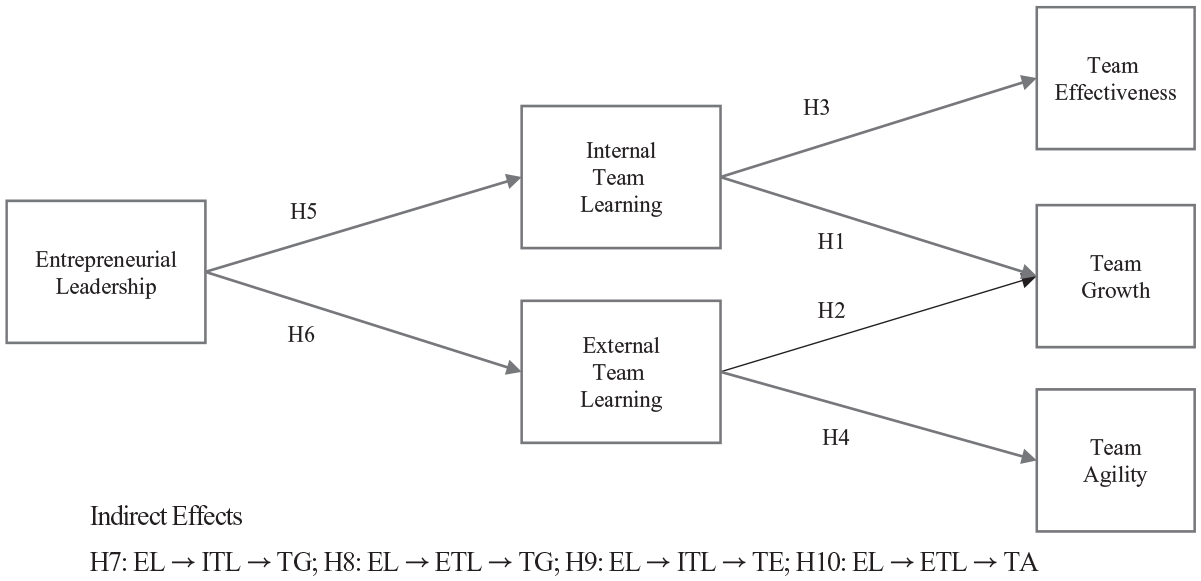
Hypothesized model.
Second, this study suggests internal and external team learning as essential mediators between founders’ entrepreneurial leadership and NVT performance, and this answers the question of how founders’ behaviors are linked to NVTs’ success. Despite clear evidence that founders’ leadership is essential for team success, our understanding of the process wherein founders facilitate team performance has been limited. In fact, there has been an explanatory gap between founders’ leadership and NVT performance as founders were examined the traditionally discussed roles, such as “key brain” or “figurehead,” in the entrepreneurship literature (Baron & Ensley, 2006; Sandberg & Hofer, 1987), which then have a direct impact on performance. In a similar vein, entrepreneurial leadership studies focused on its direct impact on individual-level self-efficacy and creativity (e.g., Bagheri et al., 2020; Fahrurrozi et al., 2023), and there is a lack of understanding of its impact on team-level processes and outcomes such as how founders foster team climates that are conducive to NVTs’ capabilities for success. In their review of team learning literature, Harvey et al. (2022) suggested that internal and external team learning would be the mediating team process between the team leaders’ behaviors and the development of team capabilities.
Finally, this study makes an important contribution by examining multiple dimensions of NVTs’ performance and provides a nuanced understanding of the relationship between team learning behaviors and NVTs performance. Team learning scholars have long argued that not all team learning is equally important for all aspects of team performance (e.g., Harvey et al., 2022; Park et al., 2013). For example, Ancona and Caldwell (1992) showed that external team learning allows teams to be better prepared for the changes in the environment, and there is mixed evidence on the effectiveness of internal team learning on a team’s adaptive performance (e.g., van der Haar et al., 2017; Wong, 2004). Especially for NVTs that have limited resources, it is a critical strategic decision on where they are going to focus on internal or external learning catering to their performance imperatives. Specifically, in addition to team growth, we examined team effectiveness and team agility using perceived ratings from the team leaders (i.e., founders). Therefore, this study provides initial insights into the relationships between internal and external team learning behaviors and multiple dimensions of NVTs’ performance.
Team Learning in NVTs
We adopt a process perspective on team learning (Edmondson et al., 2007; Hinsz et al., 1997; Van den Bossche et al., 2006) to examine team learning as a team-level activity for the acquisition of new knowledge and increase understanding of issues relevant to the team’s operation. While an outcome perspective on team learning is interested in factors that lead to the team’s mastery of the task, a process perspective of learning is more appropriate for NVTs because they are working in dynamic business environments where establishing and maintaining the learning climate is important for success (Edmondson et al., 2007). Similarly, scholars of entrepreneurial learning emphasize the importance of developing context- and level-specific understanding of entrepreneurial learning (e.g., He et al., 2018; Wang & Chugh, 2014). Specifically, entrepreneurial learning differs across individual, team, and organizational levels and across the extent to which they are embedded in established firms or are in direct contact with the business environment. Given the nature of NVTs’ focus on innovation and a rapidly changing operating environment, we investigate internal and external team learning activities (Kreiser, 2011; Van den Bossche et al., 2006).
In their recent review of team learning literature, Harvey et al. (2022) classified team learning based on the location in which learning occurs. Internal team learning is carried out by team members through interaction with each other (within-team). Teams engage in internal learning when members ask questions, provide feedback, and deliberate on different ideas collectively. Internal team learning also involves joint evaluation and discussion of team goals and relevant strategies (Knipfer et al., 2018). For example, as a newly formed venture team, there is great ambiguity in terms of how to best collaborate with one another. Internal learning activities integrate diverse knowledge and opinions from different members and allow members to effectively coordinate their expertise and actions.
External team learning is carried out by team members through interaction with nonmembers thereby, it occurs by crossing team boundaries (Ancona & Caldwell, 1992). Through external team learning, NVTs expand their knowledge pool by seeking new, up-to-date information and perspectives from outside the team’s boundaries (Koryak et al., 2015). External team learning activities by team members help NVTs to gather expert knowledge and support networks that are essential for team success (Knipfer et al., 2018). While there are many benefits associated with external team learning, scholars argued that external learning would better prepare NVTs for the case of a quick change in the operating environment (Harvey et al., 2022).
A Multidimensional Perspective on NVT Performance and Team Learning
Team Growth
Team growth is one of the most popular outcome measures for diagnosing the early success of NVTs (Klotz et al., 2014; Knight et al., 2020). Because they are small, NVTs start with a minimal number of essential members who often play multiple roles with diverse responsibilities (Blank & Dorf, 2012; Fisher et al., 2016; Kazanjian, 1988; Ries, 2019). As business expands over time, they start to acquire new members, albeit carefully and selectively. For instance, imagine Jeff Bezos, who founded Amazon in his garage and then added team members as the business took off. NVTs launch their enterprises with a bare minimum of founder(s), and thus shrinking in team size can trigger a substantial limitation in available human resources and competitiveness, especially in a start-up’s early stage (Fiet et al., 1997; Gilbert et al., 2006). Accordingly, scholars in venture team literature argue that an increase in the number of team members is an important indicator of long-term quantitative growth for early start-up teams, for which financial indicators such as sales or profits are not yet available (Beckman, 2006; Huang et al., 2014).
We argue that internal team learning would promote team growth by creating momentum for building sustainable collaborative processes. Teams that engage in active internal learning create a sense of the co-creation of collective success. In teams with active internal learning, the ideas and inputs of individual members are thoughtfully evaluated and integrated into overall team processes. Individual team members would experience an increased sense of development and learning when team members learn from each other. By providing rich opportunities for learning and development, venture teams with active internal learning would be more likely to attract new members: The majority of people who leave a higher-level job in a larger organization to join a start-up are typically drawn by the appeal of a collaborative learning experience (Agarwal, 2019). In addition, teams that engage in active internal learning are more likely to be aware of gaps in the team’s knowledge and experience. In turn, this enables more targeted and successful recruitment of additional team members. Lazar et al. (2020) argued that NVTs undergo a unique endogenous growth process, whereby they add new members through a self-selection process. The growth of NVTs is based on mutual attraction, by which prospective members must perceive the NVT’s potential and the NVT must recognize the merits of adding new members to the team. Therefore:
Hypothesis 1: Internal team learning of NVTs will have a positive relationship with team growth.
External team learning also exerts a positive influence on the growth of NVTs. Through their engagement in external learning, teams would likely have greater contact with potential team members who have valuable knowledge and skills to offer the team. However, because they are new and small in size, NVTs frequently experience great difficulty in finding and recruiting those with the necessary knowledge and expertise (Bruderl & Schussler, 1990; Cardon & Stevens, 2004; Fisher et al., 2016). Many NVTs rely on members’ social networks to expand their size: When team members actively engage in external learning activities, they are likely to gain access to potential candidates. For example, Zane and DeCarolis (2016) suggested that NVT activities that involve acquiring new knowledge and information through external contacts increase the chance of identifying and recruiting new members. In addition, active and collaborative interaction with someone outside the team would be conducive to building the positive relational capacities of the team in general. Therefore:
Hypothesis 2: External team learning of NVTs will have a positive relationship with team growth.
Founders’ Evaluation of Team Effectiveness
Team effectiveness is emphasized in studies of organizational teams where team leaders who are working closely with the team provide their perception of how their teams are meeting the task demands (e.g., N. Chen et al., 2024; Leroy et al., 2021). While only limited studies of venture teams have examined team effectiveness ratings from founders (e.g., A. De Jong et al., 2013; Stam & Elfring, 2008), scholars emphasized the importance of entrepreneurial literature to consider this dimension of team outcome as a viable way to obtain insights in managing venture teams (Klotz et al., 2014). Accordingly, this study used founders’ evaluations of their team’s effectiveness. Given the entrepreneurial aspirations of NVTs, they set multiple task objectives in their day-to-day operations—that is, team effectiveness (Hackman, 1987). From consolidating task assignments for an upcoming pilot to collaborating on procedural details to refine their prototype, NVTs work toward effective collaboration in their handling of immediate task demands (Chowdhury, 2005; Wójcik-Karpacz et al., 2022). We argue that the more active an NVT’s internal learning, the more likely the team is to achieve a high level of team effectiveness. Many internal learning activities, such as asking questions, seeking feedback, and sharing information, enable a team to build a superior collaborative mechanism for team members and facilitate their progress toward meeting the objectives (Kameda & Tindale, 2006). As members of NVTs engage in internal learning behaviors, they develop more sophisticated and nuanced understanding of the different types of expertise and perspectives members can contribute to the team (Andries & Debackere, 2006). By collectively reflecting on mistakes committed by members or the team, NVTs can continuously improve their coordination efficiencies and refrain from repeating similar mistakes (Kayes et al., 2005). Therefore:
Hypothesis 3: Internal team learning of NVTs will have a positive relationship with team effectiveness.
Founders’ Evaluation of Team Agility
Agility is often used to measure team capabilities to rapidly adapt in response to changes in the environment (Krüger, 2023). Previously assumed to be a relevant performance indicator only for organizations in a hyper-competitive environment, being agile is now acknowledged to be particularly relevant for venture teams that prioritize innovation and creativity (Lu & Ramamurthy, 2011). Essentially, an NVT is a collective system that dynamically interacts with its surrounding business environment. Failure to adapt to changes in its environment can quickly limit an NVT’s sustainability (Tallon & Pinsonneault, 2011). For example, despite the ingenuity of the product created, an NVT in the bioengineering sector would falter if it failed to understand the latest cultural trends for its target customers. External learning allows teams to expand their understanding of changes, opportunities, and threats in the environment, whereby members sharpen their foresight and improve their readiness for future changes. External learning allows NVTs to develop sensitivity to the market and competitors and remain abreast of potential changes in the environment (Kwon et al., 2018). Teams that are well equipped to respond to new information from a changing environment—because they engage in external learning—would be able to make a quick modification or timely adaptation (Baltar & de Coulon, 2014). As a result of a high level of external learning activities, each member of an NVT plays a significant role in monitoring and proactively planning for potential changes in the business environment.
In this study, we did not expect a positive relationship between internal learning and agility because the team scholars suggested that engagement in external learning, given the flow of information being from outside to inside of the team, is much more conducive to teams’ adaptive performance. Harvey et al. (2022) found mixed effects of internal learning on teams’ dynamic operational capabilities. They explained that while team internal learning establishes a positive climate for team learning routines among members, being engrossed in such internal learning routines can hamper the team’s adaptive capabilities. Similarly, we did not expect a significant relationship between team external learning and team effectiveness. Because external team learning focuses on acquiring information from outside, it would not directly enhance team effectiveness, which involves active collaboration among members (Hackman, 1987). Therefore:
Hypothesis 4: External team learning of NVTs will have a positive relationship with team agility.
Founder(s)’ Entrepreneurial Leadership in NVTs
The importance of leadership in a new venture has been well documented and is one of the core factors that determine the success of a new venture (Leitch et al., 2013; Sklaveniti, 2017). Particularly for NVTs, with no standard operating procedures or established organizational structure in place, members of newly formed start-ups largely rely on the founder(s)’ behaviors as the salient determinant for the focus of their teamwork (Hmieleski & Ensley, 2007; Knipfer et al., 2018). Entrepreneurial leadership, as the leadership style specific to entrepreneurship, is distinct for being opportunity-oriented, instilling confidence in taking a risk, and emphasizing teamwork (e.g., Cai et al., 2019; Miao et al., 2019; Renko et al., 2015). Without the strong presence of leaders who demonstrate entrepreneurial leadership behaviors, NVTs would quickly be blindsided by immediate performance imperatives and lose sight of their entrepreneurial aspirations.
Entrepreneurial leadership consists of sets of behaviors that are conducive to entrepreneurial scenario enactment, whereby the leader promotes shared entrepreneurial visions and goals, and case enactment, whereby the leader creates positive pathways for a collective commitment to shared goals and the orchestration of teamwork (Gupta et al., 2004). Guided by entrepreneurial leaders who constantly instill shared meaning into their daily activities, members would be more likely to broaden their capabilities to calibrate entrepreneurial goals and direct their energies to address challenges and the potential risks of failure (Staw et al., 1981). The construct of entrepreneurial leadership is relatively recent and has been proposed by scholars who emphasize the context-specific nature of leadership behaviors (e.g., Gupta et al., 2004; Renko et al., 2015). Previous studies on entrepreneurial leadership have examined established ventures (Huang et al., 2014), teams in established firms (Cai et al., 2019), or top management teams (Miao et al., 2019).
Founder(s)’ Entrepreneurial Leadership and Team Learning
Team scholars emphasize the role of the team leader in the team’s engagement with learning processes (e.g., van der Haar et al., 2017; Zaccaro et al., 2007). Especially for NVTs’ highly novel operating environment, the founder(s) cannot provide the team with all of the answers. Instead, the team as a whole should transform itself into a continuous learning system in which members interact and integrate their individual information to obtain greater understanding (Hinsz et al., 1997). In a similar sense, using a team regulation perspective, Zaccaro et al. (2007) argued that team leaders assume the role of a learning partner who promotes the team’s exploration of learning. Team leaders have great leverage in influencing team learning because they coordinate team goal setting, monitoring team progress, and providing feedback on how the team is doing (Berson et al., 2015).
The founder(s)’ entrepreneurial leadership is closely linked to team learning activities. Specifically, when the founder demonstrates entrepreneurial leadership, team members share a clear understanding of the team’s entrepreneurial focus, goals, and procedures (i.e., shared task representation), which facilitates the coordination of members’ diverse information and perspectives (Gupta et al., 2004; van Ginkel & van Knippenberg, 2012). Also, entrepreneurial leadership instills confidence in members’ pursuit of new ideas (Sklaveniti, 2017), whereby they are more likely to express and discuss unique or uncommon ideas. In a similar vein, entrepreneurial leadership behaviors showcase the leader’s commitment to innovation, whereby members are encouraged to challenge assumptions and beliefs (M. H. Chen, 2007; Gupta et al., 2004). Accordingly, members would feel safe questioning their teamwork routines and providing constructive suggestions to improve their efficiencies. Under entrepreneurial leadership, the founder encourages members to take risks associated with trying new things; otherwise, team members might fail to perceive them as effort well spent and an opportunity to better understand the problem. This divergence-seeking nature of an entrepreneurial focus would render teams less likely to experience pressure to reach a quick consensus. Instead, it is acceptable for members to engage in collective thought experiments in search of creative solutions and ideas (Nemeth, 1997). Therefore:
Hypothesis 5: The founder’s entrepreneurial leadership will have a positive relationship with NVTs’ internal team learning.
The founder(s)’ entrepreneurial leadership will also increase external team learning. Entrepreneurial leadership mobilizes members who are committed to the entrepreneurial vision, emphasizes the dynamic nature of the business environment, and promotes a sense of agency in navigating the environment (Gupta et al., 2004; Sklaveniti, 2017). Entrepreneurial leadership encourages members to share a clear vision of the entrepreneurial objectives that serve as guiding principles for their activities. Without salient entrepreneurial objectives, team members’ external activities can quickly lose their initial learning intention and degrade into less valuable activities, such as networking and relationship building (Chandler & Lyon, 2009; Teece, 2012). That is, external learning consists of targeted, task-oriented activities designed to obtain information from outside sources (Bresman, 2010; Brinckmann & Hoegl, 2011). Founders who lead entrepreneurial teams with a high level of entrepreneurial leadership would actively seek and secure external developmental opportunities for team members, whereby they obtain valuable knowledge and insights from outside sources (Brockman, 2013; M. H. Chen, 2007; Shane & Cable, 2002). Under such leadership, members are more likely to feel empowered to acquire relevant knowledge through their navigation of the surrounding environment. Also, entrepreneurial leadership emphasizes collective dedication to adopting unique or unconventional perspectives. External learning activities provide an optimal opportunity to experience an outside-in perspective on their team’s operation. Therefore:
Hypothesis 6: The founder’s entrepreneurial leadership will have a positive relationship with NVTs’ external team learning.
Mediating Effects of Team Learning
We believe that the impact of the founder(s)’s entrepreneurial leadership behaviors would create the chain of inputs-processes-outcomes, where team internal and external learning processes take on the key mediating roles. Team scholars have long supported an inputs-processes-outcomes perspective on team performance (Hackman, 1987; Mathieu et al., 2008). Inputs generally refer to the characteristics of teams, such as their structure, task types, and members. In particular, team leaders’ dispositional and behavioral attributes are considered to be critical determinants that shape team processes. Team processes generally refer to the coordination of team members’ knowledge, motivation, and actions, such as integrating members’ diverse perspectives and organizing members’ efforts toward accomplishing team goals. Team outcomes are often examined in terms of team-level effectiveness, such as team task performance and member satisfaction (Hackman, 1987).
Accordingly, we posit that entrepreneurial leadership would influence the growth of NVTs through fostering team learning processes. Entrepreneurial leadership empowers teams to acquire necessary knowledge and skills through coordination, knowledge sharing, idea generation, and risk-taking in pursuit of innovative solutions (Cai et al., 2019; Gupta et al., 2004). This internal learning process enables teams to identify knowledge and skills gaps, leading to the search for and attraction of passionate new employees eager for development opportunities (Agarwal, 2019; Lazar et al., 2020). Furthermore, entrepreneurial leaders promote the acquisition of external knowledge and seek developmental opportunities for their teams outside of the team boundaries (Shane & Cable, 2002). This facilitates network building, which grants teams access to a wider pool of potential employees (Lazar et al., 2022; Zane & DeCarolis, 2016). Thus, we expect that:
Hypothesis 7: The internal team learning of NVTs will mediate the relationship between entrepreneurial leadership and team growth.
Hypothesis 8: The external team learning of NVTs will mediate the relationship between entrepreneurial leadership and team growth.
As the creator of the venture, founder(s) precede the formation of NVTs and exert direct influence on team learning processes, which then produces positive team effectiveness and agility. Specifically, in the absence of a greater organizational context that exerts a top-down influence on team members’ collaborative interactions, the founder(s)’ entrepreneurial leadership mobilizes team outcomes by facilitating internal team learning. This fosters coordination among team members, where team members exhibit a deeper shared understanding of team goals, processes, and capabilities (Cai et al., 2019; M. H. Chen, 2007). As a result, team members work together more seamlessly and efficiently, enhancing team effectiveness in achieving team objectives (Chowdhury, 2005). Meanwhile, by encouraging exploration of the external environment, entrepreneurial leaders enable their teams to understand the market, anticipate changes, and adapt quickly (Shane & Cable, 2002). External learning would enhance the team’s ability to respond to evolving circumstances, thereby increasing team agility (Lu & Ramamurthy, 2011). Thus, we posit that:
Hypothesis 9: The internal team learning of NVTs will mediate the relationship between entrepreneurial leadership and team effectiveness.
Hypothesis 10: The external team learning of NVTs will mediate the relationship between entrepreneurial leadership and team agility.
Method
Research Context
Compared with the US and Europe, which offer established business environments for start-ups, South Korea’s history of start-ups is relatively brief. Spurred by technological advancements related to personal computers and consumer electronic devices in the 1990s, the Korean Venture Association was established in 1995. Korea aims to become a regional start-up hub to facilitate innovation, and the Korean government has provided $4 billion to start-up businesses since 2015—the largest government backing per capita for start-ups in the world. Compared with start-ups in the US (17%), UK (24%), France (45%), and Japan (36%), around 62% of new start-ups in South Korea receive government funding and support (Hwang, 2020). Also, dozens of accelerator programs are sponsored by the government, conglomerates, and private organizations; these entities provide business support such as funding, mentoring, and coworking spaces. Start-ups in South Korea are under intense competitive pressure; only 27% survive longer than 5 years, in contrast to those in France (44.3%) and the UK (41.1%). Hence, our sample of Korea’s start-up ecosystem is an appropriate setting for studying NVTs.
Sample and Procedure
South Korea does not have a formal registration procedure for NVTs, and no formal list of NVTs or official statistics are available. Accordingly, to maximize our chance of reaching our potential sample of interest, we contacted Korean start-up business incubators and the top 20 start-up accelerators in Korea. For example, the Ministry of SMEs and Start-ups and conglomerate corporations such as Samsung and Hyundai operate active financial and managerial support programs for NVTs and provide coworking spaces, technological assistance, and business mentoring. Also, one of the accelerators was able to identify and gain access to NVTs in universities with active venture cultures, such as the Korea Advanced Institute of Science and Technology.
We recruited a sample of NVTs with the support of Korean accelerators, government agencies, incubation centers, and companies that offer coworking spaces for NVTs for the period October 4 to 25, 2019. The first author met with the director of an accelerator who has frequent contacts with NVTs and agreed to help recruit NVTs. The first author explained the study’s definition of NVTs and the four criteria to be used for sample selection: (1) Team size—10 persons or fewer (Beckman et al., 2007; Schwaber & Sutherland, 2017; Vozza, 2014); (2) Team age—5 years or younger (Chowdhury, 2005; Korean Statistical Information Service, 2019); (3) Autonomous entrepreneurial team in direct contact with its environment (Bruderl & Schussler, 1990; Cardon & Stevens, 2004); and (4) No vertical status differences among members other than team founder(s) (Fisher et al., 2016; Kazanjian, 1988).
Eighty teams participated in the study (90 founders and 319 members). After we checked team-level agreement indices on the main variables (entrepreneurial leadership, internal team learning, external team learning), we excluded two teams from data analyses because their rwg values were lower than .4 for entrepreneurial leadership responses (Lindell & Brandt, 1999). Therefore, the final sample size consisted of 78 teams (88 founders, 1 314 members), which included 37 teams in the information and communication technology (ICT) industry and 41 teams in non-ICT industries. Team sizes ranged from 2 to 10 members (mean = 6.24) and average team age ranged from less than 1 to 60 months (mean = 26.24 months). Of the 78 teams, six teams had cofounders and 72 teams had a single founder. 2 In those teams with co-founders, members rated the founders’ entrepreneurial leadership using co-founder-referenced items. For example, instead of “the founder of this team,” members rated “the founders of this team.” In addition, before we collected data for the main study, we conducted subject matter expert (SME) interviews and a pilot test using SMEs that consisted of entrepreneurs, founders of ventures, and civil servants who work closely with the government’s startup initiatives. This pilot study was for us to ensure the items that we are using for the study are relevant to the context of Korean NVTs (Brislin, 1986). The detailed information is available from the first author.
Measures
Founder’s Entrepreneurial Leadership
Team members rated the founder’s entrepreneurial leadership behaviors based on a scale modified from Gupta et al.’s (2004) measure of entrepreneurial leadership behaviors using a 7-point Likert scale ranging from 1 (very strongly disagree) to 7 (very strongly agree). The scale used a four-dimensional model of entrepreneurial leadership (α = .966; Appendix A), which consisted of two larger facets representing entrepreneurial scenario enactment (Framing the challenge and Envisioning the future) and two representing entrepreneurial case enactment (Building affective commitment and Creating team synergy). Ratings by team members were aggregated after checking the values in terms of agreement and reliability (rwg = .95, ICC(1) = 0.31, ICC(2) = 0.64).
Internal Team Learning
Team members and founders reported their internal team learning activities based on a modified scale of Van den Bossche et al.’s (2006) team learning scale (see also Decuyper et al., 2010). Specifically, team internal learning consists of five components that capture the extent to which team members engage in sharing ideas, actively debate members’ ideas, and integrate members’ ideas. Internal team learning was measured using items that capture (1) Sharing (e.g., “Team members are listening carefully to each other”); (2) Constructive conflict (e.g., “This team tends to handle differences of opinions by addressing them directly”); (3) Reflexivity (e.g., “We regularly discuss whether the team is working effectively”); (4) Experimental behavior (e.g., “Our team tests new working methods”); and (5) Information storage and retrieval (e.g., “We store team documents in a common archive”). These five were measured on a 7-point scale (1 = very strongly disagree to 7 = very strongly agree; α = .946). Ratings by team members and founders were aggregated after checking the values in terms of agreement and reliability (mean rwg = .95, ICC(1) = 0.29, ICC(2) = 0.68).
External Team Learning
Team members and founders reported their external team learning activities based on modified items from Ancona and Caldwell’s (1992) boundary spanning activities using a 7-point Likert scale ranging from 1 (very strongly disagree) to 7 (very strongly agree). Specifically, we chose the scouting dimension from the original boundary-spanning scale, then developed a six-item scale (α = .905). This follows Marrone’s (2010) recommendation regarding the importance of developing specific targets of external information seeking that reflect the team’s boundary-spanning context. Each item pertains to a different information-seeking target outside of the NVT (i.e., technical R&D institutes, other start-ups, marketing research agencies, large companies that acquired partnerships, venture capitalists and accelerators, and government agencies). 2 Team members and founders rated the extent to which their teams engaged in the active pursuit of outside information from each target. A sample item was “My team collects information and ideas from government agencies”. Ratings by team members and founders were aggregated after checking the values in terms of agreement and reliability (mean rwg = .74, ICC(1) = 0.26, ICC(2) = 0.64).
Team Growth
Following Brinckmann and Hoegl (2011), we first subtracted the initial number of team members from the number of team members at the time of the study. Team growth was then calculated by the number of team member growth divided by the age of the team. 3 Essentially, this indicator reflects an NVT’s growth rate (Brinckmann & Hoegl, 2011; Utsch & Rauch, 2000). For example, if a NVT had four members in the beginning and eight members at the age of 36 months when they participated in our study, the team growth value would be: (8 − 4)/36 = 0.11. Consistent with the previous studies (e.g., Brinckmann & Hoegl, 2011; Utsch & Rauch, 2000), this method focuses on the changes in team size and does not capture member replacement.
Team Effectiveness
The team founder reported team effectiveness using the six items developed by Chowdhury (2005) using a 7-point Likert scale ranging from 1 (very strongly disagree) to 7 (very strongly agree) in terms of the team’s accomplishment of relevant objectives. The use of a team leader’s evaluation rating for team effectiveness was supported in team literature (e.g., J. P.De Jong et al., 2014; Hackman, 1987) and new venture team literature (e.g., A. De Jong et al., 2013; Stam & Elfring, 2008). Sample items included “quality of work” and “planning and allocation” (α = .921).
Perceived Team Agility
The team founder rated team agility based on the scale developed by Lu and Ramamurthy (2011) using a 7-point Likert scale ranging from 1 (very strongly disagree) to 7 (very strongly agree). The measure consisted of five items, and a sample item was “We are quick to make and implement appropriate decisions in the face of market/customer changes” (α = .882). The previous studies of teams used similar perception measures from team leaders (e.g., Detzen et al., 2018; Lu & Ramamurthy, 2011).
Control Variables
In this study, three variables were controlled for: (1) industry; (2) founders’ entrepreneurial experience; and (3) collaboration tools. That is, following recommendations from previous studies (Brinckmann & Hoegl, 2011; Chandler & Lyon, 2009), we controlled for each NVT’s industry. We coded industry into two categories: ICT and non-ICT. Second, we controlled for founders’ prior entrepreneurial experience, which can contribute to NVTs’ improved performance because more experienced founders may handle uncertain situations more easily and develop more business opportunities compared with new entrepreneurs (Baron & Ensley, 2006; Haleblian et al., 2006). This variable was measured by asking about founders’ previous entrepreneurial experience in terms of frequency (i.e., “How many times did you act as the founder of a start-up business before?”). Finally, most venture teams used collaboration tools such as Slack, Google Drive, and Jira to facilitate communication and knowledge sharing. In empirical studies, the use of collaboration tools has been shown to improve the speed of information sharing (Dennis et al., 2008). Therefore, we asked founders whether they used any collaboration tools.
Results
Table 1 shows descriptive statistics and a correlation matrix of all study variables. We analyzed the data using path analysis based on a multiple regression model (Hayes, 2009). The analyses were performed using Mplus 7.0. The entire model is described in Figure 2. We reported the combination of χ2, CFI, RMSEA, and SRMR (Boomsma, 2000; Kline, 2011). Fit indices for this parallel mediation model were indicative of mediocre to good model fit, χ2(11, N = 78) = 18.652, p = .068, CFI = 0.957, RMSEA = 0.094, 90% CI [0.000, 0.166], SRMR = 0.068. Specifically, the model obtained an insignificant chi-squared test (χ2(11, N = 78) = 18.652, p = .068), which indicates that the data fit well with the model, as Bentler (1990) recommended. Regarding fit indices, a CFI value of 0.900 is considered a good fit (Bentler, 1990), an SRMR value less than 0.08 a reasonable fit (Hu & Bentler, 1999), and an RMSEA value of less than 0.100 a mediocre fit (Browne & Cudeck, 1993). In our model, while CFI = 0.957 and SRMR = 0.068 are good and reasonable, respectively, the value of RMSEA = 0.094 is mediocre. We believe that the less than optimal RMSEA value could be due to the small sample size. Indeed, scholars have noted that when the degree of freedom is low and the sample size is small, RMSEA is not recommended because it could be biased (e.g., Kenny et al., 2015). In sum, we consider the hypothesized model to be a good fit for the data.
Summary Statistics and Correlation Matrix.
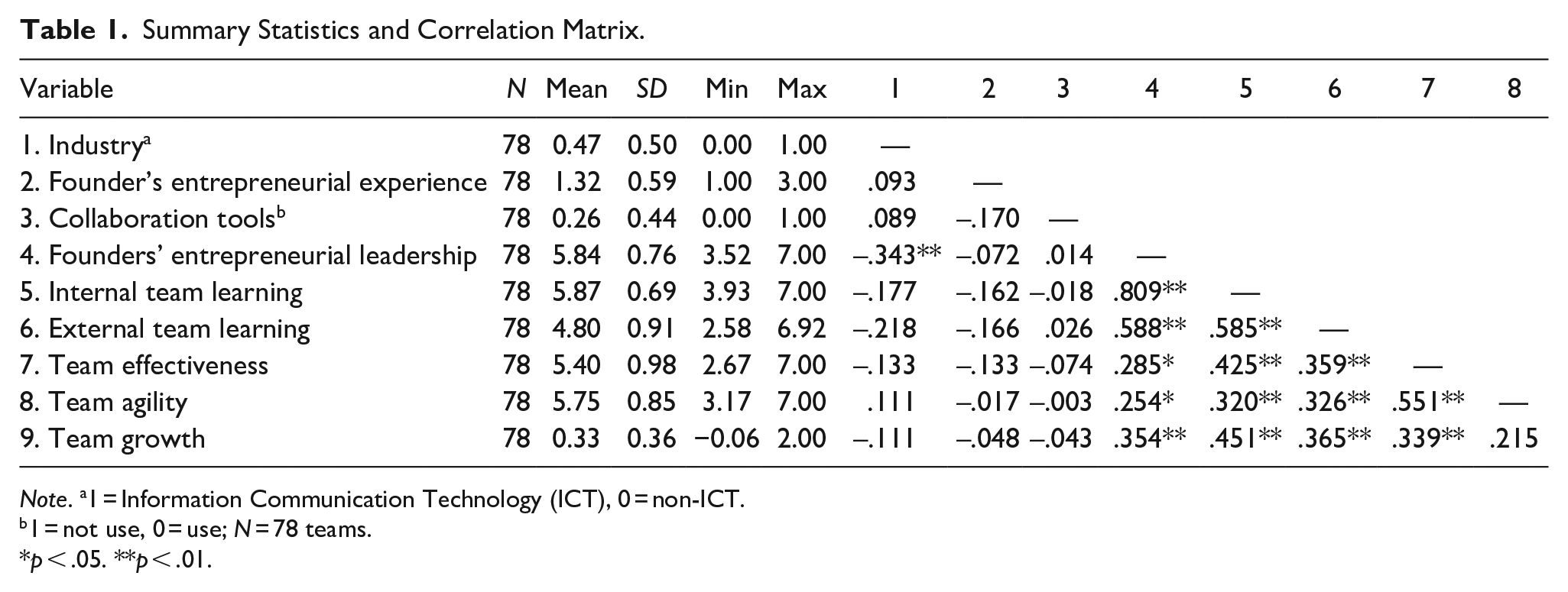
Note. a1 = Information Communication Technology (ICT), 0 = non-ICT.
1 = not use, 0 = use; N = 78 teams.
p < .05. **p < .01.
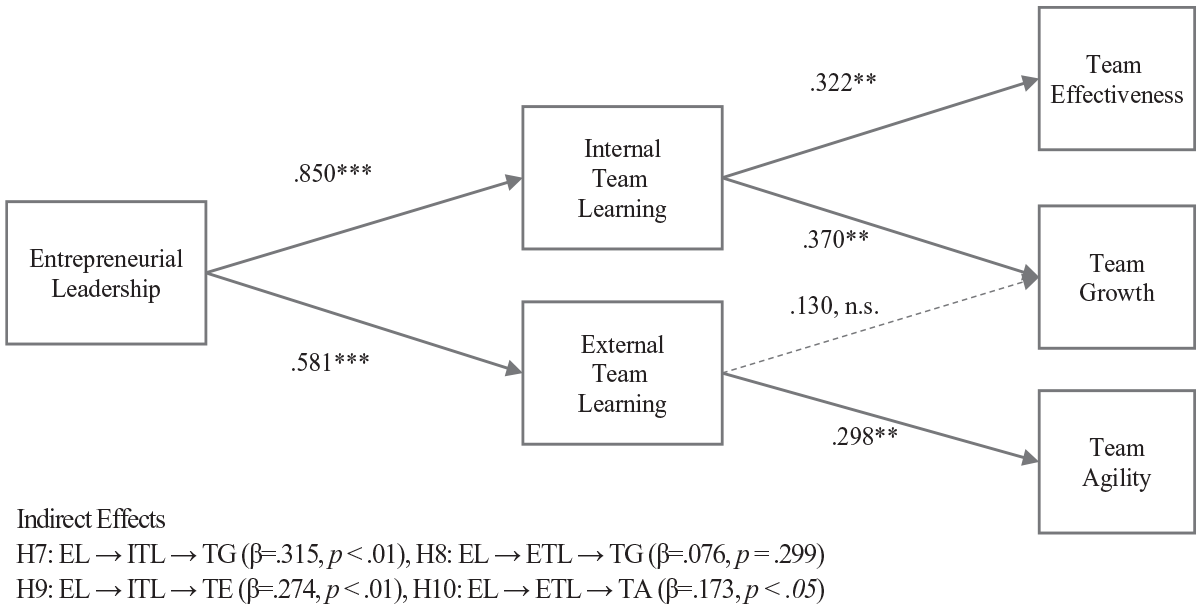
Mediation model results.
Table 2 and Figure 2 present a summary of the direct and indirect effects of entrepreneurial leadership on the mediators and outcome variables. In the following, we report standardized coefficients for all results. Hypotheses 1 and 3 proposed positive effects of internal team learning on team growth and team effectiveness. Table 2 and Figure 2 show that the direct relationships between internal team learning and team growth (β = .370, p = .005) and team effectiveness (β = .322, p = .007) were significant, and thus support Hypotheses 1 and 3.
Direct and Indirect Effects of Entrepreneurial Leadership on Team Learning Processes and NVT Performances.
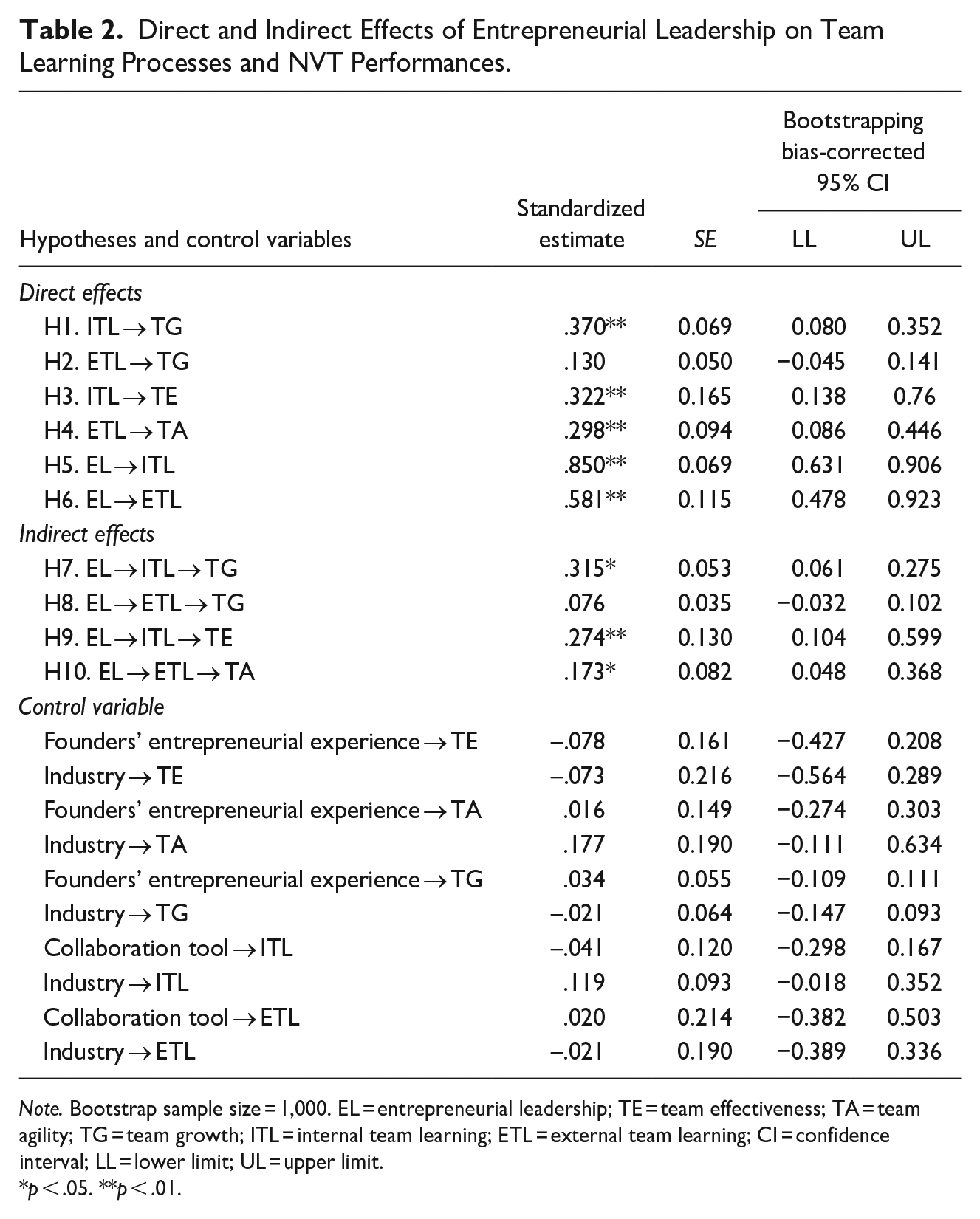
Note. Bootstrap sample size = 1,000. EL = entrepreneurial leadership; TE = team effectiveness; TA = team agility; TG = team growth; ITL = internal team learning; ETL = external team learning; CI = confidence interval; LL = lower limit; UL = upper limit.
p < .05. **p < .01.
Hypotheses 2 and 4 predicted that external team learning will be positively related to team growth and team agility. As shown in Table 2 and Figure 2, the direct effect of external team learning on team growth was insignificant (β =.130, p = .298). Therefore, Hypothesis 2 was not supported. 4 However, external team learning was positively associated with team agility (β = .298, p = .004), which lends support to Hypothesis 4.
Hypotheses 5 and 6 posited that the founder’s entrepreneurial leadership would have positive relationships with internal and external team learning. We found significant positive effects of entrepreneurial leadership on internal team learning (β = .850, p < .001) and external team learning (β = .581, p < .001). Therefore, Hypotheses 5 and 6 were supported.
To test Hypotheses 7 to 10, which posited the mediating roles of internal and external team learning on the relationships between entrepreneurial leadership and team outcomes, we followed the procedures suggested by Preacher and Hayes (2008) and constructed a 95% bias-corrected confidence interval based on 1,000 bootstrap samples (Table 2). As predicted by Hypothesis 7, the positive effect of entrepreneurial leadership on team growth was mediated by internal team learning (β = .315, p < .001, 95% CI = [0.061, 0.275]). Hypothesis 8 proposed the mediating role of external team learning in the relationship between entrepreneurial leadership and team growth. The indirect relationship between entrepreneurial leadership and team growth via external team learning (β = .076, p = .299, 95% CI = [−0.032, 0.102]) was not significant. Therefore, Hypothesis 8 was not supported. In addition, we found a significant indirect relationship between entrepreneurial leadership and team effectiveness via internal team learning (β = .274, p = .008, 95% CI = [0.104, 0.599]), which thus supports Hypothesis 9. External team learning exerted a significant indirect effect on team agility via external team learning (β = .173, p = .020, CI = [0.048, 0.368]). Therefore, Hypothesis 10 was supported.
Additional Analyses for Common Source Bias
In this study, some of the hypothesized relationships were tested using ratings that were assessed simultaneously by the same people, which raises concerns about common source bias (Podsakoff et al., 2003). For example, testing of Hypothesis 3 used an aggregated team internal learning score reported by team members and founder(s) and team effectiveness score reported by founder(s). Because the founder(s)’ rating is the common source, it could have contributed to inflating the relationship between team internal learning and team effectiveness. Accordingly, we conducted three additional analyses that consistently supported the validity of our research findings (Appendices B–D).
Confirmatory Factor Analysis
Podsakoff et al. (2003) recommended assessing the impact of the same source bias on construct validity using CFA. Specifically, following Harman’s single-factor technique, if a single factor that loads all ratings from the same source fits the data well, it indicates no difference between measures, and the common method accounts for most of the measurement variance. In contrast, if the fit indices of the one-factor model are poor and worse than other multi-factor models, the measures satisfy discriminant validity, and the same source of ratings is unlikely to threaten construct validity (e.g., Luan et al., 2016; Podsakoff et al., 2003). Accordingly, we conducted CFA analyses (Appendix B) using team members’ ratings (entrepreneurial leadership, internal team learning, and external team learning) and using founder(s)’ ratings (team effectiveness, team agility, internal team learning, and external team learning). The results of CFAs showed discriminant validity, where a model that distinguishes different items following theoretical distinctions has a significantly better fit than the single-factor model where all the ratings are loaded on one factor.
Testing of Hypotheses After Removing Common Source
We removed the common source in our testing of Hypotheses 3 to 6 and examined whether it produces significantly different results (Tables C1 and C2 in Appendix C). For example, Hypothesis 3 was tested using internal team learning based on members’ ratings only (previously, we aggregated ratings from both members and founder(s)) and team effectiveness based on founders’ responses only (the same as previously) (Table C1). Only Hypothesis 6 showed a decrease in the significance level from β = .581, p < .001 to β = .183, p = .101 (Table C3). We believe this could be because measuring team members’ external learning activities using team founders’ responses only could be limited. Overall, this provides evidence that common method concerns are not substantive with respect to testing our hypotheses.
Subgroup Analysis for Mediation
Common source may have inflated our findings for the mediation hypotheses involving perception measures (i.e., team effectiveness and team agility). Following prior research (e.g., Oh et al., 2015; Ployhart et al., 2006), we assessed common source bias using the subgroup splitting method. Of those teams that have more than three members (N = 68 teams), We randomly split the scores of internal team learning and external team learning into two subgroups, each containing 50% of the participants, then reran the mediation analyses using internal team learning scores from one group and external team learning scores from the other. For example, in team A with five members, three members were randomly assigned to subgroup 1 and two members were randomly assigned to subgroup 2. The aggregated scores of all team members in the sample for the predictor (entrepreneurial leadership) and the outcome variables (team effectiveness, team agility) were used to test the relationships with these subgroup mediators in two models (e.g., Ployhart et al., 2006) (Appendix D). This way, in each model, for half of the total participants, there were no common source biases (Ployhart et al., 2006). If common method bias existed, the results of the two models would differ. In contrast, if the results of relationships among variables were the same in both models, same-source biases would be unlikely. Results of the subgroup analysis showed that none of the relationships or significance tests differed between the two models. Therefore, same source bias was unlikely.
Discussion
This study examined mechanisms through which the founder’s entrepreneurial leadership impacts team outcomes. Drawing on a team information processing perspective (Hinsz et al., 1997), we proposed two distinct team learning processes—internal and external team learning—whereby the founder(s)’ entrepreneurial leadership impacts team effectiveness, team agility, and team growth. In line with our hypotheses, we found that internal team learning transferred the impact of entrepreneurial leadership to team effectiveness and team growth. Also, external team learning transferred the impact of the founder(s)’ entrepreneurial leadership to team agility. However, we did not find an effect of external team learning on team growth.
Theoretical Implications
Our nuanced, process-oriented perspective yields several important theoretical implications for research on entrepreneurial leadership and teams. First, we provide a much-needed process-oriented perspective to understand the founder(s)’ impact on venture team outcomes. Specifically, entrepreneurial leadership had no direct relationship with team performance. Instead, leadership behaviors impacted the three dimensions of NVTs’ performance by activating team internal and external activities. Accordingly, this study improves the understanding of start-ups by identifying team learning processes as the main mechanism whereby founders contribute to an NVT’s outcomes through team members’ active consolidation of knowledge both inside and outside the team’s boundaries. Our findings also align with prior process-oriented research on team learning, suggesting that internal and external team learning are crucial mediating mechanisms that translate team leaders’ behaviors into team capacities for success (Harvey et al., 2022). The findings regarding team learning activities answer previous studies’ call for more extensive examination of the functional perspective of team founder(s) and their behaviors (e.g., Koryak et al., 2015).
Second, this study integrates team effectiveness research and entrepreneurship research to showcase a functional aspect of the founder’s roles that goes beyond the traditionally discussed demographic characteristics. We found that entrepreneurial leadership is the core antecedent of NVT learning processes. This aligns with the entrepreneurial leadership literature, which emphasizes the capacity of this leadership to provide a clear shared vision to teams, foster coordination and commitment to innovation, encourage risk-taking, and expand networks outside the teams (Gupta et al., 2004; Sklaveniti, 2017; van Ginkel & van Knippenberg, 2012). Moreover, by focusing on entrepreneurial leadership, we provide leadership models that are particularly relevant in a new venture context, which advances understanding of leadership and its impact on NVTs. NVTs are in a metamorphic stage, in which founding members experience a growth spurt and become a collective that makes things happen. In a similar vein, Rowghani (2016) asserted that CEOs in new ventures must grow from doer-in-chief to company-builder-in-chief. Teams have a greater chance of succeeding in new ventures if they can draw on a diverse pool of information and perspectives. The two fundamental dimensions of entrepreneurial leadership—scenario enactment to identify opportunities and cast enactment to exploit opportunities—create the learning capacities of venture teams, which then lead to positive team outcomes.
Our study contributes to the NVTs literature by identifying NVT performance outcomes of team learning processes. While prior research on outcomes of team learning examined internal and external learning separately (e.g., Myers, 2021; van der Haar et al., 2017) or considered them together as a bundle (Koeslag-Kreunen et al., 2018; Schaubroeck et al., 2016), we build on these works by simultaneously examining both internal and external team learning in relation to different dimensions of NVT performance. We found that internal learning influences team growth and founder(s)’ perceptions of team effectiveness, while external learning predicts founder(s)’ perceptions of team agility. Consistent with the team learning literature (Harvey et al., 2022), our findings highlight the strategic importance of selectively focusing on either internal or external learning to align with NVT performance imperatives. Furthermore, by incorporating diverse performance indicators such as team growth, effectiveness, and agility, our study extends the theoretical discourse beyond traditional metrics of NVT performance, such as profit, sales growth, or revenue growth (see Klotz et al., 2014). This multidimensional approach is particularly relevant for NVTs in their early developmental stages, where commercialized outputs are absent, and growth-related metrics better capture their progress.
Practical Implications
Founders often prioritize scouting the right members for a venture team and are blind to the impact they themselves have on team processes and outcomes. This study highlights the importance of considering the founder(s)’ leadership behaviors with respect to the success of NVTs. Specifically, the four dimensions that were used to operationalize entrepreneurial leadership behaviors in this study suggest ways to develop leadership that caters to NVTs. That is, seemingly complex ideas regarding how to embody entrepreneurial leadership can be understood as the ability to communicate an inspirational and insightful vision for the entire team, exhibit behaviors that tighten team members’ emotional connections and commitment, and build collective capacities that effectively integrate each member’s contributions. Along these lines, Hmieleski and Ensley (2007) argue that the founder’s impact on a start-up is strongest during the early phases of venture development and rapidly decreases as the venture grows over time. In particular, we found that the founder(s)’ previous entrepreneurial experience did not have a direct impact on their entrepreneurial leadership behaviors (β = –.072, p = .533). This further highlights the fact that leadership behaviors are a deliberative and targeted set of actions that can be developed over time, and therefore they are not automatically acquired through experience.
With more than 92% of the total teams in our sample being NVTs with a solo founder, our sample differs from existing studies of NVTs that have the majority of teams with multiple co-founders. Therefore, our findings provide unique insights on NVTs with a solo founder. Compared to teams with co-founders, solo founders face various challenges in leading their teams because they must rely solely on their own knowledge, skills, and resources rather than those of multiple founders (Howell et al., 2022). However, our findings suggest that solo founders can adopt entrepreneurial leadership to foster both internal and external team learning processes for team success. For example, solo founders can share a clear and focused vision for their business with their teams, aligning team learning activities—both within and beyond the team boundaries—with their personal passions (Bui et al., 2024; Suthipongchai, 2022). Having a visionary solo founder, however, can be a liability in the long term as the entire enterprise depends on the leadership of the founder, as is shown in the case of the rise and fall of Martha Stewart Living Omnimedia. Future research may take a look at the unique challenges and opportunities of NVTs with a solo founder.
Together with the robust team literature on how to improve internal and external team learning processes, our model suggests that it is important to focus on boosting specific team learning processes that are linked to specific outcomes of NVTs. Given the scarcity of resources NVTs typically enjoy, they are often in a position to choose from a variety of strategic pathways. Accordingly, the founder(s) can adapt their focus and facilitate team processes based on targeted team outcomes (i.e., team effectiveness, team growth, and team agility) and relevant team learning processes. For example, if an NVT is in the idea-implementation stage, in which members need to quickly assess the marketability of different product protocols, emphasizing external team learning activities would improve product-market fit and team agility. Also, Ries (2019) emphasizes that the rapid generation of a minimum of variable products that respond to rapidly changing market demand is a successful strategy for NVTs that can take advantage of their small but lean organizational nature. In contrast, if an NVT is scaling up and needs to revisit and refine its team procedures, emphasizing internal team learning activities would more likely provide opportunities for improving team efficiencies.
Limitations and Future Research
Given that most NVTs are in the early stages of development, often prior to bringing their products and services to the market, this study did not include information on NVTs’ financial performance. However, this limits the generalizability of our findings, since the financial performance of start-ups and venture companies is one of the most frequently used performance indicators in prior studies. Based on previous findings on venture teams and project teams, we believe that the financial performance of NVTs could be considered to be an outcome of the three dimensions of team performance we measured in the study. Future studies could also consider venture teams’ financial performance, such as revenue growth (Hmieleski & Baron, 2009; Huang et al., 2014) and success in attaining venture financing (Beckman et al., 2007).
In this study, we measured the main variables at the same time and provided a snapshot of the main variables and their primary relationships. In addition, given that NVTs are highly pressured in terms of time, a cross-sectional design was considered more appropriate by both founders and members, which then improved the responsiveness of the targeted sample. In a related issue, two of our team performance variables were measured based on the perception of team founders, which raises concerns about common source bias. Although the weakness was tempered by having three additional analyses, which supported the validity of our findings, we believe that future studies could employ a more objective measure of team performance with less risk of common source bias in order to provide stronger support for the causal relationships suggested in the proposed model (Lehmann-Willenbrock, 2017).
Conclusion
From Thomas Edison to Steve Jobs, founders and their venture teams have always been at the frontiers of new ideas, innovations, and revolutionary products. Given NVTs’ abundant potential, better understanding of the mechanisms that enable venture teams to succeed would have ripple effects that bring growing returns over time. NVTs are not direct extensions of their founders, nor are they collective funnels that screen out and implement different ideas. NVTs are living, dynamic systems with the potential to foster synergistic interaction among members—and thus NVTs that can support such a process would be more likely to thrive over time. We examined NVTs from a team dynamics perspective, and suggest that founder(s)’ entrepreneurial leadership allows NVTs to achieve better performance outcomes by facilitating enhanced capacities to learn, both internally and externally.
Footnotes
Appendix A
CFA Results for Entrepreneurial Leadership.
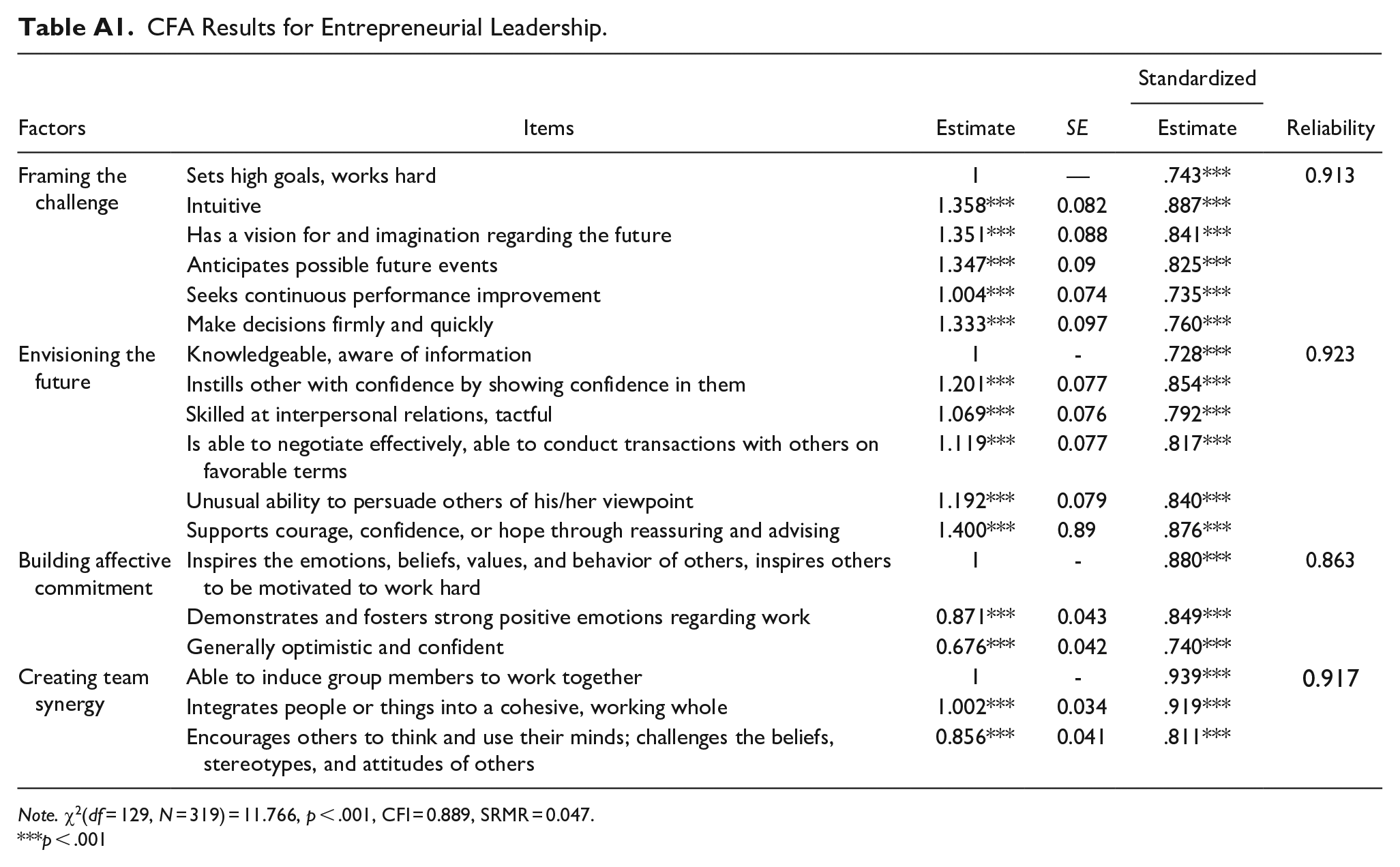
| Factors | Items | Estimate | SE | Standardized | Reliability |
|---|---|---|---|---|---|
| Estimate | |||||
| Framing the challenge | Sets high goals, works hard | 1 | — | .743*** | 0.913 |
| Intuitive | 1.358*** | 0.082 | .887*** | ||
| Has a vision for and imagination regarding the future | 1.351*** | 0.088 | .841*** | ||
| Anticipates possible future events | 1.347*** | 0.09 | .825*** | ||
| Seeks continuous performance improvement | 1.004*** | 0.074 | .735*** | ||
| Make decisions firmly and quickly | 1.333*** | 0.097 | .760*** | ||
| Envisioning the future | Knowledgeable, aware of information | 1 | - | .728*** | 0.923 |
| Instills other with confidence by showing confidence in them | 1.201*** | 0.077 | .854*** | ||
| Skilled at interpersonal relations, tactful | 1.069*** | 0.076 | .792*** | ||
| Is able to negotiate effectively, able to conduct transactions with others on favorable terms | 1.119*** | 0.077 | .817*** | ||
| Unusual ability to persuade others of his/her viewpoint | 1.192*** | 0.079 | .840*** | ||
| Supports courage, confidence, or hope through reassuring and advising | 1.400*** | 0.89 | .876*** | ||
| Building affective commitment | Inspires the emotions, beliefs, values, and behavior of others, inspires others to be motivated to work hard | 1 | - | .880*** | 0.863 |
| Demonstrates and fosters strong positive emotions regarding work | 0.871*** | 0.043 | .849*** | ||
| Generally optimistic and confident | 0.676*** | 0.042 | .740*** | ||
| Creating team synergy | Able to induce group members to work together | 1 | - | .939*** | 0.917 |
| Integrates people or things into a cohesive, working whole | 1.002*** | 0.034 | .919*** | ||
| Encourages others to think and use their minds; challenges the beliefs, stereotypes, and attitudes of others | 0.856*** | 0.041 | .811*** |
Note. χ2(df = 129, N = 319) = 11.766, p < .001, CFI = 0.889, SRMR = 0.047.
p < .001
Appendix B
Confirmatory Factor Analysis Results for Ratings of Team Members and Founders.
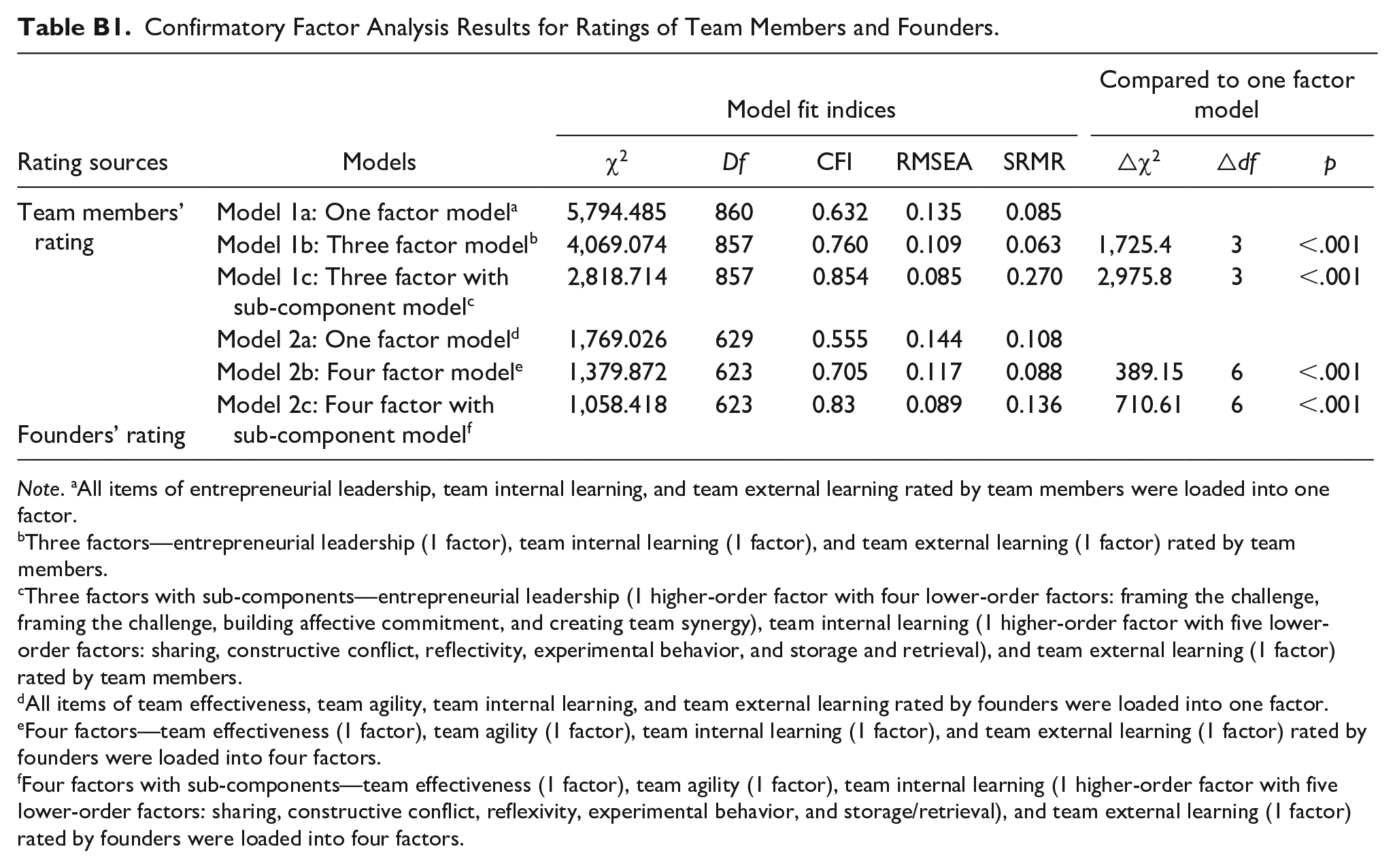
| Models | Model fit indices | Compared to one factor model | |||||||
|---|---|---|---|---|---|---|---|---|---|
| Rating sources | χ2 | Df | CFI | RMSEA | SRMR | △χ2 | △df | p | |
| Team members’ rating | Model 1a: One factor model a | 5,794.485 | 860 | 0.632 | 0.135 | 0.085 | |||
| Model 1b: Three factor model b | 4,069.074 | 857 | 0.760 | 0.109 | 0.063 | 1,725.4 | 3 | <.001 | |
| Model 1c: Three factor with sub-component model c | 2,818.714 | 857 | 0.854 | 0.085 | 0.270 | 2,975.8 | 3 | <.001 | |
| Founders’ rating | Model 2a: One factor model d | 1,769.026 | 629 | 0.555 | 0.144 | 0.108 | |||
| Model 2b: Four factor model e | 1,379.872 | 623 | 0.705 | 0.117 | 0.088 | 389.15 | 6 | <.001 | |
| Model 2c: Four factor with sub-component model f | 1,058.418 | 623 | 0.83 | 0.089 | 0.136 | 710.61 | 6 | <.001 | |
Note. aAll items of entrepreneurial leadership, team internal learning, and team external learning rated by team members were loaded into one factor.
Three factors—entrepreneurial leadership (1 factor), team internal learning (1 factor), and team external learning (1 factor) rated by team members.
Three factors with sub-components—entrepreneurial leadership (1 higher-order factor with four lower-order factors: framing the challenge, framing the challenge, building affective commitment, and creating team synergy), team internal learning (1 higher-order factor with five lower-order factors: sharing, constructive conflict, reflectivity, experimental behavior, and storage and retrieval), and team external learning (1 factor) rated by team members.
All items of team effectiveness, team agility, team internal learning, and team external learning rated by founders were loaded into one factor.
Four factors—team effectiveness (1 factor), team agility (1 factor), team internal learning (1 factor), and team external learning (1 factor) rated by founders were loaded into four factors.
Four factors with sub-components—team effectiveness (1 factor), team agility (1 factor), team internal learning (1 higher-order factor with five lower-order factors: sharing, constructive conflict, reflexivity, experimental behavior, and storage/retrieval), and team external learning (1 factor) rated by founders were loaded into four factors.
Appendix C
Appendix D
Acknowledgements
We thank Stefan Decuyper, Piet Van den Bossche, Vipin Gupta, and Michaéla C. Schippers for sharing the measurement of entrepreneurial leadership and team learning with us.
Declaration of Conflicting Interests
The author(s) declared no potential conflicts of interest with respect to the research, authorship, and/or publication of this article.
Funding
The author(s) received no financial support for the research, authorship, and/or publication of this article.
