




Abstract
Micro- and meso-scale electrostatic energy harvesting systems have high efficiency at the higher-frequency part of the spectrum due to the natural frequencies of micro-structures lying over a range from hundreds of hertz to megahertz. However, many real-life applications related, in particular, to wearable systems, structural monitoring, or the Internet of Things, are characterized by low-frequency environmental forces. The main goal of this letter is to demonstrate that the placement of a stopper that limits the motion of the proof mass and causes soft impacts in an electrostatic kinetic energy harvester is responsible for an effect known as frequency up-conversion. This means that there is a significant response to “non-resonant” frequencies away from the natural frequency of the structure leading to effective energy conversion to the electrical domain. The concept summarizing this effect is presented and modeled, and an experiment carried out on a microscopic electrostatic harvester is presented to prove the concept.
Keywords
1. Introduction
One fundamental problem of the Internet of Things (IoT) technology is the electrical supply of network nodes. There are various ways to solve this problem—usage of chemical sources, solar energy, or mechanical vibrations. Kinetic energy harvesters generate electricity out of ambient vibrations utilizing the principle of a variable capacitor and can be useful in various applications including the powering of small sensors. The subject of this paper is Electrostatic Kinetic Energy Harvesters (eKEH) (Basset et al., 2016) where the proof mass is actuated by external acceleration and causes a variation of the capacitance of a pre-charged variable capacitor (see Figure 1).
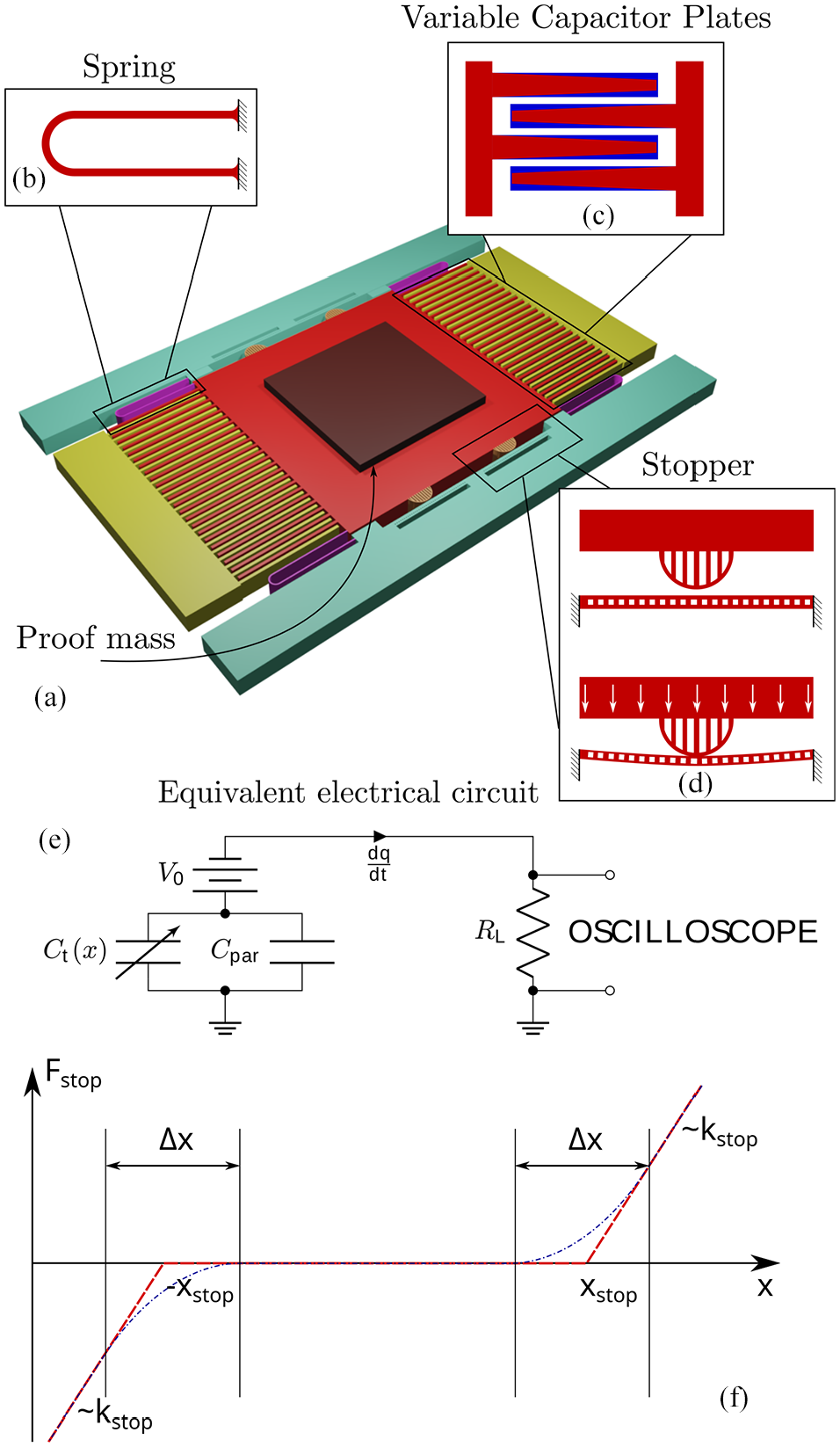
The schematic diagram presenting the structure of the electrostatic energy harvester under study in this paper constructed from the physical layout of the device. (a) General view of the structure. (b) 2D design of the linear spring. (c) The blue bars shows an initial layout of the variable capacitor. The red bars demonstrates an over-etching effect. (d) The elastic stopper, loaded and unloaded. (e) Basic electric conditioning circuit connected to the measurement equipment. (f) The stopper force versus coordinates: red dashed line is for the hard-stopper, blue dash-dot line is for the soft-stopper,
For eKEH design, it is important to model the dynamic characteristics of the eKEH under different external excitation parameters to understand what are the most efficient operating conditions. One of the main characteristics of such devices is the output power versus the external actuation frequency, which is obtained when the external sinusoidal acceleration amplitude
It has been reported that a significant growth of the converted power is observed at lower frequencies in harvesters with some particular configurations of stoppers or the proof mass with a cavity. The effect is known in the literature as frequency up-conversion. Since the first observation of this effect, there have been attempt to explain and quantify it, as well as to improve the design of the devices to enhance frequency up-conversion (Abedini and Wang, 2019; Fu and Yeatman, 2019; Guo et al., 2020; Jung and Yun, 2010; Kulah and Najafi, 2008; Lensvelt et al., 2020; Li et al., 2019, 2020, 2020; Naito and Uenishi, 2019; Speciale et al., 2020; Vysotskyi et al., 2016; Zhang et al., 2018; Zorlu et al., 2011).
The most representative and simple system for the modeling and design of a harvester with frequency up-conversion is a device with electromagnetic coupling. For this reason, some models of the frequency up-conversion effect have been attempted on this type of harvesters. The explanation of the effect is as follows. According to Faraday’s Law, the current generated in the coil is proportional to the velocity of the proof-mass (Jung and Yun, 2010; Kulah and Najafi, 2008; Zorlu et al., 2011). In such a system, the conversion of energy at low-frequencies happens because of the collision of the proof-mass with a stopper. This produces an additional oscillation at the natural frequency of the resonator that is higher than the external excitation frequency.
With respect to other transduction mechanisms, a typical eKEH displays much more complicated dynamics because the charge induced on the plates of its variable capacitors has a strong influence on the waveforms in both, the electrical and mechanical domains. In this paper, we focus on the modeling of an eKEHs with a gap-closing variable capacitor as an example of a harvester whose nonlinearity arises in the electrical domain, as shown in Figure 1(a). Study (Li et al., 2020) presents an interesting mathematical model of the spring, electromechanical coupling and the hard-stopper force and predicts hardening effects in the investigated eKEH very well. However, the presented model does not explain in detail the frequency up-conversion occurring in the system.
There are more studies investigating the influence of the stoppers and addressing the bandwidth extension toward higher frequencies (the Duffing effect), but not the appearance of an enhanced low-frequency response (Ibrahim et al., 2018; Mahmoud et al., 2017).
This brief is focused on the quantitative investigation of the frequency up-conversion effect in a harvester with electrostatic transduction and nonlinearity in the electrical domain. Our aim is to propose a concise and accurate model that will not only explain why the effect happens but also will allow us to simulate the characteristic of a harvester in a predictive manner. To our knowledge, such a model is not discussed in the literature despite the fact that frequency up-converting is known.
The structure of the paper is as follows. Section II of the letter presents the statement of the problem that is formulated as a lumped model containing ordinary differential equations describing the mechanical and electrical domains. Section III briefly outlines the finite-element-method modeling of the system capacitance. Section IV presents the description of the experiment, experimental results, the technique to extract parameters and the comparison. In the Conclusions section, we discuss the novelty of the results and the advantage to use soft stoppers.
2. Statement of the problem
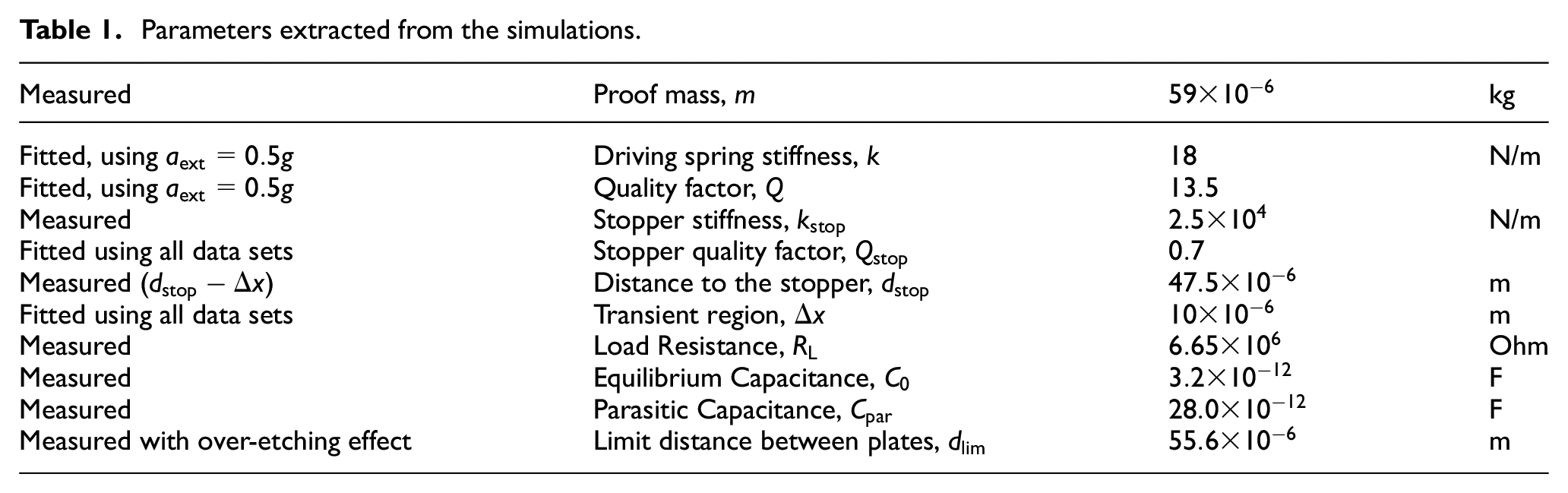
It is considered that frequency up-conversion is an effect when the resonator of a kinetic energy harvester exhibits high-power mode when the external excitation applied is at low frequency. This usually occurs due to collisions with stoppers or other collision related effects. To describe this phenomenon, we built a lumped model of the electrostatic energy harvester with a stopper based on the physical geometry. As the example here, we test the device whose fabrication is described in detail in Lu et al., 2015. The parameters of the device are given in Table 1.
Parameters extracted from the simulations.
Lumped models are a very common model of choice for MEMS resonators and kinetic energy harvesters based on them (Ibrahim et al., 2018; Mahmoud et al., 2017). For the device under study in this paper, we proposed a lumped model that includes the following forces:

Here
The motion of the resonators in kinetic energy harvesters are usually limited by stoppers. One can classify stoppers as hard or soft. For example, the effect of a hard stopper placed symmetrically on the both sides of the resonator can be modeled by an piece-wise function
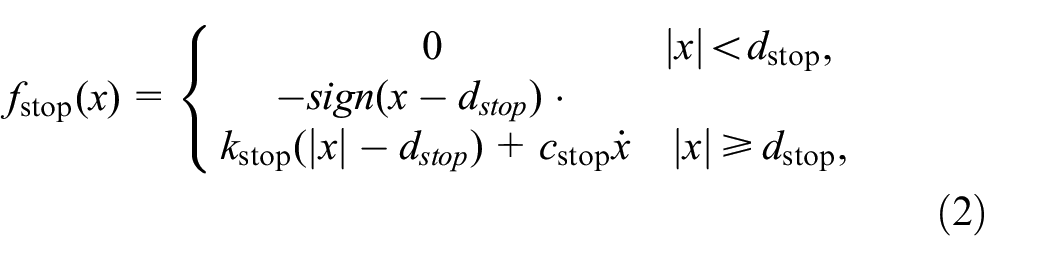
Here,
With respect to the soft stopper, its stiffness has a transient region and a wide region of response with respect to the relative displacement of the resonator. Its model is as following:
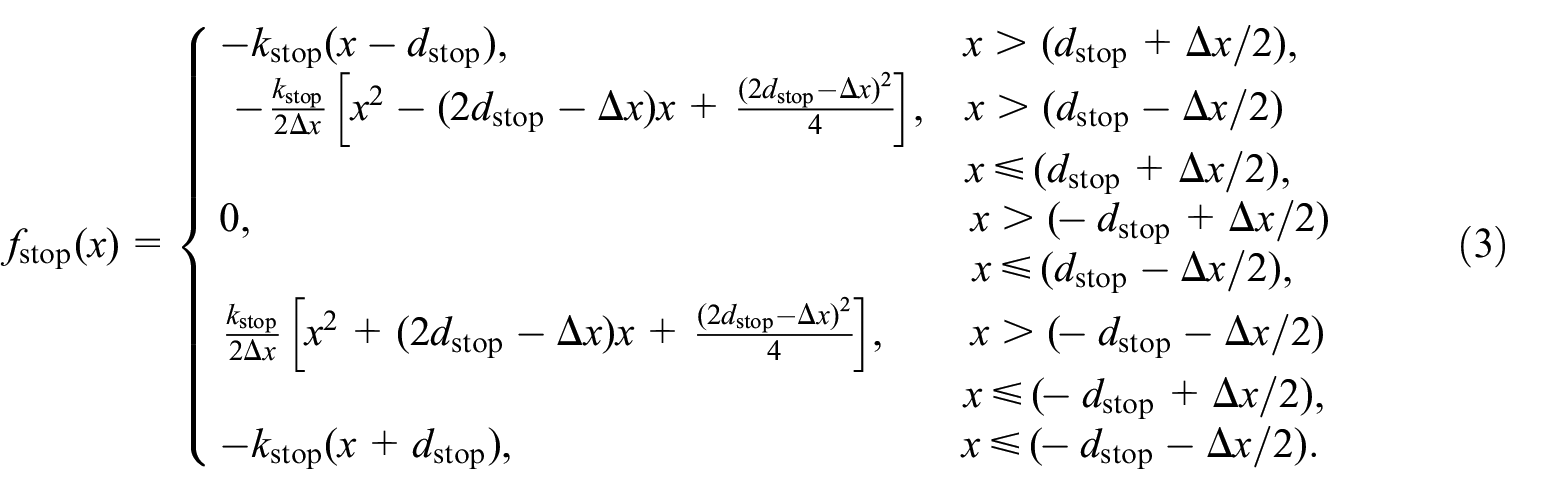
The parameters of the stopper are to be reconstructed from measured data. The softness of a stopper is regulated by the width of the
The transducer force

Here
Up until this point, the basic component of the model are general. In the next sections, we will show that adding the accurate modeling of the capacitance and understanding the nonlinear effects produced by the stopper will allow us to explain the physics of frequency up-conversion (qualitatively and quantitatively) through the generation of higher harmonics.
3. Verification of 1D model using finite element simulations
For the model of the variable capacitor, we use the ideal gap-closing approximation. The following expression connects the variable capacitance

where

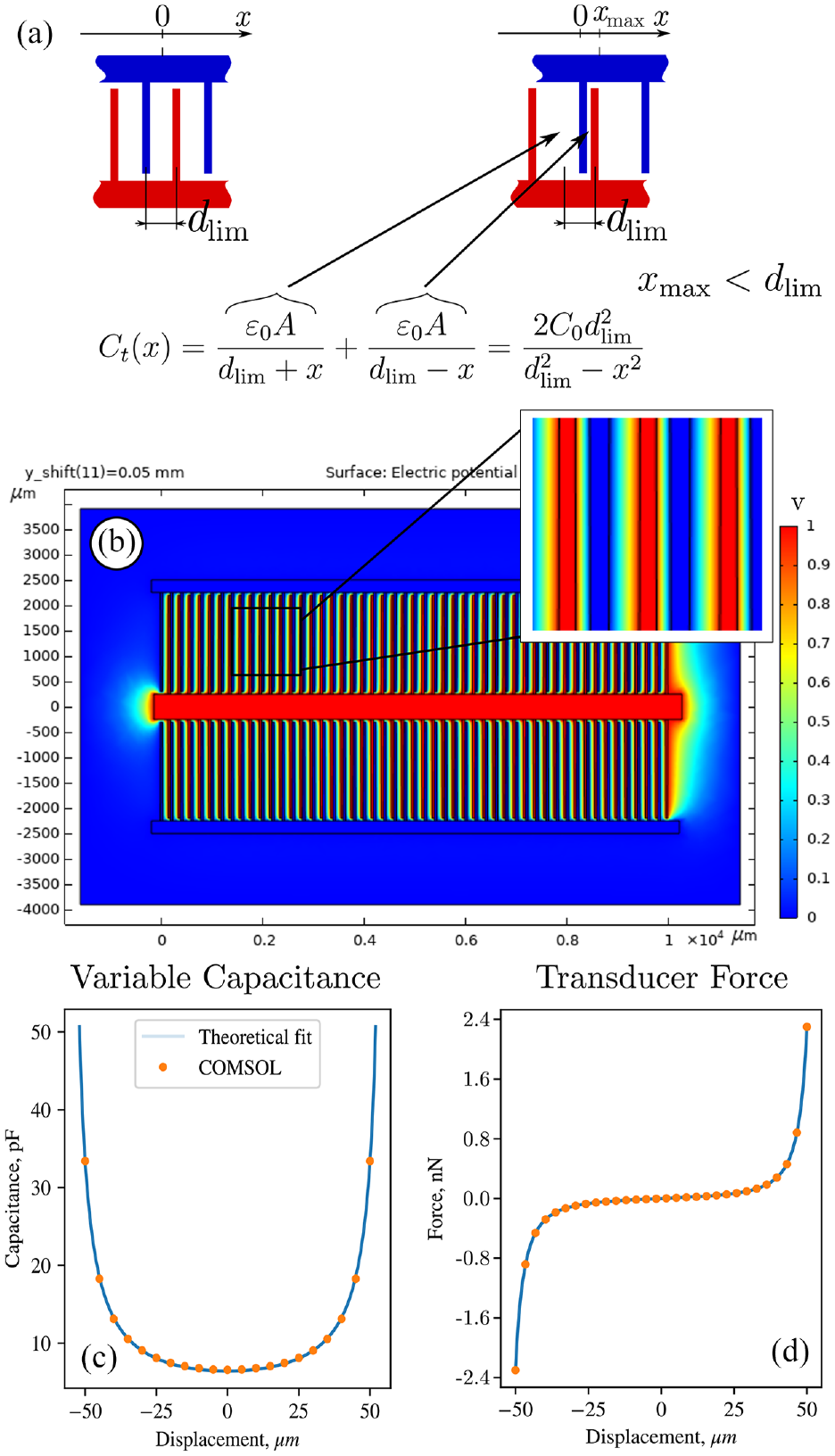
Capacitance and transducer force calculation. (a) The principle of the gap-closing capacitor and the analytical formula describing it. (b) Finite Element Method simulations of the electric potential distribution due to the variable capacitor plates at a fixed potential difference of
However, one has to note that the expression above does not take into account the non-uniformity of the electric field at the edges of the plates and the effects associated with over-etching during the manufacturing of the device (see Figure 1(c)). For this reason, we employ a 3D model of the variable capacitor of the studied device using the layout and over-etching of the plates effects (Figure 2(b)). Using a FEM Poisson equation solver (COMSOL Multiphysics), we calculate the 3D electric potential distribution, variable capacitance of the structure and the electrostatic force acting on it (Figure 2(c) and (d)).
The FEM solver corroborated the hypothesis that the over-etching effect causes only minor changes in the magnitude of
4. Results: Experimental observation of frequency up-conversion and its analysis
The photo of the experimental set up is shown in Figure 3. The experiment consisted of measuring the power dissipated across the load resistor (see Figure 1(e)). It was then converted into the energy per cycle of oscillations. The forward and backward frequency sweeps were recorded over a frequency range from 0 to 500 Hz. The electrostatic transducer (variable capacitor) was biased either by an electret of 21 V or by the electret (21 V) and an additional source of 25 V. Different harmonic accelerations were applied: weak (0.5
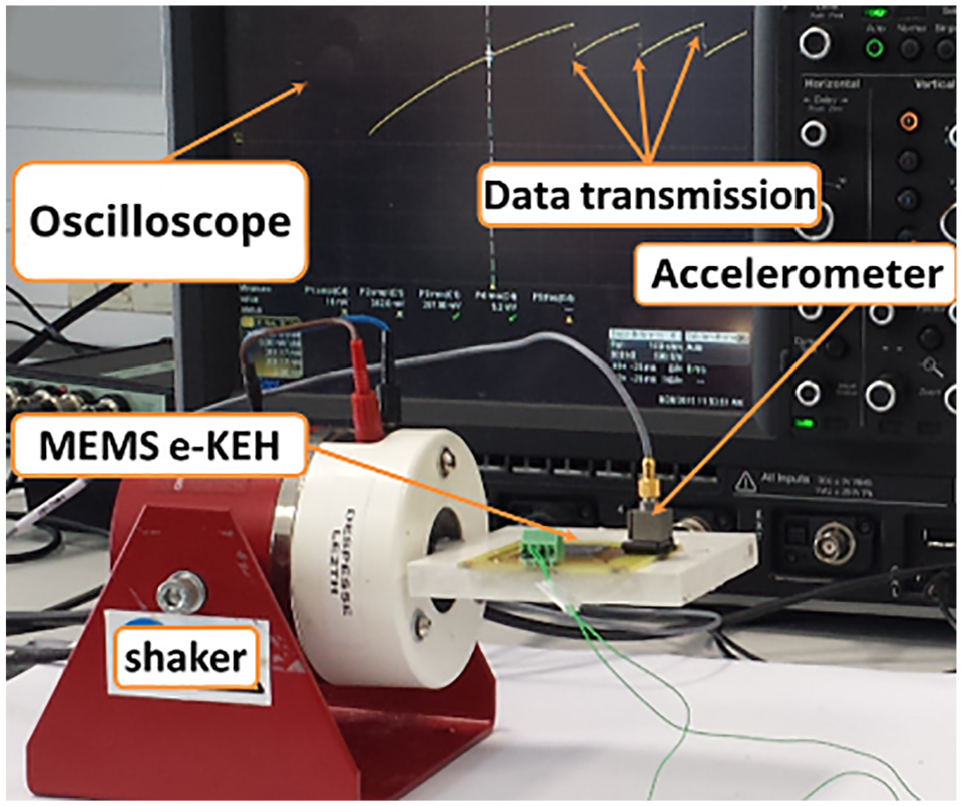
The experimental setup: an electrostatic KEH is set into motion by a shaker. The acceleration (amplitude and frequency) is controlled by an external accelerometer and feedback loop. The energy generated per cycle (
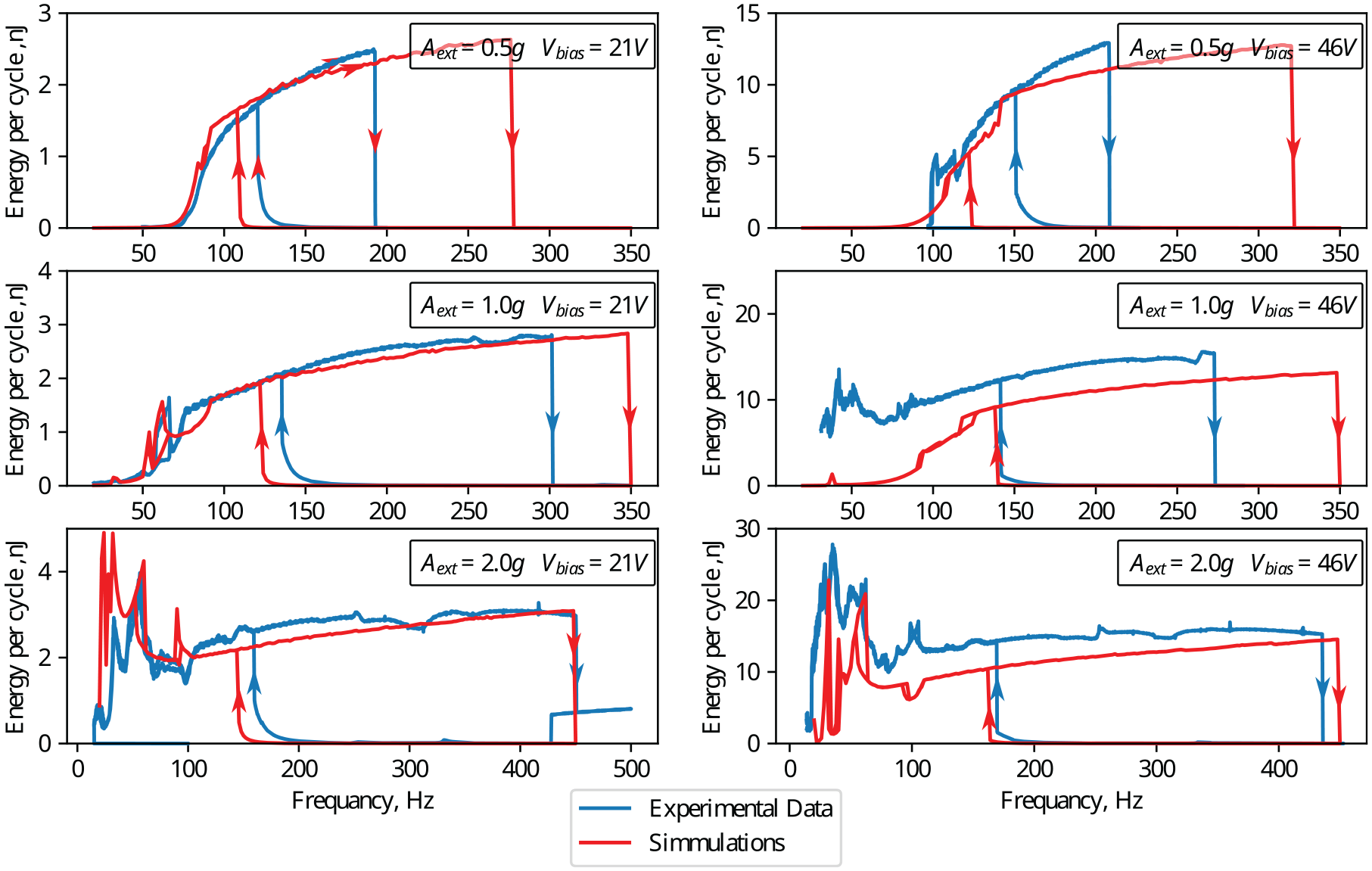
Matching of the experimental data with the simulation results. The blue lines correspond to the measured energy converted per oscillation cycle on the device. The red lines correspond to the simulation results. Note that the variable capacitor is pre-charged by the electret layer with voltage
For the studied device, Table 1 summarizes what parameters are known or measured directly (i.e. mass
As was mentioned in the Introduction, gap-closing eKEHs often display complex dynamics depending on many factors, and not all of them are possible to measure (See Table 1). Moreover, in this paper we focus on the low-frequency region of forced oscillations that may display some (not significant) disagreement with experimental data. However, the proposed model allows one both options, to model the frequency up-conversion effect and the hardening of the resonance curve.
The methodology of this study is based on the numerical modeling and optimization of the equations outlined in previous section and comparison of the simulated parameter sweeps with the experiment. In order to perform the optimization and comparison, we applied numerical integration with controlled accuracy (using the boost-odeint library (Ahnert and Mulansky, 2020)) to the system of equations (1), (4) with known functions (5) and (6) and obtained the
The amplitude of oscillations can be calculated as

where
The mathematical model of the studied KEH, although formulated in a general form, allows one to obtain some deep understanding of the factors that affect the generation of energy at different external frequencies, in particular, in the sub-resonance region where frequency up-conversion takes place. We would like to highlight again that this effect (frequency up-conversion) was reported in the literature, however to the knowledge of the authors there is no quantitative model explaining its physics.
The coordinate

where
Figure 5 illustrates that the frequency up-conversion effect is due to higher harmonics generated by the KEH resonator. The graph at the center of the figure shows a simulated frequency sweep (forward and backward branches) with a clear up-conversion region for the frequencies below the linear resonance one. The heat map on top of the figure shows the relative magnitude (in dB) of higher harmonics
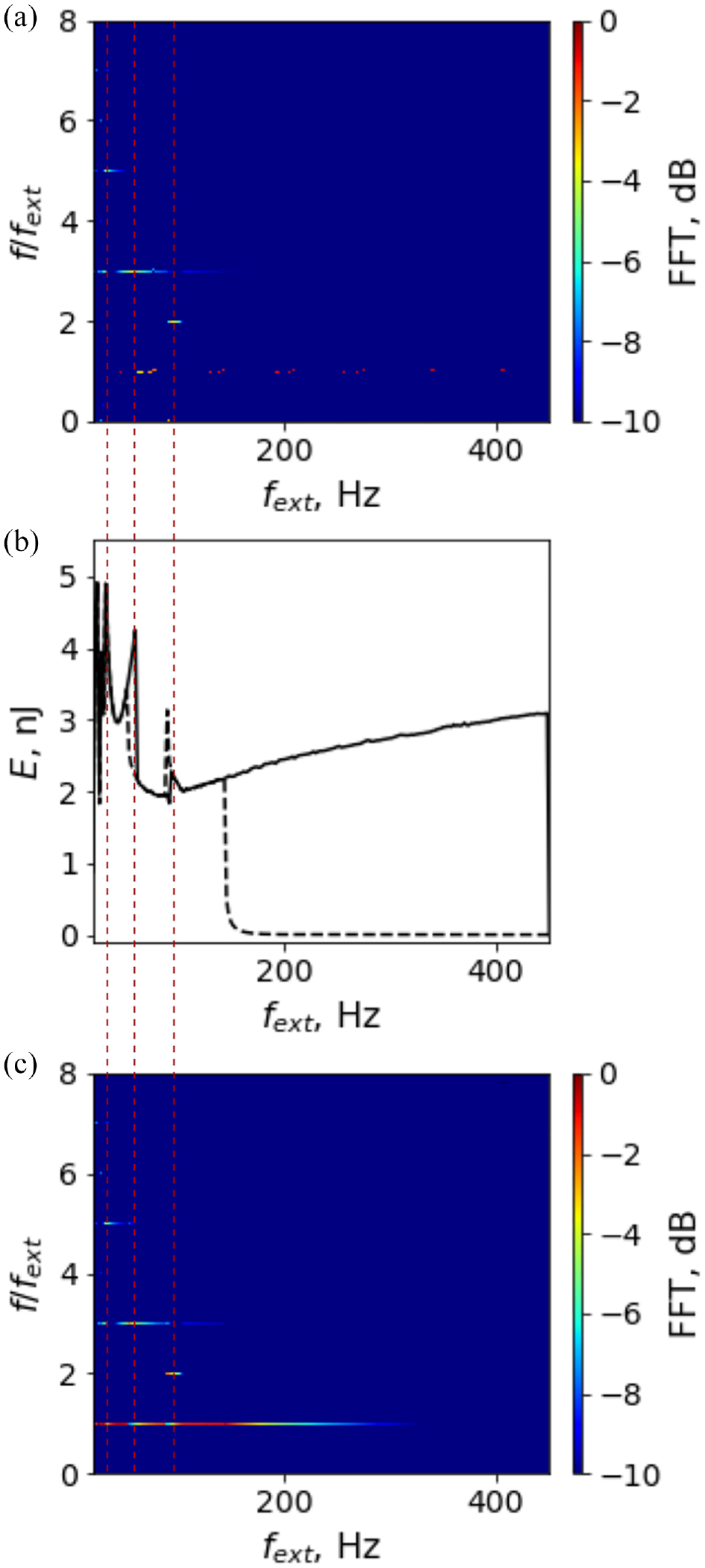
Analysis of the forward and backward branches of the system under the bias voltage
These concept is further expanded in Figure 6 where the distribution of energy per cycle of oscillations across higher harmonics is presented. As an example, we take the same case as shown in Figure 5:
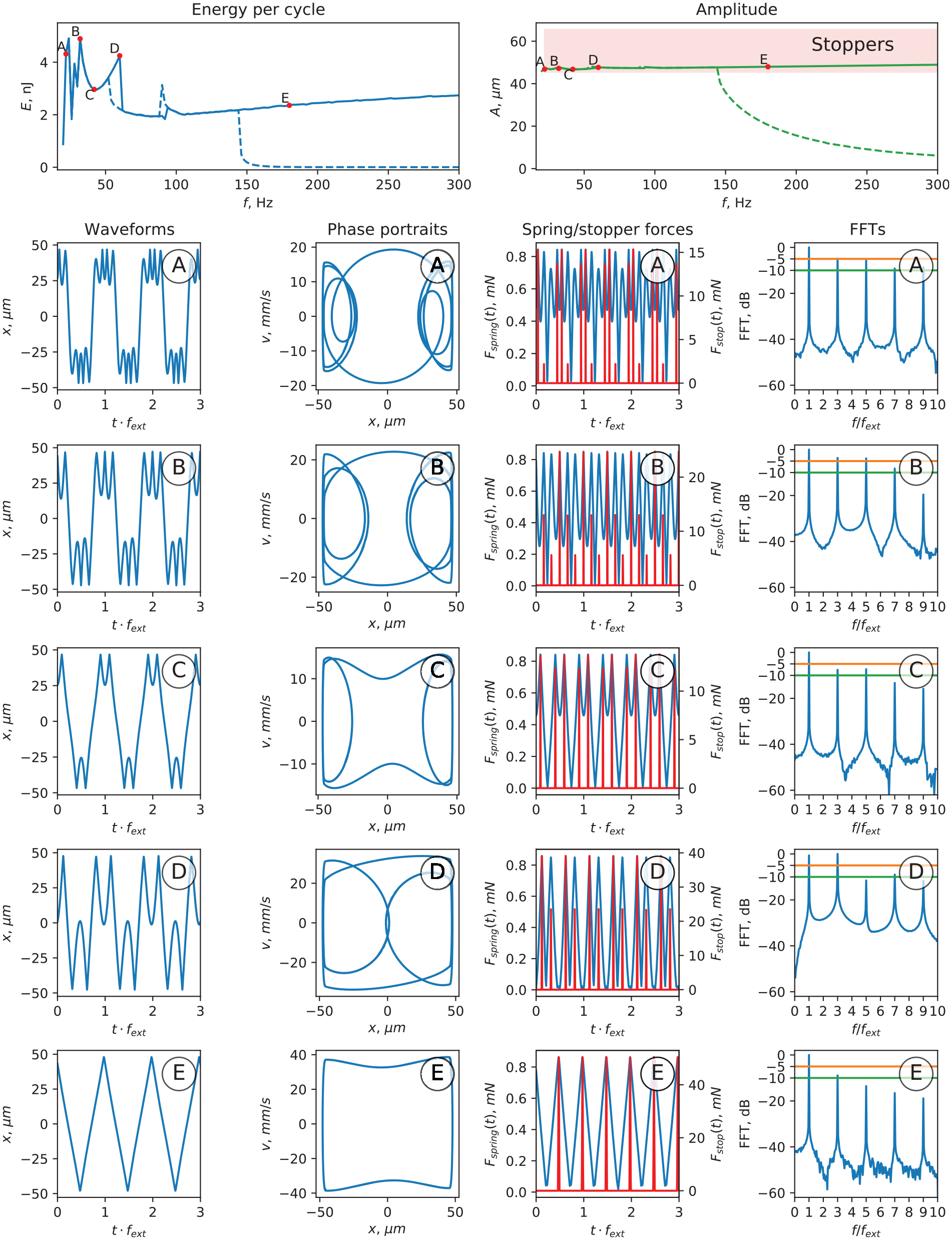
Analysis of the forward and backward branches of the system’s frequency sweep under the bias voltage
Figure 6 provides further explanation on the frequency up-conversion effect from the stand-point of the dynamics of the harvester’s resonator (obtained by solving the correspondent set of equations). The frequency sweeps, containing the forward and backward branches of the energy per cycle and amplitude, are shown at the top of the figure. The points of interest
One should note that that the peaks in the frequency sweep (points
5. Conclusions
This brief paper is dedicated to an explanation into the frequency up-conversion effect based on a quantitative model. We use a compact lumped model of a electrostatic kinetic energy harvester with a (soft) stopper and a basic conditioning circuit. Using FEM simulations, we proved that a simple expression for the variable capacitance and the transducer force are applicable for the investigated harvester. Using that model we showed that the collisions between the proof-mass and the stoppers are causing higher harmonic oscillations and therefore causes frequency up-conversion in this system.
The key points are as follows:
Frequency up-conversion is observed in a harvester with a linear resonator and a soft stopper when the frequency of the external oscillations is below that of linear resonance.
Frequency up-conversion occurs when the linear resonator experiences a very soft impact with the stopper and is explained by the generation of higher oscillations harmonics. The harvester generated as increased converted power.
When the KEH is driven into hard-impact mode, higher harmonics decay. The converted power increases as is similar to conventional hardening nonlinearity cases.
Soft stopper may be particularly useful in this case as it is important to keep the KEH oscillators in the mode of soft bouncing. Soft stoppers can be modeled using the approximation of the smoothed stopper force with relatively wide transient region
While frequency up-conversion was observed and reported in other systems with impact, we provide a compact model and physics explanation of this effect.
Footnotes
Declaration of conflicting interests
The authors declared no potential conflicts of interest with respect to the research, authorship, and/or publication of this article.
Funding
The authors disclosed receipt of the following financial support for the research, authorship, and/or publication of this article: This document is the results of the research project funded by Science Foundation Ireland under grant 13/RC/2077
