




Abstract
Kinship caregivers raise relative children who are unable to be cared for by their parents. Most kinship caregiving takes place outside the child welfare system (“informal” care), meaning that caregivers do not have access to foster care payments to offset the costs of child rearing. The main source of financial support for informal kinship caregivers is Child-Only TANF, which is inadequate to meet the full range of caregiver needs. To address this funding gap, the authors present a comparative policy analysis of seven programs in six states that have implemented supplemental state funds for informal kinship caregivers. The authors analyze key features of each program and compare the socioeconomic and political characteristics of states that offer supplemental caregiver benefits to those of states that do not. Recommendations for policy and practice are discussed.
Kinship caregivers are non-parent relatives or close family friends who provide full-time care for children whose parents cannot care for them due to circumstances such as poverty, incarceration, parental substance use, or death (Gleeson et al., 2009). U.S. Census Bureau data (2021b, 2021c) show that there are at least 2.3 million grandparents raising over 2.7 million grandchildren in the United States. However, data from the 2013 National Survey of Children in Nonparental Care estimate that just 63% of kinship caregivers are grandparents, suggesting that the Census Bureau estimates are an undercount of the true incidence of kinship care in the United States (Radel et al., 2016).
The vast majority of kinship caregivers care for children without the involvement of the child welfare authority, also known as “informal kinship care” (as opposed to “formal” care arranged by the child welfare authority). Just 133,873 children are placed in “formal” relative foster care placements, representing <5% of all kinship children (U.S. Department of Health and Human Services, Administration for Children and Families, Administration on Children, Youth and Families, Children’s Bureau, 2022).
Informal kinship caregivers benefit both the children in their care and taxpayers by keeping children out of the child welfare system (Gleeson et al., 2009). A systematic review of outcome studies showed that children in kinship care experience fewer mental and behavioral problems, greater well-being, and less placement disruption than children in non-relative foster care (Winokur et al., 2018). Informal caregivers also save the government a significant amount of money. Beltran (2014) estimated that if 1.3 million of the kinship children who are being cared for informally by relatives entered foster care, it would cost taxpayers about US$4 billion each year.
Informal kinship caregivers support the government, but does the government support them in return? Informal caregivers tend to be more financially disadvantaged and less connected to services than formal caregivers, and just half receive any financial assistance for caregiving (Bavier, 2011; Ehrle & Geen, 2002; Gibbs et al., 2006; Goodman et al., 2007; Harding et al., 2020; Radel et al., 2016; Stein et al., 2014; Swann & Sylvester, 2006). Federal benefits are inadequate to meet informal caregivers’ needs due to low benefit amounts and numerous barriers to access (Center on Budget and Policy Priorities [CBPP], 2022; Dehry et al., 2022; Nelson et al., 2010). States have begun filling in this service gap, but little is known about the characteristics of state benefit programs or how they are designed (Beltran, 2014). This research was requested by the kinship care advocacy community in order that state policymakers might better understand and emulate existing benefits designed to support informal kinship caregivers.
This article utilizes a mixed-methods comparative state policy approach to explore the key features of existing state benefits that support informal kinship caregivers and so help keep children in kinship care (Miller, 2004). This approach seeks to analyze and explain variation in public policy across states by examining political and socioeconomic characteristics. These characteristics may include party control, state fiscal capacity, state personal income, public opinion, and population size, among others (Miller, 2004).
While several different bodies of research and models exist within this approach, all posit that public policy is influenced by internal and external factors such as those listed above. All, too, are consistent with the idea that these factors can act as obstacles, resources, and/or motivations for policymakers (Miller, 2004). Welfare policies in particular are grounded in the “normative values of policy makers and constituents” by requiring particular characteristics of recipients and so determining who is “deserving” of help, and of how much (Davies & Worden, 2009, p. 196). By using the theoretical framework of comparative state policy (Miller, 2004), this article endeavors to describe variation in financial assistance for informal caregivers, analyze state-level factors that may explain and illuminate those differences, and offer recommendations for equitable application of these policies across states.
Literature Review
Kinship Caregivers’ Financial Needs
Despite the benefits of kinship care, kinship caregivers often face significant financial burdens in connection with raising kinship children, including expenses related to clothing, extracurriculars, housing, and child care. Lino and colleagues (2017) conservatively estimated the average annual direct cost of raising a child under 18 was between US$12,350 and US$13,900 per child in 2015 dollars. Numerous studies, however, indicate that kinship families are more likely to be living with limited financial means (Ehrle & Geen, 2002; Gleeson et al., 2009; Lee et al., 2016). They may therefore struggle to shoulder this significant financial load. U.S. Census Bureau (2021a, 2021b) data indicate that the median household income for kinship caregivers is US$45,000—compared with US$69,000 for the overall U.S. population—and three out of every ten children in kinship care households are living in poverty (U.S. Census Bureau, 2021a, 2021b).
Informal kinship caregivers are particularly vulnerable to financial strain, more so than formal caregivers. Radel and colleagues (2016) found that while more than three-quarters of foster parents (some of whom are kin) received financial assistance, just half of informal kinship caregivers received any form of financial assistance to care for their kinship child. Additional research shows that informal caregivers tend to be more financially disadvantaged and less connected to services than caregivers with access to child welfare system resources (Bavier, 2011; Ehrle & Geen, 2002; Gibbs et al., 2006; Goodman et al., 2007; Harding et al., 2020; Radel et al., 2016; Stein et al., 2014; Swann & Sylvester, 2006). Nearly half of grandparent caregivers, who make up the majority of kinship caregivers, are over 60 and so may be retired and on fixed incomes (U.S. Census Bureau, 2021c). The high poverty rates and lack of financial support can have harmful consequences: numerous studies have linked adequate financial means and income support programs to improved health, achievement, and well-being for children (Waxman et al., 2021). In one study of informal kinship caregivers, for example, Washington and colleagues (2013) found that during periods when African American informal kinship families had access to more financial resources, their children scored higher on measures of academic and social competence.
Federal Financial Supports for Kinship Caregivers
Formal kinship caregivers are eligible for significantly more financial benefits and services than informal kinship caregivers. Licensed kinship foster caregivers are eligible for a monthly foster care payment from the child welfare authority, which averaged US$511 per child per month in 2010 (U.S. Government Accountability Office [GAO], 2011) and has since increased to US$657 per child per month in 2023 (World Population Review, 2023). Licensed caregivers who have a kinship child placed with them for 6 months or more may also be eligible for Title IV-E Guardian Assistance Program (KinGAP), which is currently available in 41 states (Virginia Poverty Law Center, 2018). Importantly, neither foster care payments nor KinGAP are means-tested programs, meaning that families can receive some funding regardless of their monthly income and assets.
The Temporary Assistance for Needy Families (TANF) Child-Only grant is the only federal benefit specifically intended to supplement the costs for caring for children in informal kinship arrangements (CBPP, 2022). Unlike other TANF programs, the Child-Only grant is not means-tested, meaning that the income and assets of the caregiver(s) are not considered in the application process (Beltran, 2014). Dehry and colleagues (2022) report that in 2020, the median TANF Child-Only grant amount for one child was US$231 per month (US$2,772 per year), which is one third of the average amount that licensed formal kinship caregivers can receive (US$657), and one fifth of the average estimated monthly cost of raising a child in the United States (US$1,093) (Lino et al., 2017).
Although a crucial lifeline in the absence of alternatives, the TANF Child-Only grant alone is not sufficient to meet the needs of kinship families (CBPP, 2022). Nelson et al. (2010) found that a small fraction of caregivers eligible for Child-Only TANF receive the benefit. There are a number of possible reasons for this low service uptake, including the low benefit amount. In addition, TANF programs require the caregiver to allow the state to collect child support from the child’s parent(s) on their behalf, which many kinship caregivers are fearful to do out of concern for the parent’s well-being or due to fear of retaliation from the parent (Beltran, 2014). There is one exception to this requirement: “good cause.” However, not all states clarify what their good cause exemption policies are, and even in states with a structured exemption process, the caregiver still must show that collection would cause an undue burden (Brown, 2000). States can also define “relative” in whatever way they choose—some states include only blood relatives, while others include family-like connections. These barriers, in combination with caregivers’ lack of awareness of their eligibility for these benefits, all contribute to low uptake of Child-Only TANF benefits (Beltran, 2014).
State Supplemental Funding for Informal Kinship Caregivers
To address inadequate and inequitable federal funding for kinship caregivers who cannot access public child welfare system benefits, several states have implemented supplemental benefits for informal caregivers using state funds. Although information about state benefits and services available to kinship caregivers can sometimes be found on state or kinship program websites, it is often incomplete and unclear. Joyce (2019) provides an overview of which states have state-funded programs in addition to federal Child-Only TANF, although the brief leaves open questions about whether the state benefits were available to informal caregivers and whether the programs have changed since the data were collected (some program information was collected as early as 2004). Given that information on state kinship caregiver benefits is limited online, the authors seek to improve the accessibility of program information so that states looking to implement similar programs have a clear understanding of what other states have done and can build on these program efforts. Also important in this inquiry is to provide clarity on the benefits that do currently exist in states so that practitioners can better support families in the states that they serve. This article also seeks to understand factors that may have influenced how and why states have designed supplemental programs to support informal kinship caregivers.
Comparative State Policy
An increasing number of states have begun implementing their own state-funded support programs for kinship caregivers. The first kinship navigator programs began in the early 2000s and helped connect caregivers to additional resources (Beltran, 2023). The adoption of these programs came as awareness of need among the informal caregiver population was rising (Geen, 2004), only a few decades after child welfare agencies had begun to turn to kin as formal foster parents but nearly 50 years after the first Child-Only grants (Jantz et al., 2002). State-funded financial assistance for informal caregivers also began to be adopted around this time (Geen, 2004; Geen et al., 2001) but appeared to be less common than state-funded kinship navigator programs, although the lack of transparent program information precludes certainty.
Prior studies have examined what factors affect policy adoption and innovation, particularly in regard to social services and welfare. Generally, both political and economic state characteristics are considered important to include in comparative state policy analysis (Miller, 2004). First, we consider political and social factors. Ma (2017) found that liberal government ideology is significant in government policy innovation and in fact tends to impact policy innovation a great deal more than citizen ideology. As regards race, some researchers have theorized that states with higher populations of communities of color tend to be less generous towards those communities in policy - where white people feel threatened, policymakers will spend less on programs that benefit those communities (Gilens, 1999; Soss et al., 2001). Others, however, were unable to find significant correlations to support this (Davies & Worden, 2009). Researchers have also found insignificant relationships between measures of need and funding, suggesting that states do not necessarily provide more funding with greater need, and may in fact do the opposite (Tweedie, 1994; R. M. Walker, 2014). This may be especially true for vulnerable populations. For example, one state comparative study on funding allocations to support indigent representation in court found that states with greater need contributed less (Davies & Worden, 2009).
The role economic factors play is also debated. Ma (2017) and R. M. Walker (2014) found that state fiscal capacity was not significantly associated with innovation, while prior studies have found that wealthier states are more likely to innovate (Gray, 1973; Miller, 2004; J. L. Walker, 1969). Particularly with regard to policies that focus on welfare and financial assistance, as in this article, studies indicate that wealthier states tend to provide more funding (Koven & Mausolff, 2002; Tweedie, 1994). Executive and legislative capacity has also been examined: Ma (2017) found that management capacity of a government is in fact negatively correlated with innovation, while others have argued that more professionalized legislatures and empowered governments are more likely to innovate (Coleman, 1999; Sigelman et al., 1981). Although comparative state policy analysis has examined welfare and assistance in some areas, no research of this kind has yet been conducted to examine policy as it relates to the financial support available for informal caregivers raising relative children.
Method
To explore the key features of existing state strategies to support informal kinship caregivers, the authors utilized a mixed-methods comparative state policy approach (Miller, 2004). In accordance with this theoretical framework, we gathered data about the programs and policies that met our inclusion criteria and analyzed how these policies varied by state socioeconomic and political characteristics, including average household income, governor party, populace ideology, and public benefit variables. These variables are among those recommended by Miller (2004) and Ma (2017).
Using a combination of program website information, interviews with knowledgeable program staff, state legislative websites, and publicly available data, we answer the following research questions:
Research Question 1 (RQ1): What are the common and unique elements of state supplemental funding programs for informal kinship caregivers in the selected states?
Research Question 2 (RQ2): What socioeconomic and political factors might have influenced the adoption and development of these programs?
The quantitative data in our analysis provide clear evidence of similarities and differences between states, while the qualitative data offer rich and detailed program information as a model for other states. As Miller (2004) notes, comparative state analysis typically focuses on quantitative data but is benefited by the inclusion of and emphasis on qualitative data.
This article provides state policymakers, program staff, advocates, and researchers with examples of ways that states have designed state-funded programs to support informal caregivers and offers a roadmap for policy development in other states. This study was exempt from the human subjects’ institutional review process as data collected were restricted to material available in the public domain.
Sample Selection Process
Google Scholar and Google were used to find information on state-funded financial supports available to kinship caregivers in each of the 50 states in 2023. At the outset, 21 states were identified as possibly having programs that met the inclusion criteria. The authors used a purposive sampling approach to identify contacts in the states of interest who could answer questions about the programs (e.g., program directors, state administrators, nonprofit directors, etc.). A program specialist at the U.S. Department of Health and Human Services, Administration for Children and Families also provided contacts for the states of interest. The authors reached out to each of these contacts via email. Of the 21 identified states, 19 responded to our outreach via email. One confirmed via email that no programs met our criteria. Four ceased communication or were unable to meet or provide information within the allocated observation time period for this inquiry (April 10, 2023 to May 25, 2023). The authors conducted semi-structured interviews with an additional 14 respondents who were able to meet within the allocated observation time period for this inquiry. See Figure 1 and Table 1.
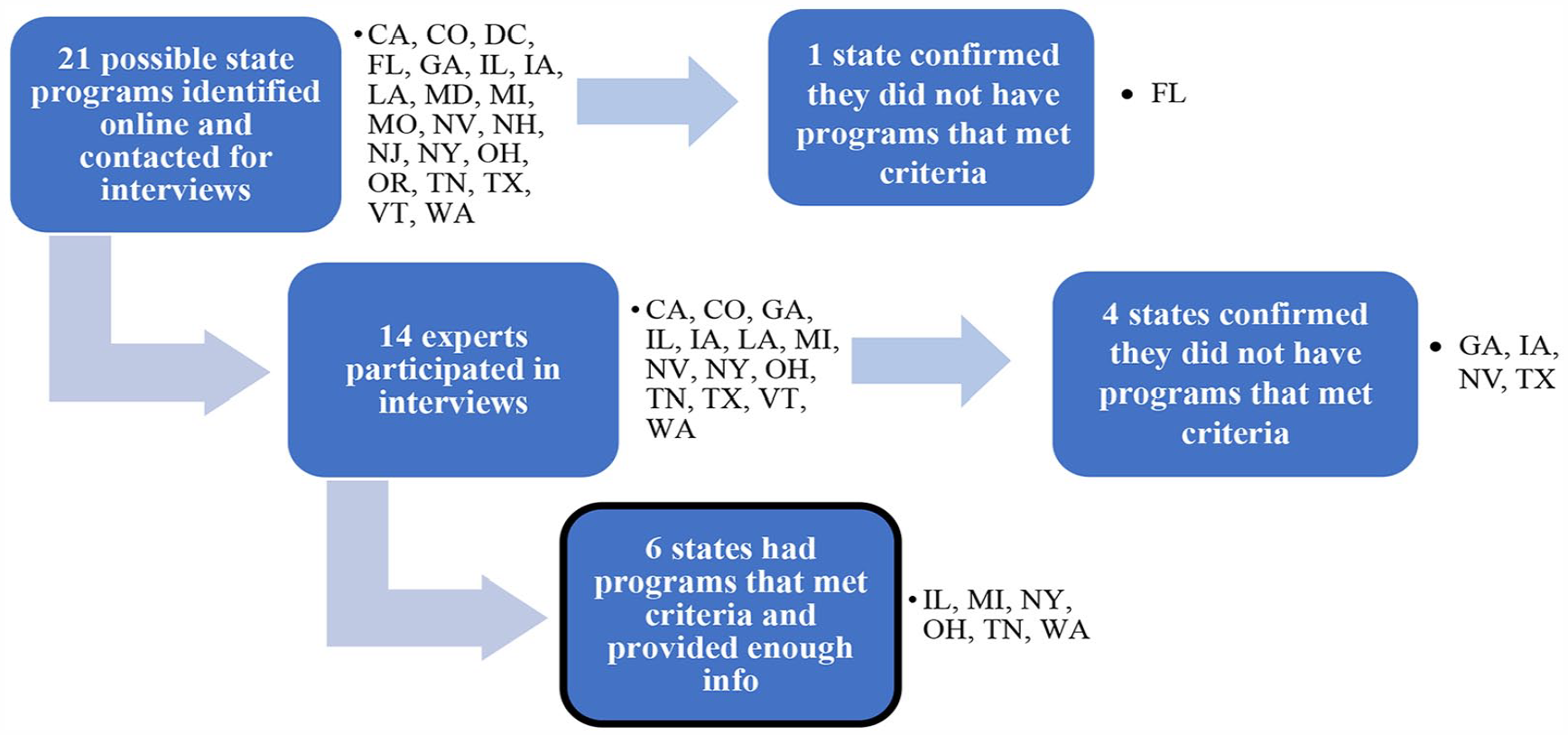
Sample Selection Process.
Case Selection Process.
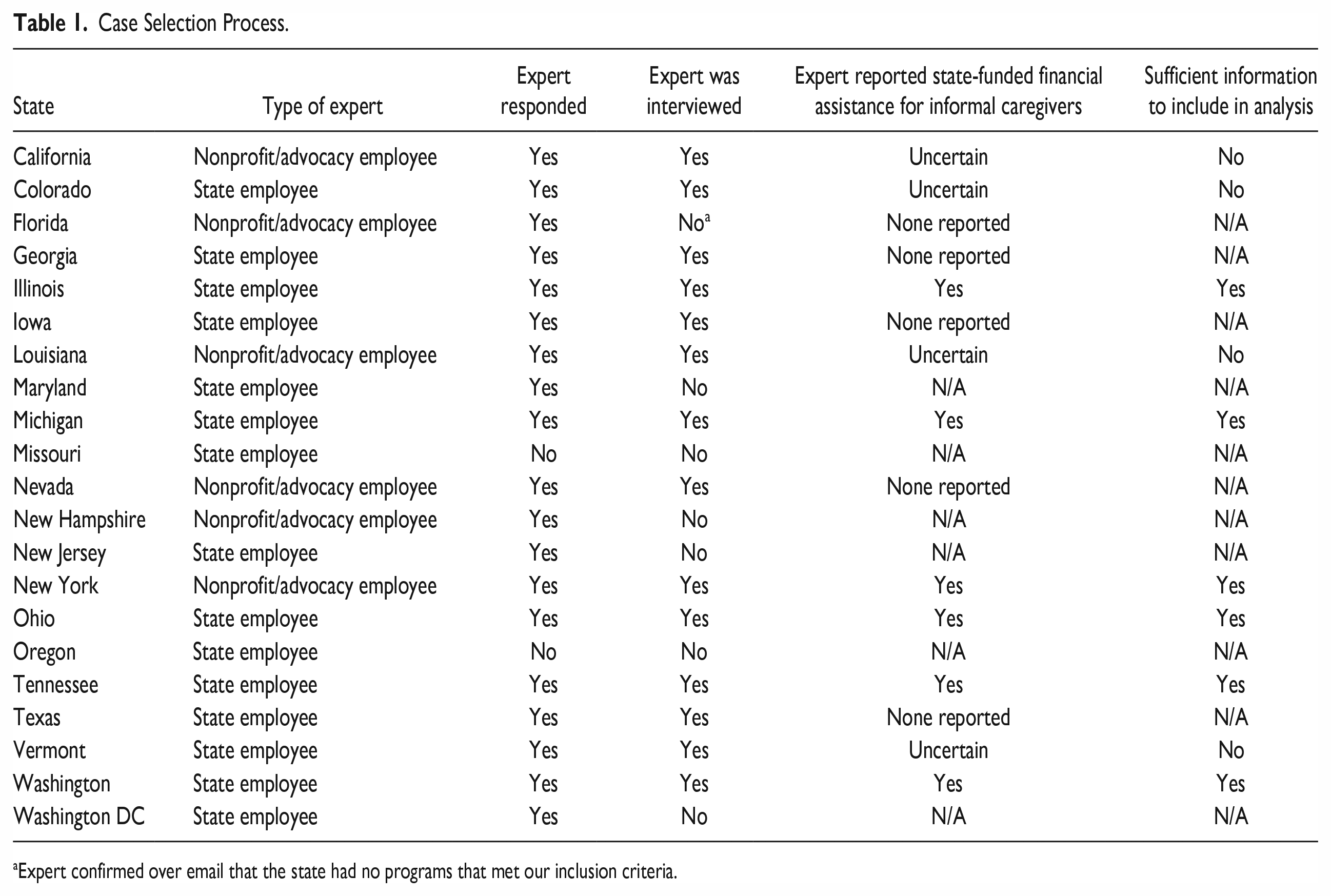
Expert confirmed over email that the state had no programs that met our inclusion criteria.
Interview Protocol
The authors reached out to each identified contact via email to schedule an interview, describing in the email the purpose of the research and the inclusion criteria. Each interview was conducted via video call and lasted between 15 and 60 min, depending on the volume of information provided. Each interview incorporated the same preliminary topics/questions to determine what programs were available and whether they met this article’s inclusion criteria. When requested, the authors provided this list of 8 overall topics/questions and 12 sub-topics/questions to the experts in advance of the call.
Topics included funding sources, eligibility requirements (including requirements regarding custody, licensure, and income or expenses), assistance methods (including in what form the financial assistance was given, frequency and/or time limits, and payment amounts and/or limits), and any requirements for participants during the program (e.g., check-ins with staff or regular renewals). Additional probing questions were asked in each interview to gather sufficient detail about each program’s unique characteristics. The authors took detailed notes during each interview. After the call, the authors followed up via email to confirm or clarify information provided during the interview.
Determination
After conducting the interviews, the authors determined that seven programs in six states met the inclusion criteria: (a) The program was funded by state dollars, (b) The program provided concrete support such as cash or material goods/services to informal kinship caregivers, and (c) The program staff provided information about all or most of our variables of interest. Program staff were given the opportunity to review their program’s data for accuracy. State websites were then used to confirm the existence of legislation or administrative policy. Program information was organized into six major variables in Table 2.
Results.
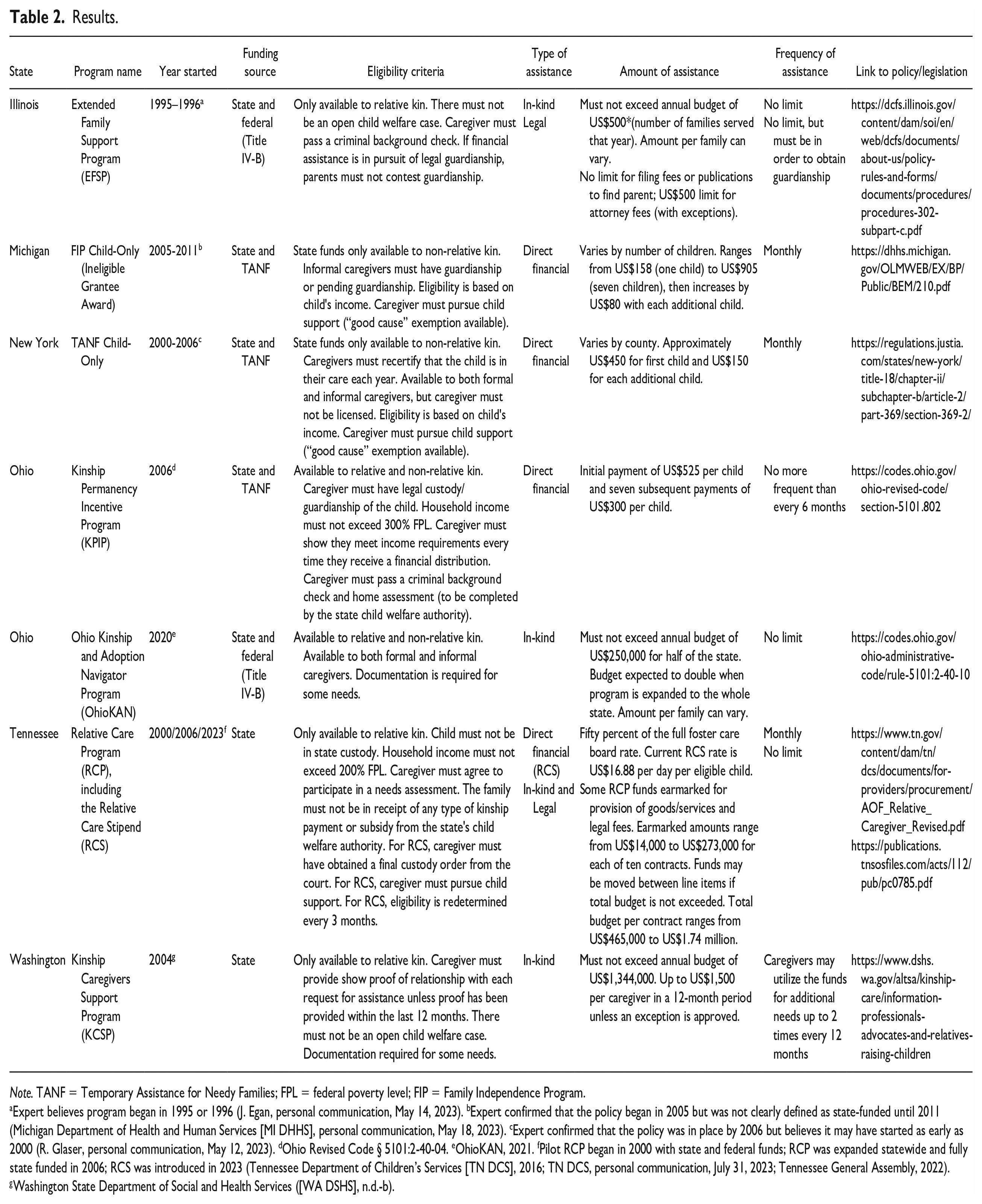
Note. TANF = Temporary Assistance for Needy Families; FPL = federal poverty level; FIP = Family Independence Program.
Expert believes program began in 1995 or 1996 (J. Egan, personal communication, May 14, 2023). bExpert confirmed that the policy began in 2005 but was not clearly defined as state-funded until 2011 (Michigan Department of Health and Human Services [MI DHHS], personal communication, May 18, 2023). cExpert confirmed that the policy was in place by 2006 but believes it may have started as early as 2000 (R. Glaser, personal communication, May 12, 2023). dOhio Revised Code § 5101:2-40-04. eOhioKAN, 2021. fPilot RCP began in 2000 with state and federal funds; RCP was expanded statewide and fully state funded in 2006; RCS was introduced in 2023 (Tennessee Department of Children’s Services [TN DCS], 2016; TN DCS, personal communication, July 31, 2023; Tennessee General Assembly, 2022). gWashington State Department of Social and Health Services ([WA DSHS], n.d.-b).
Although some experts were not able to provide sufficient information to make a determination, five of the initial states contacted confirmed that they did not have any programs that met the inclusion criteria: Florida, Georgia, Iowa, Nevada, and Texas.
Expert Description
For the six states with programs that met the inclusion criteria, with the exception of New York, all experts interviewed were program staff at the department in their state overseeing child welfare policy administration. At least one staff member interviewed from each state worked directly on the kinship programs described in this article, with position titles including program manager, program coordinator, program administrator, program analyst, and project manager. The expert interviewed for New York is the director of the state’s Kinship Navigator program. Although not a state employee, she has worked with the program for over 15 years to help direct kinship caregivers to resources for support and financial assistance in New York.
Quantitative Variables
In line with Miller (2004)’s suggestions, both socioeconomic and political variables were included in the analysis. The following socioeconomic variables were chosen:
State Benefit Amount per Month for Caregiver With One Child
Programs included in this analysis varied in how much money was allocated per caregiver for one child. To compare the states, a monthly benefit amount for one child was calculated for each state program which reported a maximum amount allocated per caregiver (all except OhioKAN and Tennessee’s RCP in-kind & legal supports reported this information). Some programs provided a maximum daily or annual rate, which was converted to a monthly rate equivalent. The initial payment for Ohio KPIP differs from subsequent payments, so all were averaged and then converted from biannual to obtain a monthly rate equivalent.
Maximum TANF Amount for Single Parent With One Child
Indicates the maximum monthly benefit amount a single parent with one child can receive in 2023 dollars (Falk & Landers, 2023).
Percent of Families Receiving TANF
The number of families receiving TANF in a given state (Falk & Landers, 2023) divided by the total number of families in that state (U.S. Census Bureau, 2021d).
Household Income
The average yearly household income by state (U.S. Census Bureau, 2021e).
The following political variables were chosen:
Governor Party
Given the small sample size of states, we chose to analyze governor party instead of legislative party control, as legislative party control is a multi-level variable (both red, both blue, or split control). Governor party is a binary categorical variable that indicates whether the state’s governor was a Democrat or Republican when the state benefit policy was adopted.
Populace Ideology
We analyzed the median rating of political ideology in the state population from 1988 to 1992, published by Groffman et al., in 1999, which is the only freely available National Election Survey data. The policies included in the quantitative analysis were adopted between 1995 and 2006, meaning the ideology data were collected at most 15 years before policy adoption. Entries represent median answers to an ideological self-report question on a 7-point scale (1 = very liberal and 7 = very conservative). The scale items were: Strong Democrat, Weak Democrat, Independent-Democrat, Independent-Independent, Independent-Republican, Weak Republican, Strong Republican.
Quantitative Analysis
The purpose of the quantitative analysis was to answer RQ2.
Political ideology: Among states that confirmed they had state supplemental benefits for informal caregivers, a Welch’s two-tailed t-test was conducted to assess whether the kinship benefit amount was significantly different in states with Republican versus Democratic governors. Welch’s t-test was used because the variables’ variances were not equivalent. A two-tailed independent samples t-test was conducted to assess whether the mean populace ideology ratings in states that had supplemental benefits were more or less liberal than in states that confirmed they did not have such benefits.
Benefit amount: In states that confirmed they had state benefits for informal caregivers, a two-tailed independent samples t-test was conducted to assess whether the maximum amount offered to a single adult with one child through TANF was significantly different than the supplemental state benefit. A two-tailed independent samples t-test was also conducted to compare the maximum TANF benefit amount in states that had supplemental benefits to states that confirmed they did not have such benefits. A linear regression was conducted to see whether the amount of TANF offered predicted how much a state offered in state supplemental benefits. Finally, a two-tailed independent samples t-test was conducted to see whether there was a difference in the percent of the state population receiving TANF among states that did and did not have benefits. For all results, significance is reported at the 1%, 5%, and 10% level.
Results: RQ1
The authors identified seven programs in six states that provide state-funded financial support to informal kinship caregivers: Illinois offers the Extended Family Support Program (EFSP), which uses a mix of state and Title IV-B funding (J. Egan, personal communication, April 21, 2023). Ohio provides the Ohio Kinship and Adoption Navigator Program (OhioKAN), which uses state and Title IV-B funding, and the Kinship Permanency Incentive Program (KPIP), which uses state and TANF funding (Ohio Department of Job and Family Services [OH JFS], personal communication, April 17, 2023).
Every state provides federal TANF-funded Child-Only grants, but states differ in whether these federal grants are available to non-relative kin. Michigan and New York restrict federal TANF Child-Only grants to relative kin (in Michigan, TANF is called the Family Independence Program or FIP). For non-relative kin, both states provide state-funded Child-Only grants as an alternative (Johnson, 2021; Michigan Department of Health and Human Services [MI DHHS], personal communication, May 17, 2023; R. Glaser, personal communication, May 10, 2023).
Tennessee offers a state-funded Relative Care Stipend (RCS) as part of their state-funded Relative Care Program (RCP) (Tennessee General Assembly, 2022). Finally, Washington uses state funding to provide its Kinship Caregivers Support Program (KCSP) (Washington State Department of Social and Health Services [WA DSHS], n.d.-a; Washington State Legislature, 2021). Each program is summarized below, including the type, amount, and frequency of financial assistance and any eligibility criteria. See Table 2.
Washington also sets aside state funds for seven tribal nations in the state to run their own Tribal Navigator Programs. Each tribe receives US$50,000–US$58,000 per year for the program, up to 25% of which can be used for goods or services for kinship families (R. Alber, personal communication, July 21, 2023). As these programs are administered by sovereign governments, the authors do not include them in our analysis of the results, but this funding is discussed further in the “Implications for Practice” section. None of the other five states with programs that met our inclusion criteria reported this type of funding.
Type, Amount, and Frequency of Financial Assistance
Direct Financial Payments
Four states provide direct, regular financial payments to caregivers: Michigan, New York, Tennessee, and Ohio. Michigan and New York both provide monthly stipends through state-funded Child-Only grants. In New York, this amount is roughly US$430 for the first child and US$130 for each additional child, based on the “standard of need” in each county (Johnson, 2021; R. Glaser, personal communication, May 10, 2023). In Michigan, the amount of the stipend varies depending on the number of children—for instance, a caregiver of one child would receive US$158 per month, while a caregiver of three children would receive US$420 (MI DHHS, 2008).
Tennessee also provides a monthly stipend through its RCS. The payment is calculated to equal “fifty percent of the full foster care board rate for the care of the child(ren)” (Tennessee Department of Children’s Services [TN DCS], 2022). The current stipend is US$16.88 per day per eligible child (TN DCS, personal communication, July 31, 2023).
For Ohio KPIP, caregivers receive up to eight total payments, which can be no more frequent than every 6 months but may be less frequent—if, for instance, a caregiver has varying income, they can wait longer to meet the income requirement. Distribution amounts vary but are currently set at an initial payment of US$525 per child and subsequent payments of US$300 per child (Ohio Department of Job and Family Services [OH JFS], n.d.; OH JFS, personal communication, April 17, 2023).
In-Kind Support
In addition to connecting caregivers with services and resources, Illinois’s EFSP, OhioKAN, Tennessee’s RCP, and Washington’s KCSP all provide funds to purchase specific items or services to help meet the needs of children in informal care. For instance, these funds may be used for rent, utilities, or a new bed or clothing for a child. Each of these programs allows for some flexibility in how much a caregiver receives. For Illinois’s EFSP, the program’s annual budget is US$500 multiplied by the total number of families served, but the amount per individual family varies (J. Egan, personal communication, April 21, 2023). OhioKAN’s annual budget for financial assistance is US$250,000, and though there is no set limit per caregiver, particularly high requests must be approved by the director. OhioKAN is currently at full implementation in only half the state, and once the program expands, the budget is expected to double (OH JFS, personal communication, April 17, 2023). Tennessee earmarks some of its RCP funds to each provider for “specific assistance to individuals,” including the provision of goods and services. The amounts for this line item are based on requests by the providers and so vary, but range from US$14,000 to US$273,000 across 10 contracts. However, as providers are free to move funds between line items, this range may not be an accurate representation of the amount spent on in-kind support in Tennessee (TN DCS, personal communication, August 3, 2023). Washington’s annual budget for KCSP is US$1,344,000 (Washington State Legislature, 2021). For Washington’s KCSP, an exception must be approved if a caregiver’s needs exceed US$1,500 in a 12-month period (WA DSHS, 2022).
OhioKAN and Tennessee’s RCP do not limit the number of times a caregiver can request assistance, though staff do try to ensure that caregivers are not reliant on funds for ongoing needs (OH JFS, personal communication, April 17, 2023; TN DCS, personal communication, July 31, 2023). Washington’s KCSP specifies that “caregivers may utilize the funds for additional needs up to 2 times every 12 months” (WA DSHS, 2022).
Legal Support
Illinois’s EFSP also provides funds to assist caregivers in obtaining uncontested guardianship. Funds for attorney’s fees are limited to US$500 per case, though caregivers can seek approval to exceed that amount. There is no limit to funds for filing fees or publications to locate the parent (Illinois Department of Children and Family Services [IL DCFS], 2019; J. Egan, personal communication, April 21, 2023). The funds that Tennessee’s RCP earmarks for “specific assistance to individuals,” as described above, can also be used by providers to assist caregivers with legal fees in pursuit of permanency for a child (TN DCS, personal communication, July 31, 2023).
Eligibility Criteria
Relationship
States in this study differ in whether programs are available only to kin related by blood, marriage, or adoption, or whether programs are also available to “fictive” or “non-relative” kin. Fictive or non-relative kin are typically those with a family-like attachment to the child. Illinois’s EFSP, Tennessee’s RCP (including RCS), and Washington’s KCSP are only available to relative kin (IL DCFS, 2019; TN DCS, 2022; WA DSHS, 2022). In Michigan and New York, both relative and non-relative kin can access Child-Only grants, but only non-relative kin are paid through state funds (Johnson, 2021; MI DHHS, 2017). OhioKAN and Ohio’s KPIP are available to both relative and non-relative kin (Ohio Revised Code § 5101.85).
Child Welfare Involvement
All programs in this study are open to informal caregivers, but they vary on whether they are also open to formal caregivers. For instance, to be eligible for Illinois’s EFSP or Washington’s KCSP, families must not have an open child welfare case (R. Alber, personal communication, May 10, 2023; IL DCFS, 2019; WA DSHS, 2022). In Tennessee, the child must not be in state custody to qualify for RCP (including RCS) (TN DCS, 2022).
Legal Custody or Guardianship
Three programs in this study require that caregivers have legal custody or guardianship of the child in their care. Ohio’s KPIP provides payments only for caregivers who have already obtained legal custody or guardianship (Ohio Revised Code § 5101.802). Michigan’s state-funded Child-Only grants require that non-relative caregivers have guardianship or pending guardianship or that the child has been placed with the caregiver by the child welfare authority (MI DHHS, 2021). Although caregivers do not need legal custody or guardianship to participate in Tennessee’s umbrella RCP and so receive in-kind support, a caregiver must have a final custody order from the court to receive the stipend element of the program (RCS) (TN DCS, 2022).
Income Levels
To receive financial support, some states require that caregiver or household income be below a certain level. Ohio’s KPIP and Tennessee’s RCP (including RCS) both set maximum household incomes based on the federal poverty level (FPL): 300% FPL and 200% FPL, respectively (Ohio Revised Code § 5101.802; TN DCS, 2022). Caregivers must routinely show that they meet income requirements (OH JFS, personal communication, April 17, 2023; TN DCS, 2022). For state-funded Child-Only grants in Michigan and New York, as with federal TANF Child-Only, eligibility for the program is based only on the child’s income (Kinship Care Resource Center, n.d.; New York State Office of Children and Family Services [NYS OCFS], 2020). Three in-kind programs have no income requirements: Illinois’s EFSP, Washington’s KCSP, and OhioKAN (J. Egan, personal communication, April 21, 2023; OH JFS, personal communication, April 17, 2023; WA DSHS, 2022).
Pursuing Child Support
Three programs in this study require that caregivers pursue child support: Michigan’s and New York’s state-funded Child-Only grants and Tennessee’s RCS (MI DHHS, personal communication, May 22, 2023; NYS OCFS, 2020; TN DCS, 2022). Tennessee’s umbrella RCP does not require caregivers to pursue child support—only if they are seeking the stipend element of the program (RCS) (TN DCS, 2022). Illinois, Ohio, and Washington did not report a requirement to pursue child support for their programs. As with federal Child-Only TANF, Michigan and New York allow a “good cause” exemption if the caregiver believes that pursuing child support could endanger the caregiver or the child (MI DHHS, personal communication, May 22, 2023; NYS OCFS, 2020).
Background Checks and Assessments
States in this study have adopted varying eligibility requirements in addition to the above. For instance, caregivers must go through a criminal background check and a law enforcement screening to receive Illinois’s EFSP, while Tennessee’s RCP (including RCS) requires that caregivers take part in a needs assessment (J. Egan, personal communication, April 21, 2023; TN DCS, 2022). Ohio’s KPIP requires that the state’s child welfare authority complete an initial criminal background check and home assessment to determine eligibility. (OH JFS, n.d.; OH JFS, personal communication, April 17, 2023). Michigan, New York, Washington, and OhioKAN did not report any required background checks or assessments for their programs.
Results: RQ2
The authors used state socioeconomic and political characteristics to answer RQ2.
Political Ideology
States that were confirmed to have state-funded benefits had significantly more liberal populace ideology (M = 4.35, SD = 0.19) than states that confirmed they did not have such a benefit, M = 4.71, SD = 0.16, t(9) = 3.35, p = .009. See Table 3. Among states with benefits for informal kinship caregivers, states with Republican governors at the time of policy adoption (MI, OH, and IL) provided a smaller supplemental benefit amount (M = 97.7, SD = 53.7) than states with Democratic governors (M = 360.3, SD = 205.7), but the difference was not statistically significant, t(2) = −2.1, p = .17. See Table 4.
Populace Ideology in States With and Without State Benefits
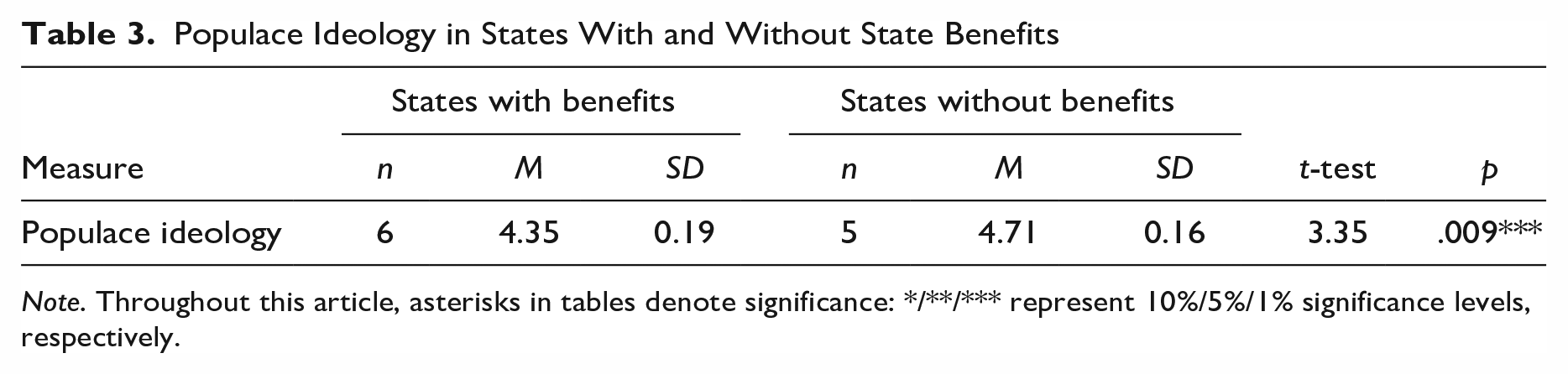
Note. Throughout this article, asterisks in tables denote significance: */**/*** represent 10%/5%/1% significance levels, respectively.
Average State Supplemental Benefit Amount by Governor Party.

Comparison With Maximum TANF Grant Amount
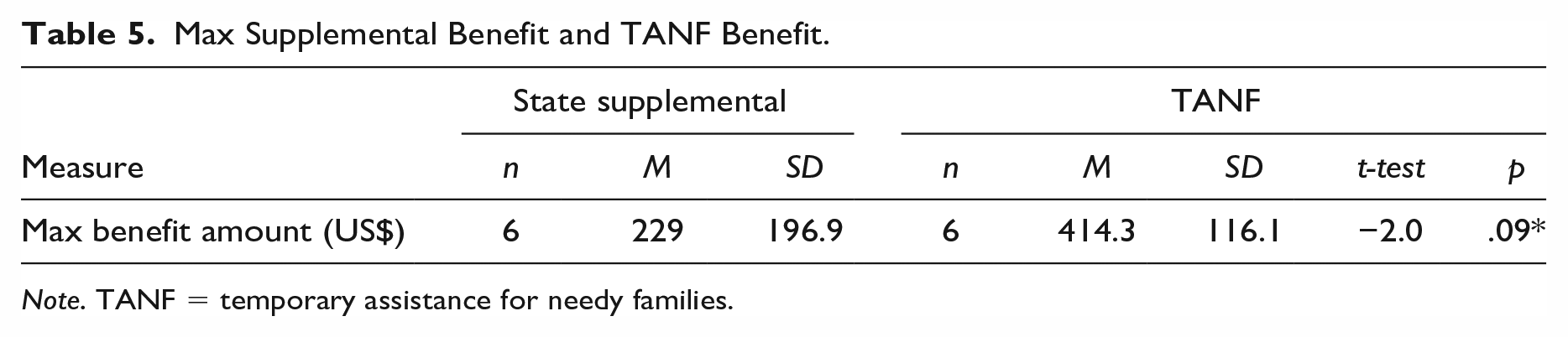
In states that confirmed they had state benefits for informal caregivers, the state benefit amount was lower (M = 229, SD = 196.9) than the maximum TANF benefit for the equivalent family type in those states (M = 414.3, SD = 116.1), but this result was only significant at the 10% level, t(10) = −2.0, p = .09. See Table 5. There was no significant relationship between the state benefit amount and the maximum TANF benefit in each state, R2 = .05, F(1, 5) = 0.2, p = .61. See Table 6.
Max Supplemental Benefit and TANF Benefit.
Note. TANF = temporary assistance for needy families.
Relationship Between Max Kinship Benefit and Max TANF Amount.

Note. CI = confidence interval.
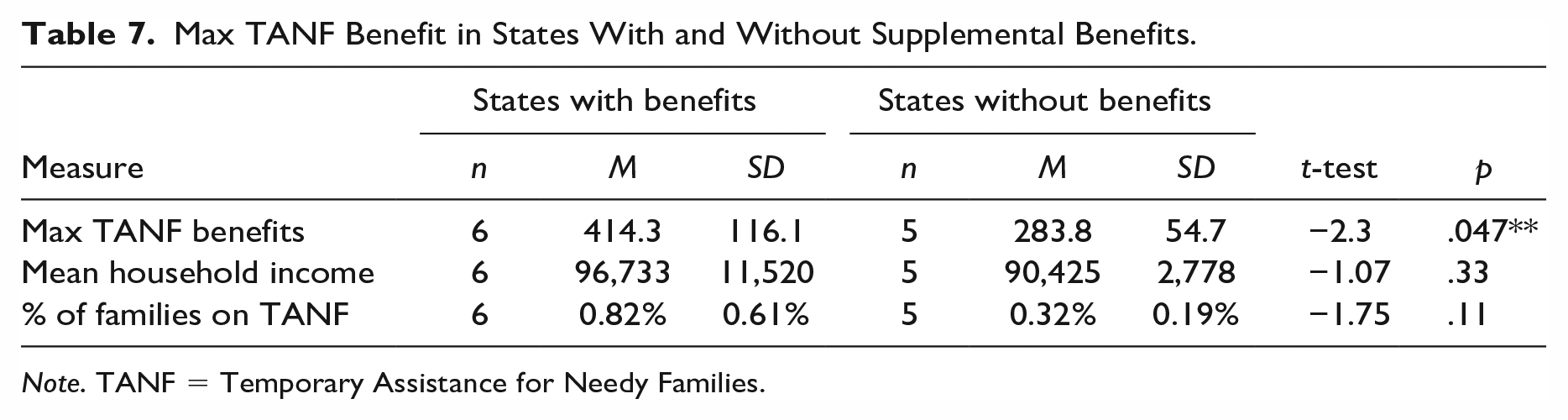
States that were confirmed to have supplemental benefits had significantly higher maximum TANF benefits (M = 414.3, SD = 116.1) than states that did not have supplemental benefits for caregivers, M = 283.8, SD = 54.7, t(9) = −2.3, p = .047. Although states without supplemental benefits had slightly lower mean household incomes (M = 90,425, SD = 2,778) than states with benefits (M = 96,733, SD = 11,520), the difference was not statistically significant, t(5) = −1.07, p = .33. States that had supplemental benefits also had a larger proportion of families receiving TANF (M = 0.82%, SD = 0.61%) than states which did not have supplemental benefits, but the difference was not statistically significant, M = 0.32%, SD = 0.19%, t(9) = −1.75, p = .11. See Table 7.
Max TANF Benefit in States With and Without Supplemental Benefits.
Note. TANF = Temporary Assistance for Needy Families.
Discussion
Our results are consistent with literature regarding the impact of political characteristics on policy adoption and innovation but are the first to examine this impact on benefits for informal caregivers. For example, our quantitative analysis indicates that states with more liberal populaces are more likely to provide state-funded financial assistance to informal caregivers (significant at the 1% level). Although Ma (2017) did not find significant correlation between liberal citizen ideology and policy innovation across states, as we did, he did find a correlation within states across time. Research also suggests that elected officials are more likely to adopt policies that are broadly favored by their citizens, which strengthens the rationale behind our finding in that liberal citizen ideology may encourage innovation and “creative ideas and practices” in policy (Hogan, 2008; Ma, 2017, p. 120). Relatedly, the state-funded benefit amounts in our results were higher in states with Democratic governors than in states with Republican governors at the time of program creation, although this finding was not statistically significant. This accords with other studies and literature reviews that have found significant positive correlation between liberal government ideology and policy adoption or innovation (Berry et al., 2015; Boehmke & Skinner, 2012; Ma, 2017). Both of these results can be explained by a long-held theory in social policy research, explained by Davies and Worden (2009), that welfare policies are based on the values of policymakers and constituents and that they “construct rules about who deserves public assistance” (p. 196). States with policymakers and constituents of different ideologies might therefore hold different values regarding who deserves assistance, and how much. In this instance, this rationale suggests that liberal populaces and governments consider more people deserving of more assistance, which applies to informal kinship caregivers as well.
States with supplemental benefits in our study also report higher maximum TANF benefits (significant at the 5% level) and larger proportions of families receiving TANF (not significant, p = .11), suggesting that federal benefits are more freely distributed by those states. We theorize several reasons this could be. First, it could be a further indirect effect of political ideology as described by Davies and Worden (2009): If liberal constituents and governments consider more people deserving of more assistance, it follows that states with those characteristics would set higher benefit levels for TANF as well as for state-funded assistance. It also follows that those states would make those benefits more accessible so that more families would be able to receive those benefits. Second, these results could suggest that states providing supplemental benefits face greater need than states that do not: If informal caregivers are less in need of financial assistance in a particular state, fewer families would use TANF, TANF benefit levels could be lower and still meet need, and the state would have little incentive to provide state supplemental benefits. The authors find this explanation uncompelling given prior research and demonstrations of need as described in § Kinship Caregivers’ Financial Needs (Albert, 2000; Davies & Worden, 2009; Tweedie, 1994). Third, it could be that states providing higher TANF benefits and state supplemental funding to more individuals are wealthier, and so able to divert more resources to welfare (Koven & Mausolff, 2002; Tweedie, 1994). Although our comparison of mean household income in states with and without supplemental benefits was not statistically significant, states without benefits did have slightly lower incomes. We propose that both the first and third rationales are likely explanations for these findings.
Overall, given our small sample size, the significance levels of our findings are remarkable. They are in accordance with the underlying assumption of comparative state policy theory that economic and political factors can greatly influence public policy. In particular, they suggest that state welfare policies for informal kinship caregivers are strongly impacted by citizen ideology and by pre-existing federal benefits for those same caregivers. Implications for policy and practice, based on results for both of our research questions, are discussed below.
Implications for Practice
The number of children in informal kinship care far exceeds the number of children in foster care. Informal care arrangements are critical, not only for children in care but also for society. A robust body of research shows that kinship caregivers are more likely than the general population to need financial support (Ehrle & Geen, 2002; Gleeson et al., 2009; Lee et al., 2016). Despite this, few states report any financial support for informal caregivers. Although this study was not a comprehensive state-by-state review, the states we contacted were those identified as most likely to have programs meeting our criteria. Of those states we interviewed, fewer than half reported state-funded financial assistance programs for informal caregivers. For social workers working in state policy, it is critical to ensure that informal caregivers have equitable access to sufficient financial assistance programs. Conclusions and recommendations are below.
Program Options
For states seeking to implement or improve supports for informal caregivers, the programs described in this study provide a variety of policy options to choose from. Direct financial payments allow the most flexibility and agency for caregivers, and programs in our study varied in payment amount and frequency (monthly to biannually). In-kind support offers less flexibility but may be a more politically feasible way to provide relief for caregivers’ pressing needs. One benefit of these programs is that the amount of funding is adaptable to a family’s unique situation—there is no one set amount. In-kind programs can cover a security deposit for a new apartment, for example, if a caregiver finds themselves supporting more children than space allows.
In our analysis, we found no significant relationship between the state benefit amount and the maximum TANF benefit in each state—although state benefits were consistently lower than TANF benefits (significant at the 10% level). This suggests that state benefit amounts may not be reflective of actual caregiver need. States should consider implementing more rigorous metrics to determine benefits for informal caregivers, as these amounts vary significantly across our sample. Although our sample size was small, this conclusion is consistent with our qualitative results, where few states reported benefit amounts that were tied to a standard of need, pre-existing federal benefits, or pre-existing state benefits for formal families. Tennessee’s RCS may provide a model for a program that is determined by a metric: Informal families receive a stipend that is equal to half the foster care board rate received by formal families. Even this is not ideal, however: the closer informal caregiver benefits are to formal caregiver benefits, the more equitable financial assistance for informal caregivers will be.
Transparency
Formal kinship caregivers have guaranteed access to a child welfare caseworker who can ensure they are receiving all of the benefits and services they are eligible for, including respite care, child care subsidies, and cash payments (Children’s Bureau, 2019; National Conference of State Legislatures, 2019), but informal caregivers do not always receive this guidance through a complex and convoluted system. Much of the information in this study was obtained through personal interviews or from legislative or administrative policy sources. States should ensure that these are not the only means by which individuals can learn about their programs and the associated eligibility criteria. Transparent, easy to find, publicly facing webpages as well as flyers, brochures, and kinship navigator resources are vital to ensure equitable access to benefits that caregivers are eligible for.
Relatedly, there is currently no requirement that states collect or report data on whether caregivers are formal or informal. This makes it exceedingly difficult to track trends, barriers, and policy or program effects across states. Greater transparency would also assist researchers in the future as they undertake further comprehensive reviews of kinship care.
Strict Eligibility Criteria Can Create Barriers to Access
The programs detailed in this study provide vital support to informal caregivers and we encourage states to emulate them. However, certain elements may prevent caregivers from obtaining assistance. We recommend that state policymakers avoid criteria that restrict eligibility on the basis of legal custody or guardianship, income, child support, background checks, or assessments.
Legal Custody or Guardianship
Three programs in this study require caregivers to obtain legal custody or guardianship. However, the process of obtaining legal custody or guardianship through the court can be burdensome and time-consuming (Children’s Bureau, 2018; Shanahan & Carpenter, 2019). In addition, the process often involves scrutiny by the court into the caregiver’s life, home, and relationships (Children’s Bureau, 2018). Many caregivers may be wary of sharing personal information (Beltran, 2014). Caregivers who are hesitant to take on the burdens associated with seeking legal custody or guardianship will not be able to access this vital financial assistance.
Income Levels
State policymakers may also be tempted to base eligibility on the income of the caregiver, as two programs in this study do. However, rather than preventing abuse of the system by those with adequate means, this criterion often reduces the number of eligible caregivers who seek out the program. Caregivers may be unwilling to submit to scrutiny of their financial status and the stigma that can accompany proving to a worker that they deserve the aid (Stuber & Schlesinger, 2006). For example, when Washington started including income as an eligibility requirement for TANF Child-Only in 2011, over 1,500 children across the state lost access to those grants. Typically, this was not because caregivers were ineligible, but because caregivers did not want to share their financial information (Beltran, 2014). By including income eligibility criteria, states risk excluding many of the caregivers they are trying to serve.
Pursuing Child Support
As discussed above, the federal government requires that TANF Child-Only grant recipients seek child support. Three states in this study have incorporated this into their programs as well. This is another barrier for many caregivers, who may fear that parents will retaliate against them or the child if they allow the state to pursue child support (Beltran, 2014). If state policymakers opt to include pursuing child support as an eligibility criterion, a “good cause” exemption should be widely advertised, clearly defined, and involve few obstacles (Beltran, 2014).
Background Checks and Assessments
Several programs in this study have instituted background checks, law enforcement screenings, or home assessments for applicants. Many kinship caregivers are wary of extensive surveillance and scrutiny by the government. Background checks often create undue barriers for kinship caregivers who are willing to take in children that may otherwise struggle to be placed with foster parents (Lewis, 2017). In addition, these requirements disproportionately affect caregivers of color. Racial bias is pervasive throughout the carceral and child welfare systems (Devine & Caughlin, 2014). As a result, caregivers of color are overrepresented in these systems and may be less likely to pass background checks and home assessments (Merkel-Holguin et al., 2022). In addition to bias, racial income disparities can make it difficult for caregivers of color to meet assessment criteria without the financial assistance to which they are applying. Caregivers of color may be even more hesitant to pursue programs with these criteria in place due to the fear they may lose their kinship children if they do not pass the background check. Given numerous concerns, the authors advise state policymakers not to make eligibility for benefits contingent upon passing a background check.
State Support of Tribal Right to Self-Determination
Only one state in our results provides funding for tribal nations to administer their own programs supplying financial assistance to informal caregivers. However, it is critical that tribal nations have control over their own finances and programs, particularly as regards the field of foster and kinship care. For more than a century, states were complicit in the removal of Indian children and the erosion of tribal nations’ right to self-determination, first through mandated boarding schools and then through the foster care system (Broadhead et al., 1976; Haag, 2007). By the mid-1970s, it was estimated that 25-35% of all Indian children were “being raised by non-Indians in homes or institutions” (Broadhead et al., 1976, p. 79). This removal has had devastating consequences for Indian children and tribes. Research shows that the loss of connections with family, culture, and community negatively impacts the well-being of children, while maintaining those connections is a protective factor against substance use and mental health concerns, among others (Partners for Our Children, 2019, 2021)
In response to these incredibly high rates of removal and negative outcomes, Congress passed the Indian Child Welfare Act in 1978 (ICWA, 1978), reinforcing tribes’ sovereignty and the importance of children remaining with their tribes: [T]he States, exercising their recognized jurisdiction over Indian child custody proceedings through administrative and judicial bodies, have often failed to recognize the essential tribal relations of Indian people and the cultural and social standards prevailing in Indian communities and families (25 U.S.C. § 1901(5)).
Given this historical and enduring erosion of tribal self-determination by states, providing state funds for tribal nations to administer their own caregiver programs and provide financial assistance as they see fit is an important step in promoting equity. We recommend that state policymakers consider budgeting state funds for this purpose.
Proposals for Implementation
The authors propose several strategies that advocates can consider as they strive to successfully implement supplemental support for caregivers. To build a foundation ripe for passage of a financial support bill, states can pass legislation and administrative policy that prioritizes support for kinship caregivers, even if the foundational policies do not have dollars attached. For example, Washington passed a series of bills prior to the adoption of KCSP, such as a preference for the state child welfare authority to place children with relatives (WA DSHS, n.d.-a).
In addition, advocates should not underestimate the power of grassroots advocacy from organized kinship caregivers (Christens & Speer, 2015). In Washington, kinship support group leaders organized caregivers to testify before the legislature, influencing the adoption of a series of supportive kinship legislation (R. Alber, personal communication, May 10, 2023).
Finally, states should consider piloting programs in a smaller area before expanding statewide to ensure the program is embedded into culture and practice, which can build institutional support for expansion (Checkland et al., 2021). Both Tennessee and OhioKAN implemented their programs in smaller areas before expansion. This may also offer helpful precedent for states that want to lower the administrative costs associated with implementation.
Limitations
Limitations of this comparative policy analysis include the authors’ inability to conduct a comprehensive state-by-state review due to time constraints. The authors relied on contacts identified by the Children’s Bureau and national kinship care experts they were connected to through their past work, and therefore our results may be biased and not fully inclusive or representative of the state supports that exist for informal kinship caregivers across the United States. Relatedly, not all contacts that we identified were responsive or able to meet within the allocated observation time period for this inquiry, which may have resulted in bias as well. Given the small sample size, results should be interpreted with caution as they may not be generalizable to all states. In addition, while much of the information discussed in this article was verified in statute and program materials, some program information was not available in writing online. In these cases, the authors relied upon the understanding of the program staff we were able to connect with. Furthermore, when hypothesizing about the relationship between state characteristics and program implementation, we cannot be confident in our causal theories about whether the identified factors influenced program adoption.
The literature would benefit from future studies that conduct state-by-state reviews of both state-funded and federally funded financial assistance for informal caregivers. Analyses of factors that impact eligibility criteria across states would also be informative, particularly an examination of the racial makeup of state populations. Finally, beneficial future research could examine state characteristics over time and how changes in those characteristics may have impacted the adoption and diffusion of programs for informal caregivers.
Conclusion
This research informs states as they seek to develop laws and policies to provide supplemental financial support to kinship caregivers. State funding is an important source of financial assistance for financially vulnerable kinship families. We applaud the six states in our study who have developed state-funded programs for informal caregivers and encourage other states to do the same, with thoughtfulness around eligibility, benefit amount, and program transparency.
Footnotes
Acknowledgements
The authors thank the following individuals for providing the valuable insights included in this study: Rosalyn Alber, Program Manager at Washington State Department of Social & Health Services; John Egan, Program Administrator at the Illinois Department of Children & Family Services; Rae Glaser, Director of New York State Kinship Navigator; staff at the Grandfamilies & Kinship Support Network: A National Technical Assistance Center at Generations United; and program staff at the Michigan Department of Health & Human Services, the Ohio Department of Job & Family Services and the Tennessee Department of Children’s Services. They are also grateful to individuals in the following states for taking the time to meet with them: Colorado, Georgia, Iowa, Louisiana, Nevada, Texas, and Vermont.
Disposition editors: Angelique Day and Cristina Mogro-Wilson
Declaration of Conflicting Interests
The author(s) declared no potential conflicts of interest with respect to the research, authorship, and/or publication of this article.
Funding
The author(s) received no financial support for the research, authorship, and/or publication of this article.
