




Abstract
Kinship caregiving, especially the phenomenon of grandparents providing sole care for their grandchildren, occurs at a higher rate in American Indian/Alaskan Native (AI/AN) communities than in any other demographic group. In 2017, the State of Washington allocated resources to seven tribes to build and implement culturally relevant kinship navigation programs. Survey results (N = 70) of AI/AN kinship caregivers in the state indicate that caregiver needs, service access, and utilization look different in tribal communities as compared with research conducted in nontribal communities. Specifically, AI/AN caregivers are more likely to report challenges with obtaining housing, transportation, and working with their kinship children’s school than nontribal caregivers. Focus groups with tribal kinship navigators (N = 9) from five of these seven programs describe the greatest challenges they’ve experienced with program implementation including program eligibility, what kinship caregivers most often ask for assistance with, what system-level disparities that exist between tribal and nontribal kinship navigator programs and provide suggestions for program improvement.
Keywords
Introduction: Historical Context of Kinship Care in AI/AN Families
Across the United States, an increasing number of grandparents are the primary caregivers for their grandchildren, a phenomenon that has been termed “grandfamilies” (Cross, 2005). Specifically, more than 1 in 10 grandparents have a grandchild living with them, according to AARP’s (2019) 2018 Grandparents Today National Survey. In about one-third of those living situations, a grandparent is the primary caregiver. The proportion of AI/AN grandfamilies is nearly three times higher than other racial and ethnic groups (Mutchler et al., 2007). In Washington State, 41% of AI/AN grandfamilies report grandparents as responsible for raising their grandchildren with no parent present, compared with 16% for the overall population (American Community Survey, 2020). A significant number of grandmothers are the primary care providers (90%) than grandfathers in AI/AN grandfamilies (Cross et al., 2010; Fuller-Thomson & Minkler, 2005).
A cultural tradition that has long been a part of AI/AN communities is the role of the grandparent in teaching skills, traditions, and holds a strong role in the care and raising of their grandchildren (Lewis et al., 2018). As elders, AI/AN grandparents hold the role of respected knowledge keepers, and their day-to-day interaction with grandchildren has been and continues to be an essential method of teaching cultural values and skills from generation to generation (Day, 2007; Fowler, 1990). The importance of gender in kinship relationships has been stressed by other scholars with disproportionate representation of grandmothers as primary caregivers and as extensive secondary caregivers to their grandchildren (Luo et al., 2012). Grandmothers provide sole care for their grandchildren at a higher rate in AI/AN communities than in other demographic groups (Bailey et al., 2019). In AI/AN folklore, the role of the grandmother is a central figure in creation and serves as a source of spiritual guidance (Schweitzer, 1999). The grandmother’s connection with her grandchild provides an important manifestation of cultural values in a way that differs from the European/Western understanding of a grandmother’s role (Waller, 2001). A child’s family, in AI/AN tradition, includes the involvement of extended relations such as cousins, aunts, uncles, and in addition to grandparents (Red Horse, 1997; Sahota, 2019). Historically, these extended family members acted as caregivers to children in a network of shared roles with parents. In addition, tribal members outside the strictly biological definition of blood relatives are called “cousin” or “auntie” as trusted parts of a child’s close family (Byers, 2010; Coleman et al., 2001). The extended definition of kinship is the foundation of community connection, the clanship system, and what it means to have a tribal identity (Sahlins, 2013).
Grandparents have a strong responsibility to educate their grandchildren in traditional cultural practices, tribal language, and value their role as knowledge keepers (Byers, 2010; Day, 2007; Fowler, 1990). Grandparents view their role as helping guide their grandchildren toward good behavior as a way to preserve the culture and positively benefit the community as a whole (Byers, 2010; Schweitzer, 1999). Grandparents, and specifically grandmothers, have a deeper cultural role as wisdom keepers that inspires them to see their actions and teaching as important to the whole community, along with their relationship with the grandchild (Cross et al., 2011; Robbins et al., 2005). Teaching appropriate behavior in a traditional cultural sense is also a task that grandparents regularly take on as part of their role. Grandparents teach traditional arts, food preparation, hunting, and other skills to transmit cultural knowledge (Lewis et al., 2018).
Traditionally, children were frequently sent to live with their grandparents for extended periods of time as part of their cultural learning process (Henderson et al., 2017). Reciprocally, the children’s presence provided a mutual benefit for the grandparents as they received assistance with tasks of daily living, experience caring connections, and a reduction in isolation (Bailey et al., 2019). Grandparents acting as primary caregivers view themselves as carrying out an expected and culturally valuable role (Roderick, 2011). They also express a sense of pride and empowerment in being able to protect their grandchildren from the involvement of governmental and/or private foster care systems, thereby disrupting current programs that may be seen as mirroring the AI/AN “child removal” policies of the past century (Carlos, 2020).
Networks of kinship care are more readily available to families living on or in proximity to the family’s tribal lands or AI/AN reservation (Mutchler et al., 2007). In addition to the traditional cultural role of grandparents caring for grandchildren, AI/AN young adults may leave the reservations to seek employment and/or educational opportunities which are often limited on tribal lands (Croy et al., 2009). Given the cultural value of kinship care networks for children, and the respected value of grandparent care, a parent’s choice to assign primary caregiving to a grandparent may be seen in a positive light in this cultural context (Coleman et al., 2001).
Formal Versus Informal Kinship Arrangements
Out-of-home care includes formal legal placements that require court involvement such as family foster care, treatment foster care, permanent guardianships, and adoption; it also includes informal care arrangements between a birth parent and caregiver for example, placing a child with a friend or relative for a period of time without court or child welfare agency involvement (such as a limited guardianship, power of attorney, or no legal relationship) (Child Welfare Information Gateway, 2022).
In terms of formal foster care, children of AI/AN ancestry are three times more likely to be placed in foster care than children of other cultural backgrounds in the United States (Grinnell-Davis et al., 2023; Puzzanchera et al., 2022). Nationally, the disproportionality index for AI/AN children in foster care is 2.72, the highest over-representation of children in foster care of any demographic group (National Center for Juvenile Justice, 2019). At 3.39, Washington State’s disproportionality index for AI/AN children in foster care is higher than the national rate (National Center for Juvenile Justice, 2019).
Many AI/AN children placed in foster care benefit from placements in relative homes. The Indian Child Welfare Act (ICWA) offers protections and support for children in formal care placements. Specifically, these protections include providing families with services that are remedial and rehabilitative in nature and focused on preventing the break-up of a family before removing children, or terminating parental rights after a removal occurs. In addition, families are eligible for active assistance from workers to achieve service pan goals, and following ICWA preferences, including placement with relatives when a child is court ordered into an out-of-home placement (Cross, 2006). ICWA does not apply to children in informal kinship care (National Indian Child Welfare Association, 2018). For those families willing to interact with the child welfare system, ICWA supports active efforts to keep AI/AN children with their families and connected to their culture and tribal communities. As noted above, a variety of factors influence AI/AN caregivers to be reluctant to interact with child welfare systems (Cross, 2005). Many AI/AN kinship caregivers could benefit from ICWA provisions, but there is a lack of information being disseminated about the law and how ICWA could be used to support children in kinship care. In one study, 22% of AIAN kinship caregivers reported they were not aware of ICWA, and 48% reported that it was not helpful to them (Cross, 2005). When ICWA was not identified as helpful, it was because it was circumvented, or the family was not eligible for services/protections under the ICWA (Cross, 2006). For the percentage of grandfamilies whom ICWA was helpful, they described that assistance was available to address barriers such as transportation, childcare, financial issues, and culturally appropriate services (National Indian Child Welfare Association, 2018).
Informal care arrangements do not afford relative caregivers the same level of protections and service options that more formal types of legal custody offer, and they are not included in foster care counts. In recent decades, an increasing number of children of all demographic groups are being cared for through informal care by nonparent relatives such as grandparents, uncles, or aunts (Cross, 2005). This type of informal kinship care is found at significantly higher rates among AI/AN families (U.S. Census Bureau, 2018).
The caregiving relationship remains informal in many AI/AN grandfamilies due to the complexities and stresses of the legal and court system surrounding the custody process (Cross et al., 2011; Lewis et al., 2018) The number of informal kinship caregiving among AI/AN grandfamilies is estimated to be nearly 10 times greater than formal out-of-home care (Day et al., 2020). Without legal custody, grandparents face other barriers to services such as enrolling children for Temporary Assistance for Needy Families (TANF) financial assistance, and/or enrolling children in school (Kelly, 2019). Complex reasons contribute to the decision whether to establish legal custody for the grandchild, not least of which is the stress that may be triggered by any involvement with the courts or government agencies as a reminder of historical trauma. Historical trauma is defined as 200 years of government-sanctioned genocidal actions and policies that have been implemented over time with the goal to destroy AI/AN culture and replace it with dominant Eurocentric worldviews of individualism, materialism, and capitalism (Craven, 2020; Walters et al., 2011). Parental absence may also be seen as temporary, such as relocation for education or employment opportunities, treatment for substance use, incarceration, or illness. If the primary caregiving role is temporary, a grandparent would have less interest in incurring the costs of legal custody or guardianship (Byers et al., 2017).
Understanding the type of legal arrangement in which children are being cared for by relatives is important as services and supports that are offered to kinship families are directly connected to the type of legal placements in which they are participants. Grandparents caring for grandchildren among the AI/AN communities face greater financial challenges compared with other racial/ethnic groups in the United States (Mutchler et al., 2007; U.S. Census Bureau, 2018). Twice as many of AI/AN grand family households report poverty level incomes as compared with grandfamilies of other racial/ethnic groups (Probst et al., 2004). One explanation for reports of greater financial challenges may be because a greater proportion of AI/AN grandfamilies are headed by single grandmothers when compared with the general population (Casper & Bianchi, 2001; Fuller-Thomson & Minkler, 2005; Mutchler et al., 2002). While grandmothers report a strengthened cultural connection in this caregiving and teaching role, at the same time, inequities and stresses are evident for these AI/AN kinship caregivers (Weaver & Brave Heart, 1999). Informal care arrangements in particular result in barriers preventing access to important supports and services such as medical care, education, and financial assistance. Barriers to services result in poorer outcomes for children and long-term problems for families and communities (Cross & Day, 2008).
Access to and Utilization of Services Among AI/AN Grandfamilies
Health and Mental Health Services
Access to medical, dental, and mental health services are limited on tribal reservations (Byers, 2010); transportation availability to access distant nontribal health services is a barrier for those living in rural areas, especially for people receiving low incomes (Bailey et al., 2019).
For children eligible for Medicaid and other services, a grandparent is prevented from enrolling the child if she or he does not have legal custody (Butts, 2005; Mooradian et al., 2007). In addition, tribal medical services are not available to children and grandchildren of enrolled tribal members if the children themselves are not enrolled members of the tribe. Each tribe establishes its own enrollment regulations, and it is not uncommon that an enrolled member is prohibited from enrollment of the child, for example, based on the concept of “blood quantum” (Bureau of Indian Affairs, 2022). As a result, grandparents are often not permitted to utilize tribal services for their grandchildren or would be required to pay for services (Cross et al., 2011).
Emotional health issues in AI/AN community members are higher than other demographic groups (Kwon & Saadabadi, 2022). Children in out-of-home care are at greater risk of emotional and mental health issues because of experiences of neglect or abuse (Kohler et al., 2015). Grandparents report lack of access to mental health services in rural and reservation areas for their grandchildren (Cross et al., 2011). Barriers to access include distance, transportation costs, and treatment costs. Untreated emotional health issues appear to correlate to the disproportionately high drop-out rates among AI/AN youth, and high rate of substance use disorder diagnoses among AI/AN young adult (18%) as compared with the general population (10%; Kwon & Saadabadi, 2022; Sarche & Spicer, 2008). Grandparents may have limited ability to recognize the mental health needs of, or treatment options for their grandchildren, and lack of access to regular health care services results in underdiagnosis of health conditions (Byers et al., 2017). For those children at risk of diagnoses such as fetal alcohol syndrome, appropriate treatments would be delayed due to inaccessible medical care (Dennis & Brewer, 2016).
The health of grandparents may also be a factor to consider in the care of grandchildren. In one study, 74% of grandparents in grandfamilies reported chronic medical conditions such as heart disease, diabetes, and arthritis (Mooradian et al., 2007). These health conditions may limit the grandparent’s ability to carry out daily activities related to caring for their grandchildren (Cross et al., 2010). The cost of medical services for grandchildren is a barrier for low-income AI/AN grandfamilies, leading to lower health outcomes for the children (Cross et al., 2011).
Early Childhood and School-Based Services
Grandmothers reported that access to respite care and childcare are lacking in rural or reservation settings (Byers, 2010; Dennis & Brewer, 2016). Given the disproportionately high rate of poverty among AIAN grandmothers, the cost of transportation to distant childcare providers and the cost of childcare fees are barriers to access of these services for the majority of grandfamilies (Child Welfare Information Gateway, 2021; Cross et al., 2010).
Grandparents face some barriers to enrolling grandchildren in school when there is an informal caregiving arrangement rather than legal custody or guardianship (Kelly et al., 2012). Sometimes, these barriers result in delays in children starting or continuing their studies at grade level. Grandparents express pride in children achieving good grades and enjoyment of their grandchildren’s participation in sports and other school-related activities (Lewis et al., 2018). Grandchildren in AI/AN grandfamilies show signs of struggling in school, for example, a higher proportion are not reading at grade level or are enrolled in special education programs, and there is a higher drop-out rate (Banks-Joseph & McCubbin, 2006; Hunt & Harrington, 2010). In nontribal schools, racial bias and teasing/bullying continue to cause stress for AI/AN children (Cross & Day, 2008). Supportive resources such as special education, tutoring, health checks, and career counseling appear to be lacking in tribal schools, contributing to disparities for AI/AN grandchildren (Manson, 2004).
School-based services appear to be less accessible to informal kinship caregivers. Grandparents reported being prohibited from enrolling their grandchild in school (Day & Cross, 2004) and experiences of being treated disrespectfully by social workers when seeking information about health or social service assistance for their grandchild (Mooradian et al., 2007). Social services provided through tribal schools may not be available to children who are not enrolled tribal members. Conversely, social services may not be available through public schools for children who are not formally under the legal custody of the grandparent (Cross, 2005). Grandparents report a need for legal assistance to interact with courts related to parent incarceration or to address the enrollment and child custody barriers to services such as education and medical care (Byers, 2010; Cross, 2005; Generations United, n.d.).
Housing Services
Housing and overcrowded housing is an issue for some AI/AN grandfamilies (Cross et al., 2011). Culturally, sharing housing with more than one generation of family members has traditional roots in AI/AN communities. The presence of aunts, uncles, or cousins can provide support for the grandparents and additional caregivers for the child (Cross et al., 2010). Child welfare policies, however, present barriers to shared households. Such policies create a disincentive for some grandparents to formalize caregiving through the court system (Generations United, n.d.). Complexities surround tribal housing as well. Grandparents who are enrolled tribal members are eligible for tribal housing or senior housing, but policies may differ for a nonenrolled grandchild (Mooradian et al., 2007).
Role of Historical Trauma in Service Access and Utilization
Historically, kinship networks were and continue to be a source of strength and resilience for AI/AN families in their survival of 200 years of genocidal actions and policies implemented with an overt goal to destroy AI/AN culture. Disregarding treaty agreements, federal actions have displaced AI/AN communities from their land, destroyed traditional food sources, prohibited, and criminalized spiritual practices, and forcibly removed children from their parents’ homes to send them to U.S. Indian boarding schools thousands of miles away from their homes (Thornton, 1987). Children who attended these boarding schools endured severe punishment for speaking their languages and experienced physical, emotional, and sexual abuse. Those who survived returned to their home reservations with emotional scars and barriers which made it difficult to reconnect with or understand their parents, relatives, and tribal communities (Unger, 1977).
The psychological injuries resulting from repeated experience of these assaults are referred to as historical trauma (Weaver & Brave Heart, 1999). The scars of these injuries continue to affect all generations referred to as intergenerational trauma (Cross & Kastelic, n.d.; Weaver & Brave Heart, 1999). Many of the harms experienced by AI/AN community involved interaction with governmental programs and agencies, including education and religious organization. Historic trauma continues to manifest in strong distrust of governmental programs, courts, and agencies that can be seen as a significant contributing factor to a variety of mental, behavioral, and physical health issues that manifest in the AI/AN community at higher rates than in other U.S. demographic groups (Cross et al., 2011).
Kinship Navigator Programs: A Solution to Service Access and Utilization Barriers
To assist kinship caregivers to overcome barriers to accessing services, many states established kinship navigator programs in the early 2000s (U.S. Department of Health & Human Services [USDHHS], Administration for Children and Families [ACF], Children’s Bureau, n.d.). The goal of these programs is to support kinship caregivers by connecting them to information, providing referrals to services, or actively assisting with the application process for benefits. Services vary depending on the program design and the needs identified in the respective states. Kinship navigator programs often include services such as support groups, training sessions, recreational activities, peer support, case management, respite care, outreach, utility or rent assistance, child supplies, and health care or tutoring referrals (Grills, 2015; Human Services Research Institute, 2018; United Way of California, 2016). To date, four kinship navigator programs have been identified by the Title IV-E Prevention Services Clearinghouse (2023) as evidence based (Ohio, Colorado, Nevada, and Arizona). Evaluations of these programs show increased factors contributing to stability for children and a reduction in factors contributing to stresses that disrupt care (Grills, 2015; LeCroy et al., 2015).
Washington State established a statewide kinship navigator program in 2005, following a successful pilot project conducted in Seattle and Yakima in 2004 (TriWest Group, 2005). Working at the county or tribal level, kinship navigators act as local liaisons who proactively provide information, referrals, advocacy, and education to kinship caregivers. The program directly addresses the complexities of service navigation and support by providing guidance to caregivers on difference services available to them in the communities in which they reside, who the providers are, the eligibility criteria and system procedures associated with service access (Aultman-Bettridge & Selby, 2012; TriWest Group, 2005). Assistance topics commonly include legal, financial, health care, and social services. For caregivers who are eligible, navigators help with applications for state and federal benefits (Day et al., 2020).
In 2017, the Washington State legislature established funding for tribal kinship navigator programs that have been operating out of 7 of the 29 Tribal Nation communities within Washington State (Alber et al., 2020). Members of the remaining 23 federally recognized tribes in Washington State (Washington State Governor’s Office of Indian Affairs, 2022) may access kinship navigator services through local county government programs (Alber et al., 2020). Federal funding for tribal run kinship navigator programs is currently only available to tribal nations with direct Title IV-E agreements with the Children’s Bureau. These funds first became available in 2018, and there are a total of 11 tribal nations that have received these funds (USDHHS, ACF, 2021).
Current Study
This study is designed to examine the unique contributing factors influencing kinship care in AI/AN communities across WA State and is the first known study to attempt to examine the impact of tribal kinship navigator programs since the program was first implemented in 2017. Based on larger study of survey data from 898 kinship caregivers of all race/ethnic demographic groups (of which 70% identified as grandparents) across Washington State, this study identifies areas in which AI/AN caregivers’ situations (N = 70) differ from other demographic groups and provides context for consideration in understanding why these differences exist. It also provides additional context of the barriers of service access and utilization by AI/AN kinship families from the perspective of kinship navigators who are responsible for implementing six of the seven tribal kinship navigator programs in WA State. This study design was selected as a strategy to understand whether the services provided by the kinship navigators are reflective of what kinship caregivers reported they needed on the surveys. Two primary research questions were answered as a focus of this mixed-methods study: Are there any differences in how AI/AN kinship caregivers describe their sources of support, challenges, and unmet needs as compared with their nontribal counterparts? In addition, how do navigators that run tribal kinship navigator programs describe the AI/AN caregivers that participate in their programs, what their unmet needs are, and how navigator programs could be improved to support these unmet needs.
Methods
This mixed-methods study uses primary survey data collection methods among caregivers and focus group methods with tribal kinship navigators to understand the resources available in their communities to support AI/AN kinship caregivers. Understanding the unique challenges and barriers to accessing and utilizing resources and supports in AI/AN communities is critical to the development and success of culturally relevant and culturally derived interventions that are well utilized in these communities.
Sample
Seventy AI/AN kinship caregivers who were currently caring for their relatives’ children in Washington State between November 2019 and May 2020 responded to the survey. These surveys were disseminated through one of three state administrative offices (the public child welfare agency, aging and long-term services, and the state economic services office responsible for the implementation of the child-only TANF 1 grant). Our sample of AI/AN caregivers was parenting an average of 2.4 children without a partner and in an informal placement arrangement without legal protections that if obtained, could increase their access to services. About 92% of the sample reported household incomes below the state average, which stood at US$77,006 in 2020 (U.S. Census Bureau, 2021). Additional descriptive information about these caregivers is provided in Table 1. In comparison with the full sample of kinship caregivers who participated in the larger study, AIAN caregivers are more likely to be caregiving alone (not have a marital partner) have lower incomes and were more likely to be parenting without a formal legal arrangement. AIAN caregivers did not differ from the larger sample based on age and number of children in the home (Day et al., 2020).
Kinship AI/AN Caregiver Demographics and Placement Type.
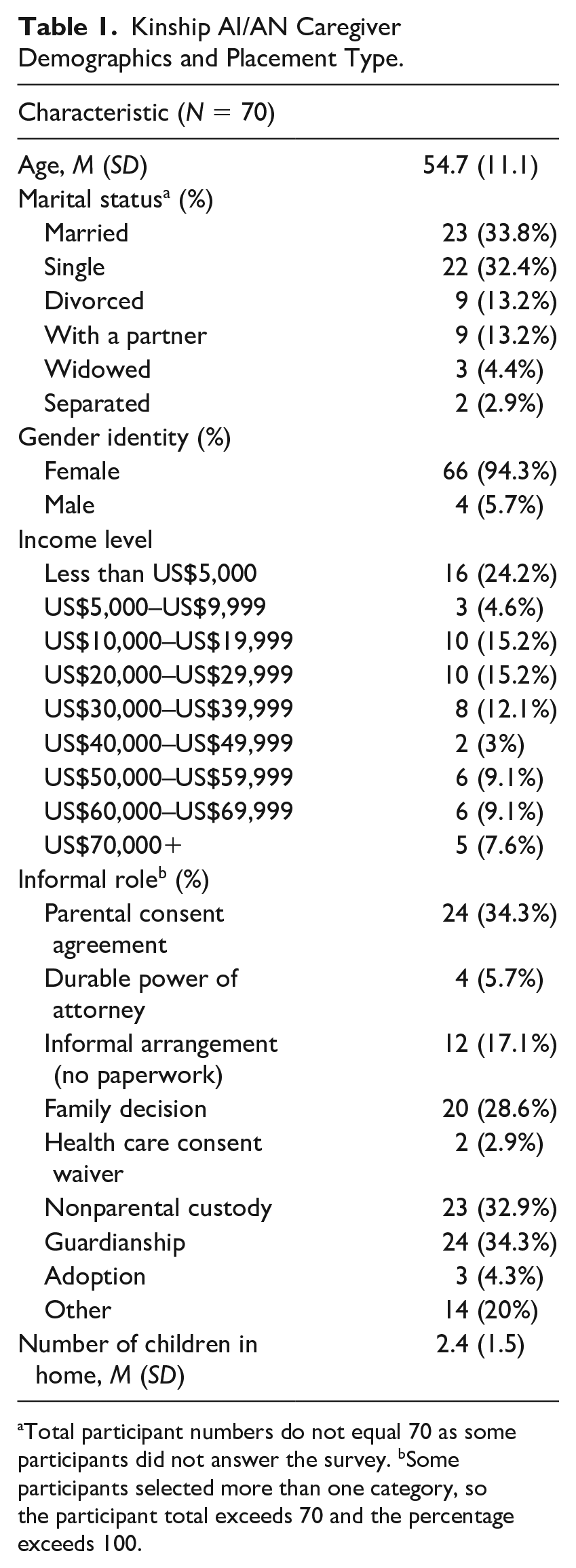
Total participant numbers do not equal 70 as some participants did not answer the survey. bSome participants selected more than one category, so the participant total exceeds 70 and the percentage exceeds 100.
Nine kinship navigators, 8 females and 1 male, representing six of the seven tribal kinship navigator programs in WA State participated in the kinship navigator focus group. This focus group was conducted in person at the state’s annual aging and long-term care statewide kinship navigator training conference in October of 2018. All the navigators were enrolled tribal members, but not necessarily members of the tribes in which they were employed to implement these tribal kinship navigator programs.
Procedures
Surveys were disseminated by mail by one of three state agencies to kinship caregivers who were actively receiving services by these agencies. Surveys could be completed in paper format and returned in a postage paid envelope provided or participants had the option to take the survey online through a link that was provided in the letter that accompanied the paper survey. The survey included a total of 29 total open- and closed-ended questions and had an average time of completion (based on results of the electronic surveys completed) of 15 minutes. Closed-ended questions on the survey were limited to demographics (caregiver age, race, gender, and marital status) and identification of unmet needs. A sample open-ended question included in the survey was There are a number of services, resources, laws, and policies that affect your ability to care for your children. What do you believe is the single most important thing that needs to change to help you and others in your situation?
Survey takers were offered a lottery incentive of a US$50 gift cards (given to 20 randomly selected participants).
Focus group participants self-selected into the focus group during a conference session that was offered during the state annual kinship navigator training conference. Participants received a US$25 gift card for compensation for their time. The focus group was 60 min in length and was conducted by one tribal and one nontribal researcher. The focus group was audio recorded and transcribed verbatim. This focus group and the survey protocols were reviewed and approved by the Washington State Internal Review Board (WSIRB).
Analysis
Survey data were analyzed using descriptive (frequencies, percentages, means, and standard deviations) and bivariate statistics (chi-squares and t-tests) using STATA 16.0 software (StataCorp Stata MP, 2023).
Focus group data were coded for themes using the phenomenological analytic process as defined by Moustakas (1994) by two independent coders. The primary focus of phenomenological analysis is to capture the essence of the meaning of the experience as described by the participants through a process of observing and describing the phenomena being studies (Giorgi, 2009). A thematic content analysis was conducted which uncovered emerging themes from the focus group transcript. Final themes were determined through a scheduled meeting between the two coders to reach consensus and focused on strength and depth of concepts as well as frequency of concepts identified in the transcript. Findings from the focus group were shared with the navigators and other tribal administrators of these programs to ensure the results correctly captured their worldview. Each theme identified in the results section is accompanied by a quote provided during the focus group to highlight a concrete example of how the theme is applicable to AI/AN kinship caregivers and how those experiences could be improved through the bolstering of these kinship navigator programs.
Results
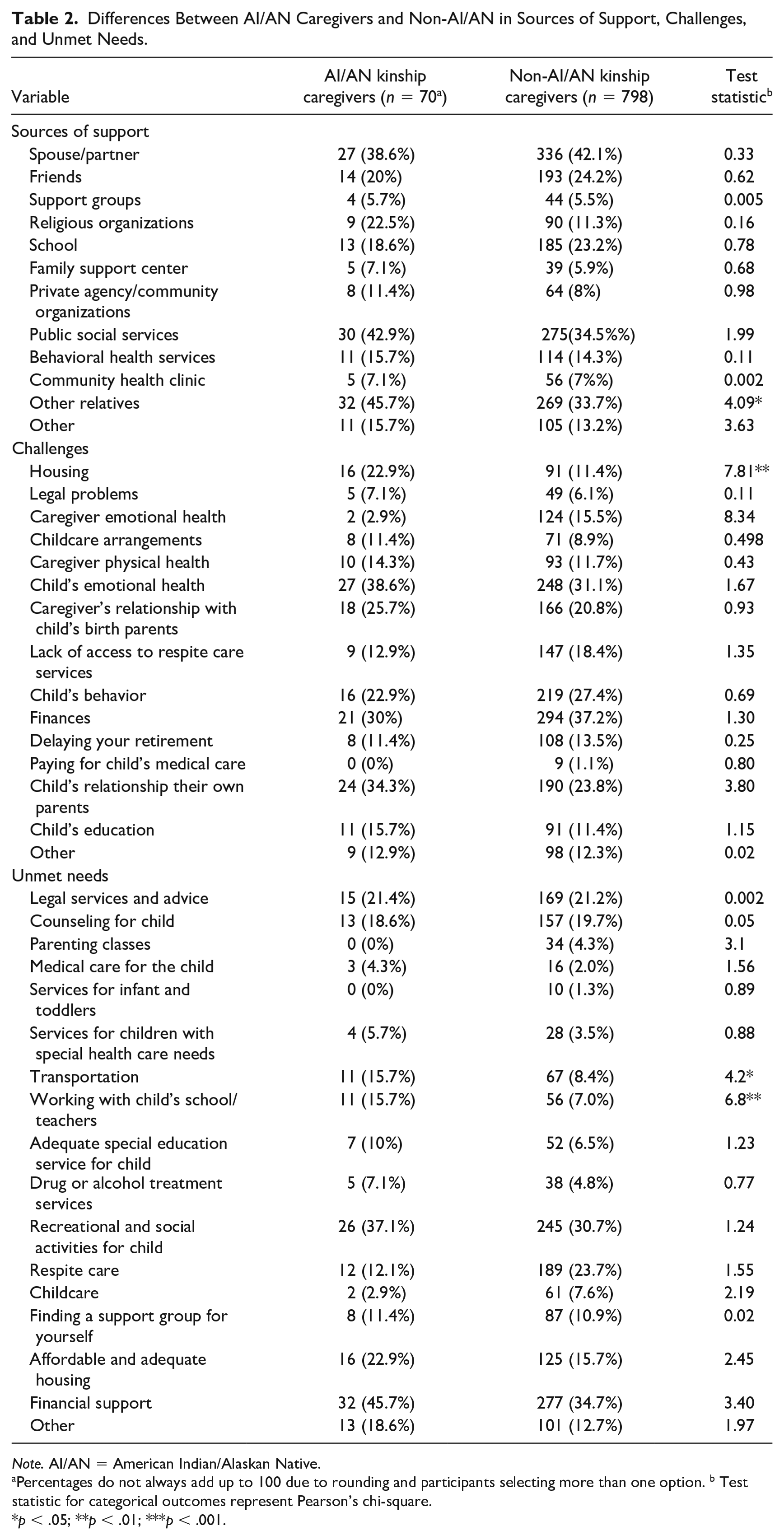
AI/AN caregivers are significantly more likely to rely on relatives as their primary source of support than nontribal caregivers. They were also statistically more likely to report challenges related to housing, and describe unmet needs related to transportation and engagement with their kinship child’s school and/or teacher than nontribal kinship caregivers (see Table 2).
Differences Between AI/AN Caregivers and Non-AI/AN in Sources of Support, Challenges, and Unmet Needs.
Note. AI/AN = American Indian/Alaskan Native.
Percentages do not always add up to 100 due to rounding and participants selecting more than one option. b Test statistic for categorical outcomes represent Pearson’s chi-square.
p < .05; **p < .01; ***p < .001.
In total, the kinship navigators identified six primary overlapping themes related to how the current kinship navigator program could be enhanced to address the unmet needs of AI/AN kinship caregivers. These six themes included (a) a description of who is served, who is not, and to what extent caregivers are served by the program, (b) the eligibility criteria required to access services that are provided, (c) the primary needs of kinship caregivers and children and youth as articulated by caregivers who reach out to them for services, including (d) funding and other concrete services and supports that are utilized by families, (e) the variability of emergency funding that is available within each tribal community to disseminate to caregivers who need it, and (f) recommendations on how the current kinship navigator program could be improved to increase service access and utilization of AIAN caregivers. These major themes and their associated subthemes are depicted in Table 3.
Tribal Kinship Navigators Focus Group (N = 9).
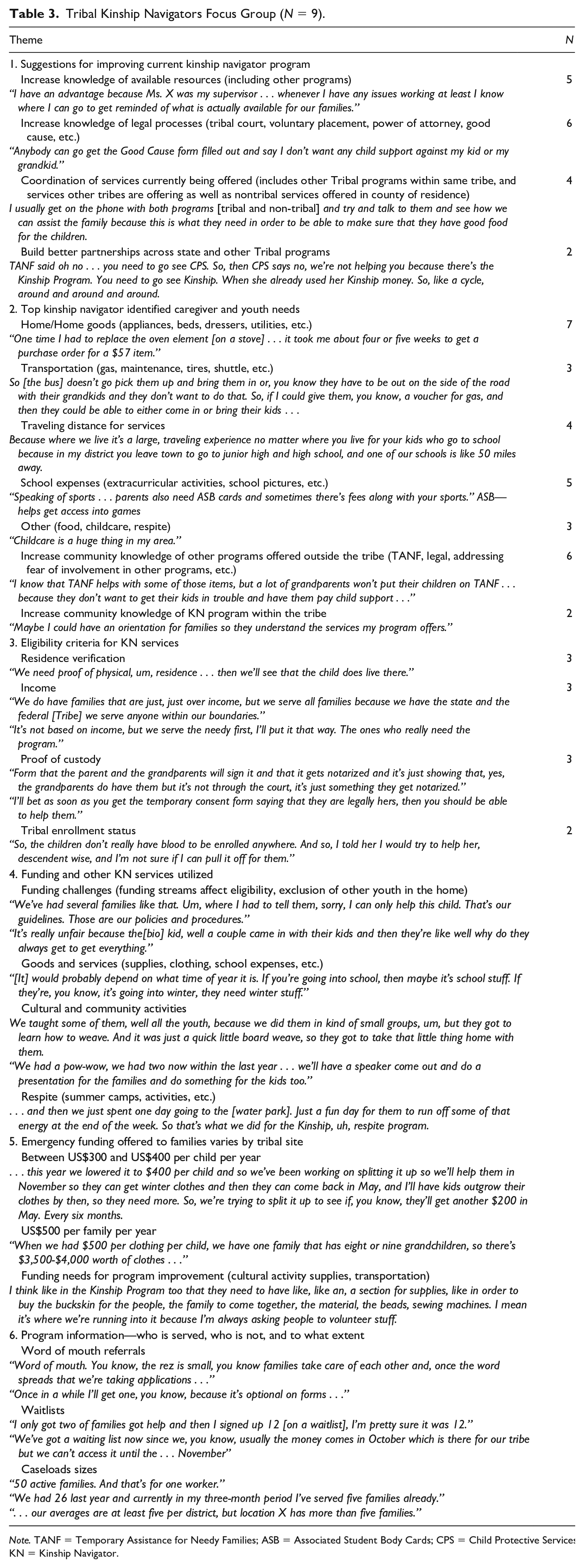
Note. TANF = Temporary Assistance for Needy Families; ASB = Associated Student Body Cards; CPS = Child Protective Services; KN = Kinship Navigator.
Discussion and Implications for Practice
The results of the descriptive and bivariate analysis of the survey data and qualitative data collected from the tribal navigators during the focus group demonstrate several similarities between the current population of AI/AN caregivers in Washington and other studies conducted with AI/AN caregivers in other states (more likely to be parenting in a single parent home, living in a home with incomes below the state income averages, and parenting in an informal arrangement without court involvement or its associated protections; Cross et al., 2011; Mutchler et al., 2007; Probst et al., 2004). AI/AN caregivers and the tribal navigators both reported challenges related to housing, transportation, and the kinship children’s schooling; these were also themes identified in the literature that were of need for this subpopulation of caregivers and children (Cross & Day, 2008). This indicates that tribal navigators have a good read and understanding about the service needs of the kinship families they are serving and appear to be prioritizing the types of services that families say they need the most help accessing. For some of these identified needs to be addressed, changes in federal policy will be eminent. For example, the Native American Housing Assistance and Self Determination Act of 1996 was passed to provide federal assistance for Indian tribes by consolidating funding for low-income housing into a single, formula-driven block grant program (U.S. Department of Housing and Urban Development, n.d.). Unfortunately, funding allocations under this initiative are far below the needs of tribal populations. In terms of transportation, reservations are often located in rural areas where public transportation is not often available. Lack of access to reliable transportation is a major barrier to service access. Unmet needs related to engagement in schools are a complicated matter in tribal communities. There is a lot of historical traumas that can resurface for grandparents raising grandchildren who attended AI Boarding Schools when they are being asked to engage with schools on behalf of the children in their care. Schools have historically not been safe places for AI/AN people (Newland, 2022). Extra care, patience, and understanding are needed on behalf of today’s public-school leaders and teachers to authentically engage AI/AN caregivers on education matters related to the AI/AN children in their homes to build trust and relationships with education institutions and AI/AN communities. Navigators should be trained in how to support caregivers in navigating Individual Education Plan meetings and be encouraged to attend these meetings with kinship caregivers to ensure these caregivers feel they have a trusted person in their corner to navigate education challenges on behalf of their grandchildren.
The navigators also discussed the need to educate caregivers about their legal options and to increase knowledge among caregivers about the various legal processes and what they mean in terms of protections for the kinship family unit, and helping families understand what the associated benefits they are eligible for based on the type of legal arrangement the family is in. These include benefits offered within the tribe, services that could be obtained from other tribes, as well as benefits available to families from agencies located outside a tribal community, including state resources, such as TANF. AI/AN caregivers are often more comfortable accepting benefits and resources from tribal versus state entities due to survivors (many of them being the grandparents raising their grandchildren) past experiences of violence and cultural degradation (forced relocation, genocide), as there is likely increased fear and mistrust of responders who work outside tribal communities (Walters et al., 2011).
In 2018, under the Family First Prevention Services Act, the federal government for the first time funded tribal-specific kinship navigator programs (USDHHS, ACF, 2018). Only one of these federally funded programs is located in Washington State. As such, the findings of this study offer significant implications and lessons learned for other tribal kinship navigator programs that exist across the United States as well as guidance for states exploring tribal/state partnerships for the development of culturally grounded kinship navigator programs operated it Title IV-E and IV-B tribal communities.
As efforts to expand tribal kinship navigator programs continue, it is important to understand that federal and state funding formulas for kinship navigator programs need to take into consideration administrative costs associated with building and sustaining culturally grounded and culturally relevant kinship navigator programs that AI/ANs are comfortable utilizing. Smaller tribes are often allocated federal and state grants that do not cover the costs of hiring qualified staff that are critical to the operation of these programs, and many elect to turn down these funds because they are cost prohibitive. Minimum thresholds need to be considered to ensure that tribes are set up for success. Congress has recently introduced a bill in the 118th Congress, the Tribal Family Fairness Act (H.R. 2762) that would right-size federal funding formulas that would greatly improve the ability of tribes to take advantage of these initiatives. The kinship navigators in this study recounted these concerns when they described how Washington State allocated funding for emergency assistance to their programs. The per child/per family emergency assistance formulas for tribes as articulated by the tribal navigators are far lower than the formula estimates the state provides at the county level (Day et al., 2020).
Conclusion
This study provided a strong foundation for understanding the unique challenges and unmet needs of AI/AN kinship caregivers parenting children in Washington State, as well as how current kinship navigator programs could be enhanced to address the identified needs and concerns of AI and AN families across the state of Washington and throughout the United States. These enhancements include the need for navigator training on what Individual Education Plans (IEPs) are and how they could serve as education advocates for caregivers who need to support in addressing their relative children’s education needs as well as investments of additional financial resources to address transportation and housing barriers. Finally, there is a need for resource equity in terms of infrastructure between tribal and nontribal programs.
Footnotes
Disposition editor: Cristina Mogro-Wilson
Declaration of Conflicting Interests
The author(s) declared no potential conflicts of interest with respect to the research, authorship, and/or publication of this article.
Funding
The author(s) disclosed receipt of the following financial support for the research, authorship, and/or publication of this article: This research was supported by a grant from the US Department of Health and Human Services, Administration for Children and Families, Grant # ACYF-CB-PI-18-05, “Developing, enhancing or evaluating kinship navigator programs.
