




Abstract
Cybercrime is increasingly recognized as a global issue, with adolescents being a key group as crime trends shift online. However, relatively little is known about the prevalence of cybercrime, its specific risk factors, and how they differ across high and low-middle-income countries. This highlights the need for more cross-national comparative studies on the cybercriminal behavior of young people. This study examines the prevalence of four types of cybercrime (image-based abuse, online hate speech, cyberfraud, and hacking) among adolescents aged 13 to 17 in Europe and South America (N = 28,325). Utilizing data from the International Self-Report Delinquency Study 4 (ISRD4), the analysis includes nine countries from Europe (Denmark, Estonia, Finland, Iceland, Lithuania, Norway, Slovenia, Sweden, and the United Kingdom) and three from South America (Argentina, Brazil, and Venezuela). According to our results, there is variation in adolescent cybercrime offending between countries and continents. Overall, cybercrime and hacking were more common in South America, whereas image-based abuse was more prevalent among adolescents from Europe. Cybercrime was associated with low self-control, morality, and anticipated formal sanctions for cybercrimes, whereas peer delinquency was associated with a higher likelihood of offending. In line with situational action theory (SAT), peer delinquency and anticipated formal sanctions for cybercrimes were associated with cybercrime only among those with low or average morality.
Introduction
Cybercrime is recognized as a growing problem around the world as the crime trends are moving from offline to online. This has been reflected in a decrease in overall crime, especially in the Global North (Farrell et al., 2014), and a simultaneous increase in cybercrime (Farrell & Birks, 2018; Miró-Llinares & Moneva, 2019; Tcherni et al., 2016). Although the global economic impact of cybercrime is difficult to estimate, it is believed to be more than $1 trillion annually and growing (Kovalchuk et al., 2021). At the same time, cybercrime poses a significant threat to individuals, national security, and social stability (Borwell et al., 2025; Chen et al., 2023; Kaakinen et al., 2021). As general criminal behavior peaks during adolescence (Moffitt, 1993) and young people increasingly engage with digital environments, adolescents represent a critical group for both cybercrime research and prevention efforts.
However, despite its increasing significance, the true nature of cybercrime, as opposed to traditional offline crime, is still poorly understood in many ways. For example, researchers are still debating whether cybercrime is an entirely new form of crime or a traditional crime carried out in an online environment (Smith & Stamatakis, 2020). This definitional ambiguity can affect both prevalence estimates and explanations of cybercrime (Payne, 2020). A common definition of cybercrime refers to technology-mediated offenses, categorized as either cyber-enabled or cyber-dependent (Choi et al., 2020). Cyber-enabled crimes use information and communication technology (ICT) to facilitate traditional offenses (e.g., technology-facilitated sexual violence), whereas cyber-dependent crimes, such as hacking, rely entirely on digital technology.
Also, the prevalence and geography of cybercrime remain poorly understood (Bruce et al., 2024). A major challenge is that most cybercrimes go unreported and therefore do not appear in administrative records. Variations in cybercrime laws, recording practices, and law enforcement capacity also affect the share of cases reported to authorities, complicating cross-country comparisons (Bruce et al., 2024; Holt, 2018). Self-reported crime surveys address the problem of hidden crime (Kivivuori, 2011). However, cross-national surveys with standardized cybercrime items remain rare, limiting the ability to assess the true extent of cybercrime globally.
Although tracing the origins of cybercrime is complex, literature suggests that cybercrime is not evenly distributed across countries. For example, a survey of professionals working in the field of cybercrime identified the United States as one of the main cybercrime hubs in the Western world, while Brazil was the most prominent country in South America (Bruce et al., 2024). However, the experts only considered financially motivated cybercrime, which is not necessarily representative of the mass cybercrime that young people are usually involved in. Also, no individual-level inferences can be made from expert opinions. Another study found that cybercrime is geographically concentrated in high-income regions with greater access to technology, with Europe and North America having the highest number of IP addresses linked to cybercrime, while the western and northern areas of South America show significantly lower numbers (Chen et al., 2023).
Criminological theories are often expected to provide explanations for every form of criminal behavior (Wikström, 2014). However, the distinct and constantly evolving nature of cybercrime, compared to offline crime, has posed challenges for traditional criminological theories (e.g., Smith & Stamatakis, 2020). Most of them were established before the global rise of cybercrime, leaving uncertainty about their applicability to this relatively new form of offending, particularly as cybercriminals seems to differ from offline offenders in some aspects (Kranenbarg et al., 2019). Many theories have also been criticized for relying too much on unidimensional explanations while overlooking the situational dynamics of crime emerging from person-place interactions (Wikström & Kroneberg, 2022).
One prominent theoretical framework that addresses these shortcomings and could be effectively applied to the online context is situational action theory (SAT; Wikström et al., 2012; see also, e.g., Hu et al., 2024). According to the SAT, crime is explained through a situational perception–choice process. A crime occurs when a crime-prone individual encounters an opportunity for crime in a criminogenic environment (Wikström et al., 2012). Individual susceptibility to crime is influenced by factors such as personal morals and the ability to exercise self-control in settings that encourages crime (see Wikström et al., 2010). Criminogenic environments, in turn, are settings that create opportunities for crime or weaken moral constraints, for example, through associations with criminal individuals or a lack of social control (see Wikström et al., 2024).
The applicability of SAT has been proved widely with offline crime (e.g., Hardie & Rose, 2025; Wikström et al., 2010). However, SAT research has been criticized for its Eurocentrism and narrow focus on certain forms of criminal behavior, highlighting the need for cross-national comparisons and broader testing across crime types (Hardie & Rose, 2025). To our knowledge, SAT has not been applied to cybercrime before. However, there are good reasons to assume that the person–place dynamics of crime may also extend to online settings.
Online settings can provide distinctive cues and abundant opportunities for crime compared with physical world, such as anonymity and perceptions of weak formal control (Wright, 2013), influence of the online community (Hughes et al., 2024), and easy access to illegal material (Broséus et al., 2017). From an SAT perspective, individuals assess these criminogenic online environments through a moral lens. If they perceive cybercrime as a possible course of action, their ability to exercise self-control ultimately determines whether they act on it. In online contexts, the moral threshold for crime may be lower, as cybercrime may be perceived as less serious than traditional offline offenses (see, for example, Vepsäläinen et al., 2025). Indeed, research suggests a reciprocal relationship between an individual’s personal traits and the influence of online environments (Kaakinen et al., 2020; Vepsäläinen et al., 2024). Although the SAT has not previously been applied directly to cybercrime, it has already proven to be a useful theoretical framework for studying other antisocial online behaviors, such as cyberbullying (Hu et al., 2024; Song & Lee, 2020).
This study addresses key gaps in cybercrime research by using self-report data and applying SAT to adolescent cybercrime. Comparing youth cybercrime in Europe (Global North) and South America (Global South) is particularly valuable, as it allows for assessing whether regional differences in socioeconomic contexts, technological access, and social control mechanisms (Chen et al., 2023), for example, shape cybercrime prevalence and associated risk factors. We also test the theoretical scope of the SAT in different cultural contexts. We use cross-national survey data of adolescents from aforementioned regions, collected as part of the fourth ISRD4 (Marshall et al., 2022), to compare the prevalence of cybercrime between countries from these continents and examine how SAT-based theoretical risk factors predict cybercrime across different continents.
More specifically, we investigate how self-control and moral attitudes describing an individual’s propensity for crime are associated with cybercrime. Furthermore, we examine how exposure to delinquent peers (as an environmental inducement), as well as how anticipated formal sanctions for cybercrimes (Bossler, 2019) and neighborhood collective efficacy (Sampson & Wikström, 2008), is associated with cybercrime. Here, anticipated sanctions for cybercrimes and neighborhood collective efficacy represent different sources of control. According to SAT (Wikström et al., 2024), expected sanctions can be assumed to act as a friction in cybercrime situations, slowing down offending. However, it is not clear whether neighborhood social control has significance in the context of cybercrimes. We present the following theory-based research questions:
Data and Method
Data
This study uses data from the fourth ISRD4, which began collecting data in 2022. The respondents were school children aged 13 to 17 (N = 28,325, 51% male, mean age = 15.02, SD = 1.21) from 12 countries. All respondents outside of the 13 to 17 age range were removed from the data set. The nine European countries representing the Global North are Denmark (N = 1,094), Estonia (N = 5,778), Finland (N = 2,037), Iceland (N = 3,007), Lithuania (N = 1,784), Norway (N = 1,559), Slovenia (N = 2,490), Sweden (N = 1,342), and the United Kingdom (N = 3,827). Three countries representing the Global South are Argentina (N = 1,932), Brazil (N = 1,909), and Venezuela (N = 1,566). In each country, standardized questionnaires were administered to school classes sampled from two major cities, resulting in samples representative of adolescents living in urban areas of the participating countries. Data collection took place in schools during regular school hours. The survey was conducted in all countries between 2022 and 2023. The study implementation in each country followed the research ethics standards of the ISRD4 protocol and the respective national guidelines (Marshall et al., 2022). In addition to data collection, the same ethical research principles and data protection standards were applied throughout the subsequent processing of the data.
Measures
Cybercrime offending was measured with four binary items asking whether the respondent had, during the past 12 months, (a) shared an intimate photo or video of someone online that they did not want others to see (image-based abuse); (b) sent hurtful messages or comments on social media about someone’s race, ethnicity or nationality, religion, gender identity, sexual orientation, or similar characteristics (online hate speech); (c) used the internet, email, or social media to deceive others (e.g., phishing, selling worthless or illegal goods) for monetary gain (cyberfraud); or (d) hacked or broken into a private account or computer to acquire data, gain control of an account, or destroy data (hacking). A binary variable was constructed to indicate whether the respondent had committed at least one of these cybercrimes during the previous 12 months (0 = no cybercrimes, 1 = at least one cybercrime).
Self-control was measured using a six-item version of the Grasmick et al. (1993) self-control scale, adapted for the ISRD4 study (see also Marshall et al., 2022). This shortened version focuses on the impulsivity and risk-seeking dimensions of the original scale. Respondents rated their agreement with items such as “I act on the spur of the moment without stopping to think” and “I like to test myself every now and then by doing something a little risky” on a 5-point Likert-type scale (1 = fully agree to 5 = fully disagree). Items were summed into a composite scale ranging from 6 to 30, with higher scores indicating higher self-control. Cronbach’s alpha showed good internal consistency for the scale (α = .79). Only cases with no missing values on any scale items were included in the sum.
Morality was assessed with eight items measuring how wrong respondents considered various antisocial or criminal behaviors committed by someone of their age (Marshall et al., 2022). These questions are adapted from measures of moral beliefs based on SAT (Wikström & Butterworth, 2006). Respondents rated the wrongfulness of acts such as “lie, disobey, or talk back to adults such as parents and teachers” and “share online an intimate photo or video of someone that he or she did not want others to see” using a 4-point scale (1 = not wrong at all to 4 = very wrong). A sum score ranging from 8 to 32 was created, with higher scores reflecting stronger moral rejection of antisocial behavior. The scale showed good reliability (α = .82). Only cases with no missing values on any scale items were included in the sum.
Peer delinquency was measured with a binary indicator of whether the respondent had close friends who had committed any of the following offenses: shoplifting, burglary, assault, image-based abuse, or hacking. The variable was coded as 0 if none of the respondent’s close friends had committed any of the offenses and 1 if at least one close friend had committed any of the listed acts.
Anticipated formal sanctions for cybercrimes were measured using a five-item scale adapted from the Anticipated Formal Sanctions Scale (Bossler, 2019) and included in the ISRD4 questionnaire (see Marshall et al., 2022). Respondents evaluated statements on a 5-point Likert-type scale about the perceived likelihood of detection (e.g., “Computer crimes are quickly discovered by the police”), severity of punishment (e.g., “The punishments for computer crimes are serious”), and perceived likelihood of victims reporting offenses. Items were summed into a scale ranging from 5 to 25, with higher scores indicating stronger perceptions of deterrent effects. The scale demonstrated good reliability (α = .83). Only cases with no missing values on any scale items were included in the sum.
Collective efficacy in the neighborhood was measured using a shortened three-item version of the scale developed by Sampson and Wikström (2008), as included in the ISRD4 survey (see Marshall et al., 2022). Respondents were asked how likely adults in their neighborhood would intervene in problematic situations, such as someone spray-painting graffiti or fighting on the street. Responses were given on a 5-point Likert-type scale (1 = very unlikely to 5 = very likely), and the items were summed into a composite variable ranging from 3 to 15. The scale showed acceptable internal consistency (α = .77). Only cases with no missing values on any scale items were included in the sum.
Control variables included respondent age, sex (male/female), immigration background (0 = no, 1 = first generation, 2 = second generation), number of close friends (0 = none, 1 = 1–9, 2 = 10 or more), number of friends known only from the internet (0 = none, 1 = 1–9, 2 = 10 or more).
Analyses
Descriptive statistics for the 12-month prevalence of image-based abuse, online hate speech, cyber fraud, and hacking, as well as general cybercrime offending (no cybercrime vs. at least one type of cybercrime) and for all other all study variables are reported in Table 1. For Table 1, all scale scores were transformed to POMP scores (percent of maximum possible; Cohen et al., 1999) to enhance comparability across scales of different lengths. This transformation yields a uniform 0 to 100 metric, facilitating the interpretation of descriptive statistics and model results. Statistics are estimated for the total sample and separately for the samples from South America and Europe. In the results section, we discuss only the cybercrime prevalence rates. We report country-level cybercrime prevalence estimates in Figure 1 (see also the appendix). Differences in the distribution of study variables between South America and Europe were examined using chi-square tests for categorical variables and t-tests for continuous variables. These tests accounted for the clustering of observations within schools. Country-level differences in sample sizes were accounted for using weights, and responses with more than three implausible answers were excluded (for details see Marshal et al., 2025).
Descriptive Statistics of the Study Variables in the Total Sample and for South America and Europe.
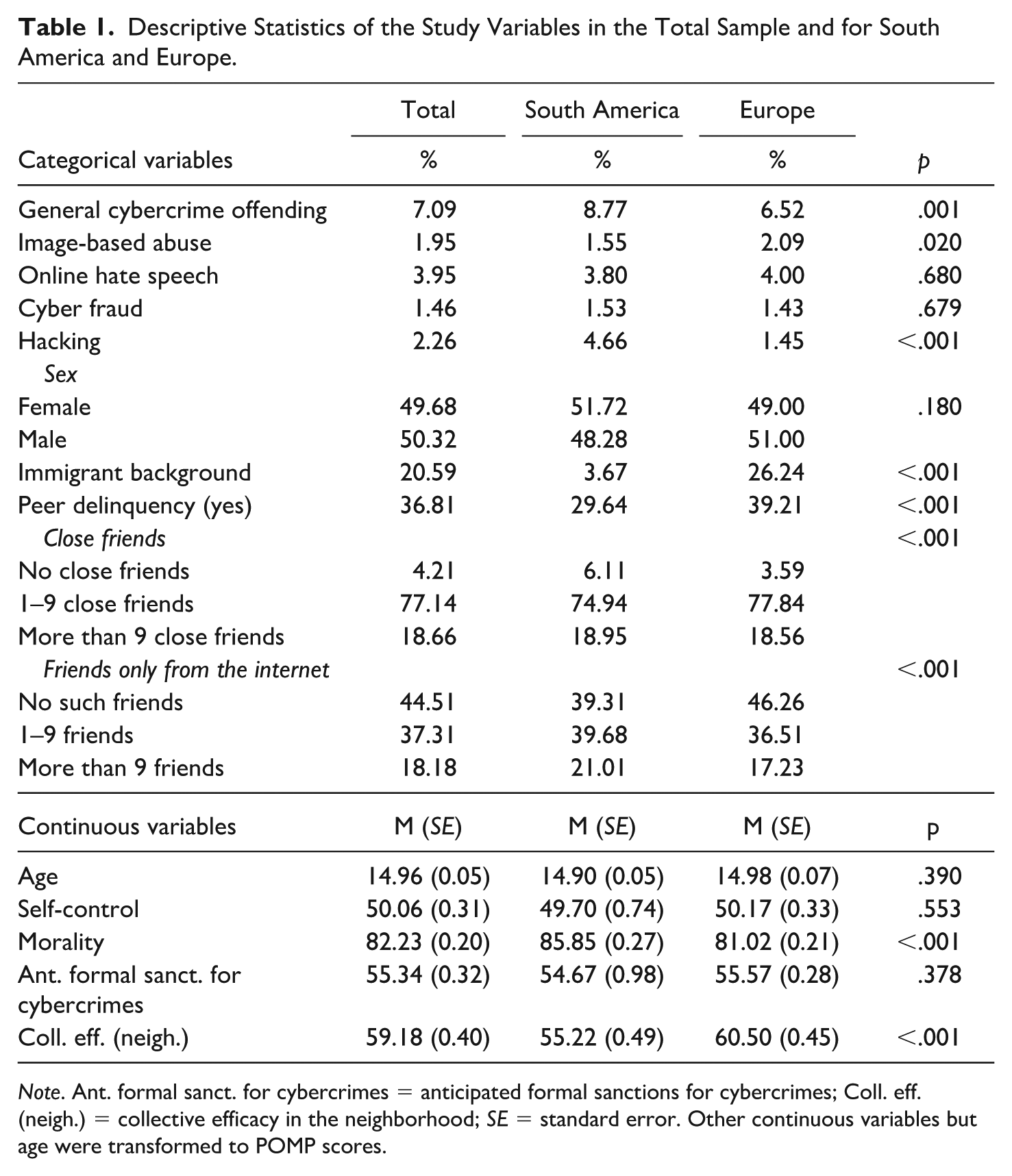
Note. Ant. formal sanct. for cybercrimes = anticipated formal sanctions for cybercrimes; Coll. eff. (neigh.) = collective efficacy in the neighborhood; SE = standard error. Other continuous variables but age were transformed to POMP scores.
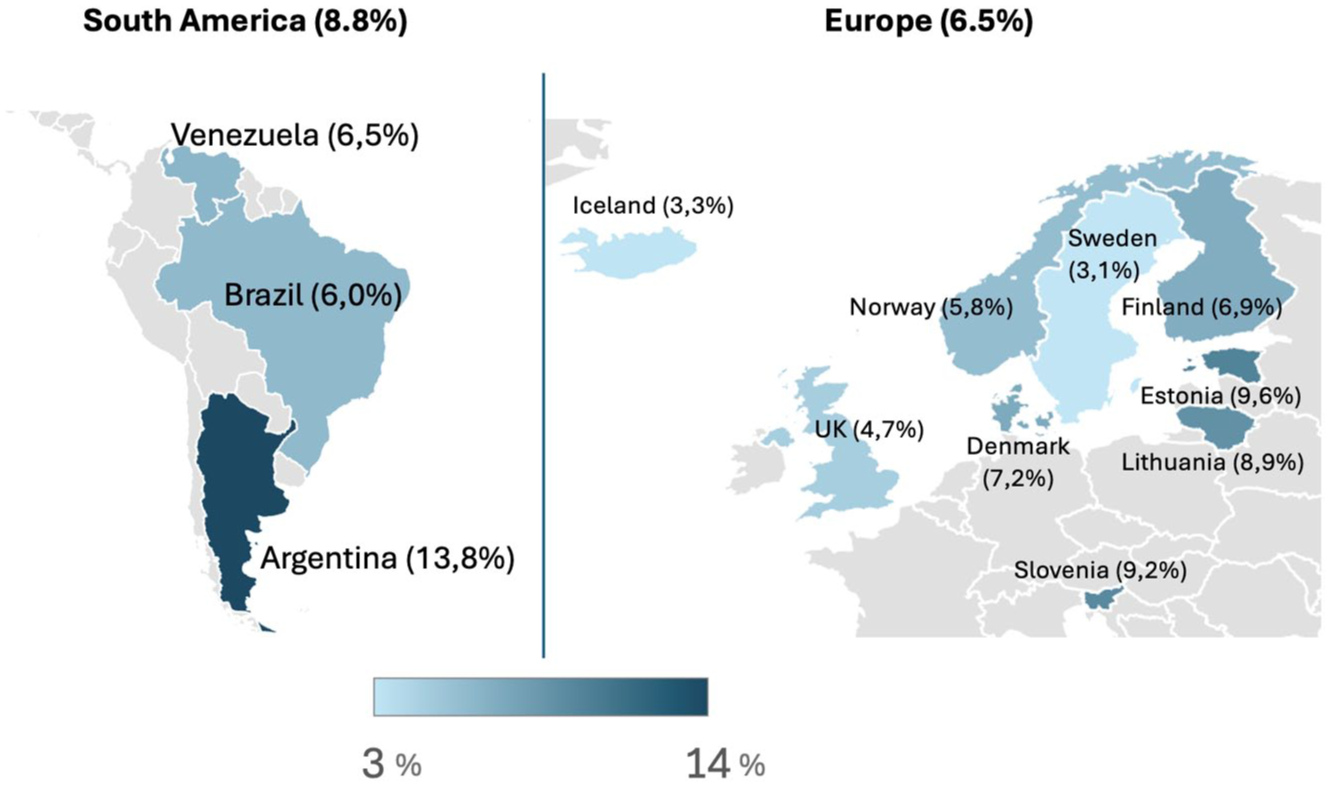
Cybercrime Prevalence in South America and Europe.
The association between cybercrime offending and theoretical risk factors is analyzed using a linear probability model (LPM). LPMs are a type of regression model used when the dependent variable is binary, estimating the probability of an outcome as a linear function of the predictors. In an LPM, regression coefficients represent the change in the probability of cybercrime (in percent) associated with a one-unit change in the predictor variable. In this study, the LPM is used because it handles interaction terms more effectively than nonlinear models and, in some cases, has performed better in modeling rare outcomes (Timoneda, 2021). For ease of interpretation, the outcome in the LPM was rescaled from 0–1 to 0–100, allowing the coefficients to be interpreted directly as percentage-point changes.
In the models, we used general cyber-offending as the dependent variable. The independent variables are self-control, morality, peer delinquency, anticipated formal sanctions for cybercrimes, collective efficacy in the neighborhood, and control variables. Model 1 includes all explanatory variables. In Model 2, we add SAT-based interaction terms between morality and peer delinquency, anticipated formal sanctions for cybercrimes, and collective efficacy in the neighborhood (reported only in text to save space). Model 1 and Model 2 are estimated separately for the South American and European samples. We compare the coefficients between the models using 95% confidence intervals (CIs). Nonoverlapping CIs are interpreted as statistically significant differences in the coefficients. Significant interactions are reported alongside the results. To improve the comparability of regression coefficients across independent variables with different scales, we followed Gelman’s (2008) recommendation to divide the scores of our continuous variables (except for age) by two standard deviations. This transformation yields variables with a standard deviation of approximately 0.5, making their variance more comparable to that of binary variables. As a result, a one-unit change corresponds to a two-standard-deviation change in the original scale.
For Model 2, the significant interactions are elaborated based on the model predictions. In these analyses, we calculate the association of peer delinquency, anticipated formal sanctions for cybercrimes, or collective efficacy in the neighborhood with cybercrime offending among respondents with low morality (two standard deviations below the mean), average morality (mean), and high morality (two standard deviations above the mean). The interactions are also plotted in Figure 2.
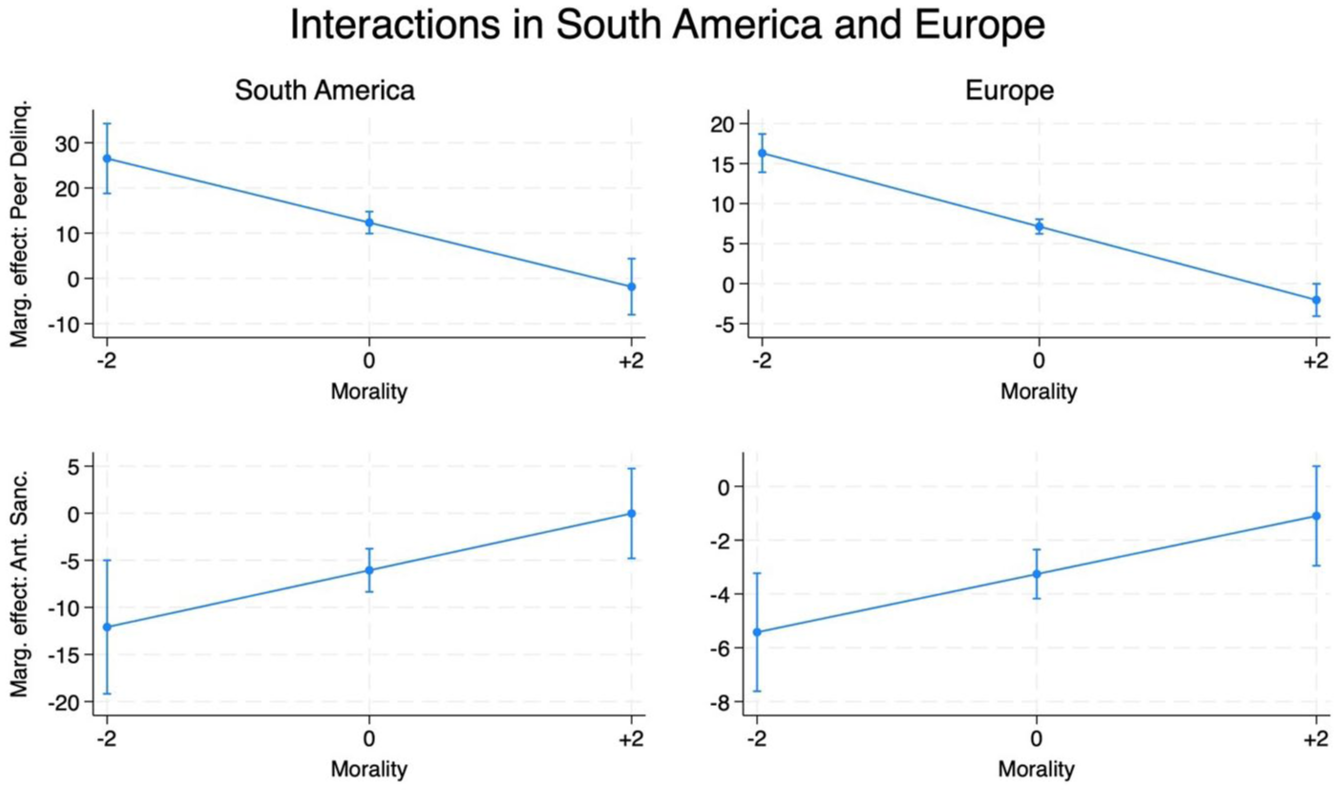
Model-Predicted Associations of Cybercrime With Peer Delinquency and Anticipated Sanctions at Low (−2 SD), Average (mean), and High (+2 SD) Levels of Morality.
For all models, we report the coefficient of determination (R²), regression coefficients, and corresponding p-values. The estimation of standard errors accounts for the clustering of observations within schools. Country dummy variables are included in all models but are not reported in the tables. All continuous variables, except age, were standardized for the models.
Results
The overall prevalence of cybercrime offending among adolescents in the total sample was 7.1% (see Table 1). The prevalence was higher in South America (8.8%) than in Europe (6.5%; p = .001). Cybercrime offending was most prevalent in Argentina (13.8%), and least prevalent in Sweden (3.1%) and Iceland (3.3%; see Figure 1). The most prevalent cyber offense was online hate speech in the total sample (3.95%) and among adolescents from Europe (4.0%). In South America, the most prevalent cybercrime was hacking (4.7%). Image-based abuse was more prevalent among adolescents from Europe (2.1%) than from South America (1.6%; p = .020). Hacking, in turn, was more prevalent in South America (4.7%) than in Europe (1.5%; p < .001). Online hate speech and cyber fraud did not differ significantly between Europe and South America.
The explanatory power of the LPM models was relatively low (R² = .112 in South America and .085 in Europe). Self-control was associated with a reduced probability of cybercrime offending in both South America (b = −2.49, p = .011) and Europe (b = −2.93, p < .001; see Table 2). Morality was also associated with a reduced probability of offending in South America (b = −9.96, p < .001) and Europe (b = −5.66, p < .001). Anticipated formal sanctions for cybercrimes were linked to a lower probability of offending in both South America (b = −5.38, p < .001) and Europe (b = −3.32, p < .001). Peer delinquency, in turn, was associated with a higher probability of offending in both samples (b = 11.55, p < .001 in South America and b = 7.57, p < .001 in Europe), with a significantly stronger association in South America.
A Linear Probability Model Predicting Cyber Offending.
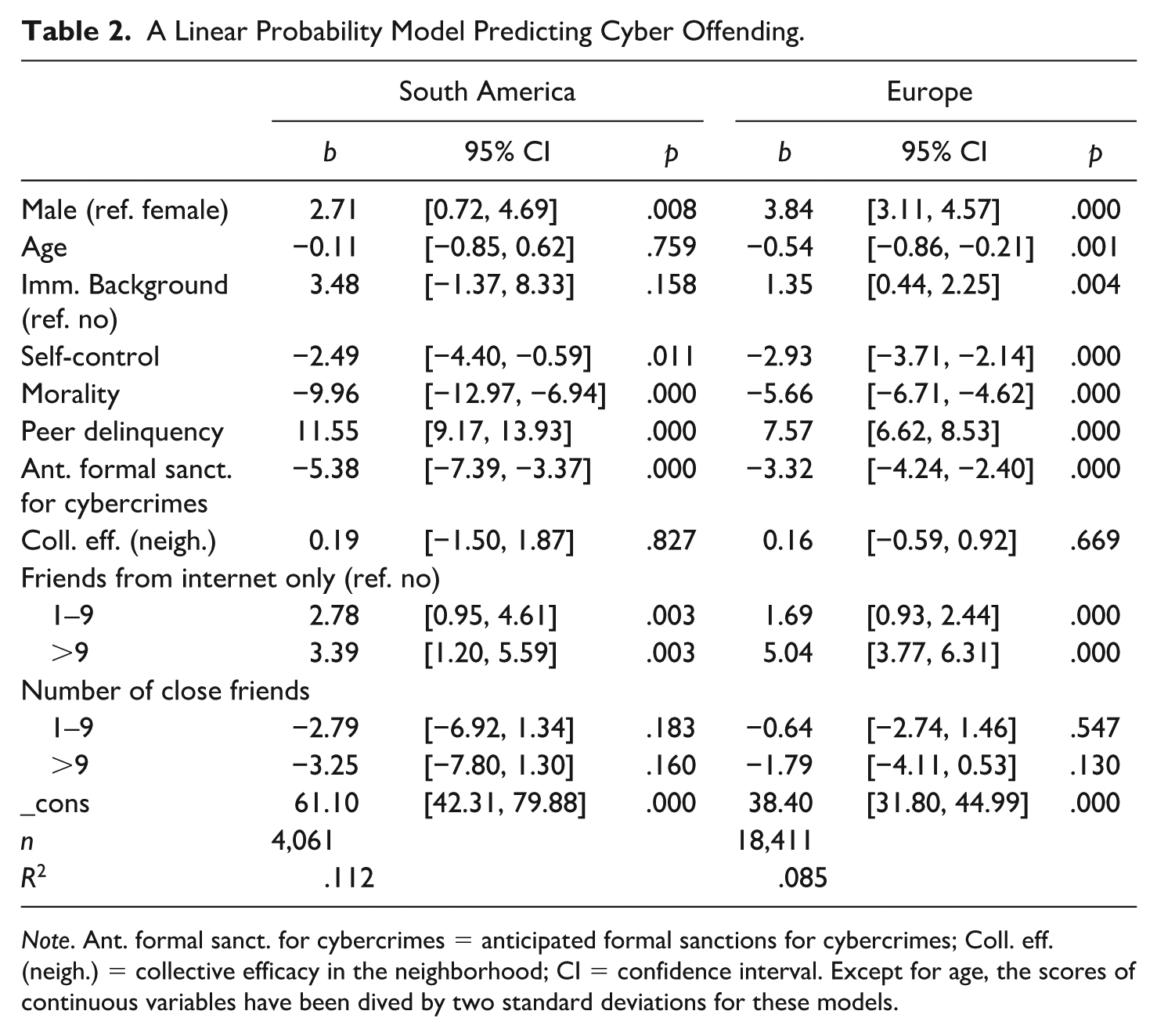
Note. Ant. formal sanct. for cybercrimes = anticipated formal sanctions for cybercrimes; Coll. eff. (neigh.) = collective efficacy in the neighborhood; CI = confidence interval. Except for age, the scores of continuous variables have been dived by two standard deviations for these models.
Adding interactions in Model 2 increased the explained variance in both South America (R2 = .124) and Europe (R2 = 9.27; not reported in tables). The moderations predicted by the SAT, both in South America and Europe, were significant for the interactions between morality and peer delinquency (b = −14.17, p < .001 in South America; b = −9.17, p < .001 in Europe) as well as between morality and anticipated sanctions (b = 6.03, p = .035 in South America; b = 2.16, p = .020 in Europe). The interaction between morality and collective efficacy in the neighborhood did not significantly predict offending in South America or Europe.
According to the model predictions (plotted in Figure 2), peer delinquency was not significantly associated with cybercrime among respondents with high morality (two standard deviations above the mean) in South America (b = −1.84, p = .557). In Europe, peer delinquency was associated with a reduced probability of cybercrime among these high morality respondents (b = −2.04, p = .048). Anticipated sanctions were not associated with cybercrime among respondents with high levels of morality in South America (b = −0.03, p = .990) or Europe (b = −1.10, p = .243).
Peer delinquency was significantly associated with an increased probability of cybercrime among respondents with average morality (b = 12.34, p < .001 in South America and b = 7.13, p < .001 in Europe) and low morality (b = 26.51, p < .001 in South America and b = 16.30, p < .001 in Europe). Anticipated sanctions were significantly associated with a reduced probability of cybercrime among respondents with both average (b = −6.06, p < .001 in South America and b = −3.26, p < .001 in Europe) and low morality (b = −12.09, p = .001 in South America and b = −5.42, p < .001 in Europe).
Discussion
This study examined cybercrime offending and its SAT-based risk factors among European and South American adolescents. According to our findings, there are significant variations in adolescent cybercrime offending across countries and continents. Hacking was more common among South American youths, whereas image-based abuse was more prevalent among European youths. This aligns with literature highlighting the geographical variation in cybercrime (Bruce et al., 2024). However, our results do not support previous findings suggesting that youth cybercrime is more prevalent in high-income regions with greater access to technology (Chen et al., 2023).
According to our main findings, adolescents who engaged in cybercrimes reported lower levels of self-control and morality. In addition, they more frequently had delinquent peer groups and anticipated less formal sanctions for cybercrimes compared with others. Earlier studies identified similar factors as significant factors in understanding cybercrime (Farrell et al., 2014; Tcherni et al., 2016) and offline crime (e.g., Wikström et al., 2012, 2024). Our findings also imply that the risk factors for cybercrime and their significance may also vary regionally and culturally (see, for example, Bruce et al., 2024). For instance, the findings indicate that peer delinquency has a stronger association with cybercrime offending in South America than in Europe. For morality, the association was stronger in South America than in Europe, although the 95% confidence intervals slightly overlapped.
The theoretical foundations of SAT appear useful in understanding adolescent cybercrimes based on our research findings (Wikström et al., 2024). As previous studies have shown with offline crimes, individual crime propensity and criminogenic environment seem to be interactively related to cybercrime. Social environmental inducements (peer delinquency) and control (anticipated sanctions) were more strongly associated with offending among respondents with weaker morality. In cases of the highest morality, they did not predict cybercrime at all. Conversely, adolescents whose moral filter allows for criminal behavior are at greater risk of cybercrime the more they are exposed to delinquent peers or the less they perceive formal social control in the online environment. These results call for further investigation. In the SAT, peer crime is often understood to imply inducement or increased opportunity for offending (Wikström et al., 2012). However, it is not clear whether cyber offenses (e.g., online hate speech or cyber fraud) are as strongly shaped by peer group dynamics as offline crime. Based on our findings, the association between cybercrime and peer delinquency appears to be in line with SAT.
Collective efficacy of the neighborhood was not associated with cybercrime offending, regardless of individual moral beliefs. This finding can be interpreted as related to the situational nature of SAT. According to SAT, an individual’s crime propensity is relative to each situation (Wikström et al., 2010). Hence, cybercrime is the result of the interaction between an individual’s criminal propensity and the criminogenicity of the online environment, whereas offline crime is influenced by the criminogenic potential of the physical world. As the situational setting for cybercrime is the online environment, the criminogenic potential of the residential area seems to be less relevant to cybercrime, regardless of the individual’s crime propensity. This finding also supports the notion that traditional criminological theories may need adaptation to fully explain cybercrime (Smith & Stamatakis, 2020; Wikström & Kroneberg, 2022).
When interpreting the results of this study, certain limitations must be considered. First, it is important to note that this study focused on self-reported cybercriminal behaviors among adolescents rather than officially recorded offenses. Self-reports can capture less serious forms of crime that often go unreported (Kivivuori, 2011). Accordingly, most of the cybercrimes examined here involve relatively widespread, low-threshold behaviors, such as online hate speech. Consequently, these findings cannot be generalized to adult populations or financially motivated cybercrimes, highlighting the need for further research on cross-national differences using diverse operationalizations and measurement approaches.
Second, the research is based on cross-sectional observational data, so the analyzed relationships cannot be interpreted as evidence of causality. In the future, the ISRD should also consider incorporating longitudinal elements into the design. On the other hand, a strength of the study is the measurement of adolescent cybercrime using a broad, internationally comparable survey. However, ISRD studies are based on city samples, which limits their representativeness as national samples. This data collection method includes the strengths and challenges of self-reported surveys, such as reporting on sensitive issues. However, the school survey used has been found to be an effective way to measure sensitive and socially undesirable topics (e.g., Kaakinen et al., 2022).
Footnotes
Appendix
The Prevalence of Different Cybercrime Offenses Across the Study Countries.
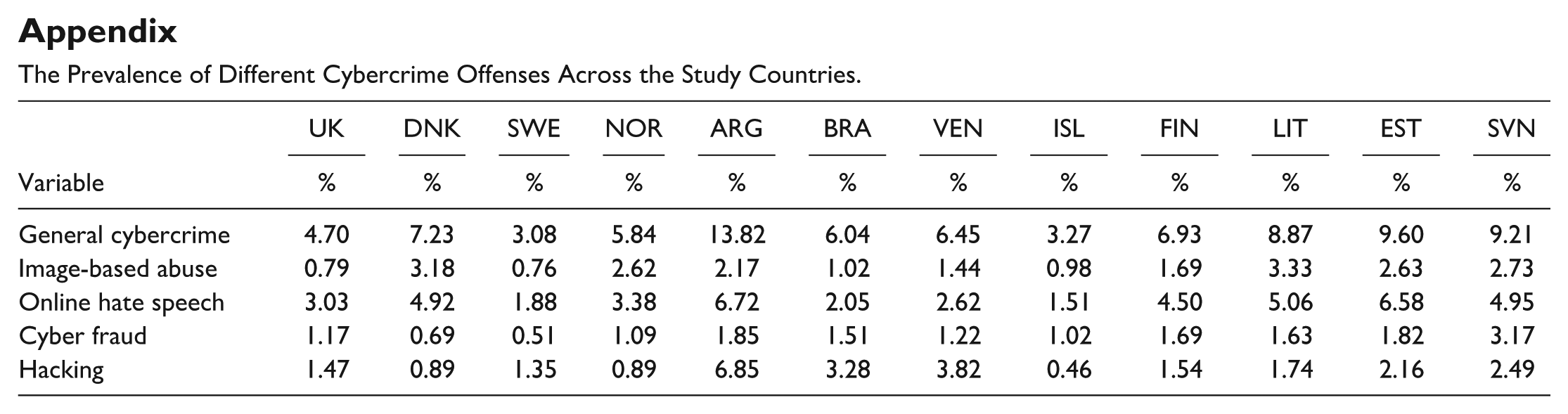
| Variable | UK | DNK | SWE | NOR | ARG | BRA | VEN | ISL | FIN | LIT | EST | SVN |
|---|---|---|---|---|---|---|---|---|---|---|---|---|
| % | % | % | % | % | % | % | % | % | % | % | % | |
| General cybercrime | 4.70 | 7.23 | 3.08 | 5.84 | 13.82 | 6.04 | 6.45 | 3.27 | 6.93 | 8.87 | 9.60 | 9.21 |
| Image-based abuse | 0.79 | 3.18 | 0.76 | 2.62 | 2.17 | 1.02 | 1.44 | 0.98 | 1.69 | 3.33 | 2.63 | 2.73 |
| Online hate speech | 3.03 | 4.92 | 1.88 | 3.38 | 6.72 | 2.05 | 2.62 | 1.51 | 4.50 | 5.06 | 6.58 | 4.95 |
| Cyber fraud | 1.17 | 0.69 | 0.51 | 1.09 | 1.85 | 1.51 | 1.22 | 1.02 | 1.69 | 1.63 | 1.82 | 3.17 |
| Hacking | 1.47 | 0.89 | 1.35 | 0.89 | 6.85 | 3.28 | 3.82 | 0.46 | 1.54 | 1.74 | 2.16 | 2.49 |
Declaration of Conflicting Interests
The authors declared no potential conflicts of interest with respect to the research, authorship, and/or publication of this article.
Funding
The authors disclosed receipt of the following financial support for the research, authorship, and/or publication of this article: This work was supported by the Academy of Finland (grant number 342741/2021; PI Dr. Markus Kaakinen).
