




Abstract
This article explores whether there was a universal increase in homicide victimization in 2014 to 2016 and 2019 to 2020. Although the United States observed increases in homicide victimization in 2014 to 2016 and 2019 to 2002, it is unlikely that all nations observed simultaneous increases in homicide victimization. Therefore, we explore whether countries observed increases in homicide victimization from 2014 to 2016, only part of the time, and before and after 2014 to 2016. We also investigated which nations observed an increase in homicide victimization from 2019 to 2020. We used WHO mortality homicide victimization data for an initial sample of 116 nations. In general, it does not appear that there was a simultaneous universal increase in the times under study. However, most of the sample at some point between 2014 and 2016 experienced increases in homicide victimization.
Keywords
Do other nations have similar homicide trends as the United States? Was there a universal increase in homicide from 2014 to 2016 and from 2019 to 2020? These questions require consideration because the evidence is mixed. There is a weak global homicide trend (LaFree et al., 2015; Rogers & Pridemore, 2018), with only a small proportion of the variation in homicide victimization shared among nations (<10%). However, other research finds that there are similar trends in homicide victimization across different classifications of nations (Adıyaman & Kasman, 2022; LaFree et al., 2015; Tonry, 2014; Tuttle et al., 2021; Weiss et al., 2016). What might increase homicide victimization at the national level may not initiate in all nations at the same time. Instead, there may be delayed effects that inferential comparisons would be unable to detect. These delayed effects could explain inconsistent conclusions about crime trends across nations.
In this article, we examine homicide over a decade (2010-2020) to investigate whether nations observed similar trends in homicide as the United States. We begin by discussing the explanations for the increase in homicide in the United States in 2014 to 2016 and 2019 to 2020. Then we investigated whether these explanations would also explain increases in homicide in other nations. We shift our focus to exploring four research questions regarding the timing of homicide increases across nations, and then situate the homicide victimization increases within the gender- and age-specific homicide rates within nations. We conclude by discussing the implications of our findings and avenues for future research.
Crime Trends in the United States and Reasons for Increases in 2014-2016 and 2019-2020
Figure 1 provides the homicide trend for the United States from 1950 to 2020. Crime trends in the United States have received extensive attention after the increase in the 1980s and during the decline in the 1990s (Blumstein, 2006; Zimiring, 2006). Originally, the decline in homicide victimization in the 1990s was thought to be unique to the United States and not experienced by other nations (Blumstein & Wallman, 2006; Zimiring, 2006). However, through a series of exploratory data analyses (using regional average homicide victimization rates) and latent class analyses, the 1990s decline in homicide victimization is no longer understood to be uniquely a U.S. phenomenon (Santos & Testa, 2018; Tuttle et al., 2021; Weiss et al., 2016).
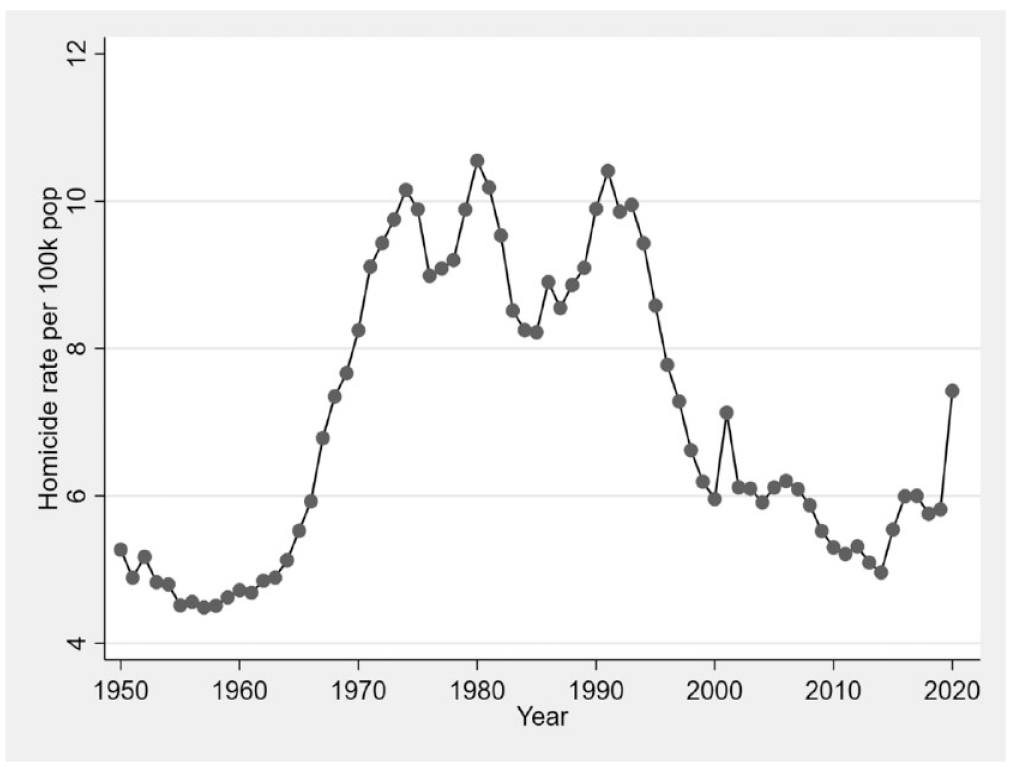
United States Homicide Trend From 1950 to 2020.
However, there has been little research on whether the most recent increases in homicide in the United States (2014-2016 and 2019-2020) occurred in other nations. Within the U.S. literature, there have been a handful of studies exploring the 2014 to 2016 increase in homicide victimization. Specifically, Rosenfeld and Fox (2019) used exploratory data analysis to understand which demographic groups were the most affected by the increase in homicide victimization in the United States. They found that most age groups observed an increase in homicide victimization. Males had a strong increase in homicide victimization. Female homicide victimization also increased but at a lower rate.
Furthermore, the consensus is that drug use, specifically opioids, contributed to the increase in homicide victimization in the United States from 2014 to 2016 (Gaston et al., 2019; Rosenfeld et al., 2017). Illicit drug markets and intimate partner violence are the mechanisms linking opioids to homicide (Gaston et al., 2019; Pryor et al., 2021; Rosenfeld et al., 2017, 2021, Cerdá et al., 2013). Drug-related homicides increased compared with other types of homicide (Rosenfeld & Fox, 2019). There is a historical understanding that the drug trade can lead to violence, with the increase in homicide victimization in the 1980s believed to be the result of the crack epidemic (Blumstein & Wallman, 2006). The proposed mechanisms to account for the relationship between drug markets and crime are the lack of legitimate access to formal social control to handle disputes between parties or violence being used to obtain money and/or drugs (Gaston et al., 2019). There is overwhelming research that changes in drug markets can affect crime trends in the United States (Blumstein & Wallman, 2006; Gaston et al., 2019; Rosenfeld & Fox, 2019).
Within the U.S. literature, there are still only tentative explanations and limited exploration of what could explain the increases in homicide victimization from 2019 to 2020. However, it is largely agreed that COVID-19 likely had some effect on homicide victimization in the United States (Regalado et al., 2022; Rosenfeld & Lopez, 2020). The causal mechanism for the relationship between COVID-19 and increases in homicide is unclear.
One explanation utilizes general strain theory. COVID-19 caused increases in unemployment in the United States (Campedelli et al., 2021), and other conditions that could result in strain (Kim & Phillips, 2021; Regalado et al., 2022). Supporters of general strain theory argue that COVID-19 increased negative stimuli (lockdown, economic insecurity) and removed positive stimuli (relationships outside the home, and employment) as possible explanations for why homicide would increase (Regalado et al., 2022). Within general strain theory, when positive stimuli are removed or negative stimuli introduced, there is the potential for negative emotions (strain) which could result in crime (Agnew, 1992).
Finally, some have cited civil unrest in the United States as a possible explanation for the increase in homicides from 2019 to 2020 (Regalado et al., 2022). There were multiple well-publicized police shootings of unarmed Blacks in the United States during the COVID stay-at-home orders. Some have contributed these shootings and subsequent protest as evidence of citizens losing faith in the police. Police legitimacy and crime are believed to be negatively related. That is, as citizens lose faith in the police, crime rates are likely to increase (Cook, 2015).
Can the Explanations of the 2014 to 2016 and 2019 to 2020 U.S. Homicide Increases Apply to Other Nations?
Many scholars assume that the United States and other nations should have similar crime trends (LaFree et al., 2015; Santos & Testa, 2018; Tonry, 2014; Tuttle et al., 2018). These assumptions persist despite that only approximately 4% to 8% of the variation in homicide victimization is shared among nations (Rogers & Pridemore, 2018, p. 706). However, there is some evidence that suggests that the opioid epidemic, COVID-19, and civil unrest could have influenced homicide in other nations (Häuser et al., 2021; Organization for Economic Cooperation and Development, 2019; Testa et al., 2022).
The opioid epidemic is not unique to the United States. The Organization for Economic Cooperation and Development (OECD) noted that the accessibility of opioids (both through legal and illegal channels) has increased, along with opioid-related deaths in OECD nations (Organization for Economic Cooperation and Development, 2019). Furthermore, within Europe, the level of opioid consumption has increased significantly (Häuser et al., 2021). Therefore, there are reasons to suspect that if the opioid epidemic in the United States influenced homicide victimization in 2014 to 2016, then it would also contribute to changes in homicide victimization across nations (but not simultaneously). There is tentative support that there is a significant association between opioid-related deaths and increases in homicide victimization across nations (Testa et al., 2022).
Much of the world was affected by the COVID-19 epidemic. This included increases in unemployment and economic strain felt throughout the world due to COVID-19 lockdowns. Therefore, there are reasons to suspect that some of the possible explanations for why COVID-19 is related to an increase in homicide victimization in the United States could also account for changes in homicide across nations. Some research explored the effect COVID-19 stay-at-home restrictions had on crime across nations (Nivette et al., 2021). Studying 27 cities across 23 countries showed that the stay-at-home orders reduced urban crime in many of the cities under study. However, there was variation across which cities and the types of crime that were reduced due to the stay-at-home orders. It was not possible to adequately explore if homicide victimization decreased because there were too few cases. However, assault, burglary, robbery, theft, and motor vehicle theft all initially decreased after the stay-at-home orders were initiated.
Civil unrest was not unique to the United States from 2019 to 2020. Anti-vaccine protests in Canada, France, and Belgium contributed to civil unrest in these nations. In Chile, the Estallido Social protest took the nation over. In October 2019, millions of Chileans took to the streets in the largest protests observed in Chile. The protest was caused in part by increases in public transportation prices, cost of living, unemployment, social inequality, and privatization. The Chilean protest resulted in the majority of Chileans voting for a new constitution. Hong Kong China had massive demonstrations starting in March 2019 over the Fugitive Offender Ordinance bill. Furthermore, other nations in solidarity with the United States also protested police brutality and killings (LaFree, 2021). Therefore, the United States did not have a monopoly on civil unrest. If both police and political legitimacy are the mechanisms through which homicide increased, there is already research supporting the relationship between homicide and legitimacy across nations (Dawson, 2017, 2018; Nivette & Eisner, 2013; Pare, 2014).
Research Questions
In general, there are reasons to suspect that homicide victimization increased in some countries during 2014-2016 and 2019-2020. Therefore, we explore a series of research questions to better understand if other nations have similar trends in homicide victimization as the United States. The first research question is:
Research Question 1 (RQ1): How often did nations observe similar increases in homicide victimization?
The next research question explores whether nations other than the United States also experience an increase in homicide victimization between 2014 and 2016? However, we suspect that the increase was unlikely to always occur simultaneously in all nations. Therefore, we also explore whether any nation experienced increases at other times, including between 2014 to 2015 and 2015 to 2016, shortly before 2014, and after 2016. The third research question examines which countries also observed an increase in homicide victimization from 2019 to 2020? The final research question attempts to provide some context to nations that had homicide increases by exploring the gender- and age- specific homicide rates to see which (if any) gender or age group was responsible for the increase in homicide victimization.
Method
Sample
Table 1 provides the sample of nations and the number of years homicide data were available. To be included in the initial sample, countries must have had data available from 1950 to 2020 in the World Health Mortality Platform. One hundred and sixteen nations meant this criterion. The average number of years that nations had homicide data available between 1950 and 2020 was 39.82 years.
Sample of Nations and Years Available From 1950 to 2020 and 2014 to 2016.
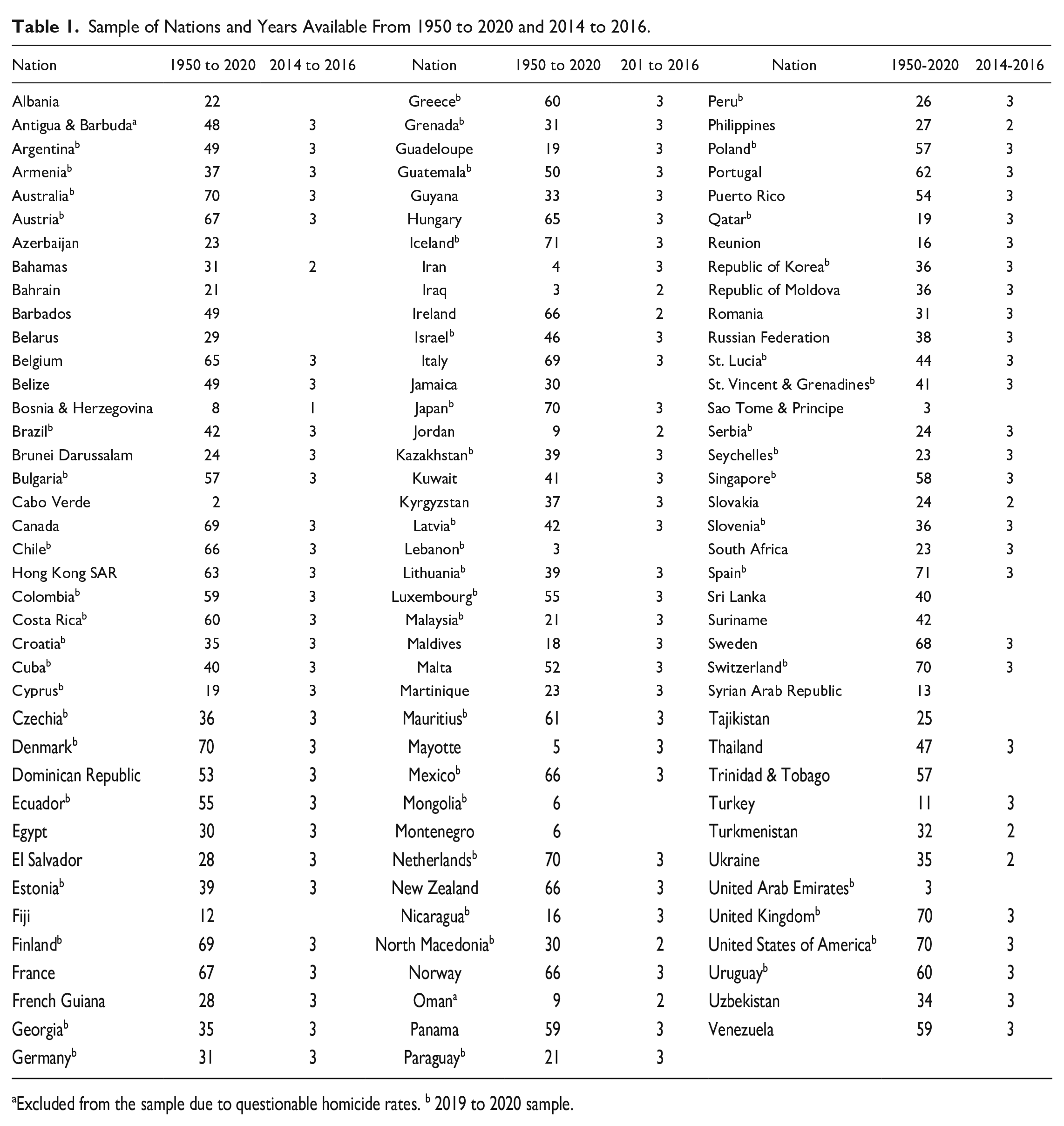
Excluded from the sample due to questionable homicide rates. b 2019 to 2020 sample.
A secondary sample was also limited to countries that had data available between 2014 and 2016. This reduced the sample to 93 nations. Of these nations, Antigua and Barbuda and Oman both had questionable trends in homicide victimization (reporting no homicides over multiple years). Therefore, we removed them from the sample. The average number of years that nations had homicide data from 2014 to 2016 is 2.88 years.
For some analyses, the sample was limited to countries that had homicide data from 2019 to 2020. Fifty-four nations meant this criterion. The average number of years that the nations had homicide data for 2019 to 2020 was 2 years.
Data
We obtained homicide victimization rates per 100,000 population, gender-specific homicide rates (male and female) per 100,000 gender-specific population, and age-specific (15-24, 25-34, 35-44, 45-54, and 55+) homicide victimization counts from the WHO mortality platform (World Health Organization, 2023). To obtain the age-specific homicide victimization rates per 100,000 age-specific population, we combined the age groups from the WHO mortality platform and used age-specific population totals from the United Nations Demographic Statistics Database. WHO defines homicide victimization using ICD-10 classifications (X85-Y09, Y871). 1
We use the WHO mortality platform over alternative sources due to the reliability of the data. The WHO mortality platform does not estimate homicide victimization rates when nations do not report their data, nor does it upweight (or down weight) homicide victimization rates. For more information on why WHO mortality data is preferred over all other sources of homicide data across nations, see Rogers and Pridemore (2023) and Kanis and colleagues (2017).
Results
RQ1: How Often Did Nations Observe Similar Increases in Homicide Victimization?
To answer our RQ1, we start by exploring the percentage of nations that had increases in their year-to-year homicide rates. To do this, we simply first differenced the homicide rate and coded a dichotomous variable as 1 if the first difference rates were positive and 0 if they were negative. Then we found the yearly percentage of nations that observed an increase. The percentage of nations with an increase was calculated as the number of nations that were coded 1 divided by the sample of nations that had data available for the specific year under study.
Figure 2 provides the percentage of nations that observed an increase in the year-to-year difference in homicide rates and the count of nations that had data available within the year. Over the 72 years of data, there are 28 years in which 50% of nations observed simultaneous increases in homicide victimization. Furthermore, there were 8 years in which 60% to 69.99% of nations observed increases in homicide victimization (1956, 1967, 1971, 1973, 1981, 1988, 1990, and 1992). Finally, there is only 1 year (1989) in which 70% of nations observed an increase in homicide victimization.
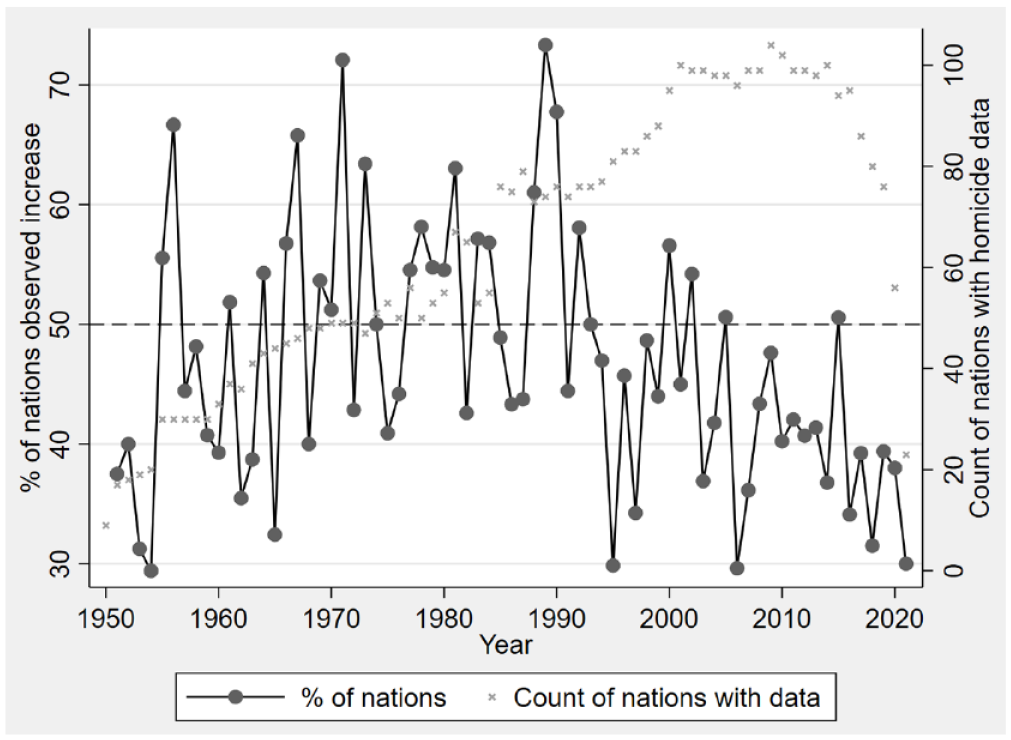
Percent of Nations That Had a Year-to-Year Increase in Homicide Victimization.
Therefore, from 1950 to 2020, there are few years where there is some suggestion of a universal increase of homicide victimization across a little more than half of the nations under study. However, this is not evidence of a universal trend in homicide victimization (for more discussion, see Rogers & Pridemore, 2018). These simultaneous increases could just be noise and due to random variations in within-nation homicide rates. Furthermore, as the sample of nations that have available mortality homicide victimization rates from WHO increases, it becomes increasingly rare for >50% of nations to observe simultaneous homicide victimization increases.
There is little evidence that other nations also observed the increases in homicide victimization experienced in the United States between 2014 to 2016 and 2019 to 2020. The number of nations experiencing simultaneous increases from 2014 to 2016 only once reaches 50%. Therefore, any similarities may be the result of noise and random chance. Despite a small sample of countries with homicide data for 2019 to 2020, very few of the countries observed simultaneous increases (30%).
Research Question 2 (RQ2): Did Nations Other Than the United States Also Experience an Increase in Homicide Victimization Between 2014 and 2016? Or Only During Some of the Time?
To answer our RQ2, we explored simultaneous and non-simultaneous increases in homicide victimization by graphing the homicide rates per 100,000 population and the gender-specific homicide victimization rates. For these analyses, we restricted our sample to nations that had homicide data available from 2014 to 2016. In addition, we restricted the study years 2010 to 2020. We then classified nations based on whether they had increases in homicide victimization throughout the 2014 to 2016 range, from 2014 to 2015, from 2015 to 2016, before 2014, and after 2016.
Of the 93 nations with valid data available between 2014 and 2016, 12.9% (n = 12) observed an increase in homicide victimizations. Figure 3 provides the homicide victimization and gender-specific homicide victimization rates for 2010 to 2020 for these nations.
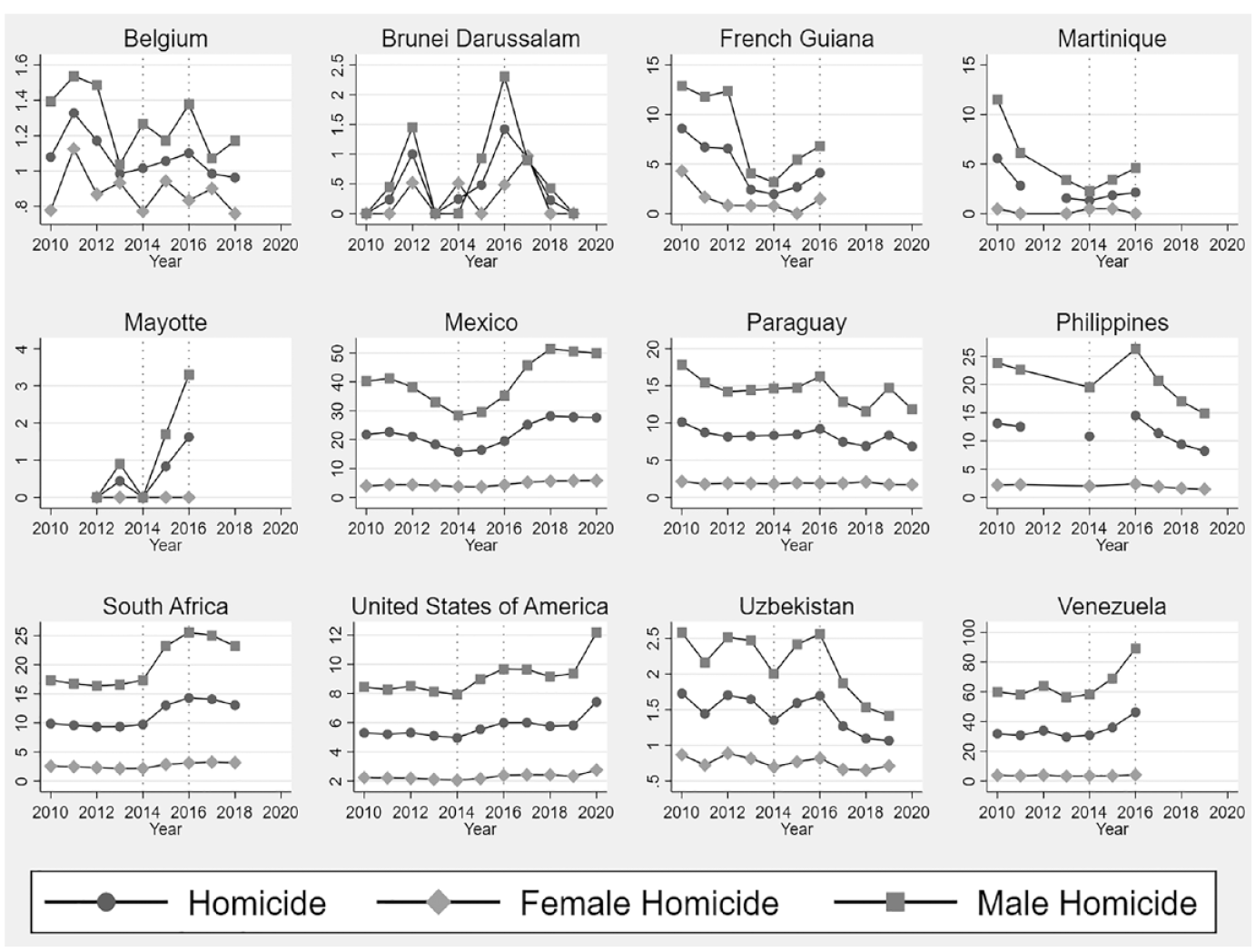
Homicide and Gender-Specific Homicide Victimization Rates for Nations That Observed an Increase From 2014 to 2016.
With only 12.9% of the nations in the sample experiencing an increase in homicide victimization from 2014 to 2016, it does not appear that the increase in homicide observed in the United States is universal. However, there are reasons to suspect that changes in homicide victimization may not occur simultaneously across all nations. Therefore, we explored nations that had increases in homicide victimization during different times.
First, we look at nations that observed an increase in 2014 to 2015. Figure 4 provides the rates of homicide and gender-specific homicide victimization for nations that observed an increase in homicide in 2014 to 2015. Of the nations in the sample (n = 93), 35.5% (n = 33) observed an increase in homicide between 2014 and 2015. Therefore, if we included nations that observed an increase in homicide between 2014 and 2016 (n = 12), this would mean that 48.4% (n = 45) observed an increase in homicide victimization at some point during the 2014 to 2016 period.
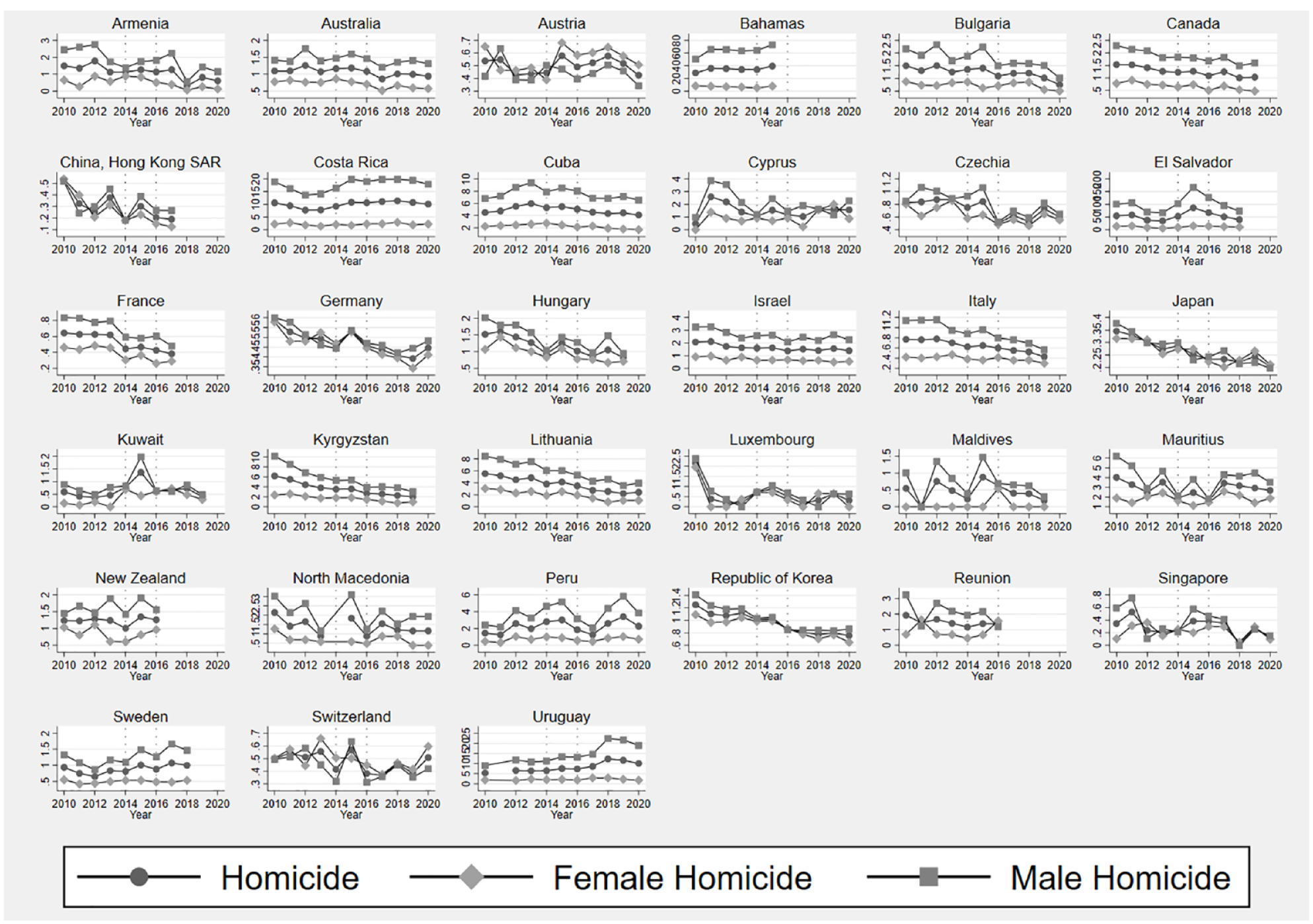
Homicide and Gender-Specific Homicide Victimization Rates for Nations That Observed an Increase From 2014 to 2015.
Furthermore, 19.4% (n = 18) of nations observed an increase in homicide victimization in 2015 to 2016. Figure 5 provides the homicide and gender-specific homicide victimization rates for nations that observed an increase in homicide victimization from 2015 to 2016 only. Meaning that at some point in 2014 to 2016 67.7% (n=63) of the nations in our sample experienced an increase in homicide victimization.
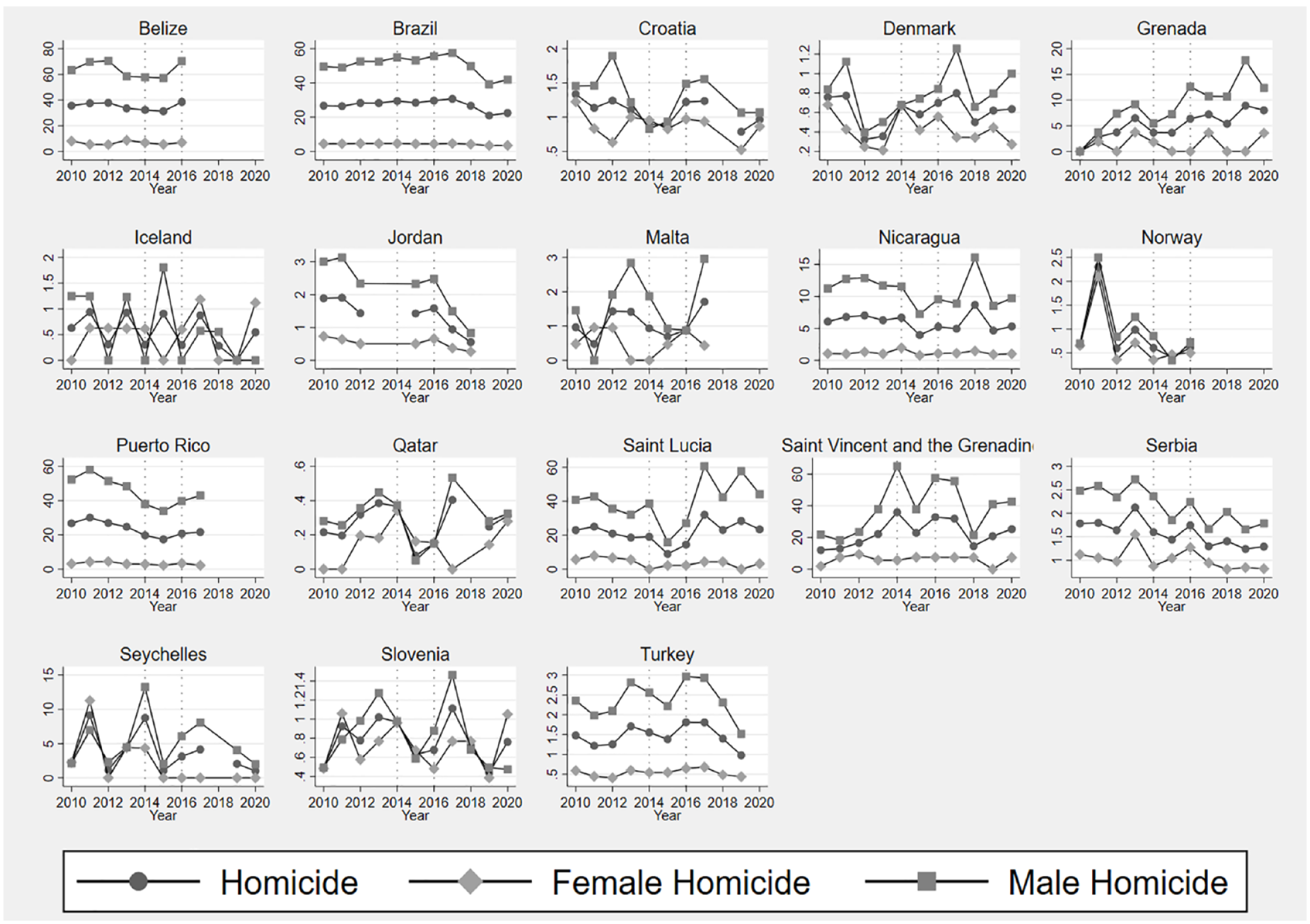
Homicide and Gender-Specific Homicide Victimization Rates for Nations That Observed an Increase From 2015 to 2016.
We also examined whether nations had an increase before 2014 and after 2016. Between 2010 and 2013, 16.1% (n = 15) of the nations in the sample observed an increase in homicide victimization. After 2016, 5.4% (n = 5) of the countries observed an increase in homicide victimization.
Research Question 3 (RQ3): Did Nations Other Than the United States Also Experience an Increase in Homicide Victimization Between 2019 and 2020?
To answer our RQ3, we further restricted our sample to only countries that had available homicide data for 2019 to 2020 (n = 54). Of these nations, 30% (n = 16) observed an increase in homicide victimization between 2019 and 2020. Figure 6 provides homicide rates and gender-specific homicide victimization rates for nations that observed an increase in homicide victimization from 2019 to 2020.
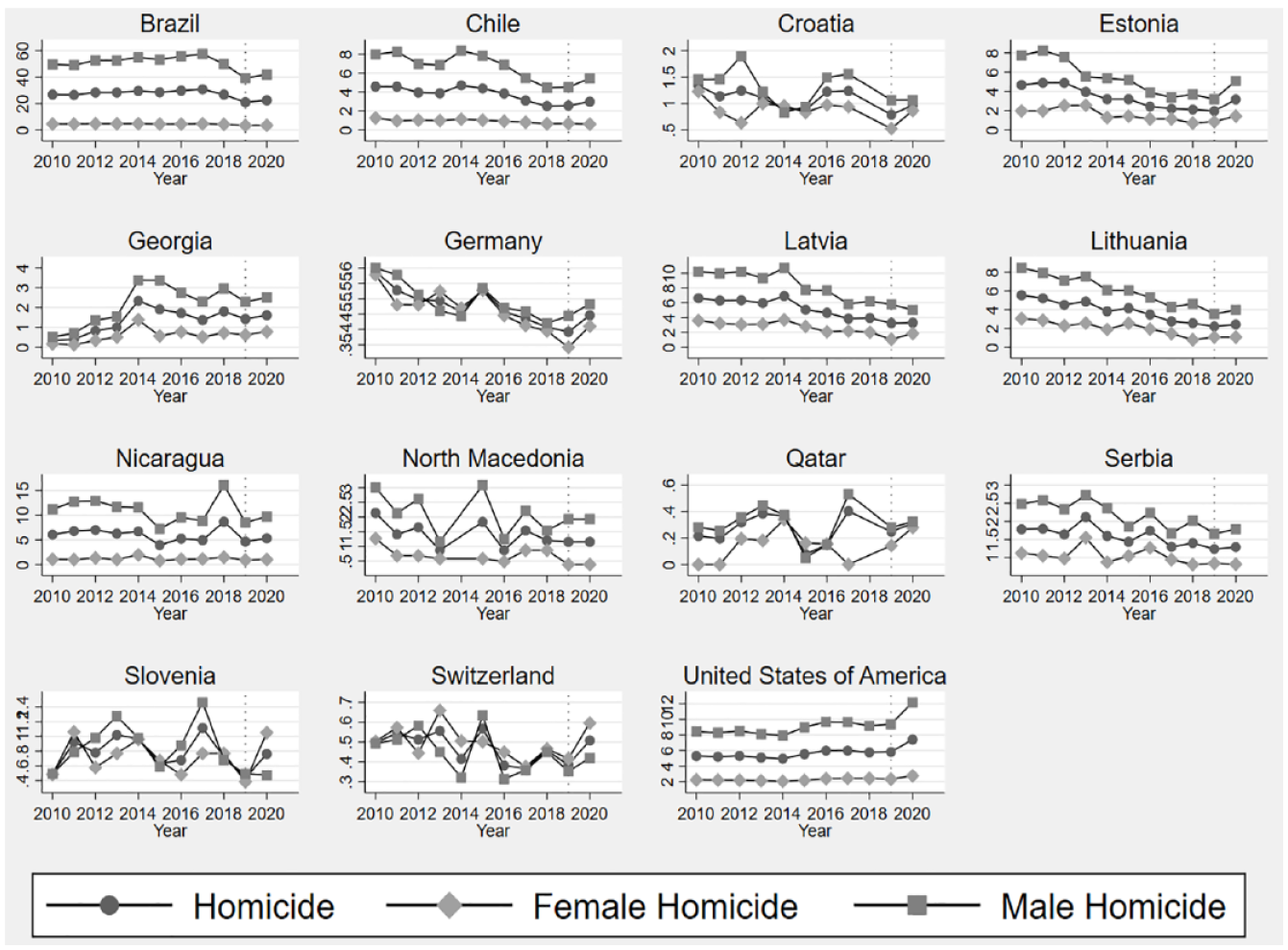
Homicide and Gender-Specific Homicide Victimization Rates for Nations That Observed an Increase From 2019 to 2020.
There does not appear to be an increase in homicide victimization that is shared among nations from 2019 to 2020. Most of the sample did not observe an increase during that period. However, the sample size is small, as there are no homicide data available yet for most nations in 2020. As more data become available, this research question should be revisited.
Research Question 4 (RQ4): Can Changes in Gender- and Age- Specific Homicide Rates Help Put the Increases in Homicide Victimization Into Context?
Finally, to answer our RQ4, we created two additional graphs to explore the age-specific homicide victimization rates for nations that observed increases in 2014 to 2016 and 2019 to 2020. We already provided the gender-specific homicide victimization rates in previous graphs.
For countries that experienced an increase in homicide victimization between 2014 and 2016, most of the nations experienced simultaneous increases in female and male-specific homicide victimization rates (see Figure 3). The exceptions are Belgium, Brunei Darussalam, French Guiana, and Martinique. In Belgium, female homicide rates increased from 2014 to 2015, while male homicide rates increased from 2015 to 2016. In Brunei Darussalam and French Guiana, the rates of female homicide victimization initially decreased in 2014 to 2015, then increased in 2015 to 2016. For all other nations in the sample, the highest increases experienced were for male homicide victimization rates between 2014 and 2016.
Of the nations that observed an increase in homicide victimization between 2019 and 2020, Estonia, Georgia, Germany, North Macedonia, Qatar, Switzerland, and the United States all observed increases in female and male homicide victimization (see Figure 6). For Switzerland and Slovenia, female homicide rates were higher than the male homicide victimization rates. Croatia, Latvia, Saint Vincent and Grenadines, and Slovenia all observed increases in female homicide victimization in 2019 to 2020. St. Vincent and the Grenadines technically had an increase in both male and female homicide victimization rates, but the increase in female homicide victimization was much steeper than male homicide rates. Finally, Brazil, Chile, Lithuania, Nicaragua, and Serbia observed increases in male homicide victimization rates.
Figure 7 provides the age-specific rates of homicide victimization and overall homicide victimization rates for nations that observed an increase in homicide victimization from 2014 to 2016. Age-specific homicide victimization rates in Mexico, Paraguay, the Philippines, South Africa, the United States of America, Uzbekistan, and Venezuela appear to trend with the overall homicide victimization rates. Slightly older populations tend to contribute to the increases in homicide victimization observed from 2014 to 2016. Venezuela is an exception because the rate of age-specific homicide victimization of 15 to 24 had the strongest increase of all age groups.
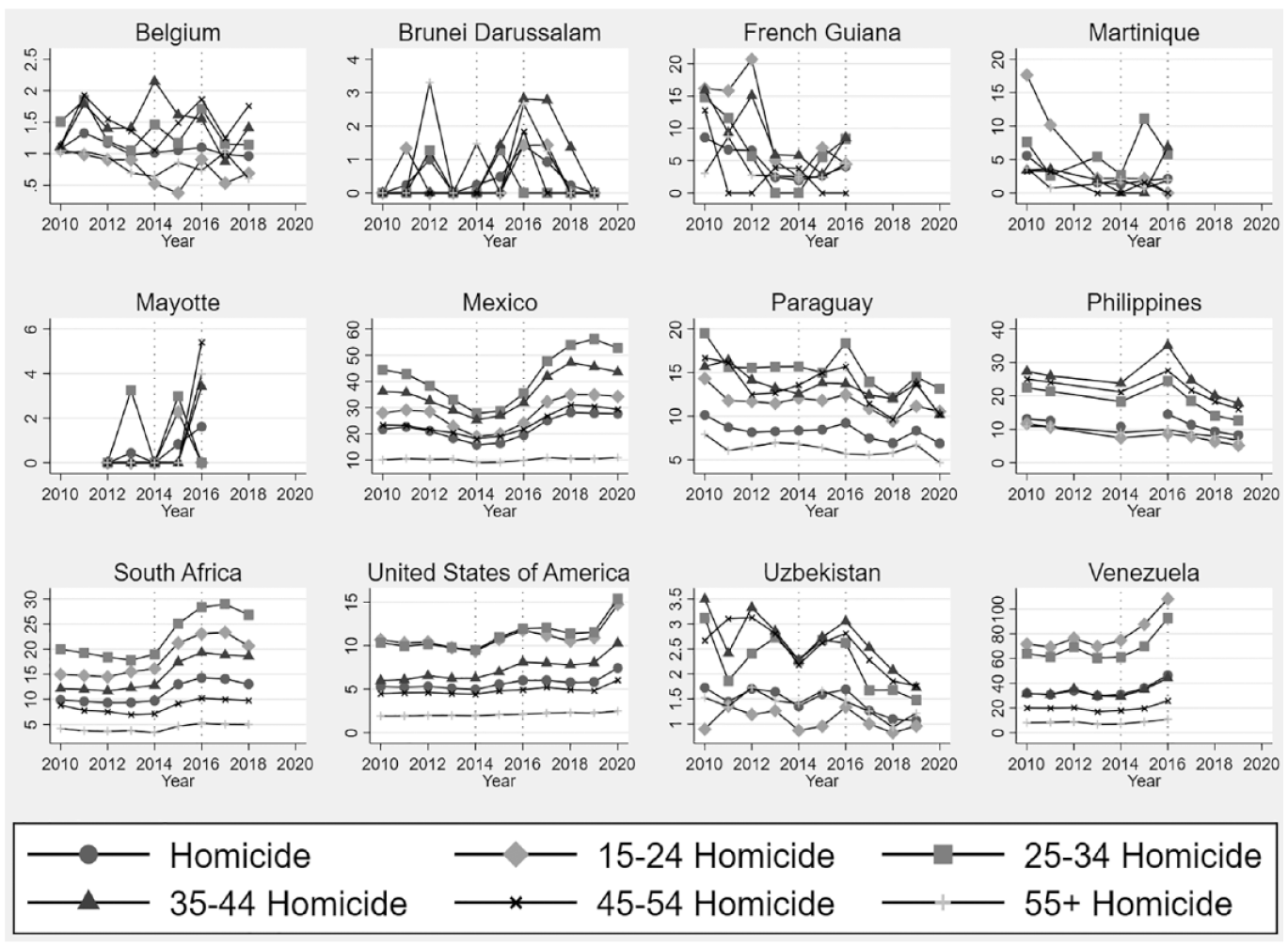
Homicide and Age-Specific Homicide Victimization Rates for Nations That Observed an Increase From 2014 to 2016.
Figure 8 provides the age-specific rates of homicide victimization and the overall rates of homicide victimization for nations that observed an increase in homicide victimization from 2019 to 2020. Brazil, Chile, Estonia, Latvia, Nicaragua, and the United States all have age-specific homicide victimization rates that trend well with overall homicide victimization rates. Other nations had slightly older populations that contributed the most to increases in homicide victimization rates from 2019 to 2020. Their slightly older age groups having some of the highest (or at least higher homicide victimization rates than the overall homicide victimization rate) are unexpected, based on some research (Santos & Testa, 2018). However, others maintain that the young population (usually 15-24) is not expected to have the highest victimization rates across most nations (Rogers, 2014).
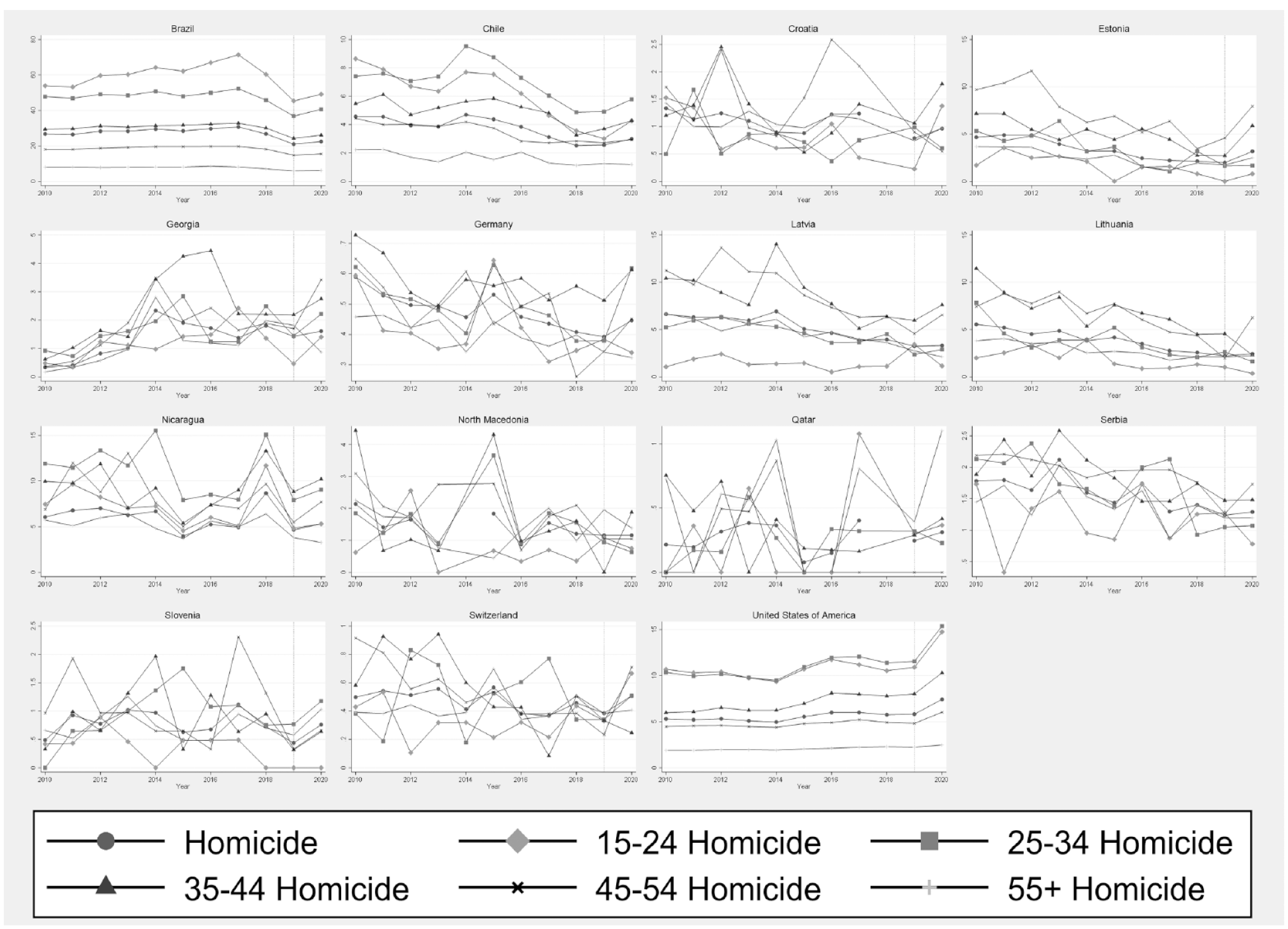
Homicide and Age-Specific Homicide Victimization Rates for Nations That Observed an Increase From 2019 to 2020.
Switzerland and Brazil are the only nations in which the 15 to 24 age group had the highest homicide rates in 2019 to 2020. Chile and the United States both observed increases in the 25 to 34 age group as the highest homicide rates, but the 15 to 24 age group was the second highest. Therefore, overall age appears to contribute to increase in homicide victimization in 2019 to 2020 increases, but it is not the age group that we might expect for most nations.
Discussion
The purpose of this study was to explore whether other nations had similar trends in homicide victimization as the United States. Specifically, we investigated whether there was a universal increase in homicide victimization in 2014 to 2016 and 2019 to 2020. We also considered the possibility that increases in homicide victimization would not occur simultaneously in all nations. That a nation may observe an increase in homicide during some part of the 2014 to 2016 range and before or after 2014 to 2016. This is because it is unlikely that the correlates of homicide victimization within nations will have simultaneous temporal effects on homicide across all nations. We did not explore the causes of the increases observed within nations, nor will we attempt to account for them because additional research is necessary to understand if what we believed caused increases in homicide in the United States also created those increases in other nations.
In general, it is difficult to argue that there were simultaneous increases in homicide victimization across nations in 2014 to 2016 and again in 2019 to 2020. This is not overly surprising, given previous research exploring yearly fluctuations in homicide victimization across nations only observed a weak overall trend in homicide victimization (LaFree et al., 2015; Rogers & Pridemore, 2018). However, despite the weak supranational trend, many scholars have maintained that there are likely universal trends in homicide victimization (Santos & Testa, 2018; Tonry, 2014; Tuttle et al., 2018). When exploring simultaneous changes, it is difficult to make a case that there is a universal trend of homicide victimization in any classification of nations.
First, we observed that from 1950 to 2020, there were 28 years in which half of the nations in the sample observed an increase in homicide victimization simultaneously. However, as the sample sizes of countries that have available homicide data increased, the frequency of simultaneous increases in homicide victimization decreased. Indicating that it is likely that the previous observations were the result of a homogeneous sample.
Our next research question explored which countries observed an increase in homicide victimization from 2014 to 2016, and only during some of the time. We found that 12.9% observed a simultaneous increase in homicide during the 2014 to 2016 period. Within the 2014 to 2016 period, 35.5% observed an increase from 2014 to 2015% and 19.4% from 2015 to 2016. Therefore, approximately 67.7% of the sample observed some increase in homicide victimization during 2014 to 2016. Given that over a majority of nations experienced an increase, there is tentative support that nations experienced an increase in homicide victimization at some point between 2014 and 2016. Even though WHO mortality data are some of the best measures of homicide (Rogers & Pridemore, 2023), the data are not free of measurement error.
Within the U.S. literature, the general explanation is the opioid epidemic (which was experienced at least in most Western nations) could contribute to the observed increases. Testa and colleagues (2022) observed a relationship between opioid-related deaths and victimization by homicide. However, their research included only parts of the period understudy and only OECD nations. Future research should explicitly explore whether the increases observed during the 2014 to 2016 time frame could be contributed to the opioid epidemic.
Our next research question shifted the period: Was there a universal increase in homicide from 2019 to 2020? The sample size here is much smaller because the WHO has a long delay between when homicide counts are reported for public use and the current year. Of the 54 nations that had homicide victimization data from 2019 to 2020, only 30% had an increase in homicide victimization. Therefore, most countries did not observe an increase in homicide victimization in 2019 to 2020. However, the sample size is small, and this question should be revisited as more data become available.
The causal mechanism between COVID-19 and the increase in homicide in the United States is unclear. However, based on the small sample of nations in this study, it is unlikely that there was a universal increase in homicide in 2019 to 2020. Although COVID-19 has a global impact, it does not appear to have a strong impact on homicide in all nations. However, we only conducted rudimentary exploratory analyses, and future research should explicitly test for the effect of COVID-19 on homicide in 30% of sample nations that observed an increase in homicide during 2019 to 2020.
Finally, our last research question sought to better understand the possible explanation for increases in homicide in 2014 to 2016 and 2019 to 2020 by situating the increases within gender- and age-specific homicide victimization data. In general, many nations had similar trends for men and their overall victimization of homicides. This is not surprising because men are typically the most likely victims of homicide even outside of the United States (LaFree & Hunnicutt, 2005). There were a few exceptions where the female homicide victimization rates were higher (Switzerland and Slovenia) than the male homicide victimization rates. Finally, age-specific homicide victimization still does not support that the young population (15-24) has the highest victimization rates across nations (Rogers, 2014). However, for many nations, age-specific homicide rates trend with the overall homicide victimization rates.
Future Directions
Future research on cross-national trends in homicide victimization should explore the explanations for the shared trends in homicide victimization between nations in 2014 to 2016. Although the supranational trend is weak, the majority of our sample for 2014 to 2016 had an increase in homicide victimization at some point. Using these nations as informed samples (similar to the work of Adıyaman & Kasman, 2022) could help build stronger theoretical explanations for homicide across nations.
There is evidence that nations might share increases in homicide victimization, but these increases do not occur simultaneously. Instead, the correlates that influence homicide victimization across nations might be activated at various times, or policies within nations might reduce the effects of the correlates. When comparing trends between nations, researchers in the future should continue to be cautious about year-to-year comparisons.
Footnotes
Declaration of Conflicting Interests
The author(s) declared no potential conflicts of interest with respect to the research, authorship, and/or publication of this article.
Funding
The author(s) received no financial support for the research, authorship, and/or publication of this article.