




Abstract
Young people with a migrant background are often overrepresented in crime statistics. This study used data from the third International Self-Report Delinquency (ISRD3) study to examine to what extent cultural alignment—cultural resemblance between host and heritage country—and structural influences—socioeconomic starting position and related disadvantage—mediated differences in offending between native students and students of four different migrant backgrounds—Western, Post-Communist, Asian, Middle Eastern—in five Western European countries. This study showed that all migrant groups, except for the Asian group, had significantly higher lifetime serious offending rates than native students. Opposed to the expectations, however, the Western group with the highest levels of cultural alignment—suggesting easier adaptation to the host country—also had the highest offending rates. In the mediation analysis, cultural alignment and structural disadvantage did not satisfactorily explain the relatively large differences in offending between Western and native students and further research would be needed to better understand these differences. In contrast, for the Middle Eastern group, structural disadvantage fully explained differences in offending with native students, also when accounting for cultural alignment; in other words, mechanisms related to structural disadvantage—for example, exposure to risks of delinquent development—for this group appeared to be more determining in explaining differences in offending with natives than their level of cultural alignment or background. For Asian and Post-Communist students, structural disadvantage mediated the largest part of the difference in offending with natives, but cultural alignment for these groups also explained part of this difference. This finding suggests that for these two groups mechanisms related to both cultural alignment—for example, acculturation processes, higher probability of parent–child conflict, and so on—and structural disadvantage are needed to understand differences in offending with native students.
Introduction
Immigration is a highly debated issue in many Western countries. Youth delinquent behavior is one outcome that is frequently linked to immigration in public debate. Popular media often represent immigration as a cause of crime and the growing fear of crime fostered by these media is dominating the public perception of immigration. Indeed, young people with a migrant background are often overrepresented in crime statistics (Junger-Tas et al., 2010). Previous international research, however, found that some countries produce better outcomes for youths with a migrant background than others, for instance, in educational achievement and well-being but also in lower levels of delinquent behavior (Fossati, 2011; Junger-Tas et al., 2010; Killias, 1989). These findings imply that migrant background—if at all—is not the only factor in youth delinquent development.
In the academic literature, theoretical perspectives regarding the so-called crime–immigration nexus generally fall into two groups: “culturalist” and “structuralist” perspectives (Portes & Rivas, 2011). Culturalists tend to focus on adaptation to the host country and developmental problems that could result from adolescents developing in the context of several, possibly conflicting, cultural frameworks at home, at school, and in the neighborhood (see, for example, Atzaba, Poria, & Pike, 2007; Marsiglia, Nagoshi, Parsai, Booth, & Castro, 2014; Phinney, Ong, & Madden, 2000). Structuralists, on the contrary, emphasize structural factors, such as socioeconomic position of migrant families, and related advantages or disadvantages that may influence adolescent development (e.g., Brody et al., 2001; Elliott et al., 1996; Sampson, Morenoff, & Raudenbush, 2005).
Despite global significance, most knowledge on the crime–immigration nexus and related theories derives from single city- or country-based studies, many of which situated in the United States (e.g., Davies & Fagan, 2012; Martinez, 2006; Morenoff & Astor, 2006; Ousey & Kubrin, 2009; Sampson et al., 2005). Many of these US studies find no evidence for increased rates of migrant offending and even report protective influences of migration on offending. Research, however, suggests that the context of immigration and related theoretical development in the United States may not fully pertain to the European situation (Portes & Rivas, 2011; Thomson & Crul, 2007). Several European studies report significantly higher offending rates for migrant than for native youth in different European countries (e.g., Hallsten, Szulkin, & Sarnecki, 2013; Salmi, Kivivuori, & Aaltonen, 2015). One of the few internationally comparative studies on youth delinquent behavior—the second wave of the International Self-Report Delinquency (ISRD2) study—presents mixed findings with significantly higher levels of offending for migrant youth in some countries (the Czech Republic, Italy, Slovenia, Switzerland, Sweden, subgroups in Germany, the Netherlands) and not in other countries (e.g., Denmark, Finland, Russia, United States) (Junger-Tas et al., 2010).
Cross-national research on this matter is limited as comparability of data is complicated by the vast variety of data sources, differences in data collection, and variation in methodological quality across studies and countries (Junger-Tas et al., 2012; Killias, 1989). This study contributes to the existing literature using a cross-national comparative research design with data from five Western European countries—Austria, Belgium, Germany, the Netherlands, and Switzerland—to examine the relative contribution of cultural alignment—cultural resemblance or distance between country of residence and country of origin—and structural influences in differences in self-reported youth delinquent behavior between migrant and native youth to facilitate better understanding and theory development in the European context.
This study uses the third International Self-Report Delinquency (ISRD3) study, a study among 12- to 16-year-old high school students in more than 35 countries (Enzmann et al., 2017). The main research question is as follows: To what extent do cultural alignment and structural influences explain possible differences in self-reported serious lifetime offending between native students and students with a migrant background? Previous research has shown that the long-term positive or negative consequences of migration are particularly felt by the children of immigrants (Morenoff & Astor, 2006; Portes & Rivas, 2011; Zhou, 1997a). This article focuses on the first- and second-generation children with a migrant background and compares their involvement in delinquency with that of native-born students.
Background
Culturalist Perspective
Culturalist perspectives primarily focus on the cultural and linguistic adaptation of children with a migrant background to the host society and on mechanisms underlying more positive or negative adaptation and associated adolescent development. Adolescent development of migrant children happens in the context of two or more different, possibly contradictory, cultural frameworks to which they have to relate in the formation of their own behavior, belief, and value systems (Berry, Phinney, Sam, & Vedder, 2006). This process, often referred to as acculturation, does not stand alone, but happens in the family setting with parents going through their own processes of acculturation (Marsiglia et al., 2014; Telzer, 2010). Although children of migrants are socialized to the language, values, and beliefs of their host country at school and in the neighborhood, parents may have a harder time learning the language and accepting new lifestyles and value systems their children adjust to. Dissonance in the acculturation rates of parents and children, or an acculturation gap, has been related to increased parent–child conflict and relatedly maladaptive adolescent development, such as depression, delinquent behavior, and the use of serious violence by migrant youth (Schwartz et al., 2013; Telzer, 2010).
More resemblance between the host and culture of heritage—cultural alignment—facilitates easier adaptation of both parents and children and consequently decreases the acculturation gap and related adolescent problem behavior. Conversely, where cultural differences are larger, the likelihood of an acculturation gap and thus the probability of problem behavior and delinquent offending is greater. Nevertheless, several studies suggest that parental acculturation may also have adverse effects as protective influences from the heritage culture against risk behaviors slowly disappear (Thomas, 2011). In the United States, Marsiglia et al. (2014), examining Mexican American families, found that a greater parent–child acculturation gap was associated with more parental monitoring and a consequent protective effect on problem behaviors, whereas more parental acculturation was associated with less monitoring and more adolescent risk behavior.
Structuralist Perspective
Structuralist perspectives generally relate to the socioeconomic position of migrant families and associated advantages or disadvantages (Zhou, 1997a). Recent Organisation for Economic Co-operation and Development (OECD; 2015) statistics report an overrepresentation of immigrants among both highly educated and less educated populations in many OECD countries. The starting position of migrants has large implications for their children’s progression and adaptation to society.
Professional migrants with a higher educational degree and direct access to the mainstream labor market provide their children with a better socioeconomic starting position in terms of neighborhood and school quality, access to valuable social networks, and opportunities for success compared with unskilled migrants working in poorly paid jobs (Zhou, 1997a). In the United States, positive outcomes for young people with a migrant background have been found to largely result from the social progression and positive outcomes of children from professional immigrants (Portes & Rivas, 2011). Children of low-status migrants, on the contrary, are more likely to end up in disadvantaged neighborhoods and are consequently exposed to more risks associated with a higher probability of youth delinquent development (e.g., Elliott et al., 1996; Ousey & Kubrin, 2009; Portes & Rivas, 2011; Thomas, 2011), even to the extent that some scholars in the United States have come to speak of the risk of “generations of exclusion” (Telles & Ortiz, 2008) or “permanent poverty and assimilation into the underclass” (Zhou, 1997b).
In the criminological literature, social disorganization theory represents a structuralist perspective that links living in disadvantaged situations to potentially higher crime involvement. Building on research of the Chicago School, Shaw and McKay (1942) observed that specific areas were consistently associated with high crime rates over several decades, despite changes in ethnic composition. Social disorganization does not explain offending behavior as such. Low informal social control is considered to be the mechanism linking social disorganization to higher offending (Sampson, Morenoff, & Gannon-Rowley, 2002). Higher social mobility and heterogeneity in these socially disorganized areas prevented the development of informal social networks to exercise informal social control. Immigration may contribute to high residential mobility and ethnic heterogeneity in certain areas. However, low informal social control and higher social disorganization have been found to similarly affect all people living in an area, whether migrant or native (Reid, Weiss, Adelman, & Jaret, 2005). In this view, overrepresentation of people with a migrant background in disadvantaged areas and exposure to negative influences regarding delinquent development would then explain overrepresentation of migrants in crime statistics. Besides neighborhood quality, poor school quality and marginalized schools in disadvantaged areas could result in a cumulation of disadvantage for children living in these areas (Borgna & Contini, 2014; Portes & Hao, 2004). Previous studies have associated concentrated disadvantage and living in disadvantaged neighborhoods with several negative developmental outcomes, such as alcohol and substance use, problem behavior, and delinquent development (Odgers et al., 2009; Wright, Kim, Chassin, Losoya, & Piquero, 2014).
Model and Hypotheses
In this study, the central concepts are operationalized as shown in Figure 1.
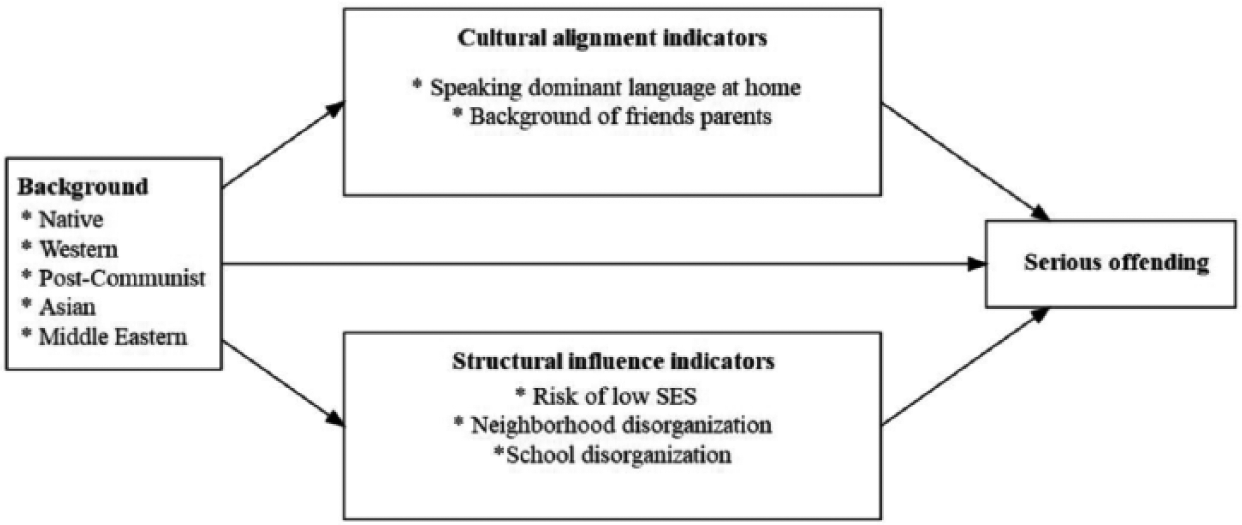
Mediation model.
As shown in Figure 1, this study considers four migrant subgroups from different regional backgrounds: Western, Post-Communist, Asian, and Middle Eastern. The first three hypotheses in this study are related to the relationship between migrant background, cultural alignment, and structural deprivation.
That is, native-born students will exhibit the highest level of cultural alignment with the host country. Students with a Western background will be most comparable to the native group and will still have relatively high levels of cultural alignment, followed by students with a Post-Communist background with somewhat lower levels. Students with an Asian or Middle Eastern background are expected to exhibit the lowest levels of cultural alignment.
That is, native-born students will experience the lowest levels of structural disadvantage, followed by students with a Western background with comparable levels of disadvantage, then students with a Post-Communist background with already higher levels of disadvantage, with students with an Asian or Middle Eastern background experiencing the highest levels of structural disadvantage.
The last three hypotheses of this study are related to the relationship between migrant background and delinquency. Based on acculturation theory, one would expect levels of delinquency to reflect levels of cultural alignment.
Following expectations stated in Hypotheses 1 to 3 about different migrant backgrounds and cultural alignment, self-reported delinquency rates of students with a Western background will be most similar to those of native-born students, whereas rates are expected to be most dissimilar—and highest—for students with an Asian or Middle Eastern background. Students with a Post-Communist background will be in between the Western group and the Asian and Middle Eastern group in terms of offending rates.
Given that the previous hypotheses only related to average group differences, a presumed within-group variation in cultural alignment and structural deprivation leads to the last two hypotheses.
That is, for all groups, lower levels of cultural alignment, and relatedly implicit processes described in acculturation theory, explain part of higher offending for students from different migrant backgrounds as compared to native-born students.
In accordance with structuralist perspectives, the expected poorer socioeconomic starting position of groups with lower levels of cultural alignment and relatedly their higher exposure to structural disadvantage and risks of delinquent development is expected to explain more of the hypothesized difference in offending between native and migrant students than their level of cultural alignment.
The next section will describe the methods used to test these six hypotheses.
Method
Selection of Countries
The focus of this article is on Western European countries as these countries are more similar in terms of gross domestic product (GDP), wealth and welfare structure, and to some extent migrant population (e.g., Eurostat, 2017; OECD, 2017; The World Bank, 2016a). Within the ISRD3 dataset, we selected those countries with a substantial proportion of participating students with a migrant background in the sample; a selection of five countries was achieved, namely, Austria, Belgium, Germany, the Netherlands, and Switzerland.
Data Collection
Data were collected during the third wave of the International Self-Report Delinquency (ISRD) study among the seventh, eighth, and ninth grade students aged 12 to 16 in more than 35 countries between 2012 and 2016 (Dataset ISRD3 v1-1, February 13, 2017). The subsample of five countries included 17,604 students. About 5% had at least one missing observation (N = 960). Cases were omitted from the analysis if they had more than one missing item on one of the latent variables and/or missing observations on outcome variable, other independent variables, or control variables (N = 589; 3.4% of subsample). Countries employed a multistage sampling procedure with school classes in two major cities of the country as primary unit with proportionate-to-size sampling. Countries with a national sample oversampled in two larger cities (see Table 1) (see Enzmann et al., 2017, for a more detailed overview of data collection and sampling procedures for all participating countries).
Overview of Data Collection by Country (Based on Enzmann et al., 2017).
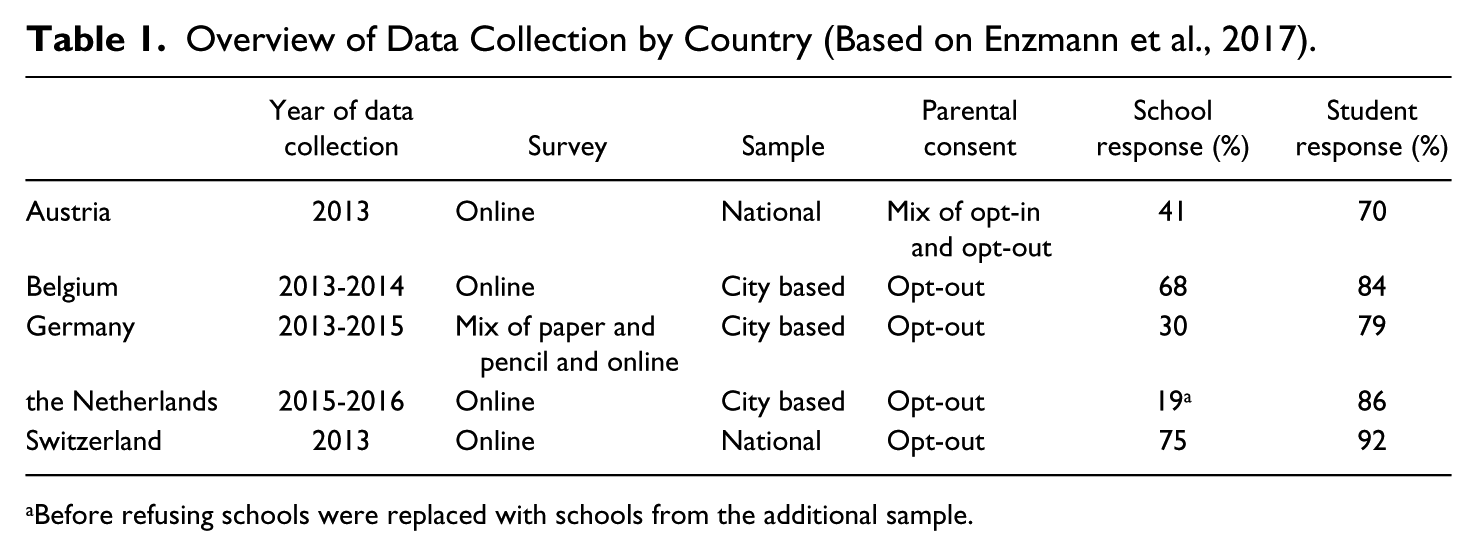
Before refusing schools were replaced with schools from the additional sample.
Standardized online and paper-and-pencil surveys were used to collect data in the classroom setting. Four countries exercised passive parental consent (opt-out) procedures which meant that parents had to indicate if they did not want their child to participate in the study. Only Austria employed a mix of active and passive parental consent (opt-in/opt-out). Participation in the survey was anonymous and students were allowed to refuse participation during data collection. School response varied for most countries between 41% and 75%, with relatively low rates for Germany (30%) and the Netherlands (19%, but 33% after replacing refusing schools with schools from the additional sample). Student response was generally high, ranging from 70% to 92%.
Measures
The ISRD3 survey mainly included modules of questions that had been translated and validated during the second wave of ISRD (Junger-Tas et al., 2012). New question modules were based on validated translated scales whenever available. Measures are briefly described, and a summary of measures is provided in Table 2.
Overview of Measures.
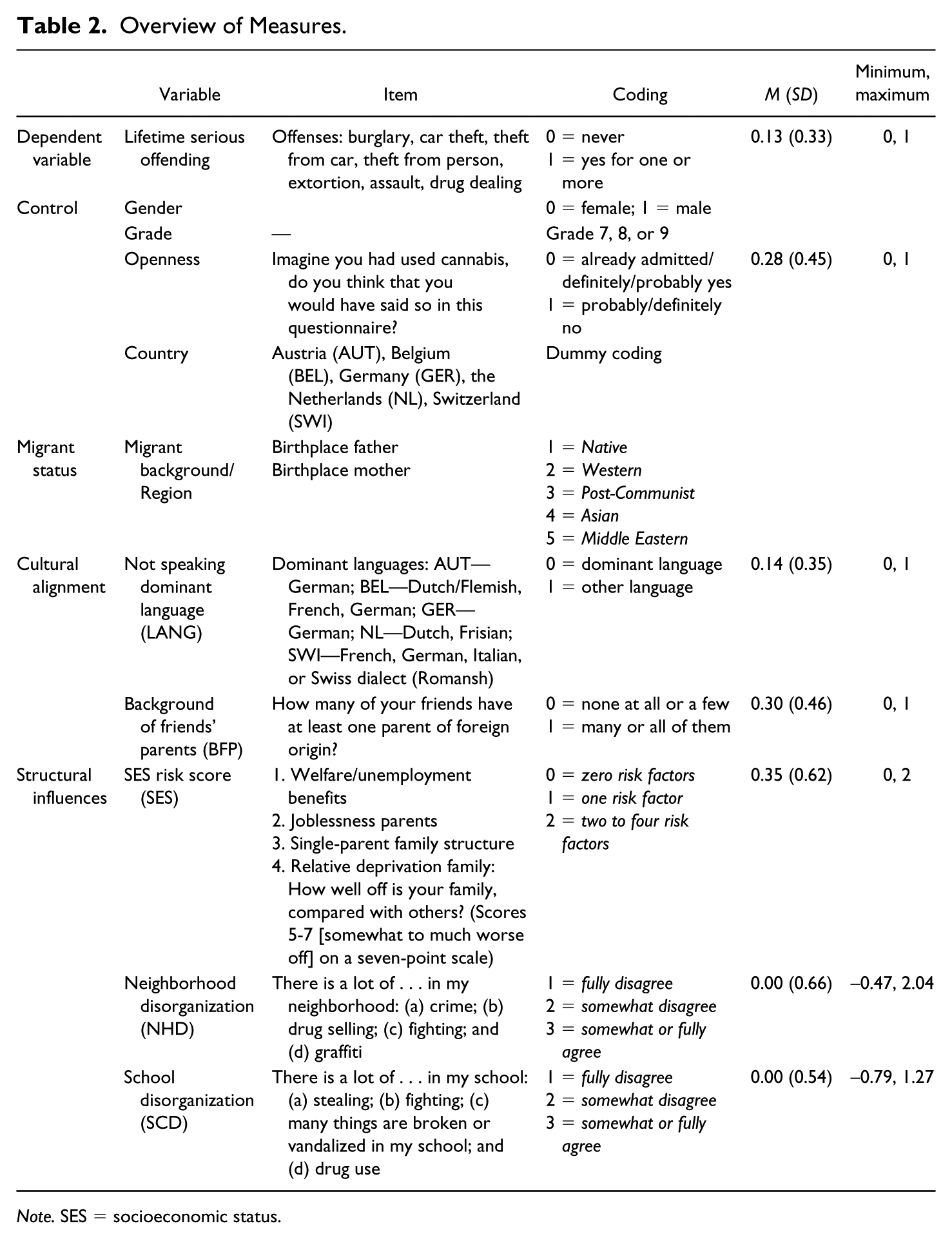
Note. SES = socioeconomic status.
Delinquent behavior
A binary indicator of lifetime serious offending was used as a delinquency measure (yes if ever engaged in one or more offenses). Items were originally adapted from the National Youth Survey (Elliott, Huizinga, & Ageton, 1985). In line with previous ISRD research, serious offenses included burglary, car theft, theft from car, theft from person, extortion, assault, and drug dealing (Junger-Tas et al., 2012). The selection of lifetime rather than last year offending as a measure of delinquent behavior particularly for first-generation migrant students raises the risk of some of these students reporting about behavior in the country of origin. For such students, this measure would then relate to behavior that is not associated with factors in the host country which is the main focus of this study. Although this risk cannot be completely denied nor prevented and data do not allow for the exclusion of this specific group from the analysis, it would most likely only concern a very small proportion of students. Most students in the sample are second generation and were thus born in the current country of residence (74% of the migrant students in the sample; see Table 4 in section “Sample Description”). Moreover, even of the first-generation students, most likely a considerable part will have arrived at an early age (before age 8) and are more comparable to second- than to first-generation students (i.e., they could not have engaged in this behavior in the country of origin). As such, possible effects are likely to be mitigated by the fact that despite relating to lifetime offending most of this reported behavior did occur in the country of residence, also for first-generation students. Gender, grade, openness or willingness to answer honestly, and country were included as control variables as these variables have all been found to influence rates of self-reported offending in previous studies.
Migrant status
Regional background was selected as a measure to represent the predictor variable migrant status. Four different regions were identified based on parent’s region of origin (United Nations, 2016; The World Bank, 2016b) 1 : (a) Western, for example, Anglo-Saxon (e.g., England, United Sates, Australia, New Zealand), Scandinavian, West and Southern Europe (e.g., the Netherlands, Belgium, France, Italy, Greece, Spain, etc.); (b) Post-Communist and Southeastern Europe; (c) Asian (e.g., China, Thailand, India); and (d) Middle East and North Africa.2,3 Students were considered native if both parents were native born and migrant if at least one parent was foreign born. In the case of only one foreign-born parent, students were assigned the region of this parent. Mother’s region prevailed if both parents had different origins. This classification based on four regions was deliberately chosen as a low number of regions would not do justice to the cultural diversity in the sample and a number of regions would complicate the analysis tremendously.
Cultural alignment
ISRD3 did not incorporate measures of cultural values, so cultural alignment and the related underlying mechanisms were assessed implicitly by two indicators that reflected an approximation of a respondent’s cultural alignment or resemblance to the host culture: speaking the dominant language of the host country at home or not; the number of friends with foreign-born parents. The first indicator, language, is considered a valid measure of cultural alignment (Levels & Dronkers, 2008), capturing both cultural closeness of first-generation immigrant families already speaking the language on arrival and acculturation within and over generations as people become more adapted to the host country. As such, language captures also natives speaking another language at home (e.g., third- or fourth-generation immigrants) (0 = dominant language; 1 = other language). The second indicator was dichotomized into a binary indicator representing the respondent’s share of friends with foreign-born parents (0 = “none” or “a few”; 1 = “many” or “all”). This indicator reflected the respondent’s level of integration into the host society.
Structural influences
A cumulative socioeconomic status (SES) risk score providing an indication of risk of low SES was calculated for each student (Beach et al., 2016). This score combined four different dichotomous indicators associated with an increased risk of low SES in previous research, namely, welfare or unemployment benefits as the source of household income, joblessness, single-parent family structure, and increased levels of perceived relative family deprivation (e.g., OECD, 2017). A risk score was generated ranging from 0 to 2 (0 = zero risk factors, 1 = one factor, 2 = two to four factors).
Neighborhood disorganization entailed a five-item scale based on a common neighborhood scale developed by Sampson, Morenoff, and Earls (1999) and included, for example, items on crime, drug selling, and fighting in the neighborhood. School disorganization included a four-item scale with disorganization items adapted to the school environment such as items on drug use, vandalism, and stealing at school. This school disorganization scale has previously been developed and tested in ISRD2 (Junger-Tas, 2012). As skewness was an issue, the reduction of response categories—combining responses “somewhat agree” and “fully agree” into one category—reduced skewness and kurtosis to an acceptable level for most school disorganization items; remaining nonnormality, mainly related to neighborhood disorganization, was taken into account in the selection of the estimation method for the analysis. Items were then transformed into z scores.
The two latent variables were separately tested in a confirmatory factor analysis. School disorganization showed a good fit, χ2(2) = 12.83, p = .002; root mean square error of approximation (RMSEA) = 0.018; comparative fit index (CFI) = 0.999; Tucker–Lewis index (TLI) = 0.997, and good reliability (Cronbach’s α = .72), but had somewhat lower standardized factor loadings—three larger than 0.6 and one of 0.49. Neighborhood disorganization did not show a satisfying fit for the RMSEA, but removing the item with the lowest loading—abandoned buildings—improved the model significantly, χ2(2) = 48.68, p = .000; RMSEA = 0.037; CFI = 0.998; TLI = 0.995, with three standardized factor loadings larger than 0.77 and one of 0.63 and good reliability (Cronbach’s α = .85). The two latent factors combined provided a good fit, χ2(19) = 826.307, p = .000; RMSEA = 0.049; CFI = 0.982; TLI = 0.973, and a two-latent-variable model fitted significantly better than a one-latent-variable model. The fit also proved to be good across all migrant groups with RMSEA ranging between 0.047 and 0.052 and CFI/TLI between 0.949 and 0.970.
Sample Description
Half of the sample is male (49%) with an average age of 13.9. About two fifths of the students have a migrant background (41%) and 72% second generation (see Table 3). Austria has the smallest proportion of migrant students (31%), Germany and Switzerland the largest, respectively, 51% and 49%. The Asian group is the smallest group in most countries. Germany, Belgium, and the Netherlands have the largest proportion of students with a Middle Eastern background, Switzerland the largest proportion of Western students.
Sample Statistics by Country.
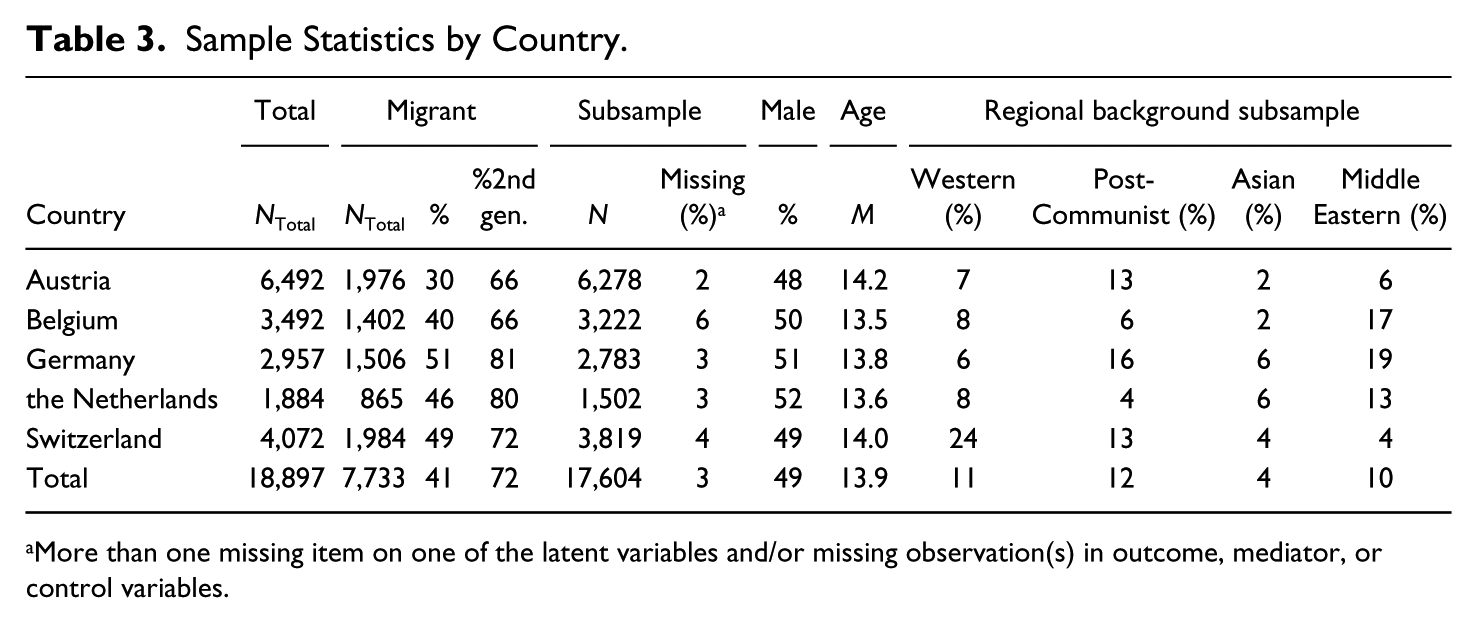
More than one missing item on one of the latent variables and/or missing observation(s) in outcome, mediator, or control variables.
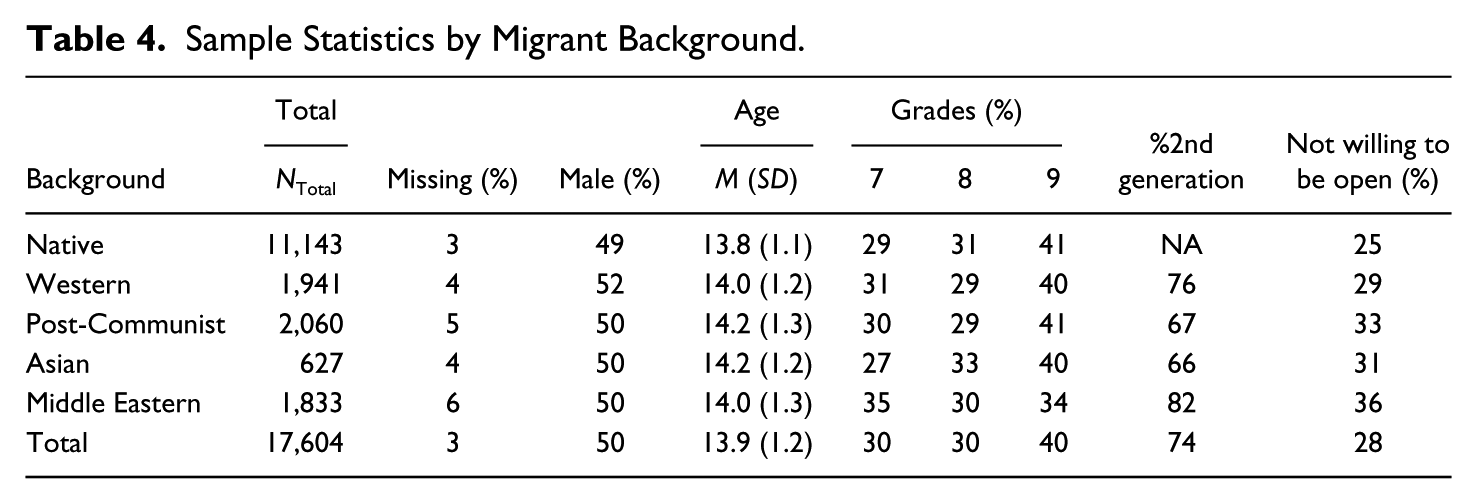
Native students and different migrant subgroups are largely comparable in terms of gender and age (see Table 4). The Middle Eastern and Western groups have most second-generation students, 82% and 76%, respectively. The Middle Eastern group has the highest percentage of missing observations (6%) which could possibly partly be explained by unwillingness to be open about sensitive questions (36%). Openness is therefore included as a control variable in the analysis.
Sample Statistics by Migrant Background.
Analytic Strategy
Given the multilevel structure of the data—students in classes—a first step was to consider the need for multilevel modeling by running an empty multilevel model. Intraclass correlation was rather small—.037 for serious offending—and a design effect 4 smaller than 2 indicated no need for multilevel modeling (Maas & Hox, 2005). It was therefore decided to not further complicate the analysis and proceed with a single-level mediation model.
Mplus 8 was used to run a logistic mediation analysis (estimator = MLR [maximum likelihood robust]) with serious offending declared as the categorical outcome variable, dominant language, background of friends’ parents, and the risk of low SES as the mediator variables, and neighborhood and school disorganization as the latent mediator variables. As suggested by indices for model improvement (nonlogistic), error terms of the SES risk score and school disorganization were allowed to correlate with the variable neighborhood disorganization which was considered appropriate as these variables reflected indicators of the same underlying construct. The analysis considered the relative direct and indirect effects of cultural alignment and structural influences on offending for students from different backgrounds compared with native-born students (Hayes & Preacher, 2014). First, a control model was run with all except control variables constrained to zero (M0), followed by a direct-effects model with only the direct effect of background on serious offending while accounting for gender, grade, openness, and country (M1). The next model tested the mediating influence of cultural alignment indicators—dominant language and background of friends’ parents—while keeping structural indicators constrained (M2). Then a structural influence model with the SES risk score, neighborhood disorganization, and school disorganization (M3) was tested while constraining cultural alignment indicators which was followed by a final model with all influences included (M4). Indirect effects were estimated through the MODEL CONSTRAINT command with Baron and Kenny’s (1986) formula for indirect effects: indirect effect = effect of independent variable on mediator variable (a) × effect of mediator on outcome (b). Significance of the mediation was estimated with the Sobel test (Baron & Kenny, 1986).
As Mood (2010) warned that unobserved variance in logistic regression could lead to flawed conclusions, principles of the KHB-method were applied to provide comparable measures of mediation that were less sensitive to unobserved variance (Karlson, Holm, & Breen, 2012, originally related to program in Stata, but here applied to results from Mplus). The decrease in the direct effect of subsequent models compared with the direct-effects model (M1) was calculated for each group (total decrease and %mediated). Then the contribution of each mediator in a specific model to this decrease in direct effect was considered, %contributed to decrease by each mediator in model 5 (total = 100%), as well as the proportion mediated by each mediator of the %mediated 6 (total = %mediated). Results of the mediation analysis in Mplus were more or less comparable to a mediation model with neighborhood and school disorganization as factor variables with the khb-command in Stata 14 SE and led to similar conclusions.
Results
Cultural Alignment and Structural Influences Across Groups
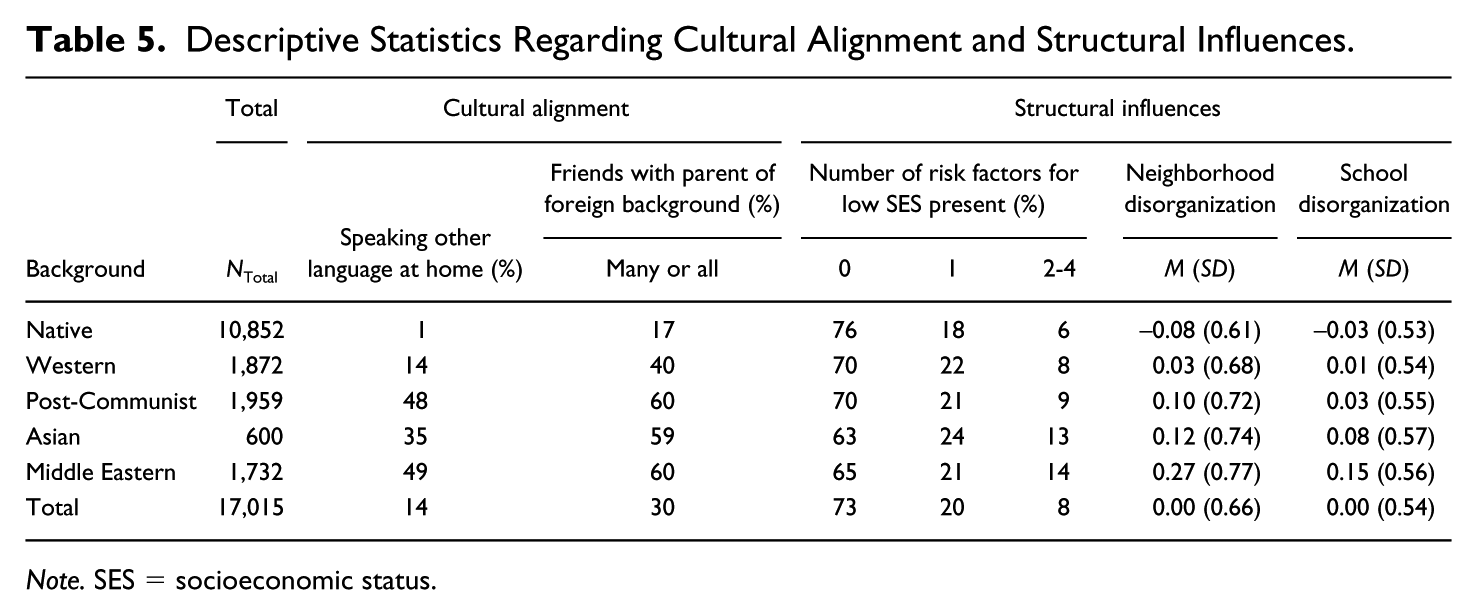
A first look at the indicators for cultural alignment and structural influences shows an interesting picture (see Table 5). Only few of the native students speak another language at home (1%) and most native students do not have a lot of friends with a migrant background (83% none or a few). In line with the first hypothesis on cultural alignment for each group (H1), the Western group is most similar to the native group with a relatively small proportion speaking another language at home (14%, about one in seven), but already a larger proportion having friends with a migrant background (40% many or all of their friends). Although expected to be more comparable to the Western and native groups, the Post-Communist group actually is more similar to students with a Middle Eastern or Asian background when it comes to language and friends. The Post-Communist, Middle Eastern, and Asian groups are comparable in terms of friends with a migrant background (friends’ parents’ background); 59% to 60% of these students report that many or all friends have foreign-born parents. Looking at the language spoken at home, particularly the Post-Communist and Middle Eastern groups stand out with 48% to 49% of these groups speaking another than the dominant language at home as opposed to about one third of the Asian group (35%). In contrast with H1, the Asian group thus showed somewhat higher levels of cultural alignment than the Post-Communist and Middle Eastern groups in terms of language.
Descriptive Statistics Regarding Cultural Alignment and Structural Influences.
Note. SES = socioeconomic status.
In terms of structural influences and risk of low SES (H2), largest differences between groups are visible for two to four risk factors: 6% of the native and 8% to 9% of the Western and Post-Communist groups report two or more risk factors. In line with the second hypothesis, percentages of multiple risk factors are more than twice as high as those for the Asian and Middle Eastern as for the native group, respectively, 13% and 14%. Also in support of the second hypothesis, a similar pattern is visible for neighborhood and school disorganization; the native group generally has the lowest mean score indicating on average the lowest level of disorganization and means are increasing for the migrant groups, with the highest means for students with a Middle Eastern background. These results are largely in support of H3 which stated that groups with lower levels of cultural alignment were expected to be exposed to higher levels of structural disadvantage. The only exception is the Post-Communist group which regarding cultural alignment is more similar to the Middle Eastern and Asian groups (lower levels of cultural alignment), but regarding structural disadvantage appears to be more similar to the Western group (relatively low experienced structural disadvantage).
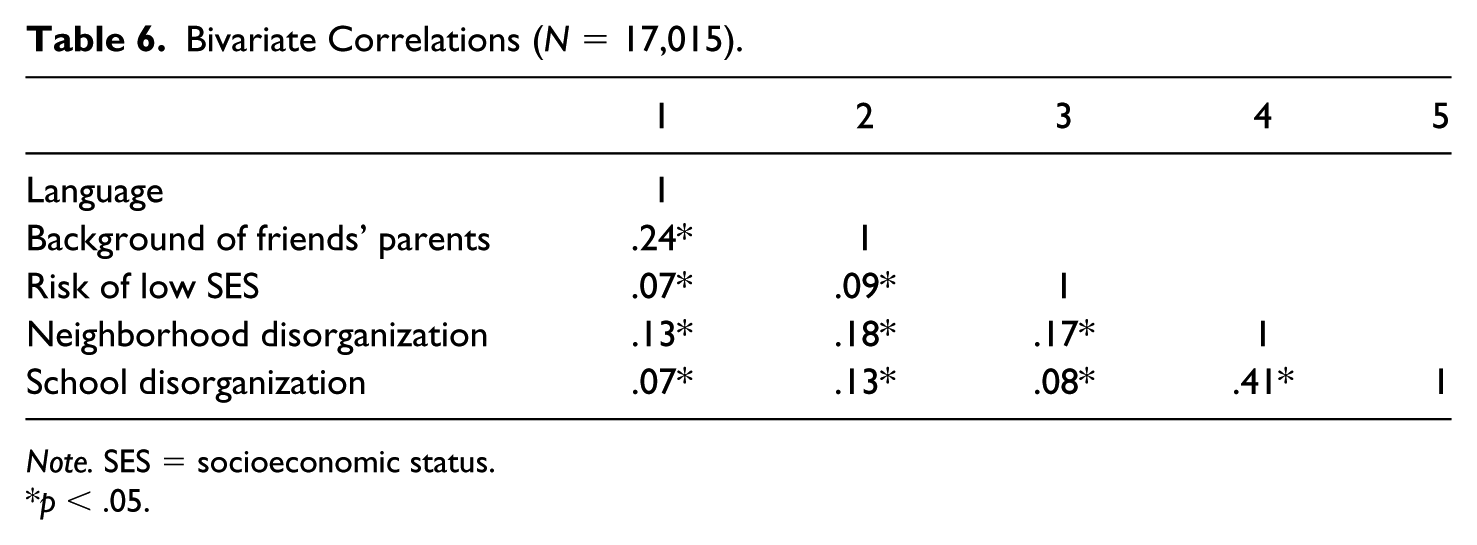
Pairwise correlations (see Table 6) show the highest correlations for neighborhood and school disorganization, two structural influence indicators (.41, p < .05). The two cultural alignment indicators—language and background of friends’ parents—show a slightly elevated correlation (.24, p < .05). The correlation between the SES risk score and neighborhood disorganization is lower than expected (.17, p < .05) which could possibly be explained by the fact that both variables may capture somewhat different groups. As such, the combination of the three structural indicators appears to best represent a broader range of structural influences and disadvantage than each of these factors alone could.
Bivariate Correlations (N = 17,015).
Note. SES = socioeconomic status.
p < .05.
Differences in Offending Between Migrant and Native Students
Following the fourth hypothesis on cultural alignment and offending (H4), one would expect Western students to be most comparable to the native group in terms of offending rates and other groups to show higher prevalence rates. Figure 2, however, shows a different picture. Overall, all migrant backgrounds have a higher prevalence of serious lifetime offending than the native group, but as opposed to the expectation the Western group has the highest prevalence rates of all groups. Differences are significant for Western, Post-Communist, and Middle Eastern (Tukey–Kramer, p < .001), but not for Asian (p = .14).
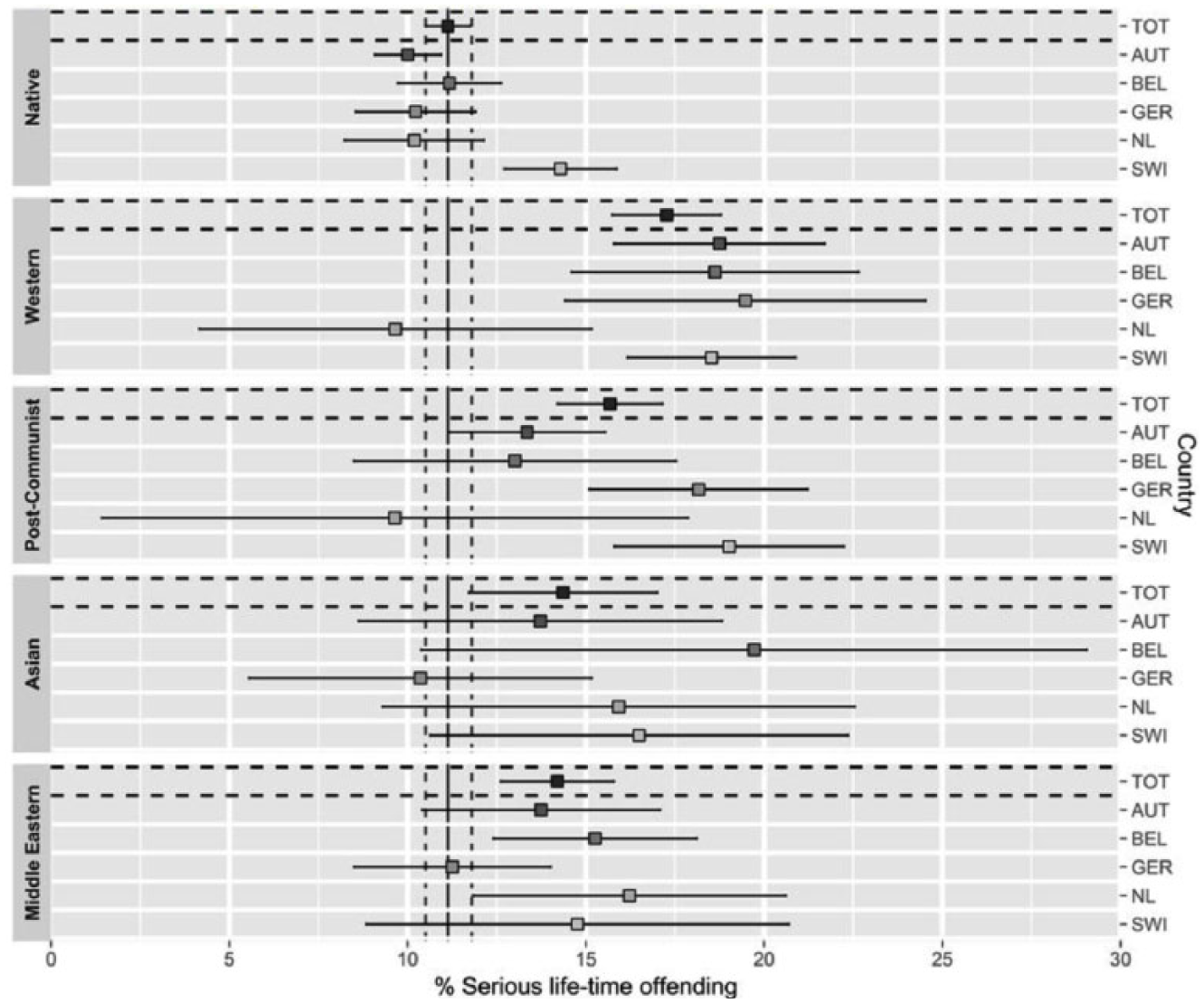
Marginal rates of serious offendinga overallb and per country.c
Looking at differences within individual countries, the Western group shows significantly higher rates of serious offending than the native group in four of the five countries (p < .05 for Austria, Belgium, Germany, and Switzerland). Only in the Netherlands, the Western and native groups are comparable in terms of offending. The Post-Communist group has significantly higher rates in two countries, Austria and Germany. Despite some higher rates in some countries—8.5% higher in Belgium and 5.7% higher in Germany—the Asian and native groups do not significantly differ which may partly due to smaller group sizes and larger confidence intervals for the Asian group. The same is true for the Middle Eastern group. However, for Belgium and the Netherlands, differences for this group are close to significant (p = .093 and p = .10, respectively).
Based on the previous results, the hypothesis of cultural alignment and offending (H4) is not supported as expected. In accordance with this hypothesis, overall prevalence rates of lifetime serious offending are significantly higher across all migrant groups compared with the native group, except for the Asian group which has comparable rates. For the Asian group, this finding is in agreement with previous research in the United States where Asians are often labeled a high-achieving migrant group with low crime rates (Portes & Rivas, 2011). In contrast with the expectations from the fourth hypothesis, however, the Western group which showed the highest level of cultural alignment also has the highest prevalence rate for serious offending, whereas differences are smaller for the Post-Communist and Middle Eastern groups. Despite this unexpected finding, most groups do have significantly higher prevalence rates and it is therefore interesting to examine to what extent these differences are mediated through cultural alignment and structural influence indicators for different groups.
Cultural Alignment and Structural Influences in Offending
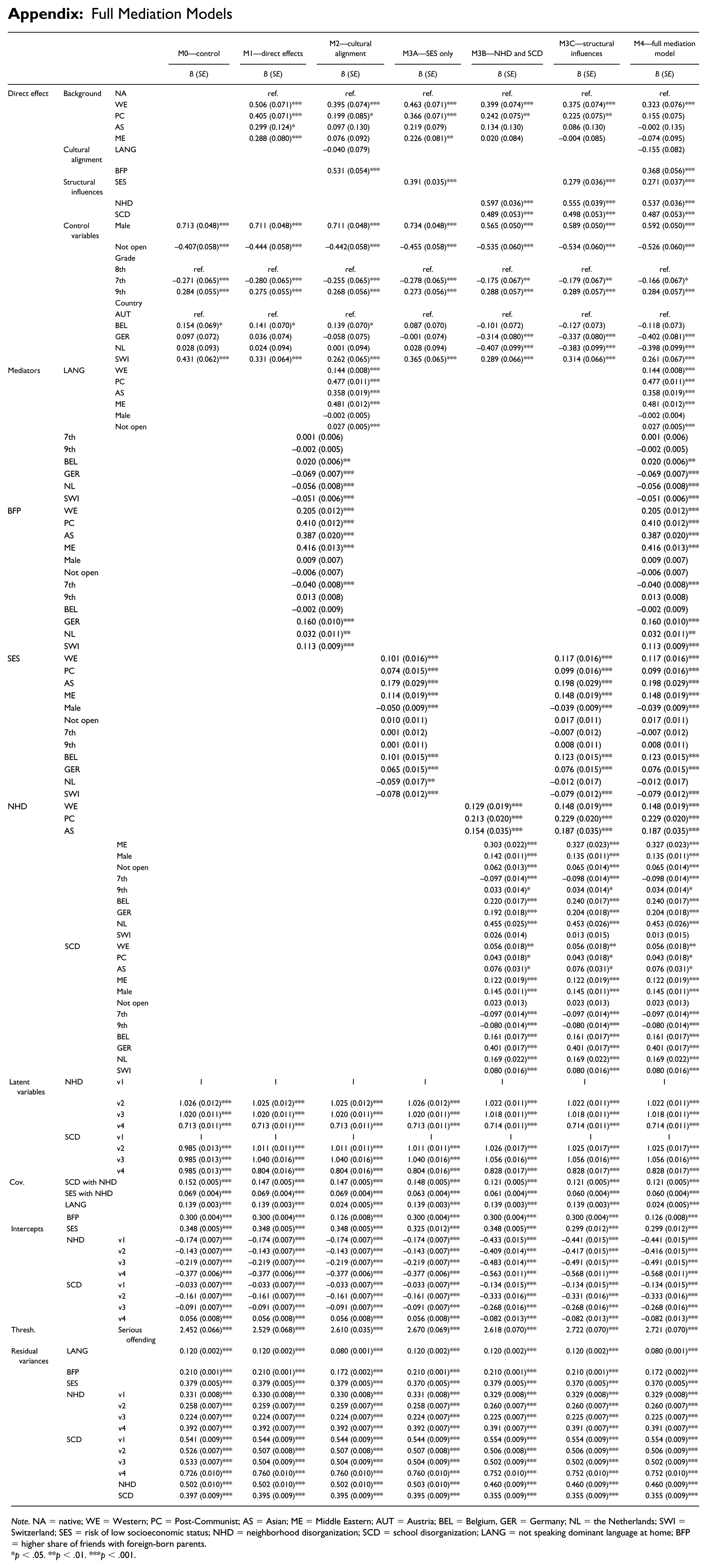
The direct-effects model (M1) with only direct effects for the four groups with the native group as reference—adjusted for control variables—shows a similar pattern as described in the previous section (see Appendix for full output of mediation models). 7 Direct influences of background on serious offending are largest for the Western and Post-Communist and somewhat smaller for the Asian and Middle Eastern groups (see Table 7). In contrast to previous results, direct effects are also significant for the Asian group which could have to do with the Tukey–Kramer test being more conservative in assessing significance.
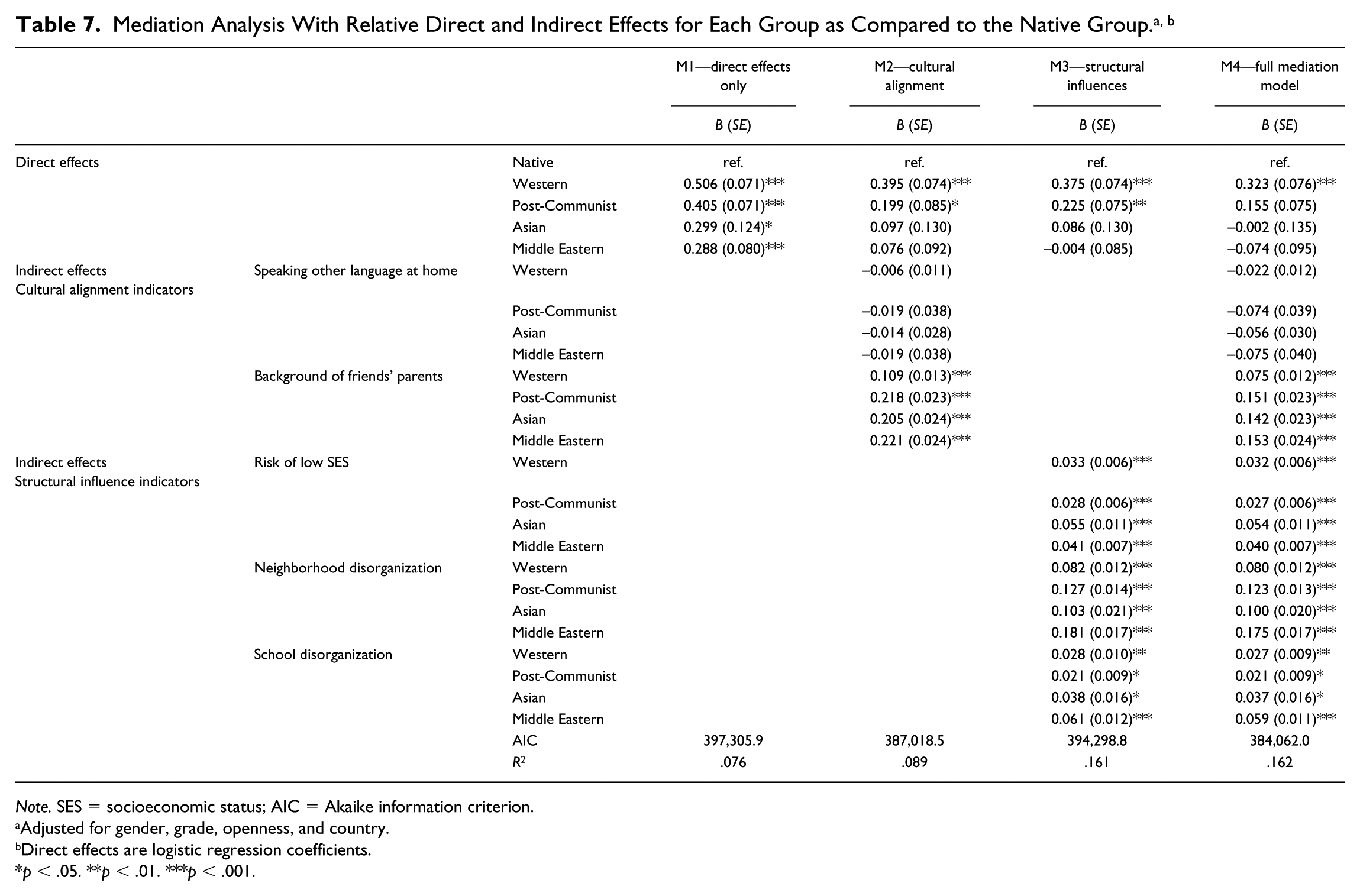
Note. SES = socioeconomic status; AIC = Akaike information criterion.
Adjusted for gender, grade, openness, and country.
Direct effects are logistic regression coefficients.
*p < .05. **p < .01. ***p < .001.
The second model, the cultural alignment model (M2), introduces the variables not speaking the dominant language at home and background of friends’ parents to examine whether these variables fully or partially mediate direct effects of migrant background on lifetime serious offending for the four groups; in other words, whether these influences could fully or partially explain the differences in offending between native students and different migrant groups (see Table 8, M2). The introduction of these cultural alignment variables generates a reduction in direct effect for all backgrounds which is largest for the Middle Eastern and Asian groups, that is, 74% and 68%, respectively. For both groups, direct effects of background on offending become insignificant. The decrease is substantial for the Post-Communist group (51%), but the direct effect remains significant. The decrease is smallest for Western students (21%). Not speaking the dominant language does not significantly influence serious offending for any group. A lower level of integration, indicated by the amount of friends having foreign-born parents, increases the probability of serious offending for all groups; this effect is comparable for the Post-Communist, Asian, and Middle Eastern groups and smaller for the Western group. Findings are in agreement with H5 that differences in lifetime serious offending between migrant and native students can partially be explained by the level of cultural alignment.
Relative Direct and Indirect Effects and Percentage Mediated by Group (Ref. = native; N = 17,015).a, b.
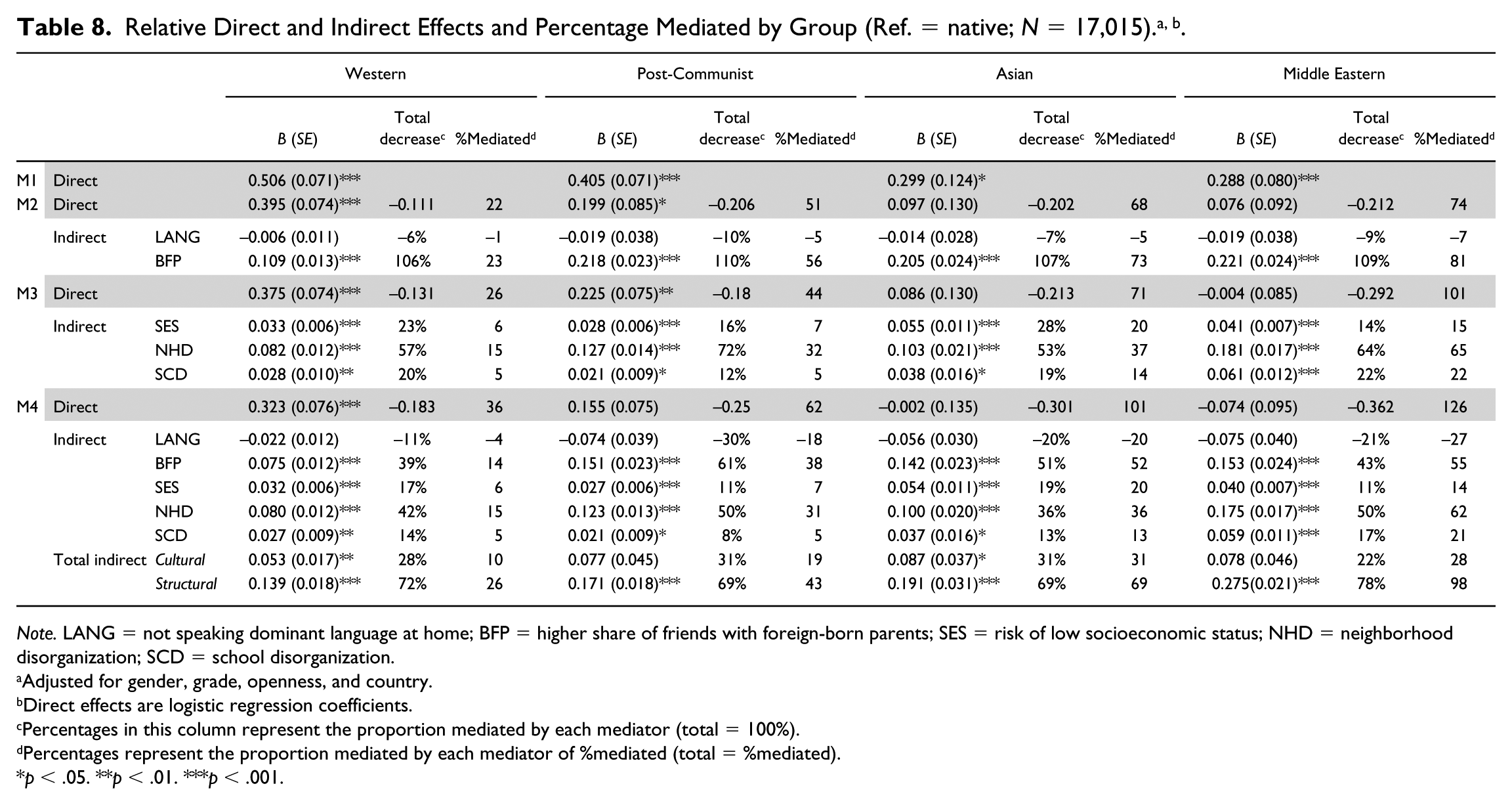
Note. LANG = not speaking dominant language at home; BFP = higher share of friends with foreign-born parents; SES = risk of low socioeconomic status; NHD = neighborhood disorganization; SCD = school disorganization.
Adjusted for gender, grade, openness, and country.
Direct effects are logistic regression coefficients.
Percentages in this column represent the proportion mediated by each mediator (total = 100%).
Percentages represent the proportion mediated by each mediator of %mediated (total = %mediated).
*p < .05. **p < .01. ***p < .001.
The next model, the structural influence model (M3), introduces the three structural influence variables, SES risk, neighborhood disorganization, and school disorganization, to find out to what extent these influences mediate or explain the difference in offending with natives (see Table 8, M3). The structural influence model produces a substantial decrease for the Middle Eastern group; the direct effect of background is for this group fully mediated (101% mediated), most of which by neighborhood disorganization (64%). For the other groups, the reduction is smaller and effects are only partially mediated; for the Asian group, structural influences explain about 71% of the difference in offending with natives, for the Post-Communist 44%, and for the Western group 26%. Also for these groups, neighborhood disorganization explains most of the difference in offending with the native group. For Asian and Western students, in particular, SES risk appears to have a more profound mediating influence on serious offending than for the other groups (28% and 23% of the total decrease vs. 16% and 14% for Post-Communist and Middle Eastern, respectively).
Comparing the separate cultural alignment and structural influence models (M2 and M3), structural disadvantage as presented in the structural influence model appears to explain more of the difference in offending between native and most migrant groups than cultural alignment as reflected by higher percentages mediated (see Table 8, M2 and M3). Except for the Post-Communist group, this finding appears to be largely in agreement with the H6, but differences between the two models are relatively small for the Asian and Western groups. For the Post-Communist group, the cultural alignment model appears to explain more of the difference in offending with native students than structural disadvantage. This hypothesis, however, can only be truly tested by combining all cultural alignment—not speaking dominant language at home and background of friends’ parents—and structural influence indicators—SES risk, neighborhood disorganization, and school disorganization—into one model (M4). The analysis shows that 70% to 80% of the difference in offending between native and different migrant groups can be explained by living in more structural disadvantage. These proportions mediated are rather comparable across groups. It should be noted that when considering separate indicators the cultural alignment indicator with the most influence—having a larger share of migrant friends—for both the Asian and the Post-Communist groups mediates a larger part of the direct effect than the structural indicator with the largest mediating influence, neighborhood disorganization. Given that both the cultural alignment and structural indicators were carefully selected to reflect these constructs, comparing total percentages for cultural alignment and structural influences seemed justified.
Differences become only clearly visible when considering the total percentage mediated (see Table 8, total indirect). In line with H6, structural disadvantage fully mediates the influence of background on lifetime serious offending for the Middle Eastern group (98%), the group that reported the lowest cultural alignment. Also as expected, the underlying mechanisms related to less cultural alignment or more structural disadvantage only explain a small part of the difference in offending between the native and Western groups (combined 36% mediated). As such, the relatively high rates of offending in the Western group as compared to natives cannot satisfactorily be explained by either model. Somewhat in agreement with expectations, for the Asian group most of the difference in offending with the native group is mediated by living in more disadvantaged situations (69%), but full mediation is only established when also accounting for lower levels of cultural alignment and related underlying mechanisms such as possibly acculturation conflict (31%, total mediated = 101%). Although comparable in terms of cultural alignment to the Middle Eastern and to some extent to the Asian group, for the Post-Communist group a relatively small proportion of the influence of background on offending is mediated through cultural alignment and structural influence indicators (62%). The underlying mechanisms in cultural alignment and structural disadvantage only partially help explain differences in offending with the native group. Just as for the Asian group, cultural alignment mechanisms also appear to be more explanatory than for the Middle Eastern group as these mechanisms explain about one third of the mediated effect (31%).
Conclusion and Discussion
Many Western countries currently experience heated public debates about immigration. Presumed links between immigration and rising crime rates, in the criminological literature defined as the crime–immigration nexus, represent a prominent topic in these debates. Undeniably, young people with a migrant background are often overrepresented in crime statistics (Junger-Tas et al., 2010). This study used data from the ISRD3 study to evaluate differences in offending between native and migrant students in five Western European countries. The main aim was to examine to what extent the underlying mechanisms related to cultural alignment or resemblance between host and heritage culture and structural influences, such as neighborhood and school disadvantage, mediated differences in self-reported serious lifetime offending between native students and migrant students from four different regional backgrounds.
A first conclusion of this study is in line with previous research on the crime–immigration nexus in relation to first- and second-generation children of immigrants; higher prevalence rates of serious lifetime offending were found across all migrant groups compared with native-born students. More cultural alignment or resemblance, despite making adaptation to the country of residence easier however, did not automatically equal lower offending rates. The Western group which showed most cultural resemblance to the native group also had the highest offending rates of all groups, whereas rates were somewhat lower for the other groups with less cultural resemblance. One possible explanation for relatively lower rates of the Middle Eastern, Asian, and Post-Communist groups as compared to the Western group could be slightly—these groups still did have higher or comparable rates, not lower rates than native students—protective cultural parental influences of first-generation parents against delinquent development as found in previous research in Mexican American families in the United States (e.g., Marsiglia et al., 2014). The fact that not speaking the dominant language at home in the mediation analysis appears to have a protective influence—close to significant across all groups in the final model with all cultural alignment and structural influences included—could be an indication, but such an explanation would require further research with third- and fourth-generation migrant students.
Second, the mediation analysis in this study provided mixed results regarding mediating influences of cultural alignment and structural influence indicators and the related underlying mechanisms. For the Middle Eastern group with on average the lowest level of cultural alignment and the highest level of structural disadvantage, mechanisms related to structural disadvantage indeed appeared to be a more important mechanism in explaining differences in offending with natives than less cultural resemblance which is in line with the structuralist perspective that a poorer socioeconomic starting position and related exposure to risks associated with offending is more determining than cultural background in offending rates. For the Western group, despite relatively high offending rates, mechanisms related to cultural alignment and structural disadvantage only explained a small proportion of the difference in offending. Although the relatively high offending rates for this group were unexpected, results from the analysis were as expected and in line with both culturalist and structuralist perspectives given that the Western group was more comparable to the native group in terms of culture and (lower levels of) social disadvantage. Further research, however, would be needed to examine other mechanisms, such as parenting practices or other cultural or structural dimensions that were not part of this study, that could explain these relatively high rates. For the other two groups, Asian and Post-Communist, despite on average showing lower levels of cultural alignment than the native group, differences in offending with native students could not only be explained by structural disadvantage. These differences appear to be mediated by mechanisms associated with both cultural alignment, for instance, related to acculturation and increased probability of parent–child conflict, and structural disadvantage. Nevertheless, also for these groups, structural disadvantage explains most of the difference in offending with native students. Similar to the Western group, not all differences in offending could be explained by these two mechanisms for the Post-Communist group.
Some limitations ought to be mentioned. First, this article used indirect rather than direct measures of cultural alignment or resemblance and related mechanisms. More direct measures might have improved the explanatory value of this study and it is possible that more precise measures would have produced somewhat different outcomes as the three measures representing structural influences may have captured less measurement error than the two dichotomous measures reflecting cultural alignment. Unfortunately, such measures were not included in ISRD3. Selected measures for cultural alignment were in line with the academic literature and were the best available options for such an analysis with this valuable and unique dataset. For future research, it would be interesting to include multiple-item scales, for instance, related to cultural values, alignment, or acculturation to better grasp the influence of individual variation within and across groups. Second, a common problem in this type of research is that migrant groups are often overrepresented in more disadvantaged neighborhoods which could complicate disentangling cultural alignment and structural influences on offending. Pairwise correlations did not give rise to concern in general or for specific groups and structural influences were strictly selected to represent disorganization and disadvantage to reduce chances of capturing cultural rather than structural influences. Although issues with overrepresentation of certain migrant groups in more disadvantaged areas cannot be ruled out completely, the analysis offered some valuable insights in differences across groups.
Despite these limitations, the analysis suggests that poorer socioeconomic starting position and related exposure to concentrated disadvantage for some migrant subgroups may have more influence on delinquent development than their cultural background. Even for groups for which cultural alignment appears to be a factor, it is not culture of immigrants per se that is associated with delinquent development—in fact, previous research shows that culture of origin could be protective against delinquent development—but actually processes involved in the adaptation to the host country that may be mechanisms in delinquent development. Blaming immigration and culture for higher crime rates, as often done in public debate, as such prevents societies from taking responsibility for more structural social disadvantage and facilitating processes of integration that appear to be actually underlying mechanisms in offending.
Footnotes
Appendix: Full Mediation Models
| M0—control | M1—direct effects | M2—cultural alignment | M3A—SES only | M3B—NHD and SCD | M3C—structural influences | M4—full mediation model | |||
|---|---|---|---|---|---|---|---|---|---|
| B (SE) | B (SE) | B (SE) | B (SE) | B (SE) | B (SE) | B (SE) | |||
| Direct effect | Background | NA | ref. | ref. | ref. | ref. | ref. | ref. | |
| WE |
|
|
|
|
|
|
|||
| PC |
|
|
|
|
|
0.155 (0.075) | |||
| AS |
|
0.097 (0.130) | 0.219 (0.079) | 0.134 (0.130) | 0.086 (0.130) | –0.002 (0.135) | |||
| ME |
|
0.076 (0.092) |
|
0.020 (0.084) | –0.004 (0.085) | –0.074 (0.095) | |||
| Cultural alignment | LANG | –0.040 (0.079) | –0.155 (0.082) | ||||||
| BFP |
|
|
|||||||
| Structural influences | SES |
|
|
|
|||||
| NHD |
|
|
|
||||||
| SCD |
|
|
|
||||||
| Control variables | Male | 0.713 (0.048)*** | 0.711 (0.048)*** | 0.711 (0.048)*** | 0.734 (0.048)*** | 0.565 (0.050)*** | 0.589 (0.050)*** | 0.592 (0.050)*** | |
| Not open | –0.407(0.058)*** | –0.444 (0.058)*** | –0.442(0.058)*** | –0.455 (0.058)*** | –0.535 (0.060)*** | –0.534 (0.060)*** | –0.526 (0.060)*** | ||
| Grade | |||||||||
| 8th | ref. | ref. | ref. | ref. | ref. | ref. | ref. | ||
| 7th | –0.271 (0.065)*** | –0.280 (0.065)*** | –0.255 (0.065)*** | –0.278 (0.065)*** | –0.175 (0.067)** | –0.179 (0.067)** | –0.166 (0.067)* | ||
| 9th | 0.284 (0.055)*** | 0.275 (0.055)*** | 0.268 (0.056)*** | 0.273 (0.056)*** | 0.288 (0.057)*** | 0.289 (0.057)*** | 0.284 (0.057)*** | ||
| Country | |||||||||
| AUT | ref. | ref. | ref. | ref. | ref. | ref. | ref. | ||
| BEL | 0.154 (0.069)* | 0.141 (0.070)* | 0.139 (0.070)* | 0.087 (0.070) | –0.101 (0.072) | –0.127 (0.073) | –0.118 (0.073) | ||
| GER | 0.097 (0.072) | 0.036 (0.074) | –0.058 (0.075) | –0.001 (0.074) | –0.314 (0.080)*** | –0.337 (0.080)*** | –0.402 (0.081)*** | ||
| NL | 0.028 (0.093) | 0.024 (0.094) | 0.001 (0.094) | 0.028 (0.094) | –0.407 (0.099)*** | –0.383 (0.099)*** | –0.398 (0.099)*** | ||
| SWI | 0.431 (0.062)*** | 0.331 (0.064)*** | 0.262 (0.065)*** | 0.365 (0.065)*** | 0.289 (0.066)*** | 0.314 (0.066)*** | 0.261 (0.067)*** | ||
| Mediators | LANG | WE |
|
|
|||||
| PC |
|
|
|||||||
| AS |
|
|
|||||||
| ME |
|
|
|||||||
| Male | –0.002 (0.005) | –0.002 (0.004) | |||||||
| Not open | 0.027 (0.005)*** | 0.027 (0.005)*** | |||||||
| 7th | 0.001 (0.006) | 0.001 (0.006) | |||||||
| 9th | –0.002 (0.005) | –0.002 (0.005) | |||||||
| BEL | 0.020 (0.006)** | 0.020 (0.006)** | |||||||
| GER | –0.069 (0.007)*** | –0.069 (0.007)*** | |||||||
| NL | –0.056 (0.008)*** | –0.056 (0.008)*** | |||||||
| SWI | –0.051 (0.006)*** | –0.051 (0.006)*** | |||||||
| BFP | WE |
|
|
||||||
| PC |
|
|
|||||||
| AS |
|
|
|||||||
| ME |
|
|
|||||||
| Male | 0.009 (0.007) | 0.009 (0.007) | |||||||
| Not open | –0.006 (0.007) | –0.006 (0.007) | |||||||
| 7th | –0.040 (0.008)*** | –0.040 (0.008)*** | |||||||
| 9th | 0.013 (0.008) | 0.013 (0.008) | |||||||
| BEL | –0.002 (0.009) | –0.002 (0.009) | |||||||
| GER | 0.160 (0.010)*** | 0.160 (0.010)*** | |||||||
| NL | 0.032 (0.011)** | 0.032 (0.011)** | |||||||
| SWI | 0.113 (0.009)*** | 0.113 (0.009)*** | |||||||
| SES | WE |
|
|
|
|||||
| PC |
|
|
|
||||||
| AS |
|
|
|
||||||
| ME |
|
|
|
||||||
| Male | –0.050 (0.009)*** | –0.039 (0.009)*** | –0.039 (0.009)*** | ||||||
| Not open | 0.010 (0.011) | 0.017 (0.011) | 0.017 (0.011) | ||||||
| 7th | 0.001 (0.012) | –0.007 (0.012) | –0.007 (0.012) | ||||||
| 9th | 0.001 (0.011) | 0.008 (0.011) | 0.008 (0.011) | ||||||
| BEL | 0.101 (0.015)*** | 0.123 (0.015)*** | 0.123 (0.015)*** | ||||||
| GER | 0.065 (0.015)*** | 0.076 (0.015)*** | 0.076 (0.015)*** | ||||||
| NL | –0.059 (0.017)** | –0.012 (0.017) | –0.012 (0.017) | ||||||
| SWI | –0.078 (0.012)*** | –0.079 (0.012)*** | –0.079 (0.012)*** | ||||||
| NHD | WE |
|
|
|
|||||
| PC |
|
|
|
||||||
| AS |
|
|
|
||||||
| ME |
|
|
|
||||||
| Male | 0.142 (0.011)*** | 0.135 (0.011)*** | 0.135 (0.011)*** | ||||||
| Not open | 0.062 (0.013)*** | 0.065 (0.014)*** | 0.065 (0.014)*** | ||||||
| 7th | –0.097 (0.014)*** | –0.098 (0.014)*** | –0.098 (0.014)*** | ||||||
| 9th | 0.033 (0.014)* | 0.034 (0.014)* | 0.034 (0.014)* | ||||||
| BEL | 0.220 (0.017) |
0.240 (0.017) |
0.240 (0.017) |
||||||
| GER | 0.192 (0.018)*** | 0.204 (0.018)*** | 0.204 (0.018)*** | ||||||
| NL | 0.455 (0.025)*** | 0.453 (0.026)*** | 0.453 (0.026)*** | ||||||
| SWI | 0.026 (0.014) | 0.013 (0.015) | 0.013 (0.015) | ||||||
| SCD | WE |
|
|
|
|||||
| PC |
|
|
|
||||||
| AS |
|
|
|
||||||
| ME |
|
|
|
||||||
| Male | 0.145 (0.011)*** | 0.145 (0.011)*** | 0.145 (0.011)*** | ||||||
| Not open | 0.023 (0.013) | 0.023 (0.013) | 0.023 (0.013) | ||||||
| 7th | –0.097 (0.014)*** | –0.097 (0.014)*** | –0.097 (0.014)*** | ||||||
| 9th | –0.080 (0.014)*** | –0.080 (0.014)*** | –0.080 (0.014)*** | ||||||
| BEL | 0.161 (0.017)*** | 0.161 (0.017)*** | 0.161 (0.017)*** | ||||||
| GER | 0.401 (0.017)*** | 0.401 (0.017)*** | 0.401 (0.017)*** | ||||||
| NL | 0.169 (0.022)*** | 0.169 (0.022)*** | 0.169 (0.022)*** | ||||||
| SWI | 0.080 (0.016)*** | 0.080 (0.016)*** | 0.080 (0.016)*** | ||||||
| Latent variables | NHD | v1 | 1 | 1 | 1 | 1 | 1 | 1 | 1 |
| v2 | 1.026 (0.012)*** | 1.025 (0.012)*** | 1.025 (0.012)*** | 1.026 (0.012)*** | 1.022 (0.011)*** | 1.022 (0.011)*** | 1.022 (0.011)*** | ||
| v3 | 1.020 (0.011)*** | 1.020 (0.011)*** | 1.020 (0.011)*** | 1.020 (0.011)*** | 1.018 (0.011)*** | 1.018 (0.011)*** | 1.018 (0.011)*** | ||
| v4 | 0.713 (0.011)*** | 0.713 (0.011)*** | 0.713 (0.011)*** | 0.713 (0.011)*** | 0.714 (0.011)*** | 0.714 (0.011)*** | 0.714 (0.011)*** | ||
| SCD | v1 | 1 | 1 | 1 | 1 | 1 | 1 | 1 | |
| v2 | 0.985 (0.013)*** | 1.011 (0.011)*** | 1.011 (0.011)*** | 1.011 (0.011)*** | 1.026 (0.017)*** | 1.025 (0.017)*** | 1.025 (0.017)*** | ||
| v3 | 0.985 (0.013)*** | 1.040 (0.016)*** | 1.040 (0.016)*** | 1.040 (0.016)*** | 1.056 (0.016)*** | 1.056 (0.016)*** | 1.056 (0.016)*** | ||
| v4 | 0.985 (0.013)*** | 0.804 (0.016)*** | 0.804 (0.016)*** | 0.804 (0.016)*** | 0.828 (0.017)*** | 0.828 (0.017)*** | 0.828 (0.017)*** | ||
| Cov. | SCD with NHD | 0.152 (0.005)*** | 0.147 (0.005)*** | 0.147 (0.005)*** | 0.148 (0.005)*** | 0.121 (0.005)*** | 0.121 (0.005)*** | 0.121 (0.005)*** | |
| SES with NHD | 0.069 (0.004)*** | 0.069 (0.004)*** | 0.069 (0.004)*** | 0.063 (0.004)*** | 0.061 (0.004)*** | 0.060 (0.004)*** | 0.060 (0.004)*** | ||
| LANG | 0.139 (0.003)*** | 0.139 (0.003)*** | 0.024 (0.005)*** | 0.139 (0.003)*** | 0.139 (0.003)*** | 0.139 (0.003)*** | 0.024 (0.005)*** | ||
| BFP | 0.300 (0.004)*** | 0.300 (0.004)*** | 0.126 (0.008)*** | 0.300 (0.004)*** | 0.300 (0.004)*** | 0.300 (0.004)*** | 0.126 (0.008)*** | ||
| Intercepts | SES | 0.348 (0.005)*** | 0.348 (0.005)*** | 0.348 (0.005)*** | 0.325 (0.012)*** | 0.348 (0.005)*** | 0.299 (0.012)*** | 0.299 (0.012)*** | |
| NHD | v1 | –0.174 (0.007)*** | –0.174 (0.007)*** | –0.174 (0.007)*** | –0.174 (0.007)*** | –0.433 (0.015)*** | –0.441 (0.015)*** | –0.441 (0.015)*** | |
| v2 | –0.143 (0.007)*** | –0.143 (0.007)*** | –0.143 (0.007)*** | –0.143 (0.007)*** | –0.409 (0.014)*** | –0.417 (0.015)*** | –0.416 (0.015)*** | ||
| v3 | –0.219 (0.007)*** | –0.219 (0.007)*** | –0.219 (0.007)*** | –0.219 (0.007)*** | –0.483 (0.014)*** | –0.491 (0.015)*** | –0.491 (0.015)*** | ||
| v4 | –0.377 (0.006)*** | –0.377 (0.006)*** | –0.377 (0.006)*** | –0.377 (0.006)*** | –0.563 (0.011)*** | –0.568 (0.011)*** | –0.568 (0.011)*** | ||
| SCD | v1 | –0.033 (0.007)*** | –0.033 (0.007)*** | –0.033 (0.007)*** | –0.033 (0.007)*** | –0.134 (0.015)*** | –0.134 (0.015)*** | –0.134 (0.015)*** | |
| v2 | –0.161 (0.007)*** | –0.161 (0.007)*** | –0.161 (0.007)*** | –0.161 (0.007)*** | –0.333 (0.016)*** | –0.331 (0.016)*** | –0.333 (0.016)*** | ||
| v3 | –0.091 (0.007)*** | –0.091 (0.007)*** | –0.091 (0.007)*** | –0.091 (0.007)*** | –0.268 (0.016)*** | –0.268 (0.016)*** | –0.268 (0.016)*** | ||
| v4 | 0.056 (0.008)*** | 0.056 (0.008)*** | 0.056 (0.008)*** | 0.056 (0.008)*** | –0.082 (0.013)*** | –0.082 (0.013)*** | –0.082 (0.013)*** | ||
| Thresh. | Serious offending | 2.452 (0.066)*** | 2.529 (0.068)*** | 2.610 (0.035)*** | 2.670 (0.069)*** | 2.618 (0.070)*** | 2.722 (0.070)*** | 2.721 (0.070)*** | |
| Residual variances | LANG | 0.120 (0.002)*** | 0.120 (0.002)*** | 0.080 (0.001)*** | 0.120 (0.002)*** | 0.120 (0.002)*** | 0.120 (0.002)*** | 0.080 (0.001)*** | |
| BFP | 0.210 (0.001)*** | 0.210 (0.001)*** | 0.172 (0.002)*** | 0.210 (0.001)*** | 0.210 (0.001)*** | 0.210 (0.001)*** | 0.172 (0.002)*** | ||
| SES | 0.379 (0.005)*** | 0.379 (0.005)*** | 0.379 (0.005)*** | 0.370 (0.005)*** | 0.379 (0.005)*** | 0.370 (0.005)*** | 0.370 (0.005)*** | ||
| NHD | v1 | 0.331 (0.008)*** | 0.330 (0.008)*** | 0.330 (0.008)*** | 0.331 (0.008)*** | 0.329 (0.008)*** | 0.329 (0.008)*** | 0.329 (0.008)*** | |
| v2 | 0.258 (0.007)*** | 0.259 (0.007)*** | 0.259 (0.007)*** | 0.258 (0.007)*** | 0.260 (0.007)*** | 0.260 (0.007)*** | 0.260 (0.007)*** | ||
| v3 | 0.224 (0.007)*** | 0.224 (0.007)*** | 0.224 (0.007)*** | 0.224 (0.007)*** | 0.225 (0.007)*** | 0.225 (0.007)*** | 0.225 (0.007)*** | ||
| v4 | 0.392 (0.007)*** | 0.392 (0.007)*** | 0.392 (0.007)*** | 0.392 (0.007)*** | 0.391 (0.007)*** | 0.391 (0.007)*** | 0.391 (0.007)*** | ||
| SCD | v1 | 0.541 (0.009)*** | 0.544 (0.009)*** | 0.544 (0.009)*** | 0.544 (0.009)*** | 0.554 (0.009)*** | 0.554 (0.009)*** | 0.554 (0.009)*** | |
| v2 | 0.526 (0.007)*** | 0.507 (0.008)*** | 0.507 (0.008)*** | 0.507 (0.008)*** | 0.506 (0.008)*** | 0.506 (0.009)*** | 0.506 (0.009)*** | ||
| v3 | 0.533 (0.007)*** | 0.504 (0.009)*** | 0.504 (0.009)*** | 0.504 (0.009)*** | 0.502 (0.009)*** | 0.502 (0.009)*** | 0.502 (0.009)*** | ||
| v4 | 0.726 (0.010)*** | 0.760 (0.010)*** | 0.760 (0.010)*** | 0.760 (0.010)*** | 0.752 (0.010)*** | 0.752 (0.010)*** | 0.752 (0.010)*** | ||
| NHD | 0.502 (0.010)*** | 0.502 (0.010)*** | 0.502 (0.010)*** | 0.503 (0.010)*** | 0.460 (0.009)*** | 0.460 (0.009)*** | 0.460 (0.009)*** | ||
| SCD | 0.397 (0.009)*** | 0.395 (0.009)*** | 0.395 (0.009)*** | 0.395 (0.009)*** | 0.355 (0.009)*** | 0.355 (0.009)*** | 0.355 (0.009)*** | ||
Note. NA = native; WE = Western; PC = Post-Communist; AS = Asian; ME = Middle Eastern; AUT = Austria; BEL = Belgium, GER = Germany; NL = the Netherlands; SWI = Switzerland; SES = risk of low socioeconomic status; NHD = neighborhood disorganization; SCD = school disorganization; LANG = not speaking dominant language at home; BFP = higher share of friends with foreign-born parents.
*p < .05. **p < .01. ***p < .001.
Acknowledgements
I would like to thank Claire Aussems for our discussions on methodology and Majone Steketee for her feedback on early drafts of this article. I would also like to thank the reviewers and guest editors for their helpful comments.
Declaration of Conflicting Interests
The author(s) declared no potential conflicts of interest with respect to the research, authorship, and/or publication of this article.
Funding
The author(s) disclosed receipt of the following financial support for the research, authorship, and/or publication of this article: In the Netherlands, ISRD3 was funded by the Netherlands Organisation for Scientific Research (NWO 464-13-115) under an Open Research Area grant.